
PART 2
The heartbeat stopped when the technician turned off the machine.
Not the baby’s heartbeat.
The sound of it.
One moment the room was filled with that quick, astonishing rhythm, and the next there was only the quiet hum of the ultrasound equipment and the soft rustle of paper beneath me.
I wiped my cheeks before the technician could offer another tissue.
“Everything looks good,” she said gently.
“The measurements are right where we’d expect.”
I nodded.
Those were the only words I cared about.
Everything looks good.
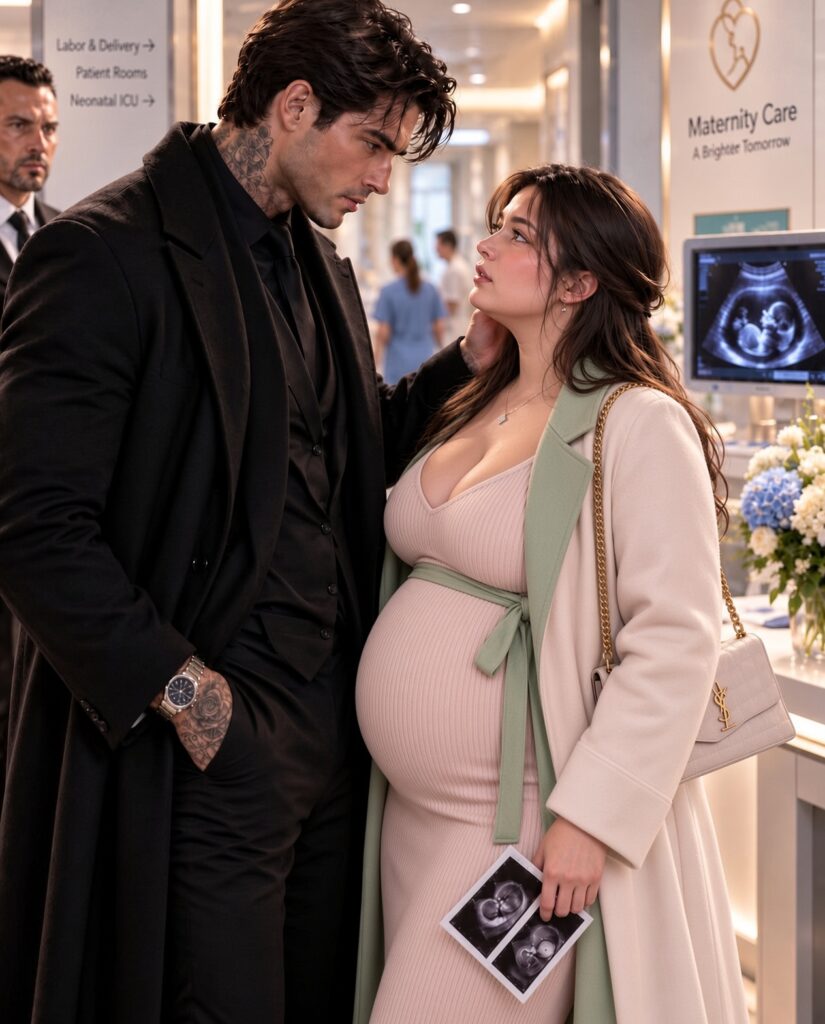
She printed several images and placed them in a white envelope.
I held it with both hands.
The photograph inside was grainy and gray, almost impossible to understand unless someone pointed out where to look.
But I understood it.
That tiny curve was a spine.
Those were legs.
That was my child.
“Would you like a few minutes?” she asked.
“Yes.
Please.”
The door closed behind her.
For a little while, I sat in the dim room with my coat still open and one hand resting below my stomach.
Then I remembered Adrian standing in the hallway.
Listening.
I didn’t know whether he was still there.
Part of me hoped he had left.
Another part—the part I resented—wondered what his face had looked like when he heard the heartbeat.
I dressed slowly.
When I finally opened the door, the hallway was empty.
Relief came first.
Disappointment arrived immediately afterward.
I hated them both.
Then I saw Marco standing near the elevators.
He straightened when he noticed me.
“Claire.”
“Where is he?”
Marco glanced toward the windows at the far end of the corridor.
Adrian stood there with his back to us.
For a man who seemed incapable of uncertainty, he looked strangely lost.
“He didn’t want to be standing outside the room when you came out,” Marco said.
“That sounds unusually considerate.”
Marco’s mouth shifted, but he didn’t smile.
“He’s learning.”
“Two months late.”
“Yes.”
The answer surprised me.
Marco had been Adrian’s closest friend since college and his chief operating officer for almost ten years.
During my marriage, I had sometimes suspected Marco would defend Adrian against a hurricane.
But he only looked tired.
“He asked me to tell you he won’t follow you,” Marco said.
“He also asked me to give you this.”
He held out a card.
There was no Moretti Capital logo.
No embossed office address.
Just Adrian’s name and a phone number written beneath it in black ink.
“That’s his private number,” Marco said.
“I deleted the old one.”
“I know.”
Of course Adrian knew.
“He said you can use it if you need his medical history.
Or anything else concerning the pregnancy.”
“Did he say anything about being the father?”
Marco hesitated.
“He said that is your conversation, not mine.”
I slipped the card into my pocket.
“I may never call.”
“He knows.”
“And he’s not sending lawyers?”
Marco looked almost offended.
“No.”
“Investigators?”
“No.”
“People to confirm where I live?”
“He already knows where you live.”
My eyes narrowed.
Marco immediately lifted one hand.
“From the divorce paperwork, Claire.
Not because anyone followed you.”
I let out the breath I had been holding.
“Right.”
“For what it’s worth,” he said quietly, “he told everyone this morning that nobody is to contact you unless you contact him first.”
Everyone.
In Adrian’s world, that word probably included lawyers, assistants, family members, drivers, security, and half the people on the twenty-seventh floor of Moretti Capital.
I should have felt reassured.
Instead, I felt sad.
Because respecting a boundary should not have seemed like evidence of transformation.
It should have been ordinary.
I looked down the corridor.
Adrian had not moved.
“Why is Vanessa here?”
Marco’s face changed.
Only slightly.
But I knew him well enough to see it.
“That’s another conversation.”
“With whom?”
“Adrian.”
“I’m not asking Adrian.”
“Then I probably shouldn’t answer.”
I gave him a humorless smile.
“Still loyal.”
“To both of you, actually.”
“That must be inconvenient.”
“You have no idea.”
The elevator arrived.
I stepped inside.
Just before the doors closed, Adrian turned.
Our eyes met across the corridor.
He didn’t approach.
He didn’t call my name.
He simply stood there while the doors slid shut between us.
For some reason, that restraint unsettled me more than pursuit would have.
I did not call Adrian.
Not that day.
Not the next.
For eleven days, his handwritten card remained in the small ceramic bowl beside my front door, buried under subway receipts and spare keys.
My life returned to its new routine.
I worked three days a week from a consulting firm in Dumbo, where nobody had known me as Mrs.
Moretti first and Claire second.
I bought groceries from the little market on Henry Street.
I learned which café made decaf coffee that didn’t taste like punishment.
I assembled half of a changing table before admitting I had put one of the side panels on backward.
I woke at two in the morning wondering whether sixteen weeks was too early to choose a stroller.
And every few days, something inside me fluttered.
The first time it happened, I thought it was my imagination.
The second time, I put down the book I was reading and waited.
There it was again.
A soft movement.
Private.
Impossible.
I smiled before I remembered there was no one in the apartment to tell.
That was the hardest part.
Not being alone.
I had chosen alone.
There was strength in that.
The difficult part was having moments so large they seemed to demand a witness.
I would instinctively reach for my phone and then realize I no longer had a person who belonged on the other end.
My mother had died when I was twenty-four.
My father lived in Vermont with his second wife and called faithfully every Sunday, but our relationship had always been affectionate rather than intimate.
My closest friend, Emma, was in Chicago completing a pediatric fellowship.
There were people who loved me.
But none of them had been there when the pregnancy began.
Adrian had.
Whether I wanted that fact to matter or not.
On the twelfth day after the hospital, my obstetrician called.
“Nothing is wrong,” Dr.
Shah said immediately.
Those four words should be printed on every medical office telephone.
I sat down.
“All right.”
“I’m reviewing your family-history questionnaire before your anatomy scan.
You left the paternal cardiovascular history blank.”
“I don’t know much about it.”
“Can you find out?”
I stared toward the entryway.
At the ceramic bowl.
“My ex-husband’s father died fairly young.
Fifty-eight, I think.”
“Cause?”
“Heart attack.”
“Confirmed coronary disease?”
“I assumed so.”
“If you can get more specific information, it would be useful.
It may be nothing relevant.
But family history matters, especially when we’re deciding whether genetic counseling is appropriate.”
After we hung up, I stood in my apartment for almost a minute.
Then I walked to the bowl.
Adrian answered on the second ring.
“Claire?”
No hello.
Just my name.
As though he had been staring at the phone.
“I need your family medical history.”
A pause.
“Of course.”
“Your father.
What exactly did he die from?”
The silence that followed was longer.
“Where are you?”
“Why?”
“Because this is not a conversation I want you having while you’re crossing a street.”
“I’m at home.”
“Are you sitting down?”
My fingers tightened around the phone.
“Adrian.”
“My father did not die of a heart attack.”
I lowered myself onto the sofa.
“What did he die from?”
“A cardiac arrhythmia caused by an inherited form of cardiomyopathy.”
The apartment seemed suddenly very quiet.
“You knew this?”
“Not when he died.”
“When did you find out?”
“Last year.”
Last year.
When we were still married.
I stared at nothing.
“And you never told me.”
“No.”
“Why?”
“Because his doctors initially believed there could be a hereditary component.
They recommended that I be tested.”
A cold feeling moved through me.
“And were you?”
“Yes.”
“What did they find?”
“Claire, the first result wasn’t clear.”
“What does that mean?”
“They identified a genetic variant.
At the time, they couldn’t say whether it was harmless or associated with disease.”
I closed my eyes.
Suddenly I remembered.
Adrian changing.
Not all at once.
Gradually.
The cancelled weekend in Maine.
The night I found him standing barefoot in the kitchen at three in the morning staring at nothing.
The increasingly frequent dinners he claimed were work.
The way he stopped touching me sometimes as though affection itself required a decision he could not make.
I had interpreted everything as rejection.
Perhaps some of it had been fear.
That realization did not erase the hurt.
It only changed its shape.
“Is that why you wanted the divorce?”
He did not answer immediately.
“In part.”
I felt anger then.
Quiet anger.
Not explosive.
Worse.
“Come to Brooklyn.”
“Now?”
“Yes.”
“I’ll be there.”
“No driver waiting outside.”
“Fine.”
“No Marco.”
“Fine.”
“And Adrian?”
“Yes?”
“If you walk into my apartment and tell me you left me for my own good, I’m going to ask you to leave.”
Another pause.
“I understand.”
He arrived forty minutes later carrying nothing.
No flowers.
No carefully chosen gift.
No grand gesture.
Good.
He wore a charcoal sweater beneath his coat instead of a suit.
I could not remember the last time I had seen him dressed like a person who might buy his own groceries.
He looked around my apartment only once.
The place was small compared with the penthouse.
Warm wood floors.
Books stacked beside the sofa.
A half-built changing table near the windows.
A blue mug abandoned on the counter.
His gaze lingered on the changing table.
“You put that together?”
“Mostly.”
“One panel is backward.”
“I know.”
“I can—”
“No.”
He nodded.
“Okay.”
That single word told me more about the last two months than a speech could have.
The old Adrian would have fixed it.
Not because he thought me incapable.
Because he believed every problem that entered his line of sight became his responsibility.
This Adrian sat when I pointed to the chair.
I remained on the sofa.
“Tell me everything.”
He folded his hands.
“My father collapsed at his office.
The initial assumption was myocardial infarction.
Months later, one of the cardiologists reviewing his case suspected arrhythmogenic cardiomyopathy.
There had been other unexplained cardiac deaths in his extended family.”
“And nobody told you?”
“My mother didn’t want me worried until there was something certain.”
“That sounds familiar.”
His eyes lowered.
“Yes.”
I hadn’t expected him to accept the criticism so easily.
“A research team reexamined tissue samples and identified a genetic variant.
Because I’m his son, I was screened.”
“And they found the same variant.”
“Yes.”
“What does that mean for the baby?”
“We don’t know that it means anything.”
“Adrian.”
“I’m not minimizing it.
I’m telling you exactly what the doctors told me.
The variant was classified as uncertain.
It was not considered evidence that I had the disease.”
“But you thought you might.”
“Yes.”
“Did you have symptoms?”
“No.”
“Did you see a cardiologist?”
“Yes.”
“Vanessa?”
His head came up.
There it was.
The name that had lived between us longer than Vanessa herself ever had.
“No,” he said.
“Vanessa was the person who convinced me to see one.”
I waited.
He exhaled.
“She works in cardiac imaging now.”
I blinked.
Vanessa Russo had been a medical resident when Adrian and I met, but she had disappeared from his life so completely after our wedding that I had never asked where her career had taken her.
“She’s a doctor?”
“A cardiologist.”
“And you went to her.”
“I called her because she had known my father.
I wanted someone who could tell me whether I was overreacting.”
My laugh was quiet.
“You called your first love about something you couldn’t tell your wife.”
Pain moved across his face.
“I know how that sounds.”
“It sounds exactly like what happened.”
“Yes.”
That stopped me.
No defense.
No correction.
Just yes.
He leaned forward.
“I made choices I thought were practical.
They were also cowardly.”
I looked at him.
Adrian Moretti had apologized to people before.
I had heard him do it in boardrooms.
Concise.
Controlled.
Efficient.
This was different.
“I was afraid,” he said.
The sentence seemed almost unnatural coming from him.
“I had spent my entire life believing fear was something you solved privately.
My father never talked about uncertainty.
My mother survived difficult things by becoming more composed.
I learned the same way.”
“So you shut me out.”
“Yes.”
“And when I noticed?”
“I told you I was busy.”
“You were always busy.”
“I know.”
“You made me feel ridiculous for wanting to know what was happening in my own marriage.”
His eyes closed briefly.
“I know.”
The baby moved.
A small flutter beneath my ribs.
Instinctively, my hand went to my stomach.
Adrian noticed.
He did not ask.
That mattered.
“What happened with the test?”
I asked.
“I repeated imaging every few months.
Everything was normal.
The genetic laboratory continued reviewing the variant.”
“And?”
“The classification changed.”
My heartbeat quickened.
“To what?”
He hesitated.
“Likely benign.”
I stared at him.
“What?”
“They no longer believe it is associated with disease.”
The room went still.
“When did you find that out?”
“Claire—”
“When?”
“Before the divorce.”
Every softening feeling I had experienced over the previous half hour disappeared.
“How long before?”
He looked at me.
“Not long.”
“That’s not an answer.”
“Twelve days.”
Twelve days.
I stood.
He stood too, then seemed to think better of it and sat again.
“You knew twelve days before you stood beside those windows and told me our marriage should end.”
“Yes.”
“So the medical issue was gone.”
“The uncertainty surrounding that specific variant was.”
“But you still asked for a divorce.”
“Yes.”
I stared at the man I had once known better than anyone.
Or thought I had.
“Then stop telling me this was about protecting me from some disease.”
“I said it was part of the reason.”
“What was the other part?”
His jaw tightened.
For a moment I saw the old Adrian.
The man who could place an emotion behind a locked door in less than a second.
Then, slowly, the tension left his face.
“I thought you wanted to leave me.”
I actually laughed.
Not because it was funny.
Because it was absurd.
“I begged you to talk to me for almost a year.”
“I know.”
“I suggested counseling.”
“I know.”
“I asked you to take a week off work.”
“I know.”
“And you concluded I wanted a divorce?”
“I heard you talking to Emma.”
My laughter stopped.
“When?”
“Three weeks before I asked you to end the marriage.”
I searched my memory.
Emma and I spoke constantly then.
“What did you hear?”
“You said you couldn’t live that way anymore.”
My stomach sank.
I remembered the conversation.
I had been standing in our guest room, crying quietly so Adrian wouldn’t hear from his office down the hall.
Emma had asked how long I could continue feeling lonely inside a marriage.
I had said, I don’t know.
Then I had said something else.
Something Adrian apparently had not heard.
“If nothing changes,” I whispered.
His brow furrowed.
“What?”
“I told Emma, ‘If nothing changes, I can’t live this way forever.’”
He was silent.
“I also told her I still loved you,” I said.
“I told her I wanted you to fight for us.”
Something shifted in his face.
“I didn’t hear that.”
“Of course you didn’t.”
“Claire—”
“You heard half a conversation and decided the rest of my life for me.”
“I believed you were staying because you felt responsible for me.”
“You could have asked.”
“Yes.”
“You could have walked ten feet into that room.”
“Yes.”
“You could have said, ‘Claire, are you unhappy?’”
“Yes.”
“But instead you decided that letting me go was somehow noble.”
“No.”
His answer was immediate.
I stopped.
“No?”
I repeated.
“I told myself it was noble.”
His eyes met mine.
“It wasn’t.”
For the first time, there was no calculation in his expression.
No carefully assembled explanation.
“I was relieved,” he said quietly.
That hurt more than anything else he had said.
I crossed my arms over myself.
“Relieved.”
“Yes.
Because if you wanted to leave, then I didn’t have to admit that I had failed at the one relationship I cared about more than anything else.”
He looked down.
“I could tell myself I was giving you what you wanted.
I didn’t have to risk asking you to stay and hearing that you wouldn’t.”
I sat again because my knees felt weak.
He had been afraid I would leave.
So he left first.
It was painfully ordinary.
No conspiracy.
No grand betrayal.
Just two people standing on opposite sides of a door, each convinced the other had already walked away.
“Why didn’t you tell me when the test came back?”
“By then I had already convinced myself that my fear wasn’t the real problem.”
“What was?”
“Me.”
I looked at him.
“My work.
My family.
The way I shut you out whenever I couldn’t control something.
The way I expected you to understand what I never explained.”
He paused.
“I thought you would be happier without me.”
“That wasn’t your decision to make.”
“I know that now.”
“You keep saying that.”
“Because you’re right.”
I looked toward the windows.
Outside, Brooklyn was turning gold with late afternoon.
For three years, I had wanted this conversation.
Now that it was happening, I did not know what to do with it.
“You should go.”
Adrian stood.
He buttoned his coat.
At the door, he stopped.
“I have copies of all my medical records.”
“Send them to Dr.
Shah.”
“I will.”
“And nothing else.”
“All right.”
His hand touched the doorknob.
Then I heard myself speak.
“Why were you at the hospital with Vanessa?”
He looked back.
“She was having a procedure.”
My stomach tightened.
“What kind?”
“That isn’t my information to share.”
“Were you there because she asked you to be?”
“Yes.”
“Why you?”
He hesitated.
“Because she doesn’t have much family in New York.”
There were a dozen questions I could have asked.
I asked none.
Adrian opened the door.
Then he paused.
“For what it’s worth, Claire, Vanessa and I have not been together since we were twenty-five.”
“I know what you told me.”
“That wasn’t what I meant.”
I met his eyes.
He seemed to reconsider whatever he had been about to say.
“Goodbye, Claire.”
The door closed quietly behind him.
Two days later, a secure email arrived from Adrian’s cardiologist.
No note from Adrian.
No message.
Only the records I had requested.
I forwarded everything to Dr.
Shah.
That evening, someone knocked.
I expected the delivery I had ordered.
Instead, I found Sofia Moretti standing in the hallway holding a paper grocery bag.
Adrian’s younger sister looked almost exactly as I remembered her—dark curls, enormous brown eyes, and the permanently amused expression of someone who had survived being raised among serious people by refusing to become one.
“Before you close the door,” she said, “I have soup.”
I stared at her.
“And bread.”
“Sofia.”
“And I’m not here on Adrian’s behalf.”
“Did he tell you?”
“No.”
That surprised me.
“Marco did.”
“That surprises me less.”
“He only told me because I was about to call you to ask whether you still had my grandmother’s recipe box.”
I stepped aside.
“You could have texted.”
“You changed your number.”
“Oh.”
She followed me inside.
“And before you apologize, you were entitled to change it.”
She unpacked soup, bread, oranges, and something wrapped in butcher paper.
“What’s that?”
“Cheese.”
“I’m pregnant.”
“It’s pasteurized.”
“You checked?”
“I interrogated the man behind the counter until he showed me the label.”
Despite myself, I laughed.
Sofia looked toward my stomach.
Her face softened.
“Can I hug you?”
The question nearly undid me.
“Yes.”
She wrapped her arms around me carefully.
No squealing.
No dramatic tears.
Just warmth.
“I missed you,” she said.
“I missed you too.”
We ate soup at my small kitchen table.
Sofia told me about her architecture firm.
I told her about consulting.
Neither of us mentioned Adrian for almost forty minutes.
Then she said, “He’s different.”
I raised an eyebrow.
“I’m not campaigning.”
“Good.”
“I’m serious.”
“So am I.”
She tore bread into small pieces.
“He started therapy.”
That caught me off guard.
“Adrian?”
“Yes.”
“The same Adrian who once said self-reflection was something people invented because jogging was unpleasant?”
“He denies ever saying that.”
“He absolutely said it.”
“I know.
I was there.”
I smiled.
Then Sofia grew serious.
“I’m not telling you because I think you should forgive him.”
“I may forgive him.”
“That’s not the same as going back.”
“No.”
She nodded.
“I think he finally understands that.”
After dinner, she helped me turn the changing-table panel around.
I let her.
Before leaving, Sofia pulled a small wooden box from her bag.
“I found this at Mom’s.”
My grandmother-in-law’s recipe box.
I ran my fingers across the worn lid.
“I forgot I still had things there.”
“We packed your belongings too quickly.”
“We?”
“Mom and I.”
My throat tightened.
Elena Moretti had not contacted me once after the divorce.
I had assumed that meant she had chosen her son.
Perhaps that had been unfair.
“She packed my things?”
“Most of them.”
Sofia hesitated.
“There’s another box.”
“What kind?”
“Papers.
Photos.
Things from the study.”
“I don’t want anything from the study.”
“I think you should look at it.”
“Why?”
“I don’t know.”
That answer made me look up.
Sofia frowned.
“Mom found an envelope inside one of your books.
It has your name on it.”
“From whom?”
“Adrian.”
My pulse changed.
“When?”
“I don’t know.
It wasn’t sealed.”
“Did you read it?”
“No.”
“Did your mother?”
“No.”
I should have told her to throw it away.
Instead I said, “Bring it next time.”
Sofia nodded.
She returned Sunday afternoon.
The envelope was cream-colored.
My name was written across the front in Adrian’s handwriting.
Claire.
Nothing else.
Inside was a single sheet of paper.
At the top was a date.
March 6.
I stared at it.
Our divorce had been finalized March 28.
Adrian had asked to end our marriage March 10.
Four days after this letter.
My hands began to tremble.
Claire,
I have been trying to say this aloud for months and failing every time.
The test results changed today.
The variant is likely benign.
I should feel relieved.
Instead, I am sitting in my study realizing that the worst thing I almost lost was never my health.
It was you.
I made you live beside a fear I refused to name.
I watched you ask me what was wrong and chose silence because I did not know how to let you see me uncertain.
I do not know if you still want this marriage.
I am beginning to understand that I have given you very little reason to.
But if you do, I want to try again properly.
Not with promises I can hide behind.
With honesty.
With help.
With time.
If you don’t want that anymore, I will understand.
But I need to finally ask instead of deciding for you.
A.
I read it twice.
Then a third time.
Sofia sat across from me, silent.
“He wrote this four days before he asked me for a divorce.”
Her face changed.
“What?”
“He never gave it to me.”
“Maybe he forgot.”
“No.”
I knew Adrian.
He did not forget documents.
He did not misplace important conversations.
“He changed his mind.”
But why?
I turned the page over.
There was nothing on the back.
Only one detail caught my attention.
A faint fold across the middle.
As though the letter had once been carried somewhere before being put away.
The next morning, I called the number on Adrian’s card.
He answered immediately.
“I found your letter.”
Silence.
Then:
“Which letter?”
“March sixth.”
The silence deepened.
“Where did you get that?”
“Sofia.”
He exhaled slowly.
“Claire—”
“You wrote that you wanted to save our marriage.”
“I did.”
“Four days later, you ended it.”
“Yes.”
“You said you overheard me talking to Emma three weeks before that.”
“Yes.”
“Then something doesn’t make sense.”
He said nothing.
“You already knew about that conversation when you wrote the letter.”
“Yes.”
My heart began beating harder.
“So that wasn’t what changed your mind.”
“No.”
A small chill moved over my skin.
“What happened between March sixth and March tenth?”
Adrian was quiet for so long I thought the call had dropped.
Then he said something I never expected.
“I found out something about my father.”
“What?”
“It involves your family too.”
I stood very still.
“My family?”
“Yes.”
“How?”
“I don’t want to tell you over the phone.”
“Then tell me where.”
Another pause.
“My mother’s house.”
“Why there?”
“Because she has the records.”
“What records?”
Adrian’s voice was quiet.
“The ones I should have shown you before I ever asked you to sign those papers.”
PART 3
Elena Moretti lived in a limestone townhouse on East Seventy-Third Street that always seemed too quiet for Manhattan.
I had not been there since the Christmas before my divorce.
For three years, I had sat at her dining-room table beneath a portrait of Adrian’s grandfather and tried to understand a family that loved deeply but expressed it through carefully prepared meals, expensive birthday gifts, and emergencies handled without visible panic.
The Morettis did not shout.
They organized.
They did not confess.
They solved.
Until, apparently, nothing could be solved anymore.
Adrian opened the door himself.
He looked as though he had not slept.
“Claire.”
“Where is your mother?”
“In the library.”
I removed my coat.
His gaze dropped briefly to my stomach.
I was eighteen weeks now.
There was no hiding it anymore.
My body had changed in a way I found strangely comforting.
The pregnancy had become visible evidence that my life was moving forward even when the rest of me felt uncertain.
Adrian took one step backward, giving me room.
He had become careful around me.
At first, I thought it was performance.
Now I wondered whether he was simply learning that love and permission were not the same thing.
The library doors were open.
Elena stood beside the fireplace.
She was sixty-three, elegant without effort, her silver-dark hair cut to her shoulders.
For the first time since I had known her, she looked nervous.
“Claire.”
“Hello, Elena.”
Her eyes immediately filled.
She recovered quickly.
Of course she did.
“I owe you an apology.”
I was not prepared for that.
“For what?”
“For many things.”
Adrian moved toward the table.
Elena stopped him.
“No.
Sit down.”
He looked at her.
“Mother—”
“You have spent your entire life standing when conversations become difficult.
Sit.”
To my surprise, he obeyed.
I almost smiled.
Almost.
Elena gestured toward another chair.
I sat opposite Adrian.
Between us was a leather folder.
Elena remained standing.
“When my husband died,” she began, “we found irregularities in several of his private investments.”
I looked at Adrian.
He shook his head slightly.
Apparently this was new to him too.
“Not criminal irregularities,” Elena said quickly.
“Nothing like that.
Personal investments.
Quiet ones.”
She opened the folder.
Inside were bank statements, legal documents, and several handwritten letters.
“Twenty-seven years ago, my husband invested in a small printing company in Connecticut.”
I frowned.
“My father owned a printing company.”
“Yes.”
The word settled heavily.
Bennett Press.
My father had started it with his brother in the nineties.
It nearly failed after my uncle died.
Then an anonymous investor appeared.
I had been twelve.
“Your father never knew who provided the capital,” Elena said.
“He said it was a private fund.”
“It was Gabriel.”
Adrian’s father.
I looked down at the documents.
“Why?”
Elena pulled out a letter.
“Because your mother asked him.”
My breath caught.
“My mother knew Gabriel?”
“Yes.”
I felt suddenly as though the room had shifted.
My mother, Anne Bennett, had been dead for sixteen years.
She existed in photographs now.
In recipes.
In the way I still folded towels exactly as she had taught me.
“What was their relationship?”
Adrian spoke for the first time.
“That was the question I had too.”
I looked at him.
“And?”
“Friends,” Elena said.
“Nothing more.”
The certainty in her voice surprised me.
“You know that?”
“I found their correspondence.”
She handed me several letters.
I recognized my mother’s handwriting immediately.
The sight of it hurt in an old, familiar place.
Dear Gabriel,
David will never accept money from me, and certainly not from you, if he knows where it came from…
I read slowly.
My mother had met Gabriel Moretti through a scholarship foundation where they both volunteered.
Years later, when my father’s business was close to collapse, she contacted Gabriel.
Not for herself.
For my father.
Gabriel invested quietly, took no controlling interest, and refused repayment beyond the original terms.
It had saved Bennett Press.
“This is strange,” I whispered.
“Yes,” Elena said.
“But what does it have to do with our divorce?”
Adrian leaned forward.
“When my father’s medical history was being reviewed, Marco and I had to go through old financial records.
I found the investment.”
“You thought your father had some secret connection to my mother.”
“Yes.”
“And you couldn’t simply ask me?”
“I intended to.”
“When?”
He looked toward the folder.
“March sixth.”
The letter.
The one he wrote asking to save our marriage.
“What changed?”
Elena sat at last.
“I did.”
Adrian’s expression hardened—not with anger, but pain.
His mother continued.
“Adrian came here that evening.
He showed me the investment documents.
I recognized Anne’s name.”
“You knew my mother?”
“Not well.”
Her fingers tightened together.
“But I knew enough to recognize the situation.”
“What situation?”
Elena looked toward her son.
“I told Adrian that your mother had asked Gabriel for help because your father was having serious financial problems.”
“That’s true.”
“I also told him something I should not have told him.”
Adrian looked away.
“What?”
“That your mother had once considered leaving your father.”
I went completely still.
“My mother?”
“Yes.”
“That makes no sense.”
“I know.”
“No, you don’t.
My parents were happy.”
“They were.”
“Then why would she leave?”
Elena’s voice softened.
“Because happiness is not always uninterrupted.”
I stared at her.
She explained that during the worst year of Bennett Press, my father had become withdrawn.
Embarrassed.
Consumed by work.
My mother had felt alone.
Painfully alone.
The parallel was so obvious that I almost could not breathe.
“She talked to Gabriel,” Elena said.
“He encouraged her not to make a permanent decision during a temporary crisis.
He helped stabilize the business because he believed David was a decent man who had lost his footing.”
My eyes burned.
“My mother never told me.”
“You were a child.”
“Did my father know?”
“Eventually.”
“And they stayed together.”
“Yes.”
“They were married until she died.”
“Yes.”
I looked at Adrian.
Understanding arrived slowly.
“You found out my mother nearly left my father because he shut her out.”
“Yes.”
“And somehow that convinced you to divorce me?”
“No.”
He rubbed one hand over his face.
“It convinced me I had become exactly what your father had been during that period.”
“That still doesn’t explain it.”
“I know.”
He looked at me.
“What I haven’t told you is what my mother said afterward.”
Elena’s eyes lowered.
Adrian continued.
“She said your mother stayed because your father changed.”
I waited.
“She said he stopped treating vulnerability like humiliation.
He asked for help.
He reduced his hours.
He went to counseling.
He rebuilt their marriage.”
“That sounds like a reason to try.”
“It should have been.”
His mouth twisted bitterly.
“But I heard it differently.”
Of course he had.
I knew before he said it.
“I thought you deserved a man who had already learned those lessons.”
Something inside me softened and hurt at the same time.
“Adrian.”
“I had the letter in my coat.”
The folded line.
“I came home intending to give it to you.”
He stared at his hands.
“Then you were asleep.”
I remembered that night.
I had fallen asleep on the sofa.
He had covered me with a blanket.
The gesture had confused me because we had barely spoken all week.
“I stood there looking at you,” he said.
“And I thought about all the months you had been asking me to change while I insisted nothing was wrong.”
He paused.
“I decided asking you to stay would be another selfish thing.”
“So four days later you told me to leave.”
“Yes.”
I shook my head.
“That logic is unbelievable.”
“I agree.”
“No, you don’t get to agree now.”
“I know.”
“And stop saying you know.”
He almost smiled.
“Okay.”
Silence settled.
Not hostile.
Just full.
I turned to Elena.
“Why didn’t you contact me after the divorce?”
Her face changed.
“Because Adrian asked me not to.”
My gaze snapped to him.
He shook his head quickly.
“Not because I wanted to isolate you.”
Elena continued.
“He believed contact from us would make you feel pressured.”
I almost laughed.
“You Morettis are astonishing.”
“That,” Elena said dryly, “is something on which we can agree.”
I looked at her.
She smiled faintly.
Then it disappeared.
“I should have ignored him.”
“Probably.”
“I wanted to call you every day for the first month.”
“Why didn’t you?”
“Because I have spent too much of my life confusing restraint with respect.”
The sentence sounded like something she had been carrying for years.
Perhaps Adrian had learned more from his family than any of them realized.
She glanced toward my stomach.
“I don’t know what place you want me to have in the baby’s life.”
My throat tightened.
“But I would like one.”
I looked down at my hands.
This was what made families difficult.
People could hurt you without intending to.
They could fail you and still love you.
They could be wrong without being cruel.
And sometimes forgiveness did not arrive because the past changed.
It arrived because the future still had room.
“You can be the baby’s grandmother,” I said.
Elena pressed her lips together.
Her eyes filled again.
“Thank you.”
I turned to Adrian.
“That answer does not automatically include you.”
“I understand.”
“For once, I believe you.”
The following weeks were surprisingly uneventful.
That was exactly what I needed.
Adrian did not send flowers.
He did not appear at my door.
He did not try to turn fatherhood into a negotiation.
Instead, every Tuesday afternoon, I received one message.
How are you feeling?
At first, my answers were short.
Fine.
Good.
Tired.
Then one Tuesday I wrote:
Apparently our child hates carrots.
His reply came a minute later.
That is reasonable.
I stared at the phone.
I typed:
You eat carrots.
Under protest.
For some reason, I laughed for almost five minutes.
At twenty weeks, I had my anatomy scan.
The night before, I stood in the nursery—which was still mostly boxes—and looked at Adrian’s name on my phone.
Then I called him.
“Claire?”
“I have the anatomy scan tomorrow.”
“I know.”
Of course he knew the date.
I had sent the schedule to his cardiologist because of the records.
“I was wondering if you wanted to come.”
Silence.
Then:
“Yes.”
Nothing more.
No dramatic gratitude.
No promise.
Just yes.
The next morning, he was already in the waiting room when I arrived.
He stood.
“You’re early,” I said.
“So are you.”
“I’m eight minutes early.”
“I’m twenty-three.”
“That sounds more like you.”
For a moment, we were almost ourselves again.
Then the nurse called my name.
Inside the room, Adrian took the chair nearest the wall.
The technician moved the wand slowly across my stomach.
“There’s the spine.”
Adrian leaned forward.
“And the heart.”
He stopped breathing.
Four chambers flickered on the screen.
The technician measured carefully.
“Everything looks beautiful.”
I glanced at Adrian.
He had tears in his eyes.
He did not wipe them away.
That may have been the moment I first believed he could become someone different.
Not because he cried.
Because he let me see it.
“Would you like to know the sex?” the technician asked.
Adrian looked at me.
My choice.
I nodded.
“Yes.”
She smiled.
“You’re having a girl.”
A daughter.
The words changed the room.
I laughed.
Adrian closed his eyes briefly.
“A girl,” he whispered.
When we left, he stood beside me on the sidewalk.
“Thank you for letting me come.”
“She’s your daughter too.”
He looked at me carefully.
“That doesn’t mean you owe me access to every moment.”
“No.”
“I know.”
I almost told him not to say it.
Instead, I smiled.
“You’re getting better.”
“At what?”
“Knowing.”
He laughed.
I had forgotten what his laugh sounded like.
Vanessa Russo called me two days later.
I nearly declined the number.
“Claire?”
“Yes.”
“This is Vanessa.”
Of all the voices I had imagined over the years, hers was surprisingly ordinary.
Warm.
A little hesitant.
“I hope this isn’t inappropriate.”
“That depends.”
“Fair.”
She took a breath.
“I heard you saw Adrian at the hospital.”
“I did.”
“I wanted to explain why he was there.”
“He told me you were having a procedure.”
“Yes.
Nothing dramatic.
I had a benign ovarian cyst removed.”
“I’m glad you’re okay.”
“Thank you.”
There was a pause.
“I asked Adrian to come because I needed someone listed as my emergency contact.”
I said nothing.
“My parents live in Italy now.
My brother was overseas.
Adrian and I have been friends longer than we were ever anything else.”
“I know you were his first love.”
“I was.”
Something about her calmness made the old jealousy feel almost embarrassing.
“Did he ever talk about me?”
“All the time.”
That startled me.
“Not romantically,” she added quickly.
“Mostly he asked questions.”
“What kind?”
“How do you know when someone has stopped believing you can change?”
I closed my eyes.
“When did he ask that?”
“January.”
Two months before the divorce.
“He also asked whether fear could make someone sick when nothing was medically wrong.”
“The heart tests.”
“Yes.”
“You knew about them.”
“I helped connect him with a specialist.
I refused to treat him myself.”
“That was wise.”
“I have occasional moments.”
I smiled despite myself.
Then Vanessa became quiet.
“There’s something else I think you should know.”
I waited.
“The night before he asked you for a divorce, he called me.”
My chest tightened.
“He told me he was going to let you go.”
“What did you say?”
“That he was an idiot.”
I laughed unexpectedly.
“I told him if he loved you, he should ask what you wanted instead of constructing an answer in his own head.”
“That sounds familiar.”
“He didn’t listen.”
“No.”
“He usually didn’t, back then.”
The words mattered.
Back then.
Not forever.
Not always.
People were not fixed objects.
That was comforting.
And dangerous.
Because if Adrian could change, then eventually I would have to decide whether I trusted the man he was becoming rather than continuing to judge only the man he had been.
“Why are you telling me this?”
I asked.
“Because I spent years being a symbol in your marriage without knowing it.”
I went still.
“I’m sorry for that.”
“You didn’t do it.”
“No.
Adrian did.”
“He whispered your name once.”
Silence.
Then Vanessa said, “Oh.”
I nearly laughed.
“That bad?”
“I know exactly when that was.”
“You do?”
“The night his father’s records were released.
He called me around midnight because he had received the genetic report and was panicking.
I talked him through what the language meant.”
I remembered that night.
Adrian had come to bed after two.
He had fallen asleep facing away from me.
Sometime before dawn, I heard him say, “Vanessa.”
For two years, I had carried that one word like proof.
Proof that some part of my husband belonged somewhere else.
“He was probably dreaming about the conversation,” Vanessa said.
I sat slowly.
“That possibility never occurred to me.”
“Did you ask him?”
“No.”
There it was.
My part.
Smaller than his, perhaps.
But real.
I had believed things too.
I had collected silences and given them meanings.
I had assumed his distance meant indifference.
I had decided Vanessa represented love he had never gotten over.
I had never asked directly because I was afraid the answer would hurt.
Adrian and I had been mirrors in the worst possible way.
“Thank you,” I said.
“I hope you’re both happy someday.”
“Together?”
“That’s none of my business.”
I smiled.
“I like you more than I expected.”
“I’ll take that as a victory.”
At twenty-eight weeks, Adrian assembled the crib.
I supervised.
“You’re doing that wrong,” I told him.
He looked at the instruction sheet.
“I am following step twelve.”
“You skipped nine.”
“There is no nine.”
I took the booklet.
There was, in fact, no nine.
“That seems irresponsible.”
“On the manufacturer’s part?”
“Yes.”
“Obviously.”
The nursery had slowly taken shape.
Cream walls.
A pale wooden crib.
Books from Sofia.
A hand-knitted blanket from Elena.
A framed photograph of my mother on the shelf.
Beside it, at Adrian’s suggestion, was a photograph of his father laughing at a summer barbecue years before either of us knew what secrets he had been keeping.
Not all secrets were malicious.
Some were born from love.
That did not make secrecy wise.
But it made people easier to understand.
After the crib was finished, Adrian sat on the floor.
“So,” he said, “have you chosen a name?”
“I have a list.”
“How many?”
“Fourteen.”
“That isn’t a list.
That’s a census.”
“What would you name her?”
He thought.
“Lila.”
I stared at him.
“That’s on my list.”
His eyebrows lifted.
“Really?”
“Number three.”
“What are one and two?”
“You haven’t earned access to classified information.”
He nodded solemnly.
“Understood.”
The ease between us frightened me more than tension had.
Because I liked him again.
Not the memory of him.
Him.
This version.
The man who left at nine because I said I was tired.
The man who attended therapy every Thursday and never told me what he discussed unless I asked.
The man who had started taking Saturdays off.
The man who apologized without using apologies as bargaining chips.
At thirty-two weeks, he asked if I wanted to have dinner.
Not as parents.
As Claire and Adrian.
“I don’t know,” I said.
“That’s okay.”
“You’re not going to convince me?”
“No.”
“That’s irritating.”
“Would you prefer a presentation?”
“Absolutely not.”
“A spreadsheet?”
“Go home.”
He smiled.
“Good night, Claire.”
Three days later, I called.
“Dinner.”
“What?”
“I’ll have dinner with you.”
“When?”
“Friday.”
He was quiet.
Then:
“I know a place.”
“Not somewhere you own.”
“I don’t own restaurants.”
“You own pieces of restaurants.”
“That is technically different.”
“Brooklyn.”
“Brooklyn.”
“Nothing with a dress code.”
“Fine.”
“And no private room.”
“Claire.”
“What?”
“I said dinner, not a merger.”
I laughed.
Friday evening, we sat in a small Italian restaurant on Court Street.
Nobody recognized him.
Or if they did, nobody cared.
We talked about ordinary things.
Books.
Sofia’s terrible taste in television.
My consulting work.
His decision to restructure Moretti Capital so Marco could handle more daily operations.
Halfway through dessert, Adrian said, “I don’t want our old marriage back.”
I put down my spoon.
“That’s a dangerous opening line.”
“I mean it.”
He looked at me.
“Our old marriage failed.”
The word used to frighten him.
Now he said it plainly.
“I loved you badly in it.”
I swallowed.
“I loved you badly sometimes too.”
He shook his head.
“This isn’t a competition.”
“I know.”
“I’m not asking you to marry me again.”
“Good.”
“Not tonight.”
I stared.
A smile touched his mouth.
“That was a joke.”
“You’re developing those?”
“Therapy.”
“Remarkable.”
His expression softened.
“I would like the chance to know you again.”
“You already know me.”
“I knew the version of you who lived around my life.”
The words landed gently.
“I want to know the one who built her own.”
I looked through the restaurant window at people hurrying along the sidewalk.
“I don’t know where this goes.”
“Neither do I.”
“Does that bother you?”
“Yes.”
I smiled.
“Good.”
He laughed.
“Why good?”
“Because you’re finally admitting uncertainty won’t kill you.”
He raised his glass.
“To surviving uncertainty.”
I touched mine to his.
Our daughter arrived three days after her due date.
Labor began at four seventeen in the morning with a sensation I initially dismissed as indigestion.
By six, I called Dr.
Shah.
By seven, I called Adrian.
He answered immediately.
“It’s time.”
There was silence.
Then a crash.
“What was that?”
“My lamp.”
“You broke a lamp?”
“I stood up too fast.”
Despite a contraction, I laughed.
“Come to the hospital.”
“I’m leaving now.”
“Adrian.”
“Yes?”
“Drive normally.”
A pause.
“I’m taking a car.”
“Good.”
He met me at the hospital entrance.
He did not rush toward me.
He looked at my face first.
“Where do you want me?”
The question stayed with me.
Where do you want me?
Not where should I be.
Not where do I belong.
Where do you want me?
“Here,” I said.
So he stayed.
Labor was long but uncomplicated.
Elena and Sofia waited nearby.
My father arrived from Vermont that afternoon, carrying a ridiculous stuffed giraffe nearly as tall as he was.
Emma called between shifts from Chicago and cried harder than anyone.
And Adrian remained beside me.
Quiet when I needed quiet.
Funny when I needed distraction.
Gone when I asked him to get ice.
Present when I reached for his hand without thinking.
At 9:42 that evening, our daughter was born.
The world did not stop.
There was no cinematic silence.
Machines continued beeping.
People moved.
Someone adjusted a light.
Dr.
Shah said something I barely heard.
Then a tiny, furious cry filled the room.
They placed her against me.
I looked down.
Dark hair.
Tiny mouth.
Wrinkled forehead.
Perfect.
“Oh,” I whispered.
That was all I could say.
Oh.
Adrian stood beside the bed.
He was crying openly.
“Do you want to meet her?”
I asked.
He nodded but did not move.
“Come here.”
He stepped closer.
I shifted carefully.
“Lila,” I said.
His eyes met mine.
“You chose it.”
“We chose it.”
He touched one finger gently to her hand.
She closed her tiny fist around it.
Adrian made a sound somewhere between a laugh and a sob.
“Hello, Lila.”
Later, after everyone left and the room became quiet, he sat beside the window holding our sleeping daughter.
I watched them.
For years, I had believed safety meant certainty.
A good marriage.
A stable home.
A husband who always knew what to do.
Then certainty disappeared.
And I learned something else.
Trust was not knowing someone would never make a mistake.
Trust was knowing they would tell you the truth afterward.
Stay for the difficult conversation.
Listen when the answer was uncomfortable.
Change because change was necessary, not because change guaranteed a reward.
Adrian looked up.
“What?”
“You’re staring.”
“I’m thinking.”
“That usually worries me.”
I smiled.
“About us.”
His face grew serious.
“You don’t have to decide anything tonight.”
“I know.”
He adjusted the blanket around Lila.
“I meant what I said.
Whatever happens between us, I’ll be here for her.”
“I know.”
“And for you when you want me.”
I looked at him.
“What if I want you tomorrow?”
“I’ll be there.”
“What if I don’t the day after?”
“I’ll give you space.”
“What if I change my mind again?”
He considered.
“Then I suppose I’ll survive uncertainty.”
I laughed softly.
“Therapy really is remarkable.”
“So I’ve heard.”
One year later, we celebrated Lila’s first birthday in my father’s backyard in Vermont.
There were balloons tied to the porch.
Sofia baked a cake that leaned slightly to the left.
Marco arrived with a stuffed bear wearing a tiny business suit, which I immediately confiscated.
Elena sat beside my father drinking lemonade and arguing amiably about whether children needed shoes before they could walk.
Vanessa sent a book.
Emma flew in from Chicago.
And Lila spent most of the afternoon more interested in wrapping paper than presents.
Adrian and I stood beneath the maple tree while our daughter toddled unsteadily between Sofia and my father.
“You realize,” I said, “that everyone here is watching us.”
“They’re pretending not to.”
“Poorly.”
Adrian smiled.
We had been dating for eight months.
Slowly.
Sometimes awkwardly.
We lived separately.
He had a drawer at my apartment.
I had a key to his place.
We attended counseling together twice a month, not because we were in crisis, but because neither of us wanted silence to become our first language again.
Moretti Capital continued without me.
My consulting work had grown into a small firm with two employees.
For the first time in years, I did not feel absorbed into someone else’s story.
I had my own.
Adrian reached into his pocket.
I narrowed my eyes.
“What are you doing?”
“Relax.”
“That sentence has never made anyone relax.”
He pulled out a folded piece of paper.
Not a ring.
I stared.
“What is that?”
“A letter.”
“Oh no.”
“It’s short.”
“That’s what you said about our wedding vows.”
“They were short.”
“They were fourteen minutes.”
He handed me the paper.
Across the front, he had written:
Claire.
Just like before.
I unfolded it.
There were only a few lines.
I once wrote you a letter asking whether our marriage could be saved.
I never gave it to you.
This time I’m giving you the question before I decide the answer.
I don’t want the life we had.
I want whatever life we can build honestly from here.
If someday you want to marry me again, I will ask properly.
If you never do, I will still be grateful for the family we have become.
A.
I read it twice.
Then I looked up.
“You really are not proposing?”
“No.”
“Good.”
His expression shifted.
“Good?”
“Yes.”
I folded the letter.
“Because if you proposed at our daughter’s birthday party with both our families watching, I’d make you wait six months just on principle.”
He laughed.
“Noted.”
I slipped the letter into my pocket.
Then I took his hand.
“Ask me tomorrow.”
He stopped smiling.
“What?”
“Tomorrow.”
“Claire.”
“Not now.”
His eyes searched mine.
I squeezed his fingers.
“I spent years believing the important thing was whether you loved me.”
I glanced across the yard.
Lila had reached Elena and was demanding to be lifted.
My father was laughing.
Sofia was trying to straighten the collapsing cake.
Marco was pretending not to watch us.
Everything was ordinary.
Everything was precious.
“I finally understand that wasn’t the difficult question,” I said.
“What was?”
“Whether we could build something where love wasn’t required to carry everything by itself.”
Adrian said nothing.
“Love needs honesty,” I continued.
“And choice.
And room.
And people who are willing to say they’re scared before fear starts making decisions for them.”
His eyes glistened.
“I’m still scared sometimes.”
“So am I.”
“I don’t know if I’ll always get it right.”
“You won’t.”
“That was fast.”
“I definitely won’t either.”
He smiled.
Then I looked at the man I had divorced.
The man I had once blamed for every silence between us.
The man who had hurt me without wanting to, and whom I had misunderstood in ways I had never examined until our life together was already gone.
Forgiveness had not returned us to the beginning.
Thank God.
The beginning had been two people who loved each other without understanding how much courage love would eventually require.
We were not those people anymore.
“Tomorrow,” I repeated.
He nodded.
“Tomorrow.”
Lila squealed across the yard.
We both turned.
She was standing by herself.
No hands.
No furniture.
No one holding her.
For one suspended second, she looked startled by her own balance.
Then she took one step.
Everyone erupted.
Lila laughed and took another.
Then another.
Straight toward us.
Adrian crouched on one side.
I crouched on the other.
Neither of us reached too soon.
Neither tried to choose her direction.
We simply waited.
She wobbled.
Recovered.
And kept coming.
That night, after everyone had gone inside, I found Adrian sitting alone on the porch steps.
I sat beside him.
For a while, neither of us spoke.
The mountains were dark against a violet sky.
Fireflies appeared near the field.
Somewhere inside the house, my father was singing badly to Lila.
“You know,” I said, “when I saw you in that hospital, I thought it was the worst possible coincidence.”
Adrian smiled.
“And now?”
“I think it was just a coincidence.”
He laughed.
“That’s less romantic than I expected.”
“Life usually is.”
“I’m learning.”
I rested my head against his shoulder.
He went still for half a second.
Then relaxed.
“We wasted a lot of time,” he said.
“Yes.”
“I’m sorry.”
“I know.”
He turned slightly.
“Does that still annoy you?”
“Less than it used to.”
“Progress.”
I looked toward the warm kitchen windows.
My father passed by carrying Lila.
Elena followed him with a bottle.
Sofia appeared behind them, apparently still arguing about the cake.
Family.
Not perfect.
Not simple.
Not guaranteed.
Chosen.
Rechosen.
Sometimes repaired.
“Adrian?”
“Yes?”
“You can ask now.”
He stared at me.
“You said tomorrow.”
“I changed my mind.”
A slow smile appeared.
“Are you sure?”
I thought of every version of us.
The young couple who believed love would make communication unnecessary.
The married pair who lived in the same penthouse and somehow became lonely in separate rooms.
The strangers who signed divorce papers.
The frightened man outside an ultrasound room.
The woman determined to raise her child alone rather than beg someone to stay.
The parents who learned to sit beside uncertainty without running from it.
The two people on this porch.
“No,” I said.
His smile disappeared.
Then I smiled.
“But I don’t need to be sure about forever tonight.”
Understanding softened his face.
“I just need to be sure about the next choice.”
“And are you?”
“Yes.”
He reached into his pocket.
This time, there was a ring.
Not my old one.
A different ring.
Smaller.
Simple.
New.
Adrian held it without kneeling.
I loved him for that.
No audience.
No spectacle.
No attempt to recreate what we had lost.
“Claire Bennett,” he said, “will you marry me?”
I looked at him for a long moment.
Then I thought about the question I had asked myself almost two years earlier when I left the penthouse.
Who am I if I stop being Mrs.
Adrian Moretti?
I knew the answer now.
I was Claire.
A daughter.
A mother.
A friend.
A woman who built her own work and her own home.
A woman capable of leaving when staying meant disappearing.
A woman capable of returning when returning became a free choice rather than an obligation.
Marriage could no longer erase that.
Nothing could.
“Yes,” I said.
Adrian closed his eyes.
Only for a second.
When he opened them, I held out my hand.
He slid the ring onto my finger.
From inside the house came Lila’s delighted shriek.
We both laughed.
“No dramatic kissing,” I warned him.
“My father is probably looking through the window.”
Adrian glanced behind me.
“He is.”
I turned.
My father immediately disappeared behind the curtain.
I groaned.
Adrian laughed harder.
Then he kissed me.
Not like an ending.
Not like the recovery of something lost.
Like a beginning we had finally earned the wisdom not to take for granted.
Months later, when we married again, there were only twelve people in attendance.
Brooklyn Botanic Garden.
A spring morning.
Lila carried one flower and dropped it halfway down the aisle.
Nobody cared.
Vanessa attended with a physician from her hospital she had recently begun dating.
Marco cried and denied it afterward.
Sofia gave a toast that lasted eight minutes and included several stories Adrian had specifically forbidden her to tell.
Elena danced with my father.
And when it was time for our vows, Adrian looked at me and said the simplest words he had ever given me.
“I will ask instead of assuming.”
My throat tightened.
I answered with my own.
“I will speak instead of hoping you understand.”
Then we both promised the ordinary things.
To stay curious.
To tell the truth.
To let the other person change.
To remember that love did not make either of us mind readers.
To choose each other without requiring either person to disappear.
Later, long after the photographs and dinner, I stood with Adrian near the garden gate.
Lila was asleep against his chest.
Her small hand rested beneath his collar.
“Happy?” he asked.
“Yes.”
“Certain?”
I looked at him.
He grinned.
I shook my head.
“No.”
“Good.”
I smiled.
“Good?”
“You taught me something.”
“What?”
He looked down at our sleeping daughter.
“That certainty was never the promise.”
“What was?”
He reached for my hand.
“That whatever comes next, we don’t decide it alone.”
This time, when we walked forward, neither of us was leading.
And neither of us was following.
We simply went together.

