
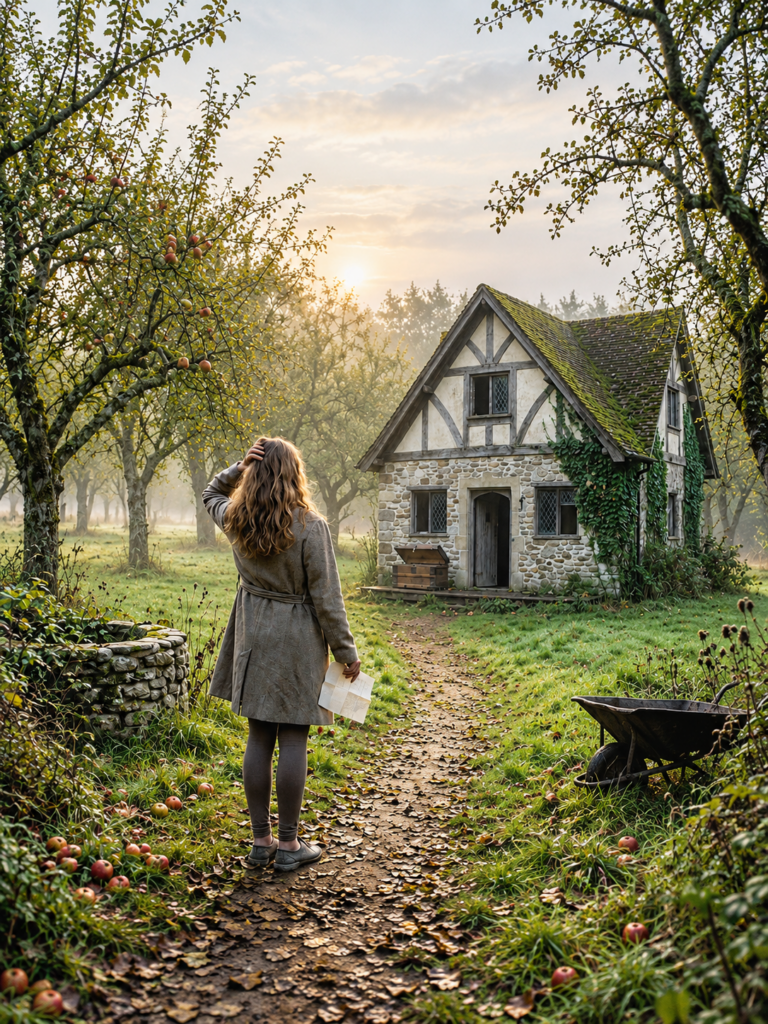
she arrived with forty one dollars and a trash bag and found the last living redfall apple her dead grandfather had hidden up a mountain so she could carry it down
Part 1
At eighteen June had forty-one dollars, a black trash bag of clothes, and a coat that used to be her mother’s. The coat hung past her knees. The money was folded into the inside pocket where her mother used to keep grocery lists. Three weeks after the funeral a letter found her at the bus station. She had a grandfather she had never heard of. He was dead now, and he had left her an apple orchard in the mountains from a man her mother never named.
Folks called it the dead Greer place. The trees were bare, the barn was caving in, and the county wanted nine thousand dollars she did not have. Her mother had run from that orchard as a girl and never spoke of it again. But none of that had happened yet. On the morning the letter came, June was just a girl with nowhere to be, sitting on a hard plastic chair in a bus station because the bus station was warm and nobody made you leave.
Her mother had died of a cancer that started somewhere quiet and spread before anyone thought to look. There had been no money for the doctors who fixed things, only the ones who explained them. When the rent came due and there was no one left to pay it, the landlord changed the locks while June was at the laundromat. She came home to a black trash bag on the stoop with her clothes inside and a note that said the rest had been sold for what was owed.
The letter had been forwarded twice. The envelope was soft from handling, the address crossed out and rewritten in three different hands. It had chased her from the apartment to the shelter to the county office and finally to general delivery at the post office two blocks from the station. The woman at the window had slid it across the counter and said, “Somebody’s been trying to find you, hun.”
Inside was a single page from a law office in a town June had never heard of. The lawyer wrote plainly. A man named Hollis Greer had passed in October. In his will he had left his property, an orchard and the land it sat on, to his daughter Delia. And if Delia could not receive it, then to Delia’s child. The lawyer was sorry to learn that Delia had also passed. That made June the heir. There were papers to sign. There was a key to collect. There was, the letter said near the bottom, a matter of unpaid taxes that would need her attention.
June read it four times. Delia was her mother’s name. The rest of it might as well have been written in another language. She had asked her mother once when she was small why they did not have grandparents like other kids. Her mother had been washing dishes and her hands went still in the gray water. “Because some doors you close so they stay closed,” she said. “Don’t go knocking on that one, baby.” June never asked again. Her mother had a way of making a subject disappear, and June had learned not to chase the things her mother buried. Now here was a door and her mother was not around to keep it shut.
June found a pay phone because her own phone had been shut off when the bill stopped getting paid. She fed it quarters and called the number on the letterhead. A receptionist put her through and then a man’s voice, dry and unhurried, said his name and asked if she was really Delia’s girl.
“I’m her daughter,” June said. “June.”
There was a long pause on the line. “Well,” the lawyer said, “I’ll be. He always said you might turn up.”
“Who said?”
“Your grandfather. Hollis.” The lawyer cleared his throat. “Miss, I won’t lie to you. What he left isn’t worth much in dollars. The place has been going downhill a long while now. The taxes alone are near nine thousand, and the county’s already filed once to take it. But it’s land and it’s yours. Free and clear if you want it. If you don’t, it’ll go to auction and the dead will eat whatever it brings.”
June looked at the trash bag between her feet. “How far is it from where you are?”
“Four hours by bus, maybe five. You’d come into Senate. Anybody there can point you up the road.” He paused again. “You got somewhere else to be?”
“No,” June said. “I don’t have anywhere to be.”
The bus left at six the next morning. A ticket cost twenty-six dollars, which left her fifteen, and she spent four of that on two gas station sandwiches she meant to make last all day. She kept one in each pocket of the big coat so she would not be tempted to eat them both at once. The city fell away behind the glass. June watched it go without much feeling. Then came the long flat country, then hills. Then the hills closed in and became mountains, dark and folded over on themselves, the bare trees gray as smoke up the slopes. She had never been anywhere like it. The bus climbed and the engine strained and her ears popped and somewhere in there she fell asleep against the window with her mother’s coat pulled up to her chin.
She woke when the driver called the stop. Senate was a single street with a traffic light that blinked yellow, a feed store, a diner, a church, and a gas station that doubled as everything else. It was past four in the afternoon and the light was already going thin and golden behind the ridge. June stepped down with her trash bag and stood on the cracked sidewalk, feeling like the only moving thing in a painting.
The diner was warm and smelled like coffee and fried onions. A woman behind the counter, sixty maybe, with reading glasses pushed up into gray hair, looked her over once and poured a cup of coffee without being asked. “You look froze,” the woman said. “Sit. Coffee’s on the house if you’re new. It’s the only free thing in this town.”
June sat. The coffee was strong and she wrapped both hands around the mug. “I’m looking for the Greer Orchard,” she said. “Hollis Greer’s place.”
The woman’s eyebrows went up. The two old men in the corner booth stopped talking. “Now what would a girl your age want with that?” the woman said. It was not quite a question.
“He left it to me,” June said. “He was my grandfather. I never met him.”
The diner got quiet. One of the old men coughed. The woman set down the pot. “You’re Delia’s,” she said softly. And there was something careful in how she said the name, like setting down a cup she did not want to crack. “Lord, you’ve got her chin. You knew my mother?”
“Everybody knew everybody back when. She lit out of here what must be twenty years now. Never came back.” The woman studied June’s face. “Honey, I don’t know how to say this kind, so I’ll just say it. That orchard’s a ruin. Hollis let it go to seed years back. The trees don’t bear. The barn’s half down, and there’s so much owed on it the county’s about to swallow it whole. People around here call it the dead Greer place. You came a long way for a pile of sticks.”
“It’s the only thing anybody ever left me,” June said.
That landed. The woman’s face changed. She turned and cut a slice of pie and set it in front of June without a word. Then leaned on the counter. “It’s two miles up the gap road on the right, past the old church camp. You’ll know the gate by the mailbox. Says Greer. What’s left of it.” She glanced at the window at the failing light. “You won’t make it before dark walking. You got a place to stay tonight?”
“I’ll figure it out,” June said, which was what she always said.
“There’s a dog up there,” one of the old men called from the booth. “Hollis’s old hound. Been living wild since they took him to hospice. Mean now, most likely. Hungry for certain. You watch yourself.”
June thanked them. She ate the pie slowly, every bite. And when she stood to go, the woman pressed a foam box into her hands with a sandwich in it and would not take the dollar June tried to give her. “Sit down. You’ll embarrass us both,” she said. “Go on now before the light’s gone. And girl, if that place runs you off, you come back here. We’ll think of something.”
It was the first kindness anyone had shown June since her mother got sick, and she had to leave fast so the woman would not see her face.
Part 2
The gap road climbed away from town between dark trees, the pavement giving out to gravel, then to two ruts with grass growing up the middle. June walked with the trash bag over her shoulder and her breath smoking in front of her. She passed the church camp, shuttered for the season, and a fallen-in tobacco barn, and then the trees opened and she saw it.
The orchard sat on a long south-facing slope, rows of trees climbing the hill in crooked lines. Even in the dusk she could see they were finished. The limbs were black and tangled, half of them broken under their own weight, choked in wild grape and bittersweet. Between the rows the grass stood waist high and brown. At the bottom of the slope hunched a farmhouse with a sagging porch, and beside it a barn with a swayed roof and one wall bowed out like a held breath. A square of white paper was nailed to the gate post. June already knew what it would say before she got close enough to read it. Notice of delinquent taxes, and under that smaller, a date in the spring, and the word sale.
She stood at the gate a long time. She had not let herself hope for much. Still, some small part of her had built a picture on the bus, a warm kitchen, apples in a bowl, a place that had been waiting for her. What waited for her was a debt and a graveyard of trees.
“Okay,” she said out loud to nobody. “Okay.”
The mailbox leaned at the gate, the name worn down to Greer. Below it someone had bolted a second, newer sign, hand-painted, the letters careful and square. No trespassing. This means you. She wondered who it had meant. Hollis had no one left to keep out. June pushed through the gate, which hung by one hinge and screamed when it moved, and walked down toward the house.
That was when she heard the growl. It came from under the porch, low and steady. Two eyes caught the last light. The dog came out slow, belly down, hackles up. He was a big hound gone to bone, ribs like barrel staves under a coat matted with burrs, one ear torn at the tip. His lips were peeled back, but his tail was tucked. And June had spent enough nights in enough alleys to know the difference between a thing that wants to hurt you and a thing that is only scared.
She stopped moving. She did not look him in the eye. She crouched down slow, set the trash bag aside, and opened the foam box from the diner. “Easy,” she said. “Easy now. I know. I’m hungry too.”
She broke off a piece of the sandwich and tossed it gently, halfway between them. The dog flinched at the motion, then froze, nose working. The growl wavered. He crept forward, snatched the bread, and backed off to swallow it whole, never taking his eyes off her. June tore off another piece and tossed it closer, then another, closer still. By the fourth piece he was taking it from a foot away. And by the time the sandwich was gone he was standing over her, his big head dropped, breathing his terrible breath into her face while she sat very still and let him decide.
“There,” she whispered. She let him smell the back of her hand. “There. We’re the same, you and me. Nobody fed us either.”
She read the worn brass tag hanging off his collar by the porch light’s ghost. One word, stamped deep. Drum.
“Drum,” she said, and his tail moved just once, low, like he had not heard the word in a long time and was surprised to find it still belonged to him.
The house was locked. June tried the front door and the back and the windows and found nothing she could open without breaking, and she could not bring herself to break a window of a house that was now somehow hers. The barn would have to do. She found a horse blanket stiff with dust and a stack of feed sacks, and she made herself a nest in the corner that smelled least of rot. Drum followed her in without being asked and lay down against her back like he had done it every night of his life. The warmth of him was the only warm thing for two miles. She thought she would lie awake. Instead she slept hard, the dead sleep of a body that has run out of road.
And she might have slept till noon if Drum had let her. But sometime in the gray before dawn the hound got up. He went to the barn door and stood there with his nose pointed up the hill and he whined, a thin urgent sound, and looked back at her and whined again.
“Go on then,” June mumbled. “I’m not your keeper.”
Drum did not go on. He came back and took the sleeve of her mother’s coat in his teeth, careful, the way a dog carries something he means to keep, and he pulled.
June sat up. “What?”
He let go and trotted to the door and looked back, pulled at her again, whined. There was nothing playful in it. June had grown up reading rooms, reading her mother’s silences, reading the faces of men in shelters to know which ones to avoid. She did not know how to read a dog, but she knew insistence when she saw it. She got up, wrapped the coat around her, and followed him out into the cold.
The orchard climbed away above her, the dead rows black against a sky just turning the color of a bruise. Drum did not go up the rows. He cut left along the bottom of the slope into the throat of a narrow hollow where a creek ran down out of the trees and the brush grew so thick June had to turn sideways to follow. Branches caught her hair. Twice she nearly turned back. But the dog kept stopping to make sure she was still there, and so she kept on, climbing along the water in the dark until the hollow widened into a little flat bench of ground sheltered on three sides by the mountain. And there June stopped because she could not understand what she was looking at.
There was a fence, not a falling-down fence like every other fence on the place, but a real one built recent and built to last, posts set straight and wire pulled tight, ringing maybe a quarter acre of ground. A gate stood in the middle of it with a hasp and a heavy lock. And inside the fence, in even rows, the grass mowed short around their trunks, stood a couple dozen apple trees that were nothing at all like the ruined skeletons down the hill. These were alive. Their limbs had been pruned back hard and clean. The cuts pale and recent, painted at the ends with something to seal them. Their bark was sound. Mulch was banked careful around every trunk. Somebody had been up here in this hidden fold of the mountain where no road came and no eye could see, taking care of these trees like they were the only thing left in the world that mattered.
Drum walked the fence line to the gate and sat down in front of it and looked back at June and waited the way he must have waited a hundred mornings for a man who was never coming up that hollow again. The lock would not give. June pulled at it and rattled the hasp and pressed her face to the wire, and the trees on the other side just stood there in the gray light, pruned and mulched and impossible. Off to one side, dug back into the bank where the hollow steepened, she found a low stone building with a plank door and a tin roof, half cellar and half shed, and that was locked too, with a newer padlock that had not had time to rust. Whoever kept this place kept it shut.
June stood there until her feet went numb. Then she did the only thing she could do. She memorized the way, marked the gate in her mind, and went back down the hollow to the world she could actually get into.
By the time the sun cleared the ridge she had decided whatever was up that hollow, somebody knew about it. And the only somebody who had reached out to her was the lawyer in town. She left the trash bag in the barn, told Drum to stay, which he ignored, and walked the two miles back down the gap road with the hound trotting at her heel like he had appointed himself to the job.
The law office sat over the feed store, up an outside staircase. The lawyer turned out to be an older man with a soft belly and kind, tired eyes, and when June came through the door he stood up so fast he knocked a folder off his desk.
“You came,” he said. “I half thought you wouldn’t.”
“You said there was a key,” June said.
“Keys,” he corrected, and opened a drawer. He laid them on the desk one at a time, talking as he went. House key. Barn. And a third, smaller, on a loop of baling twine with a strip of masking tape on it gone yellow. He turned the tape so she could read what was written on it in a shaky hand. The hollow. Keep it going.
June’s mouth went dry. “Keep what going?”
“That,” the lawyer said, “is the part I can’t tell you because I don’t know. Your grandfather was a private man. And at the end he got more private, not less.” He pushed a thick envelope across the desk. “These are the trust papers. The place is yours, but it comes with the debt. And the debt comes with a clock. The county sale is set for the second week of April. You owe nine thousand and change. After the fifteenth they stop taking partial payments and it goes to auction whole.”
June counted in her head. It was the middle of February. “That’s eight weeks.”
“About that.” He hesitated, then took a second envelope from the drawer. This one sealed, the paper heavy and cream-colored. Her name written across the front in the same shaky hand as the tape. June. Not to my granddaughter, not anything else. Just her name, like he had known her all her life. “He left this with me a few weeks before he passed. Made me promise I’d only give it to you at the orchard, not in town. Said you’d want walls around you that were his when you read it.” The lawyer slid it over gently. “I don’t know what’s in it. I didn’t open it.”
June took the envelope. It weighed almost nothing and felt like the heaviest thing she had ever held. She did not open it. Some part of her understood that whatever was inside would change the shape of things, and she wanted to choose the moment.
“There’s one more thing you should hear from me and not from him,” the lawyer said. He laced his fingers together. “You have an uncle. Wade Greer. Your mother’s brother. He’s still here. Lives up the other side of the ridge, runs a few cattle. He worked that orchard alongside Hollis his whole life, and he expected to inherit it. When the will read out your name instead of his, he did not take it well.” The lawyer met her eyes. “I’m not telling you to be afraid of him. I’m telling you he’s hurting, and hurting men say things. If he comes around—and he will—you remember he’s got a side to this too.”
“My mother had a brother,” June said slowly. The words felt strange in her mouth. A whole person she had never been told existed. “She never said. She never said any of it.”
“No,” the lawyer said quietly. “I don’t expect she did.”
Down on the street June stood in the cold sun trying to hold all of it at once. A grandfather. An uncle. A debt with a deadline. A locked hollow. An envelope with her name on it. Drum leaned against her leg. She put her hand on his head without thinking about it.
“You need to talk to Odell,” a voice said. It was one of the old men from the diner, the one who had warned her about the dog. He was loading sacks of feed into a truck and he jerked his chin up the road. “Odell Vance grows apples up the next ridge. The only orchard around here that still does. Him and your grandpa were thick as thieves for forty years, then fell out, then patched it up like old men do. If anybody can tell you what’s up that mountain, it’s him. He’s at the feed store most mornings jawing.” Matter of fact, he pointed. An old man in a canvas coat was coming out of the feed store with a coil of wire over his shoulder. He was tall and bent at the same time, with a white mustache stained yellow at the corners and hands swollen at the knuckles from a lifetime of cold work. When he saw June he stopped dead. The wire slid off his shoulder and he did not seem to notice.
“My god,” Odell said. “Delia.”
“June,” she said. “Delia was my mother. She passed.”
The old man’s jaw worked and then his face went still. He came closer slow and looked at her like a photograph he had not seen in a long time. “Of course you are. Of course she did. I heard. I’m sorry.” He cleared his throat hard. “Hollis know about you at the end?”
“I don’t know,” June said. “I never met him. I didn’t know he existed until last week.”
Odell nodded like that was about what he expected and his shoulders dropped. “Walk with me,” he said. “I’ll buy you a coffee and I’ll tell you what your grandpa was, since it don’t appear anybody else will.”
They sat in the diner in the corner booth and Odell wrapped his ruined hands around a mug and told her. “Your grandfather was an apple man. Not like me. I grow apples to sell. Hollis hunted them.” He saw she did not understand. “Used to be all through these mountains. Every farm had its own apples. Trees folks grew from seed, named after whoever grew them or whatever holler they come from. Hundreds of kinds. Thousands. Then the big growers come in wanting just a few that ship good and look pretty in a store. And the old kinds got cut for firewood. And the old folks who knew them died, and the names died with them.” He turned the mug slowly. “Hollis couldn’t stand it. He’d hear about some old tree behind a fallen cabin forty miles back in the hills, last of its kind, and he’d drive his truck till the road quit and walk till his legs quit just to cut a few twigs off it before it died. Then he’d bring them home and graft them onto good rootstock and keep them alive. Saved kinds nobody else on this earth had anymore. He found apples the books said were gone.”
“Why?” June asked. “If there’s no money in it.”
Odell looked at her a long moment. “A tree don’t care whose hands planted it. Give it sun and water, it’ll try to feed you anyway. Your grandpa figured the least a man could do was return the favor. Keep the thing alive so it could keep on feeding folks after he was gone.” He shrugged. “Some men leave money. He wanted to leave apples.”
June thought of the rows up the hollow, the careful cuts, the banked mulch. “There’s trees up the hollow behind his place,” she said. “Fenced. Somebody’s been keeping them. The cuts are fresh.”
Odell’s hands went still on the mug. “Was it you?” June asked.
“No,” he said, and he said it careful, picking the word up and setting it down. “I helped him plant some of that years back. But I haven’t been up that hollow since before he got too sick to climb it. And that’s the better part of a year. Whatever’s been kept up there since, it wasn’t me, and it wasn’t him.” He looked out the window at the ridge. “Somebody’s been up there, though. You’re right about that. I’d wondered who else would.”
The old man did not answer that. He drank his coffee. “You got the key to it?”
“Yes.”
Odell set down the mug and pushed himself up out of the booth, joints cracking. “Then go open it, girl. Whatever your grandpa hid up that hollow, he hid it for the one who’d come asking. That’s you.” He put a swollen hand on her shoulder for a second, light as a bird. “And when you’ve seen it, you come find me. There’s things I’ll want to know and things you’ll want to ask. And we’ll both of us be too proud to admit it. Come anyway.”
Part 3
June walked back up the gap road with the keys heavy in her coat pocket and Drum ranging ahead. The cold had loosened toward noon, and the orchard, when she came to it, looked a little less like a graveyard and a little more like something that had only fallen asleep. She tried the house first. The key turned hard and the door swung in on the smell of a place that had been closed up since a man died in it. Cold ash and dust, and underneath, faint and medicinal, the ghost of sickness. June stood in the doorway and made herself go in.
It was one room mostly, a kitchen and a sitting room together with a bedroom off the back. A recliner sat by the cold wood stove with a green oxygen tank beside it. The clear tubing still looped over the arm where he had left it. A man had spent his last good days in that chair. June could see the shape of him in the worn cushion, but it was the walls that stopped her. Every wall was covered. Hand-drawn maps of the orchard, the rows numbered, each tree marked with a name in tiny careful letters. Pages torn from seed catalogs, circled and noted in the margins. A corkboard thick with index cards, and on each card an apple’s name and a date and a place, like a register of the dead or the saved. Junaluska. Magnum Bonum. Buckingham. Royal Lemon. Names she had never heard in a hand she was coming to know. And on the back wall, framed behind cracked glass, a yellowed newspaper page. June leaned in to read it. The headline said a local grower claimed to have found an apple thought extinct since before the First World War. There was a photograph of a younger Hollis, lean and unsmiling, holding up a single dark apple in the flat of his hand like he was showing the camera his own heart. Beside it, in a cheap frame, hung a second clipping. This one was smaller, from a farm journal, and the headline was not kind. A professor from the state agricultural college, a man with letters after his name, had examined the claim and called it impossible. The apple was misidentified, he said, or invented. He used the word fraud. He said it was a shame to see an old man chasing ghosts and calling them history.
June read it twice. Then she looked back at the chair, at the oxygen tank, at the walls a dying man had filled with the names of things he had spent his life refusing to let disappear. And she understood without being told that the professor’s word in that cheap frame had cost Hollis something he never got back.
There was a photograph on the windowsill. The only one in the house. A woman, dark-haired, laughing at whoever held the camera, an apple tree in white blossom behind her. June turned it over. On the back, in the shaky hand: Vera, the spring we planted the hollow. June set it down very gently like it could break, and it could. She did not open her grandfather’s letter. Not yet. Some things you walk up the mountain to read.
She climbed back up the hollow with the key on its loop of twine, Drum pushing ahead through the brush like he had done it a thousand times, which she was beginning to think he had. At the stone building she fit the key to the padlock and it opened on the first try, the shackle springing up like it had been waiting. The door swung in. Cold air breathed out at her, cellar cold, even and deep. The cold men dig into a hillside on purpose. June let her eyes adjust. There were shelves. There was a workbench under a small window with a vise bolted to it and grafting knives laid out in a row, oiled and sharp. There were jars, dozens of them, each holding cuttings of bare wood standing in damp sawdust, each labeled. And there was a wooden cabinet against the back wall. And on the bench in front of it, set out square in the center where it could not be missed, a ledger, brown leather, swollen with use, a pencil tied to it on a string.
June opened it. The early pages were old, the ink brown with age, the entries going back decades. Each one was a tree, a name, a date, a place it had come from, whether the graft took or failed, whether it bore. She turned the pages forward through the years, through a whole life’s work, the hand growing shakier as the dates climbed toward the present, and near the back, on a page by itself, underlined twice, she found it. The Redfall. Believed lost since 1919. Last known tree, the old Codle home place, taken down for a road. June read the entry under it. Found it. After all these years I found it living and grafted it true and it bears. Let them call me a liar now. Then a date, and below the date a line that had been written slower, the pencil pressed deep. They will not believe it from me so I will not tell them. I will keep it alive up here where it’s safe and let the one who comes after carry it down the hill when I’m gone.
June’s heart was going hard. She turned to the cabinet and opened it, and inside in neat rows hung tools and twine and rolls of grafting tape, and on a shelf at eye level sat a single object set apart from the rest. A wooden plant tag, hand-painted, the paint still bright. Not a number. Not one of the old apple names from the cards on the wall. A name. Her name. In her grandfather’s hand, lettered as careful as a man can letter when his hands have started to shake. June.
For a long moment June did not breathe. She lifted the tag off the shelf and held it in both hands and turned it in the cold light from the little window. Sure she had read it wrong, but there was no reading it wrong. Her name painted on a wooden tag by a man who had died before she ever knew his face, hung in a cabinet in a cellar dug into a mountain she had reached two days ago by bus. She did not understand it, and she wanted to, badly, like a thirst. So she did the thing she had been carrying around all morning and putting off. She tucked the tag in her coat pocket against her mother’s grocery-list pocket, took the ledger under her arm, and went down the hollow to the house, to his chair, to read the letter he had wanted her to read inside walls that were his.
Drum laid down across the doorway. June sat in the recliner that still held the shape of a dead man, slid her thumb under the flap, and opened it. The handwriting was the same shaky hand from the tape and the tag. It filled four pages front and back, and it began without any of the soft words letters usually begin with.
June, it said. If you are reading this then you came, and Odell or that lawyer kept their word and pointed you up the right hollow, and you have likely already found the trees and wondered who in the world was crazy enough to plant a secret orchard on a mountain nobody visits. That was me. Let me tell you why. Because nobody else can. And because you have a right to it, and a right is about all I have left to give you.
June read on. The letter did not waste her time. I had a wife. Vera. She was the best of us. And when she went fast in the spring I did a coward’s thing. I crawled into these trees and I shut the door on everything else, including my own children. Your mother was sixteen. She needed her daddy, and her daddy was up a holler talking to apple trees because the apple trees did not die on him and people did. I told myself I was grieving. The truth is I was hiding, and I let her grieve alone, and at eighteen she did the only sensible thing a girl can do with a father like that. She left. I was too proud and too broke inside to go after her. And the longer I waited the bigger the waiting got until it was a wall I could not climb. Then it was decades. Then it was too late.
June set the page down in her lap. Outside the wind moved in the dead rows. She picked it up again. Your uncle Wade stayed. He stayed and he worked and he watched me chase ghosts. And I never once told him I was proud of him, and that is a sin I will answer for. So if Wade is hard with you, and he will be, you understand it is me he is angry at. And I am not here to be angry at anymore, so it will fall on you. That is not fair and I am sorry for it. He is not a bad man. He is a man who got the cold end of me his whole life. Go easy where you can.
Then the letter changed. The hand got slower. The lines closer together, like he had stopped to gather himself between sentences. A while back a letter came. It was from your mother. The first word from her in more than half my life. She wrote because she was sick and she knew where it was going. And she wrote to tell me one thing. That I had a granddaughter. That her name was June because she was born in the month her grandmother died, the month the orchard blooms. I sat in this chair and I read it. An old man who had finally been handed something to live for about ten winters too late to live for it.
June’s eyes burned. She made herself keep reading. I wrote her back. I told her to come home, both of you. That the door was open, that it had always been open, and I was the fool who forgot to say so. I do not know if she got it. The letter that came after was from a hospital, and it was not in her hand. So I never got to tell her I was sorry, and I never got to meet you, and there is no fixing that, and I have quit trying to make my peace with it because some things a man should not be at peace with.
The next part was the part that undid her. But I had one thing. All my life I hunted a lost apple. The Redfall. The one they put in the paper. The one the professor called me a liar over. I looked for it the better part of my life and late, too late for most things, I found it living behind a fallen house. The last one on earth. And I grafted it and I kept it secret because I was done being laughed at. It is the best thing I ever did and the only thing I have that is worth a dime. So when your mother’s letter came and told me your name I knew what to do with it. I struck out the old name in my book and I gave the apple to you. It is yours now. The June. Not the Redfall. I could not put my arms around you so I did the only thing an old apple man knows how to do. I gave you my name for things and I gave my best thing your name. And I hid it up that hollow so it would still be living when you came. Grafting is just teaching a stranger to bear fruit on your roots. Reckon that is all family ever was.
The last lines were short. Take it down off this mountain, June. Do not let it die up here in the dark with me. That is the whole of what I am asking. Everything else, the land, the debt, the mess I made of all of you, you do with as you see fit, and I will not blame you for any of it. But carry the apple down. Your grandfather, Hollis Greer.
June sat with the pages in her lap and the dead man’s chair around her. She did not cry loud. She cried with her face still and the tears just running, which was how her mother used to. Drum came and put his head on her knee. “He never held me once,” she said to the dog, because there was no one else. “But he gave my name to the best thing he ever grew.”
She read the whole letter twice more. Then she got up because sitting still had started to feel like going under. And she walked back up the hollow in the falling dark with Drum. And she let herself into the cellar again and she lit the lantern she found on the bench and she went through everything because now she had to know all of it.
It was past midnight when she found the rest. She was on her knees pulling the jars of cuttings off the bottom shelf to read their labels when she noticed one board of the cellar floor sat a hair proud of the others. The nail heads bright where a hand had pried it up and set it down many times. June worked her fingers under the edge and lifted it. In the gap beneath, wrapped in an oilcloth and tied with twine, sat a flat tin box.
Inside the tin were the things a careful man hides from the world but cannot bear to burn. There was a letter in her mother’s handwriting, the paper cheap and thin, the one Hollis had written about. June read her mother’s words to a father she had never once mentioned. And there was June’s own name in her mother’s hand, and a line near the end that stopped her cold. He should know he has a granddaughter before I go, because she is going to be alone in this world, and a person ought to have somewhere they came from, even if they never use it. Her mother had tried. At the very end, with no time left, her mother had reached back toward the door she spent her whole life holding shut. And she had done it for June.
Under that letter was a second in Hollis’s hand, finished but never sent. The envelope addressed and stamped and never mailed because the next news came too fast. And under that, folded in thirds, an official-looking form only half filled in, the heading printed across the top. Application for registration of a heritage fruit variety. In the box marked variety name the old name had been crossed out with one firm line and above it, in the shaky hand, he had written June. Clipped to the form was a business card soft from handling from a woman at something called the Southern Heritage Apple Society. On the back of it Hollis had written a phone number and four words. They will believe you.
June understood then what she was holding. It was not money, but it was the seed of money if the apple was what he swore it was. The sort of thing the preservation people and the old apple hunters and the cider makers would line up to get a single cutting of, enough maybe to pay a debt and save a mountain. And it was more than money. It was the thing the man in the cheap frame on the wall had stolen from her grandfather. It was proof. A way to make the professor wrong at last. Late. Too late for Hollis to see it. But not too late for his name.
She had eight weeks. She had a phone number on the back of a card, a county clock ticking toward April, and a tag in her pocket with her own name on it. She was still on her knees in the cellar with a tin in her lap when she heard the truck.
Part 4
It came grinding up the gap road with one headlight, and it did not slow at the house. It came on up the rutted track as far as a truck could go. And then a door slammed. And there were boots in the brush and a flashlight beam swinging wild up the hollow. And a man’s voice, rough and furious, calling out into the dark. “I know you’re up here. I seen the lantern. You got no business on this mountain, girl. None.”
June came out of the cellar with the lantern and Drum came out beside her with a low sound in his chest, and the flashlight found them both and held. He was a big man gone heavy through the middle, in a feed cap and a coat as old as the one June wore. Where the light caught the edge of his face June saw her mother’s bones in it and her own. And that was the strangest thing of the whole strange night, to look at a stranger raging at her in the dark and find her dead mother’s chin.
“Wade,” June said.
That stopped him a half second. “You don’t get to say my name like you know me.” He came closer, breathing hard from the climb. “I worked this place my whole life. Broke my back on these trees while he chased phantoms. And he leaves the whole of it to some city girl he never laid eyes on. You’re not a Greer. Never set foot on this mountain till this week. You don’t know what that hollow is. You don’t know what any of it is.”
“It’s a lost apple,” June said quietly. “The Redfall. He found it. It’s real.”
The flashlight beam jerked. For just a moment the fury went out of the man and his face opened, raw and startled. And then it closed back over. But June had seen it. She filed it away without knowing yet what it meant.
“There’s a man wants this ridge,” Wade said. “Cidery outfit out of the city. Building some resort thing. Been after it a long time. He’ll pay enough to clear the taxes and put real money in your pocket and mine, and you can go on back to wherever you come from and never think about us again. That’s the smart play. That’s the only play. You sign, we split it. Everybody comes out ahead, and these trees that ruined this family finally get to be firewood like they always should have been.”
“He asked me to carry the apple down off the mountain,” June said. “It’s the last thing he asked anybody for.”
“He asked,” Wade said, and his voice cracked on it. And June heard a lifetime of a son in that crack. “He asked you. He never asked me for one thing in his life except to stay out of his way.” He turned, the light swinging down the hollow toward the dead orchard and the caving barn and the white notice on the gate. “Sale’s the second week of April. You don’t have nine thousand, and you’re not going to find it picking apples off dead trees. When the county takes it, it all goes for nothing, and that apple of his rots in the ground same as he is. You think on that.”
He went back down the hollow with his one headlight and the dark came back, and June stood there with the lantern and the tin and the dog and her grandfather’s whole life in her hands. She did the math one more time and there was no way the math worked. Then she thought of the soft card and the four words on the back of it and she made up her mind.
She called the number the next morning from the pay phone outside the gas station, feeding it the last of her quarters. The soft card flattened on the metal shelf in front of her. A woman answered on the third ring, brisk and kind. And June got about four sentences in before the woman went quiet on the other end.
“Say that name again,” the woman said. “The variety.”
“Redfall,” June said. “He wrote it was lost since 1919. He said the last tree was at the old Codle place.”
There was a sound like a chair being pushed back fast. “Honey, I have been doing this work most of my life and I have a list of apples we believe are gone, and the Redfall is near the top of it. Men have spent whole careers looking for that tree.” A pause. “Who did you say you were?”
“Hollis Greer’s granddaughter.”
The woman exhaled. “Hollis Greer. We owe that man an apology nobody ever paid him.” June heard a pen scratching. “Don’t you touch those trees. Don’t let anyone prune them, move them, nothing. I can be there Thursday. Will you be there Thursday?”
“I’ll be there,” June said. “I don’t have anywhere else to be.”
She had said that line a hundred times before, and every time it had been a surrender. This was the first time it came out of her mouth as a promise instead.
Thursday was four days off. The county sale was eight weeks off. In between sat a problem shaped like nine thousand dollars, and June had eleven of her forty-one left.
The developer found her before the apple woman did. He came up the gap road in a clean gray truck on Wednesday afternoon. A younger man in a quilted vest with a tablet under his arm and good boots that had never seen mud. He found June and Odell at the bottom of the dead orchard, where Odell was showing her how to tell a tree that was truly finished from one that was only neglected, his swollen finger tracing the green a thumbnail scratch brought up under dead-looking bark.
“Miss Greer,” the man called, friendly, already smiling. “I’ve been hoping to catch you. I think we can solve all your problems this afternoon.”
He had the numbers ready on the tablet. He turned it so she could see. The figure he named would clear the back taxes, pay off the lien, and leave June with more cash in her hand than she had held in her whole life. He talked about the view, the spring water, the cabins they would build along the ridge, the parking. There was no cruelty in him about the trees. He simply did not see them. To him the orchard was the empty space where a thing he wanted would go.
“You can sign today,” he said. “We can wire a deposit by Friday. You walk away clean. No debt. No winters in a falling-down house. No more of whatever this has been for you.” He glanced at her mother’s enormous coat, at the trash bag visible through the open barn door, and his voice went gentle in a way that was almost worse than rude. “You’re eighteen. You’ve got a whole life. This mountain doesn’t have to be it.”
It was the easiest thing in the world he was offering. A bed. An end to the cold. The thing June had wanted every single night for the past month, held out to her on a tablet screen. And all she had to do was sign her grandfather’s mountain away and let the bulldozers have the hollow. June thought about the tag in her pocket. She thought about a sick man filling four pages in a hand that could barely hold a pencil, asking her for one thing.
“No,” she said.
The man blinked. “I don’t think you understand the offer.”
“I understand it.” June’s voice was quiet and it did not shake. “You’re offering me money to bulldoze the last living Redfall apple on earth so people can park their cars where it grows. The answer is no.”
Odell made a low sound that might have been a laugh. The developer’s smile stayed on his face but it stopped meaning anything. He left a card June did not take and said the offer stood until the sale, that she would come to her senses when the county came for the deed, and that he would be around. His clean truck went back down the road and June stood there shaking now that it was over, because she had just turned down the only sure thing anyone had offered her in years to bet everything on a dead man’s word.
Odell put his hand on her shoulder. “That was either the smartest thing I ever saw a Greer do,” he said, “or the dumbest. We’ll know Thursday.” Then he squeezed once. “Your grandpa couldn’t come to you, so he left you the one thing he had that would outlive them both. You just refused to set it on fire. I’d call that carrying it down the mountain. He’d call it that too.”
The woman from the Apple Society arrived Thursday at noon in a mud-spattered station wagon with a magnifying loupe on a cord around her neck and a milk crate of reference books in the back. She was near seventy, small and quick, and she did not waste a minute on the house. “Take me up,” she said. “Take me up right now.”
June took her up the hollow, Odell behind them, Drum ranging ahead. At the fence the woman stopped and looked at the rows of pruned and mulched and cared-for trees. And she stood very still. “Somebody loved these,” she said softly. She went through the gate to the tree under the painted tag, the finest one, the one Hollis had set apart, and she lifted a low branch and turned a few dried leaves still clinging to it. And she pulled her loupe up to her eye and bent close to the bark, the buds, how the spurs sat on the wood. She took a withered apple off the ground that the deer had not finished, brown and frostbit, and she cut it in half with a pocket knife and studied the core, the seeds, the shape of the cavity. She tasted it, frost-ruined as it was, and closed her eyes. For a long time she did not say anything. June’s heart climbed up into her throat and sat there.
“I read the report that professor wrote,” the woman said at last, still looking at the apple in her hand. “Years back. We all did. He was a careful man and he was wrong, and he never had the grace to wonder if he might be.” She straightened up and looked at June and her eyes were wet. “This is the Redfall. I have spent the back half of my life looking for it. Your grandfather found it and held it and told no one because we broke his heart over it. It is the most important tree on this mountain. Maybe in this whole state. And four days ago it had no one in the world to keep it alive.”
June found she could not speak.
“It’s worth nothing and everything,” the woman went on, brisk again now, blinking hard. “Nobody can buy this tree, but every serious orchard and grafter and cider house in the country is going to want wood off it, and they will pay. And our society funds preservation work, and there are grants for exactly this. And we move fast when it matters. Young lady, your nine thousand is a phone call I will make tonight. The hard part was never the money. The hard part was finding the tree, and a dead man already did that for you.” She put the frostbit apple in June’s hand and folded her fingers around it. “Now. Who has been watering these? Because it has not been a ghost, and the cuts are this season’s, and someone hauled mulch up a mountain with no road. I would like to shake their hand.”
And that was when June understood the look she had filed away in the dark. She did not have to answer, because down at the foot of the hollow an engine had cut off and bootsteps were coming up through the brush, slow this time, and Wade came up into the cleared ground at the top and stopped when he saw all of them standing there around the tree. He had a five-gallon bucket in each hand, river water slopping. He stood there caught, a big man holding two buckets he had carried up a mountain, his face working.
“Wade,” June said.
“He couldn’t climb it no more,” Wade said. The words came out of him like they hurt. “Last summer. Lungs give out. He’d sit in that chair and look up the hollow and he couldn’t get to them. And I wasn’t going to let his trees die just because I was sore at him. So I hauled the water every week. After dark, mostly, so I wouldn’t have to talk to nobody about it.” He set the buckets down. “I told myself I was doing it for spite. Keeping the thing alive so I’d have something to hold over him. That’s a lie. I did it because they were his and he loved them more than he loved me. And watering them was the closest I could get to him.” His voice broke all the way now. “Even after. Even after he was gone I kept coming up here with these buckets like a fool. Because if I stopped then he was really gone. And I wasn’t ready for him to be really gone.”
Nobody moved. The frostbit apple was warm in June’s hand.
“I stayed sixty years and went bitter,” Wade said, looking at June, at his sister’s chin on a stranger’s face. “Your mama left and got herself loved and got herself a girl. And that girl is standing in my daddy’s hollow holding his apple. Took me this long to see I had it backwards. The leaving didn’t cost her the love. The staying didn’t earn me it. I just never once asked for it, and neither did he. And so the two of us went and starved to death three feet apart for the better part of our lives.” He wiped his face with the back of a big hand. “I’m sorry I come up here yelling at you in the dark. You’re the only piece of my sister left walking around, and the first thing I did was tell you you didn’t belong.”
June crossed the cleared ground and stood in front of this big bitter grieving man who had her mother’s face, and she did the thing she had wanted her whole life for somebody to do for her. She did not make him earn it first. “You kept them alive,” she said, “when nobody was watching and there was nothing in it for you. You carried water up a mountain in the dark for a man who never thanked you. Odell told me real family is who stays.” She put her hand on his arm. “You stayed, Wade. You’re the one who stayed.”
The big man folded forward and put his face in his hands and cried in great silent heaves, the cry of a man who had held it in too long, and June stood with her hand on his arm and let him. And Drum leaned against his leg, and Odell took his hat off, and the woman from the Apple Society quietly turned away to give him the dignity of it.
Up and down the rows the Redfall trees stood in the thin Thursday light with their buds already swelling toward a spring that for the first time in a long while somebody would be there to see. When Wade could talk again he wiped his face and looked at the trees and then at June. “That cider man’s offer,” he said roughly. “The resort.”
“I told him no,” June said.
“Good.” Wade nodded, slow and certain. “Because I got a little put by, and I got cattle I can sell, and there is not going to be any auction. Whatever that grant don’t cover, I cover. I’m not watching the county take my daddy’s mountain eight weeks after I finally figured out why I’ve been hauling that water.” He looked at her and there was nothing left of the man from the dark with the one headlight. “If you’ll have an old uncle around the place. I know these trees. I know which one he set the most store by. I can teach you. He’d have taught you himself if any of us had been less of a fool.”
“I’d like that,” June said, and her voice did the thing his had done. “I don’t know how to keep them alive. I’ve never kept anything alive but a windowsill tomato.”
“Then you’re already most of the way there,” Odell said. “Wanting to is the whole trick. The trees do the rest.”
The woman from the Apple Society came over and shook Wade’s hand and held it in both of hers a moment, and then she got down to business because there were eight weeks and a great deal to do. She would make her calls that night. There would be a man up with a cooler within the week for scion wood while the trees were still dormant, because the world’s grafters could not graft what they did not have. And the surest way to keep the Redfall from going extinct a second time was to get its wood into a hundred orchards by spring. The words came fast and June tried to hold all of them. And Wade stood beside her saying, “I’ll show her the trees. I know the trees.” And Drum sat in the open gate of the fence Hollis built, guarding the way up the hollow he had guarded all along.
That evening June and Wade and Odell sat at the table in the old farmhouse under the walls covered in a dead man’s careful handwriting, and they cut scion wood by lamplight. Wade showed her how to choose a length of this year’s growth, straight and sound, the buds tight and good. He showed her how to label each bundle, wrap it damp, and lay it in the cooler. June worked slow and careful, her grandfather’s grafting knife warm in her hand, and across the table her uncle watched her do it with his sister’s chin set in concentration, and the old house that had been holding its breath since October seemed to let it out.
“He’d be up in that chair right now,” Wade said quietly, nodding at the empty recliner, “telling us we’re cutting them too long.”
“Then cut them how he liked,” June said.
So they did. And outside, up the dark hollow, the most important tree on the mountain stood in its careful fence with its buds swelling. No longer a secret. No longer alone. Waiting on the spring with the first hands in a long while reaching toward it, getting ready to carry it down.
Part 5
The county sale came and went in April, and the dead Greer place was not on the block. The grant money the apple woman promised came through in March, and the first orders for scion wood came in faster than anyone expected, from preservation orchards and cider houses and a famous old nursery up north that had been hunting the Redfall for two generations. Between the grant and the wood and the cattle Wade sold without being asked twice, the nine thousand got paid with a little leftover, and the lawyer tore the lien notice off the gate post himself and handed it to June and said, “Burn that. You’ve earned the match.”
By the time the orchard bloomed June was living in the farmhouse. She had washed the windows and aired the rooms and built a fire in the wood stove that her grandfather never got to feel that last winter. She did not move much around. The maps stayed on the walls. The index cards stayed on the corkboard. The recliner stayed by the stove. And June left the green oxygen tank in the corner because taking it out felt like throwing away the last of him, and she was not ready, and there was no rule that said she had to be. Vera’s photograph she moved to the kitchen windowsill where the morning light came in, so the woman who planted the hollow could watch the orchard wake up.
And the orchard woke up. That was the thing June had not been ready for. In May the hollow filled with white blossom, every saved tree in its careful fence breaking into bloom at once, and the bees came up out of nowhere, and the whole bench of ground hummed. June stood in the gate the first morning it happened, with her mother’s coat still hanging off her shoulders, and she understood for the first time why a man would give his whole life to this and count it well spent.
Wade came nearly every day. He showed her the trees as his father had shown him, his big ruined hands suddenly gentle on the wood, naming each one, telling her which liked wet feet and which would scab if you looked at them wrong. They cleared the dead commercial rows down the slope a few at a time, cutting out what was truly gone, saving what had only been waiting. It was slow and it was hard, and June’s hands blistered and then toughened, and she found she did not mind the work. The work had a point. At the end of a day she could turn and see exactly how far they had come, which was more than her old life had ever let her say.
Odell taught her to graft. He sat her at the bench with her grandfather’s knife and a bundle of dormant wood and a box of rootstock. And he showed her how to cut the scion and the stock to match, how to bind them, how to seal the joint, how to set the whole thing in a pot and wait. The first dozen she tried all failed. The next dozen half took. By the end of that first spring she had a hundred little potted trees lined up on the south side of the barn. Each one a Redfall. Each one a copy of the last tree on earth, and not one of them hidden.
“That’s the part your grandpa never got right,” Odell told her, looking down the rows of pots. “He saved them so good he buried them. A thing you keep too safe is just as gone as a thing you lose. He figured that out at the end. I think it’s why he left you that letter instead of a padlock.”
June ran her hand along the tops of the little trees. “He hid it so it wouldn’t die,” she said. “I figured the surest way to keep it alive is to give it away.”
So she gave it away. She sent scion wood to every orchard that asked and some that did not. She drove the potted Redfalls down to the county extension office and gave them to anyone who would plant one and promised to keep it. The apple woman put the rediscovery in the society’s journal with Hollis Greer’s name on it and the date he found the tree, and a line that said the original doubt had been, in the society’s own words, a serious and lasting error. It was not the front-page apology Hollis deserved, but the people who knew apples read it and they knew what it meant. And within a season the name that had been a punchline in this part of the country was a name those people said with their hats off. The professor was dead by then. June found she could not hold a grudge against a dead man on behalf of another dead man. She had done the only thing that mattered, which was to make the truth louder than the lie and let the lie keep till judgment.
In the fall the mother tree bore. It was not a heavy crop. The tree was old and had been through a hard stretch with no one to feed it. But it set fruit, real fruit, dark red going to near purple on the sun side, heavier in the hand than it looked. June and Wade and Odell stood under it on a bright October morning. And Wade reached up and picked the first one and turned it in his hand and went quiet, because the last person to hold a ripe Redfall in this hollow had been his father. He held it out to June.
“You first,” he said. “It’s got your name on it.”
June took the apple. It was cold from the night and it smelled like nothing she could put words to. Sharp and sweet and old. She bit into it and the taste went all through her, and she finally understood what her grandfather had spent his life chasing through the back hollows of these mountains. It tasted like something that should not still exist. It tasted like being found. She did not say any of that out loud. She just handed the apple to Wade so he could taste it too, and then to Odell, and the three of them passed it around under the tree until it was gone. And nobody said much, and nobody needed to.
That winter the county called June about a boy. He was sixteen, the woman on the phone said, and the placement had fallen through and there was nowhere to put him till spring, and somebody at the diner had mentioned that the Greer girl up the gap had a big empty farmhouse and a soft spot for strays. June looked at the spare room she had been meaning to clean out, and she looked at Drum asleep by the stove, the same hound who had been a rack of bones guarding a dead man’s porch the winter before and was now fat and gray-muzzled and snoring. And she said yes before the woman finished asking.
The boy came up the gap road on a gray afternoon with everything he owned in a backpack, which was more than June had come with, and she met him at the gate where the mailbox still said Greer. “They told me this place was dead,” he said, looking at the bare winter trees, suspicious, ready to be lied to because he had been lied to plenty.
“Everybody says that,” June said. “Come spring you’ll see.”
She put him in the spare room. She fed him, and she did not ask him questions he was not ready to answer, and she left him space to be a person who did not trust anything yet. In the mornings she took him up the hollow and put a grafting knife in his hand and showed him how to teach a stranger to bear fruit on its roots. And she watched the set of his shoulders come down an inch at a time, week by week, just as her own had.
“Why are you doing this?” he asked her once. It was a question June knew from the other side. She had wanted to ask it of every person who was ever kind to her and never had, because asking out loud might break the spell. “You don’t even know me.”
June thought about how to answer. She thought about a bus station and forty-one dollars and a trash bag on a stoop and a letter that found her anyway, and a man who gave his best thing her name because he could not give her his arms. “Because somebody I never met carried something up a mountain and kept it alive in the dark just so it would still be here when I came,” she said. “I’m doing the same thing. Keeping a thing alive till the right person shows up. Turns out that’s most of what family is.”
The boy did not have anything to say to that, but he came up the hollow with her the next morning without being asked. And the morning after. And by spring, when the orchard broke into white blossom all over again and the bench of ground filled with bees, he was standing in the gate beside her with that look on his face. The one she had worn herself. The one that says a person has finally landed somewhere that is not going to disappear.
They put up a marker that spring. Nothing fancy. A flat creek stone Wade set at the top of the hollow under the mother tree. It had two names cut into it, Hollis and Vera, and below them no dates and no scripture, just three words June chose. They kept roots. Wade ran his thumb over the letters when it was set and nodded once and did not trust himself to talk, and that was all right. The trees said the rest.
People came to the orchard now. Word had gone around about the lost apple and the girl who saved it. And on the first Saturday of bloom June started opening the gate to anyone who wanted to walk up and see. The woman from the diner came, and the old men from the corner booth, and families with kids who had never tasted an apple that did not come from a store. June would cut a Redfall into pieces and pass it around and watch their faces change, and hand out little potted trees to anyone with a yard and a promise. Odell stood with her at one of those gatherings, leaning on his cane, watching a line of strangers carry her grandfather’s apple off down the mountain in their own two hands, exactly as Hollis had asked. More of them than he ever could have imagined.
“He spent his whole life afraid these would disappear,” Odell said. “Look at it now. You couldn’t kill this apple if you tried. It’s in too many hands.” He shook his head slowly. “Roots don’t ask permission, girl. They just hold on. Your grandpa held on through everything that should have finished him, and then you held on, and now half the county’s holding on for you. That’s how a thing lives forever. Not by hiding. By spreading out.”
June watched a small girl bite into a slice of Redfall and stop chewing, surprised, the same as they all did. “I used to think you inherited a place like this,” June said. “Like it just got handed to you and then it was yours.” She smiled. “It doesn’t work that way. Some things you don’t inherit. You grow into them.”
By the third spring the dead Greer place was not dead. And nobody called it that anymore. They called it the orchard, or they called it Greer’s, and they said it like it was a thing that had always been there and always would be, which is the highest thing a place can become. June still wore her mother’s coat. It did not hang off her like it used to. She had grown into it, or it had given up trying to be too big. And either way it fit her now, worn soft at the elbows from a thousand mornings in the trees. The forty-one dollars were long gone, spent on bus fare and quarters and a girl who had needed them. The trash bag she had come with was somewhere in the back of a closet, empty, and she kept it because a person should remember the shape they came in.
On an evening in October, with the boy off at the barn and Wade gone home over the ridge and Odell dozing in the recliner that was Hollis’s and was now just the good chair by the stove, June walked up the hollow alone as she liked to at the end of a day. Drum came with her, slower now, gray all through his muzzle, stopping to smell the things old dogs stop to smell. At the top, under the mother tree, June reached up and picked a single apple, dark red going to purple, and she sat down on the creek stone with her grandfather’s and grandmother’s names under her, and she bit into it.
The hollow was loud with crickets and the creek and the last birds going to roost. Down the slope the orchard ran on into the dark, row after row, alive. Somewhere among them grew a hundred copies of the last tree on earth, and a hundred more in other people’s yards, and the apple in her hand had her name on it, given to her by a man she never met, who could not come to her and so had left her the one thing he had that would outlive them both. Drum sighed and lay down across her feet. June finished the apple slow and dropped the core in the grass where a seed of it might someday try its luck. And she sat there in the dark a long while, in a coat that finally fit, in a place that was finally hers. And she was not cold. And she was not alone. And she was at last exactly where she was supposed to be.


