
Part 1
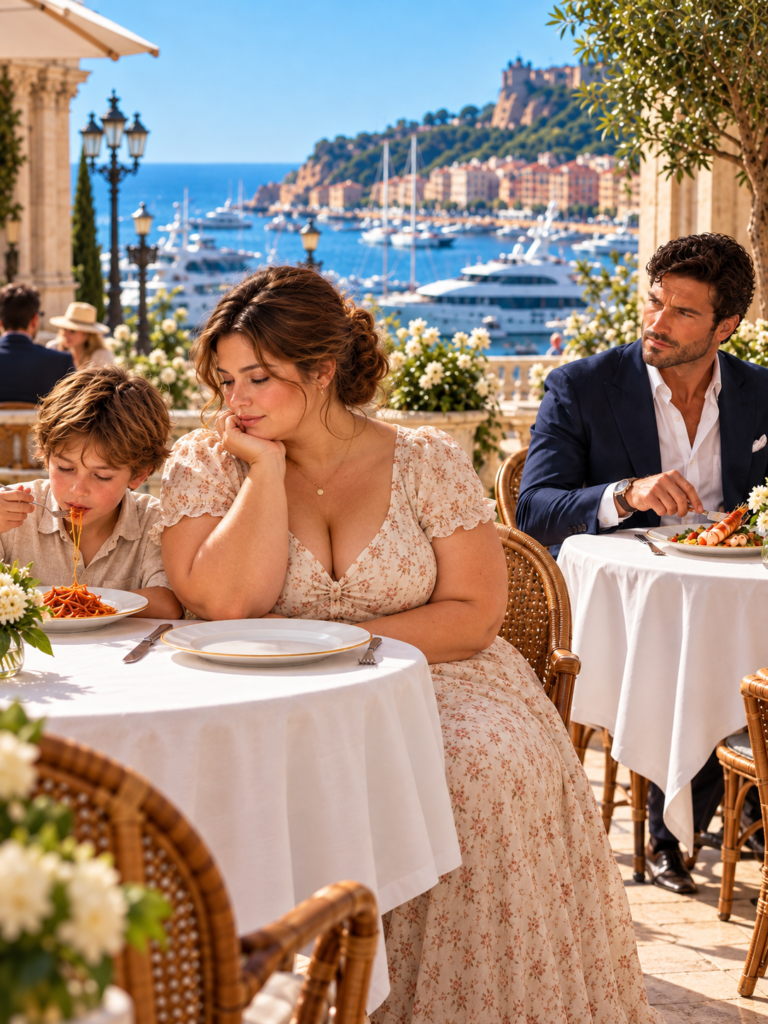
The waiter looked at the empty plate in front of the young mother, then at the little boy still eating his spaghetti.
“Madam, I’m going to have to ask you to move.”
Anna Lenoir lifted her eyes.
The afternoon sun was blazing over Monaco’s harbor. White yachts rocked gently against their moorings, and the terrace of the Belle Rive restaurant was crowded with people whose watches probably cost more than Anna earned in a year.
She had saved for six months to sit at this table.
“I’m sorry?” she asked.
The waiter adjusted his white jacket.
“The tables overlooking the harbor are reserved for guests ordering complete meals. There’s another table near the kitchen entrance. You’ll be more comfortable there.”
Anna felt the heat rise into her cheeks.
Across from her, eight-year-old Theo stopped winding spaghetti around his fork.
“Mom? Are we doing something wrong?”
“No, sweetheart.”
She tried to smile.
“We were just finishing.”
But Theo wasn’t finished. Half his spaghetti remained, and he had been eating deliberately slowly because he wanted his birthday lunch to last.
Anna began reaching for her worn handbag.
At the next table, a man in a navy jacket laid down his knife.
“They’re staying.”
His voice was quiet.
The waiter turned.
“Excuse me, sir?”
“The lady and her son are staying at that table.”
“I’m afraid restaurant policy—”
“They’re my guests.”
The waiter finally recognized him.
His expression changed instantly.
“Mr. Valmont. Of course. I didn’t realize—”
“I know exactly what you didn’t realize.”
Maxime Valmont looked toward the small table beside the kitchen entrance.
“Bring the lady another menu. And leave them alone.”
The waiter swallowed.
“Yes, sir.”
Anna stared at the stranger.
He was perhaps thirty-six, with dark hair, a white open-collar shirt, and the composed appearance of a man who rarely needed to repeat himself.
She didn’t know that he owned the restaurant.
Or the luxury hotel above it.
Or two more hotels along the harbor.
And she certainly didn’t know that the building surrounding her held a secret about her dead husband.
All she knew was that a stranger had just prevented her son’s birthday from becoming another painful memory.
“Thank you,” she said stiffly. “But we don’t want to inconvenience anyone.”
“You aren’t inconveniencing anyone.”
“We were about to leave.”
Theo looked horrified.
“But Mom, I haven’t finished.”
Maxime turned toward him.
“It’s your birthday, isn’t it?”
Theo blinked.
“How did you know?”
“I heard your mother mention it earlier.”
“You were listening?”
“I’m afraid so. Terrible habit.”
Theo considered this.
“I’m eight.”
“Eight?” Maxime leaned back thoughtfully. “Then I’m quite certain you have to finish that spaghetti.”
“Why?”
“Monaco law. Nobody leaves a birthday lunch with half a plate of spaghetti.”
Theo laughed.
Anna wanted to resist, but her son’s laughter softened something inside her.
She sat down again.
The waiter returned with a menu, holding it as though it might explode.
“Something else for you, madam?”
Anna shook her head.
“Just the water, thank you.”
Maxime noticed the way her fingers tightened around the glass.
He also noticed the small bread roll she had broken beneath the table earlier, eating pieces so discreetly that her son wouldn’t realize she was hungry.
He had seen wealthy people reject expensive meals because the sauce was the wrong shade.
He had seen businessmen spend thousands on wine they barely tasted.
But he had never watched a woman go hungry while pretending it was a choice.
And something told him that offering her a free lunch directly would only humiliate her further.
So he didn’t.
Instead, he summoned Louis, the elderly headwaiter who had worked at Belle Rive for thirty years.
Maxime whispered a few words.
Louis listened, glanced toward Theo, and nodded.
Ten minutes later, he returned carrying a small chocolate cake with a single candle.
“Happy birthday, young man. Compliments of the restaurant.”
Theo’s mouth opened.
“For me?”
“Of course. Every birthday guest receives a cake here.”
It was a magnificent lie.
In thirty years, Louis had never witnessed such a tradition.
But his expression was so solemn that even Anna almost believed him.
Theo closed his eyes, made a wish, and blew out the candle.
Then he picked up his knife and divided the cake into two equal halves.
He pushed one toward Anna.
“You have to eat this, Mom.”
“Oh, sweetheart, it’s yours.”
“No. It’s the law in Monaco.”
Maxime looked toward the harbor to hide his smile.
Anna stared at the cake.
For a moment, her composure almost failed.
She had not eaten a proper meal since the previous evening. Her stomach ached, and the smell of chocolate made her mouth water.
So she lifted her fork.
And ate.
At the neighboring table, Maxime deliberately kept his attention on the sea.
He understood that sometimes kindness meant allowing someone the dignity of believing they had not been observed.
Six months earlier, Anna had placed the first few coins inside an old tea tin.
It sat on a shelf in the tiny kitchen she shared with Theo above a laundry in Menton.
She had written three words on a piece of paper and tucked it beneath the lid.
Theo’s birthday lunch.
For most families, a restaurant meal wouldn’t have required half a year of planning.
For Anna, it meant avoiding unnecessary train trips, repairing Theo’s shoes instead of replacing them, and sometimes telling him she had already eaten at work.
On the morning of his eighth birthday, she counted the money.
Forty-one euros.
Enough for their train tickets to Monaco, a plate of spaghetti, and orange juice.
Not enough for two meals.
She had known that before leaving home.
It didn’t matter.
Two years earlier, Theo’s father had made him a promise.
Marc Lenoir had been a construction worker with enormous hands and a laugh that could fill an entire room.
He loved pointing out buildings he had helped construct.
Whenever they walked beside Monaco’s harbor, Marc would lift Theo onto his shoulders and point toward the Belle Rive terrace, where white parasols shaded diners looking out at the yachts.
“One day, little captain, we’ll eat lunch up there. All three of us. You’ll watch the boats like a prince.”
Theo had believed him.
Anna had believed him too.
Then, on September twelfth, at 10:15 in the morning, a section of scaffolding collapsed at a luxury hotel construction site in Monaco.
Marc fell nineteen meters.
He died in the ambulance.
Anna arrived at the hospital twenty minutes too late.
Three weeks after his funeral, a letter came from a law firm representing Riviera Construction, the insurers, and the hotel owner.
The wording was polished and impersonal.
Marc had failed to secure his safety harness.
His own negligence had caused the accident.
No compensation would be paid.
Anna knew her husband had always worn his harness.
He had joked about it every morning.
“I’m far too handsome to die young.”
But knowing something wasn’t the same as proving it.
She couldn’t afford a legal battle.
The other workers avoided her calls.
Even Bruno, Marc’s elderly foreman, who had cried quietly at the back of the church during the funeral, refused to speak with her afterward.
Eventually Anna sold their apartment with the balcony.
She moved into a cramped room above a laundry, worked days selling sightseeing-boat tickets in Monaco, and spent three nights a week ironing hotel sheets until four in the morning.
She learned to survive on little sleep.
She learned to stretch soup across two dinners.
And she learned how to make her son believe they still had enough.
But she never forgot the promise about the restaurant.
So on his eighth birthday, she brought him there.
She had no idea that the terrace stood directly beneath the scaffolding where Marc had died.
When they finished eating, Theo approached Maxime’s table carrying a folded sheet of paper.
“I made you something.”
Maxime looked up.
“For me?”
Theo nodded.
“It’s a yacht.”
The drawing showed a long white vessel with three decks, a flag, and two stick figures.
“This one’s me,” Theo explained, pointing to a figure waving from the upper deck.
“And that’s Dad steering.”
Maxime studied the second figure.
“Does your father like boats?”
Theo nodded seriously.
“He’s in heaven now. But when I draw him, I can still put him wherever I want.”
Maxime’s fingers tightened slightly around the paper.
It took him a moment to answer.
“Then I’m honored you’ve included me in your drawing.”
Theo smiled.
Anna came over and took her son’s hand.
“Thank you again, Mr…”
“Valmont. Maxime Valmont.”
“Thank you, Mr. Valmont.”
“You’re welcome, Anna.”
She hesitated.
“You really didn’t have to do any of this.”
“I know.”
Their eyes met.
It was the first time she truly looked at him.
There was no pity in his expression.
Only a seriousness she couldn’t quite understand.
At the reception desk, Anna paid with small bills and coins from her old purse.
She refused to let the restaurant cover her order.
Then she walked away with Theo, his hand tucked into hers.
Maxime watched them disappear into the crowds along the harbor.
Afterward, he examined the drawing again.
On the back, in careful handwriting, someone had written:
Theo Lenoir. Third Grade. Saint-Michel Primary School. Menton.
He folded the paper gently.
Then he called for the terrace manager.
Gérard arrived wearing a practiced smile.
“Mr. Valmont. Is everything satisfactory?”
“I understand we have a policy requiring guests who order only one meal to sit near the kitchen.”
Gérard barely hesitated.
“Yes, sir. Naturally, we must maintain certain standards on the terrace.”
“Whose policy?”
“Mine, sir.”
Maxime studied him.
“Then you can abolish it.”
“Of course.”
“Today.”
Gérard bowed.
“Certainly.”
Maxime disliked the ease of his smile.
By the time he returned to his office, the drawing was in his jacket pocket.
He placed it beside his desk lamp.
It remained there.
To the outside world, Maxime Valmont had an enviable life.
At thirty-six, he controlled one of Monaco’s most recognizable hospitality groups.
His father, Henri, had expanded the family’s modest hotel business into an empire of luxury properties and waterfront investments.
Henri’s fatal stroke three years earlier had left Maxime with enormous wealth, an influential name, and a board of directors that still occasionally treated him like an inexperienced heir.
Philippe Morel was the most powerful of them.
For twenty years, Philippe had been Henri’s business partner and confidant.
He understood every important contract, knew every influential family in Monaco, and had spent decades building relationships Maxime could not simply replace.
Philippe also had a daughter.
Sabine Morel.
Beautiful, sophisticated, and accustomed to being obeyed, Sabine had once been engaged to Maxime.
Their families considered the marriage inevitable.
For a while, Maxime had believed it might work.
Then, during a dinner aboard Philippe’s yacht, he watched Sabine send a fish dish back to the kitchen three times.
The young chef eventually emerged to apologize.
Sabine reduced her to tears in front of the guests.
Maxime had watched the woman’s hands tremble as she carried the plate away.
The following week, he ended the engagement.
Sabine left for Paris.
Philippe never forgave him.
Since then, Maxime had worked fourteen-hour days and eaten Tuesday lunches alone at Belle Rive, where the harbor offered one of the few things in his life that didn’t demand a decision.
But now there was a drawing on his desk.
And whenever he looked at it, he remembered a hungry woman sharing birthday cake with her son.
He told himself he was only concerned about the boy.
Even in the privacy of his office, the explanation felt incomplete.
The following Saturday, Anna was working at the little wooden ticket booth near Monaco’s old harbor.
Sightseeing boats departed every hour.
She had just explained the tour route to a German couple when a familiar voice interrupted.
“One ticket, please.”
She looked up.
Maxime Valmont stood outside the booth in a white shirt, his sleeves rolled to his forearms.
In his hand was Theo’s drawing.
Anna froze.
“How did you find me?”
He turned the page over.
“Your son has very neat handwriting. His school is listed on the back.”
“You went to his school?”
“Not inside. I visited Menton, and a woman at the bakery nearby told me where you worked.”
Anna frowned.
“Mr. Valmont—”
“Maxime.”
“You don’t owe us anything.”
“I understand.”
He placed fifteen euros on the counter.
“That’s why I’m purchasing a ticket.”
She looked at the money.
Then at him.
“You want the harbor tour?”
“Unless you’re refusing customers now.”
Despite herself, Anna laughed.
Maxime smiled and accepted his ticket.
He spent the next hour sitting between two families from Lyon, listening to a recorded guide describe landmarks that he either owned or had known since childhood.
When he returned, Anna was still at the booth.
“Well?” she asked.
“Excellent tour.”
“Really?”
“You should charge more.”
“That isn’t my decision.”
“Then someone is missing an opportunity.”
She shook her head, smiling.
He returned the following Saturday.
And the one after that.
He never arrived with a chauffeur waiting nearby or a conspicuous entourage.
He simply bought his ticket.
When customers weren’t waiting, they talked.
About Menton.
About the sea.
About the grandmother who had lived there during Maxime’s childhood.
And about Theo, who had repeatedly asked whether the gentleman from the restaurant had kept his drawing.
“Tell him it’s on my desk,” Maxime said.
Anna raised an eyebrow.
“Seriously?”
“Beside my lamp. I see it every morning.”
Something gentle crossed her face.
“He’ll be pleased.”
On the fourth Saturday, Maxime made a mistake.
“Anna, there’s a position opening at the Belle Rive reception desk. Morning hours. Proper contract, good salary, health insurance.”
She stopped counting tickets.
He continued carefully.
“You speak French, Italian, and English. You know how to handle customers. I think you’d be very good at it.”
Her expression closed.
“No.”
“Anna—”
“No, Mr. Valmont.”
“Please hear me out.”
“I heard you.”
She set the tickets down.
“I work for every euro I earn. I don’t want to spend my days wondering whether someone hired me because I’m capable or because a rich man felt sorry for the woman who couldn’t afford lunch.”
“That isn’t what I meant.”
“But it is what you’re offering.”
Her voice wasn’t angry.
That somehow made it worse.
“My husband worked hard his entire life. He believed in doing a job properly and standing on your own feet. That’s how we raised Theo. I can’t throw that away because you want to help me.”
Maxime absorbed the words.
He had spent years solving problems with money, contracts, positions, and influence.
For once, those methods were useless.
After a long moment, he nodded.
“You’re right. I’m sorry.”
Anna’s gaze softened.
“I know you meant well.”
“I won’t offer again.”
And he didn’t.
But the next Saturday, he returned.
This time, he spoke only about the weather, the boats, and a question Theo had asked concerning yacht engines.
Anna noticed.
He had listened.
And for a woman who had spent two years being ignored by people with power, that mattered more than she expected.
Part 2
In August, Maxime made Theo an offer.
“Would you like to see a real yacht?”
Theo stared at him as though he had just offered to take him to the moon.
“Inside?”
“Inside.”
“Even where the captain stands?”
“If your mother agrees.”
Anna needed a full week to decide.
She understood the dangers of allowing someone wealthy and powerful into their lives.
Theo could become attached.
He could begin expecting luxuries she could never provide.
And Maxime might eventually discover that kindness was easier to offer than commitment.
But Theo was already dreaming about the boat.
Finally, she agreed.
Maxime’s yacht was named Clémentine, after his grandmother.
It wasn’t the largest in Monaco’s harbor, but it was an elegant white vessel with three decks.
Theo stopped walking when he saw it.
His eyes widened.
“It looks like my drawing.”
Maxime glanced toward the boat, then at the boy.
“It does, doesn’t it?”
“Can I see the wheel?”
“You can help steer. Under supervision.”
Theo nearly ran aboard.
An hour later, they were cruising toward Cap Martin.
The captain stood nearby while Theo balanced on a small box behind the wheel, his hands carefully placed where Maxime instructed.
The boy’s expression was so intensely serious that the captain eventually excused himself for a moment to conceal his amusement.
Anna sat on the rear deck, watching the wind lift Theo’s brown hair.
Her son was laughing.
Not politely.
Not the small, careful laugh he used when he saw her exhausted.
He was laughing without restraint.
She couldn’t remember the last time she had heard that sound.
When they returned to harbor, Theo fell asleep among the cushions, completely worn out.
Maxime brought two cups of coffee and sat beside Anna.
For a while, neither spoke.
Then Anna looked toward her sleeping son.
“Thank you.”
“You’ve already thanked me.”
“I haven’t thanked you for this.”
She swallowed.
“He hasn’t been that happy since his father died.”
Maxime followed her gaze.
“My father used to take me out on boats when I was his age. He worked constantly. Those trips were the only times I had him entirely to myself.”
“You must miss him.”
“I do.”
He turned his coffee cup between his hands.
“I wish I’d appreciated those days more while they were happening.”
Anna looked at him.
He was different here from the man she had first seen at Belle Rive.
Less guarded.
Less like someone carrying an entire business on his shoulders.
“Can I ask about Theo’s father?” Maxime said.
Anna’s expression changed slightly.
“What would you like to know?”
“How he died.”
She looked toward the coastline.
“He was working on scaffolding at a construction site here in Monaco. Two years ago.”
Maxime listened.
“He fell. The company claimed he wasn’t wearing his safety harness.”
Her voice hardened.
“But Marc always wore it. He was careful. He had a family waiting for him.”
“What happened afterward?”
“The lawyers wrote a letter saying nobody owed us anything.”
“Did you challenge it?”
“I tried. I couldn’t prove they were lying, and I couldn’t afford to keep fighting.”
Maxime lowered his eyes.
“I’m very sorry.”
Anna gave a weary smile.
“Everyone was sorry.”
The words carried no accusation toward him, but they landed heavily.
“Sorry doesn’t pay rent,” she added.
Then she shook her head.
“Forgive me. That was unfair. You’ve been good to us.”
“Where was the construction site?”
Anna stared at the water.
“It doesn’t matter anymore.”
“Anna—”
“Please.”
He stopped.
She turned to him.
“I spent nearly two years asking questions nobody would answer. I can’t live inside that accident forever. Theo needs me here, now.”
Maxime nodded.
“All right.”
He let the subject go.
Later, he would remember that decision with extraordinary regret.
At the end of August, Anna invited him to dinner.
It wasn’t a luxurious occasion.
It was the only way she knew to repay something that money couldn’t measure.
Her little kitchen above the laundry barely accommodated three chairs.
She prepared fish soup using Marc’s mother’s recipe, baked bread, and made lemon tart from fruit growing on the tree in the courtyard.
From the window, a narrow gap between two rooftops revealed a small portion of the Mediterranean.
The washing machines downstairs vibrated through the floor.
Maxime arrived without flowers or extravagant gifts.
He had finally learned that Anna preferred being treated as a hostess rather than someone waiting to be rescued.
Theo insisted on showing him every drawing he had made since their yacht trip.
One featured the Clémentine navigating enormous waves.
Another included a sea monster.
“The monster is friendly,” Theo explained.
“Good,” Maxime said. “My insurance company would probably object otherwise.”
Anna laughed from the stove.
When dinner was ready, she served Maxime first.
Then Theo.
Finally, she ladled a small portion into her own bowl.
The soup was excellent.
Maxime told her so, and she seemed genuinely pleased.
Halfway through dinner, Theo asked for more.
Without thinking, Anna transferred most of her remaining fish to his bowl.
Maxime watched the simple movement.
It was automatic.
A gesture rehearsed through hundreds of meals.
“Anna.”
She glanced up.
“Yes?”
“You always do that, don’t you?”
“Do what?”
“Give everyone else the food before you take any.”
She looked at the bowls.
“It’s nothing.”
“And then you give away your own portion.”
“That’s what mothers do.”
Maxime shook his head.
“No. That’s what you’ve been doing because nobody has been making sure you have enough.”
Anna lowered her spoon.
For several seconds, she said nothing.
She had grown accustomed to being necessary.
To working.
To making decisions.
To hiding exhaustion until Theo was asleep.
Nobody had stopped long enough to ask what those choices cost her.
Her eyes filled, and she looked down before he could see.
But Maxime saw.
He didn’t reach for her.
He simply stayed at the table.
After Theo went to bed, they stood together on the narrow balcony overlooking the street.
An old Italian song played somewhere in the neighboring buildings.
The evening smelled of lemon leaves and laundry soap.
Maxime leaned against the railing.
“I’m terrible at this.”
Anna smiled.
“At standing on balconies?”
“At whatever this is.”
She looked toward him.
“Go on.”
“All day, people ask me for things. Money. Contracts. Favors. My signature on something.”
“That sounds exhausting.”
“It can be.”
He glanced at her.
“You’re the first person in years who has refused nearly everything I’ve offered.”
Anna laughed softly.
“So you keep coming back because I’m difficult?”
“No.”
His answer came without hesitation.
“I keep coming back because when I’m with you, I don’t feel alone.”
Anna stopped smiling.
Not because the words frightened her.
Because they reached a place she had kept closed since Marc’s death.
Maxime took her hand.
Slowly.
Carefully.
She could have stepped away.
He left her that choice.
Instead, she let her fingers curl around his.
For a long time, neither said anything.
It was enough.
In the first week of September, Sabine Morel returned from Paris.
By Wednesday, she knew about Anna.
Gérard, the Belle Rive terrace manager, had told her.
He remembered being reprimanded in front of his staff because of a woman with an almost-empty purse.
And he resented it.
Over champagne at Philippe Morel’s table, he described the birthday lunch, the sightseeing tickets, the yacht excursion, and Maxime’s visits to an apartment above a laundry in Menton.
Sabine listened without interrupting.
Her smile grew more rigid with every detail.
“Who is she?”
Gérard gave a dismissive shrug.
“Nobody important. She sells boat tickets. Works nights ironing sheets at the Excelsior.”
Sabine set down her glass.
“The Excelsior?”
“Yes, mademoiselle.”
The hotel belonged to the Morel family.
Sabine knew exactly where its laundry was.
She also knew why her father had summoned her back to Monaco.
The Valmont Group and the Morels were preparing a major joint venture involving four new coastal hotels.
At the Valmont Group’s sixtieth-anniversary reception near the end of September, Philippe intended to announce the partnership.
He hoped to accomplish something else as well.
He wanted Sabine back beside Maxime.
Their renewed relationship would strengthen the alliance between two powerful families.
Sabine had never accepted that Maxime could choose to live without her.
Now she discovered he was spending time with a widow who worked in her family’s laundry.
To Sabine, the situation was intolerable.
At 1:15 the following morning, Anna was ironing sheets in the Excelsior’s basement laundry.
Steam clouded the long windowless room.
The machines rumbled.
Three other women worked beside her, folding white linen into precise rectangles.
The night supervisor was kind, and the women had become Anna’s friends.
The work was exhausting, but it helped pay the rent.
The door at the top of the stairs opened.
A woman wearing a white evening gown descended, carrying a glass of red wine.
The room grew quieter.
“Which one of you is Anna Lenoir?”
Anna set aside the sheet she was folding.
“I am.”
Sabine approached.
She examined Anna’s worn sneakers, faded apron, tightly tied hair, and the small red marks on her forearms from the hot iron.
“So this is you.”
Anna frowned.
“Do we know each other?”
“No. But I know who you are.”
Sabine smiled.
“The poor widow who thinks she’s found a way into a wealthy man’s life.”
“I don’t understand.”
“Oh, I believe you understand perfectly.”
Sabine walked along the table stacked with freshly ironed sheets.
“It’s rather clever, actually. The empty plate. The adorable little boy. The sad story about your husband.”
Anna went still.
“Leave my son out of this.”
Sabine ignored her.
“Men like Maxime can be surprisingly sentimental. Give them a tragic story and they start believing they’re heroes.”
Anna held her gaze.
“I haven’t asked Maxime for anything.”
“Of course not. That’s what makes it effective.”
Sabine leaned closer.
“Let me explain something. Men like Maxime marry women like me.”
She glanced at the piles of linen.
“Women like you iron our sheets.”
Then she tipped her glass.
Red wine spilled across the freshly pressed white linen.
The stain spread through several folded sheets.
Sabine looked at the damage.
“Oh dear. You missed a spot.”
She placed the empty glass down.
“Better do those again.”
And she walked upstairs.
Nobody moved until the door closed.
Anna stood beside the stained linen, her hands motionless.
Graça, the oldest worker, a Portuguese grandmother, approached and placed an arm around her shoulders.
“Don’t give her your tears, sweetheart.”
Anna stared at the sheets.
“I wasn’t going to.”
She gathered the damaged linen, put it back into the washing machine, and worked through the entire pile again.
One sheet after another.
Until four in the morning.
The following day, the hotel manager summoned her.
He claimed a guest had complained about her conduct.
Her services were no longer required.
Anna tried to defend herself.
The decision had already been made.
She walked out of the hotel carrying her apron in a small bag.
And she told Maxime nothing.
She insisted to herself that it was pride.
But the truth was more complicated.
For the first time since Marc’s death, she had allowed herself to imagine being loved again.
Sabine had appeared in that basement to remind her how different their worlds were.
And Anna was terrified that if she told Maxime what had happened, she might see even the smallest hint that Sabine was right.
On Saturday, Maxime noticed Anna’s exhaustion immediately.
She was smiling less.
Her eyes looked hollow.
He asked whether something was wrong.
“Just tired.”
“Are you sure?”
“I haven’t been sleeping well.”
He didn’t believe her.
But he had learned not to force his way past her boundaries.
Instead, he mentioned something Theo had told him about a school project.
“My City from Above.”
Anna nodded.
“He needs to draw Monaco from a high place.”
“My office has a rooftop terrace. You can see almost the entire principality.”
Theo had been trying to find an elevated viewpoint for days.
“Would it really be all right?”
“Bring him Wednesday afternoon. I’ll be in meetings, but my assistant can show you both upstairs.”
Anna hesitated.
Then she imagined Theo’s delight.
“All right.”
Wednesday afternoon, the Valmont Group headquarters glittered above Monaco’s harbor.
Glass walls reflected the sea.
Pale stone floors led toward offices overlooking the city.
Theo stood on the upper terrace with his pencils and drawing pad, overwhelmed by the view.
From that height, the yachts looked like small white toys.
His excitement was so complete that he barely spoke.
Anna waited in the corridor outside Maxime’s office.
The walls were lined with framed photographs recording sixty years of Valmont family history.
The family’s first hotel.
Ribbon-cutting ceremonies.
Architectural projects.
Grand openings.
She walked slowly past them.
Then stopped.
One photograph showed a large building beside the harbor, surrounded by scaffolding.
Below it was a familiar terrace.
White parasols.
Stone balustrades.
The same place where she had taken Theo for his birthday.
Across the scaffolding, a sign displayed the name:
BELLE RIVE.
A small plaque identified the project as the hotel’s new wing.
The date was from the year Marc had died.
Anna stared at the steel framework.
Her husband had stood on those platforms.
He had looked down at the white parasols.
He had dreamed about bringing their son there.
Behind her, an office door opened.
“Anna?”
Maxime approached.
“I finished earlier than expected. Has Theo—”
He stopped.
Her face had lost its color.
She pointed toward the photograph.
“Belle Rive.”
“Yes.”
“The new wing.”
Maxime followed her gaze.
“My father started the project. I completed it after his death.”
Anna looked at him.
“My husband died there.”
Maxime didn’t move.
“What?”
“September twelfth. Two years ago. Ten fifteen in the morning.”
Her voice was unnaturally controlled.
“He fell from those scaffolds.”
Maxime stared at the photograph.
Anna continued.
“Your company’s lawyers sent me a letter after the funeral. They said Marc wasn’t wearing his harness.”
“Anna—”
“They said the hotel owner wasn’t responsible.”
He looked at her.
“And you were the owner.”
Maxime’s breath caught.
“I didn’t know.”
She gave a small, disbelieving shake of her head.
“I swear to you, I didn’t know who he was. I was told a worker had died at the construction site. They said the insurers and lawyers were handling it.”
“You never asked his name?”
The question struck harder than anger would have.
Maxime couldn’t answer.
Anna’s eyes filled.
“Of course you didn’t.”
“Please listen—”
“He was just a construction worker. One of the men building your beautiful hotel.”
“That isn’t how I see him.”
“But it was how the people running your company treated him.”
Her voice finally broke.
“You sit in restaurants looking out at the sea. Someone else deals with the men who fall.”
Maxime looked at her helplessly.
“I never saw the letter.”
“That doesn’t change anything.”
She moved past him toward the terrace.
Theo was still drawing.
He protested when Anna told him they were leaving.
“But Mom, I haven’t finished!”
“I’m sorry, sweetheart.”
“Did I do something?”
“No.”
She took his hand.
“We have to go.”
Theo began crying as she led him through the corridor.
Maxime didn’t follow.
He stood before the photograph, staring at the scaffolding.
Then he entered his office.
He called his assistant.
“I want every document relating to the Belle Rive construction accident two years ago.”
His voice was steady, but his fingers pressed hard against the desk.
“The contractor’s records. Insurance correspondence. Police reports. Legal documents. Anything sent to the widow.”
“All right, sir.”
“And find out who authorized the response.”
He paused.
“Everything. Today.”
Part 3
The file arrived the following morning.
It was disturbingly thin.
A short police report.
Two pages from Riviera Construction.
A statement claiming Marc Lenoir had been found without his safety harness properly attached.
An insurance denial.
A copy of the letter sent to Anna.
Maxime read every page twice.
Then he reached the final document.
A board resolution declining compensation to Marc’s family.
The decision had been made during a meeting Maxime had missed because he was in New York signing a contract.
One director had signed on behalf of the board.
Philippe Morel.
Maxime stared at the signature.
The law firm responsible for Anna’s letter was also a firm he recognized.
It handled private legal matters for Philippe.
Maxime called an attorney who had been a trusted friend of his father.
“I need to know who owns Riviera Construction.”
By the end of the day, he had his answer.
The construction company belonged to a Luxembourg holding structure.
Philippe Morel owned forty percent.
Maxime began reviewing the original construction bids.
Riviera had won the contract for the Belle Rive expansion by offering a price thirty percent below the competing bids.
The apparent savings came from cheaper materials, fewer scaffold fasteners, and reduced inspections.
If a defective scaffold had caused Marc’s death, Riviera Construction would face questions about its equipment and the way the project had been managed.
If Marc could be blamed for failing to secure his harness, responsibility could be shifted onto the dead man.
Maxime looked again at Philippe’s signature.
For the first time, he saw the accident not as a closed insurance matter, but as a chain of decisions that other people had been allowed to make without scrutiny.
He thought of Anna selling her apartment.
Of Theo’s drawing.
Of the empty plate.
Then he picked up the phone.
On Sunday, Maxime found Bruno Ferri sitting on an overturned crate near Menton’s fishing harbor.
The sixty-eight-year-old former foreman had retired six months earlier.
He held a fishing rod in one hand.
A bucket of bait rested beside his feet.
When Maxime introduced himself, Bruno didn’t seem surprised.
Only frightened.
“I wondered when somebody would come.”
Maxime remained standing.
“Why?”
Bruno stared toward the sea.
“I thought it would be the police. Maybe the widow.”
He looked up.
“Never thought it would be the owner.”
Maxime sat beside him.
“Tell me what happened to Marc Lenoir.”
Bruno’s hands began trembling.
For a long time, he said nothing.
Then he spoke.
“Marc was wearing his harness.”
Maxime felt the words settle into the quiet air.
“He always wore it,” Bruno continued. “Never had to remind him.”
Bruno looked down at his fishing rod.
“That morning, he came to me because the clamps on the third level were bad. Cheap metal. Some were already rusting.”
“What did he say?”
“He wanted the work stopped until they could be replaced.”
“Did you stop it?”
“I called the Riviera office.”
Bruno swallowed.
“They said there wasn’t money for replacement clamps. No time for delays. They told me to keep the men working.”
He rubbed his hands together.
“Half an hour later, the third level came apart.”
Maxime remained motionless.
“Marc fell with the broken clamp still attached to his harness. His harness wasn’t the problem. The scaffold failed.”
“Did you see it?”
“With my own eyes.”
Bruno closed his eyes.
“I climbed down and took pictures before the ambulance arrived. The harness. The clamp. Everything.”
“Where is the harness now?”
“A lawyer from head office came that evening. Took it away in a plastic bag.”
Bruno’s voice grew strained.
“Two days later, the report said they found Marc without his harness attached.”
“You told them that was false?”
“I tried.”
“What happened?”
“They reminded me I had eighteen months left before retirement.”
He stopped.
“My wife was sick. We needed my pension. They said it would be a terrible shame if I lost my job before qualifying.”
Maxime looked out at the fishing boats.
Bruno wiped his eyes.
“I went to Marc’s funeral. Saw his wife holding that little boy. I couldn’t look at them.”
“Anna called you.”
“I know.”
“You didn’t answer.”
“I couldn’t tell her the truth. And I couldn’t bear lying to her.”
For two years, Bruno had carried the shame.
Maxime waited until the older man could speak again.
“Do you still have the photographs?”
Bruno reached into his jacket.
He brought out an old phone with a cracked screen.
“I never deleted them.”
He handed it over.
Maxime examined the images.
There it was.
A safety harness.
Securely fastened.
And at its end, a broken metal clamp.
A simple photograph that contradicted the official account of Marc Lenoir’s death.
Maxime returned the phone carefully.
“Bruno, I need your help.”
The older man looked at him.
“Will it make things right?”
“No,” Maxime answered. “Marc won’t come back.”
He paused.
“But we can stop the people responsible from hiding behind his name.”
Bruno looked down at his hands.
Then nodded.
For the next ten days, Maxime worked with his attorney and Bruno.
They compared the photographs with Riviera Construction’s purchasing records.
They located orders for inexpensive scaffold clamps.
They found documentation showing that Philippe had approved the contract thirty percent below the competing bids.
There were payment records, correspondence, and decisions that had never appeared in the accident file.
One email troubled Maxime particularly.
It had been sent by an attorney to the insurers three days after Marc’s death.
The message indicated that the problem concerning the safety harness would be resolved.
Maxime read that sentence over and over.
He thought about the man who had gone to work that morning.
The man who had reported unsafe equipment.
The man whose wife had spent two years believing she could never clear his name.
And Maxime understood something that made him deeply ashamed.
He had inherited a company large enough to influence much of Monaco’s waterfront.
Yet he had allowed himself to know almost nothing about what happened to the men who built it.
He had trusted reports because reading them more closely would have meant confronting problems his executives assured him were already handled.
Now a little boy was growing up without his father.
And a woman Maxime loved believed his company had stolen the truth about that death.
On September twentieth, Maxime sent the complete evidence file to Monaco’s labor inspectors and public prosecutor.
Then he wrote a letter by hand.
He addressed it to Anna in Menton.
He didn’t ask for forgiveness.
He didn’t defend himself.
He told her that at the Valmont Group’s anniversary reception on the last Saturday of September, he intended to say publicly what should have been said two years earlier.
He wanted Marc’s name restored.
He wanted Anna to witness it, if she chose.
And he made clear that she owed him neither a conversation nor her presence.
When the letter arrived, Anna read it twice.
Then she placed it inside the old tea tin.
She didn’t reply.
On the evening of the anniversary reception, the Belle Rive terrace looked almost unreal.
Three hundred guests filled the elegant outdoor space.
White flowers stood on every table.
Lanterns illuminated the stone railing.
A string quartet played beneath the parasols.
Business leaders, bankers, government officials, and yacht owners mingled with photographers covering one of Monaco’s most anticipated social events.
Near the microphone, Philippe Morel accepted congratulations.
The joint venture would be announced shortly.
Four new hotels.
A major expansion.
An alliance that promised immense profits.
Sabine stood beside her father in a silver gown, smiling for photographs.
She expected the evening to confirm everything she had always believed about wealth and belonging.
Gérard moved among the tables, directing the waiters.
He paid no attention to the elderly man wearing a borrowed suit, seated alone near the kitchen entrance with a hat resting on his knees.
Bruno Ferri had never attended an event like this.
He had spent much of his life working on scaffolding above buildings where men like Philippe hosted parties.
Tonight, he sat quietly and waited.
At 9:15, Maxime approached the microphone.
The quartet stopped.
Conversations faded.
Maxime looked across the terrace.
Then he saw them.
Near the stone steps rising from the harbor stood Anna in her familiar cream-colored dress.
Theo held her hand.
His white shirt was slightly too large.
Anna had come.
Not because she had forgiven Maxime.
Not because she wanted to stand beside a billionaire in front of Monaco’s elite.
She had come because Theo had found the letter inside the tea tin and read it slowly.
Then he had asked her a question she couldn’t answer.
“Mom, what does it mean to give Dad his name back?”
Now she stood beneath the lanterns, still holding her son’s hand.
Maxime met her eyes for a moment.
Then faced the guests.
“Good evening. Thank you all for joining us to celebrate sixty years of the Valmont Group.”
He glanced toward Philippe.
“Tonight was intended to mark the beginning of an important partnership. We were going to announce a joint venture involving four new luxury hotels.”
Philippe smiled.
Maxime continued.
“That announcement will not take place.”
A murmur moved through the crowd.
Philippe’s smile disappeared.
Maxime looked toward the table beside the railing.
“In July, I was having lunch on this terrace. At the next table sat a young mother and her eight-year-old son.”
Several guests glanced around.
“It was the boy’s birthday. His mother had saved for six months to bring him here because his father had once promised him lunch overlooking the yachts.”
He paused.
“She had enough money for one meal. So she bought it for her son.”
The terrace grew quieter.
“A member of our staff tried to move them beside the kitchen because their order wasn’t considered sufficient for a table overlooking the harbor.”
Gérard lowered his eyes.
“I believed that was the worst injustice connected to that family.”
Maxime looked toward Anna.
“I was wrong.”
He turned back to the audience.
“The boy’s father was named Marc Lenoir.”
A few heads lifted.
“He was a construction worker. Two years ago, he was helping build the new wing of this hotel.”
Maxime gestured toward the building.
“On September twelfth, he fell nineteen meters from scaffolding above this terrace. He died before reaching the hospital.”
Anna gripped Theo’s hand.
Maxime continued.
“Three weeks after the funeral, a law firm acting for the companies involved wrote to his widow. The letter stated that Marc caused his own death by failing to attach his safety harness.”
He looked toward the front tables.
“That letter was sent in the name of businesses for which I was responsible.”
The silence deepened.
“Marc Lenoir was wearing his harness.”
Behind Maxime, the large screen that had been displaying historic photographs changed.
An image appeared.
A broken steel clamp.
Still attached to a secured safety harness.
“This photograph was taken shortly after the accident by the construction foreman, Bruno Ferri.”
Faces turned toward the elderly man by the kitchen.
Bruno remained seated.
“The scaffold collapsed because defective, inexpensive clamps were used. On the morning of his death, Marc reported their condition and requested that work be stopped.”
Maxime’s voice sharpened.
“His warning was rejected.”
He allowed the audience to absorb that.
“The company responsible was Riviera Construction.”
Philippe shifted beside the microphone.
“Maxime,” he said quietly.
Maxime didn’t look away.
“Philippe Morel owns forty percent of Riviera Construction.”
The audience stirred.
“Philippe approved the original construction contract. He also signed the board resolution denying compensation to Marc’s widow while I was away on business.”
Philippe stepped forward.
“This is outrageous.”
Maxime continued.
“The company underbid its competitors by thirty percent. Purchasing records reveal significant savings on scaffold materials and inspections.”
Philippe’s face reddened.
“You’re making accusations based on the word of some old foreman?”
Maxime faced him.
“His photographs are supported by invoices, purchase orders, and correspondence.”
“This is a lie!”
“The labor inspectors and public prosecutor have had the complete file since September twentieth.”
Maxime looked toward the stone staircase.
“And I believe two gentlemen have arrived who would like to speak with you.”
Two men in dark suits stood near the lanterns.
They waited without approaching the microphone.
Philippe looked from them to Maxime.
For the first time that evening, he seemed unable to find words.
Then Sabine stepped forward.
Her face was white with anger.
“This is because of her!”
She pointed across the terrace.
Toward Anna.
“The laundry woman!”
Hundreds of faces turned.
Sabine laughed bitterly.
“You’re throwing away twenty years of business relationships for a woman who irons sheets?”
Anna stood motionless.
Theo looked up at her.
“Mom?”
She released his hand gently.
“Stay right here, sweetheart.”
Then she walked across the terrace.
Past the white flowers.
Past the bankers and ministers.
Past tables where dinner cost more than she once earned in a week.
She stopped in front of Sabine.
“Yes,” Anna said quietly. “I ironed your family’s sheets.”
Sabine lifted her chin.
Anna continued.
“I ironed them after you poured wine on them. I washed them and pressed them all again. Every single one.”
Sabine’s expression faltered.
“I worked nights for two years. I cared for my son. I paid my bills. And I have never been ashamed of any honest work I’ve done.”
Anna’s voice remained calm.
“My husband helped build the walls of this hotel with his own hands.”
She gestured toward the building.
“He died doing that work.”
Then she looked directly at Sabine.
“What have you ever built?”
Sabine opened her mouth.
Nothing came out.
Anna turned away.
She walked back to Theo, took his hand, and stood beside him.
Maxime waited until she had returned.
Then he addressed the board members seated near the front.
“Philippe Morel will no longer serve on this board. The proposed joint venture with the Morel family is canceled.”
Philippe began protesting.
Maxime did not engage him.
“And Gérard, you may collect your belongings Monday morning. Your employment here is finished.”
Gérard stared down at his shoes.
Maxime faced the audience again.
“The Valmont Group will provide the Lenoir family with the compensation they should have received two years ago.”
He took a breath.
“From this point forward, the group will assume direct responsibility for worker insurance coverage on our construction sites. We will not leave those protections solely to contractors or distant holding companies.”
He glanced once more toward Anna.
“We will also establish a fund to support families of workers injured or killed on our projects.”
He paused.
“It will be called the Marc Lenoir Fund.”
Nobody moved.
Then, at the little table beside the kitchen entrance, Bruno rose.
His borrowed jacket hung awkwardly from his shoulders.
He held his hat against his chest.
And he began to applaud.
Slowly.
One clap after another.
Louis set down the tray he was carrying.
He joined in.
Then the waiters.
The musicians.
Eventually, the entire terrace filled with applause.
Anna barely heard it.
She was looking at Bruno.
The elderly foreman was crying.
She crossed the distance between them and took his hands.
“I’m sorry,” he whispered. “I should have told you. I should have done something.”
Anna’s eyes filled.
“I know you were frightened.”
“I was a coward.”
“You spoke now.”
His fingers shook in hers.
“It doesn’t bring Marc back.”
“No.”
She swallowed.
“But it means Theo can know the truth.”
Bruno lowered his head.
Anna squeezed his hands.
“Marc respected you. He used to say you were the best foreman on the coast.”
Bruno covered his face.
And Anna stood beside him until he could look up again.
Much later, after the guests had left and the lanterns were burning low, Anna stood beside the terrace railing.
Monaco’s harbor stretched before her, dark water reflecting the lights of expensive yachts.
Theo had fallen asleep across two chairs, wrapped in Louis’s jacket.
Maxime approached quietly.
He stopped beside Anna.
For a long time, they watched the boats without speaking.
Finally, Anna said, “I don’t want money to be your apology.”
Maxime turned toward her.
“I understand.”
“Marc earned that compensation. It’s something he was owed. It’s not a present for me, and it doesn’t erase what happened between us.”
“I know.”
Anna looked down at the water.
“Do you?”
“Yes.”
Maxime rested his hands on the railing.
“I should have read that file two years ago. I should have known the name of the man who died building my hotel. I should have questioned the people who told me everything was settled.”
His voice grew quieter.
“I trusted them because it was convenient. Because I had meetings to attend and contracts to sign.”
Anna listened.
“You were right about me,” he said.
She turned.
“That day in my office, you said I sat at tables overlooking the sea while somebody else dealt with the people who fell.”
He paused.
“I hated hearing it because I knew you were right.”
Anna wiped at her eyes.
“Maxime…”
“I’m not asking you to forgive me.”
“Then what are you asking?”
He looked toward Theo, sleeping beneath the oversized jacket.
“One lunch.”
Anna blinked.
“What?”
“One lunch. With you and Theo. At that table by the railing.”
He smiled faintly.
“And this time, nobody gets an empty plate.”
Anna looked away.
For a moment, her shoulders trembled.
Then she laughed softly through her tears.
“I have one condition.”
“Anything.”
“This time, I pay.”
“Anna—”
“Forty-one euros.”
He stared at her.
“Forty-one?”
“That’s the budget, Mr. Valmont. You can accept it or refuse.”
Maxime studied her for a long moment.
Then smiled.
“I accept.”
Anna shook her head.
“You really don’t know when to argue, do you?”
“I’m learning.”
She looked toward the boats again.
Slowly, almost cautiously, she leaned her head against his shoulder.
Maxime wrapped an arm around her.
They remained beside the railing until the last lantern went dark.
One year later, on another hot July afternoon, the table beside Belle Rive’s white stone railing was occupied by three people.
A woman wearing a new cream-colored summer dress.
A man in a white shirt with rolled sleeves.
And a nine-year-old boy with untidy brown hair who was explaining the mechanical workings of a yacht engine with the authority of a naval engineer.
Three full plates stood before them.
Anna Lenoir still lived by the principles that had carried her through her hardest years.
She worked.
She made her own decisions.
She refused to let gratitude become a debt.
But her life had changed.
She now directed the Marc Lenoir Fund from a small office near the harbor.
During its first year, the fund had helped forty-one families affected by workplace accidents.
Bruno visited every Thursday to assist with files and tell stories about Marc.
Sometimes Anna found Theo listening from the doorway, fascinated by details about his father that no photograph could provide.
Theo had grown four centimeters.
He wanted to become a yacht designer.
Or possibly a pirate.
He hadn’t decided.
And Maxime had become part of their lives in a way none of them had expected.
He didn’t try to replace Marc.
He never asked Theo to stop talking about his father.
He listened to the boy’s stories.
He learned which foods Anna liked instead of merely noticing what she refused.
He discovered that being loved required more attention than giving expensive gifts.
In the spring, aboard the Clémentine, he had asked Anna to marry him.
Theo had been at the wheel, pretending with remarkable determination not to listen.
Maxime had offered Anna a ring made from a delicate strand of gold wire.
She recognized its meaning immediately.
Years earlier, Marc had proposed on a beach in Menton with a ring twisted from ordinary wire.
Maxime had remembered the story.
Anna cried when she saw the ring.
Not because one love had replaced another.
But because she had once believed that losing Marc meant she had reached the end of being loved.
Now she understood that memory and happiness could exist together.
She had said yes.
Back at Belle Rive, Louis approached their table carrying a chocolate cake.
Nine candles burned on top.
Theo straightened.
“Finally.”
“Patience, young captain,” Louis said.
Theo closed his eyes and blew out every candle.
Then he picked up the cake knife.
He divided the cake into three pieces, carefully adjusting them until he was satisfied that each portion was equal.
He placed one candle on each slice.
Anna watched him.
Maxime smiled.
Theo pushed a piece toward his mother, another toward Maxime, and kept the third.
“Everybody has to eat,” he announced.
Anna laughed.
“Is that another one of your rules?”
Theo nodded gravely.
“It’s the law in Monaco.”
Maxime laughed with her.
A young waiter who had joined the restaurant that summer watched from a nearby table.
He noticed Louis turn away, wiping his eyes.
The waiter frowned.
“Is something wrong?”
Louis shook his head.
“No.”
He looked back at the family beside the railing.
Three people.
Three plates.
Three pieces of birthday cake.
“Nothing at all.”
The young waiter didn’t understand.
He couldn’t know about the old dress, the forty-one euros, the broken scaffold clamp, the drawing of a yacht, or the father whose name had finally been restored.
He couldn’t know that the mother at that table had once broken a bread roll into tiny pieces beneath it so her son wouldn’t realize she was hungry.
Or that the wealthy man beside her had once believed he understood everything about running a hotel, until a little boy’s birthday revealed how much he had failed to see.
Louis understood.
He had witnessed the beginning.
And now, watching Theo offer his mother the first piece of cake, he could see what had changed.
Sometimes the most important thing at a table isn’t the expensive food, the polished silver, or the magnificent view.
Sometimes it’s an empty plate.
An absent father.
A name erased from a company’s records.
A person everyone else has learned to overlook.
And sometimes, a life changes because somebody at the next table notices what is missing—and decides it matters.


