
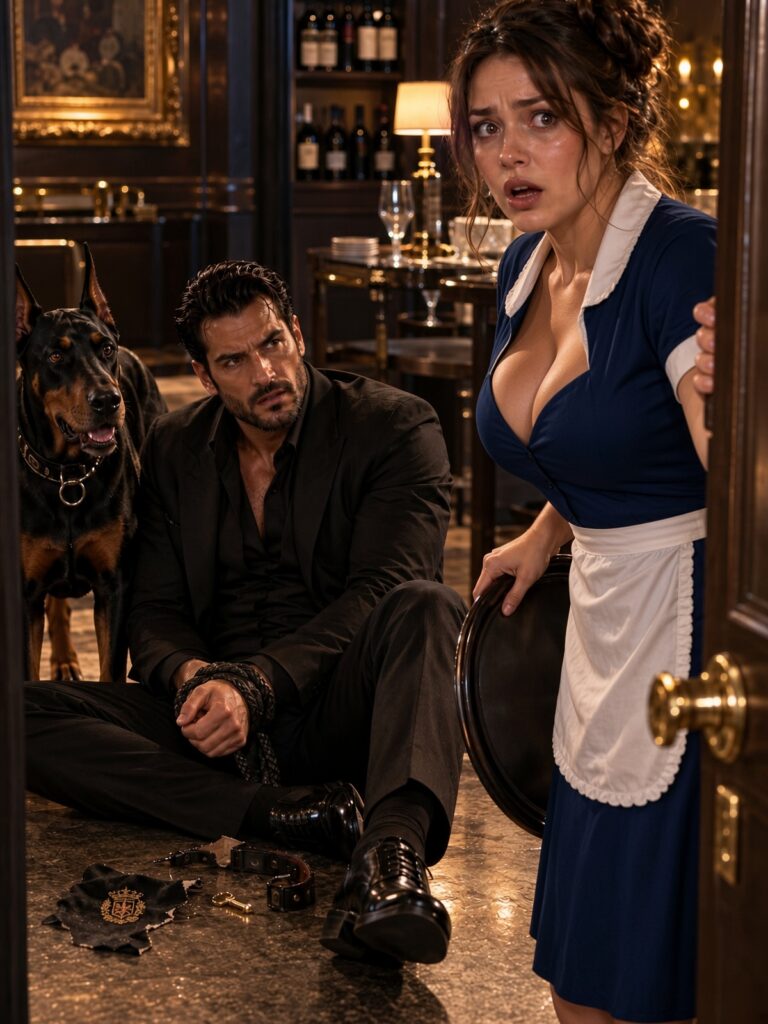
Maeve Nolan followed a muffled whimper into a freezing alley and found a bleeding Cane Corso chained behind her diner, its muzzle cinched shut so tightly it could barely breathe.
She cut the dog free—then heard a man whisper from the darkness, “Don’t touch him.” The man was beaten, bleeding, and bound to the same iron pipe.
By sunrise, Maeve would discover she had dragged Arthur Romano—the man who controlled half the city’s waterfront—into her one-bedroom apartment, while the men who had left him to die were already looking for the woman who helped him escape.

PART 1 — THE MAN BEHIND THE DUMPSTER
The neon sign above Carmichael’s Diner buzzed like an insect trapped behind glass.
Maeve Nolan had hated that sound for seven years.
Tonight, after twelve hours carrying coffee, meatloaf, pie, complaints, and other people’s bad moods, it felt as though the electrical hum had moved inside her skull.
“Trash.”
Carmichael pointed toward two leaking black bags near the kitchen door.
Maeve looked at him.
“My shift ended four minutes ago.”
“And yet the garbage remains.”
“Miraculous observation.”
His face hardened.
Maeve took the bags.
Rent was six days away.
Sarcasm was cheaper than unemployment.
Outside, November rain cut sideways through the alley.
Maeve hauled the first bag toward the green dumpster, boots splashing through oily puddles.
She threw it over the rim.
Then heard a sound.
Low.
Ragged.
Not human.
Not quite animal either.
Maeve stopped.
Another sound came from behind the dumpster.
A muffled whine.
She reached into her apron and wrapped her fingers around the utility cutter she used for cardboard boxes.
“Hey.”
Nothing.
“I have trash and eleven dollars.”
“If you’re planning a robbery, this is going to disappoint everybody.”
She moved around the dumpster.
Two gold eyes reflected the distant streetlight.
A dog.
Huge.
Brindle.
Cane Corso.
Its muzzle had been bound with heavy plastic ties.
A chain circled its neck and connected it to a pipe running along the brick wall.
Blood darkened its coat.
“Oh, God.”
Maeve crouched.
The dog flinched violently.
“I’m not touching you yet.”
She held out one hand.
“See?”
The animal’s chest heaved.
Maeve moved closer by inches.
“I know.”
“I hate strangers too.”
Finally her palm touched its shoulder.
Every rib was visible beneath the wet fur.
Maeve slid the cutter carefully beneath the plastic around its muzzle.
One pull.
Nothing.
Second.
The tie snapped.
The dog dragged in air.
Then pressed its massive head against Maeve’s chest.
She closed her eyes.
“Yeah.”
“I know.”
Her fingers moved toward the chain.
A shadow shifted beyond the dog.
Maeve jerked backward.
The cutter came up.
“Don’t.”
A man’s voice.
Barely there.
Dragged through gravel.
Maeve squinted.
Someone sat against the wall behind the dog.
Dark suit.
White shirt almost black with blood.
Hands bound above him to the same pipe.
His head hung forward.
Rain ran from his hair.
“Jesus Christ.”
He lifted his face.
One eye swollen shut.
The other pale gray.
Cold.
Alert.
Completely wrong for a dying man.
“Walk away.”
Maeve stared.
“You’re tied behind my dumpster.”
“You don’t want this.”
“Correct.”
She crawled closer.
“But apparently wanting things isn’t how my evening works.”
She cut at the restraint around his right wrist.
The plastic finally gave.
His arm dropped.
He groaned but swallowed the sound.
The second restraint came loose more slowly.
When it snapped, his entire body folded forward.
Maeve caught him.
He was brutally heavy.
“Stay awake.”
“Maeve.”
She froze.
He nodded weakly toward her name tag.
“Go home.”
“You first.”
She freed the dog’s chain.
Then dragged the stranger upright.
The three of them staggered through rain toward her twenty-six-year-old Honda.
Headlights turned into the alley behind them.
A black SUV.
Slow.
Searching.
Maeve shoved the man into the passenger seat.
The dog climbed into the back.
Her engine coughed twice before catching.
She drove.
Three streets later, the man grabbed her wrist.
“No hospital.”
“You need one.”
“They’ll find me.”
“You’re bleeding through my seat.”
“They’ll kill you too.”
Maeve looked at him.
He meant it.
An hour later, after a discreet emergency physician Arthur trusted had stabilized the worst wound and left through Maeve’s rear stairwell without asking questions, Maeve returned to her kitchen.
Something silver lay beside the ruined suit jacket.
A heavy Zippo lighter.
She turned it over.
A Roman numeral had been engraved into the metal.
V.
Maeve’s stomach dropped.
She knew that mark.
Every bartender, landlord, dockworker, and small-business owner in the city did.
She walked slowly toward the bedroom doorway.
The injured stranger was awake.
Watching her.
Maeve lifted the lighter.
“No.”
The gray eye held hers.
She whispered:
“You’re Arthur Romano.”
He said nothing.
That was answer enough.
Maeve looked toward Duke sleeping beside the mattress, then toward the man newspapers called the Architect—the syndicate boss half the city was too afraid to name aloud.
Outside, tires moved slowly along her street.
Searching.
Arthur’s voice came quietly from the dark.
“Now you understand why I told you to walk away.”
PART 2 — THE WOMAN WHO WOULD NOT LOOK AWAY
Maeve did not scream.
She wanted to.
She also wanted to throw Arthur out, lock every door, call three police departments, quit Carmichael’s, and move to a town where the most dangerous thing in the alley was an aggressive recycling bin.
Instead, she stood in the doorway holding the silver lighter.
“How many people are looking for you?”
Arthur’s answer came after a pause.
“Enough.”
“Excellent.”
Maeve put the lighter on the dresser.
“How many know you’re alive?”
“Very few.”
“How many know I exist?”
“Hopefully none.”
The word hopefully did not help.
Maeve folded both arms.
“You said those men would kill me too.”
“Yes.”
“Why?”
“Because if they learn you helped me, they will assume I told you things.”
“You’ve told me almost nothing.”
“They won’t know that.”
She stared at him.
“And the police?”
Arthur’s mouth tightened.
“I don’t know which ones I can trust yet.”
“Comforting.”
“No.”
He shifted.
Pain crossed his face before he could hide it.
Maeve noticed.
Arthur hated that she noticed.
Good.
At least the irritation was mutual.
“You need sleep.”
Maeve said.
“I need a phone.”
“You need antibiotics.”
“I need both.”
She tossed him the cheap prepaid phone she kept for work emergencies.
“No internet.”
“Better.”
Arthur dialed from memory.
Maeve turned away deliberately.
“I’m not listening.”
“You should.”
She looked back.
“Why?”
“Because you’re already involved.”
“I hate that sentence.”
“So do I.”
He called someone named Nico.
No surnames.
No explicit details.
Arthur said he was alive.
Said somebody inside his organization had leaked his route.
Ordered no retaliation until he knew who.
That surprised Maeve.
The Arthur Romano she knew from rumors was supposed to react to betrayal by turning neighborhoods into cautionary tales.
Instead he said:
“Freeze access.”
“Change routes.”
“Move no one until I know where the leak came from.”
Then:
“And nobody comes near this address until I authorize it.”
Maeve pointed at herself.
“Strongly support that last one.”
Arthur ended the call.
The phone trembled slightly in his hand.
Not fear.
Weakness.
He was still injured.
Human.
Maeve disliked how easy it was to forget.
Morning entered through the dirty windows.
Arthur developed a fever before seven.
Maeve called the physician who had treated him during the night.
Dr. Samuel Higgins returned in a plain jacket and looked annoyed at everyone involved.
“You should be in a monitored bed.”
Arthur answered:
“I would prefer not to be.”
“I would prefer patients with common sense.”
“Neither of us is getting everything.”
Higgins checked the wound, listened to Arthur’s lungs, examined his ribs, and started a proper course of antibiotics.
“No improvised heroics.”
he told Maeve.
“If he becomes confused, can’t breathe normally, develops worsening abdominal pain, or spikes a high fever, you call me and we relocate him whether he likes it or not.”
Maeve nodded.
Arthur did not.
Higgins looked at him.
“That was not addressed to you.”
Maeve immediately liked the doctor.
Arthur did not argue.
That frightened her more than if he had.
Before leaving, Higgins looked at Duke.
“You get the dog checked too.”
Arthur’s face changed.
First real alarm Maeve had seen.
“Is he hurt?”
“Malnourished.”
“Cut around the muzzle.”
“Probably dehydrated.”
Maeve said:
“I can take him.”
Arthur looked at her.
“No.”
“You’re half dead.”
“I’m improving.”
“You’re currently being defeated by my mattress.”
Duke rested his head across Arthur’s ankle.
Maeve pointed.
“Your witness disagrees.”
Higgins arranged for a trusted veterinary technician to come quietly.
The dog’s injuries were painful but manageable.
By noon, Duke had eaten two bowls of food and stolen one slice of Maeve’s toast.
That felt like victory.
Arthur told Maeve to go to work.
She laughed at him.
“You want me to serve eggs while a criminal search party circles my block?”
“You miss a shift the morning after I disappear behind your diner, someone may notice.”
Maeve stopped laughing.
Arthur continued.
“Your routine protects you.”
“Temporarily.”
“What about you?”
“I stay out of sight.”
“And if you collapse?”
“I have Higgins’s number.”
“And hands.”
“And an impressive capacity for stubbornness.”
Maeve pointed at him.
“If you die on my couch, I’m charging your estate for cleaning.”
“I’ll make a note.”
She changed clothes.
Before leaving, she looked at Arthur.
“Do not answer my door.”
“I run a criminal organization, Maeve.”
“I understand doors.”
“That remains under review.”
At one-thirty that afternoon, three men entered Carmichael’s.
Maeve knew immediately.
Leather jackets.
Wrong posture.
Eyes checking exits instead of menus.
One had a scar through his upper lip.
They sat in her section.
Carmichael appeared from the kitchen.
Too quickly.
His smile too large.
Maeve noticed that too.
“What can I get you?”
“Coffee.”
Scar Lip said.
“Black.”
She poured three cups.
Returned.
As she placed the last mug down, the man looked at her.
“You worked closing last night?”
“Every miserable minute.”
“See anything behind the diner?”
Maeve shrugged.
“Rain.”
“Garbage.”
“A raccoon with more confidence than me.”
The man smiled without warmth.
“No trouble?”
“Depends.”
“Carmichael charged a truck driver fourteen dollars for pancakes.”
“I thought there might be a riot.”
Scar Lip’s eyes studied her.
Maeve let exhaustion cover fear.
It was easy.
She had more exhaustion.
“You hear about a guy getting hurt?”
“No.”
He leaned back.
“What time did you leave?”
Maeve looked at him.
“Are you asking as law enforcement or as a creepy man who drinks bad coffee?”
One of his companions almost smiled.
Scar Lip did not.
“Just curious.”
“Well, curiosity isn’t free.”
Maeve held out her hand.
“Three coffees.”
“Six dollars.”
He paid.
She walked away.
Her knees nearly failed behind the counter.
Carmichael avoided her eyes for the rest of the shift.
That bothered her.
At seven, Maeve returned home carrying groceries, dog food, and the cheapest soup she could find.
Duke met her at the door.
Tail wagging.
Arthur sat upright on the couch wearing one of Maeve’s oversized sweatshirts stretched almost offensively across his shoulders.
The sight was so ridiculous Maeve stopped.
“What?”
Arthur asked.
“Nothing.”
“You’re smiling.”
“I’m observing crime.”
“I’m wearing clothing.”
“You’re wearing a shirt with a cartoon duck on the sleeve.”
Arthur looked down.
There was, in fact, a duck.
Maeve laughed.
Arthur’s expression became offended.
That made it worse.
“You own better clothes?”
“Most people do.”
She handed him a grocery bag.
“Soup.”
He looked inside.
“Canned.”
“Do not insult your host.”
“I’m assessing.”
“That is rich-man language for insulting things quietly.”
Arthur almost smiled.
Then Maeve told him about the diner.
His face changed immediately.
“Scar through the lip?”
“Yes.”
“Mick Sullivan.”
“You know him?”
“Unfortunately.”
“Did Carmichael speak to them?”
“I didn’t see.”
Arthur looked toward the window.
“Sullivan’s people were part of the crew that hit me.”
“Part?”
Maeve sat opposite.
“What does that mean?”
Arthur was silent.
Then:
“They had my schedule.”
“Security configuration.”
“Vehicle change.”
“Something only people inside my organization knew.”
“So you have a traitor.”
“Yes.”
“Do you know who?”
“No.”
Maeve looked around her apartment.
“Wonderful.”
Arthur’s gaze returned to her.
“I will get you out when it’s safe.”
“Where?”
“Somewhere protected.”
“No.”
His eyebrow moved.
“No?”
“I’m not disappearing into some bunker because your employees have trust issues.”
“Maeve.”
“My rent is still due.”
“My job still exists.”
“My life doesn’t vanish because yours exploded in my alley.”
Arthur’s jaw tightened.
“You cannot keep living normally if Sullivan identifies you.”
“Then maybe we focus on not letting him identify me.”
Arthur studied her.
Then slowly nodded.
“All right.”
The fact that he changed strategy instead of arguing unsettled Maeve.
She had expected command.
He had listened.
That was more dangerous.
The strange domestic routine lasted three days.
Maeve worked.
Arthur recovered.
Duke adopted the couch and apparently both humans.
Maeve discovered Arthur hated canned green beans.
Arthur discovered Maeve fell asleep watching late-night television and woke whenever anyone touched the remote.
On the second evening, she found him repairing the loose leg on her kitchen chair.
“What are you doing?”
“It was unstable.”
“It has been unstable for two years.”
“Yes.”
“That’s its personality.”
Arthur tightened the screw.
“Now it has a new personality.”
Maeve watched him.
“Do mafia bosses usually repair furniture?”
“No.”
“Good.”
“I was worried this was cultural.”
Arthur gave her a look.
For several minutes, the apartment felt almost normal.
That frightened both of them.
On the third night, Arthur received a call from Nico.
He moved toward the kitchen window.
Listened.
Maeve pretended to read.
Could not.
Finally Arthur said:
“Say that again.”
Silence.
Then:
“You’re certain?”
He ended the call.
Maeve put down the magazine.
“What?”
“My driver is dead.”
The room changed.
Maeve’s humor disappeared.
“I’m sorry.”
Arthur stared at the phone.
“Leo had been with me sixteen years.”
Maeve waited.
Arthur’s face became the cold expression newspapers knew.
But now she had seen what lived beneath it.
“Was he the leak?”
“No.”
“You sure?”
“He changed the route that night at my instruction.”
“Only four people knew the change.”
Arthur looked toward the floor.
“Leo was one.”
“Me.”
“Nico.”
“And Victor Caruso.”
“Who’s Victor?”
“My operations director.”
“Thirty years with the family.”
Maeve’s stomach tightened.
“Then either someone listened…”
“Or Victor sold me.”
Arthur finished.
Duke pressed against his leg.
Arthur rested one hand on the dog’s head.
His fingers trembled once.
Maeve pretended not to see.
The next morning, Maeve found Arthur standing at her refrigerator looking at a notice held beneath a chipped magnet.
FINAL RENT WARNING.
She snatched it down.
“Privacy.”
Arthur looked at her.
“How far behind?”
“Not your business.”
“Maeve.”
“No.”
He stopped.
She expected him to continue.
He didn’t.
After a moment Arthur said:
“Fine.”
Maeve narrowed her eyes.
“That’s it?”
“You said no.”
“Yes.”
“So that’s it.”
She stared.
Most men with power treated no as the opening paragraph of negotiation.
Arthur returned to his coffee.
Maeve hated how much that small act affected her.
At the diner, Carmichael grew strange.
Nice.
That was worse.
He offered Maeve a break.
He had never voluntarily offered anyone a break.
“Why are you being creepy?”
“I’m being a good employer.”
“You once charged me for a plate a customer broke.”
“Business was tight.”
“Business is always tight when my paycheck arrives.”
Carmichael’s smile disappeared.
Maeve watched him.
Something was wrong.
She went into the office during her break.
Not snooping.
Looking for the new schedule.
On Carmichael’s desk sat an envelope.
Cash visible inside.
Beside it:
A printed photograph of Maeve’s Honda.
Her throat went dry.
She did not touch anything.
She walked out.
Finished the shift.
Then called Arthur from the alley.
“Carmichael sold me.”
Silence.
“How do you know?”
“Photo of my car on his desk.”
“Cash.”
Arthur’s breathing changed.
“Leave through the front.”
“Do not go home.”
“Where?”
“I’ll send a car.”
“No.”
“Maeve.”
“No strange cars.”
“Fine.”
He corrected himself instantly.
“Go to the twenty-four-hour pharmacy on Winston.”
“Stay under cameras.”
“Nico will meet you.”
That she accepted.
Because it was a plan built around her fear instead of over it.
Maeve reached the pharmacy.
Nico arrived seven minutes later in an ordinary gray sedan.
He did not approach her until she nodded.
“Arthur said you might prefer that.”
Maeve hated how much she appreciated it.
“Where is he?”
“Your apartment.”
“What?”
“He refused extraction until you were clear.”
“That idiot.”
Nico’s mouth moved.
“Yes.”
Maeve got into the car.
Halfway there, Arthur called.
“Do not come back.”
“You are in my apartment.”
“Yes.”
“Then stop giving me orders from my furniture.”
“Maeve.”
The phone filled with a heavy crash.
Arthur stopped speaking.
Maeve went cold.
Then barking.
Duke.
Another crash.
Nico swore and turned the car sharply.
“What’s happening?”
Maeve demanded.
“Arthur?”
No answer.
The call remained open.
Then a man’s voice in the distance.
“Romano!”
Gunfire cracked faintly through the speaker.
Maeve’s blood turned to ice.
Nico accelerated.
“No.”
Maeve said.
“What?”
“No.”
She gripped the dashboard.
“I am not driving toward a gunfight.”
Nico looked at her.
Correct.
He called his team.
Professional security and local police had already been alerted through a report on suspicious armed men entering the building.
Maeve insisted.
“No vigilante extraction.”
Nico’s jaw tightened.
“Arthur will hate that.”
“Arthur can file a complaint if he survives.”
The next eight minutes lasted an hour.
Police arrived first.
Nico’s security team secured the exterior.
Residents evacuated through the rear.
Maeve stood across the street in freezing drizzle, every muscle shaking.
Then Duke appeared at the entrance.
Brindle body wet.
Running.
Maeve’s knees almost gave out.
Arthur followed.
One arm around his ribs.
Blood at his temple.
Alive.
Police moved around him.
Questions.
Chaos.
Two attackers were arrested inside.
Another fled through the rear but was caught nearby.
No rooftop battle.
No heroic massacre.
Just evidence.
Weapons.
Phones.
Faces.
Arthur crossed the street toward Maeve.
She slapped him.
Not hard.
Enough.
Nico looked away.
Arthur touched his cheek.
“What was that?”
“You stayed in my apartment while armed men were coming.”
“I needed to—”
“You needed to get out.”
“I was trying to protect—”
“Stop.”
Maeve’s eyes filled.
“Do not say protect when you mean you decided my home was worth risking because your pride couldn’t retreat.”
Arthur went completely still.
Rain slid down his face.
Maeve pointed toward the building.
“That apartment is all I have.”
Arthur looked at the shattered window upstairs.
Then back.
“You’re right.”
She blinked.
“I’m furious.”
“I know.”
“I may remain furious.”
“You should.”
Maeve wiped her face angrily.
“That was a very inconvenient answer.”
Arthur almost smiled.
Then winced.
His ribs still hurt.
Maeve could not return home.
Police needed the apartment as a crime scene.
Arthur offered his estate.
She refused.
Then looked at Duke.
At her boarded window.
At the reporters already appearing at the far end of the block.
“One night.”
Arthur nodded.
“One night.”
“No money.”
“No wardrobe.”
“No makeover.”
“No room with a fountain.”
His mouth twitched.
“There is no bedroom fountain.”
“Rich people lose perspective.”
“Understood.”
Arthur’s estate stood outside the city behind stone walls and trees.
Maeve stared.
“This is absurd.”
“It’s a house.”
“No.”
“This is where emotionally unavailable vampires hold shareholder meetings.”
Nico laughed openly.
Arthur looked betrayed.
Maeve smiled despite everything.
Inside, an older woman named Teresa met them.
She looked at Arthur’s injuries.
Then Maeve.
“You’re the waitress.”
“Apparently.”
Teresa kissed Maeve’s cheek.
Then slapped Arthur lightly on the shoulder.
“You brought gunmen to her apartment?”
Arthur sighed.
“I did not bring them.”
“You brought the life that brought them.”
Maeve immediately loved Teresa.
Arthur seemed resigned to democracy forming against him.
Later, Arthur met privately with Nico and attorneys.
Maeve was given a guest room with a lock on the inside.
No guards at the bedroom door.
No instructions beyond:
“If you need anything, Teresa is across the hall.”
Maeve showered.
Then stood by the enormous window.
Her life felt gone.
Diner.
Apartment.
Routine.
Even the stupid buzzing neon sign.
All because she had followed a whimper into the rain.
A knock came.
Arthur.
“I brought food.”
“Leave it.”
“All right.”
His footsteps receded.
Maeve stared at the closed door.
He had learned quickly.
That mattered.
The phones recovered from the attackers changed everything.
Not instantly.
Evidence rarely behaves that dramatically.
But messages linked Sullivan’s crew to payments from a company controlled by Victor Caruso.
Arthur’s thirty-year operations director.
The same man who knew the last-minute route change.
Nico brought the report into Arthur’s study.
Maeve happened to be there because Teresa had sent her to return a tray.
She saw Arthur’s face.
Not rage.
Something worse.
Grief compressed into stillness.
“Victor?”
she asked.
Arthur nodded.
“He practically raised me after my father died.”
Maeve understood too well what betrayal did when it wore a familiar face.
“Why?”
“Money.”
“Succession.”
“Maybe resentment.”
Arthur looked toward the dark window.
“Men create elegant reasons after greed makes the first decision.”
“What happens now?”
His eyes went cold.
Maeve braced.
Then Arthur said:
“My lawyers give the evidence to investigators handling the assault.”
She blinked.
“No private basement?”
“No.”
“You sound disappointed.”
“I am adjusting to your reputation.”
Arthur almost smiled.
Then:
“I want the entire network disconnected from anything I control.”
“Quietly.”
“Lawfully where possible.”
“And Sullivan?”
“Police already have enough from the apartment attack to start.”
Maeve looked at him.
“You could destroy them yourself.”
“Yes.”
“Why not?”
Arthur’s eyes held hers.
“Because three days in your apartment taught me something humiliating.”
“What?”
“I am very good at winning wars.”
“I am less certain I’ve ever ended one.”
Maeve said nothing.
That answer stayed with her.
Caruso attempted to run.
He did not get far.
Financial records, recovered communications, and testimony from two arrested attackers tied him to the assault on Arthur and to Sullivan’s payments.
Arthur met him once.
With attorneys present.
Recorded.
Maeve learned later only because Arthur told her.
“You wanted to go?”
“No.”
“Why meet him?”
“Because I needed to know whether thirty years had ever been real.”
“And?”
Arthur looked tired.
“Some of it.”
Maeve understood.
People could love you and still betray you.
Truth refused clean categories.
That was deeply inconvenient.
The Sullivan organization fractured under arrests and internal distrust.
Mick Sullivan faced multiple charges connected to Arthur’s abduction and the apartment attack.
Arthur’s own businesses attracted scrutiny too.
That part irritated him.
Maeve said:
“You don’t get to be offended investigators noticed the mob boss.”
“I am not offended.”
“You have an offended eyebrow.”
“I have one eyebrow.”
“Exactly.”
Arthur cooperated through counsel where legally required.
He separated several legitimate companies from people connected to violent operations.
It cost him money.
Control.
Some allies.
Maeve watched from a distance.
She did not congratulate him for obeying laws.
He seemed to understand that.
After four days at the estate, Maeve packed.
Arthur found her near the front hall.
“Where are you going?”
“Back to work.”
“Carmichael sold your plate information.”
“Then I am going back to collect my paycheck and tell him exactly what I think of his career choices.”
“You cannot work for him.”
Maeve turned.
“Careful.”
Arthur stopped.
Rephrased.
“I do not think working there is safe.”
“Better.”
“Also correct.”
“Probably.”
Arthur took a breath.
“I can arrange—”
“No.”
He closed his mouth.
Maeve’s expression softened despite herself.
“I need to build what happens next.”
“I cannot go from barely surviving under Carmichael to living in your estate because you feel indebted.”
“That isn’t freedom.”
Arthur looked at her.
“I owe you my life.”
“I didn’t save you to collect it.”
“I know.”
“Then let the debt end.”
He hated that.
She could see.
Good.
Arthur asked:
“What do you need?”
“My apartment repaired.”
“I can work with victim-assistance resources and insurance first.”
“Any remaining damage from the attack is on the people who caused it.”
“Not a secret Arthur fund.”
“Understood.”
“And Duke?”
Arthur looked toward the dog sitting beside the stairs.
Duke immediately walked to Maeve.
Sat on her foot.
Maeve stared.
Traitor.
Arthur’s mouth twitched.
“Apparently Duke has voted.”
Maeve scratched the dog’s ears.
“We can share custody.”
Arthur raised an eyebrow.
“Negotiable.”
Maeve returned to Carmichael’s that afternoon.
Carmichael looked as if he had not slept.
“Maeve.”
She untied her coat slowly.
“You sold surveillance footage.”
“I was scared.”
“Of Sullivan?”
“Yes.”
“So you traded me instead.”
“I didn’t know what they wanted.”
Maeve looked at him.
“You did not ask because the cash was already in your hand.”
Carmichael’s face reddened.
“You think you’re better than me because Romano—”
“No.”
Maeve’s voice remained calm.
“I think I’m done working for a man who sold an employee because he decided his fear was worth more than her safety.”
She placed her apron on the counter.
“My final check.”
“And unpaid overtime.”
“You don’t have—”
“My attorney will send the hours.”
Carmichael blinked.
“You have an attorney?”
“No.”
“Arthur has seven.”
“He is lending me one for labor-law consultation.”
She smiled thinly.
“Apparently rich people are occasionally useful.”
Then she walked out.
The broken neon sign buzzed above her.
For the last time.
PART 3 — THE DINER WITH HER NAME ON THE DEED
Maeve spent the next month discovering that surviving something dramatic did not make the ordinary parts easier.
Rent still existed.
Her Honda still made a clicking sound every third morning.
Her savings remained insulting.
Employment applications asked why she left Carmichael’s.
Maeve resisted writing:
EMPLOYER SOLD ME TO ORGANIZED CRIME.
Instead:
Seeking safer working environment and advancement.
Technically true.
She found temporary breakfast shifts at a hotel restaurant.
Less money.
Better manager.
No one snapped fingers.
That alone felt luxurious.
Arthur did not disappear.
He also did not take over.
That distinction mattered more than Maeve expected.
Sometimes Duke arrived in a black SUV with Nico, because apparently shared dog custody required transportation usually reserved for heads of state.
Arthur came himself twice.
The first time he brought coffee.
Maeve opened her apartment door.
“You remembered.”
“Cream.”
“One sugar.”
She frowned.
“It was two sugars before.”
“You changed it at the estate.”
Maeve hated the warmth that moved through her.
“Creepy.”
“Observant.”
“Same neighborhood.”
Duke pushed past both of them.
Arthur stayed outside until Maeve stepped aside.
Choice.
Always choice now.
He was learning.
So was she.
Maeve’s apartment eventually became livable again.
New window.
New lock.
Damaged furniture replaced through restitution funds and insurance.
Arthur paid nothing directly.
She checked.
Twice.
“You truly believed I would sneak money into an insurance claim?”
“Yes.”
“Fair.”
He seemed almost proud she checked.
Maeve found that attractive.
This was becoming a serious problem.
One Saturday, Arthur asked her to lunch.
“Public.”
Maeve said.
“Yes.”
“No private back room.”
“Yes.”
“No armed men at the table.”
“They’ll be outside.”
“I can live with outside.”
They ate sandwiches at a place near the river.
Arthur wore a dark sweater instead of a suit.
It made him look less like a headline.
More dangerous somehow.
Maeve stared too long.
Arthur noticed.
“What?”
“You look strange.”
“Strange?”
“Normal.”
He almost smiled.
“Insulting.”
“Survive.”
They ate.
For ten minutes, nothing dramatic happened.
Maeve realized she liked that.
Arthur told her about Duke.
He had found the dog as a pup after one of his warehouses burned.
Duke had been wandering outside near firefighters.
No chip.
No owner.
Arthur kept him.
“Why?”
Maeve asked.
“He bit Nico.”
Maeve laughed.
“Excellent judgment.”
“Nico disagreed.”
Arthur looked toward the river.
“Duke stayed beside me when my father died.”
The sentence came quietly.
Maeve did not make a joke.
Arthur looked at her.
“Thank you.”
“For what?”
“For not turning that into sympathy.”
“You don’t need sympathy.”
“No.”
“What do you need?”
Arthur thought.
“I’m still learning.”
Maeve nodded.
Good answer.
Weeks passed.
Arthur’s name stayed in newspapers.
Investigations.
Business restructuring.
The Caruso betrayal became part of a wider prosecution.
Mick Sullivan remained jailed pending trial.
Arthur’s reputation changed slightly.
Not softer.
More complicated.
Some called him weakened because several of his operations had been shuttered.
Others said he had become more dangerous because he moved legitimate businesses under transparent management and stopped letting old associates feed off them.
Maeve did not care.
Arthur still came to her apartment sometimes and argued with the radiator.
That was the version she knew.
Carmichael’s Diner closed in February.
Maeve learned from a former coworker.
Tax debt.
Unpaid vendors.
The assault investigation had damaged business.
Carmichael sold.
Maeve stood outside the darkened windows one evening.
The dead neon sign looked pathetic.
Duke sat beside her.
Arthur stood several feet away.
“You brought me here intentionally.”
Maeve said.
“Yes.”
“Why?”
“The building is being auctioned.”
Maeve laughed.
“Okay.”
Arthur handed her a folder.
“No.”
“You haven’t opened it.”
“Folders from you ruin my week.”
“Open it.”
She did.
Property appraisal.
Equipment list.
Estimated repair costs.
Then an offer to purchase.
Not Arthur’s name.
Maeve’s.
She looked up.
“What is this?”
“A financing proposal.”
Her eyes narrowed.
Arthur continued quickly.
“Not a gift.”
“An independent lender.”
“Down payment funded from the restitution settlement Carmichael owes employees after your wage claim.”
“Additional amount from the sale of the watch.”
Maeve blinked.
“The Patek?”
“Yes.”
“I thought you took it back.”
“I did.”
“Then sold it.”
“Why?”
Arthur’s gaze held hers.
“Because that watch bought the first twenty-four hours of my life.”
“It seemed appropriate that whatever remained should help buy the place where you were trapped for seven years.”
Maeve stared at the papers.
The numbers were real.
Not fantasy.
Not a free building.
A mortgage she could actually afford if the diner operated well.
Arthur had arranged nothing she could not verify.
Her lawyer had a contact number.
Independent title company.
No hidden ownership.
No Romano lien.
Maeve’s throat tightened.
“You thought of everything.”
“No.”
Arthur looked toward the diner.
“You’ll think of the things I missed.”
She read the first page again.
“Why not just buy it and give it to me?”
His expression changed.
“Because you told me exactly why you would hate that.”
Maeve looked at him.
Something inside her shifted.
Not because he had offered property.
Because he had listened.
Maeve bought Carmichael’s.
Not easily.
Loan underwriting.
Licenses.
Inspections.
A horrifying plumbing report.
One ancient fryer condemned by the city.
Arthur never interfered.
He offered contacts.
Maeve accepted three.
Rejected six.
Arthur complained exactly zero times.
Nico complained enough for everyone.
“You rejected the refrigeration contractor.”
“He quoted me forty percent over market.”
“He is excellent.”
“He is robbing you.”
Nico thought.
“That explains why Arthur likes him.”
Maeve smiled.
Arthur, standing nearby, said:
“I am reconsidering several relationships.”
Maeve renamed the diner.
Not after herself.
Not after Arthur.
DUKE’S.
Arthur stared at the new sign.
“You named the restaurant after my dog.”
“Our dog.”
Arthur looked down at Duke.
The dog appeared smug.
Maeve added:
“He had the most important role.”
“I was also tied to the pipe.”
“You complained more.”
Arthur accepted defeat.
Opening day arrived in spring.
Fresh paint.
Working neon.
Clean kitchen.
New heater.
Staff paid above the old rate.
Every employee received a written harassment policy.
No hidden cameras.
No off-books wages.
Maeve installed bright lights in the alley.
Security camera coverage aimed only at entrances and trash area.
Emergency call button.
The dumpster moved closer to the door.
Small changes.
Specific changes.
Trauma turned into architecture.
Arthur arrived at six in the morning.
Before opening.
No entourage.
Duke beside him.
Maeve was behind the counter adjusting coffee filters.
“You’re early.”
“You said opening at seven.”
“You do not work here.”
“I am a customer.”
“We’re closed.”
“I know the owner.”
“She has boundaries.”
Arthur sat anyway.
Maeve poured coffee.
Set it in front of him.
“Three dollars.”
Arthur looked offended.
“I financed part of the building.”
“You did not.”
“Correct.”
“Three dollars.”
Arthur placed five on the counter.
Maeve returned two.
“No special treatment.”
He smiled.
“Yes, boss.”
The bell above the door chimed.
First customer.
An elderly bus driver.
Maeve straightened.
“Morning.”
Arthur watched her move behind the counter.
Not serving because she had nowhere else to go.
Serving in a place she owned.
That difference changed everything.
Romance did not arrive dramatically.
No gala.
No kidnapping recovery kiss.
No rain.
It arrived on Tuesday mornings.
Arthur delivering Duke.
Maeve saving him pie without admitting she saved him pie.
Text messages about whether Cane Corsos should be permitted on couches.
Arguments about coffee.
One evening Arthur stayed after closing to help stack chairs.
Maeve watched him.
“You’re doing that wrong.”
“They’re chairs.”
“There is a system.”
“Of course there is.”
“Do not mock management.”
Arthur smiled.
“I would never.”
The diner became quiet.
Maeve wiped the counter.
Arthur stood on the other side.
The same counter where powerful men now paid exactly the same price as everyone else.
“You know what’s weird?”
Maeve asked.
“What?”
“You terrified me more when you were helpless.”
Arthur raised an eyebrow.
“In your bathtub?”
“Yes.”
“Why?”
“Because you needed something.”
Maeve looked down at the rag.
“People needing me has always been dangerous.”
Arthur became very still.
She continued.
“My mother needed money.”
“My old boss needed extra shifts.”
“Boyfriends needed understanding.”
“Everybody needed something and somehow I always became the payment.”
Arthur’s voice came quietly.
“I need things from you.”
Maeve looked up.
“Like what?”
“Honesty.”
“Time.”
“Sometimes patience.”
“I want affection.”
“I want your company.”
He paused.
“But none of those become debts because I want them.”
Maeve felt heat behind her eyes.
“That was disgustingly healthy.”
“I have counsel.”
She laughed.
Then Arthur said:
“Can I kiss you?”
Maeve stopped laughing.
There it was.
The question.
Not assumption.
Not rescue turned reward.
Her choice.
“Yes.”
He kissed her across the counter.
Slow.
Careful.
Duke sneezed loudly between them.
Maeve pulled away laughing.
“Romantic.”
Arthur looked at the dog.
“Traitor.”
Months later, Maeve learned Arthur still had instincts that frightened her.
A supplier insulted her.
Arthur wanted him blacklisted from half the city.
Maeve said no.
He argued.
She told him to leave the diner.
Arthur did.
That part mattered.
He came back the next morning.
Paid for coffee.
Apologized.
“I thought protection meant eliminating problems.”
Maeve leaned against the counter.
“And?”
“Sometimes it means allowing you to decide which problems are yours.”
“Good.”
“I still dislike the supplier.”
“You’re allowed feelings.”
“Generous.”
Maeve smiled.
Growth was irritatingly uncinematic.
Mostly repetition.
Caruso pled guilty to conspiracy charges connected to Arthur’s kidnapping and financial crimes within Romano-controlled companies.
Arthur attended no private revenge ceremony.
There wasn’t one.
Maeve asked:
“Does that feel unfinished?”
Arthur thought.
“Yes.”
“Good.”
He looked surprised.
Maeve continued.
“Maybe unfinished is what keeps you from turning everything into blood.”
Arthur did not answer immediately.
Then:
“Maybe.”
Sullivan went to trial.
Evidence from the apartment attack, captured communications, financial transfers, and testimony from several associates made the case stronger than Arthur’s personal revenge ever could have.
Maeve testified only regarding what she had seen.
The alley.
The diner questioning.
The invasion of her apartment.
She hated court.
The defense attorney asked why she helped Arthur instead of calling police immediately.
Maeve answered:
“Because he was bleeding beside a dog whose mouth had been tied shut.”
“And because he told me the people looking for him might include compromised officers.”
“Was that reasonable?”
“At three in the morning in freezing rain?”
Maeve looked at the jury.
“Nothing felt reasonable.”
The attorney asked whether she had later received financial benefits from Arthur.
Maeve smiled faintly.
“I received a business loan from an independent lender.”
“And a watch was sold.”
“Yes.”
“Was that compensation?”
“No.”
“The watch paid for emergency costs from the night I saved him.”
“The loan is being repaid monthly.”
“Would you like my accountant?”
A juror hid a smile.
Arthur heard about the exchange later.
“You offered them your accountant?”
“I panicked.”
“I’m proud.”
“Don’t be.”
Maeve repaid the diner loan faster than projected.
Not because Arthur secretly helped.
Because Duke’s became successful.
Night-shift nurses.
Dockworkers.
Bus drivers.
Construction crews.
College students.
People who wanted coffee without being judged for sitting too long.
Maeve kept one booth free between two and four in the morning for hospital workers.
Discount coffee.
No questions.
Arthur noticed.
“You lose money on that booth.”
“I know.”
“You’re keeping it.”
“Yes.”
Arthur smiled.
“Good.”
She narrowed her eyes.
“Do not make business decisions.”
“I said nothing.”
“You said it with your face.”
On the first anniversary of the alley, Maeve closed Duke’s early.
Arthur arrived after dark.
Rain had started.
Not hard.
Enough.
They walked behind the diner.
The old gas pipe remained.
Bright security light above it now.
No blood.
No restraints.
No fear.
Duke sniffed the bricks.
Then sat.
Maeve looked at the place where she had found him.
“You told me to walk away.”
Arthur stood beside her.
“Yes.”
“What would have happened if I did?”
“I would have died.”
The simplicity of it tightened her chest.
Arthur looked at her.
“You know what I think about most?”
“What?”
“You cut Duke loose first.”
Maeve smiled.
“He was nicer.”
“He was muzzled.”
“Exactly.”
Arthur laughed.
Then his expression changed.
“I spent years believing the only way to survive was to become the thing nobody wanted to approach.”
Maeve looked at him.
“And?”
“Turns out sometimes surviving depends on one exhausted woman ignoring good advice.”
“That should be on my business card.”
Duke grew fat.
Not dangerously.
Comfortably.
Maeve accused Arthur of overfeeding him.
Arthur accused Maeve.
Teresa blamed both.
Nico produced photographic evidence.
A family scandal.
One Sunday afternoon, Maeve sat on Arthur’s terrace with Duke sprawled across both their feet.
She looked toward the estate.
“Still vampire museum.”
Arthur sighed.
“You have eaten here every Sunday for a year.”
“Research.”
“And slept here.”
“Occasionally.”
“You have a drawer.”
“Temporary occupation.”
Arthur smiled.
“Maeve.”
“What?”
“I love you.”
She went completely still.
Arthur did too.
He had not planned it.
That helped.
Maeve looked at him.
“You don’t need me to say it back immediately?”
“No.”
“You’re sure?”
“Yes.”
She studied him.
Then:
“Good.”
Arthur almost looked wounded.
Maeve smiled.
“I love you too.”
His face changed.
The dangerous man disappeared.
For one second he looked younger.
Surprised.
Almost shy.
Maeve immediately ruined it.
“Don’t make that face.”
“What face?”
“The emotionally available one.”
“It’s unsettling.”
Arthur kissed her.
He proposed another year later.
At Duke’s.
After closing.
No ring hidden in food.
No public spectacle.
Arthur simply sat at the counter.
Maeve poured coffee.
He placed a small box beside the mug.
She stared.
“No.”
Arthur blinked.
“I haven’t asked.”
“I’m setting expectations.”
“Helpful.”
He opened it.
Simple ring.
Beautiful.
Not absurd.
Maeve noticed that too.
“I know you don’t want to leave the apartment above Duke’s yet.”
“Yes.”
“I know you do not want the diner transferred into any trust connected to me.”
“Yes.”
“I know you want separate accounts.”
“Yes.”
Arthur looked at her.
“I know marriage does not make any of those answers change.”
Maeve’s throat tightened.
He continued.
“So this is not an offer to merge our lives into one account.”
“It is an invitation to keep choosing each other while maintaining doors we can both open ourselves.”
Maeve put both hands on the counter.
“That sounds like lawyers helped.”
“Several.”
“Good lawyers?”
“Painfully.”
She laughed.
Arthur stood.
“Maeve Nolan.”
“Yes?”
“Will you marry me?”
She looked at Duke sleeping near the coffee machine.
At the deed framed discreetly in the office doorway.
At Arthur.
Then:
“Yes.”
“But you still pay for coffee.”
Arthur smiled.
“I expected nothing less.”
The wedding was small.
Teresa cried.
Nico denied crying.
Maeve’s old diner coworkers came.
Higgins attended and told Arthur he was still medically reckless.
Arthur said:
“Two years ago.”
Higgins replied:
“I hold grudges professionally.”
Duke wore a bow tie and attempted to eat part of Maeve’s bouquet.
No underworld summit.
No photographers.
No business alliances created.
Just people.
Marriage did not make Maeve safer because Arthur belonged to her.
It made both of them more responsible for understanding where protection ended and control began.
That line continued moving.
They kept talking.
Sometimes badly.
Sometimes after arguments.
Once Maeve did not speak to Arthur for an entire afternoon because he had quietly bought the building next to Duke’s without telling her.
“I bought it as an investment.”
“It shares my wall.”
“Yes.”
“You knew I was considering expanding.”
“Yes.”
“You bought the property before I could make my own offer.”
Arthur stopped.
The mistake arrived visibly.
Maeve folded her arms.
“What did you just do?”
“I removed one of your choices.”
“Yes.”
Arthur closed his eyes.
Then sold the building to an unrelated property company at cost.
Maeve later negotiated her own lease with that company.
No special rate.
Arthur hated every minute.
He survived.
Years passed.
The city changed.
Syndicates weakened under arrests, regulation, money moving into places where old forms of organized crime became less useful.
Arthur turned increasing energy toward legitimate port businesses.
Independent boards.
Compliance.
People who did not owe him personal loyalty.
It was less glamorous.
More durable.
Maeve teased him.
“You became corporate.”
“I remain terrifying.”
“Your accountant wears orthopedic shoes.”
“He is very dangerous.”
“To depreciation schedules?”
“Exactly.”
Duke’s expanded.
Not into a chain.
Maeve hated chains.
One second location near the hospital.
Same coffee.
Same no-nonsense service.
A small program covered meals for families spending long nights in pediatrics or intensive care.
No big plaque.
No Arthur Romano Foundation branding.
Maeve insisted.
“If people need a sandwich, they should not have to read your biography first.”
Arthur agreed.
Mostly.
One winter evening, years after the alley, a teenage dishwasher found an injured stray cat behind Duke’s.
The boy came inside panicking.
Maeve went out.
Arthur happened to be there.
He watched her crouch in the snow.
Same careful hand.
Same quiet voice.
The cat hissed.
Maeve waited.
Arthur smiled.
“What?”
she asked.
“Nothing.”
“You have a face.”
“I was remembering.”
Maeve looked toward the alley.
Then understood.
“Don’t get sentimental near the trash.”
“I wouldn’t dare.”
The original diner deed stayed framed inside Maeve’s office.
Not prominently.
Near the filing cabinet.
Beside payroll schedules and health-inspection notices.
Arthur once asked why she kept it there instead of at home.
Maeve answered:
“Because this is where it matters.”
“This place is mine.”
“Not because you gave it to me.”
Arthur raised an eyebrow.
“You didn’t give it to me.”
“You helped me make it possible to buy.”
“Important distinction.”
“Extremely.”
Arthur smiled.
“That may be the most Maeve sentence ever spoken.”
On their fifth wedding anniversary, Arthur arrived at Duke’s shortly before closing.
No security inside.
Duke—older now, muzzle graying—followed slowly.
Maeve poured Arthur coffee.
He placed three dollars on the counter.
Correct amount.
She looked impressed.
“Training finally worked.”
“I am teachable.”
“Debatable.”
The diner emptied.
Maeve turned off the overhead lights, leaving only the warm lamps above the counter.
Outside, light rain silvered the pavement.
Arthur looked toward the back door.
“Walk?”
Maeve nodded.
They stepped into the alley.
Duke moved between them.
The green dumpster had been replaced years ago.
The old pipe remained in the wall.
Maeve touched it.
Cold metal.
Arthur stood beside her.
Not the broken man she found.
Not exactly.
Scars remained.
Some visible.
Most not.
Maeve had scars too.
Different ones.
They did not need to compete.
“You know.”
Arthur said.
“What?”
“The first night you told me if I died on your floor, you’d put me in a rug.”
Maeve nodded.
“I was overwhelmed.”
“You did not own a rug.”
“Details.”
“I spent several days worried about this.”
“No, you didn’t.”
“No.”
He smiled.
Maeve looked toward the street.
Five years earlier, headlights turning into this alley would have made her blood freeze.
Now a delivery truck passed.
Nothing more.
Arthur rested one hand near hers against the wall.
Not over it.
Near.
Same lesson.
Still practiced.
Maeve moved first.
Intertwined their fingers.
“Do you ever wish I walked away?”
Arthur asked.
She thought.
“Sometimes.”
He looked offended.
“You leaked blood all over my Honda.”
“The Honda should have been retired.”
“Do not insult the dead.”
“It was mechanically irresponsible.”
Maeve smiled.
Then became serious.
“No.”
“I don’t wish I walked away.”
“Do you?”
Arthur looked at Duke.
Then at Maeve.
“I spent my whole life believing surviving meant making sure nobody could put their hands on me.”
“Then somebody did.”
“They tied me to a pipe.”
“They almost killed Duke.”
“And the only person who stopped was a woman who had less power than everyone who drove past.”
Maeve listened.
Arthur continued:
“You didn’t save me because you thought I was important.”
“You saved me before you knew my name.”
“That changed what I thought importance meant.”
Maeve’s eyes burned.
She immediately became defensive.
“That was dangerously beautiful.”
“I rehearsed nothing.”
“Worse.”
They walked back inside.
Duke settled beneath the counter.
Maeve locked the front door.
Arthur picked up two coffee cups and carried them to the sink.
Maeve watched.
The city still feared Arthur Romano.
Some of that fear was deserved.
Some belonged to a man he had been.
Some belonged to stories larger than the truth.
Maeve did not pretend love had made him harmless.
Harmless had never been the requirement.
Accountable mattered more.
Choice mattered more.
A man who could hear no and remain.
A man who knew protection did not grant ownership.
A man willing to put evidence in a courtroom instead of every enemy in the ground.
None of those things erased his past.
They determined what he did next.
And Maeve?
She was never the poor waitress rewarded for saving a king.
She became the owner of Duke’s because she built something.
Paid employees.
Signed checks.
Argued with inspectors.
Repaired refrigerators at six in the morning.
Learned spreadsheets.
Negotiated loans.
Burned three batches of pie.
Hired people Carmichael would once have exploited.
Turned a dangerous alley into a lit, monitored service yard where nobody had to choose between curiosity and survival in total darkness.
Arthur had opened doors.
Maeve decided which ones to walk through.
That was the difference.
Years before, Maeve thought the only rule keeping ordinary people alive was simple:
Keep your head down.
Mind your business.
Walk away.
Sometimes that rule was smart.
Sometimes walking away was survival.
But the night she heard Duke whimper behind a dumpster, another truth had interrupted it.
Someone had done terrible things because they assumed everyone else would keep walking.
Maeve had not.
She did not think that made her heroic.
It made her tired.
Terrified.
Occasionally furious.
It nearly got her killed.
But it also exposed a betrayal.
Saved a dog.
Saved a man.
Destroyed one version of Arthur’s empire and forced a better version to fight for air beneath it.
Most importantly, it taught Maeve something about herself.
She was not invisible because powerful people had failed to notice her.
She had simply spent too many years in rooms that profited from pretending not to see.
Arthur dried the last coffee mug.
Placed it upside down.
Incorrect shelf.
Maeve sighed.
“You’ve been married to me five years.”
“Yes.”
“That does not go there.”
Arthur looked at the cup.
Then at her.
“Are you certain?”
Maeve pointed.
“Move it.”
The man who once controlled half the waterfront moved the coffee mug.
Duke opened one eye.
Maeve smiled.
“Good boy.”
Arthur stared.
“You were talking to me.”
“Maybe.”
He walked around the counter.
Maeve stepped backward.
“Do not start a crime in my diner.”
Arthur smiled.
“No promises.”
“Wrong answer.”
He stopped.
Reconsidered.
“No crimes in your diner.”
“Better.”
Maeve kissed him.
Outside, rain touched the alley softly.
The old pipe stayed cold against the brick.
No restraints.
No blood.
No headlights searching the darkness.
Just the diner’s new neon sign glowing red and gold above the street.
DUKE’S — OPEN 24 HOURS.
Anyone could come in.
Nurses ending impossible shifts.
Truck drivers starting them.
People who had nowhere else warm to sit.
Coffee cost three dollars.
Arthur paid every time.
And whenever somebody asked Maeve how she ended up owning a diner with a giant Cane Corso sleeping beneath the counter and one of the city’s most feared men washing mugs after closing, she never told them the fairy-tale version.
There wasn’t one.
She simply smiled and said:
“I took out the trash one night.”
Then she looked at Arthur.
Arthur looked at Duke.
And all three of them knew exactly how much had happened because one exhausted woman heard something suffering in the dark—
and refused to keep walking.


