
Part 1
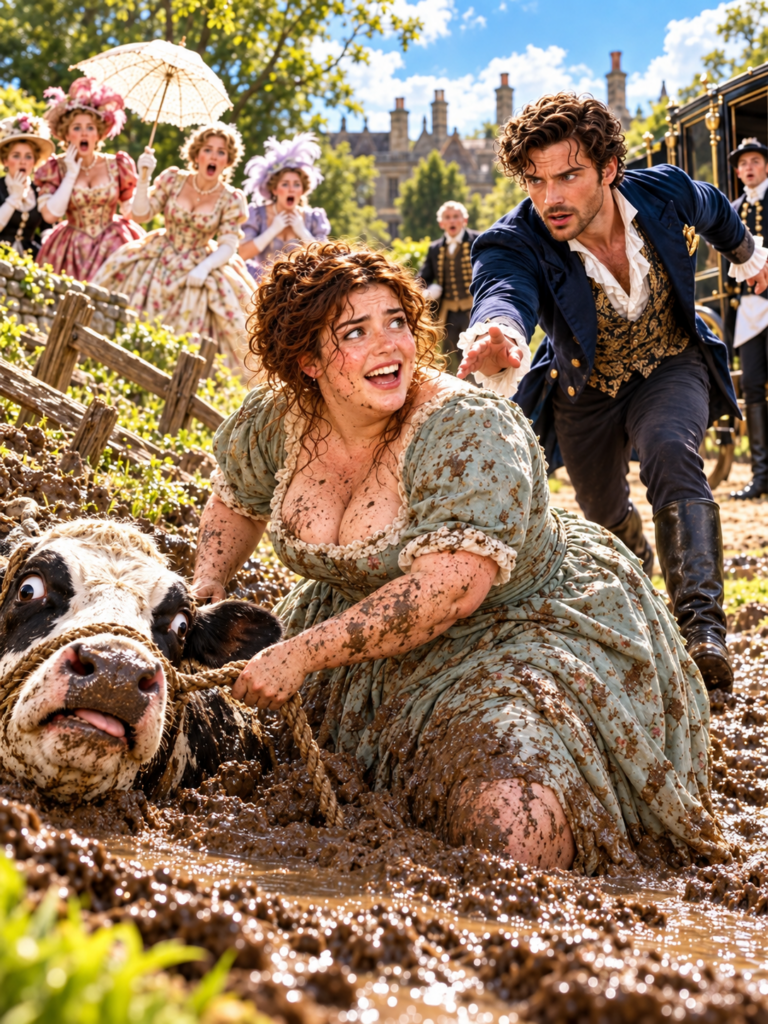
The first thing His Grace, Christopher Yarborough, Duke of Foxglove, saw that morning was a woman’s muddy boot disappearing beneath a frightened cow.
The second was the woman herself, emerging from behind the animal with her sleeves rolled above her elbows, her hair coming loose beneath a battered bonnet, and an expression suggesting she had no patience left for either livestock or gentlemen.
“Move that carriage!” she shouted. “Unless His Grace means to have a dead cow delivered to his doorstep!”
Christopher had never been addressed in quite that manner.
Certainly not by a young woman standing waist-deep in a drainage ditch.
And never before breakfast.
His coachman looked back in alarm. The road between Foxglove Park and the village of Goldmere had become an extraordinary spectacle. A section of wooden fencing had collapsed beneath the weight of a large white dairy cow. The animal was wedged between a splintered rail and the muddy bank, its front legs struggling for purchase.
Several farm boys pulled uselessly at a rope.
An elderly laborer shouted instructions nobody followed.
And the young woman in the ditch appeared to be the only person who understood what she was doing.
Christopher opened his carriage door.
“Your Grace!” his footman protested. “The ground is quite unsuitable.”
“So, apparently, is the road.”
He stepped down.
Behind his carriage waited Lady Leticia Fenmere, the latest in a long procession of prospective duchesses. Her family had sent her to Foxglove Park three days earlier in the confident belief that a sufficiently distinguished lineage and an agreeable face would accomplish what ninety-eight previous attempts had failed to do.
Christopher had informed her father the previous evening that the match would not proceed.
Lady Leticia had taken the rejection with admirable dignity.
Her father had not.
Now she leaned from her carriage window, holding a lace handkerchief over her nose.
“Surely someone ought to remove that dreadful animal.”
The girl in the ditch looked up.
“I am attempting to do precisely that, my lady. Though the cow has expressed no opinion about you.”
A farm boy choked on his laughter.
Christopher felt an unfamiliar movement at the corner of his mouth.
“What do you require?” he asked.
The girl studied him.
For a moment, he had the uncomfortable impression that she was assessing his usefulness rather than his rank.
“Two men at the rear,” she said. “One to steady her neck. And someone must loosen that lower rail before she breaks a leg.”
Christopher removed his gloves.
“I can take the rail.”
Her eyebrows rose.
“Have you handled a saw, Your Grace?”
“Not recently.”
“Then take the neck. A cow does not care for a duke with tools any more than I do.”
This time Christopher smiled openly.
He obeyed.
The animal was named Dove, although Christopher soon concluded that the name had been selected by someone with a questionable understanding of temperament.
Dove objected vigorously to being rescued.
She shook her great head, struck the mud with one hoof, and sent a magnificent quantity of foul water over Christopher’s boots.
The girl paid him no attention.
She crouched, worked a rope beneath the cow’s chest, and directed the farm boys to pull only when she gave the word.
Then she planted her shoulder against Dove’s flank.
Christopher watched her brace herself.
There was nothing delicate about the effort. Her face tightened, her boots sank deeper, and her arms trembled beneath the strain.
Yet she did not give way.
“Now!”
The boys pulled.
Christopher steadied Dove’s head.
With a great heave, the animal rose enough for the trapped leg to slide free.
The cow scrambled onto the road, staggered twice, and then stood calmly chewing grass as if the entire difficulty had been an inconvenience arranged for her amusement.
The watching villagers cheered.
The girl sat down in the mud.
Christopher looked at his ruined coat.
Then at his equally ruined boots.
Then at the triumphant animal.
“I believe,” he said, “that may be the most expensive walk I have ever taken.”
The girl glanced at him.
“Your boots will dry.”
“And my dignity?”
“That depends upon whether you insist upon speaking about it.”
He laughed.
It surprised him almost as much as it surprised his servants.
For six months, Christopher had endured the exhausting ceremony his aunt called a suitable search for a duchess.
Ninety-nine ladies had been presented.
Ninety-nine conversations had ended in polite disappointment.
Some had loved his title.
Others had loved his houses.
Several had admired the fortune attached to the Yarborough name with such enthusiasm that Christopher wondered whether they would recognize him without the title.
He had begun to believe that every agreeable woman in England regarded marriage as an exchange of property accompanied by music.
Yet here was a young woman who had commanded him like a stable hand and apparently forgotten his existence the moment the cow was safe.
“What is your name?” he asked.
“Dina Holliford.”
“Are you employed at Foxglove Park?”
“My father held the Lower Goldmere dairy tenancy. I manage it now.”
“Your father?”
“Dead these three years.”
She answered without inviting pity.
Christopher noticed the movement of her hand toward a small silver locket beneath her collar, but she released it before he could inquire.
His steward, Mr. Edward Eady, finally arrived from the rear carriage.
“Your Grace, I must apologize. Miss Holliford is a capable village girl, though rather inclined to speak beyond her station.”
Dina rose.
“Speaking has never been the difficulty, Mr. Eady. Listening is what seems to exhaust people.”
The steward’s expression hardened.
Christopher looked from one to the other.
Something passed between them.
It was too brief to name, but it was unmistakably hostile.
“Has there been trouble with the dairy?” he asked.
Eady answered immediately.
“Nothing requiring Your Grace’s attention.”
Dina brushed mud from her skirt.
“Then I suppose the seven families receiving notices to surrender their grazing rights have imagined the letters.”
The cheerful mood vanished.
Christopher turned toward his steward.
“What notices?”
Eady hesitated.
“Routine adjustments to the eastern pasture arrangements.”
“I gave no instruction to dispossess tenants.”
“Certainly not, Your Grace. Merely preliminary measures.”
Dina met the duke’s eyes.
“My father’s cows grazed on Lower Meadow when your grandfather was a boy. If that right is taken, the dairy cannot survive winter.”
Christopher remembered the papers waiting on his desk.
The proposed agricultural improvement scheme.
The promising investment terms.
The enclosure agreement that Sir Malcolm Tavistock had urged him to sign before the forthcoming county dairy exhibition.
He had considered the agreement a practical solution to Foxglove Park’s declining revenues.
Now, standing in mud beside a remarkably indifferent cow, he felt the first stirrings of doubt.
“Come to the estate tomorrow morning, Miss Holliford.”
Eady stiffened.
“Your Grace—”
“I should like to hear more.”
Dina considered him.
“Will Mr. Eady be present?”
“If you wish.”
“I would rather he were not.”
Christopher almost laughed again.
“Very well.”
She gave him a small curtsy, more out of acknowledgment than submission.
“Then I shall come.”
As she led Dove toward the village, Christopher watched her go.
Lady Leticia’s carriage rolled forward beside him.
“You cannot seriously mean to invite that person into the house.”
Christopher looked down at the mud drying upon his hands.
“I believe I just did.”
Foxglove Park had been the seat of the Yarborough family for nearly two centuries.
Its stone terraces overlooked broad lawns, formal gardens, wooded hills, and the rich meadowland surrounding Goldmere.
Its library contained more books than Christopher could read in three lifetimes.
Its dining room could seat forty guests.
Its ancestral portraits displayed twenty generations of men who looked profoundly certain of their own importance.
And beneath all that grandeur lay accounts Christopher had spent the past year trying unsuccessfully to reconcile.
His father had left debts.
Crop yields had fallen.
The old mill required rebuilding.
Several tenant farms were struggling.
Sir Malcolm Tavistock, a wealthy neighboring landowner, had offered a solution: consolidate the common grazing land, reorganize the smaller tenancies, and lease the eastern meadows for more profitable agricultural production.
Christopher had resisted the proposal at first.
But Tavistock possessed figures, estimates, lawyers, and confidence.
Christopher possessed increasingly urgent bills.
By the morning after the incident with Dove, he had begun to suspect that confidence might be easier to manufacture than honesty.
Dina arrived at ten precisely.
She wore her best brown dress, properly brushed boots, and a plain bonnet tied with faded blue ribbon.
She had brought a thick notebook.
Lady Sorell, Christopher’s formidable aunt, received her with all the warmth of a winter fireplace that had not yet been lit.
“Miss Holliford,” she said, looking her over, “I understand you have made quite an impression upon my nephew.”
“I fear I have made a greater one upon his boots, my lady.”
Christopher coughed.
Lady Sorell did not smile.
“My nephew’s duties involve matters considerably more important than livestock.”
“Then it is fortunate livestock have no need to approve his duties.”
Dina placed her notebook on the library table.
Christopher opened it.
The pages were filled with figures.
Milk production.
Fodder costs.
Births and losses among the village herds.
Records of grazing days, purchases, repairs, and payments.
Several columns extended back more than six years.
He turned another page.
A small handwritten note appeared beside an entry for Lower Meadow.
Grazing fee increased despite no change in lease.
He looked up.
“Who prepared these accounts?”
“I did.”
“Who taught you?”
“My father taught me numbers. My mother taught me to question them.”
“You have been keeping these records for years?”
“Someone must.”
Eady stood by the fireplace, visibly displeased.
“Your Grace, village calculations are frequently incomplete.”
Dina turned to him.
“Then perhaps you will explain why three different families have been charged for the same repaired fence.”
Silence settled across the library.
Christopher looked again at the page.
Three payments.
One fence.
The same date.
The same amount.
“Mr. Eady?”
“A clerical oversight.”
“And this?” Dina asked, turning the page.
A payment for roofing slate.
A payment for timber.
A payment for labor.
All charged to the Lower Meadow dairy buildings.
Christopher remembered passing those buildings the previous autumn.
Their roofs had been visibly damaged.
He looked at Eady.
“Were these repairs completed?”
“I believe so.”
“I do not believe they were,” Dina said quietly.
Lady Sorell straightened.
“Miss Holliford, accusing an estate steward of dishonesty is a very serious matter.”
Dina closed the notebook.
“Yes, my lady. So is charging a widow for a roof that still leaks over her bed.”
Christopher felt the words settle heavily in the room.
For months, he had been told the tenants were careless, indebted, reluctant to improve their holdings.
He had received lists of arrears.
Requests for additional investment.
Warnings of inevitable decline.
He had rarely received the tenants’ own figures.
“Leave us, Mr. Eady,” he said.
The steward went rigid.
“Your Grace—”
“That will be all.”
When the door closed, Christopher walked to the window.
Below the terrace, gardeners were trimming hedges into perfect shapes.
Beyond them lay the meadows whose value had been calculated in pounds rather than families.
“How long have you suspected something is wrong?”
Dina hesitated.
“Since my father died.”
“Why did you not write to me?”
“I did.”
Christopher turned.
“Three times.”
“I received no letters.”
“I know that now.”
A terrible possibility entered his mind.
Eady handled correspondence relating to estate tenants.
Eady maintained the rental accounts.
Eady had urged approval of Tavistock’s contract.
Christopher returned to the table.
“Miss Holliford, the county exhibition is eleven days away. Sir Malcolm intends to use it to demonstrate the necessity of his proposed changes.”
“I know.”
“I want the dairies represented properly. Not as an entertainment for visiting ladies, but as evidence of what the land actually produces.”
Dina watched him carefully.
“And you want me to arrange it?”
“Yes.”
“On wages?”
“Certainly.”
“With authority to inspect the dairy accounts?”
“Yes.”
“And to dismiss anyone interfering with the work?”
Christopher considered this.
“Within reason.”
Dina held his gaze.
“Your Grace, cows are not particularly reasonable. Neither are dishonest men.”
Lady Sorell made a faint noise of disapproval.
Christopher reached for a sheet of paper.
“Then let us define your authority carefully.”
For the next hour they argued over terms.
Dina insisted that all participating dairy workers receive payment directly.
She demanded control over milk collection and storage, permission to inspect supplies, and access to the repaired exhibition grounds.
Christopher negotiated only where he believed the estate’s legitimate obligations required it.
At last they signed an agreement.
Dina rose.
“I will begin tomorrow.”
Christopher studied her.
“What do you hope to accomplish beyond saving the dairy?”
She looked at her father’s notebook.
“Find out what happened to him.”
The answer chilled the room.
Lady Sorell frowned.
“I understood your father died of a fever.”
“He did.”
“Then what is there to discover?”
Dina slipped the notebook into her bag.
“Why he became frightened of the estate accounts before he died.”
She turned to Christopher.
“And why, two days before his last illness, he told me never to trust Mr. Eady with anything written in my mother’s hand.”
That evening, Christopher sent for the old tenancy records.
Eady supplied the files, but several pages were missing.
When Christopher asked about them, the steward claimed they had suffered water damage during a winter storm.
Christopher sent for the estate solicitor.
The solicitor was away in London.
He requested the correspondence archive.
Eady reported that it was being reorganized.
By midnight, Christopher had received more excuses than documents.
He stood alone in the library, looking at the names of families whose rents supported his house.
On the mantel stood a portrait of his father.
The late duke had been respected, stern, and almost obsessively concerned with preserving the estate.
Christopher remembered him saying that land survived because men of rank understood hard choices.
As a boy, he had believed him.
As a man, he was beginning to wonder who had been forced to endure those choices.
A soft knock interrupted his thoughts.
Lady Sorell entered.
“I hear you have given that dairy girl extraordinary authority.”
“She knows more about our production than anyone on the estate.”
“That does not make her a suitable companion.”
“I did not hire her as a companion.”
His aunt studied him.
“Christopher, ninety-nine families have been disappointed by your indecision.”
“Ninety-nine women were presented to me as if I were selecting a horse.”
“And yet you appear considerably more interested in one who handles horses’ larger relatives.”
Christopher shook his head.
“Dina Holliford has discovered discrepancies in our accounts.”
“Then correct them.”
“I intend to.”
Lady Sorell lowered herself into a chair.
“You are walking into dangerous ground.”
“Because of the accounts?”
“Because when men of your position begin questioning those who serve them, they sometimes discover how much they have preferred ignorance.”
Christopher looked at her.
It was the closest she had come to criticizing his father.
Before he could answer, a servant arrived carrying a folded message.
It had been found beneath the library door.
No signature.
No seal.
Only one sentence written in uneven black ink.
Ask Miss Holliford what her father hid beneath the old dairy floor.
Christopher read it twice.
Then he looked toward the dark fields beyond the windows.
For the first time in his life, the future of Foxglove Park seemed to depend not upon the decisions of its duke, but upon a secret buried somewhere beneath a poor farmer’s home.
Part 2
Dina discovered the first sign of sabotage in a churn that should have contained sweet cream.
It smelled of vinegar.
She stood in the dairy courtyard with the lid in her hand while the morning workers gathered around her.
“Was this washed last evening?” she asked.
Hettie Primble, the youngest dairy maid, nodded urgently.
“I washed it myself, miss. With boiling water.”
“Who brought it back from the storehouse?”
Hettie hesitated.
“Mr. Eady’s assistant.”
Dina replaced the lid.
“Then we shall not use it.”
The exhibition was nine days away.
The estate’s main dairy yard had become a hive of activity. Workers carried pails between buildings. Carpenters repaired fencing. Carts delivered straw, fodder, firewood, and freshly made display tables.
Christopher appeared almost every morning.
At first he watched.
Then he asked questions.
Then, to Dina’s astonishment, he began working.
His first attempt to carry two full milk pails ended with half their contents upon his trousers.
Hettie laughed so violently that she had to sit down.
Christopher regarded the dripping pails with considerable dignity.
“I assume there is an accepted technique.”
Dina took the handles from him.
“There is.”
“Will you explain it?”
“When you stop trying to impress the pails.”
He studied her.
“Do they have high standards?”
“Higher than most titled gentlemen.”
Despite herself, she smiled.
Their friendship developed through small, often inconvenient encounters.
He helped mend a calf enclosure.
She taught him the importance of clean water and properly stored feed.
He showed her how an estate’s accounts were arranged.
She showed him how those accounts concealed what workers actually paid.
He listened when she spoke.
Not always perfectly.
Sometimes rank made him impatient, and sometimes his instinct was to solve a difficulty before understanding it.
But he was learning.
That surprised her.
Dina had spent most of her life encountering men who believed instruction from a woman was a form of public humiliation.
Christopher occasionally looked humiliated.
Then he took out his notebook anyway.
On the fourth day, he brought her the anonymous message.
They stood in the old dairy building, well away from the main courtyard.
Dina read it.
Her face changed.
“Where did this come from?”
“I had hoped you might know.”
She looked toward a patch of floorboards beside the disused cheese press.
“My father worked here before the estate moved the larger dairy into the new building.”
“Did he hide something?”
“He hid many things. Coins beneath a loose brick. Keys above doorframes. A bottle of elderberry wine my mother was not supposed to discover.”
Christopher waited.
Dina knelt beside the press.
“I remember him lifting this board once.”
With a narrow iron tool, she worked at the edge.
The board rose stiffly.
Beneath it lay a shallow cavity.
Empty.
For a moment she simply stared.
Christopher crouched beside her.
“Was something taken?”
“There should have been a tin box.”
“How do you know?”
“Because I remember its blue lid.”
She touched the dusty boards.
Her father had been a large, quiet man, more comfortable with animals than conversation.
In the months before his death, he had become unusually watchful.
He had forbidden her to enter the estate offices.
He had questioned unexpected visitors.
Once, she remembered, he had argued with Mr. Eady beside the dairy door.
The steward had departed red-faced.
Her father had afterward told her to remember the weight of every honest thing she carried.
She had not understood him.
Now she wondered whether he had been trying to warn her.
“Someone came here before us,” she whispered.
Christopher examined the cavity.
The dust on the surrounding boards was old.
But one corner bore a fresh scratch.
“Recently.”
She looked at him.
“Then someone knows what we are looking for.”
“And may know more than we do.”
Footsteps sounded outside.
They rose quickly.
Mr. Eady appeared at the doorway.
“Your Grace. I was told you had come to inspect the old dairy.”
Christopher brushed dust from his hands.
“We have.”
“An unsafe building. I should advise against disturbing the floor.”
Dina watched him.
“Has anyone else been here?”
“Only maintenance men.”
“When?”
“I cannot be expected to recall every trivial repair.”
Christopher stepped toward him.
“Perhaps you should begin keeping better records.”
Eady bowed stiffly.
After he left, Dina found a small triangular piece of blue paint near the wall.
She tucked it into her pocket.
She did not tell Christopher.
Not yet.
Two nights later, the duke hosted a formal supper for visiting investors and neighboring families.
Lady Sorell insisted Dina attend.
The invitation was framed as an honor.
Dina recognized a trial when she saw one.
Her best dress had been altered by Hettie, who declared that no duchess in England could improve upon its fit if the wearer insisted upon breathing.
Dina arrived to find the dining room sparkling with candles.
She was seated between a retired colonel who spoke exclusively of horses and a gentleman who appeared convinced that dairy work consisted of instructing cows to produce butter.
Christopher sat at the head of the table.
He looked uncomfortable when he saw her.
Not because of her appearance.
Because he understood the purpose of her invitation.
Lady Leticia Fenmere, still visiting at Lady Sorell’s request, examined Dina’s gown with thoughtful curiosity.
“I understand you have taken charge of the exhibition.”
“Of its dairy work, my lady.”
“How extraordinary.”
“Not particularly. Someone must do it.”
A gentleman across the table laughed.
“And I hear Miss Holliford possesses the strength of three farmhands.”
Dina placed her fork down.
“Only when the farmhands are talking.”
Several guests laughed.
The gentleman reddened.
Another guest leaned forward.
“His Grace seems to have discovered a remarkable novelty.”
Christopher spoke sharply.
“Miss Holliford’s knowledge has proved indispensable to the estate.”
Dina looked at him.
The compliment felt strangely like an injury.
“Indeed,” Lady Sorell said. “She has been most useful.”
Useful.
The word returned with the force of an old humiliation.
Dina heard her father’s voice telling her that work deserved payment, not gratitude.
She saw the ladies smiling as if she were an entertaining creature brought indoors for the evening.
And Christopher, who should have understood by now, was smiling with pride at his own defense of her.
She rose.
“Forgive me, Your Grace. I have work early tomorrow.”
Lady Sorell frowned.
“The second course has not been served.”
“Then I shall leave more for the guests.”
Dina departed.
Christopher caught her near the servants’ staircase.
“Dina.”
She stopped.
“Have I offended you?”
“You meant well.”
“That sounds dangerously like an accusation.”
“It is.”
He looked genuinely bewildered.
“I was defending your abilities.”
“I do not need my abilities displayed as entertainment.”
“Those people were insulting you.”
“And you answered by telling them how valuable I am to you.”
He fell silent.
Dina struggled to steady her voice.
“Do you understand how tired I am of men deciding whether I deserve respect based upon what I can do for them?”
Christopher looked away.
She continued.
“If I could not lift a cow, would I deserve kindness? If my hands were weak, would I deserve wages? If I knew nothing of dairies, would I still deserve to be heard?”
“Of course.”
“Then why did you speak as though my usefulness were the reason?”
The question left him without protection.
He had believed himself better than the people at the table.
Yet he had praised her in exactly the terms they understood.
Skill.
Service.
Value.
Possession.
“I am sorry,” he said.
Dina examined his face.
“I believe you.”
But she walked away.
The next morning Christopher did not arrive with his notebook.
He came carrying tools.
Dina found him at the north pasture attempting to replace a broken gate hinge.
He had removed his coat.
His sleeves were rolled.
And he was holding a hammer in the manner of a man considering negotiation with it.
“That hinge belongs on the other side,” she said.
Christopher looked down.
“So I have discovered.”
“Then why have you fixed it there?”
“I was hoping the gate might appreciate initiative.”
She almost smiled.
He removed the hinge.
She showed him how to fit it correctly.
They worked without speaking for a while.
When the gate finally swung smoothly, Christopher set down the hammer.
“I have spent my life expecting people to explain themselves in ways that are comfortable for me.”
Dina leaned against the fence.
“And?”
“You should not have to make yourself comfortable to be treated fairly.”
She waited.
He continued.
“I wanted those people to recognize your worth. I should have challenged their belief that they were entitled to measure it.”
Dina looked at his reddened hands.
“That is closer.”
“Closer to forgiveness?”
“Closer to understanding.”
He nodded.
There was a quiet honesty in his acceptance that unsettled her more than any grand declaration could have done.
For the first time, she wondered whether he might truly change.
Not because he was fascinated by her.
Not because he admired her strength.
But because he had begun to recognize the limits of his own.
The breakthrough came from Lady Leticia.
She arrived at the dairy yard on a wet afternoon wearing practical boots so new that Dina suspected they had been purchased expressly for the humiliation.
“I wish to learn how to judge cream,” she announced.
Dina studied her.
“Why?”
“Because I have spent twenty-three years being educated for marriage, and I would like to discover whether that education has been of use to anyone.”
It was an answer Dina understood.
She gave Lady Leticia a spoon.
The first attempt was dreadful.
The second was worse.
By the third, Lady Leticia could distinguish sweet cream from cream beginning to sour.
She stared at the spoon.
“My mother will be horrified.”
“Then you may have learned something valuable.”
They both laughed.
Later, while helping sort the exhibition supplies, Lady Leticia mentioned seeing Eady’s assistant carry a blue tin box from the old dairy.
Dina went still.
“When?”
“Two days ago. He placed it in Sir Malcolm Tavistock’s carriage.”
“Are you certain?”
“It was a dreadful carriage. Crimson upholstery with black tassels. One remembers offenses against taste.”
Dina thanked her.
Then she went directly to Christopher.
They searched Tavistock’s correspondence against the estate payment ledgers.
At first the entries appeared ordinary.
Consultancy fees.
Surveying charges.
Private advances.
But Dina recognized the recurring sums.
They matched the unexplained charges imposed upon the tenant dairies.
Christopher called for the oldest surviving copies.
Several had been altered.
Others were missing.
One set contained signatures supposedly written by Dina’s father after the date of his death.
Christopher stared at them.
“This is forgery.”
“Yes.”
“And Tavistock has been receiving money from the estate.”
“Not merely money,” Dina said.
She turned over a deed.
The eastern grazing lands were subject to an old covenant protecting common pasture access for families with longstanding dairy tenancies.
It could not be removed simply by the duke’s signature.
A valid release required the consent of the affected tenants.
Yet Tavistock’s proposed agreement contained a schedule of supposed tenant approvals.
Some names were written in identical handwriting.
One belonged to Mrs. Voss, an elderly widow who could not write.
Another belonged to Dina’s father.
Christopher felt sick.
“The land cannot legally be enclosed under these documents.”
“Not if anyone proves they are false.”
He looked toward the window.
“Then that is why they wanted the dairy to fail.”
Dina nodded.
A failing exhibition would make the tenants appear incapable of maintaining the land.
Financial distress would pressure them into surrendering rights they might otherwise refuse to sell.
And forged approvals could be buried beneath the appearance of consent.
“We need the original covenant,” Christopher said.
“It may have been in my father’s box.”
“Which Tavistock now possesses.”
Their eyes met.
The great house was quiet around them.
Beyond the glass, rain swept across Goldmere’s fields.
Christopher understood then that the matter had never been simply about improving his estate.
It was about taking land from people who possessed very little power to defend it.
And he had almost lent his title to the theft.
The next evening a fire began in the dairy storehouse.
Hettie smelled smoke first.
By the time Dina reached the yard, flames had caught the dry straw stacked near the rear wall.
The cows were in the adjoining building.
Dove stood near the gate, lowing with growing fear.
Dina seized a bucket.
Christopher arrived moments later.
“Get the animals out!” she shouted.
He did not argue.
Together they opened the side enclosure and directed the cattle toward the meadow.
The flames spread rapidly, fed by straw and old timber.
A roof beam cracked.
Dina heard Hettie cry from inside.
The girl had returned for the account books.
Dina ran toward the door.
Christopher caught her arm.
“The roof is going!”
“Hettie is inside!”
He looked at the flames.
Then he released her.
“I am coming.”
They entered through a side passage filled with choking smoke.
Hettie was crouched beneath a fallen shelf.
Christopher lifted the timber while Dina pulled the girl free.
They stumbled into the yard as part of the roof collapsed behind them.
For several moments nobody spoke.
Hettie sobbed.
Dina knelt beside her, holding her face between soot-blackened hands.
“You foolish girl. Books can be replaced.”
Hettie shook her head.
“Not those books.”
She opened her coat.
Inside lay Dina’s father’s notebook and a packet of old folded papers.
The documents had been hidden in the bottom of a locked chest beneath the dairy office.
Hettie had discovered them while trying to save the records.
Christopher unfolded the largest sheet.
The paper was brittle.
A blue wax seal remained attached to one corner.
Across the top was written:
An Agreement for Perpetual Common Grazing, Granted to the Households of Lower Goldmere.
Beneath it appeared the signature of Christopher’s grandfather.
And below that, the signatures and marks of twenty-six tenant households.
Dina stared.
Her father’s name appeared beside a later certified copy of the agreement.
The same document contained a handwritten statement.
If this covenant should be disputed, the parish register and the original estate survey shall serve as independent witnesses.
Christopher looked at her.
“We have it.”
But Dina was not looking at the covenant.
She had found another paper.
A letter in her father’s handwriting.
It was addressed to the late duke.
She opened it with shaking fingers.
The letter explained that Eady had been secretly altering accounts and transferring sums to Tavistock for years.
It described forged tenant signatures.
It warned that Tavistock intended to acquire the grazing land through financial pressure.
And in its final paragraph, her father had written:
I fear Mr. Eady has persuaded Your Grace that I am a troublesome man. I write not for myself but for the families whose cows will be taken after mine.
Dina felt tears rise.
Her father had tried to warn the duke.
He had not been merely anxious.
He had been fighting for the village.
Christopher read the letter.
He recognized a note in his father’s hand along the lower margin.
Eady assures me the allegations are unfounded. No further action required.
The paper trembled in his fingers.
His father had received the warning.
And dismissed it.
The truth was worse than Christopher expected.
Dishonesty had flourished because a duke had trusted the man who served his interests more than the tenant who questioned them.
He looked at Dina.
“I cannot undo what my father failed to do.”
She wiped her cheeks.
“No.”
“But I can refuse to repeat it.”
Before she could answer, a rider approached from the main road.
The man dismounted hurriedly.
“Your Grace, Sir Malcolm has called a meeting of the county investors. He claims the dairy fire proves the village holdings are unsafe and mismanaged.”
“When?”
“Tomorrow morning.”
Christopher looked toward the smoking ruins.
Tomorrow was the day before the exhibition.
Tavistock meant to secure approval before the documents could be examined.
Christopher folded the covenant carefully.
“Then we shall attend.”
Dina rose beside him.
“And this time,” she said, “the people who own those grazing rights will speak for themselves.”
Part 3
The meeting took place in the great hall at Foxglove Park.
Sir Malcolm Tavistock stood before a table covered with maps, deeds, and carefully arranged financial statements.
He had the confident appearance of a man who believed the conclusion had already been purchased.
Several neighboring landowners attended.
So did the estate solicitor, two county magistrates, Lady Sorell, and a collection of investors.
What Tavistock had not expected was the arrival of twenty-three tenant farmers, dairy workers, widows, and village representatives.
They entered behind Dina.
Christopher walked beside her.
The hall fell quiet.
Tavistock smiled thinly.
“Your Grace. I had not understood this was to be a public assembly.”
“Neither had I,” Christopher replied. “Until I discovered that the people most affected by your proposal had never been invited to discuss it.”
Tavistock gestured toward the documents.
“Such matters require professional judgment.”
“Then we shall begin with the documents.”
Christopher laid the old grazing covenant upon the table.
The solicitor leaned forward.
For several minutes he studied the paper, the seal, and the accompanying certification.
Then he examined the proposed enclosure agreement.
“These instruments appear to conflict,” he said.
“They do,” Christopher replied.
Tavistock’s smile faded.
“The older covenant is obsolete.”
“On what authority?”
“Customary land improvement practice.”
“Then you will have no difficulty identifying the legal basis.”
The solicitor continued examining the documents.
Dina stepped forward.
“My father kept records of every common grazing household in Lower Goldmere. The families were told they had agreed to surrender their rights.”
She held up the schedule of signatures.
“Several of these are false.”
Tavistock gave a contemptuous laugh.
“A dairy woman is scarcely qualified to determine the validity of legal instruments.”
Mrs. Voss moved from among the tenants.
She was a small woman with rough hands and a back bent by decades of labor.
“Then perhaps I may speak, sir.”
Tavistock stared.
The widow pointed at the paper.
“That is supposed to be my signature.”
“Yes.”
“I cannot write my name.”
A murmur passed through the hall.
“My husband taught me my letters, but my fingers would never make them properly. I sign with a cross.”
The solicitor examined the register.
He turned to the magistrates.
“The discrepancy requires investigation.”
Dina presented another document.
“This approval was signed in my father’s name six months after he died.”
A magistrate took it.
The silence became profound.
Christopher watched Tavistock.
For the first time, the man’s confidence faltered.
“These irregularities may be explained by clerical errors.”
“Then explain this.”
Christopher placed the estate ledgers beside the payment records.
The solicitor reviewed the matching amounts.
Money charged to tenants had been entered as estate maintenance expenditure.
From there it had moved through accounts controlled by Eady.
Several payments corresponded to Tavistock’s private firm.
Christopher spoke quietly.
“You sold my estate a scheme to save it from financial decline. Meanwhile, money belonging to its tenants was being taken through the accounts you advised us to trust.”
Tavistock’s expression hardened.
“Your Grace would do well to consider how such accusations may affect the reputation of your family.”
Christopher looked toward the assembled villagers.
For years, he had been trained to fear scandal.
A duke’s reputation was supposed to stand above ordinary concerns.
Yet his family’s reputation had offered little protection to the people beneath it.
“I am considering my family’s reputation,” he replied. “That is why I will no longer defend its mistakes.”
He turned toward Eady, who stood beside the door.
“Mr. Eady, you are relieved of your duties. The relevant records will be placed with the solicitor for examination.”
The steward opened his mouth.
Closed it.
Then looked toward Tavistock.
The exchange was brief.
But everyone saw it.
The magistrates requested that both men’s statements be taken formally.
Christopher did not pretend that guilt had been finally established or that the matter could be settled by a speech.
The evidence would require proper scrutiny.
The accounts would have to be audited.
The signatures examined.
And those who had lost money or land would need restitution.
But the enclosure agreement would not be signed.
He took the document from the table.
“I withdraw my support.”
Tavistock stood motionless.
Christopher faced the tenants.
“The common grazing arrangements will remain in place while their rights are verified and secured. Any improper charges identified in the accounts will be repaid.”
The room remained silent.
Then Mrs. Voss began to cry.
Not loudly.
Not dramatically.
She simply pressed her hand to her mouth.
Dina moved toward her.
The old woman gripped Dina’s fingers.
“Your father would have wanted to see this.”
Dina could not answer.
Across the hall, Christopher saw her standing among the people whose lives had been dismissed as figures upon a page.
He understood something then that ninety-nine courtships had never taught him.
Love was not finding a woman who could fit herself into his world.
It might be discovering whether his world could become worthy of her.
The county dairy exhibition opened the following morning.
Despite the fire, the villagers had rebuilt enough of the damaged display to proceed.
Dina had insisted.
They borrowed tables from the parish hall.
The blacksmith repaired broken hinges without charge.
Mrs. Voss brought her finest cheeses.
Hettie recruited three neighboring dairymaids.
Lady Leticia arrived carrying a stack of neatly written labels.
Lady Sorell supplied new linen and complained bitterly about its cost.
Even Christopher contributed, though Dina assigned him tasks of increasing simplicity after his third attempt to arrange the butter display.
“Your Grace,” she said, examining his work, “have you ever seen butter placed that way?”
“I believe the arrangement is artistic.”
“It appears to be surrendering.”
He looked at the misshapen curls.
“A fair criticism.”
She handed him a cloth.
“Polish the table.”
He obeyed.
The exhibition drew a larger crowd than expected.
News of the previous day’s confrontation had already spread.
Visitors came to see the dairy that had nearly been destroyed.
Some came hoping for scandal.
Others came out of curiosity.
But the villagers were determined to show them something more enduring than gossip.
The cheese was excellent.
The butter won praise from the judges.
The cream demonstration attracted more attention than anyone anticipated.
Dina moved through the grounds directing workers with calm authority.
She had barely slept.
Her hands ached.
Her dress bore a dark stain near the hem.
Yet she had never felt more certain of her purpose.
Then she heard the crack.
A sharp report came from the temporary cattle barrier.
Dove, standing in the exhibition ring, jerked her head.
A section of fencing swung loose.
Someone shouted.
The cow began to retreat, pushing toward a crowd of spectators.
Dina recognized the danger immediately.
She ran.
“Clear the passage!”
The animal’s weight struck the weakened rail.
The upper timber gave way.
Dina caught its falling end against her shoulder before it could strike a child standing nearby.
Pain shot down her arm.
She held on.
For one terrible moment the rail threatened to drag her beneath it.
Then Christopher appeared.
He took the weight beside her.
“Where?”
“Toward the field!”
Together they lifted and turned the timber enough for the farm boys to guide Dove through the open passage.
The cow stumbled into the grass.
Stopped.
And immediately began investigating a basket of apples.
The crowd exhaled.
Christopher lowered the rail.
Dina sank onto a nearby bench.
He crouched beside her.
“Are you hurt?”
“My shoulder will survive.”
“You might have been killed.”
“So might the child.”
He looked toward the little boy, now safely held by his mother.
Then back at Dina.
“You do not have to carry every danger alone.”
She studied him.
“Neither do you.”
For a moment, neither spoke.
He sat beside her, heedless of his formal coat and the mud beneath the bench.
Across the field, Dove ate another apple.
Christopher laughed softly.
“Your cow has caused the downfall of my entire system of courtship.”
“She has a talent for exposing bad structures.”
“I noticed.”
He grew serious.
“Dina, I owe you more than thanks.”
“You owe me no grand speech.”
“Then I will try for a small one.”
She looked at him warily.
He continued.
“When I first saw you, I admired your strength. I believed that was what made you extraordinary.”
“And now?”
“Now I think your strength was simply the first thing I understood.”
She did not look away.
“You saw dishonesty in figures I had never examined,” he said. “You saw dignity in people I had allowed others to describe as burdens. You made me question things I had mistaken for duties.”
A faint tremor entered his voice.
“I do not wish to make you another possession of Foxglove Park.”
“Good.”
“I wish to become a man you might freely choose.”
Dina looked toward the exhibition.
Village girls were carrying pails.
Hettie was showing Lady Leticia how to test butter.
Mrs. Voss was discussing prices with a merchant who had previously refused her goods.
Life continued around them.
Not in grand gestures.
In ordinary acts of determination.
“Christopher,” she said at last, using his name without a title, “I have spent my life being told what I cannot become.”
He waited.
“If I marry you, people will tell me what a duchess ought to be.”
“I know.”
“They will expect me to abandon the dairy.”
“I would not ask it.”
“They will expect me to become grateful for the privilege.”
He looked at her.
“Then I shall have to learn how to disappoint them.”
Dina smiled.
It was not yet an answer.
But it was a beginning.
The dairy school was Dina’s idea.
Its first classroom was the old tithe barn beyond the church.
The estate provided the building, equipment, and a modest annual grant.
The village dairy association managed its practical instruction.
Dina insisted upon written rules.
Girls would be taught to read and keep accounts.
They would learn animal care, dairy production, land agreements, and basic commercial arithmetic.
They would receive instruction without having to surrender their earnings to relatives or employers.
Widows could attend.
So could older working women.
Lady Leticia volunteered to teach letters twice a week.
At first the villagers regarded her with suspicion.
Then she spent an entire afternoon teaching a twelve-year-old girl to write her own name and refused to leave until the child could do it confidently.
After that, people began to reconsider her.
Lady Sorell funded two scholarships.
She explained the decision by declaring ignorance an unnecessarily expensive defect.
Christopher ordered the estate’s repaired accounts displayed where tenants could inspect charges affecting them.
The first public meeting was chaotic.
Questions came from every direction.
Why had a fence cost so much?
Why were certain wages lower than others?
Who decided which dairy received repairs?
Christopher found himself unable to answer half of them.
Dina stood beside him.
Not to rescue him.
To ensure the questions were not dismissed.
He learned to say, “I do not know, but I shall find out.”
The words cost him more pride than he expected.
They also earned him more trust than he had ever received through ceremony.
Three weeks after the exhibition, Christopher came to the school without a carriage, servant, or formal appointment.
Dina was teaching six girls how to record milk quantities.
A young student looked up.
“Miss Holliford, His Grace is here.”
Dina glanced toward the doorway.
Christopher stood holding a bundle of new slates.
“An offering,” he said.
“From whom?”
“A repentant gentleman who has discovered the cost of education.”
“Then set them beside the cupboard.”
He obeyed.
The girls exchanged amused looks.
When the lesson ended, Dina walked outside with him.
Autumn sunlight lay across the fields.
The grass smelled of rain.
Dove slept beside the stone wall, perfectly satisfied with a world that provided food at regular intervals.
Christopher removed his hat.
Dina stopped.
“That looks serious.”
“It is.”
“If the accounts have gone wrong again, I shall require tea before hearing about them.”
“The accounts are satisfactory.”
“Then what is it?”
He took a breath.
“I have asked many women whether they would marry me.”
“Ninety-nine, according to an entire county that has made the number impossible to forget.”
“And I have given none of them sufficient reason to believe I understood what I was asking.”
Dina folded her hands.
Christopher continued.
“I thought marriage meant choosing someone suitable for my life. I did not understand it ought to mean building a life two people can share.”
The wind moved softly through the hedge.
“I love you, Dina.”
She did not speak.
“I love your courage. I love your judgment. I love the way you refuse easy answers, especially from me.”
His mouth curved.
“I even love the fact that a cow appears to consider me unqualified for nearly everything.”
Dina laughed despite herself.
Christopher stepped closer, but did not take her hand.
“I would like to marry you. Not because you rescued Dove, or because you saved my estate from a disastrous bargain.”
He looked steadily into her eyes.
“But because I want to spend my life beside the woman who taught me that the worth of a person cannot be measured by what others can take from her.”
Dina swallowed.
For years she had dreamed of safety.
Of a home no one could threaten.
Of enough money to keep the dairy open.
Of dignity that did not depend upon permission.
She had never expected love to become part of that dream.
And she had never expected to find it in a man whose family had once stood on the opposite side of everything she needed to protect.
“Christopher,” she said softly, “I will not give up the school.”
“I know.”
“I will continue managing the dairy.”
“I would be greatly disappointed if you did not.”
“And when you are wrong, I will tell you.”
“I have begun to depend upon it.”
She studied him for a long moment.
Then she held out her hand.
“Yes.”
He stared.
“Yes?”
“Yes, I will marry you.”
His expression changed so completely that she almost laughed.
Christopher took her hand with extraordinary care.
For once he seemed to have no clever answer.
He simply drew her toward him.
She rested her forehead against his.
Beyond them, Dove gave a long, disapproving moo.
Dina closed her eyes.
“I believe she objects.”
Christopher smiled.
“Then I shall have to win her approval.”
“That may prove more difficult than winning mine.”
“I am beginning to suspect it.”
Their wedding took place in the village church the following spring.
There were noble guests, certainly.
Some arrived out of affection.
Others came because the marriage of a duke to a dairy farmer’s daughter remained irresistible gossip.
But the front pews were filled with the people of Goldmere.
Mrs. Voss wore a new bonnet.
Hettie cried before the ceremony began.
Lady Leticia stood beside Dina as a friend rather than a rejected rival.
Lady Sorell supervised the flowers with the gravity of a military commander.
Dove did not attend the church service.
This was not due to any lack of interest on her part.
She had simply been judged unsuitable for the building.
Afterward, when the wedding party returned to Foxglove Park, the animal stood near the orchard gate wearing her old blue ribbon.
Christopher approached with an apple.
Dove considered him.
Took the apple.
And permitted him to scratch behind her black ear.
Dina watched with delight.
“You have been accepted.”
“An honor greater than my title.”
“Do not tell Lady Sorell.”
“She already suspects.”
That evening, as music filled the great house, Dina stepped onto the terrace.
The fields stretched dark and quiet beneath the stars.
For a moment she thought of her father.
Of the records he had kept.
Of the warnings nobody had heard.
Of the land he had fought to protect.
She wished he could have seen the school.
The girls learning their letters.
The widows reading their accounts.
The village reclaiming the right to speak in decisions about its future.
Christopher came to stand beside her.
“Are you happy?”
She considered the question.
“Yes.”
“Even with the formidable burden of being a duchess?”
“I have endured more formidable burdens.”
“Such as?”
She glanced toward the distant meadow.
“A cow with unreasonable opinions.”
Christopher laughed.
Then he reached for her hand.
Below them, lamps glowed in the school windows.
The gutters had been fitted properly.
The doors were sound.
The accounts were open.
And on a wall inside the classroom hung the old blue ribbon halter, washed and carefully repaired.
It was not a relic of the day a duke discovered an extraordinary country girl.
It marked the beginning of something far greater.
A place where working women could learn to defend what belonged to them.
A place where daughters would be taught to sign their own names.
A place where strength meant more than lifting a heavy burden.
Christopher looked at his wife.
For six months, he had rejected ninety-nine noble ladies while searching for a woman worthy of his title.
He had believed the problem lay in the women who failed his expectations.
He understood now that the question had always been the wrong one.
Dina had never needed to become worthy of his world.
He had needed to make that world worthy of her.
And when the morning came, the new Duchess of Foxglove did not begin her married life by arranging flowers or selecting jewels.
She put on her working boots.
She took her husband’s hand.
And together they walked across the dew-covered meadow toward a school full of girls waiting to learn.
Dove followed them, slowly and with considerable authority.
For once, no one tried to stop her.


