
Part 1
The first thing Eleanor Whitcomb noticed about the wedding gown was that someone had sewn the wrong side of its pocket shut.
The second was that the stitching had been done deliberately.
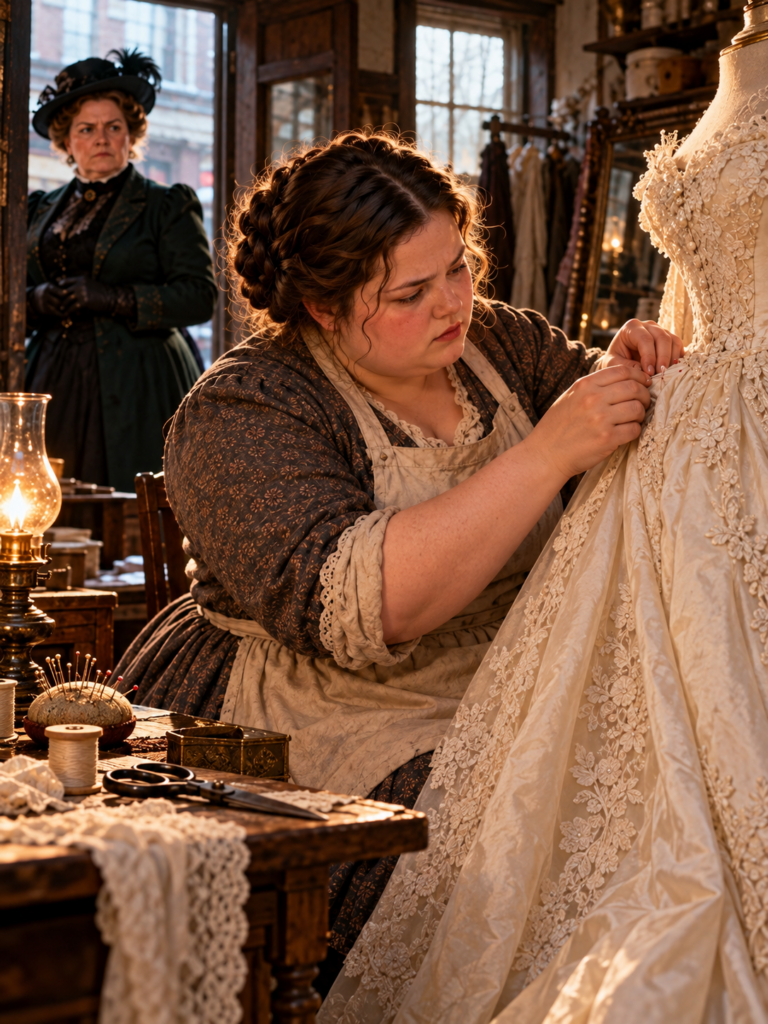
She stood in the rear workroom of a deserted dressmaker’s shop on a bitter November morning in 1896, holding the faded ivory silk between fingers reddened by cold.
Outside, the market town of Bellwick was waking beneath a sky the color of pewter. A delivery cart rattled across the cobblestones. Somewhere beyond the churchyard, a factory whistle announced the beginning of another working day.
But inside the shop, everything seemed to have been waiting for years.
Dust lay thick upon the cutting tables. The windows had turned nearly opaque with grime. Old fashion plates curled against a damp wall, and the iron stove beneath the mantel had not held a proper fire in months.
Yet the wedding gown hanging beside the workroom door remained astonishingly beautiful.
Its bodice was fitted with a precision Eleanor had rarely seen. Delicate embroidery traced the neckline like frost gathering upon a window. The full skirt fell in graceful folds, and the silk possessed that particular luster found only in expensive fabrics, the sort ordered by noble families who thought nothing of spending a working woman’s yearly wages upon a single evening’s appearance.
Eleanor knew such gowns well.
For six years she had made them for other women.
Women who entered drawing rooms beneath glittering chandeliers. Women whose names appeared in newspapers. Women who scarcely glanced at the seamstress kneeling at their feet, pinning their hems while they discussed engagements, fortunes, and the latest scandal in London.
Now, at twenty-six, Eleanor owned almost nothing.
Her mother had died the previous spring. Her father’s modest savings had vanished long before that. A cousin entrusted with settling the family’s affairs had assured Eleanor that no money remained, although she had later discovered he had sold several pieces of her mother’s furniture without accounting for the proceeds.
She lacked the money to challenge him.
Then, in October, a solicitor’s letter arrived.
A woman named Miss Beatrice Harrow, formerly a fashionable dressmaker in Bellwick, had died and left Eleanor the contents and remaining lease of her establishment.
Eleanor had never met her.
The solicitor explained only that Miss Harrow had once been acquainted with Eleanor’s mother.
The bequest was not generous.
The building stood in a declining row of shops behind the market square. The roof leaked. The rent was overdue. Most townspeople considered the premises cursed by failure, though no one could explain exactly what had caused it.
But to Eleanor, who had spent years sewing gowns credited to another woman’s fashionable establishment, the abandoned shop offered something precious.
A door upon which she might paint her own name.
She had arrived that morning carrying a carpetbag, a sewing box, three pounds in savings, and a small portrait of her mother.
Now she examined the gown more carefully.
Its construction was exquisite.
The seams were nearly invisible. The bones in the bodice were set straight and secure. The tiny silk-covered buttons along the back had been made individually, each one finished by hand.
But the skirt told a different story.
There was a pocket concealed in the left side.
That itself was unusual but not extraordinary. Some ladies preferred hidden pockets for handkerchiefs, keepsakes, or private letters.
What troubled Eleanor was the stitching across its opening.
The fabric had been closed with pale thread, distinct from the ivory silk used everywhere else.
And beneath the pocket, the hem had been folded more heavily than necessary.
Eleanor held it toward the window.
“Whoever made you,” she whispered, “knew precisely what she was doing.”
She could not understand why such a skilled woman would finish an elegant gown with one awkward seam.
Nor could she explain why the dress appeared never to have been worn.
A narrow paper label remained stitched beneath the collar.
In a graceful hand were the words:
Lady Catherine Ashcombe. June 1884.
Eleanor frowned.
Ashcombe.
Even a newcomer to Bellwick knew that name.
The Ashcombes had once owned nearly half the surrounding countryside. Their ancestral seat, Wycliffe Hall, stood four miles north of town among wooded hills and formal gardens.
Its late master, the Duke of Wycliffe, had died twelve years earlier.
And everyone knew that his only daughter had disappeared from society shortly afterward.
Some said she had married beneath her rank.
Others claimed she had been disowned.
Eleanor had heard the gossip without paying much attention.
Until now.
She returned the gown to its hook.
“Well, Lady Catherine,” she murmured, “whatever happened to you, someone cared enough to make you a beautiful dress.”
She did not open the pocket.
Not that morning.
Instead, she rolled up her sleeves and began scrubbing the windows.
By afternoon she had swept the front room, cleared the cutting table, and persuaded the stove to burn.
The following day she painted a small sign.
Eleanor Whitcomb — Dressmaking, Alterations, and Fine Repairs.
She placed it in the window beside a neatly mended gentleman’s waistcoat.
For three days nobody entered.
On the fourth, a woman arrived in a carriage.
Eleanor heard the wheels stop outside and looked up from a length of dark wool.
A footman opened the carriage door.
The woman who descended wore a deep plum traveling costume, a feathered hat, and a heavy fur collar. Her appearance suggested both wealth and a determination that others should recognize it.
She entered without knocking.
“Are you the young person who has taken over Miss Harrow’s establishment?”
“I am Eleanor Whitcomb, madam.”
The woman surveyed the shop.
Her gaze lingered upon the worn boards and patched plaster.
“I see.”
She spoke as though the condition of the premises confirmed something unpleasant.
“I am Lady Augusta Ashcombe.”
Eleanor straightened.
The name meant something immediately.
Lady Augusta was connected by marriage to the late duke’s younger brother, Lord Lionel Ashcombe, who now occupied Wycliffe Hall.
“I was unaware anyone intended to reopen this shop,” Lady Augusta continued.
“The lease was left to me, my lady.”
“An unfortunate inheritance.”
“I hope to make it otherwise.”
A faint smile appeared upon Lady Augusta’s face.
“Ambition is an admirable quality when supported by proper circumstances.”
Eleanor did not answer.
The woman’s eyes traveled toward the workroom.
Then stopped.
The bridal gown hung in the half-light.
For one brief instant, Lady Augusta’s expression changed.
Her lips parted.
The gloved hand resting upon her reticule tightened.
Then she recovered herself.
“Good heavens. Is that old thing still here?”
Eleanor followed her gaze.
“Yes, my lady.”
“Miss Harrow was always obstinate.”
“She seems to have been a remarkable dressmaker.”
“Remarkable?” Lady Augusta gave a short laugh. “Perhaps in her youth. Toward the end she became rather peculiar.”
She stepped closer.
“That gown was never collected. It belongs to a very unfortunate chapter of this family’s history.”
“Lady Catherine’s wedding?”
The question escaped before Eleanor could stop it.
Lady Augusta turned sharply.
“Who told you that?”
“The name is sewn inside.”
A silence followed.
Beyond the window, the church clock struck eleven.
Lady Augusta approached the gown but did not touch it.
“I should advise you to dispose of it.”
Eleanor looked at her.
“Dispose of it?”
“Burn it. The silk is old, the fashion hopeless, and the memories attached to it quite unpleasant.”
“It is valuable work.”
“Not to anyone who matters.”
Eleanor felt an unexpected flash of anger.
“My lady, whoever made this dress spent hundreds of hours upon it.”
“Then hundreds of hours were wasted.”
Lady Augusta turned toward the door.
“I shall send a servant tomorrow to collect it. There is no need to concern yourself with the matter.”
Eleanor stepped forward.
“Forgive me, but the gown was included among the contents left to me.”
The noblewoman looked back slowly.
“Do you understand who I am, Miss Whitcomb?”
“Yes, my lady.”
“And who holds the mortgage upon these premises?”
Eleanor said nothing.
“My husband has considerable influence with the estate agents managing this entire street.”
She allowed the words to settle.
“I would not encourage you to begin your business by making enemies.”
The door closed behind her.
Eleanor remained motionless.
Then she looked toward the wedding gown.
The fine silk stirred faintly in the draft.
A dress twelve years old.
A bride who had vanished.
And a powerful woman who wanted the gown burned.
That evening Eleanor carried the dress to the cutting table.
She locked the shop door and lit two candles.
Then she began examining every inch of its construction.
The pale thread closing the pocket was unmistakably different from the rest.
It had not been used carelessly.
The stitches were spaced with extraordinary precision, as though whoever made them intended another dressmaker to notice.
Eleanor fetched her smallest scissors.
For several minutes she hesitated.
A garment was a private thing. Every fitting left some trace of the woman for whom it had been made. To cut into another person’s wedding gown felt almost like opening a sealed letter.
But Lady Augusta’s warning had changed the matter.
Someone wished the gown destroyed.
Eleanor slipped one blade beneath the first stitch.
She worked carefully, removing each thread without harming the silk.
When the pocket opened, she put her fingers inside.
Nothing.
She turned it inside out.
Empty.
There was not even a scrap of paper.
Eleanor sat back.
She almost laughed at herself.
Had she imagined an entire mystery because a haughty noblewoman disliked an old wedding dress?
Perhaps Lady Augusta wanted no reminder of a family humiliation.
Perhaps Miss Harrow had sewn the pocket shut simply because the bride never collected the gown.
Yet the hem still troubled her.
It was too thick.
She turned the skirt over, laid its lower edge across the table, and ran her hand along the doubled fold.
At one point she felt something unlike silk.
Not hard.
Not quite soft.
A flat resistance beneath the lining.
Her breath caught.
Eleanor brought the candle closer.
She found a row of tiny stitches concealed beneath the outer hem.
They were identical to those across the pocket.
Then she understood.
The pocket had been meant to attract attention.
The hem had been meant to escape it.
She cut one stitch.
Then another.
The folded silk loosened.
Inside lay a narrow strip of oil-treated linen, sewn into the gown so smoothly that its contents had remained invisible for twelve years.
Eleanor carefully opened it.
Three folded documents slipped onto the table.
One was a letter.
One bore a red wax seal.
The third was a sheet covered with signatures.
She unfolded the letter first.
Its ink had faded to brown.
To the person whose hands are skilled enough to find what I have concealed:
I pray that you are honest, for the life of an innocent woman may depend upon what you do next.
My name is Beatrice Harrow, dressmaker of Bellwick.
In the year 1884, His Grace the Duke of Wycliffe entrusted to me a document that his own family would have destroyed.
He feared his brother’s household.
He feared especially the woman who now calls herself Lady Augusta Ashcombe.
Eleanor stopped reading.
The candle flame trembled.
She looked toward the locked door.
Then she forced herself to continue.
The document is his last will and testament.
It names his daughter, Lady Catherine, as the rightful inheritor of Wycliffe Hall and the greater portion of his estate.
If the present occupants remain in possession, it is because they have concealed the truth.
I have protected these papers for as long as I could.
If God does not allow me to finish what I began, I ask another woman to do what I could not.
Find Catherine.
Tell her that her father never abandoned her.
Eleanor lowered the letter.
For a long time she could hear nothing except the slow ticking of the clock above the mantel.
Then she unfolded the sealed document.
Across its first page, in ornate legal lettering, appeared a name she had seen carved upon the great memorial inside Bellwick church.
Arthur Henry Ashcombe, Seventh Duke of Wycliffe.
Beneath it lay the disposition of an immense fortune.
Land.
Investment income.
The ancestral house.
And a private trust established expressly for his only daughter.
Eleanor turned to the final page.
There were signatures.
Three witnesses.
One belonged to Beatrice Harrow.
Another to a physician.
The third to a clerk named Samuel Fenwick.
Then, beneath them, the duke’s own signature.
A weak, trembling hand.
But unmistakably the signature of a dying man.
Eleanor remembered Lady Augusta standing before the gown.
Burn it.
Suddenly the instruction seemed far more sinister.
The young dressmaker had inherited a failing shop.
But hidden inside its most beautiful garment was evidence that a noble family might have stolen an estate.
And if Lady Augusta suspected what remained inside the silk, Eleanor understood something else.
The woman would not be satisfied with a warning.
She would come back.
Part 2
The following morning, Eleanor stitched the documents into the lining of her own winter coat.
She had scarcely finished when a boy appeared at the shop door carrying a note.
It bore the Ashcombe crest.
Miss Whitcomb,
Lady Augusta expects the bridal gown to be delivered to Wycliffe Hall before noon.
Her Ladyship trusts that you will not make further difficulties.
There was no signature.
Eleanor folded the note and placed it in a drawer.
Then she took down the wedding gown.
For several minutes she considered what to do.
At last she wrapped it in a clean linen sheet and carried it upstairs to the tiny bedroom above the shop.
She concealed it beneath the mattress.
At eleven o’clock a servant arrived.
He was broad-shouldered, red-faced, and impatient.
“I’ve come for the dress.”
“Please tell her ladyship that the gown is not available.”
He stared.
“Not available?”
“It is undergoing repairs.”
“Her ladyship said it was to be burned.”
“Then she can hardly object to a delay.”
The man glanced past her.
“I was instructed to bring it back.”
“And I am telling you that you cannot.”
For one uneasy moment Eleanor wondered whether he would simply push past her.
Instead, he gave a humorless laugh.
“You’re a bold one.”
“I am a dressmaker.”
“That’s not the same thing.”
“No,” Eleanor replied. “But today it appears to be enough.”
He left muttering.
Eleanor knew she had gained very little.
Lady Augusta possessed money, influence, and a household full of servants.
Eleanor possessed twelve shillings, an aging sewing machine, and a secret she scarcely understood.
She needed someone who remembered the duke’s death.
Someone outside the Ashcombe household.
Her first source of information arrived that afternoon carrying a torn apron.
Mrs. Martha Bell had spent thirty years taking in laundry from the better houses of Bellwick.
She had broad hands, sharp eyes, and little patience for ceremony.
Eleanor repaired her apron while asking cautiously about Wycliffe Hall.
Mrs. Bell snorted.
“There’s a house that’s seen plenty of misery beneath a fine roof.”
“You knew the former duke?”
“Not personally. A man like that hardly came calling on washerwomen. But I knew his housekeeper, Mrs. Pike.”
“Is she still living?”
“Aye. Near eighty now. Lives with a niece outside town.”
Eleanor threaded another needle.
“And his daughter?”
Mrs. Bell’s expression softened.
“Poor Lady Catherine.”
“What happened to her?”
“Depends who tells it.”
“I should like to know what you remember.”
Mrs. Bell leaned back.
“The old duke loved that girl. Everyone knew it. Her mother died when she was a child, and His Grace never remarried. Catherine was his whole world.”
She glanced toward the window.
“Then his health failed, and his brother came to stay. Lord Lionel, with that wife of his. Augusta was handsome as a painting then, and twice as cold.”
Eleanor continued sewing.
“Did they get along with Catherine?”
“They smiled at her in public.”
“And privately?”
Mrs. Bell gave a grim little laugh.
“Privately is where the trouble began.”
She explained that Lord Lionel had gradually assumed responsibility for the estate while the duke’s condition worsened.
Lady Augusta dismissed servants loyal to Catherine and replaced them with her own acquaintances.
Letters were intercepted.
Visitors were turned away.
The duke’s daughter had begun spending more time at the dressmaker’s shop, where Beatrice Harrow had served as both confidante and friend.
“She was to marry a young naval lieutenant,” Mrs. Bell said. “A respectable fellow. Not rich, but decent.”
“What became of him?”
“After the duke died, the whole matter collapsed.”
“Why?”
Mrs. Bell lowered her voice.
“Because the will they read gave Catherine practically nothing.”
Eleanor’s needle stopped.
“The old duke had always promised her Wycliffe Hall. Then after he died, the lawyers claimed he’d changed his mind years before.”
“Did Catherine believe them?”
“She had no choice.”
Mrs. Bell shook her head.
“They said she might have a small annual allowance if she behaved properly and made no trouble. Her intended husband’s family became concerned about the match. The wedding was postponed. Then canceled.”
“And Catherine?”
“She went north. Some said to relatives, others to work as a companion. After that, nobody much heard of her.”
Eleanor looked down at the apron.
On its faded cotton, she had made six nearly invisible stitches.
Mrs. Bell watched her.
“Why so interested, dear?”
Eleanor considered telling her.
But she remembered Beatrice’s warning.
She shook her head.
“Only because I found a gown made for Lady Catherine.”
The older woman’s gaze sharpened.
“Still here?”
“Yes.”
“That’ll explain why Augusta was seen on this street.”
Eleanor looked up.
“You know about that?”
“Half Bellwick knows whenever her carriage stops anywhere.”
Mrs. Bell leaned across the table.
“Listen to me. Those people have had twelve years to make their version of the story respectable. You ought to be careful about asking questions.”
That night Eleanor could not sleep.
The documents lay beneath her pillow.
She kept imagining Lady Catherine at twenty, standing in a beautiful gown while others arranged the destruction of her future.
Eleanor had known poverty.
She had known the humiliation of asking for wages already earned.
But she had never possessed a great house only to be told that her own father had chosen to cast her out.
The thought haunted her.
Two days later, Eleanor visited Mrs. Pike.
The former housekeeper lived in a small cottage beyond the town’s eastern fields.
She was thin, white-haired, and nearly blind.
At first she refused to discuss Wycliffe Hall.
“I’ve nothing to say about those people.”
Eleanor placed the portrait of Beatrice Harrow upon the table.
It had been tucked into the back of an old pattern book.
“Do you remember this woman?”
Mrs. Pike touched the edge of the photograph.
Her expression changed.
“Beatrice.”
“She left me her shop.”
“Then she must have trusted you.”
“I never knew her.”
Mrs. Pike looked toward the fire.
“That doesn’t mean she knew nothing about you.”
Eleanor felt a chill.
“What do you mean?”
The old woman was silent for some time.
Then she asked, “Was your mother Mary Whitcomb?”
“Yes.”
“Beatrice once worked beside her in London.”
Eleanor stared.
“My mother never mentioned her.”
“They quarreled. Or rather, they were parted by circumstances that neither woman could put right.”
Mrs. Pike closed her eyes.
“Beatrice was a good woman. Too loyal for her own safety.”
Eleanor leaned forward.
“What happened to Lady Catherine?”
The old housekeeper’s hands began to tremble.
“She was robbed.”
The words came so quietly that Eleanor almost missed them.
“Not of jewels. Not of a few thousand pounds. They robbed her of the one thing she believed could never be taken.”
“Her father’s love?”
Mrs. Pike nodded.
“On the morning the will was read, Augusta told her that her father had deliberately excluded her because he disapproved of her marriage. Catherine begged to see the document. They showed her an old one.”
“An older will?”
“Yes. Signed before the duke’s final illness.”
“Was there another?”
Mrs. Pike lifted her head.
“That was the rumor.”
Eleanor took a breath.
“Did you ever see it?”
“No. But I saw the duke give Beatrice something.”
Eleanor’s heart began to beat faster.
“When?”
“Three days before he died.”
The old woman gripped the arms of her chair.
“He had sent for her privately. The servants were told it concerned alterations to Catherine’s wedding gown. But when Beatrice left his room, she was carrying a leather portfolio beneath her cloak.”
“Did anyone else know?”
“The physician. And a clerk from York who had come about the estate accounts.”
“Samuel Fenwick?”
Mrs. Pike went very still.
“How do you know that name?”
Eleanor hesitated.
Then she reached inside her coat.
She placed Beatrice’s letter upon the table.
Mrs. Pike could no longer read easily, so Eleanor read the words aloud.
When she finished, the old woman began to cry.
Not loudly.
She sat with her hands folded and tears making slow paths down her cheeks.
“I knew,” she whispered. “I knew something terrible had happened.”
“Why didn’t you speak?”
“I tried.”
Mrs. Pike looked at Eleanor with an expression that held twelve years of regret.
“Lord Lionel dismissed me before the funeral. He gave me a month’s wages and told me that any interference in family matters would cost my nephew his position on the estate.”
She swallowed.
“My nephew had three children.”
Eleanor understood.
Fear was not always cowardice.
Sometimes it was a cupboard that needed filling.
“Do you know where Lady Catherine went?”
Mrs. Pike nodded slowly.
“At first she stayed with an aunt near Durham. Later I heard she had become a teacher.”
“Where?”
“I don’t know now.”
Eleanor took her hand.
“You’ve told me more than anyone else has.”
Mrs. Pike looked at the letter.
“Then tell Catherine something for me, if you find her.”
“What?”
“Tell her there were people who never believed her father had stopped loving her.”
The search lasted six weeks.
Eleanor wrote letters to former servants, distant relatives, parish offices, and schools in northern England.
She used nearly all her remaining savings on postage.
Meanwhile she kept the shop open.
Each morning she repaired coats and skirts. Each evening she followed rumors that led mostly nowhere.
Lady Augusta did not return personally.
Instead, the estate agent arrived with a notice demanding settlement of the shop’s overdue rent within thirty days.
Eleanor borrowed money from Mrs. Bell.
She hated doing so.
The older woman pressed the coins into her hand anyway.
“Pay me when you’re prosperous.”
“And if I never am?”
“Then I’ll count it as an investment in my own amusement. I’ve never seen anyone annoy Lady Augusta quite so thoroughly.”
One afternoon, shortly before Christmas, a letter came from a schoolmistress in a northern village called Alderford.
Eleanor opened it beside the stove.
The writer remembered a Miss Catherine Ashcombe who had taught music and needlework at the village school some years earlier.
She had married a bookseller named Thomas Reed.
They now lived in a small house near the market square.
There were two children.
Mrs. Reed, the letter said, remained much loved by the community.
Eleanor read the paragraph three times.
Then she pressed the paper against her chest.
Catherine was alive.
The woman whose father had left her a fortune was earning a modest living hundreds of miles from the house where she had grown up.
Eleanor had scarcely recovered from the news when another visitor appeared.
He was a well-dressed gentleman of about forty, with a narrow face and impeccably polished boots.
He introduced himself as Mr. Edwin Mercer, solicitor to the Ashcombe family.
“I understand,” he said pleasantly, “that you have come into possession of certain old documents.”
Eleanor’s fingers stiffened.
“Documents, sir?”
“Belonging to the estate.”
“I am afraid I don’t know what you mean.”
He smiled.
“Miss Whitcomb, we are both reasonable people.”
He placed a leather purse upon the table.
Its weight made a heavy sound.
“Five hundred pounds.”
Eleanor stared.
It was more money than she had earned in several years.
“For what?”
“For the gown, any papers connected with it, and your written assurance that you will not discuss the matter further.”
Eleanor felt the room becoming very cold.
So Lady Augusta knew.
Perhaps not exactly what Eleanor had found.
But enough.
“Why would an old wedding gown be worth five hundred pounds?”
Mr. Mercer continued smiling.
“Sentiment can be an expensive inconvenience for families of distinction.”
“And what if I decline?”
“Then I fear your circumstances may become difficult.”
He glanced around the shop.
“A young woman alone, with debts and no established business, is rather vulnerable to misunderstandings.”
Eleanor understood the threat.
He was not offering to purchase a dress.
He was offering to purchase her silence.
She pushed the purse toward him.
“I cannot help you, Mr. Mercer.”
His smile disappeared.
“Do not be foolish.”
“I have work to finish.”
He rose slowly.
“Her Ladyship has been remarkably patient.”
“Then please convey my gratitude.”
He stared at her.
Then he picked up the purse and walked out.
Eleanor watched him disappear into the street.
Only when the door closed did she realize she was shaking.
She went upstairs, unstitched the documents from her coat, and concealed them once more, this time inside the cover of her mother’s old family Bible.
Three days later, she boarded a northbound train.
She carried the Bible in her carpetbag.
The bridal gown remained hidden beneath the mattress.
Eleanor had never traveled so far alone.
The journey took most of a day, with delays and crowded compartments and long stretches of frozen countryside beyond the windows.
She arrived at Alderford after sunset.
The village lay beneath a thin layer of snow. Yellow light shone from cottage windows, and the smell of coal fires hung in the narrow streets.
A boy directed her to the bookshop.
It stood beside a cobbler’s establishment, with a modest sign reading:
T. Reed — Books and Stationery.
Through the window Eleanor saw shelves of worn volumes, a little counter, and a woman helping a child choose a book.
The woman was tall and plainly dressed.
Her dark hair had begun to show gray.
There were lines at the corners of her eyes, and her sleeves bore the faint shine of cloth repaired too many times.
Yet something in the graceful way she moved suggested a very different upbringing.
Eleanor opened the door.
The bell rang.
“Good evening,” the woman said.
“Are you Mrs. Catherine Reed?”
“I am.”
“My name is Eleanor Whitcomb.”
Catherine smiled politely.
“How may I help you?”
Eleanor took a breath.
“I’ve come from Bellwick.”
The smile vanished.
For several seconds Catherine said nothing.
Then she turned to the child.
“Mary, run upstairs and ask your father to finish the supper, please.”
The girl obeyed.
Catherine waited until her footsteps faded.
“What do you want?”
Her voice had become quiet and guarded.
“I knew someone connected with your family.”
“Then I’m afraid you’ve traveled a long distance for very little.”
“I have something that belonged to your father.”
Catherine stepped backward.
“My father has been dead twelve years.”
“I know.”
“Then whatever you wish to sell, I don’t want it.”
“I’m not selling anything.”
Eleanor opened her carpetbag.
She removed the Bible and laid it upon the counter.
Then she opened the cover and carefully unfolded Beatrice Harrow’s letter.
At the sight of the signature, Catherine’s hand rose to her mouth.
“Beatrice?”
Eleanor nodded.
“She kept something for you.”
Catherine reached for the paper.
Her eyes moved across the lines.
Once.
Then again.
Her face turned white.
Eleanor remained silent as Catherine read.
The old shop clock ticked above the shelves.
From upstairs came the faint sound of a child’s laughter.
At last Catherine lowered the letter.
“No.”
It was scarcely a word.
More a breath.
“No, that cannot be.”
Eleanor unfolded the will.
Catherine recognized her father’s handwriting before she reached his signature.
Her knees seemed to weaken.
She gripped the counter.
“He signed this?”
“Yes.”
“For me?”
Eleanor nodded.
Catherine traced the writing with her fingertips.
Then she began to weep.
Not like a duchess.
Not like a woman trained since childhood to hide her emotions before servants and strangers.
She wept like someone who had carried a wound so long that its existence had become part of her life.
For twelve years she had believed her father had willingly disinherited her.
For twelve years she had lived beneath the shame of his supposed rejection.
Now his trembling signature lay before her.
A final act of love.
And an entire stolen life folded between two pieces of paper.
When Thomas Reed came downstairs, he found his wife seated behind the counter with the will in her lap.
Eleanor stood beside her.
Catherine looked up at her husband.
“Tom,” she whispered, “my father didn’t cast me out.”
He stopped.
She held the document toward him.
“He tried to leave me everything.”
Thomas crossed the room.
He knelt beside her and took her hands.
For a moment neither spoke.
Then Catherine began to cry again.
And Eleanor, watching them, understood that she had not merely found a missing inheritance.
She had returned a dead father’s love to the daughter who had believed it lost.
But the hardest decision still lay ahead.
Part 3
They sat together until long after the children had gone to bed.
Thomas Reed made tea, though none of them drank much of it.
The documents lay across the small parlor table beneath a brass lamp.
Catherine read every page.
Sometimes she stopped and looked into the fire.
Sometimes she asked Eleanor to repeat how the gown had been found, how the pocket had been stitched, and why Beatrice had hidden the documents inside the hem.
At last she said, “I remember the dress.”
Her voice was soft.
“Beatrice made it herself. She wouldn’t allow her apprentices to touch the bodice.”
Eleanor smiled faintly.
“That sounds like her work.”
Catherine looked down.
“I was so proud of it.”
She paused.
“I was twenty-one. I thought I had a lifetime ahead of me.”
Thomas rested a hand upon her shoulder.
Catherine continued.
“The week before Father died, Beatrice came to Wycliffe. She told me the final fitting would have to wait.”
“Did she say why?” Eleanor asked.
“No. She looked frightened.”
Catherine pressed her lips together.
“Then after Father’s funeral, everything happened so quickly. The will was read. Lionel told me the house was his. Augusta said Father had been disappointed in my judgment and had chosen to make other arrangements.”
“Did you challenge them?”
“I begged for an explanation. But everyone around me seemed to accept it. The solicitor, the steward, even the physician who attended Father in his last illness.”
She looked at the will.
“I thought there must be something wrong with me. Some failing so serious he could not bear to leave his home to me.”
Eleanor felt the pain beneath those words.
A stolen fortune could perhaps be restored.
A stolen sense of being loved was harder to repair.
“What happened to your engagement?” she asked gently.
Catherine lowered her eyes.
“Edward’s family withdrew their approval. They had never welcomed the match entirely. Once I had no fortune, they insisted he would ruin his prospects by marrying me.”
“Did he agree?”
“Not at first.”
She gave a small, sad smile.
“He was young. So was I. We quarreled. By the time he wrote to say he would marry me despite his family, I’d already gone north. His letter never reached me until months afterward.”
Eleanor said nothing.
“I suppose Augusta made certain of that too.”
Catherine looked toward Thomas.
“But life did not end there. I found work. I met a good man. We built something of our own.”
Thomas squeezed her hand.
“And I have never regretted one day of it.”
Catherine smiled at him.
“Nor have I.”
Then her expression grew serious.
“Yet it was wrong.”
Eleanor nodded.
“Yes.”
“They lied about my father.”
“Yes.”
“And Beatrice died protecting the truth.”
“She did.”
Catherine looked at the papers for a long time.
Then she said, “What can be done?”
Eleanor explained everything she had learned.
Mrs. Pike’s recollection.
The surviving servants.
The clerk named Samuel Fenwick.
The threats from Lady Augusta.
Mr. Mercer’s offer.
When she mentioned the five hundred pounds, Thomas looked up sharply.
“They offered you money to surrender the documents?”
“Yes.”
“Then they know the papers are dangerous.”
“Or fear they may exist,” Eleanor replied. “I don’t believe Mr. Mercer knew precisely what I had.”
Catherine folded her hands.
“We could take the money.”
Eleanor looked at her.
Catherine spoke slowly.
“Not the five hundred. I mean we could approach them privately. Make them recognize the will. Accept a settlement.”
Thomas remained quiet.
“It would spare us a public scandal,” Catherine continued. “Our children would not have to hear strangers discussing their mother in newspapers.”
She looked toward the ceiling.
“Mary is only nine.”
No one answered.
The fire settled in the grate.
Then Catherine lifted her head.
“But if we do that, the lie remains.”
Eleanor watched her carefully.
“Bellwick would still believe my father disinherited me.”
Her voice strengthened.
“Beatrice would remain the strange old dressmaker who closed her shop after making a gown nobody wanted.”
She rose.
“And Lionel and Augusta would remain the generous relations who took in a poor girl after her father’s death.”
Thomas stood beside her.
“Catherine—”
“No.”
She shook her head.
“I have spent twelve years believing I was unwanted by the person who loved me most. I will not allow their lie to outlive him.”
She picked up the will.
“We shall prove it publicly.”
Eleanor felt an unexpected surge of pride.
“Then I shall help you.”
Catherine looked at her.
“You’ve already done more than anyone could ask.”
“Not yet.”
“Miss Whitcomb, you’ve risked your livelihood.”
Eleanor gave a faint smile.
“My livelihood was scarcely worth boasting of when I began.”
“That does not make it less precious.”
Eleanor thought of her mother, of the long years sewing beautiful gowns beneath another woman’s name.
Then she remembered Miss Harrow’s shop.
A ruined place left to a stranger.
A last act of faith.
“Beatrice chose me,” Eleanor said. “Or she chose my mother’s daughter. I think I ought to finish the work.”
The legal struggle began in January.
Catherine engaged a solicitor in York, a sober gentleman named Mr. Nathaniel Briggs, who had no connection to the Ashcombe family.
He listened carefully.
He examined the will.
Then he gave them a warning.
“A document twelve years old may be challenged on many grounds.”
“Is it invalid?” Catherine asked.
“Not necessarily. But its authenticity, execution, and circumstances will be scrutinized.”
Eleanor leaned forward.
“We have Miss Harrow’s letter.”
“A useful piece of supporting evidence, but not sufficient by itself.”
“Mrs. Pike remembers the duke entrusting something to her.”
“Again, useful.”
He tapped the signature page.
“What we require most urgently is a surviving witness.”
“Samuel Fenwick,” Eleanor said.
“Precisely.”
The clerk had disappeared from the county years earlier.
At first the search seemed hopeless.
Old directories gave conflicting addresses.
One former employer believed Fenwick had emigrated.
Another recalled he had retired to the coast.
Then Thomas discovered a reference to the man’s younger brother in a newspaper archive.
The brother had died in Scarborough.
The notice mentioned a surviving relative, Samuel Fenwick, residing near Whitby.
A letter was dispatched.
Three days later came a reply.
The old clerk was alive.
He had suffered from rheumatism and poor eyesight, but his memory remained sound.
He remembered the Duke of Wycliffe.
He remembered witnessing a new will in March 1884.
And most importantly, he remembered Beatrice Harrow standing beside him in the duke’s study.
When shown a carefully prepared copy of the signature page, he confirmed his own hand.
Mr. Briggs traveled north to interview him.
Within a fortnight, a sworn statement had been taken.
The evidence was growing stronger.
But the Ashcombes did not yield.
Lady Augusta’s solicitor challenged the document.
He alleged that Beatrice Harrow had fabricated the will out of resentment toward the family.
He suggested that Eleanor had discovered old stationery and manufactured the supposed hidden papers herself.
In a letter to Mr. Briggs, he described Eleanor as an ambitious dressmaker seeking advancement through scandal.
When Eleanor heard this, she went very still.
Then she asked for the bridal gown to be brought to York.
Mr. Briggs looked puzzled.
“Why?”
“Because Mr. Mercer believes the paper is the whole of the evidence.”
“Is it not?”
“No.”
Eleanor placed the gown upon his table.
“The cloth has something to say.”
She showed him the pocket.
The differing thread.
The doubled hem.
The silk lining.
Then she turned the skirt inside out and explained the construction.
“This sleeve was not placed inside the dress afterward. It was incorporated when the hem was originally finished.”
“How can you prove that?”
“Because the stitching passes through the same layers in the same sequence throughout. The thread is continuous. The wear, the pressure marks, the way the silk has settled—these all show the garment was finished around the hidden sleeve.”
Mr. Briggs studied the hem.
“Could someone imitate that work?”
“Someone could attempt it. But a trained dressmaker would see where old seams had been disturbed.”
“Can you demonstrate?”
“Yes.”
She brought a length of fresh silk.
With needle and thread she sewed a small concealed sleeve into a sample hem.
Then she opened it and resewed the outer seam to imitate a later alteration.
She placed both examples beside the gown.
“See the difference?”
Mr. Briggs bent closer.
He could not.
But when Eleanor pointed to the tiny marks left by the original needle holes, he began to understand.
“We shall need another expert.”
“Then bring one.”
A respected London dressmaker, Mrs. Edith Langford, was asked to examine the gown independently.
Her conclusion supported Eleanor’s.
The hidden sleeve had been incorporated into the dress’s original construction.
Its stitching was consistent with Miss Harrow’s workmanship.
The garment did not, by itself, establish the will’s legal validity.
But it corroborated the account of how the document had been concealed and preserved.
The evidence connected Beatrice’s letter, the witnesses, and the gown.
By March, the case had attracted public attention.
A local newspaper reported that the former Lady Catherine Ashcombe had challenged the settlement of her father’s estate.
The headline was printed in large black letters.
DUCAL INHERITANCE DISPUTED — MISSING WILL DISCOVERED AFTER TWELVE YEARS
Within days, Bellwick was filled with speculation.
Some defended Lord Lionel.
Others remembered Catherine as a kind young woman who had never deserved her humiliation.
Former servants began coming forward.
One remembered Lady Augusta forbidding Catherine to enter the duke’s private rooms during his final illness.
Another recalled Lord Lionel ordering several cupboards cleared the morning after the funeral.
A retired coachman testified that Beatrice Harrow had visited Wycliffe Hall repeatedly during the duke’s last days.
The respectable story the Ashcombes had told for twelve years began to crack.
Then, one wet April morning, Lady Augusta herself came to Eleanor’s shop.
This time she arrived without a carriage.
Her elegant clothes remained, but her face had changed.
There were dark shadows beneath her eyes.
She entered quietly and stood before the cutting table.
Eleanor put down her needle.
“Lady Augusta.”
The noblewoman looked toward the wedding gown, which had been returned after examination.
“So it is still here.”
“Yes.”
“After all this.”
Eleanor said nothing.
Lady Augusta walked slowly toward it.
For a moment she seemed almost older than the years she carried.
“Do you know what you’ve done?” she asked.
“I have helped a woman establish what her father intended.”
“You have ruined a family.”
Eleanor met her eyes.
“Your family had twelve years to put the matter right.”
Lady Augusta’s mouth tightened.
“You know nothing of what happened in that house.”
“Then tell me.”
The words seemed to surprise her.
She turned away.
“His Grace had become unreasonable. Lionel had managed the estate for years. Catherine would have taken everything from him.”
“It was her father’s estate.”
“You speak like a child.”
“Then why are you here?”
Lady Augusta looked back.
For the first time, her expression held something other than contempt.
Fear.
“Because I hoped you might persuade her to accept a private settlement.”
“She has already refused.”
“We can offer a generous sum.”
“It is not my decision.”
“Tell her she may return to her quiet life. Tell her no good will come of tearing this apart.”
Eleanor thought of Catherine holding her father’s will in a small northern bookshop.
“She had a quiet life, my lady. What she did not have was the truth.”
Lady Augusta stepped closer.
“You imagine truth is simple because you have never been responsible for a great estate.”
Eleanor’s voice remained steady.
“I have been responsible for keeping myself fed, keeping a roof over my head, and earning every shilling with my hands. I know enough about responsibility to understand that it cannot be built upon another person’s ruin.”
For several seconds Lady Augusta stared at her.
Then her shoulders sank.
“Beatrice should have burned it.”
Eleanor looked toward the gown.
“No,” she said. “She should have been heard.”
Lady Augusta left without another word.
The settlement came two weeks later.
Lord Lionel’s legal advisers, confronted with the surviving witness, the corroborating testimony, and mounting questions concerning the old probate arrangements, recommended compromise.
The family agreed to recognize Catherine’s claim, restore Wycliffe Hall and the principal estate interests to her, and account for the income previously received.
The settlement required extensive negotiations and did not erase every legal and financial complication created during the intervening years.
But it achieved what Catherine had demanded.
A formal acknowledgment that her father’s later will was genuine.
That the estate had been withheld from its intended heir.
And that Lady Catherine Ashcombe had never been disowned.
The newspapers reported the resolution.
For the first time in twelve years, the public account of her father’s last wishes matched the truth.
Lord Lionel withdrew from Wycliffe Hall.
Lady Augusta left Bellwick soon afterward.
Neither returned for the ceremony Catherine arranged that summer.
It was not a grand celebration.
There were no glittering guests from London, no elaborate banquet, no procession of carriages.
Instead, Catherine stood in the library of Wycliffe Hall beside her husband, her two children, Eleanor Whitcomb, Mrs. Pike, Mrs. Bell, and a few others who had helped bring the truth to light.
The house was beautiful.
Sunlight fell through tall windows onto polished floors.
Portraits of Catherine’s ancestors looked down from paneled walls.
At the far end of the room hung a painting of her father.
She approached it slowly.
For a long moment she said nothing.
Then she reached out and touched the carved frame.
“I believed you sent me away,” she whispered.
Thomas stood beside her.
Catherine took a breath.
“I know now.”
She remained there another moment before turning to the others.
“I have something to announce.”
They gathered around.
“Wycliffe Hall will not become our principal home.”
Several people looked surprised.
“My husband has his work in Alderford. My children have their friends and school. We have built a life there, and I do not intend to discard it.”
She glanced around the vast library.
“But this house has served one family long enough without serving the town that helped sustain it.”
She explained that part of the estate income would endow a school for girls who lacked the advantages of wealth or family protection.
It would teach reading, arithmetic, bookkeeping, and practical trades.
Needlework would be among its principal subjects.
The school would provide apprenticeships and wages wherever possible.
No girl would be expected to work for years without payment merely to earn the favor of a fashionable employer.
Catherine turned to Eleanor.
“I should like you to direct the needlework instruction.”
Eleanor stared.
“Me?”
“Yes.”
“But I have a shop.”
“And you shall keep it. The school needs your skill two days a week, if you can spare them.”
“I don’t know what to say.”
“Then say yes.”
Eleanor laughed through sudden tears.
“Yes.”
Mrs. Bell clapped her hands.
“About time somebody paid that girl properly.”
Laughter filled the library.
But Catherine had one more thing to say.
“The school will bear a name.”
She looked toward the window.
“It shall be called the Beatrice Harrow School of Practical Arts.”
Eleanor covered her mouth.
Catherine smiled at her.
“She protected my father’s last wishes when no one else dared. It seems right that her name should be remembered for something more than a wedding gown.”
The school opened that autumn.
Its first pupils were twelve girls, ranging from thirteen to seventeen.
Some were daughters of laborers.
One was an orphan from a nearby parish.
Another had been dismissed from domestic service after refusing an employer’s improper demands.
They came shyly into the bright workroom, uncertain whether such an opportunity could truly belong to them.
Eleanor welcomed each one.
She taught them to thread needles, measure accurately, cut cloth without waste, and repair garments so neatly that the mending became nearly invisible.
But she taught something else as well.
A trade was not merely a means of earning money.
It was a form of independence.
A woman who possessed a skill could carry part of her security in her own hands.
She could lose a house.
She could lose an employer’s favor.
She could be denied an inheritance.
But knowledge, carefully learned and honestly practiced, could not be taken from her so easily.
Eleanor’s shop prospered too.
Customers who had once crossed the street rather than enter the shabby establishment now waited weeks for appointments.
Ladies from neighboring counties sent orders.
Even the fashionable dressmakers of London began to speak respectfully of the young woman whose knowledge of silk and stitching had contributed to the resolution of a ducal inheritance dispute.
Eleanor accepted the business without changing her prices beyond what was fair.
She paid her assistants properly.
She repaired Mrs. Bell’s aprons without charge, though the older woman protested every time.
And above the front door she hung a new sign.
Eleanor Whitcomb — Fine Dressmaking and Ladies’ Tailoring.
Her name.
At last.
One afternoon, almost a year after the morning she first entered the abandoned shop, Catherine came to visit.
She arrived carrying a large wrapped parcel.
Eleanor recognized its shape immediately.
“The gown?”
Catherine nodded.
“I thought of keeping it at Wycliffe Hall.”
“And you decided against it?”
“I did.”
They carried it into the workroom.
Together they unfolded the old ivory silk.
Time had softened its color, but the workmanship remained beautiful.
Eleanor touched the tiny embroidered flowers along the bodice.
“Beatrice made something extraordinary.”
“She did.”
Catherine stood quietly.
“When I was young, I thought that dress represented the life I was going to have.”
She gave a small smile.
“A grand wedding. A grand house. Everything proper and beautifully arranged.”
“And now?”
“Now I think it represents something quite different.”
Eleanor looked at her.
Catherine touched the repaired hem.
“Someone cared enough to protect me when I could not protect myself.”
Her eyes shone.
“I want the gown to stay here.”
“Here?”
“Where Beatrice worked. Where you found it.”
Catherine looked around the warm little room.
“Not locked away in a glass case. I want the girls to see it. To touch the cloth when you think it appropriate. To understand what careful work can preserve.”
Eleanor nodded.
“I would be honored.”
They hung the gown beside the window.
The same place where Eleanor had found it.
But the room was no longer cold.
There were new curtains, polished tables, baskets of thread, and a cheerful fire burning beneath the mantel.
Outside, the shopfront shone.
Inside, young apprentices bent over their work, laughing softly as they practiced difficult stitches.
Catherine watched them for a while.
Then she turned to Eleanor.
“My father left me a house,” she said. “Beatrice gave me back the truth. And you gave me the courage to claim it.”
Eleanor shook her head gently.
“You had that courage already.”
“Perhaps. But I had forgotten where to find it.”
They embraced.
When Catherine left, Eleanor remained alone in the workroom.
She lifted the hem of the wedding gown and examined the place where the papers had rested for twelve silent years.
The stitches had been repaired.
The hidden sleeve was empty.
Yet the gown no longer seemed unfinished.
At the mantel stood a small wooden frame containing a line taken from Beatrice Harrow’s final letter.
Eleanor had written it herself in neat, careful script.
A thing made with honest hands may carry the truth longer than those who try to bury it.
Beneath the frame lay the little silver seam ripper she had used to open the hem.
It was an ordinary tool.
The sort a dressmaker might purchase for a few pennies.
But Eleanor had never been able to look at it without remembering that cold November night, the candlelight trembling upon the cutting table, and the moment a forgotten woman’s work surrendered its secret.
Beyond the window, Bellwick moved through another autumn afternoon.
A carriage passed.
The church bells sounded.
A mother and daughter stopped to admire the dresses on display.
And in the workroom, beneath the warm light, a young apprentice called to Eleanor.
“Miss Whitcomb, I’ve made a mistake in this seam.”
Eleanor turned.
“Then we’ll put it right.”
“But I’ve already sewn the whole length.”
“That doesn’t mean it cannot be mended.”
The girl looked miserable.
Eleanor smiled and picked up the silver seam ripper.
“Come here, child. I’ll show you something.”
She drew a chair beside the cutting table.
Then she began removing the stitches, one by one, with the same care she had once given to an unworn bridal gown.
The girl watched closely.
And above them, in the quiet room where one woman’s courage had outlived her death, the ivory dress hung in the afternoon light.
No bride had ever worn it.
No wedding portrait had preserved its beauty.
No church had witnessed its passage down the aisle.
Yet it had fulfilled a purpose greater than the celebration for which it had been made.
It had carried a father’s love through twelve years of silence.
It had protected a daughter’s rightful inheritance.
And it had taught a penniless seamstress that even the smallest, most overlooked work could become an instrument of justice.
For the truth had not been hidden in a palace vault.
It had not survived beneath a nobleman’s seal or behind a locked library door.
It had waited inside a humble seam.
Until the right hands came to open it.


