
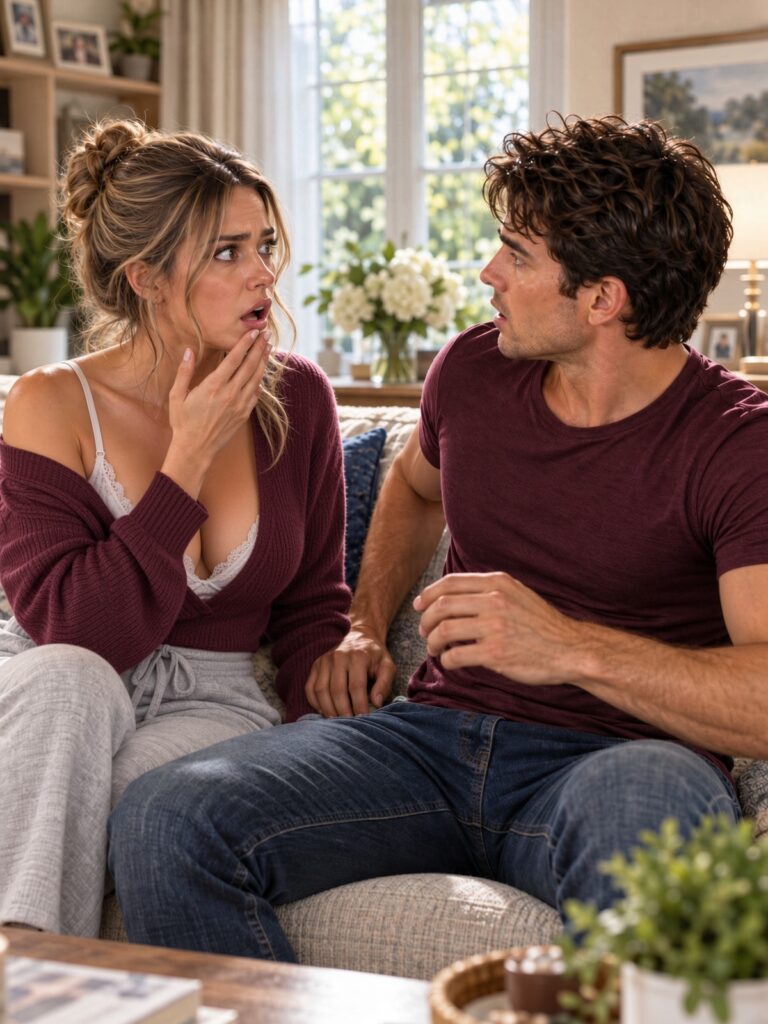
PART 1
The worst part about accidentally kissing your best friend is not the kiss.
It is the silence afterward.
That one impossible second when both of you pull back and suddenly realize the safest relationship in your life may no longer be safe at all.
That was exactly what happened to me on a rainy Saturday night in Portland, Oregon, when I leaned toward Hannah Whitmore at the same moment she turned her head.
Our lips touched.
Barely.
Maybe one second.
Then Hannah moved back.
The smile vanished from her face.
And after ten years of friendship, I had absolutely no idea what to say.
My name is Caleb.
I was thirty-two at the time, and Hannah had been my best friend since our junior year of college.
Not one of my best friends.
My best friend.
There is a difference.
She was the person who had seen every version of me that I preferred keeping away from the rest of the world.
The broke college student living on noodles.
The twenty-five-year-old convinced a terrible startup job was “good experience.”
The man sleeping in a hospital chair while his father died from complications after a stroke.
The person who spent six months afterward telling everyone he was fine because admitting otherwise seemed more exhausting than grief itself.
Hannah had seen all of it.
I had seen hers too.
Breakups.
Bad roommates.
Career panic.
Her mother’s surgery.
The year Hannah convinced herself that being constantly busy meant she was successful instead of simply exhausted.
We had survived enough together that friendship stopped feeling like something we maintained.
It simply existed.
Like gravity.
You notice gravity only when something suddenly changes direction.
The kiss changed direction.
At least that was how it felt.
That Saturday, Hannah had invited me to her apartment because she was helping organize a winter fundraiser for the Eastside Community Center.
The event raised money for coats, heating assistance, school supplies, and emergency grocery cards for local families.
Hannah worked in nonprofit development, which meant her job consisted of convincing people with money that other people’s problems were worth paying attention to.
She was good at it.
Possibly because she could make guilt sound like an exciting opportunity.
I worked in commercial project management.
Less noble.
More spreadsheets.
The community center fundraiser was the kind of thing Hannah always volunteered for even when her actual job was already swallowing most of her week.
I had warned her.
“You realize volunteering more because you’re overworked is not recovery.”
“I am not overworked.”
“You answered three emails during dinner yesterday.”
“I’m efficient.”
“You apologized to your soup because your phone vibrated.”
“That was private.”
She still asked me to help.
I still said yes.
Again.
Gravity.
Rain hammered against her apartment windows all afternoon while we folded cardboard donation boxes, sorted name tags, packed gift bags, and argued about whether dark green counted as a festive color.
“It’s elegant.”
Hannah said.
“It looks like a bank brochure.”
“Red is obvious.”
“It’s Christmas.”
“It’s a winter fundraiser.”
“Those are Christmas cookies on your table.”
“They are neutral snowflakes.”
“They have Santa hats.”
Hannah threw ribbon at me.
Around ten, we stopped working.
Around eleven, she opened wine.
By midnight, we were both on her couch watching old college videos because apparently adulthood had become so exciting that footage of us being idiots at twenty-one qualified as entertainment.
One video showed our graduation party.
Hannah had been wearing a blue dress and silver shoes.
I had been attempting something that theoretically belonged to the category of dancing.
“Oh my God.”
she said.
“You looked like somebody was controlling your knees remotely.”
“That is a recognized dance style.”
“It absolutely is not.”
“You were worse.”
“I have rhythm.”
“You assaulted a chair.”
“The chair moved.”
Hannah laughed so hard she folded sideways toward me.
I reached out automatically to steady her.
At the exact same moment, she turned.
Our faces were suddenly inches apart.
Neither of us stopped.
Maybe that was the part I thought about most afterward.
There had been enough time.
A fraction.
Still enough.
Then our lips touched.
Soft.
Surprised.
Gone almost immediately.
Hannah pulled back first.
I froze.
She stared at me.
I stared at her.
Rain hit the windows.
Somewhere on the television, twenty-one-year-old Hannah was still laughing.
I said:
“Sorry.”
Worst possible word.
Her expression changed.
“No.”
“I mean—”
“I know.”
“I didn’t—”
“I know.”
Another terrible sentence.
We sat there like two people who had forgotten how language worked.
Finally Hannah gave me a small smile.
“It’s okay.”
That should have reassured me.
It didn’t.
Because I knew Hannah.
Her real smile reached her eyes.
This one stopped halfway.
I stood.
“I should go.”
“Caleb.”
“It’s late.”
“You don’t have to—”
“I know.”
That was becoming a theme.
I found my jacket.
Hannah walked me to the door.
Neither of us hugged.
We always hugged.
Sometimes quick.
Sometimes one arm.
Sometimes the kind where one of us had had a terrible week and neither wanted to admit we needed another thirty seconds.
That night, nothing.
I stepped into the hallway.
“Good night.”
Hannah said.
“Night.”
The door closed.
I stood there for almost a minute.
Then walked downstairs convinced I had just ruined the most important relationship in my life.
I did not sleep.
At first, I tried telling myself the kiss meant nothing.
Accident.
Physics.
Bad timing.
Two heads.
One couch.
End of story.
Then I kept remembering the half second before either of us moved away.
That was the problem.
If it had been entirely accidental, why had my first reaction not been embarrassment?
Why had part of me wanted to stay?
That question was harder.
Because the honest answer had history.
Hannah and I had never dated.
Not once.
But there had been moments.
Years earlier.
Small ones.
A camping trip near Mount Hood when she fell asleep beside me near the fire and I stared at her longer than I should have.
A New Year’s Eve when we stood on somebody’s balcony after midnight and I thought about kissing her.
The month after her relationship with Daniel ended, when she started coming over every Friday and I caught myself noticing what perfume she wore.
Then the feeling would fade.
One of us would date someone else.
Life would move.
Friendship would reassert itself.
Comfortable.
Safe.
I had decided years before that occasional attraction did not automatically mean a friendship was secretly a romance waiting to happen.
Adults can notice each other.
That does not mean every feeling deserves action.
So I left it alone.
Apparently Hannah had not been as unaware as I assumed.
At 8:12 the next morning, my phone buzzed.
Hannah:
Can we meet?
I stared for almost a full minute.
Then typed:
Yes.
She suggested a coffee shop overlooking the Willamette River.
Neutral territory.
That felt ominous.
When I arrived, Hannah was already there.
Coffee untouched.
Hands around the cup.
She looked like she had slept approximately as well as I had.
“Hey.”
“Hey.”
I sat.
For three minutes we discussed weather.
Nobody has ever cared less about weather.
Then Hannah exhaled.
“The kiss didn’t scare me because it was accidental.”
There went the weather.
I looked at her.
“What scared you?”
She stared into her coffee.
“That I liked it.”
My brain stopped.
Hannah continued before I could respond.
“I need to say all of this before you say anything.”
“Okay.”
She looked up.
“I’ve been thinking about you differently for months.”
“How many?”
“I don’t know.”
“Hannah.”
“Maybe six.”
I stared.
“Six months?”
“Don’t make that face.”
“What face?”
“The one where you’re mentally rebuilding every conversation we’ve had.”
That was exactly what I was doing.
She continued.
“It started when Mom had surgery.”
Her mother, Diane, had needed a complicated hip revision the previous spring.
Hannah had gone to Seattle for nearly six weeks to help during recovery.
I drove up twice.
Then again when Hannah came down with the flu and was trying to care for her mother while barely functioning herself.
I brought groceries.
Changed a broken porch light.
Drove Diane to physical therapy twice.
Cooked badly.
Mostly stayed out of the way.
“That?”
I asked.
“Yes.”
“I changed a light bulb.”
“You also sat with Mom for three hours while I slept.”
“She likes me.”
“She loves you.”
“Everybody’s mother loves me.”
“That is deeply untrue.”
Hannah smiled briefly.
Then became serious.
“You were patient.”
“You didn’t act like helping made you important.”
“You didn’t tell me I owed you.”
“You came because I asked.”
“And then you left when I didn’t need you anymore.”
Something about that sentence stayed with me.
Hannah continued.
“I started wondering what it would be like if the person I trusted most was also the person I built a life with.”
I did not know what to do with my hands.
“So you wanted to date me?”
“I didn’t know.”
“That is not the same thing.”
“No.”
“And I was terrified of finding out.”
“Why?”
She laughed once.
“Caleb, if I date some man for four months and it ends, I lose a boyfriend.”
“If I date you and it ends badly, I could lose the person who knows where my spare key is.”
“That is apparently your measure of intimacy?”
“You know what I mean.”
I did.
Because the same fear had kept me quiet for years.
I looked toward the river.
Then said:
“I’ve thought about it too.”
Hannah went completely still.
“When?”
“Different times.”
“Not constantly.”
She smiled.
“So romantic.”
“I’m trying to be accurate.”
“When?”
“New Year’s at Tyler’s place.”
Her eyebrows rose.
“That was four years ago.”
“Yes.”
“The camping trip.”
“Which one?”
“Mount Hood.”
“You thought about kissing me when I had marshmallow in my hair?”
“I was emotionally confused.”
Hannah laughed.
Then:
“Anything recent?”
I looked at her.
“Yesterday.”
“Before the kiss?”
“Yes.”
Her smile disappeared again.
Not badly this time.
Something softer.
For several seconds, neither of us spoke.
Then Hannah said the sentence I least expected.
“I don’t want you to become my boyfriend.”
I blinked.
“What?”
“Not today.”
“That was a violent change of direction.”
“I know.”
She leaned forward.
“I want thirty days.”
“To do what?”
“Stop pretending.”
I stared.
“What does that mean?”
“It means we spend thirty days being honest that this possibility exists.”
“We go on actual dates.”
“We talk about things we usually avoid because friendship lets us.”
“Marriage.”
“Kids.”
“Money.”
“Where we want to live.”
“What scares us.”
“What we expect from relationships.”
“What happens when one of us is angry.”
“And what if after thirty days we decide this is terrible?”
Hannah looked directly at me.
“Then we stop.”
“That easily?”
“No.”
“Probably not.”
“But we agree now that thirty days does not create an obligation.”
“No one owes the other person a relationship because we tried.”
“And if one of us says no at the end?”
“The other doesn’t punish them by destroying the friendship.”
That last part sounded impossible.
I said so.
“We can’t guarantee that.”
“No.”
Hannah nodded.
“We can only promise not to weaponize it.”
“If I say no, you’re allowed to be hurt.”
“If you say no, I’m allowed to be hurt.”
“But neither of us gets to say, ‘Then I guess ten years meant nothing.’”
That was painfully Hannah.
Thoughtful.
Structured.
Emotionally terrifying.
I drank coffee that had already gone cold.
“Thirty days.”
“Thirty.”
“Are there rules?”
She smiled.
“I knew you’d ask.”
“You have rules.”
“I made notes.”
“Of course.”
She pulled a folded page from her purse.
I stared.
“You created a relationship pilot program.”
“I work in nonprofit development.”
“We evaluate outcomes.”
I started laughing.
For the first time since the kiss, the fear loosened.
The rules were surprisingly simple.
No sleeping together during the thirty days.
Not because sex was wrong.
Because both of us agreed it would add emotional momentum before we had answered basic questions.
We could kiss if we both wanted.
We would go on at least four intentional dates.
Each of us would plan two.
No pretending something was okay when it wasn’t.
No using mutual friends as unofficial therapists about the other person without first talking directly.
No grand romantic gestures designed to force an answer.
No proposing at the end of thirty days.
“That needed writing?”
I asked.
“You make spreadsheets for vacations.”
“Fair.”
Then Hannah added:

PART 2
“And we keep some normal friendship.”
“What does that mean?”
“If we spend thirty days turning every conversation into relationship analysis, we’ll both want to die.”
“Excellent.”
“So some nights we watch television.”
“Some nights we argue about food.”
“We still get to be us.”
That part mattered.
I agreed.
Day one was a Wednesday.
Our first official date was at a small Italian restaurant in Southeast Portland.
We had eaten there together before.
Dozens of times.
That made it stranger.
Hannah wore a green sweater I had seen five times.
I wore a jacket she had mocked twice.
Nothing externally changed.
Then the server asked:
“Together or separate checks?”
Hannah looked at me.
I looked at her.
“Together.”
I said.
She raised an eyebrow.
“That was bold.”
“I’m experimenting.”
Conversation felt unnatural for twenty minutes.
We had spent ten years talking about everything except the fact that we might want each other.
Now even harmless questions seemed loaded.
“Do you want bread?”
What does bread mean?
Finally Hannah said:
“This is terrible.”
I laughed.
“Thank God.”
“I thought I was failing.”
“We need to stop performing date.”
“Yes.”
She stole one of my olives.
Normal returned.
After dinner, we walked along Division Street.
Hannah slipped her hand into mine.
No announcement.
No joke.
My whole body noticed.
“How does this feel?”
she asked.
“Suspiciously good.”
“Same.”
That was our first data point.
The next serious conversation was children.
Neither of us had ever discussed it beyond jokes.
I assumed Hannah wanted them.
She assumed I did not.
We were both wrong.
“I think I want one.”
I said.
“Maybe two.”
Hannah looked surprised.
“You?”
“Yes.”
“Why do you look offended?”
“You’ve spent ten years acting like toddlers are escaped criminals.”
“They are.”
“That doesn’t mean I dislike them.”
“What about you?”
Hannah hesitated.
“I used to think definitely.”
“And now?”
PART 3
“I’m not sure.”
That surprised me more.
She explained.
Her job had become more demanding.
She valued independence.
She worried about becoming the default parent simply because she was the mother.
Her own father had been kind but largely absent from domestic life.
Diane handled everything.
Appointments.
School.
Meals.
Emotional labor.
Hannah did not want that.
“If I have children,” she said, “I don’t want to become project manager of the family while my husband waits for assignments.”
Fair.
I said:
“I don’t want that either.”
“How do you know?”
“I don’t.”
“Good answer.”
We talked about parental leave.
Career interruptions.
Childcare.
Whether we would stay in Portland.
Nothing romantic.
Incredibly important.
At the end, neither of us knew whether we definitely wanted children.
But we discovered uncertainty did not automatically equal incompatibility if both of us were willing to keep the question open honestly.
Money came next.
Hannah saved aggressively.
I did too.
She hated debt.
I had a mortgage on a small condo and considered that normal.
She donated more than I did.
I spent more on travel.
Neither was dramatic.
Still useful.
Then family.
Hannah’s mother expected frequent visits.
My mother lived in Eugene and increasingly needed help managing my father’s old property.
Would we ever relocate?
Unknown.
Another data point.
Then conflict.
That one was uglier.
On day eleven, I canceled dinner.
Work emergency.
A commercial renovation project was behind schedule.
A subcontractor discovered structural damage behind an old wall.
I texted Hannah at 4:45.
Can we move dinner? Site problem.
She answered:
Sure.
I believed her.
Mistake.
The next morning, Hannah was cold.
Not openly.
Subtly.
Short replies.
No joke.
I finally asked:
“What?”
“Nothing.”
“Rule violation.”
She sighed.
“I know.”
Then:
“I hated that you canceled.”
“I had to stay.”
“I know.”
“Then what’s the problem?”
“The problem is you didn’t ask.”
I frowned.
“I told you.”
“Exactly.”
“You said, ‘Can we move dinner?’ after you had already decided.”
“There was no realistic alternative.”
“Then say that.”
“Hannah.”
“No.”
She crossed her arms.
“This is what you do.”
“What?”
“You decide responsibility gives you the answer.”
“Then you inform everyone.”
“That’s unfair.”
“Is it?”
I started defending.
Stopped.
Because she was right enough that anger became inconvenient.
My father had been the same.
Decisive.
Reliable.
Loved.
Also terrible at remembering that other people deserved participation even when the outcome seemed obvious.
“What should I have done?”
Hannah answered immediately.
“‘I have an emergency at the site. I need to stay. I’m sorry. Can we reschedule?’”
I stared.
“That is almost exactly what I wrote.”
“No.”
“You wrote it like moving dinner was a calendar adjustment.”
“I wanted you to know that I knew you were disappointed.”
That seemed absurdly small.
Which usually means it is not small.
“I’m sorry.”
Hannah’s shoulders dropped.
“Thank you.”
Then she said:
“I also need to apologize.”
“For?”
“I said ‘sure’ when I meant ‘I understand, and I’m disappointed.’”
“That was also dishonest.”
“Yes.”
We were both irritated.
Neither stormed away.
Thirty-day experiment survived.
Another data point.
Around day fourteen, the first real kiss happened.
Not the accidental one.
We were at my condo watching a documentary neither of us cared about.
Hannah was sitting beside me.
Her knee against mine.
We both knew we were no longer watching television.
I looked at her.
She looked back.
“Are we doing this?”
I asked.
“I think we’re discussing documentary quality.”
“Hannah.”
She smiled.
“Yes.”
“Can I kiss you?”
“Yes.”
I did.
Deliberate.
Slow.
No surprise.
The difference between that kiss and the first one was enormous.
The first had revealed possibility.
The second was a choice.
We kissed for a while.
Then stopped.
Not because neither wanted more.
Because we had made an agreement.
Hannah rested her forehead against mine.
“This rule is stupid.”
“You wrote it.”
“Past Hannah was cautious.”
“Present Hannah remains legally bound.”
“We did not notarize anything.”
“Spiritually enforceable.”
She laughed and pushed me away.
Good.
On day seventeen, I almost ended the experiment.
That surprised me.
We were discussing careers.
Hannah had been offered the possibility of leading fundraising for a larger nonprofit in Seattle.
Nothing formal.
Still.
If accepted, she might move.
“When were you going to tell me?”
I asked.
“Now.”
“How long have you known?”
“Six days.”
“Six?”
“I wanted to know whether it was real.”
“Before telling me?”
“Yes.”
I stood and walked toward the window.
The feeling was disproportionate.
Which meant it had found something older.
“You’re angry.”
Hannah said.
“I’m trying not to be.”
“Why?”
“Because this is exactly what scares me.”
“What?”
“Getting close to someone and discovering their life already has another direction.”
Hannah’s expression softened.
But she did not rush to reassure me.
Good.
She asked:
“Do you want me not to consider Seattle?”
“No.”
That came fast.
“Then what?”
“I want information before it becomes a decision.”
“That is fair.”
“I also need you to know something.”
“What?”
“If Seattle becomes the right job, I may take it.”
My stomach tightened.
“That sounds like a warning.”
“It’s honesty.”
She continued.
“I don’t want our thirty days to become an invisible veto over opportunities.”
“Neither do I.”
“Good.”
Then I admitted something harder.
“I think part of me was hoping this month would end with everything decided.”
Hannah laughed softly.
“Caleb.”
“I know.”
“One month cannot decide the next forty years.”
“Apparently.”
“What can it decide?”
She asked.
I thought.
“Whether we want month two.”
“Exactly.”
That became another rule.
No demanding lifetime certainty from short-term honesty.
Seattle never became an offer.
But the conversation mattered anyway.
Day twenty was Hannah’s planned date.
She took me to a pottery class.
I was terrible.
She was worse.
We made two objects the instructor politely described as bowls.
Mine resembled structural failure.
Hannah’s looked like it had been emotionally injured.
We laughed so hard we had to stop.
Later, walking to the car, Hannah said:
“This is the part I’m afraid of losing.”
“What?”
“This.”
“The stupid part.”
I understood.
Romance has a tendency to make people treat fun like proof.
Then conflict makes them panic.
Friendship had allowed us years of ordinary stupid moments.
Would dating make everything heavier?
“Maybe we protect it on purpose.”
I said.
“How?”
“Not every dinner becomes relationship summit.”
“Not every bad mood means something is wrong.”
“Not every disagreement becomes evidence we should have stayed friends.”
Hannah smiled.
“Good.”
Then:
“And if we break up?”
There it was.
The thing neither of us could solve.
I said:
“I don’t know.”
“What if it ruins everything?”
“It might.”
Hannah looked at me.
No reassurance.
Because there was none.
“I hate that.”
“Me too.”
That was probably the most honest part of the thirty days.
Risk remained.
No contract protected friendship from consequence.
All we could do was decide whether avoiding risk forever was actually preserving something—or simply preventing it from changing.
Day twenty-three was bad.
Hannah’s mother called.
A follow-up scan showed something concerning near the site of her previous surgery.
Probably inflammation.
Possibly another procedure.
Hannah panicked.
I arrived at her apartment with dinner.
Started asking questions.
Doctor?
Timeline?
Next appointment?
Did Diane need someone to stay?
Had Hannah checked flights?
Halfway through, she said:
“Stop.”
I did.
“What?”
“I don’t need project management.”
Right.
“What do you need?”
“To be scared.”
That answer broke something open in me.
I sat beside her.
No plan.
No research.
No phone.
Hannah cried.
I held her.
The scan eventually proved less serious than feared.
Medication.
Physical therapy adjustment.
No surgery.
But the evening remained important.
I had spent most of my life believing love meant usefulness.
My father had been like that.
He fixed.
Provided.
Solved.
The day he died, I remember standing in his garage surrounded by tools and realizing I knew exactly how he had loved me.
But there were conversations we never had because neither of us knew how to be present without doing something.
Hannah had shown me another version.
Stay.
No solution.
I needed that.
She needed a different lesson from me.
Three days later, I was overwhelmed at work.
Not crisis.
Just exhausted.
I canceled nothing.
Asked for nothing.
Hannah came over.
Saw my apartment.
Laundry unfolded.
Laptop open.
Dinner nonexistent.
“What do you need?”
she asked.
My instinct:
Nothing.
Instead:
“Can you make food while I finish this email?”
“Yes.”
Simple.
Receiving help without turning it into failure.
Another data point.
On day twenty-seven, we nearly slept together.
That is worth including because otherwise our restraint sounds effortless.
It wasn’t.
We had gone to a small concert.
Drinks afterward.
Back to Hannah’s apartment.
One kiss became several.
Then the entire logic of our rule became incredibly irritating.
Hannah stopped first.
“Thirty days.”
“I hate your system.”
“You agreed.”
“I was manipulated by coffee.”
She laughed against my shoulder.
Then became serious.
“I want this.”
“I know.”
“But I don’t want sex to become the reason we say yes on day thirty.”
That made sense.
Still annoying.
I went home.
Very slowly.
Day twenty-nine felt worse than day one.
We both knew the deadline was coming.
For almost a month, we had been living inside possibility without naming a final answer.
Now there had to be one.
I wrote notes.
Actually.
Hannah found out later and considered it proof she understood me too well.
I wrote:
Why yes?
Why no?
What changed?
What remains unresolved?
The yes side was easy.
I loved being with her.
Trusted her.
Wanted her physically.
Respected her.
Could imagine ordinary life together, not just romance.
The no side was not empty.
I worried we wanted different degrees of stability.
I feared that my desire for certainty could become controlling.
Hannah’s willingness to consider big changes frightened me.
Children remained uncertain.
Families lived in different cities.
Nothing catastrophic.
Nothing guaranteed.
That was when I realized what I had been unconsciously seeking.
Proof.
I wanted thirty days to prove that choosing Hannah was safe.
It did the opposite.
It proved choosing anyone meaningful would never be safe in the way I wanted.
People change.
Jobs move.
Parents get sick.
Feelings can shift.
Relationships can fail even when nobody betrays anyone.
The question was not:
Can I guarantee this will not hurt?
The question was:
Do I want to participate anyway?
My answer was yes.
On day thirty, we returned to the Eastside Community Center.
The fundraiser had taken place the previous evening.
It raised enough money to fund winter emergency assistance for hundreds of local families.
Volunteers were packing remaining coats and boxes.
Hannah had insisted we help close out the event before talking.
“That feels psychologically manipulative.”
I told her.
“How?”
“You’re putting me in a room full of evidence that you’re a good person.”
“Maybe I’ve been planning this for a month.”
“Disturbing.”
We worked until almost nine.
Then people began leaving.
Warm string lights still hung across the main hall.
Cardboard boxes lined one wall.
Hannah stood beside me.
“Thirty days.”
“Technically thirty days and nine hours.”
“Of course you know.”
“I track important metrics.”
She rolled her eyes.
Then neither of us smiled.
Hannah took my hand.
“What do you want?”
There it was.
No performance.
No accidental kiss to blame.
No emergency.
No fear demanding immediate certainty.
Just choice.
“I want to try.”
Her eyes filled.
I continued.
“Not because thirty days proved this is guaranteed.”
“It didn’t.”
“Not because the friendship was secretly fake.”
“It wasn’t.”
“I want to date you because I like what happens when we stop pretending there isn’t another possibility.”
Hannah squeezed my hand.
“What about the friendship?”
“I want that too.”
“You’re greedy.”
“Very.”
She laughed through tears.
Then said:
“I want month two.”
I smiled.
“That’s extremely romantic.”
“I learned from you.”
I touched her face.
Stopped.
“Can I kiss you?”
Hannah nodded.
“Yes.”
Our first real kiss after the decision was quiet.
No fireworks.
No applause.
No miraculous soundtrack.
Volunteers were laughing somewhere in the hallway.
Someone dropped a box.
A vacuum cleaner started in another room.
Normal life surrounding something important.
Perfect.
Dating after the thirty days was both easier and harder than the experiment.
Easier because the question was answered.
Harder because now choices had consequences without an expiration date.
Three months later, Hannah received an actual job offer.
Not Seattle.
San Francisco.
Significant salary increase.
Major nonprofit.
Excellent opportunity.
We had been dating ninety-two days.
I remember because apparently I do, in fact, track emotional metrics.
Hannah said:
“I’m considering it.”
My chest tightened.
Then I asked the question I had learned to ask.
“What do you want?”
“Part of me wants to go.”
Honest.
“And part?”
“Doesn’t want to leave you.”
We spent two weeks talking.
Not negotiating who loved whom more.
Examining reality.
Could I move?
My company had Portland projects.
Maybe later.
Could we do long distance?
Yes.
Did Hannah want the job itself or what accepting it symbolized?
That became the real question.
After visiting the organization, she declined.
Not because of me alone.
The role was less strategic than advertised.
More donor management.
Longer hours.
She realized she wanted leadership eventually, but not that position.
Important distinction.
If she had wanted it deeply, the decision might have gone differently.
A year later, I received an offer requiring frequent travel.
Hannah hated it.
I accepted anyway after we talked.
We spent eight months with me gone two nights most weeks.
It strained us.
No moral.
No secret gift.
Just strain.
Eventually I changed roles because I discovered I disliked the travel too.
Relationship decisions are sometimes mutual without becoming sacrifice mythology.
Two years after the kiss, we moved in together.
Not Hannah’s apartment.
Not mine.
A new rental.
Neutral.
Shared choice.
Before signing, we discussed money.
Deposits.
Rent split proportional to income.
Utilities.
Furniture.
What happened if we broke up.
Hannah’s mother called this:
“Very unromantic.”
Hannah answered:
“So is fighting over a couch during heartbreak.”
Diane admitted the point.
Living together exposed new information.
Hannah left every kitchen cabinet open.
Every one.
I closed them.
Loudly.
She accused me of passive aggression.
I accused her of attempting to kill me through upper-cabinet impact.
I scheduled household chores.
She hated the schedule.
Then became irritated when I stopped and laundry accumulated.
We created something less rigid.
Not beautiful.
Functional.
We also discovered our biggest conflict.
When scared, I moved closer.
When overwhelmed, Hannah needed space.
At first, both interpreted the other badly.
I thought space meant withdrawal.
She thought questions meant pressure.
Therapy helped.
Not because our relationship was failing.
Because we were tired of having the same argument under different names.
A couples counselor gave us one rule.
Say what your nervous system is asking for before assuming the other person understands.
So Hannah learned to say:
“I need an hour alone. I am not leaving.”
I learned to say:
“I need reassurance before we stop talking.”
Simple.
Difficult.
Useful.
Children became a real question around year three.
By then, Hannah was thirty-five.
Biology made uncertainty less theoretical.
We spent months discussing it.
She remained unsure.
I leaned yes.
That created pain.
Not resentment.
Pain.
At one point Hannah said:
“If I decide no, will you leave?”
I hated the question.
Still answered.
“I don’t know.”
She cried.
So did I.
We did not convert honesty into punishment.
Eventually Hannah realized she did want one child.
Not because I wanted one.
Because the idea had become hers too.
We married first.
Not because of pregnancy timing.
Because after four years together we wanted marriage.
Small ceremony near the Columbia River.
Diane cried through most of it.
My mother cried before it started.
Our college friends spent the reception telling exaggerated stories about how obvious our attraction had always been.
It had not been obvious.
That irritated me.
People rewrite history after the ending becomes visible.
Friendship had been real.
Not waiting room.
Not camouflage every day.
There were years when neither of us wanted more.
That mattered.
We wrote our own vows.
Hannah said:
“I promise not to call silence peace when I am actually afraid to say what I want.”
I said:
“I promise not to confuse planning with control, or uncertainty with danger.”
Then we kissed.
Deliberately.
Still preferred.
Our daughter, Lucy, was born two years later.
Parenthood immediately destroyed any illusion that communication skills made us evolved.
Sleep deprivation turns emotionally literate adults into courtroom adversaries over bottle sterilization.
Hannah struggled with postpartum anxiety.
Professional care mattered.
Doctor.
Therapist.
Family help.
I could support.
I could not treat.
One night, Lucy was six weeks old and had been crying for almost two hours.
Hannah stood in the kitchen crying too.
“I’m failing.”
I said:
“No.”
Too quickly.
She snapped:
“You don’t know what I feel.”
She was right.
I changed the answer.
“What do you need?”
“I don’t know.”
So I stayed.
When she asked me to take Lucy, I did.
When she wanted the baby back, I gave her back.
When therapy appointments began, I adjusted work.
Not heroism.
Parenting.
Hannah recovered gradually.
Years later, she said:
“The hardest thing was everybody telling me I was doing great when I knew I wasn’t okay.”
That changed how we spoke to other people.
Encouragement should not erase reality.
I eventually became director at my firm.
Hannah became development vice president at a regional nonprofit.
Lucy grew.
At seven, she found our college videos.
Disaster.
She watched the graduation dance.
Then said:
“Dad, what are you doing?”
“Dancing.”
“No.”
Hannah laughed so hard she nearly fell off the couch.
Again.
I immediately moved three feet away.
She stared.
“Really?”
“Trauma response.”
Lucy asked:
“What?”
“Nothing.”
Someday.
At ten, Lucy learned the kiss story.
Edited version.
“Did you accidentally kiss?”
“Yes.”
“How?”
“Physics.”
Hannah answered.
Lucy frowned.
“Then you got married because you accidentally kissed?”
“No.”
I said.
“The accident made us talk.”
“That’s different.”
“So you already loved Mom?”
I thought.
“I loved her as my friend.”
“Then later we decided we wanted something more.”
Lucy considered this with the seriousness of a judge.
“Could she say no?”
“Yes.”
“Could you?”
“Yes.”
“Then okay.”
Children often find the correct question faster than adults.
At forty-eight, Hannah’s mother developed early cognitive decline.
The woman whose recovery years earlier had first made Hannah look at me differently now needed more significant help.
There was painful symmetry in that.
We did not romanticize it.
Diane gradually lost independence.
Hannah struggled.
Old fear returned.
Would caregiving consume her career?
Would she become the default because she was the daughter?
We discussed options.
Her brother participated.
Professional home support.
Then assisted living when safety required it.
Hannah felt guilty anyway.
I did not say:
You’re doing the right thing.
Sometimes there was no clean right thing.
I said:
“You’re making the best decision with the information you have.”
That was truer.
Diane died at seventy-nine.
After the funeral, Hannah found me alone in the kitchen.
“You know what Mom told me after that first surgery?”
“What?”
“She said you looked at me like I was home.”
I froze.
“She said that?”
“Yes.”
“Why didn’t you tell me?”
Hannah smiled sadly.
“Because it would have terrified both of us.”
Probably.
We laughed.
Then cried.
Grief contains both without asking permission.
Our marriage had bad years.
Important to say.
One particularly bad year came when Lucy left for college, Diane had died, and my work consumed most of me.
Hannah felt abandoned.
I felt criticized.
We stopped asking direct questions.
Old patterns.
She withdrew.
I managed.
We became frighteningly polite.
One evening Hannah said:
“I think we are behaving like friends who share a mortgage.”
That hurt.
Because it was accurate.
We returned to counseling.
No affair.
No dramatic betrayal.
Just neglect.
Repair required boring things.
Protected dinners.
Phones away.
Saying when resentment started rather than six months later.
Sex had become rare.
We talked about that too.
Awkwardly.
The marriage improved.
Not restored to an imaginary golden period.
Changed.
More realistic.
Less automatic.
At our twenty-fifth anniversary, Lucy asked:
“What is the secret?”
Hannah said:
“There isn’t one.”
I said:
“Your mother made a thirty-day evaluation document.”
She groaned.
“That was twenty-nine years ago.”
“Still foundational.”
Lucy laughed.
Then asked seriously:
“Did you know after thirty days?”
I looked at Hannah.
“No.”
She smiled.
“No.”
Lucy looked confused.
“But you stayed together.”
“Knowing you want to continue,” Hannah said, “is not the same as knowing how it ends.”
That had become the central truth.
At thirty-two, I believed courage meant admitting I loved Hannah.
Later, I learned that was only the beginning.
Courage was telling her when I resented her.
Listening when she resented me.
Admitting we might want different things.
Allowing choices whose outcomes I could not control.
Not using history as debt.
Not saying:
After everything we’ve been through, you owe me.
Love cannot survive that sentence for long.
Our friendship helped.
It also complicated things.
Sometimes we avoided conflict because we had a decade-long identity as people who “never fought.”
Romance forced us to become less precious about harmony.
Disagreement did not mean friendship had failed.
It meant two people existed in the same relationship.
Hannah eventually retired before I did.
She immediately filled her calendar with volunteer work.
I pointed this out.
She denied it.
Then reduced two committees.
Growth.
I retired later.
We moved to a smaller house outside Portland.
Lucy lived in Seattle by then.
Married.
One son.
Hannah became the grandmother who brought books and art supplies.
I became the grandfather who checked whether the batteries were included.
Predictable.
One rainy Saturday, almost forty years after the accidental kiss, Hannah and I found the old college video on a hard drive.
Same graduation dance.
Same terrible knees.
We watched.
Hannah started laughing.
Not as violently now.
Age creates self-preservation.
She leaned against me.
Then said:
“Do you ever wonder what would’ve happened if we missed?”
“What?”
“The kiss.”
I knew immediately.
“If I turned a second later.”
“If you leaned the other direction.”
“Maybe nothing.”
Hannah looked surprised.
“Really?”
“Yes.”
“Maybe we would have figured it out six months later.”
“Maybe five years.”
“Maybe never.”
“That doesn’t bother you?”
I thought.
“No.”
That was different from the man I used to be.
I had once wanted our story to prove something.
That the kiss revealed destiny.
That feelings had been there all along.
That life pushed us together because we were supposed to be.
Now I preferred the less magical version.
We had an accident.
It made avoidance harder.
Then we had a conversation.
Then thirty days.
Then a date.
Then month two.
Then years of choices.
That was enough.
Hannah took my hand.
“You know I was terrified you’d say no after thirty days.”
“So was I.”
“You looked calm.”
“I was performing.”
“You?”
“Shocking.”
She smiled.
“Would you do it again?”
“The thirty days?”
“Yes.”
I considered.
“Yes.”
“Same rules?”
“No.”
Her eyebrows rose.
“I would remove the pottery date.”
“You’re still bitter because my bowl was better.”
“Your bowl collapsed in the kiln.”
“Art is subjective.”
“Gravity is not.”
She laughed.
Then rested her head against me.
Still familiar after all those years.
Still not guaranteed.
Nothing is.
The next morning, our grandson found us in the kitchen.
He was seven.
He pointed at an old photograph from the community-center fundraiser.
Hannah and me standing under string lights.
“Is that when you got married?”
“No.”
“When we started dating.”
“How long after the accidental kiss?”
“Thirty days.”
“Why did you wait?”
Hannah answered:
“Because we wanted to make sure we were choosing each other and not just reacting to one surprising moment.”
He thought.
“Did it work?”
I looked at Hannah.
She looked at me.
“Mostly.”
I said.
She hit my arm.
Then corrected:
“The waiting worked.”
“The rest took practice.”
Better.
That is the part people leave out of love stories.
The beginning can be accidental.
The continuation cannot.
An unexpected kiss can reveal a question.
It cannot answer it.
Thirty days can give two people space to become honest.
It cannot guarantee compatibility.
Friendship can create trust.
It cannot eliminate risk.
Marriage can express commitment.
It cannot freeze people in place.
Everything after the moment is participation.
Again.
Again.
Again.
When I think about that rainy Saturday now, I no longer remember the kiss most clearly.
I remember the silence.
The terror.
The realization that something precious had become uncertain.
At thirty-two, I believed uncertainty was the danger.
At seventy, I understood it differently.
Uncertainty was simply the place where choice became real.
If Hannah had been guaranteed to love me forever, saying yes would have meant very little.
If I had known we would never hurt each other, trust would not have required courage.
If friendship could not have changed, we would never have discovered what else it could become.
We had no guarantee.
We still stepped forward.
Not because the accidental kiss proved we belonged together.
Because thirty days later, with the surprise gone and the choice completely ours, we still wanted another day.
Then another.
Then enough of them became a life.
The End.


