
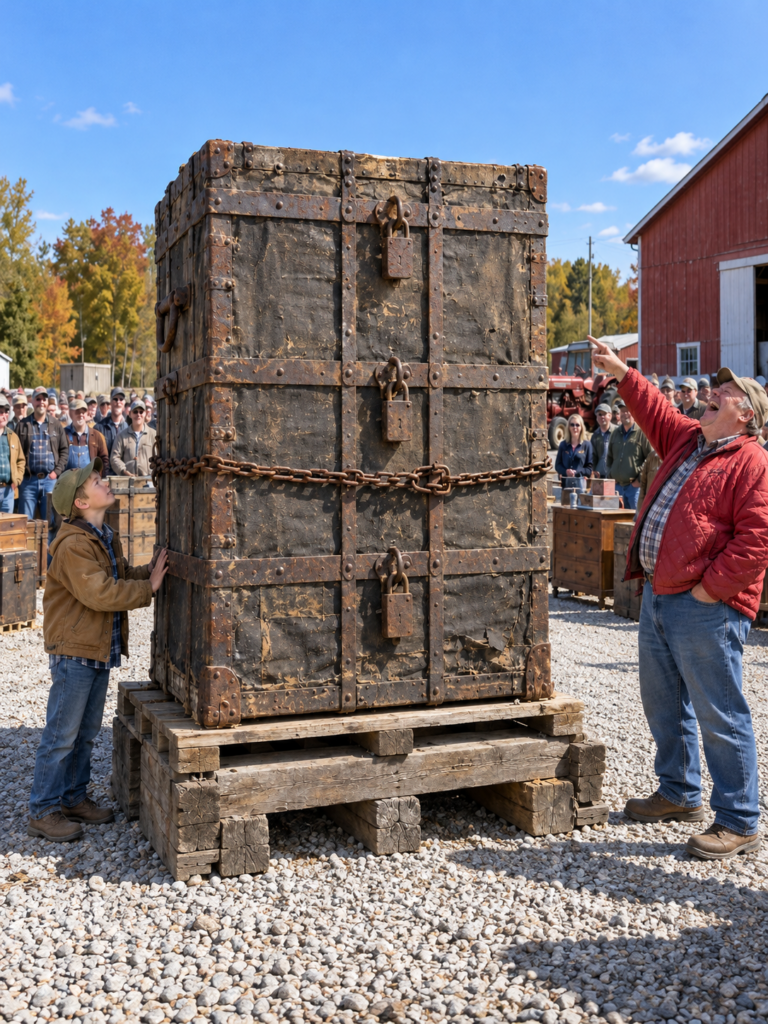
the boy who paid fifty dollars for a padlocked trunk the whole yard laughed at and would not open it until the right people stood in the room and the river came out of the dark
Part 1
The gravel of the sale yard still held the morning’s damp when Royce Tibbit threw his arms wide so the whole place could hear him. “Folks, the Kenny boy just paid fifty dollars for a box of mouse nests taller than his granddaddy.” The laughter rolled across the rows like a gust through dry corn. Royce reached into the bed of his pickup, came out with a crowbar, and held it up by the hooked end, grinning. “Go on, son. Pop it open. Let’s all see what fifty dollars buys.”
Arlo Kenny kept one hand flat on the cold iron band of the trunk and did not reach for the bar. He was twelve, narrow through the shoulders, the brown canvas chore jacket hanging a little loose on him. In the front pocket were two twenties and a ten—every dollar he had made mowing lawns along Cherry Street since the first week of June. The trunk stood upright on a pallet at the end of the third row of lots, and calling it a trunk was like calling a grain bin a bucket. It rose half again as tall as a grown man. Its oak slats had gone the gray of river driftwood under a skin of tarred canvas, and three iron bands were riveted around it—one at the crown, one at the waist, one at the foot. Down its face hung three padlocks the size of a man’s fist, each one rusted solid to its hasp, and somebody long ago had drawn a chain around the whole thing and locked the chain to itself. It had come down out of the old Ashby loft that morning, and it had taken four men and a come-along to stand it up. Nobody had a key. Nobody living had seen it open.
When Lyall Ostrander, the auctioneer, reached it with his clipboard, he had to admit he did not know what it was. Lot 96, he called, white straw hat pushed back on his head. One large freight trunk, contents unknown. Padlocked, no keys. Out of the Ashby loft. Who will start me at one hundred? Nobody would. He came down to seventy-five, then fifty, and got nothing but grins and folded arms. That was when Royce, who owned Tibbit Salvage out on the river road and had bought half the estates in the county for pennies, called out from the front row in his bright red quilted jacket. “I’ll give you five dollars to haul it off, Lyall, and that’s charity.”
People laughed. Royce liked it when people laughed. He was a big, heavyset man in his fifties with a voice built for shouting across a scrapyard, and he had spent the whole morning walking the rows and making jokes about other people’s grandmother’s furniture. Then a voice from the back said, “Fifty.” Every head turned. Arlo stood next to his grandfather holding up the cardboard bidder card Hollis had handed him, and his face was as steady as a fence post. Lyall looked at Hollis Kenny, a lean white-haired man of seventy-three in a tan work coat. Hollis gave one small nod. It was his number, and he was letting the boy use it.
“I have fifty,” Lyall said, a little surprised. “Do I hear sixty?”
Royce nearly doubled over. “Sixty, Lyall? Nobody else wants it. He could have had it for a nickel.”
Lyall let the gavel fall. “Sold to bidder 240 for fifty dollars.”
That was when Royce made his announcement to the yard and fetched his crowbar and held it up. The boy looked at the bar for exactly one second. Then he said, in a clear voice that carried further than anyone expected, “No, sir. I’m not opening it here.”
Royce turned to the crowd with his eyebrows raised. “You hear that? He’s taking it home to open in private so nobody sees him cry.” More laughter. A man by the hay wagon slapped his knee. Somebody’s teenage nephew made a noise like a raccoon. Arlo stood there and took it, his hand still flat on the cold iron band, and he did not explain himself to anybody.
Royce was not finished. He strolled a slow circle around the trunk and wrapped it with the straight end of the crowbar so that it gave back a dull dead knock. “Curtains, rotten ones. The Ashbys never threw out a rag in their lives. That’s a coffin for curtains, son. And when you get it home, you’ll find out it cost more to haul than you paid for it.” That part at least was true. The trunk weighed somewhere north of half a ton, and Hollis’s old flatbed Ford had only a hand winch bolted behind the cab.
“Tell you what,” Royce said, loud and generous. “I’ll take that iron off your hands. Ten dollars for the bands and the locks. You’ll be out forty, but you’ll learn something. That’s a cheap lesson.”
“No thank you, Mr. Tibbit,” Arlo said.
“Twelve?”
“No thank you.”
Royce shook his head at the crowd as if to say, well, folks, you all saw me try. “Kennys,” he said, just loud enough. “Never could tell a bargain from a bill.” Hollis Kenny’s jaw tightened at that. Everybody in the yard knew what it meant. Six years before, when Hollis’s hardware store on Front Street had closed, it was Royce Tibbit who bought the shelving and the nail bins at the closing sale for almost nothing. And it was Royce who told the story at the feed store for a year afterward about the old man who got misty over a nail bin. Hollis had not cried, but the story had stuck to him the way stories do in a small river town.
Arlo looked at his grandfather. His grandfather looked back, and something passed between them that nobody else in that yard could read. “Gus,” Hollis said quietly to Gus Varner, who farmed the place next to theirs and had come to the sale for a disc harrow. “You got an hour?” Gus had an hour. So did his grown son. Lyall Ostrander lent them two ratchet straps and would not take a dime for them. It took four men, the winch, a long plank, and most of an hour to walk that trunk up onto the flatbed, and Arlo stood off to the side in his grandfather’s spare work gloves, calling out when a strap slipped, never once getting in the way. Royce stayed to watch, leaning on his fender with the crowbar over his shoulder, narrating every inch. “Careful, boys. Don’t drop the curtains. Easy now. You’ll wake the raccoon.”
When they had it strapped up right behind the cab, towering over the roof of the truck, Royce cupped his hands around his mouth. “Hey, Arlo, when you finally open it, you call me. I want to see your face.”
The boy rolled down the passenger window. He looked at Royce for a long moment. “I will,” he said. “I promise.”
Royce laughed all the way to his truck. He would be telling the story at the feed store by noon. He had no idea yet that the boy meant every word.
The Kenny place sat on four acres above the river, a white frame house with a porch that leaned a little, and a machine shed with a dirt floor that Hollis had kept swept for fifty years. They backed the flatbed in until the trunk’s shadow fell across the workbench, chocked the wheels, and left it standing in its straps. Hollis did not ask anything until the engine had ticked itself quiet. Then he took off his glasses, wiped them on his shirt, and said, “All right, tell me.”
Arlo pulled a folded square of paper from the inside of his jacket. He had printed it three weeks earlier at the Clement County Historical Society on one of the Saturdays he spent there helping Mrs. Odessa Puit feed old newspapers through the microfilm reader. He was the kind of boy who would rather read a newspaper from 1881 than play a video game, and he did not much care who knew it. It was a copy of an advertisement from the Pel’s Landing Courier, the spring of 1881. Across the top, in heavy black type, it announced a farewell exhibition at the Garnet Opera House, three nights only, of Carol’s grand moving panorama of the Ohio River. Nine hundred feet of canvas. Pittsburgh to Cairo in a single evening.
“I didn’t know what a moving panorama was either,” Arlo said. “So I looked it up. Before there were movies, painters would take one strip of canvas, eight or nine feet tall and hundreds of feet long, and paint a whole journey on it, mile after mile. They wound it onto a great wooden roller and set a second roller across a stage. Then in a darkened hall with a piano playing, two stagehands turned the cranks and the audience watched the river slide past as if from the deck of a steamboat. People paid a quarter to see them. Almost all of them were gone now, burned or rotted or cut up for wagon covers.”
He turned the paper over. On the back was a second clipping from 1931, the year the Garnet closed for good. Among the things given away was one line: the old Carol panorama, boxed in its traveling case and sealed against the damp, which Mr. Ashby had kindly agreed to store in his loft.
Hollis read it twice. Then he took his flashlight around to the left side of the trunk and crouched where the boy pointed, low below the middle band. Under ninety years of loft grime, letters had been stenciled into the canvas skin. Most were gone, but a C was there, and an A and two R’s, and the faint outline of a W at the end. Beside them was a small brass plate, green with age, riveted into the oak. Arlo had found it that morning walking the rows, had rubbed it with his thumb when nobody was looking, and had read the words “roll one” and the name of a Cincinnati wagon works. He had not said a word to anybody. He had just gone to find his grandfather and asked to borrow his number.
Hollis stood up slowly. He looked at the trunk, then at his grandson, and for the first time in a long while he laughed—a short, surprised laugh with no meanness in it. “Why didn’t you open it at the sale?” he asked. “You could have shut Royce Tibbit up right there.”
Arlo had thought about that all the way home. “Because if I’m wrong, it’s curtains like he said, and I’m out fifty dollars. But if I’m right, it’s been shut since 1931. And if I pry it open in a barnyard with Mr. Tibbit jabbing at it, and the canvas is rotten at the edges, or it tears, or somebody grabs at it,” he shook his head, “then nobody will ever believe what it was. They’ll just say the Kennys found some old rags. Same as they always say.”
Hollis was quiet.
“I want somebody there who knows,” Arlo said. “Somebody whose word counts. And I want everybody who laughed to see it with their own eyes.”
So they did not open it. They did not so much as touch a hasp. They left it standing in the shed, still sealed, and went inside and called Odessa Puit.
Part 2
Mrs. Puit was seventy-eight and had run the historical society out of a converted bank on Front Street for longer than Arlo had been alive. When she heard what the boy had bought, the line went silent for so long that Hollis thought the call had dropped. “Hollis,” she said at last, “is it still sealed?”
“Still sealed.”
“Then for heaven’s sake keep it that way. I’m calling Ruth Amler.”
Dr. Ruth Amler had spent thirty-four years as senior curator of paintings at the state historical museum and now worked as an independent appraiser, the kind of expert insurers and museums both called when they needed a figure they could stand behind. She rang back at a quarter past one and asked to speak to the buyer himself. Arlo described it all—the bands, the tarred canvas, the stencil, the brass plate, and the two capped iron hubs he had noticed on top of the trunk, one at each back corner, like the ends of axles poking through.
“Those are the roller spindles,” Dr. Amler said, and her voice had changed. “Arlo, I’m going to be honest with you. Most of the time, a canvas that has sat in a barn loft for ninety years is mildew and dust. The paint comes off like old wallpaper. I’ve opened cases like this and found nothing but a roll of brown rot. So don’t get your hopes up.”
“Yes, ma’am.”
“But promise me nobody opens that case until I get there. Not you. Not your grandfather. Nobody. I can be there by seven tonight.”
“Tonight?”
“If it’s what you think it is,” she said, “I don’t want it sitting in a shed one hour longer than it has to.”
Arlo hung up, found a pencil and a sheet of notebook paper, and started a list. He did not want a crowd. A crowd was what he’d had at the sale, and a crowd laughs. He wanted people whose word the town trusted. Lyall Ostrander, who had run the sale and could swear the trunk came straight out of the Ashby loft with its locks rusted shut. Lyall’s wife Peg, who had written the boy’s name in the clerk’s book. Mrs. Puit. Gus Varner and his wife Bonnie. His mother Karen, who was working a day shift at the county hospital and would be off at six. His grandfather. And one more name at the bottom, underlined twice.
Hollis read it over his shoulder. “You sure about that one?”
“I promised,” Arlo said.
Tibbit Salvage sat on six acres of crushed cars and coiled cable along the river road with a cinder-block office out front. Hollis waited in the truck with the window down. Arlo walked up to the office in the bright afternoon and found Royce on the porch with two of his yard men, still telling the story. “And he says, ‘No, sir. I’m not opening it here.’” The men saw the boy and went quiet. Royce turned around.
“Well, look who it is. Get it open yet? Was it curtains?”
“No, sir. I haven’t opened it,” Arlo said. “I’m opening it tonight at seven at the Grange Hall on Mill Road, with an appraiser from the state museum there. You said to call you when I opened it, so I’m telling you. You’re invited.”
Royce stared at him. Then he laughed so hard he had to sit down on the porch rail. “An appraiser for a box of moth food. Son, you’re the best thing that’s happened to this county all year.” He wiped his eyes. “I’ll be there. Front row. I’ll bring popcorn.”
“Yes, sir,” said Arlo, and walked back to the truck.
The Mill Road Grange Hall was a long white building with a pressed-tin ceiling, a small stage at one end, and folding chairs every family in that end of the county had sat on at some funeral lunch. By five, Gus and Hollis and Lyall had winched the trunk off the flatbed, walked it up a ramp of planks, and set it upright in the middle of the stage, still chained, still padlocked, still wearing ninety years of loft dust. Bonnie Varner set out a dozen borrowed chairs in two short rows. Peg Ostrander brought a coffee urn because Peg brought a coffee urn to everything. Mrs. Puit came with a camera and a box of white cotton gloves. Karen Kenny came straight from the hospital in her navy cardigan, her badge still clipped to the pocket, and stood at the back of the stage, looking from the trunk to her son as if she were seeing both of them for the first time.
“Fifty dollars,” she said quietly.
“It was mine,” Arlo said. “I mowed for it.”
She thought about that. Then she put her hand on the back of his neck, the way she used to when he was small, and left it there.
Part 3
Royce Tibbit arrived at ten minutes to seven with his nephew Kyle and one of his yard men. He walked down the center aisle in his red quilted jacket like a man arriving at a ball game and took the middle chair of the front row. He had not brought popcorn. He had brought his crowbar, and he laid it across his knees. “In case the professor needs a tool that works,” he told the room. Nobody laughed this time. Royce noticed, frowned, and laughed by himself.
At three minutes to seven, headlights swung across the windows. Dr. Ruth Amler was a small silver-haired woman in her sixties in a long camel coat with reading glasses on a cord and a hard leather case in each hand. She shook hands with Hollis, then Mrs. Puit, and then she came to Arlo and shook his hand exactly the way she had shaken the grown-ups. “You must be the buyer.”
“Yes, ma’am.”
“Then you’re the one who opens it when I say so, and not one minute before.” She looked past him at the trunk, and Arlo saw her stop for half a step, the way a person stops when they recognize someone across a street. “Well,” she said softly. “Look at you.”
She did not touch it at first. She circled it twice with a flashlight, bent close to the brass plate and the stencil, and photographed each padlock. She ran a gloved fingertip along a seam where the canvas met the oak and smelled the glove. “Pine tar,” she told Mrs. Puit. “Every seam was painted shut. Whoever sealed this knew exactly what they were doing. That’s the only reason anything inside has a chance.”
Royce shifted in his chair. “Awful lot of fuss for a curtain box, ma’am.”
Dr. Amler looked at him over her glasses for a long moment, the way she might have looked at a water stain. “Then you won’t mind waiting,” she said.
At seven she nodded to the boy. Lyall cut the old chain with a pair of long bolt cutters, and it slid to the floor in a heap of orange rust. The padlocks would not cut. The shackles were too thick. So Hollis handed Arlo the long pry bar from the truck, set his own hands on the bar beside his grandson’s, and showed him where to seat the flat end behind the first hasp. Arlo pulled on his safety glasses and his work gloves. Dr. Amler stood at his shoulder, close enough to stop him.
“Slow,” she said. “Let the old wood do the work.”
Arlo leaned. The hasp groaned. Ninety years of rust held and held, and then the screws came out of the oak with a sound like a dry branch cracking, and the first padlock swung free and thumped against the wood. From the front row, Royce clapped slowly, three times. The second hasp came easier. The third came hardest of all, and Arlo’s arms were shaking when it finally gave. Then nothing held the front of the trunk but the tarred seam, and Dr. Amler ran a thin pallet knife down it from top to bottom and stepped back.
“Your trunk,” she said. “Open it.”
The front of the case was one tall door on old strap hinges. Arlo pulled and his grandfather pulled with him, and the door came away from the frame with a long sigh of air. The smell that came out was not mildew. It was linseed oil and cedar, and something Mrs. Puit would later say smelled exactly like the inside of an old church. Inside, filling the case from floor to ceiling, stood a single enormous roll, taller than any man in the room, wrapped in oilcloth gone the color of tea. Beside it, in its own cradle, stood a second wooden roller, empty. A pair of iron crank handles hung on pegs inside the door, and behind them was a flat bundle tied with faded ribbon.
Royce Tibbit leaned forward in his chair. Dr. Amler handed out cotton gloves. Then, with five of them working together, she lifted away the outer oilcloth and a second wrap of soft muslin beneath it. And there, on the outer face of the canvas, upside down from where they stood, were the blue of water and the white stacks of a steamboat. Dr. Amler let out a breath she seemed to have been holding since one o’clock that afternoon.
“Help me walk it,” she said. “Just a few feet. Just enough to see.”
They set the empty roller at the far side of the stage and fitted the cranks. Hollis took one handle and his grandson took the other, and with Dr. Amler guiding the edge of the canvas in her gloved hands, they began very slowly to turn. The Ohio River came out of that trunk. It came out eight feet tall and as bright as the day it was painted. A wide brown river under a summer sky. Sycamores leaning over the banks. A sternwheeler pushing upstream under a long feather of smoke. A man in a straw hat fishing off a flatboat, his line a single hair of white paint. Ninety years in the dark, rolled tight inside oil and pine tar, and the dark had kept every color.
Ten feet of river, then twenty, then thirty, and the people in the folding chairs got up without deciding to and came to the edge of the stage. Then the river turned a bend, and there was a town, a small town, on a high bank with a brick warehouse at the landing and a white steeple on the hill and a road winding up from the water. Every person in that hall knew the shape of that bank. They drove past it every day. It was Pel’s Landing as it had looked in 1849, before the flood wall, before the bridge, before any of them were born.
“That’s the old church,” Bonnie Varner whispered. “Before the fire. That’s the steeple my grandmother used to talk about.”
At the foot of the landing, painted with the same small loving care as everything else, a sidewheel ferry was taking on a wagon and a team of mules. And along the white paddle box of that ferry, in neat red letters, the painter had lettered a name: Tibbit.
Royce Tibbit was standing at the edge of the stage. Nobody had seen him get up. He stared at the name on the ferry with his mouth open, and the crowbar hung forgotten from his hand. “That’s Amos,” he said to nobody. “My great-great-granddad’s boat. There’s a photograph of it at my mother’s house. I never saw it in color.”
Part 4
Dr. Amler had stepped down to read the ribboned bundle under the hall lights—a printed program and a ledger in the painter’s own hand of every town the panorama had played. When she came back up the steps, she took off her glasses and spoke not to the room but to the boy. “Arlo. This is Josiah Carol’s grand moving panorama of the Ohio River. It was painted in 1849 and shown in more than two hundred towns. Every reference I have ever read lists it as lost. Only a handful of moving panoramas survive anywhere in this country, and not one of the great Ohio River canvases. Not one, until tonight.”
She let that settle. “I’ll need to examine the full length in a proper studio before I sign anything formal, but I have done this work for a long time, and I’m comfortable saying this tonight, in front of all of you, on the record. For insurance purposes, I would not let this canvas leave this hall valued at less than six hundred forty thousand dollars, and I would expect the state museum to want it very badly.”
Six hundred forty thousand dollars. For a moment nobody in the Grange Hall moved. Then Peg Ostrander put a hand over her mouth and sat down hard on a folding chair, and Gus Varner said a word he would apologize to the pastor for on Sunday, and Karen Kenny crossed the stage in three steps and wrapped her arms around her son from behind and held on. Royce Tibbit said nothing at all. He stood at the edge of the stage, white as the paddle box, staring at a little painted ferry with his family’s name on it. It was his nephew Kyle who finally spoke, and he meant no harm by it. “Uncle Roy, you offered him twelve dollars for the iron.”
Somebody laughed. Not the barnyard laugh of that morning, but a short, helpless laugh, the kind people make when something is too much. Royce heard it. He looked down at the crowbar in his hand as if he did not know how it had got there. Then he walked back up the aisle, laid it on his empty chair, and sat down in the last row by himself.
Lyall Ostrander cleared his throat. “For the record,” he said, “Peg’s got it in the clerk’s book. Lot 96 sold to bidder 240. Arlo Kenny. Fifty dollars cash. That sale is closed. It’s the boy’s.”
They wound the canvas back inch by inch. Dr. Amler would not let it go further that night. The full length needed a climate-controlled room and a team of four, and she had seen too many treasures ruined by excitement. So the door was closed again. The trunk went back to the machine shed, and Hollis sat up beside it until dawn in a lawn chair with a thermos of coffee, just in case.
The calls started on Monday. A dealer in New York offered nine hundred thousand site unseen. A collector in Texas called twice. Dr. Amler’s formal report arrived at the end of the month, forty pages long, and confirmed every word she had said in the hall. And then Arlo did something nobody expected, which by then was becoming a habit. He sold it to the state museum for the appraised value and not a dollar more, on two conditions. The panorama would be conserved and shown again in full, with the cranks turning the way it was meant to be seen, and the very first showing would be in Pel’s Landing.
“It’s the town’s river,” he told the museum’s director. “They should get to see it first.”
The money went where a twelve-year-old boy with a grandfather and a nurse for a mother would send it—into a college fund, onto the leaning porch and the shed roof, and into a new hardware store on Front Street, in the same brick storefront where Hollis Kenny’s old one had stood. Hollis said he was too old to run it. He ran it anyway. On the wall behind the counter hung his old nail bins, which Royce Tibbit had brought back one Saturday in his own truck and would not take a dollar for.
Part 5
It took the museum’s conservators fourteen months to clean nine hundred feet of canvas. They wrote that the Pel’s Landing passage was among the finest in the whole work, as if the painter had lingered in that town longer than he meant to. On a Saturday evening the following December, the Grange Hall on Mill Road was full for the first time in years. They borrowed chairs from three churches. People drove in from four counties. Mrs. Puit sold programs at the door for a quarter apiece because that was what it had cost in 1881, and every quarter went to the historical society’s roof.
The lights went down. A woman from the Methodist church played the piano, and at the side of the stage, with a museum conservator on one side and his grandfather on the other, Arlo Kenny took hold of an iron crank and began to turn. When Pel’s Landing came around the bend, the whole room made one soft sound together—the sound people make when they see a face they thought was gone.
In the back row sat a heavyset man in a red quilted jacket. He had bought his ticket like everybody else, and he did not laugh once all evening. When the ferry crossed the stage with his family’s name on its paddle box, a few people turned to look at him, and Royce Tibbit did not look away. He nodded slowly and wiped his eyes with the back of his hand.
Afterward, as the hall emptied, he came down the aisle to where Arlo was winding the cranks and stood there holding his cap. “I laughed at you,” he said, in front of everybody.
“Yes, sir.”
“I was wrong.”
“Yes, sir,” said Arlo. And then, because he was his grandfather’s grandson, he held out his hand, and after a second, Royce Tibbit shook it.
They still talk about that sale in Clement County. Not just about what the trunk turned out to hold, though they talk about that too. They talk about the boy who stood in a barnyard with his hand on a padlocked box while the whole yard laughed at him, and would not open it until the right people were in the room. Fifty dollars, a promise, and a little patience. That was all it took.


