
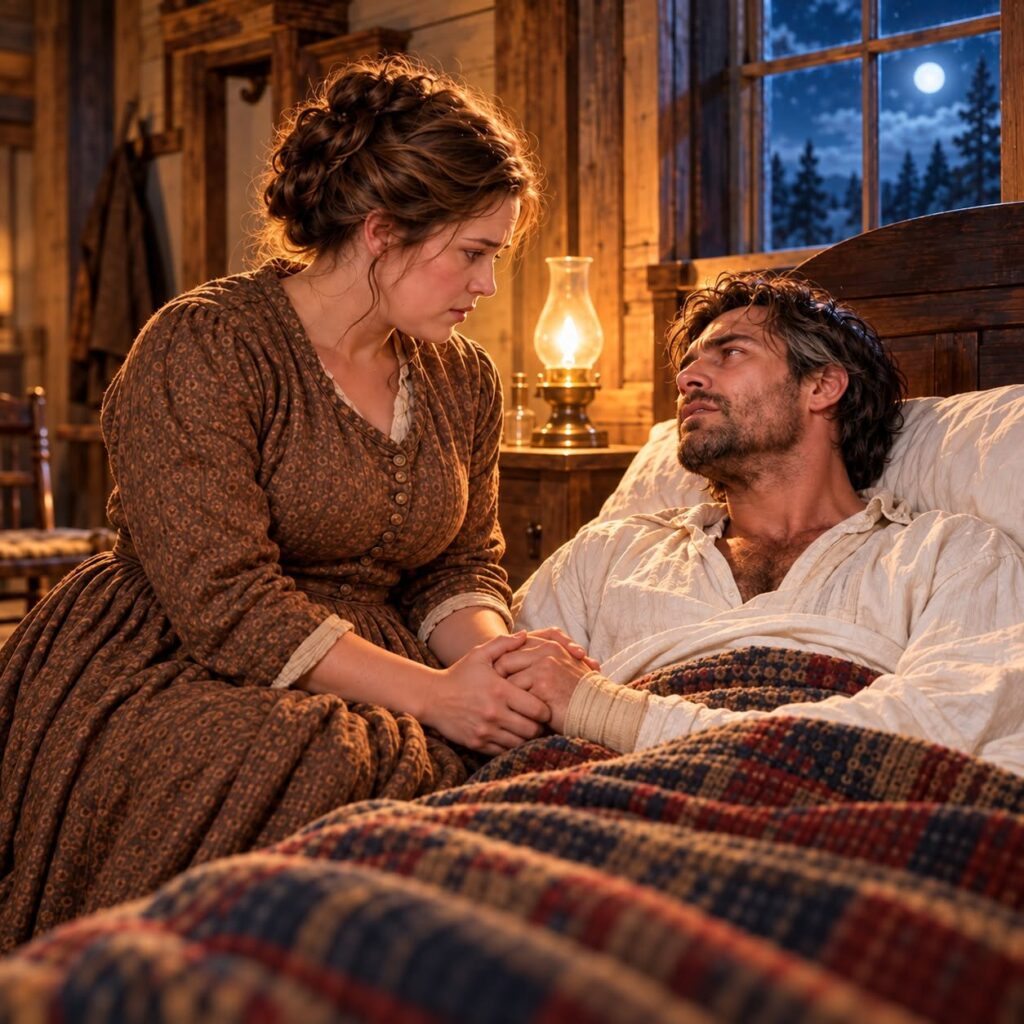
PART 3 — THE RANCHER’S DEAD WIFE LEFT A SECRET BENEATH HIS SADDLE, AND THE WOMAN WHO SAVED HIM WAS NEVER SUPPOSED TO FIND IT
Silas stood in the bedroom doorway, clutching something wrapped in a dirty piece of canvas.
His hands were shaking.
Clara Whitmore had seen enough frightened men to know when fear came from something more serious than a difficult conversation.
“Silas,” she said carefully, “what did you find?”
The old ranch hand looked toward Everett Caldwell.
The rancher was struggling to sit upright, his fever-bright eyes fixed on the bundle.
“Put it away,” Everett rasped.
Silas didn’t move.
“Mr. Caldwell, I can’t.”
“I said put it away!”
The effort sent Everett into a coughing fit. His broken ribs made him gasp, and Clara immediately moved to support his shoulders.
“Enough,” she said firmly. “You’ll tear yourself apart shouting.”
Everett caught her wrist.
“Clara. Please.”
There was something in his voice she had not heard before.
Not anger.
Not stubbornness.
Fear.
Silas stepped into the room and unfolded the canvas.
Inside lay a short strip of black leather, two severed saddle straps, and a small brass fitting.
Clara frowned.
“What am I looking at?”
Silas swallowed.
“The cinch strap from Mr. Caldwell’s saddle. I went back to the creek after Dr. Aldridge asked me to look over the accident.”
Everett shut his eyes.
Silas continued.
“At first I thought the leather snapped when the horse went down. But it didn’t.”
He held the strap toward the lamp.
Two clean cuts ran almost completely through the leather.
“Someone sliced it,” Silas whispered. “Then rubbed mud into the marks so they’d look old.”
Clara stared at the ruined strap.
“You’re saying someone wanted Everett to fall?”
“I’m saying that saddle was made to come loose beneath him.”
A heavy silence filled the bedroom.
Outside, wind moved through the cottonwood trees.
Everett’s breathing had become shallow again.
Clara turned to him.
“Did you know?”
He refused to meet her eyes.
“Everett.”
“I suspected.”
The answer was barely audible.
Clara felt something cold settle beneath her ribs.
“You suspected someone tried to kill you, and you said nothing?”
“I wasn’t certain.”
“Then why did you warn Silas not to tell me?”
Everett looked toward the window.
“Because people who get close to me have a way of ending up dead.”
Clara stared at him.
“What does that mean?”
He closed his eyes.
For several seconds, she thought he wouldn’t answer.
Then he whispered, “It’s how Eleanor died.”
Silas lowered himself into the chair by the door.
He suddenly looked ten years older.
Clara remained beside Everett’s bed, her hand resting lightly on the quilt.
Seven years earlier, Eleanor Caldwell had died when her carriage overturned along the northern ridge.
That much Clara already knew.
Dr. Aldridge had mentioned it.
So had Silas during their wagon ride.
What neither man had explained was that Eleanor’s carriage had been found with a broken harness strap.
And that Everett had spent seven years believing he should have noticed something was wrong.
“She was coming back from Red Hollow,” he said, his voice hoarse. “She’d gone into town to speak with a lawyer.”
“About what?”
Everett shook his head.
“I never knew.”
He swallowed painfully.
“We’d argued that morning. She wanted me to examine certain ranch accounts. Said money was disappearing. I told her she was mistaken.”
His eyes filled.
“She said I was too willing to trust men simply because they’d worked for my father.”
Clara listened without interrupting.
“I told her she was imagining things. She left angry.”
He stared at his injured hand.
“That was the last conversation we ever had.”
Silas bowed his head.
“Boss…”
“Don’t,” Everett whispered.
Clara understood now why he’d spoken Eleanor’s name during the fever.
Why he’d made his beautiful house feel like a tomb.
He wasn’t merely grieving his wife.
He was serving a sentence he’d imposed upon himself.
“Who handled the ranch accounts?” Clara asked.
Everett hesitated.
“My cousin.”
“What’s his name?”
“Martin Caldwell.”
Silas looked up sharply.
Clara noticed.
“What is it?”
The ranch hand rubbed his jaw.
“Martin was the one who saddled Mr. Caldwell’s horse the morning of the accident.”
The room became terribly quiet.
Everett turned toward him.
“You didn’t tell me that.”
“I didn’t think anything of it at the time.”
“Where is Martin now?” Clara asked.
“Billings,” Everett answered. “He said he had business concerning the cattle contracts.”
Silas shook his head.
“That’s what he told you, boss. But one of the hands saw him riding toward the north pass yesterday evening.”
Clara felt her pulse quicken.
“Was he expected back?”
“No.”
She looked between the two men.
A wealthy rancher.
A dead wife.
A cousin responsible for the financial records.
And two accidents involving damaged harness equipment.
Clara had never studied law.
She didn’t know how to investigate a crime.
But she understood one thing perfectly.
Someone had tried to take Everett Caldwell away from this world.
And that person might return to finish the job.
She drew the quilt over his shoulders.
“Silas, lock every downstairs door. Have someone remain near the stables, and send word to the sheriff when you can.”
Silas stood.
“And you, Miss Whitmore?”
Clara pulled the chair closer to Everett’s bed.
“I’m staying here.”
Everett opened his eyes.
“You shouldn’t.”
She met his gaze.
“Well, Mr. Caldwell, that makes two of us doing things we shouldn’t.”
For the first time that dreadful morning, he almost smiled.
Dr. Aldridge arrived shortly after sunrise.
The elderly physician examined Everett carefully, changed the dressings around his injured ribs, and studied the worsening tenderness along his side.
His expression grew grave.
“This fever has lasted too long.”
Clara watched his face.
“How serious?”
“Serious enough that I want someone beside him constantly. His chest injury may have developed an infection.”
“Will he survive?”
Aldridge glanced toward Everett.
“If his breathing worsens, he may not.”
Clara felt the floor shift beneath her.
She had known this man less than a day.
He had insulted her, ordered her away, and complained about nearly everything she did.
Yet the thought of him dying left a strange, terrible emptiness in her chest.
The doctor instructed her on his care and promised to return with additional medicines.
Before leaving, he drew her into the hallway.
“Miss Whitmore, there’s something else.”
She looked up.
“About the saddle?”
He nodded.
“I examined the leather myself. Those cuts were made with a blade.”
“Then someone tried to kill him.”
“That’s a matter for the sheriff. But I’m deeply concerned.”
Clara folded her arms.
“Do you suspect Martin Caldwell?”
The doctor studied her.
“I suspect Everett has trusted the wrong people.”
He hesitated.
“His father died owing money to several banks. Everett worked twenty years to settle those debts. Martin has controlled the books for most of that time.”
“And Eleanor questioned him?”
“Frequently.”
“Why didn’t you tell Everett?”
“Because Eleanor never showed me proof. Only her concerns.”
Clara looked toward the bedroom.
“Then perhaps it’s time someone found it.”
By the second evening, Everett’s fever had begun to ease.
He was still dangerously weak, but his breathing had steadied, and he could remain awake long enough to speak.
Clara sat beside the window mending a torn shirt.
Everett watched her quietly.
Finally, he said, “You never told me why you came to Montana.”
Clara continued sewing.
“Needed work.”
“That can’t be the whole story.”
“It usually is.”
He waited.
The silence stretched between them.
Then he asked, “Who taught you to sew like that?”
“My mother.”
“Is she still living?”
Clara’s needle stopped.
“No.”
“I’m sorry.”
She nodded.
Another silence.
Everett looked toward the lamp.
“Silas says you’ve worked in kitchens, laundries, and hospitals.”
“Silas talks too much.”
“He says you’re not afraid of hard work.”
“I’ve never had the luxury.”
Everett studied her face.
“You’re twenty-nine?”
“Yes.”
“And you’ve been alone twelve years?”
Clara finally set down the shirt.
“Since I was seventeen.”
“What happened?”
She looked toward the window.
Moonlight silvered the distant mountains.
“My father died in a sawmill accident. My mother followed him the next winter. There were debts, and the landlord wanted his rent.”
Everett remained silent.
“I went to work for a family in Cheyenne. They promised wages and a room.”
“Did they pay you?”
“Not regularly.”
Her mouth tightened.
“The lady of the house said I ought to be grateful. That a girl who looked like me couldn’t afford to be particular.”
Everett frowned.
“What did she mean?”
Clara gave a small, humorless smile.
“You’ve seen me, Mr. Caldwell.”
“Of course I have.”
“Then you know.”
He studied her broad shoulders, strong hands, and the plain dress stretched across her ample figure.
Then he looked back at her face.
“I know you’re capable.”
She laughed softly.
“That’s a kinder answer than most.”
“Clara…”
But she continued.
“When I turned twenty, a traveling salesman offered to marry me. Said he’d give me a home and never let me go hungry.”
“What happened?”
“I believed him.”
Everett went still.
“We were engaged for three months. I gave him the money I’d saved. He said he needed it to purchase a wagon and begin a business.”
Everett’s expression darkened.
“He took it?”
“Every penny.”
“And left?”
Clara nodded.
“He left a note saying he’d found a woman better suited to his ambitions.”
She looked down at her hands.
“I learned something that day.”
“What?”
“Never build your whole life around a promise someone else can break.”
Everett stared at her.
Then he said quietly, “I think I’ve been living by the same rule.”
Clara looked up.
For a moment, neither spoke.
Two wounded people sat in a room full of shadows, separated by years of disappointment but joined by something neither quite understood.
Then Everett held out his uninjured hand.
“Clara?”
She hesitated.
“Yes?”
“Would you sit closer?”
She moved her chair beside the bed.
He took her hand.
Not desperately, as he had during the fever.
Gently.
As though asking permission to hope.
On the fourth morning, a ranch hand discovered Martin Caldwell’s abandoned horse near the northern boundary.
Its saddlebag contained a revolver, several forged receipts, and a torn page from the ranch ledger.
Silas brought the evidence directly to Everett.
But Clara noticed something else.
The handwriting on the receipts was remarkably neat.
Every letter carefully shaped.
She remembered seeing similar writing somewhere.
“Silas,” she asked, “does Martin keep a desk in the house?”
“Yes, ma’am. Little office beside the dining room.”
“Would you show me?”
Everett tried to rise.
Clara turned toward him.
“Absolutely not.”
“This concerns my ranch.”
“And you’ll be able to concern yourself with it much better when you can stand without fainting.”
He scowled.
She pointed at the pillow.
“Stay.”
Silas grinned.
“She’s got your measure, boss.”
“Silas, I employ you.”
“Yes, sir. And I’d like to remain employed, so I’m listening to Miss Whitmore.”
Clara followed him downstairs.
Martin’s office smelled of ink, tobacco, and old leather.
A large desk stood beneath the window.
Its drawers were locked.
Silas produced a key.
“Martin left it on the mantel before he rode out.”
Inside the first drawer lay ordinary ranch correspondence.
The second contained cattle receipts.
The third was almost empty.
But Clara noticed scratches along its wooden bottom.
She pressed her fingers against the boards.
One shifted.
Beneath the false bottom rested a narrow packet tied with black ribbon.
Clara lifted it carefully.
Across the front, in elegant handwriting, were the words:
FOR EVERETT — IF ANYTHING HAPPENS TO ME.
She stopped breathing.
“Eleanor,” Silas whispered.
Clara untied the ribbon.
Inside were four letters and a small accounting book.
The first letter had been written seven years earlier.
My dearest Everett,
I pray you never have reason to read this. But if harm comes to me, I need you to understand that the danger is closer than you believe.
Clara glanced at Silas.
His face had gone pale.
She continued.
Martin has been selling cattle without your knowledge. He has forged your name on contracts and used the money to purchase land near the eastern railroad survey.
I confronted him yesterday. He threatened me.
I am going to Red Hollow to speak with Mr. Fletcher, the attorney. If I do not return, please do not believe it was an accident.
Clara’s hands trembled.
There was more.
And Everett, please forgive me for the things I said this morning. You are a good man. Your loyalty is one of the reasons I loved you. But loyalty becomes dangerous when it is given to someone who has not earned it.
Whatever happens, do not let grief make you cruel.
Live.
Love again, if you can.
And know that you were the happiest part of my life.
Eleanor.
Clara pressed the letter against her chest.
Silas turned away, wiping his eyes.
For seven years, Everett had blamed himself for his wife’s death.
Now, hidden inside the house where he’d mourned her, lay the truth that might finally set him free.
But when Clara turned the last page of the little accounting book, she found something even more alarming.
Martin had not merely stolen cattle money.
He had borrowed heavily against land Everett believed he owned outright.
Three notes were due within the month.
If the debts went unpaid, the ranch could be seized.
And every document carried a signature resembling Everett’s.
Clara looked toward Silas.
“We need the sheriff.”
Silas nodded.
“He’s been sent for.”
“How long?”
“Two days, perhaps.”
She stared at the papers.
“Then we’d better pray Martin doesn’t return before him.”
But at that very moment, a horse thundered into the courtyard.
A shout came from outside.
Then the unmistakable sound of breaking glass.
Silas rushed toward the window.
His face drained of color.
“Miss Whitmore…”
Clara stepped beside him.
Martin Caldwell stood in the yard with a rifle.
And he was looking straight at the house.
Martin was a lean man in his early forties, with narrow shoulders and a handsome face that seemed carefully practiced.
He stood near the horse trough, rain-dark hair plastered against his forehead.
“EVERETT!” he shouted.
Silas pulled Clara away from the window.
“Get upstairs.”
She clutched Eleanor’s letters.
“What about you?”
“I’ll try to talk him down.”
“He’s armed.”
“So am I.”
But before Silas could reach the doorway, Martin fired.
The shot shattered the upper pane of the office window.
Clara ducked.
Glass scattered across the floor.
“EVERETT! COME OUT!”
From upstairs came the sound of Everett calling her name.
Clara ran toward the staircase.
She reached his room and found him struggling to pull on his boots.
“What are you doing?”
“That’s Martin.”
“I know.”
He reached for a revolver on the bedside table.
She caught his arm.
“You’re still ill.”
“He’s threatening my men.”
“And what good will you do them if you collapse halfway down the stairs?”
Everett stared at her.
She took a breath.
“Listen to me. We found Eleanor’s letters.”
He went completely still.
“What?”
Clara handed him the packet.
For several seconds, he couldn’t move.
Then he saw his wife’s handwriting.
His knees weakened.
Clara helped him sit.
“Read it.”
He looked up.
“Clara—”
“Read it, Everett.”
Outside, Martin shouted again.
But Everett barely seemed to hear.
He unfolded the first letter.
His eyes moved across the page.
Once.
Twice.
Then his face crumpled.
“No…”
Clara knelt beside him.
He pressed the paper against his lips.
“She knew.”
His voice broke.
“Dear God, she knew.”
Tears slipped down his cheeks.
For seven years, Everett Caldwell had refused to cry in front of another living soul.
Now he wept openly.
“She tried to tell me,” he whispered. “And I wouldn’t listen.”
Clara took his hand.
“She knew you loved her.”
“I should have protected her.”
“You couldn’t protect her from a man you didn’t know was dangerous.”
He looked at the letter again.
“She told me to live.”
“Yes.”
“To love again.”
Clara swallowed.
“Yes.”
Everett raised his eyes.
For one suspended moment, the gunshots outside seemed impossibly distant.
Then Silas shouted from below.
“MISS WHITMORE! HE’S COMING IN!”
Clara stood.
She took the revolver from Everett’s hand.
“Stay here.”
His eyes widened.
“Clara, no.”
“I’m not going to shoot anyone.”
“Then what are you doing?”
She looked toward the door.
“Buying us time.”
Martin entered through the back door.
Clara heard his boots crossing the kitchen floor.
Then his voice.
“Silas, don’t be a fool. This doesn’t concern you.”
“It concerns every man who works this ranch,” Silas answered.
A heavy thud followed.
Someone fell.
Clara descended the staircase quietly.
At the bottom, she saw Silas lying against the wall, blood running from a cut above his eyebrow.
Martin stood over him with the rifle.
Clara stopped.
“Mr. Caldwell.”
Martin spun toward her.
“Who are you?”
“Clara Whitmore.”
He looked her up and down.
Then sneered.
“The hired nurse?”
“Yes.”
“Where’s Everett?”
“Upstairs.”
“Bring him down.”
“He can barely walk.”
“Then carry him.”
Clara didn’t move.
Martin’s eyes narrowed.
“I don’t think you understand your position.”
“I understand it perfectly.”
She kept her voice calm.
“You need Everett alive long enough to sign something.”
Martin stared.
Then a strange smile appeared.
“Well. You’re cleverer than you look.”
Clara ignored the insult.
“What are the papers?”
“Business.”
“Forged loans?”
His smile vanished.
“Who told you?”
“No one had to.”
He stepped closer.
Clara felt her heart hammering.
But she kept talking.
“You’ve taken money from this ranch for years. You sabotaged Everett’s saddle. And Eleanor discovered what you were doing before she died.”
Martin’s expression changed.
For the first time, the practiced charm disappeared.
“You found her letters.”
Clara said nothing.
He moved toward her.
“Where are they?”
“Somewhere safe.”
“Give them to me.”
“No.”
He raised the rifle.
Clara’s mouth went dry.
She could hear Silas breathing behind him.
Outside, horses shifted nervously in the yard.
Martin took another step.
“You have no idea what I’ve sacrificed for this place.”
Clara looked him directly in the eyes.
“Neither did Eleanor, until you killed her.”
Martin’s face twisted.
“She should have kept her mouth shut.”
The words hung in the air.
Even he seemed to realize what he’d said.
Clara felt a terrible calm settle over her.
“Then it’s true.”
Martin’s eyes darted toward the staircase.
“Where is Everett?”
A voice answered from above.
“Right here.”
Everett stood on the landing.
He was pale as death.
One hand gripped the railing.
The other held Eleanor’s letter.
Martin stared.
“Everett…”
“Seven years.”
Everett’s voice was weak but steady.
“For seven years, I believed my wife died because I let her leave angry.”
Martin shook his head.
“You don’t understand.”
“I understand you murdered her.”
“Everett, listen—”
“I trusted you.”
The words were almost a whisper.
Martin’s face hardened.
“Your father trusted you with everything. Land. Money. A name worth having. And what did I get?”
Everett descended one step.
“Work. A salary. A home.”
“Scraps!”
Martin shouted the word.
“I gave this ranch twenty years!”
Everett looked at him.
“And Eleanor gave you a chance to confess.”
Martin lifted the rifle.
“Enough.”
Clara moved before she could think.
She stepped between the cousins.
“Put the gun down.”
Martin laughed bitterly.
“Get out of my way.”
“No.”
“You’re going to die for a man you’ve known four days?”
Clara’s hands trembled.
But she stayed where she was.
“Not if you put down that rifle.”
Martin’s finger tightened near the trigger.
Then a voice rang from the front door.
“DROP IT, MARTIN!”
Three armed ranch hands stood in the doorway.
Behind them was Deputy Thomas Rusk, who had ridden ahead of the sheriff after receiving Silas’s urgent message.
Martin spun toward them.
In that instant, Silas lunged from the floor and struck Martin behind the knees.
The rifle discharged into the ceiling.
Plaster rained down.
Clara threw herself against the wall.
Everett stumbled backward.
The deputy rushed forward.
Within seconds, Martin was pinned to the floor, his rifle kicked away.
Clara stood trembling beneath the staircase.
Her ears rang.
Her heart pounded.
Then she heard Everett.
“Clara?”
She turned.
He was gripping the railing, struggling to remain upright.
“Are you hurt?”
She shook her head.
“No.”
He took one unsteady step toward her.
Then another.
She hurried to him.
“Everett, you impossible man.”
He caught her hand.
“Are you hurt?” he asked again.
“No.”
His face crumpled with relief.
And before the deputy, the ranch hands, and a bewildered Silas, Everett Caldwell pulled Clara into his arms.
He held her as though the entire world had nearly slipped away.
Martin Caldwell’s arrest changed everything.
The sheriff recovered forged loan agreements, altered cattle records, and correspondence linking Martin to fraudulent land transactions.
A search of his rented room in Billings uncovered additional documents and a knife matching the cuts found on Everett’s saddle straps.
The investigation into Eleanor’s death was reopened.
Martin eventually admitted that he had tampered with her carriage harness after learning she intended to expose his theft.
He maintained he had only wanted to frighten her.
But the prosecutors believed otherwise.
Eleanor had died on the northern ridge.
And Martin had spent seven years profiting from her silence.
The evidence was enough to bring him to trial.
Meanwhile, Everett faced the difficult task of untangling the debts Martin had created.
Some creditors accepted that the signatures were forged.
Others demanded payment until the courts settled the matter.
The ranch was not suddenly free of trouble.
But it was no longer trapped beneath a secret.
And for Everett, that changed more than anyone expected.
Three weeks after the shooting, Clara stood outside the ranch house with her canvas bag.
The morning was bright.
The grass smelled of summer.
Everett had recovered enough to walk without assistance, though Dr. Aldridge continued to warn him against heavy work.
Clara had received her wages.
More than the promised dollar and fifty cents.
Silas had quietly added a generous bonus.
She’d protested.
He’d refused to take it back.
Now she stood beside the wagon, preparing to return to Red Hollow.
Everett emerged from the house.
“What’s this?”
Clara turned.
“My things.”
“I can see that.”
“I’m leaving.”
He stared at her.
“Why?”
“You’re well enough now. Dr. Aldridge says you no longer need someone watching you through the night.”
Everett glanced at the bag.
Then at her.
“So that’s it?”
She forced a smile.
“That was the arrangement.”
“One night?”
“One night.”
“You stayed nearly a month.”
“Well, you’re a particularly troublesome patient.”
He didn’t smile.
“Clara.”
She looked away.
There were too many things she wanted to say.
That she’d grown accustomed to hearing his footsteps in the hallway.
That she liked watching him drink coffee on the porch.
That she’d begun imagining mornings in the bright kitchen and evenings listening to Silas tell stories beside the fire.
That for the first time in twelve years, leaving felt less like freedom than loss.
But she knew better than to trust such dreams.
Everett was a wealthy rancher.
A respected man.
She was a hired nurse with two dresses, a worn canvas bag, and no family name worth mentioning.
Whatever tenderness had grown between them belonged to the strange, frightened days of his illness.
Real life would eventually return.
And when it did, men like Everett Caldwell did not marry women like Clara Whitmore.
“I should go,” she whispered.
She reached for the wagon.
Everett caught her hand.
“Wait.”
She stopped.
He looked down at her fingers.
The same fingers that had held his through fever.
That had brought him water.
That had placed Eleanor’s final letter into his hands.
“Do you remember what I asked you that first night?”
Clara swallowed.
“Yes.”
“I asked you not to leave.”
“You were ill.”
“I was frightened.”
She looked up.
He took a breath.
“And I’m frightened now.”
“Everett…”
“Because if you climb into that wagon, I’m going to spend the rest of my life wondering whether I let the best thing that’s happened to me in seven years disappear down that road.”
Tears burned behind her eyes.
“You don’t owe me anything.”
“I know.”
“Then why are you saying this?”
“Because I love you.”
The words came without hesitation.
Clara stared.
Everett stepped closer.
“I didn’t mean to. I wasn’t looking for it. And I certainly wasn’t prepared for a woman who could order me around in my own bedroom.”
A small laugh escaped her.
He smiled.
“But somewhere between you refusing to be frightened of me and holding my hand when I thought I was dying, I began to understand something.”
“What?”
“I wasn’t alive, Clara. Not really. I was breathing and working and letting the years pass.”
His voice softened.
“Then you came upstairs with that battered canvas bag and told me you were being paid to make certain I survived the night.”
Clara’s tears slipped down her cheeks.
“You made me want to survive more than that night.”
She covered her mouth.
Everett reached into his coat.
But he did not produce a ring.
Instead, he unfolded a piece of paper.
“Aldridge says you’re looking for work.”
Clara blinked.
“What?”
“I need someone to manage the household. Someone to make sure the men eat properly and the accounts are kept honestly.”
Her face fell slightly.
“Everett, I don’t want charity.”
“Neither do I.”
He handed her the paper.
It was an employment agreement.
A fair salary.
A private room.
And authority to hire additional help.
Clara stared.
“You want me to stay as your housekeeper?”
“If that’s what you want.”
He paused.
“But I also want you to know that my feelings have nothing to do with your employment. You can accept the work and never return my affection. You can decline it and still have my respect.”
Clara looked at him.
He continued.
“I won’t ask you to promise me forever when you’ve spent so long learning not to promise anyone tomorrow.”
Her heart tightened.
“I’ll ask you only one thing.”
“What?”
“Would you stay long enough for us to find out what this might become?”
Clara stared at the agreement.
Then at the road.
For twelve years, she’d survived by leaving before anyone could abandon her.
She knew how to pack.
How to disappear.
How to start over.
What she didn’t know was how to remain somewhere she was wanted.
Slowly, she set her bag on the ground.
“One condition.”
Everett straightened.
“Name it.”
“You stop pretending you don’t need people.”
He smiled.
“That may take some practice.”
“And another.”
“I thought you said one.”
“You’ve always been difficult. I’ve learned to adjust.”
He laughed.
“Go on.”
“If I stay, I won’t be treated as someone you ought to hide when respectable company visits.”
The smile disappeared from his face.
He stepped closer.
“Clara Whitmore, I would be proud to have you beside me anywhere.”
She searched his eyes.
Then, at last, she believed him.
“All right,” she whispered.
Everett blinked.
“All right?”
“I’ll stay.”
His face changed so completely that Clara laughed through her tears.
He reached for her.
Then stopped.
“May I?”
She nodded.
He drew her gently into his arms.
And for the first time since she was seventeen, Clara let herself lean against someone without wondering how soon she’d have to stand alone again.
Autumn came early to Red Hollow that year.
Golden leaves drifted across the Caldwell ranch.
The cattle grew fat on the high meadows.
Repairs began on fences Martin had neglected, and Silas took on two additional hands.
The household changed as well.
Clara opened the windows.
She planted flowers beside the porch.
She brought warm bread to the bunkhouse and insisted the men eat at regular hours.
She moved Eleanor’s portrait from the dark hallway into the sunny sitting room, where Everett could see it without feeling as though the house were a place of mourning.
One evening, he found Clara standing before it.
“Do you think she’d mind?” Clara asked softly.
Everett approached.
“Mind what?”
“Me being here.”
He looked at Eleanor’s smiling face.
For a long moment, he said nothing.
Then he answered, “I think she’d be glad someone finally made me open the curtains.”
Clara smiled.
He took her hand.
“I’ll always love her.”
“I know.”
“That doesn’t mean there’s less room for you.”
Clara turned toward him.
He brushed a loose strand of hair from her cheek.
“Grief taught me to close every door,” he whispered. “You taught me they could open again.”
She rested her forehead against his.
And beneath Eleanor’s gentle gaze, they shared their first kiss.
The following spring, Everett proposed beneath the cottonwood tree near the creek.
The same creek where someone had tried to take his life.
Clara noticed the place immediately.
“Everett, of all the places in Montana…”
He smiled.
“I know.”
“Why here?”
“Because this was where I nearly lost my future.”
He took her hands.
“And I wanted it to become the place where I asked for one.”
He lowered himself onto one knee.
Clara began crying before he opened the ring box.
“Clara Whitmore, you once told me that promises are dangerous because people can break them.”
She nodded.
“I can’t promise there will never be trouble. Or pain. Or days when I’m too stubborn for my own good.”
She laughed through her tears.
“But I can promise you this. I’ll never make you earn your place in my home by making yourself smaller.”
Her breath caught.
“I love the woman who walked into my bedroom and refused to be frightened of me. I love your courage, your kindness, your strength, and every part of the life that brought you here.”
He opened the box.
Inside lay a simple gold ring.
“Will you marry me?”
Clara stared at him.
Then she looked at the creek.
The sunlight moved across the water.
A meadowlark called from the fence.
For twelve years, she’d told herself that staying was dangerous.
That belonging to someone meant giving them the power to hurt her.
But she’d come to understand something during her months at the ranch.
Love wasn’t the absence of risk.
It was choosing someone who treated your trust as something precious.
“Yes,” she whispered.
Everett smiled.
Then Clara laughed.
“Yes, you stubborn, impossible man.”
He slipped the ring onto her finger.
And when he stood, she threw her arms around him so enthusiastically that he stumbled backward.
“Mind the ribs!” he laughed.
“Those healed months ago.”
“I know. But I’m beginning to think marrying you may be more dangerous than falling off that horse.”
She kissed him.
“Then you’d better learn to hold on.”
They married in June.
Not in a grand church before strangers.
But beneath the cottonwood trees, surrounded by the ranch hands, Dr. Aldridge, Silas, and the few neighbors who had earned their trust.
Clara wore a cream-colored dress she’d sewn herself.
It fit her broad shoulders beautifully.
Her hair was pinned with tiny white flowers.
And when she stepped into the clearing, Everett looked at her as though the entire world had become something miraculous.
Silas stood beside him.
The old ranch hand leaned close.
“Remember when you told me to send her away?”
Everett smiled.
“I remember.”
“Good thing she doesn’t listen.”
“The best thing that ever happened to me.”
During the ceremony, Everett held Clara’s hands and spoke his vows slowly.
Not like a man reciting words he’d memorized.
Like a man who knew exactly what each one meant.
When Clara promised to stand beside him through whatever life brought, her voice trembled.
But she did not hesitate.
Because this time, she wasn’t promising to disappear into someone else’s life.
She was promising to build one together.
Years later, visitors to the Caldwell ranch often heard an unusual story.
They were told that the mistress of the house had originally arrived with a canvas bag, two dollars and forty cents, and an agreement to care for a dying stranger for one night.
They heard how she had stood up to a man twice as stubborn as most people could tolerate.
How she had discovered a hidden betrayal.
How she had helped bring a murderer to justice.
And how the rancher who once ordered her out of his bedroom eventually begged her to stay for the rest of his life.
But Clara herself rarely told the story that way.
When young women came looking for work, she treated them kindly.
When a girl arrived frightened and alone, Clara made certain she had a meal before asking questions.
And when someone apologized for being too plain, too large, too poor, or too ordinary to deserve a good life, Clara would smile.
Then she would tell them something she’d spent twelve years learning.
“Never believe that being unwanted by the wrong people means you are unworthy of being loved.”
She would glance toward the porch, where Everett often sat reading with a cup of coffee.
“And don’t mistake being alone for being strong. Sometimes the bravest thing you’ll ever do is let someone care for you.”
One summer evening, long after the ranch had become a place of laughter and warmth, Everett found Clara sitting beside the bedroom window.
She was reading the same little book she’d brought on her first night.
He leaned against the doorway.
“Mrs. Caldwell?”
She looked up.
“Yes?”
“I’ve been thinking.”
“That sounds dangerous.”
He smiled.
“Do you remember what you told me when I asked why you were still here?”
She pretended to consider.
“I’ve told you many things.”
“You said, ‘Where else would I be?'”
Clara closed her book.
“I remember.”
Everett crossed the room and offered his hand.
“Well, I’ve been meaning to give you a better answer.”
She took it.
He drew her gently to her feet.
“Here,” he whispered. “Right here. Where you’re loved.”
Clara smiled through sudden tears.
Outside, the prairie wind whispered through the cottonwoods.
Inside, the little oil lamp burned beside the bed.
And the woman who had once believed she belonged nowhere finally understood that home was not a place someone allowed her to stay.
It was a place where she was wanted.
Not for one night.
Not until the work was finished.
Not until she became inconvenient.
But for every ordinary, imperfect, beautiful day that followed.
Because sometimes the person who arrives to save your life is the one who teaches you how to live it.
THE END.


