
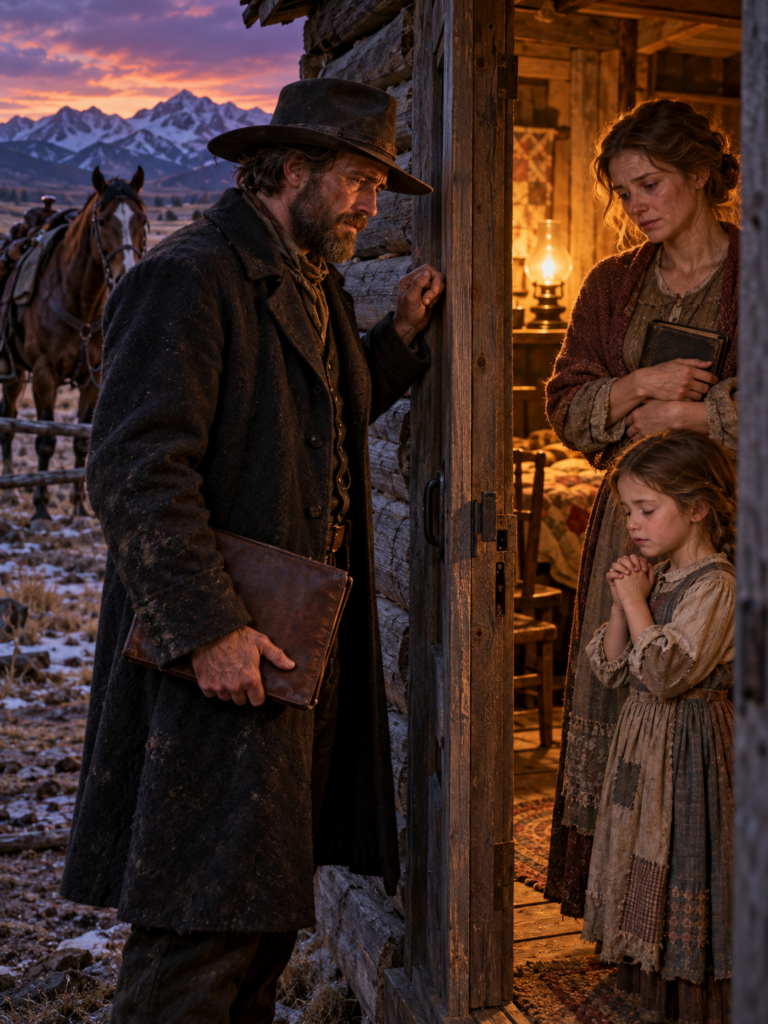
Gideon’s fingers remained against the edge of the ledger.
“What about him?”
Hannah glanced toward Lucy, who was occupied examining the pencil marks.
“Mr. Pruitt came here last Thursday.”
Gideon straightened.
“Dutch?”
“He asked whether I meant to pay. I told him I’d saved eleven dollars and hoped to find work for the rest.”
“What did he say?”
“That there was no sense waiting until winter to give the cabin to someone more useful.”
Gideon’s jaw tightened.
Dutch had been pressing him for a week, but he hadn’t mentioned visiting Hannah himself.
“Did he threaten you?”
“He said you’d make your own decision. Then he suggested I ought to spare myself the embarrassment of being removed.”
Hannah’s expression hardened.
“I told him I wouldn’t leave without speaking to the owner.”
Gideon glanced at the account.
Dutch managed contracts and credit for their cattle partnership, but the cabin belonged to Gideon alone. He had never given Dutch authority to decide who lived there.
“He had no business speaking for me.”
“I suspected as much.”
“Why didn’t you tell me when I came in?”
“Because I didn’t want you giving me work out of anger toward another man.”
That answer surprised him.
Hannah touched the ledger.
“If you need someone who can cook, sew, and keep a household running, I’ll do the work. But I won’t be a quarrel between partners.”
Gideon held her gaze.
“Fair enough.”
Lucy looked up.
“Does that mean Mama still has a job?”
“It does.”
“Good. Because she makes bread better than anybody.”
“Lucy,” Hannah murmured.
“It’s true.”
Gideon glanced at the loaf.
“I haven’t had decent bread since September.”
“Then perhaps,” Hannah said, “you’ve made yourself a sound bargain.”
Her smile lasted barely a second.
But Gideon remembered it.
They reviewed the wages, the hours, and the rent deduction together. Hannah insisted on keeping her own written record. Gideon agreed and showed her each entry before setting down his pencil.
By the time the terms were settled, darkness had swallowed the road.
Gideon rose.
“I’ll expect you Monday morning.”
“We’ll be there.”
He reached for his coat.
Lucy hurried to the doorway.
“Mr. Hale?”
He turned.
“Were you sad when you came here?”
The question caught him completely unprepared.
Hannah reached for her daughter’s shoulder.
“That’s enough questions for one evening.”
But Gideon answered.
“I suppose I was.”
“Are you still?”
He considered the child, her worried mother, and the cabin that had almost stood empty by week’s end.
“Not quite as much.”
Lucy nodded as though that settled an important matter.
Gideon stepped outside.
The cold struck his face.
He mounted his horse and started toward the ranch, the leather ledger resting against his chest.
For the first mile, he thought about Eleanor.
For the second, he thought about Hannah Morrow’s eleven dollars.
For the third, he considered whether Dutch had grown so accustomed to treating people as expenses that he no longer noticed when he was humiliating them.
By the fourth, Gideon understood something uncomfortable.
Dutch had not forced him to ride to that cabin.
The decision had been his own.
He had intended to put Hannah and Lucy out, and he couldn’t lay that choice entirely at another man’s feet.
At the ranch house, a single lamp burned in the kitchen.
The building was large enough to accommodate a dozen people at supper, but only one chair stood at the long table.
Above the hall, three front windows had remained curtained for years.
Gideon entered, hung his coat, and opened the ledger again.
Hannah’s new employment agreement lay beside the unpaid rent account.
He examined both.
Then he remembered Dutch’s words from the previous morning.
A cattle outfit has to pay for the men who keep it alive. You can’t carry people who don’t return their keep.
Gideon had accepted that reasoning without much argument.
But Hannah wasn’t asking to be carried.
She was asking to work.
He took out a clean sheet and began listing what the house and bunkhouse actually needed: cooking, laundry, mending, provisions, and regular accounts.
There was more work than one woman could complete in ordinary hours.
He would need to make certain she wasn’t expected to do all of it.
Footsteps sounded on the porch.
A firm knock followed.
Gideon opened the door.
Dutch Pruitt stood beneath the lamp, his coat collar turned against the cold.
“Well?” Dutch asked. “Is the cabin clear by Saturday?”
Gideon held the door without moving aside.
“No.”
Dutch frowned.
“What’s that supposed to mean?”
“I’ve hired Mrs. Morrow.”
For several seconds, Dutch said nothing.
Then his eyes moved to the ledger beneath Gideon’s arm.
“You’ve put her on the payroll?”
“Yes.”
“With winter coming?”
“Yes.”
Dutch stepped closer.
“Gideon, have you considered what happens when every person who owes you money expects a job instead?”
“I’ve considered the work that needs doing.”
“And if the ranch can’t afford your kindness?”
Gideon looked steadily at the man with whom he’d done business for eleven years.
“Then we’ll examine the accounts. We won’t begin by making a widow ashamed of trying to feed her daughter.”
Dutch’s expression cooled.
“You’d best remember that answer when the bank asks us for money.”
Gideon frowned.
“What are you talking about?”
Dutch reached into his coat and removed a folded notice.
“Our operating note comes due January first.”
He extended the paper.
“And I’ve made a decision you aren’t going to like.”
Gideon took the notice from Dutch’s hand.
The paper was a reminder of a debt he already knew existed, though he hadn’t expected his partner to bring it up that night.
“What decision?”
Dutch didn’t immediately answer.
Instead, he looked beyond Gideon into the quiet ranch house.
“Nothing here has changed in nine years,” he observed.
“That doesn’t answer my question.”
“You used to understand that the business came first.”
Gideon folded the notice.
“And now?”
“Now you’ve hired a woman who owes you rent because her daughter knows how to pray.”
Gideon’s face hardened.
“Be careful what you say about that family.”
Dutch lifted his hands.
“I won’t argue tonight. But January is coming, and sentiment won’t persuade a banker.”
He turned back toward his horse.
Gideon watched him ride away, disturbed less by the threat than by the satisfaction with which Dutch had delivered it.
For eleven years, the arrangement had been straightforward.
Gideon owned eleven thousand acres of cattle country, including the north-pasture cabin. Dutch held a one-third interest in the cattle operation and helped handle its buyers, credit, equipment purchases, and contracts.
The land itself was not Dutch’s.
Their operating debt, however, belonged to the business they shared.
Three years earlier, they had borrowed $8,400 for cattle, equipment, and improvements to the barn. Regular payments had reduced the balance, and spring deliveries were expected to bring substantial income.
But cattle promised for spring didn’t put cash into a banker’s hands in December.
And Gideon was about to discover just how thoroughly Dutch understood that weakness.
***
On Monday morning, Hannah and Lucy walked up the road to the ranch house.
The sun had barely cleared the hills.
Lucy stopped on the porch.
“It’s bigger than the church!”
“Not quite,” Hannah said.
“It looks bigger.”
Hannah studied the great front windows, the deep porch, and the stone chimney rising above the roof.
There was money in the construction, certainly.
But the house had the strange, abandoned dignity of a place that hadn’t welcomed anyone in years.
Inside, Gideon showed her the kitchen.
The stove was cold.
The cupboards held plenty of flour and beans, though almost nothing had been arranged sensibly. Cooking utensils were stacked in awkward places. A flour sack sat open near the pantry door.
Hannah surveyed the disorder.
“How have you managed?”
“Poorly.”
“At least you’re honest.”
“I’d rather you didn’t tell the hands how poorly.”
“They already know.”
He looked at her.
She smiled.
The first loaf was baking before noon.
By evening, stew simmered on the stove, two piles of mended clothing stood on the sideboard, and Hannah had begun a written inventory of supplies.
She had also made something clear.
She would prepare meals and perform the agreed household work during her paid hours, but she intended to continue outside sewing commissions whenever she could.
Gideon had no objection.
“Your own trade is your own affair,” he said.
“And Lucy won’t be expected to earn her supper.”
“Certainly not.”
“Then we’ll get along.”
That evening, Hannah set three places at the long kitchen table.
Gideon stopped in the doorway.
“I usually eat alone.”
“So I’ve noticed.”
“I didn’t expect you to stay.”
“The workday’s done,” Hannah said. “You’re welcome to eat what I’ve cooked. Lucy and I can take ours home if you’d rather.”
Lucy was already sitting in a chair.
Gideon glanced at her hopeful face.
“There’s no need.”
Before anyone touched a spoon, Lucy folded her hands.
“We say grace.”
Gideon became still.
Hannah noticed immediately.
“You needn’t join in.”
He looked at the empty chairs surrounding them.
Then he lowered his head.
Lucy thanked God for the food, her mother’s new employment, and the cabin they were allowed to keep.
She also thanked Him for Gideon.
When the prayer ended, Gideon didn’t speak.
But Hannah saw the way his hand trembled slightly as he lifted his spoon.
Over the following weeks, the great house began to change.
Not all at once.
A freshly washed curtain appeared at the kitchen window. Bread cooled on the sideboard. The bunkhouse hands received repaired shirts, and Hannah began correcting the pantry accounts.
Lucy learned to carry kindling in small, safe bundles, though Gideon insisted she leave the heavy logs alone.
Sometimes she worked arithmetic on a slate beside the stove.
Other times, she asked Gideon questions.
“Do cows know when it’s Sunday?”
“I doubt it.”
“How do you know?”
“I’ve never asked one.”
“Then you don’t know.”
Gideon stared at her.
Hannah laughed so hard she had to sit down.
The sound startled him.
So did the ease with which he found himself laughing too.
One afternoon, Hannah caught him burning a piece of bread over the stove.
“You manage nine hundred head of cattle,” she observed.
“Near enough.”
“And eleven thousand acres.”
“That’s right.”
“But bread defeats you.”
“Land ownership doesn’t improve a man’s cooking.”
“Apparently not.”
The laughter faded into a silence that felt unexpectedly comfortable.
Then Gideon found himself saying, “The house used to be different.”
Hannah didn’t press.
She had noticed the closed front rooms, the dusty rocking horse, and the curtains nobody opened.
She also knew the difference between an invitation and a wound a person wasn’t ready to show.
***
In November, she learned the reason.
Lucy was practicing sums beneath the kitchen lamp when Gideon came inside from the barn.
He stopped at the doorway.
The golden light fell across Hannah’s hair. Lucy leaned over her slate, counting on her fingers.
For one unbearable instant, Gideon saw another evening.
Another woman.
A child who had never lived long enough to sit at that table.
His face drained.
“Gideon?” Hannah asked.
He sat heavily.
The use of his first name seemed to reach him through the memory.
“My wife was named Eleanor.”
Hannah remained quiet.
“She was expecting our first child. Nine winters ago.”
He stared toward the stove.
“They both died one February night. I buried them together.”
Lucy had stopped writing.
Gideon looked at the child.
“I’m sorry, little miss. I didn’t mean to trouble you.”
Lucy shook her head.
“My papa died, too.”
“I know.”
“Do you miss them every day?”
“Yes.”
She considered that.
“Mama says you can be happy and still miss somebody.”
Gideon looked toward Hannah.
“She’s right,” Hannah said.
His eyes shone.
“I stopped praying afterward.”
Hannah waited.
“I couldn’t bear asking heaven for anything when I’d already lost everything I wanted.”
Lucy slid down from her chair and stood beside him.
“Maybe you don’t have to ask for anything.”
He looked at her.
“Maybe you could just talk.”
Gideon closed his eyes.
Hannah gently guided Lucy back to her slate, allowing the man his silence.
Later, when the child was occupied, Hannah spoke.
“Peter used to say that sometimes a prayer changes the person who must act, not the difficulty itself.”
Gideon looked at her.
“Did you believe him?”
“Not every day.”
“And now?”
She glanced toward her daughter.
“I’ve learned that people can help answer what they once prayed for.”
Gideon stared at his hands for a long while.
***
The first snow arrived in early December.
Dutch Pruitt came to the ranch house with his collar raised and his patience plainly exhausted.
He found Gideon on the porch.
“I’ve decided not to sign the January renewal.”
Gideon turned.
“What?”
“I’m finished with this partnership.”
“You can’t simply walk away from our obligations.”
“I know. That’s the difficulty.”
Dutch explained that he had found a prospective buyer in Denver for his one-third interest. But the buyer wouldn’t enter the business while the existing bank note remained tied to Dutch’s name.
The operating debt had been reduced to $6,700.
Renewal without Dutch would require fresh terms.
“Then I’ll meet the bank myself,” Gideon said.
“You’ll need cash, new security, or another reliable partner.”
“That’s for the banker to decide.”
Dutch looked toward the northern pasture.
“You own valuable land. A portion could be sold. Or mortgaged.”
“No.”
“You haven’t even heard the terms.”
“I know what you’re suggesting.”
Dutch’s gaze shifted toward the road to Hannah’s cabin.
“That little place would bring something.”
Gideon stepped nearer.
“The cabin isn’t part of our partnership.”
“I didn’t say it was.”
“Then leave it out of your calculations.”
Dutch’s expression hardened.
“You’ve grown soft.”
“Perhaps.”
“Soft men lose ranches.”
Gideon held his gaze.
“And hard men sometimes forget why they wanted one.”
Dutch rode away without another word.
***
Four days later, Hannah confronted Gideon at supper.
Lucy had gone home with a trusted ranch hand to light the cabin stove before darkness.
Gideon had barely touched his meal.
“You’ve been to Pueblo twice,” Hannah said. “You’ve stopped eating properly, and you stare at the window as though bad news might crawl through it.”
“I’m thinking.”
“You’re worrying.”
He gave her a tired look.
“You notice too much.”
“I have to. I keep your accounts.”
That drew the smallest smile.
Then he told her.
The bank wanted $900 off the principal, current interest paid, and acceptable evidence that the business could carry the remaining debt without Dutch.
Gideon could safely raise about $500 without touching feed money or wages.
The rest was uncertain.
Hannah listened.
“Will you sell the cabin?”
“No.”
“Gideon—”
“I said no.”
She looked at him for several seconds.
Then she went to her bag and brought out her glass jar.
Eleven dollars.
She placed it on the table.
“Put that toward the note.”
He shook his head.
“You need that.”
“I’ve earned other wages since you came to my door.”
“Then save them.”
Hannah’s voice steadied.
“You gave me an opportunity to work. You didn’t buy the right to decide what I do with my money.”
That stopped him.
She continued more gently.
“I won’t hand it over as charity. Record it as a loan. And I expect repayment.”
Gideon studied her.
“Eleven dollars won’t solve this.”
“No. But it may keep you from giving up before we find the rest.”
She sat again.
“And there’s something else.”
“What?”
“I’ve been treating my sewing like odd work instead of a trade.”
She explained that Mrs. Abbott, who ran the general store, had customers waiting for repairs and dressmaking. A back room could be rented cheaply.
If Hannah established herself there, she could take larger orders and receive deposits.
“It’ll mean more income for Lucy and me,” she said. “Regardless of what happens here.”
Gideon nodded.
“Sounds sensible.”
“I have thirty dollars coming from my sister in Missouri. I’ll use that for cloth, thread, and tools.”
“Not for the bank?”
“No. For the business.”
At last Gideon smiled.
“You’re a better businesswoman than half the men I know.”
“Then perhaps you ought to listen to me more often.”
***
By December tenth, Hannah’s sewing room was operating.
Lucy sat beneath the cutting table after school, sorting buttons into little piles.
Mrs. Abbott sent customers. The minister’s wife ordered dresses. Four women left deposits for spring clothing, and Hannah accepted work on shirts, winter garments, and a wedding dress.
The first week’s deposits totaled seventy-three dollars.
They were not all profit. Materials, rent, and future work still had to be accounted for.
But the orders gave Hannah something she hadn’t possessed since Peter’s death.
A growing business she could call her own.
Meanwhile, Gideon sold two unused wagons, collected overdue cattle payments, postponed equipment purchases, and secured a written spring delivery agreement from a Pueblo buyer.
The numbers slowly improved.
Then, on December seventeenth, Dutch returned.
He brought a single folded agreement.
“I’ll sign the renewal,” Dutch announced.
Gideon studied him suspiciously.
“Under what condition?”
Dutch looked toward the kitchen window.
“End the arrangement with Mrs. Morrow.”
Gideon didn’t speak.
“Send her back to the cabin. Stop paying her from ranch accounts. Give the buyers and bankers something to see besides a man doing favors for a widow.”
“You’ve seen her work?”
“That isn’t the point.”
“It is to me.”
Dutch held out the paper.
“Sign this understanding, and I’ll support the bank renewal.”
Gideon took it.
For a moment, Dutch looked relieved.
Then Gideon tore the agreement in half.
And tore it again.
The pieces fell into the snow.
Dutch stared.
“You’d risk your cattle business over her?”
“No,” Gideon replied. “I’m refusing to disgrace an honest employee to purchase your cooperation.”
“You’ll regret this.”
“I may regret several things before January. That won’t be one of them.”
From the kitchen, Hannah had heard enough to understand.
That evening, when Gideon brought her and Lucy home, she waited until Lucy had gone inside.
“You should have accepted his signature,” she said.
“Not on those terms.”
“It might have saved the ranch.”
“At your expense.”
Hannah’s eyes filled.
“You’re a stubborn man.”
“Frequently.”
“And proud.”
“Sometimes.”
She stepped closer.
“You know, those aren’t always virtues.”
“No,” he said. “But neither is surrendering something decent because a difficult man offers an easier road.”
She smiled faintly.
Lucy called from inside.
“Mama! The stove’s ready!”
Hannah turned toward the door.
Then looked back.
“You know something, Gideon?”
“What?”
“Lucy may have been right about you.”
He removed his hat.
“I hope so.”
***
By Christmas Eve, the ranch had gathered the required nine hundred dollars.
Gideon contributed what he could spare. Old wagons had been sold, receivables collected, and expenses delayed. Hannah lent eleven dollars from her savings and a carefully limited portion of her sewing proceeds.
Every dollar she advanced was recorded as a debt owed to her.
Gideon insisted on documenting it properly.
Hannah approved.
But even after the principal reduction and interest were provided for, the bank still needed to be satisfied that the business could proceed without Dutch.
On December twenty-sixth, a letter arrived.
Gideon was to meet the bank on December twenty-ninth.
No approval.
No refusal.
Only an appointment.
That evening, Lucy bowed her head at supper.
“Dear God, this is the fourth prayer.”
Gideon lifted his eyes.
“I thought we’d already used the fourth.”
“That was for our house.”
“What is this one for?”
Lucy looked directly at him.
“Yours.”
The room fell quiet.
Then Gideon bowed his head.
When Lucy finished, he whispered a word he hadn’t spoken at the supper table for nine years.
“Amen.”
Hannah heard him.
Neither mentioned it.
Three days later, at nine in the morning, a horse approached the ranch house through the thin December snow.
Gideon stepped onto the porch.
It was Dutch.
He dismounted slowly.
“My Denver buyer has withdrawn,” he said.
“I heard.”
“I can’t settle my share of the debt without selling my interest.”
“That was the risk you chose.”
Dutch nodded.
Then he removed a folded agreement.
“I’ve found another buyer.”
Gideon remained silent.
“Samuel Whitaker.”
Gideon’s eyes narrowed.
Whitaker operated a smaller cattle outfit six miles south. He was careful with money, reliable with livestock, and known to meet his obligations.
“He wants my third,” Dutch continued, “provided you’re willing to take him as a partner.”
“And the bank?”
“They’ve indicated they’ll accept his backing.”
Gideon studied him.
“What’s the catch?”
“There isn’t one.”
“You’ve never made a proposal without one.”
Dutch looked toward the snow at his feet.
“The catch,” he said quietly, “is that you have to believe I’m finally trying to leave this partnership properly.”
Before Gideon could answer, two more riders came into view.
One was Samuel Whitaker.
The other was Mr. Ames of the Pueblo bank.
Dutch glanced toward them.
“The meeting,” he said, “is coming here.”
Gideon held the folded agreement in his hand and looked back toward the kitchen, where Hannah stood watching through the window.
Then he opened the front door.
“Come inside,” he told them. “We’ve got accounts to settle.”
Gideon held the door open while the three men entered.
Hannah was already moving toward the stove.
She poured fresh coffee into three cups, brought another chair from the wall, and placed everything on the long kitchen table.
Mr. Ames removed his gloves and surveyed the room.
“I hope we’ve not arrived at an inconvenient hour.”
“No worse than most bank business,” Gideon said.
Whitaker gave a brief chuckle.
Dutch remained serious.
Hannah set down the coffee.
“I’ll leave you gentlemen to your discussion.”
“Stay,” Gideon said.
She paused.
He looked directly at her.
“You have money involved in this matter. I’d prefer you heard how it’s handled.”
Hannah glanced toward Mr. Ames.
The banker nodded.
“If everyone agrees, Mrs. Morrow is welcome.”
She sat at the far end of the table.
Not beside Gideon.
Not behind his shoulder.
In a chair of her own.
Mr. Ames opened his leather case.
“Well, gentlemen, the bank’s principal concern is not whether your business has had a disagreement. It’s whether the debt will be repaid.”
He laid out the figures.
The $900 principal reduction had been made.
Interest was accounted for.
Gideon’s spring cattle contract from Pueblo offered a credible source of future revenue.
His herd was in reasonable condition, and he had avoided weakening the business by selling essential livestock or cutting winter feed.
Most importantly, Whitaker had sufficient credit and assets for the bank to consider him a satisfactory replacement partner.
There were still documents to execute and responsibilities to settle.
But the principal obstacle had been removed.
Hannah listened carefully.
When Mr. Ames reached the account of loans to the cattle business, he stopped.
“Mrs. Morrow, I see your advances have been entered as short-term borrowings.”
She glanced toward Gideon.
“He put my eleven dollars in the bank papers?”
“He certainly did,” Ames replied.
Hannah gave Gideon a look.
“You might have warned me.”
“You told me it was a loan.”
“I did.”
“Then I thought it ought to appear as one.”
She shook her head, smiling despite herself.
“At least you’ve learned to keep an accurate record.”
Whitaker laughed.
Even Dutch lowered his eyes to hide the beginning of a smile.
Then the banker returned to the papers.
“The bank has agreed, subject to completing these instruments, to renew the operating note through the spring cattle settlement.”
Silence.
Gideon didn’t move.
Hannah drew a slow breath.
Dutch stared into his coffee.
Mr. Ames closed the folder.
“Mr. Hale, you may continue operating without mortgaging your land to meet this temporary shortage.”
Gideon rested both hands on the table.
Eleven thousand acres.
Nine hundred cattle.
Years of work.
None of it had to be dismantled.
The north-pasture cabin was safe.
So was the ranch house.
And the woman who had once been afraid to answer his knock was sitting at his table, looking at him as though she had never doubted he could find a way through.
Footsteps sounded in the hall.
Lucy appeared at the kitchen door.
“You said I wasn’t supposed to listen.”
Hannah turned.
“Lucy Morrow!”
“I wasn’t listening the whole time.”
Gideon’s mouth twitched.
“How much did you hear?”
“Enough.”
“Enough for what?”
She walked straight to him.
“Did God save your house?”
Mr. Ames blinked.
Whitaker looked confused.
Dutch set down his cup.
Gideon regarded the girl for a long moment.
“The bank has agreed to help us keep it.”
Lucy nodded solemnly.
“Then that makes four.”
For the first time in years, Gideon laughed without restraint.
Not politely.
Not because someone had said something amusing and expected a response.
He laughed from somewhere that grief had left untouched for too long.
Hannah laughed with him.
Mr. Ames asked what everyone found so funny.
Lucy answered before anyone could stop her.
“Mr. Hale needed help remembering how to pray.”
Gideon wiped at one eye.
“Yes,” he admitted. “I suppose I did.”
***
The agreements took proper work to finish.
Samuel Whitaker examined the cattle accounts and confirmed the terms under which he would purchase Dutch’s one-third interest.
The banker reviewed the obligations each man would assume.
Gideon was determined that the departing partner leave without disputes that might bring creditors back to the ranch door.
Dutch, for once, made no effort to gain an advantage beyond the fair value of his share.
When the business was settled, he approached Gideon privately.
“I owe you an apology.”
Gideon studied him.
“You’ve already said you were wrong.”
“I want to say what I was wrong about.”
Gideon waited.
“I looked at that widow and saw an expense. I looked at her girl and saw another mouth somebody would have to feed.”
Dutch swallowed.
“Then I decided you were weak because you saw something else.”
Gideon’s expression remained guarded.
“You tried to use the bank to make me humiliate her.”
“I did.”
“And you nearly cost both of us the business.”
“I know.”
Outside the office window, a light snow fell across the town street.
Dutch stared at the floor.
“I can’t undo it.”
“No.”
“But I can end our partnership fairly.”
Gideon extended his hand.
Dutch accepted it.
There was no promise that they would become friends again.
No declaration that eleven years of resentment had vanished.
Only two men agreeing to finish something honestly.
For Gideon, that was enough.
***
Back at the ranch, life resumed its familiar work.
There were cattle to feed.
Equipment to mend.
Winter accounts to review.
Hannah’s customers needed garments completed, and Lucy still had arithmetic to learn.
Nothing became magically easy because the bank had renewed its note.
But the weight beneath those ordinary tasks had changed.
Gideon no longer entered the ranch house wondering whether every piece of furniture would soon be sold.
Hannah no longer feared that each sound at her cabin door might be someone ordering her to leave.
And Dutch’s departure allowed Gideon and Whitaker to arrange the business according to terms both men respected.
A few days after the bank meeting, Gideon visited Hannah’s sewing room.
Mrs. Abbott was arranging supplies in the store when he came through the door.
“She’s working in back,” she told him.
He found Hannah standing over a length of blue cloth, measuring the sleeve of a dress.
A half-finished winter shirt rested beside her sewing basket.
Lucy sat beneath the window with her slate.
“Mr. Hale!” she exclaimed.
“Miss Lucy.”
Hannah looked up.
“Is something wrong at the ranch?”
“No.”
“Then why do you look as though you’ve ridden all the way here to deliver dreadful news?”
“I’ve come to see whether you’d take supper with me on New Year’s Eve.”
Hannah stared.
“Gideon, I’ve cooked more suppers for you than I could count.”
“This one wouldn’t be work.”
She set down her measuring tape.
“What do you mean?”
“I’d like to come to the cabin. If you’ll allow it.”
Lucy scrambled from her chair.
“We have enough plates!”
Hannah gave her daughter a warning look.
“I believe,” Lucy added more quietly, “that we might.”
Gideon smiled.
“Would seven o’clock be convenient?”
Hannah studied his face.
He was plainly nervous.
It astonished her that a man who could face bankers, cattle buyers, and stubborn business partners without flinching should struggle to ask one woman to supper.
“Yes,” she said.
“We’d be glad to have you.”
***
On New Year’s Eve, Gideon rode the same road he had traveled in October.
The fields were pale beneath a light covering of snow.
The cabin chimney breathed a thin ribbon of smoke into the cold evening.
He remembered how different everything had looked on that first journey.
Then, he had counted five months of unpaid rent.
He had pictured an empty cabin, repaired and made available to another worker.
He had thought himself reasonable.
Now he understood that a man might be reasonable about figures and terribly wrong about people.
Hannah opened the door before he knocked.
She wore a dark green dress she had altered herself, simple and carefully fitted.
Her brown hair was neatly pinned.
She looked tired, as women who worked long hours often did.
But the frightened strain Gideon had seen in October was gone.
“Good evening.”
“Good evening, Hannah.”
Lucy appeared from behind the table.
“I helped set the plates.”
“I can see that.”
“And I didn’t break one.”
“An accomplishment worth celebrating.”
The meal was plain but generous.
There was stew, fresh bread, preserved fruit, and coffee.
Gideon had brought a small packet of sweets for Lucy, which Hannah permitted her to open after supper.
They talked about the ranch, the sewing orders, Mrs. Abbott’s business, and whether Lucy’s arithmetic was improving.
Gideon suspected the child had deliberately made one of her sums wrong to see whether he would catch it.
He did.
Lucy was delighted.
For a while, the three of them were simply happy.
There was no great declaration.
No mention of the bank.
No difficult account waiting to be settled.
Just warmth, good food, and conversation.
Before nine, Lucy was asleep beneath her patched quilt.
Hannah cleared the dishes.
Gideon helped carry them to the washing basin.
“You don’t need to do that,” she said.
“I know.”
“Then why?”
“Because they’re dirty.”
She laughed.
It was a small answer.
But it told her something about the kind of life he might be willing to share.
When the last plate was put away, Hannah accompanied him onto the porch.
Moonlight lay across the northern pasture.
Gideon removed his hat.
She smiled.
“You always do that when you’re troubled.”
“What?”
“Turn your hat in your hands.”
He looked down.
“I’ve owned this hat a long time.”
“The hat isn’t the difficulty.”
He took a breath.
“No.”
Hannah waited.
He looked toward the window where Lucy slept.
“The last time I stood on this porch, I came here to take your home.”
“I remember.”
“I had an entire speech prepared.”
“I’m certain it was excellent.”
“It was. Until I heard your daughter.”
Hannah’s smile faded into something more tender.
Gideon continued.
“I thought that if I kept my affairs in order, I could prevent losing anything else.”
He paused.
“After Eleanor died, I shut half my house and most of my life. It seemed easier than living with reminders of what I’d lost.”
Hannah stood very still.
“Then Lucy prayed,” he said, “and you opened the door.”
She looked toward him.
“I was afraid of you that evening.”
“I know.”
“I had eleven dollars, a child to protect, and nowhere certain to go.”
“I know that, too.”
“But you didn’t ask me to be grateful. You asked whether I could work.”
Gideon’s voice softened.
“You had every right to expect that much.”
“And you listened when I told you I wanted wages, not charity.”
“You knew what you needed.”
“Not everything.”
He turned to her.
Hannah looked toward the pasture.
“I’ve spent two years trying to keep Peter’s death from taking the rest of our lives with it.”
Her eyes shone.
“I was afraid that if I accepted too much from another person, Lucy and I would lose the little independence we’d managed to keep.”
Gideon didn’t interrupt.
“I still love Peter,” she said.
“I would never ask you to stop.”
“He was good to us.”
“I’m glad.”
Hannah lowered her head.
“I didn’t think there was room in my heart for anything new.”
Gideon reached toward her hand, then stopped.
She closed the distance herself.
Their fingers met.
“I love you, Hannah.”
The words were quiet and certain.
“I love Lucy. I love coming home and hearing her questions. I love watching you argue over an account until you know every dollar is properly entered.”
Hannah laughed through her tears.
“I love that you’re not afraid to tell me when I’m wrong.”
“That’s fortunate. You’re wrong often enough.”
“Gideon!”
He smiled.
Then became serious.
“I want to marry you. Not because you owe me anything. Not because I helped you keep this cabin. And not because I can’t bear living alone.”
He held her hand carefully.
“I want to make a life with you because I know what you value, and I want those things to matter in my home as much as they matter in yours.”
Hannah breathed slowly.
“And my sewing business?”
“Yours to keep.”
“Lucy’s home?”
“We’ll decide together what becomes of it. I’ll never ask her to forget Peter.”
“And if I don’t wish to move into the big house before we’re married?”
“Then you won’t.”
She searched his face.
“You’ve thought about this.”
“Nearly every day.”
Hannah smiled.
“I’ve thought about it, too.”
He waited.
For one more moment, she considered what she was choosing.
Not a roof.
She already had one.
Not an income.
She had built her own.
Not safety bought through obedience.
Gideon had never asked that of her.
What she wanted was the man standing in front of her, with his old hat in his hands and his heart finally open.
“Yes,” she whispered.
Gideon’s breath caught.
“Yes?”
“Yes, Gideon. I would like to marry you.”
A floorboard creaked behind them.
They turned.
Lucy stood in the doorway in her nightdress, clutching the edge of her quilt.
“I knew it.”
Hannah covered her mouth.
“Lucy!”
“I tried to sleep.”
“You were listening.”
“Only when something important happened.”
Gideon crouched so he was level with her.
“Lucy, your mother and I have agreed we’d like to marry.”
“I heard.”
“Did you?”
“Most of it.”
Gideon chuckled.
Lucy looked at him gravely.
“I asked God for a kind man.”
“I remember.”
“And I asked Him to make Mama happy.”
“Yes.”
She paused.
“I didn’t ask for another papa.”
Gideon’s throat tightened.
“No, sweetheart. You didn’t.”
Lucy stepped closer.
“But I think perhaps I got one anyway.”
He opened his arms.
She went into them.
Hannah knelt beside them, wrapping both in her embrace.
On the porch where a landlord had once come to remove a family, three people began making room for one another.
***
They married in April.
Hannah kept the cabin through the winter, exactly as she wished, and continued her work in Mrs. Abbott’s back room.
When spring came, she completed the orders already promised, arranged dependable hours for her customers, and chose which work she would continue after the wedding.
Reverend Tolliver conducted the ceremony.
Mrs. Abbott cried openly.
Samuel Whitaker and his wife attended, along with several ranch hands who had grown fond of Hannah’s cooking and Lucy’s endless questions.
Gideon wore his best coat.
Hannah wore a dress she had sewn herself.
Lucy carried a small bunch of spring flowers.
There were no grand speeches.
Only promises they had discussed carefully and intended to keep.
Hannah did not become merely the mistress of a large ranch house.
She remained a skilled seamstress with customers, accounts, income, and decisions of her own.
Gideon continued managing the land and cattle business with Whitaker, whose steady judgment proved a welcome contrast to the troubled partnership that had preceded it.
After the wedding, Gideon presented Hannah with an unexpected proposal.
He wished to give her the north-pasture cabin and forty surrounding acres.
Not a promise that she could always live there.
Not an entry in a rent book.
An actual transfer of ownership, with the necessary access and water arrangements addressed.
Hannah argued with him for three days.
“You needn’t do that,” she insisted.
“I know.”
“Then why?”
“Because I want you to have something that no future quarrel over my cattle business can take from you.”
“I married you, Gideon. I don’t expect to be turned out.”
“Nor do I intend it. But I’d like you to own the place you worked so hard to preserve.”
She thought about it.
Then she agreed.
When the documents were ready, she examined every line before signing.
Gideon watched with unconcealed affection.
“All those words for one small cabin,” she murmured.
“It’s a good cabin.”
“It has a leaking corner by the stove.”
“We’ll repair it.”
“And the porch steps are uneven.”
“We’ll repair those, too.”
She set down her pen.
“Some things,” she said, “are worth making sound instead of merely making presentable.”
Gideon smiled.
“I couldn’t agree more.”
***
The years that followed were not without difficulty.
There were lean seasons and cattle prices that disappointed the most hopeful forecasts.
There were repairs that cost more than expected, sicknesses that kept household members in bed, and long weeks when the work seemed endless.
But Gideon and Hannah had learned something before their marriage that continued to serve them afterward.
They spoke plainly about money.
They made decisions together when those decisions affected their common life.
And when they disagreed, neither expected the other to surrender merely for the sake of peace.
The front curtains of the ranch house were opened.
The dusty rocking horse was cleaned and brought into use for Lucy.
The long table acquired more chairs.
Some evenings only three people sat there.
Other evenings ranch hands, neighbors, and friends filled nearly every place.
The house was no longer preserved like a memorial.
It was lived in.
Hannah never asked Gideon to forget Eleanor.
Sometimes he spoke of her.
Sometimes he didn’t.
He gradually found that remembering a happy day with his first wife no longer made the happiness of his present life feel like a betrayal.
Hannah felt much the same about Peter.
When Lucy asked questions about her father, both adults listened.
Gideon understood he had not been given the task of replacing the man.
He had been entrusted with helping to raise the daughter Peter had loved.
And Lucy, who never lacked for questions, made certain he remained humble.
One Sunday afternoon, after a particularly long discussion about how cattle knew where to find water, she informed Gideon that he was improving.
“At what?” he asked.
“Knowing things.”
He raised an eyebrow.
“That’s generous.”
“You still don’t know everything.”
“No.”
“But you’re better at saying so.”
Hannah nearly spilled her coffee laughing.
***
When Lucy grew older and married, she and her husband lived for a time in the north-pasture cabin.
The place had been repaired, enlarged modestly where needed, and cared for over the years.
Hannah remained its owner, and Lucy always understood what that meant to her mother.
It was not simply the house where she had spent her early childhood.
It was where Hannah had learned that accepting help did not mean surrendering independence.
Where Gideon had learned that lawful authority could be exercised with compassion.
And where a child had prayed with all the determination her seven-year-old heart could muster.
Later, Lucy’s own children played outside beside a flower bed arranged around an old wagon wheel.
Their laughter traveled across the meadow.
Gideon would sometimes stand near the fence and listen.
The sound didn’t erase what he had lost.
It reminded him how much life he had once refused to let back in.
***
One warm June evening, long after the first winter had passed into family memory, Gideon sat at the long kitchen table.
Fresh bread rested beneath a clean cloth.
Outside, cattle moved lazily across the pasture in the last gold light.
Hannah stood at the stove.
Lucy, visiting with her family, had brought her old arithmetic slate for the children to play with.
Gideon was searching a cabinet when he found something he hadn’t opened in years.
His brown leather rent ledger.
The binding was worn.
Several pages had loosened.
He carried it to the table and began turning through the old accounts.
Then he stopped.
Hannah Morrow.
Five months unpaid.
Twenty dollars.
He studied the entry.
At the time, he had believed the amount large enough to justify removing a mother and child from their home.
Now, after years of managing thousands of dollars in cattle accounts, the figure seemed both terribly small and terribly important.
Hannah noticed his silence.
“What have you found?”
“An old account.”
She came nearer.
Then she saw her name.
“Oh, Gideon.”
He picked up his pencil.
“Something I should have settled long ago.”
“The rent was paid through my wages.”
“I know.”
“And the later accounts were settled, too.”
“I know that as well.”
She looked suspicious.
“What are you doing?”
He wrote beneath the old entries.
Paid in full.
Then, after a moment, he added a private note.
One prayer.
Lucy appeared beside him.
“What are you writing?”
“Closing a ledger.”
She peered at the page.
“That isn’t proper bookkeeping.”
Gideon looked offended.
“I’ve kept accounts longer than you’ve been alive.”
“And you ought to know that a prayer isn’t money.”
“No,” he agreed.
He looked around the kitchen.
At the curtains moving in the evening breeze.
At the bread Hannah had baked.
At the chairs around a table that had once held only one.
At Lucy, no longer a frightened little girl with loose braids, but a grown woman whose children were laughing in the yard.
Then at Hannah.
“No,” Gideon repeated softly. “It isn’t money.”
Hannah rested her hand on his shoulder.
“What is it, then?”
He closed the ledger.
“Sometimes it’s what makes a man understand what his money is for.”
The room grew quiet.
Nine years before meeting Hannah and Lucy, Gideon had stopped praying because he believed heaven had gone silent.
He had stood over Eleanor’s grave and asked questions that no one could answer.
And for years afterward, he had kept his house orderly, his business profitable, and his heart carefully closed.
Then one autumn evening he had ridden four miles with a ledger beneath his coat.
He had expected to collect twenty dollars.
Instead, he had heard a little girl ask God not to let her mother lose their home.
The prayer hadn’t paid the rent.
It hadn’t settled the bank note.
It hadn’t made Dutch Pruitt honest or brought Eleanor back.
Hannah had worked for her wages, built her trade, protected her rights, and made her own decisions.
Gideon had faced the bank, revised his business affairs, and learned to choose mercy without abandoning responsibility.
And Lucy had simply kept praying.
Gideon set his hand over Hannah’s.
For the first time in many years, he bowed his head at that table without feeling as though he was speaking into an empty room.
“Thank You,” he whispered.
Hannah’s eyes filled.
Lucy folded her hands beside him.
Gideon opened his eyes and looked once more at the old ledger.
He had not learned that every prayer would be answered as a person hoped.
He had learned something quieter.
That sometimes the answer begins with an ordinary human choice.
A knock at a door.
A few honest questions.
A chance to work.
A willingness to listen.
And a man deciding that the people standing before him are worth more than the sum written beside their names.
Outside, the evening light settled over the north pasture.
The cabin remained standing.
The ranch remained prosperous enough to sustain the people who worked it.
And in the great house that had once held nothing but silence, a family gathered around a table with room for everyone.
Gideon slipped the ledger into the cabinet.
He would never again need it to remind Hannah what she owed.
But he kept it to remember the evening when he discovered how much he still had to give.


