
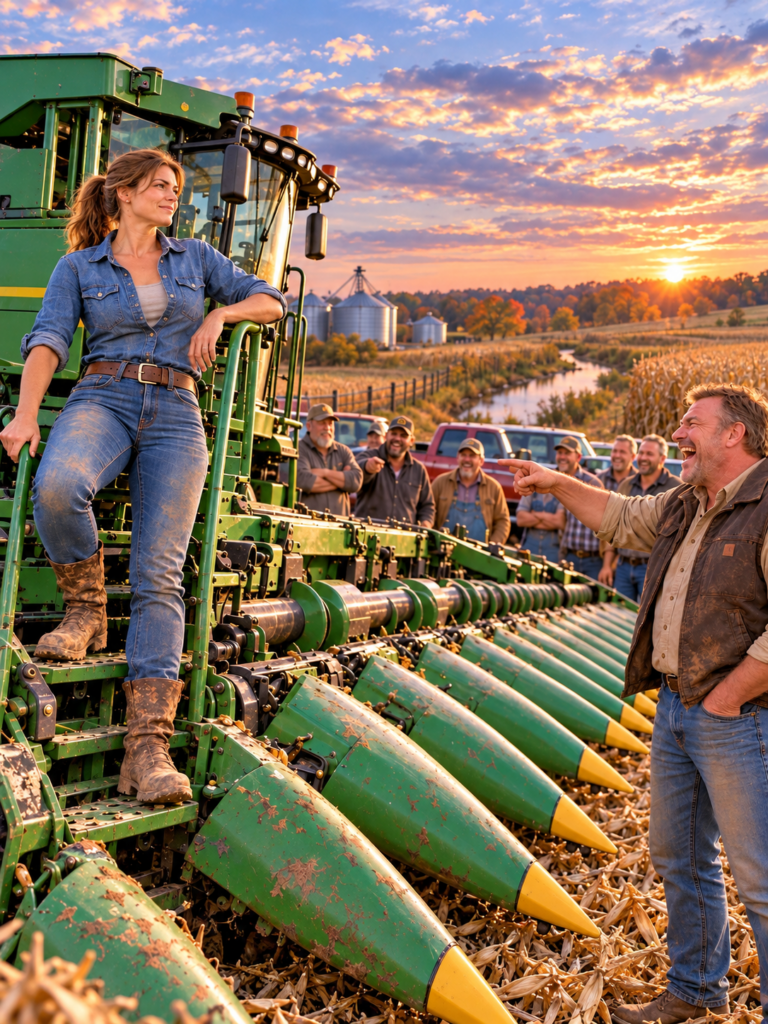
they laughed when she unfolded the 16-row corn head on bennett ground and told her she was not a farmer—until two hundred acres vanished by sunset and the man who said she was only a replacement asked her to run the county when the storm turned
Part 1
The kitchen light was still on when Claire Bennett walked in from the machine shed at ten minutes after five. The coffee pot had finished its cycle and the smell of it filled the room the way it always had when her father was the first one down. She poured a cup, black, and stood at the window watching the dark begin to thin over the north block. The stalks out there were thinner than she liked after the dry summer. The heads were full enough, but the stalks themselves had that brittle look that meant the first hard wind would lay them down if they waited too long.
Robert had always said the window did not care how ready you thought you were. It opened and it closed and the only thing that mattered was whether you were already moving when it did. Claire had heard that sentence so many times she could hear it in his voice even when he was not in the room. She carried the cup to the table where the field maps were already spread out and the calculator sat on top of the yield sheets. She had been running the same numbers for three days. The old eight-row header the farm had always used would take longer than the window allowed. She had known that before she sat down with the maps. She just needed to see the hours written out so she could stop arguing with them.
The phone on the counter rang at six-fifteen. It was the hospital. Robert had gone down between the machine shed and the house. They said minor stroke. They said he was stable. They said he would not be going back to the field until the doctors cleared him and that the clearance would not come before harvest was finished. Claire drove to the hospital with the maps still in the passenger seat. Robert looked smaller in the bed than she had ever seen him. His left hand rested on the blanket and did not quite close when she touched it. He asked about the corn. She told him the numbers. He listened and did not tell her what to do. That was new.
She drove home and called the contact three counties east who had mentioned the C16F the week before. Sixteen-row folding corn head, lightly used, available for the week she needed it. The man on the phone asked if she was sure. Claire said she had run the numbers. He said most people who said that had not actually run them. She gave him the acreage on the long center blocks and the headland lengths and the grain-cart cycle times she had calculated the night before. There was a pause. Then he said the header would be on a flatbed by morning.
Word moved the way it always moved in that part of Iowa. By the time the flatbed turned into the Bennett driveway the next afternoon, three pickup trucks were already parked along the county road. Wade Mercer was in the lead truck. He had run custom harvest crews across three counties for almost twenty years and he knew what Bennett ground looked like from the road. Tight waterways. Short headlands. Field shapes that punished wide equipment. He got out and walked to the fence line while Claire and the driver began unstrapping the header. The folding arms came down one by one in the late light. Sixteen snouts. Wade watched them settle and shook his head.
“Sixteen rows on Bennett ground,” he said. “You’ll fold more stalks than you’ll harvest.”
Claire kept working the pins. “I’ve run the numbers.”
One of the men in the second truck laughed. “She’s run the numbers.”
Wade looked at the house, then back at her. “Robert let her do this?”
Claire did not answer. She finished the last pin and stepped back. The header sat on the ground looking larger than anything that had ever been on the place. Wade crossed his arms.
“This machine isn’t about the farm,” he said.
“No?”
“You’re not a farmer, Claire.”
She looked at him for a moment. The men in the trucks were watching. She could feel the shape of the conversation the way she had felt it for eight years—Robert at the center, Claire somewhere behind him, useful but not in charge. She had stopped trying to argue with that shape. She had simply kept working inside it. Now the shape was standing at her fence line telling her she was not a farmer.
“Then watch me,” she said.
Wade did not smile. He got back in his truck and the others followed. Claire stood in the yard until the dust settled. Then she walked the header once more, checking the folding joints and the gathering chains, and went inside to call the hospital and tell her father the machine had arrived.
Part 2
She was in the combine cab at five-twenty the next morning. The engine turned over in the dark. The C16F unfolded in the gray light while the first trucks pulled up along the road again. Claire lined up on the first rows of the north block and dropped the header. Sixteen snouts went into the standing corn and she drove forward. The first hour showed her everything the men on the road had driven out to see. One of the curved sections near the drainage tile caught her on the second pass. She drifted wide by just enough to matter. On the old eight-row the mistake would have cost her a few seconds and a narrow strip of missed ears. On the C16F it cost her a full corrective pass. She could feel the trucks watching while she made it.
A gathering chain on the left side began feeding stalks unevenly. The engine-load monitor climbed. Claire stopped the combine in the middle of the field, climbed down without looking toward the road, and spent eleven minutes clearing residue and adjusting the chain tension by hand. When she climbed back into the cab her hands were sticky with plant sap and her shoulders already ached. She pulled forward and within three passes understood what had actually gone wrong. It was not the machine. She had been pushing the combine faster than its optimal feed rate because she knew they were watching. The speed felt like confidence. It was not. It was performance.
She thought about what Robert had said in the hospital the night before. She had told him what Wade said. Robert had listened and then told her that whatever happened tomorrow she should not harvest for them. She had not been sure she understood him. Now, sitting in the cab with the load monitor still elevated and the trucks still parked on the road, she understood. She slowed down. Not because the header demanded it. Because she stopped harvesting for the people on the road and started harvesting for the corn. The gathering chains steadied. The engine load settled into a band she could hold. The grain-loss monitor dropped to a number that made sense. Sixteen rows began disappearing the way they were supposed to, clean and continuous. The grain-cart operator, Dean Holloway, started hustling to stay ahead of her for the first time all morning.
By late morning the trucks along the county road had gone quiet. Wade leaned against his hood with his arms still crossed, but he was not talking anymore. He was watching the acre count climb. After lunch Claire reached the field that mattered most. Two hundred acres of long, straight rows with clean headlands on both ends. She unfolded to full width, lined up on the first pass, and the machine found its rhythm almost immediately. Row after row of standing corn became stubble behind her. Dean swung the grain cart in and out with the quiet efficiency of a man who had been farming long enough to read a harvest operation without being told what to do. The afternoon stretched long and golden the way Iowa afternoons can in early fall. Claire worked through it without stopping.
At four-thirty Wade drove back to the field. He had expected her pace to have dropped. It had not. At six-twelve, with the sun already soft and low on the western tree line, Claire entered the final sixteen rows of the block. She came out the other end and the field behind her was nothing but stubble from fence line to fence line. Two hundred acres gone before sunset. Dean walked the field himself and came back with a look on his face that said more than he put into words. The grain-loss numbers were as clean as anything he had seen all season.
That evening the annual Bennett harvest reunion filled the old barn the way it always had. Neighbors. Neighboring farmers. A few people who drove an hour because Robert Bennett’s harvest parties had always been worth the trip. Robert arrived in a wheelchair, looking steadier than he had in the hospital but still slower than Claire was used to seeing him. When she walked through the barn doors Dean stood up. Then the farmer beside him stood, and the one beside that man, and within a few seconds most of the room was on its feet. The applause was genuine and full, the kind that surprised even the people making it. Claire looked at her father across the room. Robert watched her with an expression she had never quite seen on him before. For the first time in eight years she felt the county seeing her as something other than a footnote to his reputation.
Wade Mercer did not applaud, but he did not leave either. He stood near the back wall with a drink in his hand. When Claire glanced toward him he was looking not at her but at Robert, studying the old man in the wheelchair with an expression that was difficult to read.
Her phone rang while she was still standing just inside the barn doors. She stepped outside to take it. The regional processor’s quality testing had flagged three Bennett loads. Cracked kernels. Mechanical damage above threshold. Enough to put her premium contract status under review. If the remaining loads came back the same way, Bennett Farm was looking at a significant price penalty on the entire harvest. She stood in the dark outside the barn with the noise of the reunion behind her and ran the math again. This time it came back wrong in a different direction.
Part 3
By the following morning the story had already changed shape. Two hundred acres by sunset became two hundred acres of damaged corn by the time it moved through the county conversation. Wade did not need to say anything unkind. He simply observed that acres per hour meant nothing if the elevator did not want what came out the other end. Claire spent the first part of the morning nearly accepting that version of events. She questioned her speed. She questioned whether she had been driving the machine the way the critics had always predicted she would—hard and reckless and trying to prove something.
Then she started looking at the actual data. She compared load samples against the grain-handling timeline. Not every load was damaged. The corn coming directly off the combine tested clean. The loads that had run through the older Bennett grain cart, a unit the farm had used for nearly fifteen years, showed the cracking. She opened the cart’s unloading system and found the auger flighting heavily worn and slightly deformed in one section. Under normal harvest volume it had never caused a visible problem. But Claire had doubled the throughput. The worn auger, under that load and at that speed, had been crushing kernels on the way out.
The C16F had not damaged the crop. Claire’s failure to redesign the whole system around the new capacity had. She stood next to the grain cart in the morning light and understood the difference between those two things completely, and understood that the second one was entirely hers to own.
The storm was less than ten hours away. More than four hundred acres of Bennett corn were still standing. Wade arrived at Bennett farm midmorning with two combines and an offer that was, by any practical measure, reasonable. His crew would take over the remaining four hundred acres. He had the operators, the grain carts, the truck contacts, and the margin to absorb the emergency logistics. The price was high, not dishonest, but high. Claire stood in the driveway listening to him lay it out with the particular patience of a man who already knew the answer was yes.
“You made your point yesterday,” he said. “Now it’s time to let professionals finish what you started.”
He did not say it cruelly. He said it the way someone says a thing they have believed for a long time and are finally being proven right about. Claire almost signed. She had the pen in her hand and the number in front of her and every logical reason to let the crew take over. Then she drove to the hospital instead.
She sat with Robert and told him the whole of it. The grain cart. The processor call. The contract. Wade’s offer. All of it. She told him she thought maybe she had been trying to become him all along and that maybe that had been the mistake underneath every other mistake. Robert listened until she finished and then said that was exactly right. That had always been the mistake. She was not supposed to replace him. She was supposed to run her farm.
Claire sat with that for a moment. Then the thing he had told her two nights ago finally landed the way it was meant to. Don’t harvest for them. Not for the county. Not for Wade. Not even for Robert himself. She drove back to Bennett farm and tore up the takeover agreement. Then she called Wade and told him she did not need him to run her harvest. She needed two combines for the fields where her machine had no business being—the tight corners, the short headlands, the curved sections around the drainage tile. She called Dean Holloway and arranged to borrow his grain cart to replace the damaged Bennett unit. She contacted two neighboring operations for additional trucks and called the processor directly to explain the grain-handling failure and request that new loads be tested on a clean sample basis. Then she built an entirely new sequencing plan around the equipment she actually had, assigning the C16F only to the long straight blocks where sixteen rows produced a genuine advantage and nothing else.
For the first time in two days the operation made sense as a system rather than as a single machine trying to carry everything alone.
Part 4
Harvest restarted in the early afternoon. The C16F moved through the long center blocks with the kind of efficiency it had shown the previous evening, clean and consistent, grain-loss numbers holding steady. Wade’s smaller headers worked the difficult sections without fighting the terrain. Dean’s grain cart kept pace with the combine throughput. Trucks rotated between the field and storage on a schedule Claire had written on the back of a field map and handed to the drivers at the end of the driveway. She adjusted twice as conditions changed, and both times the people running the equipment simply followed the updated plan without debate.
By late afternoon the operation had found a rhythm that the day before, with all its speed and noise and audience, had never quite achieved. At dusk seventy acres remained on Bennett ground. The wind had begun moving through the corn in long sustained pushes, the kind that flattened weakened stalks and made every remaining hour count. Wade radioed that she could push her ground speed up by a mile an hour and probably get out ahead of the worst of it. Claire checked the grain-loss monitor and the engine load and the moisture readings and told him no. The previous evening she had harvested fast because people were watching. This time she held the speed that protected the grain because that was the actual job.
Thirty acres became twenty. Twenty became ten. With sixteen rows left standing in the last block she aligned the header a final time. Robert had been brought to the field edge in his wheelchair, just far enough from the combine to watch without being in the way. No crowd. No reunion. No applause. Claire lowered the header into the last rows of corn and drove them clean to the far headland. When she raised the machine at the other end, Bennett farm was harvested. The first hard drops of rain struck the windshield before she had finished her turn.
She had barely climbed down from the cab when Wade’s radio crackled with the call that changed the shape of the evening. One of his operators had suffered a major mechanical breakdown several miles away on a neighboring property. The storm had caught three farms in the same position Bennett had been in twelve hours earlier—narrow window, standing corn, no time left. Roughly three hundred fifty additional acres across several properties. And Wade’s crew was now a machine short. He looked at Claire with an expression that required no translation. Hours earlier he had come to rescue her. Now he needed her machine.
“We can use the sixteen-row head,” he said.
Claire looked toward the barn for a moment, thinking through everything she had, every reason not to. Her farm was safe. Her contract might survive. She had already given the day everything she had, and some of the farmers waiting on those properties had been parked along the county road that morning expecting her to fail. Then she looked at the radar on her phone and climbed back into the cab.
“Quit talking,” she told him.
The convoy moved down the county road in the last gray light before the storm. Claire’s combine. Wade’s remaining machine. Two grain carts. A rotation of semis that picked up and delivered without stopping. At the first neighboring farm Claire reorganized the equipment assignment before a single row had been cut, putting the C16F on the long center ground and directing Wade’s header to the field edges and corners. Nobody argued with the plan. When one of the neighboring farmers suggested a change to the truck rotation, every person in the field looked toward Claire before anyone responded. It was a small thing, and it happened naturally, and it meant more than the applause in the barn the night before because nobody had arranged it.
They cleared the first block and moved to the second. The wind grew serious. A few outer rows in the final field began leaning before the header reached them. At the last farm, with lightning showing on the western horizon, Wade asked if they had one more pass cycle in them. Claire studied the field, checked the conditions, and said yes. The machines went in together and came out the other end as the rain began in earnest. The last truck’s tarp pulled tight over a full load while water hammered the field behind them.
Part 5
Two days later the processor confirmed that the new Bennett loads met premium standards. The investigation into the kernel damage traced entirely to the worn grain-handling equipment, and the premium contract was restored. Several farmers whose acres Claire had helped pull ahead of the storm came to Bennett Farm that week. Not quite to apologize, but to talk about what came next. Dean said the county lost too much ground every harvest season because farms waited until equipment failed before asking for help. He proposed a coordinated emergency network, and everyone in the room looked toward Claire. Wade said she should run it. The same man who had told her she was not a farmer, that she was a replacement trying to fill a space that was not hers, now wanted her deciding where his machines went when the weather turned.
Claire did not celebrate. She simply opened her notebook.
The following season Bennett Farm looked different in ways that were difficult to point to from the road but immediately visible to anyone who worked the operation. Claire did not go looking for bigger equipment. Instead she went looking for every place the system had failed her. The grain-handling bottlenecks. The truck rotation gaps. The maintenance items that had been deferred long enough to become liabilities. She rebuilt the harvest logistics from the ground up, not around what her father had always done, but around what the farm actually needed now. The C16F stayed. She used it only on the ground where sixteen rows made a genuine difference. And on the sections where it did not, she made different choices. Harvest losses dropped. Downtime fell. The processor renewed the premium relationship without being asked twice.
She was also asked to coordinate the county’s new cooperative emergency harvest schedule, the network Dean had proposed and that the room had quietly agreed she should lead. Wade still ran more equipment than anyone in three counties. Dean still carried more years of experience than anyone at the table. But when the weather turned and the decisions had to be made fast, they called Claire. Not because she had cleared two hundred acres in a single afternoon, though she had. Because when her own operation was failing around her she had figured out what was actually broken and fixed that instead of the thing everyone was looking at.
Months later Robert walked through the equipment shed on his own. He moved slowly but steadily, and he carried the notebook he had kept for nearly thirty years, every Bennett harvest recorded in his handwriting, season by season, decision by decision. He handed it to Claire without a speech. When she asked if he wanted her to keep using it, he shook his head and pointed to the empty notebook on the workbench beside her. She opened it. On the first page she wrote, Bennett Farm, harvest year one.
Outside, the C16F sat folded and clean in the afternoon light. Claire had known how to harvest corn long before anyone in the county respected her for it. What she had to learn was that her value did not begin when people applauded, and it did not disappear when they doubted her. Two hundred acres by sunset made them notice her. What she did after sunset made them trust her.


