
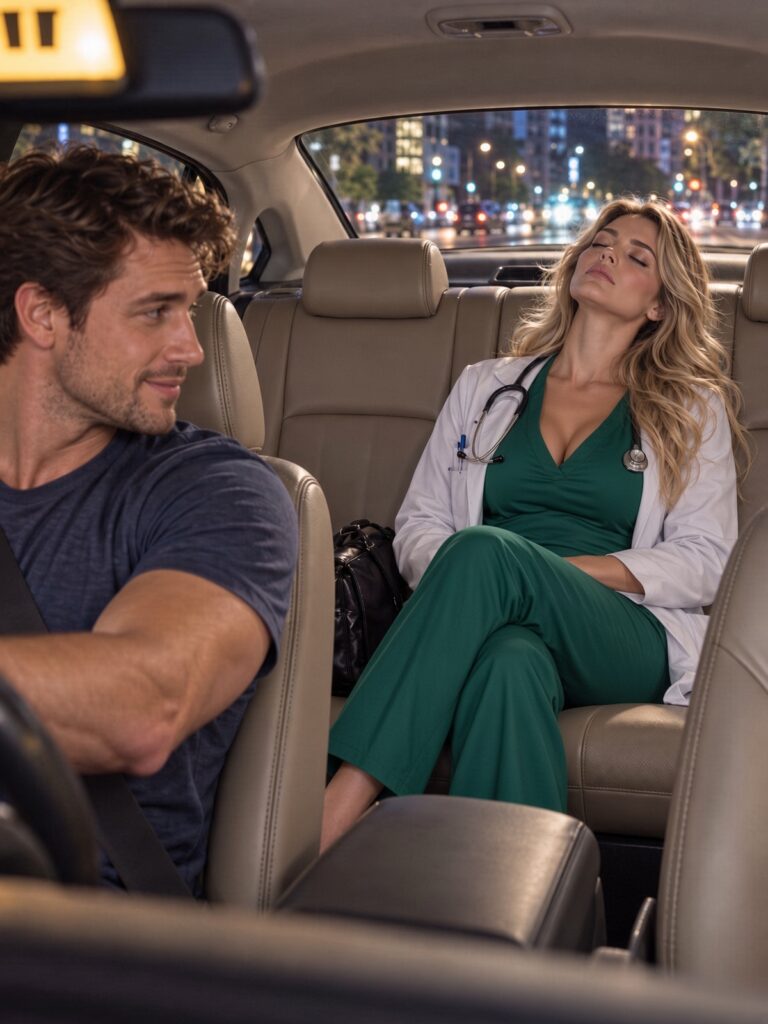
A Simple Parking-Lot Mix-Up Turned Strange When An Exhausted Doctor Accidentally Climbed Into My Car Thinking It Was Hers. By The Time She Realized Her Mistake, She Was Too Tired To Be Embarrassed—And Instead Of Jumping Out, She Looked At Me With A Tired Smile And Said, “Maybe Getting Into The Wrong Car Was Exactly What I Needed.” Suddenly, Neither Of Us Seemed In A Hurry To Correct The Mistake.
PART 1
“Can I get in the wrong car again?”
Three months after the strangest passenger pickup of my life, Elizabeth Hart stood beside the front passenger door of my taxi outside Hawthorne General and asked me that question with a smile.
Her phone was fully charged.
She had checked the license plate.
She knew exactly who I was.
This time there was no mistake.
That was why I unlocked the door.
The first time we met, none of that was true.
My name is Ricky Foster.
I was thirty-seven and drove a cab in the Hawthorne–Maplewood area, mostly afternoons, evenings, airport runs, hospital pickups, and the kind of late-night fares people remember only because they are too tired to drive themselves.
I owned my sedan outright.
Nothing luxurious.
Silver Toyota.
High mileage.
Clean interior.
Reliable engine.
Three charging cables because passengers always needed the one connector I had forgotten to carry.
Driving suited me.
I liked people in manageable doses.
Twenty minutes.
Forty-five.
Occasionally an hour if the airport traffic hated everybody equally.
People told cab drivers things because we occupied a strange category.
Present.
Listening.
Temporary.
Nobody expected us to solve their life.
I respected that.
I also respected rules.
No moving the car until I knew the destination.
No accepting a visibly impaired passenger without making sure they had somewhere safe to go.
No personal questions unless the passenger started the conversation.
No pretending a generous tip made unsafe behavior acceptable.
Those rules were the reason Elizabeth and I had a second conversation at all.
It happened on a Tuesday a little after eleven at night.
I had just dropped a passenger outside Hawthorne General and pulled into the authorized waiting lane.
No pickup assigned.
Meter off.
I was checking the dispatch screen when the rear door opened.
A black leather bag landed on the seat.
Then a woman in blue scrubs climbed inside, closed the door, leaned back, and said:
“Just home, please.”
Before I could answer, her eyes closed.
I turned around.
White medical coat over the scrubs.
Stethoscope partly visible near one pocket.
Dark hair twisted into something that had probably started the day as a neat bun.
Face exhausted enough that even sleeping for three seconds looked less like rest and more like system shutdown.
“I can take you home,” I said quietly.
“But I need two things first.”
Her eyes opened.
“An address and some proof that I’m actually your driver.”
She blinked.
Then looked toward the dashboard.
Her hand went to her phone.
Black screen.
She pressed the button twice.
Nothing.
Closed her eyes again.
Then:
“Please tell me your name is Ricky.”
“It is.”
Her shoulders dropped.
“Good.”
“But I still don’t have your ride.”
That woke her.
“What?”
“I’m a licensed Hawthorne cab.”
“I’m in the hospital pickup lane.”
“But I don’t have an app booking under your name.”
She sat forward.
“I booked a silver sedan.”
I looked around my own car.
“Dangerous description.”
She stared at the dead phone in her hand.
“I looked at the app for maybe half a second.”
“Then my phone died.”
“I came outside.”
“Saw silver sedan.”
“Apparently decided verification was optional.”
“You’re in a real cab,” I said.
“Just possibly not the cab you ordered.”
“That is less reassuring than you think.”
Fair.
I handed her a charging cable.
“Plug in.”
“We wait.”
“You’re not driving?”
“Not until you know where you are and I know where we’re going.”
For the first time, she really looked at me.
Not as a driver.
As a stranger she had accidentally climbed into a car with while exhausted.
“Okay.”
Then:
“Thank you.”
We sat there with the meter dark while her phone came back.
When the screen finally lit up, she unlocked it and started laughing.
Not because the situation was funny exactly.
Because exhaustion makes absurdity easier than embarrassment.
“My driver is also named Ricky.”
“East entrance.”
“Different silver sedan.”
“Different plate.”
I smiled.
“That explains some things.”
She canceled the other request.
Then I gave her the choices.
“You can go back inside and book another car.”
“Or I can take you as a regular metered ride.”
“You give me the address before we move.”
She nodded.
“Second option.”
“Maplewood.”
She gave me the street.
Buckled her seat belt.
Only then did I start the meter.
For the first five minutes, neither of us spoke.
That was fine.
Passengers are allowed to be tired without turning their exhaustion into entertainment.
Then she said:
“I’m Elizabeth.”
I glanced at the mirror.
“Nice to meet you, Elizabeth.”
“Under unusually secure conditions.”
She smiled.
“I’m sorry.”
“For?”
“Getting into your car like that.”
“I finished a fourteen-hour shift.”
“Handover ran late.”
“My phone died.”
“Apparently the part of my brain responsible for checking license plates had resigned.”
“You corrected it when you noticed.”
“That’s what matters.”
She looked out the window.
After another minute:
“I’m a resident.”
“What kind?”
“Internal medicine.”
“I’m in the part of training where every person I know tells me it gets better later.”
“Does it?”
“I’ll let you know when later arrives.”
She asked what I did besides drive.
I told her:
“Mostly drive.”
She laughed.
Then I explained the reserve account.
Every month, I transferred a set amount into savings.
Not for a house.
Not retirement.
Something more immediate.
Time.
My goal was enough cushion that taking one evening off would not automatically require working twice as late another night.
“That sounds backwards,” Elizabeth said.
“What does?”
“You’re saving money so you can work less.”
“Exactly.”
“I like driving.”
“I just don’t want every night to become financially mandatory.”
She nodded slowly.
I saw something land.
At her building, I stopped under the awning.
She chose a tip much larger than the ride deserved.
“You don’t need to do that.”
“I slept in your back seat before the meter started.”
“That’s not a billable service.”
“Standard tip.”
“Really.”
She changed it.
“Fine.”
Then opened the door.
Stepped out.
Stopped.
“Can I have your number?”
That surprised me.
She immediately clarified:
“Not because I need another taxi tonight.”
“I’m going upstairs and sleeping for an irresponsible amount of time.”
“But I’d like to know how to reach you afterward.”
Clear.
Direct.
I liked that.
I took a business card from the visor.
Wrote my cell number on the back.
“I usually drive afternoons and evenings.”
“Text first.”
“If I’m with somebody, I won’t answer.”
“Fair.”
She looked at the card.
“Good night, Ricky.”
“Good night, Elizabeth.”
I waited until she got inside the lobby.
Then drove away.
At the cab lot, my friend Patrick Foster—no relation, despite sharing a last name—looked over my trip sheet while I closed out.
“Maplewood after eleven?”
“Hospital walk-in.”
“Normal?”
“Eventually.”
I moved money into the reserve account.
Still short of the monthly target.
About one solid Friday evening.
That mattered.
Not desperately.
But enough.
At home, I reheated pasta and found myself thinking about Elizabeth.
Not the sleeping part.
Not the scrubs.
The moment she realized her mistake.
No excuses.
No defensive performance.
Just:
I messed up.
Let’s fix it.
I liked that.
I liked even more that she asked for my number without making me guess why.
I still expected nothing.
The next afternoon, twenty minutes before my shift, my phone buzzed.
This is Elizabeth.
I slept ten hours.
I have verified both my identity and yours.
I laughed.
Then another message arrived.
I want to take you to dinner.
This time you do not have to drive me anywhere.
I read that twice.
No vague:
We should hang out.
No artificial excuse.
No pretending gratitude was the reason.
She wanted to see me.
I wanted to see her too.
I wrote:
I’m booked from 4 until a little after 8, including an airport run I promised days ago. I can’t move it. I could do 9, but that’s late.
Her response came fast.
9 is when I become decorative furniture.
I have tomorrow off.
Laundry at Juniper around 3:00.
Cafe next door.
3:30?
I checked my schedule.
I needed to leave by 4:20.
Forty minutes.
Not much.
Still real.
3:30 works. Hard stop at 4:20.
Deal. I’ll warn the dryer.
That first date happened beside an industrial laundromat.
Elizabeth was wearing jeans, white sneakers, and an oversized green sweater.
A basket of folded scrubs sat near her feet.
Another load turned behind glass.
She saw me.
Then looked through the dryer window.
Winced.
“It rejected my deadline.”
I leaned toward the glass.
“Drum moving.”
“Heat seems theoretical.”
She sighed.
“I’m sorry.”
“I thought I’d finish before you got here.”
“We can go next door now.”
“Or…”
She hesitated.
“We can move this to another day.”
I understood.
She was giving me an exit.
Not testing me.
The date she had imagined had turned into two adults standing beside commercial washers and wrinkled hospital clothes.
“I want to see you.”
Her eyes lifted.
“Not because you owe me for the ride.”
“Not because the location is ideal.”
“I just want to see you.”
Her expression changed.
Quieter.
“Okay.”
“Then stay.”
We dragged two plastic chairs near the machines.
Elizabeth told me about her day off.
Laundry.
Groceries.
And saying no to two requests to cover parts of other residents’ shifts.
“That last one was hardest.”
“Why?”
“I always think being available makes me a good colleague.”
“And today?”
“Today I wanted my day off.”
“That seems legal.”
“I’m experimenting.”
When the dryer finally surrendered the scrubs, we went next door.
Small café.
Six tables.
Sandwiches.
Nothing memorable about the food.
Everything memorable about how easy the conversation became.
I told Elizabeth more about the reserve account.
“The goal isn’t to stop driving.”
“I like it.”
“I just want to reach a point where time off doesn’t feel like a financial emergency.”
She nodded.
“That makes more sense than I want it to.”
“You?”
She smiled.
“I keep saying I want a life outside the hospital.”
“Then whenever I get free time, I either pick up another shift or spend it recovering enough to go back.”
Our food arrived.
Elizabeth had asked for dressing on the side.
She pushed the cup toward me.
“You said you have another pickup.”
“I figured you’d save half your sandwich.”
“You planned for my leftovers.”
“Advanced medical training.”
I smiled.
She had listened.
At 4:16, I checked my watch.
“I need to go in four minutes.”
“I know.”
“I won’t make you late.”
I stood.
Then realized I did not want the date to end.
Not because it had been extraordinary.
Because it had barely started.
“What are you doing Tuesday?”
“I’m off at two.”
“Maple Lanes.”
“Three?”
Her smile appeared slowly.
“You’re asking me on a second date.”
“Yes.”
“Very clear.”
“I try.”
Tuesday, I blocked the hours.
That sounds obvious.
It wasn’t.
At 2:30, I could have accepted a short fare.
I didn’t.
For once, the empty part of the calendar already had a purpose.
Elizabeth was at Lane Seven when I arrived.
Rented shoes.
Black top.
Hair loose.
She looked at the bowling rack.
“You’re early.”
“So are you.”
PART 2
“I wanted first choice of ball.”
“Has it improved your odds?”
“Ask after one frame.”
My first ball went directly into the gutter.
Elizabeth laughed so hard she had to lean against the scorer’s table.
“I calculated that.”
“Obviously.”
“Data collection.”
Then she hit one pin.
One.
She turned toward me.
I raised an eyebrow.
“Not a word.”
The bowling became irrelevant quickly.
We were both terrible enough to stop pretending score mattered.
At the table behind the lane, she asked:
“What happens when you reach your reserve number?”
“I stop treating every free evening like something I should monetize.”
“Will you?”
That made me pause.
I had spent months planning how to afford flexibility.
Very little time deciding how I would use it.
“I think so.”
Elizabeth turned her paper cup between her hands.
“I do the same thing.”
“What?”
“Talk about wanting a life outside work.”
“Then protect none of it.”
“What would you do if you had a completely free evening?”
She thought.
“Eat dinner while it’s hot.”
“See the same person twice in one week without requiring a scheduling committee.”
“I could support that.”
After bowling, we walked slowly toward the parking lot.
At my car, Elizabeth stopped beside me instead of heading toward hers.
“I’m hungry.”
“So am I.”
“You have work.”
“I do.”
For half a second, I considered opening the dispatch app.
Cancel first pickup.
Shift things around.
We could get dinner.
Then I stopped.
Someone already expected me.
That commitment mattered too.
“Next week.”
“Dinner.”
“Enough time to finish it.”
Elizabeth smiled.
“That sounds aggressively luxurious.”
“Thursday.”
“I’m scheduled until six.”
“Then dinner after.”
“If your shift changes, tell me early.”
“We adjust.”
She nodded.
Then she took my hand.
Not accidentally.
Her fingers slid between mine.
“I like that you say what you mean.”
I looked down.
“I like that you ask.”
Her thumb moved once against my hand.
Then she let go.
I drove away ten minutes later with a passenger in the back seat and the memory of her hand still in mine.
Thursday failed beautifully.
I arrived near the restaurant at 5:40.
Meter off.
At 6:05, Elizabeth texted:
Handover disaster. Twenty more.
Twenty became forty.
Then fifty.

PART 3
I moved the reservation once.
At 7:20, the kitchen called.
Last seating.
I canceled.
At 7:31, Elizabeth came through the hospital doors.
Hair tied back.
Shoulders low.
Apology already visible.
“I’m sorry.”
“I know.”
“We missed it.”
“We missed the restaurant.”
She looked at me.
“That distinction is generous.”
“It’s accurate.”
We walked there anyway.
Lights dimmed.
Chairs upside down.
Elizabeth stared through the window.
“I kept thinking ten more minutes.”
“Then another ten.”
“I did the same thing.”
“What?”
“I thought if I waited long enough, the original plan would survive.”
She looked over.
“So we both had a bad plan.”
“Apparently.”
A takeout noodle shop was still open.
We ate at two stools beside the window.
No linen.
No reservation.
No illusion about what happened.
Halfway through, Elizabeth put down her fork.
“I don’t think this is working.”
My chest tightened instantly.
She saw it.
“Not us.”
“This.”
“What?”
“This way of doing it.”
She looked down.
“I keep giving you the part of my day that’s left after everybody else gets what they need.”
“Then I arrive exhausted and apologize like that makes it sustainable.”
I looked toward the street.
“That’s not only you.”
“I keep fitting you between fares because that’s what I’m good at.”
“I can make a schedule technically work.”
“That doesn’t mean the schedule is good.”
Elizabeth nodded.
“I spent the whole afternoon looking at the clock.”
“Not romantically.”
“Anxiously.”
“I don’t want to be distracted treating patients because I’m trying to squeeze a personal life into a gap too small to hold one.”
“And I don’t want our dates to feel like a countdown until I leave.”
Silence.
Then she asked:
“What if we stop doing that?”
“How?”
“One evening.”
“A real one.”
“Not after a shift if I can avoid it.”
“Not before your best earning hours.”
“We pick it first.”
“Then protect it.”
I knew exactly what that cost.
Friday nights paid well.
Her schedule moved constantly.
My reserve target was still short.
I also knew I wanted to try.
“Next Friday.”
“Seven.”
Her eyes held mine.
“Seven.”
“If something real changes, we say it early.”
“Deal.”
Outside, she reached for my hand again.
This time I closed my fingers around hers before she had to do everything herself.
Three days later, Patrick offered me a corporate airport run.
Friday.
8 p.m.
Excellent fare.
Guaranteed return.
Enough money to put me over the reserve target in one night.
I stared at the schedule.
There was no honest version where I accepted it and still had dinner with Elizabeth at seven.
I could move the date.
Easy.
Also exactly the habit we had agreed to stop treating as automatic.
“I can’t take it.”
Patrick looked surprised.
“You sure?”
“Yes.”
“You’ve been chasing the reserve number for months.”
“I know.”
“Car problem?”
“No.”
“I already committed the time.”
He studied me.
Then pulled back the sheet.
“That must be some commitment.”
“It is.”
I did not tell Elizabeth.
That part mattered.
I did not want Friday dinner arriving with a price tag she had never agreed to pay.
My choice.
My cost.
No debt.
Thursday afternoon, I saw Elizabeth near the transit center.
Another resident stood beside her.
Elizabeth introduced us.
“Ricky, Lisa.”
Lisa smiled.
“We traded part of the weekend.”
Elizabeth immediately corrected:
“We traded because it works for both of us.”
Lisa raised an eyebrow.
Then nodded.
“Right.”
“Mutually beneficial.”
I liked that correction.
No sacrifice story.
No:
Look what I gave up for love.
Lisa wanted one schedule.
Elizabeth wanted another.
They traded.
When Lisa left, Elizabeth pointed toward her own hatchback.
“I drove.”
“You don’t need a ride?”
“No.”
“I came to see you.”
That landed differently.
She had not shown up because she needed transportation.
She simply wanted to be where I was.
“Done in ten minutes.”
“I can wait ten.”
When I finished, we walked to a nearby market.
“Friday.”
“Out or my place?”
Elizabeth thought.
“Your place.”
“I’ll cook.”
“No closing kitchen.”
“Good.”
“What do you like?”
“Chicken piccata.”
“Potatoes.”
“Something green if you insist on adulthood.”
We shopped together.
I started planning cooking order aloud.
Elizabeth stopped beside produce holding a lemon.
“Ricky.”
“What?”
“What if I get there at seven and need ten minutes to sit down first?”
I looked at her.
“Then dinner happens at 7:10.”
She smiled.
“Excellent.”
That was when I understood another part of the problem.
I knew how to make a plan.
I was learning that a plan containing another person had to leave room for that person.
Friday, I finished my last committed fare at 4:35.
Turned off new requests.
For two minutes, my brain calculated lost income automatically.
Then the evening became quiet.
I cleaned the apartment.
Put music on.
Prepared only what needed preparing.
I almost made an extra appetizer.
Stopped.
Nobody asked for it.
I left the green beans untrimmed so there would still be something simple we could do together if Elizabeth wanted.
At 7:04, the buzzer sounded.
She stood outside holding a bakery box.
Black pants.
Cream sweater.
Eyes exhausted.
“You look tired.”
“I am.”
“Sit first?”
She looked past me toward the kitchen.
Then exhaled.
“I want to put this down, take off my shoes, and not be charming for fifteen minutes.”
“That works.”
She stared.
“Really?”
“Really.”
She came inside.
I set the dessert on the counter.
She kicked off her shoes.
Curled into one end of the sofa.
I brought water.
Sat across from her.
Did not hover.
We said almost nothing.
Ten minutes later, she opened her eyes.
“Okay.”
“I’m back.”
“One joke?”
“Maybe later.”
“That’s fine.”
She stood.
“What can I do?”
“Nothing.”
“I know.”
“I’m choosing green beans.”
I handed her the cutting board.
She trimmed beans.
I cooked chicken.
At one point, I reached for another pan.
Elizabeth looked at it.
“Do we need that?”
I thought.
“No.”
I put it away.
She smiled.
The kitchen smelled like butter, garlic, and lemon.
No passenger waiting.
No reservation closing.
No pager controlling the edge of the hour.
For the first time since meeting, time did not feel borrowed.
That made me nervous because I knew exactly what I wanted.
“Elizabeth.”
She looked up.
“Yeah?”
I had rehearsed several versions.
All worse than the truth.
“I want to date you.”
“Seriously.”
She went still.
“I don’t want this to be something we do only when the hospital releases you early or I get an empty block between fares.”
“I know our schedules won’t suddenly become easy.”
“I’m not asking for easy.”
Her expression softened.
“I’m asking whether you want to keep making real room for this with me.”
She put down the knife.
“Yes.”
No joke.
No delay.
Then she stepped closer.
“I want that too.”
“I like my job.”
“I know you like yours.”
“I don’t want either of us pretending those things matter less than they do.”
“I don’t either.”
“But I also don’t want to keep calling whatever time is left over a relationship.”
“Neither do I.”
She looked at me.
“I came here because I wanted to be here.”
“Not because you helped when my phone died.”
“Not because I owed you a better date.”
“I wanted you.”
That hit harder than I was prepared for.
I rested one hand lightly at her waist.
She came the remaining distance herself.
Our first kiss was short.
Quiet.
No rush.
When we separated, she stayed close.
Then looked toward the stove.
“Chicken.”
“I know.”
“Burning?”
“No.”
She smiled.
“Of course.”
I kissed her once more.
Then finished dinner.
That mattered too.
After the kiss, potatoes still needed draining.
Plates still needed carrying.
Sauce turned slightly too salty.
We laughed.
A relationship had started.
Dinner still required work.
Later, we sat on the sofa.
Elizabeth leaned against me.
“We should pick the next night before this one ends.”
“That sounds like planning.”
“I’m not against planning.”
“I’m against pretending planning means nothing can change.”
Fair.
Tuesday worked.
We made the rule:
If something real changes, we change the plan together.
If nothing real changes, we keep it.
That became more important than any romantic speech.
Over the next three months, we practiced.
One Wednesday, Elizabeth’s shift ran two hours late.
Instead of forcing midnight dinner, we moved it to breakfast.
She arrived with damp hair.
I arrived half-awake after driving late.
We ate eggs.
No apology ritual.
Another Sunday, I got offered a profitable airport fare during time we had already protected.
I declined without announcing it like a heroic sacrifice.
Sometimes our planned time was four hours.
Sometimes ninety minutes.
The point was no longer duration.
It was intention.
Elizabeth still worked long hospital days.
I still drove evenings.
We did not reorganize entire careers around each other.
We made room inside them.
That sounds small.
It changed everything.
Three months after the wrong-car night, I finished a shift just after eleven.
Drove to Hawthorne General.
Meter off.
This time I was expected.
Elizabeth came through the doors wearing blue scrubs, white coat over one arm, black bag on her shoulder.
Phone bright in hand.
Before crossing the curb, she checked the plate.
I laughed.
She stopped beside the passenger door.
“Can I get in the wrong car again?”
“There’s a problem.”
“What?”
“Your phone is charged.”
“You checked the plate.”
“You’re running out of excuses.”
She smiled.
“I’m not blaming anything.”
I unlocked the door.
She put her coat and bag in the back.
Then climbed into the front beside me.
Seat belt.
Phone in cup holder.
“I checked.”
“I saw.”
“I know exactly whose car I’m getting into.”
She rested her hand on my knee.
Not because she was exhausted and needed help.
Not because she had made a mistake.
Because we were together and she wanted to touch me.
“Simple dinner?”
“Simple.”
“Your place or mine?”
“Yours.”
“I brought groceries.”
Elizabeth looked over.
“You planned.”
“I left room for you to change it.”
Her smile softened.
“That I can work with.”
I put the car in drive.
The meter stayed dark.
There was no fare.
No destination I had to guess.
That could have been the end of the story.
It wasn’t.
Real relationships become more interesting after the charming beginning ends.
Elizabeth entered a demanding stage of residency six months later.
Night rotations.
ICU blocks.
Weekend coverage.
I hit my reserve target.
Then discovered something embarrassing.
I still volunteered for extra work.
The money had stopped being the whole reason.
Availability itself had become identity.
If Patrick texted:
Need someone for an airport run?
I liked being the person who answered yes.
Elizabeth noticed.
“You reached your number.”
“Yes.”
“So why did you work six nights last week?”
“Busy week.”
“That isn’t an answer.”
“I like working.”
“So do I.”
She looked at me.
“That’s exactly why we need boundaries.”
She was right.
Annoying.
Useful.
The reverse happened too.
Elizabeth kept saying she wanted fewer extra shifts.
Then somebody from residency would call.
Sick child.
Family emergency.
Interview.
She said yes.
Again.
Again.
One evening she arrived at my apartment three hours late after covering for somebody else.
No emergency.
She simply found it hard to refuse.
I did not say:
“You always do this.”
I had learned enough.
I asked:
“Did you want to cover?”
Elizabeth went quiet.
“No.”
“Then why?”
“Because they needed someone.”
“That isn’t the same question.”
She sat down.
“I don’t know how to be the person who says no when I can help.”
I understood that far too well.
We developed another rule.
Before agreeing to optional work during protected personal time, wait ten minutes.
Not for emergencies.
Not when a patient needed immediate coverage.
Optional requests.
Ten minutes.
Ask:
Do I actually want this?
What am I moving?
Who absorbs the cost?
Simple.
We failed often.
Less often over time.
Elizabeth completed residency.
The day of graduation, I attended with her mother, older brother, and two friends from medical school.
She became an attending physician at Hawthorne General.
Better salary.
More autonomy.
Also new pressure.
Everybody said:
Now your schedule will get easier.
It didn’t.
Different.
Not easy.
But she had more control.
That mattered.
I changed too.
Driving remained good work.
Still liked the city.
Still liked the temporary intimacy of passengers.
But the economics wore on me.
Maintenance.
Fuel.
Insurance.
One accident I did not cause kept the car in the body shop for eleven days and reminded me how fragile self-employment could be.
Patrick asked whether I wanted a dispatcher role.
Steady salary.
Benefits.
Less driving.
My first reaction was no.
Elizabeth asked:
“Do you want to keep driving?”
“Yes.”
“All of it?”
I stopped.
“No.”
That question changed the decision.
I accepted a hybrid position.
Three dispatch shifts.
Two driving days.
Enough time on the road that I still felt like myself.
Enough predictability that life stopped depending on every Friday night.
Elizabeth never told me to do it.
Good.
I chose.
Our first serious relationship crisis came two years in.
Not cheating.
Not money.
Time.
Again.
Elizabeth was offered a six-month clinical fellowship in Boston.
Excellent program.
Temporary.
Career-defining.
She told me before accepting.
Good.
I reacted badly anyway.
“So you’re leaving.”
“I’m considering going.”
“Six months.”
“Yes.”
“And what happens to us?”
Elizabeth’s face changed.
“We decide together.”
I heard fear anyway.
Old fear.
That relationships survive only if proximity stays easy.
I hated that version of myself.
The next day, after cooling down, I apologized.
“I turned your opportunity into evidence you were leaving me.”
“You did.”
“I’m sorry.”
She nodded.
Then:
“I also assumed you’d automatically be fine because six months sounded temporary to me.”
“That wasn’t fair either.”
We discussed it.
Could I relocate temporarily?
No.
My job and family were here.
Could she commute?
Not realistically.
Would six months long-distance damage us?
Possibly.
Would rejecting the fellowship create resentment?
Also possible.
Elizabeth wanted the fellowship.
That was the fact.
I wanted the relationship.
Also fact.
She went.
We planned monthly visits.
Not weekly fantasy.
Call schedule flexible.
No mandatory bedtime report.
No resentment accounting over who flew more.
Some weeks were excellent.
Some terrible.
Once we went four days exchanging only:
Alive?
Alive.
Love you.
Love you too.
That counted.
When she returned after six months, we did not pretend nothing had changed.
She had changed.
I had too.
We dated in the same city again deliberately.
No instant cohabitation because distance proved commitment.
Another year passed before we moved in together.
New apartment.
Not hers.
Not mine.
Ours.
That mattered more than I expected.
Elizabeth had hospital routines.
I had early dispatch days.
She needed silence after certain shifts.
I liked talking when I got home.
We made signals.
Headphones on:
I’m decompressing.
Kitchen light left on:
Come talk when you’re ready.
Not romantic.
Extremely useful.
Three years after meeting, I proposed.
Not in the taxi.
Considered it.
Rejected.
Too cute.
I chose Juniper Counter.
The café beside the laundromat where our first date had almost failed before starting.
Same narrow room.
Different chairs.
Elizabeth saw me looking toward the laundromat.
“Do not tell me you brought dirty scrubs for nostalgia.”
“No.”
“Good.”
I took out the ring.
She froze.
“Ricky.”
“The first time we met, you got in the wrong car.”
“Strong opening.”
“I wouldn’t move until we both knew where we were going.”
Her eyes filled.
“I think that became our entire relationship.”
“We kept stopping.”
“Checking.”
“Changing plans.”
“Making sure neither person was just being carried along because the schedule said so.”
I smiled.
“I don’t know every destination from here.”
“I do know I want to keep choosing them with you.”
I knelt.
“Elizabeth Hart, will you marry me?”
She laughed through tears.
“Yes.”
Then:
“After verifying your identity.”
“Reasonable.”
We married the following spring.
Small.
Her hospital friends.
My cab crew.
Family.
Patrick gave a speech.
“I’ve known Ricky long enough to remember when his retirement plan was ‘drive more.’”
I objected.
“Reserve plan.”
“Same illness.”
Everyone laughed.
Then he said something I remembered.
“Elizabeth did not teach Ricky that work was bad.”
“He likes work.”
“She taught him that free time is not wasted time simply because nobody paid for it.”
Elizabeth squeezed my hand.
Her colleague Lisa spoke too.
She said:
“Ricky did not rescue Elizabeth from medicine.”
“Thank God.”
“She’d have ignored him.”
“What they figured out was less dramatic.”
“You can care deeply about work and still stop giving every person you love the leftovers.”
That became our unofficial marriage rule.
Not every week was balanced.
That idea is nonsense.
Sometimes medicine took more.
Sometimes my work did.
Sometimes family did.
Sometimes illness.
But imbalance was temporary and named.
Not disguised as normal.
Years passed.
Elizabeth eventually became medical director for a hospitalist program.
She hesitated before accepting.
“More meetings.”
“Fewer overnight shifts.”
“More responsibility.”
“More control.”
“What do you want?”
She smiled.
“You always ask that now.”
“Occupational hazard.”
“I want it.”
“Then take it.”
She did.
Then set one condition during negotiation.
Protected one evening every week except true clinical emergencies.
Her department chair agreed.
Not because romance mattered.
Because retention did.
Good workplaces benefit when people have lives.
My own career changed again.
Patrick retired.
I became partial owner of the cab cooperative with two other drivers.
For a man who once built savings to afford one night off, owning part of the business felt strange.
I almost became worse.
Emails.
Scheduling.
Fleet maintenance.
Driver problems.
Elizabeth watched for months.
Then asked:
“When was your last actual day off?”
I opened my calendar.
Bad sign.
We hired a better operations manager.
I gave up control of dispatch two evenings a week.
The cooperative did not collapse.
It improved.
Humbling.
Marriage did not make us experts at our own advice.
We still had to relearn it.
At forty-seven, Elizabeth’s mother became ill.
Not terminal.
Chronic cardiac condition.
Appointments.
Medication.
Transportation.
Elizabeth immediately started doing everything.
Doctor daughter.
Of course.
Her brother tried helping.
She corrected him.
Her mother tried deciding.
Elizabeth corrected her too.
Finally I asked:
“Are you supporting your mother or managing her?”
Elizabeth stared.
Then sighed.
“Managing.”
“Why?”
“Because I know medicine.”
“She still gets to decide.”
“I know.”
That was a hard year.
She learned how different it felt to be family instead of physician.
I learned not to use my car automatically for every appointment.
Sometimes her mother wanted a rideshare.
Sometimes her son.
Sometimes me.
Ask.
Again.
Always ask.
We did not have children.
We discussed it seriously.
Elizabeth had spent her thirties in training.
I had never felt strongly called toward fatherhood.
By the time the question became urgent enough to require an answer, neither of us wanted a child enough to build our life around one.
We chose no.
Some relatives treated that like tragedy.
It wasn’t.
Our family still became crowded.
Nieces.
Nephews.
Friends.
Residents Elizabeth mentored.
Drivers from the cooperative who showed up at holidays because they had nowhere else nearby.
Life expands in more than one direction.
On our tenth anniversary, Elizabeth gave me a framed copy of the original fare receipt.
I stared.
“You kept this?”
“Digital archive.”
“You had it printed?”
“Yes.”
“This is extremely strange.”
“Look at the bottom.”
She had added one line beneath the old receipt:
WRONG CAR.
RIGHT CHOICE.
METER OFF.
I laughed.
“That is offensively sentimental.”
“You proposed in a laundromat café.”
“Adjacent to laundromat.”
“Details.”
We hung it in the hallway.
Years later, a nephew asked:
“Did Aunt Elizabeth really get into Uncle Ricky’s taxi by mistake?”
“Yes.”
“Wasn’t that dangerous?”
Good question.
Elizabeth answered before I did.
“It could have been.”
“That’s why Uncle Ricky didn’t drive until we checked everything.”
She looked at me.
“That is the part people skip when they tell the cute version.”
Exactly.
The story was never:
Exhausted doctor gets into stranger’s car and fate takes over.
The safe part mattered.
She got in the wrong vehicle.
I kept the meter off.
We verified identity.
Waited for her phone.
Confirmed the destination.
Gave her options.
Then she chose.
That pattern mattered far more than coincidence.
The wrong car introduced us.
Choice built everything afterward.
At fifty-five, Elizabeth reduced hospital administration and returned to more direct patient care three days a week.
People found that strange.
Management usually pays more.
She said:
“I miss patients.”
So she chose fewer meetings.
More medicine.
I eventually sold most of my cooperative ownership to younger drivers.
Kept a small stake.
Still drove occasionally.
Not because I needed the money.
Because I still liked it.
One evening, I picked up a resident outside Hawthorne General.
Young.
Exhausted.
Climbed in.
Checked the plate first.
I smiled.
Progress.
During the drive, she said:
“Do you always work this late?”
“Not anymore.”
“Why?”
I almost gave a speech.
Didn’t.
“Learned to leave room.”
She laughed.
“For what?”
“Whatever matters when work ends.”
That answer would have sounded impossible to me years earlier.
Back then, money in the reserve account represented security.
It still did.
I never became someone who pretended finances did not matter.
Free time is easier to protect when rent is covered.
Elizabeth understood that.
When we first dated, neither of us told the other:
Just work less.
That advice is useless if someone cannot afford it or if patient safety requires coverage.
Instead:
Plan.
Trade.
Build savings.
Use benefits.
Negotiate.
Create systems.
Do not turn one person’s sacrifice into another person’s obligation.
Those principles kept love from becoming resentment.
At our twentieth anniversary, Elizabeth finished a shift at Hawthorne just after eleven.
I drove over.
Not working.
Different car by then.
Still silver.
I parked in the same pickup lane.
She came through the doors.
Gray streaks in her hair.
White coat over one arm.
Phone in hand.
She checked the plate.
Always.
Then stopped beside my passenger door.
“Can I get in the wrong car again?”
I smiled.
“You have been using that line for twenty years.”
“It keeps working.”
“You checked the plate.”
“I know.”
“You know the driver.”
“Unfortunately.”
“Phone charged?”
“Eighty-seven percent.”
“No defense.”
She opened the door.
Climbed in.
Front seat.
Then placed her hand on my knee.
Same gesture.
Same meaning.
Not need.
Not mistake.
Choice.
“Dinner?”
“Simple?”
“Yes.”
“Your place or mine?”
Elizabeth looked toward me.
“We have the same place.”
“Excellent point.”
She laughed.
I started the car.
No meter.
The streets were quiet.
At home, we reheated soup.
Did not cook anything impressive.
Elizabeth kicked off her shoes.
Sat on the couch.
I brought water.
She looked at me.
“You know what I liked most about the first night?”
“What?”
“You didn’t take advantage of me being tired.”
The answer hit me differently after all those years.
“I was doing my job.”
“I know.”
“That’s why.”
She continued.
“You didn’t turn my mistake into intimacy.”
“You waited.”
“You let me choose later.”
I sat beside her.
“That seems like a low standard.”
“It should be.”
“Still matters.”
She leaned against me.
Then:
“And you?”
“What did you like most?”
I thought.
“You asked for my number clearly.”
She laughed.
“Very romantic.”
“I’m serious.”
“You didn’t make me guess whether gratitude was interest.”
“You said what you wanted.”
She smiled.
“I was too tired for subtlety.”
“Best quality.”
Maybe that was our whole marriage.
Less subtlety.
More clarity.
Not:
You should know.
Not:
If you loved me, you would.
Not:
I sacrificed this, therefore you owe me that.
Say it.
I want dinner.
I need rest.
I cannot make tonight.
I want this job.
I don’t want that shift.
I miss you.
I need quiet.
I need company.
I want to go.
I want to stay.
Simple sentences saved us repeatedly.
People like dramatic love stories because dramatic moments are easy to identify.
Wrong car.
First kiss.
Proposal.
Wedding.
Real relationships are mostly maintained by less cinematic decisions.
Turning off new ride requests.
Trading a shift early rather than apologizing late.
Rescheduling breakfast instead of forcing midnight dinner.
Saying no to work without demanding credit for it.
Showing up because you want to, not because someone needs transportation.
Leaving room inside a plan for another person to change it.
That was love for us.
Not abandoning ambition.
Not pretending work did not matter.
Not making every choice fifty-fifty.
Making sure neither person lived permanently on leftovers.
Elizabeth once said:
“The saddest thing about my twenties was that I thought exhaustion proved I was committed.”
I understood.
Mine was similar.
“I thought income proved every hour was used correctly.”
Both wrong.
Work can be meaningful.
Hard work can be necessary.
Ambition can be good.
But every available hour is not morally required to become productive.
Some hours are allowed to become dinner.
Bowling.
Laundry.
Silence on a sofa.
A drive with the meter off.
At sixty, I kept the original business card I gave Elizabeth.
She had written something on the back years later.
I found it in a drawer.
Ricky Foster
Hawthorne Cab Cooperative
Below my old handwritten number, her handwriting:
Text first.
I laughed.
She heard me from the kitchen.
“What?”
“You vandalized history.”
“I improved it.”
That evening, we sat beside the window while rain moved across Maplewood.
Elizabeth had retired from full-time hospital work.
I drove only when I felt like it.
Neither of us became good at doing nothing.
Still learning.
She looked out.
“Do you ever wonder what would have happened if my original driver had been parked where he was supposed to be?”
“Yes.”
“And?”
“I would have driven somebody else.”
“You would have gone home.”
“We probably never meet.”
She nodded.
“Does that bother you?”
“No.”
That surprised her.
“Why?”
“Because I don’t need the mistake to have been destined.”
“It happened.”
“We made choices afterward.”
“That’s enough.”
Elizabeth smiled.
“Very healthy.”
“I’m old.”
“Finally.”
She took my hand.
I looked at her.
The woman who once fell asleep in my back seat because her body had finally found five minutes where nobody needed anything.
She was still a doctor.
Still someone people needed.
But she had learned something hard.
Being needed by everyone is not the same as belonging somewhere.
I had learned the mirror lesson.
Every open hour did not have to earn money before I was allowed to enjoy it.
We built a life around neither extreme.
Enough work.
Enough savings.
Enough rest.
Enough room.
Not perfect balance.
A workable one.
If somebody asks how we met, Elizabeth still says:
“I got into the wrong car.”
I always correct:
“You got into the wrong car and then made several increasingly deliberate decisions.”
She usually rolls her eyes.
But that correction matters to me.
Mistakes happen.
Chance happens.
Timing happens.
None of those guarantees anything.
The part worth trusting is what comes after.
Verify.
Ask.
Choose.
Protect what you say matters.
And when plans change, change them together.
The first night, Elizabeth gave me an address before I moved.
Years later, neither of us needed every destination planned.
We had learned something better.
Know who is beside you.
Know why they are there.
Leave enough room for both people to speak.
Then drive.
The last time Elizabeth used the line, we were leaving Hawthorne after a charity dinner.
I had pulled the car around.
She stood beside the passenger door in a dark blue dress.
No scrubs.
No dead phone.
No exhaustion.
She looked through the window.
“Let me get in the wrong car again?”
I unlocked the door.
“You know this is legally your car too.”
“Ruins the story.”
“Terrible.”
She climbed in.
Buckled up.
Then looked at me.
“I know exactly whose car I’m in.”
I smiled.
“So do I.”
I put the car in drive.
The meter stayed dark.
No fare.
No passenger in the back.
No destination I had to guess.
Just home.
The End.


