
When the Plus-Size Technician Spoke Italian to the Widow, the Mafia Boss Heard Her Mother’s Voice and Left Eight Thousand Dollars and a Ticket to Turin
Part 1
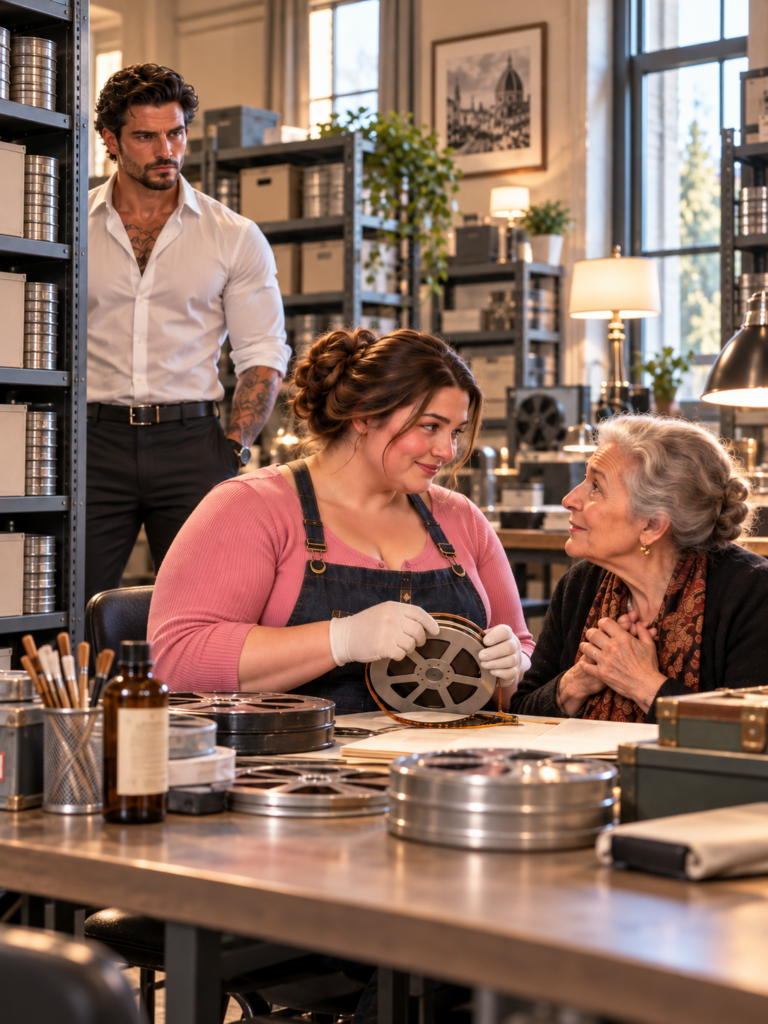
November wind off Lake Erie rattled the old windows of Lakefront Heritage Audio long after most of downtown Buffalo had gone dark. Norah Bellamy sat hunched over the restoration console in the back room, oversized headphones covering her ears, while a damaged reel-to-reel tape turned slowly beneath the warm yellow light of her desk lamp. At twenty-eight she had the soft, full figure she had spent most of her life being made too aware of—rounded hips, a generous waist, and a face that remained strikingly pretty even after ten hours of work. Chestnut-brown hair fell in loose waves past her shoulders, though tonight she had twisted most of it into an untidy knot with a pencil shoved through the center. Pale skin beneath her eyes showed the exhaustion of too many late shifts. She wore a dark green sweater, plain black trousers, and practical shoes, the kind of clothes chosen by someone who had long ago learned that comfort mattered more than being judged by strangers.
She had been working since eight that morning. The cracked magnetic tape belonged to a local family who had already waited six months to hear their grandfather’s voice again, and she could not bring herself to leave it unfinished simply because the clock said she should. That stubbornness had cost her sleep before, just as loyalty had cost her far more when she abandoned three years of study in Bologna to return home after her father’s stroke. She rarely regretted coming back for him, but there were nights when Italian words still surfaced in her thoughts before English ones, and she wondered what part of herself she had left behind across the Atlantic.
The front door chimed. Norah barely noticed it through the headphones. Out in reception, Megan Price—a narrow-framed woman of thirty-four with short blonde hair and the permanently tense expression of someone who had spent nine years explaining why damaged recordings could not be repaired overnight—had already put on her wool coat. An elderly woman entered carrying a dented tin box against her chest. She appeared close to eighty, small and stooped, wrapped in a faded charcoal coat that looked as though it had survived several decades of northern winters. Wisps of white hair had escaped the dark scarf tied beneath her chin. Her dark brown eyes remained sharp and anxious.
She approached the counter and began speaking in Italian while clutching the box tighter. Megan blinked, tried slower English, then reached for her phone as though a translation app might solve everything. The old woman understood almost none of it, and the harder she tried to explain, the more frightened her voice became. Through the wall and beneath the hiss in her headphones, Norah heard a sentence that made her fingers freeze above the controls.
“Per favore… è la voce di mio marito.”
Norah pulled off the headphones so quickly that one side struck the console. She stepped into the reception room. Three people looked toward the old woman with the particular discomfort Americans often showed when a language they did not understand suddenly filled a small space.
“Signora,” Norah said gently.
The old woman’s head snapped toward her. Relief appeared so nakedly on her face that something tightened inside Norah’s chest. She repeated the greeting, listening carefully to the older woman’s vowels and the slight narrowing of certain consonants, then shifted her own pronunciation almost without thinking. It was not simply Italian. There was a northern cadence beneath it, softened by decades abroad but still present—a rhythm Norah remembered from elderly speakers she had met while studying near Bologna and traveling farther north for archival work.
The woman’s name was Lucia Moretti. She had lived in Western New York for more than fifty years, long enough to understand ordinary English but never enough to trust herself when frightened or emotional. Norah guided her toward a chair. Only then did Lucia loosen her grip on the tin box.
“My husband,” Lucia explained in Italian, laying one trembling hand over the lid. “His voice is inside.”
Norah opened the box. The faint odor of old cardboard, dust, and mildew rose from several reel-to-reel tapes wrapped in yellowing paper sleeves. Lucia told her that her husband Paulo had died eighteen years earlier after a long illness. Most of his photographs had survived, along with his shirts, his wedding ring, and a wooden toolbox their son refused to throw away. But photographs had never been enough. Paulo had sung constantly when he was young—badly when he cooked, beautifully when he believed no one was listening. Somewhere on these tapes was a recording made during their wedding celebration in 1967.
Norah examined the damaged edges under a magnifying lamp without touching the contaminated section with bare fingers. “I cannot promise I can save all of it,” she said in Italian. Then she looked into Lucia’s wet, frightened eyes. “But I think his voice is still here.”
Lucia began to cry—not dramatically, but the quiet collapse of someone who had spent years believing a door had closed forever and had just been told there might still be a crack of light beneath it. Norah pulled another chair beside her instead of retreating behind the counter. For nearly twenty minutes they spoke while Megan dimmed the lights and quietly stopped checking the clock. Norah asked about Paulo, not merely about the tape. Lucia smiled through her tears as she described a tall, stubborn mechanic with black hair who had arrived in America convinced he could repair anything except his own singing voice. She laughed when she remembered him ruining a pot of sauce because he had become distracted by a Verdi aria on the radio. Norah laughed with her, though something in the story touched a place she usually kept guarded.
Across the hallway, behind a glass wall darkened by the reflection of the evening outside, Vittorio Cenino had stopped listening to the archivist speaking beside him. At thirty-nine he was nearly six-foot-three, broad through the shoulders without the exaggerated bulk of a bodybuilder, and carried himself with the economical stillness of a man who disliked unnecessary movement. Dark brown hair was combed neatly back from a hard angular face, a few natural strands of silver beginning at his temples. A close-trimmed shadow of beard sharpened the line of his jaw. He wore a charcoal overcoat over a white shirt with the collar open. Most strangers noticed his size first, then his eyes—dark, patient, and unnervingly attentive. He had learned very young that anger made men careless. The more dangerous a situation became, the quieter he grew.
He had barely noticed Norah when he first entered. To him she had simply been the woman behind the glass, bent over a machine with headphones covering her ears—until she stepped into reception and answered Lucia in Italian. Something in his attention changed. He did not stare at her body, though he registered her full figure and the way she seemed briefly self-conscious when several faces turned toward her. What held him was her voice. Her Italian was too natural to be classroom Italian. More importantly, she was altering it deliberately, matching Lucia’s northern rhythm with the unconscious precision of someone who heard language as sound before meaning.
Vittorio moved closer to the glass. He had spent three years listening to old tapes, private recordings, telephone interceptions, and damaged fragments recovered from men who had lied to him about where they came from. During those years one woman’s voice had become so familiar that he could recognize its pauses as easily as another man might recognize a favorite song. Isabella Conti had supposedly died in Italy long ago. Yet as Norah spoke, he felt the first cold stir of recognition.
Lucia handed Norah a cardboard sleeve with faded handwriting. “I cannot read this anymore,” she said. “Tell me what he wrote.”
Norah angled the sleeve beneath the lamp and read the Italian aloud. The sentence itself was ordinary—a private joke from a husband to a wife about remembering a song even after forgetting the words. But Vittorio did not hear the meaning first. He heard the timing. Norah placed the stress on the second clause in exactly the same unusual way Isabella had done on a recording made more than twenty years earlier. There was the same fractional pause before the final phrase, the same slight lowering of the vowel, the same breath released through the nose before the last word.
He went completely still. He watched Norah hand the sleeve back and saw the elderly woman close both hands around hers in gratitude. Norah looked embarrassed by the affection but did not pull away. For one strange second he saw another woman in the angle of her face—not identical, not even close, but something in the concentration around the eyes. He remembered the grainy photograph in his private file: Isabella Conti, younger than Norah was now, standing outside a building in Turin with wind pulling dark hair across her cheek. Officially she had died in a road accident. Unofficially she had disappeared with information powerful people had spent decades trying to recover.
He had come to retrieve the voice of his father. Instead he may have found the daughter of the woman he had been hunting for three years.
By the time the last light disappeared from the windows, Norah had finished stabilizing the damaged portion of Lucia’s tape. She shut down the transfer system, covered the equipment, gathered her coat and canvas shoulder bag, and walked through the darkened reception area. Megan had left more than two hours earlier. Norah was reaching for the alarm panel when something on her work table caught her eye. A black envelope sat precisely in the center of the desk where there had been nothing before. It was thick, unmarked, and made from expensive matte paper that looked completely out of place beside cleaning brushes, tape splicing blocks, and handwritten repair notes.
She opened it cautiously. Inside was a stack of crisp hundred-dollar bills secured with a paper band. She counted once, stopped, then counted again. Eight thousand dollars. Beneath the cash lay a heavy white business card bearing only two words in small black lettering: Cenino. Under the card was a printed flight itinerary for a private aircraft scheduled to leave Buffalo at 10:40 the following night. Destination: Turin, Italy. On the back of the card, handwritten: Your Italian is impressive. Your ear is more valuable. I need both.
Norah stood there holding eight thousand dollars in one hand and a ticket to another country in the other. She gave a short, humorless laugh to the empty room. “Absolutely not.”
She shoved everything back into the envelope and carried it toward the reception desk, already planning to lock it in the office safe until morning. Yet curiosity stopped her. The man behind the glass came back to her—nearly six-foot-three, dark hair brushed back, broad shoulders beneath a charcoal coat, eyes that seemed to notice everything while revealing nothing. She opened her laptop and typed the name. The first pages were polished business profiles describing Cenino Marine Turbine and Propulsion, a privately controlled company specializing in marine turbines, propulsion systems, and heavy repair work for Great Lakes freighters. Industry estimates placed the company’s value well into the hundreds of millions. Vittorio appeared in several photographs, always composed, always slightly apart from everyone around him.
She clicked deeper. Older newspaper reports mentioned federal investigations that had ended without charges. Questions surrounding port contracts. Witnesses who later declined to cooperate. Shell companies allegedly connected to men with long-standing ties to organized crime. The phrase Cenino family appeared more than once. Nothing proved what Vittorio himself had done, but nothing made her feel safer either.
She sat alone beneath the reception lights for almost forty minutes. Why her? Her Italian was good, and her ear for regional speech was better than most because she had studied phonetics and restoration work for years. But wealthy men did not send private planes across the Atlantic because a technician could distinguish northern Italian vowels. There had been something in the way he watched her through the glass—a focus too intense to belong to casual interest. He had begun paying attention after she spoke to Lucia, more specifically after she read the sentence on the old tape sleeve.
Norah closed the laptop and pressed both palms against her face. Whatever Vittorio Cenino wanted, she did not intend to discover it by climbing aboard his airplane. She placed the envelope inside her bag rather than leaving it at the archive—partly because eight thousand dollars was too much money to abandon in an office drawer, and partly because she wanted to return it directly.
During the bus ride home, Buffalo passed in wet black windows. Norah lived in a modest second-floor apartment above a closed tailor shop, chosen because the rent was low and the bus route ran directly toward the rehabilitation center where her father spent most weekdays. She barely slept. By morning she had decided on a simple plan: call Cenino Marine, tell whoever answered that Mr. Cenino had left something belonging to him, return every dollar, and forget the entire thing.
She made coffee, put the envelope on the kitchen table, and reached for her phone. It rang before she could make the call. Denise Keller from the rehabilitation center explained that Norah’s father’s insurer had denied authorization for another portion of his treatment, including several therapy sessions the neurologist considered important. They could appeal, but appeals took time and offered no guarantee. The amount due if he continued privately was substantial.
Norah stood frozen beside the kitchen table. Eight thousand dollars would not reverse her father’s stroke or restore the career he had lost. But it could cover months of the additional treatment—months in which he could continue working toward walking more steadily and speaking without fighting each sentence. She hated the speed with which her mind began calculating. The night before, returning the cash had felt obvious. Now the envelope seemed to sit on the table with a physical weight far beyond paper and money.
She paced the apartment for nearly an hour, arguing silently with every version of herself. By afternoon she had made one decision, though she refused to call it trust. She deposited none of the money. She kept it sealed in the envelope and packed only a small suitcase, two changes of clothes, her passport, her restoration headphones, a notebook, and the digital recorder she carried whenever she worked with unfamiliar audio. She sent Megan a message saying a private consulting job might keep her away for several days, then visited her father long enough to tell him she had been offered unexpected work overseas. She did not mention mafia rumors, mysterious cash, or a black envelope left after midnight.
At 9:55 that evening she stood inside a private terminal at Buffalo Niagara International Airport with her suitcase beside her and the envelope still hidden in her bag. Through the glass she could see a sleek aircraft waiting beneath white floodlights while cold rain moved across the runway. An attendant checked her passport and told her the flight to Turin was ready for boarding. She took one last look at the terminal doors behind her, knowing she could still turn around. Then she gripped the handle of her suitcase and walked toward the plane—not because she trusted Vittorio Cenino, and not because eight thousand dollars had bought her obedience, but because she needed to know what a mafia boss had heard in her Italian that she herself had never noticed.
Part 2
Turin appeared beneath a pale winter sky, its rooftops and church domes fading into morning haze while the Alps rose white and distant beyond the city. Norah had slept perhaps forty minutes during the flight. Vittorio himself had never appeared. The aircraft carried only two flight attendants and a quiet security man who introduced himself as Marco. He brought her coffee, told her the landing time, and refused, with almost impressive gentleness, to explain where they were going afterward.
By the time the plane touched down, irritation had begun replacing fear. She stepped onto the cold tarmac wearing her wool coat over travel-wrinkled clothes, chestnut hair tied loosely behind her head, and immediately noticed a black sedan waiting. Marco placed her suitcase in the trunk and opened the rear door. Norah climbed inside because she had already crossed the Atlantic.
The sedan carried her away from Turin through neighborhoods that gradually thinned into broad roads, bare vineyards, and winter fields. Nearly forty minutes later the car turned through black iron gates and entered a property set against low wooded hills. The house was not the ancient stone villa she had imagined but a modern structure of pale limestone, glass, and dark metal, elegant without ornament, positioned so that its wide windows overlooked the valley. Two men in dark coats stood near the entrance, both watchful but unobtrusive.
Norah followed Marco inside. The room into which she was shown was large and almost severe—cream stone floors, black furniture, and a wall of glass facing gray hills under the Italian morning. Vittorio stood beside that window with one hand in his trouser pocket as though he had been waiting long enough to become part of the architecture. Without his overcoat he looked even taller. His white shirt was open at the throat and rolled neatly to the elbows, exposing muscular forearms crossed by several lines of black Latin script and older geometric markings. Dark brown hair was brushed back from his angular forehead, silver showing naturally at both temples. His expression did not change when she entered.
Norah stopped several feet from the low leather chair positioned opposite him and remained standing. She did not give him time to speak.
“You knew my mother.”
For the first time since she had seen him, Vittorio’s stillness looked less like control and more like calculation. He studied her for several seconds, then crossed to a long black table and picked up a small digital recorder. He placed the device between them, pressed a button, and stepped back.
Static whispered through the speaker, followed by the faint scrape of something against an old microphone. Then a woman began speaking Italian. Norah’s breath stopped. The voice was older than hers, lower and slightly more controlled, but there was something inside it so intimately familiar that her skin went cold. The woman shaped certain vowels exactly as Norah did when she stopped thinking about them. She paused before complex phrases in the same place. Even the soft exhale between sentences sounded disturbingly close to the way Norah heard herself on recordings.
“Isabella Conti Bellamy,” Vittorio said quietly. “Your mother.”
Norah had been seven when Isabella died, young enough for memory to become unreliable and old enough to spend years wondering which pieces were real. In the photographs her mother had been a slender woman with dark chestnut hair cut just below the shoulders, pale olive-toned skin, expressive brown eyes, and an elegant narrow face that Norah had inherited only around the eyes. Her father had always described Isabella as intelligent, private, and stubbornly independent—an Italian translator who had done commercial and legal work before marrying an American. He had said she died in a traffic accident during a visit to northern Italy. Because grief had turned him into a quieter man afterward, Norah had eventually learned not to ask for details that made his face close.
Vittorio dismantled that history piece by piece. Isabella had indeed translated documents, but translation had never been the important part of her work. Her real specialty was voice analysis and coded communications. Long before modern biometric systems became common, she had developed methods for identifying speakers through cadence, breathing patterns, vowel structures, regional inflections, and subtle inconsistencies most listeners never noticed. Those talents brought her into the orbit of the Relli family, an old criminal financial network whose influence stretched between Turin, Milan, Monaco, and several international banking channels. The Rellis did not behave like street criminals. Their strength came from money that appeared respectable by the time it reached daylight. Isabella had worked inside the communication structure that connected those operations, authenticating sensitive messages and helping design methods that allowed key people to confirm identities without placing names into written records.
That work gave her access far beyond what the Rellis should ever have allowed one specialist to possess. She learned which accounts were hidden behind shell companies, which payments were routed through apparently legitimate businesses, and which transfers were allegedly used to buy cooperation from officials or move illicit funds without attracting attention. According to the records Vittorio had gathered, Isabella eventually decided to leave. Before doing so, she copied an extraordinary amount of financial and communications material. She never delivered it to police, to a rival organization, or to the Rellis. She hid it. Not long afterward, Isabella Conti Bellamy was dead.
Norah turned away from him and stared through the window because looking at him had become unbearable. She wanted to reject everything as manipulation. Yet the woman’s voice still seemed to linger in the room, impossible to dismiss because Norah had heard herself inside it.
“The accident,” she said at last.
Vittorio’s voice became quieter. He told her the official report described a wet road outside Turin, a vehicle leaving the pavement, and injuries severe enough to kill Isabella before help arrived. He also told her pieces of the record did not align—a missing witness statement, an unexplained gap in the timeline, and one investigator who later refused to discuss the case at all. “I believe she was killed.”
Norah turned back to him slowly. Her eyes were wet, though her expression had hardened. “And you want what she hid?”
“Yes.”
The answer landed more cleanly than any lie could have. He explained that he was not the only person searching. For years, fragments of Isabella’s old communications had circulated among people who understood what her archive might contain. Until recently no one knew whether any member of her immediate family remained reachable. Someone connected to the Rellis had learned that Isabella had a daughter living in Buffalo. Vittorio’s own people had discovered the same fact while tracing an older connection—Lucia Moretti.
Norah’s head lifted immediately. Vittorio told her Lucia had known Isabella when both women were younger, before Isabella’s work became dangerous and before Norah was old enough to remember any of it. Lucia herself was not part of the Relli network, but she represented one of the few surviving personal links to Isabella’s early life in northern Italy. Relli watchers had begun following her movements. Vittorio’s people had noticed and started watching as well. Lucia’s visit to Lakefront Heritage Audio had been genuine. Her husband’s tapes were real. Her grief was real. But the fact that dangerous people were interested in where Lucia went was not coincidence.
“So yesterday you were watching an eighty-year-old widow.”
“So were they.”
He explained the part that had brought Norah to Italy. No one had expected Lucia to encounter Isabella’s daughter that evening, and certainly no one had expected Norah to answer her in Italian. But when Norah adapted her pronunciation to Lucia’s regional cadence, Vittorio heard something he had spent three years studying in archival recordings of Isabella—a distinctive rhythm of stress, breath, and vowel placement. The resemblance was not merely genetic vocal similarity. Norah had also spent years studying language and sound, unintentionally developing the very abilities that made those inherited patterns useful. When she read the handwritten sentence from Lucia’s tape sleeve, the resemblance became unmistakable.
“Isabella’s daughter might not merely know where the secret is,” he said. “You yourself might be the key capable of opening it.”
The following morning, in a private study at the villa, gray winter light stretched across a long walnut table covered with photocopied architectural plans, bank records, and enlarged photographs of an underground corridor. The archive Isabella had hidden was believed to be inside a private storage vault beneath a former commercial bank in central Turin. A building whose public floors had been converted years earlier for foundations, private events, and cultural organizations, while part of the original basement infrastructure remained sealed. Isabella had worked with the bank during the late 1990s when biometric security was still experimental and institutions were testing voice recognition as an additional layer of authentication. She had helped design one prototype that did not simply compare words. It analyzed pitch, breath intervals, vowel construction, timing, and the highly individual way a speaker formed particular sounds.
Vittorio pushed an old engineering memo toward her. “Could it still work?”
Norah studied the technical notes for nearly an hour. The system was crude compared with modern voice authentication. Yet in some ways that made it more difficult to fool, because Isabella had designed its final layer around her own speech rather than a broad commercial profile. A perfect vocal imitation would not necessarily be enough. The lock appeared to compare a sequence of acoustic traits—where the voice rose and fell, the spacing between breaths, the duration of specific vowels, and the rhythm created by a particular regional pronunciation.
Norah did not sound exactly like her mother, and she refused to let him pretend otherwise. Her voice sat slightly lower. Her breathing pattern was different, and twenty years of American English had shaped certain consonants Isabella would have formed more naturally in Italian. But she had something no hired impersonator could manufacture easily. She had lived in Italy for three years, studied linguistics and acoustic restoration, and spent hundreds of hours listening to damaged recordings where meaning could be recovered only by hearing what other people missed.
“It might recognize enough of her in me,” she said. “But only if I control how we do this.”
She did not soften her conditions. Her father was not to be contacted, followed, pressured, threatened, or used as leverage under any circumstance. Vittorio was to tell her everything relevant to the vault, even information he thought would make her hesitate. Most importantly, if the vault opened, no one—not Vittorio, not his men, not anyone attached to the Cenino organization—would touch the data before Norah knew what her mother had left behind.
She expected resistance on the third condition. Instead he leaned back in his chair, rubbed one thumb once across the edge of the table, and said, “Agreed.”
Norah narrowed her eyes. “You didn’t even negotiate.”
“You came here because you wanted answers, not because you work for me. If I forget the difference, you leave.”
There was no charm in the way he said it, and strangely that made her trust the statement more. Over the next two days something subtle shifted between them. Vittorio stopped having other men explain plans to her as if she were luggage being moved between locations and began bringing questions directly to her. He asked which recordings she needed, whether the room would alter resonance, whether background noise could interfere with the system, and how many attempts she thought they could risk before an old security protocol locked them out entirely. He never interrupted when she explained something technical, even when the explanation ran longer than necessary because she was nervous.
She had spent enough of her life watching people decide what her body said about her before she opened her mouth. Men had spoken slowly to her as if being heavy meant being dull. Women had offered unsolicited advice about clothes and diets. University classmates had once joked that a woman who worked with delicate archival equipment should have delicate hands to match. Vittorio did none of it. He noticed her competence first. He also never mocked the fact that she questioned nearly every instruction he gave, even when one of his security men visibly lost patience with her. The most frightening man in the room, she realized, was usually the only one who did not seem threatened when she challenged him.
Their opportunity arrived through a charity gala being held at Palazzo Careno. Donors, bankers, industrial families, and cultural foundations would gather under enough public scrutiny to make open aggression difficult. The event itself took place several streets from the old bank’s original financial wing, but a preserved service network beneath adjoining properties still connected portions of the historic complex through maintenance corridors. Vittorio’s people had confirmed that one sealed branch reached the basement containing the private vault corridor.
The plan was simple only from a distance. Vittorio would attend the gala publicly, making certain that anyone connected to the Rellis saw him surrounded by donors, photographers, and business figures upstairs. His presence would pull attention toward the obvious threat. Norah, dressed not as a socialite but as a temporary archival consultant carrying approved access credentials, would enter through a service passage used by preservation staff.
“You are the distraction,” she told him while checking a small recorder inside her evening bag.
He adjusted the cuff of his black jacket. “For once, being recognizable is useful.”
Part 3
Palazzo Careno glowed beneath chandeliers that evening, its curved baroque walls filled with conversations, crystal glasses, dark formal wear, and the soft movement of people accustomed to being observed. Norah saw Vittorio only once after they entered. He stood beneath a gilded arch, speaking to two older businessmen with the calm ease of a man who belonged anywhere he chose to stand, while at least three other men in the room watched him too carefully to be casual. Every eye that remained on him was one less eye searching the service corridors.
She slipped through a staff door with a borrowed badge, descended two narrow flights of stone stairs, and passed from polished history into the colder, practical architecture beneath it. The air changed first, becoming damp and faintly metallic. Fluorescent maintenance lights replaced chandeliers. She followed the route she had memorized until she reached a corridor ending in a steel door set into a wall thick enough to belong to another era. There was no keypad, no card reader, no visible lock—only a small black microphone mounted beside the steel frame at mouth height.
Norah stopped several feet away, suddenly aware of her own breathing. She had practiced the phrase with Isabella’s recordings until she could hear the differences between them even while half asleep. She closed her eyes and remembered the old recording: Isabella’s breath before the first word, the slight upward lift in voce, the controlled shortening of record, the way the final phrase softened instead of falling. More than technique, she tried to remember the emotional shape behind it—the rhythm of a woman building a lock around something she feared would outlive her.
She stepped closer to the microphone and spoke clearly. “La voce ricorda ciò che il sangue dimentica.”
Nothing happened for one second, then two. By the third, disappointment began to become panic. A small mechanism clicked somewhere inside the wall. A low electric hum followed. Then several old internal bolts withdrew one after another with heavy metallic sounds. The door released several inches.
Norah slipped inside and found a narrow storage chamber lined with metal shelving and old secure cabinets, most of them empty. At the rear stood one small drawer with a handwritten inventory code matching the number in Isabella’s notes. She opened it with gloved hands. Inside lay a compact encrypted data drive protected by an older shockproof casing and several dozen analog recordings—small tapes, microcassettes, and labeled voice reels carefully wrapped against moisture. Her throat tightened when she saw Isabella’s handwriting on several of the labels. She placed the recordings into the padded archival bag she had brought and secured the encrypted drive inside an interior pocket closest to her body.
When she turned toward the steel doorway, someone was standing on the other side. He was not one of Vittorio’s men. Adriano Relli looked to be in his early forties, tall but lean, with dark blonde hair combed neatly away from a narrow forehead and a clean-shaven face, handsome in the polished, controlled way of someone who had spent his adult life learning how to appear harmless in expensive rooms. His gray-green eyes were unusually still. The dark navy suit he wore belonged upstairs among donors and bankers rather than beneath the building in a forgotten vault corridor.
Norah recognized him from the surveillance photographs Vittorio had shown her. Adriano had been among the men tracking Lucia Moretti. He did not look angry now. That frightened her more. In his right hand was a compact black pistol held low enough to look almost casual but angled directly toward her.
“So Isabella really did leave a key,” he said in English, his voice smooth and almost conversational. His gaze moved from her face to the padded archival bag. “The drive, Norah. Give it to me.”
She knew she could not fight him. He was taller, stronger, armed, and standing between her and the only exit. Trying to grab the pistol would not make her brave. It would make her dead. She forced herself to breathe slowly, keeping the archival bag against her hip, while Adriano watched her with the patient confidence of a man who believed the situation had already been decided. Somewhere beyond him, ventilation moved through old ducts with a low mechanical whisper. Norah listened because listening was what she did when fear threatened to overwhelm thought. She noticed the irregular cycle of the fan, the faint relay click from the locking system, and the slight echo created whenever Adriano spoke inside the narrow chamber.
An idea formed—not because it was guaranteed to work, but because fear sounded different when a person believed a machine was about to act against him.
“You should stop talking,” she said calmly.
Adriano’s eyes narrowed, though the pistol remained steady. Norah kept her expression neutral and glanced deliberately toward the microphone beside the door. She told him Isabella had built more than voice authentication into the vault—that the system continued monitoring acoustic signatures after entry and compared every sustained voice with the authorized pattern that opened it. If an unidentified speaker remained inside too long, she said, an old containment protocol would seal the chamber and trigger an automatic security alert.
None of that was true. She had studied enough of the surviving schematics to know the lock was sophisticated for its time, but she had seen nothing suggesting continuous voice surveillance. Adriano gave a small smile and called it a desperate bluff.
Norah looked at the watch on her wrist. “Eight seconds.”
His smile weakened but did not disappear. “Seven.”
The gun lifted a fraction higher. Six. At that exact moment the ventilation system shifted cycles. A heavy metallic clunk traveled through the ductwork, followed by the grinding vibration of an old damper repositioning somewhere behind the wall. Adriano’s reaction was almost invisible, but Norah was listening for it—a sharp breath, a change in the pressure of his shoes against the floor, the fractional movement of the gun as his attention snapped toward the steel door.
It was enough. She had kept the emergency access badge Vittorio’s team provided, clipped inside her coat. She ripped it free, struck it across the maintenance reader hidden along the interior frame, and lunged sideways rather than toward Adriano. The door released just long enough for her full body to slip through the narrowing opening. Adriano cursed and turned, but she was already outside, slamming her palm against the closure control. Steel moved between them with a deep mechanical groan. The last thing she saw was Adriano reaching the doorway, alive and furious, before the lock engaged.
Norah stood in the corridor shaking so badly she had to brace both hands against the wall. She had not defeated him by overpowering him. She had simply made him believe one sound meant something it did not. She hurried into the maintenance corridor, found the secure alcove Vittorio’s people had designated as an emergency staging point, and removed the encrypted drive from the archival bag. During the previous two days she had insisted on carrying a compact transfer unit she understood herself rather than trusting one prepared entirely by Cenino technicians. She connected the drive, verified the directory structure, and released a first evidence package containing financial ledgers, shell company references, account routing records, and supporting audio files into an encrypted legal channel prepared in advance. Within minutes the packet reached Italian financial authorities through an independent legal intermediary, creating an official trail that neither the Rellis nor the Ceninos could quietly erase.
Only after the confirmation appeared did she allow herself to move again. Adriano remained locked inside the vault, unharmed, and the alert she triggered brought legitimate security toward the lower level rather than armed men from either criminal faction. She walked away carrying the original data while the authorities were already receiving enough material to ensure the secret no longer belonged to whoever happened to hold the strongest gun.
Vittorio’s sedan waited several blocks away from the gala under a row of bare trees. When Norah climbed into the rear seat, she found him already there, jacket open, white shirt still immaculate. Two of his security men occupied the front. He looked first at her face, then at her hands, checking for injury before asking about anything else. Only when he saw no blood did he extend one hand between them.
“The drive.”
She reached into her bag and placed a small USB device in his palm. He turned it once between his fingers, then looked at her.
“A copy.”
“Yes.”
The men in front became remarkably interested in the windshield. Vittorio’s voice dropped another degree—the dangerous quiet she had already learned meant his mind was moving faster than his expression. “Where is the original?”
Norah smiled. The truth was larger than the question. Before leaving the underground level she had completed three encrypted backups using separate destinations she had arranged herself. The first contained a dead-man release instruction: if she or her father disappeared under suspicious circumstances, copies of the archive would automatically be transferred to lawyers and investigative authorities. The second preserved the material most directly connected to Relli operations. The third contained everything else she had found, including documents whose references appeared to touch businesses or intermediaries connected to Cenino interests. The USB she had given him was useful, but it did not give him ownership of Isabella’s archive, and it did not give him control over Norah.
Vittorio said nothing for so long that even the quiet breathing of the men in front became noticeable. Then he laughed. It was not loud and there was no anger in it. It was the same slow, restrained smile she had glimpsed in Buffalo when he first realized she was more complicated than he expected.
“You never trusted me.”
“You’re a mafia boss. Trusting you completely would be a sign that I’m not as intelligent as you think I am.”
One of the men in front shifted almost imperceptibly but still did not turn around. Vittorio studied her face for several seconds. Then he gave a single nod. “Good.”
He closed his fingers around the copy she had given him and never asked for the original again.
The consequences unfolded over the following months through lawyers, investigators, court orders, and financial proceedings rather than bullets. The Relli material was submitted formally through independent legal counsel. Authorities froze multiple accounts while several shell companies came under investigation or lost access to funds that had moved invisibly for years. Norah gave technical explanations concerning the audio archive without surrendering control of material unrelated to the investigations. Learning quickly that her mother’s legacy was safest when no single powerful person possessed all of it.
Back in Buffalo, her father entered a stronger rehabilitation program with better access to specialized therapy. But Norah refused to allow Vittorio simply to pay the bill as another mysterious favor. Instead she required a written agreement tying the expense to legitimate consulting work she performed for Cenino Marine, with rates, obligations, limits, and repayment terms reviewed independently. Vittorio thought the contract excessively detailed. Norah told him that men who left eight thousand dollars in black envelopes had forfeited the right to complain about paperwork. To her surprise, he signed every page.
Norah did not join the Cenino organization, move into Vittorio’s house, or become a decorative beneficiary of his power. She built something of her own. Using the experience that had once seemed too specialized to matter outside dusty archives, she established a small firm devoted to audio restoration, voice authentication, forensic recording analysis, and preservation of damaged historical media. Cenino Marine Turbine and Propulsion became her first major corporate client under a contract she negotiated herself, and other work followed as attorneys, archives, insurers, and private institutions learned what she could do. The woman who had once spent her nights repairing other people’s memories in a cramped Buffalo restoration room eventually employed technicians of her own.
Vittorio continued flying between Buffalo and Italy, at first with perfectly plausible business reasons involving marine contracts, legal consultations, and archived communications. After a while even Norah stopped pretending to believe all of them. He would arrive at her office carrying coffee, sit where he could see the door as always, and ask what she was working on before he asked when she was free for dinner.
One quiet evening months later they stood together near the window of Norah’s new studio while snow drifted over Buffalo and the restored voice of Paulo Moretti played softly from speakers across the room. Lucia had already received her finished recording, but Norah kept a permitted working copy because it reminded her where everything had begun. Vittorio listened to Paulo sing for several seconds before Norah looked at him and smiled.
“You know the funniest part?”
“What?”
She nodded toward the old reel. “If Lucia hadn’t walked into Lakefront Heritage Audio that night, you never would have found me.”
Vittorio shook his head. “I would have found you.”
Norah raised an eyebrow. “That confident?”
“No.” His gaze settled on her with that familiar patience that no longer frightened her the way it once had. “Patient.”
Norah looked toward the snow beyond the glass and thought of the black envelope, the airplane, the steel vault beneath Turin, her mother’s voice coming through an old recorder, and the moment a locked door had opened because she understood sound well enough to make the past recognize her. For years she had believed the important decisions in her life had been made by circumstances—her father’s illness, leaving Italy, money, responsibility, grief. Vittorio had certainly changed the direction of events. But she finally understood that power was not the same thing as authorship. He had not rescued her from obscurity, given her intelligence, or placed courage inside her when she needed it. He had only shown her a door she had not known existed.
Vittorio Cenino might have been the most powerful man she had ever met, but he was not the person who had changed Norah Bellamy’s life. He had simply opened the door. She had always been the one who chose to walk through it on her own two feet.


