Part 1
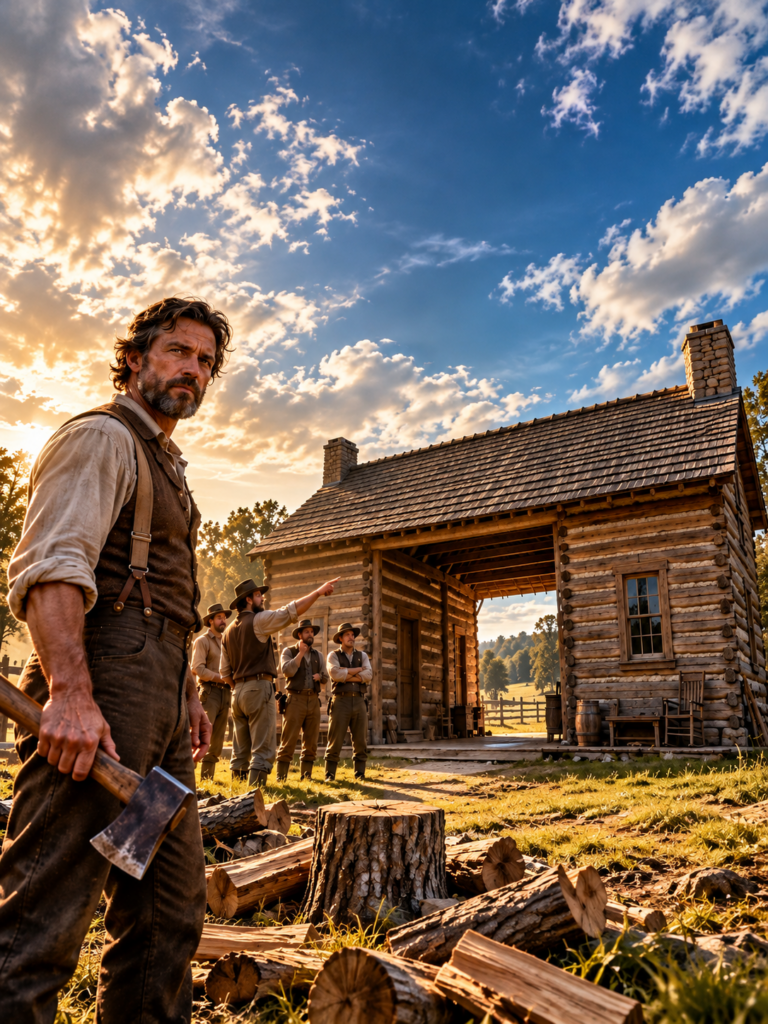
Samuel Reed stood in the middle of the foundation lines he had marked that morning and watched the spring wind move across the field. It came from the southwest, crossed the young corn, and continued without stopping. He had driven four stakes for the western room and four more for the eastern room, leaving twelve feet of open ground between them. The empty space looked wrong to anyone who knew how a house was supposed to begin. It looked unfinished before a single log had been laid.
He was thirty-six years old and rebuilding on a small piece of land in Middle Tennessee. He owned two horses, several hogs, a collection of carpenter’s tools that had belonged to his father, and enough cleared ground to grow corn if the weather held. He was not wealthy. What he carried with him was experience with heat. He had spent most of his life in the upland South, where winter could be uncomfortable but summer could change the way a family lived. People worked before sunrise. They rested when the sun stood highest. Cooking fires were avoided in the hottest part of the afternoon when possible. At night, families opened whatever doors and windows they had and waited for moving air that sometimes never came.
His first cabin had been the kind of house that protected a man from rain and still made him miserable. It had one main room, thick log walls, a stone chimney, one door, and two small windows set where they were easiest to cut rather than where air could travel. During winter Samuel loved it. The chimney held heat. The thick walls kept the cold out. During July the same cabin became an oven. The roof absorbed the sun all afternoon. The stone chimney stayed warm long after the cooking fire died. Warm air collected near the ceiling and stayed there. Because the windows were small and poorly placed, the inside remained still even when a breeze crossed the field outside. Samuel would step through the door and feel the difference immediately. Outside might be hot. Inside felt trapped.
His wife had become ill during one especially brutal summer. There was no single dramatic moment that convinced him the cabin had caused it. He knew better than that. Illness came from many things—water, exhaustion, the ordinary risks of the country. But he never forgot the nights when she could not sleep because the air inside refused to move. He would open the door. He would open both windows. He would carry bedding outside. Sometimes they slept on the narrow porch. Sometimes they slept beneath a tree at the edge of the yard. The house, the place they had built for protection, was often the last place they wanted to be. She recovered. Samuel remembered.
When he finally had enough lumber and help to replace the old cabin, he did not begin by asking how to build a larger house. He asked a stranger question. How could he build a house that did not trap summer inside it?
He had seen an answer years earlier. While traveling south with a timber crew he had stopped at several homes built in a peculiar arrangement. One room stood on one side. Another stood several yards away. A single roof covered both. Between them ran a broad open passage. The first time Samuel saw one he assumed exactly what his neighbors would later assume about his. The owner had not finished it. Then Samuel sat in that passage at midday. The roof blocked the direct sun. The open ends allowed air to move through. While the rooms on either side were warm, the center remained shaded and noticeably more comfortable. Doors opening from the rooms into that central passage allowed moving air to reach the living spaces as well. Samuel never forgot it.
So when he marked the foundation of his new house he left the middle open on purpose. Thomas Bell noticed first. Thomas owned the next farm east and had helped raise enough cabins to recognize the normal order of construction. He rode over one afternoon, dismounted, and stood with his hands on his hips while Samuel measured the empty space a second time.
“Where’s the center wall going?” Thomas asked.
“There won’t be one.”
Thomas assumed he had misunderstood. Samuel explained that the roof would span the entire structure, but the middle would remain open from front to back. Thomas stared at the foundation lines. Then he laughed. Not cruelly at first. He simply thought Samuel was joking. The laugh faded when Samuel began laying the first logs exactly as he had described.
The two sections rose separately. Each was essentially a small log cabin of its own. The western room would hold the main living and sleeping space. The eastern room would be used for storage, guests, and work. Between them remained the gap. As the walls reached shoulder height the structure looked increasingly strange. Neighbors stopped along the road to study it. Some asked whether Samuel had run out of logs. Others suggested connecting the rooms before he put on the roof. One man told him that if he wanted two cabins he should simply build two cabins. Samuel did not want two cabins. He wanted the space between them. That distinction made little sense to anyone watching.
Thomas returned several days later and stood in the empty middle with his arms crossed. “You’re building a house with a road through it.”
Samuel liked that description because that was almost exactly what he wanted. Not a road for people. A road for air. He did not spend much time explaining himself. He kept working. The criticism grew once the roof frame began. Samuel placed heavy beams across both rooms and over the empty center. Then he roofed all of it. From a distance the house looked complete. Up close anyone could see straight through the middle. A person standing in front could look beneath the roof and see the field behind the house. Thomas told anyone who would listen that Samuel Reed had built a house with a hole in it. Samuel heard the talk and kept measuring, cutting, and fitting.
Part 2
By late May the walls were up and the roof was on. The central passage received a wooden floor raised slightly above the ground so water would not stand on it. The roof extended beyond the walls enough to keep much of the corridor shaded even when the sun was angled. Samuel placed doors from both rooms directly into the passage. Windows on the outer walls could be opened at the same time. The arrangement meant he could open a door toward the shaded center and a window toward the outside, giving moving air more than one path through a room. That was the theory.
Neighbors continued to stop. Some offered practical advice. One suggested hanging canvas across the open ends so the space could at least be closed at night. Another said the open middle would be a problem when cold weather returned. Samuel listened and nodded and went back to work. He was not building for winter alone. He was building for the months when the air stopped moving inside ordinary walls.
The house was not finished until early June. By then mornings were already warm. Samuel moved his bedding into the western room. For the first week nothing remarkable happened. The house was comfortable. So were everyone else’s. Thomas Bell visited one evening and leaned against a post in the open passage. A light breeze crossed the field and moved through the center of the house. Thomas admitted that the spot was pleasant. Then he pointed out the obvious problem. Pleasant was not the same as useful. Samuel had sacrificed a large portion of his roofed floor area just to create an outdoor hallway. That same roof and timber could have covered another enclosed room. A family with limited resources could not afford to waste space.
Samuel understood the argument. An enclosed room looked valuable. An empty corridor did not. He had counted the logs and the labor. He knew what the middle could have become if he had closed it. He also knew what his old cabin had become in July. He had carried his wife outside because the house they had built for safety had turned into the least safe place to sleep. He was not willing to build another one like it simply because the new design looked unfinished to men who had never spent a night trying to breathe inside a sealed cabin.
June became July. Rain grew scarce. The ground hardened. Corn leaves curled during the afternoon. The wind did not disappear entirely, but it weakened. And the heat settled over the farms day after day. Inside ordinary log houses conditions became exhausting. Windows helped. Open doors helped. But many homes had only one or two small openings, and the large roof surfaces baked beneath the sun for hours. Cooking made things worse. A midday fire could heat a small cabin long after the meal was finished. Families began spending more time outside beneath trees. Children played in whatever shade they could find. Adults sat with wet cloths on the backs of their necks and waited for evening.
Samuel did the same. He was not immune to heat. His strange house did not create cold air. That mattered. The open passage was not magic. If the day was hot, Samuel was hot. But when even a small breeze crossed his land, the house gave it somewhere to go. The center remained shaded. Air passed beneath the roof instead of striking a solid wall. In the hottest part of the afternoon Samuel often moved his chair into the passage. He repaired harness there. He sharpened tools there. He ate there when the western room felt too close. The breeze that moved through the open middle reached the doors of both rooms. When he left those doors open, the air inside the rooms moved as well. It was not cool. It was less still.
Thomas Bell stopped laughing sometime in the third week of July. He began visiting. At first he claimed he was only passing through. He would ride up, dismount, and stand in the passage while he talked about the corn or the price of nails. Then he began bringing small repair jobs—a broken harness strap, a loose tool handle, a cracked wooden box. He would sit in Samuel’s central passage while they worked. Soon he was staying through the hottest part of the afternoon. One day Samuel noticed that Thomas had positioned his chair exactly in the center where the air moved strongest. Neither man mentioned it. Thomas still said the design was wasteful. He said it while sitting in the middle of the waste.
By the end of July other neighbors began stopping as well. They did not admit they had come for the shade. They came to ask about a tool or to deliver a message or to look at the corn. Then they stayed longer than the errand required. Samuel’s sister came with her daughter one afternoon and sat in the passage while the child played on the wooden floor. An older man from farther down the road stood at the open end and watched the breeze move through. He said nothing about the missing wall. He simply stood there until the worst of the heat had passed and then rode on.
Part 3
The real test came in August. Several days of unusually oppressive heat arrived with almost no nighttime relief. The problem was no longer simply working under the afternoon sun. It was sleeping. A house heated all day could remain uncomfortable well after dark. Bodies added more heat. Cooking added more. Children became restless. Adults woke repeatedly and lay staring at the dark ceiling while the air refused to move. Thomas’s youngest son began sleeping on the floor near the open doorway of their cabin because it was the only place where he occasionally felt moving air. Even that helped only a little. The doorway itself was small. The air that entered had nowhere to go once it was inside.
At Samuel’s house the western sleeping room was warm too. But Samuel changed how he used the building. Near sunset he opened the outer windows. He opened the door facing the center passage. Then he left the opposite side of the passage completely unobstructed. As evening air began moving across the farm, the shaded corridor cooled first. The two enclosed rooms opened toward it. The house did not suddenly become cold, but the trapped feeling eased. Samuel moved a narrow bed into the central passage. On the worst nights he slept there directly beneath the roof, protected from dew, protected from light rain, open to whatever breeze crossed the field. The same empty space his neighbors had called waste was now the most useful part of the house.
He woke one night to the sound of a wagon. Thomas Bell’s wife stood at the edge of the passage carrying their youngest child. The boy had spent the evening crying and could not sleep inside their cabin. Thomas followed a few minutes later with blankets. Samuel did not say anything about the months of jokes. He helped them lay bedding across the passage floor. The boy fell asleep first, then his mother. Thomas remained awake. He sat near the edge of the corridor looking through the open end toward the dark field. Every few minutes a weak breeze came across the grass. It entered one side of Samuel’s house, passed beneath the roof, and continued out the other. Thomas sat with his hands on his knees and watched it happen. He finally understood that the missing wall was not missing at all. The absence was the feature.
Over the next several evenings more people found reasons to visit after dark. Samuel’s sister brought her daughter. The older neighbor came because his own cabin remained stifling after sunset. Children were laid on quilts in the shaded passage. Women sat and sorted beans by lantern light because the work was easier where the air moved. Samuel repaired tools there in the evening because the light was better and the heat was less. Meals were sometimes eaten there. The open center had become part porch, part workshop, part sleeping space, and part ventilation corridor. It was not wasted space. It was flexible space. And because it had never been enclosed, it never trapped heat the way the rooms did.
One afternoon a man from the next county stopped to look at the house. He had seen similar arrangements farther south. He stood in the passage and nodded once. “Dogtrot,” he said. Samuel had not heard the name before. The man explained that some families built the two rooms and the open middle all at once. Others began with a single cabin and later added a second room several feet away, connecting them with one roof when they could afford the timber. Either way the open center served the same purpose. Shade. Air. A place to work or rest beneath a roof without sealing the heat inside. The man stayed long enough to drink water and then rode on. Samuel thought about the name. It sounded ordinary. Almost too ordinary for something that had taken his neighbors so long to understand.
Part 4
Then a storm approached. For the first time Samuel’s design seemed ready to fail for the opposite reason. Wind increased sharply from the southwest. The same open corridor that welcomed breezes now gave strong wind a direct path beneath the roof. Rain followed. Thomas rode over at dusk and stood at the edge of the passage with his hat pulled low. He expected Samuel to regret everything. The wind moved through the open middle hard enough to lift the edge of a blanket that had been left on the floor. Rain blew in at an angle and wet the wooden boards nearest the open ends.
Samuel did not regret it. He had already built heavy shutters and simple removable barriers for severe weather. They were not elegant. They were boards fitted with leather hinges and iron hooks that could be set across the open ends of the passage when conditions demanded it. He and Thomas put them in place together. The wind still moved, but it no longer drove straight through. The rain no longer reached the center. The barriers reduced the exposure without permanently turning the space into another room. When the storm eased, Samuel removed them again. The passage was open by morning. The wooden floor was wet at the edges and dry in the middle. The breeze returned as if nothing had interrupted it.
That evening taught Samuel something important. The design worked because it could remain open when openness helped and it could be partially protected when weather changed. It was not the strongest possible wall. It was not the largest possible house. It was a house built around movement. Thomas stood in the passage after the barriers came down and looked from one open end to the other. He did not laugh. He did not offer advice. He simply stood there until the last of the rain had stopped and then rode home.
By September the worst heat had passed. Nights cooled enough that sleeping inside the western room became comfortable again. Thomas returned to spending most nights at home, but he had begun looking at his own cabin differently. Its walls had always represented security. Now he noticed what they stopped. Not only rain. Not only cold. Air. He mentioned it once while helping Samuel reset a loose shutter. “I keep thinking about what that middle does when the air is moving,” he said. Samuel nodded and kept working. He did not need Thomas to say more. The fact that Thomas had stopped calling the space a waste was enough.
The following spring Thomas added a broad covered opening between his cabin and a new room he was building beside it. He did not copy Samuel’s house exactly. He did not need to. The principle was enough. He left enough space for air to move and enough roof to keep the sun off the people who stood beneath it. Other families in the region already knew the form. Some had grown up in houses built the same way. Others had seen them farther south. The design would become known by the name the man from the next county had used. A dogtrot. Two enclosed sections. One shared roof. An open central passage. Simple enough that a child could understand it once shown. Strange enough that a person seeing it for the first time might assume the builder had forgotten half the house.
Samuel watched Thomas raise the new roof and thought about the nights his wife had spent outside because the old cabin would not let the air move. He thought about the nights Thomas’s son had slept on the passage floor because it was the only place the boy could breathe. He thought about the men who had stopped along the road and asked whether he had run out of logs. None of them had been cruel. They had simply measured a house by how much space it enclosed. Samuel had learned to value one section precisely because it enclosed nothing.
Part 5
Later owners of similar houses often enclosed those passages. To them the empty middle looked like space waiting to become another room. Boards went up. Doors were cut. The open ends disappeared. And once the walls went up, something else disappeared with them. The breeze. The shaded corridor that had cooled first in the evening became another room that held heat the same way every other room held heat. Samuel understood that before his neighbors did, not because he knew more about architecture and not because he had calculated airflow with any precision. He had simply spent enough hot nights inside a sealed cabin to understand that sometimes a building could protect you too well from the world outside.
That summer everyone who looked at Samuel Reed’s unfinished house saw the same thing. A roof. Two rooms. And a large piece missing from the middle. They were right about everything except the last part. Nothing was missing. The empty space was what made the house work when the heat settled and the air stopped moving anywhere else. Samuel kept the barriers he had built for storms. He used them when the wind drove hard and the rain came in at an angle. The rest of the time he left the middle open. He slept there on the worst nights. He worked there on the hottest afternoons. He watched the breeze enter one end, pass beneath the roof, and leave through the other. It was not cold air. It was moving air. In a country where summer could turn a solid house into a place no one wanted to stay, moving air was enough.
Years later, when travelers asked about the open middle, Samuel usually gave a short answer. He said the house needed a place for the wind to go. He did not tell them about the nights his wife had spent outside or the evenings Thomas’s family had carried bedding into the passage. He did not need to. The house itself answered the question. Anyone who stood in the middle on a hot afternoon and felt the air move through could understand what the empty space was for. The men who had laughed in the spring had stopped laughing by August. Some of them had slept there. That was enough. The open middle remained open. The breeze continued to use it. And Samuel continued to value the part of the house that enclosed nothing at all.