August lifted the first envelope toward the lamp, his hands shaking as he reached for the seal.
The paper cracked softly beneath his thumb.
He unfolded the letter.
For the first time in twenty-two years, he saw Evangeline’s familiar handwriting.
She had written about the ranch, her father’s difficult temper, and a promise August had made when they were young.
He had told her he would build a house with a west-facing porch, where they could watch the cattle returning in the evening.
She had teased him for his terrible black coffee and his insistence that she ought to appreciate chicory.
August pressed his hand against his mouth.
He remembered those conversations.
He remembered a girl racing him along the fence line, laughing when her horse pulled ahead.
He remembered believing there would be years enough to fulfill every promise.
Then he opened the second letter.
The Sterling ranch had been lost.
Her family was leaving Texas.
She had something important to tell him.
Something she did not dare entrust entirely to paper.
August read it twice.
He reached for the third envelope.
The handwriting was less steady.
Its message was brief.
Evangeline wrote that she would raise the child alone if necessary.
She had waited for an answer.
None had come.
She asked only whether there was still room for them in the life he had promised to share.
At the bottom, she left instructions for finding her through Father Whitfield at the mission in Concordia.
August remained motionless.
A child.
His child.
He looked at the letter again, unable to believe that a few folded pages could contain so many years of stolen life.
Then he remembered Rosalind.
Twenty-two years old.
An orphan.
A young woman whose mother had once owned a ring matching his own.
He sat down heavily.
For years, he had believed his search unsuccessful.
But the truth was worse.
Someone had intercepted Evangeline’s letters.
Someone had directed him toward Louisiana when the answer might have been waiting elsewhere.
And that someone had apparently profited from the destruction of her family’s ranch.
August returned to the ledgers.
The old accounts confirmed that Cornelius’s lending interests had been involved in the Sterling debt.
Records later showed that land acquired through the holding company had eventually become part of the Renwick estate.
August had been grazing cattle on former Sterling property without ever knowing its history.
His wealth had benefited from what appeared to be a deliberate injustice.
He summoned Elias Kirby, the family’s elderly former accountant.
Kirby examined the entries the following morning.
At last, he lowered his spectacles.
“Your brother called that debt before its time.”
“Was that permitted?”
“Not according to the agreement I remember.”
“Why didn’t you object?”
Kirby stared at his hands.
“Because I was employed by your family, Mr. Renwick. And because I was less courageous then than I ought to have been.”
August looked toward the window.
“And the land?”
Kirby traced another entry.
“Cornelius used that company to purchase it.”
August closed his eyes.
The evidence was not yet complete.
But the pattern was becoming impossible to ignore.
He spent the next days obtaining records.
The documents strengthened his suspicion that Cornelius had deliberately ruined the Sterling family and prevented Evangeline from reaching him.
Then August saddled his horse for Concordia.
He carried the three letters inside his coat.
The journey took two days of hard travel, with an overnight stop along the way.
At the mission, Father Alonso searched the old parish registers.
The former priest, Father Whitfield, had died the previous year.
But his records remained.
They found a baptismal entry for a baby girl.
Her mother was Evangeline Bell.
The date matched August’s calculations.
The child’s name was Rosalind.
August could hardly breathe.
Then the priest turned to another record.
Six years after the birth, Evangeline had died of fever.
Her burial was recorded in the little cemetery behind the mission.
August asked to see the grave.
He stood before the modest stone for a long time.
For twenty-two years, he had imagined Evangeline living somewhere beyond his reach.
He had never known she was dead.
Never known she had borne his child.
Never known she had waited for letters that his brother had hidden.
When he returned to Millbrook, he could not immediately face Rosalind.
For three evenings, he attempted to write an explanation.
Every draft seemed inadequate.
Finally, he placed the letters, copied records, and an old photograph into a wooden box.
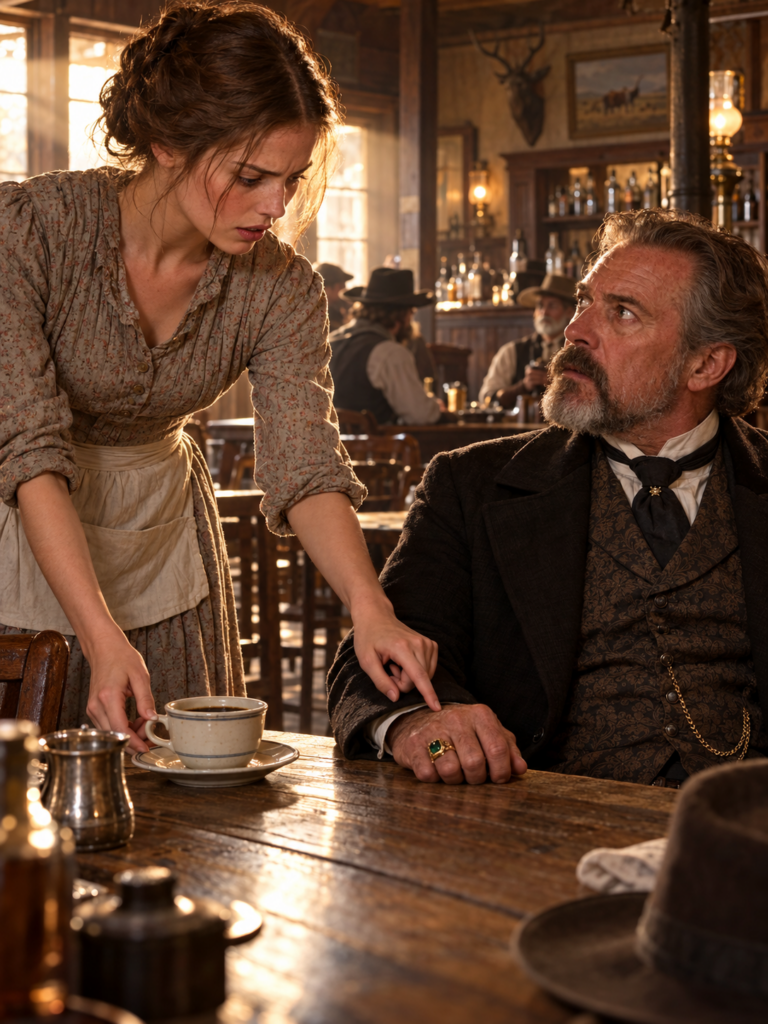
He went to the saloon after the dinner crowd had thinned.
Rosalind was wiping tables.
She looked up as he approached.
“Mr. Renwick.”
“Miss Bell.”
“Have you found the answers you wanted?”
August set the box upon the table.
“Some of them.”
“And will you tell me?”
He nodded.
“But I must warn you. What I’ve learned concerns your entire life.”
Rosalind looked at the box.
Then at the man standing before her.
“I’ve spent twenty-two years living that life, sir. Whatever is inside, I’m entitled to know it.”
August stepped back and pulled out a chair.
This time, he did not ask her to sit.
He waited until she chose to.
Then he opened the box.
On top lay the photograph of a young woman laughing in the sunshine.
Rosalind reached for it.
Her fingers began to tremble.
“That’s my mother.”
August nodded.
She looked from the photograph to the three unopened envelopes, their seals now broken.
“What are these?”
“Letters she wrote to me.”
Rosalind slowly lowered the photograph.
August placed the copied baptismal entry between them.
“Your mother was Evangeline Sterling,” he said. “And, Rosalind, I believe I am your father.”
The waitress stared at him.
Then she reached across the table, took the parish record into her own hands, and began reading the lines that had been missing from her life.
Rosalind held the parish record beneath the saloon lamp.
Her own name appeared upon it.
Rosalind Bell.
Her mother’s name stood above it.
Evangeline Bell.
And beside the record lay three letters written by the woman Rosalind had spent sixteen years remembering through fragments.
She read the date again.
Then she looked at August.
“You believe you’re my father?”
“Yes.”
“Believe?”
“The dates agree. The letters explain what happened. The parish record establishes your mother’s identity. I have every reason to believe it.”
Rosalind’s expression hardened.
“Then tell me everything.”
August sat opposite her.
He explained the youthful courtship, the two neighboring ranches, and the promises he and Evangeline had made.
He told her of the Sterling family’s sudden financial ruin.
Of his search.
Of the information that had sent him to Louisiana.
Of the three letters found among Cornelius’s possessions.
And of the land transactions now connecting his brother to the destruction of Evangeline’s family.
Rosalind listened without interrupting.
When he finished, she stared at the photograph.
“So my mother wrote to you.”
“Yes.”
“Three times.”
“Yes.”
“And you never answered.”
“I never received them.”
She raised her eyes.
“Do you know what she must have thought?”
August lowered his head.
“I have scarcely been able to think of anything else.”
“My mother was poor. She worked when she was ill. She gave away the only beautiful thing she owned because we needed food.”
Her voice tightened.
“She died believing you had chosen not to come.”
August said nothing.
Rosalind leaned forward.
“And I grew up in an orphanage.”
“I know.”
“No, Mr. Renwick. You know the words. You don’t know the life.”
He accepted the rebuke.
She continued.
“I wore dresses other girls had outgrown. I worked for every supper once I was old enough. I’ve spent years saving coins so that someday I might own a roof that nobody can take away from me.”
Her eyes filled.
“And all that time, you had ranches and cattle and more money than I can imagine.”
August looked at her.
“Yes.”
“And your brother made certain I never knew?”
“That appears to be what happened.”
Rosalind shook her head.
“He’s been dead eight years.”
“Yes.”
“How convenient that he cannot answer for any of it.”
August did not defend himself with anger.
He understood her suspicion.
For all she knew, he was another wealthy man offering an explanation that benefited him.
“I can show you the original papers,” he said. “You needn’t accept my word alone.”
She looked at the letters.
“Would you have wanted me?”
The question struck him harder than anything else she had said.
August struggled to answer without making a promise about a past he could not change.
“I wanted to marry your mother,” he said. “I searched for her after she disappeared. Had I known about you, I would have come.”
“You can’t prove that.”
“No.”
Her eyes filled again.
“Then perhaps we ought not pretend the last twenty-two years can be repaired by saying it.”
August nodded.
“We ought not.”
She took the box.
“I need time.”
“Take whatever time you need.”
“And I don’t want anyone told that I’m your daughter.”
“Not without your permission.”
She stood.
“For now, you’re still Mr. Renwick.”
He rose as well.
“I understand.”
Rosalind carried the box upstairs to her small rented room.
That night, she read every letter.
In the first, she found a mother she had never known.
A young woman who rode fast, teased the man she loved, and dreamed of a house with a western porch.
In the second, she found fear.
In the third, she found courage so desperate that it made her chest ache.
Her mother had been willing to raise her alone.
But she had not wanted to.
For the first time, Rosalind understood the difference.
Evangeline’s poverty had not been the result of simple misfortune.
Someone had taken the land beneath her family’s feet.
Someone had hidden the letters that might have brought help.
And someone had ensured that August Renwick went looking in the wrong direction.
Rosalind placed the letters beneath her pillow.
She did not sleep much.
***
For three weeks, August kept his distance.
He sent no lavish gifts.
He did not appear at the saloon every evening.
He continued examining the property records with Elias Kirby, seeking a clearer accounting of what had happened to the Sterling ranch.
Rosalind continued working.
Her employer noticed nothing unusual beyond her occasional silence.
She still carried meals.
Counted supplies.
Checked deliveries.
Saved coins.
But the world had shifted beneath her.
Every time she looked at a wealthy customer, she wondered what it might mean to belong to a family that owned more land than she had ever walked across.
Every time she opened the wooden box, she remembered that the family had existed before she knew it.
And that she had existed perfectly well without them.
Eventually, she agreed to visit the Renwick ranch.
August received the news with such relief that he made his first serious mistake.
He ordered a room prepared for her.
He arranged for new dresses to be made.
He instructed the household staff to address her as Miss Renwick.
He assigned her a permanent place at his dining table.
By the time Rosalind arrived, an entire life had been arranged around someone who had never agreed to enter it.
The ranch house was enormous.
Its windows overlooked broad pastures and distant cattle.
Polished furniture stood in rooms large enough to hold most of the boardinghouse Rosalind dreamed of owning.
August led her upstairs.
“This is your room.”
Rosalind looked inside.
A fine bed.
Fresh curtains.
A wardrobe containing new dresses.
A writing desk.
A polished washstand.
Everything was beautiful.
Nothing belonged to her.
She turned.
“Who chose these things?”
August hesitated.
“I did.”
“The dresses?”
“Yes.”
“The room?”
“Yes.”
“The servants calling me Miss Renwick?”
His expression changed.
“I thought—”
“You thought what a daughter of August Renwick ought to have.”
“I wanted you to feel welcome.”
“You furnished a room for a woman you’ve imagined. You never asked what the woman standing here wanted.”
He looked at the floor.
She continued, her voice quieter now.
“I have worked for years to make my own decisions. I’m not going to surrender that because you’ve discovered who my mother was.”
August took a breath.
“You’re right.”
“Then why didn’t you ask?”
“Because I’m accustomed to solving problems by giving orders.”
Her expression softened only slightly.
“I am not one of your problems.”
“No,” he said. “You’re not.”
Rosalind returned to town before supper.
For eleven days, she did not come back.
August did not send for her.
He canceled the dressmaker’s remaining work.
He told the household staff to use the name Rosalind preferred.
And he waited.
It was unfamiliar work for a man accustomed to making decisions and seeing them carried out.
***
When he next appeared at the saloon, he brought no money, flowers, or expensive parcels.
He carried a photograph.
Rosalind eyed his empty hands.
“No more dresses?”
“I’ve been informed that dresses don’t mend twenty-two years.”
A reluctant smile touched her face.
“No. They don’t.”
He placed the photograph on the counter.
It showed Evangeline in another moment of youth.
Her hair had blown loose.
She was laughing at something beyond the camera.
Rosalind drew it toward her.
“Where did you find this?”
“Behind the first photograph. I’d never noticed it.”
She studied her mother’s face.
For much of her childhood, Evangeline had been tired.
Sometimes gentle.
Sometimes anxious.
Often struggling to make a small amount of food last another day.
Rosalind had not known this laughing woman.
“Was she always like that?” she asked.
“Not always. But she laughed more easily than I did.”
Rosalind nodded.
“She used to tell me stories when I was little. I thought she made some of them up.”
“She may have improved a few.”
Rosalind looked up.
August smiled faintly.
“She was very good at winning an argument, especially when the facts were against her.”
For the first time, Rosalind laughed with him.
It did not erase her anger.
But it made the room feel less crowded with it.
August waited until she had finished looking at the photograph.
“Rosalind, tell me what you want. Not what I believe you ought to want.”
She thought carefully.
“I don’t know everything yet.”
“That’s fair.”
“But I know I don’t want to move into your house simply because you’ve found me.”
“You don’t have to.”
“I want to keep working.”
“Then keep working.”
“I want to understand what happened to my mother’s land.”
August nodded.
“And eventually?”
She looked toward the saloon’s dining room.
“I still want my boardinghouse.”
He had never heard her speak of it before.
He listened while she explained.
She wanted respectable rooms.
A kitchen large enough to feed travelers.
Fair prices.
And a place where poor people would not be humiliated for needing help.
When she finished, August said, “That sounds like a fine enterprise.”
“It would be mine.”
“Yes.”
She studied him.
“Can you understand why that matters?”
“I believe I’m beginning to.”
***
Rosalind returned to the ranch a week later.
This time, she chose the afternoon.
She ate at the long table where the ranch hands took their meals.
She asked questions about livestock, accounts, grazing schedules, and the workers who kept the operation running.
She did not pretend to know ranching.
She knew food, ordering, recordkeeping, and the difficult arithmetic of making too little money stretch far enough.
When she spotted an error in a flour delivery account, she pointed it out.
August examined the figures.
“You found that in a minute.”
“I spent years counting every penny,” she replied. “When a mistake means somebody goes hungry, you learn to look carefully.”
He did not praise her as though she were performing a trick.
He asked her to explain the calculation.
She did.
He listened.
Later, while they stood near the stable, a wary gelding approached Rosalind when she offered him an apple.
August looked amused.
“He usually keeps away from strangers.”
“Perhaps he doesn’t care who my father is.”
August laughed.
Rosalind looked at him.
It was the first time she had heard him laugh without restraint.
For a moment, she could almost imagine the young man her mother had once loved.
That evening, on the porch, she asked him about Evangeline.
“Not the woman from the letters,” she said. “Tell me what she was like before everything went wrong.”
August rested his coffee cup upon the railing.
“She was stubborn.”
“So you’ve said.”
“And quicker than I was on horseback.”
“That’s interesting.”
“She made certain I knew it.”
Rosalind smiled.
“She hated chicory coffee,” August continued. “Once, she poured an entire cup behind the stable because she didn’t want her mother to see she’d left it untouched.”
Rosalind laughed.
August grew quiet.
“I wish you’d known her then.”
Rosalind looked toward the pasture.
“I wish she’d been allowed to remain that woman.”
Neither spoke for a while.
Then August said, “So do I.”
***
The following week, he invited her into the ranch office.
This time, there were no dresses.
No prepared room.
Only documents.
Maps.
Accounts.
And Elias Kirby, who had agreed to explain the old entries.
Together, they traced the Sterling property’s transfer through Cornelius’s holding company and its later absorption into the Renwick estate.
August showed Rosalind which acres had belonged to her mother’s family.
He explained that he wanted the property restored through proper legal arrangements, with an accounting of its use and income.
Rosalind studied the papers.
“Are you trying to buy my forgiveness?”
“No.”
“Then what?”
“Return something that should never have become mine.”
She looked at him.
“That isn’t the same thing.”
“No.”
She considered the maps.
Then she said, “I want to learn how to manage it.”
August nodded.
“I can arrange for someone to teach you.”
“I want to choose whom I learn from.”
He almost answered automatically.
Then stopped.
“Of course.”
“And I want part of the income to help the orphanage that raised me.”
“That can be included in your plans.”
“Not because you owe the orphanage anything.”
“Because you choose it.”
“Yes.”
August looked at her for a long moment.
He was beginning to understand how much he had mistaken providing for someone with listening to them.
He had money enough to furnish houses, purchase horses, and acquire land.
But the daughter before him had spent her whole life learning how to survive without his help.
If he hoped to know her, he would have to respect the woman those years had made.
They began planning the land arrangements carefully, with professional assistance.
Rosalind insisted upon reading the papers herself.
She wanted to understand every provision before signing.
August did not rush her.
For a time, it seemed they had found a way forward.
Then a bank clerk mentioned that August had instructed his lawyer to prepare an inheritance arrangement naming her as his heir.
Rosalind rode to the ranch at once.
She entered his office carrying the news.
“You’ve done it again.”
August looked up.
“What?”
“You’ve made a decision about my life and told everyone who handles your money before you told me.”
His face fell.
“I wanted you protected if something happened to me.”
“Then you should have spoken to me.”
“I thought—”
“I know what you thought.”
Her voice was sharp.
“You thought you could arrange everything and make the uncertainty disappear. But I am not a parcel of land or an entry in your accounts.”
August rose slowly.
He looked toward the ledgers on his desk.
All his life, he had measured responsibility by what he could secure.
Buildings.
Cattle.
Money.
Contracts.
Now his daughter was asking for something his wealth could not purchase.
A voice equal to his own.
He looked at her.
“I’ve forgotten that family isn’t something a man can command.”
Rosalind’s expression softened.
“Then remember.”
“I will ask the lawyer to wait. We can discuss the arrangement together, and you may decide what you wish to accept.”
She nodded.
“That’s what I needed.”
It was not a grand reconciliation.
But it was honest.
And for the first time, Rosalind began to believe that her father might truly learn to know her.
***
One evening, while rereading Evangeline’s first letter, Rosalind noticed a reference to a merchant in Concordia.
Her mother had written that the man had shown kindness during the hardest months after the Sterling family lost its ranch.
Rosalind remembered the ring.
The green stone.
The winter when Evangeline had traded away her most treasured possession.
She took the letter to August.
“I think this may be where she parted with it.”
He examined the passage.
Together, they began following the old connection.
They contacted the merchant’s descendants.
A surviving account and family recollections confirmed that Evangeline had exchanged her ring for provisions and assistance during a difficult winter.
The ring had passed through several hands afterward.
Its present owner still had it.
And when he learned why Rosalind and August were searching, he agreed to sell it for the amount originally recorded against the provisions.
August offered more.
The man refused.
Rosalind looked at her father.
“For once, don’t argue with someone who’s trying to do a decent thing.”
August closed his mouth.
Then he smiled.
They arranged to travel to Concordia together.
It would be Rosalind’s first journey to the place where her mother had spent her final years.
And the first time August would make that journey knowing the daughter beside him was the child Evangeline had written about.
On the morning they set out, August brought the three old letters.
Rosalind carried the photographs.
Neither knew exactly what to expect at the end of the road.
But for the first time, the journey belonged to both of them.
And when Rosalind mounted her horse, she looked at August and said, “You’d best keep up, Mr. Renwick. My mother apparently rode faster than you.”
He stared at her.
Then laughed.
“I see certain family habits have survived.”
She turned her horse toward the road.
“Then let’s find out how many.”
August followed.
Ahead lay Concordia, the lost green ring, and the grave of the woman whose courage had kept their story alive long enough for them to find one another.
August urged his horse onto the road behind Rosalind.
For a few moments, he watched the young woman riding ahead of him.
She sat confidently, keeping her mount at an even pace and glancing back whenever the trail narrowed.
Evangeline had once ridden that way.
Not because Rosalind was an exact likeness of her mother.
She was not.
She had her own manner, her own stubbornness, her own sharp intelligence.
But every so often, August caught a gesture that belonged to the past.
The tilt of a head.
The determined set of a jaw.
The way she looked directly at him when she expected an honest answer.
He had missed her entire childhood.
He could not recover it.
But he could be present for the life she was choosing now.
The thought steadied him.
Their journey to Concordia took two days.
They stopped to rest their horses, shared simple meals, and spoke about things that had nothing to do with lost land or family wrongdoing.
Rosalind asked how ranch hands were paid.
August explained the seasonal demands of the cattle operation.
He asked about the saloon’s accounts.
She told him how she had discovered missing flour in a delivery and persuaded the supplier to correct the mistake.
He listened with amusement.
“Sounds as though you could manage my purchasing better than half the men I employ.”
“Perhaps. But I’d need to learn what your ranch actually purchases before accepting that compliment.”
He smiled.
“Fair answer.”
At their evening stopping place, Rosalind took her mother’s photograph from its protective wrapping.
She looked at the laughing young woman.
“Do you think she would have liked who I became?”
August considered carefully.
“I never knew the grown woman she became after leaving Texas.”
Rosalind looked up.
He continued.
“But the Evangeline I knew admired courage and practical sense. I think she would have recognized both in you.”
Rosalind lowered her eyes.
“She taught me the little I remember of being loved.”
August said nothing.
“She was tired so much of the time,” Rosalind continued. “But if I woke frightened, she would sit with me until I slept again. Sometimes she told me stories about horses and a ranch I thought she had imagined.”
August felt his throat tighten.
“What did she say?”
“That there were fields stretching farther than I could see. That a person could ride all afternoon and still belong to the same piece of country.”
She smiled faintly.
“I thought every mother told stories like that.”
August looked toward the darkening horizon.
“She was remembering home.”
Rosalind nodded.
“And perhaps trying to give me a little of it.”
***
They reached Concordia the following afternoon.
The mission bell tower stood above the low buildings of the settlement.
Father Alonso received them with quiet courtesy.
He remembered August’s earlier visit and understood why the young woman accompanying him had come.
Rosalind asked first to examine the parish records.
The priest brought out the register.
She found her own baptismal entry.
Then the record of her mother’s burial.
She touched the page gently.
For years, Evangeline had existed in her daughter’s memory as a woman who cooked over a small stove, mended dresses by lamplight, and told stories about a beautiful green ring.
Here, written in careful ink, was evidence of another part of her life.
A young mother who had brought her child to be baptized.
A woman who had sought shelter and assistance when she needed it.
A person whose life had mattered enough for someone to preserve her name.
Rosalind closed the book carefully.
“Thank you,” she told Father Alonso.
The priest nodded.
“Father Whitfield believed records were a kindness to those who might come looking later.”
Rosalind thought about that.
She had come looking.
And the record had been waiting.
***
The merchant’s descendants received them later that day.
The present owner brought out a small wooden box.
Inside lay a gold ring set with a large green stone.
Rosalind knew it before anyone spoke.
Her mother had described it so often that seeing it felt strangely familiar.
She lifted it carefully.
The setting resembled August’s ring.
But this one was Evangeline’s.
The ring that had been traded away during a winter of hunger.
The ring that had helped secure food and assistance when Rosalind was too young to understand what poverty cost.
For a long moment, she could not speak.
August stood beside her.
“Is it as you imagined?” he asked softly.
Rosalind nodded.
“More so.”
The merchant explained the surviving account of the exchange.
Evangeline had needed provisions and help for her household.
She had offered the ring because it was one of the few possessions that could be exchanged for what she required.
Rosalind closed her fingers around the gold.
“She never said she regretted feeding us.”
August listened.
“She said she wished she could have looked at the ring a little longer.”
Rosalind looked down.
“She gave up something beautiful so I could keep living.”
The merchant waited respectfully while she composed herself.
The agreed payment was made.
August offered to carry the box.
Rosalind shook her head.
“I’ll keep it.”
He nodded.
“Of course.”
She placed it safely inside her traveling bag.
For the remainder of the visit, she checked more than once to make certain it was still there.
***
The following morning, Father Alonso accompanied them to the little cemetery behind the mission.
He showed them the grave and then quietly withdrew.
The headstone was simple.
Evangeline Sterling Bell.
Rosalind knelt beside it.
August stood a few steps back, holding his hat.
He had already visited once, alone.
But this time was different.
The woman kneeling before the grave was the daughter Evangeline had wanted him to know.
He could see her.
Hear her breathing.
Watch her take the green ring from its box.
Rosalind pressed the stone gently against her mother’s name.
“It’s back, Mama,” she whispered.
The wind moved softly through the grass.
“I remembered your stories.”
She looked at the ring.
“I didn’t know what they meant. I didn’t know there was a ranch or a man who loved you or letters that never reached him.”
Her voice broke.
“But I remembered.”
August looked away.
Rosalind continued.
“You gave this up so I could have something better than a pretty ring.”
She drew a slow breath.
“I think you would want me to wear it now.”
She slipped it onto her finger.
The fit was not perfect.
That did not matter.
She could have it adjusted later.
For the moment, she wanted to feel it there.
Rosalind stood.
August stepped closer.
“I should have found her,” he said.
She looked at him.
“You searched.”
“Not in the right place.”
“You were sent in the wrong direction.”
“I should have known.”
“How?”
He had no answer.
Rosalind studied his face.
She had spent months considering how much anger a daughter could fairly carry toward a father who had never known she existed.
Some of that anger remained.
It might always remain.
But August had not hidden from the truth once he found it.
He had shown her the letters.
Admitted the failures of his family.
Opened the accounts.
Agreed to restore what could be restored.
And, slowly, begun asking instead of deciding.
That did not give her back the years.
But it gave her something with which to face the years ahead.
“She died believing you didn’t want us,” Rosalind said.
August’s eyes filled.
“I know.”
“That part still hurts.”
“It should.”
She looked toward the grave.
“I don’t think she would want us to spend the rest of our lives hurting each other over something neither of us knew how to stop.”
August swallowed.
“No.”
Rosalind looked at him.
“I am not ready to pretend everything is settled.”
“I wouldn’t ask it.”
“But I’d like to know you.”
His face changed.
It was not a dramatic transformation.
Only the slow release of a man who had been holding his breath for months.
“I’d like that more than I can say.”
Rosalind stepped closer.
For a moment, she hesitated.
Then she took his hand.
They stood beside Evangeline’s grave without speaking.
It was not the reunion she should have witnessed.
It was not justice for everything that had been lost.
But it was a beginning.
And beginnings, Rosalind knew, were sometimes the most a person could honestly offer.
***
When they returned to Millbrook, Rosalind resumed her work at the saloon.
That decision surprised some people.
The daughter of August Renwick, one of the wealthiest ranchers in Texas, was still carrying plates and checking flour deliveries.
Several customers offered unsolicited opinions.
One suggested that a woman in her position ought to retire from work immediately.
Rosalind smiled politely.
“My position is precisely where I choose to stand.”
August heard about the remark later.
He did not instruct anyone to treat her differently.
He had learned that lesson.
Instead, he continued meeting with her to discuss the restored Sterling property.
They worked through the accounting.
They examined how the land had been used.
They arranged for professional advice concerning the transfer and future management.
Rosalind wanted to understand every decision.
She asked questions until she was satisfied.
Sometimes August became impatient.
When he did, she noticed immediately.
“You’ve explained that too quickly.”
“Have I?”
“Yes.”
He would take a breath and begin again.
Elias Kirby occasionally joined them.
The elderly accountant came to respect Rosalind’s attention to detail.
She was not impressed by large figures merely because they were large.
She wanted to know what they represented.
Costs.
Income.
Supplies.
Work.
Consequences.
The habits she had learned while counting coins behind a saloon counter proved valuable when examining ranch accounts.
August gradually stopped thinking of her as someone who needed to be taught everything.
She had knowledge he lacked.
She merely needed experience with this particular kind of property.
And she was willing to gain it.
***
The inheritance matter was settled through conversation rather than another surprise.
August explained what he wished to provide.
Rosalind explained what she was willing to accept.
They worked through the arrangements with legal assistance.
She did not agree to become dependent upon his decisions.
He did not insist that his wealth entitled him to make hers.
It was slow work.
But when the papers were finally prepared, Rosalind understood what she was signing.
That mattered to them both.
The restored property also made possible the dream she had carried since adolescence.
Her boardinghouse.
She chose a site two streets from the saloon.
Not on the ranch.
Not inside August’s enormous house.
In town, where travelers could find it.
August offered money.
Rosalind explained how she intended to finance the enterprise through the income and property arrangements now under her control.
She would accept practical assistance where it was useful.
But she wanted the accounts to remain hers.
August agreed.
The building would have guest rooms, a dining area, and a kitchen large enough to serve nourishing meals.
Rosalind insisted upon proper storage, clean bedding, and enough space for workers to move without colliding.
She had spent years seeing how badly run establishments treated both their staff and their customers.
She intended to do better.
A traveler who could pay would pay a fair price.
Someone temporarily unable to afford a meal would not be humiliated at the door.
She knew the difference between generosity and careless management.
Her boardinghouse would have to survive if it was going to help anyone.
She planned accordingly.
***
Construction began that summer.
August visited the site regularly.
Sometimes he brought information about suppliers.
Sometimes he carried lumber beside the hired carpenters.
The workers were initially astonished to see a man of his wealth doing ordinary physical labor.
By the second week, they had grown accustomed to it.
Rosalind visited every day she could.
She checked deliveries.
Examined measurements.
Compared costs.
And asked for work to be corrected when it did not meet the agreed plan.
One carpenter remarked that she possessed a rather determined manner.
Rosalind smiled.
“I learned early that a roof isn’t much use if it leaks.”
August overheard and laughed.
That evening, they sat at the ranch office reviewing the accounts.
Rosalind found an error in a supply invoice.
August studied the figures.
“You’ve caught another one.”
“I intend to catch them before they become expensive.”
He nodded.
Then he looked at her thoughtfully.
“What?”
“Nothing.”
“August.”
He smiled.
“I was thinking your mother would enjoy watching you argue with these accounts.”
Rosalind looked down at the paper.
“She’d probably have several opinions herself.”
“She certainly would.”
For a moment, they both smiled.
The memory no longer belonged to August alone.
He could share it.
And Rosalind could add the stories she remembered from her mother’s later years.
Between them, Evangeline became more than a lost young woman or a grieving mother.
She became a whole person again.
Someone who had loved horses.
Hated chicory.
Made difficult decisions.
Laughed.
Worked.
Endured.
And saved her daughter’s life in small, ordinary ways long after her great hopes had been broken.
***
The following autumn, a letter arrived from the church orphanage where Rosalind had grown up.
She opened it at the ranch.
Inside was a note thanking her for money she had contributed toward winter coats and new beds.
The letter was addressed to Miss Rosalind Bell.
August noticed the name.
“You’ve kept Bell.”
“Yes.”
He nodded.
She waited.
He did not ask why.
After a moment, she volunteered the answer.
“It’s the name I grew up with.”
“I understand.”
“People may know who my father is now. But the girl who survived without knowing him still matters.”
August looked at her.
“She matters a great deal.”
Rosalind smiled.
“Good.”
She folded the letter and placed it carefully inside her bag.
It was one of the first times they had discussed her name without either feeling that a choice must be made between the past and the present.
She could belong to her father without ceasing to belong to herself.
***
By the time the boardinghouse was ready, Rosalind had finished making decisions about its rooms, furnishings, kitchen, and daily operations.
The opening morning arrived bright and clear.
She stood outside the building, studying its freshly painted door.
For years, the boardinghouse had existed only in the small figures she kept in her savings book.
A few coins here.
Another week’s wages there.
The stubborn belief that someday she might have enough.
Now it stood before her.
Real walls.
Real windows.
A kitchen that smelled of fresh bread.
And rooms prepared for people who needed a place to stay.
August approached carrying his hat.
“Everything in order?”
“Nearly.”
“What remains?”
Rosalind glanced toward the entrance.
“I haven’t gone in as a guest.”
He looked puzzled.
She smiled.
“I’ve spent years serving other people. I thought I ought to be the first person welcomed beneath my own roof.”
August stepped aside.
“Then after you, Miss Bell.”
Rosalind opened the door.
She walked into the boardinghouse she had built.
Then she turned back.
“Will you come in?”
He smiled.
“If I’m invited.”
“You are.”
Inside, she showed him the rooms.
The kitchen.
The dining tables.
The carefully arranged supplies.
He listened as she explained how the place would operate.
When they reached the largest guest room, she paused.
“This one is for me.”
August looked at her.
“You’re living here?”
“Yes. At least while I establish the business.”
He nodded.
“It’s a fine room.”
She looked toward the window.
It overlooked the street where she had worked for years.
But from here, the view felt entirely different.
She was no longer watching other people leave with wages she needed to survive.
She was looking out from a place she had chosen.
August understood enough not to interrupt.
***
Their Sundays became a quiet tradition.
Rosalind visited the ranch when business permitted.
Sometimes they ate with the workers.
Sometimes they sat in the office comparing accounts.
Sometimes they went riding.
August told stories of Evangeline.
Rosalind told stories of the boardinghouse guests.
They disagreed occasionally.
August still possessed the habits of a man who had spent decades issuing instructions.
Rosalind still had little patience for being managed.
But they had learned how to stop before a disagreement became an old injury.
“Are you asking?” she would say.
August would pause.
Then he would begin again.
And sometimes, when she made a judgment too quickly, he would ask whether she wished to hear another view.
She usually did.
Neither needed to surrender the right to decide.
That was what made their growing trust possible.
One Sunday, while August was examining a new set of ranch accounts, Rosalind noticed him looking toward the green ring on her finger.
“What is it?”
“Nothing.”
She raised an eyebrow.
He smiled.
“I was remembering your mother wearing hers.”
Rosalind turned the stone gently.
“I used to think of this ring as the one beautiful thing poverty took from her.”
“And now?”
She considered.
“Now I think of it as the thing she gave away because I mattered more.”
August looked at her.
“She would be glad you have it.”
“I hope so.”
Rosalind took off the ring and placed it between them.
For a moment, the green stone caught the sunlight.
She looked at the matching ring August still wore.
For twenty-three years, he had kept it because it reminded him of a woman he believed he had lost forever.
Now the two rings were together again.
But their meaning had changed.
One belonged to the past he could not repair.
The other belonged to the daughter who had survived it.
Rosalind slipped the ring back onto her finger.
“I won’t spend my life mourning what I never had,” she said.
August nodded.
“Nor should you.”
“I want to remember Mother. But I want to live, too.”
“So do I.”
***
The next spring, they returned to Concordia together.
This time, the journey felt familiar.
Rosalind knew where the road narrowed.
August knew the stopping places.
Neither needed to fill the hours with explanations.
At the mission cemetery, they stood beside Evangeline’s grave.
Rosalind brought flowers.
August cleaned a little dust from the stone.
Then they sat beneath the nearby shade for a while.
Rosalind told her mother about the boardinghouse.
About its first difficult winter.
About the guests who had arrived hungry or tired and found a place at her table.
She told her about the orphanage receiving its new beds and coats.
And about the ranch accounts she was learning to manage.
August listened.
When she finished, he spoke quietly.
“I wish you could have seen her, Evangeline.”
Rosalind looked at him.
August kept his eyes upon the stone.
“She is her own woman. And I am proud to know her.”
The words settled gently between them.
Rosalind reached for his hand.
There was still sorrow.
It belonged there.
The life they had lost could not be returned.
Evangeline would never see the boardinghouse.
Never sit with them at the ranch table.
Never hear Rosalind tell her how much she had grown.
But the truth was no longer buried with her.
The letters had been found.
The land had been accounted for and restored.
The ring had come home.
And her daughter had chosen what to do with the future.
When they rose to leave, Rosalind walked a few steps ahead.
Then she stopped.
August was adjusting the strap of his saddlebag.
She turned toward him.
“Pa.”
The word was quiet.
So natural that it surprised them both.
August froze.
Rosalind looked at the road.
“The horses are this way.”
He stood staring at her.
Twenty-two years of absence could not be explained by a single word.
Nor could they be made right by it.
But for the first time, his daughter had called him something other than Mr. Renwick or August.
Something he had never expected to hear.
He swallowed.
“Then we’d best get going.”
Rosalind smiled.
He walked beside her.
***
Years afterward, people in Millbrook would still tell the story of the orphaned waitress who recognized a green-stone ring on the hand of the wealthiest rancher in Texas.
Some spoke of the lost inheritance.
Others remembered the hidden letters.
A few preferred the scandal of Cornelius Renwick’s long-buried dealings.
But those who knew Rosalind understood that the greatest change had not been the discovery of her father’s fortune.
She had found the truth about her mother.
Recovered a piece of her family’s history.
Built the boardinghouse she had dreamed of since childhood.
And gained a father who had finally learned that love did not mean deciding another person’s life for them.
August, meanwhile, discovered that being a father was unlike being a rancher.
Cattle could be counted.
Land could be measured.
Accounts could be balanced.
But a relationship could not be restored through paperwork alone.
It required patience.
Honesty.
Apologies when they were deserved.
And the humility to ask a grown daughter what she wanted before trying to provide it.
One evening, after the boardinghouse had closed its dining room, Rosalind found August sitting at a small table near the window.
He had come from the ranch for supper.
His hat rested beside him.
His green-stone ring caught the lamplight.
She carried over two cups of coffee.
He looked at the one she placed before him.
“Black?”
“As terrible as Mother said you liked it.”
He laughed.
“And yours?”
“Certainly not chicory.”
August laughed again.
Rosalind sat opposite him.
Through the window, Millbrook settled into the evening.
The saloon where she had worked stood farther down the street.
She could see its lights.
Once, she had watched those lights while counting coins in a small rented room, wondering whether she would ever have enough to begin a different life.
Now she was sitting beneath her own roof.
August looked around the dining room.
“You’ve made something fine here.”
“We have good people working hard.”
“You’ve led them well.”
Rosalind smiled.
“Thank you.”
He watched her for a moment.
Then he said, “I still wish I’d found you sooner.”
She looked at him.
“I know.”
“I wish your mother had known I never stopped looking.”
“I know that too.”
Rosalind reached across the table.
He took her hand.
“But we’re here now, Pa.”
August lowered his eyes.
She squeezed his fingers.
“And I intend to make good use of the years we have.”
Outside, the evening wind moved gently along the wooden boardwalk.
Inside, the boardinghouse was warm.
The last dishes had been washed.
The guest rooms were occupied.
And beside Rosalind sat the father whose name she had not known for most of her life.
They could not undo the winter when Evangeline traded her ring for food.
They could not recover her lost years or give her the future she had once imagined.
But the daughter she had protected had grown into a woman who could protect others.
The land taken from her family had become part of a livelihood built through her own decisions.
And the green ring that once represented sacrifice now rested upon Rosalind’s hand as a reminder of everything her mother had made possible.
August looked at his daughter across the table.
She was no longer the frightened girl of his imagination.
She was Rosalind Bell.
Owner of a boardinghouse.
Manager of her own affairs.
A woman who had learned to survive before he ever came into her life.
And now, by her own choice, his daughter.
Rosalind lifted her coffee.
“To Mother,” she said.
August raised his cup.
“To Evangeline.”
They drank.
And for once, the silence between them held neither accusation nor regret.
Only two people who had arrived at the same table by a long and painful road.
A father who had learned to listen.
A daughter who had learned that accepting love did not require surrendering herself.
And a ring whose green stone still shone beneath the lamplight.
The story had begun with a waitress recognizing something she thought had been lost.
It ended not with the wealth she discovered, but with the life she chose to build.
And when August rose to leave, Rosalind walked him to the door.
“Sunday?” she asked.
“I’ll be there.”
She smiled.
“Good night, Pa.”
He touched the brim of his hat.
“Good night, my girl.”
Then he stepped onto the boardwalk, and Rosalind closed the door of her own home behind him.
The little green ring rested warm against her hand.
And for the first time in her life, the name of her father was no longer a question.