
Part 1
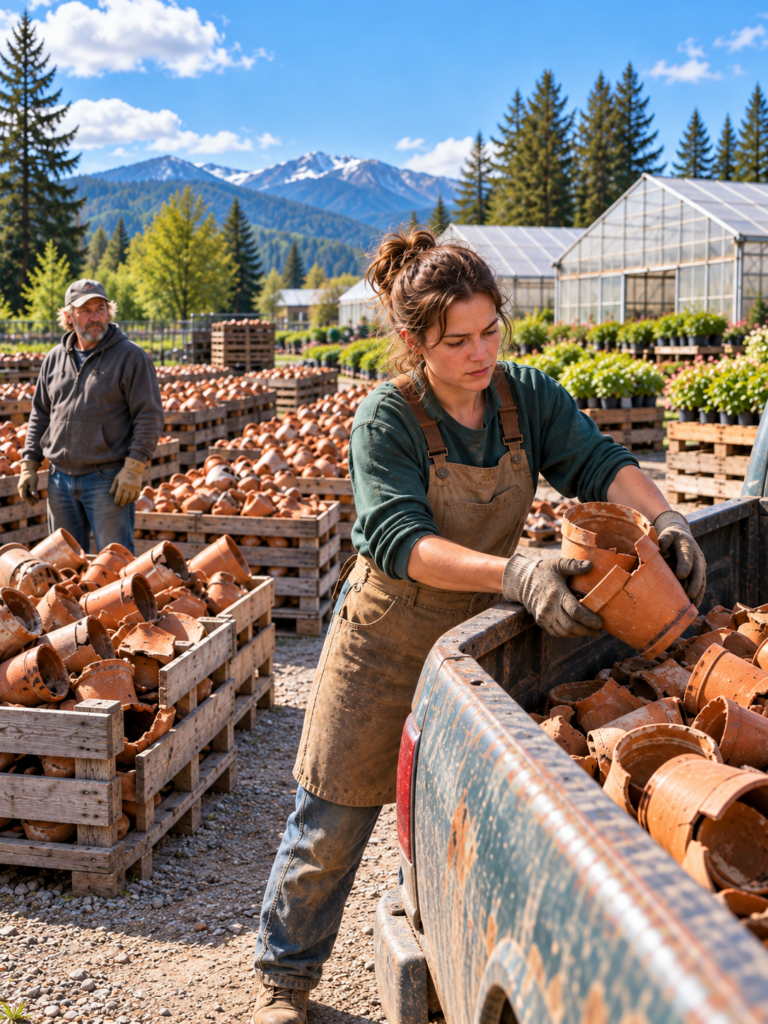
April of 1987 in the nursery supply lot behind the Woolner Brothers greenhouse operation outside Mill Haven, Kittitas County, Washington. Nine rows of wooden pallets stacked with cracked terracotta stood in the open, the broken rims and split walls catching the pale spring light. Karen Field stood at the edge of the second row in her grandmother’s canvas apron, twenty-four years old, with eleven hundred and thirty dollars in her left coat pocket. She had driven forty-one miles in a truck whose heater worked on the driver’s side only. The figure she had been refining since February sat clear in her head: a standard six-inch nursery pot, injection-molded plastic, cost the Woolner operation roughly fourteen cents to source from a supplier in Yakima. A six-inch terracotta pot, fired and glazed and sold through a garden center, retailed between a dollar eighty and two forty depending on finish. The distance between those numbers was not a secret. It was simply a gap nobody local had decided to fill with their hands.
She asked the yard man, a quiet fellow named Curtis who wore the same gray cap every day of the year, what they did with the cracked stock. He told her they hauled it to the county landfill in May, which cost them thirty-eight dollars a load, and they usually ran two loads. Karen said she would take the lot for nine dollars. Curtis said he would have to ask. He came back in eleven minutes and said the answer was yes and that she should be gone by noon because the forklift needed the lane. She counted out nine dollars from her left pocket, put the remaining two hundred and thirty in her right, and began loading cracked terracotta into the bed of the truck by hand. She made four trips that first April: nine the first, seven the second, eleven the third, and fourteen the fourth. By the third trip Curtis had started setting aside the larger cracked pieces in a separate stack near the gate, and she paid a premium for those without being asked. By the end of the month she had hauled just over nine hundred pounds of cracked terracotta to the converted equipment shed behind her grandmother’s house on the Ellensburg Road, and she had spent forty-one dollars total, which included the four trips’ worth of gas.
What she did with it was not immediately obvious to anyone who looked in through the shed window. Her grandmother, Freda Field, had come to Kittitas County from a family of Norwegian potters who had worked in the Skien Valley before the war. Freda had brought with her a set of wooden molds, a collection of hand tools whose handles had been replaced so many times the original wood was entirely gone, and a single-volume manual on ceramic casting that had been printed in Oslo in 1931 and translated into English by someone whose English was nearly but not quite perfect. Freda had set up a small casting operation in the equipment shed in 1953, working with local earthenware clay dug from a deposit on the back of the property. She had made pots for the garden, for neighbors, for the church sale, and for no one in particular, because making pots was the thing she did the way other people breathed. She had died in March of 1986, thirteen months before Karen’s first trip to the Woolner lot, and she had left Karen the shed, the molds, the tools, the manual, and a savings account at the Ellensburg branch of the Cascade Valley Bank whose balance was four thousand three hundred and twelve dollars, which Freda had built by the single method of never spending what she had not already earned.
Karen had spent the thirteen months between Freda’s death and that first April at the Woolner lot reading the Oslo manual, rebuilding the shed’s kiln, and making pots that she considered practice and did not sell. She had also been watching the nursery supply market with the focused attention of someone who has decided to understand a thing completely before acting on it. She knew that the Woolner operation wrote off between eight thousand and ten thousand cracked pots every spring. They did this because terracotta cracked during winter storage when moisture got into the clay body and froze. The cracked pots were considered waste because a cracked pot could not hold soil under nursery conditions without failing at the point of sale. She knew that the clay in those cracked pots was not waste. It was fired terracotta which could be ground, recombined with fresh earthenware clay and a measured addition of grog, and recast into new pots that were structurally sounder than the originals, because the recycled fired material changed the thermal behavior of the clay body in ways the Oslo manual described in three careful pages that Karen had read until the margins were soft.
This is what she meant when she said to no one in particular and to her grandmother’s empty shed in the winter of 1986 that a cracked pot was not a broken pot. It was a pot that had already been fired once and was waiting to be fired again.
The Woolner brothers themselves, Gareth and Lyall, were not unkind men. They were practical men who had run a successful nursery supply operation for twenty-two years and who understood their business very well. What they understood was that terracotta cracked, that cracked terracotta was a liability, and that the county landfill charged by weight. When Curtis mentioned to Gareth in passing that a young woman from out on the Ellensburg Road had been buying the cracked stock for a few dollars a trip, Gareth’s response was to tell Curtis to make sure she signed for the loads so there was no question of disposal liability. He did not ask what she planned to do with it. The question did not occur to him as relevant. Lyall, who handled the supply side of the business, heard the same report and said it sounded like someone who made garden ornaments. And that was the end of the conversation at the Woolner Brothers greenhouse operation in the spring of 1987.
The story that traveled that spring went from Curtis at the nursery yard to the counter at the Mill Haven Feed and Farm Supply, where a man named Gordon Pedabone, who sold bagged amendments and fertilizer and had opinions about most things, said it was a shame to watch a young woman haul trash forty miles when she could be doing something useful. He said this without malice. He said it the way you say a thing when you have decided what category something belongs in and you are just confirming the category out loud. The story traveled from Gordon’s counter to the co-op on the highway where it became a shorter version of itself. By the time it reached the café on Second Street in Mill Haven, it had lost most of its detail and retained only the image of a truck full of broken pots driving east, which struck the people who heard it as either eccentric or sad, depending on their disposition.
Karen heard a version of this story from her neighbor Bertram Ingersoll, who farmed the quarter section to the north and who told her about it in the way a neighbor tells you something they think you should know, with his eyes on the fence line and his voice careful. Karen thanked him. She did not explain herself. She went back into the shed and ground another forty pounds of cracked terracotta in the hammermill she had rebuilt from a salvaged unit she had bought for thirty-two dollars at the Yakima equipment auction in January. And she thought about what her grandmother had said once, which was that the people who told you what something was worth were usually the people who had not figured out what it was for.
Part 2
The shed itself was a board-and-batten structure thirty-two feet by twenty-two feet built in 1947 from Douglas fir milled at a small operation in the Teanaway drainage and hauled to the property by Freda’s husband Niels, who had died before Karen was born and who existed in the shed as a set of hand-cut mortise joints in the wall framing that Karen had never seen the equal of. The kiln sat at the north end, a downdraft design that Freda had built in 1954 with firebrick from a demolished bakery in Ellensburg and which Karen had rebuilt in the winter of 1986 by pulling it down to the first course and relaying it with new high-duty firebrick from a supplier in Spokane, refractory mortar mixed by hand in a five-gallon pail, and a replacement burner assembly that she had fabricated from pipe fittings and a salvage gas valve she had bought for six dollars at the Wapato salvage yard. The kiln held a maximum load of sixty standard six-inch pots per firing or forty of the larger eight-inch forms, and it reached cone six in approximately nine hours on a good firing day when the ambient temperature was above forty degrees.
Along the south wall Freda’s wooden molds hung on a system of wooden pegs that Freda had installed in 1955 and never changed. There were thirty-one molds in total, ranging from a two-inch seedling cup to a fourteen-inch floor pot with a fluted lip, and Karen had added six of her own design by the spring of 1987, cut from dense hardwood she had bought as a lumber mill offcut lot for seventeen dollars at a sale in Cle Elum the previous October. The casting bench ran the full length of the east wall, twelve feet of smooth planed Douglas fir supported on pipe legs with a plaster bat at the center for hand work and a recirculating water system Karen had plumbed herself from copper pipe salvaged from a demolished farmhouse that Bertram Ingersoll had let her strip before he burned it.
The clay body she was developing that spring was the thing that mattered most, and it took her longer than she had planned. The Oslo manual described a recycle ratio of not more than thirty percent fired material by dry weight in a casting body, because above that threshold the fired grog interfered with the plasticity of the wet clay and the cast walls became uneven in thickness, which meant uneven drying, which meant stress cracks in the greenware before it ever reached the kiln. Karen had tested the manual’s limit and found it conservative for the specific clay she was working with, which was a red earthenware from a deposit she had identified on the back of the property in the fall of 1986 by digging a series of test pits along the east fence line, pulling samples at three depths, and sending them to a ceramics testing laboratory in Seattle for analysis. The analysis cost her forty-five dollars and told her that the clay had a natural silica content of sixty-one percent, a firing range of cone 04 to cone 2, and a shrinkage rate of approximately nine percent from wet to fired. It also told her that the clay was exceptionally consistent across the deposit, which was not something she had expected and which changed her calculation considerably, because consistent clay meant predictable shrinkage and predictable shrinkage meant she could design her molds to a specific finished dimension and hold that dimension across a production run. A six-inch pot that was reliably six inches after firing was worth more to a nursery operation than a six-inch pot that ranged between five and three-quarters and six and a quarter, because nursery operations use standardized trays and racks and a pot that did not fit the tray was a problem at the point of sale. This was something Karen had learned not from the Oslo manual but from spending two afternoons at the Woolner Brothers greenhouse, watching how pots moved through the operation, which she had done in September of 1986 by asking Gareth Woolner if she could observe for a day, telling him she was studying nursery operations, which was true.
By June of 1987 she had a casting body she was satisfied with. It was twenty-seven percent recycled terracotta grog by dry weight, the remainder being the local red earthenware blended with a small addition of ball clay for workability. It cast cleanly in the wooden molds, dried without cracking in the shed’s ambient conditions, and fired to a warm red-brown at cone one that was denser and harder than standard nursery terracotta because the grog had already been through one firing cycle and its pores were partially sealed. A pot cast from this body and fired correctly would hold water for forty-eight hours without seeping, which was longer than any standard nursery terracotta Karen had tested, and she had tested eleven commercial pots from four different suppliers by filling them, setting them on plywood, and timing them.
She made her first production run in July of 1987. Sixty pots, all six-inch, all from the same mold, all from the same clay body mixed in a single batch. She loaded the kiln on a Tuesday morning, fired through Tuesday night, and opened it on Wednesday at noon when the temperature had dropped below two hundred degrees. Fifty-eight of the sixty pots came out intact. Two had hairline cracks at the rim, which she set aside. The fifty-eight intact pots were, by her measurement, six inches in diameter to within a sixteenth of an inch across the entire run, and they were, by her eye, the most consistent batch of terracotta she had produced. She priced them at two dollars and ninety cents each. She put them in the truck on a Thursday morning and drove to Mill Haven.
Her first customer was not the Woolner brothers. Her first customer was a woman named Selma Radkey who ran a perennial nursery from her property on the Reecer Creek Road and who sold at the Ellensburg Farmers Market on Saturday mornings. Selma bought twelve pots at two dollars and ninety cents each, which was thirty-four dollars and eighty cents, paid from a cash envelope she kept in her truck’s glove box. Selma turned the pots over in her hands for a while before she paid, looking at the drainage hole, pressing her thumb against the wall, holding one up to the light. She said they were heavy. Karen said that was the grog. Selma said she did not know what that meant, but that the color was good and she would try them. She tried them. She came back the following Thursday for twenty-four more.
The Woolner brothers were the fourth customer, not the first. By the time Karen approached Lyall Woolner in October of 1987 with a sample box of six pots and a price sheet, she had already sold two hundred and thirty-one pots to seven customers across Kittitas and Chelan counties. Her average price was three dollars and five cents, and she had a waiting list of four nurseries who had heard about the pots from Selma Radkey, who talked about them at the farmers market in the way that people talk about a thing they feel they discovered. Lyall looked at the sample pots for a long time. He was a methodical man who did not make quick decisions about supply. He turned each pot over twice, looked at the drainage hole, set it on the counter and looked at the rim, and then picked it up again and tapped it with one knuckle to hear the ring. A good terracotta pot rings when you tap it. A poor one thuds. Lyall’s pots rang. He asked what she was charging. She told him three dollars and ten cents for the six-inch, four dollars and twenty cents for the eight-inch, and six dollars and eighty cents for the ten-inch. He asked if she could supply a hundred per month. She said she could supply a hundred and twenty. He asked about consistency. She put a micrometer on the counter and measured the six pots in the sample box for him, reading each diameter aloud. The range across the six pots was less than a thirty-second of an inch. Lyall wrote her a purchase order for a hundred and twenty six-inch pots per month at three dollars even, which was ten cents below her asking price, and she accepted it because a hundred and twenty pots per month at three dollars was three hundred and sixty dollars, and three hundred and sixty dollars a month was a number that changed what was possible in the shed on the Ellensburg Road. She did not tell Lyall Woolner that she had been buying his cracked stock for nine dollars a load. He did not ask where her clay came from. The purchase order was signed in October of 1987, and Curtis, who handled the yard, began setting aside the larger cracked pieces in a separate stack near the gate as a matter of course, without being asked, which was a form of recalibration that required no conversation at all.
Part 3
Here is what the next four years looked like from inside the shed. Karen fired the kiln forty-three times in 1988. Each firing produced between fifty-four and sixty intact pots, and she averaged fifty-seven point two across the year, which meant she produced two thousand four hundred and fifty-nine pots in 1988 against a target of two thousand four hundred. Her reject rate was four point one percent, which she tracked in a ledger she kept on the casting bench, a green-covered composition book that had belonged to Freda and that still had Freda’s clay body notes in the first twelve pages in a handwriting so small and precise it looked like it had been typeset. Karen’s notes began on page thirteen and were written in the same hand, which was not a coincidence. She had been reading Freda’s handwriting since she was seven years old.
The clay body required refinement in the spring of 1988 when the earthenware deposit showed a shift in plasticity in the lower stratum, which Karen identified by a change in the feel of the wet clay at the casting bench and confirmed by pulling new test samples and sending them to the Seattle laboratory for a second analysis at forty-five dollars. The analysis showed a slight increase in calcium content in the lower layer, which was causing the clay to stiffen faster during casting and produce walls that were marginally thicker on the bottom than the top. She adjusted the water content of the casting slip by two percent and added a small amount of sodium silicate as a deflocculant, which she had read about in a ceramic arts journal she had found at the Ellensburg library and checked out twice before buying a used copy from a bookshop in Seattle by mail for three dollars and fifty cents. The adjustment solved the problem in three test batches, and she returned to full production in April with a reformulated body that she recorded in the green ledger as body version three, noting the date, the ratios, the test results, and the cost per pound of each component.
The cost per pound of the clay body as of May 1988 was as follows: local earthenware zero cents because she dug it herself from the property deposit; ball clay from a supplier in Spokane four cents per pound delivered; sodium silicate three cents per pound; recycled terracotta grog zero because the cracked stock from the Woolner lot cost her between seven and twelve dollars per load, and each load contained enough fired material to produce approximately four hundred pots’ worth of grog after grinding. The total material cost of a finished six-inch pot, including the gas for the kiln firing, was eleven cents. She was selling them for three dollars and ten cents. The difference between eleven cents and three dollars and ten cents was not profit in the simple sense because there was her labor and the kiln depreciation and the cost of the molds and the truck and the road. But the structure of it was sound in a way that a person who had read Freda’s ledger for twelve pages before her own notes began would recognize immediately.
By the end of 1989 Karen had eleven regular customers, a monthly production capacity of three hundred and forty pots across three kiln sizes, and a waiting list that she had stopped adding names to because she could not fill the orders she already had. She had also begun making the eight-inch and ten-inch forms in quantity, which required the six new molds she had cut from the mill offcut hardwood, and which produced a per-pot margin that was wider than the six-inch because the price scaled with size faster than the material cost did. An eight-inch pot used approximately two and a half times the clay of a six-inch pot and required the same firing cycle, but it sold for four dollars and forty cents instead of three dollars and ten cents, which meant the margin per cubic inch of clay was higher on the larger forms. She had worked this out in the green ledger in the fall of 1988 and had shifted her production mix accordingly, running a ratio of roughly half six-inch to one-third eight-inch to one-sixth ten-inch, which was the mix that maximized revenue per firing given the kiln’s volume constraints.
She hired her first help in March of 1990. His name was Tobin Voss and he was seventeen years old, the son of a sheep farmer on the Naam Road. He had appeared at the shed door one Saturday morning and said he had heard she was busy and asked if she needed someone to grind and mix. He was not wrong that she was busy. She told him she would pay him four dollars and fifty cents an hour for grinding and mixing and loading the kiln, and that he would work Saturday mornings and Wednesday afternoons, and that if he broke a mold he would tell her immediately and they would figure out together whether it could be repaired. He agreed to these terms. He was a careful worker who asked questions only when he had already tried to answer them himself, which was the quality Karen valued most in anyone who worked near her molds, and he stayed for three years.
The private doubt, if it came, came in the winter of 1990 in January, when a cold snap held the Kittitas Valley at twelve degrees for nine days and the water line to the casting bench froze inside the wall and split. Karen spent four days without running water in the shed and had to haul water in five-gallon buckets from the house, which meant she missed a firing cycle and fell behind on the Woolner order for the first time. She sat at the casting bench on the fourth evening with the green ledger open and thought about whether the thing she was doing was the right scale, whether she had built something that could hold, whether she was making pots or just making work. She thought about it for the length of time it took to drink a cup of coffee. Then she wrote down the cost of a copper water line run inside the heated portion of the shed wall, which was forty-two dollars in materials and her own labor, and she noted it as a capital improvement, and she went to bed. She ran the new line the following Saturday with Tobin’s help and did not miss another firing cycle that winter.
By 1991 the story that traveled about Karen Field was a different story than the one that had traveled in 1987. The 1987 story was about a young woman hauling trash. The 1991 story was about a woman on the Ellensburg Road whose pots you had to get on a list for and whose six-inch standard was the pot that the Woolner Brothers greenhouse was putting in their retail display as an example of what a terracotta pot was supposed to look like, which was a fact that Gareth Woolner had mentioned to a buyer from a garden center in Yakima without any apparent awareness of the irony, because the irony required knowing where the clay had come from and Gareth did not know.
Gordon Pedabone, who had said at his counter in 1987 that it was a shame to watch a young woman haul trash, came to the shed in the spring of 1991. He did not come to apologize. He came because his wife had been on the waiting list for a set of twelve-inch floor pots for seven months and he was hoping that showing up in person might move things along. Karen sold him the floor pots at the standard price, which was nine dollars and sixty cents each, and told him the waiting list was the waiting list and that she appreciated his patience. He paid cash. He carried the pots to his truck himself and drove back to Mill Haven, and Karen watched him go from the shed door and then went back to the casting bench. That was the whole of it. No apology required and none offered. And the day continued.
Part 4
Let me tell you about what the ledger said at the end of 1991, because the arithmetic is the part of the story that the story that travels always leaves out, and the arithmetic is the part that mattered. Revenue for 1991: four thousand one hundred and twenty pots sold at an average price of three dollars and eighty-two cents, which came to fifteen thousand seven hundred and thirty-eight dollars and forty cents. Material cost for the year: cracked terracotta stock ninety-six dollars and forty cents across eleven loads; ball clay and sodium silicate two hundred and twelve dollars; kiln gas three hundred and eighty-one dollars; mold maintenance and replacement sixty-seven dollars; copper fittings and miscellaneous shed repair thirty-eight dollars. Tobin’s wages two thousand one hundred and sixty dollars for the year. Total direct costs three thousand and fifty-four dollars. Net before her own labor twelve thousand six hundred and eighty-four dollars. She paid herself a wage she had set at the beginning of the year and noted in the ledger, and she put the remainder into the Cascade Valley bank account that had started as Freda’s four thousand three hundred and twelve dollars and had been growing since 1988 at a rate that the bank officer, a quiet man named Ansel Zeller, who had learned not to ask too many questions, reviewed each quarter with the expression of a man recalibrating something he had assumed was settled.
She had also by the end of 1991 supplied cracked-pot sourcing information to two other small ceramics operations in the region, one in Wapato and one in the Yakima Valley, because she had been asked by both of their operators how she sourced her grog and she had told them, because the information cost her nothing and the nursery industry produced more cracked terracotta every spring than any three small-scale operations could use. This was a form of generosity that was also a form of confidence. She was not worried about competition because her advantage was not the source material. It was the clay body, the molds, the firing discipline, and the four years of recorded data in the green ledger that told her exactly what to do when the clay changed or the weather changed or the kiln ran hot on the left side, which it did three times a year in a pattern she had identified and noted and compensated for.
The Woolner brothers expanded their retail operation in 1992, adding a garden-center component to the nursery supply business, and Lyall Woolner came to the shed on the Ellensburg Road in February of that year with a proposal. He wanted to carry Karen’s pots as a branded retail line labeled with the name of the operation and a brief description of the clay body, at a retail price he would set and from which he would take a margin. He showed her a margin schedule. She looked at it for a moment and said she would think about it. She thought about it for a week, during which she called Selma Radkey and two of her other long-standing customers and asked what they thought, and then she went back to Lyall and said she would supply the retail line at four dollars and ten cents for the six-inch, five dollars and sixty cents for the eight-inch, and eight dollars and ninety cents for the ten-inch, which were prices twenty-five to thirty-two percent above her existing wholesale prices, and that the label would say what she told it to say. Lyall accepted. The retail line launched in April of 1992 under the name Field Earthenware, which was two words Karen had written in the green ledger on the inside back cover in 1988 as a note to herself about what she was building and which she had not shown to anyone until she handed Lyall the label specification. The label said Field Earthenware, Kittitas County, Washington, cast from local clay and recycled terracotta, fired once. That last line was Freda’s. Karen had found it in the Oslo manual in the margin of the page about recycle ratios in Freda’s small precise handwriting in Norwegian, and she had translated it with a dictionary and written it in the green ledger on page thirteen, the first page of her own notes, before she had cast a single pot. She did not explain the line on the label. She did not need to. The people who understood it understood it, and the people who did not understand it bought the pot anyway because it was a good pot.
Tobin Voss left in 1993 to attend a ceramics program at a community college in Bellingham, which Karen had suggested to him in the fall of 1992 after watching him spend three Saturday mornings trying to understand why a particular mold produced pots with a slight lean to the left, which turned out to be a warped mold base, but the process by which Tobin had diagnosed it—pulling the mold apart, checking each component against a steel square, eliminating variables one at a time—was the process of someone who was thinking about clay rather than just working with it. She told him the program existed. She told him it was a good program because she had written to them and asked about their curriculum. She did not tell him to go. He went. He came back to Kittitas County in 1996 and opened his own small production pottery in Cle Elum, and his first order of business was to call Karen and ask if she still had cracked stock available because he had heard about the grog body from the Wapato operation and wanted to try it. She told him yes, and she gave him the clay body formula from the green ledger, which was by then on its sixth revision, and she told him the formula was his to use and modify, and she did not want anything for it except to hear what he found when he changed it. He found that the formula worked better with a slightly higher grog percentage when the ambient humidity was above sixty percent, which was more often in Cle Elum than on the Ellensburg Road, and he wrote her a letter about it with his data and she wrote back with a question about his water chemistry. This correspondence continued for several years and produced a seventh revision of the clay body formula that Karen noted in the green ledger with Tobin’s name beside the entry.
By the spring of 1994 the Woolner Brothers operation was writing off fewer cracked pots per season, not because they had changed their storage practices but because Karen was buying the cracked stock before it accumulated to the level that required a landfill run. The economics of this were straightforward. Karen was paying between nine and fourteen dollars per load, and the landfill had raised its rate to fifty-one dollars per load, so the arrangement saved the Woolner operation money and supplied Karen with material, and both parties understood this without discussing it. Curtis, who still wore the same gray cap, had by this point developed a sorting practice that separated the cracked stock by wall thickness and pot size, because Karen had mentioned once in passing that thicker-wall material ground more efficiently and Curtis had simply begun sorting accordingly without being asked to formalize it. That is the kind of recalibration that does not make a story. It makes a practice. The practice was in place by 1994 and it continued without interruption.
Part 5
The question that the story that traveled never quite answered, and that Bertram Ingersoll asked her indirectly one evening in 1995 when they were standing at the fence line between their properties watching the light go off the ridge, was whether she had known from the beginning that it would work. He asked it the way a neighbor asks a real question without preamble, because they had been neighbors long enough that preamble was unnecessary. Karen thought about it for a moment. She said she had known the clay body was sound. She said she had known the market existed because she had looked at it carefully before she acted. She said she had not known whether she could do the work at the scale required and that she had found out by doing it, which was the only way she knew to find out anything. Bertram nodded and looked at the ridge. He said that sounded about right. They stood at the fence for a while longer and then went back to their respective properties.
In 1995 she expanded the shed by adding a twenty-foot lean-to on the south side framed from Douglas fir she had bought as a mill offcut lot from the same Cle Elum operation she had sourced from in 1986, and she poured a concrete floor in the lean-to and installed a second kiln, a larger updraft design she had built from plans in a ceramics journal and modified based on her own firing data, which held a maximum load of ninety standard six-inch pots or sixty-eight eight-inch or forty ten-inch. The second kiln had been operational since September of 1995 and had increased her annual production capacity from approximately four thousand pots to approximately seven thousand, though she ran it at roughly eighty percent of capacity because she had decided that the quality of each firing mattered more than the quantity of pots produced and that a kiln pushed to its limit every cycle produced more rejects and more variation than a kiln run with margin. Her production in 1997 was six thousand two hundred and forty-one pots. Her average selling price across all sizes and channels was four dollars and sixty-three cents. Her gross revenue was twenty-eight thousand eight hundred and ninety-five dollars and eighty-three cents. Her total direct costs, including two part-time workers who came three days a week each, materials, both kilns’ gas consumption, mold replacement, and shed maintenance, were nine thousand four hundred and twelve dollars. The Cascade Valley bank account, which had started as Freda’s four thousand three hundred and twelve dollars in March of 1986, had a balance that Ansel Zeller reviewed in January of 1998, and about which he said, in the understated way of a bank officer who has been doing this long enough to have learned what he does not know, that it appeared the operation was doing well. Karen said it appeared so. She signed the quarterly review form and drove back to the Ellensburg Road.
The Woolner Brothers retail garden center by 1997 had a standing display of Field Earthenware pots near the entrance, which Gareth Woolner had positioned there because customers asked for them by name and he had found that customers who came in for the pots bought other things while they were there. The display included a small card written by Gareth that said the pots were locally made from Kittitas County clay. The card did not mention the cracked stock. Gareth did not know about the cracked stock in the way that a person knows something they have thought about. He knew it the way you know a thing that has been in plain sight for ten years and that you have never had reason to examine. The cracked stock went to Karen’s truck every spring. The pots came back to the retail display. The connection between those two facts had not been a subject of conversation between Gareth Woolner and Karen Field in ten years of doing business together. It became a subject of conversation in April of 1997 when a journalist from the Ellensburg Daily Record came to the shed to write a story about small-scale manufacturing in Kittitas County and asked Karen in the course of the interview where her raw material came from. Karen told her. The journalist wrote it down. The story ran the following Thursday under a headline about local craftsmanship, and it included a paragraph about the recycled terracotta grog and where it was sourced. Gareth Woolner read the story on Thursday morning at his kitchen table. He drove to the nursery. He stood in the yard for a while looking at the pallet area near the gate where Curtis stacked the cracked stock. Then he went inside and called Lyall. Neither of them called Karen. What Lyall did two weeks later was place an order for forty ten-inch Field Earthenware pots for the retail display, which was the largest single order he had placed in ten years of purchasing, and he paid the invoice within five days of receipt, which was faster than his standard terms. That was the whole of the recalibration at the Woolner Brothers greenhouse operation in the spring of 1997. Gareth changed one behavior. He stopped telling people the cracked stock was a disposal problem when the subject came up, which it did occasionally with other nursery operators who were dealing with the same winter cracking issue. He said they had a buyer for it and left it at that.
The green ledger went through four composition books between 1987 and 2001. The fourth book was not green. It was a black-covered composition book that Karen had bought at the Ellensburg office supply store because they were out of green, and she had noted on the inside front cover in Freda’s style of notation the date and the reason for the change and the fact that the clay body formula was now on its ninth revision and that the ninth revision was the most stable she had produced. The ninth revision used thirty-one percent recycled terracotta grog, the local red earthenware, ball clay, and a very small addition of fine silica sand that Karen had begun adding in 1999 after Tobin Voss had mentioned in a letter that sand addition in small percentages improves surface texture on larger forms. She had tested it in five batches before adopting it and she had noted the test results in the ledger with the same precision she had applied to every change since 1987. Tobin’s operation in Cle Elum was producing by 2001 approximately three thousand pots per year and he had two apprentices of his own, one of whom was the daughter of a sheep farmer on the Naam Road who had appeared at his door one Saturday morning and said she had heard he was busy. He wrote Karen a letter about this and she wrote back one sentence: Yes, that is how it goes.
The transmission of the way of seeing was not a ceremony. It was a letter and a clay body formula and a note in a ledger and a suggestion made once about a ceramics program in Bellingham and a Saturday morning at the casting bench where Karen watched a seventeen-year-old boy diagnose a warped mold by eliminating variables one at a time and understood that the thing she had learned from Freda was already in someone else’s hands. Freda’s wooden molds still hang on the pegs on the south wall of the shed. Twenty-nine of the original thirty-one are intact. Two were replaced in 1994 when the wood checked beyond repair and the replacements were cut to the same dimensions from the same species of hardwood and hang in the same positions. The six molds Karen added in 1987 hang beside them. The casting bench is still Douglas fir, still twelve feet, still smooth from thirty-five years of clay and water and the weight of work. The Oslo manual is in a waterproof sleeve on the shelf above the bench, next to the four composition books and the black one, and next to those is a folder that contains the clay body formula on its ninth revision, printed on three sheets of paper and annotated by hand in the margins in two different handwritings. The kiln fired last Thursday. Sixty-three eight-inch pots. Body version nine, cone one, nine hours and forty minutes. Sixty-one came out intact. The two rejects are in the grog bucket near the hammermill waiting to be ground.
That first load of cracked terracotta cost nine dollars. The operation it became has sold, by a conservative count across thirty-seven years of production, somewhere in the neighborhood of one hundred and eighty thousand pots. The distance between nine dollars and one hundred and eighty thousand pots is not a mystery. It is eleven cents of clay per pot, a firing discipline recorded in five composition books, a way of looking at cracked terracotta that Freda brought from the Skien Valley and left in an equipment shed on the Ellensburg Road, and a twenty-four-year-old woman who drove forty-one miles in a truck with a broken heater because she had done the arithmetic, and the arithmetic said go.
