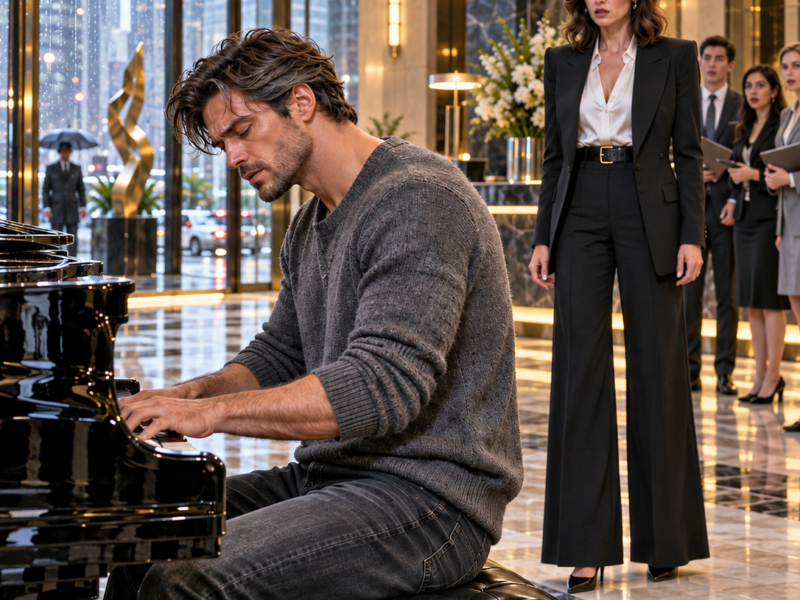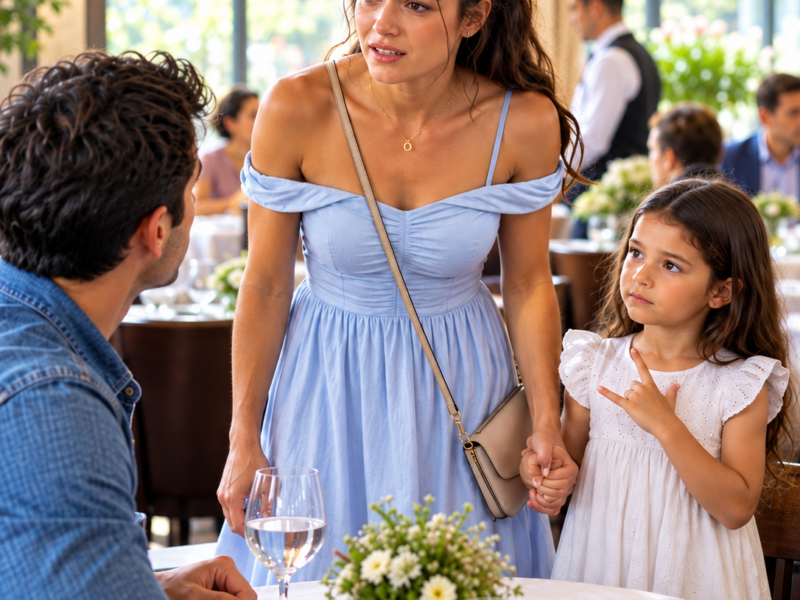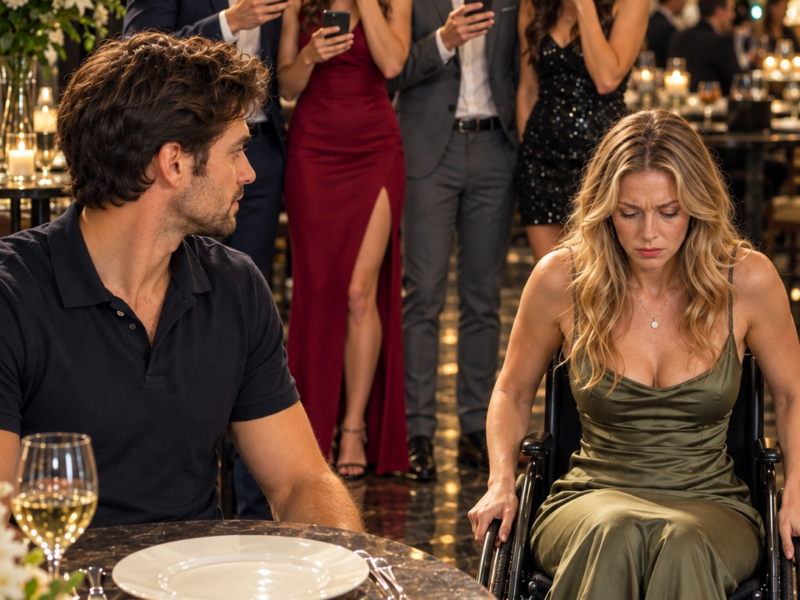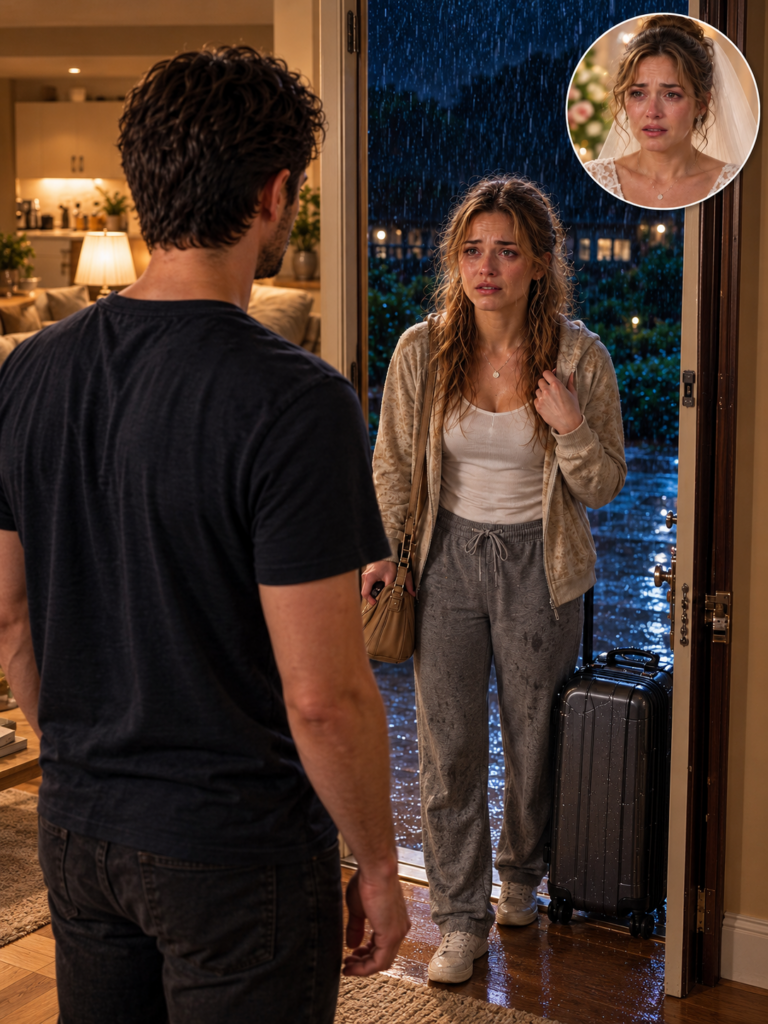
my ex’s sister showed up at my door at one in the morning sunburned from her honeymoon in a men’s denim jacket over a white sundress carrying a stuffed armadillo and told me she needed me to say the right thing after she said my name at the altar instead of her husband’s…
Part 1
The knock came at 1:17 in the morning. I opened the door in boxer shorts and a faded Spurs T-shirt with a hole in the armpit, fully prepared to deal with my neighbor’s drunk cousin again. That man had been mixing up apartment numbers for two years and usually arrived smelling like beer and regret.
Instead I found Willa Ross standing under my porch light in San Antonio. Her wedding braid was half undone. She was sunburned across the nose, wearing a men’s denim jacket over a white sundress, and clutching a stuffed armadillo that looked like it had been purchased in an airport gift shop out of pure desperation. She looked like a woman who had just outrun her own life.
“Sam,” she said. “I need you to not say anything until I’m finished. And when I’m finished, I need you to say the right thing.”
I gripped the door frame. “Okay.”
Her mouth twitched. That tiny, tired, almost-smile hit harder than it should have. Willa had always been able to do that—make a room feel warmer without trying.
My name is Sam Delgado. I’m thirty-three. I restore historic buildings for a living. For most of my life I considered myself a reasonable man. I paid my bills early. I returned neighbors’ ladders. I kept my feelings in a tidy box labeled not appropriate. Willa Ross was in the box.
She was thirty, a large-animal veterinarian who spent half her life in rubber boots. She had a laugh that arrived about half a second before she gave it permission. She smelled like hay and lavender soap. Three days earlier I had stood at the back of Mission San José Chapel in a gray suit and watched her marry another man.
She was also the younger sister of my ex-girlfriend.
“Come in,” I said.
She stepped past me, close enough that her shoulder brushed my chest. She smelled like salt and airport coffee and sunscreen. Neither of us moved for a second.
“I’m sorry for the hour,” she whispered. “You’ve seen me fall asleep at a barbecue with a rib in my hand. My dignity left years ago.”
She smiled and it broke in the middle. I shut the door.
She looked around my living room—the drafting table with half-finished drawings of a limestone facade, the half-dead fern in the window, the chipped coffee mug she’d bought me two Christmases ago because she said my dishes made me look like a man recovering from a divorce he’d never had.
“You kept the mug,” she said. “It says world’s okayest guy.”
“It’s basically my brand.”
She touched the rim, then pulled her hand back like she’d touched a live wire. That was when I noticed her ring finger. The diamond was gone. In its place was a pale stripe of skin where the sun hadn’t reached. My stomach dropped.
“Willa.”
“I know. It’s in my pocket. I didn’t throw it in the ocean, in case you’re wondering. It cost nine thousand dollars and I’m not a monster.”
I went to the kitchen because I needed my hands to do something useful before my face betrayed me. “Tea? Do you still have the kind that tastes like regret?”
“Chamomile. Perfect.”
While the kettle ticked I tried not to look at her. I failed. She sat on my couch with her boots off and her feet tucked under her, hugging the ridiculous armadillo, looking small and wrecked and impossibly dear.
Let me tell you how I got there.
I dated Kendra Ross for two years. We ended things eighteen months earlier on a patio in Alamo Heights over margaritas, with a politeness that was almost embarrassing. She wanted a life in Austin. I wanted to stay near my buildings. We hugged, we cried a little, and we agreed to stay friends, which in my experience is what people say right before they stop calling.
But I’d kept going to the Ross family ranch. Kendra’s father, Hank, had taught me to fix a fence line. Her mother, June, still sent me home with tamales. And Willa was there every Sunday in muddy boots with straw in her hair and a laugh I told myself meant nothing.
I remembered the night it started. A cold March night, three in the morning, a heifer in trouble in the south barn. Willa had called her father, who was in Houston, so she’d called me. I’d held a flashlight in a freezing barn for two hours while she delivered a calf with her arms up to her elbows, talking softly, steadily, like a woman defusing a bomb. When the calf finally stood, wobbling and wet, she looked up at me with tears in her eyes and said, “You stayed?”
“Of course I stayed.”
“Most people wouldn’t have.”
I didn’t know what to say, so I said, “Nice work, Doc.”
She laughed, and I knew I was in serious trouble.
After that we became something I couldn’t name. Texts at midnight. Coffee after rounds. A running argument about whether menudo counted as a soup. We never crossed a line. I made sure of it. She was Kendra’s sister. There was a rule nobody had ever said out loud, but everyone understood. You don’t date your ex’s sister.
Then Cameron Hale came along. He was a corporate attorney, tall, polite, with perfect teeth and a way of saying Willa like he was reading it off a contract. He proposed on a rooftop. She said yes. I said congratulations and meant it, mostly. Then I went home and organized my sock drawer for three hours.
I was asked to give a toast at the wedding. Kendra insisted. “You’re practically family.” So I stood up in a rented tent, glass in hand, and delivered four minutes on how Willa could make anyone feel brave. I got to the last line, the one I’d rehearsed all week. May you always be as happy as you make everyone else. And I looked at Willa, and she was looking at me, and for one second the whole tent went quiet. I forgot the last line. I just raised my glass and said, “To Willa.”
She smiled at me, trembling, and mouthed, “Thank you.”
Back in my apartment the kettle clicked off. I made the tea and carried it to the couch. She took the mug in both hands. Our fingers touched. It wasn’t dramatic. No thunder, no music. Just skin against skin and years of unsaid things pressing into the quiet.
“Did Cameron stay in Cabo?” I asked carefully.
“He’s on a flight tomorrow. He booked mine for tonight.” She let out a laugh that sounded like a cough. “He was kind about it. That’s the worst part. He’s such a kind man.”
“Willa. What happened?”
She stared at her bare hand. Her voice dropped. “I said the wrong name at the altar.”
I went completely still. Outside, a car hissed through the wet street. The refrigerator hummed. My heart did something I’m fairly sure would have alarmed a cardiologist.
“What name?” My voice came out rough.
She looked at her knees, then at my knee about three inches from hers. Then slowly she put her hand over mine. “Yours.”
For a second I forgot how to breathe. Not poetically. Literally. My chest locked up so tight I made a sound like a man swallowing a paperclip.
“Say something,” she whispered.
“I’m trying to figure out if I’m asleep.”
“You’re not.”
“Are you sure? Because this is exactly the kind of dream where I look down and realize I’m back in high school with no pants.”
Her laugh came out wet. “You’re wearing boxers. It’s not that far.”
“So the preacher said—Pastor Dale asked me to repeat after him. ‘I will take you, Cameron.’ And I said, ‘I will take you, Sam.’”
I put my free hand over my face. “There was a moment. A long, awful moment. The entire chapel went silent. My aunt dropped her program. And then I said ‘Cameron’ really fast. And Pastor Dale said, ‘Take your time, dear.’ And everyone laughed like it was a cute little slip.”
“Did Cameron—”
“He smiled. He squeezed my hand. He said, ‘It’s okay,’ very quietly.” Her voice cracked. “And he knew. I saw his face. He knew right then.”
I couldn’t say anything. I just turned my hand over under hers until our palms were pressed together.
“I told myself it was nerves,” Willa said. “I told myself it was grief because you’d been in my life for so long. I told myself the feeling was just familiarity. And then we got to Cabo. And on the second night he asked me what I wanted to do the next morning. And I said, ‘I want to call Sam and ask him if the heifer is okay.’”
“The heifer is fine.”
“I know the heifer is fine, Sam. That’s not the point. Sorry. I’m nervous. I make jokes.”
“I know. I love that.”
She froze. We both froze. The word hung in the room like a lit match.
“You love that?” I repeated.
Her face went pink all the way to her ears. “I mean, I appreciate that.”
“That’s not what you said.”
“It’s a figure of speech.”
“Willa.”
“I’m exhausted. I’ve been crying in an airport bathroom. A man in Houston gave me this armadillo. It’s a very nice armadillo. His name is Gary.”
I laughed. I couldn’t help it. Then she laughed too, helplessly, her forehead dropping against my shoulder. And for a second we were just two people on a couch at 1:30 in the morning, shaking with the kind of laughter that happens right before a very serious conversation.
When it faded she stayed there, her head against me. Her hair smelled like sunscreen and rain.
“I was going to talk to him calmly,” she said into my shirt. “I practiced. I wrote it in my notes app. But when I opened my mouth all I could say was ‘I’m sorry,’ over and over. And he said, ‘You don’t have to be.’ And I cried and he held me. And I thought, this man deserves someone who says his name at the altar.”
“I’m sorry.”
“Don’t be sorry. Be honest.”
She lifted her head. “You told me once, years ago, when I was twenty-six and in a mess, that if I ever did something stupid I should call you.”
“I remember.”
“Here I am. I did something stupid. And I need you to tell me if I’m wrong.”
“Wrong about what?”
She took a breath. Her eyes were red-rimmed and enormous. “About you.”
The apartment felt very small. I held her hand tighter and said the only thing I had.
“I love you.”
Her breath caught.
“I’ve loved you for three years. I tried not to. I packed it away. I put it in a box and labeled it not appropriate and told myself I was a decent man. I stood in that chapel and I watched you walk down the aisle and I thought, this is what it feels like to be brave, because I was being brave. I was letting you go.”
Tears spilled down her cheeks. She didn’t wipe them.
“I forgot the end of my toast. The last line. It was ‘May you always be as happy as you make everyone else.’ And I couldn’t say it because I didn’t believe you would be. Not with him. Because I thought I would give anything to be the one making her happy.”
“Sam.”
“And I know it’s complicated. I know you’re married, technically. I know you’re Kendra’s sister. I know I’m the worst possible choice. A man who showed up to her wedding to wish her well and spent the whole night staring at the exit. But if you came here because you wanted to hear that you didn’t make a mistake saying my name, then I need you to know you didn’t.”
She put her hand over her mouth. A sob broke out, then a laugh, and then she threw her arms around me. I held her. She shook against me, small and warm and alive. And I thought, with great clarity, Oh. There you are.
After a while she pulled back just enough to look at me. “I don’t want to be your rebound.”
“I don’t want to be yours. I want to be sure.”
“So do I.”
“Then we should wait.”
“Waiting is very mature. I hate it.”
“I hate it too.” She smiled. Her eyes dropped to my mouth and back up. “Can I tell you what I want, please? I want to kiss you. And then I want to sleep. And then in the morning I want to go to my sister and tell her myself. Kendra deserves it from me, not from Facebook.”
I nodded. “Then we’ll do it together.”
“You’d do that?”
“Willa. I’d hold a flashlight in a barn for you for eight hours.”
She laughed, eyes shining. “Say it again.”
“I’d hold a flashlight—”
“The other part.”
“I love you.”
She kissed me. It was soft at first, careful, a question. Then her fingers curled into my T-shirt and pulled me closer, and the question became an answer. She tasted like chamomile and salt. The kiss deepened slowly, steadily, like a tide coming in after years of being held back. When we finally pulled apart her forehead rested against mine and we were both breathing hard.
“Okay,” she whispered. “That was worth the wait.”
“Which wait?”
“All of them.”
I made up the bed for her and took the couch, noble and deeply uncomfortable. She stood in my bedroom doorway for a long time, looking at me, and then said in a voice so quiet I almost missed it, “I don’t want to be alone.”
So I carried my pillow in, lay on top of the covers, fully dressed, and held her. Her head on my shoulder. Gary the armadillo wedged between us like a very small chaperone. I didn’t sleep. I just lay there listening to her breathe, thinking she’d said the wrong name at the altar, and that it might be the most right thing she’d ever done.
Part 2
I woke to sunlight and the smell of coffee and a quiet clatter in my kitchen. I found Willa in my old flannel shirt standing at the stove doing something unspeakable to a pan of eggs. Her hair was a wild halo. Her nose was peeling. Gary sat on the counter supervising.
“I’m cooking.”
“I see that.”
“It’s going very badly.”
“I can tell.”
“Don’t help.”
“I wasn’t going to.”
“Yes, you were.”
I came up behind her and wrapped my arms around her waist. She leaned back against my chest like she’d done it a hundred times. We stood there in the morning light, her hair against my cheek, the eggs sizzling and burning.
“Sam, I’m scared.”
“Of Kendra?”
“Of everything.” She turned in my arms. “Of her face. Of my parents. Of Cameron’s mother, who sent me a text that just says ‘Pray.’ It’s so ominous.”
I kissed her forehead. “You’re not doing this alone.”
“I know.”
“We’ll go together. I’ll drive.”
“You’ll drive?”
“I have a truck. It has a very inspirational bumper sticker.”
She smiled. “What does it say?”
“My other car is also a truck.”
She laughed, kissed me quick, and burned another egg.
We drove to the Ross Ranch at ten. The Texas hill country rolled out in green and gold, wildflowers shaking in the roadside ditches, the sky enormous and blue. Willa held my hand across the console the entire way. When we turned onto the gravel drive she took a long breath.
Kendra was sitting on the front porch swing with a cup of coffee, wearing jeans and an old Longhorn sweatshirt, her hair in a messy bun. She watched us pull up. She watched Willa climb out of my truck. She watched my hand resting at the small of her sister’s back.
“Oh,” Kendra said.
“Kendra,” Willa said. “Can we talk?”
Kendra set down her coffee. For a long moment nobody spoke. A mockingbird sang from the fence. Then she stood slowly and said, “I knew it.”
My heart stopped.
“I knew it,” Kendra repeated, quieter. “Not about the wedding. About the two of you.” She looked at me. “Sam, you took the heifer shift. You never take the heifer shift.” She turned to her sister. “And Willa, you stopped bringing him up for a year. You went completely silent about him. I thought it was weird, but I figured you were being polite.”
“I was never going to tell you.”
“Why not?”
“Because you’re my sister and he’s your ex and there’s a rule.”
“A rule I made up in my head.”
“There isn’t a rule?”
“There isn’t.” Kendra crossed the porch and wrapped her arms around her sister. I stood very still. Willa clung to her, crying, and Kendra said, “You idiot. You absolute idiot. I broke up with him. I do not own him.”
“I know.”
“I’m not mad.”
“You’re not?”
“I’m a little mad.” Kendra pulled back, wiped her cheek, and glared at me. “I’m mad that I wasted two years on a man who was clearly in love with my sister the whole time.”
“I wasn’t. I swear. Not then.”
“Then when?”
“Probably the heifer.”
Her mouth twitched. Willa let out a wet, shaky laugh, and Kendra, to my immense relief, started laughing too.
“I’m going to need you to fix the porch swing as penance.”
“Yes, ma’am.”
“And you can start by hugging me.”
I hugged her. She smelled like her mother’s coffee cake. She whispered in my ear, “If you hurt her, I’ll sic Dad’s bull on you.”
I whispered back, “Understood.”
Then she let go and went inside, calling over her shoulder, “Mom, Dad, your daughter’s here. Put on pants.”
Willa and I stood on the porch, hand in hand, grinning like fools.
The rest of that day was a hurricane. Hank shook my hand and said, “About time you fixed my fence,” which I understood as a blessing. June cried into a dish towel and handed me a tamale the size of a football. Cameron, bless him, called that afternoon and spoke to Willa for twenty minutes, calmly, kindly. When she hung up she told me he’d said, “I hope he knows how lucky he is.” She’d answered, “He does.”
I did.
Two weeks after the wedding that wasn’t, Cameron Hale asked to meet me. I almost said no. Then I thought about a man who held his wife’s hand through the worst moment of his life and said, “It’s okay.” So I met him at a coffee shop near the river, wearing my cleanest jacket, with Willa’s blessing and a stomach full of nerves.
He stood when I walked in, tall, polite, tired around the eyes. He shook my hand. “Sam. Cameron. I wanted to say something to your face.”
He sat down and stirred his coffee for a long time. “In Cabo, on the third night, she said your name in her sleep. Not a big dramatic thing. Just ‘Sam.’ Soft, like you were in the room. I didn’t say anything. I’d known since the altar. I just hadn’t wanted to.” He gave a small, rueful smile. “I’m not angry. I’m not even that sad anymore. I’m just… I’d like to know she ends up with someone who deserves her.”
“I don’t know if I deserve her.”
“That’s the right answer.” He finished his coffee. “Take care of her.”
“She takes care of herself. I just hold the flashlight.”
“That’s the nicest thing anyone’s said all month.” He laughed, genuinely, and stood. He shook my hand again and walked out into the sun. And I sat there for a long time thinking that some people are simply better than the situations they find themselves in.
The annulment took four months. The paperwork was tedious and Willa cried twice. Her aunt—the one who dropped her program—wrote a long letter I wasn’t allowed to read. Cameron, true to form, handled everything with grace. He sent Willa a message the day it was finalized. Just five words: Be happy. I mean it. She showed it to me, eyes wet, and I held her until the tears stopped.
Part 3
Our first official date, the Saturday after the paperwork went through, was at Gruene Hall, the oldest dance hall in Texas—a rambling wooden building with a sawdust floor, a rowdy band, and ceiling fans that did very little. Willa wore a green sundress and her good boots. She came out of her front door and I forgot how to form sentences.
“You’re staring.”
“I’m admiring the green. The dress. The boots. The woman. All of it.”
“Smooth.”
“I’ve been working on that line for a year.”
We two-stepped across the floor with a hundred strangers. Or rather, I two-stepped and Willa stepped on my feet with total commitment.
“I’m sorry,” she gasped, laughing. “I can’t control my ankles.”
“You’re doing great.”
“I’m doing terribly.”
“You’re doing terribly with enthusiasm.”
She laughed so hard she had to hold on to my shoulders. The band slid into a slow song, something with a steel guitar and a long sad ache in it. I pulled her close, one hand at her back, and she rested her cheek on my chest. Her hair smelled of lavender. Around us couples swayed in the dusty golden light.
“Is this the first date? Official first date?”
“Do I get a goodnight kiss?”
“I’d consider it a professional obligation.”
She smiled against my shirt. “Then I’d like to start now.”
She tilted her face up and I kissed her slowly in the middle of a crowded Texas dance floor while the band played on. Somewhere behind us a very drunk man shouted, “That’s how you do it!”
We took it slowly because we wanted it to last. We cooked dinner at my place on Thursdays and at her tiny rental near the clinic on Sundays. I fixed her broken screen door. She delivered a foal at my cousin’s quinceañera in a party dress with the whole family watching, and I stood by with a flashlight and a plate of brisket. We argued about whether menudo counted as soup. We drove the hill country on weekends with the windows down and the radio loud. I learned she sang in the truck badly, always with total commitment. She learned I hummed when I was nervous.
I said the words again quietly one night in June on the porch of my apartment, fireflies blinking over the lawn. “I love you.”
She grinned. “I know. You said it in the middle of the night in your sleep.”
“I did not.”
“You said, ‘Willa, the heifer is fine.’”
“That sounds accurate.”
She laughed and I kissed her, slow and sure, her hands warm on my face.
A year after that 1:17 a.m. doorbell, I took her back to Mission San José. It was a Sunday morning. The chapel was empty and quiet, afternoon light pouring through the old stone arches in long gold stripes. Willa wore jeans and a white shirt, her hair in a braid, her boots dusty from a morning call. She’d followed me inside, confused, holding Gary the armadillo, who had become a permanent fixture in our lives.
“Sam, why are we here?”
“I wanted to see something.”
“What?”
I walked her down the aisle. Her boots clicked on the old stone. At the front, beneath the arch, I stopped and turned to face her.
“A year ago I stood at the back of this room and watched the woman I loved walk toward another man, and I told myself it was the bravest thing I’d ever do.” I took her hands. “I was wrong. This is.”
Her eyes filled. “Sam.”
I dropped to one knee on the cold stone. I took a small cedar box from my jacket pocket. I’d carved it myself in my workshop, sanding it down until my fingertips went numb. Inside was a simple gold band with a tiny wildflower engraved on the inside.
“Willa. Willa Ross. You said my name in the wrong place at the wrong time, and I’ve been grateful for every second of it. I don’t have a toast. I don’t have a speech. I just have a flashlight and a very good truck. Will you marry me? And this time I promise you can say my name on purpose.”
“Yes,” she said, her voice breaking. “Yes. Obviously yes. Sam Delgado, I take you.”
She dropped to her knees and kissed me so hard we nearly toppled over. Gary the armadillo rolled across the stone floor. From the back of the chapel a sudden burst of applause echoed through the arches. I looked up to see the entire Ross family standing in the doorway—Hank, June, Kendra, and three aunts.
“You told them?” Willa gasped.
“I told your mother. She told everyone.”
“Of course she did.”
Pastor Dale, in the back row, wiped his eyes and called out, “Take your time, dear.”
We got married that October on the Ross Ranch under a canopy of cottonwood trees strung with white lights, the hill country glowing gold behind us. Kendra was Willa’s maid of honor. She gave a toast so funny and so tender that half the guests cried into their napkins. Hank walked Willa down the aisle in his best boots. June wore a sparkly cardigan and wept openly. Cameron sent a case of champagne with a note that read, To the right name. –C. Willa framed it.
At the altar Pastor Dale looked at Willa and said, “Repeat after me. I will take you.”
She smiled, glanced at me, and said clearly, loudly, so the whole ranch could hear, “I will take you, Sam.”
The crowd cheered. Somebody threw a boot in the air.
At the reception we danced under the stars, her head against my shoulder, her hand in mine. She hummed, soft and unaware and perfect.
“You’re humming,” I whispered.
“I know,” she whispered back. “Don’t stop me.”
We still tell the story. Every anniversary at the ranch, over a barbecue plate, someone raises a glass and asks, “Willa, tell them what you said at the altar.”
And she grins and says, “I said the wrong name.”
And I say, “Best mistake anyone ever made.”