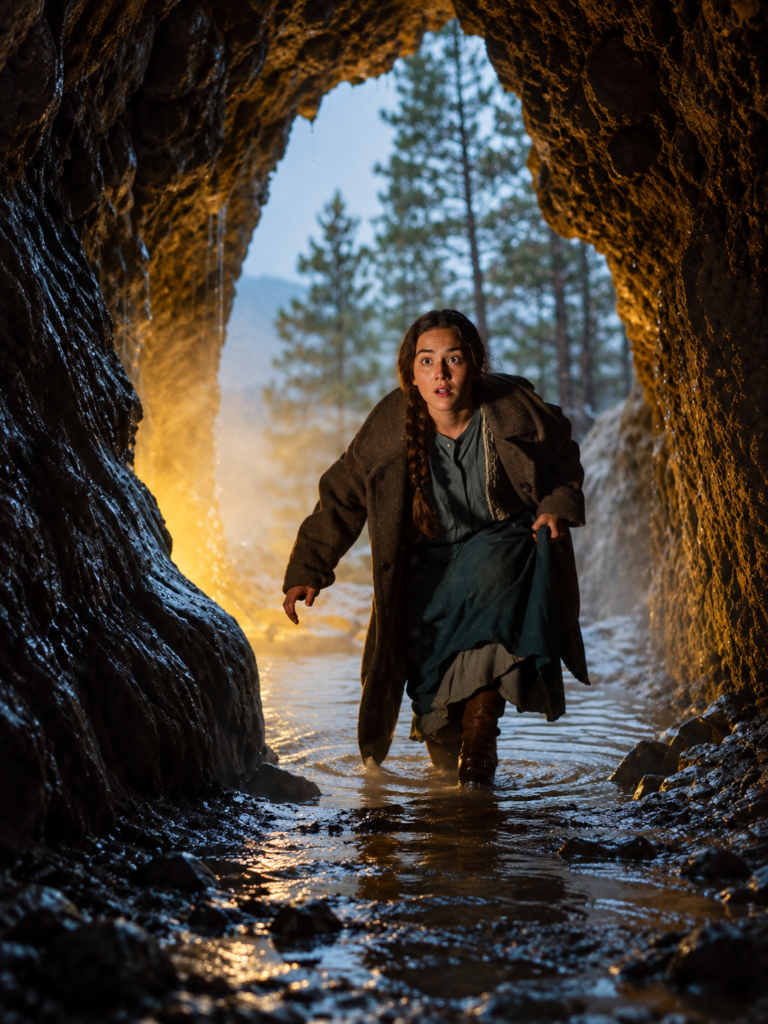
kicked out in october the widow found a cave of warm water and when the blizzard buried the valley it became the only refuge anyone had left
Part 1
The first snow had not even touched the ground when they told me to leave. It was October, too early for winter to settle hard, but late enough that everyone in the valley could feel the change coming. The air carried that sharp edge of cold that warned you the mountains were already turning. I stood on the porch of the house I had lived in for five years, staring at the man who had just taken it from me. My husband, Daniel, had been gone three months. The property had never been in my name. When he died it passed to his family, and his brother had no intention of letting a widow stay.
“Just until spring,” Thomas Reed said, as if that made the words kinder. He was tall, broad-shouldered, always speaking like everything he said had already been decided. “The land’s in my name now. You understand that?”
I did understand. That was the problem. “You’ll freeze out there,” I said quietly.
He shrugged. “You won’t if you head south.” The mountains loomed behind him, already dusted white on the higher ridges. South meant leaving everything behind—the valley, the only place that had ever felt like home, the grave on the hillside where Daniel rested under a simple wooden cross I had helped set. “I’m not going south,” I said.
Thomas studied me for a moment. Then he nodded once, the way a man nods when he has expected the answer and is already finished with the conversation. “Then you’d better leave before the first real storm hits.”
By sunset I was walking away with everything I could carry. A bedroll. A small pack of food—dried meat, a little flour, two potatoes. A kettle. And the old iron knife Daniel had used for everything from cutting rope to skinning game. Behind me the house stood quiet in the fading light, not mine anymore. Ahead of me the mountains. Cold wind followed me as I climbed the narrow trail out of the valley. The path twisted through pine trees and rocky slopes, rising steadily toward the foothills. I did not have a destination. Only a direction. Up. Away from the place that had no room for me anymore.
By nightfall the temperature dropped fast. Frost coated the ground. The wind grew sharper, cutting through my coat as if the wool were nothing. I found a small hollow between two rocks and built a fire with dry pine branches. The flames flickered weakly against the dark. Not enough. Not nearly enough. I pulled my blanket tighter around me and stared up at the sky. Clouds moved quickly across the moon. Storm clouds. Winter was coming faster than anyone expected, and I was alone in the mountains with nothing but a small fire to keep me alive.
The next morning the fire was gone. Cold had taken it during the night. I woke with stiff fingers and numb toes. My breath came out in sharp clouds as I packed what little I had left and kept moving. The forest thickened as I climbed. Tall pines blocked the wind in places, but the higher I went the colder it became. By midday snow began to fall. Light at first, just a few drifting flakes, but it was enough. Enough to tell me I was running out of time. I needed shelter. Real shelter. Not a hollow in the rocks. Not a fire that could die in the night. Something that could hold heat. Something the wind could not tear apart.
That was when I saw it. At first it looked like nothing more than a shadow in the hillside, a dark opening beneath a cluster of trees. I almost walked past it, but something about the way the snow did not gather near the entrance made me stop. I stepped closer. The air changed immediately. The wind dropped. The cold eased. I frowned, then took another step forward, and another, until I was standing inside the cave. It stretched deeper into the mountain than I expected. The walls curved smoothly, worn by time and water. And the air—the air was warm. Not just sheltered. Warm. I blinked in disbelief. Caves were supposed to be cold and damp. This one felt different.
I walked farther inside. The ground sloped gently downward toward a shallow pool of water near the back. Steam rose faintly from its surface. I froze, then slowly stepped closer. The water shimmered in the dim light, rippling softly. I knelt and reached out. My fingers touched the surface. Warm. Not just above freezing. Actually warm. I pulled my hand back in shock. A hot spring. The words came out as a whisper. I had heard of them before. Deep underground water heated by the earth itself, rising through cracks in the stone. Rare, but not impossible. And this one was inside a cave, hidden, protected, perfect. I sat back on my heels, staring at the pool. Warm water. Shelter from the wind. Stone walls that held heat. For the first time since I left the valley I felt something close to hope.
That night I did not build a fire. I did not need to. The cave held the warmth. The spring filled the air with a soft, steady heat that wrapped around me like a blanket. I slept deeper than I had in days. When I woke the storm had arrived. Snow poured down outside the cave entrance, carried by a rising wind that howled through the trees. But inside the air stayed calm, warm, still. I stepped to the entrance and looked out. The forest was already disappearing beneath a blanket of white. The trail I had followed into the mountains was gone, buried, erased. There was no going back, even if I wanted to. I turned and looked at the cave behind me, at the spring, at the steady warmth rising from the water. “This is it,” I said quietly. “This is where I stay.”
Part 2
The next few days became a rhythm. I explored the surrounding forest for food and wood, set simple snares with the knife and whatever cord I had, gathered pine nuts and late berries before the snow grew too deep. And every night I returned to the cave, to the warmth, to the shelter that no wind could reach. I began to build. A small wall of stone near the entrance to block drafts. A place to sleep farther inside where the warmth stayed strongest. Hooks and lines to hang food away from animals. The cave became more than shelter. It became a home. And as the storms grew stronger it became something else—a place winter could not touch.
Weeks passed. Then the storms worsened, the kind that did not stop after a day or even two, the kind that buried forests, collapsed branches under heavy snow, turned the mountains into a frozen wilderness no one could cross. From the cave entrance I watched it happen. The valley below slowly disappeared beneath white. The smoke from chimneys grew thinner, fewer, struggling. And for the first time a thought crossed my mind. The people who had sent me away were now facing the same winter I had feared, but they did not have what I had. They did not have warmth built into the mountain itself. They did not have a place the cold could not reach. They had houses, wood, fires that could burn out. But I had something else entirely, and before winter ended the town would realize just how valuable that difference was. Because the storm that had just begun was not going to stop anytime soon.
The storm did not pass. That was the first thing I understood. By the end of the second week it became clear this was not just a harsh winter. It was something else, something heavier. The snow did not fall in storms anymore. It simply continued, day after day. Wind carved deep ridges across the mountains, burying the forest beneath layers of ice and powder. From the cave entrance I watched the world disappear. Trees bent under the weight. Branches snapped. The trail I had climbed weeks earlier no longer existed. Even the shape of the land had changed. The mountains had been swallowed. But inside the cave nothing changed. The air stayed warm. The stone held the heat. And the spring flowed endlessly, its quiet ripple echoing softly through the chamber.
I had stopped counting the days. There was no need. The storm made time meaningless. What mattered was survival. And survival, for me, had become steady. I did not wake freezing. I did not ration firewood. I did not fear the night. The cave had removed those worries entirely. The heat came from the earth itself, unending, reliable, safe. I spent my days improving the space, reinforcing the stone wall at the entrance, building a proper sleeping area farther inside, stacking food and supplies where the warmth would not spoil them. The cave was not just shelter anymore. It was stronger than any cabin in the valley.
And then one morning I saw movement. At first I thought it was just the wind, a shift in the snow, but then I saw it again—a dark shape against the white, struggling. I stepped closer to the entrance, narrowing my eyes against the brightness. A man. No, three men, moving slowly through the snow below the ridge. They were barely visible, half buried with every step. I felt something tighten in my chest. No one should have been out there, not in this. They would die before reaching the trees, before finding shelter, before finding anything—unless I turned back toward the cave, the warmth, the safety, the place I had built to survive alone. For a moment I hesitated, because I knew what it meant. If I helped them this place would not be mine alone anymore. The silence, the control, the certainty—all of it would change. But then I looked back at the man. One of them stumbled, fell to his knees, did not get up right away. That decided it. I grabbed my coat and stepped into the storm.
Part 3
The wind hit me immediately, sharp, violent, but I knew the terrain now. I moved quickly down the slope, keeping my body low against the gusts. “Over here!” I shouted. My voice was almost swallowed by the wind, but one of them heard. His head lifted. He pointed. The others turned slowly toward me. They followed, barely, step by step, until I reached them. Jacob Turner was the first to recognize me. “Mary,” he rasped, his voice raw from cold. “Yes.” His eyes widened. “You’re alive.”
“Move,” I said firmly. “Now.” There was no time for questions. I led them back up the ridge, guiding them toward the cave. They stumbled more than they walked, but they followed. And when they reached the entrance they stopped. The warmth hit them instantly. Turner froze. “What is this?”
“Inside,” I said. They did not argue. They stepped into the cave and for a long moment they just stood there breathing, letting the warmth soak into their frozen bodies. One of the men sank to his knees. “Dear God.” Turner looked around slowly. The stone walls, the rising steam from the spring, the calm air untouched by the storm outside. “It’s warm,” he said. “Yes.”
“How?” I gestured toward the water. “Hot spring.” He stared at it, then back at me. “You’ve been here this whole time?” “Yes.” “And you’re—” He shook his head in disbelief. “Fine.” I nodded. “I am.” Silence settled over the cave, broken only by the quiet movement of the water. Turner finally spoke again. “The town—” He hesitated. “Isn’t doing well.” I felt that same tightening in my chest. “How bad?”
“Worse than anything we’ve seen.” He stepped closer to the entrance and looked out into the storm. “We’ve lost livestock. Wood’s running low. Some houses already freezing at night.” I looked back at the cave, at the steady warmth, the unchanging shelter. “And you came up here why?” Turner gave a faint, tired smile. “Looking for anything. Didn’t expect this.” I did not respond right away because I already knew what was coming next. Turner turned back toward me. “There are more people in town.” His voice was quieter now. “Families. Children. They won’t last if this keeps up.” The storm held outside. Unrelenting. Unending. I walked slowly toward the spring. The warmth rose around me. Comforting. Steady. Safe. This place could hold more people. The cave was large enough. The heat was constant. The water never stopped flowing. It was not just shelter anymore. It was something else. Something bigger. I turned back toward them. “How many?” Turner hesitated. “Maybe twenty.” I nodded once. “Then we move fast.” His eyes widened. “You mean—” “Yes.” Relief flooded his face. “We can bring them here.” “Yes.”
Part 4
The next day became a blur of movement. The storm had not eased, but now we had a purpose. Turner and the others rested just long enough to regain strength. Then we went back out. Trip after trip, guiding people through the storm one group at a time. The climb was brutal, slow, dangerous, but the cave waited at the top—warm, safe, unshaken. By the time the third day ended the cave was full. Families huddled near the walls. Children wrapped in blankets. Men sat quietly staring at the spring like it was something unreal, because it was. In a world buried by ice and wind this place still held life, still held warmth, still held hope.
I organized what I could. Sleeping places rotated so no one stayed too long against the cold stone. Food shared from what people had carried and what I had already stored. The spring water used carefully for drinking and for warming hands and feet. Children were kept farther inside where the heat stayed strongest. The men who still had strength took turns clearing snow from the entrance so the air could move without letting the wind inside. No one argued about who owned the space. Survival had simplified the questions. Mrs. Ellison, who had once sold eggs at the valley market, sat with two small children and told them stories in a low voice so the others could rest. A man named Harris, who had worked timber with Daniel years earlier, helped me reinforce the stone wall at the entrance with larger rocks so the drafts stayed out. Jacob Turner moved among the groups, checking on the weakest and bringing me quiet reports about who needed more warmth or more food.
On the fourth night one of the children developed a cough that would not ease. I moved the family closer to the spring and showed the mother how to hold the child’s hands near the rising steam without letting the skin burn. The warmth did what a fire could not—it stayed constant through the night. By morning the cough had softened. No one spoke of miracles. They simply stayed. Outside the storm continued. Branches snapped under the weight of snow. Somewhere below the ridge a cabin roof gave way with a sound that carried even through the wind. Inside the cave the only sounds were the soft ripple of the spring and the low murmur of people who had stopped fighting the cold long enough to remember they were still alive.
Thomas Reed arrived on the sixth day with two other men from the lower valley. He did not recognize me at first in the dim light. When he did he stopped just inside the entrance and stared. Snow clung to his coat. His hands were red and stiff. For a moment neither of us spoke. Then he said, “Mary.” I nodded. He looked past me at the people settled along the walls, at the steam rising from the pool, at the stone that held the heat of the earth. He did not ask how I had found it. He did not offer an apology. He simply stepped farther inside and stood near the wall until the warmth reached him. I did not turn him away. The cave did not care who had held the deed to the house in the valley. It only cared that the cold stayed outside.
Part 5
The storm raged for another two weeks, but inside the cave people slept, ate, recovered. For the first time since winter began they were not fighting to survive. They simply were surviving. And when the storm finally ended the valley below was unrecognizable. Buried. Broken. Changed. But the people who had made it to the cave were still alive. Turner stood beside me at the entrance looking out over the snow-covered landscape. “You know,” he said quietly, “they threw you out.” I nodded. “And now—” He gestured behind us toward the people inside. “You saved them.” I looked back at the cave, at the warmth rising from the earth, at the life it had protected. “They didn’t know,” I said. Turner nodded slowly. “No, they didn’t.”
The wind had finally gone quiet. And for the first time since October the mountains felt still again. People began the slow work of returning to what remained of their homes. Some roofs had collapsed. Some woodpiles had been buried beyond recovery. Livestock that had not been moved in time were gone. The valley would take years to look the way it once had. But the ones who had spent those weeks in the cave walked down the ridge with their children still breathing and their hands still able to hold tools. Thomas Reed was among the last to leave. He stood at the entrance for a long moment and looked at the spring. Then he looked at me. “The house,” he said. “When the snow clears.” I waited. He did not finish the sentence. He simply turned and started down the path. I did not follow him. The house in the valley had never truly been mine. The cave had never needed a deed.
I stayed through the first thaw. The spring continued to rise, warm and steady, while the snow melted from the higher slopes and the sound of running water returned to the draws. People came back up the ridge in ones and twos—some to thank me, some simply to stand inside the entrance and feel the heat again, some to ask whether the place would still be there next winter. I told them the truth. The cave had been there long before any of us. The spring had been rising through the stone for longer than the valley had held houses. What had changed was only that someone had needed it enough to find it. And that, when the need came, the door had been left open.
On a clear morning in early spring I walked back down to the valley for the first time. The house where I had lived with Daniel stood with its porch cleared and smoke rising from the chimney. Thomas was outside stacking wood. He saw me and stopped. Neither of us spoke across the distance. I turned instead toward the hillside where Daniel’s cross still stood above the snow line. The wind moved through the pines. Below, in the valley, people were already mending fences and clearing paths. Above them the cave waited, warm and quiet, holding the heat of the earth for whoever might need it when the next winter came. I stood there a long time. Then I walked back up the ridge. The entrance was still clear. The spring still rose. And the stone walls still held the warmth that had kept us alive when everything else had failed. Sometimes the strongest shelters are not built with wood or walls. Sometimes they are hidden, waiting until the moment everyone finally needs them.