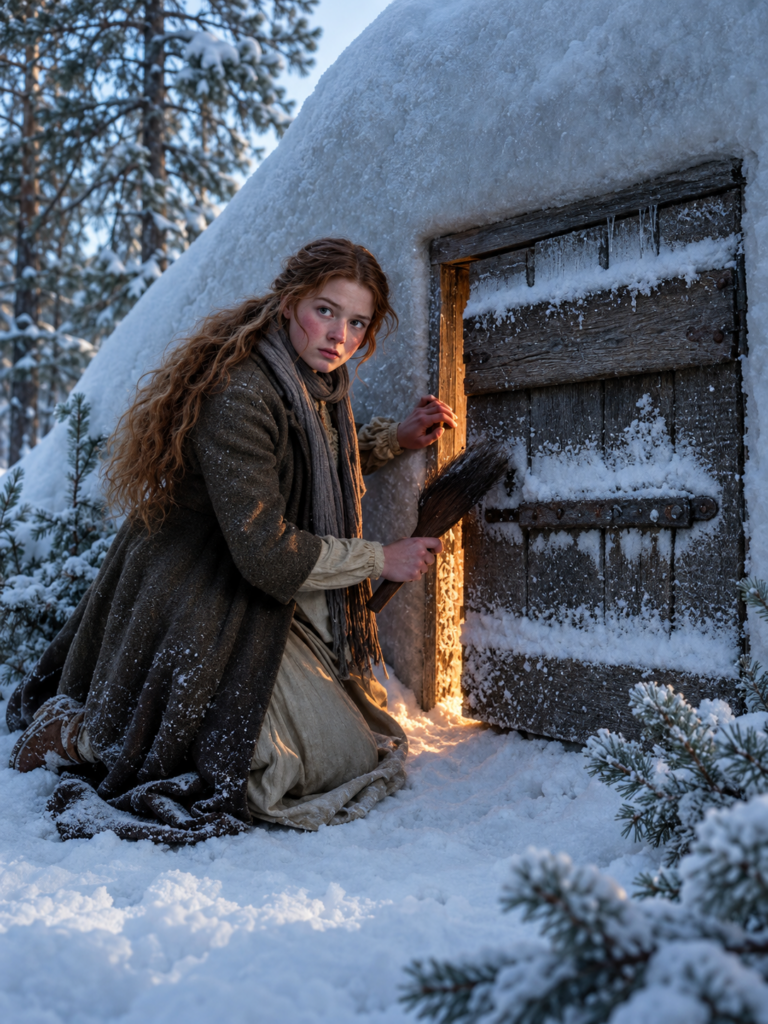
her uncle shut the door the morning the first snow fell and the buried hillside shelter she stumbled into by accident kept an entire valley alive that winter
Part 1
The first snow of the season began falling the same morning Lydia Hale was told to leave. Not tomorrow, not after the roads cleared, not once winter had passed. That day. Her uncle stood in the doorway of the farmhouse with his coat already buttoned, as though remaining outside longer than necessary might somehow weaken his decision. The snow was still light then, individual flakes drifting across the yard and catching on the stacked cordwood she had split the week before. Inside, the house smelled of cold coffee and the last of the morning fire.
“You’re old enough to manage yourself now,” he said. His voice was not angry. That was the part she would remember later. There was no raised tone, no accusation she could answer. Only the flat delivery of a man who had already finished the arithmetic in his head.
Lydia stared at him without speaking. At seventeen she had already worked harder than most grown men in the valley. She hauled water before dawn when the pump froze, split kindling after dark so the stove would last until morning, patched fencing in spring rain, and harvested until her hands cracked each autumn. After her aunt died in July the work had only increased. Grief had settled into the rooms like a draft no one bothered to seal, and once that happened her uncle began speaking differently, as if every extra plate at the table had become visible all at once. He counted the potatoes in the cellar. He measured the flour. He watched how long the lamp burned after supper.
“You can stay in town,” he said. “Find work.” In winter, with no money, no horse, and nowhere waiting for her, he knew exactly what he was doing. That was the part Lydia could not forgive. Not cruelty born from anger. Cruelty born from convenience. He handed her a canvas pack containing half a loaf of bread, a worn blanket, two jars of preserves, and her father’s old knife. Then he shut the door. Just like that. The latch clicked. Snow drifted across the yard while Lydia stood motionless for several seconds, listening to the muffled sounds of life continuing inside the house she had helped maintain for six years. No one came back out. That told her everything.
She turned toward the road. The nearest town sat nearly twelve miles away across uneven winter ground. In good weather the journey would take most of a day on foot. In snow, longer. Still, movement meant heat. Standing still meant bitterness and cold. So she walked. By noon the snowfall thickened. Not dangerous yet, but steady enough to erase old tracks and blur distances. The hills beyond the valley faded in and out behind drifting white curtains. Wind swept loose snow across the road in thin waves that stung her face. Lydia pulled her coat tighter and kept moving. The bread in her pack hardened quickly from cold. Her boots, already worn thin at the soles, soaked through by mid-afternoon. She knew enough about winter to understand the true danger. Not dramatic freezing. Gradual exhaustion. One bad decision followed by another smaller one. Too much sweat. Wet clothing. Poor shelter. Night arriving before preparation. That was how people disappeared.
As evening approached she left the road intentionally. Most travelers stayed on open paths for speed. Lydia wanted cover. The hills west of the valley held clusters of pine and exposed stone where wind broke unevenly. She figured she might at least find enough shelter to survive the night before continuing toward town in the morning. The climb grew steeper. Snow deepened between rocks. Twice she slipped hard enough to bruise her knees. By sunset the cold had begun reaching through her coat entirely. That frightened her more than hunger. Cold inside clothing means time is running out. She scanned the hillside desperately for anything usable. A fallen tree. A rock shelf. Even thick brush.
That was when she noticed the door. At first she thought it was only shadow. A dark rectangle set into the hill beneath a curved rise of earth and snow. But as she moved closer, shape emerged. Wood. Old wood. Half buried beneath drifting snow and climbing brush. The hillside around it looked unnatural once she saw it properly. Not a random slope, but shaped ground. Rounded. Reinforced. Deliberate. Someone had built here. Long ago. Lydia brushed snow away from the handle. Iron. Cold enough to burn skin through her glove. The door did not move immediately. She leaned harder. Wood groaned softly, then opened inward several inches, releasing a breath of air unlike the frozen world outside. Cool, but not deadly. Still air. Protected air. Her heartbeat quickened. She widened the gap and peered inside. Darkness descended below ground by way of rough stone steps. For one dangerous moment she hesitated. People vanish in places like this, too, she thought. Collapsed shelters. Animals. Old wells. But the wind behind her answered quickly enough. She stepped inside and pulled the door shut. Silence swallowed the storm immediately. Not complete silence. A softer one. The kind found underground.
Lydia stood motionless while her eyes adjusted. Then she struck a match. The small flame revealed a narrow passage leading downward into a chamber larger than she expected. Stone walls curved overhead in an arched ceiling reinforced with heavy timber beams darkened by age. Shelves lined the far wall. And on those shelves, jars. Dozens of them. Preserves, dried goods, root vegetables packed in sand, barrels sealed with waxed cloth. She stared in disbelief. The room looked abandoned, but not ruined. Everything had been arranged carefully once by hands that understood survival. Near one wall sat a small iron stove connected to a stove pipe running upward through the hill. Beside it lay stacked split wood protected from moisture. Lydia crossed the room slowly as though sudden movement might break the illusion. Dust coated many surfaces, but not thickly enough to suggest decades. Someone had used this shelter once. Perhaps not recently, but long enough to build it properly.
She touched one jar. Cold. Intact. Her hands shook as she checked another, then another. Food. Real food. Not enough for luxury. Enough for survival. A rough bunk stood near the rear wall beneath folded blankets stiff with age, but dry. Crates of potatoes filled the corner beside sacks she guessed contained grain. Every part of the shelter spoke of preparation, not panic. Whoever built this place expected isolation, expected winter, and planned accordingly. Lydia moved back toward the door and listened carefully. No voices outside. No signs of ownership. Only distant wind crossing the hill above. She should leave, she thought. Someone might return. But the thought dissolved almost immediately against the reality pressing through her frozen boots and aching hands. Night had arrived. The storm was worsening, and outside there was nothing. Inside there was shelter. Sometimes survival decides morality before pride can object.
She knelt beside the stove and examined it carefully. Dry ash remained inside. Beside the wood pile sat flint, tinder scraps, and old newspaper folded beneath a tin cup. Everything needed still existed. Whoever left had expected to return eventually. Perhaps they never did. Lydia lit the fire slowly, terrified of wasting the opportunity through carelessness. Smoke drew upward immediately through the pipe. Good draft. Good construction. Within minutes, warmth began pushing gently into the room. Not enough to fully thaw her. Enough to stop the slide toward danger. She removed her boots and held numb feet near the stove while snow melted from her coat onto the packed earth floor. Then she opened one jar of preserved carrots with trembling hands. The taste nearly made her cry. Not because it was extraordinary. Because it meant tomorrow existed again. Outside, the storm thickened across the hills. Inside, lantern light slowly filled the buried room. Lydia looked around at the hidden shelves, the careful storage, the underground walls holding steady against winter, and understood something important. This was not merely a shelter. It was a system built by someone who understood that surviving winter required more than courage. It required preparation hidden beneath ordinary ground.
Part 2
Lydia Hale woke the next morning to silence and warmth she had almost forgotten could exist together. For a moment she did not remember where she was. Then the curved earth ceiling above her came into focus, followed by the glow of faint coals still alive inside the stove. The shelter held heat, not perfectly, but steadily. That mattered more. She sat up beneath the old blankets and listened carefully. No footsteps overhead. No voices. Only distant wind muffled by layers of soil and timber. The hill itself protected the room. That realization settled deeply into her bones. Outside, winter attacked. Inside, winter waited at the edges. The difference between those two conditions was survival.
Lydia fed the stove carefully, using only small pieces of wood at first. Whoever built the shelter had prepared thoughtfully, but supplies were not endless. Every choice mattered now. She spent the morning inspecting the chamber properly. There were more rooms than she first realized. A narrow storage alcove dug farther into the hillside held sacks of grain protected inside sealed barrels. Another smaller room contained tools, axes, shovels, spare lantern glass, bundles of dried herbs hanging from rafters. Nothing luxurious. Everything useful. The shelter had not been built for comfort. It had been built for endurance. Near the rear wall she found something else, a ledger wrapped carefully in cloth inside a wooden box. The pages belonged to a man named Walter Bellamy, written in careful slanted handwriting over several winters. The entries were practical: outside temperature, wood remaining, how long potatoes lasted, how much lamp oil was consumed each month, and scattered between those notes, pieces of explanation.
Built shelter after the freeze of ’71. Ground stays steadier than air. Most people freeze because they wait too long to prepare. Lydia read every line slowly. Walter Bellamy had once lived alone in the hills after losing his family during a brutal winter epidemic decades earlier. The shelter became his answer to fear. Not a cabin. A buried storehouse against disaster. His final entry was dated seven years before. Leg injury worsening. Going into town tomorrow for supplies before heavy snow. No entries followed. Lydia closed the ledger quietly. He had likely never returned. For a long time she sat beside the stove thinking about the strange chain of events that had carried her here. A forgotten shelter. A dead man’s preparation. A storm arriving the same night she was cast out. Luck and suffering often travel together.
By afternoon the snowfall deepened again. Furious and uneasy, Lydia climbed the stairs and pushed the outer door open slightly. The world outside had vanished beneath white. Drifts climbed halfway up nearby trees. Wind swept powder across the hillside in long silver waves. The road below the valley could no longer be seen. No one would reach town in this. No one should even try. She closed the door quickly and secured the inner latch. That evening, while feeding the stove, she noticed something else about the shelter. It stayed dry. The earth walls absorbed moisture slowly instead of letting frost gather everywhere like ordinary cabins. Vegetables remained unfrozen. Water buckets formed only thin ice at the surface. The hill moderated everything. That was why Bellamy had built here. Not hidden from people. Hidden from extremes.
The storm lasted three days. On the fourth morning Lydia heard knocking. Faint. Dull. At first she thought it was imagination. Then it came again. She climbed the stairs cautiously and opened the outer door just enough to see. A woman and young boy stood outside half covered in snow. Mrs. Danner from the valley. Lydia recognized her immediately. The older woman looked stunned. “We saw smoke,” she said weakly. “Thought maybe hunters.” Lydia opened the door wider at once. “Come inside.” The boy nearly stumbled down the steps from exhaustion. Inside the shelter both stopped the moment warmth touched them. Not hot warmth. Living warmth. The kind that allows hands to move properly again. Mrs. Danner looked around the chamber in disbelief. “What is this place?” “I think,” Lydia said quietly, “it was built for winters like this.”
That afternoon brought two more visitors, then another by evening. Word traveled quickly whenever smoke existed during hardship. The valley was struggling badly. Wood piles had become wet beneath drifting snow. Several storage sheds collapsed under weight. Roads vanished entirely. Worst of all, many families had not stored enough food. They always expected movement between houses to remain possible. The storm had ended that illusion. By the second night seven people occupied the buried shelter. Lydia organized quickly. Wood near the stove. Food rationed evenly. Sleeping places rotated. Ventilation checked carefully so the room remained safe. The shelter worked because it had been designed as a system. Air. Storage. Mass. Protection. Everything connected.
Part 3
Turner Blake arrived on the third day after following tracks through the hills. He stopped inside the doorway staring at the underground chamber lit by lantern glow and lined with shelves of preserved food. “You’ve been living here,” he said. It was not quite a question. “Surviving here.” He looked embarrassed. Not because of the shelter. Because he remembered the morning she had been cast out. His eyes moved toward the jars, the stove, the earth walls. “This place is warmer than my cabin.”
“It changes slower,” Lydia replied. That was the real lesson. The shelter ignored sudden weather because the hill itself absorbed change slowly. Turner sat heavily near the stove. “We nearly burned all our wood in four days.” Lydia handed him soup. “You built for weather,” she said. “This was built for winter.” He thought about that for a long time.
The people who came carried pieces of their own stories with them. Mrs. Danner’s husband had gone out looking for a downed cow the morning the storm worsened and had not returned. She and the boy had waited two days before the wood ran low and the cold pushed them onto the road. An older couple from the lower end of the valley arrived with wet blankets and a tin of matches they had managed to keep dry. A young man Lydia knew only by sight from the feed store carried his younger sister on his back part of the way; her boots had frozen solid and her feet were numb to the ankle. Lydia set them near the stove and worked circulation back into the girl’s feet with her own hands, the same way her aunt had once taught her after a long day in the creek. No one asked where the food had come from. Hunger does not inquire about ownership when the alternative is empty stomachs and wet boots.
Lydia kept the ledger near the stove and read more of Bellamy’s notes when the others slept. He had recorded the depth of the snow each morning. He had noted when the potatoes began to sprout and how he stopped it by moving the crates farther from the stove. He had written, once, that the greatest danger was not the cold itself but the decision to leave the shelter too soon because the quiet became unbearable. Lydia understood that sentence more clearly each day. The buried room held sound differently. Voices did not carry the way they did in a cabin. Footsteps on the packed earth floor stayed low. The wind outside became a distant suggestion rather than a constant presence. People spoke less. They listened more. They watched the stove and counted the remaining jars without saying the numbers aloud.
On the fifth night the young man’s sister woke crying from the pain of returning feeling in her feet. Lydia sat with her until the girl slept again. Mrs. Danner’s boy asked, very quietly, whether they would have to leave when the snow stopped. Lydia did not answer immediately. She looked at the shelves. At the stacked wood that had not yet been touched in the rear alcove. At the way the stone walls held the heat of the day even after the fire had been banked for the night. “Not if we are careful,” she said. The boy nodded as if that were enough. Outside, the wind had begun to shift. The sound against the hill changed from a steady push to something less certain. Lydia stayed awake longer than the others, feeding the stove one careful piece of wood at a time and listening for the moment when the storm might finally loosen its hold.
Part 4
The storm finally weakened near the end of the week. When skies cleared the valley emerged damaged and exhausted. Several families had already abandoned their homes temporarily to stay with neighbors. Food stores were lower than expected. Wood piles nearly halved. Yet beneath the hillside, supplies still remained. Not untouched, but stable. People began climbing to the hidden shelter regularly after that. Some to trade. Some to help reinforce the entrance. Some simply to understand how it had survived so well.
Lydia walked the road back toward the valley with Turner on the first clear morning. The snow reached above her knees in places. Drifts had buried the lower fence lines entirely. At the Danner place the roof of the storage shed had collapsed under the weight; splintered boards and wet grain lay exposed to the sun. Mrs. Danner stood in the yard with her boy, both of them looking smaller than they had inside the shelter. Turner’s cabin, when they reached it, smelled of damp smoke and cold ash. The woodpile outside had been reduced to a few frozen rounds half buried in snow. He stood on the porch and did not invite her inside. “You can take what you need from the shelter,” he said. “Until spring. I won’t argue about it.” Lydia nodded. She did not thank him. Thanks implied a debt she had not asked to carry.
Word of the buried room moved through the valley the way news of a downed tree or a broken bridge always moved—quietly, then all at once. Men came with shovels and axes and spent an afternoon clearing the entrance so the door would open without force. Someone brought a second stove pipe section from an abandoned claim higher in the hills and helped seat it more securely through the earth. A woman from the east ridge arrived with two sacks of dried beans and asked, without ceremony, whether there was space on the shelves. Lydia accepted the beans and made a careful mark in the margin of Bellamy’s ledger. She had begun keeping her own notes on the remaining pages. Dates. Number of people. Wood used. Jars opened. The handwriting was less steady than Bellamy’s, but the purpose was the same.
By the middle of the second week the path to the shelter had been packed hard enough that a person could walk it without breaking through. Families sent children with empty jars to be filled and returned the next day. Lydia portioned carefully. She had learned, from Bellamy’s notes and from watching the shelves diminish, that generosity without measurement became another form of loss. No one argued with her numbers. They had seen what the storm did to the surface stores. They understood, for the first time in years, that the ground itself could be made to hold what the air refused.
One afternoon her uncle appeared at the edge of the clearing above the door. He did not come down the path. He stood with his hands in his pockets and watched the smoke rise from the pipe. Lydia was outside stacking split wood someone had hauled up from the lower timber. She saw him and did not stop working. After a while he turned and walked back toward the road. He did not call her name. She did not follow him. The snow on the path held both sets of tracks for a time, then the wind smoothed them together until only the direction remained clear.
Part 5
By spring the buried doorway no longer looked forgotten. A path led to it now, then another. Men discussed root cellars differently. Families started building hillside storage rooms of their own. People who once trusted only cabins began trusting the ground itself. The snow melted slowly from the higher slopes, revealing the shaped earth around Bellamy’s shelter for what it was: not an accident of the hillside, but a deliberate alteration of it. Someone had cut into the slope, laid stone, timbered the ceiling, and covered the work again so that only the door remained visible. The work had taken more than one season. Lydia understood that now, reading the earlier pages of the ledger where Bellamy had recorded the number of loads of rock he moved each week and the depth of the trench he dug before the first hard freeze.
She stayed in the shelter through the thaw. There was no place else waiting. Her uncle’s house remained closed to her, and the town, when she walked there one clear afternoon, offered only the same limited work it had always offered—cleaning rooms at the boarding house or helping in the kitchen at the hotel when the stage came through. Neither paid enough to rent a room through another winter. The shelter, by contrast, still held potatoes that had not sprouted, jars that had not frozen, and a stove that continued to draw cleanly. People continued to come. Some brought seed potatoes in exchange for advice about ventilation. Some asked whether she would show them how Bellamy had sealed the barrels. Lydia answered what she could. She kept the ledger on the table near the stove and let anyone who wanted to read it do so.
On a morning in late April she walked to the upper end of the valley where the old Bellamy cabin had once stood. Nothing remained but the foundation stones and a collapsed chimney. The ground around it was soft with meltwater. She stood there a long time and thought about the man who had lost his family and answered the loss by digging into the hill. He had not written about grief in the ledger. He had written about temperatures and wood and the length of time a crate of potatoes would last if kept away from the stove. The grief was in the work itself. Lydia understood that kind of answer. She had been given a knife, a blanket, and two jars, and told to manage. She had found a door. The difference between those two conditions was not luck alone. It was the preparation someone else had made years earlier, hidden where only a person walking off the road in a storm was likely to see it.
When she returned to the shelter that evening the path was already worn smooth. Smoke rose from the pipe. Inside, two women from the lower valley were sorting beans on the table while a boy stacked wood near the stove. They looked up when she entered and nodded the way people nod when a place has become familiar. Lydia set her pack down and fed the fire. Outside, the last of the snow was sliding from the higher branches. Inside, the earth walls held the day’s warmth and the shelves still carried enough to see the valley through the uncertain weeks until the gardens came in. She opened the ledger to a clean page and wrote the date. Then she wrote, in the careful hand she had practiced from Bellamy’s example, that the door had been found, the stove still drew, and the hill continued to do what it had been built to do. She closed the book and set it back in its box. The work of staying alive had not ended. It had only changed its shape.