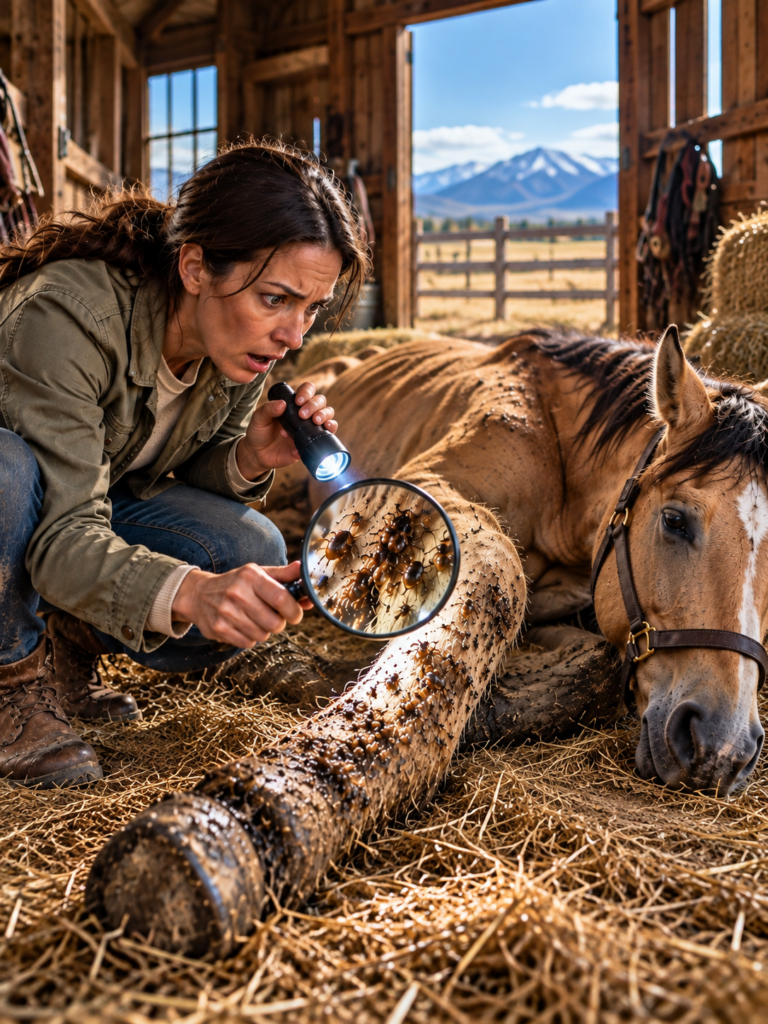
she found three hundred tiny creatures clinging to her horse’s legs and the mud underneath them carried a secret her father had tried to report eighteen years before anyone would listen
Part 1
Maren Holt had owned Juniper for seven years, long enough to know the mare’s moods by the sound of her hooves on the stall boards. The ordinary restless shuffle before grain was one thing. The tight, circling knock that started just before four-thirty on a late-August morning was another. Maren heard it from the gravel yard while she carried the flashlight in one hand and the empty bucket in the other. Montana before sunrise held a dry hush that settled once the creek beds gave up and the grasshoppers took the fields. She lifted the latch on Juniper’s stall and the smell hit her first—a faint mineral wetness that did not belong in a barn at the end of a dry summer. It smelled like the underside of a rock in a creek, and there had been no creek on the Holt ranch since Maren was a girl riding a second-hand saddle.
She swung the flashlight low. For three full seconds her brain refused to assemble what her eyes were giving it. From the knee down, Juniper looked as if someone had pressed wet gravel into her coat and left it there. Hundreds of small rounded shapes the color of wet bark packed so densely in places that the buckskin hair underneath had disappeared. They were not scattered the way parasites scatter. They were not in the pastern folds or behind the knee where the skin ran thin and warm. They gripped individual strands of hair with a patience that looked almost deliberate, and they stopped at nearly the same height on all four legs, as if someone had dipped the mare to a mark and lifted her out again.
Juniper was not in the kind of distress a horse shows when something is feeding on her. There was no sweating along the flank, no flared nostril, no hard flinch when Maren laid a palm against her shoulder. Her gums were a healthy pale pink. Her pulse ran fast but not frantic. Her ears tracked Maren’s voice. The mare was bothered, not injured, and the difference between those two things is the entire first chapter of veterinary medicine.
Maren slid a hand down the cannon bone, talking the whole time in the flat low voice she used for colic and thunderstorms. Juniper let her reach the fetlock before she snatched the leg away and slammed her hip into the stall wall hard enough to rattle the hinges. Maren backed out, closed the gate, and did the math she always did, which was the math of money. A ranch call from Callum Reed was a hundred and forty dollars before he opened his truck. She had eleven hundred in an account meant to carry her into October. Then she thought about her father, who had waited on a vet call exactly once in his life and had buried a mare named Comfort four days later. She took out her phone and dialed. Callum answered on the second ring the way country vets always do, already awake.
She was still waiting at six-fifteen when a white pickup turned up her drive without being invited. In that part of Montana that told you everything about the person behind the wheel. Blair Ashcroft got out in clean boots and a canvas jacket that had never held a bale and stood looking at the barn as if she were appraising a used appliance. She said she had been running the north fence line and seen the lights on. Maren, too tired to lie before sunrise, said her mare had come up covered in something and the vet was on his way. Blair looked into the stall and her mouth did a small thing that was not quite a smile. She said she hoped it wasn’t anything that moved because her father ran nine hundred head within two miles of that barn and the agricultural board took reportable conditions seriously these days. Then she said that if Maren ever got tired of waking up to problems like this one, the standing offer was still standing and her father would hate to see the whole place go to a bank instead of a neighbor.
Maren said no the way she had said no eleven times before. Blair drove off toward the ridge where the Ashcroft fence posts ran in a line so straight it looked printed.
Callum Reed arrived at twenty past seven with the sun already hard and white over the eastern hills. He was forty-six and had the particular walk of a man kicked enough times to respect every animal he met. He said nothing clever when he saw Juniper’s legs. He sedated the mare lightly so she would tolerate handling, knelt in the shavings with fine forceps, worked one of the creatures free, and held it to the light for a long moment without speaking. Maren watched his face and learned more from it than she wanted to.
“These aren’t ticks,” he said finally, turning the forceps so she could see. The thing was flattened and segmented, a little larger than a grain of rice, with legs folded tight and a pale underside that caught the light. It was an aquatic invertebrate, he told her, the kind that lived in wet margins and shallow standing water and clung to vegetation in a slow seep. Then he said the part that mattered. These animals did not travel. They did not swarm, they did not hunt, and they could not survive more than a day or two on a dry horse in a dry barn. For three hundred of them to be on one mare’s legs, that mare had to have stood in their water.
Maren told him there was no water. She said it twice because the first time it came out defensive and she hated the sound of it. No pond, no slough, no seep, nothing but two stock tanks she filled from a well that had been dropping four inches a year since she was in high school. The nearest live water was the Claremont ditch, seven miles southeast, past two highways and a railroad grade, and no horse alive was making that trip in a night and standing in her own stall by four.
Callum kept working, parting the hair in small sections, and then he stopped. “Maren,” he said, “come look at this.” Underneath the creatures, in the hair itself, was a layer of dried mud. Not the pale tan dust of her own pastures, not the gray silt that came off the county road. This was black, fine as graphite, dried in thin plates that flaked when he scraped them with his thumbnail. It was on all four legs, under the invertebrates, in the same band. Callum rubbed a flake between his fingers and smelled it and said nothing for a while. The barn was so quiet Maren could hear the mare breathing. Then he looked up at her and passed her out the open door toward the north pasture, where the grass went brown and the ground rose toward the Ashcroft line.
“So where did this horse stand in water last night?”
Maren did not have an answer. But she had a gate latch on the north pasture that she had closed herself at nine the previous evening. When she walked out to check it an hour later, it was hanging open.
They tracked her on foot because Callum said he wanted the sequence, not the destination. Juniper’s prints came out of the home paddock, crossed the hardpan by the loading chute, and ran north in a line that was not a wandering line. Maren said it out loud. A horse grazing out of a bad gate meanders, eats in circles, loops back toward the barn because the barn is where food comes from. Juniper had walked a route north-northeast at a steady pace for most of a mile. Up over the low bench, straight toward the corner where the fence met the section line.
A third of the way up the bench, Callum crouched over something Maren had walked right past. A six-foot section of her north fence was down. Not broken, not stretched, not pushed out at the bottom the way a fence goes when a bored horse leans on it until the staples sing. The two bottom strands had been pulled off the posts cleanly and hooked back over loosely. The kind of job a man does in a hurry when he intends to come back. There was no hair in the barbs and no blood, which meant whatever came through here came through an opening already made. She stood up with a feeling in her stomach she did not like. The question was no longer where Juniper had gone. It was who had opened the fence and whether her mare had gone out through it or whether somebody had come in.
Callum said fences came down for a dozen reasons, including hunters and strays, and that they should keep walking. But Maren noticed that he photographed the wire before they moved on. Three angles, boot in the frame for scale, and he did not explain why.
Past the fence the land belonged to nobody in particular. A quarter-mile strip of state ground between Maren’s deeded acres and the hard edge of Ashcroft land and cattle. It was country she had not walked in nine years because there was nothing out there. The whole bench had the look of ground that had been dry so long it had forgotten what it used to be. But Maren remembered standing in water up to her shins down in a cut below it when she was seven while her father pointed out where the fish held. She counted four cottonwoods still standing on the horizon, dead, bark gone, white as bone, and she had not thought about what a dead cottonwood meant in twenty years.
The hoof prints ran out on a stretch of caliche so hard it rang under their boots. Callum worked a slow arc looking for the pickup point and found nothing. Maren went the other way and found the creatures. Nine or ten of them lay in the grass at the base of a sagebrush, dried and curled and unmistakably the same animal that was all over her mare’s legs. Callum knelt, looked, then sat back on his heels and said what she had been circling without saying.
“They’re not a problem that happened to your horse,” he said. “They’re a record of where your horse was. Three hundred of these aren’t an infestation, Maren. They’re evidence.”
It rearranged something in her head. All morning she had treated the creatures as the mystery. They were not. They were the witness. And a witness that could not survive a day away from standing water was telling her plainly that somewhere within an easy night’s walk of her barn there was standing water she had never known about.
She started walking a grid forty paces out and forty back the way her father had taught her to look for a downed calf, and she did it for an hour while the sun turned the bench to glare. She found it because of a smell, not a sight. Under the skirt of a big old sagebrush the air was cooler and carried that same faint mineral wetness she had smelled in the barn. Maren knelt and pushed the dead grass aside, and the ground underneath was dark. She cut a square of sod with her pocketknife and lifted it, and eight inches down the soil was damp enough to hold the shape of her thumb. Callum took a sample into a plastic tube and said carefully that damp soil under a shrub in August was unusual but not impossible. But he also said the thing neither of them could explain away, which was that a damp patch of dirt does not coat a horse’s legs in black organic mud up to the fetlock. Something out here held real water. Not moisture, not dampness, but enough water to make mud, and enough standing time for an entire community of aquatic invertebrates to establish in it.
Maren was still holding the square of sod when she heard a diesel engine working up the two-track behind them. She turned and watched a gray truck crest the bench with a cloud of dust behind it, and a second truck trailing. Sterling Ashcroft got out slowly because men like him had learned long ago that moving slowly made other people wait. He was fifty-eight, trim, in a pressed shirt, with the kind of hat that had never once been rained on. He looked at Maren, at the knife in her hand, at the hole in the ground, and asked pleasantly whether she knew she was two hundred feet from his deeded boundary.
She said she was standing on state ground, which she was, and he smiled as if she had made a charming mistake and said the lease on that strip had run with his operation since 2004. Callum explained in neutral terms that he was documenting an exposure incident involving a horse. Sterling asked what sort of exposure. When Callum said aquatic invertebrates, Sterling laughed. It was not a cruel laugh, which was somehow worse. He said that if Maren had decided she had found a secret river under a sagebrush flat, she ought to sell the place before her imagination knocked another ten percent off the appraisal. He said he had punched four test wells on that side of the ridge in 2009 and come up with sand and disappointment and could have the reports on her kitchen table by Friday.
Maren did not answer because she was watching him. Sterling Ashcroft was relaxed in his shoulders and loose in his hands and absolutely still in his eyes. He asked twice where exactly she had found the sample. He asked once whether the vet was taking anything back to the clinic. Those were not the questions of a man who thought the whole thing was funny. They were the questions of a man who wanted to know what was in the truck.
They started back at noon, Maren leading Juniper who had followed them out on her own and would not leave. And it was Juniper who stopped. Thirty yards short of the broken fence, the mare planted all four feet and turned her head southeast toward a low mound of ground sitting almost exactly on the Ashcroft line. A rise no higher than a kitchen table covered in the same gray grass as everything else. Maren clucked and pulled. Juniper did not move. Her nostrils worked wide and slow, the way a horse smells water from a mile off on a hot day, and she stared at that nothing little mound for eleven full seconds before she allowed herself to be led home.
Part 2
Callum sent what he could not run himself to the state lab in Bozeman and it took four days. In those four days Maren cleaned three hundred and eleven invertebrates off her horse with a curry comb and counted every one into a jar because she did not know what else to do with her hands. The results came back on a Tuesday evening and Callum did not email them. He drove out, which told Maren the shape of the news before he got out of the truck.
The creatures were a native freshwater amphipod, a species the lab described as an obligate aquatic, meaning it could not complete any part of its life cycle out of water. The population represented multiple age classes including juveniles. That detail was the one Callum underlined twice with his pen on her kitchen table. A few adults could conceivably be carried in on a bird or a flood. Multiple age classes meant breeding. Breeding meant the water had been there continuously for weeks at minimum and probably months. Somewhere within a mile and a half of where they were sitting, there was water that had been alive long enough to raise a generation.
The mud was worse or better, depending on where a person was standing. The black sediment was not road silt and not scum from a rain puddle. It was old organic material, highly decomposed. The layered muck that accumulates on the bottom of a wetland over decades, mixed with fragments of aquatic plant tissue and microscopic shells from organisms that live only where water is more or less permanent. Callum said what the lab would not put in writing. A rain puddle is three days old. This mud was thirty years old and something had recently stirred it back to the surface.
Then he put a small clear specimen bag on the table and slid it across. Maren picked it up and held it to the light. Inside was a sliver of green plastic a little longer than a matchstick, curved on one face, chalky and crazed with a web of fine cracks the way plastic gets when it has lived a long time in dirt and sun. Callum said he had found it wedged up in the hair of Juniper’s left hind, almost at the coronet band, packed in under the mud where the curry comb would never have reached it. He had run it past a man he knew at the irrigation supply in Billings. It was high-density polyethylene. It was the kind used in buried agricultural waterline and the color and the wall curvature suggested a pipe somewhere between six and eight inches in diameter.
Maren set it down carefully. The way a person sets down something that has changed the weight of a room. Her ranch had a well, a pressure tank, two hydrants and four hundred feet of two-inch galvanized her father laid in 1981, and she knew every inch of it because she had dug most of it up twice. There was no green plastic on the Holt place and never had been. Which meant that somewhere out on that bench, underground that was supposed to be dry, there was a pipe.
She did not sleep that night. After two in the morning she went to the machine shed and pulled down the three file boxes that had sat above her father’s workbench since the week he died. Boxes she had never opened because opening them had seemed like a thing she would do later when it hurt less. Later had never arrived. She sat on an overturned bucket and went through four decades of a man’s paperwork by the light of a shop lamp. At the bottom of the second box, folded into eighths and soft as cloth, was a survey map of the Holt Ranch dated 1989. Maren spread it on the workbench and anchored the corners with sockets. It showed the deeded acres, the barn, the old homestead foundation, the section lines, and running down out of the northeast, crossing the bench, entering her property near the corner where the fence was now broken, and continuing southwest through what was currently her hay ground, was a thin blue line labeled in her father’s block printing: Willow Run.
She stared at it for a long time. She had never seen the name written down. She had only heard it once or twice as a child, the way you hear the names of dead relatives, and she had assumed it was something her father had made up for a place that no longer existed. She pulled up the current county parcel map on her phone and set the two side by side, 1989 and now. The section lines matched, the road matched, the barn matched. Where the blue line had been there was nothing at all, not a dry wash, not a dashed seasonal channel. Willow Run had been erased, the way a thing is erased when enough years pass that no surveyor in the field has any reason to draw it.
And sitting there on an upturned bucket at three in the morning, Maren finally heard a sentence her father had said to her a hundred times in a completely different key. She had been nineteen and leaving for a job in Billings, and he had been standing in the driveway with his hands in his pockets. And he had said, “This land was never short of water. It was people that kept the water from getting here.” She had taken it then for what old men say about the places they are losing. A kind of grief dressed up as a complaint. She had been embarrassed by it. She had changed the subject and gotten in the truck.
By sunrise she was in the county clerk’s office. And she stayed until the woman at the desk started turning off lights. She pulled deeds, water rights filings, and transfer records going back thirty years. Ashcroft Land and Cattle had acquired the upper parcel, the ground above the bench where the old channel came down out of the hills, eighteen years earlier in a package purchase from an estate. The filing was routine. The price was unremarkable. Nothing about it would have made anyone look twice. But Maren had another set of dates because her father had kept a water journal every year of his adult life, a column of numbers in a drugstore ledger. Willow Run had run every spring. Through the year the Ashcrofts bought the upper parcel. The next year it ran eleven days and quit. The year after that it did not run at all. His well log showed static water level dropping from twenty-two feet to twenty-nine in those same two years. Then a long slow slide, four inches a year, all the way down to the sixty-eight feet she was pumping from now.
So the story Maren had believed about her own life turned out to have the wrong subject in it. She had believed she was the daughter of a man who failed to keep a ranch profitable and that she was the woman stubborn enough to keep failing at it after him. Everybody in the county believed that version. It was in the way the bank officer said her name. Now there was a paper map with a blue line on it, a jar of three hundred and eleven creatures that could not live out of water, and the possibility that her family had not been failing at all.
She took it to the county agricultural advisory meeting on the second Thursday of September in the extension office basement with folding chairs and bad coffee and twenty-six people who had known her since she was in diapers. She had the map, the lab report, the jar, the pipe fragment in a plastic case, a page of dates in her own handwriting. She had rehearsed it in the truck four times and she got ninety seconds in before she heard how her own voice sounded in a room and that was the moment Sterling Ashcroft knew he had already won the evening. He did not interrupt. That was the craft of it. He let her finish, then stood with his hat in his hand and was kind. He said everyone in the room knew what the Holt family had been through and that drought was a thief that had taken from all of them. He said he had tremendous respect for Callum Reed but had not been aware the man was a hydrologist. And then he said gently that what he was hearing was a rancher behind on an operating note who had found some bugs on a horse and built a conspiracy out of them and that he hoped somebody who cared about her would say so before she spent money she did not have.
Four people laughed. Not meanly, not all of them, but they laughed and Maren stood at the front of a basement with a jar of dead amphipods in her hand and felt the temperature of the whole county change. Blair Ashcroft raised her hand from the third row and said she wanted to make something public right there so nobody could say the family had been anything but generous. She named a figure, thirty thousand over the last offer. She said it the way you offer a coat to someone standing in the rain, and it landed on Maren like a hand on the back of the neck.
Maren drove home with the windows down because she could not stand the sound of her own breathing. Callum called at nine-fifteen and she picked up. He did not apologize for the meeting and did not tell her she had been brave, which she was grateful for. He said she was never going to beat Sterling Ashcroft with an argument because Sterling owned the room, and the room would always agree with the man who had the most to lose by being wrong. Then he said, “Stop trying to prove where the water used to be. Find out where your horse went.”
Part 3
So she did it the simple way, the only way she could afford. She borrowed a livestock tracking collar from a woman who ran yearlings up by Judith Gap, a cheap satellite unit that pinged a location every two minutes, strapped it to a halter, and turned Juniper into the north pasture at eight-thirty on a Friday night with the broken fence left exactly as she had found it. Then she sat in her truck in the dark with a thermos and a phone showing one slow green dot. For two hours the dot ate grass. At eleven-forty it started moving. Maren followed on foot at a distance, no flashlight, by starlight and the glow of the screen against her thigh. Juniper went up over the bench the same way as before, through the gap in the wire, across the state strip, and did not stop at the sagebrush where Maren had dug. She kept going southeast another forty yards and halted at the low mound she had stared at for eleven seconds a week earlier.
When Maren came up over the rise, the mare was pawing. Not the sharp dig of a horse after a gopher, but the slow deliberate strike of a horse working ground she has worked before. Maren knelt where Juniper had been striking, and the dirt was already dark. She used the folding spade she had brought, and six inches down the soil was wet. And at fourteen inches the hole began filling slowly from the sides with cold water that smelled exactly like the barn had smelled the morning this started. She sat back on her heels with her hands in the mud and held absolutely still. And that was when she heard it. Underneath her, faint beneath her own pulse and the grass moving, there was running water. Not a trickle at the surface. Something steady and continuous with the hollow note water makes when it is traveling inside something.
She followed the sound east, kneeling every ten feet to put her ear to the dirt. And the note got stronger until she crossed the state strip and came up against the Ashcroft fence line. There, nine feet on her side of the wire, in a shallow swale where the grass grew a foot and taller and greener than anything around it, the ground had slumped in a long narrow trough. Maren dug for forty minutes, broke the spade handle, and finished with her hands. And at two feet down she touched a curved surface, cold and smooth, and cleared it until eighteen inches of it lay exposed. It was pipe, buried, old, bedded in gravel that had not come from that bench. The body was black, but the coupling collar at the joint was green, the exact chalky green of the sliver in Callum’s specimen bag. Maren put her hand on it and felt the vibration of moving water through her palm. And she sat in a hole in the dark with mud to her elbows and did the one piece of geometry that mattered, which was direction. The natural grade on that bench ran southwest. Downhill was her place. The pipe ran northeast. Whatever came down out of those hills was being collected before it could surface and carried against the grade, away from the Holt ranch, under the Ashcroft fence, and out of her life.
And then she did the smartest thing she did in the entire affair, which was nothing. She did not cut the pipe or break the coupling. She took thirty-one photographs with the timestamp on, four of them with the Ashcroft corner post in frame for position, recorded ninety seconds of video panning from the pipe to the horizon, and logged the coordinates off the collar unit. Then she filled the hole back in, laid the sod over it, led her horse home, and spent the rest of the night sitting on the kitchen floor shaking.
She called Callum at six, and he was there by seven-thirty with a camera and a measuring tape. They drove as far as they could and walked the rest, and Maren came up over the bench talking, telling him exactly how far from the corner post it was, and then she stopped walking because the swale was gone. The ground where she had dug was flat. The taller green grass was gone. A forty-foot run of bench had been bladed smooth and the spoil feathered out, and two sets of steel track impressions sat fresh in the dirt, sharp-edged before any dew had softened them. Somebody had put a dozer on that ground between three in the morning and seven, which meant somebody had known within hours exactly what she had found.
The offer came on Monday by certified letter from a law office in Billings, and the number in it was two hundred and six thousand above the figure Blair had announced in front of the whole county eleven days earlier. Maren read it at the mailbox and read it again at the kitchen table, and the second time through, the entire structure of the last eighteen years turned over and showed her its underside. Because the thing about Sterling Ashcroft’s offer was that it was an argument against itself. For years he had explained to anyone who would listen that the Holt place was dry ground, worn out, overgrazed by a man who did not know when to quit. He had said it in the basement in front of twenty-six people. If that were true, the property was worth what dry ground is worth and not a dollar more. And a man as careful with money as Sterling Ashcroft does not pay two hundred thousand over market for ground he believes is worthless. Either he had been lying about the land for eighteen years or he had just learned something on a Saturday morning that was worth a great deal of money to keep quiet. Maren was fairly sure it was the first one. She did not sign.
Instead she spent money she did not have, eleven thousand drawn against equipment she owned outright, and hired Elliott Vance who was fifty-two and independent and had spent nineteen years doing water resource work for tribal governments with no business relationships anywhere in that county. He came out for six days with ground-penetrating radar, a water level meter, and a laptop full of records nobody in that basement had ever bothered to look at. He did not care about the horse. He cared about elevation, permeability, and paper. What he found rearranged the story one last time.
Willow Run, Elliott explained on the sixth evening with four maps weighted down on Maren’s table, had never been a surface stream fed by snowmelt in any simple sense. It was a spring-fed system. The water originated in a confined aquifer, a saturated gravel layer trapped between two beds of clay that charged from the high country and ran southwest under the bench. And the critical fact, the one that made Maren put down her coffee, was that the saturated layer did not sit under Ashcroft ground. It ran under the Holt ranch, under her hay ground, under her barn, under the chair she was sitting in for most of a mile, and it only rose close enough to the surface to emerge as a spring near the property line up by that low mound Juniper would not walk past. Elliott put his pen on the map. The water, he said, is yours before it is anybody’s, and it is under your deeded ground for the whole length of its run. All somebody had to do was intercept it in the last three hundred feet where it came close enough to the surface to reach with a trench and a pipe and move it off before it daylighted. Do that, and the spring dies, the shallow wells lose their recharge, and the place slowly becomes exactly the kind of ranch nobody can make a living on. Nobody has to steal anything visible. The land simply fails.
And then Elliott said the part that was not hydrology. An aquifer like that one, in that county, at that depth, with that recharge rate, was worth more than cattle. He talked about the four municipal water applications filed in the basin since 2019, the price per acre-foot, and the way water in the dry west had quietly become the only crop that mattered. A man who controlled the ground above it, and also the ground where it ran shallow enough to develop, would not be a rancher with a good well. He would hold the single most valuable asset within forty miles. Which meant Sterling Ashcroft had never wanted Maren’s grass. He had wanted the ground over the water, and he had needed to buy it cheap. And the surest way to buy a ranch cheap is to wait until the family on it cannot afford to stay. He had not needed to threaten anyone. He had only needed to be patient and let a dry bench and a dropping well and a bank officer do the work. Eighteen years of patience, and he had been close. In two more bad seasons she would have sold at his number and thanked him for being decent about it.
And the thing that broke it, after eighteen years, was a crack in a plastic coupling. Elliott’s best reconstruction, which he would not swear to but which fit every piece of evidence they had, was that somewhere in the buried run a joint had failed, probably in the spring, probably from forty years of freeze and thaw working at an old fitting. Water had begun escaping into the gravel and finding its old path again, seeping up into the lowest ground, into the swale and the depression beyond it. Over weeks it had collected under the tall grass into a shallow wetland no bigger than a kitchen floor, hidden from the road, hidden from the air, hidden from everyone except the one animal whose whole life was organized around the smell of water. Juniper had found it on a hot night through an open gate. She had waded in up to her fetlocks and stood there drinking and pawing in the cool of it the way horses do, stirring thirty years of settled sediment up off the bottom. And the amphipods, which had colonized that new water and were breeding in it, which cannot swim well and survive by gripping whatever they can hold on to when their world is disturbed, had done the only thing their biology allows. They gripped. Three hundred and eleven of them rode a buckskin mare a mile and a half across a dry bench, through a broken fence, into a barn, and into the one pair of hands in the county that would look at them and ask a question instead of reaching for a brush. They had never attacked anything. They had carried a secret home.
Part 4
Maren did not go after Sterling Ashcroft by herself, and she did not do it in a basement. She spent six weeks building a file. It held the 1989 survey with Willow Run drawn in her father’s hand, the lab report with the age class analysis, the sediment work showing decades of wetland deposition, the pipe fragment with the supplier’s written identification, thirty-one timestamped photographs of a buried coupling with an Ashcroft corner post in frame, the raw collar data tracking a horse across a bench on two separate nights, and Elliott Vance’s forty-one-page assessment with his license number on the cover. Elliott added the piece that finished it. He pulled federal aerial survey imagery from 1978, 1991, and 2006. In the first two, a dark meandering line crossed the bench and ran southwest onto Holt ground with a corridor of trees along it. In the third, taken four years after the upper parcel changed hands, the line was gone and the trees were dying. Anyone with eyes could see a stream in two pictures and no stream in the third, and the date on each was printed in the corner by an agency with no interest in Montana real estate.
Sterling denied everything, and he denied it well because he had been doing it a long time. The pipe was an abandoned stock water line from the previous owner. He had no records of it, had never used it, had never authorized work on state ground. That would have held, the way those things usually hold, except for the single stupid thing he had done in a panic on a Saturday morning because somebody had put a dozer on that bench. Equipment leaves a record even when men do not. The machine was a leased track dozer, and the leasing company in Lewistown had telematics on it, as every leasing company has had for a decade, and that unit logged position, engine hours, and operating time automatically to a server that nobody on the Ashcroft payroll had thought about in years. The log showed the machine working a forty-minute job at coordinates that sat on state lease ground, nine feet from the Ashcroft corner post, beginning at four-nineteen in the morning on a Saturday in September, six hours after Maren Holt had knelt in that exact spot with her hands in the mud. The fuel card used that morning was issued to Ashcroft Land and Cattle. The ground disturbance was on state land without a permit, which was a separate violation entirely, and it was the one that opened the door.
Blair Ashcroft was the one who walked away from it, and she did not do it nobly. She was a thirty-two-year-old executive who read the telematics report, understood in about four minutes what her father had done, and what it would cost every acre she expected to inherit, and made a cold decision about where to be standing when it landed. She told investigators she had not known about the diversion, and that she had been directed to pursue the Holt acquisition aggressively without ever being told why it mattered so much. It was not courage, but she stopped lying, and that was enough to let the rest of it through.
The state opened a formal investigation in November, and the thing about formal investigations is that they take the story out of the hands of whoever is best at telling it. Sterling could no longer stand with his hat in his hand and be gently devastating in a basement. He sat at a table in a room with a stenographer and listened while a biologist described the breeding population of amphipods as a reliable indicator of a persistent water feature that had reestablished where the record said the ground was dry. The creatures he had laughed at in front of twenty-six people were entered into evidence with a case number.
But the moment Maren remembered afterward came in February in a conference room in Billings when Sterling’s attorney slid a settlement agreement across the table. The number on it was large. The second page was a confidentiality clause, broad and permanent, covering the maps, the samples, the aerial photographs, the assessment, and any statement regarding the historical course of Willow Run. The water rights question would be resolved privately outside the administrative process. Maren read all nine pages because her father had taught her never to be rushed by a man in a clean shirt. Then she squared the stack and pushed it back across the table.
“You still think I’m selling land,” she said. She stood and picked up her coat. “I never was.”
Part 5
The ruling came down in April and like most rulings it was less dramatic than the thing it ended. The diversion was ordered removed and the historical course restored to the extent physically practicable. Ashcroft Land and Cattle paid a civil penalty for unpermitted work on state ground and a larger one for interference with a natural water course and entered a monitoring agreement with a ten-year term. Nobody went to prison. Sterling sold the upper parcel in September and moved to a house in Scottsdale that Maren never saw a picture of.
The water came back in June and it came back small. Maren had expected in whatever part of her still believed in endings to walk over the bench one morning and find a creek. What she found was a seam of damp in the grass, then a trickle no wider than her boot, finding the old grade through the sagebrush, pooling, going under, surfacing again forty feet on. Willow Run in the year it came home was something a person could step across without thinking. But the grass along it turned a green the rest of the county did not have. The static water level in her well came up eleven inches by August, the first rise since before she was born. Two of the four dead cottonwoods put out suckers from the root collar which Elliott said meant the roots had been alive down there the whole time, waiting.
Maren did not become wealthy. Once the lawyers and Elliott and the operating note were paid, the settlement came to a number that fixed the barn roof and bought three years of breathing room. She still got up at four-forty. She still worried about hay. What changed was smaller and better than money. For the first time since she had taken the place over, she went into a winter without doing the arithmetic of water, without sitting at the kitchen table in October calculating what hauling would cost if the well dropped another four inches.
Callum came out in September and the two of them stood at the fence and watched Juniper, now ten years old and entirely unimpressed with her own importance, standing in four inches of Willow Run with her head down drinking. Callum said she was the first patient he had ever treated who brought her own criminal investigation home on her legs. Maren laughed for the first time in about a year.
The last thing came in October in an envelope from Elliott Vance. He had been working through an archived file at the State Water Resources Office chasing a different thread and had found a letter. It was two pages typed on a machine with a bad lowercase e dated the fourteenth of March 2007. It was from Thomas Holt and it described, in the careful unemotional language of a man who knew he was writing to people who received a lot of letters from cranks, a stream that had stopped running. A well that was dropping, a neighbor who had purchased the ground above him, and a request that someone come and look. There was a departmental stamp on the second page. No action warranted, insufficient evidence of diversion, file closed. He had known. Not the aquifer or the pipe or the geometry of it, but the shape of the thing, and he had known it fourteen years before anyone listened. And he had been filed away and then he had gone out and worked that drying ranch for another nine years without once telling his daughter he had tried.
Maren sat on the back step with the pages in her hand for a long time. Below the signature he had added one line, the way he added lines to everything. Someday the land will tell somebody what happened. She looked up. Out past the fence in the long gold light, the mare was standing in the middle of a thin ribbon of water that was not supposed to exist in a channel that had been erased from every map in the county. On ground her family had been told for eighteen years was worthless. Her father had been right. He had just been wrong about the messenger, because it was never going to be a letter, or a lawyer, or a man from the state. In the end the land told the story the only way it could, through a thirsty horse who walked out of an open gate in the dark, and three hundred small creatures too stubborn to let go.
There are signs in every life that look too small to be worth anyone’s attention. A smear of mud, an animal behaving strangely, a few creatures so insignificant that the natural response is to brush them off and get on with the day. But sometimes the smallest thing is the thread that leads to the largest truth. And the only difference between the people who find it and the people who do not is whether they looked twice at something everyone else had dismissed. Maren Holt did not beat Sterling Ashcroft because she had more money, more land, or more friends in the county, because she had none of those things. She beat him because when an entire room laughed at what she had seen, she kept asking the question anyway. Never decide a thing is meaningless just because other people refuse to look closely at it.