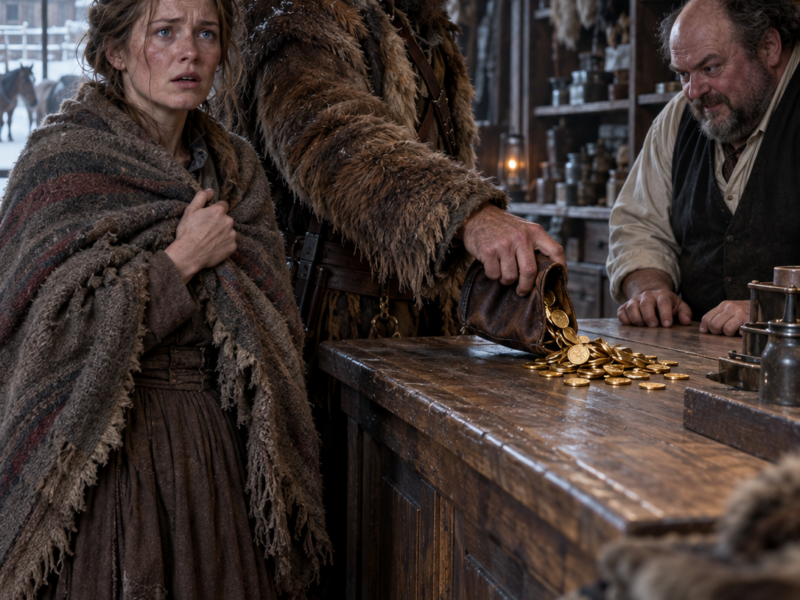
she paid eleven hundred dollars for the calf they said would die before the county line and eighteen months later the blackwoods stood silent while the measuring stick proved what none of them had been willing to see
Part 1
The sale barn outside Dillard smelled of wet straw, diesel, and the particular sourness of animals that had been standing too long in pens. By four in the afternoon the ring had emptied. The good lots were already loaded and gone. What remained were the animals nobody had wanted when the bidding was still honest.
Marin Hol walked the alley with her hands in the pockets of her jacket. She had driven ninety miles with eleven hundred dollars folded against her ribs and a single purpose: to come home with something that would not bankrupt her by Christmas. Her place sat on one hundred and forty acres of rolling grass her grandfather had bought in the 1950s. It had been hers alone for three years, ever since her father’s stroke put him in a care facility in Casper. She was thirty-one. She ran the operation with seasonal help and a ledger she understood better than she wanted to.
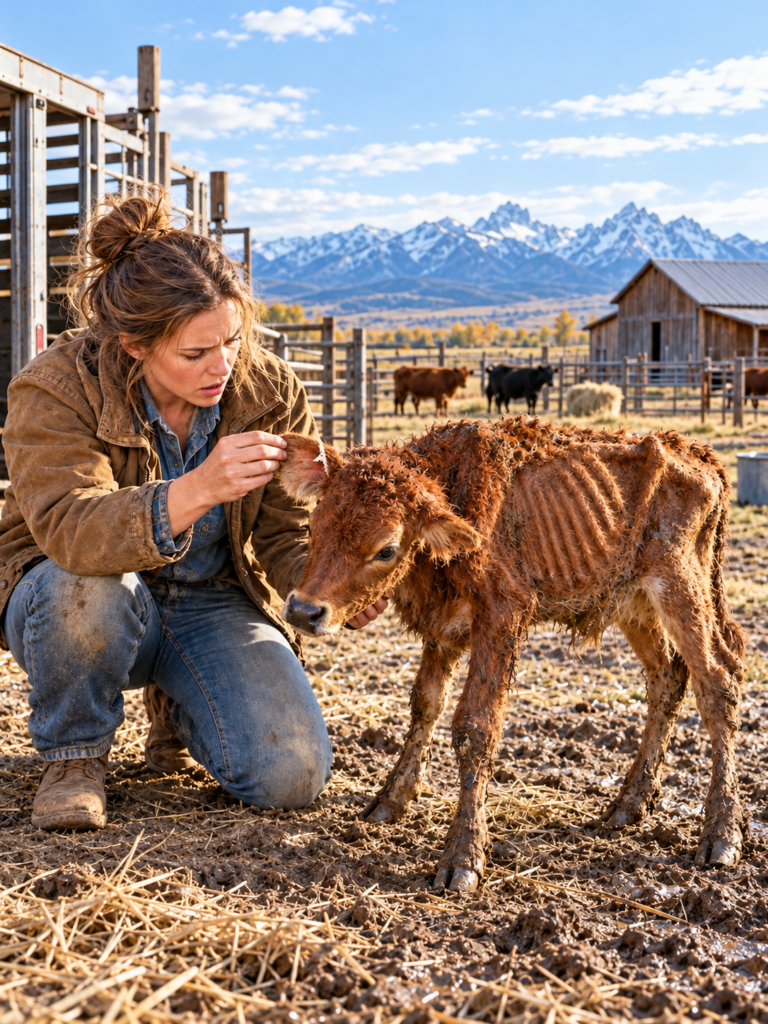
The last pen on the north wall was set apart. The calf in the corner was lying down with its head up, which was the only encouraging thing about it. Its ribs stood out in hard ridges under a coat the color of dirty straw. The coat was patchy along the flanks where it had rubbed itself raw. The eyes were sunk back. Marin had diagnosed dehydration from thirty feet away. Everything about the animal said the same flat thing: it had been set aside because setting it aside cost nothing and fixing it would cost plenty.
She crouched on her heels with her forearms across her knees and watched it the way she watched a weather front—patiently, waiting for it to show her what it was actually doing. After a minute something stopped adding up. The head was too big for the body, which happened in wasted animals, but the skull itself was broad through the forehead in a way illness did not create. The front feet folded under its chest were enormous. Not swollen. Not infected. Simply large, with heavy pasterns and a depth of bone through the cannon that did not belong on a frame that thin.
Wade Kesler found her there ten minutes later. He had run the Dillard sale for twenty-two years. He was fifty-five and he had a way of talking that cut directly to the part people did not want to hear. He leaned on the gate, looked at the calf, looked at her, and said she was staring at a four-legged veterinary bill.
“Came in sick,” he said. “Vet on duty wouldn’t pass it for the ring. If you want to be helpful you can walk away and let me handle it quietly.”
He did not say the word waiting at the end of the sentence. Marin asked how old it was. Wade said the paperwork called it a bull calf somewhere around seven months, maybe eight, and then he made a face that suggested the paperwork had been filled out by somebody in a hurry. She asked where it had come from. He said a consignment, one of several lots that had arrived together on a truck from the eastern part of the state. That was all he offered. At the time it did not strike her as an answer with anything hidden inside it. It struck her as the ordinary vagueness of a business where animals changed hands four times before anyone wrote anything down.
“What would it take to buy him?” she said.
That was the moment Preston Blackwood came down the alley with two men from Blackwood Crown Ranch walking a half step behind him. Preston was thirty-four. He wore a jacket that cost more than Marin’s trailer hitch. He had spent the morning buying four of the best bred heifers in the sale at prices that made the room go quiet. He saw her crouched near the back pen and laughed before he even looked at what she was looking at. Then he looked and he laughed harder and put one hand on the rail to steady himself.
“You shopping or performing a mercy?” he said.
She did not answer. He told her that if she wanted to raise a skeleton he had several out in the north pasture she could have for free. One of his men snorted in a way that was supposed to be quiet and was not. Preston went on for another thirty seconds, pointing out that the legs on that thing belonged on a mule and that whatever was wrong with it had already won.
Marin kept her eyes on the calf through all of it. Her face did nothing at all, which anyone who knew her would have recognized as the most dangerous expression she had. When Preston finally ran out of material and walked off with his men toward the office, she turned back to Wade and repeated her question about the price.
Wade named a figure that was not really a price. It was the paperwork cost of making an animal somebody else’s problem, and they both understood that. He said it almost reluctantly, like a man handing over a tool he knew would break. He also told her straight out that he was not warranting a thing, that the calf might be dead in the stock trailer before she hit the county line, and that he would not take it back.
Marin counted out the money, signed where he pointed, and went to back her trailer up to the loading chute. Behind her, through the open office window, she could hear Preston telling the story to someone who had not been there to see it.
It was while she was clipping the trailer gate that she noticed the ear. The left one had a notch torn through the lower edge, old and fully healed over, the kind of damage a tag makes when it gets caught and ripped out. But the tear was clean through the margin, almost straight, and there was no tag anywhere on the animal, not in either ear, and no tattoo she could find in the fading light. She stood there with her hand on the gate latch and thought about it for exactly as long as a tired woman with ninety miles ahead of her thinks about anything. Every commercial calf in that barn had carried some kind of identification. This one carried the place where identification used to be.
She named him Atlas the second night. Not out of any grand intention, but because he was standing in the corner of the sick pen holding his own head up like it weighed as much as the world did. It was a joke she made at two in the morning, and it stuck.
By then she had already called Dr. Silus Boon. He had practiced large animal medicine in that part of Wyoming for thirty-one years and answered his phone at odd hours because he had never learned how to stop. He came out the following afternoon in a truck with two hundred and forty thousand miles on it and said almost nothing for the first ten minutes.
What Boon prescribed was unglamorous: fluids, a course of antibiotics, dewormer, and a feeding schedule so conservative that Marin questioned it, because an animal in that condition can be killed by generosity faster than by neglect. The eleven weeks that followed ran on that schedule. There was no transformation, no single morning where the animal stood up healed. There were four feedings a day worked around every other chore on the place, which put her in that pen at five in the morning and again at eleven at night. There was the week in October when Atlas stopped eating entirely and she slept in her truck outside the barn with the window down so she could hear him. There was the morning she found him lying flat on his side and stood in the doorway for three full seconds before she saw his ribs move.
Word got around because word always gets around in a county with one feed store and one sale barn. By the middle of November the story of Marin Hol buying a dying calf at the Dillard sale had made it to every coffee counter within forty miles. And the story improved every time it was told. In some versions she had paid four hundred dollars. In some versions she had cried at the auction. In every version it was funny. And in every version it confirmed a thing that certain people already believed about a thirty-one-year-old woman running her grandfather’s place alone.
Marin heard most of it secondhand. She stopped going into the feed store on Saturdays, which was the only concession she made.
Part 2
Preston Blackwood made a point of stopping by in early December. He did not get out of his truck. He sat in the driveway with the engine running and the window down and offered, with great seriousness, to buy the calf off her for two hundred dollars to help her cut her losses before she had any more money in it. He said it the way a man delivers a rehearsed line.
Marin, who had by then spent close to nine hundred dollars on fluids, antibiotics, dewormer, and the specific milk-based supplement Boon had specified, looked at him through the open window and said, “No, thank you.”
Preston said the offer stood until it did not. Then he backed out of her drive fast enough to spray gravel across her fence line.
Sterling Blackwood was the one who said the sentence that Marin would carry for the next two years. She met him by accident in the aisle of the feed store in late January. Both of them reaching for the same brand of mineral tub. He was forty-seven. He owned eleven thousand acres and a genetics program that supplied bulls to four states, and he had the particular courtesy of a man who has never needed to be rude to win. He asked after her father and how the winter was treating her. Then he said he had heard about the calf and that he hoped she would take it in the spirit it was offered when he told her that ranching was a business.
Marin said she was aware of that.
Sterling nodded, set the mineral tub in his cart, and said that pity does not pay the feed bill. He said it kindly, which was somehow worse, and then he wished her a good season and walked toward the register.
She stood in that aisle for a while after he left. The infuriating part was that he was not wrong. She had put nine hundred and forty dollars into an animal worth, by any honest accounting, nothing at all. In a year when her hay costs had climbed nineteen percent and her bank was asking more questions than usual, she drove home doing the arithmetic. She fed Atlas that night anyway. At eleven, the same as always.
Boon noticed first in February. He had come out to pregnancy-check a group of her cows, and afterward he walked down to look at Atlas, who by then had been moved out of the sick pen into a small paddock with two older steers for company. Boon stopped at the gate and did not go through it. He stood there with one boot on the bottom rail and his head tilted slightly. Marin, who was pulling off her sleeve gloves, asked him what was wrong.
He said nothing was wrong. He said it in a tone that meant something was interesting, which from Silus Boon was practically a shout. He asked her to bring the calf up to the chute. Then he did something he had not done once during the entire medical course of treatment, which was measure him. He measured the height at the hip. He measured the height at the shoulder. He ran the tape around the heart girth. And he wrote all four numbers on the back of an invoice because he did not have anything else. Then he measured the hip height a second time with Marin holding the tape as though he suspected his own hands.
He looked at the invoice for a long moment. He asked her very carefully whether she was certain what the sale barn had said about the calf’s age. Marin told him what Wade had told her, which was seven or eight months at the time of purchase, making him roughly eleven months now.
Boon did not respond right away. When he did, he said that the numbers on the invoice were consistent with an animal of that age in the sense that a tall tree is consistent with being a tree. He explained that skeletal growth in cattle follows patterns that are stubborn and predictable. That frame score is largely set by genetics rather than nutrition, and that an animal who had been nutritionally wrecked for months should be behind the curve for his age, not ahead of it.
Atlas was not behind the curve. Atlas had been starving and had still outgrown every other animal in his paddock.
He told her not to make anything of it yet. He said growth could surprise people, that age estimates from sale barns were frequently wrong by months in either direction, and that one set of measurements proved nothing. But he asked if she would mind if he came by every six weeks and took the numbers again, and he said it casually enough that Marin almost missed how uncasual it was.
She said that was fine.
After he drove off she stood at the paddock gate for a while and looked at the animal she had been feeding four times a day since October. And for the first time she looked at him the way she had looked at him in that back pen, which is to say as a set of facts instead of a responsibility.
By the following June, eight months after she had brought him home, the facts had become difficult to ignore. The coat that had been the color of dirty straw had shed out into a deep, even red-brown that lay flat and bright across a body that had filled in everywhere it was supposed to. He had depth through the chest, a long level top line, and a hind quarter that had developed with a kind of symmetry that even a person with no interest in cattle would have found pleasant to look at. The ridiculous legs were still long, but they no longer looked ridiculous. They looked like the right legs, finally attached to the right animal.
He stood sixty-one inches at the hip, a full six inches taller than the two older steers sharing his paddock. Both of whom had been born four months before he was.
Preston Blackwood found out in July at the Fourth of July roping in Dillard when somebody mentioned offhand that Marin Hol’s dead calf had turned out to be about the size of a horse. He laughed naturally. Then two weeks later he had business on the north end of the county, and he took the long way home, which happened to run past Marin’s place, and he slowed down at the fence line. Atlas was standing broadside, about forty feet off the road with his head over the top wire. Preston stopped the truck completely. He sat there for eleven seconds with his foot on the brake, and his face did something that nobody was present to see.
He got out. Marin came down from the equipment shed because she had heard a truck door and she found him standing at her fence with his hands on his hips looking at the animal without any of his usual arrangement of expression. He asked her in a flat voice how old it was. She told him. He asked what she was feeding it. She told him that too, which was grass and a modest ration, nothing exotic. And she watched him process that answer. Then she watched him put his face back on.
He said that big does not mean good, that there was a reason real programs selected for moderation and that she should be careful not to confuse a tall animal with a valuable one.
Marin said she had not confused anything.
Preston said he would see her around and drove off, and the exchange would have been forgettable except for those eleven seconds in the truck. Marin thought about them while she walked back up to the shed. She had known Preston Blackwood in a distant way since high school, and she had been on the receiving end of his opinions a dozen times. And in all of that she had never once seen him look at something and go quiet first. Contempt, she understood. Contempt was cheap, and he spent it freely. What she had seen at the fence was not contempt. It had looked for just a moment like alarm.
Part 3
Nine days later a man named Dale Everett knocked on her door. He worked for Blackwood Crown Ranch in a capacity he described as acquisitions, and he had come to make an offer on the red bull in the east paddock. He said eighteen hundred dollars.
Marin, standing in her doorway in a sweat-stained shirt, asked him to repeat it. He added that it was a generous number for an animal with no registration papers, no known sire, no performance data, and a documented history of serious illness, and that Blackwood was prepared to pay it simply because Mr. Blackwood admired an impressive-looking animal.
She told him she would think about it. She did not think about it for long because the arithmetic was obvious and ugly in a way that had nothing to do with the money. Eight months earlier the same operation had offered her two hundred dollars to take the problem off her hands as a kindness. Now they wanted to pay nine times that for an animal they had already told her twice was worthless. Nothing about Atlas had changed except that he had become visible.
She called the number Dale Everett had left and declined.
Four days after that he called her back and said the offer was now thirty-two hundred. That was the moment the whole thing stopped being a nice story about a recovered calf. Marin sat down at her kitchen table with the phone still in her hand and worked through it the way she worked through a feed contract. Blackwood Crown Ranch had the resources to buy any impressive animal in four states without ever driving down County Road 14. They did not need a grade bull with no papers. And even if they had, the bidding would not have doubled in ninety-six hours over an animal whose only documented quality was that he was tall.
Somebody over there knew something.
She told Dale Everett no again. And then she called Silus Boon.
Boon came the next morning and spent two hours with Atlas in the chute, which was longer than he had spent with him at any point since the animal was dying. He went over him inch by inch with a thoroughness that Marin found almost uncomfortable to watch. He checked the teeth and revised his age estimate downward by a month. He checked the testicles, the feet, the joints, the hair whirl on the forehead. And then he spent eleven minutes on the left ear, turning it in both hands, holding it up against the light coming through the barn door, running his thumbnail along the healed margin of the notch.
He said it was not a tear.
Marin asked what he meant.
Boon said that when an ear tag gets ripped out by a fence or a feeder, it leaves a characteristic injury, a splitting along the grain of the tissue that heals into a ragged V. What Atlas had was a clean removal of a section of the ear margin healed over with scar tissue that ran straight across. He said it was consistent with somebody taking shears to it. And he pointed out something Marin had never thought to check, which was a faint flattened area on the right ear where a tattoo might once have been applied and then abraded.
Neither of them said the obvious thing out loud, which was that somebody had deliberately broken the link between this animal and a record.
Boon pulled hair follicles from the tail switch, bagged them, and filled out a submission form for a genomic panel through a laboratory in Nebraska that he had used for twenty years. The test would run a parentage verification against their database and return a breed composition profile. He warned her twice about the limitations. If Atlas’s parents had never been genotyped, the parentage portion would come back empty, and they would learn nothing except what breeds were in the mix, which they could mostly guess by looking at him. He said results typically took three to five weeks, sometimes longer in the fall when everybody was testing. He sealed the envelope.
The waiting started on a Tuesday in early August. It lasted six weeks and they were not quiet ones. Atlas kept growing, which by then had stopped being surprising and started being slightly unnerving. In September he passed sixty-four inches at the hip, and the two steers in his paddock had begun to behave around him the way cattle behave around something that occupies more space than they do. A woman driving her kids to school took a photograph of him standing at the fence and it went around among the ranching families in the county, passed from phone to phone at ball games and church and the co-op, and the way people talked about him turned over completely. For almost a year he had been Marin Hol’s sick calf. Now the question everybody was asking was what in the world she was raising out there.
Sterling Blackwood came himself on the twenty-second of September. He arrived alone in a clean truck, and he did not sit in the driveway with the engine running the way his nephew had. He got out, closed the door, and waited by the gate until Marin walked down to him, which was a courtesy that cost him something, and which she noticed. He was not laughing. There was none of the gentle amusement from the feed store aisle. He looked at Atlas for a long moment and then he turned and offered her nine thousand dollars cash payable that afternoon. Trailer provided.
Marin asked him a question instead of answering. She asked why he wanted an animal that his own family had twice told her was not worth the feed it would eat.
Sterling said that circumstances change and that an operation like his had room for a genuinely impressive individual, that there was promotional value in a herd sire with presence and that he was prepared to pay for presence. It was a reasonable answer delivered reasonably. It was also, Marin knew, completely insufficient to explain a man of his position standing in her driveway personally on a Tuesday afternoon with nine thousand dollars he was willing to hand over without a veterinary inspection or a breeding soundness exam.
She said no.
Sterling asked her what number would move her and she said there was not one until she understood why he was asking. And for the first time in the two decades she had known of him, Sterling Blackwood’s composure slipped. It was not dramatic. His jaw set, and he looked past her at the paddock for perhaps four seconds, and when he spoke again his voice had an edge in it that had not been there before. He told her that she was going to do with that animal what people without resources always do, which is hold on to something too long and lose the window. Then he thanked her for her time and left.
Wade Kesler called her that Friday night. He had been thinking about it for a month, he said, and he had finally gone back through his own records from the previous fall, and there was something he should have told her at the time, and had not, because at the time it had not seemed to matter. The load Atlas came in on had not been an ordinary commercial consignment. It had been part of the asset liquidation of the Howard place out of Converse County, a seedstock operation that had been breeding cattle for thirty-eight years and that had collapsed after the owner’s death and a family dispute that ran eighteen months in probate.
Wade explained what that kind of liquidation looks like from the inside, and it was not pretty. The herd had been dispersed in pieces by a court-appointed administrator with no cattle background. Registration certificates lived in a filing cabinet in a house that had been emptied and sold. Animals had been moved twice before they reached him. Once to a holding facility where they were commingled with cattle from two other estates. The sick ones had been sorted off and sent through as salvage because that was simplest. Wade said he had received forty-one head on that truck with paperwork for twenty-six and that nobody had been able to tell him which was which.
She sat in her kitchen for an hour after that call and the shape of the whole year rearranged itself in front of her. She had spent eleven months believing a thing that everyone around her also believed, which was that Atlas had been cheap because he was bad. That was not what had happened. He had been cheap because nobody could prove he was anything. His illness had been the perfect camouflage, not because it made him look worthless, but because it gave every person who glanced at him a sufficient reason to stop looking. An animal with no papers and a bad coat and sunken eyes is not a mystery. It is an answer. That was the whole trick of it, and it had worked on dozens of people in one afternoon.
Part 4
Four days later Silus Boon called her at six in the morning and asked her to come to the clinic. He had the laboratory report on the desk when she got there in a plain envelope, and he did not hand it to her immediately. He asked her to sit down first, which was not Boon’s style at all. Then he told her what the panel had come back with.
The breed composition was not a surprise in its broad strokes. A predominantly continental profile heavy with Chianina and Maine-Anjou influence over a British base, which was exactly the recipe a person would use if their explicit goal was extreme frame and mature size. Boon said that was the easy part. The hard part was the parentage section. He said the laboratory had found a match. Not a probable one, not a statistical suggestion, but a verified sire match against an animal already genotyped and stored in their database because that animal had been tested years earlier as part of a commercial breeding program.
He turned the page around so she could see the registered name printed in the field, a long string of letters and numbers ending in a herd prefix. Marin read it twice. Then she looked up at Boon, who was watching her with the expression of a man who had known this for forty minutes and had not yet decided how he felt about it.
The prefix belonged to Blackwood Crown Ranch.
The next eleven days were spent in county offices, on the phone with a probate attorney in Douglas, and at a kitchen table in Converse County belonging to the late Ray Howard’s daughter-in-law, who turned out to be relieved that somebody had finally asked. The picture that came together was not a conspiracy. It was something more ordinary and in some ways more damning. Between 2018 and 2022, Blackwood Crown Ranch had run a cooperative breeding arrangement with the Howard operation, placing semen from three of their sires over Howard cows in exchange for first option on the resulting bull calves. It was a standard arrangement. It had produced, by all accounts, some exceptional animals. Atlas had been one of them. He had been born in March of the previous year out of a Howard cow by a Blackwood sire named on that laboratory report, and by the terms of the agreement he was exactly the kind of calf the entire arrangement existed to produce.
Then Ray Howard died in October. The family went to war over the estate and the cooperative program dissolved inside a probate filing. Like everything else, the calves from that cross were scattered through three sales in two months. Nobody at Blackwood went looking for them because by then Blackwood’s attorneys had advised the ranch to treat the whole Howard relationship as a liability and disengage.
The ear was the only part that stayed ugly. The most likely explanation, which the daughter-in-law offered without being asked, was that somebody working the dispersal had been pulling tags off animals to break them loose from disputed inventory lists, a crude trick to move stock that was supposed to be frozen by the court. It had probably been done to a dozen head. It was also entirely possible that Atlas’s tag had come out on its own and been trimmed by somebody for a reason now unknowable. Marin decided she would never have certainty on that point and that it did not actually matter. The tag had come off. The record had broken. The animal had ended up in a back pen and Preston Blackwood had walked past that pen.
That was the piece that Marin turned over the most because it was the piece that explained everything afterward. He had stood six feet from a bull calf carrying his own ranch’s sire line and he had seen a skeleton because a skeleton was all he had looked for. Then ten months later he had stopped his truck at a fence line and seen the same head and the same enormous feet on a healthy frame and he had recognized the type instantly because recognizing the type was his literal job.
Nobody had cheated Marin Hol and nobody had cheated anybody else. The Blackwoods had simply been so certain of their own eye that they never thought to look twice, and their certainty had cost them.
Boon, when she laid all of it out for him, was careful about what he let her conclude. He told her that having a verified sire of consequence did not make Atlas worth a fortune, and that she needed to hear that clearly before anybody else told her otherwise. He said there were thousands of animals in this country with good sires behind them and most of them were ordinary. What made Atlas unusual was narrower and more specific than that. It was the combination of three things, none of which was impressive alone, and all of which together added up to an individual you might not see twice in a career if you were paying attention.
The first was the size itself. Documented now across fourteen months of measurements in Boon’s handwriting, a mature frame score at the extreme upper edge of what the breed associations even had a category for. The second was that the size was clean. He was not coarse. He was not structurally compromised. His feet and joints were sound under all that mass. And he moved well, which is the thing that usually fails first in an animal that large. The third was the pedigree verification, which meant that what he was could be explained rather than merely admired.
Boon said that an animal like that was not a lottery ticket. It was a tool, and tools have narrow real value to the few people who need exactly that tool. But the part Boon kept coming back to, the part he said twice in that conversation, was this. Marin had bought Atlas before any of it was knowable. She had not bought a pedigree because the pedigree had been invisible and would have stayed invisible without six weeks and a laboratory in Nebraska. She had not bought potential in any rational sense because every honest professional in that barn had assessed the animal correctly as a bad risk. She had looked at a dying calf and seen a wide forehead and heavy bone and had decided that was worth eleven hundred dollars and eleven months of her life to find out. If Atlas had turned out to be nothing, she would have fed him anyway until he died or didn’t.
Part 5
The county livestock exposition was held the second weekend of October at the fairgrounds in Dillard, and Marin entered Atlas in the open class for the measurement and evaluation program, which was a minor part of the event that mostly served as a way for operations to get third-party data on their stock. She had not entered an animal in anything in six years. Her hired hand, a twenty-year-old named Cody Ror, helped her wash and clip him on the Thursday, and they drove in Friday morning with Boon following in his own truck because he had refused to miss it, and had also refused to say why in those words.
Blackwood Crown Ranch had four head entered, and Preston was standing with them near the north end of the barn when Cody backed the trailer to the unloading area and dropped the gate. And the sound in that end of the barn changed. Atlas came down the ramp slowly, the way he always came down a ramp, placing each foot deliberately because he had been doing that since the night she first loaded him. He was two months short of two years old. He stood sixty-eight inches at the hip and weighed, on the scale at the co-op the previous week, two thousand four hundred and ten pounds. He was not fat. He was not deformed or bloated or grotesque in any of the ways that people sometimes mean when they say an animal is enormous. He was simply correct and then scaled up past the point where correct stops being ordinary.
Somebody near the alley said a word out loud that got repeated down the row. A man who had been loading a feed cart stopped loading it. The conversation at the north end of the barn did not continue, and Preston Blackwood stood with one hand resting on a gate latch and watched the animal he had declined to look at in a back pen four hundred feet from where he was currently standing walk past him under halter, led by a woman he had called a skeleton collector in front of six people. He did not say anything. There was nothing available to say that would have helped him.
The official measurement happened at eleven on Saturday, conducted by two association representatives with a calibrated stick and a scale, with the numbers recorded on a form and witnessed. They measured him twice because the first number required it, the same way Boon had required it fourteen months earlier in a barn at the end of a bad winter. When the second reading matched, one of the representatives stepped back and looked at the animal for a moment without writing anything, which is the professional version of the sound the feed-cart man had made.
The figure went on the board at the front of the barn with the rest of the day’s results. Atlas was recorded as the largest individual present at the exposition that year by a margin of nine inches at the hip over the next animal, and the representative noted on the form that he was, to the association’s knowledge, the largest documented individual among all participating operations in the region. There was no trophy. There was no ceremony. There was a form on a clipboard and a number on a whiteboard in a drafty barn in Dillard, Wyoming, and it was in every way that counted to the people in that building the end of an argument that had started in a back pen on a Tuesday afternoon eighteen months earlier.
Sterling Blackwood found her by the trailer at four after most of the crowd had thinned out. He had his hat in his hand, which Marin thought was overdoing it slightly, and he asked her plainly and without preamble what it would take. He named a number first this time, instead of waiting, a serious number, the kind that would have retired her operating note and put a new roof on the barn and replaced the swather she had been nursing through four seasons. He said he would also put her name on the animal’s record permanently. He said he thought that was fair, and by any measure available to him it was.
Marin said no.
He asked her why, and he asked it like a man who actually wanted the answer rather than like a man closing a deal. And so she gave it to him. She said he had told her something in the feed store aisle about twenty months ago and that she had thought about it a great deal since. She said he had been right. Ranching was a business. She said it without any edge because she had stopped needing one.
Sterling nodded slowly, the way a person nods when they know a sentence is not finished. Then she said that if she had looked at Atlas as a number on that Tuesday in Dillard, he would not be standing in this trailer today because the number had been zero and every single person in that barn had calculated it correctly. She said the arithmetic had not been wrong. The arithmetic had just been incomplete, and the only reason she had the rest of it was that she had crouched down and stayed there for one minute longer than anybody else was willing to.
Sterling Blackwood did not answer. He stood there in the October light with his hat in his hand and said nothing at all, and the silence did more than any argument she could have constructed.
The story moved through the ranching community that winter the way the first version had moved through it the year before, except that now the joke was pointed in the other direction, and the people who had told it originally were the ones who had to sit through it. Sterling, to his credit, did not hide. He addressed it directly at a cattleman’s association dinner in January, and what he said was harder on himself than on his nephew. He said the family had made an evaluation error that the operation’s own protocols should have caught, that a sale barn is the one place where you look at every animal regardless of how it presents, and that they had become comfortable enough to skip steps.
The attention that came to Marin’s place was more than she wanted, and she was honest about that. Three operations contacted her about genetic access. Within a month a feed company offered a sum for a promotional campaign that made her laugh out loud on the phone. Two people suggested she tour him, which she declined so quickly that one of them asked whether she had misunderstood. She had watched what the previous twenty months had done to that animal’s body, and she had a clear idea of what a transport schedule would do to his joints.
What she did instead was work out an arrangement with Silus Boon, who had, in a sense, been quietly auditioning for it since the first set of measurements on the back of an invoice. They structured a limited breeding program on her place with Boon managing the veterinary side, a fixed cap on collections per year, mandatory rest intervals, and a provision that Marin wrote in herself stating that if the animal’s soundness declined, the program stopped immediately regardless of demand. Her attorney told her the clause was unnecessary and would cost her money. She left it in. It ended up being the thing that made two of the three serious operations want to work with her more, not less.
Wade Kesler brought her the photograph in March. He had been going through a box of material from the Howard dispersal that the administrator had never collected, mostly worthless. And near the bottom he found a stack of printed photos that somebody at the Howard place had taken for their own records. One of them showed a group of spring calves on grass with their dams. He had circled one in pen. It was a dark red calf, maybe three months old, standing beside a big-framed cow with her head down grazing. And on the back somebody had written a date and a pasture name in blue ink.
Marin took it to the window to see it better, and what she found there did something to her that none of the laboratory reports had managed. The calf in the photograph was healthy. Bright-eyed, slick, well-grown, standing square on grass in May sunshine, with no illness anywhere in him yet, and the legs were already too long. The feet were already enormous, heavy and wide beneath a body that had not grown into them, exactly the way they had been in that back pen in Dillard eight months later, when forty people walked past and saw a dying animal.
She stood there a long time with that photograph. The thing she understood, standing at her kitchen window in March with her thumb over the corner of a printed picture, was that there had never been a transformation. Nothing had turned into anything. The frame that made Atlas the largest documented animal in the region had been on him before he was ever weaned. Before the dispersal, before the fever, before the knife on his ear, before he was carried in a trailer to a sale barn and set aside as a loss. Every single piece of evidence had been visible the entire time in plain light on a healthy calf in a pasture in Converse County.
She put the photograph in the drawer with her grandfather’s brand registration and went back outside to finish the fence. She was still finishing that fence a year and a half later on an evening in late September because the west line had never once in four generations been finished. The light was doing the thing it does in Wyoming in the fall, coming in low and gold across the grass and making everything look better than it is. She had the stretcher clamped and was working the wire when she heard the slow sound of hooves on dry ground behind her and did not turn around because she had heard that particular sound several thousand times and knew exactly what was making it.
Atlas walked past her at a distance of about fifteen feet. Unhurried, on his way to the water tank. He was four years old and fully mature. His back passed nearly level with the top wire of the fence she was rebuilding and his shadow went across her and the post and the stretcher and kept going. He paid her no attention at all, which was its own kind of compliment, and the ground moved slightly under her boots the way it always did. He drank for a while. Then he stood there in the gold light looking out across the country, enormous and calm and entirely unaware of a single thing that had ever been said about him.
A car came down County Road 14 and slowed and stopped on the shoulder. Marin heard it and glanced over and a man was leaning across his passenger seat with his phone up to the window, taking a picture through the glass. He saw her looking and gave her an apologetic wave and she lifted her hand back and he took two more pictures and drove on. It had happened thirty times that year. Two years earlier people had also stopped on that road to look at Atlas. They had stopped for a completely different reason, and some of them had been laughing before they got their windows down.
She went back to the wire.
The thing was, when she thought about him, which was not as often as people assumed, the picture in her head was almost never this one. It was not the exposition barn or the number on the whiteboard or Sterling Blackwood standing in the October light with his hat in his hand. It was a cold pen in October with a bare bulb overhead and a skinny red calf lying on his side at eleven at night with his ribs barely moving and a woman sitting on an overturned bucket with a notebook on her knee writing down a temperature, having no idea whatsoever whether any of it was going to amount to a single thing.
Real worth does not always arrive in a shape that makes people stop and admire it. Atlas stood in an auction pen on an ordinary Tuesday, and dozens of capable, experienced people walked past him, and every last one of them saw the same animal. Most of them saw sickness, expense, and risk, and they were not foolish for seeing it, because all three were genuinely there. Marin Hol saw those things too. The only difference between her and everyone else in that barn was that she looked one more time. That is the whole distance between a loss and a legend. And it is much shorter than anybody wants to believe.