
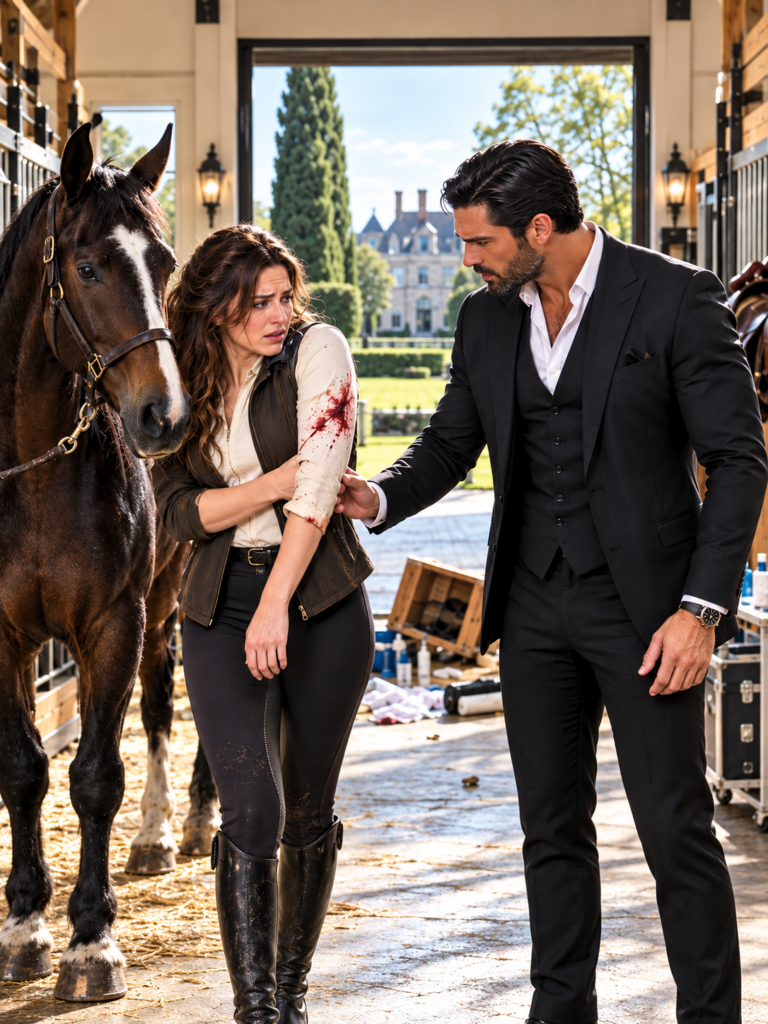
The first thing Rowan Sheehan noticed about Ashgrove was that nobody had swept the front steps in weeks.
The second was that someone had left a bowl of oats out for a fox that was not a fox at all.
She stood at the bottom of the drive with her bag over one shoulder, watching the large gray house shift between shadow and gold as the evening light moved across it, and thought: whoever runs this place is either drowning in his problems or doesn’t care what anyone thinks.
It turned out both were true.
“You’re the horsewoman.”
A voice spoke behind her. It was not quite a question.
She turned.
He was younger than she expected, maybe in his mid-thirties, wearing clothes that looked as though he had come straight from the stables, sleeves rolled above forearms that had done real work.
Declan Cavanagh.
She had seen his photograph only once, in a racing supplement three years ago, standing beside his father with a smile that had never reached his eyes.
“Equine rehabilitation specialist,” Rowan said. “But horsewoman will do.”
Something flickered at the corner of his mouth and disappeared before it became a smile.
He did not offer his hand, and she had not expected him to.
She had read enough about the Cavanagh family to know that Ashgrove did not welcome strangers so much as tolerate them temporarily, the way it tolerated weather.
“Midnight Rail is in the east block,” he said. “Won’t let anyone near his right hind leg. Three vets have tried.”
“I heard.”
“You didn’t ask why.”
“I don’t need to know why yet,” she said. “I need to see how he stands before anyone starts telling me stories about him.”
He looked at her for a second, long enough to make her feel as though she were being weighed on a scale whose numbers she could not see.
Then he turned and started walking, and she took that as the closest thing to an invitation she was likely to get.
Midnight Rail was seventeen hands of coiled distrust.
The moment Rowan stepped into his stall, he swung his hindquarters toward the wall so quickly that a thin stable hand with a nervous laugh nearly fell over the half-door getting out of the way.
“That’s Cormac,” Declan said from a safe distance. “He’s been looking after him since the injury.”
Cormac did not quite meet her eyes.
“He was quiet with me for months. Then last week he suddenly stopped letting anyone near that leg.”
Rowan did not answer immediately.
She crouched at the threshold, slow and low, and let the horse look at her for a long time before she said anything.
His ears were pinned, but not completely.
Pinned the way ears get when an animal is preparing to defend itself rather than attack.
There was a difference, and most people never learned to see it.
“He isn’t vicious,” she said at last. “He’s guarding something. The question is whether he’s guarding the leg or the memory of the leg.”
Declan stood with his arms folded outside the stall.
“Does it matter which?”
“It matters a great deal.”
She left it there because she had learned a long time ago that explaining yourself to men who had not actually asked rarely accomplished much.
Instead, she went back to watching the horse.
Somewhere at the edge of her awareness, she knew he was watching her watch him.
It was not an unfriendly look.
More like a man taking inventory, placing her beneath a heading he had not chosen yet.
On the second morning, a young filly went down hard in the training ring, tangled in a badly tied lead rope.
By the time Rowan reached her, the filly was on her side, kicking wildly, eyes rimmed white with panic.
Two of the younger grooms stood frozen by the fence, shouting things that only made it worse.
Rowan did not shout.
She dropped to her knees in the mud, close enough for the filly to see her without strain, and started humming in a low, steady voice.
Not a tune.
Just a sound she had used a hundred times with animals too frightened to hear words.
It took less than a minute for the thrashing to ease and another two before the filly settled enough for Rowan to free the rope.
When she stood, mud covering her to the elbows, Declan was at the fence where the grooms had been shouting moments before, arms folded, watching her with an expression she had not seen on him yet.
Not the wary appraisal of the first night.
Something clearer.
Attention.
As though he had learned a fact about the world and intended to keep it.
“You didn’t touch her until she was already calming down,” he said.
“Touching a panicked animal too early gives the panic something to fight,” Rowan said, wiping her hands on her jeans.
“Same with people, usually.”
“Professional opinion or personal?”
“Ask me again in a month.”
She walked toward the wash area before he could see how close the question had landed.
He did not ask again that month, but after that morning she noticed he stopped standing at a polite distance during her sessions with Midnight Rail.
He began leaning on the fence close enough that she could hear him breathe.
Close enough that whatever sat between them stopped being quietly professional.
No one told her when dinner was, so she assumed there was no dinner.
By eight, she was still in the tack room, studying Midnight Rail’s file beneath a bare bulb and eating a granola bar from the bottom of her bag.
At half past eight, the door opened and Bridie, the housekeeper, came in.
Broad-shouldered and deliberate, she had introduced herself with the expression of a woman who had assessed better people than Rowan and found them inadequate.
She set a plate on the worktable without a word and left.
Shepherd’s pie.
Still steaming.
Rowan looked at the door Bridie had gone through, then at the plate, and felt a small, unwelcome tightening in her chest when she realized someone had noticed she had not eaten.
She mentioned it to no one.
She thought about it far longer than a shepherd’s pie deserved.
The days took on a shape she had not expected.
Ashgrove ran on a fixed rhythm.
Feed at six.
Training at seven.
The low murmur of the radio in the yard.
Bridie’s bell for staff lunch at one.
Within four days, Rowan found herself inside that rhythm without ever quite agreeing to it.
She worked with Midnight Rail every morning for ten minutes at a time, never touching his leg, only teaching him that her hands approaching his body did not mean pain was coming.
Declan appeared most mornings.
He never announced himself.
He simply stood there, leaning on the rail, arms folded, watching in a silence that unsettled her at first and then gradually stopped feeling like observation and began to feel more like company.
On the fifth morning, without taking her eyes off the horse, she said, “You never ask how it’s going.”
“You’d tell me if it wasn’t going well.”
“That’s an assumption.”
“It’s a wager. I’ve been told I’m good at reading which horses are worth the money before the sales ring proves it. Turns out the same trick works on people.”
“And what’s your reading of me?”
He was silent so long that she turned to look at him.
He was watching the horse, not her.
His jaw was tight in the way it gets when a person chooses the honest answer instead of the easy one.
“That you don’t like anyone taking care of you,” he said. “Someone once made you feel like a burden for needing help, and you’ve been trying to prove them wrong ever since.”
Rowan’s hand went still on the horse’s shoulder.
“That’s a very precise reading for five days’ acquaintance.”
All he said was, “I’ve had practice.”
He did not explain further.
She found herself not pressing.
There was a kind of privacy in an indirect answer like that.
The privacy of someone protecting a wound rather than a secret.
She knew the difference.
She lived on the wrong side of it herself.
She came to know Ashgrove the way you come to know a house: by living in it rather than having its history told to you.
That Declan had not fired a single employee left over from his father’s time, even the ones everyone quietly resented, because loyalty meant more to him than efficiency.
That he ate standing up most days, like a man who had trained himself not to sit down for anything.
That when the phone rang late, and it often did, with low, urgent voices slipping through the stone hallway, his whole posture changed.
His shoulders rose toward his ears as though bracing for news he had survived once before and was not sure he could survive again.
She never asked about that first call years ago, the one that had left a mark on him she could see from across the stable yard.
But one rainy evening, when the rain came slanting down from the hills and they were sheltering beneath the feed room awning because they had both been caught outside at the wrong moment, he told her anyway.
“My father went to prison when I was nine,” he said, watching water pour from the gutter. “Someone he’d trusted for fifteen years gave everything to the guards. Every ledger. Every name. Every horse that wasn’t really just a horse. It cost him six years. Cost us the good name we’d spent two generations building.”
“Who was it?”
“His own brother.”
Declan’s voice did not change, which somehow made it worse than if it had.
“He sat at our Sunday table for a decade wearing a wire.”
Rowan said nothing for a moment.
The rain kept falling.
“So now,” she said slowly, “anyone hiding something from you is standing exactly where your uncle stood.”
“I know how that sounds.”
“It sounds like a reasonable thing to be afraid of. It doesn’t sound fair to make everyone else answer for it.”
He looked at her then, carefully, in a way he had not quite allowed himself before.
“No,” he agreed. “It doesn’t.”
“What happened to him? Your uncle?”
“He’s dead now. It wasn’t us, if that’s what you’re asking. His conscience did more damage than we ever would have. Spent the last ten years of his life drinking himself to death in a flat in Cork, and my father never went to see him. Not once. Not even at the end.”
He said it coldly, like a fact recited rather than a feeling lived.
“I used to think that was what made my father strong. Now I think it meant he never let himself finish being angry, so it had nowhere to go except into us.”
“Is that where the late-night phone calls come from?”
He looked at her, surprised she had noticed, then clearly decided not to bother pretending otherwise.
“Some of them. My father’s health isn’t what it was. When the phone rings after eleven, there’s about a one-in-three chance someone’s telling me this is the night I have to drive to the hospital and find out how much of him is left when I get there.”
“That’s a hard way to get used to answering a phone.”
“What kind of fear is worse, waiting for it or having it happen?”
He looked at her sideways.
“I’d say you know something about that.”
In the charged silence that followed, she thought she owed him something real in return.
A fair trade.
Wound for wound.
For one unguarded second, she nearly did it.
Nearly said: I know what it is to have people look at you differently once they decide you’re breakable.
Nearly told him about the fall five years ago that ended her competitive career.
Not because her body failed her, but because a room full of people had decided, after one bad landing, that she could never again be trusted with a horse’s life.
How the whispers had followed her out of every stable in the country until there was nowhere left for her to go except the shadows, fixing horses others had given up on.
Invisible.
Useful.
Safe.
She did not say it.
The moment passed.
The rain eased.
Cormac came running across the yard with a question about a feed order.
And what might have been said remained unsaid.
The night of the raid, Rowan was in the east block at half past eleven because Midnight Rail had not eaten his feed and she wanted to watch him before allowing herself to sleep.
She heard the vehicles before she saw them.
No headlights.
Engines cut early.
Coasting the final distance over the gravel.
Not the way anyone came to Ashgrove with good intentions.
She had just enough time to hide in the feed room before three men entered through the yard gate.
They were not careful.
One went toward the equipment room.
Another toward the office block.
The third, young and nervous and obviously new to this kind of thing, headed straight for Midnight Rail’s stall with a syringe in his gloved hand.
Rowan understood, with a clarity faster than fear could catch up to, exactly what she was seeing.
It was not theft.
It was a message.
If you crippled Cavanagh’s only promising Grade One horse three weeks before the family’s biggest comeback race, you were not just taking a trophy from them.
You were taking the legitimacy they were trying to win back with it.
She stepped out of the feed room before she had consciously decided to.
“Stay away from him.”
Her voice came out steadier than she felt.
The young man spun around, startled.
The syringe went one way and his gloved hand went the other, straight toward her, driving her into the doorframe hard enough that she felt something tear in her upper arm before she understood it had not been a fist.
It was a grazing gunshot fired at close range and badly aimed.
The shot had been meant for the stall door.
It caught her instead when she threw herself between the gate and the animal.
The alarm bell old Tom rang from the yard cottage sent all three men scattering into the dark faster than they had come.
The whole thing lasted maybe ninety seconds.
Rowan stood in the empty yard with one hand pressed to her sleeve, breathing hard, and made a decision in the time it took the ringing in her ears to fade.
No one could know what had really happened here tonight.
Not yet.
Not until she understood who inside this house had known the raiders were coming and when.
Because someone had known.
The gate had been left unlocked.
The dog had not barked.
And the only people with access to that information were people who ate at Bridie’s table.
She wrapped clean gauze around her arm in the tack room, tight enough to stop the worst of the bleeding, and told the house in the morning that Midnight Rail had spooked and knocked her against the door.
No one questioned it.
No one except Declan, who looked at the line of gauze beneath her sleeve for one second too long and said nothing at all.
It held for four days.
She kept the wound as clean as she could.
Convinced herself it was superficial.
Told herself she had treated worse while dressing injured animals with nothing but a first-aid kit and stubbornness.
She kept training the horse.
Kept following the house routine.
And kept meeting old Tom in the walled garden after dark.
Twice.
Because old Tom, seventy-one years old and the only person at Ashgrove who had outlived the family grudges, quietly told her he had seen Cormac slipping toward the boundary wall a week before the raid to meet a strange car.
On the second of those four nights, Declan found her in the tack room after midnight, unable to sleep because of the pain in her arm, oiling a bridle she had already oiled twice that week because her hands needed something to do.
“You should rest that shoulder,” he said, leaning against the doorframe.
“I am resting it. This is very restful.”
He came in anyway and gently took the bridle from her hands and put it aside.
For a moment, neither of them said anything.
The single lamp buzzed overhead.
The smell of leather and hay lay thick around them.
He reached out, slowly enough that she could have stopped him, and brushed a piece of straw from her hair.
His hand stayed a moment longer than the gesture required.
“I don’t know what to do with you,” he said softly, almost to himself.
“You could start by not treating me like a puzzle.”
“I could.”
His thumb traced the line of her jaw, just once.
“But I’ve never met a puzzle I wanted to keep looking at.”
She did not pull away.
For one held breath, she thought he might close the distance between them completely.
A reckless part of her wanted him to, badly enough to frighten her.
But the guard dog barked at something in the dark, and the moment vanished the way moments usually do.
All he said was, “Sleep. That’s an order, not a request.”
And he left her standing there with her heartbeat racing harder than the pain in her arm.
It was the second meeting he saw.
He did not confront her there.
He waited until the following evening in the office, records open in front of him, his face wearing the coldest expression she had seen since the day she arrived.
“You’ve been meeting Tom after dark. Twice.”
“I have.”
“And Midnight Rail didn’t kick you.”
It was not a question.
Too late, she realized he had already worked out more than she had given him credit for.
She thought of Cormac.
Of speaking his name before she had enough proof to make the accusation stand.
Of how quickly an accusation like that could get a man killed in a house like this if it landed wrong.
“I can’t tell you everything yet,” she said. “Not because I don’t trust you. Because I’m not finished being sure.”
Something closed in his face, like a door shutting on a room he had only seen halfway into.
“That is exactly what my uncle used to say.”
“Give me some time, Declan. I’m not finished being sure.”
“I’m not your uncle.”
“No,” he said. “You’re a stranger I let into my house because you were good with horses, and now you’re meeting my staff in the dark and hiding something under your sleeve. You think I haven’t noticed. Tell me why this is supposed to be different.”
She could have told him then.
The words were there.
But an old, stubborn structure inside her, built years ago in an arena full of people who had decided in a single moment that she could no longer be trusted with anything fragile, held firm instead.
And all she said was, “Because it is different. And you have to trust me on that. Which I know is the one thing you can’t do.”
“Then we have a problem,” he said.
The office felt very cold and very final.
She left that night not knowing whether she still had a job.
The gala came three nights later.
It was a fundraiser for the local nursing home, held every year in the long gallery at Ashgrove, a room older than the family’s crimes.
And, as everyone understood without saying it, it existed partly to remind the county that the Cavanaghs were neighbors, no matter what people whispered about them.
Rowan had not planned to attend.
Bridie insisted, without cruelty, that every member of staff capable of standing upright was expected to appear in the gallery for at least an hour.
Rowan wore the only respectable dress she owned, long-sleeved, and told herself it was for warmth even though she knew perfectly well it was to hide the bandage beneath.
The wound had been getting worse for two days.
She knew the signs well enough from a lifetime around injured animals to recognize them in herself.
She simply refused to look at them directly.
Heat beneath the skin.
Pain no longer localized, beginning to spread toward her shoulder.
A steady low-grade fever she blamed on the weather.
She lasted forty minutes in the gallery before the room tilted around her.
After that, she remembered only fragments.
The chandelier swaying strangely.
A champagne glass falling somewhere it should not have.
Declan’s hand closing firmly around her arm to steady her, directly over the wound.
When she gasped and pulled back, the movement tore what remained of the healing skin.
A dark stain spread rapidly through the white fabric, running toward her wrist in front of forty guests and every member of his staff.
For one terrible, silent second, nobody moved.
Then Declan’s voice cut through the room.
Not loud.
But carrying the particular weight of a man accustomed to being obeyed.
“Everyone out. Now.”
The gallery emptied in less than a minute.
He did not wait for it to empty completely.
He tore her sleeve open before the last guest had reached the door.
And when he saw the wound clearly for the first time, inflamed and badly stitched with fishing line and a steady hand, four days old and worsening, something like grief passed through his face before settling into anger.
“That is a gunshot wound.”
It was not a question.
“You have been carrying a gunshot wound in my house for four days and telling me a horse did it.”
“Declan—”
“Who shot you?”
“One of the raiders the night of the alarm.”
She was shaking now.
From adrenaline.
From fever.
From finally releasing something she had held too tightly for too long.
Her hands did not know how to stop trembling.
“I was protecting Midnight Rail. I didn’t tell you because I didn’t know yet who let them in, and I wasn’t going to give you a name I couldn’t prove. Not in this house. Not with what happens to names in this house.”
“So instead, you nearly died in my hall.”
“I wasn’t going to die.”
“You don’t know that.”
Something broke in his voice then.
Something she had not heard once in three weeks of watching him lock every feeling behind a closed door.
“I have watched people I loved get worse because they needed five more minutes before telling the truth. I buried one of them. I am not doing that again because you decided caution mattered more than safety.”
It was the first time he had spoken the word love in any form.
Even indirectly.
Even angrily.
And it landed somewhere beneath the fever and pain and stopped her breath more completely than the wound had.
The estate doctor arrived within twenty minutes.
Declan stayed with her through the entire cleaning and closing of the wound, saying almost nothing, holding her uninjured hand in a grip that only gradually loosened as color returned to her face.
“Cormac,” she said finally, once the doctor had gone and the fever had cooled enough for her to think clearly. “Cormac let them in. Tom saw him meeting a car from the Slater side the week before. I didn’t want to say his name until I was sure because I know what happens to men in this house when you’re wrong about them.”
Declan was silent for a long time.
Then he said, “If you’d been wrong, jealousy and bad luck could have gotten a man killed.”
“I understand why you waited.”
He looked at her hand inside his.
“I don’t have to like it to understand it.”
Cormac did not deny it.
In the end, when Declan confronted him the following morning with Tom’s account and the timeline connecting the meeting by the wall, the unlocked gate, and the money Cormac had not been careful enough to hide, he actually cried.
That surprised Rowan more than the confession itself.
He said he had never meant for anyone to be hurt.
He had only wanted the position Declan had given to a younger man, and the Slater family had presented the whole thing as a message that would not permanently injure anyone.
Rowan was not told what happened to him afterward.
She did not ask.
And she understood that not asking was a kind of trust she had chosen to give Declan.
She spent three days after the gala in the small guest room in the east wing, under Bridie’s strict insistence and the doctor’s even stricter orders.
Declan came every evening.
Not with questions this time.
With tea.
Small pieces of news from the day.
And once, with one of his old worn leather riding gloves, which he placed on the bedside table without a word.
She understood now that this was how he gave things.
Indirectly.
Without announcement.
Meant to be noticed, not acknowledged.
On the first of those evenings, Bridie came before him with a tray.
She set it down and paused at the door long enough to say without turning around, “He hasn’t eaten a proper meal sitting down since his mother died almost ten years ago. You may want to know that before you decide what kind of man you’re dealing with.”
Then she left, allowing the remark to do its work quietly.
On the second evening, Declan brought Midnight’s training log instead of tea and read the notes aloud in a low voice while she drifted in and out of feverish sleep.
Not because the notes mattered, she realized later.
But because his steady voice in the dark was a kind of medicine.
And somehow he had understood that without either of them saying it.
Once, she woke to find him still there long after she had fallen asleep, sitting in the chair with his hand gently wrapped around hers above the blanket.
She stayed still for a long moment, simply watching him stare into the distance, unwilling to break whatever fragile, quiet thing was happening in that small room.
“You could have told me,” he said on the third evening, sitting in the chair he had begun to treat as his own. “At any point during those four days.”
“I know.”
“Why didn’t you?”
She thought of the arena.
The fall.
The years of being the woman people no longer trusted with anything breakable.
“Because the last time people decided I couldn’t be trusted with something fragile,” she said, “I lost everything that mattered to me. I spent five years making sure nobody ever got the chance to look at me and see someone who needed taking care of. Bleeding in silence felt safer than being seen as breakable again.”
“And now?”
“Now I think I’d rather be seen than be safe.”
He did not say anything clever in response.
He simply reached out and took her hand again, as he had in the gallery.
Except now there was no fever forcing the gesture.
No fear.
Only his thumb moving slowly over her knuckles as though learning the shape of something he intended to keep.
Midnight Rail raced three weeks later in front of the largest crowd Ashgrove had drawn in a decade.
He won by a length and a half.
Rowan stood at the rail wearing a coat that covered the scar she had stopped trying to hide.
Declan’s hand rested, quiet and certain, at the small of her back.
Afterward, in the stillness of the east block, with the horse settling and the crowds gone, evening turning the yard gold the way it had on her first night, Declan looked at her the way he had that first evening.
Studying her.
Committing her to memory.
But there was nothing temporary in his expression now.
“I used to think trustworthy people were the ones with nothing to hide,” he said. “Turns out the ones worth keeping are the ones brave enough to stop hiding it.”
Rowan laughed, low and surprised, and leaned into him.
She did not pull away when his arm went around her shoulders.
For once, she did not think about how strange it was to be held instead of being the one holding everyone else up.
“I had a version of that speech ready for the first vet who walked through that gate,” she admitted. “Don’t let them see you need anything. Leave before they decide you’re a burden. I’ve been saying that to myself for five years.”
“And now?”
“Now I think I’d rather stay somewhere long enough to find out what happens when I stop planning my exit.”
He turned her gently by the shoulder so she faced him instead of the horse.
There was no trace of caution or appraisal left in his face.
Nothing postponed for later consideration.
“Then stay,” he said. “Not because Midnight Rail needs you. Because I need you, and I’m tired of pretending that isn’t the truest reason.”
“That is a remarkably unguarded thing for a Cavanagh to say out loud.”
“And you are a remarkably unguarded reason to say it.”
He brushed a loose strand of hair away from her face.
The same quiet movement from the tack room.
But this time, no dog barked to interrupt them.
Neither of them had any reason left to step away.
Old Tom rang the evening bell from the yard cottage, as he did every night of her life at Ashgrove, and neither of them moved toward it.
The golden light kept sliding across the stable walls as it had on that first evening.
And this time, when Declan leaned down and kissed her slowly and surely, without hesitation, Rowan let herself sink into it completely and did not think once about how it might look to anyone watching.


