
Part 1
The engine cut out so abruptly that Tom Brant felt the silence before he understood what had happened.
One moment, the rented tractor was moving steadily across the dark Iowa soil, its engine carrying a familiar vibration through the floor and seat. The next, something struck hard beneath the machine. The cab pitched forward, the driveline gave a violent jolt, and the engine stumbled into a rough, uneven shudder that rattled Tom’s teeth.
Then everything stopped.
Tom sat gripping the steering wheel.
Beyond the windshield, the rows stretched toward the far fence. A thin veil of dust drifted past the glass and settled over the hood. The creek lay beyond the lower edge of the field, hidden behind a line of trees not yet fully leafed out for spring.
The ground ahead looked no different from the ground behind him.
That was what frightened him.
He knew this place.
He had stopped here before.
Not in this machine, but close enough that the distinction no longer mattered.
Three tractors. Three breakdowns. The same forty-acre field.
And now, with the third machine dead beneath him, Tom could no longer persuade himself that he was simply having a run of bad luck.
He turned the key again.
The starter engaged briefly, but something in the machine sounded wrong. Tom released the key before he could make matters worse.
He sat back.
The tractor belonged to a dealership in town. It was an expensive piece of machinery, worth roughly eighty-five thousand dollars, and the rental agreement left him responsible for damage.
He had taken it because he was desperate to keep planting.
Now he was afraid even to climb down.
Gravel crunched near the edge of the field.
Tom looked toward the road and saw Ray Kowalski’s pickup beside the fence.
Ray had been repairing farm equipment in that part of central Iowa for longer than some of the younger farmers had been alive. He was sixty years old, with a weathered face, an old cap faded almost beyond its original color, and a way of moving that suggested he had learned long ago not to waste effort.
He climbed out of his truck, shut the door, and started across the soil.
Tom expected him to inspect the tractor.
Instead, Ray walked right past it.
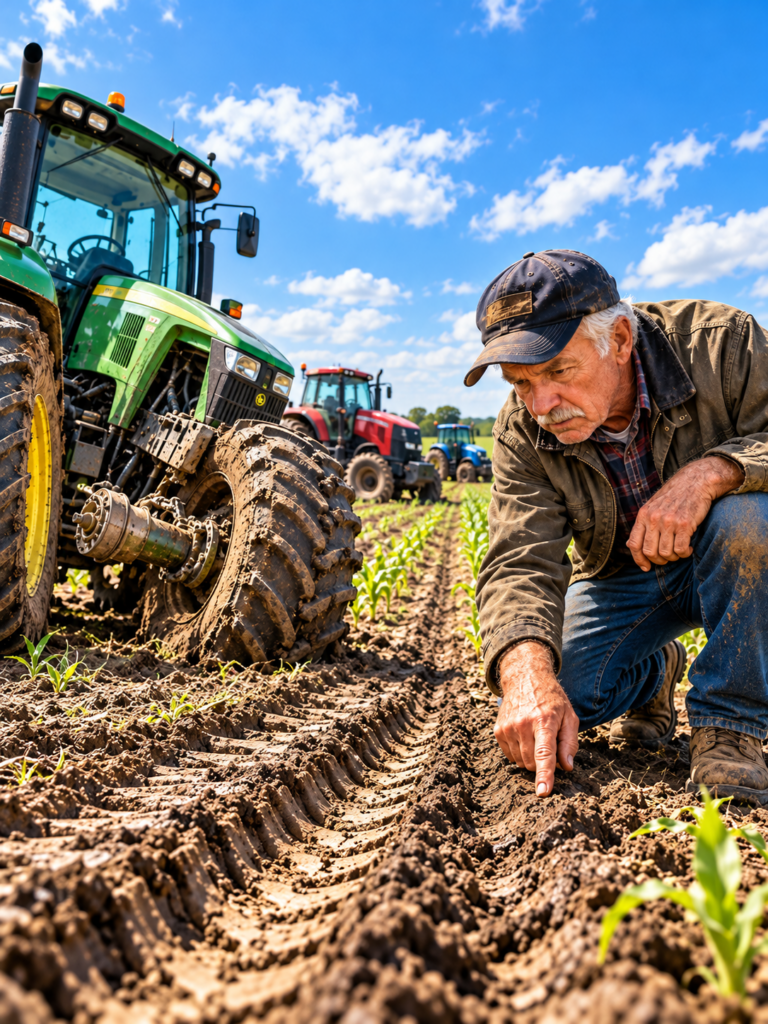
He stopped beside a deep tire impression several yards behind the machine and crouched down. He brushed loose soil away with his fingertips, then followed the mark with his eyes toward the fence.
Tom climbed out of the cab.
“Ray?”
The mechanic did not answer immediately.
He studied the ground a while longer, stood, and looked toward a section of the field farther west.
“Tom, where did the other two stop?”
Tom frowned.
“You know where. I showed you.”
“I know the general area. I want the exact spots.”
Tom pointed.
Ray followed his gesture, then turned back toward the rental tractor.
“Did they stop in a straight line?”
Tom stared at him.
“What difference would that make?”
Ray looked at the tire track again.
“Maybe none.”
He adjusted the brim of his cap.
“But three machines don’t usually break three different ways on good, flat ground. And I don’t intend to tell you it’s bad luck until we know what they’re all hitting.”
Ten days earlier, Tom Brant had believed his biggest problem would be the weather.
The last week of April had arrived with the kind of opportunity that Iowa corn farmers waited for all winter. After a wet March, the soil had finally warmed enough to plant. A dry stretch appeared in the forecast. The fields were beginning to work, and every farmer in the county understood that the coming days mattered.
Tom had four hundred acres of corn to get into the ground.
He had seed already purchased, machinery prepared as well as he could manage, and an operating loan that had very little room for mistakes.
The bank had been polite during the last conversation.
That bothered him more than anger would have.
Tom had borrowed operating money for enough seasons to recognize the difference between a lender who felt comfortable and one who was beginning to count his exposure.
The loan officer had asked reasonable questions, spoken pleasantly, and reminded Tom that an update would be needed once planting was underway.
Nothing threatening had been said.
Nothing needed to be.
Tom knew the figures sitting in Jenny’s spreadsheets.
He knew what repairs had cost the previous year, what fertilizer had done to his operating expenses, and how much depended on bringing in a decent corn crop.
And he knew that the Creek 40 was the best ground he owned.
Those forty acres lay low near the creek, a broad stretch of dark soil with long, straight planting runs. His grandfather had cleared that ground. His father had worked it for decades. Tom had been driving across it since he was old enough to sit beside a grown man on a tractor and believe there was no better place in the world.
The Creek 40 wasn’t just productive land.
It was the part of the farm where his family history felt closest to the surface.
He intended to plant it first.
On Tuesday morning, he started with his own tractor, a twenty-year-old machine that had earned every scrape and oil stain on its frame.
It was not the sort of tractor that impressed anybody at a dealership.
The paint had faded. The cab showed its age. Tom knew certain sounds it made when the hydraulic oil was cold, knew which fittings needed extra attention, and could usually tell by feel when something was beginning to wear.
He trusted it because he understood it.
With the planter behind him, he entered the Creek 40 and settled into the familiar rhythm of fieldwork.
The soil rolled away in straight lines. The engine pulled steadily. Morning light spread across the dark ground.
For a while, things felt almost normal.
Tom began thinking about the acres he could cover before evening.
Then the front of the tractor dipped.
It was a small movement at first, so unexpected that he thought he might have crossed a shallow rut.
The next instant came a loud crack.
The front end dropped farther, the steering wheel jerked in his hands, and the machine stopped.
Tom shut down what remained of the operation and climbed out.
The front axle support had split.
He stood looking at it, his boots sinking slightly into the soft earth.
It was a serious failure, but old tractors suffered serious failures. Metal fatigued. Years of carrying weight finally caught up with parts that had looked sound the day before.
Tom had seen enough worn machinery to understand that.
He hated the timing, but he did not question the cause.
He blamed age.
Ray examined the damage and arranged the repair as quickly as possible.
Tom paid extra to have the work rushed, even though the money had to come from somewhere else in the budget.
When Jenny heard the estimate, she looked at the figures without immediately saying anything.
Tom knew that expression.
She was already deciding which expense could be pushed into another week.
“We’ll make it up,” he told her.
Jenny raised her eyes.
“With what?”
“Time. I’ll get another machine and keep moving.”
She looked down at the numbers again.
“Then make sure it’s one that works.”
Tom called Gary Pruitt.
Gary farmed nearby and had a newer tractor than Tom’s old machine. He understood planting windows, weather pressure, and what it meant to lose equipment at exactly the wrong time.
When Tom explained the problem, Gary agreed to help.
Tom was grateful, though borrowing machinery always came with an uncomfortable feeling.
A tractor was not a ladder or a wrench.
It was expensive, essential, and often needed by the person who owned it.
He promised to take care of Gary’s machine.
For a short while, the borrowed tractor seemed to solve everything.
It handled the planter. It moved smoothly through the field. The engine had plenty of power, and Tom began to relax.
Then he reached another part of the same stretch of ground.
A sudden blow ran through the tractor.
The machine lurched sideways.
Tom felt the wheel drop and catch, followed by a harsh tearing sound that brought him to an immediate stop.
He climbed down and found the tire ruined.
The sidewall had torn open, and the rim was bent so badly it looked as though some enormous force had struck it from below.
Tom stared at the damage.
He had seen tires fail before, but this was different from running over a piece of scrap metal or discovering an old puncture.
The tire looked as though it had been crushed against something hard.
He walked the surrounding soil, looking for a rock or a sharp object.
He found nothing.
Only the same dark ground he had driven over for years.
Gary arrived to see what had happened.
He stood beside his tractor, looking at the damaged wheel.
Tom could almost feel the weight of Gary’s disappointment.
“Whatever it costs, I’ll cover it,” Tom said.
Gary nodded.
“I know you will.”
He was quiet for another moment.
“Ground still pretty soft out here?”
“Some places.”
“Maybe you ought to give it another day.”
Tom looked across the field.
The sky was clear. The surface looked workable. His planting schedule was already coming apart.
“I don’t have another day to give it.”
Gary did not argue.
That was almost worse.
Nobody accused Tom of being careless. Nobody raised a voice. His neighbor simply accepted the situation, and Tom knew that a favor had turned into an expensive inconvenience.
When he returned home, Jenny asked about the tire.
He told her.
She closed her eyes briefly, then opened the spreadsheet again.
There were already too many numbers on the wrong side of the ledger.
“We can’t keep doing this,” she said.
“I know.”
“Do you?”
Tom looked toward the window.
Beyond the farmyard, the fields waited.
He had always believed that hard work could pull a farm through most kinds of trouble. If a machine broke, you fixed it. If the weather delayed you, you worked longer when it cleared. If money got tight, you postponed what could wait.
That way of thinking had carried him through years of difficult seasons.
But now two tractors were disabled, and the corn had not been planted.
He told himself that he needed one more machine.
One that was newer.
One that had no reason to fail.
The dealership in town had a rental available.
Tom signed the agreement despite the cost.
The machine was worth approximately eighty-five thousand dollars. It had more electronics, more glass, and more power than the tractor he owned. He felt uncomfortable climbing into it, as though he had borrowed something from a world where farmers did not spend their evenings worrying about repair invoices.
He checked the equipment carefully.
Then he drove back to the Creek 40.
This time, he moved slowly.
He knew the places where the first two machines had failed. He did not entirely understand why those places made him uneasy, but he watched the ground more closely than usual.
The tractor eased forward.
The engine ran smoothly.
Tom told himself he was being foolish.
A broken axle and a ruined tire were different problems. There was no sensible reason to connect them.
Then the cab dropped.
The driveline slammed.
The engine shuddered and died.
And Tom found himself staring at the same stretch of ground for the third time.
The dealership manager called within an hour.
The rental would not be replaced.
There would be an inspection, followed by a repair estimate.
Tom listened with one hand pressed against his forehead.
The manager was professional. He did not accuse Tom of deliberately abusing the equipment. He simply explained the terms of the agreement and what would happen next.
Tom understood every word.
By the time the call ended, his situation had changed from difficult to dangerous.
He had no working tractor available for the Creek 40.
He had three damaged machines to account for.
The forecast now showed rain by Friday.
He had four days to find a way forward.
And the bank was expecting an update.
Ray Kowalski arrived that afternoon.
Unlike Tom, Ray did not begin with the cost of the repairs.
He began with the locations.
He asked where the old tractor had stopped, where Gary’s tire had failed, and where the rental had broken down.
Tom showed him.
Ray walked between the spots, counting his steps.
Then he examined the tire impressions beside the rental.
Finally, he asked Tom to bring every piece of paperwork connected to the failures.
Back at the shop, Ray spread the documents across a workbench.
The invoice for the broken axle support.
The tire shop’s account of Gary’s ruined wheel.
The dealership’s inspection report.
Ray read each one carefully.
Then he read them again.
Tom leaned against the bench, arms folded.
“You’re not going to find much. My tractor was old. Gary had a tire go bad. The rental could’ve had something wrong before I ever touched it.”
Ray looked at the papers.
“Could’ve.”
“That’s three different failures.”
“Yes.”
“Three different machines.”
“Yes.”
Tom waited.
Ray tapped the first invoice with a thick finger.
“An axle support doesn’t just split because a farmer asks it to cross a flat field.”
He moved to the tire report.
“And that sidewall took one hell of a hit.”
Then he touched the dealership paperwork.
“Same with the driveline.”
Tom stared at him.
“What are you saying?”
“I’m saying each machine took a shock it shouldn’t have taken.”
“From what?”
Ray glanced toward the window.
“That’s what I want to know.”
The kitchen door opened.
Jenny entered carrying her phone.
She had been staying up past midnight working through the farm’s accounts, and the weariness in her face was becoming harder to hide.
“I’ve put together what we know so far,” she said.
She set the phone on the bench.
Between the axle repair, Gary’s damaged tire, and the rental expense and deductible, the trouble had already pushed past nineteen thousand dollars.
That figure did not include everything that might still arrive from the dealership.
Tom looked at it without speaking.
Jenny’s voice remained gentle.
“The bank wants updated numbers Friday.”
“I remember.”
“We can’t absorb another breakdown.”
“There won’t be another one.”
Jenny held his gaze.
“You said that after the second tractor.”
Tom looked away.
Earlier that morning, someone at the co-op had suggested he was pushing old machinery too hard.
The comment had not been cruel.
The man had probably meant it as sympathy.
But Tom had heard the judgment beneath it, whether it was intended or not.
A farmer who couldn’t keep his equipment running was a farmer whose operation was starting to slip.
He hated the possibility that other people might see his troubles more clearly than he did.
Ray folded the papers and put them together.
“Nothing else goes into that field.”
Tom turned.
“I can’t stop planting.”
“I’m not telling you to stop planting forever.”
“Ray, I’ve got four days.”
“And you’ll have nothing if you lose a fourth tractor.”
The mechanic pulled his cap lower.
“I want to walk that field in the morning. Properly.”
Tom started to protest, but Ray was already gathering the invoices.
For the first time since the breakdowns began, someone was refusing to treat the machines as three separate problems.
Tom did not know whether that was good news.
He only knew that he was running out of explanations.
Part 2
Ray arrived before the morning had fully warmed.
His pickup carried a bundle of wooden stakes, a roll of orange flagging tape, a steel probing rod, and the few hand tools he expected to need.
Tom was waiting beside the shop.
He had slept badly.
Whenever he closed his eyes, he saw the expensive rental tractor sitting motionless in the field, followed by Jenny’s spreadsheet and the bank’s approaching deadline.
Ray handed him several stakes.
“We’re going to mark them.”
“The breakdown spots?”
“Exactly where each machine stopped.”
They walked into the Creek 40 together.
The soil was still cool beneath their boots. Early sunlight lay across the dark rows, revealing the shallow ridges and wheel marks left by the previous day’s work.
Tom pointed out the location of his own tractor’s failure.
Ray checked it against the marks in the ground and drove a stake into the soil.
He tied a length of orange tape around it.
They repeated the process where Gary’s tire had torn open.
Then they marked the rental’s final position.
Ray stepped away from the last stake and walked toward the edge of the field.
Tom followed.
At first, the three orange flags appeared to be nothing more than markers scattered across a stretch of worked ground.
Then Ray moved farther back.
“Which way do your rows run?”
Tom frowned.
“North and south.”
“Always?”
“Since I’ve been farming it.”
Ray pointed toward the flags.
“Then look at those.”
Tom studied them.
The first stood near the upper portion of the field. The second was farther down and to one side. The third sat lower still, toward the creek.
He shifted a few steps, trying to understand what Ray wanted him to see.
Then the pattern became unmistakable.
The three markers formed a diagonal.
Not a perfect surveyor’s line, but close enough that the relationship was impossible to ignore.
It began near an old fence post by the road and ran across the field toward the creek.
All three breakdowns fell inside a strip perhaps thirty feet wide.
Tom looked from one flag to the next.
“That doesn’t make sense.”
Ray kept his eyes on the ground.
“Your rows go north and south. These don’t.”
“So?”
“So something that follows your planting equipment ought to follow your rows.”
He pointed along the diagonal.
“But this follows something else.”
Tom felt a faint tightening in his stomach.
He had driven this field for thirty years. He knew the low places, the areas that dried slowly, and the spots where the soil changed texture.
Yet he had never looked at it quite this way.
Three disabled tractors had seemed like a run of unrelated failures.
From where he now stood, they looked like three witnesses describing the same event.
Ray walked back toward the first marker.
He crouched beside the tire tracks and studied the impressions.
“Come look at this.”
Tom joined him.
The marks were deeper near the breakdown than they were several feet behind it.
Ray traced one with his finger.
“See how the wheel starts sinking here?”
Tom nodded.
“Then something happens. It drops harder, and the mark changes where the wheel comes back up.”
They moved to the second location.
The pattern was similar, though the damage to Gary’s machine had been different.
At the rental’s stopping point, the impressions told the same general story.
Each machine had traveled over apparently ordinary soil.
Each had dropped suddenly.
Each had taken a violent shock.
Tom straightened.
“Are you saying there’s something buried out here?”
“I’m saying the ground isn’t holding weight the way it should.”
“A rock?”
“Maybe.”
“Old foundation? Something my grandfather missed?”
Ray stood and looked around.
“Could be. Let’s find out.”
Tom wanted a simple answer.
A buried rock could be dug out. An old piece of concrete could be pulled away. Even a forgotten foundation would be better than a problem nobody could identify.
Ray, however, seemed interested in what the ground was doing rather than what Tom hoped might be beneath it.
He walked along the flagged strip, pressing the probing rod against the soil.
Near the first breakdown, he leaned on the rod.
It sank with surprisingly little resistance.
Ray pushed farther.
The steel disappeared deeper into the ground than Tom expected.
He withdrew it, moved a couple of feet, and tried again.
The result was nearly identical.
Then Ray walked ten paces away from the diagonal.
He pressed the rod into the soil there.
It met firm resistance at a much shallower depth.
Ray repeated the test several times.
The difference remained.
Tom watched the mechanic’s face.
“What does that tell you?”
“Not everything.”
Ray lifted the rod.
“But a rock ought to stop this. Here, the ground just gives way.”
He returned to the marked strip and pressed the rod down again.
“Something under here is softer than it ought to be.”
Tom looked across the field.
He had worked that soil through wet springs, dry summers, good harvests, and years when prices barely justified the effort.
He had driven discs, chisel plows, planters, and combines over it.
Nothing had happened.
He told Ray as much.
“I’ve been over this ground thousands of times.”
“I believe you.”
“With tractors, combines, everything.”
Ray rested both hands on the top of the steel rod.
“What did you change this spring?”
Tom considered the question.
“Nothing about the field.”
“I didn’t ask about the field.”
Tom glanced toward the planter.
“The planter’s new to me.”
“New?”
“Used. Bought it over the winter. Twenty-four rows.”
“Heavier?”
“Quite a bit. Bigger toolbar. Needed more ballast on the tractors pulling it.”
Ray nodded.
“There you go.”
“There I go where?”
“The ground may be the same. The load isn’t.”
Tom looked down.
For years, the farm had carried whatever equipment he put across it. He had come to think of the soil as fixed and dependable.
Ray was suggesting that dependability had limits.
He was also suggesting that Tom had crossed one without realizing it.
Still, the explanation felt incomplete.
A heavier planter might explain more pressure on the ground. It did not explain why only a narrow diagonal strip seemed unable to support that pressure.
Ray took a spade from his truck and opened a shallow hole near the first flag.
The soil inside the strip looked darker and looser than the surrounding ground.
Tom knelt and picked up a handful.
It held more moisture than he expected.
He rubbed it between his fingers.
“This part always stays wet longer.”
Ray glanced at him.
“How much longer?”
“Depends on the spring. A few days, sometimes.”
“Anything else different about it?”
Tom looked toward the creek.
“The corn usually comes up greener here.”
Ray waited.
“I figured it was better dirt.”
Tom sifted the soil through his fingers.
There had been other small differences over the years.
The low strip held moisture. It sometimes behaved differently after a rain. But the corn grew well enough, and there had never been an obvious reason to disturb a productive part of the field.
Then a memory returned.
“My dad called this the low strip.”
Ray turned toward him.
“What did he say about it?”
“He didn’t say much.”
Tom stood slowly.
“He never liked having equipment parked out here. Wouldn’t let us leave anything heavy on this section.”
“Did he say why?”
Tom shook his head.
“Not that I remember.”
The memory was ordinary, almost embarrassingly so.
His father had been full of rules about machinery and land.
Don’t turn too sharply with a loaded wagon.
Don’t trust a creek crossing just because it was safe last fall.
Don’t leave heavy equipment where the ground stays wet.
As a younger man, Tom had often treated those warnings as habits left over from a different kind of farming.
His father had worked smaller equipment, lighter tractors, and narrower planters. Tom had assumed the old rules belonged to the old machines.
Ray looked toward the shop buildings.
“Did Harold keep field records?”
Tom nodded.
“Boxes of them.”
“Drainage maps?”
“Maybe.”
“Tile records?”
Tom hesitated.
“There might be something.”
He knew exactly where his father’s old papers were stored.
He had known for years.
The green filing cabinet stood in the back of the shop, near a wall lined with shelves and obsolete equipment manuals.
Tom had barely opened it since his father’s funeral.
There was no practical reason for that. He had been busy. The farm had kept moving. A hundred urgent things had demanded his attention.
But there was another reason he had never said aloud.
The cabinet belonged to a time when Harold Brant still knew things Tom didn’t.
Opening it meant admitting that his father might have left questions unanswered, along with the records.
Tom looked back at the orange flags.
“Let’s check.”
The cabinet drawers resisted when he pulled them.
The metal handles were cold and slightly greasy. Inside, the folders smelled of old paper, oil, and the dust that settled into farm buildings no matter how often the doors were closed.
Ray waited nearby while Tom worked through the contents.
Seed invoices.
Machinery specifications.
Old receipts.
Field notes written on scraps of paper.
Some documents were so old that Tom barely remembered the companies named at the top.
He moved carefully through them.
His father had never been a particularly sentimental man, but he had been methodical.
Measurements mattered to Harold. Dates mattered. A repair done without a note might as well have been forgotten, because the next person would have no way of knowing what had been changed.
Tom had heard his father say that more than once.
At the back of a drawer, beneath a stack of old equipment information, he found a manila folder.
The label was written in Harold’s heavy block letters.
Creek 40 Tile.
Tom stopped moving.
He opened the folder.
Inside lay a map drawn on yellowed graph paper.
It showed the boundary of the Creek 40, the road, the creek, and several familiar landmarks.
Across the field ran a line from the northeast corner toward the water.
A diagonal line.
Tom laid the paper flat on the workbench.
Ray stepped closer.
Neither man spoke for a moment.
The line on the map seemed to match the orange flags they had placed that morning.
Beside it, Harold had written a note.
Old clay main laid by Dad. Outlet end silting up.
Tom read it twice.
His grandfather had installed the drainage line decades earlier. Tom knew that tile had been laid in parts of the farm, but he had never seen an accurate record of this particular main.
Beneath the first note was another.
Soft spot near fence post. Do not drive heavy over until repaired.
Tom felt the strength leave his hands.
There was a final line, partly rubbed away but still legible.
Repair planned. Never finished.
He sat down on an overturned bucket.
The paper remained open in front of him.
Ray said nothing.
Tom could remember his father talking about the farm’s old drainage system. Some lines had been installed before proper records were common. Others had been repaired and patched by people who knew the ground well enough to work from memory.
Harold used to say that the land kept a record of everything people did to it.
Tom had smiled at that.
He had thought his father was speaking poetically, in the stubborn way older farmers sometimes did when they wanted younger men to listen.
Now the words had a different weight.
His father had not simply been cautious about wet soil.
He had known there was a drainage problem.
He had marked it.
He had intended to repair it.
And he had left a warning.
Tom stared at the handwriting.
For a moment, the failed tractors and unpaid bills seemed very far away.
He could almost hear Harold telling him not to put a heavy machine near the low strip.
He remembered being impatient with that kind of advice.
He remembered believing he understood the farm because he was the one operating it now.
Ray touched the edge of the paper.
“We need to take this outside.”
They returned to the field carrying the map between them.
A light wind tugged at the corners as Ray spread it open.
Tom pointed out the old fence post, the creek, and the boundary lines.
Ray aligned the drawing with the actual ground.
Then he traced the marked clay main with his finger.
The line ran beneath all three flagged locations.
He looked at Tom.
“There it is.”
Tom stared.
“Every one?”
“Every one.”
“But that tile’s been there since the fifties.”
“Doesn’t mean it’s in good shape now.”
“Why would it start causing trouble this year?”
Ray folded the map carefully.
“Think about March.”
Tom remembered the rain.
Water had stood in low places longer than usual. Even after the surface began drying, the deeper soil had remained heavy with moisture.
“It was the wettest March we’ve had in years,” Tom said.
Ray nodded.
“Now add that new planter.”
Tom looked toward the flags.
“More weight.”
“And an old clay drainage main nobody’s maintained properly.”
Ray examined the ground again.
“One thing by itself might not have caused this. But put all three together…”
He left the sentence unfinished.
Tom understood.
The machinery hadn’t necessarily become unreliable.
The field might have changed in a way he could not see.
That evening, rain came through central Iowa.
It lasted roughly two hours, enough to darken the soil and collect in shallow depressions across the farm.
Tom lay awake listening to it.
Every minute of rain meant another possible delay.
He thought about the operating loan, the dealership, the damaged wheel on Gary’s tractor, and the old map lying on the kitchen table.
But most of all, he thought about the words beside the tile line.
Do not drive heavy over until repaired.
He wondered how long his father had known.
He wondered whether the repair had been postponed because of money, weather, or some other urgent problem that had taken priority.
He could imagine any of those reasons.
They were the same reasons Tom had postponed things himself.
By dawn, the rain had stopped.
Ray arrived early, and the two men returned to the flagged strip.
The ground was wet, but the new moisture made differences in the surface easier to see.
Near the middle flag, a shallow puddle had formed.
At first, Tom thought nothing of it.
Then Ray stopped.
“Watch that.”
The water was disappearing.
Not evenly, the way moisture normally soaked into loose soil.
It moved toward one point, circling slowly as it drained.
Tom crouched.
A faint spiral formed on the surface.
He watched the water disappear into the ground.
There was no visible pipe opening.
No ditch.
No reason for a puddle to empty that way.
Ray’s expression hardened.
“That’s going somewhere it shouldn’t.”
Tom looked at him.
“Under the field?”
“Looks that way.”
“How far under?”
“I don’t know.”
“Then we dig.”
Ray shook his head immediately.
“Not yet.”
Tom stood.
“What do you mean, not yet?”
“We know enough to stop guessing. We don’t know enough to start putting equipment over it.”
“I can’t just leave it.”
“I’m not asking you to leave it.”
Ray pointed toward the creek.
“This is drainage work. We get somebody who knows drainage.”
By noon, Dana Whitfield had arrived from two counties over.
She was a drainage contractor with the kind of equipment needed to inspect and repair buried agricultural tile.
She brought a compact excavator, inspection tools, and a small camera system that could travel inside the old pipe.
Dana listened while Ray explained the breakdowns.
She studied Harold’s map.
Then she walked the flagged strip herself, placing her boots carefully and asking where the tire marks had been deepest.
Tom watched her expression.
She did not look surprised by the idea of a failing tile line.
But she treated the ground with a caution that made him uneasy.
“You’re not going to dig right there?” he asked when she turned toward the creek.
“Not to start.”
She pointed to the mapped outlet.
“We find out what’s happening downstream first.”
At the creek, the old tile outlet was partly buried in silt and tangled roots.
Dana and her crew cleared the obstruction carefully.
The exposed clay pipe looked old and worn, but age alone did not tell them where it had failed.
Dana fed the inspection camera into the line.
Tom stood beside Ray, watching the small screen.
For the first forty feet, the pipe looked tired but intact.
The interior was stained. Some joints showed their age. Yet the camera moved forward without revealing the sort of damage that could explain three disabled tractors.
Then the picture changed.
A joint was cracked.
Another had shifted.
Farther along, a section of clay pipe had collapsed inward.
The opening was distorted and partly blocked with material that should have been outside the drain.
Silt and soil had entered the damaged pipe.
Dana moved the camera carefully, studying the broken section.
Ray leaned forward.
Tom tried to understand what he was seeing.
“That’s the problem?”
Dana kept her eyes on the screen.
“That’s part of it.”
She explained that a broken drainage main could do more than stop carrying water properly.
When water entered damaged joints and openings, it could carry surrounding soil with it.
A small amount at a time.
After a year, the change might be barely noticeable.
After many seasons, the missing soil could become a serious problem.
Tom looked back toward the field.
“And all that dirt goes down to the creek?”
“Some of it can.”
“How much?”
Dana did not answer immediately.
She studied the image again.
“Enough that I want to see what’s above this break.”
Using the inspection location and the old map, she marked the damaged section from the surface.
She moved the excavator into a position where the ground could be opened cautiously from the field edge.
Tom stood well back.
The machine’s bucket entered the soil a little at a time.
Dana did not rush.
Loose earth came away in careful layers.
At first, Tom saw only dark, wet soil.
Then the bucket exposed a space that should not have been there.
He stepped forward instinctively.
Ray caught his arm.
“Stay back.”
Tom stopped.
Beneath a relatively thin layer of root-bound topsoil lay an open hollow.
The soil under the surface had washed away.
Dana continued opening the area until the shape became clear.
It extended roughly twelve feet along the failed drainage line.
In places, the empty space reached nearly three feet deep.
Tom stared into it.
The hollow sat beneath the same piece of ground he had crossed year after year.
Above it, the surface had looked normal.
Below it, there had been almost nothing to hold the weight.
The mystery of the broken tractors was beginning to take a shape that Tom wished he had never needed to see.
Part 3
For a long moment, Tom could not speak.
The opening in the ground was not enormous by the standards of farm excavation. He had seen deeper holes, longer trenches, and more extensive drainage repairs.
But this was different.
This hole had been hidden.
A skin of topsoil, woven together by roots, had covered an empty space that was growing beneath his working field.
It had carried lighter equipment for years.
It had looked safe because nothing on the surface had announced what was happening below.
Dana stood near the excavation and studied the exposed clay.
“The pipe failed, and water kept moving through the damaged section,” she explained. “Over time, it carried soil away from around the break. That left a void underneath the surface.”
Tom looked at the rim of the hollow.
“And the top just stayed there?”
“For a while. The roots and remaining soil were holding it together.”
He glanced toward the flags.
“Until this spring.”
Dana nodded.
“The ground was wet. Your new planter put more load on the tractors. Eventually, parts of that surface couldn’t support what was crossing it.”
Tom tried to picture the first breakdown.
His old tractor moving across the Creek 40.
The front end dipping.
That terrible crack.
Then Gary’s machine striking a different part of the same weak strip.
Then the rental.
Three different failures.
Ray stepped beside him.
“Your front wheel dropped along the edge of that hollow. The axle support took the shock.”
Tom watched the mechanic point toward the damaged ground.
“Gary came through a little farther over. His tire caught the edge when the ground gave, and the sidewall tore against the impact.”
Ray turned toward the location of the third flag.
“The rental dropped a drive wheel and then caught hard when it came back onto firm ground. That’s what slammed the driveline.”
Tom looked at him.
“So none of them just broke?”
“They broke all right.”
Ray lowered his hand.
“But they didn’t break for three separate reasons.”
The words settled heavily.
One failing clay pipe.
One strip of ground.
Three damaged tractors.
Tom had spent ten days looking at engines, axles, tires, and repair invoices.
He had blamed metal fatigue, bad rubber, and the possibility of a poorly maintained rental.
The answer had been under his boots the entire time.
He looked into the hollow again.
A different thought finally reached him.
“I was sitting in those cabs.”
Ray did not answer.
Tom swallowed.
“What if the whole thing had gone down?”
Dana’s expression became serious.
A tractor was heavy machinery. A sudden collapse could throw a machine off balance, damage its running gear, or leave an operator facing a situation from which there was no easy escape.
“If the surface had failed completely under you,” Ray said, “you could’ve gone through.”
Tom felt cold despite the spring sunlight.
He remembered the first jolt.
The way the steering wheel had jumped.
The sudden drop beneath the rental tractor.
At the time, he had thought about the machine.
He had thought about the repair cost before thinking about himself.
Now he could imagine a larger section of ground giving way while he was inside the cab.
He looked across the field toward the shop.
Jenny had been at the kitchen table when he left that morning.
They had spoken about bills and planting schedules.
Neither of them had known how close the problem might have come to being far worse than money.
Tom turned away from the excavation.
He needed a moment.
Ray let him have it.
Across the field, the orange markers moved slightly in the breeze.
They seemed so obvious now.
The diagonal alignment.
The deepening tire tracks.
The probing rod sinking too far.
The damp soil.
The warning in Harold’s handwriting.
And finally, the puddle draining into the earth.
Each clue had been ordinary enough to dismiss by itself.
Together, they told a story no damaged machine could explain.
Tom looked toward the creek.
“My dad knew something was wrong here.”
Ray stood beside him.
“He knew enough to write it down.”
“He wanted it fixed.”
“Looks that way.”
Tom shook his head.
“I thought he was just being careful.”
Ray said nothing.
Tom thought about Harold’s warnings.
His father had not been a man who explained himself at length. If he saw something dangerous, he said to stay away from it. If a piece of equipment sounded wrong, he wanted it shut down. If a field was wet, he did not care how many other farmers were already planting.
Tom had mistaken some of that caution for stubbornness.
The idea hurt more than he expected.
He had inherited the ground, but not every piece of knowledge that came with it.
His father had left records, and Tom had left them unread.
Still, understanding the problem did not repair the drainage main.
By evening, Dana had prepared an estimate.
Fourteen thousand dollars.
That would cover replacing the failed section of clay tile with modern pipe, rebuilding the outlet, and filling and compacting the hollow properly so the ground could carry weight again.
If the weather cooperated, the main work would take two days.
Afterward, the disturbed soil would need time to settle.
Tom read the quote at the kitchen table.
Then he read it again.
Jenny sat across from him with her laptop open.
Harold’s map lay between them.
The figures on the screen were worse than they had been the previous evening.
More than nineteen thousand dollars in machinery-related costs, with the final rental expense still to be resolved.
Now another fourteen thousand for drainage.
And every day beyond the ideal planting window threatened to reduce the farm’s yield.
Tom rubbed his face.
“We can’t afford this.”
Jenny kept looking at the figures.
“We can’t afford not to know about it either.”
He glanced toward the window.
“The rest of the field is good ground.”
“The part that hasn’t collapsed.”
“I could just work around the bad strip.”
Jenny looked up.
“How?”
“Fence it off. Plant the other parts. Come back when there’s time.”
“And what happens to the Creek 40?”
“We lose some ground this year.”
“How much?”
Tom had no firm answer.
The dangerous strip cut diagonally across the field. Turning equipment around it would complicate planting, and the unstable area had not yet been fully rebuilt.
More importantly, he could not say with certainty where the weakened ground began and ended until the repairs were complete.
Jenny slid the old map toward him.
“Your father left that warning for a reason.”
Tom stared at it.
“I know.”
“Then maybe the answer is to do the job the way it needs to be done.”
He leaned back.
“With what money?”
Jenny looked at the laptop.
“That’s what we have to figure out.”
Ray sat quietly at the end of the table, drinking coffee.
He had listened to most of the discussion without interrupting.
Now he set down his mug.
“You’re treating the Creek 40 like it has to go first.”
Tom turned toward him.
“It was supposed to.”
“Supposed to isn’t the same thing as has to.”
Tom frowned.
Ray continued.
“You’ve got three hundred and sixty acres that aren’t sitting on top of that broken tile.”
“Yes.”
“Plant those.”
“The Creek 40 will be late.”
“Probably.”
“Late corn costs yield.”
“I know.”
Tom stared at him.
Ray leaned forward.
“Mark off that whole dangerous strip. Keep equipment away from it. Let Dana do the drainage work while you’re planting the other fields. Then plant the Creek 40 after the ground is repaired and checked.”
Tom shook his head.
“We could lose a week.”
“You might.”
“That could cost us.”
Ray met his eyes.
“Not as much as another tractor. Or somebody getting hurt.”
The kitchen grew quiet.
Ray was not promising an easy solution.
He was not telling Tom that the farm would somehow escape all financial consequences.
There would be repair bills.
There would be lost time.
The late planting might reduce the Creek 40’s yield.
But there was something new about the plan.
It was based on what they knew.
For ten days, Tom had kept trying to solve the breakdowns by putting another tractor into the same field.
Each time, he had been gambling that the next machine would be different.
Now he understood why none of those machines had been the real problem.
He looked at Jenny.
She gave a small nod.
Tom turned to Ray.
“All right. We plant the others first.”
Ray nodded once.
“Then let’s get you a tractor.”
That meant calling Gary Pruitt.
Tom stood in the kitchen with the phone in his hand, staring at Gary’s number.
He had already damaged the man’s machine.
Asking to borrow it again felt worse than the first request.
Gary had been generous the first time.
Tom did not believe generosity should be treated as an unlimited resource.
He considered trying to find another rental.
Then he remembered the dealership manager explaining that no replacement would be provided.
He pressed the call button.
Gary answered.
Tom explained what Ray and Dana had discovered.
He told him about the drainage main, the hollow beneath the surface, and the reason the three tractors had failed.
Gary listened.
“That explains the tire,” he said finally.
“It does.”
“Nobody got hurt?”
“No.”
“That’s something.”
Tom looked out at the darkening farmyard.
He told Gary about the revised planting plan.
Then he asked whether he could borrow the tractor again, this time to work the other three hundred and sixty acres.
Gary was silent for several seconds.
Tom understood what he was asking.
The tire damage had not been Gary’s fault.
Neither had the drainage problem.
And another man’s planting schedule was not Gary’s responsibility.
Finally, Gary spoke.
“Come get it in the morning.”
Tom closed his eyes briefly.
“You sure?”
“Just keep it out of that field until it’s fixed.”
“I will.”
Tom promised to pay for the damaged tire and rim.
Gary did not demand it.
Tom paid anyway.
He needed to know that, whatever happened to his own farm, he had treated his neighbor fairly.
The next call was to the bank.
That one was harder.
For several minutes, Tom sat with the phone in front of him.
He knew what the lender was expecting.
Planting progress.
Equipment status.
Updated financial numbers.
Instead, he had a story about three broken tractors and a buried drainage failure that had created another substantial expense.
He could imagine how it might sound.
Excuses.
Poor management.
An operation losing control of its costs.
Jenny sat beside him.
“Tell them what happened.”
“They might not like it.”
“They’re going to see the numbers either way.”
Tom looked at her.
She was right.
Hiding the problem would not make the repair bills disappear.
He called the loan officer.
This time, he explained everything.
He described the three failures and how Ray had traced them to the same stretch of ground.
He told the lender about the collapsed clay tile and the hollow beneath the field.
He sent Harold’s map, Ray’s notes, photographs of the excavation, and Dana’s written estimate.
Then he laid out the plan.
Plant the unaffected three hundred and sixty acres.
Repair the drainage system.
Keep all machinery away from the unstable strip until it was safe.
Finish the Creek 40 afterward, accepting the possibility of a modest yield reduction.
The loan officer asked questions.
Tom answered them.
He did not minimize the costs.
He did not claim that the planting delay would have no effect.
He told the truth as clearly as he could.
When he finished, there was a long pause.
Tom watched Jenny across the table.
Then the loan officer spoke.
A documented problem, he explained, was easier for a lender to evaluate than a series of unexplained losses.
The farm had suffered an expensive setback, but there was now evidence, a repair estimate, and a workable plan.
The bank agreed to a modest extension of the operating line, subject to conditions.
It was not a rescue.
Tom would still have to repay what he owed.
But it gave him enough room to carry out the plan without abandoning the planting season.
After the call, Tom set down the phone and stared at the table.
For the first time in days, the tightness in his chest eased.
Jenny was still looking at the budget.
“There’s one more thing,” she said.
Tom glanced at her.
“What?”
“The old baler.”
He frowned.
“What about it?”
“The one behind the shed.”
“It hasn’t run in years.”
“Six years.”
Tom knew the machine she meant.
It had been sitting unused, taking up space and gathering dust. He had kept it partly because it might someday be useful and partly because selling farm equipment often felt like admitting a chapter of the operation was over.
Jenny turned the laptop toward him.
“Sell it.”
Tom considered the suggestion.
The baler was not earning money. It was not helping with the corn crop. Whatever value it had was locked inside a machine nobody was using.
He looked back at Jenny.
“You’re right.”
The next day, he sold it.
It did not erase the cost of the tile repair or repair the tractors.
But it helped.
More important, Tom had stopped waiting for the trouble to fix itself.
He was making decisions.
Thursday morning, Dana’s crew began the drainage work.
They removed the broken clay section and installed modern corrugated pipe where the old main had failed.
They cleared and rebuilt the outlet near the creek, taking away the silt and roots that had interfered with drainage.
Then they addressed the hollow.
The empty space could not simply be covered with loose soil.
Dana’s crew rebuilt it carefully, placing material in shallow layers and compacting each layer before adding the next.
Tom understood why she insisted on doing it that way.
He had already learned what could happen when ground looked solid on top but lacked support beneath.
There would be no shortcuts now.
While the drainage work proceeded, Tom turned his attention to the rest of the farm.
Gary’s tractor was available, and he used it on the fields that had not been affected by the old tile.
He worked carefully, following the plan.
The change was difficult at first.
Every hour spent away from the Creek 40 reminded him that his best ground was still waiting.
He could see that field in his mind even while planting elsewhere.
The dark soil.
The long rows.
The orange flags marking the dangerous strip.
But whenever he felt tempted to hurry, he remembered the hollow.
And he remembered how close he had come to sending another machine over it.
Ray continued checking the repair work.
When Dana’s crew finished rebuilding the damaged area, he walked the strip with his probing rod.
He tested the soil every few feet.
The rod met firm ground where it had previously sunk too easily.
He repeated the checks along the repaired line.
Tom watched closely.
He had spent days hoping for someone to tell him the field was safe.
Now he wanted to see why it was safe.
Ray finished another test, withdrew the rod, and looked at the ground.
He seemed satisfied.
Only then did he give Tom permission to try a careful pass.
Tom chose the lightest tractor he could borrow for the check.
He climbed into the cab and started forward at barely more than walking speed.
The tires reached the repaired strip.
Tom’s hands tightened around the steering wheel.
He watched the ground.
The tractor continued moving.
There was no sudden dip.
No violent jolt.
No grinding mechanical impact.
The wheels crossed the repaired area and rolled onto the firm soil beyond it.
Tom kept going until he reached the far fence.
Then he stopped and looked back.
The tire tracks lay clean and straight behind him.
Shallow.
Even.
Ordinary.
He had never been so relieved to see an ordinary set of tire tracks.
For several seconds, he remained in the cab.
He thought about the first failure, when he had climbed down expecting to find only another worn-out part.
He thought about Gary’s ruined tire and the dealership’s damaged driveline.
He thought about Ray counting steps between three breakdown sites while Tom insisted they could not be connected.
And he thought about Harold’s yellowing map.
The Creek 40 was planted six days later than Tom had originally intended.
He knew the delay could take a small amount from the final yield.
He did not pretend that the season had gone perfectly.
The machinery damage and tile replacement had cost real money, and the additional debt would take time to work through.
But the other three hundred and sixty acres went into the ground on schedule.
The drainage main had been repaired.
The dangerous hollow was gone.
No fourth tractor had been sacrificed to a problem that could finally be understood.
And Tom still had his farm.
As summer settled over central Iowa, the corn began to grow.
On the Creek 40, the rows became green and orderly, stretching across the ground toward the low edge of the field.
The strip over the old drainage line came up green too.
It always had.
For years, Tom had looked at that healthier-looking stretch and assumed the soil was simply better there.
Now he understood that the green growth had been part of a larger story about moisture, drainage, and an aging system beneath the surface.
It was not a secret anymore.
One afternoon, Tom brought the old map into the shop.
He had placed it in a frame to protect the yellowed paper.
The handwritten notes were still visible.
Old clay main laid by Dad. Outlet end silting up.
Soft spot near fence post. Do not drive heavy over until repaired.
Repair planned. Never finished.
Tom hung the frame on the wall above the green filing cabinet.
Then he opened a new binder.
Inside, he began keeping records for every field on the farm.
Drainage lines.
Repair dates.
Known soft spots.
Old tile locations.
Changes made to equipment routes.
Notes about anything that might matter years later.
He wanted the information to be useful to someone who had never stood beside him in the field.
Jenny scanned the documents and made digital copies.
The records would not depend on a single aging cabinet or a folder someone might overlook for years.
Tom found himself spending more time than he expected looking through Harold’s old notes.
He saw how much his father had recorded.
Not only problems, but explanations.
Things repaired.
Things still needing attention.
Small details that could have been lost when one generation stopped farming and another took over.
Tom had always believed he respected his father.
He had kept the land.
He had worked it.
He had tried to make it productive enough to carry the family into another generation.
But respect, he was beginning to understand, also meant being willing to learn from what someone had left behind.
Harold had not finished the drainage repair.
Tom did not know every reason why.
Perhaps another expense had taken priority. Perhaps the weather had closed the window. Perhaps there had never been enough money at the right moment.
Tom understood those possibilities better than he wished he did.
His father had lived with the same kinds of choices.
Fix what must be fixed today.
Put off what can wait.
Hope the delayed work does not become tomorrow’s emergency.
But Harold had done one important thing.
He had written down the danger.
He had left a record of what he knew.
And the warning had survived long enough for his son to find it.
Late one afternoon, Tom stood in the shop looking at the framed map.
Ray was nearby, putting away a few tools.
Tom studied the diagonal line running across the Creek 40.
“All those years,” he said quietly.
Ray glanced up.
“What?”
“That pipe was out there all those years.”
Ray looked at the map.
“Longer than either of us probably want to think about.”
“And I never knew exactly where it ran.”
“You do now.”
Tom nodded.
He studied the words in his father’s handwriting.
“I wish I’d opened that cabinet sooner.”
Ray was quiet for a moment.
Then he said, “You opened it when you finally knew you needed to.”
Tom looked at him.
“After three tractors.”
Ray gave a faint shrug.
“Some lessons are expensive.”
Tom smiled without much humor.
“That one sure was.”
Ray set a wrench into his toolbox.
“But you listened before it got worse.”
Tom looked back at the map.
He knew the mechanic was right.
He also knew how easily the outcome could have been different.
If Ray had treated the failures as unrelated mechanical trouble, another tractor might have entered the field.
If nobody had noticed the diagonal pattern, the hollow might have remained hidden.
If Tom had continued ignoring the old records, Harold’s warning might have stayed buried beneath decades of paper.
Instead, a mechanic had asked one question that changed the direction of everything.
Did the other two stop in a straight line?
Tom thought about that question often.
Not because the answer had been complicated.
Because it had been simple.
Three machines had broken in the same field.
Their repairs looked unrelated.
Their failures seemed different.
But their tire tracks told a story.
Ray had been willing to look at the ground instead of accepting the easiest explanation.
Dana had been willing to investigate the old drainage system instead of guessing where to dig.
Jenny had been willing to face numbers Tom hated looking at.
Gary had been willing to lend his tractor again after the first favor ended in an expensive repair.
And Tom had finally been willing to listen to an old warning he had once dismissed.
None of them had made the problem disappear by wishing.
They had solved it by finding the truth, accepting the cost, and doing what needed to be done.
When harvest time eventually approached, Tom knew he would still have plenty to worry about.
Crop prices.
Weather.
Equipment.
Debt.
The ordinary uncertainties of farming had not gone away.
But one uncertainty had been removed from the Creek 40.
He knew what lay beneath it.
He knew where the drainage main ran.
He knew what had failed and how it had been repaired.
And the next person to farm that ground would not have to discover the same danger by breaking three tractors.
The framed map remained above the filing cabinet.
Below it, the new binders grew thicker.
Sometimes Tom paused in front of them before leaving the shop, especially when the morning work was pressing and he felt tempted to hurry.
He thought about the soil outside.
From the cab of a tractor, a good field could look simple. Long rows, familiar boundaries, dark earth waiting for seed.
But underneath that ordinary surface might be decades of work, unfinished repairs, forgotten decisions, and warnings left by people who knew the land before you did.
Tom had learned that the hardest way.
His father had understood that a farm remembered things, even when the farmer did not.
Three machines had failed before Tom was willing to see what the ground had been telling him.
And in the end, the detail that changed everything was not hidden inside an engine, a gearbox, or an expensive piece of machinery.
It was three sets of tire tracks crossing a field in a line that did not follow the rows.


