
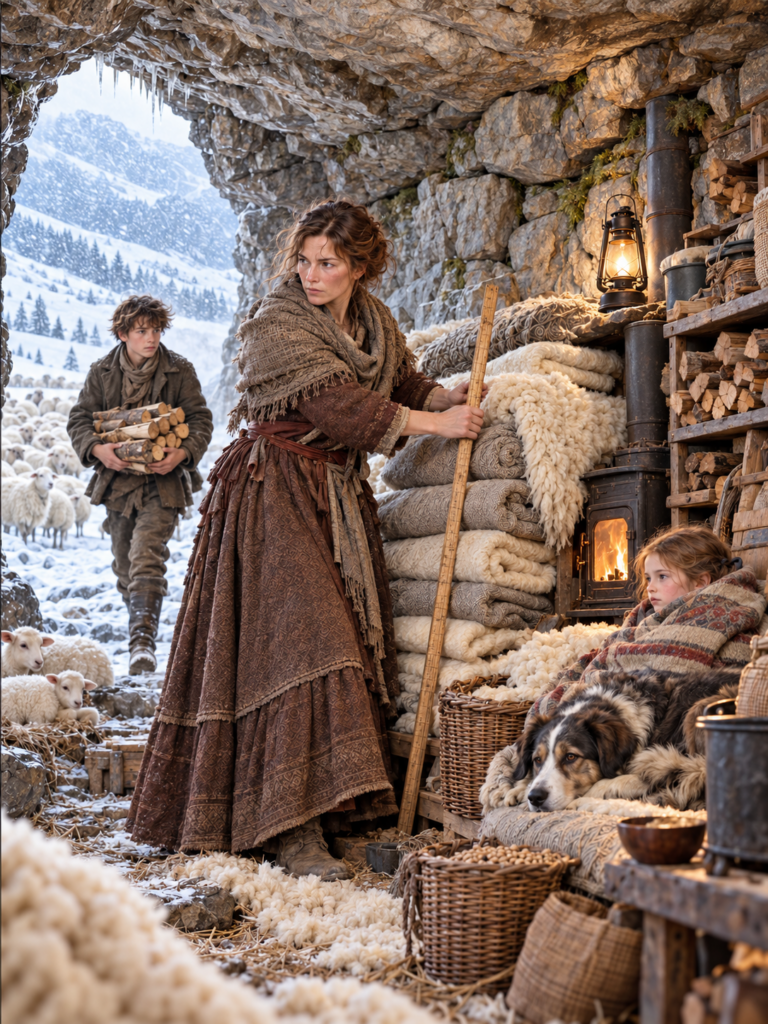
Part 1
The fourteen sheep refused to enter their pen.
Nora Whitlock stood in the doorway of her farmhouse, holding a lantern against the evening wind, and watched them gather along the northern fence. She had raised sheep long enough to recognize the difference between an animal that was frightened and one that was simply stubborn. These were neither.
They stood shoulder to shoulder, their woolly backs turned toward the barn, their heads angled toward a narrow black crack in the hillside.
Not one of them moved.
“Come on, now,” Nora called.
Her voice carried across the frozen yard, but the sheep scarcely acknowledged her.
Even Finn, the farm dog who ordinarily took great pleasure in pushing a reluctant flock through an open gate, had abandoned his usual duties. He sat in the stiff, yellowed grass beside the fence, his ears pointed forward, his eyes fixed on the same dark opening.
Nora raised the lantern.
The hillside had been there for as long as she could remember. Every spring, green grass covered its lower slopes. Every summer, the sheep wandered across it. When winter came, snow settled into the folds of the rock and turned the northern face gray and white.
There was nothing remarkable about it.
At least, that was what Nora had always believed.
She looked back toward the farmhouse. A faint orange light shone through the kitchen window, where her daughter, May, was waiting beside the stove. Her thirteen-year-old son, Eli, had gone to the barn to finish putting away the tools.
Nora should have been inside preparing supper.
Instead, she found herself opening the fence.
The sheep did not run.
They merely watched as she crossed the pasture toward the hillside, her boots breaking the thin crust of frost beneath her feet.
Finn followed.
At the base of the slope, Nora stopped and looked up.
The crack was barely visible from the house. Two uneven walls of stone leaned toward each other, forming an opening taller than it was wide. From a distance, it looked like nothing more than a deep shadow.
She had passed it hundreds of times.
Jonah had passed it, too.
The thought of her husband arrived with its usual sharpness, as though someone had pressed a thumb against a bruise that had never quite healed.
Jonah Whitlock had died the previous winter.
There had been no grand farewell, no chance for Nora to prepare herself for the silence that followed. One season she had a husband who could repair a roof, split a winter’s supply of wood, and make Eli laugh while doing the hardest chores. The next, she had his tools, his coat, and two children who still sometimes turned toward the door when the wind made the old hinges creak.
Since then, every decision on the farm had belonged to her.
Some decisions had been small.
Others had kept her awake until morning.
This one, she suspected, might be the strangest of all.
Nora stepped between the rocks.
Cold air brushed her cheeks.
Then she noticed something unexpected.
The passage did not end.
Beyond the narrow opening, the stone widened into a chamber large enough for several people to sit comfortably. Its ceiling rose unevenly overhead, and the floor, though rough, seemed unusually dry.
Nora lifted her lantern and inspected the walls.
She expected dripping water.
There was none.
She expected the heavy smell of wet soil.
Instead, the air carried only the clean, mineral scent of cold stone.
She held her free hand near the entrance.
Something moved against her fingers.
A draft.
Very slight, but unmistakable.
The hill was breathing.
Outside, the sheep remained gathered along the fence.
Nora stood motionless, listening to the faint movement of air, and remembered a conversation from years earlier.
Jonah had been repairing a section of pasture fence when she asked why the snow melted differently near the northern rocks.
He had smiled at the hillside.
“That part of the hill breathes differently in winter,” he had told her.
She had laughed and asked whether the mountain had caught a cold.
Jonah had laughed with her.
Neither of them had said anything more.
Now, standing inside the stone chamber with the first hard winter wind moving through the valley, Nora wished she had asked him what he meant.
She remained there until the lantern began to feel heavy in her hand.
Then she returned to the house.
At supper, Eli noticed that she was quieter than usual.
“Something wrong with the sheep?”
“No,” Nora answered.
He looked surprised.
“They wouldn’t go in.”
“I know.”
“Then something’s wrong.”
Nora glanced toward May, who was holding her hands near the stove.
“Maybe they’re trying to tell us something.”
Eli considered that.
“About what?”
Nora looked through the window toward the northern hillside.
“I don’t know yet.”
Three days earlier, a writer passing through the trading post had repeated a warning from an old trapper who worked the country north of the valley.
The rivers up there had frozen a month earlier than expected.
Migrating birds had disappeared almost overnight.
The trapper believed that a storm unlike anything the valley had seen in years was moving south.
He thought it might last seventeen days.
Most of the men at the trading post had laughed.
Seventeen days of blizzard conditions sounded more like a story meant to frighten inexperienced travelers than a weather prediction.
Nora had not laughed.
She had spent the evening counting the firewood stacked beside her house.
Then she had counted it again.
Even if the storm lasted half that long, she knew they were short.
Jonah had always prepared their winter supplies well in advance. He knew which trees burned slowly, which logs needed another season to dry, and how much wood the farmhouse consumed during a week of bitter weather.
Nora had learned much of it from watching him.
But watching a man work was different from having to replace the work of two people with one pair of hands.
There was still wool waiting to be sold.
There were sacks of dried food.
There were candles, blankets, water containers, and a small iron stove.
There was simply not enough firewood to heat the farmhouse through seventeen days of extraordinary cold.
That night, after the children were asleep, Nora sat beside the kitchen stove and watched the flames move.
The house was familiar.
It had kept her family warm through many winters.
But she knew every draft that crept beneath its doors, every window frame that rattled in a northern wind, and every corner where cold collected before dawn.
She thought about the dry stone chamber.
She thought about the moving air.
Then she looked at the wool.
By sunrise, Nora Whitlock had begun doing something that would become the favorite subject of conversation throughout the valley.
She was carrying bales of wool uphill.
Not toward the barn.
Not toward the trading post.
Toward the crack in the northern hillside.
Eli helped her with the smaller bundles.
“Are we storing them there?” he asked.
“Maybe.”
“Why?”
“Because I want to find out whether that chamber stays warmer than the house when the wind blows.”
He studied her.
“You mean sleep in there?”
“I mean find out what it can do before we decide anything.”
He looked up at the black opening.
“It’s a cave, Ma.”
“I noticed.”
“People don’t live in caves.”
“People haven’t always had houses, either.”
Eli smiled faintly.
It was the first time in several days that Nora had heard something of Jonah in her own voice.
She did not smile back immediately.
She was too busy examining the stone.
Inside the chamber, she walked from wall to wall, checking the floor and running her fingers along the seams. The deeper sections were dry, and the cold did not seem to bite quite as fiercely as it did outside.
She set down a wool bale, stepped backward, and looked at the entrance.
The chamber was not a miracle.
It was a possibility.
And a possibility, she had learned since Jonah’s death, was worth examining when there were no comfortable choices left.
By midmorning, Silas Whitlock arrived on horseback.
Jonah’s brother had been keeping an eye on the farm since the funeral. He had helped Nora inspect the roof, brought wood when he could spare it, and made a habit of asking the children whether they were eating enough.
Nora appreciated him.
She also knew he sometimes looked at her as though she were standing too close to the edge of something.
He dismounted beside the pasture fence and stared at the wool being carried uphill.
“Nora?”
She turned.
“Morning, Silas.”
He looked at Eli, who was dragging another bundle toward the slope.
“What exactly are you doing?”
“Testing the cave.”
Silas blinked.
“The what?”
“The chamber inside the hill.”
“I know the place you’re talking about.”
“Then you’ll know where to find me.”
Silas did not laugh.
He followed her up the hillside.
Inside, he looked around, then crouched near the entrance and touched the stone floor.
“You can’t be thinking of moving the children into this hole.”
“Not until I know whether it’s worth doing.”
“You have a house.”
“I also have a woodpile that won’t last if that trapper was right.”
“He might not be right.”
“He might not.”
“Then why go to all this trouble?”
Nora straightened.
“Because if he is right, I won’t have time to wish I’d prepared differently.”
Silas studied her for a moment.
He had known Nora long enough to recognize the tone.
Once she began working through a problem, arguing with her rarely made her stop. Jonah had understood that better than anyone.
Silas looked toward the entrance.
“There’s only one way out.”
“I know.”
“Snow could close it.”
“I know that, too.”
“And what happens if the walls get wet? Or the smoke won’t leave? You could end up trapping your children in a stone box.”
Nora looked at the chamber.
His words frightened her.
Not because she thought he was trying to hurt her, but because he was naming the same dangers that had kept her awake.
“I haven’t moved anybody in,” she said.
“Good.”
“That’s why I’m testing it.”
Silas exhaled slowly.
He was still unconvinced when he left.
By evening, Nora knew others had heard about her plans.
She could imagine the talk.
Poor Widow Whitlock.
First she lost her husband.
Now she was dragging wool into a hole in the mountain.
But she had little energy to spend on what people thought of her.
That evening, Eli discovered Jonah’s old wool measuring stick behind a shelf in the barn.
Its wood had been polished smooth by years of handling.
He carried it into the kitchen.
“Thought you might want this.”
Nora took it.
For a moment, she saw Jonah standing beside a stack of bales, measuring and counting while Eli followed him with questions.
She ran her thumb along the worn edge.
“Thank you.”
Later, she used it to measure the chamber, the bundles of wool, and the space where she hoped to store their supplies.
Then she counted everything again.
Food.
Blankets.
Candles.
Water containers.
Firewood.
The figures did not become kinder simply because she studied them longer.
Inside the farmhouse, their wood supply was dangerously small.
Inside the cave, she hoped the surrounding stone would shield them from the worst of the wind, allowing them to depend on a smaller fire.
But hope was not a plan.
She needed evidence.
The next morning, Nora and Eli carried the iron stove into the chamber, along with three bundles of split wood and two bales of wool.
They assembled a low stone barrier near the entrance, leaving a narrow opening above it where the moving air seemed strongest.
Nora lit a small fire.
Then she watched the smoke.
At first it curled upward.
For one uncomfortable moment, it lingered near the ceiling.
Then it drifted toward the gap and disappeared outside.
Nora waited.
She did not trust a result simply because she wanted it.
After a while, she pressed folded wool against the coldest section of wall and left the chamber.
When she returned an hour later, she pulled the wool away and touched the stone beneath it.
It was still cold.
But it did not feel as bitterly cold as the uncovered wall beside it.
Eli watched closely.
“Is that good?”
“It’s something.”
“Does that mean we can stay here?”
“It means we test it again.”
So they did.
Over the following days, Nora studied the chamber as carefully as she had once studied the changing weather from the kitchen window.
She learned where the floor stayed dry.
She learned which stones felt coldest.
She watched the smoke rise, followed the movement of air with a candle flame, and checked the wool for moisture.
Eli helped without complaining.
May visited during the shorter tests, wrapped in layers of wool against the cold.
Finn came and went, apparently pleased that his family had finally shown some interest in the place he had been watching.
The chamber slowly began to resemble a shelter.
Food was stacked on raised surfaces away from the stone floor.
Firewood rested on dry boards.
Wool covered the coldest wall.
Nora still had many questions.
Then, on the fifth test night, one of them received an answer she did not want.
May began coughing before dawn.
Nora woke at once.
The small fire was low, but the chamber did not feel as comfortable as it had the night before.
She reached for a folded wool blanket near the entrance.
Her fingers came away damp.
She brought the lantern closer.
A dark patch had spread across the wool.
Nora pressed her palm against it.
Cold moisture.
Her stomach tightened.
Wet wool would not insulate the way dry wool did. If more of the lining became damp, they would need more heat to compensate.
More heat meant more firewood.
And more firewood was exactly what they did not have.
Eli sat up.
“Ma?”
Nora said nothing.
He came beside her and saw the darkened wool.
“Does that mean we stop?”
She pulled the blanket away from the wall.
The stone behind it felt colder than she remembered.
For several moments, she considered everything Silas had said.
Perhaps he was right.
Perhaps she was so frightened of losing the farmhouse’s warmth that she had persuaded herself a hole in the hillside could save them.
Perhaps Jonah, if he were alive, would have told her to stop.
Then she looked at the damp wool again.
It was not damp everywhere.
Only in one area.
Nora touched the seam above it.
A thin thread of cold air brushed her fingers.
“No,” she said.
Eli waited.
She looked up at him.
“It means we found where it fails.”
The next day, Nora searched the entrance wall from floor to ceiling.
She moved slowly, holding a candle near every narrow opening in the rock, watching how the flame behaved.
The dampness had not come from a spring or a leaking ceiling.
Cold air was slipping through a seam high above the entrance, reaching the wool and leaving moisture in its fibers.
If there was one seam, others might be hidden nearby.
Nora examined every stretch of accessible stone.
By afternoon, she discovered two more.
Eli helped her collect moss.
Nora dug clay from the stream bed, her fingers aching in the cold as she worked.
Together, they packed clay and moss into the unwanted openings.
They left the original gap above the barrier untouched because it had allowed smoke to escape during the earlier tests.
Afterward, Nora watched the candle and smoke again.
She checked the wool.
She waited for the dampness to return.
The repaired sections remained dry.
Eli crouched beside two smaller sheep that had been lingering near the hillside.
“What about the lambs?”
Nora glanced at him.
“What about them?”
“Couldn’t we bring two into the outside part? At least they wouldn’t be standing in the wind.”
She considered the suggestion.
The lambs would take up space and require care.
But their living bodies would also contribute a little warmth to the protected chamber.
Eli had not solved the problem for her.
He had simply noticed something useful.
Nora smiled.
“Let’s try it.”
They brought two of the youngest lambs into the outer chamber.
The little animals shifted uneasily at first, sniffing the stone and pressing against one another. Eventually, they settled.
Soon the place smelled of wool, moss, hay, smoke, and warm animal breath.
Nora stood beside the low fire and looked around.
Nothing about the shelter was elegant.
The stone barrier was rough.
The wool lining was uneven.
The firewood pile seemed painfully small.
But the chamber had been examined, tested, repaired, and tested again.
For the first time, Nora felt that she was no longer depending entirely on a desperate guess.
Then, two mornings later, the sky turned the color of old iron.
A hard wind began before breakfast.
By noon, snow was sweeping across the fields.
Word came that a shutter had been torn from a barn two farms away.
By afternoon, the northern ridge had vanished behind a rolling wall of gray.
Nora looked toward the farmhouse windows.
She had spent days studying the cave.
Now there would be no more time for experiments.
She wrapped May in wool until the girl could scarcely bend her elbows.
Eli carried dried meat, oats, and candles.
Nora took the water containers and Jonah’s tools.
Finn followed as they climbed toward the hillside.
Behind them, the farmhouse disappeared into blowing snow.
Inside the chamber, the wind sounded different.
Against the house, storms had always struck in sharp, angry bursts. Shingles rattled, shutters shook, and every draft found a way through the walls.
Here, the stone softened the noise into something lower and more distant.
Nora lit the small fire.
The smoke rose toward the opening.
The wool remained dry.
May settled near the warmest protected wall, and Eli arranged the supplies within reach.
For several hours, Nora allowed herself to believe that the greatest uncertainty was behind them.
Then Finn began barking.
He was standing near the entrance, his ears raised, his body rigid.
Nora listened.
At first, she heard nothing except the wind.
Then came another sound.
A human voice.
Faint.
Strained.
Calling through the storm.
Eli lifted his head.
“Somebody’s out there.”
Nora hurried toward the entrance and pulled aside the covering.
Four shapes were staggering through the snow.
She recognized Lydia Mercer first.
Her husband, Grant, was struggling beside her, helping one of their children through drifts that had already risen above the child’s knees. Their second child stumbled close behind.
The Mercer family had lost the road somewhere between their farm and the trading post.
In the whiteout, they had wandered until the dim orange glow of Nora’s shelter appeared through the snow.
Lydia raised her face.
“Nora!”
Her voice cracked.
Nora stared at them.
Only days earlier, Lydia had laughed at the idea of a widow moving into a hole in the hillside.
Now her youngest child could barely stand.
Nora looked back into the chamber.
Every bundle of wood had been counted for three people.
Every meal had been measured for three.
The blankets, the water, the space, the air—all of it had been planned around Nora and her two children.
Outside, the snow was already erasing the Mercers’ footprints.
Nora looked into Lydia’s frightened eyes.
There was no useful calculation left to make.
“Bring the children in,” she said.
And with those four words, the small margin of safety she had spent days creating disappeared.
Seven people now depended on a shelter built for three.
Part 2
The first thing Nora noticed was how much water the Mercers carried into the shelter.
Snow clung to their coats, their hair, their sleeves, and the folds of their clothing. As it melted, dark spots appeared on the stone floor.
Grant’s hands were stiff with cold.
Lydia could hardly stop shaking.
Their youngest child stood between them, trembling so violently that Nora could hear the child’s teeth clicking.
“Get them farther inside,” Nora told Eli.
He moved immediately, gathering some of the wool blankets and making room beside May.
Lydia tried to speak.
“Nora, we didn’t—”
“Get the children warm first.”
“But we—”
“Lydia.”
The woman stopped.
Nora looked directly at her.
“We can talk when nobody’s freezing.”
Lydia nodded and helped her children into the sheltered part of the chamber.
Grant remained near the entrance, staring at the stone barrier and the small fire.
He seemed bewildered that anything inside the hillside could feel warmer than the open valley.
Nora knew the feeling.
She had been surprised herself.
But surprise was a luxury she could no longer afford.
There were seven people in the chamber now.
Seven people eating from the same supplies.
Seven people breathing in the same confined space.
Seven people creating moisture that could settle against the stone and wool.
She had planned their provisions carefully.
Now every number was wrong.
She knelt beside the food sacks and began counting again.
Eli joined her.
“Are we going to run out?”
Nora kept her eyes on the supplies.
“Not if we make them last.”
“They weren’t supposed to be here.”
He said it quietly, without looking toward the Mercers.
“I know.”
“We barely had enough for us.”
“I know that, too.”
Eli rubbed the measuring stick between his hands.
It was Jonah’s old habit when he had a difficult calculation to make. He would turn the stick once, look at his work, and start counting again.
Seeing her son do it brought Nora a moment of almost unbearable tenderness.
She wanted to tell him that everything would be all right.
But he was thirteen, not five.
He had carried firewood uphill. He had helped plug the cold seams. He had seen the size of their food supply.
He knew enough to recognize a false promise.
So she told him something else.
“We’ll be careful. That’s what we can do.”
They organized the chamber before the light outside disappeared completely.
The children slept farther inside, where the wool-covered wall felt least cold.
Finn curled close to them, occasionally lifting his head when the wind struck the entrance.
The adults stayed nearer the outer section.
The two lambs remained protected beyond the sleeping space, their small movements producing soft scraping sounds against the rough floor.
Grant helped move supplies onto raised boards.
Eli checked the firewood.
Lydia worked beside Nora to fold the blankets and arrange sleeping places for the children.
For the first time since entering the chamber, Lydia looked directly at the wool lining.
“You did all this yourself?”
“Eli helped.”
Lydia ran a hand across one of the thick bundles.
“I heard about it.”
Nora did not answer.
Lydia swallowed.
“I thought it was foolish.”
“I know.”
“I laughed.”
“I know that, too.”
Lydia withdrew her hand.
The silence between them was not comfortable, but Nora had no desire to turn it into an argument.
Outside, the wind was rising.
Nora moved toward the stove.
“We need the fire kept small.”
Grant looked up.
“Won’t a bigger one warm the place faster?”
“It would burn through the wood faster, too.”
He glanced at the short stack beside the wall.
“How long is that supposed to last?”
“Seventeen days, if it has to.”
Grant stared at her.
“That isn’t much wood.”
“No.”
“You really think the storm will last that long?”
Nora looked toward the dark opening.
“I hope it doesn’t.”
She told them the rules before their first meal together.
No fire larger than necessary.
No food taken simply because the hours felt long.
No wasting candles.
Every change in smoke, moisture, or temperature would be watched closely.
They would eat at regular times, no matter how tempting it became to use food as a way of comforting themselves.
The rules sounded severe when she spoke them aloud.
But Nora remembered the farmhouse woodpile and the trapper’s warning.
She could not make the supplies grow.
She could only change how they were used.
That first night, nobody slept deeply.
The Mercers’ children woke repeatedly.
May coughed beneath her blankets.
The lambs stirred when the wind struck particularly hard.
Grant rose twice to check the entrance.
Nora spent hours watching the movement of smoke above the small fire.
Each time it rose and drifted toward the opening, she felt some of the tension in her shoulders ease.
Then another gust struck the hillside, and she watched again.
By morning, the storm had not weakened.
The entrance was half-hidden behind snow.
Outside the narrow gap, there was no sign of the farmhouse.
No fence.
No pasture.
Nothing but white movement.
Lydia approached Nora while the others were eating.
“I owe you an apology.”
Nora looked up.
“You already said you were wrong.”
“I didn’t say it properly.”
“You don’t need to.”
Lydia glanced toward her youngest child, who was sitting beside May.
“We would never have found our way back.”
Nora followed her gaze.
The child was holding a small piece of dried food in both hands, eating slowly.
Lydia’s eyes filled.
“When I saw that light, I didn’t even know what it was. Grant thought it might be a lantern near the road. I just kept walking toward it.”
Nora thought of all the hours she had spent questioning whether the cave was worth preparing.
“You found us,” she said.
Lydia shook her head.
“You made sure there was somewhere to find.”
Nora did not know what to say to that.
She had not planned to save anyone beyond her own children.
She had not known the Mercers would become lost.
She had not known the light from their shelter would be visible through the blowing snow.
Yet here they were.
Four more lives inside a chamber that had been dismissed as useless.
Nora turned back to the food.
“We’re going to need everyone’s help.”
Lydia wiped her eyes.
“Tell me what to do.”
On the third day, the snow nearly closed the entrance.
Eli discovered it first.
He had gone to check the outer barrier when he realized the space beyond it was darker than it should have been.
“Ma!”
Nora hurried toward him.
Snow had packed into the opening overnight, leaving only a narrow section clear near the upper stones.
She pressed her fingers against the remaining passage and felt how tightly the drift had settled.
If it closed completely, the chamber would lose its connection to the outside air.
Grant came beside her.
“We can dig from here.”
Nora nodded.
“Carefully.”
Eli retrieved the tools they had brought from the farmhouse.
Grant began working from inside the entrance while Eli helped clear the packed snow away.
The drift resisted them.
Every handful that came loose seemed to reveal another layer of dense white snow behind it.
Nora stood close enough to watch the passage and the fire.
She could hear Grant breathing heavily as he worked.
At one point, Eli stopped and rubbed his fingers.
“Can’t feel them.”
“Warm them before you go on,” Nora told him.
Grant glanced back.
“We’re nearly through.”
“Then we’ll finish when his hands are ready.”
Eli protested, but Nora did not change her mind.
The storm was dangerous enough without turning an exhausted boy into another problem she could not solve.
When the narrow breathing channel was finally open, Nora checked the smoke.
It climbed toward the exit again.
She watched it for several minutes before allowing herself to move away.
Grant sat on the stone floor, breathing hard.
“Your boy’s a good worker.”
Nora looked at Eli, who was carefully putting the tools back in their place.
“He learned from his father.”
Eli pretended not to hear.
But Nora noticed that he stood a little straighter.
On the fourth day, the smoke began hanging lower.
The change was gradual.
At first, Nora thought the flame was simply burning differently.
Then she noticed that the thin gray trail was no longer disappearing as quickly as before.
She moved toward the entrance and discovered ice forming around the ventilation gap.
The opening had narrowed.
Cold air slipped over the frozen edge, and the familiar draft had weakened.
Nora cleared the ice.
The smoke began rising more freely.
It should have been reassuring.
Instead, it reminded her how easily a shelter could become dangerous without anyone noticing the first signs.
The cave was not safe because they had moved into it.
It was only sheltering them as long as the conditions that made it work continued.
The children did not understand all of those details.
They understood that Nora watched everything.
They understood that Eli checked the entrance.
They understood that Grant reinforced a loose part of the barrier rather than waiting for it to fall.
And they understood that Lydia no longer looked at the cave with embarrassment or suspicion.
She treated it as a place worth caring for.
By the middle of the storm, the seven of them had developed a routine.
They measured time by meals, candles, and the changing sound of the wind.
During quieter periods, they gathered packed snow from near the entrance and melted it in small batches to replace the water they used.
When the storm grew violent, they stayed farther inside and listened to the distant cracking of trees.
Nora could tell when a heavy gust struck the slope because the sound traveled through the rock like pressure through the floorboards of a house.
Sometimes the noise swelled until May pressed her hands over her ears.
Lydia would sit beside her.
“Listen to Finn,” she told the girl one afternoon.
May lowered her hands.
Finn was asleep, making soft snuffling noises beneath a fold of wool.
“If that dog can sleep through it,” Lydia said, “we ought to be able to sit through it.”
May smiled.
For a few minutes, the wind became something they could endure rather than something they had to fear.
Grant took responsibility for helping Eli maintain the entrance.
Lydia helped keep the younger children occupied and reminded them to conserve their energy.
Nora counted the food, the wood, and the candles.
Again.
And again.
Each count offered a small reassurance or revealed a new concern.
One evening, Eli came to sit beside her.
“Do you think Uncle Silas knows we’re here?”
“He knows I was preparing the cave.”
“He probably thinks we’ve done something stupid.”
Nora looked toward the entrance.
“He was worried about us.”
“Everybody was.”
“Some of them were.”
Eli picked at a loose fiber on the wool beside him.
“Were you scared he was right?”
Nora considered lying.
Instead, she answered, “Every day.”
He looked surprised.
“You didn’t seem scared.”
“Being scared doesn’t mean you stop working.”
Eli was quiet for a while.
Then he said, “Pa would have liked this place.”
Nora felt the old ache open in her chest.
She looked at the rough stone walls, the little stove, the stacked supplies, and the blankets arranged around the children.
“I think he knew something about it,” she said.
“Because of what he said?”
“Yes.”
Eli glanced at the entrance.
“That the hill breathes differently.”
Nora nodded.
“I wish I’d asked him more.”
Eli held the measuring stick across his knees.
“Maybe he thought there’d always be time.”
Nora could not answer immediately.
She thought about all the ordinary conversations she had postponed while Jonah was alive.
Questions about the farm.
Things he remembered about his childhood.
Stories he promised to tell her when the work was finished.
The unfinished conversations were sometimes harder to bear than the belongings he had left behind.
Finally, she reached over and rested her hand on Eli’s.
“That’s why we pay attention now.”
By the ninth day, the storm had developed a strange rhythm.
The wind would scream across the valley for hours, then weaken into a heavy silence.
During those quieter stretches, Nora could hear the lambs shifting and the children breathing.
Occasionally, a distant tree would break with a sound that carried through the hillside.
Then the wind would return.
The pattern reminded Nora of the chamber’s moving air.
In and out.
Pressure and release.
Almost like a living thing taking long, uneven breaths.
The two families began anticipating the quieter periods.
Grant would prepare to check the entrance.
Eli would gather the tools.
Lydia would make sure the children were settled before the next violent burst.
Nora watched the fire.
On the ninth evening, she counted the remaining wood and felt something she had not allowed herself for days.
Relief.
The stack was smaller, but it had not shrunk as quickly as she had feared.
If they maintained their careful routine, they might have enough.
Enough food.
Enough firewood.
Enough shelter.
She looked around at the sleeping children.
May’s cough had not vanished, but she was resting.
Lydia’s youngest was tucked beneath layered wool.
The older Mercer child slept nearby.
Finn lay between them, his breathing slow.
Eli had fallen asleep with one hand near Jonah’s measuring stick.
Nora watched them for a long time.
The cave was working.
Not perfectly.
Not without effort.
But it was working.
She should have been able to enjoy the realization.
Instead, she remembered the damp wool from the fifth test night.
She remembered the snow closing the entrance.
She remembered ice gathering around the ventilation gap.
Every time she had thought she understood the chamber, it had shown her something new.
Confidence, she had learned, was dangerous when it convinced a person to stop paying attention.
On the eleventh night, the familiar northern wind struck the hillside with enough force to make loose dust sift down from a narrow crack overhead.
Grant lifted his head.
“Sounds worse.”
Nora listened.
“It sounds different.”
He waited.
She tilted her head.
The wind was not striking the entrance in the same way.
For days, the pressure had come from a direction they had begun to recognize. The airflow through the chamber had behaved with a rough consistency.
Now the gusts sounded as though they were striking the hillside from an angle.
Nora watched the smoke.
It climbed toward the ceiling.
Paused.
Then continued toward the entrance.
She watched longer.
The flame wavered.
Grant noticed her expression.
“Something wrong?”
“Not yet.”
But she did not sleep easily.
Sometime later, with the storm still battering the ridge, Nora woke to a smell that did not belong.
Damp smoke.
She opened her eyes.
The fire was low.
The children were asleep.
The stone walls looked unchanged.
Then she saw the flame.
It was bending inward.
Toward the sleeping families.
Nora sat up.
For eleven nights, the warm smoke had traveled upward and toward the narrow gap above the entrance barrier.
Now it hesitated beneath the ceiling.
A thin gray layer spread across the chamber.
Nora rose quickly.
“Grant.”
He woke at once.
“What’s happened?”
“The draft.”
Eli stirred.
Nora pointed toward the flame.
“Look.”
The boy watched.
Then his face changed.
“It’s going the wrong way.”
Outside, the wind had shifted from north to northeast.
The new direction struck the hillside at an angle the entrance arrangement had not been tested against.
The familiar movement of air had faltered.
Then reversed.
Cold, damp air pushed inward through the upper gap.
The smoke no longer escaped cleanly.
May coughed.
Finn lifted his head and moved closer to her.
Grant came to stand beside Nora.
“We need to open the entrance.”
Nora looked toward the barrier.
She understood his reasoning.
Opening it might allow the smoke to clear.
But it could also let the blizzard drive directly into the chamber, scattering the warmth they had struggled to preserve.
She could hear the wind hammering the stone.
Beyond the barrier waited a wall of freezing air and snow.
Behind her lay seven people whose strength depended on the small shelter holding together.
Grant looked at May.
“She’s coughing.”
“I hear her.”
“Then we can’t leave it like this.”
Nora knelt beside the stove.
She moved the small fire farther from the entrance and reduced its strength.
Then she folded a piece of hide and narrowed the ventilation gap above the barrier.
Grant watched her.
“Will that work?”
Nora looked at the smoke.
“I don’t know.”
It was an answer she hated giving.
She had learned so much about the chamber during the previous days.
She knew where the stone remained dry.
She knew where the cold entered.
She knew how the smoke had moved when the wind came from the north.
But she had never tested a northeast gale against the entrance.
The hill was behaving differently.
And for the first time, she could not see a quick way to correct it.
One minute passed.
Then ten.
The flame continued leaning toward the sleeping families.
Smoke remained beneath the ceiling.
May coughed again.
Nora knelt beside her daughter and wrapped another layer of wool around her.
She placed a hand against the child’s chest.
“I’m here.”
May opened her eyes.
“Is something wrong?”
Nora brushed the hair from her forehead.
“The wind has changed.”
“Will it change back?”
Nora looked toward the fire.
“I hope so.”
She returned to the barrier.
Grant stood beside it, one hand resting against the stones.
“Say the word,” he told her, “and I’ll open it.”
Nora stared at the small flame.
Every part of her wanted to make a decision that would end the uncertainty immediately.
But there was no easy decision.
Opening the entrance had consequences.
Leaving it closed had consequences.
Outside, the northeast wind struck the hillside again.
Dust drifted from the rock.
The lambs shifted restlessly in the outer chamber.
Nora looked back at the children, then at the gray smoke suspended above them.
She had followed fourteen sheep into the hillside because they had noticed something she had overlooked.
She had trusted the dry stone because she tested it.
She had repaired the wet wool because she looked for the reason it failed.
But this time, she had no answer she could prove.
The wind refused to shift.
And inside the cave, the air continued moving the wrong way.
Part 3
The reversal lasted six hours.
Nora would remember those hours more clearly than almost anything else about the storm.
Not because she could describe every minute.
She could not.
Time had become something uneven inside the cave, stretching and folding around the movements of the fire, the sound of coughing, and the relentless pressure of wind against stone.
She remembered Grant sitting beside the barrier, ready to pull it apart if she asked.
She remembered Lydia holding her youngest child beneath the blankets, one hand resting protectively over the little head.
She remembered Eli watching the flame with the same fierce concentration Jonah had once given a difficult problem.
Most of all, she remembered May breathing.
Nora sat beside her daughter with a hand against her back.
Whenever May coughed, Nora felt the small body tighten beneath the wool.
Whenever she grew quiet, Nora leaned closer to listen.
The child was warm.
Too warm, perhaps.
Or perhaps Nora’s fingers were simply so cold that she could no longer judge.
The uncertainty was terrible.
She had measured firewood.
She had measured the chamber.
She had measured the remaining food and watched the movement of smoke.
But there was no measuring stick that could tell her how much longer her daughter could endure the damp, smoky air.
“Ma?”
Eli was beside the stove.
“Yes?”
“It’s still not rising.”
Nora looked up.
A thin trail of smoke drifted beneath the ceiling.
The folded hide remained wedged near the ventilation gap, and the small fire burned in its new position.
Nothing had corrected the airflow.
Nora swallowed.
“Keep watching it.”
Eli nodded.
He did not ask why she could not fix it.
Somehow, that made the moment harder.
Grant shifted beside the barrier.
“If it gets worse, we open it.”
Nora met his eyes.
“Yes.”
He glanced toward the children.
“We can’t let them breathe this all night.”
“I know.”
For the first time since the Mercers had arrived, there was no disagreement between them about what mattered.
They simply had no good choice left.
Outside, the northeast wind hammered the ridge.
A faint shower of dust fell from a crack overhead.
The two lambs pressed close together in the outer chamber.
Finn lay beside May, awake and motionless except when his ears moved toward another blast of wind.
Lydia quietly adjusted the blankets around the children.
Nobody wasted energy speaking.
They listened.
They waited.
And Nora kept watching the smoke.
During the long hours, she found herself thinking of the farmhouse.
She imagined its roof buried beneath snow and the old kitchen stove standing cold.
She pictured the table where Jonah used to sit, the shelf where May kept her few precious belongings, and the doorway where Eli had once waited impatiently for his father to return from the fields.
That house had been the center of their lives.
After Jonah died, it had also become the place where his absence was most difficult to bear.
Every room reminded her of something he had done.
Every task revealed something he was no longer there to do.
For months, Nora had fought to keep their lives unchanged.
She wanted the farmhouse to look as though Jonah might walk through the door at any moment.
She wanted the children to feel that losing their father had not meant losing everything familiar.
Now their survival depended on a place none of them had ever considered a home.
A rough chamber inside a hill.
Stone walls.
Wool bales.
A tiny fire.
Two lambs.
And the willingness of seven frightened people to trust one another.
Nora looked at Eli.
He was still studying the flame.
Jonah would have recognized that expression.
Perhaps she had been mistaken to think that everything her husband knew had died with him.
Some of it remained in his tools.
Some in the farm itself.
Some in the things he had said.
And some in the boy who had watched him work.
Another gust struck the ridge.
May coughed again.
Nora returned her attention to the present.
Memory could not move the smoke.
She had to keep watching.
Hours passed.
The fire stayed low.
The chamber remained dim.
The wind refused to release its hold on the hillside.
Then, about an hour before dawn, something changed.
It was not dramatic.
No sudden gust cleared the entrance.
No burst of fresh air swept through the shelter.
The sound outside merely grew less violent.
The long, pounding blasts became shorter.
Between them, Nora began hearing small stretches of quiet.
Eli noticed the flame first.
“Ma.”
She turned.
“Look.”
A faint thread of smoke rose from the coals.
It reached the ceiling.
Paused.
Then moved toward the narrowed opening.
Nora stared.
Another thread followed.
The flame was no longer leaning sideways.
Grant leaned forward, one hand still resting on the barrier.
“Is it changing?”
Nora watched another curl of smoke.
“Yes.”
Her voice was scarcely louder than a whisper.
The northeast wind weakened.
The pressure around the entrance shifted.
The familiar upward draft began to return.
Slowly, the smoke drew toward the opening and escaped.
Nora did not move for several moments.
She was afraid that any disturbance might undo what she was seeing.
Then she looked at May.
Her daughter’s breathing had become quieter.
The coughing eased.
Grant removed his hand from the barrier.
Lydia closed her eyes briefly and rested her cheek against her youngest child’s hair.
Eli sat back on his heels.
Nobody cheered.
Nobody said they had been saved.
The danger had simply loosened its grip.
As the chamber cleared, the gray haze gave way to familiar objects.
Wet stone near the entrance.
Darkened wool.
The small red glow of coals.
Faces drawn with exhaustion.
Nora leaned against the wall.
Her entire body ached.
The damp wool would need attention.
The firewood pile was smaller.
The storm was still raging beyond the hillside.
The morning had not ended their ordeal.
It had merely returned the shelter to them.
By the fourteenth day, the wind had settled into a constant, low roar.
Frost formed near the entrance.
The cold deepened.
Nora continued counting supplies, but her movements had become slower.
Eli checked the airflow with the same care she had shown during the first tests.
Grant watched the barrier.
Lydia helped the children remain quiet and warm.
They no longer spoke of the cave as a strange experiment.
They spoke of its walls, its fire, and its entrance with the familiarity of people who had learned every part of a small home.
On the fifteenth day, the cold seemed to penetrate everything.
The blankets felt heavy.
The stone remained bitter beneath their hands.
Yet the small fire continued burning.
The wool continued providing insulation.
And the seven of them remained together.
On the sixteenth day, almost nothing changed.
That was somehow worse than the violent nights.
The same pale light at the entrance.
The same low sound of wind.
The same careful portions of food.
The same questions nobody could answer.
The children had stopped asking when they could leave.
Nora noticed that more than anything.
She missed their questions.
Even the impatient ones.
She missed May asking whether the snow would be deep enough to play in.
She missed Eli complaining about chores.
She missed the ordinary sounds of children who believed tomorrow was something they could count on.
That evening, she looked at the little fire and spoke quietly to them.
“We’ve come a long way.”
Eli raised his eyes.
“Sixteen days.”
“Yes.”
“Think tomorrow will be different?”
Nora considered the question.
She could not promise him sunshine.
She could not promise him the storm would end.
But she could sit beside him and wait for morning.
“We’ll find out,” she said.
On the seventeenth morning, Nora woke to silence.
For several moments, she lay still.
Something was wrong.
Or rather, something familiar was missing.
There was no scraping of windblown snow against the stone.
No distant cracking of trees.
No low pressure rumbling through the hillside.
She could hear the lambs shifting.
She could hear the soft breathing of the sleeping children.
She could hear the faint crackle of their smallest fire.
Nothing else.
Eli opened his eyes.
“Ma?”
Nora sat up.
He listened.
“Is it over?”
She did not answer.
Not yet.
She rose carefully, crossed the chamber, and removed the folded hide from the entrance.
Grant woke and watched her.
She eased open the barrier.
Cold light spilled across the stone.
Nora climbed toward it.
At the opening, she stopped.
The valley was gone.
Not truly gone, of course.
The hills remained.
The trees remained.
The houses and barns were still somewhere beneath the white.
But the familiar landscape had vanished under seventeen days of snow.
Fence posts were buried.
Rooflines lay bent beneath heavy drifts.
One barn had collapsed.
Several chimneys stood silent against the morning sky.
The cold was fierce, but the wind had stopped.
Above the northern ridge, the sky was clear.
Nora stepped into the snow.
For a moment, she could do nothing but stand there.
Behind her came the sound of movement.
Finn pushed past Eli, bounded into a drift, and immediately sank almost to his chest.
He scrambled backward with such offended determination that May began to laugh.
It was a small laugh.
Weak from days of coughing and confinement.
But Nora turned at once.
She had not heard that sound in far too long.
Eli helped his sister through the entrance.
Lydia emerged with her children.
Grant followed.
Seven people stood outside the narrow crack in the hillside.
Alive.
Nora looked from one face to another.
Eli, who had carried rope and firewood into the cave when they barely knew whether it could shelter them.
May, whose coughing had frightened her more than the storm itself.
Lydia, who had once laughed at the widow’s strange preparations.
Grant, who had helped keep the entrance open when the snow threatened to bury them.
And the two Mercer children, who had followed a faint orange light through the whiteout and found warmth where no one expected it.
Seven people.
Nora’s supplies had been planned for three.
Yet all seven had endured the seventeen days.
She looked back at the opening.
The cave appeared almost embarrassingly ordinary in daylight.
A dark crack between rough stones.
A crude barrier built from earth, rock, moss, and wool.
Nothing that could explain, at a glance, what had happened inside.
By midmorning, Silas Whitlock reached the hillside on foot.
His horse could not cross the drifts.
He had spent hours struggling through the valley, checking homes and calling out to people.
When he saw Nora standing outside the cave, he stopped.
For a moment, he appeared unable to move.
His eyes traveled from her face to Eli and May.
Then to Lydia and Grant.
Then to the Mercer children.
Finally, he looked at the entrance.
The same entrance he had warned might become a stone box.
Nora waited.
Silas stepped forward.
He did not apologize.
He did not explain why he had been wrong.
He simply wrapped his arms around his sister-in-law and held her.
Nora closed her eyes.
For the first time in seventeen days, she allowed herself to lean against someone else.
Silas had been right to worry.
The cave could have failed.
The entrance had nearly closed.
The wool had become damp.
The airflow had reversed.
There had been hours when the shelter frightened Nora more than the storm outside.
But she had watched.
She had learned.
She had corrected what she could.
And when four more lives appeared at her entrance, she had made room.
In the years that followed, people throughout the valley told different versions of what had happened.
Some insisted the sheep had known the storm was coming.
Others believed Jonah Whitlock had understood the hillside and somehow left his wife the answer.
A few called it extraordinary luck.
Nora never accepted any of those explanations as the whole truth.
When someone asked how she had known the cave would keep them alive, she gave the same answer.
“I didn’t know.”
That often disappointed people.
They wanted a secret.
A hidden knowledge passed down by Jonah.
A miraculous instinct.
Something that explained why one widow had recognized what everyone else overlooked.
But Nora had no such explanation to offer.
She remembered fourteen sheep refusing to enter their pen.
She remembered Finn staring at a dark seam in the stone.
She remembered the old trapper’s warning and Jonah’s words about the hill breathing differently in winter.
She remembered finding damp wool and searching until she discovered the cold seams.
She remembered Eli gathering moss, the lambs settling into the outer chamber, and the Mercers stumbling toward the light.
Most vividly, she remembered a flame bending the wrong way while her daughter coughed beneath the blankets.
None of those things had looked like an answer when they happened.
They had looked like problems.
Problems that demanded attention.
Problems that could not be ignored simply because they were frightening.
The stone had not created warmth.
It had not defeated the storm.
It had only slowed how quickly the cold could steal their heat.
For seventeen days, that difference had been enough.
Enough for Eli to walk into daylight.
Enough for May’s coughing to ease.
Enough for Lydia’s children to make it home.
Enough for two families to emerge from a place the rest of the valley had considered useless.
Years later, the crack remained in the northern hillside.
There was no monument.
No carved inscription.
No marker explaining what had happened there.
In summer, grass grew across the lower slope, and sheep wandered past the entrance without stopping.
The stone looked much as it always had.
Cold.
Rough.
Unremarkable.
A stranger crossing the pasture might never have noticed the opening at all.
But the people who had lived through that winter remembered.
And Nora Whitlock carried one lesson from those seventeen days for the rest of her life.
Courage had not meant knowing that everything would work.
It had meant paying attention when something was wrong, doing what she could with what she had, and refusing to turn away from people who needed shelter.
Sometimes survival did not begin with a grand discovery.
Sometimes it began with fourteen sheep standing beside a fence, refusing to move.
And one exhausted widow deciding to find out why.


