
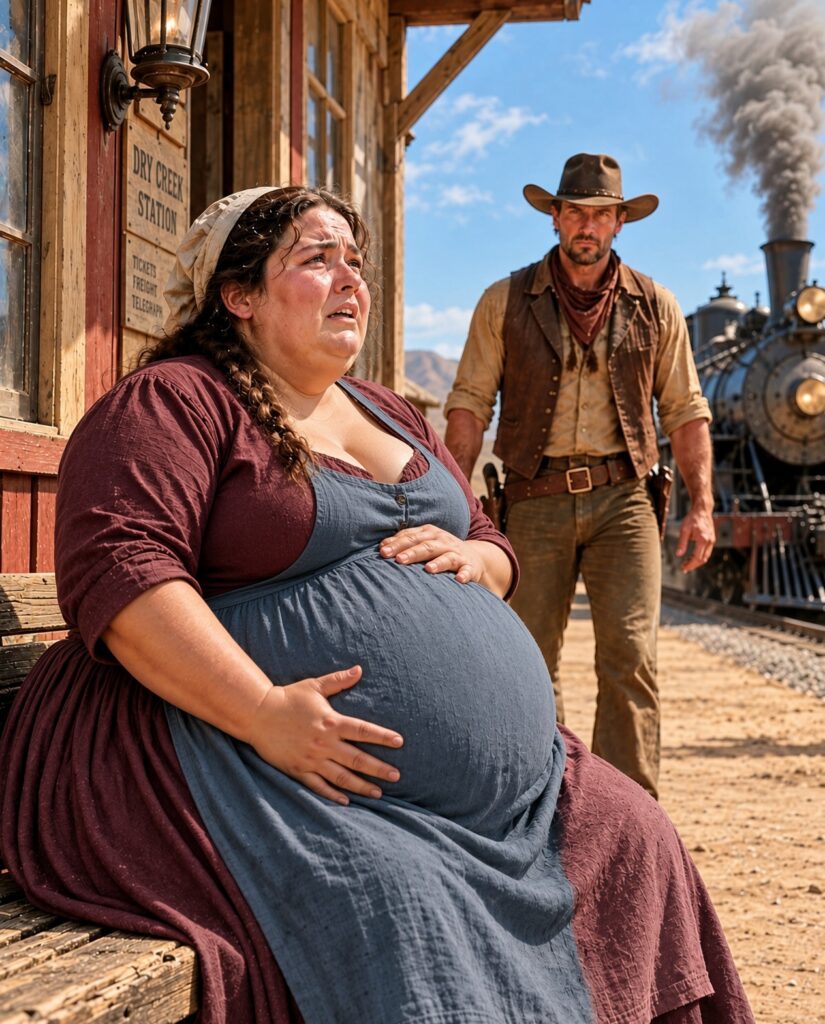
THEY SAID SHE WAS TOO OLD, TOO HEAVY, AND TOO MUCH TROUBLE TO LOVE — THEN A LONELY RANCHER SAID, “YOU BELONG HERE”
## Part 1
Everyone on the train platform saw the pregnant woman being abandoned.
No one stopped him.
Evelyn Marlo stood beneath the merciless Kansas sun with both hands pressed against her seven-month belly and screamed one name.
“Caleb!”
The man twenty yards ahead slowed.
For one terrible second, Evelyn believed he would turn around.
He didn’t.
Caleb Whitmore pulled his hat lower, walked through the crowd, passed the ticket office, and disappeared around the side of the station.
Just like that, the man who had promised to marry her walked out of her life.
And everyone watched.
Evelyn was thirty-nine years old.
People had spent years reminding her that she was getting “too old” for marriage. Too broad through the shoulders. Too heavy around the waist. Too plain. Too independent.
Then Caleb had appeared in Philadelphia.
For two months, he had courted her patiently.
He told her she was beautiful.
He told her that her strength was what he loved most.
He told her about his land out West, about a house waiting for warmth, about children laughing on the porch.
And when Evelyn discovered she was carrying his child, Caleb smiled.
“A house isn’t a home without children,” he had whispered.
So she believed him.
She packed everything she owned into one battered suitcase with a broken clasp, took the forty-one dollars she had saved from years of sewing, kissed her suspicious sister Margaret goodbye, and boarded a train west.
Now she sat alone on a warped wooden bench in Red Willow, Kansas.
Six hours passed.
Her feet swelled inside her boots.
Her stomach cramped from hunger.
People came and went.
A stationmaster asked twice whether she was waiting for someone.
The first time, Evelyn said yes.
The second time, she couldn’t.
By late afternoon, she understood.
Caleb wasn’t coming back.
She pressed trembling hands against her belly.
“We’re going to be all right,” she whispered.
She had no idea whether it was true.
But somebody needed to say it.
Then a supply wagon rolled around the side of the station.
The man driving it was perhaps forty-two, tall and weathered, with a face shaped by sun, wind, and years of silence.
He climbed down, checked a folded supply list, then noticed Evelyn.
He didn’t stare at her body.
He didn’t stare at her belly.
He simply looked at her as though she were a person whose circumstances mattered.
“Ma’am?”
“Sir.”
“You waiting for someone?”
Evelyn swallowed.
“Not anymore.”
His jaw tightened almost imperceptibly.
“My name’s Nathaniel Callaway.”
“Evelyn Marlo.”
His eyes moved toward the empty platform.
“Have you eaten?”
“No.”
He nodded toward town.
“There’s a place two streets over. I was going anyway.”
Evelyn stiffened.
“Why?”
Nathaniel looked directly at her.
“Because you’ve been sitting here in the heat without food.”
“That’s all?”
“That’s all.”
She had learned what promises from men could cost.
“What do you expect from me?”
“Nothing.”
Something about the way he said it made her believe he understood why she had asked.
At the eating house, he ordered beans, salt pork, cornbread and coffee.
He asked no intrusive questions.
Eventually, Evelyn told him anyway.
“A man brought me here from Philadelphia.”
Nathaniel listened.
“He knew about the baby?”
“Yes.”
“And he left you?”
“Yes.”
Nathaniel stared into his coffee for a moment.
Then he said quietly, “I’m sorry.”
No pity.
No judgment.
Just two honest words.
Afterward, he surprised her again.
“I have a ranch,” he said. “Spare room. Solid roof. Good well. I need help with cooking, mending and keeping the house when I’m out with the cattle.”
Evelyn stared at him.
“You don’t know me.”
“I know you sat on that platform all day without asking anybody for a thing. I know you answered me honestly. And I know you need somewhere safe tonight.”
Her eyes narrowed.
“Charity?”
“No.”
His answer came instantly.
“Work for room and board. Fair terms.”
“And if I want to leave?”
“You leave.”
“No expectations?”
“None beyond what we agree.”
She studied his face.
Then she thought of the dark platform.
The child coming in two months.
Her forty-one dollars.
“All right, Mr. Callaway.”
The ranch sat beyond miles of open country beneath a sky so full of stars that Evelyn could barely stop looking upward.
Nathaniel gave her the spare room.
Clean sheets.
A quilt.
A window facing east.
“Sleep as long as you need,” he said.
The next morning, she woke to coffee.
Then something stranger happened.
She began to wake to hope.
Days became weeks.
Evelyn repaired Nathaniel’s shirts and the faded curtains his late wife, Ellen, had sewn before dying of fever eleven years earlier.
She made bread.
Rescued the neglected garden.
Cooked hot meals.
Nathaniel never treated her like a burden.
When she attempted to calculate whether her labor covered the food she was eating, he inspected her figures.
“You’ve undervalued your work by half.”
Evelyn looked up sharply.
“You’re not simply saying that?”
“I don’t simply say things.”
Even Tom Bright, Nathaniel’s old ranch hand, started coming inside whenever fresh bread appeared.
“That’s the first decent loaf this house has seen in eleven years.”
Evelyn laughed.
Really laughed.
The sound startled her.
She had almost forgotten she could.
But the town was less kind.
Women whispered.
Men stared.
People looked at her unmarried belly and drew conclusions.
One afternoon after a particularly uncomfortable visit to Harker’s Creek, Nathaniel loaded their supplies into the wagon and said quietly:
“If someone treats you cruelly, tell me.”
“I can defend myself.”
“I know.”
He lifted a sack of flour.
“You’ve probably been defending yourself your whole life.”
Then he looked at her.
“I’m saying you don’t have to do it alone anymore.”
The words followed Evelyn home.
So did another realization.
Nathaniel never asked her to become smaller.
Never asked her to apologize for occupying space.
Never looked at her age as though it were an expiration date.
When men working for Nathaniel’s rival, Dalton Harker, rode onto the ranch one night and began mocking the “woman” inside Nathaniel’s house, Nathaniel stepped off the porch.
“You need to stop before you finish that sentence.”
No shouting.
No performance.
Just certainty.
The men left.
Later, Evelyn lay awake with her hands on her belly.
Something was changing.
Not quickly.
Not foolishly.
Stitch by stitch.
Like repairing torn fabric carefully enough that it might become strong again.
Thirty-four days after arriving, Evelyn realized she no longer woke expecting disaster.
On the thirty-fifth morning, she was gathering onions from the garden when she heard a horse coming up the eastern road.
She stood.
The basket slipped from her fingers.
Onions rolled through the dirt.
The rider passed through Nathaniel’s gate as casually as though he had every right in the world to be there.
He dismounted.
Looked directly at her pregnant belly.
And smiled.
“Evelyn,” he said. “There you are.”
Her blood turned cold.
The rider passed through Nathaniel’s gate as casually as though he had every right in the world to be there.
He dismounted.
Looked directly at her pregnant belly.
And smiled.
“Evelyn,” he said. “There you are.”
Her blood turned cold.
For one long second, the Kansas wind seemed to stop.
Evelyn could hear the onions rolling through the loose dirt at her feet.
Could hear the horse breathing.
Could hear her own pulse.
But she could not move.
Caleb Whitmore looked almost exactly as he had on the train.
Clean coat.
Polished boots.
That patient smile that had once convinced her he meant every soft word he said.
Only now she knew what lived behind it.
“You shouldn’t be here.”
His smile widened.
“That’s not much of a greeting.”
Evelyn instinctively covered her belly.
Caleb noticed.
Something flickered in his eyes.
Not tenderness.
Possession.
That frightened her more.
“I said you shouldn’t be here.”
“Evelyn.”
He took one step forward.
She stepped back.
Caleb stopped.
“All right.”
His voice softened.
The old voice.
The Philadelphia voice.
The one he had used when telling her she was beautiful.
“I understand you’re angry.”
“Angry?”
“You have every right.”
“Do I?”
“Yes.”
He removed his hat.
“I made a terrible mistake.”
Evelyn almost laughed.
The sound that came from her throat was too bitter to be laughter.
“You left me at a railway station.”
“I panicked.”
“You walked away while I was calling your name.”
“I know.”
“I was seven months pregnant.”
His jaw tightened.
“People were watching.”
“Yes.”
“You knew I had almost no money.”
“Yes.”
“You knew I knew nobody in Kansas.”
“I know.”
Evelyn stared at him.
“Then don’t call it panic.”
His expression shifted.
“Evelyn—”
“Call it what it was.”
Caleb said nothing.
“Cowardice.”
His eyes hardened slightly.
Then he recovered.
“I deserve that.”
“Good.”
She bent to pick up the basket.
“I came to make things right.”
“No.”
“You haven’t heard what I came to say.”
“I heard enough in Philadelphia.”
He frowned.
“What does that mean?”
Evelyn straightened.
“You told me you loved me.”
“I did.”
“You told me there was land waiting for us.”
“There is.”
“You told me we would build a house.”
“I meant it.”
She stared.
“Then why did you leave?”
For the first time, Caleb looked away.
Not far.
Toward the barn.
Toward Nathaniel’s house.
Toward the acres surrounding him.
Evelyn noticed.
And suddenly, some cold instinct whispered that Caleb had not come back because of guilt.
He had come because of something here.
“Why are you really here?”
Caleb looked at her again.
“To take you home.”
“This is not your home.”
“Not yet.”
He stepped forward.
Evelyn backed toward the porch.
The front door opened.
Nathaniel Callaway stepped out.
He had no rifle.
That somehow made him more frightening.
His sleeves were rolled to the elbow.
Dust coated his boots.
He had clearly come from repairing fence.
He looked at Caleb once.
Then at Evelyn.
“Everything all right?”
Evelyn answered immediately.
“No.”
Nathaniel descended the steps.
Caleb’s posture changed.
“Mr. Callaway, I presume.”
Nathaniel stopped beside Evelyn.
“Who are you?”
“Caleb Whitmore.”
Nathaniel’s eyes sharpened.
He looked at Evelyn.
“The man from the station?”
“Yes.”
Something in Nathaniel went very still.
Caleb attempted a charming smile.
“This is a private matter.”
Nathaniel looked at Evelyn.
“Is it?”
“No.”
Nathaniel turned back.
“Then it isn’t.”
Caleb laughed lightly.
“I appreciate your concern, but Evelyn and I have history.”
Nathaniel’s face did not change.
“So do wolves and sheep.”
Caleb’s smile vanished.
Evelyn nearly looked at Nathaniel in surprise.
Nathaniel rarely wasted words.
When he chose one, he meant it.
Caleb’s voice cooled.
“She is carrying my child.”
Nathaniel’s eyes went to Evelyn.
She nodded once.
Nathaniel looked back at Caleb.
“That doesn’t give you ownership.”
“No. But it gives me responsibility.”
“You misplaced that at the station.”
Caleb’s face flushed.
“I made a mistake.”
Nathaniel stepped slightly forward.
“A mistake is buying the wrong saddle.”
His voice stayed low.
“You abandoned a pregnant woman two thousand miles from home.”
Caleb clenched his jaw.
“I came back.”
Nathaniel glanced toward the horizon.
“Thirty-five days later.”
That silenced him.
Evelyn turned toward Caleb.
“How did you find me?”
He hesitated.
“People talk.”
“Who?”
“The stationmaster remembered you.”
That sounded plausible.
Too plausible.
Nathaniel heard it too.
“Why now?”
Caleb looked at him.
“What?”
“Why come now?”
Caleb’s expression flickered.
Nathaniel continued.
“You had more than a month.”
“I needed time.”
“For what?”
Caleb’s gaze hardened.
“That is none of your concern.”
Nathaniel took another step.
“Anything that rides through my gate and scares someone living under my roof becomes my concern.”
Living under my roof.
Not working for me.
Not staying temporarily.
Living.
Evelyn felt the words deep in her chest.
Caleb noticed her reaction.
And for the first time, jealousy entered his face.
“You live here?”
Evelyn lifted her chin.
“Yes.”
“With him?”
“Yes.”
Caleb stared at Nathaniel.
Then he smiled.
A crueler smile this time.
“I see.”
“No,” Evelyn said. “You don’t.”
Caleb ignored her.
“Convenient.”
Nathaniel’s voice became dangerous.
“Careful.”
Caleb laughed.
“Surely I’m allowed to question what kind of arrangement a lonely widower makes with an abandoned pregnant woman.”
Nathaniel’s expression did not move.
“Leave.”
Caleb looked at him.
“I’m speaking to Evelyn.”
“No. You’re leaving.”
“This is public country.”
“This ranch isn’t.”
Caleb’s smile disappeared completely.
He looked at Evelyn.
“I’ll be in town.”
“I don’t care.”
“You will.”
Something in his tone changed.
A threat hidden under calm words.
Nathaniel heard it.
His body shifted.
Caleb raised both hands.
“Easy.”
Then to Evelyn:
“You should ask Mr. Callaway who owns the water running through the south pasture.”
Evelyn frowned.
Nathaniel went still.
Caleb smiled again.
“There it is.”
“What are you talking about?” Evelyn asked.
Caleb mounted.
“You’ll find out.”
He touched his hat.
“I’ll see you soon.”
Then he rode away.
Nathaniel watched until the horse disappeared behind the eastern ridge.
Evelyn turned.
“What did he mean?”
Nathaniel remained silent.
“Nathaniel.”
He looked at her.
“The south creek.”
“What about it?”
His jaw tightened.
“I don’t own all of it.”
“Who does?”
He looked toward the direction Caleb had ridden.
“Dalton Harker.”
Nathaniel told her everything that evening.
Not because Evelyn demanded it.
Though she did.
Because the moment Caleb mentioned the south water rights, Nathaniel knew silence would only make things worse.
They sat at the kitchen table.
Tom Bright stood near the stove, hat turning slowly in his hands.
Nathaniel unfolded a survey map.
Twin Pines lay along the northern side of a shallow creek that fed two cattle ponds.
Evelyn traced the blue line.
“What is this parcel?”
“Harker land.”
“But the water crosses here.”
“Yes.”
“And into your pasture.”
Nathaniel nodded.
“Under an old easement.”
“What does that mean?”
“Means I can use water passing through his section.”
“For how long?”
Nathaniel did not answer.
Evelyn looked up.
“Nathaniel.”
“Another year.”
Her stomach tightened.
“Then what?”
“Harker can renegotiate.”
Tom muttered, “Or choke us dry.”
Nathaniel gave him a look.
Tom shrugged.
“She ought to know.”
Evelyn sat back.
“Why would Dalton Harker want your ranch?”
Nathaniel folded his arms.
“Same reason men always want land.”
“Money?”
“Mostly.”
Tom spoke.
“Railway survey’s coming through somewhere between Red Willow and McPhee.”
Evelyn looked at him.
“Nobody knows where?”
“Not officially.”
Nathaniel’s eyes darkened.
“But Harker thinks it’ll cross near our southern section.”
Understanding began forming.
“If he owns the creek and Twin Pines…”
“He controls nearly twelve miles of the route.”
Evelyn looked down at the map.
“What does Caleb have to do with it?”
Nathaniel answered carefully.
“I don’t know.”
Tom snorted.
“I got a guess.”
Nathaniel looked at him.
Tom continued.
“Whitmore rode straight here after a month gone, and the first thing out of his mouth was water rights?”
He shook his head.
“That ain’t romance.”
Evelyn’s face went pale.
Nathaniel noticed.
“Evelyn.”
She stood.
“Excuse me.”
He rose too.
“Where are you going?”
“Outside.”
“You all right?”
“No.”
She walked onto the porch.
The evening air had cooled.
The baby moved hard beneath her ribs.
Evelyn pressed one hand against the railing.
Nathaniel stepped outside behind her.
He kept several feet between them.
“You don’t have to talk.”
“I know.”
Silence.
Then she said, “He knew.”
Nathaniel waited.
“When Caleb courted me, he asked questions.”
“What questions?”
“About sewing. Philadelphia. My family.”
She shook her head.
“I thought they were ordinary.”
“What else?”
“Whether my sister owned property. Whether my father had ever invested west.”
Nathaniel frowned.
“What did your father do?”
“He was a surveyor.”
Nathaniel’s expression changed.
Evelyn turned toward him.
“What?”
“What kind?”
“Railroad and land surveys.”
Nathaniel stared.
“My father mapped routes for companies moving west.”
She stopped.
Nathaniel said nothing.
A memory rose so quickly Evelyn nearly lost her balance.
Caleb sitting in a Philadelphia café.
Smiling.
Asking whether her father’s old papers still existed.
She had laughed.
Said Margaret kept most of the boxes.
Another memory.
Caleb asking whether her father had ever worked in Kansas.
Yes.
Years ago.
Red Willow.
Evelyn’s breath caught.
“Oh God.”
Nathaniel moved closer.
“What?”
“My father surveyed here.”
“Here?”
“I think so.”
“When?”
“Twenty years ago. Maybe longer.”
Evelyn looked at him.
“Caleb knew.”
Nathaniel’s face hardened.
“Knew what?”
“I don’t know.”
But suddenly she was certain of one thing.
Caleb Whitmore had not chosen her because he loved her.
And he had not abandoned her because he had suddenly stopped.
Something had changed at Red Willow Station.
Something he had seen.
Or learned.
And thirty-five days later, he had returned because whatever he wanted had become important enough to come back for.
The next morning, Nathaniel rode to town.
Evelyn wanted to come.
He refused.
She argued.
He still refused.
Then he compromised and took Tom.
“You’re treating me like glass.”
“No.”
Nathaniel saddled his horse.
“You are seven months pregnant.”
“Women have been pregnant before.”
“Yes.”
“Women have ridden wagons before.”
“Yes.”
“Then—”
“And men have been fools before. Doesn’t mean I need to join them.”
Evelyn glared.
Tom coughed into his fist to hide a laugh.
Nathaniel mounted.
“I’ll be back before noon.”
“You’d better.”
His expression softened.
“I will.”
He left.
Evelyn stood in the yard watching the dust settle.
Then she went inside.
She lasted twenty minutes.
After that, she began searching her suitcase.
Caleb had packed most of their baggage in Philadelphia.
Or claimed he had.
At Red Willow Station, she had been left with only one suitcase.
Her father’s papers were not in it.
But perhaps something else was.
Evelyn emptied every dress.
Every stocking.
Every folded scrap of cloth.
Nothing.
Then she lifted the lining.
A corner had been cut and stitched again.
Her sewing eye caught it immediately.
Wrong thread.
Different tension.
She fetched scissors.
Opened the seam.
A folded page slid out.
Evelyn stared.
It was not hers.
The paper was old.
Yellowed.
Covered in lines.
A map.
Railroad markings.
Survey stakes.
Water channels.
And at the bottom, her father’s signature.
Samuel Marlo.
Evelyn sat slowly.
He had surveyed the land.
But that was not what frightened her.
A red circle had been drawn around Twin Pines.
Beside it:
PRIMARY CROSSING — NATURAL GRADE — SOUTH CREEK ACCESS CRITICAL.
Someone had hidden the map in her suitcase.
Who?
Caleb?
Why?
Her mind raced.
Perhaps he had stolen it from Margaret’s boxes.
Perhaps he had used Evelyn to transport it.
Then the baby moved sharply.
Evelyn pressed both hands over her belly.
“All right.”
She whispered.
“We think.”
She studied the map again.
A second note had been written in different handwriting.
Harker.
That one word changed everything.
Nathaniel returned at eleven thirty.
One look at Evelyn’s face and he stopped asking whether she was all right.
She placed the map on the table.
He stared.
“Where did you get this?”
“My suitcase.”
Tom leaned in.
Nathaniel’s eyes went to the signature.
“Samuel Marlo.”
“My father.”
Tom whistled.
Nathaniel studied the red marking.
His face went still.
“This is the old railroad survey.”
“You knew about it?”
“Rumors.”
“Is it valuable?”
Nathaniel laughed once without humor.
“If it’s authentic, yes.”
“How valuable?”
“Enough to explain Harker.”
Evelyn sat.
Nathaniel pointed.
“The railway hasn’t finalized the new route. But if your father’s original grade survey proves this crossing works, they can save months of engineering.”
“And Twin Pines?”
“Sits directly beside the easiest crossing.”
Tom muttered, “Harker buys Twin Pines, Harker names his price.”
Evelyn looked at Nathaniel.
“And Caleb?”
Nathaniel stared at the map.
“He may have been working for Harker.”
The thought hurt more than Evelyn wanted to admit.
Not because she loved Caleb.
That illusion had died.
But because part of her still wanted to believe she had at least once been loved.
Nathaniel noticed.
He sat across from her.
“Don’t.”
She looked up.
“Don’t what?”
“Blame yourself.”
“I was thirty-nine years old and believed the first handsome man who told me what I wanted to hear.”
“That doesn’t make you foolish.”
“It feels foolish.”
“He lied well.”
“You don’t know that.”
“I met him.”
Nathaniel’s eyes hardened.
“He lies well.”
Tom nodded.
“Real smooth bastard.”
Nathaniel looked at him.
Tom shrugged.
“What? She already knows.”
Evelyn unexpectedly laughed.
It came out shaky.
Then she began crying.
The transition happened so quickly she covered her face in embarrassment.
Nathaniel stood.
He hesitated.
Then crossed the room.
“Can I?”
Evelyn lowered her hands.
He gestured toward her.
Not touching without permission.
Even now.
She nodded.
Nathaniel placed one hand gently on her shoulder.
Evelyn leaned into him.
Not much.
Just enough.
And for the first time since Philadelphia, she allowed someone else to hold part of the weight.
They found Margaret’s telegram two days later.
It arrived addressed to Evelyn.
URGENT STOP CALEB WHITMORE VISITED MY HOUSE BEFORE JOURNEY STOP FATHER’S SURVEY BOX MISSING STOP I THOUGHT YOU TOOK IT STOP PLEASE WIRE STOP
Evelyn read it twice.
Nathaniel swore under his breath.
Tom slammed his hat against his thigh.
“There.”
Evelyn looked at Nathaniel.
“He stole the survey.”
“Yes.”
“And hid one sheet in my suitcase.”
“Maybe.”
“Why?”
Nathaniel thought.
“Insurance.”
“Against what?”
“If someone searched him.”
Evelyn understood.
Caleb had carried the valuable documents west.
But one piece had traveled separately with the woman nobody would suspect.
The older pregnant seamstress.
The inconvenient fiancée.
A perfect hiding place.
Her stomach turned.
“He used me.”
Nathaniel’s jaw tightened.
“Yes.”
There was no soft lie.
No attempt to protect her from truth.
Strangely, she loved him for that.
“Then why abandon me?”
Nathaniel looked at the telegram again.
“Maybe he never meant to stay with you.”
The words cut.
Evelyn looked away.
Nathaniel immediately regretted how they sounded.
“I mean—”
“No.”
She raised one hand.
“You’re right.”
She inhaled slowly.
“Perhaps I was simply luggage he could talk to.”
Nathaniel’s face darkened.
“Don’t.”
“What?”
“Talk about yourself like he did.”
Evelyn stared.
Nathaniel moved closer.
“You were not luggage.”
“No?”
“No.”
He glanced toward the map.
“You were the only person in his plan he underestimated.”
Something inside her shifted.
He continued.
“You still have the map.”
“Yes.”
“You recognized what mattered.”
“Yes.”
“You survived him leaving you.”
“Yes.”
“You came here and helped turn my house back into a home.”
Evelyn swallowed.
Nathaniel’s voice softened.
“So don’t use his measure of you just because he was too stupid to understand what he had.”
Neither moved.
For one dangerous second, Evelyn thought he might kiss her.
Instead, he stepped back.
She did not know whether to feel relieved or disappointed.
Both frightened her.
Dalton Harker came the following morning.
He arrived with six riders.
Not threatening enough to call violence.
Enough to be understood.
Nathaniel met them at the gate.
Tom stood twenty feet behind him with a shotgun resting against the porch rail.
Evelyn watched from inside.
Harker was perhaps fifty.
Broad face.
Expensive saddle.
The confidence of a man who had been obeyed too long.
“Callaway.”
“Harker.”
“I hear you’ve come into possession of something that belongs to me.”
Nathaniel’s expression remained flat.
“Funny. I hear that about you often.”
Harker smiled.
“The survey.”
“What survey?”
“Samuel Marlo’s.”
Nathaniel said nothing.
Harker glanced toward the house.
“Mrs. Marlo has it.”
Evelyn stepped outside.
Nathaniel immediately looked back.
She ignored him.
Harker smiled.
“Mrs. Marlo.”
“Mr. Harker.”
“I believe your husband-to-be and I had an agreement.”
“Caleb is not my husband-to-be.”
“Unfortunate.”
“For him.”
Harker laughed.
“I like you.”
“I don’t require that.”
His smile narrowed.
“I purchased certain survey rights from Caleb Whitmore.”
“You purchased stolen property.”
“Can you prove that?”
“Yes.”
That was a bluff.
Harker did not know it.
His expression tightened.
Evelyn saw the reaction.
She pressed.
“My sister has records.”
Another bluff.
Harker shifted in the saddle.
Nathaniel noticed.
Evelyn continued.
“You want my father’s survey because your railway scheme collapses without it.”
Harker’s jaw hardened.
“Careful.”
“No.”
She descended one porch step.
“I have been careful all my life.”
Another step.
“Careful not to speak too loudly.”
Another.
“Careful not to eat too much in public.”
Nathaniel watched.
“Careful not to wear anything that might draw attention to a body everyone already noticed.”
Harker looked uncomfortable now.
Good.
Evelyn continued.
“Careful not to expect too much love because women my age were told gratitude was more appropriate than standards.”
She reached the bottom step.
“I am tired of being careful around men who mistake quiet women for weak ones.”
Harker’s face went cold.
“You don’t understand business.”
“I understand theft.”
His smile disappeared.
“Hand over the survey.”
“No.”
“I can make Twin Pines worthless.”
Nathaniel stepped forward.
“No, you can’t.”
Harker turned.
Nathaniel continued.
“You close south creek, I file on the northern spring.”
Harker laughed.
“That spring runs dry in August.”
“Used to.”
Harker froze.
Tom grinned behind them.
Nathaniel said, “We found another seep line two weeks ago.”
That was news to Evelyn too.
Nathaniel had apparently been holding something back.
For once she approved.
Harker’s face reddened.
“You bluff poorly.”
Nathaniel shrugged.
“Then test me.”
Harker stared at him.
Then at Evelyn.
Then at the house.
“Caleb will handle this.”
Evelyn’s eyes hardened.
“Caleb has already handled enough.”
Harker turned his horse.
Before leaving, he looked back.
“You should remember where you came from, Mrs. Marlo.”
Evelyn smiled faintly.
“I do.”
She touched her belly.
“That’s why I’m staying.”
The riders left.
Nathaniel waited until they disappeared.
Then he turned.
“There is no northern spring.”
Evelyn stared.
Tom began laughing.
“You lied.”
Nathaniel looked almost offended.
“I improvised.”
“You said lying was Caleb’s talent.”
“Different category.”
Tom laughed harder.
Evelyn looked at Nathaniel.
Then she laughed too.
For nearly a minute, all three of them stood in the yard laughing like fools.
It was the first victory that felt like one.
That night, Evelyn went into labor.
Too early.
The pain began just after midnight.
Sharp.
Wrong.
She woke sitting upright in bed.
For several seconds she tried to convince herself it was nothing.
Then another contraction hit.
She gripped the quilt.
“Nathaniel.”
No answer.
His room was across the hallway.
She tried again.
“Nathaniel.”
The door opened instantly.
He had apparently been awake.
“What?”
Evelyn looked at him.
His face went pale.
“Oh.”
“Yes.”
Another contraction seized her.
Nathaniel stood frozen for exactly two seconds.
Then became a man possessed.
“Tom!”
He ran into the hallway.
“Tom!”
Tom was in the bunkhouse.
Nathaniel forgot.
He returned.
“Water.”
Evelyn breathed through clenched teeth.
“Nathaniel.”
“Towels.”
“Nathaniel.”
“Doctor.”
“Nathaniel!”
He stopped.
She pointed.
“Come here.”
He approached.
“Listen to me.”
“Yes.”
“You are frightening me.”
That broke through.
His breathing slowed.
“All right.”
“Get Mrs. Keller.”
“The midwife.”
“Yes.”
“Town is six miles.”
“I know.”
“I’ll ride.”
“No.”
He stared.
“You need to stay until Tom comes.”
Nathaniel nodded rapidly.
“Right.”
Another contraction.
Evelyn gasped.
Nathaniel took her hand.
She squeezed so hard his knuckles cracked.
He did not complain.
Tom arrived fifteen minutes later because his old hound had begun barking.
He entered the house, saw Evelyn, turned around, and yelled:
“I’m getting Mrs. Keller.”
Then vanished.
Nathaniel stayed.
For three hours.
Through every contraction.
Every fear.
Every moment Evelyn became certain something was wrong.
“It’s too soon.”
Nathaniel knelt beside the bed.
“Mrs. Keller says babies come when babies decide.”
“She isn’t here yet.”
“She’ll come.”
“What if she doesn’t?”
“Then we manage.”
Evelyn glared through sweat.
“We?”
Nathaniel swallowed.
“I realize that sounded ambitious.”
Despite the pain, she laughed.
Then cried.
Then another contraction came.
Nathaniel held her hand.
At dawn, Mrs. Keller arrived.
By sunrise, the child was born.
A girl.
Small.
Furious.
Alive.
Her cry filled the room.
Evelyn sobbed.
Mrs. Keller wrapped the baby and placed her against Evelyn’s chest.
“There you are.”
Evelyn stared at the tiny face.
The little fist.
The dark damp hair.
Nathaniel stood near the doorway.
He looked as though he had been struck by something holy.
Evelyn looked up.
“Nathaniel.”
He blinked.
“Yes?”
“Come here.”
He stepped closer.
Slowly.
Almost reverently.
Evelyn turned the baby enough for him to see.
“She’s perfect.”
Nathaniel’s voice broke.
“Yes.”
Evelyn watched him.
“Would you like to hold her?”
His eyes widened.
“I don’t know.”
“You’ve held calves.”
Mrs. Keller snorted.
Nathaniel looked offended.
“That is not the same.”
“No.”
Evelyn smiled.
“It’s easier.”
“It doesn’t look easier.”
She laughed softly.
Then carefully placed the baby in his arms.
Nathaniel froze.
His entire body.
“She’s very small.”
“That tends to happen.”
“What if I drop her?”
“You won’t.”
“How do you know?”
Evelyn looked directly at him.
“Because I trust you.”
Nathaniel’s face changed.
He looked down at the baby.
The child opened her eyes.
Nathaniel whispered:
“Hello.”
Something in Evelyn’s heart broke open.
Not dramatically.
Not suddenly.
Just enough to let light in.
They named her Rose.
Not Whitmore.
Not yet.
Just Rose Marlo.
Caleb came three days later.
Evelyn was sitting on the porch wrapped in a blanket with Rose asleep against her chest.
Nathaniel saw him first.
He walked toward the gate.
Caleb raised one hand.
“I’m not here for trouble.”
Nathaniel stopped.
“You usually bring it anyway.”
Caleb looked toward Evelyn.
His face changed when he saw the baby.
For the first time, something like genuine emotion appeared.
“My daughter.”
Evelyn stood carefully.
“No.”
Caleb frowned.
“What?”
“You do not get to say that like you were here.”
“She is mine.”
“She is a child.”
Evelyn held Rose closer.
“Not property.”
Caleb looked wounded.
Perhaps he even was.
“I came back.”
“Because of the survey.”
Silence.
Nathaniel watched.
Caleb looked at Evelyn.
“Harker told you.”
“No.”
“Then—”
“My sister did.”
His face went pale.
Evelyn continued.
“You stole my father’s papers.”
“I borrowed them.”
She laughed.
“You hid one in my suitcase.”
“For safety.”
“You used me to carry stolen property across the country.”
Caleb’s expression hardened.
“I needed the money.”
“So you sold my father’s work to Harker.”
“He offered enough to start over.”
“With me?”
Caleb said nothing.
There.
The final answer.
Evelyn closed her eyes briefly.
When she opened them, the pain was quieter than she expected.
Not gone.
Just finished.
“You never intended to marry me.”
Caleb looked away.
“I cared about you.”
“That was not my question.”
He said nothing.
Evelyn nodded slowly.
“Thank you.”
Caleb looked confused.
“For what?”
“For finally telling the truth without opening your mouth.”
He stepped forward.
“I still have rights.”
Nathaniel moved.
Evelyn raised one hand.
“No.”
Nathaniel stopped.
Evelyn faced Caleb.
“You want rights?”
“Yes.”
“Then begin with responsibility.”
Caleb blinked.
“You owe me thirty-five days of food, lodging, medical costs, and every expense attached to the child you abandoned.”
Caleb stared.
Evelyn continued.
“You will also return every survey document you stole from Margaret’s house.”
“You can’t prove—”
“I can.”
Another bluff.
This time Caleb knew her too well.
He narrowed his eyes.
Evelyn smiled.
“Would you like to gamble?”
He hesitated.
She had him.
“You always were stubborn.”
“No.”
Her smile vanished.
“I was always easy to underestimate.”
Caleb looked at the baby again.
“Let me hold her.”
Evelyn’s heart tightened.
She looked down at Rose.
Then back.
“No.”
His face hardened.
“She’s my child.”
“You may petition properly.”
“Evelyn—”
“You abandoned her before she was born.”
He flinched.
“You do not walk back through a gate and receive forgiveness because biology makes you inconveniently relevant.”
Nathaniel nearly smiled.
Caleb looked at him.
“This is because of him.”
“No.”
Evelyn’s answer was immediate.
“This is because of me.”
Caleb stared at her.
Perhaps that was the first time he had truly seen her.
Not as a woman grateful for attention.
Not as a carrier for stolen papers.
Not as an aging seamstress he could charm.
A woman with boundaries.
A mother.
A person he could no longer manipulate.
He put on his hat.
“Harker won’t stop.”
“Neither will I.”
Caleb mounted.
Then Nathaniel spoke.
“If you come here again without invitation, I’ll assume you mean harm.”
Caleb looked at him.
“That a threat?”
“No.”
Nathaniel’s voice stayed calm.
“A boundary.”
Caleb rode away.
Evelyn watched until he vanished.
Then Rose began crying.
And Caleb suddenly mattered much less.
The survey fight ended six weeks later.
Not with gunfire.
Not with a land war.
With paperwork.
Evelyn preferred it that way.
Margaret mailed notarized copies proving Samuel Marlo’s surveys belonged to his estate.
Caleb, facing criminal charges for theft, turned over the remaining documents.
Dalton Harker denied involvement.
Then Caleb produced letters.
Harker had paid him.
Not only for the maps.
For Evelyn.
Specifically.
The original plan had been simple.
Caleb would court Samuel Marlo’s older unmarried daughter.
Gain access to family papers.
Marry her if necessary.
Bring the surveys west.
Once the railway deal was complete, Harker would pay enough for Caleb to disappear.
But when they reached Red Willow, Caleb learned something had changed.
Harker no longer wanted him attached to Evelyn.
A pregnant wife complicated contracts.
Inheritance.
Testimony.
So Caleb had abandoned her.
He had believed shame would send her east.
Instead, Nathaniel Callaway found her.
That ruined everything.
The territorial court invalidated Harker’s claim to exclusive control of the creek because he had attempted to use fraudulent survey evidence in negotiations.
The railway company purchased a legal right-of-way.
Not from Harker.
From several landowners.
Including Nathaniel.
Twin Pines received enough money to clear its remaining debts.
Nathaniel stared at the payment draft for nearly five minutes.
Evelyn watched.
“You look ill.”
“I’ve never seen this many numbers with my name attached.”
“You’ll survive.”
“Will I?”
“No. I may reorganize your finances until death.”
He looked at her.
“That sounded like a long-term threat.”
“Perhaps.”
His eyes held hers.
The room changed.
Neither looked away.
Then Rose cried from the cradle.
Evelyn smiled.
“Saved by the baby.”
Nathaniel muttered, “Again.”
Spring came.
Then summer.
Rose grew.
So did Twin Pines.
Evelyn eventually returned to sewing for money, though Nathaniel insisted she charge properly.
“You underprice hems.”
“I do not.”
“You do.”
“You know nothing about sewing.”
“I know arithmetic.”
She glared.
He grinned.
Their arguments became a kind of courtship neither acknowledged.
Tom noticed first.
Mrs. Keller noticed second.
Mrs. Thatcher in town noticed without even visiting the ranch, which Evelyn found disturbing.
Nathaniel remained cautious.
Too cautious.
He did not want Evelyn to believe gratitude had become obligation.
Evelyn remained cautious too.
She had mistaken attention for love once.
She would not do it twice.
So they moved slowly.
Shared meals.
Long porch evenings.
Nathaniel holding Rose when Evelyn worked.
Evelyn mending his coat while he read cattle prices aloud.
Nothing dramatic.
Nothing promised.
Until one November evening.
Snow had begun falling.
Rose was six months old.
Nathaniel came inside after checking the north fence.
His coat was white with snow.
Evelyn looked up from sewing.
“You’re freezing.”
“I noticed.”
“Sit.”
“I need wood.”
“Tom brought wood.”
“Water?”
“Full.”
“Cattle?”
“Alive.”
He stared.
“You seem determined to make me unnecessary.”
Evelyn smiled.
“Sit.”
He sat.
She poured coffee.
Nathaniel wrapped both hands around the cup.
For a while, neither spoke.
Then he said:
“Harker sold his southern section.”
Evelyn looked up.
“To whom?”
“Me.”
She blinked.
“What?”
“Bank offered it after foreclosure.”
“Nathaniel.”
“I know.”
“How much?”
He told her.
Evelyn’s eyes widened.
“You paid too much.”
“I knew you’d say that.”
“You did.”
“I wanted the creek.”
“That does not excuse poor negotiation.”
He laughed.
Then became serious.
“There’s something else.”
Evelyn set down her sewing.
“All right.”
Nathaniel looked toward Rose sleeping near the stove.
Then back at Evelyn.
“I’ve been trying not to ask.”
Her heartbeat changed.
“Ask what?”
“Something selfish.”
Evelyn waited.
He rubbed one hand over his jaw.
“I told myself you needed safety.”
“Yes.”
“Then time.”
“Yes.”
“Then independence.”
“Yes.”
“And I kept telling myself if I waited long enough, I’d stop wanting more.”
Evelyn stopped breathing.
Nathaniel continued.
“It didn’t work.”
Silence.
The fire cracked.
Evelyn’s voice came softly.
“What do you want?”
He looked at her.
“You.”
No poetry.
No performance.
Just truth.
Evelyn’s eyes filled.
Nathaniel stood.
“I don’t mean because of Rose.”
She said nothing.
“I don’t mean because you cook.”
A tiny smile touched her mouth.
“Good.”
“I don’t mean because this house stopped feeling dead after you came.”
He swallowed.
“Though it did.”
Evelyn looked down.
Nathaniel took one step closer.
“I mean I want you when you’re angry.”
Another.
“When you correct my arithmetic.”
Another.
“When you tell me my shirts are beyond saving and save them anyway.”
Evelyn laughed through tears.
“I want you when town women whisper.”
His voice hardened.
“I want you when men stare.”
Another step.
“I want you when you take up half this kitchen table with fabric and complain I’m in your way.”
“You usually are.”
“I know.”
He stood in front of her.
“And I want you when you don’t need me.”
Evelyn’s breath caught.
Nathaniel looked terrified now.
More terrified than he had facing Harker.
“I love you.”
There it was.
Evelyn closed her eyes.
She had imagined hearing those words again.
She had also feared them.
Because Caleb had said them beautifully.
Caleb had said them easily.
Nathaniel said them like each word cost him something.
She opened her eyes.
“Why?”
Nathaniel frowned.
“What?”
“Why do you love me?”
He stared.
Then his expression softened.
“Do you want a list?”
“Yes.”
That surprised him.
Evelyn’s voice shook.
“I need one.”
Nathaniel understood.
So he gave her one.
“You’re kind without being weak.”
Evelyn looked down.
“You work hard.”
“You make me laugh when I don’t expect to.”
“You are stubborn beyond reason.”
She looked up.
“That is not romantic.”
“I’m not finished.”
He continued.
“You see people.”
She went still.
“Tom acts like nothing bothers him. You knew his knee hurt before I did.”
Nathaniel’s voice softened.
“Mrs. Keller pretends she hates gifts. You still bring preserves.”
Evelyn’s eyes filled again.
“You make Rose feel safe.”
He swallowed.
“You make me feel less alone.”
Silence.
Then:
“And you’re beautiful.”
Evelyn almost flinched.
Nathaniel saw.
He did not retreat.
“You are.”
“Nathaniel.”
“No.”
He shook his head.
“Don’t tell me what I see.”
Tears slipped down her face.
Nathaniel continued.
“I like your face in the morning.”
She laughed wetly.
“Terrible judgment.”
“I like your hair when you forget to pin it.”
Another tear.
“I like your hands.”
“My hands?”
“They’re always doing something useful.”
He looked at her.
“And I like that when you walk into a room, I notice.”
That broke her.
Evelyn covered her mouth.
Nathaniel crouched in front of her.
“I don’t know what other men saw.”
His voice became rough.
“I don’t care.”
He touched her hand.
“But I know what I see.”
Evelyn looked at him for a long time.
Then she whispered:
“I love you too.”
Nathaniel froze.
“Say that again.”
She laughed.
“No.”
“Evelyn.”
“You heard.”
“I need confirmation.”
“You are exhausting.”
“Evelyn.”
She leaned forward.
And kissed him.
That seemed sufficient.
They married in spring.
Not because Evelyn needed respectability.
Not because Rose needed a name.
Not because Harker’s Creek needed something new to gossip about.
They married because both wanted to.
That distinction mattered to Evelyn.
Nathaniel understood.
The ceremony took place beneath the cottonwood near the ranch house.
Tom stood beside Nathaniel.
Margaret came from Philadelphia and spent the first ten minutes inspecting Nathaniel as though he were livestock she might return.
Eventually she approved.
Barely.
Mrs. Thatcher cried louder than anyone.
Rose slept through most of it.
When the minister asked Nathaniel whether he took Evelyn as his wife, he answered too quickly.
“Yes.”
People laughed.
Evelyn smiled.
Then came her turn.
She looked at Nathaniel.
At the man who had offered food without asking payment.
Work without humiliation.
A room without expectations.
Protection without possession.
Love without requiring her to become smaller.
“Yes.”
Nathaniel smiled.
Not wide.
Nathaniel rarely smiled wide.
But enough.
Afterward, when they stood alone near the barn, Evelyn rested her head against his chest.
“Mrs. Callaway.”
She groaned.
“Don’t start.”
“I like it.”
“I may keep Marlo.”
Nathaniel considered.
“All right.”
She looked up.
“That easy?”
“Your name.”
She smiled.
“You’re improving.”
“Marriage is young.”
Years passed.
Rose grew into a fierce child who climbed everything.
She inherited Evelyn’s stubbornness.
Nathaniel blamed Caleb.
Evelyn considered that insulting.
Caleb never returned.
He served time for fraud-related charges, then disappeared west.
Evelyn occasionally wondered what became of him.
Eventually she stopped.
Dalton Harker lost most of his holdings.
Twin Pines expanded.
Not enormously.
Enough.
Evelyn kept the accounts.
Nathaniel still disliked paperwork.
Tom eventually married Mrs. Keller, shocking everyone except Mrs. Thatcher, who claimed she had predicted it.
Nobody believed her.
Margaret visited each summer.
She never admitted Kansas pleased her.
She purchased a summer dress specifically for the heat.
Evelyn considered that confession enough.
And one day, many years later, Rose came home from town furious.
She was fourteen.
Tall.
Strong.
Quick-tempered.
She slammed the door.
Nathaniel looked up.
“What happened?”
“Nothing.”
Evelyn continued sewing.
“Rose.”
The girl’s eyes filled.
“A boy called me fat.”
Silence.
Nathaniel stood.
Evelyn raised one finger.
He sat again.
Barely.
Rose looked at her mother.
“He said nobody would want me if I got bigger.”
Evelyn set down her sewing.
There it was.
The old poison.
Still alive.
Still moving from mouth to mouth.
She held out one hand.
Rose came closer.
Evelyn looked at her daughter carefully.
“Do you know what people said about me?”
Rose nodded.
“That you were old.”
Nathaniel frowned.
Evelyn ignored him.
“And?”
“Heavy.”
“And?”
“Trouble.”
Evelyn smiled.
“Very troublesome.”
Nathaniel muttered, “Extremely.”
Rose almost laughed.
Evelyn continued.
“Do you know what I believed?”
Rose shook her head.
“I believed them.”
That surprised her.
“For years.”
Evelyn looked toward Nathaniel.
“Then I made the mistake of being grateful when one man pretended not to.”
Nathaniel’s face tightened.
Evelyn turned back.
“Listen carefully.”
Rose did.
“Anyone who makes you believe love is a prize you earn by taking up less space is offering something too small to deserve you.”
Rose swallowed.
“What if nobody wants me?”
Evelyn smiled sadly.
“That question cost me years.”
She touched Rose’s cheek.
“Ask a better one.”
“What?”
“Who deserves access to your life?”
Rose stared.
Nathaniel looked down.
His eyes were wet.
Evelyn continued.
“You are not waiting to be selected from a shelf.”
She smiled.
“You choose too.”
Rose nodded.
Then Nathaniel stood.
“Now may I find the boy?”
“No.”
“Just conversation.”
“No.”
“Short conversation.”
“Nathaniel.”
He sighed.
Rose laughed.
The crisis passed.
But the lesson remained.
On Evelyn’s sixtieth birthday, Nathaniel took her to Red Willow Station.
She hated the idea.
“Why?”
“You’ll see.”
“I already saw it once. It was terrible.”
“Trust me.”
They arrived near sunset.
The station had changed.
New roof.
New platform.
Same warped bench had been moved near the side wall.
Evelyn stopped.
Nathaniel watched her.
“What are we doing here?”
He pointed.
A small brass plaque had been attached to the bench.
Evelyn walked closer.
She read.
ON THIS BENCH, EVELYN MARLO CALLAWAY ONCE BELIEVED SHE HAD BEEN ABANDONED WITH NOTHING.
SHE WAS WRONG.
SHE STILL HAD HERSELF.
Evelyn stared.
Then turned.
“You did this?”
Nathaniel looked suddenly uncertain.
“Rose helped.”
Evelyn touched the plaque.
Her eyes filled.
“I hate public attention.”
“No, you don’t.”
“I do.”
“You complain about it.”
“That means I dislike it.”
“You also stood in court and threatened two bankers.”
“Different.”
Nathaniel smiled.
Evelyn looked at the old platform.
She could almost see herself.
Thirty-nine.
Seven months pregnant.
Feet swollen.
Suitcase broken.
Forty-one dollars.
Waiting for a man who would never return.
She remembered whispering:
We’re going to be all right.
She had not known whether it was true.
Now she did.
Nathaniel stood beside her.
“Thinking?”
“Yes.”
“Dangerous.”
She elbowed him.
He took her hand.
After a while he asked:
“If you could talk to her?”
Evelyn frowned.
“Who?”
“You.”
He nodded toward the bench.
“The woman sitting there.”
Evelyn looked at it.
“What would you say?”
She thought for a long time.
Then smiled.
“I would tell her to eat sooner.”
Nathaniel laughed.
“Anything else?”
“Yes.”
She looked toward the west.
“I’d tell her that the worst thing that happens to you is not always the worst thing for you.”
Nathaniel became quiet.
Evelyn continued.
“I thought Caleb ruined my life.”
“He nearly did.”
“No.”
She shook her head.
“He exposed the life I had built around being chosen.”
Nathaniel listened.
“I spent years thinking age made me less valuable.”
She touched the lines near her eyes.
“Thinking weight made me harder to love.”
She smiled.
“Thinking independence made me troublesome.”
Nathaniel squeezed her hand.
“And now?”
Evelyn looked at him.
“Now I know anyone who needs me smaller in order to love me does not love me.”
Nathaniel nodded.
“Good.”
She raised an eyebrow.
“That all?”
“I knew that twenty years ago.”
She laughed.
“No, you didn’t.”
Nathaniel smiled.
“Probably not.”
By the time Evelyn was seventy, the story had become local legend.
As stories do, it changed.
People said Caleb abandoned her in a blizzard.
It had been brutally hot.
People said Nathaniel rode into town and challenged Caleb to a duel.
He absolutely had not.
People said Evelyn uncovered an entire railway conspiracy using nothing but a sewing needle.
That version irritated her less.
But every telling ended in roughly the same place.
Nathaniel.
Twin Pines.
The child.
The ranch.
The words.
You belong here.
Oddly, Nathaniel had never actually said them.
Not exactly.
Until one evening.
They were both old by then.
Rose had children of her own.
Tom was gone.
Mrs. Keller too.
Margaret had died peacefully in Philadelphia years earlier.
Twin Pines had passed mostly into Rose’s management.
Evelyn sat on the porch wearing a shawl.
Nathaniel lowered himself beside her.
His knees complained loudly.
“So dramatic,” Evelyn said.
“My joints are honest.”
“They’re theatrical.”
They watched sunset settle over the prairie.
After a while Evelyn said:
“Do you remember the first night?”
“At Twin Pines?”
“Yes.”
“You stared at the stars for nearly an hour.”
“I had never seen so many.”
“You almost walked into the water trough.”
“I did not.”
“You did.”
“I was tired.”
Nathaniel smiled.
Then Evelyn became quiet.
“I expected you to change your mind.”
“About what?”
“Letting me stay.”
Nathaniel looked at her.
“For months.”
She continued.
“Every morning I thought maybe that would be the day you told me I had become inconvenient.”
His expression softened.
“Why didn’t you ever tell me?”
“Because I was ashamed.”
“Of what?”
“Needing reassurance.”
Nathaniel shook his head.
“You could’ve asked.”
“I know.”
He looked toward the barn.
Then at the house.
Then at the acres they had built together.
Finally he said:
“You belonged here from the first night.”
Evelyn’s breath caught.
Nathaniel continued.
“You just didn’t know it.”
Her eyes filled.
“You waited forty years to say that?”
“You never asked.”
She laughed through tears.
Nathaniel took her hand.
“Evelyn.”
“Yes?”
“You belong here.”
She closed her eyes.
There it was.
Not as rescue.
Not as ownership.
Not as permission.
As recognition.
Evelyn leaned against him.
And for a while, neither spoke.
They did not need to.
Because belonging was no longer something Nathaniel could give her.
It was something they had built together.
Years later, Rose found her mother’s old battered suitcase in the attic.
Broken clasp.
Faded leather.
One repaired seam.
Inside were a few dresses.
A spool of thread.
Forty-one dollars wrapped in cloth.
Evelyn had never spent the money.
And beneath it was the survey map.
Rose carried everything downstairs.
Her mother was sitting near the window.
“Why did you keep this?”
Evelyn looked at the suitcase.
“Which part?”
“The money.”
Evelyn smiled.
“Because I wanted to remember.”
“What?”
“How little I thought I had.”
Rose sat beside her.
Evelyn touched the old bills.
“I thought forty-one dollars was the difference between survival and ruin.”
Then she looked around.
At photographs.
Children.
Grandchildren.
Nathaniel’s hat still hanging near the door.
He had died two winters earlier.
The grief remained.
So did the love.
Evelyn said:
“I didn’t understand wealth yet.”
Rose’s eyes filled.
“What was wealth?”
Evelyn smiled.
“A door I could lock.”
“A table where nobody mocked me.”
“A man who asked before touching me.”
“A child who knew she was wanted.”
She looked toward the porch.
“And a place where I was not required to apologize for existing.”
Rose squeezed her hand.
Evelyn looked again at the suitcase.
“Your father gave me that.”
“Nathaniel?”
“Yes.”
“He gave you a suitcase?”
“No.”
Evelyn smiled.
“He gave me the place.”
When Evelyn Callaway died at eighty-four, nearly everyone in Red Willow attended the service.
The church was too small.
People stood outside.
Some had known her as a seamstress.
Some as a rancher’s wife.
Some as the woman who defeated Dalton Harker’s railway scheme.
Some as Rose’s mother.
Some only knew the legend.
The abandoned pregnant woman.
The lonely rancher.
The second chance.
Rose stood near the grave.
The marker beside Nathaniel’s already bore his name.
Evelyn’s had one sentence beneath hers.
Rose had chosen it from something her mother once said.
It read:
SHE SPENT HALF HER LIFE FEARING SHE WAS TOO MUCH, THEN BUILT A LIFE WITH PEOPLE WHO NEVER ASKED HER TO BE LESS.
That might have been enough.
But beneath it, carved smaller, were three more words.
Nathaniel’s words.
The ones he had finally spoken on the porch after forty years.
YOU BELONG HERE.
And perhaps that was the real story.
Not that a lonely rancher rescued an abandoned pregnant woman.
Nathaniel never rescued Evelyn.
He fed her.
Offered her work.
Gave her a room.
Stood beside her.
But Evelyn rescued herself long before she understood she was doing it.
She survived the platform.
She uncovered Caleb’s betrayal.
She faced Harker.
She gave birth terrified and stayed brave anyway.
She learned to trust after trust had cost her dearly.
And when love came again, she did not accept it because she was desperate to be chosen.
She accepted it because this time she chose too.
For years, people had told Evelyn Marlo she was too old.
Too heavy.
Too independent.
Too difficult.
Too much trouble.
But the truth was simpler.
She had never been too much.
The men who tried to use her had simply offered too little.
And Nathaniel Callaway, quiet and weathered beneath a Kansas sky, understood the difference.
He never promised her a perfect life.
Never promised she would not be hurt again.
Never promised he could save her from everything.
He only gave her something Caleb never had.
A place beside him.
Not beneath him.
Not behind him.
Beside him.
And in the end, that was enough to build a home.


