
Part 1
The dress cost thirty-eight thousand dollars.
Rose Duca knew the exact amount because she had overheard two wealthy women discussing it as casually as other people discussed the price of groceries.
Thirty-eight thousand dollars for a single evening gown.
At twenty-six, Rose earned a little more than fifteen thousand dollars a year working in a dress shop on Fifth Avenue. Even if she somehow managed to spend nothing on rent, food, transportation, or anything else, it would take her more than two years to earn what that dress cost.
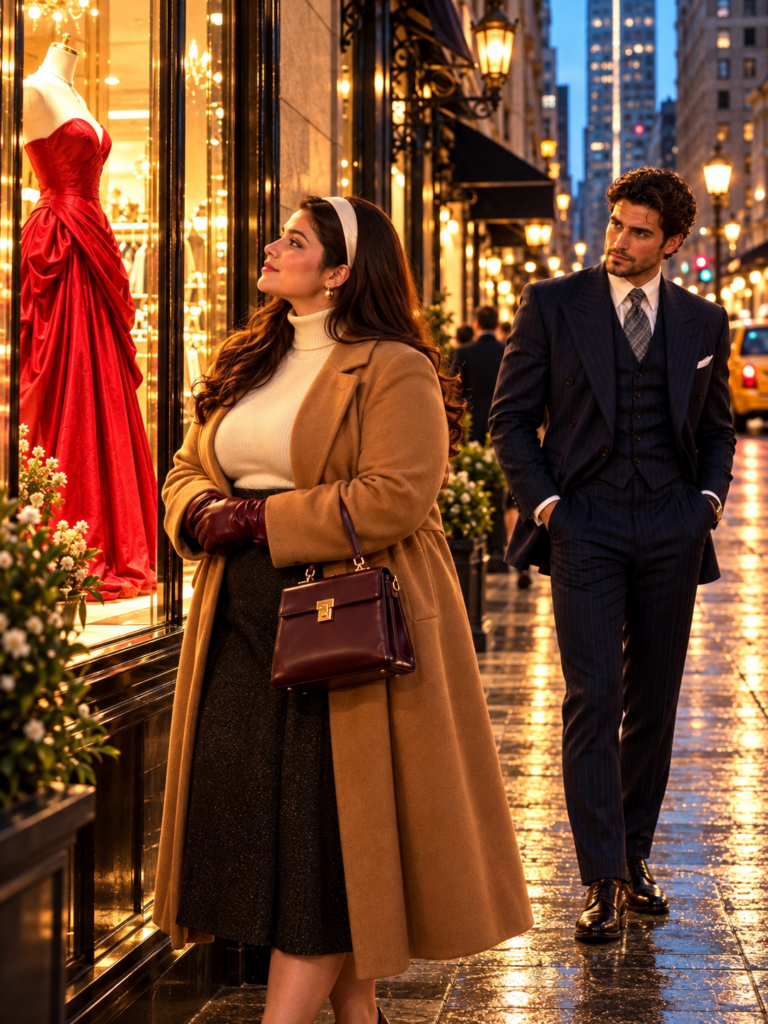
And yet, every Thursday, she traveled from Brooklyn to Manhattan just to stand in front of it.
She never entered the store. Never asked to try it on. Never even approached the door.
She simply stood two steps from the enormous display window of the House of Henriette and studied the red gown as though it contained an answer she had spent her entire life trying to find.
What Rose didn’t know was that the man who had created the dress had begun watching her.
And for the first time in four years, Charles Renwick was beginning to feel something he had almost forgotten.
Curiosity.
It was September 1990, and New York was drifting toward autumn. The mornings had developed a faint chill, though the afternoons still carried the warmth of summer through the crowded avenues.
Every Thursday, Rose left the apartment she shared with her grandmother in Bay Ridge, rode the subway to Fifty-Ninth Street, bought a sixty-cent coffee from the same corner vendor, and walked toward Fifth Avenue.
Thursday was her only day off.
Six days a week, she worked at Bellamies, a modest but respected dress shop with a dark green wooden storefront and gold lettering above the entrance. Its customers were women who could afford to spend two hundred or four hundred dollars on a good dress, women who expected attentive service and who often arrived believing they already knew exactly what they wanted.
Rose had become exceptionally good at proving them wrong without embarrassing them.
She could examine a woman’s posture and know which neckline would suit her. She could fasten a zipper without catching the fabric or disturbing the customer. She could identify where a seam would pull after three hours of sitting, or whether a skirt would lose its shape after a season.
Madame Bellamy, the owner, once told her that her greatest talent was not selling clothing.
“You make women feel comfortable before they’ve even put anything on,” she said. “That is rarer than knowing how to sell.”
Rose loved working there.
But she did not want to spend her entire life handing other people’s creations across a counter.
She wanted to make clothes herself.
That desire had begun long before she arrived in Manhattan.
Her mother, Teresa Duca, had been a dressmaker in Albany. She owned an old sewing machine purchased secondhand in 1962, and for years the machine had stood beside a window where the daylight was strongest.
The neighborhood depended on Teresa’s hands.
She shortened trousers, repaired school uniforms, altered wedding dresses, and transformed worn garments into clothes that looked almost new. Sometimes she worked for money. Sometimes she accepted whatever a family could offer.
Rose remembered a wedding dress that had taken her mother three weeks to finish.
The bride’s family paid with a crate of tomatoes and their endless gratitude.
At twelve, Rose had been furious.
“Three weeks, Mama. You worked for three weeks.”
Teresa had only smiled, touched the finished dress, and told her daughter that one day she might understand.
Rose had learned to guide fabric under a needle when she was seven, sitting on her mother’s lap. She learned how to hide a seam, how to make a garment move with the body rather than fight it, and how the smallest alteration could transform the way someone carried herself.
By the time Teresa died, Rose was twenty-two, and that old machine had become more precious to her than anything money could buy.
She had moved from Albany to New York in 1985 with one suitcase and her grandmother Ada’s address. Over the years, she filled notebooks with sketches and measurements, studied other people’s clothing, and spent evenings sewing small things for neighbors.
Two coats. Several skirts. Blouses. A little girl’s dress.
She never charged.
Some part of her still believed that without formal training, she had no right to call herself a designer.
Twice, she had applied to a fashion design school on Seventh Avenue.
Twice, she had been accepted.
And twice, the tuition had proved impossible.
So she continued working at Bellamies.
And on Thursdays, she studied the red gown.
The dress was unlike anything else in the window displays along Fifth Avenue.
Its color was difficult to describe. Not scarlet. Not burgundy. Something deeper and more unusual, as though the fabric had captured the last minute of sunlight before nightfall.
The strapless bodice held its shape with astonishing precision. Beneath the sweeping drapery, the seams seemed to disappear. The skirt fell in heavy, effortless folds that gave no hint of the intricate construction beneath them.
A small card identified the gown.
Four in the Morning.
Rose found the name strange, but what kept her returning was the construction.
How had the designer supported the upper edge of the corset without creating visible strain? Why did the folds fall naturally from one side instead of gathering at the waist? Where had the weight been distributed?
At night, she tried to reproduce the structure using inexpensive calico purchased on Thirty-Ninth Street.
Three attempts failed.
The upper edge collapsed every time.
On the fourth attempt, sometime after three in the morning, she finally realized the problem might not be the boning at all.
She wrote her suspicion in one of her squared notebooks and stared at it until dawn.
She had no idea that her answer was nearly correct.
Nor did she know that only a handful of people at Henriette understood how the original dress had been constructed.
One of them was Charles Renwick.
At forty-four, Charles controlled one of the most prestigious fashion houses in New York.
His grandmother, Henriette, had arrived from Lyon, France, in 1921 carrying two suitcases filled with patterns. She began with a small workroom on West Thirty-Fifth Street, building a reputation through precise cutting and uncompromising craftsmanship.
By 1956, her name occupied an imposing corner of Fifth Avenue.
By 1990, the company employed 240 people, operated a factory in New Jersey, and maintained four shops across three countries.
Charles had inherited more than a successful business.
He had inherited the burden of preserving a legend.
Bankers called him an owner. Fashion editors called him a creative director. Employees addressed him with a respect that sometimes bordered on fear.
But when someone asked what he did, Charles preferred a simpler answer.
“I’m a designer.”
For most of his adult life, that had been the truest thing he could say about himself.
Lately, however, it had begun to feel like a claim he could no longer justify.
Four years earlier, his marriage to Vivien had ended.
There had been no spectacular argument, no broken glass, no desperate scene. She had left quietly in February 1986, taking her belongings and ending their life together with a calmness he found almost unbearable.
For six weeks afterward, Charles barely slept.
He worked until two in the morning, returned to an empty house, and stared at the ceiling until daylight.
One night, at approximately three, he abandoned the bed and went downstairs to his private studio.
He sat before a blank sheet of paper.
An hour later, he had drawn the first lines of a dress.
The design became Four in the Morning.
The rigid corset contained an anger he had never admitted. The heavy folds seemed to carry all the exhaustion he could not put into words. He spent three months developing its unusual red, rejecting color after color until the fabric matched what he had imagined.
When the gown appeared on the runway in spring 1987, critics called it a masterpiece.
Eleven clients commissioned versions, each individually cut to measure over eleven weeks.
The original remained Charles’s property.
He placed it in Henriette’s Fifth Avenue window, where he could occasionally look at it and remember what it felt like to create something that mattered.
Then his imagination went quiet.
Collections continued to appear under his name. His staff remained exceptionally talented. Revenues were strong. The company expanded.
But Charles knew how much of the work belonged to other people.
He reviewed, corrected, approved, and signed.
He rarely created.
Sometimes he wondered whether that part of his life had ended without warning.
Then, one September Thursday, he looked down from his second-floor office and noticed a woman in a camel-colored coat standing before the red gown.
At first, she was simply another pedestrian.
Twenty minutes later, she was still there.
Charles glanced at his watch.
When she finally left after twenty-six minutes, he felt an inexplicable urge to know what she had been doing.
The following Thursday, she returned.
Same coat. Same approximate hour. Same position before the glass.
This time, Charles moved his chair closer to the window.
He noticed something unusual.
Most people looking at luxury clothing studied their own reflections. They imagined themselves wearing the dresses. They adjusted their posture, tilted their heads, pictured the life that might accompany such an expensive purchase.
This woman barely looked at herself.
She studied the gown.
Her attention moved deliberately from the bodice to a concealed seam, then down to the skirt before returning to the bodice.
She was examining its construction.
Charles leaned forward.
After twenty-eight years in fashion, he recognized the difference between admiration and understanding.
This stranger was trying to understand.
On the fifth Thursday, he went downstairs and spoke to Mary Cullen, Henriette’s longtime shop manager.
“Mary, there’s a woman who comes to look at the red dress. Dark hair. Camel coat. Do you know her?”
Mary glanced toward the window.
“Of course. She’s been coming for months.”
“Months?”
“Since April, perhaps May. Every Thursday.”
“And you’ve never spoken to her?”
“She never comes inside.”
“Do you know who she is?”
“Rose Duca. She works at Bellamies, across the avenue. Madame Bellamy’s assistant.”
Charles felt his curiosity harden into suspicion.
Garment copying was an ugly but familiar part of the business. Smaller manufacturers routinely studied exclusive designs and produced cheaper imitations.
A woman employed by another shop, studying a valuable dress every week, might have a perfectly commercial reason for doing so.
But something about that explanation troubled him.
Rose never carried a sketchbook. She never took photographs or made visible notes. She simply watched with an intensity that seemed too personal to be ordinary industrial espionage.
By evening, Charles had decided to find out for himself.
The following Tuesday, he put on an old gray coat, left Henriette, and walked into Bellamies.
It was the first time in twenty years he had entered a competitor’s shop pretending to be an ordinary customer.
A young assistant approached.
“May I help you, sir?”
“I’m looking for a gift for my niece. Someone told me to ask for Rose.”
The assistant disappeared into the back.
Moments later, Rose Duca appeared.
Charles recognized the dark hair, held away from her face with a white band. Up close, she seemed younger than he had expected, with clear, attentive eyes and a quiet manner that made him suddenly conscious of his invented story.
“Your niece,” she said. “How old is she?”
“Twenty-three.”
“Where does she live?”
“New York.”
“And what does she usually wear?”
Charles offered answers that sounded increasingly unconvincing to himself.
Rose continued asking questions, not about how much he could spend, but about the woman supposedly receiving the gift.
Was it for an occasion? What had she liked in the past? Did she prefer clothes that made a statement or clothes she could wear often?
Then Rose selected three dresses.
She dismissed the first almost immediately because its color would not suit the hair he had described.
She recommended the second as a sensible purchase.
The third was more expensive, but she showed him its side seams and explained how the extra allowance would permit future alterations.
“A well-made dress should survive changes in a woman’s life,” she told him. “Otherwise, you’re paying for something with an expiration date.”
Charles examined the stitching.
In nearly three decades of fashion, he had met celebrated designers who could discuss inspiration for hours without ever mentioning a side seam.
This young woman spoke about clothes as though their true value began after someone purchased them.
He bought the second dress.
While she wrapped it, he asked, “Have you always wanted to work in retail?”
Her hands stopped briefly on the tissue paper.
“No.”
“What did you want to do?”
“Make clothes.”
She said it without embellishment, then looked embarrassed by the admission.
Charles thanked her and left.
He walked two blocks in the wrong direction before realizing what he was doing.
That evening, he called for Douglas Fay, his assistant of eleven years.
“I need some information about a woman named Rose Duca. She works at Bellamies.”
Douglas opened his notebook.
“How much information?”
“Enough to help me understand who she is.”
Douglas studied his employer for a moment.
“That sounds like an answer from a man who’s already made a questionable decision.”
“Just find what you can.”
Four days later, a thin folder arrived on Charles’s desk.
Rose Duca. Born in Albany. Her mother, Teresa, a dressmaker, had died in 1986. No father appeared on the available records. Rose had moved to New York in 1985 and lived with her maternal grandmother, Ada Morelli, aged seventy-nine.
Five years employed at Bellamies.
An exceptionally reliable attendance record.
And two applications to a fashion school on Seventh Avenue.
Accepted both times.
Tuition never paid.
Charles read the final detail more than once.
The amount she had been unable to afford was less than he might casually authorize for a short business trip.
He closed the folder.
For the first time, he felt ashamed of the ease with which he could obtain information about someone whose life operated under constraints he rarely had to consider.
Douglas remained near the door.
“Well?”
“I haven’t decided what to do.”
“May I offer some advice?”
Charles nodded.
“Watching somebody from an upstairs window isn’t the same as meeting her. And having me collect details about her life doesn’t make it any better.”
Charles looked toward the avenue.
Douglas continued, more quietly.
“The longer you remain up here, the harder it becomes to walk downstairs.”
The following Thursday, Charles finally did.
Rose was standing in her usual place when a man’s voice came from beside her.
“Remarkable dress, isn’t it?”
She turned.
Recognition crossed her face.
“You’re the gentleman from Bellamies.”
“I am.”
“Did your niece like the dress?”
“Very much.”
It was another small lie, and this time Charles felt it settle unpleasantly between them.
He nodded toward the window.
“You come here often.”
Rose stiffened.
“I’m not blocking the entrance.”
“I didn’t suggest you were.”
“Then why do you ask?”
“Because you appear to see something most people miss.”
She considered him carefully.
Then she turned back to the gown.
“Look at the left side of the bodice.”
Charles followed her gaze.
“Where the drapery crosses?”
“Yes. There should be a visible structural seam there, but there isn’t. At least not where you’d expect it.”
“What do you think the designer did?”
Rose hesitated.
Then she began explaining.
She described the internal cotton layers, the probable construction of the corset, and the hidden support that allowed the upper edge to remain steady without straps.
She traced invisible lines through the air, showing where she believed the panels met beneath the fabric.
Charles listened without interruption.
Twice, her conclusions were incorrect.
But most of the time, she was astonishingly close.
When she explained that the structure depended partly on layers of stiff cotton cut on the bias rather than conventional boning alone, Charles almost forgot to breathe.
Only four people knew that specific detail.
He was one of them.
“How did you work that out?” he asked.
Rose shrugged.
“I ruined enough fabric trying to do it the other way.”
“And why are you so interested?”
“Because I couldn’t understand it. And once I couldn’t understand it, I couldn’t stop thinking about it.”
Something moved inside Charles, something fragile and unfamiliar.
For years, people had praised that gown for its beauty, its exclusivity, and its commercial success.
This woman wanted to know why a seam held.
“Would you have lunch with me?” he asked.
Rose checked her watch.
“I have forty minutes.”
“Then forty minutes will have to be enough.”
She chose a diner on Fifty-Sixth Street.
Charles accepted without protest.
They sat at a small table where the light was unflattering and the coffee came in thick white cups.
Rose ordered soup.
Charles ordered the same.
She told him about Albany, her mother, the old sewing machine, and a neighborhood where a good dressmaker mattered more than a fashionable label.
Eventually, she mentioned the wedding dress paid for with tomatoes.
“I used to think my mother was foolish,” she admitted. “She worked so hard and charged so little.”
“And now?”
“Now I think she understood what the dress meant to that family. Although I still wish they’d paid her properly.”
Charles smiled.
“That sounds like a difficult balance.”
“It is.”
She stirred her soup.
“I don’t think beautiful clothes should be available only to people who never have to think about their money.”
“Luxury has always depended on exclusivity.”
“I know. That’s what bothers me.”
He raised an eyebrow.
Rose leaned forward.
“At the bottom, you have inexpensive clothes that fall apart. At the top, you have extraordinary clothes that almost nobody can afford. But there’s this enormous space between them.”
“And you would fill that space?”
“With things that are beautifully made and actually useful. Things a woman could buy without sacrificing the rest of her life.”
Charles watched her for several moments.
Everything Henriette had built depended on the opposite principle. Its value came partly from the fact that most people could never possess its creations.
“What happens to luxury,” he asked, “if everyone can have something equally well made?”
Rose thought about it.
“Maybe it stops using scarcity to prove that something is beautiful.”
He laughed.
Not politely. Not the practiced laugh he used with investors and buyers.
He genuinely laughed.
Rose looked pleased with herself.
“You’re disagreeing with me.”
“Completely.”
“Good. At least you’re listening.”
For the first time in years, Charles left a conversation feeling that he had been given something rather than asked for something.
Before they parted, he asked if he could see her again.
“Next Thursday,” Rose said. “At the library on Fifth Avenue. I go there in the mornings.”
“Why the library?”
She smiled faintly.
“Because the books I need cost money I don’t have.”
Charles arrived at ten the following Thursday, having canceled three meetings.
He found Rose on the third floor, seated at a long table beneath a green-shaded lamp.
A large book about French fashion in 1947 lay open before her.
She glanced up.
“You came.”
“I said I would.”
“I assumed a man with your schedule might reconsider.”
“How do you know my schedule?”
“You look like someone who usually has somewhere more important to be.”
He pulled out the chair opposite her.
“Not this morning.”
They spent two hours discussing postwar fashion.
Rose spoke about Christian Dior’s revolutionary skirts and the enormous quantities of fabric they required when so many Europeans had spent years repairing and rationing clothing.
Charles told her how his grandmother had attended that historic Paris show.
“She stood outside afterward for half an hour,” he said. “She told me she couldn’t speak.”
Rose closed the book slightly.
“Then what did she do?”
“Returned to New York and created four designs inspired by what she’d seen. People accused her of copying.”
“Was she?”
Charles considered the question.
“She recognized where fashion was going. Sometimes that looks like imitation to people who don’t understand the difference.”
Rose nodded.
“That’s what I’m trying to learn. Not to copy the dress itself, but to understand why someone made each decision.”
Charles felt again that strange recognition.
She was describing the part of design he had once loved most.
Their conversation wandered into history, construction, fabric, and the mysterious relationship between what a woman wore and how she felt.
At one point Charles quoted a line about fashion in French, then translated it.
Rose studied him.
“How do you know so much about this?”
“I’ve worked in fashion for years.”
“Doing what?”
“Design.”
“Where?”
The question came naturally.
Charles could have answered with a single word.
Henriette.
Instead, he said, “I’ve been in the business a long time. About fifteen years.”
It was true only in the loosest possible sense, and it concealed far more than it revealed.
Rose seemed satisfied.
Charles hated himself a little for feeling relieved.
Afterward, they had lunch at a modest Italian restaurant on Forty-Fourth Street, where the waiter greeted Rose by name.
When the check arrived, Charles reached for it.
Rose stopped him.
“We’ll split it.”
“I invited you.”
“Then you can invite me again.”
“I don’t follow.”
“If you pay every time, I’ll start thinking about the money instead of the conversation. I’d rather we just enjoy ourselves.”
Charles looked down at the check.
It had been years since a restaurant bill had required even a second of thought.
Yet he understood that for Rose, accepting a favor was never entirely free of consequence.
They divided the amount evenly.
At the door, she hesitated.
“My grandmother makes dinner on Sundays. She’ll want to know who I’ve been spending time with.”
Charles felt his heart give an unexpected beat.
“Is that an invitation?”
“If you can survive being examined from head to toe.”
“I’ll take my chances.”
On Sunday evening, Charles climbed three flights of stairs to Ada Morelli’s apartment in Bay Ridge.
She opened the door wearing an apron and regarded him with undisguised suspicion.
“You’re tall,” she announced.
“Yes, ma’am.”
“Too thin, too. Come inside.”
Rose laughed from the kitchen.
The apartment had three rooms, an impossibly narrow hallway, and potted plants crowded onto every available windowsill.
Ada served pasta, rosemary chicken, and homemade wine from a neighbor. Charles sat at the kitchen table and listened as she described leaving Lucca, Italy, in 1936, working in a glove factory on Canal Street, and raising a family whose livelihood had always depended on practical skills.
When she asked about his mother, Charles answered with an openness that surprised even him.
“Her name was Julia. She was a cutter.”
“A good one?”
“The best I’ve ever known.”
He explained that Julia had entered Henriette’s workroom as a sixteen-year-old apprentice. She eventually married the owner’s son, but many employees assumed her marriage mattered more than her talent.
“She spent twenty years proving she deserved to stand at her own cutting table,” Charles said.
Ada regarded him silently.
Then she reached across the table and placed her hand over his.
“So you understand us,” she said.
Charles looked at her weathered fingers.
For a moment, he had to look away.
He left shortly before eleven.
His car was waiting downstairs, but he chose to walk toward the subway, unwilling to let Rose or Ada see another part of the life he had concealed.
The next morning, he arrived at Henriette at seven.
He canceled the spring collection meeting, postponed a lunch with buyers from Chicago, and asked Douglas to rearrange a conversation with the bank.
Then he entered the studio.
For nine hours, Charles barely left the table.
By evening, eleven sheets of paper lay scattered around him.
Ten contained variations of the same dress.
Blue silk. High neckline. Elbow-length sleeves. A completely open back.
Its beauty came from the way it revealed the woman wearing it rather than demanding attention for itself.
Charles knew exactly whom he had drawn it for.
He called Marta, Henriette’s head cutter, a woman who had worked at the house for thirty-one years and who still remembered Julia Renwick.
Marta examined the drawings without speaking.
Finally, she looked at him.
“This isn’t for the collection.”
“No.”
“For someone, then.”
Charles remained quiet.
Marta returned her attention to the design.
“The blue Milan silk we received in August. That would work. The neckline needs hand embroidery. Silver, but very fine.”
“How long?”
“Three weeks, if you let me borrow two people.”
“Take them.”
Marta gathered the drawings.
At the door, she paused.
“It’s good to see your handwriting on a pattern again, Charles.”
He remained alone in the studio after she left.
For the first time in four years, he had created something he wanted to see made.
But the joy came with a growing unease.
Rose believed he was an ordinary designer who understood her work and respected her ambition.
She didn’t know he owned the red gown she studied.
She didn’t know he owned the building around it.
And she had no idea he could change the future of the company whose window she had never dared to enter.
When Douglas confronted him the next day, the warning was gentle but unmistakable.
“Does she know who you are?”
Charles looked up from his sketches.
“Not yet.”
“Then every day you leave it that way becomes another day she’ll have to reconsider.”
“I’ll tell her.”
“When?”
Charles had no answer.
Because the truth was more humiliating than he wanted to admit.
He wasn’t afraid Rose would want something from him once she discovered his wealth.
He was afraid she would stop seeing the man beneath it.
And for the first time in years, someone had looked at Charles Renwick and seemed genuinely interested in what he could make with his hands.
He was not ready to lose that.
Part 2
Charles told her the truth on a cold Saturday morning in Central Park.
They were walking north from Fifty-Ninth Street, following the path near the pond. The trees had begun shedding their leaves, and the wind moving across the water carried the sharp edge of approaching winter.
Rose was telling him about a coat she had altered for a customer when Charles stopped.
“Rose, there’s something I should have told you weeks ago.”
She turned toward him.
His expression made her smile disappear.
“What is it?”
He looked at the pond, then back at her.
“The red gown in Henriette’s window. The one you’ve been studying.”
“What about it?”
“I designed it.”
Rose blinked.
“You worked on the gown?”
“I created it. The design, the structure, the color. It’s mine.”
She seemed to search his face for the rest of the explanation.
“And Henriette?”
Charles held her gaze.
“The company belongs to me. My grandmother founded it.”
The silence that followed was unlike any silence Charles had ever experienced.
Rose didn’t gasp. She didn’t step away dramatically or accuse him of making a fool of her.
She simply looked at him.
“You own Henriette?”
“Yes.”
“The entire house?”
“Yes.”
“And when you came to stand beside me at that window, you already knew who I was?”
Charles felt the weight of each answer.
“Yes.”
“How long?”
“I first noticed you in September. Then I learned you worked at Bellamies.”
Rose looked away.
A few leaves drifted across the path between them.
“So all that time, I was telling you how I thought that gown was made.”
“You understood more about it than almost anyone I’ve met.”
“That’s not the point.”
“I know.”
She rubbed her hands together against the cold.
“You went to Bellamies pretending to buy something for your niece.”
Charles lowered his eyes.
“I don’t have a niece.”
Rose let out a short, disbelieving laugh.
“Of course you don’t.”
“Rose—”
“And at the library, when I asked where you worked, you let me believe you were just another designer.”
“I wanted you to know me before you knew everything else.”
“But you knew everything else about yourself. I didn’t even know what questions I needed to ask.”
Charles took a breath.
“I should have told you sooner.”
“You should have.”
She stared across the water.
“I told you about my mother. I told you about the years we barely had enough money. I brought you into my grandmother’s home.”
Her voice grew quieter.
“I even insisted on splitting our lunch bills because I didn’t want you to feel obligated to pay for me.”
Charles felt something painful tighten in his chest.
“I never thought less of you for any of those things.”
“I know.”
She turned toward him.
“That’s why I’m not angry the way you probably expect.”
“Then what are you feeling?”
“Ashamed.”
“You have nothing to be ashamed of.”
“Please don’t decide that for me.”
He fell silent.
Rose looked down at the pavement.
“I was honest with you because I thought we were meeting each other on equal ground. But you knew the difference between our lives the whole time. I didn’t.”
“I never meant to humiliate you.”
“I believe that.”
Her voice softened, but the distance in her eyes remained.
“Intentions don’t undo what happened.”
Charles wanted to reach for her hand.
He didn’t.
Rose buttoned her coat.
“I need some time.”
“How much?”
“I don’t know.”
She started toward the park entrance, then turned back.
“Please don’t follow me.”
Charles remained where he was.
He watched her walk away until the trees and passing pedestrians hid her from view.
For the next nine days, he obeyed her request.
He didn’t telephone.
He didn’t send flowers or expensive gifts. He didn’t appear outside Bellamies or have Douglas deliver an explanation Rose hadn’t asked for.
Instead, he returned to Henriette and worked.
There were contracts, production schedules, employee decisions, and an entire business that still required his attention.
But the blue dress being completed by Marta’s team seemed to belong to another life.
He had drawn it in a moment of hope.
Now he could barely look at it without remembering Rose’s face in Central Park.
On the tenth day, Mary Cullen telephoned his office.
“Charles, I thought you should know. Rose isn’t at Bellamies.”
His hand tightened around the receiver.
“Is she ill?”
“She’s taken leave. Madame Bellamy doesn’t know when she’ll be back.”
Charles called Douglas.
Within forty minutes, he learned that Ada Morelli had been admitted to a hospital on Seventh Avenue in Brooklyn following a heart attack.
He arrived that evening.
The waiting room was nearly empty, lit by harsh fluorescent lights that made everything look pale and exhausted.
Rose sat against the wall in her camel coat.
Her handbag rested on her knees, held between both hands as though it were the only thing keeping her anchored to the chair.
Charles stopped a few feet away.
He had imagined seeing her again many times.
Not like this.
He walked over and sat beside her.
For several seconds, neither spoke.
Then Rose looked at him.
The effort she had been making to remain composed collapsed.
She turned toward him and began to cry.
Charles put his arms around her.
There was nothing useful he could say, so he held her while she pressed her face against his shoulder.
After a while, she managed to speak.
“Yesterday morning she was making coffee.”
Charles listened.
“She was standing in the kitchen, and then she wasn’t. Everything happened so quickly.”
“What have the doctors told you?”
“That we have to wait.”
Rose wiped her face.
“That’s all anyone says. Wait and see.”
She stared toward the closed doors leading to the wards.
“I was nine minutes late to work yesterday. I kept thinking about it all day. Nine minutes. Like that mattered.”
Charles said nothing.
“I’m twenty-six years old,” she continued. “And she’s the only family I have left.”
He wanted to tell her that she had him.
But the words felt presumptuous.
Rose had not forgiven him, and this was not a moment in which he had the right to claim a place in her life.
A nurse named Keenan came into the waiting room and explained that the next forty-eight hours would be critical.
Charles listened carefully.
Then he excused himself and made a telephone call from the corridor.
Ninety minutes later, Dr. Aaron Weiss arrived.
Weiss was an experienced cardiologist Charles had known for a decade, since the doctor had operated on Charles’s father.
He reviewed Ada’s condition with the hospital physicians, discussed adjustments to her care, and remained through the night.
Charles returned to Rose.
“Who was that?” she asked.
“A doctor I trust.”
“You called him?”
“Yes.”
“Charles, I can’t afford—”
“I’m not asking you for anything.”
She looked at him.
He continued gently.
“Your grandmother needs the best care available. That’s all I’m thinking about tonight.”
Rose lowered her eyes.
She didn’t thank him immediately.
Charles was grateful that she didn’t feel compelled to.
They remained in the waiting room, listening to footsteps, distant voices, and the occasional ringing telephone.
At some point near dawn, Rose fell asleep in her chair with her cheek resting against her handbag.
Charles stayed awake.
When Dr. Weiss emerged shortly after six, his expression was reassuring.
“The immediate crisis has passed,” he said. “She’s responding well. We’ll continue watching her closely, but she’s through the worst of it.”
Charles felt his lungs finally release the breath he seemed to have been holding all night.
He woke Rose carefully.
“Rose.”
Her eyes opened.
“What happened?”
“Ada is stable. She’s going to be all right.”
Rose stared at him, waiting for the meaning to settle.
“Really?”
“Yes.”
She covered her mouth.
Then she began crying again.
This time, Charles could feel relief moving through her entire body.
Ada was transferred to a regular ward and would need to remain in the hospital for at least another week.
When Charles and Rose stepped outside at ten that morning, the city was bright and cold.
“You need to sleep,” he told her.
“I’ll go home.”
“To an empty apartment?”
She didn’t answer.
Charles hesitated.
“Come to my house. There’s a guest room. You can stay as long as you need.”
Rose studied him.
“I don’t want you to think this changes everything between us.”
“I don’t.”
“And I won’t accept being treated like a debt you can settle.”
He nodded.
“This isn’t a bargain, Rose. I’m not trying to purchase forgiveness.”
She looked tired enough to fall asleep where she stood.
Finally, she said, “All right.”
Charles lived on East Seventy-Third Street, between Park and Madison Avenues.
The house had four floors, a narrow façade, and a black front door.
Rose expected excessive decoration, expensive furniture, and rooms designed to display wealth.
Instead, she found pale walls, polished wooden floors, and paintings arranged with no obvious intention of impressing visitors.
It was a beautiful house, but it felt strangely unoccupied.
There were no scattered newspapers, no slippers near the door, no traces of ordinary domestic life.
Charles carried her bag upstairs.
“The guest room is on the third floor.”
She looked through the doorway.
“Thank you.”
“Sleep as long as you need.”
Six hours later, Rose woke to the smell of food.
She followed it downstairs, still wearing her socks, and discovered Charles standing in the kitchen with an apron tied around his waist.
He was stirring risotto.
She leaned against the doorway.
“You cook?”
He glanced over his shoulder.
“One dish.”
“Only one?”
“My mother taught me. I’ve never developed the courage to try anything else.”
Rose approached the stove.
“It smells good.”
“Don’t sound so surprised.”
For the first time since Central Park, she smiled at him without sadness.
They ate at the kitchen table.
The conversation came slowly at first, then began finding its old rhythm.
Rose asked why nothing in the house carried the Henriette label.
“Because when I’m home,” Charles said, “I don’t want to belong to the business.”
She considered that.
Then, quietly, she asked about Vivien.
“Do you miss your wife?”
Charles took his time answering.
“I miss who I was when we first married. I was younger. I thought everything could be solved if I worked hard enough.”
“And now?”
“Now I know that isn’t true.”
Rose studied the man across from her.
For the first time, she understood that his wealth had not spared him from loneliness.
After dinner, Charles set down his glass.
“There’s something downstairs I’d like you to see.”
He led her into the basement studio.
A long worktable stood beneath adjustable lamps. Two dress forms occupied one side of the room.
On one mannequin was the finished blue gown.
Rose stopped just inside the doorway.
The fabric shimmered softly under the light.
Its high neckline and elbow-length sleeves gave it an understated elegance, while the open back added something unexpected. Along the collar, silver hand embroidery caught the light only when she moved close enough to examine it.
Rose approached the mannequin.
She didn’t touch the silk.
“Who made this?”
“Marta and her team did the construction.”
“And the design?”
“Mine.”
She looked at him.
“When?”
“The Monday after I had dinner with you and Ada.”
Rose returned her attention to the gown.
The seams were perfectly placed. Every decision appeared deliberate, but nothing seemed designed merely to show off.
It was the kind of dress her mother would have admired for the care hidden beneath its beauty.
“What’s it called?” she asked.
“Ada.”
Rose turned.
“You named it after my grandmother?”
“She put her hand over mine that Sunday and made me feel as though I belonged at her table.”
His voice softened.
“I wanted to remember that.”
Rose stood very still.
Then Charles gestured toward the adjoining room.
“Would you like to try it on?”
A few minutes later, she stepped out wearing the blue dress.
Charles had drawn it from memory, recalling the slope of her shoulders and the way she carried herself.
Somehow, it fitted her.
Rose turned toward the mirror.
The woman looking back at her was familiar, yet not quite the same.
The silk moved gently around her figure.
For a moment, she forgot the price of the fabric, the famous designer who had created it, and the enormous gulf between their circumstances.
She simply saw herself.
Charles watched her reflection.
Then he spoke.
“I want to create a new clothing line.”
Rose turned.
“At Henriette?”
“Under the company, but with its own identity. Its own name. Its own prices.”
He approached the worktable and unfolded a sheet of paper.
“Well-made garments that ordinary working women can afford. The kind of things you described at the diner.”
Rose stared at him.
“You remembered all that?”
“Every word.”
He looked at the blue dress.
“I’ve been thinking about it ever since.”
Rose lowered herself into a chair.
“Who would design this line?”
“You.”
She looked up sharply.
“Charles.”
“I mean it.”
“You can’t be serious.”
“I’ve never been more serious about anything involving this company.”
She glanced toward the dress forms.
“I’ve never gone to design school.”
“I know.”
“I have no professional portfolio. I’ve sold dresses for five years and sewn things in my bedroom.”
“And you understood the construction of a gown that took my team months to perfect.”
“That doesn’t make me qualified to run an entire line.”
“No,” Charles agreed. “But the way you think about clothes does. You’d have experienced people to help with production. You wouldn’t be expected to know everything.”
Rose folded her hands.
He continued.
“You understand a customer Henriette has ignored for decades. You know what her clothes need to do when she takes a train, carries groceries, works a full day, or wants something beautiful that will last.”
She looked at the blue silk falling around her knees.
“And what happens when everyone finds out about us?”
Charles remained quiet.
“They’ll say the shopgirl got her own collection because she’s involved with the owner.”
“Some people will.”
“They’ll say I didn’t earn it.”
“I can’t stop them from talking.”
Rose looked at him steadily.
“Then you understand why I can’t simply say yes.”
Charles sat opposite her.
“I do.”
He paused.
“But if you accept, every garment you create will carry your name. I won’t put my name on your designs. You won’t be there to make me look generous.”
“What if I disagree with you?”
“I expect you will.”
“What if I make something you don’t like?”
“You’ll have to convince me it deserves to exist. The same way every designer should.”
She considered his answer.
Charles didn’t reach for her hands. He didn’t pressure her with gratitude or imply she owed him anything because of Ada’s care.
He simply waited.
“I need to think about it,” she said.
“Then think.”
Three days later, on a Thursday, Rose gave him her answer.
“Yes.”
Charles smiled.
“But I want to make something clear,” she added.
“Go on.”
“I’m not doing this as a favor to you. And I won’t let you protect me from every difficult decision.”
“I understand.”
“If the work is mine, then the mistakes have to be mine too.”
Charles regarded her with unmistakable respect.
“Agreed.”
The extraordinary part was not that Charles had enough power to offer her an opportunity.
It was that Rose insisted on defining the terms under which she would accept it.
In October 1990, Charles called an extraordinary meeting of Henriette’s board.
Seven directors gathered around the table: two family representatives, two bank representatives, and three outside members.
Charles placed a proposal before them.
A separate fashion line.
Its own brand identity.
Dresses priced between one hundred twenty and three hundred dollars.
Gerald Wickham, sixty-eight, had served on the board since 1974 and usually reserved his opinion until everyone else had spoken.
This time, he spoke first.
“Have you considered what this does to our reputation?”
Charles met his gaze.
“Extensively.”
“We are a luxury house.”
“Yes.”
“And you’re proposing that we sell dresses for the equivalent of a working woman’s weekly wages.”
“Under a separate label.”
Wickham removed his glasses.
“The public won’t make that distinction forever. They’ll discover the ownership.”
“Then we’ll give them products worth discovering.”
Wickham shook his head.
“Henriette doesn’t sell ordinary dresses. It sells exclusivity. A woman pays us partly because the woman beside her cannot buy the same thing.”
Charles looked around the table.
“How old is our average customer?”
Nobody answered.
“Fifty-four,” he said. “Ten years ago, she was forty-eight.”
He allowed the number to settle.
“Our business is aging with its customers. We’re preserving a remarkable tradition, but we’re doing almost nothing to bring younger women toward it.”
A director from the bank asked whether the new line would weaken demand for the main collections.
Charles explained the separate branding, the controlled price range, and the opportunity to serve customers who would never otherwise enter Henriette.
He defended the proposal through commercial logic, but beneath the numbers lay a deeper conviction.
Rose had shown him something his own success had concealed.
Beautiful workmanship was not the exclusive property of wealthy people.
And he had built a career inside an institution that increasingly treated it as though it were.
The vote was close.
Four in favor.
Three opposed.
The new line was approved.
Wickham collected his papers.
At the door, he stopped.
“Fashion houses aren’t always destroyed by poor sales, Charles. Sometimes they’re destroyed by the people who forget what made them valuable.”
Charles watched him leave.
For the first time, he wondered whether preserving his grandmother’s legacy might require doing something she had never done.
On Monday, October 29, 1990, Rose Duca reported for work at the House of Henriette.
She was given a fourth-floor room, a worktable, two assistants, and a budget large enough to make her nervous about every purchase.
When she entered the building, she walked past the red gown in the window.
It was still there.
For five months, she had studied it from the pavement, never believing she had the right to step through the door.
Now she was going upstairs to create something of her own.
And the hardest part of earning her place had only just begun.
Part 3
Rose discovered quickly that entering Henriette through the front door was considerably easier than being accepted by the people who worked behind it.
Her new office occupied a room on the fourth floor.
It had excellent light, a large cutting table, shelves for fabric samples, and two assistants whose politeness seemed carefully measured.
Every morning, Rose arrived early.
Every evening, she stayed until there was almost nobody left in the building.
She had spent years imagining what it would feel like to work in a professional design house. She had not imagined how much energy she would spend proving she deserved to be there.
Some employees welcomed her.
Others treated her as a temporary indulgence of the owner.
The fabric buyer ignored three of her requests until Charles questioned him in front of his colleagues.
Afterward, Rose went directly to Charles.
“Please don’t do that again.”
“He was deliberately obstructing you.”
“Then let me deal with him.”
“Rose—”
“If I’m supposed to run this line, they need to learn that my instructions come from me. Not from you standing behind me.”
Charles studied her for a moment.
Then he nodded.
“You’re right.”
The gossip was harder to confront.
During her second week, Rose overheard an assistant named Catherine speaking to a friend in the corridor.
The words were quiet but unmistakable.
Rose stopped long enough to hear them, then returned to her room.
She didn’t cry.
She didn’t confront Catherine.
She sat at the cutting table and worked until eight that evening.
She knew an argument could never erase the suspicion surrounding her appointment.
Only the work could do that.
By December, twelve completed designs stood in her room.
They were not dramatic.
There was a skirt made to resist creasing during a subway commute. A jacket designed to sit comfortably on different body types. A dress with enough allowance in its side seams to be altered as its owner changed over the years.
Every garment began with a question Rose had learned to ask at Bellamies.
What happens when a real woman wears this?
One jacket required eleven separate samples.
Marta examined the seventh.
“It’s good,” she said.
Rose shook her head.
“It pulls under the arm.”
“Only slightly.”
“On three women out of five.”
“You could alter it individually.”
“Then it won’t be the line I promised.”
Rose made four more versions.
On the eleventh, the problem disappeared.
Marta inspected the finished pattern, then carefully copied it into her own notebook.
She rarely did that with another designer’s work.
Later, Charles asked her opinion of Rose’s collection.
Marta looked toward the fourth floor.
“She knows how a garment should sit,” she said.
Coming from Marta, it was an extraordinary compliment.
Soon, the whispers began fading.
Not because Charles ordered anyone to stop talking.
Because the employees who knew the craft could see what Rose was accomplishing.
The new line was named Rose Street, after the street in Albany where Teresa Duca had worked beside the window.
Charles visited Rose’s studio once a week.
He asked questions, examined patterns, and occasionally disagreed with a decision.
But he left the final work in her hands.
One afternoon, he noticed that none of her twelve garments had a fastening at the back.
“Was that intentional?”
Rose looked up from a sketch.
“Of course.”
“Why?”
“Because a woman should be able to dress herself.”
Charles glanced again at the garments.
“In twenty-eight years,” he admitted, “I’ve never considered that a problem.”
“That’s because somebody has probably always been there to help with the dresses you design.”
He gave a quiet laugh.
“Another argument against my entire profession?”
“Only the parts that forget who’s going to wear the clothes.”
Charles left smiling.
Rose returned to her cutting table, feeling that she had finally begun to speak in her own professional voice.
Meanwhile, Ada was recovering.
She had been discharged from the hospital in mid-November and returned to her familiar Bay Ridge apartment.
For a short time, everything seemed normal.
Then, two weeks later, she fell in the bathroom.
She broke no bones, but she remained on the floor for forty minutes before managing to reach the door.
When Rose heard what had happened, fear returned with sickening force.
Charles visited Ada and spent two hours talking with her.
He didn’t tell her she was too old to live alone.
He didn’t suggest that money could solve every difficulty.
Instead, he listened while she explained why she refused to leave the apartment where she had lived for forty-one years.
“My life is here,” Ada told him. “If I move into that big house of yours, I’ll become another piece of furniture.”
Charles considered this.
“The entire second floor has been empty for fifteen years,” he said.
Ada frowned.
“Fifteen?”
“Yes. If you don’t use it, the dust will have another fifteen.”
She laughed despite herself.
In December, Ada moved into Charles’s house on East Seventy-Third Street.
She brought fourteen potted plants, her familiar belongings, and Teresa’s old sewing machine.
Charles arranged for the machine to be placed beside a window in the studio, where the daylight fell across its worn metal surface.
Just as it had in Albany.
The house changed almost immediately.
Coffee began appearing in the kitchen early every morning. Someone left slippers in the hallway. A radio played while Ada prepared breakfast.
Sunday dinners became an institution.
First, she invited Marta.
Then Douglas.
Then Mary Cullen.
Before long, Charles would return home to find a crowded kitchen and several people talking over one another without the slightest concern for whether the owner of the house had arrived.
He loved it.
He had spent years preserving a quiet, immaculate home.
Only now did he realize how much he had mistaken quietness for peace.
One afternoon in February, Charles stopped in the kitchen doorway.
Ada was teaching Rose how to prepare dough.
Flour dusted the table. Rose was laughing at something her grandmother had said.
Charles watched them without interrupting.
For years, he had returned home to rooms that offered everything except companionship.
Now, for the first time, he didn’t wish to be anywhere else.
In March, after dinner, Charles and Rose stepped onto the balcony.
The city stretched below them, bright windows scattered among the dark buildings.
Rose rested her hands on the railing.
“Can I ask you something?”
“Anything.”
“Does it ever frighten you?”
“What?”
“How different our lives have been.”
Charles waited.
Rose continued.
“I still count what things cost when I go to the supermarket. I know which stores charge too much for milk. I remember how much I paid for every piece of fabric I bought when I was learning.”
She looked at him.
“Sometimes I wonder if you’ll get tired of that.”
Charles thought about her words.
“I’m afraid of something different.”
“What?”
“That you’ll get tired of a man who spent most of his life never having to count.”
Rose smiled.
“Then I suppose we’ll both have something to learn.”
He reached for her hand.
She took it.
Neither spoke for a while.
Their differences had not disappeared.
But they had stopped treating those differences as something one of them needed to hide.
The Rose Street debut was scheduled for April 13, 1991.
Three weeks before the show, Rose entered Charles’s office carrying a revised presentation plan.
“I want to change the runway.”
Charles glanced at the pages.
“What kind of change?”
“No professional models.”
He looked up.
“None?”
“None.”
“Rose, the show is in three weeks.”
“I know.”
“Then explain.”
She pulled out a chair.
“This entire line is about making clothes for actual women. Women who work. Women who take the subway, raise children, grow older, and have bodies that don’t look like runway mannequins.”
Charles listened.
“If I put these garments on eighteen-year-old models who are six feet tall, nobody will understand what I’ve been trying to make.”
“Who do you want instead?”
“Women who would actually wear them.”
Gerald Wickham called the idea disastrous.
He requested that his objection be formally entered into the board minutes.
It was.
Rose continued preparing the show.
On April 13, twenty-two women walked the runway wearing Rose Street.
There was a forty-four-year-old schoolteacher from Queens.
A cashier from a supermarket in Bay Ridge.
Two students.
A sixty-one-year-old former postal worker.
And Nurse Keenan, who had helped Rose through the terrifying days of Ada’s hospitalization.
Mary Cullen walked ninth, carrying herself with such natural elegance that people might have mistaken her for a professional.
At first, the audience seemed uncertain how to respond.
The first three women walked in near silence.
Charles sat in the second row, watching Rose’s work appear under the lights.
He knew how much the moment meant to her.
He also knew she had refused every suggestion that might make the show safer or more conventional.
Then, during the fourth appearance, someone applauded.
By the seventh, the applause had spread.
The audience began understanding what it was seeing.
These were not clothes designed to impress people from a distance.
They were clothes intended to belong to the women wearing them.
Near the end of the show, Ada Morelli appeared.
She was seventy-nine years old.
Her steps were slow, but her back was straight, and she wore a suit her granddaughter had made specifically for her.
The room rose to its feet.
Charles saw Wickham standing in the third row.
For a moment, the older man watched Ada with an expression Charles could not interpret.
Then Wickham turned away, still standing with everyone else.
The second-to-last woman had finished her walk.
Now only Rose remained.
The lights shifted.
And Rose Duca stepped onto the runway wearing the red gown from Henriette’s Fifth Avenue window.
Four in the Morning.
The original.
The dress she had studied through glass for five months.
Charles had removed it from the display himself the previous evening, the first time in four years he had taken it away from its familiar place.
Rose moved slowly beneath the lights.
The deep red fabric flowed around her, its extraordinary folds catching the light.
She had never wanted to possess the gown.
She had wanted to understand it.
And now she understood more than its seams.
She understood that its maker was a man who had once put his loneliness into fabric because he could not express it any other way.
She understood that a masterpiece could be both beautiful and painful.
Most importantly, she understood that her own work deserved to exist beside it.
When Rose reached the end of the runway, Charles stood.
He left his seat and walked toward her.
The audience grew quiet as he stepped onto the white runway.
Then Charles Renwick lowered himself onto one knee.
Thirty cameras turned toward them.
Rose stared down at him.
He opened a small box.
Inside was a ring with a ruby almost exactly the unusual red of the gown he had spent three months perfecting.
“Rose,” Charles said, his voice steady despite the emotion in his face, “you came to my window looking for an answer about a dress.”
He smiled faintly.
“I think I was the one who needed an answer.”
Rose’s eyes filled.
“You reminded me why I loved making things. You brought people into a house I thought had forgotten how to be a home.”
He looked up at her.
“Will you marry me?”
Rose covered her mouth.
For several seconds, she couldn’t speak.
Charles waited.
Then she nodded.
“Yes.”
The audience erupted.
Charles rose, placed the ring on her finger, and held her close.
All around them, people applauded, cameras flashed, and the future of the House of Henriette suddenly seemed much larger than the tradition it had been built to protect.
Late that evening, long after the celebration ended, Charles and Rose sat together in the small garden behind his house.
Ada had gone to bed.
A kitchen light remained burning inside.
Rose held the ring in her palm and studied its red stone.
“Tell me something,” she said.
Charles turned toward her.
“Anything.”
“How much of this did you arrange?”
He smiled.
“Which part?”
“The window. Our first lunch. The library. You appearing at the hospital. Everything.”
Charles considered the question.
“The gown stood in that window for four years before you came along,” he said. “I didn’t arrange that. And I certainly didn’t arrange for you to notice the seams.”
“And the rest?”
“The rest I arranged about as much as a man can arrange anything when he’s frightened he may never meet someone like you again.”
Rose looked at him.
“So you planned it?”
“Only one part.”
“Which one?”
“The proposal. I’ve known for three weeks.”
She laughed softly.
“You kept another secret.”
“A much better one this time, I hope.”
Rose slipped the ring onto her finger and leaned against him.
Behind them, the house was warm with the lives of people who belonged there.
Somewhere inside, Teresa Duca’s old sewing machine stood beside a window.
Across Manhattan, the display at Henriette was empty for the first time in years.
For five months, Rose had stood outside that window believing the world on the other side belonged to someone else.
The glass had never been locked.
The door had never been closed to her.
What had held her back was the belief that her talent needed someone else’s permission before it could become real.
Charles had not given her that talent.
He had simply recognized it, challenged it, and eventually learned to trust it.
And Rose had given him something wealth, reputation, and an entire fashion empire had failed to provide.
Someone who cared about the work he did with his hands.
Someone who could disagree with him without fear.
Someone who saw a man where the rest of the world saw a name.
Charles looked down at the woman beside him.
“Are you happy?” he asked.
Rose glanced at the ruby on her finger, then toward the lighted kitchen where her grandmother had spent the evening celebrating.
“Yes,” she said. “But do you know what I’m thinking?”
“What?”
“Tomorrow I want to look at that jacket pattern again. The shoulder still isn’t quite right.”
Charles began to laugh.
Rose looked offended.
“I’m serious.”
“I know you are.”
He kissed her forehead.
“That’s why I love you.”
She smiled and rested her head against his shoulder.
For four years, Charles Renwick had believed his greatest creation was a red gown made in the loneliest hour of his life.
Now he knew better.
The dress was a masterpiece.
But it was not the most valuable thing he had made possible.
That was the life waiting for them on the other side of the garden door.
A life neither of them could have bought.
And one they had finally learned to make together.


