
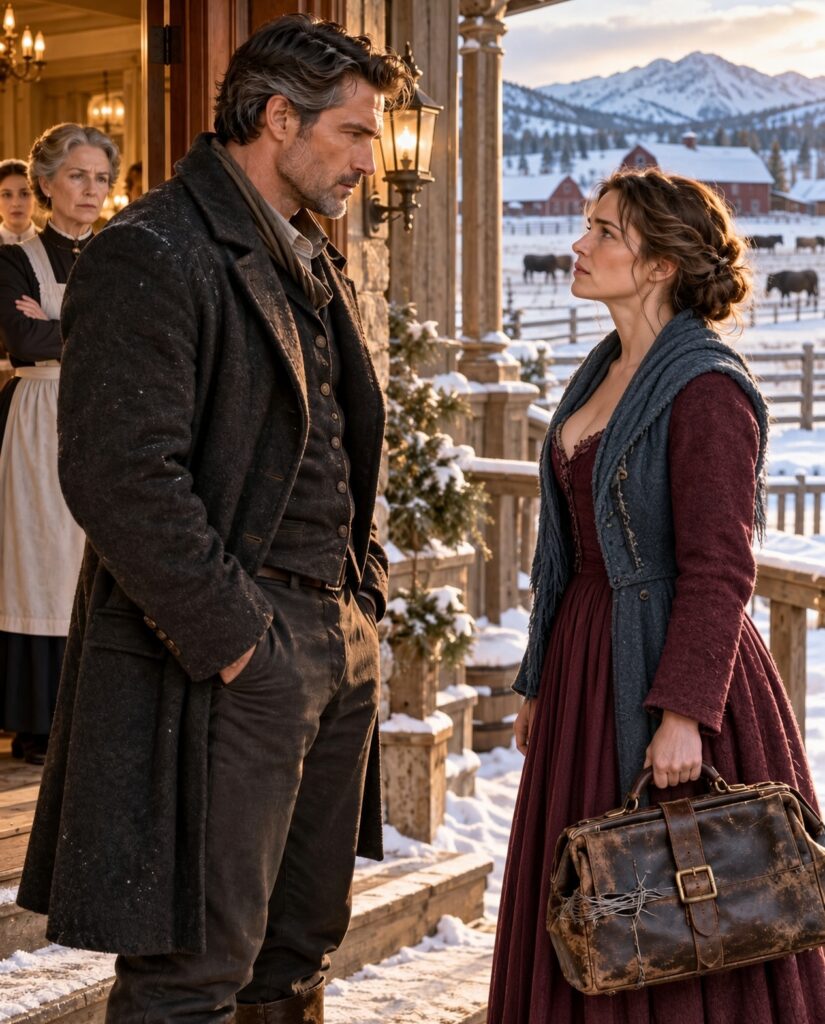
The first people at Callahan Valley Ranch laughed when penniless widow Clara Whitmore offered to cook one meal for Montana’s richest cattleman.
Ethan Callahan accepted—but the moment Clara mentioned the strange silence surrounding his children, the amusement vanished from his face.
Then he asked the one question she had hoped he would not ask: **“Why this ranch?”**
Clara was forty-one, recently widowed, and carrying nearly everything she owned inside a battered carpetbag held together with baling wire.
“Back doors are for deliveries and beggars,” Margaret Voss, the gray-haired housekeeper, announced from the kitchen doorway.
“Which one are you?”
Laughter drifted from inside.
Clara stood beneath the pale January sky while snow swept around her cracked boots.
“Neither,” she replied.
“I’m here to speak with Mr.
Callahan.”
Margaret looked her up and down.
“And what business would a woman like you have with Ethan Callahan?”
“Work.”
“We aren’t hiring.”
“I’d like to hear that from him.”
That stopped the laughter.
Margaret’s expression hardened, but Clara refused to move.
She had traveled from Billings with almost no money and walked from the ranch gate carrying her own bag.
Pride was one of the few possessions widowhood had not taken from her.
Eventually, Margaret disappeared inside.
While Clara waited, she studied the ranch.
Everything spoke of wealth.
Straight fences bordered enormous winter pastures.
Broad red barns stood against the snowy foothills.
The bunkhouse windows contained clean glass, and hundreds of cattle dotted the distant fields.
Yet something felt wrong.
The place was prosperous but strangely lifeless.
Soon Margaret returned.
“Mr.
Callahan will see you on the front porch.”
Ethan Callahan appeared before Clara reached it.
At forty-six, he was broad-shouldered and weathered, with silver beginning at his temples.
He dressed more like a working rancher than the wealthiest cattleman in the region.
But Clara noticed something else immediately.
Grief.
She knew its face because she had seen it in her own mirror.
“Margaret says you’re looking for work.”
“Yes, sir.”
“She told you we aren’t hiring.”
“She did.”
“And you stayed.”
“I did.”
Clara explained that she had cooked for ranch households for eleven years, worked in a Cheyenne hotel kitchen, and later served a private family outside Laramie.
Then she made her offer.
“Give me one meal.
Let me cook dinner tonight.
If it isn’t the best meal your kitchen has served in six months, I’ll leave tomorrow morning.”
Ethan studied her.
“What makes you think we’ve eaten badly for six months?”
Clara glanced toward the house.
“Your chimney smoke tells me the stove is properly tended.
There are spice crates beside the kitchen, but when the door opened, I smelled none being used.”
Ethan said nothing.
“Three ranch hands passed me on my way here,” she continued.
“Not one looked eager to reach the noon table.”
His eyebrow lifted.
Then Clara looked toward the silent windows.
“And a house with children shouldn’t be this quiet.”
Something changed in Ethan’s eyes.
“You make judgments quickly, Mrs…”
“Whitmore.
Clara Whitmore.”
“I make observations quickly,” Clara said.
“The judgment comes later.”
For the first time, Ethan almost smiled.
“One meal.
Dinner at six.
You work under Margaret’s supervision and follow her kitchen rules.”
“Fair enough.”
He turned toward the house, then stopped.
“Mrs.
Whitmore?”
“Yes?”
Snow moved softly between them.
Ethan’s expression had become serious again.
“Why this ranch?”
Clara tightened her fingers around the handle of her battered carpetbag.
Because cooking was not the only reason she had crossed Montana to find Ethan Callahan.
And the truth might make him send her away before she ever reached his kitchen.

Clara tightened her fingers around the carpetbag.
For one dangerous second, she considered lying.
She could say she had heard the ranch needed a cook.
She could say Billings had no work.
She could say she simply needed a roof.
All of those things were true.
None was the truth.
Ethan Callahan waited.
Clara looked toward the house.
Then toward the distant barn.
Finally, she met his eyes.
“Because of your wife.”
The porch became very still.
Margaret, who had been standing behind them, went rigid.
Ethan’s expression changed so quickly that Clara almost regretted speaking.
“You never knew my wife.”
“No.”
“Then why would you come here because of her?”
“Because she knew my husband.”
Ethan stared at her.
“What was his name?”
“Thomas Whitmore.”
The color drained from Ethan’s face.
Margaret whispered something under her breath.
Ethan stepped closer.
“What did you say?”
“My husband was Thomas Whitmore.”
Ethan looked toward the snow-covered valley.
“How long have you been a widow?”
“Seven months.”
“And Thomas?”
“Dead.”
Ethan’s jaw tightened.
“How?”
Clara hesitated.
“The official answer was an accident.”
“And the real answer?”
“He was investigating something.”
Ethan looked back at her.
“What?”
Clara lowered her voice.
“Land records.”
Margaret suddenly stepped forward.
“Mr.
Callahan—”
Ethan raised a hand.
“Inside, Margaret.”
“But the children—”
“I said inside.”
Margaret obeyed.
Clara watched her disappear.
Ethan turned toward Clara.
“You’d better come in.”
“I haven’t cooked yet.”
“Dinner can wait.”
She followed him into the house.
The warmth should have felt welcoming.
Instead, the silence became even more obvious.
There were children’s toys beneath the staircase.
A wooden horse.
A red ball.
A doll missing one shoe.
Yet no children.
Clara’s eyes moved toward the upper floor.
“How many?”
Ethan stopped.
“What?”
“Children.”
He looked at her.
“Three.”
“Where are they?”
“Upstairs.”
“Why?”
He didn’t answer.
Clara understood.
“They don’t come downstairs.”
Ethan’s face hardened.
“They don’t like strangers.”
“That’s not what I meant.”
He stared at her.
“You’ve been here five minutes.”
“I’ve been widowed seven months.”
She placed her carpetbag on the floor.
“Grief teaches you to recognize silence.”
For a long moment, neither spoke.
Then Ethan walked toward his study.
“Come.”
His office was lined with books, ledgers, and maps.
He closed the door.
“Tell me everything.”
Clara sat.
She removed a folded piece of paper from inside her coat.
“My husband worked as a surveyor.”
Ethan nodded.
“I knew that.”
“He was hired to examine several parcels around this valley.”
Ethan’s expression changed.
“He told me someone was altering boundary records.”
“Who?”
“He didn’t know.”
“Did he suspect someone?”
“Yes.”
“Who?”
Clara hesitated.
“Your wife’s brother.”
Ethan stood.
“My wife’s brother has been dead for nine years.”
“I know.”
Silence.
Thomas had discovered a series of land transfers.
Ranches had been bought cheaply after their owners were pressured into selling.
Some had later been absorbed into larger holdings.
Several deeds carried signatures from men who had claimed they were too ill to sign.
One signature belonged to a rancher who had died three years before the document was supposedly written.
Thomas had begun tracing the records.
Then he found Callahan Valley.
And one name appeared repeatedly.
Silas Voss.
Margaret’s son.
Ethan’s former brother-in-law.
Clara watched Ethan carefully.
“Thomas wrote me a letter the week before he died.”
“You have it?”
“No.”
“Why not?”
“Because the cabin burned.”
Ethan went still.
“You said your husband died in an accident.”
“He did.”
“And then your house burned?”
“Yes.”
He stared at her.
“Clara.”
She swallowed.
“Thomas left something with me before he died.”
“What?”
She reached inside her carpetbag.
At the bottom, beneath two dresses and a cooking apron, was a small tin box.
She opened it.
Inside was a brass key.
Ethan frowned.
“What is that?”
“I don’t know.”
“You carried it twelve hundred miles?”
“Yes.”
“Why?”
“Because Thomas told me that if anything happened to him, I should find Ethan Callahan.”
Ethan stared at the key.
“Why didn’t you come sooner?”
“Because I was afraid.”
“Of me?”
“No.”
She closed the box.
“Of being wrong.”
Ethan sat down.
For the first time, Clara saw something behind the grief in his face.
Fear.
“Your wife,” Clara said quietly.
“What happened to her?”
Ethan looked toward the window.
“Evelyn died five years ago.”
“How?”
“Her horse bolted.”
Clara felt cold.
“An accident?”
“Yes.”
“Was she investigating land records?”
Ethan looked at her sharply.
“No.”
“She kept documents?”
His silence answered.
Clara leaned forward.
“Ethan, I think our spouses died because they discovered the same thing.”
He stood.
“My wife wasn’t investigating anything.”
“Then why did she tell Thomas to stay away from your valley?”
Ethan froze.
Clara continued.
“She wrote him three letters.”
He turned slowly.
“You’ve seen them?”
“My husband kept copies.”
“Where?”
“Gone.”
Ethan walked toward the desk.
His hand trembled slightly.
“My wife never mentioned Thomas to me.”
“She may not have wanted you involved.”
“Why?”
“Because she was afraid.”
Ethan looked at the key.
Then at Clara.
“What does it open?”
“I don’t know.”
He took it.
For several seconds, he studied it.
Then his eyes widened.
“I’ve seen this.”
“Where?”
“In Evelyn’s things.”
Clara stood.
“Where are they?”
“Locked away.”
“Take me there.”
He hesitated.
Then nodded.
They went upstairs.
At the end of the hallway was a small room.
Ethan unlocked it.
Inside were boxes.
Evelyn’s belongings.
Clara felt something strange as she entered.
A woman’s perfume still lingered faintly in the wood.
Ethan opened the first box.
Letters.
Clothing.
Photographs.
A silver hairbrush.
Then a small wooden case.
He opened it.
Empty.
Except for a note.
Ethan read it.
His face changed.
“What?”
He handed it to Clara.
Three words were written in Evelyn’s handwriting.
Under the chapel.
Clara looked at him.
“There isn’t a chapel.”
“There used to be.”
“Where?”
Ethan pointed toward the north pasture.
“Before I built the new barn.”
They went out before sunset.
Snow covered the ground.
Ethan stopped beside an old stone foundation.
“Here.”
Clara looked around.
“What are we looking for?”
“The chapel.”
She studied the stones.
Then noticed something.
A section of foundation had been rebuilt.
Recently.
“Someone sealed something.”
Ethan knelt.
They dug.
Underneath the frozen soil was a wooden hatch.
The brass key fit perfectly.
Clara’s heart raced.
Ethan opened it.
Inside was a narrow compartment.
A metal box sat at the bottom.
Ethan lifted it out.
Inside were papers.
Dozens of them.
Land deeds.
Letters.
Bank records.
And a journal.
Ethan opened the journal.
His hands began shaking.
It belonged to Evelyn.
The first pages were ordinary.
Then the entries changed.
Silas is stealing land.
He has men in the county office.
He knows I found out.
Ethan turned the page.
If anything happens to me, Ethan must not trust the records in his own office.
His face went white.
Clara touched his arm.
“Keep reading.”
Another entry.
Thomas Whitmore knows.
I asked him to help.
Ethan looked at Clara.
“So they did know each other.”
“Yes.”
He turned another page.
The final entry was dated two days before Evelyn’s death.
Silas knows.
Below it was one sentence.
The children heard everything.
Ethan stopped breathing.
Clara looked at him.
“The children?”
He closed the journal.
“That’s why they’re silent.”
“What do you mean?”
“They were there.”
“Where?”
“The night Evelyn died.”
Clara’s stomach tightened.
Ethan ran toward the house.
Clara followed.
He rushed upstairs.
Three children were gathered in the hallway.
The oldest was twelve.
Her name was Rose.
Beside her stood eight-year-old Henry and six-year-old Alice.
They stared at their father.
Ethan knelt.
“Rose.”
She didn’t answer.
“Did you hear me?”
She nodded.
“Tell me.”
Her eyes filled with tears.
“Uncle Silas came that night.”
Ethan’s face broke.
“What did he do?”
Rose whispered,
“He argued with Mama.”
Henry covered his ears.
Ethan looked at him.
“What happened?”
Rose continued.
“He said Mama knew too much.”
Clara felt sick.
“And then?”
“He pushed her.”
Ethan closed his eyes.
Rose cried.
“She hit the fireplace.”
Silence.
“She didn’t die right away.”
Ethan’s shoulders shook.
“She told us to hide.”
“And you did.”
Rose nodded.
“We hid under the stairs.”
“What happened next?”
“Uncle Silas left.”
Ethan looked at Clara.
“Why didn’t they tell me?”
Rose answered.
“Because he told us if we talked, he’d kill you too.”
Clara understood.
The children hadn’t been disobedient.
They had been protecting their father.
Ethan knelt and pulled all three children into his arms.
For five years, he had thought they had stopped loving him.
They had thought they were keeping him alive.
That night, Clara made soup.
She served it at the dining table.
For the first time in years, the three children came downstairs.
They sat quietly.
Ethan sat beside them.
Clara put bread on the table.
Alice looked at it.
“Can I have two?”
Clara smiled.
“You can have three.”
Alice’s eyes widened.
Ethan almost laughed.
Rose looked at Clara.
“Are you staying?”
Clara looked at Ethan.
He didn’t answer.
She did.
“Yes.”
The next morning, Ethan rode to town with the evidence.
The county sheriff refused to believe him.
Until Clara placed Evelyn’s journal on the desk.
Then the sheriff went pale.
“Where did you get this?”
“Under my ranch.”
The sheriff read several pages.
“We’ll need witnesses.”
“You have them.”
He looked at Rose.
The girl stepped forward.
“I’ll tell you.”
Ethan’s hand closed around hers.
The investigation began.
Silas Voss had already left the territory.
But he had made one mistake.
He had assumed the children would remain silent forever.
They didn’t.
Rose testified.
Henry confirmed the details.
Alice remembered his coat.
Other records were recovered.
Two county clerks confessed.
A banker admitted altering mortgages.
Within months, the entire land scheme collapsed.
Families recovered properties that had been stolen from them.
And Silas Voss was arrested three states away.
When he was brought back, Ethan attended the hearing.
Clara stood beside him.
Silas looked at her.
“You should have stayed in Billings.”
Clara smiled faintly.
“My husband told me to find Ethan.”
Silas’s expression hardened.
“He’s dead.”
“Yes.”
Clara looked at him.
“But he was right.”
The trial lasted weeks.
At the end, Silas was convicted.
Ethan never celebrated.
Neither did Clara.
Too many people had lost too much.
Instead, Ethan rebuilt.
Not just the ranch.
His family.
The children began speaking again.
They laughed.
They rode horses.
They argued over chores.
Alice followed Clara everywhere.
Rose helped her in the kitchen.
Henry learned to mend fences with Ethan.
The ranch was no longer silent.
It became noisy.
Alive.
One evening, Clara stood on the porch watching the children race through the snow.
Ethan came beside her.
“You changed this place.”
She shook her head.
“They changed it.”
He smiled.
“You know what I mean.”
Clara looked at him.
“Why did you accept my offer that first day?”
“Because you promised one good meal.”
She laughed.
“That was the reason?”
“No.”
He turned toward her.
“I accepted because you looked at my house and saw what was wrong without being afraid to say it.”
Clara smiled.
“And now?”
“Now I can’t imagine this place without you.”
Her heart beat faster.
“Ethan…”
“I know you’re not here because you needed a job anymore.”
“No.”
“You don’t have to stay.”
Clara looked at the house.
At the children.
At the warm light glowing through the windows.
Then she looked at him.
“I know.”
He waited.
She stepped closer.
“I want to.”
Ethan took her hand.
“Why?”
Clara smiled.
“Because the ranch is still too quiet.”
He laughed.
“Not anymore.”
“No.”
She squeezed his fingers.
“But I think it could use one more voice.”
“Whose?”
“Mine.”
He smiled.
Then he kissed her.
Not like a man claiming something.
Like a man grateful that something good had finally survived.
The following spring, Clara planted flowers beside the porch.
Ethan built her a proper kitchen.
Margaret Voss eventually admitted that Clara made better bread than she did.
She never admitted it twice.
Rose became the ranch’s unofficial bookkeeper.
Henry became fascinated with horses.
Alice insisted on helping Clara cook every Sunday.
And Callahan Valley Ranch changed forever.
People still came because Ethan Callahan was Montana’s richest cattleman.
But they stayed because the ranch had become something else.
A home.
Years later, when Clara’s carpetbag finally fell apart completely, Alice turned it into a quilt.
She stitched pieces of the old leather into the corner.
At the center, she embroidered one sentence:
WHY THIS RANCH?
Underneath it, in smaller letters:
Because sometimes you follow a dead man’s last clue and find the family you were meant to have.
Clara kept that quilt for the rest of her life.
And whenever someone asked how she had found Callahan Valley Ranch, she told them the truth.
She had arrived with almost nothing.
One carpetbag.
One secret.
One brass key.
And a dead husband’s warning.
She had expected to find a job.
Instead, she found three children who needed someone to believe them.
A grieving man who needed someone to see beyond his silence.
And a ranch that had been waiting for a family to make it alive again.
The wealth had never been the real treasure.
The cattle hadn’t been.
The land hadn’t been.
The greatest fortune Ethan Callahan ever received was much simpler.
It was the sound of children laughing downstairs.
The smell of bread coming from the kitchen.
And the woman beside him who had arrived one cold January morning and refused to leave until she had discovered why the ranch was so quiet.
Because Clara had learned something after losing almost everything.
Sometimes grief doesn’t tell you where your life ends.
Sometimes it quietly leads you to the place where it begins again.


