
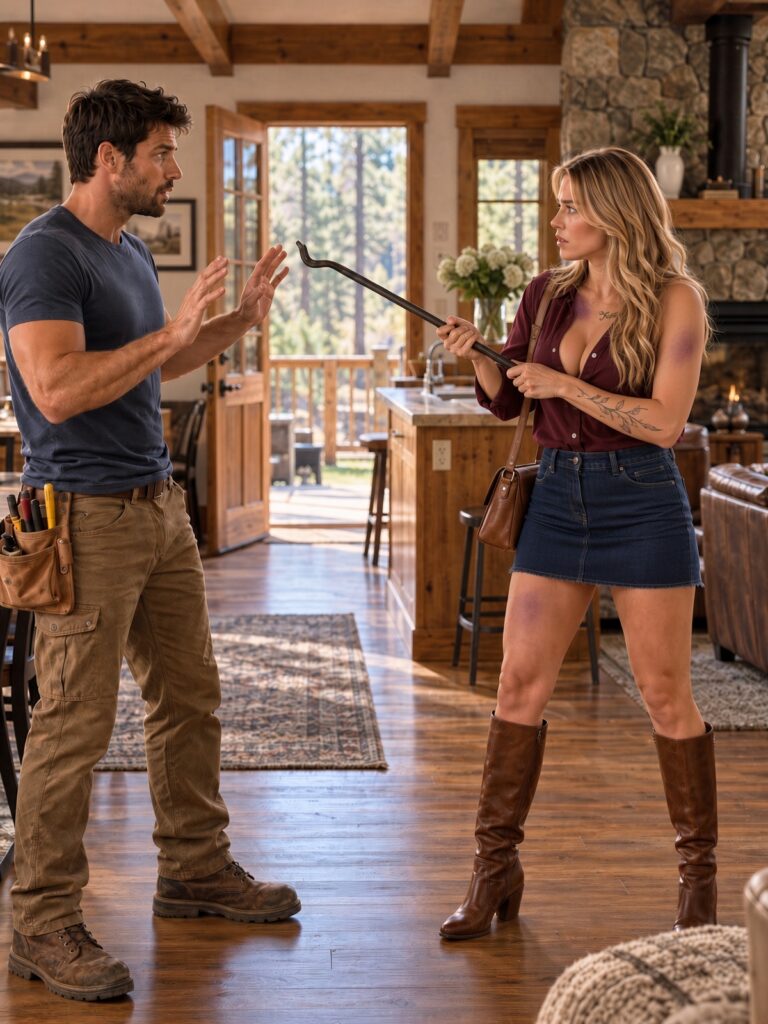
PART 3
The next morning, Sharon woke to drawers opening.
She entered the living room.
Carl’s duffel bag sat on the sofa.
Clothes folded beside it.
Tools gathered near the door.
“What are you doing?”
Carl stopped.
For the first time since she met him, he looked unsure how to answer.
“You’re leaving.”
“I’ll finish the remaining work.”
“That isn’t what I asked.”
His eyes moved toward the letter.
Sharon followed.
“What did he write?”
Carl sat down.
For several seconds, he said nothing.
Then he told her everything.
Before Big Bear, Carl had been very good at leaving.
Not because he was running from anything dramatic.
He liked project work.
San Diego.
Arizona.
Nevada.
Northern California.
Restoration.
Carpentry.
Decks.
Cabins.
Historic houses.
He rented furnished places by the month.
Owned little.
Kept most of his life in a truck and duffel bag.
It made departure easy.
Years earlier, Carl had been engaged.
Her name was Melissa.
She wanted roots.
A neighborhood.
Friends nearby.
A house they could slowly fill with things that did not fit into boxes.
Carl thought he wanted that too.
Until every conversation about mortgages, permanence, and five-year plans made him feel trapped.
No betrayal.
No screaming ending.
Melissa eventually stopped asking him to stay.
Carl stopped pretending he knew how.
Then Robert hired him for two weeks of deck repairs.
Two weeks became a month.
A railing.
A faucet.
A window Robert claimed had been “almost fixed” since 2009.
Sharon laughed.
“That sounds exactly like him.”
Carl smiled.
“That was the problem.”
Robert started asking questions.
Where next?
Why next?
Did Carl own anything that could not fit in his truck?
“One day he told me I was very good at building homes for people who actually intended to live in them.”
“What did you say?”
“I told him homes were overrated.”
“And?”
“He called me an idiot.”
Sharon laughed again.
After Robert died, the agreement allowed Carl to continue using the cabin while finishing the remaining projects.
At first, it was practical.
Bed.
Kitchen.
Workspace.
Then Carl kept coming back.
Sometimes because repairs existed.
Sometimes because his next job had not begun.
Sometimes because he knew where the coffee mugs were.
He looked toward the lake.
“Your father didn’t give me this place.”
He tapped the letter.
“He gave me somewhere to stop.”
Sharon went quiet.
“What did he write?”
Carl handed her the letter.
She hesitated.
“It’s addressed to you.”
“You can read it.”
The note was short.
Carl,
Finish the deck if you want.
Or don’t.
But don’t spend your whole life fixing places you never allow yourself to belong to.
You keep acting like freedom means leaving before anything can ask you to stay.
Maybe one day you’ll learn better.
Coffee is still in the wrong cabinet.
Robert
Sharon laughed through tears.
“Of course he mentioned the coffee.”
Carl smiled.
Then his expression darkened.
“And now you’re leaving.”
“Apparently I have excellent timing.”
The letter had not told him to leave.
It had made him realize the cabin had become different from every temporary place before it.
It had begun feeling like somewhere he could belong.
That frightened him more than departure.
Later, Sharon found Diane alone on the deck.
“Why did Dad come here so much?”
Her mother understood immediately.
For years, Sharon had explained her absence through work.
Traffic.
Los Angeles.
Busy schedules.
But both women knew the argument had done more damage than miles.
“He was proud of you,” Diane said.
Sharon looked sharply at her.
“He never said that.”
“No.”
“He was terrible at saying important things after pretending too long that he didn’t care.”
That sounded painfully familiar.
Diane continued.
“Whenever someone suggested selling the cabin, your father refused.”
“Why?”
“I asked once.”
“What did he say?”
Diane looked toward the water.
“She’ll come back when she’s ready.”
Sharon swallowed.
“He meant here.”
“I don’t think so.”
Diane’s voice softened.
“I think he meant to him.”
But that day never came.
For years, Sharon had treated the cabin like evidence of everything unfinished.
Maybe Robert had seen it differently.
Not as a trap.
As a place he hoped would remain if she ever wanted to return.
That evening, Diane and Evan left.
Sharon and Carl stayed.
The original repair list was nearly complete.
For the first time, no unfinished deck, storm, envelope, or mystery sat between them.
They sat outside while darkness settled across Big Bear Lake.
“I came here to sell it,” Sharon said.
Carl turned.
“The cabin.”
She nodded.
“I thought two weeks would be enough.”
“Clean it.”
“Decide.”
“Leave.”
Carl looked toward the water.
“It’s yours to decide.”
Sharon frowned.
“That’s all?”
“What do you want me to say?”
She opened her mouth.
Nothing came.
Then understood the problem.
She wanted Carl to object.
Wanted him to say:
Don’t sell.
This place matters now because you are here.
And suddenly she realized the property was not the only question between them.
Carl saw it too.
The silence changed.
He looked at her.
Sharon did not move.
Carl leaned closer.
Slow enough that she had time to stop him.
She didn’t.
He kissed her.
No storm.
No dramatic confession.
No dead father somehow arranging it from beyond.
Just two adults sitting on a deck.
Sharon kissed him back.
When they separated, she smiled.
“That was inconvenient.”
“Very.”
Then reality returned.
“You’re still leaving.”
“Eventually.”
“Where?”
Carl looked toward the dark lake.
“I don’t know.”
There it was.
The mystery around him was gone.
The habit remained.
Robert had been right.
Carl knew how to build a home far better than he knew how to choose one.
The following morning, Sharon received an offer on the cabin.
Cash.
Serious buyer.
Higher than the broker expected.
Closing possible in thirty days.
Three months earlier, Sharon would have signed before lunch.
Sell.
Divide proceeds according to the trust.
Close one more unfinished chapter.
Except it no longer felt simple.
She called Diane.
Then Evan.
Neither told her what to do.
That surprised her.
For years, Sharon believed keeping the cabin meant freezing Robert’s world exactly as he left it.
Same furniture.
Old mugs.
Photographs.
A shrine.
Or sell it.
Walk away.
Prove she had moved forward.
Sitting alone on the finished deck, she realized both choices were unfair.
The cabin could change.
The kitchen could change.
New photographs could appear beside old ones.
Evan could bring friends.
Diane could laugh at the same table where she once cried.
Sharon could spend an ordinary weekend there without making grief the price of admission.
Keeping the cabin did not have to mean living in the past.
Maybe it meant allowing the place to have a future.
She declined the offer.
For the first time, the decision was not:
What would Dad want?
It was:
What do I want?
That made all the difference.
When Sharon walked outside, Carl’s truck was packed.
Toolbox.
Duffel.
Jacket.
The familiar inventory of a man who had made leaving efficient.
He closed the tailgate.
“You’re leaving.”
“That was the agreement.”
“You’re annoyingly serious about agreements.”
“I’ve heard.”
Sharon looked at the cabin.
Then at him.
There was no practical reason for Carl to remain.
The contracted work was finished.
The trust had paid every invoice.
His temporary right of occupancy ended that afternoon.
That mattered.
Whatever happened next needed to be personal.
Not hidden inside employment.
Sharon refused to invent a romantic construction project so she could keep him there.
Instead, she walked closer.
“I declined the offer.”
Carl looked toward the cabin.
“You’re keeping it.”
“Yes.”
“Good.”
Again, she wanted more.
Again, he refused to guess.
So Sharon did something harder than planning.
She spoke clearly.
“I don’t want you to leave because you think staying automatically means forever.”
Carl said nothing.
“I also don’t want you staying because you think my father wanted it.”
Still nothing.
“I want to know if you want to come back.”
His eyes lifted.
“Come back?”
“Not move in.”
“Not surrender your truck.”
“Not become the official cabin carpenter for eternity.”
Carl almost smiled.
“I have work in Flagstaff next week.”
“Go.”
“Three weeks.”
“Okay.”
“Then Reno.”
“Fine.”
“Sharon.”
“What?”
“You are making this sound very easy.”
“It probably isn’t.”
She moved closer.
“But I spent four years acting like leaving was the only way to prove I had my own life.”
“You spent longer than that acting like leaving was the only way to prove you had yours.”
Carl looked toward his truck.
Then the cabin.
Then her.
“So what are you asking?”
Sharon smiled faintly.
“Breakfast.”
He blinked.
“Breakfast.”
“You have not left yet.”
“We can negotiate lunch afterward.”
Carl laughed.
“That is your offer?”
“It is the only one currently available.”
“And after lunch?”
“You are already negotiating badly.”
For several seconds, Sharon genuinely did not know what he would choose.
That mattered.
This was not Robert giving Carl permission.
Not a work agreement.
Not free lodging.
Not someone else’s unfinished plan.
Carl had to choose.
Finally he walked toward the truck.
Opened the tailgate.
Took out a small overnight bag.
Not the toolbox.
Sharon noticed.
He shut the tailgate.
“Breakfast.”
“That’s a yes.”
“That is breakfast.”
“Don’t make it weird.”
“Too late.”
He kissed her.
Then he left that afternoon anyway.
Important.
He drove to Flagstaff.
Completed his job.
Sharon returned to Los Angeles.
Also important.
They did not convert one emotional week into a permanent domestic arrangement because a dead father wrote a letter.
Carl called from Arizona.
Not every night.
Enough.
Sharon came back to Big Bear twice.
Once alone.
Once with Diane.
Carl returned four weeks later on his way north.
He stayed three days.
As Sharon’s guest.
No free labor.
No construction-for-affection arrangement.
When he fixed a sticking window, Sharon stopped him halfway.
“I am paying you.”
“It took twelve minutes.”
“Then send me a twelve-minute invoice.”
“That is insane.”
“Correct.”
He did.
For twenty-five dollars.
She paid it.
They both laughed.
The boundaries felt silly.
They were also useful.
The cabin belonged to the Baker Family Trust.
Sharon did not own it alone.
So before changing its future, she had a real conversation with Diane and Evan.
Evan wanted to keep his beneficiary interest.
Diane was relieved not to sell.
They created a written family-use agreement.
Expenses split through the trust.
Major repairs approved collectively.
No one could claim permanent residency without trustee consent.
No romantic improvisation.
Carl respected that.
He had his own apartment in Reno for several months while completing a restoration project.
Then one in Sacramento.
He still traveled.
The difference was that he began telling Sharon when he would return before knowing exactly when he would leave again.
Small shift.
Huge meaning.
Sharon changed too.
She stopped treating Los Angeles like proof she had escaped her father’s expectations.
Her career remained hers.
She accepted a promotion.
Negotiated remote Fridays twice a month.

Some of those Fridays happened at Big Bear.
She worked on the deck with a laptop.
Carl occasionally came through.
Sometimes not.
The cabin started becoming part of her present without swallowing the rest of her life.
Three months after they met, Robert’s cabin still looked mostly like Robert’s cabin.
His old mug remained in the cupboard.
His photograph stayed near the fireplace.
Part of the original deck he and Carl repaired remained untouched.
But new things appeared.
A fire pit Evan insisted they needed.
Outdoor lights Sharon chose.
A new couch Diane hated.
Photographs from a recent family weekend.
A blue ceramic bowl Carl bought at a roadside shop in Arizona and claimed was “structurally useful.”
New memories stopped asking permission to exist beside old ones.
One Saturday afternoon, Sharon walked into the cabin.
Men’s boots beside the door.
Jacket over the chair.
Fresh coffee in the kitchen.
Almost exactly like the first night.
“Carl.”
He came through the back door.
“What?”
She pointed.
“That’s my floor.”
He stared.
“Here we go.”
“And that is my coffee.”
“I made it.”
She picked up the mug.
“Then it is definitely mine.”
Carl walked closer.
“Anything here belong to me?”
Sharon pretended to consider.
“The cabin?”
“Hers.”
“Coffee?”
“Also hers.”
Carl waited.
Sharon stepped closer.
Kissed him.
When she pulled back:
“Maybe.”
That evening, Diane and Evan arrived.
Evan brought a girlfriend.
They ate outside.
Diane told a story about Robert trying to repair a boat despite having no idea how boats worked.
Evan corrected three details.
Diane ignored him.
Carl laughed.
Sharon looked around the table.
There had been a time when keeping the cabin felt like refusing to let Robert go.
Carl had believed staying anywhere meant surrendering freedom.
They had both misunderstood something.
Some places did not hold people back.
They gave them somewhere to return to.
Six months after the first summer, Carl faced the real test.
A construction company in Colorado offered him eighteen months of restoration work.
Good money.
Interesting project.
Stable contract.
He told Sharon two days after receiving the offer.
Not after signing it.
That mattered.
“I want to take it.”
Sharon’s chest tightened.
Old instinct.
Plan.
Control.
Ask when he would be back.
Define the future immediately.
Instead:
“Okay.”
Carl studied her.
“That sounded dangerous.”
“I’m thinking.”
“Take your time.”
She did.
Then:
“Do you want us while you do it?”
His expression softened.
“Yes.”
“Then say that.”
“I want us while I do it.”
“Better.”
They built a plan.
Not a promise that distance would be easy.
Carl would have two weeks off every eight.
Some would be Big Bear.
Some Los Angeles.
Some Sharon might visit Colorado.
No assumption Carl would eventually settle permanently in California.
No assumption Sharon would move.
They would evaluate what worked.
Six months later, the answer surprised both of them.
Carl liked having a longer project.
He did not feel trapped.
Because staying for eighteen months was a choice, not a sentence.
Sharon liked visiting Colorado.
She did not immediately imagine relocating.
Because loving a place did not require turning it into the only future available.
A year after they met, Carl finished the project.
He returned to Big Bear for a month.
One morning, he sat on the deck drinking coffee.
Sharon opened her laptop beside him.
“Where next?”
He looked at her.
“I don’t know.”
The old answer.
But his tone had changed.
Sharon waited.
Carl smiled.
“I’m thinking somewhere close for a while.”
“Because of me?”
“In part.”
“Careful.”
“I know.”
He looked toward the lake.
“Also because I’m tired.”
“Because I like this place.”
“Because I’ve been moving for fifteen years.”
“And because staying no longer feels like losing something.”
Sharon closed the laptop.
“That sounds suspiciously healthy.”
“Don’t ruin it.”
He rented a small workshop in Big Bear.
Not the cabin.
Important.
Built furniture.
Took restoration contracts.
Traveled when work interested him.
Returned when they ended.
For the first time, his business had an actual address that did not change every season.
He still kept the truck.
Sharon never asked him not to.
Two years after they met, Diane decided to distribute the cabin out of the family trust.
After appraisal and attorney review, Sharon and Evan became equal owners.
Diane retained a lifetime family-use right.
They signed an operating agreement covering expenses, maintenance, transfer rights, and sale procedures.
Carl was not part of ownership.
Sharon wanted that clear.
So did Carl.
Love did not require giving somebody real estate to prove trust.
A year later, Sharon bought Evan’s half when he decided he would rather use the equity toward a home near San Diego.
Independent appraisal.
Market-rate buyout.
Lawyers.
No family fight.
For the first time, Sharon truly owned the cabin.
She stood in the kitchen after closing.
Carl was making coffee.
She held up the deed packet.
“Now.”
He looked over.
“What?”
“That is my cabin.”
Carl stared.
Then laughed.
“You have waited three years for that sentence to become legally correct.”
“Yes.”
“I respect the commitment.”
He handed her coffee.
She looked at him.
“And you still do not live here.”
“No.”
“Your workshop apartment is six miles away.”
“Yes.”
“Very inconvenient.”
Carl leaned against the counter.
“Is this a proposal?”
Sharon nearly choked.
“No.”
“Good.”
“You looked terrified.”
“I’ve had experience with permanence.”
She threw a dish towel at him.
They married another year later.
Not because the cabin demanded a romantic ending.
Because by then they had spent four years learning each other outside the unusual circumstances that introduced them.
They had fought.
Seriously.
Once about money.
Once about Sharon making plans without consulting him.
Once about Carl accepting a six-week job during a period when Sharon’s mother was recovering from surgery.
The ugliest argument ended with Carl saying:
“You act like needing someone gives you permission to decide their schedule.”
Sharon replied:
“You act like being asked to stay is automatically an attempt to control you.”
Silence.
Both right.
Both wrong.
They apologized the next morning.
Carl shortened the trip by one week because the client had flexibility.
Sharon admitted she should have asked instead of assuming he would understand.
No one surrendered identity.
Both adjusted.
That was marriage before marriage.
The proposal happened on the deck Robert hired Carl to repair.
Carl carried no elaborate speech.
He sat beside Sharon one evening.
Handed her a small wooden box.
Inside was a ring.
Sharon stared.
“You made the box.”
“Yes.”
“Of course you made the box.”
“I considered buying one.”
“That would’ve been growth.”
He smiled.
Then:
“Your father told me not to spend my whole life fixing places I never let myself belong to.”
Sharon’s eyes filled immediately.
Carl continued.
“For a long time, I thought belonging meant staying in one place forever.”
“You taught me it can mean something else.”
“Returning honestly.”
“Planning together.”
“Leaving without disappearing.”
“Coming back because I want to.”
He took her hand.
“I don’t want the cabin.”
“I don’t want your father’s life.”
“I don’t want you to stop being the woman who built a career somewhere else.”
“I want you.”
“And I think I finally know how to stay without becoming trapped.”
“Will you marry me?”
Sharon wiped one cheek.
“One condition.”
Carl sighed.
“Of course.”
“No secret repair agreements with our future children.”
He laughed.
“Done.”
“And coffee stays in the original cabinet.”
“Absolutely not.”
Sharon held out her hand.
“Then we have a problem.”
Carl put the ring on anyway.
She kissed him.
They married at the cabin the following summer.
Small ceremony.
Diane.
Evan.
Friends.
A few of Carl’s former clients who had become friends.
No attempt to make Robert spiritually present in every detail.
His photograph stayed inside.
His mug stayed in the kitchen.
The wedding belonged to the living.
During dinner, Evan gave a speech.
“My sister came here four years ago ready to call the police on a stranger.”
Sharon shouted:
“He had a key!”
Carl lifted his glass.
“Still my strongest defense.”
Everyone laughed.
Evan continued.
“She also came here planning to sell the cabin.”
“She did neither.”
“I’m not sure whether that demonstrates personal growth or poor follow-through.”
More laughter.
Then Evan became serious.
“Dad spent years worrying Sharon would never come back.”
“He also spent years worrying Carl would never stop moving.”
“I think if Dad were here, he’d be unbearable about being right.”
Diane laughed through tears.
Sharon did too.
Then she looked toward the lake.
For the first time, remembering Robert did not feel like reopening an argument.
It felt like remembering a whole person.
Stubborn.
Loving.
Proud.
Wrong sometimes.
Afraid.
Unable to say certain things until he was almost out of time.
Her father.
Not a lesson.
Not a ghost.
Just Robert.
Years passed.
The cabin changed.
A new roof.
Updated kitchen.
Deck replaced eventually when the original lumber reached the end of its life.
Sharon cried when Carl removed the last section Robert had helped build.
Not because she thought wood held her father.
Because endings still hurt even when replacements were necessary.
Carl saved one intact board.
Turned it into a shelf.
Robert’s old mug sat on it.
That was enough.
Sharon eventually opened her own strategy consultancy.
Not because Robert’s business had secretly been her destiny.
It wasn’t.
Her work remained branding and organizational strategy.
But now she structured the company around the life she actually wanted.
Los Angeles clients.
Remote work.
Periodic travel.
Big Bear weeks.
Carl’s workshop expanded.
He hired two apprentices.
The man who once believed everything should fit into his truck ended up owning more clamps than any reasonable person needed.
Sharon reminded him often.
“Freedom.”
He pointed toward a wall of tools.
“This is freedom.”
“This is inventory.”
“Same thing.”
Diane visited often.
Evan married.
Had a daughter who claimed the loft bedroom as hers before turning six.
New photographs filled the walls.
Robert’s remained.
No competition.
One winter afternoon, Sharon found Carl sitting alone beside the fireplace holding the original letter.
The paper had yellowed slightly at the fold.
“You still read it?”
“Sometimes.”
“Why?”
Carl considered.
“Because I understand different parts at different times.”
Sharon sat beside him.
“What part now?”
He handed it to her.
Finish the deck if you want.
Or don’t.
But don’t spend your whole life fixing places you never allow yourself to belong to.
You keep acting like freedom means leaving before anything can ask you to stay.
Maybe one day you’ll learn better.
Coffee is still in the wrong cabinet.
Sharon smiled.
“What did he get wrong?”
Carl looked toward the kitchen.
“Coffee cabinet.”
“Everything else?”
Carl folded the letter.
“Annoyingly good.”
Sharon leaned against him.
“I think Dad’s real problem was he spent too long saying important things after people weren’t around to hear them.”
Carl looked down at her.
“You inherited that.”
She elbowed him.
“Careful.”
“I’m serious.”
“So am I.”
Then Sharon became quiet.
“I think I did.”
She had spent four years away from the cabin because returning felt too much like admitting Robert mattered.
Carl had spent years leaving because staying felt too much like admitting places mattered.
Two different defenses.
Same fear.
Belonging creates something to lose.
That is true.
No philosophy erases it.
The people you love can leave.
Places can be sold.
Parents die.
Relationships end.
Roofs collapse.
Cabins burn.
Nothing is permanent simply because you decide to stay.
Sharon learned that belonging is not protection from loss.
It is deciding some things are worth loving even though loss remains possible.
Carl learned freedom is not the absence of attachment.
It is being able to choose your attachments without pretending you have none.
One Saturday afternoon many years later, Sharon arrived at the cabin alone.
She had been in Los Angeles all week.
Carl had returned from a short restoration job the night before.
She unlocked the door.
Men’s boots by the entrance.
Jacket over a chair.
Fresh coffee in the kitchen.
She smiled.
“Carl?”
Hammering behind the cabin.
Of course.
She walked through the back door.
Carl stood beside the shed repairing a loose section of siding.
Gray beginning at his temples now.
Same flannel habit.
Same irritating calm.
He looked over.
“You’re early.”
Sharon folded her arms.
“That’s my cabin.”
Carl smiled.
“No.”
She raised one eyebrow.
He put down the hammer.
Walked toward her.
“It’s our weekend.”
Sharon pretended to consider.
“Better answer.”
Then kissed him.
The first time she found Carl inside, she believed the important question was ownership.
Who had the key?
Who had permission?
Who had the right to stay?
Those questions mattered.
Legally, enormously.
But years later, they were not the questions she remembered most.
The important ones came afterward.
Why had she stayed away?
Why did Carl always leave?
What had Robert failed to say?
What did Sharon want that had nothing to do with what her father would have wanted?
Could Carl travel and still belong somewhere?
Could Sharon keep the cabin without turning it into a memorial?
Could they love one another without converting a repair contract into romance?
Could they choose each other when neither property, work, grief, nor Robert’s wishes required it?
Those answers took years.
That made them better.
The cabin never magically healed Sharon.
Carl never filled the space her father left.
Robert’s letter did not cure Carl of fear.
No one person became somebody else’s solution.
The cabin simply kept placing choices in front of them.
Stay for breakfast?
Come back next month?
Tell the truth before leaving?
Keep the property because you want it?
Take the job because you want it?
Return because you still choose this life?
Again.
Again.
Again.
That was how belonging grew.
Not one grand promise.
A series of returns.
Near the end of Diane’s life, she spent one final summer weekend at Big Bear.
She sat on the deck beneath a blanket even though the evening was warm.
Evan’s children ran near the fire pit.
Carl grilled dinner.
Sharon brought her mother tea.
Diane looked around.
“Your father would be impossible right now.”
Sharon laughed.
“Because he was right?”
“Because he would think he was.”
“Different.”
“Very.”
They watched Carl argue with Evan about charcoal.
Diane’s voice softened.
“I’m glad you kept it.”
“The cabin?”
“Yes.”
Sharon thought.
“So am I.”
“Not because Dad wanted me to?”
“No.”
“That’s why I’m glad.”
Sharon looked at her mother.
Diane smiled.
“You finally chose it.”
That sentence stayed with Sharon.
She had spent too much of her younger life defining choices in opposition.
If Robert wanted family business, she wanted something else.
If the cabin represented him, she stayed away.
If grief pulled backward, she ran forward.
Eventually she understood that freedom built entirely around resistance is still controlled by the thing you are resisting.
Keeping the cabin became free only after it was no longer a vote for or against Robert.
It was simply something Sharon wanted.
Loving Carl worked the same way.
He was not the man her father secretly chose for her.
Robert never planned that.
He hired a carpenter.
Became his friend.
Left him a letter.
That was all.
The rest belonged to Sharon and Carl.
Which was exactly how it should have been.
After Diane died, Sharon found another envelope in her mother’s papers.
This one had her own name on it.
She hesitated before opening it.
Then laughed at herself.
Some family habits had apparently become permanent.
Inside was one page.
Sharon,
Your father kept the cabin because he hoped you would come back.
I kept it because I knew you needed the choice.
Those are different things.
I’m glad you learned the difference.
Love,
Mom
Sharon cried.
Carl sat beside her.
Did not fix it.
Some traditions were worth keeping.
Years later, when Evan suggested turning the cabin into a short-term rental during periods nobody used it, Sharon surprised herself by agreeing.
Not every week.
Limited schedule.
Family dates protected.
Revenue went toward maintenance and taxes.
The first version of Sharon would have been horrified.
Strangers using Dad’s cabin?
Impossible.
But the cabin no longer needed to prove loyalty.
Families visited.
Children played on the deck.
Couples celebrated anniversaries.
People drank coffee in the wrong cabinet.
The place lived.
Sharon liked that.
One guest left a note:
This cabin feels loved.
Sharon kept it.
Not because the guest knew Robert.
Not because they knew Carl.
Because somehow the place had become what Sharon once believed inheritance could not be.
Neither burden nor shrine.
A useful thing carried forward.
Carl retired from traveling full-time in his late fifties.
Not completely.
He still accepted jobs that interested him.
A historic lodge in Oregon.
A church restoration in Utah.
A farmhouse in Northern California.
But he stopped pretending departure was the point.
His answer to “Where do you live?” became simple.
“Big Bear.”
The first time Sharon heard him say it without hesitation, she smiled.
Carl noticed.
“What?”
“Nothing.”
“That means something.”
“You finally have an address.”
“I have had an address for years.”
“You know what I mean.”
He did.
Sharon’s career remained partly in Los Angeles until she was ready to reduce work.
Not because Carl waited.
Not because the cabin called her home.
Because eventually she wanted different proportions.
More lake.
Less freeway.
More family.
Fewer airport lounges.
Ambition changed.
That did not invalidate the woman who once fought Robert for the right to leave.
If anything, it honored her.
She left when leaving was right.
Returned when returning became hers.
One evening, long after the original fireplace poker had been moved to the shed because Sharon finally admitted nobody used it, Carl found her reading on the deck.
He sat beside her.
“Do you remember the first thing you said to me?”
“That’s my cabin.”
“You were holding a weapon.”
“Decorative fireplace tool.”
“You looked prepared to commit a felony.”
“You were in my kitchen.”
“With legal permission.”
“You had moved the coffee.”
Carl smiled.
Then:
“You were right.”
Sharon looked over.
“About the cabin?”
“Yes.”
“It was yours.”
“Eventually.”
“No.”
He shook his head.
“It was yours because it was the thing you were fighting with.”
“Your father.”
“Your grief.”
“The idea that coming back meant surrender.”
“You were the one who had to decide what it became.”
Sharon studied him.
“That was suspiciously thoughtful.”
“I’m old.”
“Apparently wisdom arrived late.”
“Still arrived.”
She rested her head on his shoulder.
Below them, Big Bear Lake reflected the last orange light of evening.
The view had not changed much since Robert’s time.
Everything else had.
And maybe that was what finally brought Sharon peace.
A place can remain familiar without remaining frozen.
A person can change without betraying who they were.
A daughter can love her father and still believe he was wrong.
A man can value freedom and still choose a home.
A cabin can hold grief without becoming a monument.
And moving forward does not always require leaving something behind.
Sometimes it requires allowing an old place to hold new life.
The first day Sharon Baker returned to Big Bear, she expected an empty cabin.
Instead, she found a stranger drinking coffee in her kitchen, repairing her deck, and carrying a key her father had given him years before.
She wanted Carl gone.
Carl believed he would leave as soon as the work ended.
Both thought the cabin was temporary in different ways.
Neither understood that the real question was not who had the right to stay.
It was whether either of them knew how to choose staying when nothing forced them to.
Robert had spent his last years hoping Sharon would return.
But hope was not ownership.
His wish did not become her obligation.
His letter gave Carl something to consider.
Not an instruction.
Not a destiny.
Just a question.
What if freedom was not leaving before attachment could hurt?
What if moving on was not selling every object connected to grief?
What if belonging did not mean losing yourself?
Sharon and Carl answered those questions badly at first.
Then better.
Over years.
Through work, distance, legal paperwork, family conversations, arguments, separate homes, changed plans, and enough breakfasts to make “temporary” stop sounding believable.
That was how the cabin became theirs emotionally long before ownership paperwork caught up.
Not because Robert arranged a romance.
He didn’t.
Not because grief delivered a reward.
It didn’t.
Because two adults eventually stopped asking what they were supposed to do and started answering what they actually wanted.
Carl wanted somewhere he planned to return to.
Sharon wanted a place that could contain her father without belonging only to him.
And both wanted each other.
Not as entire worlds.
Not as replacements for freedom.
As part of the world neither wanted to keep running from.
Years later, people still teased Sharon about the first confrontation.
Evan’s children especially.
“Grandma Sharon almost hit Grandpa Carl with a fireplace poker.”
“I did not.”
“You raised it.”
“He was an intruder.”
“I had a key,” Carl always said.
“Temporary key.”
“Legal key.”
Then Sharon would point toward the kitchen.
“And he moved the coffee.”
Everyone agreed that was unforgivable.
Carl never won that argument.
Some things truly were permanent.
The End.


