
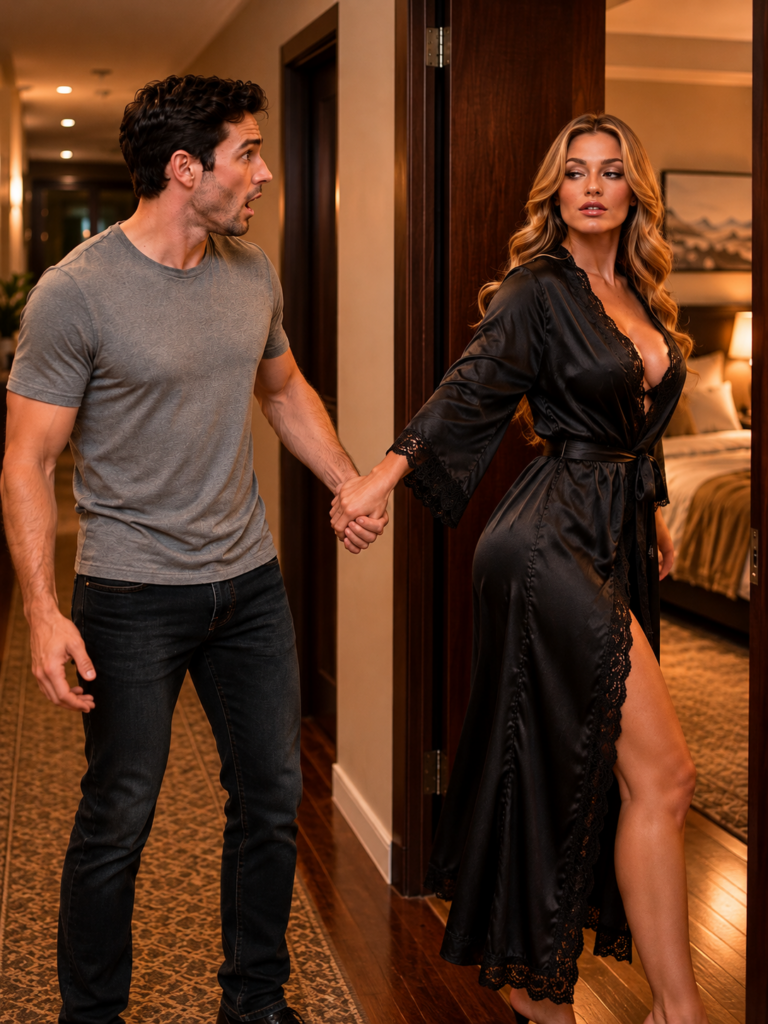
Part 1
The card reader at the pharmacy beeped once and went red.
Ethan Cole did not take the card out. He stood with his thumb still on it, watching the little screen as if it might reconsider. Behind him a man coughed into his elbow. The pharmacist, whose name tag read DENISE, kept her eyes on the register.
“Want me to split it?” she said.
“Yeah.”
Noah’s antibiotic was the part that could not wait. The ear infection had kept the boy up two nights, and the pediatrician had been plain about it. The inhaler refill could slide three days if Ethan called the office and asked for a sample, which he hated doing and would do anyway. He had thirty-one dollars in the everyday account until Friday. The antibiotic was twenty-eight with the coupon Denise had already punched in without being asked.
“Just the amoxicillin,” he said.
She bagged it. The inhaler went back into the bin under the counter. Ethan signed the slip, took the small white bag, and walked out into a parking lot that smelled like rain on hot asphalt. In the car, Noah’s booster seat held a paperback dinosaur book and a sock that had lost its pair. Ethan set the bag on the passenger seat and sat with his hands on the wheel until the shaking in them settled into something he could drive with.
Harrington & Associates took up the fourth and fifth floors of a brick building that had once been a department store. The elevator still groaned. Ethan rode it with his badge turned backward, a habit from the months after Clare died when he had not wanted anyone to read his name and arrange their face into sympathy. Three years had not ended the habit. It had only made it look like absentmindedness.
His desk was at the end of the accounting bay, near the window that faced the parking deck. He liked the deck. It did not require anything of him. The Meridian file was already open on the screen from the night before, provisional numbers highlighted in yellow where the deferred revenue still would not sit still. He had come in early to finish the schedules before the board call. The antibiotic waited in his bag. He would leave at four to make the daycare pickup, which meant the schedules had to be done by three.
People said he was reserved. They were not wrong. They were only incomplete. Reserve was what he had left after the highway patrolman had stood in his kitchen and said the other driver had been looking at a phone. Clare had been twenty minutes from home with milk and a wrap of tulips. Ordinary day. Ordinary flowers. Ethan had been left with a six-year-old who still asked when she was coming back from the store, a mortgage that had made sense on two incomes, and a quiet so wide he sometimes heard his own pulse in it.
He had learned pancakes. He had learned the names of Noah’s teachers. He had not learned how to let a room see the places that still flinched.
Eleanor Harrington came through the glass door at eight-forty with a cardboard tray and the kind of calm that made the associates sit up without being told. Forty-one, managing partner for fourteen months, dark hair in a low twist, a navy jacket that had been chosen for work and not for notice. Her husband had died of a heart attack two years back, at the table, between the salad and the thing he had been about to say. She had inherited a firm she had helped build and a grief she did not put in emails. The staff called her distant the way people call a winter field distant. Ethan had been told this. He had not added to it.
She stopped at his desk because the Meridian file had her name on the routing slip.
“Walk me through the variance before ten,” she said. “They’ll ask about the deferred piece first.”
He stood. He kept his eyes on the paper. “Most of it is timing. They booked the support contract in the month it was signed. It should spread over the service term. I’ve marked the schedules. Page four.”
She did not take the page immediately. “You can look at me while we talk. I don’t bite.”
He looked. A second, maybe two. Her eyes were tired in a way he recognized, the tired that is not about sleep. Something in his chest pulled tight, a bruise under a shirt. He dropped his gaze to the margin note he had already explained.
“Sorry. Habit.”
“All right,” she said, and took the page, and did not make it a thing.
After that she stopped more often. A clarification that could have been an email. A question about a code. He answered with the precision that had kept him employed through the worst quarter of his life, and he aimed his eyes at the screen, the file, the skyline beyond the glass. He told himself it was respect. Focus. The truth was plainer and worse. Looking at her made him notice that a person could still stand in a room after the worst day, still carry a file, still almost smile when the intern told a bad joke in the break room. Noticing felt like a door he had locked for a reason.
At four he made daycare with six minutes to spare. Noah came out with one shoe untied and a paper crown from art, the crown already bent.
“Did you get the pink one?” the boy asked, meaning the medicine, which he had decided was pink even when it was not.
“I got it.”
“Mrs. Hale said I can go back tomorrow if I don’t have a fever. Can I?”
“If you don’t have a fever.”
They ate grilled cheese at the kitchen table because the chicken had gone off and Ethan had not had time to replace it. The house still had Clare’s handwriting on the inside of the pantry door, a list of Noah’s sizes from two winters ago. He had not painted over it. Noah swung his feet and studied his father the way he studied weather.
“You look sadder than usual,” he said. “Did something happen at work?”
“Just busy, buddy. How was soccer at recess?”
“I didn’t play. My ear hurt.” Noah accepted the deflection. He had learned which questions got answers and which ones got a subject change. Ethan hated that he had taught him that, and he did not know how to unteach it in a single evening.
After the dishes he sat on the floor and built a dinosaur out of blocks while the antibiotic measured itself into a plastic cup. Noah leaned on his knee. The mortgage draft would hit Friday. Daycare was already paid through the month, which was the only reason the pharmacy card had failed on the inhaler and not on rent. The furnace filter needed changing. The car needed brakes he was pretending were fine. He had stopped contributing to the small college fund in March and had not said so out loud.
What he did not know was that the tired woman in the navy jacket had watched him from the interior window of her office twice that week. Once when he stayed through his lunch to fix a reconciliation a junior had botched, without putting his name on the correction. Once when he handed his parking validation to the temp at the front desk because her card had been declined at the deck machine and she was near tears with a stack of filings. Eleanor had not meant to keep a record. She had meant only to understand why her best senior accountant would not meet her eyes. The record had gathered anyway.
Part 2
The cost showed up in small humiliations, which were the kind he was built to survive and not the kind he was built to discuss.
On Wednesday the brakes ground at the light on Mercer. He turned the radio up so Noah would not name the sound. A shop quote, texted while he waited in the daycare line, came back at six hundred and forty for pads and rotors if they did not find more once the wheels were off. He had four hundred in savings that was supposed to be the furnace and the month he might get cut to thirty-two hours. Harrington had lost two small-business clients in the spring. Eleanor had not said layoff. She had said utilization, which was the same weather from a different direction.
He took the car in on his lunch and authorized the work he could not quite afford, because a six-year-old in a booster seat was not a place to gamble. The shop let him put two hundred on a card and the rest on a Friday pickup. He ate crackers from his desk drawer and finished the Meridian tie-out with a headache sitting behind one eye.
A junior named Priya caught him at the copier.
“The Bergson return,” she said, low. “I transposed a schedule. If it goes out like this they get a notice. I can fix it tonight, but I have to get my kid by five-thirty or the center charges a dollar a minute. My mother usually does Wednesdays. She’s in the ER with her sugar.”
Ethan looked at the clock. He had daycare until six. A dollar a minute was a language he spoke.
“Leave it. I’ll run the schedule again.”
“It’s my mistake.”
“Then you’ll owe me a schedule someday. Go.”
He stayed until five-forty. The correction was tedious and clean. He did not put a note in the file about who had caught it. When he signed the transmittal he used Priya’s initials, because the mistake had been caught and the work had been hers to learn. He made daycare at 5:58. The center director gave him the look that was not unkind and was not nothing.
Noah fell asleep over his pasta. Ethan carried him to bed and stood in the hall with the mortgage login open on his phone, moving forty dollars from the bill account to cover the brake balance so Friday would not bounce. The college fund sat untouched and smaller than it should have been. He closed the app.
Eleanor found him in the morning already at the Bergson file, checking his own check.
“You were here late,” she said.
“Clock ran.”
“Priya’s mother is all right. She told me you took the schedule.” Eleanor set a folder down and did not open it. “That doesn’t go on your utilization as supervisory. It just disappears.”
“It was an hour.”
“It was the hour you don’t have.” She waited. He kept his eyes on the screen. “Ethan.”
“The numbers are fine,” he said. “Bergson won’t get a notice.”
She left the folder and went. He felt her absence like a change in air pressure. Looking would have cost more than the hour.
At home that night Noah lined up his plastic dinosaurs and made them hold a meeting.
“This one is sad,” he said, tapping the triceratops. “He won’t look at the T. rex. The T. rex thinks it’s because he’s ugly.”
Ethan paused with a dish towel in his hands. “The T. rex isn’t ugly.”
“I know. The trike is just scared. Mrs. Hale says some kids don’t look at you when they’re scared, not when they’re mean.” Noah glanced up, quick, testing. “Are you scared of somebody at work?”
“I’m tired of somebody at work,” Ethan said, which was not the truth and not a lie. “Brush your teeth.”
He lay awake after. The ceiling had a crack he had meant to patch before Clare died. Three years of meaning to. He wondered how long a man could keep his eyes on the floor before his son started studying the floor too.
Thursday came in wet. Most of the floor cleared out by five because the network was slow and Eleanor had told them to finish in the morning rather than fight it. Ethan stayed. The Meridian board memo still had a soft number in it, and soft numbers were how people got hurt in rooms he was not invited to. He was rerunning a column when she appeared in the doorway with two paper cups.
“Chamomile,” she said. “I made an extra. The machine downstairs burns everything else.”
He took the cup. He thanked her. He did not look up.
She sat in the visitor’s chair. Rain worked the glass. The office lights hummed. He could feel her waiting, and he kept typing because typing was a place to put his hands.
“Why won’t you look at me?” she said.
The words were quiet. They still landed.
“Am I not pretty?”
His head came up before he could stop it. She was not wearing the navy jacket. She had a cardigan on over her blouse, and her eyes were bare of the professional mask, and she looked like a person who had practiced not asking and had asked anyway. Hurt sat on her face without decoration.
“It’s not that,” he said. His voice came out rough. “God, Eleanor. It is not that.”
“Then what is it?” The last word thinned. “Every time I walk into a room you look past me like I’m a filing cabinet. I know I’m not twenty-five. I know I carry more grief than people want in a meeting. I still show up. I still try. And you make me feel like the furniture. If that’s the job, say so. I’d rather have it said.”
He set the tea down because his hands had started to shake. Outside, a car hissed through the wet street.
“Seeing you hurts me,” he said.
She went still.
“I look away because looking at you reminds me I’m still capable of noticing someone. And noticing someone feels like I’m forgetting her. Clare. My wife. Three years in June. Some days it’s yesterday. When I look at you I see that life kept going. That a person can be—” He stopped, because pretty was the word she had used and it was true and it was not the point. “Kind. Still standing. And I don’t know if I’m allowed to see that yet.”
Eleanor did not wipe her eyes. They had filled, and she let them.
“I lost my husband two years ago,” she said. “Some mornings I still reach for his side of the bed. I didn’t ask you to replace anyone. I asked you to see me while we work. Is that so much?”
“No.” He held her gaze because looking away now would have been the crueler thing. “It’s not too much. I’m sorry.”
They sat with the rain. He saw the fine lines at the corners of her eyes, the way she held her cup in both hands as if it might be taken, the small tremor she was not performing. She saw, he thought, a man who had been using the floor as armor and had just admitted it. Neither of them called it anything else.
“The board wants a staffing note in the morning,” she said at last, and her voice had steadied into work, which was a mercy. “Not tonight. Go home to your son. The memo can wait an hour in the morning.”
He drove through the rain with the tea unfinished in the cup holder. Noah was on the couch with the sitter, a neighbor girl who charged less than the center’s late fee and talked to the dinosaurs as if they were colleagues. Ethan paid her, including the extra half hour, and did not let his face show what the extra half hour did to Friday.
After Noah was down, his phone buzzed. Eleanor.
Come to my office at eight tomorrow. Before the board call. Don’t bring the Meridian file.
He read it twice. No reason. No tone he could decode. His first thought was the hour he had given Priya, and whether utilization had finally become a conversation with consequences. His second thought was the tea, and the sentence he had said out loud, and a managing partner who might have decided that a senior accountant in love with a ghost was a risk she could not afford in a room full of numbers.
He typed On my way and erased it, and typed I’ll be there, and set the phone face down on Clare’s side of the bed, which he still did not sleep on.
Part 3
He was outside her door at 7:58 with his badge turned backward and his palms dry from wiping them on his trousers. The floor was empty. Her lamp was on. She looked up when he knocked, and for a moment he saw her decide not to be the woman from the rain.
“Sit,” she said. “You’re not in trouble. I should have put that in the text. I’m sorry.”
The apology loosened one knot and tightened another. He sat.
“I watched you this month,” she said. “Not as a friend. As the person who has to tell a board why this firm still deserves their clients. You corrected Priya’s schedule and left her name on it. You gave the temp your parking card when the deck declined hers. You have been leaving at four for a sick child and still hitting the deadlines, and you have not once put the cost of that on my desk. I had a private investigator’s worth of gossip available to me. I didn’t use it. I used the work.”
He did not know where to put his eyes. Looking at her was the thing they had just survived. Not looking was the old crime.
“I called the shop,” she said. “Not to pry. The brake invoice got copied to the firm card by mistake when you paid the deposit. Clerical error on their end. I saw the balance. I’m not offering to pay your car. I am offering you the senior review slot we’ve been leaving open because I didn’t trust the last two people we interviewed. It is not a gift. It is four more hours a week at your rate, a parking space that doesn’t go through the deck machine, and the right to hand a junior’s emergency back to me instead of eating it. If you don’t want it, say so, and we will never mention the invoice again.”
Ethan felt heat in his face. Charity had a smell. This was close enough that he wanted to refuse it on principle.
“I can do the work,” he said. “I don’t want the slot because you saw a bill.”
“Then don’t take it because I saw a bill. Take it because the Bergson return went out clean and Meridian’s deferred revenue finally makes sense. The bill is why I stopped waiting for a quarter to offer it.” She folded her hands. “You can say no.”
He thought of the inhaler still under Denise’s counter. Of Noah’s fever. Of the forty dollars he had moved in the dark.
“I’ll take the work,” he said. “Not the story that comes with it.”
“Fair.”
She slid a single sheet across. The hours, the rate, the start date Monday. No speech. He signed with a hand that was steadier than he felt. When he looked up she was watching him, and this time he did not drop his eyes out of habit. It still hurt. The hurt was clean, not hidden.
“About last night,” he said.
“We don’t have to do last night in this office.”
“I do. Once. Seeing you isn’t about pretty. You are—” He shook his head. “I’m not good at this. Clare bought tulips on ordinary days. I have been treating ordinary days like a betrayal ever since. You asked a fair question. I answered it late.”
Eleanor nodded. The professional mask did not quite return. “I set two places at the table sometimes before I remember. If we’re telling the truth.”
The board call took the late truth and turned it into numbers. Ethan spoke to the deferred revenue without staring at the table. Eleanor did not praise him in the room. After, by the elevator, she said only, “That held.”
The weeks that followed were careful. He lifted his gaze when she spoke, not every time, enough that she stopped bracing to be furniture. She stopped inventing reasons to pass his desk and started sending the real questions. On a Friday when the presentation ran long, she asked if he wanted dinner at the Italian place two blocks down, the one with the fluorescent light fixed and the vinyl booths. He almost said no. He thought of Noah’s trike and the T. rex. He said yes, and he texted the sitter, and he tried not to do math at the table.
They talked about the dead the way people do when they have agreed not to pretend. Clare had loved rain and bad puns. Eleanor’s husband had collected maps and hummed off key. Ethan said he still spoke to Clare in the car. Eleanor said she had canceled a dinner last month because an old forwarded email had arrived with his name on it, a subscription that would not die. Neither of them called the meal a date. Ethan paid because he had asked himself, before the check came, whether letting her pay would feel like the brake invoice. She let him.
Outside, the rain had thinned to mist. She looked at him. He looked back.
“I’m not ready for anything big,” he said. “Noah still asks about his mom every week. I still answer.”
“I’m not ready either,” she said. “I can let you see me. That’s the part I asked for.”
The hard days did not vanish. A tulip in a shop window could still take the afternoon out of his voice. An email from a dead man’s account could still make her cancel. Noah noticed the change before Ethan had a speech for it. One night, over macaroni, the boy said, “You smiled at your phone. Was it a dinosaur video?”
“It was a person from work. She told a bad joke.”
Noah pushed a noodle with his fork. “If you like her, do you stop liking Mom?”
Ethan got down on the living room floor so they were the same height. The crack in the ceiling was still there. “No. Love isn’t a pie. You don’t run out of slices. It’s more like lamps. You can turn another one on. The room gets brighter. Mom’s lamp stays on.”
Noah thought about it with the seriousness he gave to dinosaurs. “Okay. But she has to like dragons. Dinosaurs are taken.”
“I’ll mention it.”
The firm did what firms do. A rumor sparked and failed for lack of evidence. Ethan kept delivering clean numbers. Eleanor kept the board steady. Priya brought him coffee on a Wednesday and did not make a speech about her mother, which he preferred. The senior hours covered the brakes and the inhaler and, by December, a returned contribution to the college fund that was smaller than his pride wanted and real anyway.
On a Saturday he invited Eleanor to Noah’s game. She came in jeans and a sweater, no jacket, no distance. Noah scored and ran to the sideline and pulled up short when he saw her. Ethan did not push. Noah considered, then offered a high five that was mostly fingers. Over ice cream she admitted she had always liked dragons better than dinosaurs. Noah ruled dragons acceptable, with conditions.
Months later, on the anniversary of Clare’s death, Ethan drove to the cemetery alone at dawn with tulips from the grocery store, the cheap wrap, the ordinary kind. He sat on the cold grass and told her about the woman who had asked why he would not look at her, about the boy who was learning that a heart could hold more than one name, about a job that was still a job and a car that stopped when he asked it to. He did not ask permission. He told the truth, which was that he had been afraid of seeing, and that seeing had not erased her.
That night he stood in his kitchen doorway while Eleanor helped Noah label the phases of the moon for a project that was mostly tape. The domestic light fell across both of them. Looking at her did not feel like a bruise. It felt like a door he had unlocked from his side.
He sent one sentence after Noah was asleep. I looked at you today and it didn’t hurt.
She answered before he had set the phone down. Then keep looking. I’m still here.
In the spring he changed the furnace filter himself and let Noah hand him the screws. Across the street a neighbor was fighting a trash bin in the wind, papers lifting into the gutter. Noah saw it first.
“We should help,” he said. “Mrs. Hale says that’s what you do when your hands are free.”
Ethan looked at his son, then at the bin, then at the house where a second lamp had been turned on without putting the first one out. He set the filter box on the step.
“Yeah,” he said. “Come on.”
They crossed the yard together. The papers kept trying to escape. They caught them anyway.


