
Part 1
The bracelet was tucked around the baby’s left ankle, half-hidden beneath the soft yellow blanket my mother had knitted before she died.
I hadn’t thought much about it until my son, Owen, pointed toward the crib.
“Look at the letters, Mommy.”
I bent closer.
Our daughter was sleeping peacefully, one tiny hand curled beside her cheek. Her dark hair stood up in soft, stubborn wisps, and her mouth moved in the little searching motions newborns make when they’re dreaming of milk.
Everything about her seemed familiar.
Except the bracelet.
The plastic band had a printed hospital identification label. The numbers were small, and without my reading glasses, I could barely make them out.
But one thing was immediately clear.
The last name wasn’t ours.
I looked at my husband.
“Daniel, why does her bracelet say Mercer?”
He stopped halfway through folding a receiving blanket.
For a moment, he didn’t move.
Then he gave a short laugh.
“Probably a hospital mix-up. You know how busy that maternity ward was.”
I looked back at the bracelet.
Our last name was Bennett.
The baby in our crib was wearing a bracelet labeled Mercer.
“Owen, sweetheart,” I said, trying to keep my voice steady, “why don’t you go downstairs and get your coloring book?”
My son didn’t move.
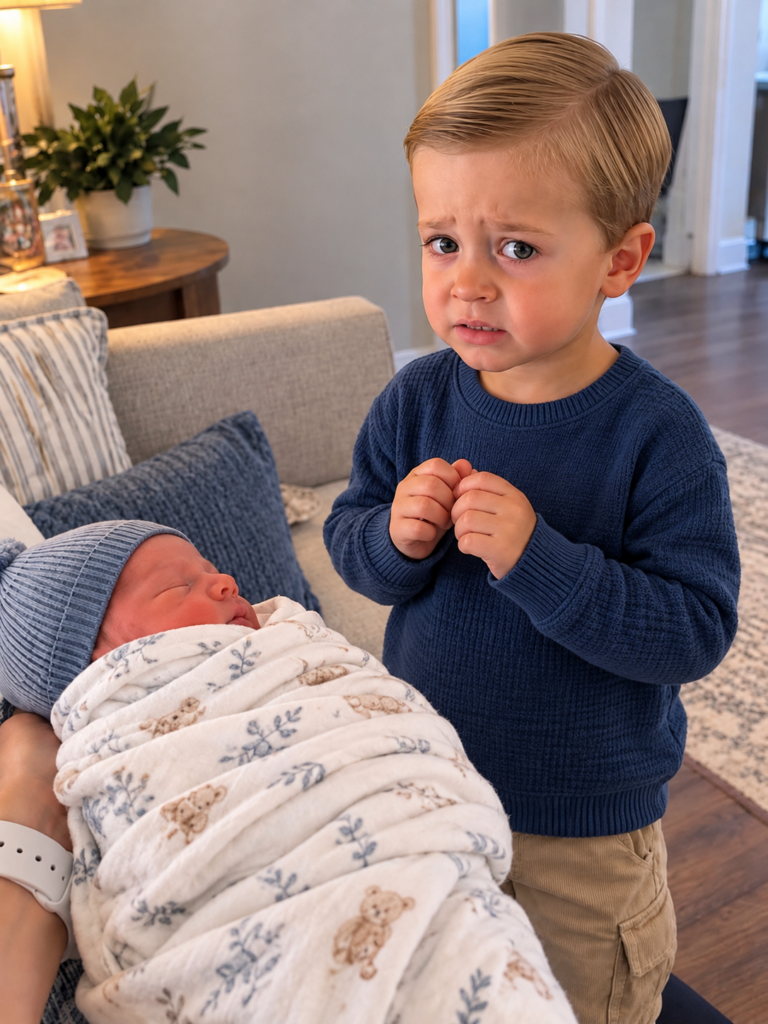
He was wearing his dinosaur pajamas, the green ones with the fading orange tail. He had been wearing them since we brought the baby home because, as he’d explained, dinosaurs were brave enough to protect little sisters.
But he hadn’t gone near the nursery once.
Not until that afternoon.
“Mommy,” he whispered, “please don’t let Daddy take me away again.”
Daniel’s expression hardened.
“That’s enough, Owen.”
The sharpness in his voice made our son flinch.
I turned toward him.
“Don’t speak to him like that.”
“He’s been acting strange since we got home. You need rest, Claire, and he’s making everything worse.”
Owen backed against the wall.
My husband took one step toward him.
“Go to your room.”
“No,” I said.
Daniel stopped.
It was such a small word, but it felt strange in my mouth.
We had been married for eleven years. In that time, I had rarely contradicted Daniel in front of anyone, especially our son.
Daniel wasn’t a cruel man in the obvious ways people imagine.
He didn’t slam doors or throw things. He remembered anniversaries, volunteered at church, and brought flowers when he knew I’d had a difficult week.
He was the sort of husband other women described as dependable.
But Daniel had a particular way of ending uncomfortable conversations.
He would sigh, lower his voice, and explain why everyone else was being unreasonable.
Usually, I believed him.
That afternoon, I didn’t.
“Owen stays,” I said. “And you’re going to explain the bracelet.”
Daniel looked from me to our son.
Then he placed the folded blanket on the dresser.
“Fine. Call the hospital. They’ll tell you the same thing I just did.”
He walked out before I could answer.
I heard his footsteps descending the stairs, measured and unhurried.
Owen remained pressed against the wall.
I crouched beside him, moving slowly because the stitches from my emergency cesarean still pulled whenever I bent.
“Sweetheart, did something happen at the hospital?”
His eyes filled immediately.
He shook his head.
Then nodded.
“Daddy said I wasn’t supposed to tell.”
My stomach tightened.
“Tell me what?”
Owen looked toward the doorway.
“Can you shut the door?”
I stood, closed it, and returned to him.
He climbed onto the little rocking chair beside the crib, pulling his knees against his chest.
The baby made a quiet squeaking sound.
Owen covered his ears.
That was when I understood that what I’d mistaken for resentment was something entirely different.
My son was terrified.
Three days earlier, I had been lying in a hospital bed at St. Catherine’s Medical Center in Columbus, Ohio.
The room smelled of disinfectant, warm blankets, and the weak hospital coffee Daniel had brought me from downstairs.
I was thirty-eight years old, exhausted, and frightened.
The pregnancy had been difficult from the beginning.
I’d suffered two miscarriages after Owen was born, and by the time I became pregnant again, I’d stopped allowing myself to imagine nursery decorations or baby clothes until the second trimester.
Even then, every appointment felt like waiting for bad news.
Daniel had been reassuring.
“Everything will be fine,” he told me before every ultrasound.
I’d wanted to believe him.
When our daughter finally arrived, there had been complications.
I remembered the doctors speaking quickly.
I remembered someone telling me my blood pressure was dropping.
I remembered a bright surgical light above my face and Daniel standing beside me in blue hospital scrubs.
Then there was a baby’s cry.
Thin.
Brief.
Beautiful.
I turned toward the sound.
“Is she okay?”
A nurse smiled behind her mask.
“She’s here, Mom.”
Someone brought the baby close enough for me to see her face.
She had a small reddish mark beneath her right ear.
I remember that clearly.
I touched it with one trembling finger.
“She’s perfect,” I whispered.
Then a doctor said something about bleeding, and the room seemed to tilt.
The next thing I remembered clearly was waking several hours later, with Daniel sitting beside my bed.
He was holding a baby wrapped in a white hospital blanket.
“Our girl is doing great,” he told me.
I cried.
He cried too.
And when he placed her in my arms, I believed the worst was over.
Owen had been waiting for his little sister for nearly eight months.
He’d wanted a brother originally, until an ultrasound revealed we were having a girl.
Then he’d immediately changed his plans.
He decided her name should be Rosie because roses were pretty and because his favorite kindergarten teacher was named Mrs. Rose.
We’d chosen the name Lily instead.
He accepted that after making us promise he could still call her Rosie sometimes.
Every evening, he read books to my stomach.
Sometimes they were actual books.
Sometimes they were elaborate stories about a dinosaur named Captain Pickles who rescued princesses from volcanoes.
He painted a crooked purple flower for the nursery wall.
He saved four quarters in a plastic jar to buy his sister a stuffed rabbit.
And on the afternoon he first met her at the hospital, he wore a little blue button-down shirt because he wanted to look respectable.
He had stood beside my bed, holding Daniel’s hand.
“Can I see her feet?”
Daniel laughed.
“Why her feet?”
“Because she’s small. I want to see how small.”
The nurse folded back the blanket.
Owen stared in amazement.
Then he leaned down and whispered, “Hi, Lily. I’m your brother.”
I remembered how carefully he spoke, as if anything louder might frighten her.
He touched one finger to her tiny hand.
And he smiled.
It was the most beautiful smile I’d ever seen on his face.
So when we came home and he refused to enter the nursery, I assumed he was struggling with the adjustment.
I had listened to the advice everyone offered.
Give the older child special attention.
Make him feel included.
Don’t force affection.
All sensible suggestions.
None of them prepared me for what he told me in that rocking chair.
“Daddy took me to find juice,” Owen whispered.
I brushed his hair away from his forehead.
“At the hospital?”
He nodded.
“After you were sleeping.”
I remembered Daniel taking him downstairs shortly before we were discharged.
He’d said the cafeteria had a vending machine Owen liked.
“What happened?”
“We didn’t get juice.”
“Where did you go?”
Owen pointed toward the hallway, though we were miles from the hospital.
“There was a room with yellow chairs. Daddy told me to sit there. He said he had to talk to somebody.”
“Who?”
“A lady.”
I kept my face carefully neutral.
“Was she a nurse?”
“No. She had a big gray sweater and her eyes were red.”
“What happened then?”
Owen picked at a loose thread on his pajamas.
“She was holding a baby.”
My heart began beating harder.
“And Daddy went to her?”
He nodded.
“They talked really quiet. Then Daddy gave her something.”
“What?”
“A brown envelope.”
I closed my eyes for one second.
When I opened them, Owen was watching me.
“Did you see what was inside?”
“No. But the lady said it wasn’t enough.”
My mouth went dry.
“What exactly did she say?”
Owen thought carefully.
“She said, ‘You promised me.’ And Daddy said he’d fix it.”
The baby stirred behind us.
I looked at her.
She had started making little fists, her face turning pink as she prepared to cry.
I stood automatically and lifted her from the crib.
Owen shrank against the chair.
“Mommy, don’t.”
I froze.
“Why?”
His voice cracked.
“Because that’s the baby Daddy took from that lady.”
There are moments when your mind refuses to understand the words you’ve heard.
You hear every syllable.
You understand the sentence.
But your thoughts move around it, searching desperately for another meaning.
“Owen,” I whispered, “babies can look very similar.”
He shook his head so hard his hair fell across his eyes.
“No. Daddy took that baby. And he put her in the little bed with wheels. The nurse was gone, and he told me to go get my backpack.”
I looked down at the child in my arms.
She opened her mouth and began crying.
The sound went straight through me.
“Where was your sister when this happened?”
Owen looked confused.
“She wasn’t there.”
“Was she with a nurse?”
“I don’t know.”
He began crying too.
“Mommy, I looked for the little red spot.”
I could barely hear him.
“What spot?”
“The one behind Lily’s ear. I wanted to show Captain Pickles because it looked like a little heart.”
I felt the room spinning.
I gently turned the baby’s head.
Behind her right ear was smooth, pale skin.
No reddish mark.
Nothing.
Owen covered his face.
“I told Daddy she wasn’t Lily. He said if I kept saying that, you would get sick again and have to go back to the hospital.”
I couldn’t speak.
My six-year-old had spent three days believing that telling me the truth might kill me.
I set the crying baby carefully against my shoulder.
Then I reached for my phone.
I called St. Catherine’s.
The woman who answered the maternity ward sounded pleasant but distracted.
I explained that I had been discharged three days earlier and had a question about my daughter’s identification bracelet.
She asked for my name, date of birth, and hospital identification information.
Then she placed me on hold.
I stood beside the nursery window, watching the neighbor across the street water her hanging baskets.
It was an ordinary Thursday afternoon.
A delivery truck stopped beside our mailbox.
Someone’s dog barked.
The world continued as if nothing were wrong.
The nurse returned.
“Mrs. Bennett, I’m going to transfer you to our patient safety office.”
I gripped the phone.
“Why?”
“There’s a discrepancy we need to clarify.”
“What kind of discrepancy?”
“I don’t want to give you incorrect information.”
“Please,” I said. “I’m holding my baby. I need to know if something is wrong.”
There was silence.
Then she spoke more gently.
“Mrs. Bennett, are you able to come to the hospital today?”
I looked at Owen.
He was staring at the floor.
“Yes.”
“Please bring the infant and her identification band. We’d also like you to bring another adult you trust.”
I heard a car door slam outside.
Daniel was leaving the driveway.
He had said nothing about going anywhere.
I watched his silver SUV disappear around the corner.
“Do I need my husband?” I asked.
Another pause.
“That decision is yours, Mrs. Bennett.”
I ended the call.
Then I called my older sister, Rebecca.
She answered on the second ring.
“Claire? Everything okay?”
I looked at the baby resting against my shoulder.
I had spent the past three days feeding her, changing her, rocking her, and kissing her soft forehead.
I knew the sound of her hungry cry.
I knew the little crease in her left palm.
But suddenly, I didn’t know who she was.
“Rebecca,” I said, “I need you to come get me.”
“What happened?”
My throat closed.
“I think Daniel brought the wrong baby home.”
Rebecca arrived twenty minutes later.
She was forty-four, divorced, practical, and the only person in my family who had never been impressed by Daniel’s polished explanations.
She stepped inside, took one look at my face, and didn’t ask me to repeat myself.
She hugged Owen first.
Then she examined the bracelet.
“Mercer,” she read quietly.
She looked at me.
“Does that name mean anything to you?”
I shook my head.
“Not yet.”
Rebecca’s mouth tightened at those two words.
We packed a diaper bag.
I put the hospital discharge papers in my purse.
Owen insisted on bringing Captain Pickles, a faded stuffed dinosaur with one missing eye.
Before leaving, I called Daniel.
He answered over the sound of traffic.
“What’s up?”
“I’m taking the baby back to St. Catherine’s.”
Silence.
Then he asked, “Why?”
“They want to check her identification.”
“Claire, don’t start this nonsense again.”
“The hospital asked me to come.”
“You misunderstood.”
“No, Daniel. I didn’t.”
His breathing changed.
“Where’s Owen?”
“With me.”
“Put him on the phone.”
“No.”
“Claire.”
There it was.
That low, warning tone.
The one that normally made me apologize, even when I hadn’t done anything wrong.
This time I didn’t.
“I’m going to the hospital,” I said. “You can meet me there if you want.”
He didn’t answer immediately.
Then he said something I would remember for the rest of my life.
“Whatever they tell you, don’t sign anything until I get there.”
I ended the call.
Rebecca was standing beside the front door.
“What did he say?”
I looked down at the baby.
“Something only a man expecting trouble would say.”
We drove to St. Catherine’s without speaking.
And when a hospital administrator met us at the maternity entrance with two members of the patient safety team, I knew our lives were about to divide into two parts.
Everything before that afternoon.
And everything after.
Part 2
The woman who led us into the conference room introduced herself as Patricia Walsh, director of patient safety.
She was in her late fifties, with short silver hair and a voice that sounded practiced at delivering difficult news.
Beside her sat a hospital social worker named Elena Ruiz.
A third woman carried a laptop and a thick folder.
I noticed the folder immediately.
People don’t bring folders that thick to explain an innocent typing mistake.
“Mrs. Bennett,” Patricia began, “before we discuss anything, I’d like to confirm that you and the infant are safe.”
I stared at her.
“Why wouldn’t we be?”
“We’re following our procedures.”
Rebecca reached for my hand under the table.
I had placed the sleeping baby in her carrier beside my chair.
Owen was across the hall in a family waiting room with a staff member Rebecca knew through a friend. He’d been promised chocolate milk and crayons.
He had asked me twice whether Daddy would be angry.
Twice, I had told him he didn’t need to worry about that.
“Please tell me what’s happening,” I said.
Patricia opened the folder.
“The identification band you brought belongs to an infant named Ava Mercer.”
The room became strangely quiet.
I looked toward the carrier.
“Ava?”
Patricia nodded.
“That’s the name listed on the band.”
“Then where is Lily?”
Nobody answered.
I felt Rebecca’s fingers tighten around mine.
“Where is my daughter?” I repeated.
Patricia looked at Elena.
The social worker leaned forward.
“Claire, we need to explain something carefully. There was a medical emergency during your delivery.”
“I know. I was there.”
“You experienced severe bleeding. Your daughter also required immediate intervention.”
I sat very still.
My heart seemed to have stopped beating.
Patricia spoke again.
“We need to verify several records before drawing conclusions about everything that happened afterward.”
“Did she die?”
The words came out so quietly that I barely recognized my own voice.
Patricia’s expression changed.
Not dramatically.
Just enough.
And that was how I knew.
“Claire,” Elena said gently, “I’m so sorry.”
I pushed my chair backward.
It scraped against the floor.
“No.”
Rebecca stood beside me.
“No,” I said again.
I looked at the baby in the carrier.
Then at Patricia.
Then back at the baby.
“I heard her cry.”
Elena nodded.
“I believe you.”
“I saw her. I touched her.”
“I know.”
“She had a red mark behind her ear.”
My voice rose.
“She was alive.”
Patricia lowered her eyes.
“Your daughter was born alive, Claire. She was critically ill, and despite treatment, she passed away.”
I couldn’t understand how a room could remain standing after someone said something like that.
How the walls didn’t crack.
How the lights didn’t go out.
How the people around me continued breathing.
“No one told me,” I whispered.
Patricia looked devastated.
“We are investigating why you were not properly informed and what happened during the discharge process.”
I turned toward Rebecca.
“She was alive.”
My sister began crying.
I hadn’t seen Rebecca cry since our mother’s funeral.
I looked down at my hands.
They were trembling so violently that I had to press them against the table.
Then something struck me.
Not the enormity of my daughter’s death.
Not yet.
Something smaller.
Something terrible.
“Daniel knew.”
Patricia didn’t answer.
But she didn’t deny it either.
I don’t remember the next ten minutes clearly.
I remember someone bringing me water.
I remember Elena asking whether I wanted a moment alone.
I remember Rebecca saying, very firmly, that I was not leaving the building without copies of every document they were legally permitted to provide.
I remember thinking about Lily’s nursery.
The purple flower Owen had painted.
The little yellow socks in her dresser.
The mobile above her crib.
And the fact that I had spent three days introducing another child to the people who loved my daughter.
A child who was now sleeping three feet away from me.
Innocent of everything.
“Where did Ava come from?” I finally asked.
Patricia hesitated.
“We’ve confirmed that her identification band corresponds to a birth at another facility. We can’t disclose another patient’s confidential medical information without proper authorization.”
“But she’s in my house.”
“I understand.”
“Someone gave me a baby who isn’t mine, and you’re telling me you can’t explain whose baby she is?”
“I can tell you that we’re treating this as a serious patient safety and child welfare matter. Law enforcement and the appropriate child protection agency have been contacted.”
Rebecca leaned forward.
“Was there a hospital-wide baby mix-up?”
“We’ve found no indication of a general identification system failure,” Patricia replied. “But the investigation is ongoing.”
“Then this was deliberate,” Rebecca said.
Patricia didn’t answer.
She didn’t have to.
Daniel arrived forty minutes later.
I heard his voice before I saw him.
He was speaking to someone in the hallway.
“I’m her husband. I have every right to be in that room.”
Rebecca stood.
I was still sitting beside the carrier.
When Daniel appeared in the doorway, his face was flushed.
He wore his usual white dress shirt, sleeves rolled neatly to his elbows, and a navy tie with tiny silver squares.
The same tie he’d worn to the hospital on the day Lily was born.
He looked at Patricia.
“What exactly have you told my wife?”
Not Is Claire okay?
Not What happened?
That was his first question.
Patricia stood.
“Mr. Bennett, we’re discussing significant discrepancies in the infant’s identity and your daughter’s medical records.”
Daniel’s eyes moved toward me.
“Claire, this is getting out of hand.”
I looked at him.
“Lily died.”
His face lost color.
Rebecca made a small sound beside me.
For several seconds, Daniel didn’t speak.
Then he stepped forward.
“Claire, we need to talk privately.”
I stood so suddenly my stitches pulled.
I gripped the edge of the table.
“Did our daughter die?”
His jaw moved.
He glanced at the hospital staff.
Then at Rebecca.
Finally, he whispered, “Yes.”
One word.
That was all.
Eleven years of marriage.
Two miscarriages.
Nine months of fear and hope.
And he gave me one word.
I felt something inside me turn cold.
“When?”
He looked down.
“After the delivery.”
“How long after?”
“Claire—”
“How long?”
He rubbed his forehead.
“About forty minutes.”
I nearly fell.
Rebecca caught my arm.
Forty minutes.
Our daughter had lived forty minutes.
And while I lay unconscious, my husband had made decisions that would poison every memory I had of her birth.
“Where is she?” I asked.
Daniel shook his head.
“We can discuss everything at home.”
“No.”
“Claire, please.”
“Where is my daughter?”
His voice hardened.
“Not here.”
The room seemed to tighten around us.
Patricia stepped forward.
“Mr. Bennett, I think it would be best if we continued this discussion with the appropriate professionals present.”
Daniel looked at her.
“You don’t understand our situation.”
I stared at him.
“Our situation?”
He turned back toward me.
“I was trying to protect you.”
There it was.
The sentence men like Daniel use when the truth is too ugly to defend.
I looked at the sleeping baby.
Then at my husband.
“Protect me from what?”
He didn’t answer.
“From knowing my daughter was dead?”
“Claire—”
“From mourning her?”
“Please lower your voice.”
“Or from finding out who Ava Mercer really is?”
Daniel’s eyes flickered toward the carrier.
That tiny movement told me more than his next hundred words ever would.
He knew exactly who she was.
I didn’t go home with Daniel.
Rebecca drove Owen and me to her townhouse in Westerville.
The infant remained under the care of medical staff and child welfare authorities while they worked to verify her identity and determine a safe arrangement.
Watching someone carry her away was one of the strangest feelings I had ever experienced.
I had spent three days caring for her.
I knew she wasn’t Lily.
But when she cried as the nurse lifted her from the carrier, every instinct in my body told me to reach for her.
I didn’t.
I stood there with empty arms and watched the door close.
On the ride to Rebecca’s house, Owen fell asleep against the window.
Captain Pickles was tucked beneath his chin.
At a red light, Rebecca reached across the console and took my hand.
“You don’t have to figure everything out tonight.”
I looked at her.
“Where did they take Lily?”
My sister swallowed.
“We’ll find out.”
“She was alone.”
Rebecca’s eyes filled.
“Claire.”
“My baby was alone when she died.”
“We don’t know that.”
But it was all I could think about.
Whether somebody had held her.
Whether she had been frightened.
Whether there had been a nurse with kind hands and a gentle voice.
Whether anyone had told her she was loved.
I had been unconscious.
Her father had known.
And the rest of the world had continued.
That night, Owen slept in Rebecca’s guest room.
I sat on the edge of the bed, watching his chest rise and fall.
After a while, he opened his eyes.
“Mom?”
“I’m here.”
“Are you mad?”
I leaned closer.
“Why would I be mad?”
“Because I didn’t tell you sooner.”
I felt tears running down my face.
“Oh, sweetheart.”
He sat up.
“Daddy said you were too sick. He said if I talked about the baby, you’d have to go back to the hospital.”
I pulled him into my arms.
For a long time, I couldn’t speak.
My husband hadn’t merely lied to me.
He had made our son responsible for keeping his lie alive.
A six-year-old boy who still needed help tying his shoes had spent three days believing his mother’s life depended on his silence.
I kissed his forehead.
“You did exactly the right thing by telling me.”
“Even though Daddy said not to?”
“Especially then.”
He was quiet.
Then he asked, “Where’s Lily?”
I closed my eyes.
I had spent the entire afternoon trying to find a way to tell him.
There was no good way.
Only the truth.
So I gave him the gentlest version I could.
“Lily was very, very sick when she was born,” I whispered. “The doctors tried to help her, but her body couldn’t get better. She died at the hospital.”
Owen stared at me.
“No.”
“I know, sweetheart.”
“But she held my finger.”
I nodded through my tears.
“She did.”
“She knew me.”
“Yes.”
His mouth trembled.
“Did she forget me?”
I broke.
I held him so tightly that Rebecca eventually came to check on us.
“No,” I whispered into his hair. “She didn’t forget you.”
He cried until he fell asleep.
And I stayed beside him until dawn.
The following morning, I called an attorney.
Her name was Margaret Ellis.
She had been recommended by Rebecca’s divorce lawyer, and unlike Daniel, she didn’t spend the first ten minutes telling me to calm down.
She listened.
She took notes.
Then she asked a question that changed everything.
“Claire, do you have access to your family’s financial accounts?”
I nodded.
“Yes.”
“Has your husband handled most of your finances?”
“Since I stopped working.”
Before Owen was born, I’d been a dental hygienist.
After he arrived, Daniel convinced me that staying home would be better for our family.
At first, it had been.
His construction supply business was growing.
We bought a house with a fenced backyard.
We took summer trips to Lake Erie.
I never worried much about the mortgage because Daniel told me we were comfortable.
But over the previous year, things had changed.
He had become unusually concerned about expenses.
He asked me to stop using our shared credit card for groceries.
He postponed repairs on the house.
He sold his father’s old fishing boat, claiming he no longer had time for it.
And twice, I caught him taking calls late at night in the garage.
When I asked what was wrong, he said business had been stressful.
I believed him.
Margaret looked at me across her desk.
“Can you access your joint bank statements?”
“Yes.”
“Bring me whatever you’re legally authorized to access. Don’t alter anything, and don’t try to access accounts or devices that aren’t yours.”
I nodded.
She handed me a notepad.
“Also, write down everything Owen said while it’s still fresh. Use his words, not yours. Don’t keep questioning him. A trained interviewer can handle anything further.”
I looked at her.
“Do you think Daniel paid someone for Ava?”
Margaret removed her glasses.
“I think there are enough warning signs that we should let the investigators establish what happened rather than guess.”
Then she leaned forward.
“But I also think you need to prepare for the possibility that this goes beyond a hospital incident.”
I spent the rest of that day reviewing records from our joint accounts.
At first, I found nothing unusual.
Mortgage payments.
Utilities.
Grocery stores.
Gas stations.
Then I opened the account Daniel used for household transfers.
Three weeks before Lily’s birth, he’d transferred eighteen thousand dollars out of our savings.
The description said BUSINESS CONSULTING.
A week later, another twelve thousand disappeared.
This one was labeled PROJECT EXPENSE.
On the day before Lily was born, six thousand dollars went to an account I didn’t recognize.
I printed the statements.
Then I found something else.
A payment to a law office in downtown Columbus.
It was dated nearly two months before my delivery.
I searched the name online.
The firm handled family law, adoption matters, and parentage agreements.
My stomach twisted.
Then I noticed the recipient’s last name on an older transfer.
Mercer.
I stared at the screen.
The name on the baby’s bracelet.
Someone named Mercer had been receiving money from my husband months before our daughter was born.
Rebecca was making dinner when I walked into her kitchen holding the bank statements.
“Do you know anyone named Mercer?” I asked.
She looked up.
“No. Why?”
“Daniel does.”
I placed the papers on the counter.
She read them.
Then her expression changed.
“Claire, there’s something I need to tell you.”
I felt exhausted before she even continued.
“What?”
“Last spring, I saw Daniel having lunch with a woman.”
I stared at her.
“Where?”
“At that little Italian place near Easton. I was meeting a client.”
“Who was she?”
“I don’t know.”
“Did you talk to him?”
Rebecca shook her head.
“He had his back to me. I almost went over, but they were arguing.”
I felt my chest tightening.
“And you didn’t tell me?”
She looked ashamed.
“I thought it was business. He had papers on the table. You were pregnant and worried about everything, and I didn’t want to upset you over something I couldn’t explain.”
I looked away.
My sister had been trying to protect me too.
Everyone had been protecting me.
Apparently, I was the only person who hadn’t been allowed to know what my own life contained.
“Was she young?” I asked.
Rebecca hesitated.
“Younger than us.”
“Dark hair?”
“Yes.”
I closed my eyes.
There was a woman at Daniel’s office named Jenna Mercer.
I’d met her twice at company Christmas parties.
She was quiet, pretty, and always wore simple gold jewelry.
She had worked as an accounts coordinator.
Once, during a company picnic, she’d brought Owen a little plastic toy truck because he was fascinated by the construction equipment parked outside the warehouse.
I remembered how Daniel had introduced her.
“Jenna keeps the office running.”
I remembered how quickly she’d looked away when I thanked her.
At the time, I assumed she was shy.
Now I wondered how many people had been looking at me with pity while I smiled through conversations.
The investigator called two days later.
Detective Samuel Price had a calm voice and a habit of letting silence do some of his questioning.
He told me law enforcement was investigating possible offenses connected to the infant’s identity, documentation, and transfer.
He couldn’t tell me everything.
But he wanted to meet.
Rebecca drove me to the police department.
I carried a folder filled with bank statements, photographs, and a copy of the baby’s bracelet information.
Detective Price listened to my account.
Then he asked about Daniel’s business.
“Has your husband been under financial pressure?”
“Yes.”
“Did he ever discuss having another child with someone else?”
I felt the blood drain from my face.
“No.”
Price wrote something down.
Then he asked, “Do you know Jenna Mercer?”
I couldn’t answer immediately.
“Yes,” I finally whispered.
“What is your relationship with her?”
“She works for my husband.”
Price glanced at his notes.
“Worked,” he corrected gently.
“She left the company about six weeks ago.”
I stared at him.
Daniel had told me she was taking extended medical leave to care for a relative.
“Is Ava hers?”
The detective paused.
“We’re working with the proper agencies to establish parentage and a complete timeline.”
I gripped the edge of my chair.
“Please don’t make me guess.”
Price looked at me for a long moment.
“Mrs. Bennett, I understand why you want answers. I also don’t want to give you unconfirmed information that could hurt you further.”
I nodded, though I hated the answer.
Then he asked whether Owen had described seeing his father with a woman at the hospital.
I told him everything.
When I finished, Price set down his pen.
“Your son was very brave to tell you.”
“He thinks he got his father in trouble.”
Price sighed.
“We’ll make sure the child interviewer understands that.”
I looked at the folder on his desk.
“What happens now?”
“We follow the evidence.”
I thought about Daniel.
About his confidence.
About his endless ability to explain away anything unpleasant.
And for the first time in eleven years, I hoped someone would ask him questions he couldn’t escape.
Daniel began calling constantly.
At first, he left apologetic messages.
“Claire, I know you’re hurt. Please let me explain.”
Then the messages became angry.
“You’ve involved outsiders in something that should have stayed between us.”
Then pleading.
“Owen needs his father. Don’t destroy his family over one terrible mistake.”
I saved every message.
On Sunday evening, he sent an email.
The subject line read: Our Family.
I opened it while sitting at Rebecca’s kitchen table.
It was long.
He wrote about our wedding.
Our first apartment.
Owen’s birth.
The miscarriages.
The terrible night of Lily’s delivery.
He told me he’d panicked.
He said he believed I would never recover from another loss.
He said he knew his decisions were wrong but that his intentions had been loving.
Then came the line that made me feel physically ill.
I thought that if you woke up with a healthy baby in your arms, we could still have the family we’d planned.
I read it three times.
He hadn’t merely concealed Lily’s death.
He had decided that one baby could replace another.
As if motherhood were a position to be filled.
As if Ava’s mother didn’t matter.
As if Lily had been an inconvenient outcome he could erase with paperwork and a blanket.
I forwarded the email to Margaret.
Then I called Daniel.
He answered immediately.
“Claire?”
“Did you ever love our daughter?”
Silence.
“Of course I did.”
“Then why did you pretend she was someone else?”
He exhaled sharply.
“You don’t understand what that day was like.”
“Tell me.”
“My business was failing. I had creditors threatening me. Jenna was making demands. Your surgery went wrong. Everything was falling apart.”
I closed my eyes.
He continued.
“I thought if I could hold things together for a little while, I could fix everything.”
“You thought you could fix our daughter’s death?”
“No. That’s not what I’m saying.”
“Then what are you saying?”
He sounded desperate.
“I’m saying I made a terrible decision because I couldn’t bear to lose you too.”
I let the silence stretch.
“Where is Lily, Daniel?”
He didn’t answer.
“Where did they take her?”
His voice broke.
“I signed the paperwork.”
“What paperwork?”
“For the hospital’s next steps.”
I felt tears running down my face.
“Did you arrange anything for her?”
Silence.
No funeral.
No memorial.
No chance to hold her one last time.
I understood the answer before he spoke.
“I didn’t know what you would want.”
I pressed a hand over my mouth.
He’d made every decision without me.
Except the one that might have allowed our daughter some dignity.
That, apparently, had been too difficult.
Three days later, the hospital’s legal department and a bereavement coordinator arranged a meeting to explain the medical records and Lily’s death.
Margaret attended with me.
So did Rebecca.
I learned that Lily had suffered severe complications during delivery.
The doctors had attempted resuscitation.
A neonatal team had worked to save her.
A nurse had held her after she died.
Her name was Caroline Foster.
When the coordinator told me that, I began crying so hard I couldn’t breathe.
“Someone held her?”
“Yes.”
“Was she alone?”
“No, Claire. She wasn’t alone.”
Caroline had stayed with her.
She had wrapped Lily in a soft blanket.
She had taken photographs and made tiny handprints and footprints in accordance with the hospital’s bereavement procedures.
Those keepsakes had been placed in a memory box.
A box I had never known existed.
I held it for nearly an hour without opening it.
The lid was pale blue.
A white ribbon was tied around it.
Inside were two photographs, the prints of my daughter’s hands and feet, a small knitted cap, and a card bearing her name.
Lily Grace Bennett.
Born at 8:42 a.m.
Died at 9:21 a.m.
Thirty-nine minutes.
Not forty.
Thirty-nine.
I stared at those numbers until they blurred.
Then I found the photograph.
Her eyes were closed.
Her tiny mouth was slightly open.
And beneath her right ear was the faint red birthmark Owen had remembered.
I touched it with my fingertip.
“My girl,” I whispered.
Rebecca began crying beside me.
Margaret quietly turned away.
I held that photograph against my chest and finally mourned the daughter I had been told was sleeping upstairs.
The strongest evidence came from an unexpected place.
Not the bank.
Not the hospital bracelet.
Not even Owen’s account.
It came from Jenna Mercer.
She contacted Margaret through her own attorney.
She wanted to speak with me.
At first, I refused.
I couldn’t imagine sitting across from the woman who had been involved with my husband.
The woman whose child I’d carried home.
The woman who had accepted money while my daughter lay dead.
But Margaret explained that Jenna’s account might help establish how Daniel had arranged everything.
“You don’t owe her forgiveness,” Margaret said. “You don’t even owe her a conversation. But you may want to hear what she has to say.”
I thought about Ava.
Her dark hair.
Her little fist.
The way she had cried when the nurse carried her away.
Finally, I agreed.
We met in Margaret’s office, with attorneys present.
Jenna arrived wearing a gray cardigan.
Her face was pale.
She looked younger than I remembered.
And frightened.
For a moment, I understood why Owen had described her as a lady whose eyes were red.
Jenna sat across from me.
She couldn’t look directly at my face.
“I’m sorry,” she whispered.
I folded my hands in my lap.
“Tell me what happened.”
She began crying.
And then she told me something that made the entire room go silent.
Daniel hadn’t simply taken advantage of Lily’s death.
He had been preparing to take Jenna’s baby long before my delivery.
Jenna said she’d become involved with Daniel the previous summer.
He told her our marriage was failing.
He claimed we were essentially living separate lives.
When she became pregnant, he insisted they needed to keep the relationship private.
She wanted him to leave me.
He refused.
By the seventh month, Jenna understood he had no intention of building a life with her.
She told him she would raise the baby herself.
Daniel began pressuring her to consider an adoption arrangement.
He claimed he knew a family who desperately wanted a child.
A financially stable family.
A loving home.
She refused at first.
Then her landlord threatened eviction.
She had lost her job at Daniel’s company after the relationship deteriorated.
She was alone, frightened, and struggling.
Daniel offered financial assistance.
Jenna admitted accepting money.
But she insisted that she had never knowingly agreed to an undocumented transfer or to passing Ava off as another woman’s biological child.
“He told me there would be lawyers,” she said, wiping her face. “He said everything would be done properly.”
I watched her.
“Did he tell you who the family was?”
She shook her head.
“Not until the hospital.”
I felt my heart pounding.
Jenna continued.
She had delivered Ava two days before Lily was born.
Daniel contacted her after my emergency surgery.
He told her that his wife had lost her child.
He said we were both devastated.
Then he made a proposal.
He said I had agreed to take Ava into our family.
He claimed our attorneys were preparing an adoption and that I was temporarily too ill to meet Jenna myself.
Jenna said she’d become uncertain.
She wanted to see documents.
He promised they would come.
Then he told her that if she backed out, she’d lose the financial support he’d provided.
He warned that she might be sued over money she couldn’t repay.
At the hospital, when he met her in the family waiting area, she had nearly changed her mind.
That was the argument Owen had witnessed.
“The envelope,” I said.
Jenna looked up.
“What?”
“My son saw Daniel give you an envelope.”
She nodded.
“It had money in it. And papers he wanted me to sign.”
I stared at her.
“You gave him your newborn daughter.”
Her face crumpled.
“I believed you wanted her.”
I shook my head.
“You never spoke to me.”
“I know.”
“You never met me.”
“I know.”
“You trusted a man who was cheating on his pregnant wife.”
Jenna began crying harder.
“I know what I did was wrong.”
I looked away.
For several moments, no one spoke.
Then Jenna whispered, “I thought she would be safe. I thought your family could give her what I couldn’t.”
I looked at the young woman in front of me.
I had every reason to hate her.
But hatred didn’t answer the question that mattered.
“What do you want now?”
She wiped her eyes.
“My daughter.”
The simplicity of her answer struck me.
She wanted the same thing I wanted.
Her child.
Only one of us still had a chance to bring hers home.
I left the meeting feeling hollow.
The truth was worse than I’d imagined, but it also made Daniel’s behavior horribly clear.
He had created two separate stories.
One for Jenna.
One for me.
He had used Jenna’s financial desperation to gain control over her decisions.
He had used my physical vulnerability and grief to conceal our daughter’s death.
He’d used Owen’s fear to protect himself.
And he’d treated both babies as pieces in a plan designed to preserve his reputation.
For the first time, I stopped wondering whether there was some explanation that could make his actions understandable.
There wasn’t.
There was only a series of choices.
And every one had required him to ignore someone else’s right to know the truth.
The final complication arrived the following Monday.
Margaret called early.
“Claire, I need you to come in.”
Her voice was unusually serious.
I was in Rebecca’s kitchen, helping Owen make toast.
“What happened?”
“Daniel’s attorney has filed documents in family court.”
My stomach sank.
“What documents?”
“He’s asking for temporary parenting orders concerning Owen.”
I gripped the counter.
“On what grounds?”
“He’s alleging you’re emotionally unstable after the birth and that Rebecca is interfering with his relationship with your son.”
For a moment, I couldn’t speak.
Then I looked at Owen.
He was carefully spreading strawberry jam onto his toast.
He had no idea that his father was trying to turn our family’s disaster into an argument against me.
Margaret continued.
“We’ll respond through the court. I’ve already begun preparing the filings.”
I looked out the kitchen window.
A row of yellow leaves had gathered along Rebecca’s fence.
The sky was gray.
For days, I’d been surviving one revelation at a time.
Now Daniel was reaching for the one person I couldn’t bear to lose.
My son.
And I understood something that made my fear sharpen into resolve.
Daniel was no longer trying to keep his secrets hidden.
He was trying to make me too frightened to expose them.
Part 3
The morning of our first family court hearing, Owen asked why I was wearing my black dress.
It was the same dress I’d worn to my mother’s memorial service.
Simple.
Long-sleeved.
Appropriate for occasions when you needed to appear stronger than you felt.
I was fastening the last button when Owen appeared in Rebecca’s doorway, holding Captain Pickles.
“Are you going somewhere sad?”
I looked at him.
“I’m going to talk to some people about keeping our family safe.”
He considered that.
“Is Daddy going?”
“Yes.”
His fingers tightened around the dinosaur.
“Will he be mad?”
I crouched in front of him.
“Owen, you don’t have to worry about taking care of grown-ups’ feelings.”
He stared at me.
“Not even Daddy’s?”
“Not even Daddy’s.”
He looked down.
Then he whispered, “I don’t want him to yell at you.”
I pulled him into my arms.
“I know, sweetheart.”
I didn’t promise that Daniel wouldn’t be angry.
I couldn’t control that.
But I could promise myself that Owen would never again be asked to carry an adult’s lie.
Family court was nothing like the courtroom dramas I’d seen on television.
There was no packed gallery.
No dramatic witness stand.
No sudden confession that brought everyone to tears.
There were simply people in uncomfortable chairs, attorneys carrying folders, and a judge who had heard too many families describe their worst days.
Daniel sat across the room in a charcoal suit.
He looked tired.
His hair was uncharacteristically untidy, and there were dark circles beneath his eyes.
For one terrible moment, I remembered the man I’d married.
The way he’d carried me across the threshold of our first apartment as a joke.
The way he’d stayed awake all night when Owen had pneumonia.
The way he’d once driven two hours through a snowstorm to bring my stranded sister home.
That man had existed.
I couldn’t pretend he hadn’t.
But so had the man who’d looked me in the eye and told me the baby in our nursery was ours.
Both were Daniel.
And that was what made the betrayal so difficult to understand.
He saw me looking at him.
His expression softened.
He took a small step forward.
Margaret touched my arm.
“Not here.”
I nodded.
Daniel stopped.
For once, I was grateful someone else had drawn a boundary for me.
The hearing concerned temporary arrangements for Owen while the broader investigations and divorce proceedings continued.
Daniel’s attorney argued that my grief had affected my judgment.
He described my decision to leave our home as sudden.
He suggested Rebecca had encouraged me to distrust my husband.
He emphasized that Daniel had been a loving, involved father.
I sat beside Margaret, listening.
Every sentence contained enough truth to sound reasonable.
I was grieving.
I had left abruptly.
Rebecca had supported me.
Daniel had been involved in Owen’s life.
But none of those facts explained why our son had been frightened into silence.
Margaret presented the court with the available records and documentation, including the ongoing criminal investigation, the hospital’s confirmed information, Daniel’s email, and the concerns raised about Owen’s emotional safety.
She did not turn the hearing into a spectacle.
She did not exaggerate.
She simply laid out what could be substantiated.
When Daniel’s attorney tried to characterize the baby identification issue as a misunderstanding, the judge interrupted.
“Counsel, are you suggesting that the infant discharged into this household was biologically the child of both parties?”
Daniel’s attorney paused.
“No, Your Honor.”
“And is there an active investigation into the circumstances of that child’s placement?”
“Yes.”
The judge reviewed the documents.
Then looked toward Daniel.
“Mr. Bennett, these allegations raise serious concerns about the judgment exercised around your child.”
Daniel stared at the table.
The judge made clear that the court was not determining criminal guilt at that hearing.
But temporary parenting decisions had to be based on Owen’s welfare.
The resulting orders placed Owen primarily with me while the case continued, with Daniel’s contact structured and supervised pending further evaluation and review.
I hadn’t won some grand victory.
There were still hearings ahead.
Still interviews.
Still months of legal uncertainty.
But when we left the courthouse, I could finally breathe.
Margaret walked beside me down the stone steps.
“You did well.”
I looked at her.
“I barely said anything.”
“You didn’t have to. You let the evidence speak.”
I stood in the cold sunlight.
For eleven years, I’d believed that keeping the peace required silence.
It had taken nearly losing everything to learn the difference between peace and surrender.
The criminal investigation moved more slowly.
Detective Price continued gathering records and interviewing witnesses.
Investigators examined the financial transfers, the documents Jenna had signed, the communications Daniel had sent, and the circumstances of the infant’s transfer.
The hospital conducted its own review.
I learned that failures in procedure and communication had allowed Daniel far more control over events than he should have had.
Certain records had been completed without the safeguards that should have protected me.
Questions that should have been answered had been left unresolved.
Staff had accepted explanations from Daniel when I was medically unable to participate.
The investigators also uncovered messages in which Daniel had discussed ways to present Ava as our child.
His words were chilling because they sounded like ordinary business planning.
We need everyone using the same name.
Don’t involve Claire until she’s recovered.
The paperwork can be fixed.
He had written those sentences while our daughter was dying and I was unconscious.
When Margaret read them to me, I felt something close inside my chest.
It wasn’t forgiveness.
It wasn’t even relief.
It was the end of a certain kind of hope.
I stopped hoping Daniel would reveal a version of the truth that made his actions less terrible.
I accepted that I might never understand how a man who had once held our newborn son so tenderly could have made these choices.
Understanding was no longer required for me to act.
Jenna’s situation remained complicated.
Her attorney worked with child welfare authorities to establish her parental rights and assess whether Ava could safely return to her care.
I was told that the process required interviews, documentation, and independent review.
I didn’t interfere.
At first, I wanted nothing to do with Jenna.
Every time I remembered feeding Ava in my nursery, I felt a painful mixture of affection, grief, anger, and humiliation.
But over time, I began separating the people involved.
Jenna had made serious mistakes.
She had accepted money.
She had trusted promises she should have questioned.
She had helped create a situation that endangered the identities and welfare of two families.
Yet Daniel had been the person who constructed the deception and benefited from keeping everyone apart.
Ava was not responsible for any of it.
She deserved to grow up knowing her own name.
Her own history.
And the truth about the people who loved her.
Eventually, I asked Margaret to convey a simple message to Jenna.
I hoped Ava was safe.
That was all.
It was the most I could offer.
In November, I received a letter from the hospital’s bereavement coordinator.
It concerned Lily’s remains and the arrangements I could now make.
I read it sitting alone at Rebecca’s dining table.
Outside, the trees had lost nearly all their leaves.
The house was quiet.
Owen was at school.
Rebecca was working.
For the first time since the hospital meeting, I could think about Lily without someone waiting for me to make a legal decision.
I thought about the day I’d learned I was pregnant.
I’d stood in our upstairs bathroom staring at the test.
After the miscarriages, I had promised myself I wouldn’t become attached too quickly.
But I had whispered, “Please stay.”
I remembered the first kick.
The first ultrasound that showed her moving.
The tiny yellow socks Owen had chosen.
The way he had pressed both palms against my stomach and announced that he could hear her thoughts.
I remembered the red mark beneath her ear.
A little heart.
Then I opened the memory box again.
I took out her photograph.
And for the first time, I didn’t look away.
“I’m sorry,” I whispered.
The room was silent.
“I’m sorry I wasn’t there when you needed me.”
I pressed the photograph against my chest.
“And I’m sorry it took me so long to find you.”
I cried for a long time.
Not because I believed I had caused her death.
The doctors had explained what happened.
There had been medical complications beyond my control.
But grief doesn’t always obey facts.
Sometimes it insists that love should have been powerful enough to prevent loss.
I was learning that love couldn’t save everyone.
Sometimes the only thing it could do was remember them properly.
We held a small memorial for Lily in early December.
There were twelve people.
Rebecca.
Owen.
Two close friends.
A few relatives.
Margaret didn’t come, though she sent flowers.
I had chosen a little memorial garden at a cemetery outside Columbus.
There was a young maple tree nearby, and the caretaker told me it turned bright red every autumn.
I liked that.
I wanted a place where something living changed with the seasons.
A place Owen could visit.
A place where Lily’s name belonged to her.
I wore a navy coat and carried the knitted yellow blanket from the nursery.
It was the only blanket I hadn’t been able to put away.
Owen stood beside me holding Captain Pickles.
When the officiant asked whether anyone wanted to say something, I had prepared a few words.
But before I could speak, Owen tugged on my sleeve.
“Can I?”
I looked down at him.
“Of course.”
He stepped forward.
He was small beside the adults, his cheeks pink from the cold.
He looked at the little memorial marker.
Then he began.
“Lily was my sister.”
His voice trembled.
“I only got to meet her one time. But I knew her for a long time because she lived in Mommy’s tummy.”
Someone behind me began crying.
Owen continued.
“I read her dinosaur stories. I think she liked them.”
He looked back at me.
I nodded.
“She did.”
He turned toward the marker again.
“I couldn’t take care of her like I promised.”
My heart broke.
I stepped toward him.
But he kept speaking.
“So I’m going to remember her instead.”
He reached into his coat pocket.
Then he placed a tiny purple plastic dinosaur beside the flowers.
It had been his favorite from a set Daniel bought him two years earlier.
“That’s Captain Pickles’ brother,” Owen whispered. “He can stay with her.”
I covered my mouth.
Rebecca put her arm around me.
And standing in the cold beside my son’s small offering, I felt something I hadn’t expected.
Not happiness.
Not peace.
But the beginning of a place for grief to live.
Lily was no longer a secret.
She was our daughter.
She had a name.
She had a story.
And nobody would ever erase her again.
The divorce took nearly a year to resolve.
Daniel’s business was in serious financial trouble.
An independent review uncovered liabilities he’d hidden from me and transactions that made our household finances far less secure than I’d believed.
Margaret helped me protect what I could, address shared obligations, and pursue a fair division under the law.
I returned to work part-time at a dental practice in Dublin, Ohio.
My first day back was terrifying.
I hadn’t worked outside the home in years.
I worried I’d forgotten everything.
But by lunchtime, my hands remembered what to do.
I remembered the quiet satisfaction of helping someone who was nervous feel comfortable.
I remembered that I had once been good at something that didn’t involve anticipating Daniel’s moods.
When my first paycheck arrived, I sat in my car and stared at the deposit notification.
It wasn’t a fortune.
It barely covered the month’s groceries and part of our rent.
But it was mine.
Earned by me.
And I cried because it represented something I’d almost forgotten existed.
A future I could build without asking permission.
Daniel eventually faced criminal charges arising from the infant’s identity and the fraudulent arrangements investigators alleged he had made.
The legal proceedings were difficult.
Not every allegation resulted in a conviction, and the final outcome was narrower than the worst suspicions investigators had initially examined.
But the evidence of deliberate deception was substantial.
Daniel ultimately accepted responsibility for serious wrongdoing in court.
I attended the sentencing hearing.
Not because I wanted to see him suffer.
And not because I believed any punishment could restore what we’d lost.
I went because I wanted to hear him acknowledge the truth in a place where explanations had consequences.
When he was given an opportunity to speak, Daniel stood slowly.
He looked older.
The confident businessman who used to charm everyone at neighborhood cookouts was gone.
He glanced toward me.
Then looked down.
“I told myself I was protecting my family,” he said.
His voice was unsteady.
“But I was protecting myself.”
I held very still.
“I was afraid of losing my marriage, my reputation, my business. I thought if I could keep everyone from finding out, somehow I could make things right later.”
He paused.
“I took away my wife’s right to grieve her daughter. I frightened my son. And I treated another mother and her baby as if their lives were mine to arrange.”
I felt tears gathering.
Daniel swallowed.
“I’m sorry.”
I had imagined hearing those words so many times.
In some versions of my imagination, they made me furious.
In others, I broke down.
But sitting there, I felt mostly tired.
He had finally named what he had done.
That mattered.
But an apology could not return Lily’s thirty-nine minutes to me.
It could not erase Owen’s nightmares.
It could not restore the trust that had made our house feel like home.
I listened.
And when the hearing ended, I left without speaking to him.
That was enough.
Owen’s recovery took longer than I expected.
He began seeing a child therapist who specialized in helping children after frightening family experiences.
At first, he rarely spoke about the hospital.
He drew pictures instead.
Some showed our old house.
Some showed dinosaurs.
A few showed a baby behind a door.
His therapist explained that children sometimes express fears through play before they can describe them directly.
I learned to stop asking whether he was okay.
Instead, I asked about his day.
I made pancakes on Saturdays.
We went to the library.
I let him choose the color of his new bedroom.
He chose green because, naturally, dinosaurs.
Some nights he still woke crying.
He worried someone might disappear.
He worried that if he told an adult something bad, the adult would become angry.
We worked through those fears slowly.
One evening, after a particularly difficult day at school, he climbed onto the couch beside me.
“Mom?”
“Yes, sweetheart?”
“Was Daddy bad before?”
I thought carefully.
“No,” I said. “People can do good things and very wrong things. Your dad did things that hurt us badly.”
Owen looked at his hands.
“Does that mean I can’t love him?”
I pulled him closer.
“No. You don’t have to stop loving someone to understand that what they did was wrong.”
He was quiet for a long time.
Then he asked, “Can I still be mad?”
I kissed his hair.
“Yes.”
He leaned against me.
“I’m both.”
I held him.
“That’s okay too.”
The following spring, I received another message about Ava.
It came through Margaret, who had maintained professional contact with the attorneys involved in the child welfare proceedings.
Jenna had completed the required process.
Ava was living safely with her.
The arrangement had been reviewed and approved by the responsible authorities.
Jenna had also found steady work and moved into a small apartment near her parents.
There was a photograph attached to a message Jenna had authorized Margaret to share.
I stared at it for a long time.
Ava was sitting on a blanket in a sunny living room.
She was bigger now.
Her dark hair had thickened.
She had two tiny front teeth and a pink bow clipped above one ear.
Jenna sat beside her, smiling.
Ava was laughing.
A wide, delighted baby laugh.
I remembered holding her in my nursery.
Her little fingers wrapped around mine.
The warmth of her against my shoulder.
For a moment, I felt the old confusion.
The strange ache of missing a child who had never been mine.
Then I looked at the photograph again.
Ava was with her mother.
She had her name.
Her identity.
Her own place in the world.
That was how it should have been.
I sent one message through Margaret.
I’m glad she’s safe. I hope you both have a peaceful life.
I didn’t ask for further contact.
Some stories don’t need everyone to become friends.
Sometimes the best ending is simply that the right people are finally allowed to live their own lives.
By the time Owen turned eight, we had moved into a modest little house with a narrow front porch and a maple tree in the backyard.
It wasn’t as large as our old home.
The kitchen was outdated.
The bathroom tiles were an unfortunate shade of peach.
The upstairs hallway creaked when anyone walked across it.
But the mortgage was manageable.
My name was on the paperwork.
And every room felt honest.
Owen helped paint his bedroom.
He made an enormous green handprint on the wall before I could stop him.
We left it there.
Rebecca came over most Sundays.
We ate dinner around a small oak table I’d found at an estate sale.
Sometimes friends joined us.
Sometimes it was just the two of us.
I no longer measured a good family by how perfect it looked to people outside the front door.
I measured it by whether the people inside felt safe enough to tell the truth.
On the second anniversary of Lily’s birth, Owen and I visited her memorial garden.
The maple tree was covered in bright spring leaves.
He carried a small bunch of white daisies.
I brought the photograph from her memory box, protected inside a little frame.
We sat on the bench nearby.
For a while, neither of us spoke.
Then Owen asked, “Do you think Lily would have liked our new house?”
I smiled.
“I think she would have loved the backyard.”
“Because of the tree?”
“Because you would have made a swing for her.”
He considered that.
“I would’ve.”
I nodded.
“I know.”
He leaned against me.
“Mom?”
“Yes?”
“Do you still miss her every day?”
I looked at Lily’s name.
The letters were small.
Simple.
Permanent.
“Yes,” I said.
He was quiet.
Then he asked, “Does it still hurt?”
I thought about the question.
The grief was still there.
Sometimes it arrived suddenly, when I passed the baby aisle at the grocery store or heard a little girl laughing in a playground.
Sometimes it felt distant enough that I could speak about Lily without crying.
But it had never disappeared.
“Yes,” I said. “Just not in the same way.”
Owen looked thoughtful.
“Like when you scrape your knee and it heals, but you can still see the mark?”
I smiled through tears.
“Something like that.”
He looked down at his own knee.
There was a little scar from falling off his bicycle the previous summer.
He touched it.
“Then I guess we can keep the mark.”
I put my arm around him.
“Yes, sweetheart. We can.”
That evening, we returned home just before sunset.
Owen ran inside to feed our dog, a scruffy rescue terrier named Biscuit.
I stayed on the porch for a moment.
The air smelled of freshly cut grass.
A neighbor was grilling dinner.
Somewhere down the street, children were riding bicycles.
I watched the fading sunlight touch the windows of our little house.
For years, I had believed that strength meant keeping a family together no matter what happened.
I thought love required swallowing anger, overlooking dishonesty, and trusting someone simply because I’d promised to do so.
But I’d learned something different.
Sometimes protecting a family means refusing to protect its secrets.
Sometimes love means telling the truth even when it breaks your heart.
And sometimes the bravest person in the room is a frightened little boy who refuses to stop saying what he saw.
Inside, Owen called for me.
“Mom! Biscuit stole my sock again!”
I laughed.
A real laugh.
The kind that comes without thinking.
“I’m coming!”
Before opening the door, I looked toward the small wooden shelf beside our living room window.
Lily’s photograph stood there in a white frame.
Beside it sat the tiny yellow socks we’d bought before she was born.
And next to those, a little purple dinosaur.
Owen had bought a replacement for the one he’d left at her memorial.
He said every dinosaur needed a brother.
I touched the frame.
For so long, Daniel had tried to convince me that losing Lily meant losing our family.
But the truth was that my daughter had never needed to be replaced.
She needed to be remembered.
And Owen had never needed to be silenced.
He needed to be believed.
I stepped inside, where my son was laughing and our dog was running down the hallway with a sock in his mouth.
The house was smaller.
Our lives were different.
There was an empty place at our table that would always belong to Lily.
But there was no longer a secret behind it.
And for the first time in years, when I closed the front door, I knew that everyone inside our home was allowed to be exactly who they were.


