
Part 1
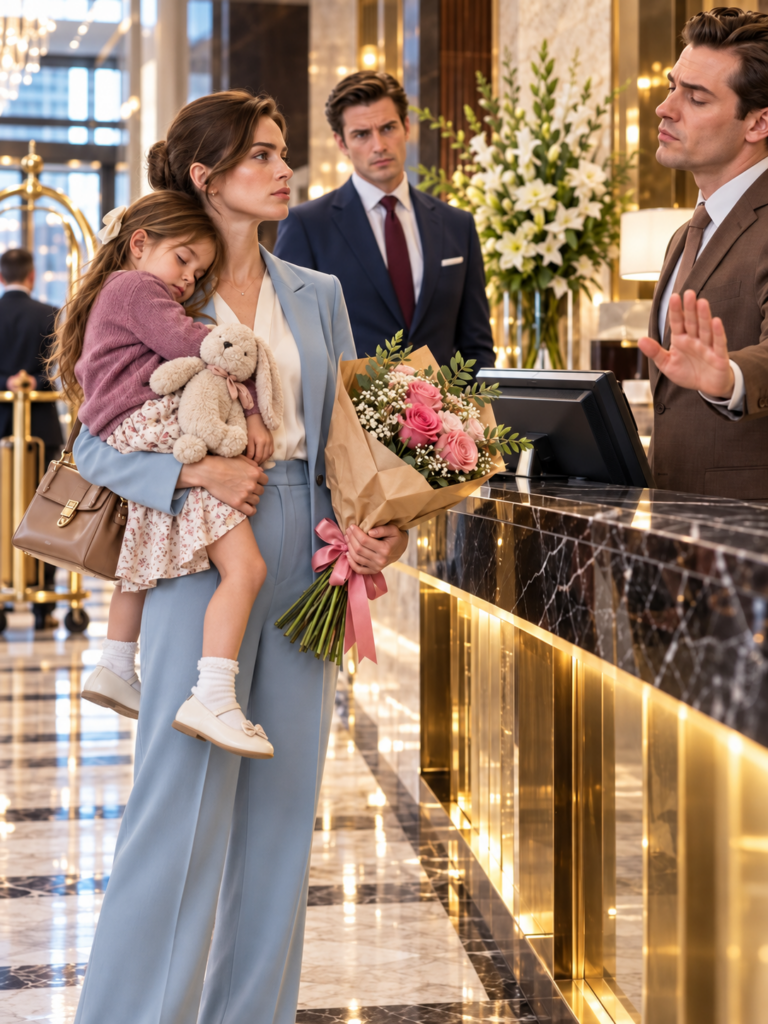
The clerk’s name was Bennett. I knew because his silver name tag caught the light every time he leaned forward to remind me that the Briarwood Grand was a luxury property.
He was perhaps thirty, with carefully combed hair, a narrow tie, and the sort of smile that never reached his eyes.
Behind him, the wall was paneled in dark walnut. A brass clock ticked above the reception desk, and fresh white orchids stood in a blue porcelain vase.
My husband had bought that vase at an estate sale in Vermont.
He had paid forty dollars for it, then spent the entire drive home boasting that it looked like something a Rockefeller would own.
I remembered laughing at him.
Now I stood beneath the same chandelier, seven years after that afternoon, listening to a stranger explain that I wasn’t suitable for the building my husband and I had spent half our marriage restoring.
“I’m not asking you to make an exception,” I said. “I’m asking you to find my reservation.”
Bennett glanced at the woman beside him.
Her name tag read SYLVIA.
She was older, perhaps in her late forties, with sharp features and immaculate makeup.
“Mrs. Hart,” she said, studying the computer, “we have no standard rooms available tonight.”
“Then it’s fortunate I didn’t reserve a standard room.”
Bennett gave a short, impatient sigh.
My son, Noah, shifted against my shoulder.
He was too big for me to carry comfortably anymore, but he had fallen asleep during the final stretch of our journey. His legs hung awkwardly against my hip, and his blue dinosaur backpack had slipped down my arm.
“Mom,” he whispered.
“I’m here, sweetheart.”
“My foot hurts.”
“I know. We’ll get you into bed soon.”
Three weeks earlier, Noah had fractured a small bone in his foot at a school playground. His doctor had cleared him to travel, but he was still wearing a walking boot.
We had spent nearly eleven hours getting from our home outside Philadelphia to Asheville, North Carolina, after a missed connection, a delayed flight, and a rental car counter that had lost our booking.
By the time we reached the Briarwood Grand, he had eaten nothing but crackers and half a turkey sandwich.
I had promised him a hot chocolate before bed.
At that moment, I would have paid a ridiculous amount of money simply to keep that promise.
“My confirmation number is right here.”
I placed my phone on the marble counter.
Bennett barely looked.
“Online confirmations can be misleading.”
“It wasn’t booked online.”
“Then perhaps you should contact whoever arranged it.”
I took a measured breath.
“The reservation was made through the company’s central office.”
Sylvia exchanged another look with him.
It was quick, but I saw it.
The kind of look adults sometimes share when they believe another person is foolish.
“Ma’am,” Bennett said, lowering his voice, “we’re hosting several important guests this weekend. There’s an international real estate summit taking place here. We cannot simply assign luxury accommodations to anyone who arrives claiming a reservation.”
“Are you suggesting I’m lying?”
“I’m explaining our policies.”
“You haven’t explained a policy. You’ve explained why you don’t believe me.”
Sylvia folded her hands.
“Perhaps everyone is tired.”
That almost made me laugh.
Everyone?
Noah had been limping through an airport on a swollen foot. I had been awake since four in the morning. Bennett had spent less than three minutes speaking to us.
Yet somehow our exhaustion had become a shared inconvenience.
I looked toward the lobby.
A man in an expensive navy suit was checking in at the adjacent counter. A bellman took his bags while another employee offered him chilled water.
Nobody asked him to prove that he belonged.
He received a room key within ninety seconds.
Bennett noticed where I was looking.
“Sir is a platinum guest,” he explained.
“And I’m a guest with a confirmation number.”
“That doesn’t necessarily mean—”
“Please,” I interrupted. “Just check the executive reservations.”
His expression tightened.
“Those accommodations are reserved for special guests.”
“I know.”
He stared.
I stared back.
There was a moment when I almost reached for my identification.
My name was Eleanor Hart.
At fifty-two, I was the chairwoman and majority owner of Hartwell Hospitality, a regional company that operated seventeen hotels across the eastern United States.
The Briarwood Grand was our flagship property.
It was also the last major project my husband, Michael, had completed before his death.
The building was more personal to me than any other asset we owned.
When we purchased it, the roof leaked, the plumbing was unreliable, and the ballroom smelled permanently of damp carpeting.
Michael had convinced me that its bones were worth saving.
“Buildings remember things,” he used to say. “Sometimes they just need somebody to believe in them again.”
We spent four years restoring it.
I selected the carpets.
Michael chose the chandeliers.
We fought over the restaurant chairs.
We nearly ran out of financing twice.
And on opening night, we stood together at the top of the grand staircase, holding hands like two frightened newlyweds.
Now I couldn’t even get a room without being judged by my coat.
But I didn’t take out my identification.
Instead, I asked, “May I have your refusal in writing?”
Bennett blinked.
“My what?”
“A written statement saying that I presented a confirmed reservation and you declined to accommodate me.”
His shoulders straightened.
“We haven’t refused you.”
“You advised me to leave.”
“I suggested alternative accommodations.”
“Because?”
“We have standards.”
There it was again.
The phrase hung between us.
Noah raised his head.
“Mom, what standards?”
Bennett looked uncomfortable for the first time.
I kissed my son’s forehead.
“It means they have rules, honey.”
“Did we break one?”
Something inside me tightened.
“No.”
“Is it because my suitcase is broken?”
His voice was so small I almost didn’t hear him.
I looked down.
One wheel of our old suitcase had snapped during the flight. I’d dragged it through the airport rather than leave it behind because Michael had bought it for our first family vacation.
Noah loved the little yellow ribbon tied around the handle.
“No, sweetheart.”
“Then why can’t we stay?”
I had no answer suitable for a seven-year-old.
Bennett cleared his throat.
“Perhaps you could continue this discussion without involving the child.”
I looked directly at him.
“He’s involved because he’s standing here.”
Before Bennett could respond, a quiet voice came from our left.
“May I get him a chair?”
A woman in a gray housekeeping uniform stood beside a luggage trolley.
Her hair was tucked beneath a patterned scarf, and she was holding a stack of fresh pillowcases.
Her name tag read ROSA.
She wasn’t looking at Bennett.
She was looking at Noah’s walking boot.
“There’s a bench by the fireplace,” she said gently. “He can sit while you get everything sorted.”
For the first time since entering the hotel, someone seemed to understand that my child was in pain.
“Thank you.”
Rosa immediately pulled the trolley aside.
She found an upholstered chair near the reception counter, brought it close enough that I wouldn’t have to leave Noah unattended, and helped me settle him into it.
“Would you like some water, young man?”
Noah nodded.
“Do you have hot chocolate?”
Rosa smiled.
“I can ask.”
Bennett’s face hardened.
“Rosa, front desk has this under control.”
She looked at him.
“Of course.”
“Then please return to your assignment.”
“Just getting the little boy settled.”
“That isn’t your department.”
Her smile disappeared.
For one brief second, I saw something in her face that disturbed me more than Bennett’s behavior.
Not surprise.
Recognition.
As though she had heard those words a hundred times.
She stepped away, but not before leaning close enough to tell Noah, “I’ll see about that hot chocolate.”
Then she disappeared through a service door.
Bennett turned back to his screen.
He entered my name again.
This time, Sylvia leaned over his shoulder.
“Try the internal account number,” she muttered.
He frowned.
“Why?”
“Just try it.”
I saw the moment the reservation appeared.
His fingers stopped moving.
Sylvia leaned closer.
The two of them stared at the monitor.
“Penthouse Twelve,” Bennett whispered.
Sylvia straightened immediately.
“Mrs. Hart, I apologize. It appears your booking was placed in a restricted account.”
“A restricted account?”
“Yes.”
“Which means?”
“Certain reservations don’t show in our ordinary system.”
I waited.
Bennett swallowed.
“You’re confirmed for the entire weekend.”
“Thank you.”
His expression changed so dramatically it would have been comical if I weren’t exhausted.
“May I arrange assistance with your luggage?”
“No.”
“Perhaps some refreshments?”
“No, thank you.”
“Mrs. Hart, we sincerely regret the confusion.”
I looked at him.
“You found the reservation after Rosa suggested helping my son.”
He glanced away.
“I’m sorry?”
“You were prepared to send us away without properly checking. Then you suddenly found it.”
His cheeks flushed.
“It was a system issue.”
I wasn’t interested in having that argument twice.
“Please prepare the keys.”
Within a minute, he handed me two cards inside a black leather sleeve.
“Penthouse Twelve. Private elevator access is included.”
Noah looked up.
“Mom, what’s a penthouse?”
“A room at the top of the building.”
His face brightened.
“Can we see the mountains?”
“I hope so.”
I picked up our suitcase.
The broken wheel scraped against the marble.
Bennett winced at the sound.
“Ma’am, we can have a bellman—”
“I have it.”
We made our way toward the elevators.
Halfway across the lobby, Rosa reappeared with a paper cup.
It had a plastic lid, and steam curled through the tiny opening.
“Hot chocolate,” she whispered.
Noah’s face lit up.
“Really?”
“Not too hot. I checked.”
She handed him the cup.
He looked at me for permission.
I nodded.
“Thank you,” he said.
Rosa crouched beside him.
“You’re welcome. Take care of that foot.”
Then she reached toward our damaged suitcase.
“Let me carry that.”
“You don’t need to.”
“I know.”
She smiled.
“That’s different from wanting to.”
I let her take it.
We rode the elevator in silence.
At the twelfth floor, the doors opened directly into a private vestibule.
The penthouse was exactly as Michael had designed it.
Cream-colored walls.
Wide oak floors.
A living room facing the Blue Ridge Mountains.
A fireplace built from locally quarried stone.
Above the mantel hung a watercolor painting of the original Briarwood Inn as it had looked in 1928.
Michael had found that painting in a dusty antique store.
He said it made the building feel as though it had a family.
Rosa placed our suitcase beside the sofa.
Then she noticed the framed photograph on the console table.
Michael stood in front of the hotel on opening night, wearing a tuxedo and smiling at the camera.
I stood beside him.
Our daughter wasn’t born yet.
Neither was Noah.
For a moment, Rosa looked confused.
Her eyes moved from the photograph to my face.
Then back again.
“Mrs. Hart?”
I nodded.
She covered her mouth.
“Oh, Lord.”
I set Noah’s drink on the table.
“Rosa, I’d appreciate it if you kept this between us tonight.”
Her face had gone pale.
“You’re Mrs. Hartwell.”
“My husband and I used Hart professionally, but yes.”
“I’ve worked here twelve years.”
“I know.”
She stared.
“I met your husband once.”
That surprised me.
“Did you?”
“At the employee Christmas breakfast. He helped wash dishes because the kitchen was short-staffed.”
I smiled.
“That sounds like Michael.”
“He asked me about my daughter. Remembered her name the next year.”
My throat tightened.
Michael could remember the names of fifty employees but never where he left his reading glasses.
Rosa glanced toward the door.
“Those people downstairs—”
“Don’t tell them.”
She looked worried.
“Are you sure?”
“Yes.”
“Mrs. Hart, if they knew—”
“That’s what concerns me.”
She understood before I finished.
Her shoulders lowered.
“I see.”
I looked toward Noah, who was sitting on the sofa carefully sipping his hot chocolate.
“Tonight, I need my son to sleep. Tomorrow, I need to understand what happened.”
Rosa nodded.
Then she hesitated.
“May I tell you something?”
“Of course.”
“Please don’t let them say it was just a misunderstanding.”
I studied her.
“Why?”
She looked toward Noah.
Then back to me.
“Because you’re not the first person they’ve tried to send away.”
The room felt suddenly colder.
“What do you mean?”
Rosa clasped her hands tightly.
“I shouldn’t have said anything.”
“Rosa.”
She shook her head.
“I have a grandson. My daughter lost her job last month. I can’t afford trouble.”
“You aren’t in trouble.”
Her eyes filled with uncertainty.
I thought of the expression she’d worn when Bennett ordered her away from the desk.
“Have you been threatened for helping guests?”
She took a breath.
“Not threatened exactly.”
“What, then?”
“Written up.”
I was silent.
“Twice,” she continued. “Once because I walked an elderly lady to her room when she was confused. Another time because I helped a family carry bags after their reservation disappeared.”
“Who disciplined you?”
She pressed her lips together.
“Management.”
I wanted to ask more.
I wanted names.
Dates.
Documents.
But Rosa was trembling, and Noah was watching us with the earnest curiosity of a child who knew something was wrong.
So I said, “Thank you for telling me.”
She nodded.
“And thank you for the hot chocolate.”
Her expression softened.
“Your little boy needed it.”
“Yes,” I said. “He did.”
After she left, I locked the door and helped Noah change into pajamas.
He insisted on keeping his dinosaur backpack beside the bed.
Inside were three things he refused to travel without: a tiny flashlight, a plastic astronaut, and Michael’s old pocket compass.
Noah had been four when his father died.
He remembered little of the illness, but he remembered the compass.
Michael used to place it in Noah’s palm and say, “Whenever you’re lost, start by figuring out where you are.”
Noah believed the compass could always lead him home.
I had never corrected him.
That evening, he lay beneath a mountain of white blankets, his walking boot resting beside the bed.
“Mom?”
“Yes?”
“Are those people downstairs angry with us?”
“No.”
“Then why were they mean?”
I sat on the mattress.
“Sometimes people look at someone and decide things without knowing anything about them.”
He considered that.
“Like when kids think Tyler’s weird because he doesn’t talk much?”
“Yes.”
“But Tyler’s nice.”
“I know.”
He frowned.
“Why didn’t you tell them this is Dad’s hotel?”
My breath caught.
It was the first time he’d called the Briarwood that.
I brushed a strand of hair away from his forehead.
“Because I wanted to see how they treated us when they didn’t know.”
He thought about that for a long moment.
“Did they fail?”
I looked into his eyes.
“Yes, honey. They did.”
He curled around the plastic astronaut.
“Rosa didn’t.”
“No.”
“She gave me chocolate.”
I smiled.
“She did.”
“And she wasn’t even the chocolate lady.”
I laughed despite myself.
“No, sweetheart. She wasn’t.”
When he fell asleep, I returned to the living room.
I stood before Michael’s photograph.
The night of the grand opening came back with painful clarity.
He’d been nervous about the guest list.
We’d borrowed money from three banks. We’d mortgaged our house. We’d argued for months about whether the project was too ambitious.
Then the first guests arrived.
Michael stood in the lobby greeting everyone personally.
A wealthy investor came through the doors carrying an expensive leather briefcase.
Five minutes later, a tired couple arrived wearing muddy hiking boots.
Michael welcomed them exactly the same way.
Later, he told me something I’d never forgotten.
“Ellie, if we ever become the kind of people who judge guests by their luggage, sell the place.”
I sat down.
My phone showed several missed messages from our chief operating officer, Adrian Price.
He had known I was coming to Asheville.
He’d arranged the reservation.
But the hotel’s general manager, Charles Whitcomb, wasn’t expecting me until Sunday afternoon.
I had deliberately arrived Friday evening.
Surprise visits had become part of my routine after Michael died.
Scheduled inspections were too easy to prepare for.
Employees behaved differently when they knew the owner was coming.
I wanted to see the hotel on an ordinary night.
Now I had.
I sent Adrian a message.
I’m here. Do not alert Charles. I need six months of front-desk complaints, guest relocation records, and employee disciplinary reports sent to my secure account.
His response arrived almost immediately.
Is something wrong?
I looked toward Noah’s bedroom.
Yes.
Then I added:
And please preserve all lobby surveillance footage from tonight.
I put down the phone.
For several minutes, I watched the mountains beyond the windows.
The hotel looked beautiful from up here.
The grounds were lit.
The fountain glowed beneath its stone archway.
Everything appeared peaceful.
But I kept hearing Rosa.
You’re not the first person they’ve tried to send away.
At 11:43 p.m., another message arrived from Adrian.
Eleanor, I found something concerning in the relocation reports. Call me before you speak to Charles.
I called immediately.
He answered on the first ring.
“Tell me,” I said.
There was a pause.
“Eleanor, over the past five months, the Briarwood has reported forty-three voluntary guest relocations.”
I frowned.
“Forty-three?”
“Yes.”
“That seems high, but we’ve had several large conferences.”
“That’s what I thought.”
I heard him turn a page.
“Then I noticed something else.”
“What?”
“Thirty-one of those guests had confirmed reservations.”
I sat forward.
“Why would confirmed guests voluntarily relocate?”
“According to the hotel records, they requested less expensive accommodations.”
I remembered Bennett suggesting a roadside motel.
My stomach tightened.
“Adrian.”
“Yes?”
“Who approved the relocations?”
Another pause.
“Charles Whitcomb.”
I stared across the dark living room.
“Every one?”
“Every one.”
“And did we refund the differences?”
“That,” Adrian said, “is the part I can’t explain.”
He paused again.
“Because according to the accounting system, the Briarwood collected full payment for twenty-seven of those reservations.”
I looked toward Michael’s photograph.
The humiliation in the lobby had been personal.
This was something else.
“Send me everything,” I said.
Then I opened my laptop and began reading.
By two in the morning, I had found a guest’s name that made my hands go cold.
A widow named Margaret Bell.
Seventy-four years old.
She had paid for three nights at the Briarwood to celebrate what would have been her fiftieth wedding anniversary.
According to the hotel’s report, Margaret had voluntarily moved to a roadside inn after requesting a cheaper room.
But attached to the accounting file was a handwritten complaint.
Only four sentences.
I had a reservation. I was told my room wasn’t available because I wasn’t dressed appropriately for the weekend’s guests. I had already paid in full. I do not understand why I was treated like this.
Beneath the complaint, someone had written:
Resolved. Guest declined further assistance.
There was no refund.
I read the note twice.
Then I noticed the date.
It was the same weekend the Briarwood had hosted a wedding for one of its wealthiest clients.
The same weekend Charles had reported record revenue.
I closed the laptop and stared into the darkness.
Somebody hadn’t merely failed to find reservations.
Somebody had learned how to turn other people’s humiliation into profit.
And tomorrow morning, I intended to find out who.
Part 2
At seven the next morning, I found Noah sitting at the dining table with his father’s compass.
He had arranged three blueberries beside his breakfast plate.
“Look, Mom,” he said. “Three mountains.”
I kissed the top of his head.
“Very impressive.”
He pointed toward the windows.
“Which one is Dad’s favorite?”
I looked outside.
The Blue Ridge Mountains stretched beneath a thin veil of morning fog.
Michael had loved these mountains.
He used to say they made even the busiest person feel small in a good way.
“The one with the clouds around it,” I said.
Noah smiled.
“I think that’s mine too.”
I made him scrambled eggs and toast.
At eight-thirty, our longtime family friend, Caroline Marsh, arrived from the nearby house where she was staying with her sister.
Caroline was sixty-one, a retired school principal, and one of the few people Noah trusted completely.
She greeted him with a small model airplane and immediately lost fifteen minutes listening to his explanation of how jet engines worked.
When I told her I needed to examine a problem downstairs, she studied my face.
“How serious?”
“I don’t know yet.”
“That usually means very.”
I managed a smile.
“Stay with Noah. Don’t let him put weight on that foot without the boot.”
She waved me away.
“I raised three boys, Eleanor. I can manage one injured astronaut.”
I changed into the same faded coat I’d worn the previous night.
Then I took the elevator downstairs.
Bennett was behind reception.
So was Sylvia.
When they saw me, neither smiled.
That told me something.
Last night, they had found my reservation and assumed the matter was finished.
I approached the desk.
“Good morning.”
Bennett straightened.
“Mrs. Hart. I trust the penthouse was satisfactory.”
“It was comfortable.”
“Excellent.”
“I’d like to speak with your general manager.”
His smile faltered.
“Mr. Whitcomb is preparing for today’s conference.”
“Please tell him a guest would like to discuss a serious complaint.”
He glanced at Sylvia.
“Perhaps I can assist.”
“I’d prefer to speak with him.”
Sylvia stepped closer.
“Mrs. Hart, your reservation problem was corrected last night. We have no reason to believe further discussion is necessary.”
I looked at her.
“Is that how guest complaints are handled here?”
She seemed startled.
“Of course not.”
“Then why are you attempting to close mine before I’ve explained it?”
Bennett cleared his throat.
“There was a technical error.”
I nodded slowly.
“And was there a technical error when you said I didn’t meet the hotel’s standards?”
His face reddened.
“I didn’t mean it that way.”
“What way did you mean?”
He didn’t answer.
Sylvia leaned forward.
“Ma’am, you’re making a rather serious accusation.”
“I’m asking a question.”
“Your manner suggests otherwise.”
I held her gaze.
For a moment, I could understand why some guests might surrender.
Not because they were wrong.
Because they were tired.
Because they had children waiting.
Because standing in a beautiful lobby while well-dressed employees implied that you were dishonest could wear down anyone’s confidence.
I thought of Margaret Bell.
Seventy-four years old.
Alone on a wedding anniversary.
How long had she stood here before giving up?
A man’s voice interrupted my thoughts.
“Is there a problem?”
Charles Whitcomb approached from the direction of the ballroom.
He was fifty-eight, tall, broad-shouldered, and wearing an expensive charcoal suit.
His gray hair was neatly parted.
A diamond-patterned tie completed the appearance of an experienced executive.
I knew him well enough to recognize his confident walk.
He had managed the Briarwood for almost four years.
Our meetings had always been cordial.
He remembered my preferred coffee.
Sent flowers on the anniversary of Michael’s death.
Complimented Noah’s school photographs.
But now he looked at me without recognition.
He had never seen me in old jeans, an inexpensive sweater, and a coat with a loose button.
Bennett looked relieved.
“Mr. Whitcomb, this guest is dissatisfied with a reservation issue from last night.”
Charles glanced at me.
“Good morning, ma’am.”
“Good morning.”
“I understand there was some confusion.”
“There was.”
“I’m pleased to hear you’ve been accommodated.”
“I haven’t told you whether I’m pleased.”
His smile thinned.
“Of course.”
“May I ask why employees here direct guests with confirmed reservations to less expensive hotels?”
Charles tilted his head.
“That doesn’t sound like our policy.”
“It happened to me.”
“I’m sure there was a misunderstanding.”
“Then I’d like to understand it.”
He glanced at the nearby conference guests.
Several were watching.
Charles lowered his voice.
“We are an exceptionally busy property. Sometimes guests misunderstand what their bookings include.”
“My booking was confirmed.”
“And you received your room.”
“Only after being told to leave.”
His expression became firmer.
“With respect, Mrs. Hart, I cannot conduct a lengthy investigation into every uncomfortable exchange at reception.”
There it was.
Every uncomfortable exchange.
As though a guest being turned away were an unfortunate conversation rather than a failure of hospitality.
I reached into my coat.
Charles watched impatiently.
I placed my corporate identification on the counter.
He looked at it.
His smile disappeared.
His eyes moved toward my face.
Then back to the card.
“Eleanor?”
“Good morning, Charles.”
Bennett leaned forward.
Sylvia went perfectly still.
For several seconds, the only sound came from the fountain near the entrance.
Charles swallowed.
“I didn’t recognize you.”
“I know.”
“Why didn’t you tell us?”
I looked at him.
“Would it have changed the way you treated me?”
“Of course.”
He realized his mistake almost immediately.
I saw it in his face.
“Eleanor, that’s not what I meant.”
“Then what did you mean?”
He glanced toward Bennett.
Then Sylvia.
Then the other guests.
“We should speak privately.”
“That’s the first sensible suggestion anyone at this desk has made.”
His jaw tightened.
I picked up my identification.
“Before we go, one thing.”
“Yes?”
“I want Rosa Alvarez protected from retaliation.”
Sylvia’s eyes flickered.
Charles frowned.
“Rosa?”
“She helped my son last night.”
“Ah.”
He looked toward the service corridor.
“I’m afraid Rosa has had some difficulty understanding department boundaries.”
I stared at him.
“Department boundaries?”
Charles seemed to realize another explanation was required.
“Our employees have specific responsibilities.”
“And helping an injured child isn’t one of them?”
“Naturally, guests should receive assistance. But we cannot have housekeeping employees abandoning their work whenever—”
“Whenever what?”
He stopped.
I waited.
“Whenever someone needs help?”
The silence spread.
Charles looked down.
“Let’s go to my office.”
His office overlooked the garden.
Michael had once used that room as a temporary workshop while supervising renovations.
Now it contained leather furniture, framed performance awards, and a wall of financial charts.
Charles closed the door.
“Eleanor, I am deeply embarrassed.”
“I imagine you are.”
“I wish you’d called me last night.”
“Why?”
“So I could have handled the matter.”
“That would have fixed my immediate problem.”
“Exactly.”
“It wouldn’t have shown me the larger one.”
He looked puzzled.
I sat down.
“Charles, tell me about your relocation program.”
His shoulders stiffened.
“What about it?”
“Forty-three guests moved to other accommodations in five months.”
His expression became cautious.
“We’ve been managing a high-demand season.”
“Thirty-one had confirmed reservations.”
“Sometimes inventory must be adjusted.”
“Twenty-seven paid the full Briarwood rate.”
He leaned back.
“Eleanor, hospitality accounting can be complicated.”
“So explain it.”
He rubbed his chin.
“Some guests agree to alternative accommodations as part of service recovery arrangements.”
“Do they receive refunds?”
“Depending on the circumstances.”
“What circumstances would justify charging someone for a luxury room and sending them to a motel?”
His face changed.
Not much.
But enough.
“I’m not sure where you’re getting your information.”
“From our own records.”
He stared at me.
Then his gaze moved toward the computer on his desk.
“Have you spoken with Adrian?”
“Why?”
“No reason.”
I let the question remain unanswered.
Then I placed a printed copy of Margaret Bell’s complaint on his desk.
“Tell me about this guest.”
He barely glanced at the paper.
“I don’t remember every individual complaint.”
“Then read it.”
He read.
His jaw shifted.
“That was handled by guest services.”
“Who authorized the relocation?”
He hesitated.
“I would need to check.”
“Your electronic signature is on the form.”
His eyes narrowed.
“Eleanor, are you accusing me of something?”
“I’m giving you an opportunity to explain.”
For the first time, Charles looked angry.
“After everything I’ve done for this property?”
I leaned back.
“What have you done?”
“I brought the Briarwood back to profitability after the pandemic. Increased conference bookings. Improved our operating margin. This hotel is one of the strongest performers in the group.”
“All true.”
“And this is how I’m treated?”
I thought about Noah, asking whether his broken suitcase had caused our trouble.
“Charles, yesterday my son asked whether we’d broken a rule because we didn’t look like the other guests.”
Charles looked away.
“He’s seven years old.”
“I understand.”
“No, I don’t believe you do.”
I stood.
“I’m initiating an independent review of guest relocations, billing adjustments, and employee discipline. All relevant records must be preserved.”
He rose as well.
“An independent review?”
“Yes.”
“Eleanor, this could damage the hotel’s reputation.”
I walked toward the door.
“Then we should have considered that before damaging our guests.”
I found Rosa in a service corridor behind the breakfast room.
She was pushing a cart stacked with fresh towels.
When she saw me, her eyes widened.
“Mrs. Hart.”
“Do you have a few minutes?”
She glanced toward a clock.
“My shift supervisor—”
“I’ve arranged for your work to be covered.”
She looked immediately worried.
“Am I being questioned?”
“I’d like to hear what you know.”
We sat in a small meeting room.
I brought coffee.
She declined it, then changed her mind.
For several minutes, she turned the paper cup between her hands.
Finally, I asked about the disciplinary warnings.
Rosa sighed.
“The first one was last November.”
“What happened?”
“An older gentleman came out of the elevator confused. His wife had gone to the hospital earlier that morning, and he couldn’t remember which room they’d been staying in.”
“What did you do?”
“I took him downstairs. Helped reception find his information. Called his daughter.”
“That sounds appropriate.”
“I thought so.”
“Why were you disciplined?”
“My supervisor said I left my assigned rooms for forty minutes.”
“Forty minutes?”
“He was frightened.”
Her voice grew quieter.
“I wasn’t going to leave him standing in the hallway.”
I asked about the second warning.
She looked down.
“A family came in from Kentucky. Mother, father, two children. Their oldest daughter was using crutches.”
My chest tightened.
“They had reserved two rooms,” Rosa continued. “Reception said one reservation couldn’t be located. The father got upset because they’d already paid.”
“Who was working?”
“Bennett.”
I wrote the name down.
“What happened?”
“The manager on duty told them to find another hotel.”
“Did you intervene?”
“I told them I knew a place nearby that had family rooms. Then I called to make sure they had space.”
“Why were you disciplined for that?”
Rosa gave a tired smile.
“Because I told the guests they should keep their receipt.”
I looked up.
“What?”
“I said if they paid for a room here, they needed proof of what happened before leaving.”
“Did Bennett hear you?”
“Yes.”
“Did he report you?”
“I think so.”
I sat back.
“And you’ve continued helping guests anyway.”
She shrugged.
“My mother cleaned hospital rooms for twenty-six years. She used to tell me that the people nobody notices are often the only ones paying attention.”
She looked at me.
“I’ve tried to remember that.”
I studied the woman across the table.
Her uniform was clean but faded. Her hands were rough from years of work. There was a tiny silver cross at her throat.
“Rosa, have you ever seen a guest relocated after being told no room was available, only to have another guest placed in that room?”
She didn’t answer immediately.
Then she whispered, “Yes.”
“How often?”
“I don’t know.”
“More than once?”
She nodded.
“Who usually received the rooms?”
She hesitated.
“Wedding guests. Conference people. Some very important families.”
I remembered the wealthy investor checking in without difficulty.
“And who was sent away?”
Rosa rubbed her thumb along the edge of her coffee cup.
“People traveling alone. Older people. Families who didn’t argue. Guests who looked like they wouldn’t know whom to call.”
My stomach turned.
“Did you report it?”
“Twice.”
“To Charles?”
“Through my supervisor.”
“What happened?”
“He said front-desk decisions weren’t my business.”
I took a slow breath.
“Rosa, I need you to understand something. You did the right thing.”
Tears filled her eyes.
She quickly looked away.
“That’s very nice of you.”
“No. It’s not a compliment. It’s a fact.”
She wiped one eye with the back of her hand.
“Sometimes I wondered.”
I reached across the table.
“Don’t wonder anymore.”
By lunchtime, Adrian had assembled a review team from corporate operations and outside accounting advisers.
We didn’t announce the full scope of the review.
We quietly preserved the records first.
Then we compared room inventory, guest invoices, relocation vouchers, employee logins, and conference booking agreements.
The first findings were disturbing.
The Briarwood had an arrangement with a nearby motel called the Pine Hollow Lodge.
During busy weekends, the hotel could transfer consenting guests there under a clearly defined overflow agreement.
It was a legitimate business practice when properly disclosed and approved.
But the agreement required the Briarwood to refund or adjust the guest’s payment and cover any difference in service value.
That had not consistently happened.
Several guests had paid luxury rates while receiving budget accommodations.
In other cases, the supposedly unavailable Briarwood rooms had been reassigned to last-minute conference clients at premium prices.
The hotel had earned money twice from rooms that could be occupied only once.
I called Adrian.
“How could our financial controls miss this?”
“We trusted the property-level reconciliation reports.”
“Who prepared them?”
“Charles’s finance manager.”
“Who signed them?”
“Charles.”
There was a long silence.
Then Adrian said, “Eleanor, I need to tell you something else.”
“What?”
“Last quarter, Charles received a large performance bonus.”
“I know.”
“Part of it was calculated using premium-room revenue.”
I shut my eyes.
A record-setting quarter.
A generous bonus.
Guests sent away.
The pieces were beginning to fit.
But I remembered Michael’s advice from years ago.
Never confuse a convincing theory with proof.
So I told Adrian, “We verify every transaction. No accusations until we know exactly what happened.”
That afternoon, I called Margaret Bell.
She answered after five rings.
“Hello?”
“Mrs. Bell? My name is Eleanor Hart. I’m calling from Hartwell Hospitality.”
A pause.
“Is this about the hotel?”
“Yes.”
“I already told your people what happened.”
“I know. I read your letter.”
Silence.
Then she said, “I’m seventy-four years old, Mrs. Hart. I don’t enjoy making trouble.”
“You weren’t making trouble.”
“Well, that’s how they made me feel.”
I let her continue.
“My husband, Arthur, and I used to stay at the Briarwood every October. For thirty-eight years.”
I glanced toward Michael’s photograph on my phone.
“He loved that hotel,” she said. “We couldn’t afford it when we were young, but later on we’d save all year for our anniversary.”
“What happened when you arrived?”
“The young man at the desk said my room wasn’t available. I showed him the confirmation, but he said there was nothing he could do.”
“Did he offer to find another room?”
“He offered the Pine Hollow place.”
“Did anyone explain the price difference?”
“No.”
“Did anyone offer a refund?”
Her voice grew thinner.
“No, dear.”
I heard a faint clatter, as though she’d put down a cup.
“Mrs. Hart, can I tell you the part that hurt?”
“Of course.”
“I was wearing Arthur’s old raincoat. It was too large for me, but it was cold, and I liked having something of his around my shoulders.”
She paused.
“The young man looked at it and asked whether I understood what kind of hotel the Briarwood was.”
I closed my eyes.
“I told him my husband and I had stayed there every year. He said the hotel was under new management and its clientele had changed.”
Her voice cracked.
“I felt so foolish standing there with my suitcase.”
I couldn’t speak.
“I went to the motel,” she continued. “It smelled like cigarette smoke. The television didn’t work. I sat on the bed and cried.”
A long silence followed.
Then she added, “Arthur would have been so angry.”
I swallowed.
“My husband helped restore that hotel, Mrs. Bell.”
“Oh?”
“He believed every guest deserved to feel welcome.”
“He sounds like a good man.”
“He was.”
“Is he still living?”
“No. I lost him three years ago.”
Her voice softened.
“Then you understand.”
“Yes,” I whispered. “I do.”
We spoke for another twenty minutes.
Before hanging up, I promised that we would investigate her complaint, correct any improper charges, and contact her with a clear explanation.
I didn’t promise an outcome I couldn’t yet deliver.
But I promised she would not be ignored again.
When the call ended, I sat alone for a while.
Then I went upstairs.
Noah was building a cardboard airport terminal with Caroline.
He greeted me enthusiastically.
“Mom! The planes have to stop because there’s a thunderstorm.”
Caroline looked at me.
Her smile faded.
“Everything all right?”
“Not really.”
She gave Noah another cardboard box and followed me into the kitchen.
I told her about Margaret.
About the relocations.
About Charles.
Caroline listened without interrupting.
Then she asked, “What are you going to do?”
“Find the truth.”
“And after that?”
I leaned against the counter.
“I don’t know.”
She studied me.
“That’s not like you.”
I looked toward the living room, where Noah was making airplane noises.
“Michael would’ve known what to do.”
Caroline’s expression softened.
“Michael would have listened to you talk it through. Then he’d have told you to make your own decision.”
I laughed sadly.
“He probably would’ve made coffee first.”
“And burned the toast.”
I smiled.
Michael had been a terrible cook.
He could negotiate construction contracts worth millions but couldn’t boil an egg without creating a mess.
Caroline touched my arm.
“Eleanor, you don’t have to become him to honor him.”
I looked down.
“Sometimes I feel as though I’m losing the parts of this company he loved.”
“Then protect those parts.”
Her voice was gentle but firm.
“That’s something you can still do.”
At four o’clock, Adrian called again.
His tone was different.
“Eleanor, I think we found the person who authorized the billing adjustments.”
“Charles?”
“Not directly.”
I frowned.
“Who?”
“His finance manager. Martin Kessler.”
I knew Martin.
Quiet, organized, rarely spoke during corporate meetings.
He had joined the Briarwood eighteen months earlier.
“What did he do?”
“According to the system logs, he processed most of the questionable charges.”
“Did Charles approve them?”
“His authorization appears on the records.”
“Then why are you hesitant?”
“Because we found an internal message from Martin asking Charles to stop the relocation adjustments.”
I sat upright.
“What?”
“The message was sent in May. Martin questioned three guest bills and said the process might violate company policy.”
“What did Charles say?”
“Nothing in writing.”
I stared at the wall.
So Martin might not have been the architect.
He might have been trying to stop it.
“Where is he now?”
“At home. His mother had surgery this week.”
“Have someone arrange a confidential interview.”
“Already done.”
“And Adrian?”
“Yes?”
“I want the original records. Not summaries.”
“Understood.”
By six, we had another surprise.
Martin had kept copies of several emails because he was concerned that management might later blame him for the charges.
One message from Charles contained a sentence that changed the direction of the investigation.
Priority inventory must remain available for summit partners and premium clients. If ordinary reservations interfere with those commitments, use the overflow process.
Ordinary reservations.
I read the words slowly.
The guests who had paid, planned, traveled, and trusted us were described as obstacles.
But the next email was worse.
It had been sent two weeks before my visit.
Corporate is reviewing guest-retention performance this quarter. We need clean complaint numbers. Resolve issues locally whenever possible and avoid unnecessary escalation.
Charles had sent it to Bennett, Sylvia, Martin, and three department heads.
I looked at the date.
Then I looked again.
That email had been sent the day after Adrian notified Charles about my planned Sunday inspection.
A chill moved through me.
He hadn’t simply failed to address a problem.
He had known scrutiny was coming.
And he’d instructed his managers to keep complaints out of sight.
I called Adrian.
“We need to speak to Charles immediately.”
“Tomorrow morning?”
“Tonight.”
At seven-thirty, Charles arrived in a private conference room overlooking the ballroom.
Adrian joined by video.
An outside investigator attended remotely, and a corporate HR representative sat beside me.
Charles entered looking irritated.
“I was told this couldn’t wait.”
“It can’t.”
He sat.
I placed copies of the emails in front of him.
“Can you explain these?”
He glanced at them.
His expression hardened.
“Internal operational communications.”
“Yes.”
“Taken out of context.”
“Then provide the context.”
He picked up the first email.
“We had obligations to high-spending conference partners.”
“And obligations to guests with confirmed bookings?”
“Of course.”
“Which obligation took priority?”
He looked at me.
“Eleanor, you know how this business works.”
“I know how I intended this business to work.”
His voice grew sharp.
“Intentions don’t pay payroll.”
The HR representative shifted in her chair.
I remained still.
“Did you authorize confirmed reservations to be moved without proper compensation?”
Charles hesitated.
“Certain adjustments were necessary.”
“That wasn’t my question.”
He looked toward Adrian’s image.
“Adrian, perhaps you could explain to Eleanor the pressures this property has faced.”
Adrian’s expression didn’t change.
“I think Eleanor understands the financial pressures perfectly.”
Charles looked back at me.
“Then you know difficult decisions have to be made.”
“By whom?”
“Management.”
“And documented how?”
His mouth tightened.
I continued.
“Did you instruct staff to record forced relocations as voluntary?”
“No.”
“Did you know that was happening?”
“I knew accommodations were being adjusted.”
“Were you aware guests were paying for rooms they never occupied?”
Silence.
“Charles.”
His hands tightened around the papers.
“I was told finance would reconcile the differences.”
“Who told you?”
He glanced toward the door.
“Martin.”
I felt a flash of anger.
Not because Martin was necessarily innocent.
Because Charles had reached for another person’s name so quickly.
I placed Martin’s May email beside the others.
“Then why did Martin warn you to stop?”
Charles stared at it.
For the first time, he looked genuinely alarmed.
“I’d have to review the full correspondence.”
“You can.”
I slid another page forward.
Martin had written:
I cannot continue coding these relocations as voluntary when guests are being denied confirmed rooms. I need written authorization for any further adjustments.
Charles’s reply had been short.
Follow established property procedure. This discussion is closed.
Nobody spoke.
Finally, Charles set down the papers.
“This is ridiculous.”
I waited.
“You’re turning a few operational mistakes into a scandal.”
“Twenty-seven guests were charged for accommodations they didn’t receive.”
“I didn’t personally handle those reservations.”
“You authorized the program.”
He stood abruptly.
“I’ve given this company four years of my life!”
I looked up at him.
“And those guests gave us their trust.”
He opened his mouth.
Then closed it.
For one moment, I thought he might finally acknowledge the harm.
Instead, he reached into his briefcase.
He placed a folded document on the table.
“Before you take this any further,” he said, “you need to read something.”
I unfolded it.
It was a copy of an internal performance directive.
The letterhead belonged to Hartwell Hospitality.
My company.
The document established aggressive revenue targets for flagship properties and instructed managers to prioritize premium accounts during high-demand periods.
At the bottom was an electronic approval.
ELEANOR HART.
Chairwoman.
My stomach dropped.
I recognized the directive.
I’d approved it eight months earlier during a companywide financial review.
But I’d never understood how Charles had interpreted it.
He pointed to the page.
“You told us to maximize premium-room utilization. You told us major accounts took priority. You approved our quarterly targets.”
I looked at him.
“Those instructions never authorized denying confirmed reservations.”
“They created the pressure.”
His voice was cold.
“And I did what was necessary to meet your expectations.”
Adrian spoke through the screen.
“Charles, the directive does not permit improper billing.”
Charles ignored him.
He leaned toward me.
“If you want this investigated publicly, go ahead. But the board will see that this happened under policies you approved.”
I looked down at my own signature.
For a moment, the room felt unbearably quiet.
Because beneath his evasions and excuses, Charles had touched something I could not dismiss.
I had approved the targets.
I had praised the revenue reports.
I had congratulated him when the Briarwood exceeded expectations.
And I had accepted the beautiful quarterly numbers without asking enough questions about the people behind them.
Charles had made his choices.
But I’d helped build a system in which the wrong achievements received applause.
I folded the directive.
“You’re right about one thing,” I said.
He straightened.
“What?”
“I have responsibility here too.”
He seemed relieved.
Then I continued.
“That doesn’t erase yours.”
His face hardened again.
I looked toward our HR representative.
“Charles is being placed on administrative leave pending the conclusion of the investigation. His access to financial and reservation systems is suspended immediately.”
He stared.
“You can’t seriously—”
“I can.”
He turned toward Adrian.
“Tell her what this will do to the conference contracts!”
Adrian said nothing.
Charles gathered his papers.
At the door, he stopped.
“You’ll regret making this personal.”
I looked at him.
“You made it personal for every guest you decided didn’t matter.”
He left.
For several seconds, nobody spoke.
Then Adrian said quietly, “Eleanor, are you all right?”
I looked down at the directive with my signature.
“No,” I answered.
And for the first time since arriving, I wasn’t certain that removing Charles would be enough to repair what had happened.
Part 3
I slept badly that night.
At three in the morning, I stood barefoot in the penthouse living room, holding Michael’s photograph.
The city lights flickered below the mountain ridges. Somewhere downstairs, a delivery truck backed toward the kitchen entrance, its warning signal faint through the glass.
I remembered the night Michael and I signed the final construction loan.
We had been sitting at our kitchen table surrounded by paperwork.
I was terrified.
He was excited.
“What if we fail?” I asked.
He thought about it.
“Then we’ll find out what we did wrong.”
“And if we succeed?”
He smiled.
“Same answer.”
I used to think that was an annoying habit of his.
Now I understood.
He never wanted success to make us stop asking questions.
I had stopped.
Not completely, perhaps.
But enough.
The Briarwood had become profitable, and I’d trusted profitability to mean health.
Our guest satisfaction surveys looked good.
Our occupancy was strong.
Our employee productivity numbers were improving.
But complaints were being buried.
Workers were being punished for showing kindness.
And some guests had been treated as inconvenient obstacles rather than human beings.
I placed Michael’s photograph back on the table.
Then I opened my laptop.
At the top of a blank page, I typed:
What did we reward?
Underneath, I wrote another question.
What did we fail to notice?
I worked until sunrise.
Not on a speech.
Not on a plan to humiliate Charles.
On a list of things that needed to change.
By eight, I had made three decisions.
The questionable guest transactions would be reviewed individually, and every improper charge would be corrected with appropriate compensation.
The investigation would be conducted independently, including a review of corporate oversight and my own decisions.
And no employee who had raised concerns in good faith would be punished for telling the truth.
I knew those decisions wouldn’t solve everything.
But they were a beginning.
At breakfast, Noah noticed the dark circles beneath my eyes.
“Mom, did you sleep?”
“A little.”
He pushed a piece of toast toward me.
“You should eat.”
I smiled.
“Are you taking care of me now?”
He nodded seriously.
“Dad said people get grumpy when they’re hungry.”
I froze.
“Do you remember him saying that?”
“Yep.”
“When?”
Noah shrugged.
“When we went fishing.”
Michael had taken Noah fishing exactly twice.
Once at a small pond near our home.
Once at a lake in Pennsylvania.
On the second trip, they caught nothing except a discarded plastic bag.
Michael called it a rare aquatic specimen.
Noah had laughed for days.
I sat beside him.
“What else do you remember?”
He thought carefully.
“Dad said fish don’t care if you’re rich.”
I laughed.
“That sounds exactly like your father.”
Noah grinned.
“He said they only care if you’re a worm.”
I laughed harder.
For a moment, the exhaustion disappeared.
Then Noah touched my hand.
“Mom?”
“Yes?”
“Are we leaving today?”
“Tomorrow, probably.”
He looked down.
“Good.”
“Why?”
“I don’t like downstairs.”
My smile faded.
I put my arm around him.
“I’m sorry.”
He leaned against me.
“Rosa’s nice, though.”
“Yes.”
“She said good morning when she saw me yesterday.”
I kissed his head.
“She has a very good heart.”
He nodded.
Then, with the simple certainty children sometimes possess, he said, “Maybe she should be in charge of saying hello.”
I looked at him.
For a moment, I couldn’t speak.
Then I smiled.
“Maybe she should.”
By ten o’clock, the corporate review team had begun interviewing employees.
Charles remained on leave.
Bennett and Sylvia had been removed from guest-facing duties pending separate investigations.
I made a point of not directing the outcome of those reviews.
What happened to me mattered.
But my ownership of the hotel could not become a reason to ignore fair procedures.
Bennett’s employment history revealed three previous complaints.
Two involved guests whose reservations he had dismissed without checking alternative booking systems.
The third involved an elderly man he had refused to assist with luggage because the man wasn’t staying in a premium room.
All three complaints had been closed locally.
None had reached corporate HR.
Sylvia’s records were more troubling in a different way.
She had been responsible for reviewing front-desk incidents.
Several complaints had been recategorized under vague descriptions such as “guest confusion” or “reservation misunderstanding.”
During her interview, she admitted that Charles had pressured supervisors to keep formal complaint numbers low.
But she also acknowledged that she’d sometimes changed classifications without being directly instructed to do so.
“Why?” the investigator asked.
According to the interview notes, Sylvia had answered:
“Because that’s what a successful department was supposed to look like.”
I stared at that sentence for a long time.
A successful department.
Not one that treated guests well.
One whose reports looked clean.
Martin Kessler, the finance manager, provided copies of his earlier objections. Investigators found that he had continued processing some disputed transactions after his warning, making his own role more complicated than his emails initially suggested.
He told the investigators that he feared losing his job.
I understood the fear.
I didn’t accept it as a complete excuse.
The review would examine his decisions alongside those of everyone else involved.
I was learning that truth rarely arrived in perfectly arranged categories.
There were people who acted selfishly.
People who followed instructions without questioning them.
People who recognized problems but chose silence.
And people like Rosa, who risked their own security to help someone they barely knew.
The harder question was what kind of workplace encouraged each choice.
On Monday morning, I called an emergency meeting with Hartwell Hospitality’s senior leadership.
The discussion lasted nearly three hours.
Some executives wanted Charles dismissed immediately.
Others worried about lawsuits, damaging publicity, and possible contract cancellations.
One director suggested we compensate affected guests quietly and avoid attracting unnecessary attention.
I listened.
Then I asked him, “What would quiet compensation change?”
He hesitated.
“We’d make the guests financially whole.”
“And the next guest?”
“We’d strengthen procedures.”
“Would we tell them what happened?”
He looked uncomfortable.
“Not necessarily.”
I leaned forward.
“Then we’d be doing exactly what Charles did. Paying for silence instead of understanding the problem.”
Nobody answered.
I continued.
“We have seventeen hotels. I don’t know whether these practices exist elsewhere. Neither do you. That’s why we need an independent examination.”
Adrian nodded.
“We can begin with a risk-based review across the group.”
“Do it.”
I looked around the conference screen.
“And I want the board to review the performance targets I approved. Not just Charles’s decisions. Mine.”
Our general counsel looked surprised.
“Eleanor, that creates additional scrutiny.”
“It should.”
A silence followed.
Then the oldest member of our board, Henry Wallace, spoke.
Henry had known Michael before we acquired our first hotel.
He was seventy-three, slow to speak, and rarely impressed by corporate language.
“Your husband used to say a company tells employees what matters by what it pays them to do.”
I smiled sadly.
“He did.”
Henry leaned toward his camera.
“Well, Eleanor, perhaps we’ve been paying people to do the wrong things.”
That ended the argument.
By Wednesday, the investigators had interviewed twenty-six employees and contacted nineteen affected guests.
The evidence established a consistent pattern.
During high-demand weekends, certain confirmed guests had been redirected to the Pine Hollow Lodge or other nearby properties without adequate disclosure or required compensation.
The rooms they had reserved were sometimes resold at higher rates.
Charles had approved the operating practices and benefited from performance measures inflated by the resulting revenue.
Martin had processed improper accounting adjustments despite raising objections.
Sylvia had suppressed or reclassified complaints.
Bennett had repeatedly failed to verify reservations and had treated guests dismissively based on assumptions about their status.
But the most painful finding concerned the staff.
Nine employees said they believed helping an upset guest outside their assigned department could harm their performance evaluation.
Six said they had stopped reporting certain service problems because previous concerns had gone nowhere.
And four described occasions when guests were treated differently based on clothing, accent, age, or perceived wealth.
Four employees.
Four separate statements.
I wondered how many others had seen the same things but remained afraid to speak.
One investigator said something I wrote in my notebook.
“The staff learned that avoiding a complaint was more important than preventing its cause.”
That sentence explained almost everything.
At the conclusion of the investigation, Charles’s employment was terminated for serious policy violations and failures of management oversight.
The company referred the financial findings to outside counsel and appropriate professionals to determine whether further reporting or legal action was required.
Martin’s employment also ended following review of his involvement in improper transactions. His earlier warnings were documented, but they did not erase his later decisions.
Sylvia was removed from her supervisory position and ultimately separated from the company after the investigation established her repeated concealment of guest complaints.
Bennett was dismissed because of the documented pattern of misconduct and previous corrective action that had failed to change his behavior.
I did not feel triumphant.
Four people had lost their jobs.
Some had families.
Some had mortgages.
Some might sincerely regret what they’d done.
I hoped they learned from it.
But regret did not restore the dignity of the guests who had been mistreated, and sympathy could not replace accountability.
The Briarwood needed better than that.
I asked Adrian to arrange a staff meeting on Thursday.
Not a glamorous corporate event.
No photographers.
No impressive presentation.
Just chairs in the ballroom and enough time for people to speak.
When I entered, nearly a hundred employees were seated in rows.
Housekeepers.
Cooks.
Maintenance workers.
Receptionists.
Servers.
Bell attendants.
Supervisors.
I recognized several faces from the renovation years.
Others were strangers.
Rosa sat near the back.
When she saw me, she gave a tiny nod.
I stood at the front without a podium.
“Some of you know who I am,” I began. “Some of you probably wish I hadn’t visited last Friday.”
A few people laughed nervously.
“I came here with my seven-year-old son. We were tired. He had an injured foot. I had a confirmed reservation.”
The room became quiet.
“We were told we didn’t belong.”
I let the words settle.
“I could stand here and tell you that the people responsible have been disciplined. That would be true.”
I paused.
“But it wouldn’t be enough.”
I looked around the room.
“This hotel operated under performance standards that encouraged some employees to value certain guests more than others. Complaints were concealed. Some of you were discouraged from helping people who needed assistance.”
Several employees lowered their eyes.
“And some of those standards came from decisions made at corporate headquarters. Decisions I approved.”
That got their attention.
I continued.
“I expect employees to take responsibility for their actions. So I have to take responsibility for mine.”
Nobody spoke.
“We are correcting improper guest charges. We are changing complaint procedures. We are reviewing performance incentives, staffing expectations, and the way employees report concerns.”
I looked toward Rosa.
“But I also want you to understand something.”
She sat straighter.
“If you see a frightened guest, an injured child, or an elderly person who needs assistance, helping that person is not abandoning your responsibilities.”
My voice trembled slightly.
“It is the reason those responsibilities exist.”
A woman near the front began crying quietly.
I didn’t know why.
Perhaps she’d experienced something similar.
Perhaps she was simply relieved.
I continued.
“I cannot promise this company will never make another mistake. It will.”
A few employees looked up.
“But I can promise that we will stop treating every reported mistake as an embarrassment to hide.”
I stepped away from the front.
Then I asked for questions.
At first, nobody moved.
Finally, a young bell attendant raised his hand.
“Mrs. Hart, what if our supervisor tells us not to report something?”
“Then you report it through an independent channel that doesn’t end with that supervisor.”
A housekeeper raised her hand.
“What if helping someone makes us fall behind on our room assignments?”
“Reasonable guest assistance will be accounted for in how your work is evaluated.”
Another employee asked about staffing.
Someone asked about complaint records.
A cook wanted to know why managers received bonuses while kitchen equipment requests were delayed.
That wasn’t directly related to the relocation problem.
But I listened anyway.
By the end of the meeting, I had seventeen pages of notes.
And for the first time since arriving, I felt we were beginning to understand the Briarwood as it truly existed.
Afterward, Rosa approached me.
She looked suspicious.
“Mrs. Hart, may I ask you something?”
“Of course.”
“Are you planning to make me a manager?”
I laughed.
“Why would you ask that?”
“Because I know how these things go. Somebody does one nice thing and suddenly everyone wants to give them another job.”
I smiled.
“I wasn’t planning to make you general manager.”
“Good.”
“But I did want to ask whether you’d be interested in helping train new employees.”
She folded her arms.
“That’s different.”
“Is it?”
“Very.”
I waited.
She looked thoughtful.
“I used to train new housekeepers.”
“I know.”
“I liked it.”
“I know that too.”
She narrowed her eyes.
“You’ve been reading files.”
“Many.”
She gave a reluctant smile.
“What would the job involve?”
“Guest service orientation across departments. Working with the new training director. Helping employees understand how to respond when someone needs assistance.”
“Would I still do housekeeping?”
“If you want to.”
“Would I get paid more?”
“Yes.”
She considered that.
Then asked, “Would I be allowed to tell managers when they’re wrong?”
I laughed.
“I would consider that an essential qualification.”
Rosa smiled for the first time without looking worried.
“Well,” she said, “then maybe we should talk.”
We arranged a meeting with HR to discuss the position properly.
I didn’t want her to feel obligated.
I didn’t want her kindness turned into a burden she hadn’t chosen.
And I certainly didn’t want to pretend one promotion could correct years of workplace problems.
But I wanted employees like Rosa to have influence.
Not because they had helped the owner.
Because they understood something the company had forgotten.
On Friday afternoon, I received a call from Margaret Bell.
“Mrs. Hart?”
“Hello, Margaret.”
“I got your letter.”
I sat down.
“I’m glad.”
“And the refund.”
“Yes.”
The company had completed its initial review of her charges and returned the full Briarwood accommodation payment, along with reimbursement of her documented relocation expenses.
We had also offered her an independent review of any additional losses she wished to raise.
Margaret was quiet for a moment.
“You didn’t have to send flowers.”
I smiled.
“I wanted to.”
I’d sent white roses.
She’d told me Arthur always brought her white roses on their anniversary.
“The flowers are beautiful,” she said. “But there’s something I don’t understand.”
“What’s that?”
“Why did you go through all this trouble for me?”
I looked toward Michael’s photograph.
“Because you deserved to be treated properly.”
She sighed.
“Oh, honey. People say that.”
I waited.
“But you actually did something.”
Her voice shook.
I felt my own eyes sting.
“Margaret, would you ever consider visiting the Briarwood again?”
There was a long pause.
“I don’t know.”
“I understand.”
“Arthur and I loved that place.”
“I know.”
“But I don’t want to feel foolish again.”
“You shouldn’t have to.”
She sighed.
“Maybe someday.”
I didn’t pressure her.
A hotel stay wasn’t something she owed us.
Her trust had been damaged.
Whether she ever returned was entirely her choice.
Before hanging up, she said something I carried with me for a long time.
“Mrs. Hart, I don’t need people to treat me like a queen. I just want them to remember I’m a person.”
After the call, I sat quietly for several minutes.
Then I wrote her words in my notebook.
They belonged in every manager’s training materials.
Not as a slogan.
As a standard.
The following morning, Noah and I prepared to leave.
His foot was improving, though he still complained whenever I reminded him to wear the walking boot.
Caroline helped pack our things.
Our broken suitcase had finally given up.
One wheel had detached completely, and its zipper was beginning to split.
I placed it near the door.
Noah looked concerned.
“Are we throwing it away?”
“I think we have to.”
“But Dad bought it.”
I knelt beside him.
“I know.”
He touched the yellow ribbon around the handle.
“Can we keep this?”
“Of course.”
I untied it carefully.
He held it in his palm.
Then wrapped it around the handle of his dinosaur backpack.
“There,” he said.
I smiled.
“There.”
At eleven, we took the elevator downstairs.
The lobby was bright with sunshine.
A pianist was playing softly near the windows.
The marble floors gleamed.
Guests crossed the room carrying luggage and coffee cups.
For the first time, I didn’t feel an immediate knot in my stomach.
Not because everything had been fixed.
It hadn’t.
Our policy changes had barely begun.
There would be more training.
More complaints to review.
More difficult conversations.
And certainly more mistakes.
But now those mistakes had somewhere to go besides a closed file.
Rosa was waiting near the entrance.
She wore her gray uniform and had a clipboard beneath one arm.
When she saw Noah, she smiled.
“Well, look who it is.”
Noah grinned.
“The hot chocolate lady!”
Rosa laughed.
“I suppose that’s my official title now.”
He limped toward her.
She knelt.
“How’s the foot?”
“Better.”
“Are you following the doctor’s instructions?”
He looked at me.
“Mostly.”
Rosa raised an eyebrow.
“Mostly?”
He grinned sheepishly.
“Mom says I have to wear the boot.”
“Then Mom is probably right.”
He sighed dramatically.
I laughed.
Then Rosa stood and turned toward me.
“Mrs. Hart, I’ve been thinking about that training position.”
“And?”
“I’d like to try it.”
I smiled.
“I’m glad.”
“But I have conditions.”
“Oh?”
“No silly speeches about me being a hero.”
I laughed.
“Agreed.”
“No pictures in the lobby.”
“Agreed.”
“And if somebody needs help, I’m still going to help them. Even if it isn’t my department.”
I extended my hand.
“I’d be disappointed if you didn’t.”
She shook it.
Then surprised me by pulling me into a hug.
For a moment, I held her tightly.
I thought about how differently this week might have ended if she hadn’t stepped forward.
Not because she recognized my name.
She hadn’t.
Not because she wanted a promotion.
She hadn’t known one was possible.
She simply saw a tired mother and an injured child.
And she helped.
Noah tugged Rosa’s sleeve.
“Can I ask you something?”
“Anything, sweetheart.”
“Why were those people so mean?”
Rosa looked at me.
I nodded.
She crouched again.
“Sometimes grown-ups forget that their job is to take care of people.”
He frowned.
“That’s a weird thing to forget.”
Rosa laughed softly.
“It is.”
He thought about it.
“Are the new people going to be nice?”
“I hope so.”
Then she added, “And if they forget, we’re going to remind them.”
Noah seemed satisfied.
He held out his hand.
Inside was his father’s old pocket compass.
Rosa looked startled.
“What’s this?”
“My dad’s compass.”
“Oh, honey, that’s special.”
He nodded.
“It helps you find your way.”
She smiled.
“I’m sure it does.”
He turned it over and showed her the needle.
“See? It always points north.”
Rosa studied it.
Then looked at me.
Her eyes were shining.
“You keep that safe,” she told him.
“I will.”
He tucked it into his backpack.
Our driver arrived.
Caroline helped load the luggage.
Before stepping outside, I turned toward the grand staircase.
Michael and I had stood there on opening night.
I could almost see him.
Young.
Nervous.
Grinning as though we had somehow gotten away with something wonderful.
I remembered how he’d squeezed my hand.
“How does it feel?” he’d whispered.
“Terrifying.”
“Good,” he’d said. “That means we care.”
For years after his death, I had tried to preserve everything he’d built.
The buildings.
The company.
The contracts.
The traditions.
But standing in that lobby, I finally understood that preservation wasn’t the same as keeping things unchanged.
Sometimes protecting what someone loved meant admitting that something had gone wrong.
And having the courage to change it.
Noah slipped his hand into mine.
“Mom?”
“Yes?”
“Are you sad?”
I looked down.
“A little.”
“Because you miss Dad?”
“Yes.”
He squeezed my fingers.
“I do too.”
We stood quietly together.
Then he asked, “Do you think Dad would like what you did?”
I glanced toward Rosa.
She was helping an elderly couple find the correct elevator.
The man moved slowly with a cane.
Rosa waited patiently.
Nobody hurried her.
Nobody told her to stay in her department.
I smiled through sudden tears.
“I think he’d be glad we tried.”
Noah nodded.
“Good.”
Outside, the mountain air was cool.
Our car waited beneath the portico.
As we climbed inside, Noah looked back through the glass doors.
“Mom?”
“Yes?”
“Do you still own this hotel?”
“I do.”
“Even after those people were mean?”
“Yes.”
He considered that.
“Then why didn’t you just tell them right away?”
I looked at him.
For a moment, I thought about all the answers I could give.
That I wanted to observe the staff.
That I needed to understand what ordinary guests experienced.
That announcing my identity would have changed how everyone behaved.
All those things were true.
But none was quite the answer I wanted him to remember.
“Because I wanted to know how they treated someone they thought wasn’t important.”
He frowned.
“But everybody’s important.”
I smiled.
“Yes.”
He looked confused.
“Then why didn’t they know that?”
I leaned closer and kissed his forehead.
“That’s exactly what I needed to find out.”
The car pulled away.
The Briarwood disappeared behind the trees as we drove down the winding mountain road.
Noah fell asleep twenty minutes later.
His dinosaur backpack rested against his chest, the yellow ribbon from Michael’s suitcase tied around its handle.
The compass was tucked safely inside.
I watched the morning sun spill across the mountains.
My phone vibrated.
A message from Adrian.
The first revised guest complaint protocol has been implemented. Rosa attended the training meeting and corrected two managers.
I laughed.
Another message appeared.
Actually, three.
I typed a reply.
Listen to her.
Then I put the phone away.
Three months later, the Briarwood had corrected the substantiated improper charges, introduced independent complaint reporting, and begun rebuilding its staff training and performance standards.
Charles’s departure had not solved everything.
The company still faced difficult questions about oversight, accountability, and the difference between financial success and genuine service.
I continued reviewing those questions across our other properties.
Margaret Bell eventually wrote me a letter.
She thanked us for taking her experience seriously.
She also explained that she wasn’t ready to return to the hotel.
I understood.
Trust cannot be demanded simply because an apology has been offered.
Rosa remained at the Briarwood.
She accepted the training position after negotiating a schedule that allowed her to continue helping her family.
She still worked on the housekeeping floor several mornings each week.
And, according to Adrian, she had become the person new employees approached when they weren’t certain what the right thing to do was.
One afternoon, she sent me a photograph.
It showed a small brass plaque near the staff entrance.
Not in the lobby.
Not where wealthy guests would admire it.
In the corridor employees passed through every day.
The words were simple:
Hospitality begins before you know who someone is.
Underneath, in smaller letters:
Every guest. Every time.
I stared at the photograph for a long while.
Then I went into my study and opened the bottom drawer of Michael’s old desk.
Inside was the original business plan we’d written twenty-one years earlier.
The pages were yellowed.
Our handwritten notes crowded the margins.
On the final page, beneath a column of estimated expenses, Michael had scribbled a sentence.
I’d forgotten it was there.
Build a place where nobody has to prove they deserve kindness.
I read it twice.
Then I sat back in his chair.
For the first time in years, remembering him didn’t feel only like losing something.
It felt like finding my way back.
Outside, Noah was playing in the yard.
His foot had healed.
He was chasing a paper airplane through the grass.
I watched him run beneath the afternoon sun, the yellow ribbon from his father’s suitcase fluttering from his backpack.
And I realized that the most important thing Michael had left us wasn’t the company, the hotels, or the beautiful building in the mountains.
It was the belief that another person’s dignity should never depend on their clothes, their money, their age, or the name printed on their reservation.
I could not change what happened to Margaret Bell.
I could not erase the night my son was made to feel unwelcome.
And I could not promise that every employee in every hotel would always do the right thing.
But I could make sure the company no longer looked away when someone did the wrong thing.
I closed Michael’s business plan and went outside to join my son.
Noah ran toward me, laughing, his paper airplane soaring over the lawn.
And for once, I didn’t think about profit, occupancy, reputation, or tomorrow’s meeting.
I simply opened my arms.
Because I finally understood what my husband had been trying to teach me all those years.
A hotel isn’t truly grand because its chandeliers shine or its rooms command high prices.
It’s grand when a tired stranger can walk through its doors and know, without having to explain who they are, that they belong.


