
Part 1
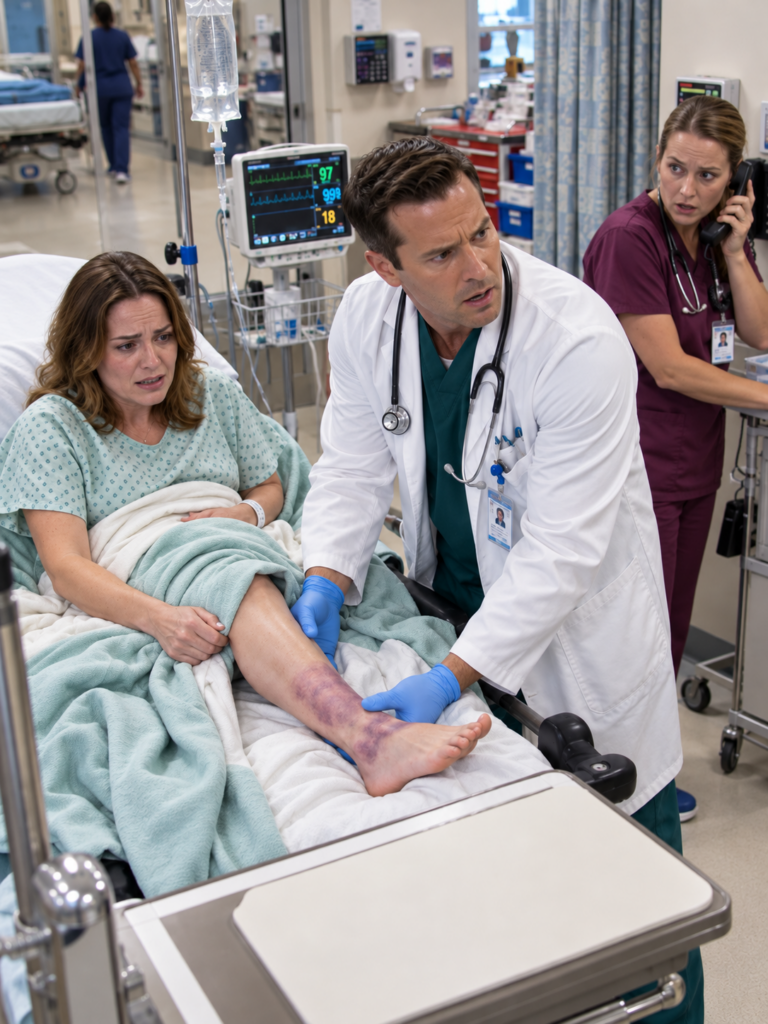
Dr. Evelyn Price looked from my phone to my ankle, then back to my face.
“Mrs. Bennett,” she said quietly, “is your husband on his way here?”
I tried to answer, but my mouth had gone dry.
My husband, Daniel, believed I was at the pharmacy.
That was what I had told him before leaving the house.
He thought I was picking up more gauze and the special medical tape he insisted was necessary to keep my wound clean. He had even handed me twenty dollars from his wallet, as though I were a child being sent on an errand.
“He doesn’t know I’m here,” I whispered.
Dr. Price gave the nurse a look I couldn’t interpret.
“Then we’re going to make sure you feel safe while we figure out what’s happening.”
She turned toward the door.
“Please ask hospital security to come upstairs.”
I was fifty-eight years old, married for thirty-one of those years, and until that moment, I had never heard a physician request security because of something my husband might have done.
My name is Margaret Bennett.
I live in a quiet neighborhood outside Columbus, Ohio, in a two-story house with pale yellow siding, an overgrown hydrangea bush, and a porch swing Daniel built during our first summer together.
For most of my adult life, I had considered myself an ordinary, fortunate woman.
I taught fourth grade for twenty-six years before retiring early to care for my mother. After she died, I began helping twice a week at the public library. I baked for church fundraisers, remembered birthdays, and kept a small vegetable garden behind the garage.
Daniel worked as a maintenance supervisor for a commercial property company. He was practical, organized, and good with his hands.
If something broke, he fixed it.
If I couldn’t open a jar, he opened it.
If my car made a strange noise, he insisted on checking it before I drove anywhere.
People called him dependable.
I had called him that, too.
But dependence can develop so slowly that you fail to notice when assistance becomes permission.
And I had reached a point in my marriage where I asked Daniel before making decisions I once would have made without thinking.
Even about my own health.
The trouble had started seven days earlier.
It was an ordinary Saturday afternoon, warm enough for me to work in the backyard wearing sandals.
I was carrying a basket of tomatoes toward the porch when the back of my heel scraped against a bent metal garden border.
The cut was small.
It stung, and there was a little blood, but I washed it under the outdoor faucet and went inside for a bandage.
Daniel was standing in the kitchen drinking iced tea.
“What happened?” he asked.
“Caught my heel on that metal edging. Nothing serious.”
He frowned.
“Let me see.”
I rested my foot on a kitchen chair.
Daniel examined the scratch, pressing his thumb against the skin beside it.
“You should be more careful out there.”
“I know.”
“Those garden borders are rusty. You could get an infection.”
“I cleaned it.”
“You don’t know what might have gotten into it.”
I remember feeling mildly irritated.
It was a scratch, not a broken bone.
But Daniel had always been particular about cleanliness, especially since his father died following complications from a hospital-acquired infection.
He took infections seriously.
Or so I believed.
He brought out the first-aid box and told me he would handle the dressing.
“You’ve got that library event tomorrow,” he said. “I’ll make sure this doesn’t slow you down.”
That sentence sounded loving.
It sounded exactly like the sort of thing a good husband would say.
I let him clean the scratch and cover it with gauze.
That evening, when I tried to check the bandage before bed, he stopped me.
“Leave it alone, Maggie. Every time you peel it off, you’re letting germs in.”
I laughed.
“It’s not a surgical wound, Daniel.”
“No, but it could become one if you keep messing with it.”
His voice carried an edge that made me stop arguing.
That was the first night.
The next morning, I woke with an unpleasant warmth around my ankle.
The wound throbbed when I stepped onto the floor.
Daniel was already dressed for church.
“Let me change it,” he said.
I sat on the edge of the bed while he removed the old dressing.
I tried to look, but he held my foot at an awkward angle.
“Is it red?”
“A little irritated.”
“Should I see a doctor?”
“For a scratch?”
He shook his head.
“Honestly, Maggie, doctors don’t need to be involved every time you get a bump.”
He applied something cool and wet to the gauze.
It had a sharp smell, stronger than ordinary antiseptic.
“What is that?”
“Something from work. Professional-grade disinfectant.”
I pulled my foot back.
“From work?”
“It’s safe when you use it properly.”
“Are you sure?”
Daniel looked up.
“Do you think I’d put something dangerous on you?”
That question ended the conversation.
I was embarrassed that I had asked.
By Monday, walking had become painful.
By Tuesday, the area around the bandage was swollen.
By Wednesday, I had started using the banister to pull myself upstairs.
Daniel continued changing the dressing every evening.
Sometimes I woke during the night and felt him adjusting the blanket around my legs.
Once, half asleep, I thought I felt him touching my ankle.
When I asked the next morning, he said I had been dreaming.
“You’ve been restless,” he told me. “Probably because you’re worrying about that scratch.”
He began preparing my meals, bringing me water, and insisting I stay off my feet.
At first, I was grateful.
Then he started answering my phone.
My closest friend, Ruth Collins, called on Thursday.
Daniel picked up before I could reach it.
“She’s sleeping,” I heard him say.
I was sitting three feet away.
When I protested, he covered the receiver.
“Do you want Ruth making a fuss? She’ll have you in an ambulance over a blister.”
He told Ruth I was fine and ended the call.
That evening, I developed a fever.
Daniel took my temperature and frowned.
“One hundred and one.”
“We should go to urgent care.”
“It’s probably a virus.”
“My ankle hurts worse.”
“Because you’ve been putting weight on it.”
He brought me soup and two pain relievers.
“Let’s give it until morning.”
Morning became another evening.
By Friday night, my fever had risen above 103 degrees.
I woke drenched in sweat, my heart racing, my ankle burning beneath a dressing that felt too tight.
Daniel was asleep beside me.
I reached down and touched the tape.
Pain shot up my calf.
I began to peel back one corner.
Daniel’s hand closed around my wrist.
“Don’t.”
I hadn’t known he was awake.
“I need to see it.”
“You’ll make it worse.”
“Daniel, I’m scared.”
He sat up, switched on the lamp, and looked at me with an expression I had not seen before.
Not concern.
Anger.
“You’re exhausting yourself over this,” he said. “I’ve spent all week taking care of you, and you keep acting like I’m doing something wrong.”
Tears filled my eyes.
“I just want to know why it hurts.”
“Because it’s infected. Because you waited too long to tell me about the scratch.”
That was untrue.
He had been standing in the kitchen when it happened.
But I was so tired that I didn’t argue.
Daniel sighed, softened his voice, and touched my shoulder.
“I’m trying to help you, Maggie.”
I apologized.
Even now, remembering that apology makes my stomach tighten.
The following morning, Daniel left to pick up groceries.
He told me not to come downstairs.
I waited until his car pulled away.
Then I got out of bed.
It took me almost four minutes to reach the bathroom.
I locked the door, lowered myself onto the closed toilet lid, and began removing the tape.
The smell reached me first.
It was sharp and chemical, mixed with something foul that made me gag.
When I lifted the gauze, I saw skin that looked nothing like the small scrape from the garden.
Dark patches surrounded the wound.
Other areas appeared pale and damaged, with angry redness spreading toward my lower calf.
My ankle had swollen so badly that the bones were almost invisible.
I stared at it.
Then I started crying.
Not because of the pain.
Because I suddenly understood how sick I had become while someone kept assuring me I was getting better.
I took a photograph with my phone.
Then I called Ruth.
She answered on the second ring.
“Maggie?”
“Can you take me to the hospital?”
Her voice changed immediately.
“What’s wrong?”
I told her.
There was a long silence.
“I’m coming now.”
“Daniel doesn’t know.”
“I don’t care what Daniel knows.”
Those words were so unlike Ruth that I almost laughed.
She had known my husband for twenty years.
She had defended him more than once when I complained about his stubbornness.
But that morning, she didn’t ask his opinion.
She arrived in fourteen minutes.
I had managed to get downstairs wearing a loose dress and one slipper.
When Ruth saw my ankle, her face went white.
“Oh, Maggie.”
“I think it’s infected.”
She caught my elbow.
“We’re going.”
At the hospital, the triage nurse took one look at the photograph and brought me into an examination room.
My temperature was 103.4.
My blood pressure was low.
My heart rate was high.
Within minutes, I had an IV in my arm and a physician standing beside my bed.
Dr. Price removed the dressing with deliberate care.
She examined the wound without speaking.
Then she asked a question I had not expected.
“Who has been treating this at home?”
“My husband.”
“What has he been putting on it?”
“Some kind of disinfectant.”
“Do you know the name?”
“No.”
She leaned closer.
“Has he used anything besides ordinary antiseptic?”
“I don’t know.”
“Did the skin look like this before he began treating it?”
“No.”
Dr. Price asked the nurse to preserve the dressing and arrange further testing.
Then my phone vibrated.
Daniel.
WHERE ARE YOU?
I didn’t answer.
A second message appeared.
THE PHARMACY DOESN’T TAKE TWO HOURS.
Then a third.
I KNOW YOU WENT TO THE HOSPITAL.
I stared at the screen.
How could he know?
I had not told anyone except Ruth.
A fourth message arrived.
DON’T TELL THEM WHAT I USED ON YOUR LEG.
Dr. Price read it over my shoulder.
That was when her expression changed.
She asked whether I wanted law enforcement contacted.
I nodded.
And when I heard the latch click as the nurse closed the examination-room door, I realized how frightened I was of the man I had spent thirty-one years sleeping beside.
Detective Sarah Morgan arrived less than an hour later.
She was in her early forties, with short brown hair and a calm manner that made her questions feel less frightening.
She introduced herself, pulled a chair beside my bed, and opened a small notebook.
“Margaret, I understand your husband has been treating an injury that has become very serious.”
I nodded.
“And he’s sent you some messages that concern the medical staff.”
“Yes.”
She looked at my phone.
“Would you be comfortable showing me those messages?”
I handed it over.
She read them.
Then she asked, “Has Daniel ever hurt you before?”
The question struck me like a slap.
“No.”
I answered too quickly.
Detective Morgan waited.
“He’s never hit me,” I added.
“That wasn’t exactly what I asked.”
I looked toward the window.
Outside, cars moved through the hospital parking lot beneath a perfectly ordinary blue sky.
I thought about Daniel taking my car keys when he believed the tires needed replacing.
I thought about him canceling a dental appointment because he said the dentist was overcharging us.
I thought about the way he corrected me in front of friends.
How he described my concerns as nerves.
How he sometimes spoke to me so patiently that other people assumed I was being unreasonable.
“He gets angry,” I admitted.
“About what?”
“When I disagree with him.”
“Does he ever keep you from leaving?”
“Not physically.”
She let the silence stretch.
I looked down at my hands.
“Sometimes he makes leaving feel impossible.”
Detective Morgan wrote something down.
Then she asked me to tell her everything I remembered about the dressing.
I started with the garden scrape.
I described the bottle, the smell, and Daniel insisting he knew how to treat the wound.
When I mentioned that he had brought the disinfectant home from work, she paused.
“What kind of products does his company use?”
“Industrial cleaning products, I suppose. Floor treatments. Degreasers. Things for commercial buildings.”
“Does he store those products at your house?”
“In the garage sometimes.”
“Where?”
“A locked metal cabinet near his workbench.”
She made another note.
“Do you have cameras at home?”
“Yes. One over the driveway, one at the front door, and another inside the garage.”
“Who controls them?”
“Daniel.”
“Do you have access?”
“I used to.”
Detective Morgan looked up.
“Used to?”
I explained that Daniel had installed a new security system three months earlier.
He told me the application was too complicated and that he would manage it himself.
I hadn’t questioned him.
After all, Daniel had always handled the technology in our house.
The detective asked whether the recordings were stored remotely.
“I think so.”
“Do you know the company?”
I gave her the name I remembered from the camera box.
She closed her notebook.
“Margaret, we’re going to look into that. For now, the most important thing is your treatment and your safety.”
I hesitated.
“Do you really think he did this deliberately?”
She didn’t answer immediately.
“I think there’s enough here that we need to find out exactly what happened.”
Something about her restraint frightened me more than an accusation would have.
Because she wasn’t guessing.
She was investigating.
And somewhere in the house where I had spent more than three decades making a marriage, there might be evidence of what Daniel had been doing while I slept.
Part 2
By Sunday morning, I had been admitted to the hospital.
The doctors were treating a serious wound infection and investigating possible chemical damage. They were monitoring the circulation in my foot and checking how deeply the tissue had been injured.
A surgeon came to examine my ankle.
He spoke gently but didn’t soften the seriousness of the situation.
“We need to control the infection and determine whether any damaged tissue requires removal,” he explained. “The next few days will tell us a great deal.”
I asked whether I would lose my foot.
He pulled a chair close to my bed.
“That’s not something I’m predicting right now. But this is a significant injury, and we’re taking it seriously.”
I began to cry.
He passed me a tissue.
“You did the right thing coming in.”
It was the third time someone at the hospital had said that.
Each time, I felt the same strange mixture of relief and shame.
Why had I needed permission to seek medical care?
Ruth stayed until visiting hours ended.
She brought me a toothbrush, clean clothes, and the little blue cardigan I always wore when I was cold.
When she saw my phone filling with Daniel’s calls, she reached for it.
“Would you like me to turn that off?”
I hesitated.
“What if something happens at home?”
“Maggie, something has happened to you.”
I looked at her.
She sat beside me and folded her hands.
“I’ve wanted to say something for a long time.”
My stomach tightened.
“About Daniel?”
She nodded.
“Do you remember my birthday dinner last spring?”
Of course I remembered.
Ruth had invited six friends to a restaurant in downtown Columbus. Daniel had complained about the parking and the prices before we even arrived.
During dinner, I mentioned wanting to take an art class.
Daniel laughed.
“Margaret already has enough unfinished projects in the basement.”
Everyone chuckled politely.
I had smiled.
Ruth hadn’t.
“He made you feel foolish,” she said now.
“It was just a joke.”
“That was what you told me then.”
I looked down.
She continued.
“Do you remember when you wanted to visit your sister in Michigan?”
“He said the weather was bad.”
“It was June.”
I didn’t answer.
Ruth’s voice softened.
“Maggie, I don’t know what happened to your ankle. But I’ve watched you get smaller around him for years.”
I stared at the hospital blanket.
She reached for my hand.
“You used to be the woman who marched into a school-board meeting and demanded heating repairs because your students were wearing coats in class. You weren’t afraid of anybody.”
I smiled through tears.
“I was terrified at that meeting.”
“You went anyway.”
Her thumb brushed my knuckles.
“That’s the woman who called me yesterday.”
For a moment, I couldn’t speak.
Then I whispered, “I keep thinking maybe he didn’t know.”
Ruth looked at me sadly.
“Then let the doctors and police find out.”
It sounded so simple.
But marriage is not simple when your memories are tied to the person you’re beginning to fear.
I remembered Daniel bringing flowers to my classroom on our tenth anniversary.
I remembered him sitting in a hospital corridor when my father suffered a stroke.
I remembered the way he cried at our daughter’s wedding.
Our daughter, Claire, was thirty-two and lived in Cincinnati with her husband and their two children.
She adored her father.
She had grown up believing he could fix anything.
How was I supposed to tell her he might have been destroying my leg?
I didn’t have to decide immediately.
Daniel called her first.
Claire rang me around noon.
“Mom, what is going on?”
Her voice was breathless.
“Dad says you had some kind of breakdown and went to the emergency room.”
I closed my eyes.
“What?”
“He says you got upset about your ankle, left without telling him, and now the police are questioning him.”
I felt cold.
“Claire, I have a serious infection.”
“I know. Dad told me.”
“Did he tell you what he was putting on it?”
Silence.
“What do you mean?”
I explained the wound, the chemical smell, the fever, and the messages.
Claire listened without interrupting.
Then she said, “Mom, Dad wouldn’t poison you.”
The word struck me.
Poison.
I hadn’t used it.
“I don’t know what he did, sweetheart.”
“He said he was trying to clean the wound.”
“I know.”
“He says you were confused from the fever.”
My chest tightened.
“I wasn’t confused when he told me not to see a doctor.”
Claire became quiet.
I heard one of my grandchildren asking for a snack in the background.
Finally, she said, “I think I need to talk to Dad.”
“Claire—”
“I love you, Mom. I just need to understand.”
She ended the call.
I lay awake that afternoon replaying the conversation.
The worst part wasn’t that Claire had doubted me.
It was that I could hear my own voice in hers.
Dad wouldn’t do that.
For years, those words had explained away anything uncomfortable about him.
Dad was stubborn.
Dad was protective.
Dad worried too much.
Dad didn’t mean it that way.
The family had developed a language for making Daniel’s behavior seem smaller than it was.
Now my daughter was speaking it.
Detective Morgan returned that evening.
She had obtained copies of my medical photographs and a detailed account from Dr. Price.
The hospital laboratory had identified a strongly alkaline substance in residue from the dressing. Further testing was underway to compare it with products that might be found at home.
She explained that such cleaners could cause chemical burns and severe tissue injury.
“Repeated contact can be especially dangerous,” she said.
I stared at her.
“Repeated?”
“The medical findings suggest this wasn’t necessarily a single exposure.”
I remembered Daniel changing the dressing every night.
His calm hands.
The way he pressed the gauze into place.
The tape pulled tight around my ankle.
I felt suddenly sick.
Detective Morgan waited until I could look at her again.
“We’re also working to preserve the home security recordings.”
“Daniel said the garage camera was broken.”
“When?”
“About two weeks ago. He said the picture kept freezing and he was waiting for a replacement.”
“Did he show you?”
“No.”
She nodded.
“That doesn’t necessarily mean there are no recordings.”
Then she asked a question that seemed unrelated.
“Has there been any recent financial conflict between you and Daniel?”
I blinked.
“Financial?”
“Arguments about money, property, insurance, retirement accounts?”
I thought about the envelope I had found on Daniel’s desk a month earlier.
It had come from a life insurance company.
I remembered seeing my name on it.
When I asked Daniel why there were insurance papers on his desk, he said it was routine paperwork from our financial adviser.
“Nothing unusual,” I told the detective.
But I didn’t sound certain.
She noticed.
“What are you remembering?”
I described the envelope.
“Did you sign anything?”
“Not recently.”
“Has he asked you to update any policies?”
“No.”
Detective Morgan wrote it down.
“Thank you.”
After she left, I thought about another conversation.
Three months earlier, Daniel had suggested selling our house.
He claimed the stairs were becoming difficult for me.
At the time, my knees occasionally ached after gardening, but I had never said I wanted to move.
He had found a new subdivision forty minutes away.
Smaller houses.
Lower maintenance.
Farther from Ruth, the library, and the church where I volunteered.
When I refused, he became unusually angry.
“You always fight me when I’m trying to make life easier,” he said.
For several days afterward, he barely spoke to me.
Then, suddenly, he dropped the subject.
I hadn’t thought much about it since.
Now I wondered why.
On Monday morning, my sister Elaine arrived from Michigan.
She was sixty-one, widowed, and the sort of woman who wore comfortable shoes because she never knew when she might need to walk into an argument.
She entered my room carrying a travel bag and a paper cup of coffee.
“Where is he?”
That was her greeting.
I almost smiled.
“Hello to you, too.”
She set down the bag and came to my bedside.
Her face changed when she saw the IV and the bulky dressing around my ankle.
“Oh, Maggie.”
She hugged me carefully.
For a long time, neither of us spoke.
Then Elaine sat down and said, “Tell me everything.”
I did.
Unlike Claire, she didn’t defend Daniel.
But she didn’t immediately condemn him, either.
She listened.
When I finished, she asked, “Do you remember the Christmas dinner four years ago?”
I frowned.
“Which one?”
“The year Mom was still alive. Daniel got angry because you wanted to stay an extra night at her house.”
I remembered.
Mom had been recovering from pneumonia.
I wanted to stay with her in Michigan while Elaine returned to work.
Daniel said we had already made plans.
When I insisted, he accused me of putting everyone else before our marriage.
We fought in the car on the way home.
Elaine watched me.
“Mom heard what he said to you in the driveway.”
My stomach dropped.
“What?”
“She never told you?”
I shook my head.
Elaine looked away.
“She asked me whether Daniel was always that controlling.”
I felt tears rising.
“Why didn’t you say anything?”
“Because you were angry whenever anyone criticized him. And because Mom said she didn’t want to cause trouble.”
I stared at the ceiling.
Mom had been dead for nearly three years.
I suddenly wanted her with a desperation that hurt more than my ankle.
“She worried about you,” Elaine said softly.
I covered my face.
That afternoon, Claire arrived.
She stood in the doorway wearing a gray sweater and carrying a small overnight bag.
She looked from me to Elaine.
Then she began crying.
“Mom.”
I held out my arms.
She crossed the room and hugged me.
For a moment, she was six years old again, climbing into my lap after a nightmare.
“I’m sorry,” she whispered.
I pulled back.
“For what?”
“I talked to Dad.”
I felt my stomach tighten.
“What did he say?”
“He kept saying you were confused.”
I closed my eyes.
“And then?”
“He said you were making accusations that could destroy his career.”
Claire wiped her face.
“He didn’t ask how you were doing. Not once.”
Elaine looked down at her hands.
Claire continued.
“I told him the hospital was treating a chemical injury. He said the doctors were exaggerating.”
I felt something shift inside me.
The explanation I had been holding onto—that Daniel had made a terrible mistake and was too proud to admit it—began to weaken.
“What else?” I asked.
Claire hesitated.
“He asked me to come to the house and take some things from the garage before the police searched it.”
The room went silent.
“What things?”
“He said there were cleaning supplies from work that weren’t supposed to be stored at home.”
My heart began pounding.
“Did you?”
“No.”
She shook her head firmly.
“I told him I wasn’t touching anything.”
Claire reached for my hand.
“Then he got angry.”
“How angry?”
“He said if I loved my family, I would help protect it.”
I stared at her.
She began crying again.
“And I realized he wasn’t talking about you.”
Detective Morgan came back that evening to speak with Claire.
My daughter showed her the messages Daniel had sent.
They arranged to preserve the conversation and document what he had asked her to do.
When Claire returned to my room, she looked exhausted.
“I used to think Dad was strict because he loved us,” she said.
I watched her sit beside the window.
“Maybe he did love us,” I replied. “But that doesn’t explain everything he did.”
It was the first time I had allowed myself to separate the two.
A person could love you and still behave cruelly.
A person could do kind things and still control you.
And a person could spend years convincing everyone he was dependable while using that reputation to escape questions.
The next morning, the police obtained the security recordings.
Daniel had been wrong about the garage camera.
It wasn’t broken.
It was recording normally.
The camera system had been installed by a local security company, and the cloud subscription remained active.
The footage from the previous week had been preserved.
Detective Morgan came to the hospital with a laptop.
She asked whether I felt well enough to watch.
I nodded.
Claire and Elaine stayed beside me.
The first recording showed the garage at 1:08 a.m.
Daniel entered wearing his blue work jacket.
He walked to the metal cabinet beside his workbench, opened it with a key, and removed a large plastic bottle.
He poured a small amount of liquid into an unmarked container.
Then he took our first-aid box from a shelf.
He left the garage.
The timestamp showed that it was the first night after my injury.
I felt my fingers go numb.
Detective Morgan opened the following night’s recording.
Daniel appeared again.
Same cabinet.
Same bottle.
Same small container.
Same first-aid box.
He repeated the process on the third night.
And the fourth.
On the fifth, he paused to check his phone.
Detective Morgan stopped the video.
The camera image showed Daniel standing beneath the fluorescent garage light, holding the bottle in one hand.
He appeared calm.
Not hurried.
Not confused.
He moved like someone performing an ordinary task.
I stared at the screen.
For all those nights, I had believed he was caring for me.
But there he was, preparing something I had never agreed to have placed on my skin.
“Can you tell what the bottle is?” Claire asked.
Detective Morgan shook her head.
“Not clearly from this recording.”
“Will you know?”
“We’re working on that.”
She played another clip.
This one was from Friday night.
The night my fever climbed above 103.
Daniel entered the garage at 12:47 a.m.
He took the bottle from the cabinet.
Then he stood still for several seconds.
He pulled out his phone and appeared to type a message.
Afterward, he returned the bottle to the cabinet.
He took a smaller container from his jacket pocket and went toward the house.
Detective Morgan paused the recording.
“Margaret, do you remember him coming into your bedroom around this time?”
I thought about waking with his hand on my ankle.
The blanket being lifted.
The sting beneath the dressing.
I nodded.
“I thought I was dreaming.”
Claire made a small sound beside me.
I looked at my daughter.
She was crying silently.
Detective Morgan closed the laptop.
“I know this is difficult. We have other evidence to review, and I don’t want to draw conclusions beyond what the recordings establish.”
But the images had already changed something fundamental.
I had watched my husband prepare the liquid before coming into our bedroom.
Repeatedly.
Secretly.
While telling me the wound needed to be left alone.
When the detective left, Claire sat on the edge of my bed.
“I don’t understand,” she whispered.
Neither did I.
I could imagine Daniel being impatient, controlling, even cruel during an argument.
I could imagine him making a reckless mistake because he thought he knew more than a doctor.
But I couldn’t understand why he would repeat that mistake every night while watching me become weaker.
Why he would let me suffer.
Why he would tell our daughter I was confused.
Why he would try to hide the cleaning supplies.
Elaine stood by the window.
After a while, she said, “There may be something else you need to know.”
I turned toward her.
“What?”
She hesitated.
“Last winter, Daniel called me.”
I blinked.
“He called you?”
“He wanted to know whether you had changed your will after Mom died.”
I stared at her.
“What did you tell him?”
“That I didn’t know.”
“Why would he ask you?”
“He said he was helping you organize your estate documents.”
I felt a chill.
I remembered Daniel asking me about the inheritance Mom had left.
It wasn’t enormous, but it was enough to provide security during retirement.
Most of it remained in an account under my name.
Mom had specifically wanted Elaine and me to have money independent of our husbands.
Daniel had occasionally complained that the account wasn’t earning enough interest.
He wanted us to combine our savings.
I refused.
It was one of the few financial decisions on which I had not yielded.
Elaine looked at me sadly.
“I didn’t think much of it at the time.”
I lay back against the pillows.
For the first time, I wondered whether the injury had anything to do with money.
That possibility was so ugly that I pushed it away.
But the following afternoon, Detective Morgan returned with information that made it impossible to ignore.
Police had recovered the cleaning product from the garage.
The label identified it as a concentrated industrial alkaline cleaner.
According to the preliminary laboratory comparison, the substance found on my dressing was consistent with the product.
They were also examining Daniel’s work records to determine when he had obtained it.
And they had found something else.
A folder in his office.
Inside were copies of our life insurance policies, retirement account statements, and preliminary paperwork concerning the sale of our house.
There was also a printed letter from a financial services company regarding a recent request for information about my assets.
Detective Morgan didn’t show me everything.
She explained that investigators were still determining which documents were relevant and whether any financial misconduct had occurred.
But she asked me an important question.
“Margaret, did you authorize Daniel to make changes to your accounts or request documents on your behalf?”
“No.”
“Did you recently sign a power of attorney?”
“No.”
She nodded.
“Do you remember signing anything he described as routine estate paperwork?”
I thought carefully.
Then I remembered.
Three weeks before the injury, Daniel had brought a folder to the breakfast table.
He said the bank needed updated signatures.
I was making coffee.
He placed two sheets beside my plate.
“Just sign these before you forget,” he said.
I asked what they were.
“Account maintenance.”
I had picked up a pen.
Then my phone rang.
It was Claire, calling about our grandson’s school recital.
I told Daniel I would sign later.
He became irritated.
“It’s always something with you.”
He took the papers back.
I never saw them again.
I told Detective Morgan.
She wrote it down.
Then she looked directly at me.
“Margaret, do you have independent access to your financial accounts?”
“Yes.”
“Have you checked them recently?”
“No.”
“Would you be willing to review them with someone you trust?”
I looked at Claire.
She squeezed my hand.
“Of course.”
That evening, my daughter helped me sign into my accounts.
My mother’s inheritance was still there.
But when we opened the joint checking account, we found several transfers I didn’t recognize.
One had gone to a financial consulting company.
Another to a real estate attorney.
A third to an account listed only by a bank reference number.
Together, they amounted to almost eighteen thousand dollars.
Claire stared at the screen.
“Mom, did you know about these?”
I shook my head.
She looked at me.
“Dad told me you two were saving to buy a condo.”
I felt the room tilt.
“A condo?”
“He said you’d finally agreed to sell the house.”
I hadn’t.
I had never agreed.
Claire leaned back in her chair.
“There’s something else.”
“What?”
“He said you were having trouble remembering things.”
I stared at her.
“When?”
“About two months ago.”
My throat tightened.
“He told me you sometimes forgot conversations and got upset when he corrected you.”
I shook my head.
“I don’t forget conversations.”
“I know that now.”
Claire swallowed.
“He said he was worried he might eventually need to make decisions for you.”
The full shape of it was still unclear.
But an awful possibility began forming.
Daniel had been telling our daughter I was confused.
He had been arranging financial matters without my knowledge.
He had tried to move us away from the people who knew me best.
And during the same period, he had taken control of a wound that was becoming life-threatening.
I looked at Claire.
“Sweetheart, I need you to promise me something.”
“Anything.”
“Don’t let him tell you who I am.”
She began to cry.
“I won’t.”
That night, I hardly slept.
Around two in the morning, a nurse came in to check my IV.
She found me sitting upright, staring at the dark window.
“Can’t sleep?”
I shook my head.
She adjusted the blanket around my legs.
“Pain?”
“Not just that.”
She pulled a chair beside the bed.
I studied her name tag.
Angela.
She looked to be in her fifties, with tired eyes and the calm patience of someone who had spent many years watching people at their most vulnerable.
“Can I ask you something?” I whispered.
“Of course.”
“How do you know when someone has been lying to you for years?”
Angela was quiet for a moment.
“Sometimes you don’t know until something happens that makes all the little things look different.”
I turned toward her.
“I keep thinking about the good years.”
She nodded.
“They mattered, too.”
“Does that make me foolish?”
“No.”
She looked at the dressing on my ankle.
“But the good years don’t change what needs to be done to keep you safe now.”
I began crying.
Angela stayed until I could breathe steadily again.
Before leaving, she asked whether I wanted the hospital’s social worker to visit in the morning.
I said yes.
It was another decision I made without consulting Daniel.
On Thursday afternoon, Detective Morgan came back.
This time, she looked more serious than usual.
She closed the door and sat beside my bed.
“Margaret, we have additional information about your husband’s activities before your injury.”
Claire was sitting beside me.
Elaine stood near the window.
The detective placed a document folder on her lap.
“Investigators have obtained records showing that Daniel contacted a legal services office about establishing authority to manage your financial affairs.”
My heart sank.
“He said he was concerned about your decision-making capacity.”
Claire’s face went pale.
Detective Morgan continued carefully.
“The request did not result in any court-appointed authority. The office asked for medical documentation, and there is no evidence that a physician certified you as incapacitated.”
I closed my eyes.
Daniel hadn’t simply been telling our family I was becoming forgetful.
He had been exploring ways to make that claim official.
Then Detective Morgan said something that made my blood turn cold.
“The financial records also show he was discussing the potential sale of your home with an agent, even though you had not agreed to sell.”
I stared at her.
“Why?”
“We’re still investigating his intentions.”
Claire reached for my hand.
Detective Morgan hesitated.
“There’s one more thing.”
She opened the folder.
“Daniel recently contacted his employer’s insurance administrator to confirm the status of a policy that provides benefits in the event of a spouse’s death.”
I heard Elaine inhale sharply.
The detective immediately added, “That fact by itself does not establish why he did it. People review policies for many legitimate reasons. We’re examining the timing along with the other evidence.”
But I couldn’t stop thinking about it.
My husband had watched my fever rise.
He had discouraged me from seeking treatment.
He had been putting a dangerous substance on my wound.
And before any of that, he had been asking questions about what would happen to our money if I could no longer make decisions.
I looked at Detective Morgan.
“Do you think he wanted me to die?”
She met my eyes.
“I can’t tell you that. What I can tell you is that we’re treating the evidence seriously, and we’re continuing to investigate.”
I nodded.
She was right not to promise an answer.
But inside me, something broke.
For thirty-one years, I had assumed Daniel’s decisions were meant to protect us.
Now I had to consider that some of them might have been meant to protect him from me.
That evening, my daughter received another message from her father.
It contained just six words.
TELL YOUR MOTHER TO STOP TALKING.
Claire showed it to Detective Morgan.
Then she turned off her phone.
She sat down beside me and said, “He doesn’t get to decide that anymore.”
For the first time since entering the hospital, I believed her.
Part 3
The turning point came on Friday morning.
I was sitting upright in bed, trying to eat scrambled eggs, when Dr. Price entered with the surgeon and a wound-care specialist.
They examined my ankle and reviewed the latest results.
The antibiotics were working.
My fever had fallen.
The damaged skin still required careful treatment, and I would need follow-up care and rehabilitation, but the doctors were cautiously optimistic about preserving my mobility.
I asked the question I had been afraid to repeat.
“Am I going to lose my foot?”
The surgeon pulled up a chair.
“At this point, we don’t expect that. We still have healing ahead, but your response to treatment is encouraging.”
I began crying.
He smiled gently.
“Those are relieved tears, I hope.”
I nodded.
After they left, I called Ruth.
She answered immediately.
“Well?”
“They think I’m going to be okay.”
Ruth made a sound that was half laugh, half sob.
“Thank God.”
Then she said, “I’m bringing you decent coffee.”
I laughed for the first time in days.
But recovery didn’t mean the investigation was over.
Later that afternoon, Detective Morgan returned.
She told me Daniel had been interviewed.
He admitted bringing an industrial cleaning product home from work.
He claimed he believed it would prevent infection.
He denied intending to hurt me.
When investigators asked why he had continued using the product after my condition worsened, he said he thought the redness and pain meant the treatment was drawing out the infection.
When asked why he hadn’t encouraged me to see a doctor, he claimed I had refused.
I sat silently, listening.
The detective continued.
“He also said you had become unusually forgetful and that you sometimes misunderstood his instructions.”
I looked at her.
“That’s what he always says.”
She nodded.
“His statements will be evaluated against the medical evidence, messages, recordings, and witness accounts.”
I stared at my hands.
“Will I have to talk to him?”
“Not unless you choose to. We can discuss ways to protect you while the investigation continues.”
I asked about the house.
Could I return?
Would Daniel be there?
What would happen to my belongings?
The social worker had already helped me contact an attorney.
Together, they were helping me understand protective-order options, temporary living arrangements, and financial safeguards.
I had decided not to go home immediately.
Elaine offered me her guest room in Michigan.
Ruth offered the spare bedroom in her house.
Claire insisted I could stay with her.
For the first time in my marriage, I had several places where I could go without asking Daniel’s permission.
It was a strange kind of wealth.
The detective opened another folder.
“We’ve also obtained more information about the recordings.”
I looked up.
“The camera system captured Daniel entering the garage every night, but it doesn’t show what happened inside the bedroom. That distinction matters.”
I nodded.
“We do have your medical findings, his messages, his admission that he used the cleaner, and evidence that he repeatedly prepared the substance.”
She paused.
“Investigators also recovered notes from Daniel’s phone that may help establish what he knew.”
My heart began racing.
“What notes?”
She didn’t show me the device.
But she explained that, through authorized examination, investigators had identified searches concerning alkaline chemical injuries, wound complications, and the effects of delayed medical treatment.
Some had been made before I cut my heel.
Others were made during the week he treated the injury.
I stared at her.
“Before?”
“Yes.”
The room seemed to move around me.
Before the garden.
Before the scrape.
Before he had ever touched my ankle with the first-aid box.
I whispered, “He knew?”
Detective Morgan chose her words carefully.
“The search history raises important questions about his knowledge and intent. We can’t assume every search reflects what someone intended to do, but the timing is significant.”
I thought about Daniel’s insistence that he was using professional-grade disinfectant.
He had told me it was safe.
He had told me I was making the injury worse by touching it.
He had told me to wait.
The detective continued.
“We also learned that a few days before your injury, he took an unapproved quantity of the cleaner from his workplace.”
I felt my throat tighten.
“He brought it home before I got hurt?”
“According to the records, yes.”
That was the moment my last comforting explanation disappeared.
I had been trying to believe that a careless husband had made a terrible mistake and then panicked.
But the bottle had been there before my scrape.
And the questions he had researched suggested he understood the dangers.
I was not ready to say exactly what he had planned.
I didn’t know whether he had expected an accident, intended to create one, or acted after the opportunity appeared.
Those were questions for the investigators.
But I knew something essential.
My suffering had not begun because I ignored a minor injury.
It had become dangerous because I trusted someone who withheld the truth.
I asked Detective Morgan whether she would tell me when charges were filed.
She said she would keep me informed through the appropriate process.
Then she asked whether I wanted a victim advocate to contact me.
“Yes,” I said.
The word came easily.
That evening, Claire sat beside my bed while I looked through photographs on my phone.
There was Daniel at our wedding, thirty-one years earlier, wearing a rented tuxedo that didn’t quite fit.
Daniel holding newborn Claire.
Daniel on a fishing trip with my father.
Daniel sitting on our porch swing with our grandson asleep against his chest.
Claire watched my face.
“Mom, are you going to delete them?”
I shook my head.
“Not tonight.”
She nodded.
I stared at the picture of our wedding.
He had been twenty-nine.
I had been twenty-seven.
We were standing outside a little white church, smiling into the sun.
I remembered thinking that marriage meant having someone to stand beside you when life became difficult.
For many years, Daniel had stood beside me.
But somewhere along the way, he had started standing in front of me instead.
Blocking conversations.
Making decisions.
Explaining me to other people.
And because he did it gradually, I had mistaken his control for devotion.
“Do you hate him?” Claire asked.
I considered the question.
“I don’t know.”
She nodded.
“I do, a little.”
I turned toward her.
“That’s a hard thing to feel about your father.”
She began crying.
“He keeps calling me and asking me to fix this.”
I reached for her hand.
“You don’t have to fix him.”
“What if he goes to prison?”
“That will depend on what he did and what the court decides.”
She wiped her eyes.
“He says we’re abandoning him.”
I squeezed her fingers.
“Claire, you can love your father and still refuse to help him hurt someone.”
She looked down.
“Even you?”
“Especially me.”
We sat together for a long time.
It was the first conversation we’d had about Daniel that didn’t end with one of us trying to defend him.
Two weeks later, I was discharged from the hospital.
My ankle was still bandaged, and I used a walker.
I needed regular wound appointments, medication, and help getting around.
But I was alive.
The day I left, Angela, the night nurse, came to say goodbye.
She handed me a small paper bag.
Inside was a pair of soft, nonslip socks.
“For when you’re back on both feet,” she said.
I laughed.
“Thank you.”
She hugged me gently.
“You’ve got a lot of living left to do, Mrs. Bennett.”
I carried those socks with me to Ruth’s house.
Ruth had prepared her downstairs guest room.
There were clean sheets on the bed, fresh flowers on the dresser, and a pitcher of water beside the lamp.
She had even moved a chair into the bathroom so I could sit while washing.
When I thanked her, she waved away my gratitude.
“You spent twenty years bringing casseroles to everybody in this town. It’s your turn.”
That first night, I lay awake listening to the unfamiliar sounds of her house.
The refrigerator humming.
A car passing outside.
The wind moving through the trees.
I kept expecting Daniel to walk in and tell me it was time to sleep.
No one did.
At two in the morning, I switched on the bedside lamp.
I looked at the dressing on my ankle.
Then I carefully checked the outer bandage, following the instructions the hospital had given me.
The wound-care nurse had explained what to watch for and when to seek help.
For the first time in more than a week, I could look at my own injury without someone accusing me of making it worse.
I cried quietly.
Not from fear.
From the relief of being allowed to know.
The following month was difficult.
I was tired much of the time.
Walking across Ruth’s living room required concentration.
Some mornings, I woke angry.
Other mornings, I missed Daniel so fiercely that I felt ashamed.
I missed having someone make coffee before I got up.
I missed hearing him work in the garage.
I missed the ordinary rituals of thirty-one years.
There were days when I remembered the good parts of our marriage and wondered whether the terrible parts had somehow swallowed them.
My counselor helped me understand that I didn’t have to erase the past to protect my future.
A marriage could contain real affection, genuine memories, and serious harm.
Recognizing the harm did not make every happy memory false.
But neither did the happy memories excuse what had happened.
I began writing things down.
Not just what Daniel had done during the week of my injury.
I wrote about other moments I had dismissed.
The family vacation he canceled after I disagreed with him about money.
The job offer he persuaded me to refuse because the commute was inconvenient.
The way he corrected my stories in front of guests.
The birthday dinner when he told everyone I was becoming forgetful because I had misplaced my reading glasses.
The bank statements he insisted were too complicated for me.
Some entries seemed small.
Others were painful.
Together, they formed a picture I had never wanted to see.
I wasn’t foolish for trusting my husband.
But I had spent years confusing peace with silence.
And silence had cost me more than I understood.
In November, my attorney helped me begin divorce proceedings.
It was not an easy decision.
Thirty-one years of marriage could not be reduced to a single signature.
I sat in her office with the paperwork in front of me for almost twenty minutes.
She did not hurry me.
Finally, I picked up the pen.
My hand trembled.
But I signed.
When I finished, I expected to feel triumphant.
Instead, I felt grief.
I was mourning the marriage I believed I had.
And perhaps the one I had spent years trying to create.
My attorney explained the next steps.
We would address the house, financial accounts, and temporary arrangements through the legal process.
She had also helped me document unauthorized financial activity and take precautions with my accounts.
The investigation into Daniel’s conduct continued separately.
I was learning that justice rarely arrived as a single dramatic moment.
It arrived through appointments, documents, phone calls, and decisions that were often exhausting.
But each step moved me toward a life I could control.
In early December, Detective Morgan called.
She told me prosecutors had filed criminal charges against Daniel related to the injury.
The case would proceed through the courts.
She cautioned that an accusation was not a conviction and that the legal process could take time.
I appreciated her honesty.
For weeks, I had imagined a courtroom scene where every lie would be exposed at once.
Instead, there would be hearings, evidence, legal arguments, and uncertainty.
I was frightened.
But I no longer felt responsible for protecting Daniel from the consequences of his choices.
That night, Claire came to Ruth’s house with the children.
My grandson, Oliver, was six.
He climbed onto the couch beside me and studied my walker.
“Grandma, is your foot still broken?”
I smiled.
“It wasn’t broken, sweetheart. It was very hurt.”
“Does it still hurt?”
“Sometimes.”
He thought about that.
Then he reached into his pocket and pulled out a small plastic dinosaur.
“You can borrow him.”
I looked at the green toy.
“Why?”
“He’s brave.”
I laughed.
“Is he?”
Oliver nodded seriously.
“He fought a bigger dinosaur and didn’t run away.”
I accepted the toy.
“Then I think I’ll keep him close.”
My daughter watched us from the kitchen doorway.
Her eyes filled with tears.
Later, after the children fell asleep, Claire sat beside me.
“Mom, Dad wrote me a letter.”
I felt my stomach tighten.
“What did he say?”
“He said he never intended for you to get that sick.”
I stared at her.
“Did he say he was sorry?”
Claire shook her head.
“He said everything got out of control.”
I looked toward the Christmas lights Ruth had hung in the window.
Everything got out of control.
That was how Daniel described years of decisions he had made while insisting I was the unreasonable one.
I turned back to Claire.
“Do you want to keep talking to him?”
She hesitated.
“Maybe someday. But not until I know what to believe.”
I nodded.
“That’s your decision.”
She looked relieved.
I understood then that freeing myself from Daniel’s control did not mean controlling everyone else’s relationship with him.
Claire would have to find her own way through what had happened.
My responsibility was to protect myself, tell the truth, and allow her the freedom to do the same.
The months that followed were slower than I wanted.
My wound gradually healed, leaving scarred, sensitive skin around my ankle.
Physical therapy helped me rebuild strength.
At first, I could only walk from one end of the therapy room to the other.
Then I managed the hallway.
Then the parking lot.
One morning in February, my therapist asked me to walk without the cane for a short distance.
I stared at the floor.
“What if I fall?”
“We’ll be right here.”
I took one step.
Then another.
My ankle felt stiff.
My balance wasn’t perfect.
But I reached the other side.
The therapist smiled.
“There you go.”
I stood there crying.
It was only a dozen steps.
But to me, it felt like crossing a bridge back into my own life.
In the spring, the criminal case moved forward.
Daniel’s attorney argued that he had made a reckless but unintentional mistake.
The prosecution presented the medical evidence, the laboratory findings, the security recordings, and the messages he had sent.
Investigators had also documented the timing of his searches about chemical injuries and his efforts to discourage me from seeking care.
The financial records raised further questions about his conduct, although those issues were not all part of the same criminal proceeding.
Eventually, Daniel accepted a plea agreement involving a felony assault charge.
The judge imposed a prison sentence and a period of supervision afterward.
The precise legal result mattered, but it wasn’t the moment that changed me most.
That came when I was given the opportunity to speak at sentencing.
I had spent weeks writing my statement.
At first, I filled pages with anger.
I wanted to describe every feverish night.
Every time he told me to wait.
Every moment I had apologized for being frightened.
But when the day came, I stood in court with a much shorter statement.
Daniel sat beside his attorney.
He looked older than I remembered.
His hair had more gray in it.
His shoulders were bent.
For one brief instant, I saw the man I had married.
Then I remembered him telling our daughter that I was confused.
I looked at the judge.
“For thirty-one years, I believed my husband was the person who would protect me when I was vulnerable,” I said. “When I was injured, he asked me to trust him. I did. That trust left me seriously hurt and delayed the medical care I needed.”
My voice trembled.
I took a breath.
“I don’t know whether I will ever understand every decision he made. But I do know I was told not to believe my own pain, not to look at my own wound, and not to seek help when I knew something was wrong.”
The courtroom was silent.
“I am still learning to trust myself again. I hope the court understands that the injury was not only physical. It changed the way I see the person I built my life with.”
I folded the paper.
Then I said the line I had practiced until I could say it without crying.
“I will not let what he did determine the rest of my life.”
When I returned to my seat, Claire took my hand.
Daniel did not look at me.
For once, I didn’t need him to.
There was no dramatic confession.
No sudden apology.
No moment when he admitted everything and explained why.
I had imagined that such an explanation might set me free.
Instead, I discovered that freedom sometimes begins when you stop waiting for the person who hurt you to give you an answer.
By the following summer, the divorce was finalized.
The financial settlement required careful negotiation, but I was able to retain the house after adjusting other assets as part of the agreement.
I moved back in on a warm afternoon in June.
Ruth and Elaine helped me carry boxes.
Claire brought sandwiches.
Oliver arrived holding a drawing of a dinosaur standing in front of a yellow house.
“It’s Grandma’s dinosaur,” he explained.
I put the picture on the refrigerator.
Then I walked through the rooms.
The house looked familiar, but it felt different.
Daniel’s work boots were gone.
His jacket no longer hung by the back door.
The garage had been cleared of his equipment and cleaning supplies.
The locksmith had changed the locks.
A technician had reset the security system so that I controlled my own access.
I stood in the kitchen, looking at the place where Daniel had first examined my small garden scrape.
For a moment, I could almost hear his voice.
Let me handle it.
I closed my eyes.
Then I opened the back door.
The garden was overgrown.
Tomato vines had collapsed against their supports.
Weeds had spread along the fence.
And the bent metal border that had scratched my heel was still there.
Ruth followed me onto the porch.
“Do you want me to have someone remove that?”
I looked at the edging.
For months, I had imagined that piece of metal as the beginning of everything.
But it wasn’t.
The scrape had been an accident.
What happened afterward had been a series of human decisions.
I nodded.
“Yes. Let’s replace it.”
Ruth smiled.
“Something safer?”
“Something I choose.”
We spent the next few weekends restoring the garden.
Claire helped plant tomatoes.
Elaine brought lavender from Michigan.
Ruth insisted on adding marigolds because she said every respectable vegetable garden needed them.
I worked slowly.
Some afternoons, my ankle ached.
When it did, I rested.
I no longer treated pain as a personal failure or an inconvenience to someone else.
One Saturday, Claire found me sitting on the porch swing with a glass of iced tea.
She sat beside me.
“Mom, can I ask you something?”
“Of course.”
“Do you think you’ll ever get married again?”
I laughed softly.
“Goodness, Claire. I’m still figuring out where to keep the coffee mugs without your father rearranging them.”
She smiled.
“I know.”
I thought for a moment.
“I don’t know what the future holds. But I do know I’m not lonely just because I’m living alone.”
She leaned against my shoulder.
For a while, we watched Oliver chasing butterflies across the lawn.
Then Claire whispered, “I’m proud of you.”
I shook my head.
“I was frightened most of the time.”
“I know.”
“I made mistakes.”
“I know.”
“I stayed longer than I should have.”
She turned toward me.
“Mom, you left when you realized you needed to.”
I looked at her.
She squeezed my hand.
“And you never stopped trying to get better.”
That evening, after everyone had gone home, I made myself dinner.
Just a baked potato, a small salad, and a cup of tea.
I carried the plate to the kitchen table.
For decades, I had waited for Daniel before eating.
Even when he worked late.
Even when he was in a bad mood.
Even when I was hungry.
It had become such a habit that I barely noticed it.
Now I sat down while the food was still warm.
Outside, the evening light settled across the garden.
The hydrangea bush near the porch had begun to bloom again.
I thought about the first night of the injury, when Daniel told me not to remove the bandage.
I had obeyed because I thought trust meant believing the person you loved.
Now I understood trust differently.
Trust could not require silence.
It could not demand that I ignore pain.
And it could not survive when one person claimed the right to decide what the other was allowed to know.
After dinner, I washed my plate and stepped onto the porch.
My ankle still carried scars.
They would probably never disappear completely.
But I could walk.
I could drive.
I could visit my sister.
I could answer my own phone, manage my own money, and make decisions about my own body.
A small green dinosaur stood on the kitchen windowsill, watching over the garden.
I smiled when I saw it.
Then I sat on the porch swing Daniel had built thirty-one years earlier.
For a long time, I had wondered whether I should take it down.
But the swing was sturdy.
The wood was still good.
And I loved sitting there in the evenings.
I finally understood that I didn’t have to surrender every part of my past just because one person had betrayed me.
I could keep what was good.
I could release what was harmful.
And I could decide what belonged in the life ahead of me.
The sun slipped behind the neighboring houses.
I rested my feet on the porch boards and listened to the quiet.
No one was telling me what I felt.
No one was telling me what to believe.
No one was promising that tomorrow would be the day I finally received the help I needed.
For the first time in a very long time, tomorrow belonged to me.
And I didn’t have to wait for it to begin living.


