
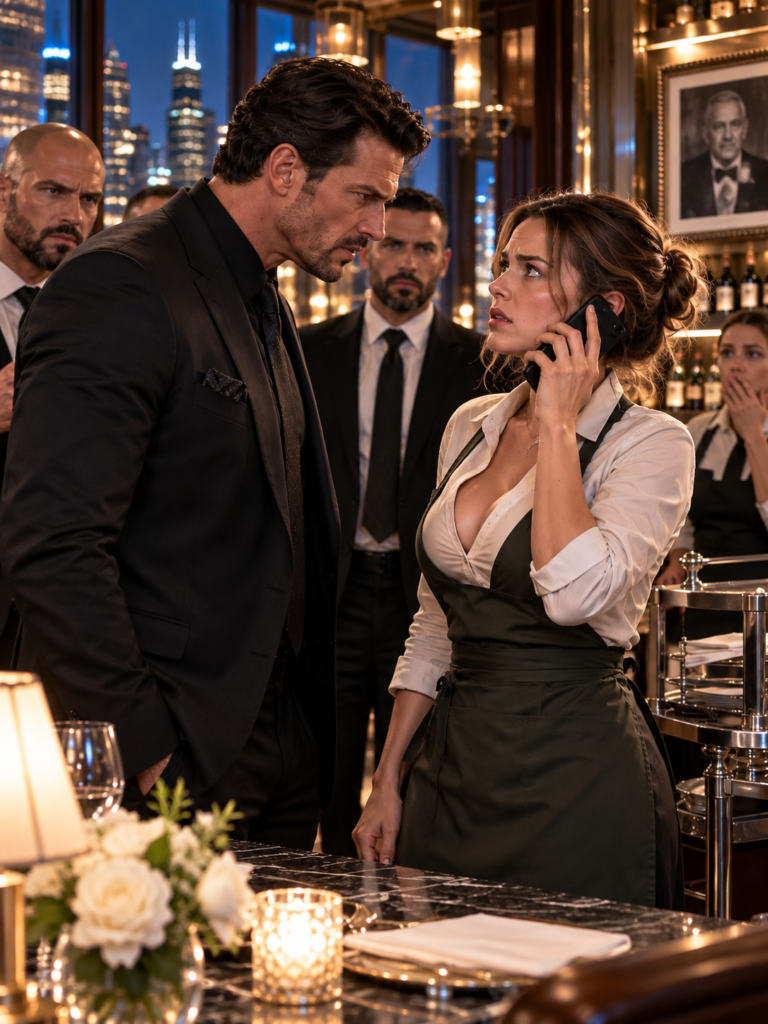
The Mafia Boss Slapped a Waitress Over His Missing Watch—Then She Made One Call and Whispered, “Daddy”
Vincenzo Moretti slapped the twenty-two-year-old waitress hard enough to split her lip because a three-million-dollar watch had vanished from his table—and everyone in the Sapphire Lounge was too afraid of him to intervene.
Clara Evans wiped the blood from her mouth, pulled an ancient burner phone from her pocket, and pressed the only number stored inside it.
When the man on the other end answered, she looked straight into Enzo’s eyes and whispered one word: “Daddy.”

PART 1 — THE ONE NUMBER SHE SWORE SHE WOULD NEVER CALL
Rain glazed the Tribeca streets black that night.
Inside the Sapphire Lounge, weather did not exist.
The private club smelled of polished mahogany, cigar smoke, citrus peel, and champagne expensive enough that Clara Evans sometimes calculated how many months of rent one bottle represented.
She adjusted her apron and kept walking.
Ten hours on her feet.
Twenty-two years old.
One unfinished art-history degree.
Student loans.
A one-room apartment in Queens where the radiator hissed all night and roaches occasionally appeared beneath the sink no matter how carefully she cleaned.
That was the life she had chosen.
Because the other life had come with bodyguards.
Locked gates.
Men with guns standing outside bedroom doors.
And a father who loved her so fiercely that love had eventually begun to feel like another prison.
“Table four.”
Manager Robert Henderson snapped his fingers.
“Thirty-year Macallan.”
He leaned close.
“And don’t screw this up. That’s Moretti.”
Clara did not need clarification.
Everybody in New York nightlife knew Vincenzo Moretti.
Thirty-two.
Tailored charcoal suit.
Burnt-dark eyes.
Youngest head of the Moretti organization in a generation.
The kind of man whose arrival made managers straighten their backs and rich men lower their voices.
Clara carried the crystal decanter toward his booth.
Enzo barely looked at her.
“Pour.”
She did.
Perfectly.
As she reached for an empty tumbler, her sleeve brushed a leather ledger.
Beside it sat a platinum watch.
Enzo’s hand closed around her wrist.
Hard.
“Careful.”
Clara looked up.
For one second their eyes met.
Something in Enzo’s expression changed.
Not kindness.
Recognition of resistance.
“I apologize,” Clara said.
He released her.
“Go.”
Twenty minutes later, Henderson stormed into the kitchen.
“Evans. Out front.”
“What happened?”
“Move.”
The Sapphire Lounge had gone silent.
Lights were brighter now.
Music off.
Enzo stood beside the empty booth.
His suit jacket was gone.
The watch was too.
“Where is it?”
Clara stopped.
“Where is what?”
“My watch.”
“I didn’t take anything.”
“You were at my table.”
“So were your guests.”
His eyes narrowed.
“Empty your pockets.”
Clara did.
Pen.
Fourteen dollars in tips.
Lip balm.
Nothing else.
“Check her locker,” Enzo said.
Then, with cold contempt:
“Search her.”
Clara stepped backward.
“No.”
Nobody said no to Vincenzo Moretti.
The entire room seemed to inhale.
Enzo came closer.
“You think you have options?”
“I think I have rights.”
He laughed.
“Not in here.”
“I didn’t steal from you.”
“You saw something worth more than you’ll earn in a lifetime.”
His voice became louder.
“And you thought nobody would care what happened to some broke little waitress.”
Clara’s face hardened.
“Check your own friends.”
That was when Enzo lost control.
His hand moved.
The crack of the slap exploded through the club.
Clara crashed sideways into a table.
Crystal shattered.
Copper filled her mouth.
She touched her lip.
Blood.
Nobody moved.
Not Henderson.
Not Enzo’s men.
Not a single wealthy patron.
Clara slowly pushed herself upright.
For four years she had promised herself she would never make the call.
She had changed her surname.
Changed her hair.
Changed cities.
Changed everything.
But violence had found her anyway.
She reached into her back pocket.
Enzo’s guards tensed.
Clara pulled out a cheap black burner phone.
Enzo scoffed.
“Calling police?”
“No.”
She held down the number one.
The line rang once.
A man answered.
“Speak.”
Clara’s throat tightened.
The entire room watched.
She looked directly at Enzo.
“Daddy.”
Silence on the line.
Then the voice changed completely.
“Clara?”
Her eyes closed.
“Yes.”
“Where are you?”
“The Sapphire Lounge. New York.”
“What happened?”
Clara looked at Enzo.
“He hit me.”
The voice became terrifyingly quiet.
“Who?”
“Vincenzo Moretti.”
A long pause.
Then:
“Put him on.”
Clara held out the phone.
Enzo took it.
“Who is this?”
The answer came like a door closing.
“My name is Alessandro Viti.”
Every trace of color vanished from Enzo Moretti’s face.
PART 2 — THE PRICE OF HITTING THE WRONG WOMAN
Enzo had heard Alessandro Viti’s name before he was old enough to understand what it meant.
Men in his father’s generation said it carefully.
Never loudly.
Never as a joke.
Viti had built his influence in Sicily decades earlier, then survived long enough to become more myth than man inside the American underworld.
Enzo had always assumed half the stories were exaggerated.
Standing in the middle of the Sapphire Lounge with a cheap plastic phone against his ear, he suddenly hoped all of them were.
“You’re lying,” Enzo said.
His voice betrayed him.
On the other end, Alessandro remained calm.
“Look at her eyes.”
Enzo looked.
Clara was standing now.
Blood on her lower lip.
Bruise forming over her cheek.
Blue eyes.
Pale.
Cold.
Viti eyes.
Enzo had seen those eyes in old photographs.
Government hearings.
Newspaper archives.
Pictures of Alessandro from the nineties.
His stomach dropped.
“Mr. Viti.”
“You touched my daughter.”
“It was a mistake.”
“You accused her.”
“Yes.”
“You struck her.”
Enzo swallowed.
“Yes.”
The answer came after a long silence.
“Is she bleeding?”
Enzo looked toward Clara.
“Yes.”
Something shattered on the other end.
Glass, perhaps.
Then Alessandro said:
“I’m coming.”
“Sir, listen—”
“No.”
The voice hardened.
“You listen.”
Enzo’s men could not hear the words, but they watched their boss’s face change.
“Until I arrive, she decides what happens inside that room.”
The call ended.
Enzo lowered the phone.
Luca Moretti, his security chief and distant cousin, approached.
“Boss?”
Enzo looked at him.
“Lock nobody in.”
Luca frowned.
“What?”
“Open the front doors.”
“Enzo—”
“Do it.”
Then he pointed toward Clara.
“And nobody touches her.”
Clara took the phone back.
Her fingers were steady now.
That bothered Enzo more than tears would have.
“Your father is coming.”
“I gathered that.”
Enzo looked at the bruise.
His own hand had made it.
The fact suddenly felt separate from the missing watch.
Separate from Alessandro.
“I need to find the watch.”
Clara’s laugh held no humor.
“Now you need evidence?”
Enzo flinched.
She continued.
“When I asked for cameras, you called me convenient.”
“I was wrong.”
“Very.”
Manager Henderson appeared with ice wrapped in a bar towel.
Clara took it from him.
“Thank you.”
Enzo stared.
“You thanked him.”
“Yes.”
“He abandoned you.”
Henderson went pale.
Clara pressed the ice to her cheek.
“So did everyone.”
Nobody in the room liked hearing it.
Good.
Enzo turned toward the guests.
“Who was at my table?”
Several hands shifted.
Nobody volunteered.
Luca answered.
“You.”
“Bianca.”
“Marco and Andre until ten.”
“Then Clara came for service.”
Enzo looked toward Bianca Miller.
Twenty-six.
Aspiring model.
Woman he had been casually dating for three weeks.
She stood near the bar holding a silver clutch against her side.
“Bianca.”
She frowned.
“What?”
“Where were you when I went to the restroom?”
“At the bar.”
“What did you touch on the table?”
“Nothing.”
“Give Luca your bag.”
Her eyes widened.
“No.”
Clara watched.
Interesting.
Enzo’s voice stayed low.
“Bianca.”
“This bag costs more than his car.”
“Then he’ll hold it carefully.”
“No.”
That was enough.
Enzo looked at Clara.
She nodded once.
Not permission.
Confirmation that she saw it too.
“Bianca,” Enzo said, “either you open it yourself or we wait for police.”
The entire room reacted.
Police.
From Enzo.
Clara almost smiled.
Fear taught respect for procedure remarkably quickly.
Bianca’s fingers shook.
“You wouldn’t.”
Enzo took out his phone.
“I’ll call them myself.”
She cracked.
“I picked it up because you left it there.”
Enzo froze.
“What?”
“I was going to give it back.”
“Where is it?”
Silence.
Luca held out his hand.
Bianca started crying.
Slowly, she opened the clutch.
Lipstick.
Compact.
Keys.
Then platinum.
Enzo’s watch.
It hit the table with a dull metallic weight.
The room did not gasp.
It had exhausted itself.
Enzo stared at the watch.
Then Clara.
A $3 million object.
A ten-second assumption.
One act of violence that could not be returned to the shelf where it came from.
Bianca rushed toward him.
“Enzo, I was scared when you started yelling.”
“You watched me accuse her.”
“I didn’t think you’d hit her.”
Clara cut in.
“And when he did?”
Bianca looked toward her.
Nothing.
Clara lowered the ice pack.
“Exactly.”
Enzo picked up the watch.
It suddenly looked ridiculous.
“I’m sorry.”
Clara stared.
“No.”
His jaw tightened.
“No?”
“You are afraid of my father.”
“Yes.”
Enzo did not lie.
“That isn’t an apology.”
She stepped closer.
“If my father didn’t exist, what would you be doing right now?”
The question hit harder than Alessandro’s name.
Enzo looked around.
The terrified staff.
Henderson.
The broken glass.
Luca.
People who had watched him because fear had trained them not to intervene.
“I don’t know.”
Clara nodded.
“Then start there.”
The club physician treated her cheek in a private office upstairs.
No fracture.
Cut lip.
Bruising.
Mild swelling.
Clara refused narcotic painkillers.
She accepted ibuprofen, water, and a clean blouse from a female bartender named Naomi.
While she changed, Enzo stood alone in his office.
Luca entered.
“Private jet from Palermo requested priority at Teterboro.”
Enzo closed his eyes.
“How long?”
“Under an hour.”
Luca hesitated.
“What do we do?”
Enzo looked toward the surveillance monitors.
“Nothing.”
“That’s not a plan.”
“If Viti wants war, every man I call makes it worse.”
“So we just wait?”
Enzo opened a drawer.
Inside sat a pistol.
He stared at it.
Then shut the drawer.
“Yes.”
For once, no weapon gave him the answer.
Twenty minutes later, Clara entered.
Clean blouse.
No apron.
Bruise darker.
“Everyone still here?”
“I told them they can leave.”
“Good.”
“Henderson tried to fire you.”
Clara raised an eyebrow.
“Before or after you hit me?”
“Before he knew who you were.”
“And now?”
“He wants to apologize.”
She smiled bitterly.
“Of course.”
Enzo rubbed both hands over his face.
“I don’t know how to fix this.”
“That may be the first intelligent thing you’ve said tonight.”
He looked toward her.
“What do you want?”
Clara thought.
“First, Henderson stops threatening staff with blacklisting.”
Enzo nodded.
“Second, every employee who witnessed what happened gets paid for the rest of tonight.”
“Yes.”
“Third, Bianca leaves safely.”
Enzo stared.
“She stole from me.”
“Then file a police report.”
“She almost got you killed.”
“No.”
Clara’s expression hardened.
“You almost got me killed.”
That silenced him.
“Bianca stole property.”
“You committed violence.”
“Do not merge your responsibility with hers because it makes you feel cleaner.”
Enzo sat.
“Fine.”
“Police report.”
“No retaliation.”
“No one touches her.”
“Good.”
“What else?”
Clara looked toward the door.
“When my father arrives, you do not kneel.”
Enzo blinked.
“He may require that.”
“That is his problem.”
“Clara, your father—”
“I know exactly who my father is.”
She stepped closer.
“That is why I ran.”
Those words changed the room.
Enzo stared.
“You ran from Viti?”
“I ran from a world where every mistake became blood.”
Her eyes became distant.
“Where men said protection when they meant ownership.”
“My father loved me.”
“He also had guards outside every door.”
“I couldn’t make a friend without somebody checking her family.”
“I couldn’t go to a museum without two men five steps behind me.”
“I wanted to find out who Clara was when nobody was afraid of her surname.”
Enzo looked at the bruise.
“And you found me.”
“No.”
She corrected him.
“I found another man who thought fear was power.”
The words landed precisely.
Enzo looked away.
At 10:42, headlights filled the street outside.
Three black SUVs.
Not six.
No army spilling onto sidewalks.
Clara had apparently used the forty minutes before arrival to make another call.
She would later tell Enzo she had ordered her father not to turn Tribeca into a military parade.
The doors opened.
Four security men entered first.
Professional.
Quiet.
Then Alessandro Viti.
He was sixty-four.
Shorter than legend made him.
Silver hair.
Dark overcoat.
Wooden cane with a carved lion at the handle.
He ignored everyone.
Walked directly to Clara.
Stopped.
His eyes found the bruise.
Clara had prepared herself for anger.
She had not prepared herself for grief.
Alessandro lifted one hand.
Touched her uninjured cheek.
“Tesoro.”
Her throat closed.
“Hi, Papa.”
Four years disappeared.
Not resentment.
Not history.
Just a father seeing his daughter hurt.
“I looked everywhere.”
“I know.”
“You killed the tracker.”
“Yes.”
“You changed your hair.”
“Yes.”
“You used Evans.”
“Mama’s grandmother.”
Alessandro’s eyes filled.
“You could have called.”
“I needed to know I could survive without calling.”
He looked at the bruise.
“And?”
Clara gave a tired smile.
“Mixed results.”
Something like a laugh escaped him.
Then Alessandro turned toward Enzo.
The father vanished.
The feared man remained.
“Vincenzo Moretti.”
Enzo stepped forward.
“Mr. Viti.”
“You struck her.”
“Yes.”
“Why?”
“I lost my watch.”
Alessandro stared.
Enzo continued before cowardice could tempt him.
“I decided the poor employee nearest the table was the easiest person to blame.”
Clara watched.
Good.
No excuse.
Alessandro’s eyes narrowed.
“You knew she was innocent?”
“No.”
“I didn’t care enough to find out.”
Better.
The room became very quiet.
“What consequence would you give another man for doing that to your daughter?”
Alessandro asked.
Enzo’s face tightened.
“I don’t have a daughter.”
“Imagine.”
Enzo looked toward Clara.
“Death.”
Alessandro nodded.
Then reached beneath his coat.
Clara stepped forward.
“Papa.”
He stopped.
She stared at him.
“If you kill him, you make tonight about you.”
Alessandro’s jaw hardened.
“He hit you.”
“Yes.”
“He threatened you.”
“Yes.”
“And he lives?”
“If I choose.”
The security men shifted almost imperceptibly.
Nobody spoke to Alessandro Viti that way.
Except apparently his daughter.
Clara continued.
“I ran because every problem in our house ended with men deciding somebody had to disappear.”
Her voice shook.
“I am not coming back to that.”
Alessandro looked hurt.
“That is what you think I taught you?”
“It is what I learned.”
A long silence.
Enzo barely breathed.
Alessandro finally lowered his hand.
No gun appeared.
Maybe none had been there.
Maybe Clara never knew.
“What do you want?”
he asked her.
Clara turned toward Enzo.
Not revenge.
Not ownership.
“Accountability.”
Enzo swallowed.
She continued.
“He pays my medical bills.”
“Of course.”
“He compensates me for the lost work and assault through attorneys.”
“Yes.”
“He creates an independent workplace complaint system in every legitimate Moretti business where employees can report abuse without going through him.”
Enzo blinked.
Clara kept going.
“No manager threatens people with blacklisting.”
“No executive touches an employee.”
“No private security searches anyone without legal authority.”
“And the incident tonight gets documented internally exactly as it happened.”
Enzo stared at her.
“That could hurt me.”
“Yes.”
“Good.”
He almost smiled.
“Anything else?”
Clara looked toward Alessandro.
“My father goes back to Sicily without starting a war.”
Alessandro made a disgusted sound.
“Terrible condition.”
“Papa.”
“Fine.”
Then Clara looked at Enzo again.
“And you do not protect me because he ordered you.”
“What?”
“I’m staying in New York.”
Alessandro frowned.
“Clara.”
“I’m staying.”
She continued.
“I’ll arrange my own security.”
“My own apartment.”
“My own work.”
“If Enzo wants to make tonight right, he helps when I ask and stays away when I don’t.”
Enzo nodded.
Alessandro studied him.
Then Clara.
“You are asking me to trust him.”
“No.”
Clara’s answer came instantly.
“I’m asking you to trust me.”
That was harder.
Everyone knew it.
Alessandro’s fingers tightened around his cane.
Then released.
“All right.”
Clara closed her eyes.
For four years, she had imagined winning that sentence.
It felt quieter in real life.
Alessandro walked to Enzo.
Stopped inches away.
“If she calls me because you frightened her…”
Enzo held his gaze.
“You won’t need to come.”
“Why?”
“Because I will turn myself in before you land.”
Alessandro’s mouth twitched.
Not approval.
Perhaps respect for the answer.
“See that you do.”
He kissed Clara’s forehead.
Then left forty minutes later.
No bodies.
No gunshots.
No burned club.
Enzo stood outside in rain watching the black SUVs disappear.
Clara came beside him.
“You’re alive.”
“I noticed.”
“You disappointed?”
Enzo looked at her bruise.
“No.”
“Relieved?”
“Not yet.”
“Why?”
“Because now I actually have to become the man I pretended I was.”
Clara studied him.
That was the first moment she saw something beneath the violence.
Not goodness.
Possibility.
It was not enough.
But it existed.
The Moretti Hospitality Group hired outside employment counsel within a week.
Enzo hated every meeting.
Clara enjoyed watching him hate them.
The attorney, Lydia Park, was forty-eight and entirely unimpressed by his surname.
“You cannot have employees afraid to report you to yourself.”
“I understand.”
“No, you don’t.”
She slid a policy across the table.
“You think your intentions replace systems.”
Clara almost applauded.
Enzo looked at her.
“You invited this woman here specifically to hurt me.”
“Yes.”
“Good work.”
Independent reporting hotline.
External investigator for executive misconduct.
Anti-retaliation policy.
Security limits.
Required management training.
Enzo signed all of it.
Then he did something Clara had not requested.
He stood in the Sapphire Lounge before the entire staff.
No patrons.
No cameras.
No press.
Just employees.
“I accused Clara without evidence.”
He looked at the floor briefly.
“I assaulted her.”
Nobody moved.
“I created a workplace where none of you believed you could stop me.”
His voice tightened.
“That is mine.”
Not Henderson’s.
Not Bianca’s.
Not Clara’s father’s.
Mine.
“If you were afraid of me that night, you were right to be.”
He looked toward Naomi, the bartender.
“From today forward, no one here loses work for reporting abuse.”
“No one gets touched because someone important is angry.”
“And that includes me.”
Henderson was removed as manager after an outside review found a pattern of threats toward staff.
Not because Clara demanded his destruction.
Because the records supported it.
He kept employment with a different property after retraining at a lower managerial level.
Clara noticed Enzo did not argue.
Months passed.
Clara found an apartment in SoHo.
Small by Moretti standards.
Beautiful by hers.
Tall windows.
White walls.
Enough room for books and canvases.
She returned to school part-time.
Finished the degree she once thought useless.
Art history.
Enzo paid none of her tuition.
She would not let him.
He did provide security after she received threats from gossip pages and underworld curiosity.
But the security reported to Clara.
Not Enzo.
That distinction mattered.
She also accepted a consulting role with Moretti Hospitality’s legitimate art and design holdings.
A contract.
Salary benchmarked by outside HR.
Three-month termination clause either side.
No romantic favor.
No life debt disguised as employment.
Clara reviewed club interiors, hotel acquisitions, gallery partnerships, and cultural properties Enzo’s organization had accumulated because rich men liked owning beautiful things they barely understood.
She understood them.
A neglected Lower East Side theater became her first project.
Enzo wanted luxury event space.
Clara wanted public programming.
They argued for forty minutes.
“You can’t give prime Manhattan space away.”
“I’m not giving it away.”
“You want community performances.”
“On dark nights.”
“That’s revenue loss.”
“No.”
She pushed the spreadsheet toward him.
“That’s customer acquisition disguised as not being a jerk.”
He stared.
Then laughed.
“Fine.”
The program worked.
Students came.
Independent theater companies.
Local art groups.
Private event bookings increased because the venue developed an identity beyond expensive chandeliers.
Enzo began asking:
“What do you see?”
instead of:
“Do this.”
Clara noticed.
She also noticed other changes.
He stopped carrying a gun inside legitimate businesses.
His security became less visible.
He drank less.
He attended anger-management sessions with a psychologist in Brooklyn under another name.
Clara learned that last part accidentally.
She did not tease him.
He seemed disappointed.
“You’re not going to say anything?”
“No.”
“I had six prepared responses.”
“Save them for therapy.”
He smiled.
That smile became dangerous for different reasons.
Still, Clara did not forget the slap.
Once, in a crowded elevator, a man moved too quickly beside her and her body flinched before her mind understood.
Enzo saw.
He stepped away.
Not closer.
That mattered.
Another time, during an argument over the theater budget, Enzo slammed his palm against the table.
Clara froze.
His face changed instantly.
He stepped back.
“I’m sorry.”
She picked up her bag.
“Meeting over.”
“Clara.”
“No.”
He did not follow.
The next morning an email waited.
I raised my hand in anger near you. I understand why that matters regardless of whether I touched you. I have rescheduled the discussion with Lydia present. I will not contact you outside work today unless you initiate.
No flowers.
No money.
No demand for forgiveness.
Clara read it twice.
Then went to work.
Change, she learned, was not becoming incapable of failing.
It was what a person did the second old instincts returned.
Six months after the Sapphire incident, Tony Russo came down from New Jersey.
Loud.
Proud.
Used to the older Enzo.
He met them at Lera, one of Enzo’s legal gaming lounges operating under private-club rules.
Clara was reviewing renovation plans at the bar.
Tony snapped his fingers.
“Sweetheart, bourbon.”
Clara did not look up.
“Bartender is six feet to your left.”
Tony laughed.
“I heard Moretti has himself a princess now.”
Enzo stood near the opposite end of the room.
Watching.
Clara continued reading.
Tony approached.
“You don’t remember how service works?”
“I remember perfectly.”
She closed the folder.
“I also remember I don’t work for you.”
Tony reached for her wrist.
Enzo crossed the room immediately.
Months earlier, he would have broken the man’s arm before anybody finished blinking.
His hand closed around Tony’s forearm.
Firm.
Controlled.
“Don’t touch her.”
Tony sneered.
“Or what?”
Enzo’s jaw flexed.
Clara saw the old violence rise.
Then stop.
Enzo released him.
Looked toward security.
“Escort Mr. Russo out.”
Tony laughed.
“That’s it?”
“Yes.”
“You’ve gotten soft.”
Enzo looked at him.
“No.”
“I finally learned that hurting you isn’t proof I’m stronger.”
Clara went perfectly still.
Tony spat something vulgar.
Security removed him.
No broken wrist.
No gun.
No blood.
Enzo returned.
Clara looked at him.
“What?”
“You wanted to hit him.”
“Very much.”
“You didn’t.”
“Lydia says I should celebrate small behavioral victories.”
Clara smiled.
“Good therapist.”
He smiled too.
Later that night, on the sidewalk outside, Clara received a call from Sicily.
Her father.
“I heard Russo insulted you.”
Clara looked at Enzo.
He sighed.
“Do you have cameras in my hair now?”
Alessandro continued.
“I also heard Vincenzo did not break anything.”
“No.”
“Disappointing.”
“Papa.”
“I’m joking.”
“You are terrible at it.”
A pause.
Then Alessandro said:
“He is changing.”
Clara looked toward Enzo, who deliberately moved farther away to give her privacy.
“Yes.”
“Do you trust him?”
Clara thought.
“More than before.”
“That is not the question.”
“No.”
She watched traffic.
“I trust myself around him.”
Alessandro went silent.
Then:
“Better answer.”
Clara smiled.
After the call, Enzo asked:
“Did I pass inspection?”
“No.”
“Wonderful.”
“He said you were changing.”
Enzo looked toward the wet pavement.
“I am.”
“For him?”
“No.”
That answer came quickly.
“For you?”
He considered.
“At first.”
Clara waited.
“Now?”
Enzo looked back at the theater marquee across the street.
“For me.”
There it was.
The answer she had needed without knowing it.
Eight months after the slap, Enzo invited Clara to dinner.
Not business.
Not protection.
Dinner.
She said no.
He accepted.
A month later, he asked again.
She said:
“Maybe.”
He waited.
Two weeks later, she chose the restaurant herself.
Public.
Small Italian place in Brooklyn.
No bodyguards at the table.
No special room.
Enzo looked absurdly nervous.
Clara enjoyed it.
“You’ve negotiated with men carrying guns.”
“Yes.”
“And this scares you?”
“More.”
“Good.”
They talked for three hours.
Childhood.
Books.
Her mother.
His father.
Why Clara ran.
Why Enzo became violent.
His father had taught him that hesitation invited attack.
Alessandro had taught Clara something similar from the opposite side.
Power prevented loss.
Control prevented betrayal.
Both children had grown into adults learning how false that promise was.
When Enzo drove her home, he stayed in the car.
No attempt to kiss her.
“Good night.”
“That’s it?”
He looked confused.
“You sound disappointed.”
“I’m conducting research.”
He laughed.
“Good night, Clara.”
She went upstairs smiling.
That frightened her.
The next morning she told her therapist.
“I think I like him.”
Dr. Miriam Cole did not react dramatically.
“Does liking him make you less safe?”
“I don’t know.”
“Does he punish your boundaries?”
“No.”
“Does he demand forgiveness?”
“No.”
“Does he minimize what happened?”
“Never.”
“Does he use your father’s fear as leverage?”
“No.”
Clara sighed.
“You’re supposed to tell me this is a terrible idea.”
“I’m supposed to help you determine whether it is your idea.”
That sentence stayed.
Ten months after the Sapphire Lounge, Clara kissed Enzo.
Not on a balcony after he broke someone’s wrist.
Not because her father assigned him to her.
Not because he rescued her.
She kissed him in the lobby of the renovated theater after the opening night of a free youth arts program.
Kids were leaving with parents.
Staff stacked chairs.
Enzo had spent the evening carrying folding tables because somebody asked.
No one bowed.
No one feared him.
Clara watched him laughing with a twelve-year-old who had accidentally spilled soda on his suit.
Enzo looked at the stain.
Then said:
“I deserved worse.”
The child had no idea why Clara laughed so hard.
Later, after everyone left, they stood beneath the marquee.
Enzo said:
“What?”
“Nothing.”
“You’re staring.”
“I know.”
“Should I be worried?”
“Probably.”
Then Clara stepped forward.
Kissed him once.
Enzo froze.
She pulled back.
“Say something.”
“I had a speech prepared for if this ever happened.”
“And?”
“I forgot it.”
“Excellent.”
He touched her face.
Then stopped before contact.
“May I?”
Clara’s chest tightened.
The hand that once took without asking.
Now waiting.
“Yes.”
His fingers touched her cheek.
The bruise had faded months earlier.
Memory had not.
But memory no longer controlled the entire meaning of his hand.
He kissed her again.
Slowly.
No ownership.
No debt.
Choice.
That should have been the ending.
Life rarely ends where stories want it to.
Three weeks later, Clara learned Enzo planned to sell several illegal operations he had inherited.
Not expand.
Exit.
He did not tell her first because he feared she would think it was for her.
When she learned from Lydia, she confronted him.
“You’re dismantling parts of your organization.”
“Yes.”
“Why?”
Enzo looked exhausted.
“Because I’m tired.”
“That isn’t enough.”
“No.”
He sat.
“I watched my father spend thirty years building power he could never sleep peacefully inside.”
“I inherited all of it.”
“Then I hit you because I lost a watch.”
He stared at his hands.
“That was the most honest thing I ever did accidentally.”
Clara frowned.
“What?”
“It showed me exactly what I had become.”
He looked toward her.
“I don’t want to become a good man only when you’re watching.”
Clara sat opposite.
“What happens if you walk away?”
“I can’t walk away from everything overnight.”
“People depend on legitimate businesses.”
“Employees.”
“Contracts.”
“Families.”
“But the violent parts?”
“I’m separating.”
“Closing what I can.”
“Refusing new activity.”
“Moving legitimate businesses under independent management.”
He smiled grimly.
“Apparently becoming boring is complicated.”
Clara thought of Alessandro.
“You tell my father?”
“No.”
“Why?”
“Because then he’ll tell me how to do it.”
She laughed.
Correct.
The process took another year.
Not cleanly.
Not magically.
Enzo remained a man with a past that could not be converted into a résumé line called redemption.
Some relationships ended badly.
Old allies called him weak.
Law enforcement scrutiny remained.
Clara did not participate in criminal decisions.
That boundary never moved.
She built the legitimate hospitality and arts group into something separable from Enzo’s old operations.
Independent accounts.
Professional executives.
Real employment policies.
Audits.
Taxes.
Board oversight.
Systems.
Enzo complained about every committee.
Clara added another.
On the first anniversary of the night he struck her, they returned to the Sapphire Lounge after closing.
The same booth still existed.
Enzo’s watch sat on his wrist.
Clara wore no apron.
The club had changed.
Brighter staff areas.
Visible cameras covering public spaces while preserving privacy appropriately.
Security rules.
Anonymous reporting.
Henderson no longer managed.
Naomi did.
Enzo stood beside table four.
“I hate this table.”
Clara sat.
“I like it.”
“Why?”
“It’s expensive.”
He smiled.
Then turned serious.
“I owe you something.”
“No money.”
“No.”
He removed the watch.
Set it on the table.
Clara stared.
“If you give me that ridiculous thing, I’ll throw it into the Hudson.”
“I know.”
“Then?”
Enzo looked at it.
“I wore this because my father gave it to me when I became head of the family.”
“He said every man in the room should know what my time cost.”
Clara raised an eyebrow.
“That is unbearable.”
“I know.”
He smiled.
“After last year, it reminded me of something else.”
“What?”
“That I almost destroyed a person because I thought an object proved my importance.”
He pushed the watch toward the center.
“I’m selling it.”
“For what?”
“The employee emergency fund.”
Clara went still.
“Medical leave.”
“Legal assistance.”
“Crisis grants.”
“All Moretti Hospitality staff.”
She looked at him.
“Whose idea?”
“Naomi’s.”
“Good.”
“I wanted credit.”
“You don’t get it.”
“Cruel.”
Clara touched the watch once.
Cold platinum.
Meaningless metal.
Then pulled her hand away.
“Do it.”
Enzo nodded.
Another anniversary passed.
Clara finished her degree.
Her father came from Sicily for graduation.
Quietly.
One SUV.
Two security people.
Progress.
Alessandro sat beside Enzo during the ceremony.
Neither man enjoyed it.
Clara loved that.
Afterward Alessandro took her aside.
“You look happy.”
“I am.”
“With him?”
“With myself.”
Alessandro smiled.
“The correct answer.”
“And yes.”
She looked toward Enzo, who stood awkwardly holding flowers beside Naomi and Lydia.
“With him too.”
Alessandro’s face tightened.
“Unfortunately.”
“Papa.”
“He hit you.”
“I remember.”
“I know.”
She touched his arm.
“That’s why this choice has to be mine.”
Alessandro looked at her.
“I spent your childhood trying to stop the world from hurting you.”
“I know.”
“And instead I made you run.”
“You made me strong too.”
“Not enough to keep you.”
“That was never your job.”
His eyes filled.
Clara hugged him.
For four years they had spoken only through occasional encrypted messages after the Sapphire night.
Now they were learning how to be father and adult daughter.
Less protection.
More invitation.
It was harder for Alessandro than commanding men.
Clara enjoyed reminding him.
Two years after the slap, the Lower East Side theater hosted the opening of Clara’s first independent foundation.
Not Viti.
Not Moretti.
The Evans Arts Initiative.
She kept the surname she had chosen while hiding.
It had become hers.
The initiative funded arts education and emergency grants for hospitality workers pursuing education.
The irony delighted her.
Art history was no longer useless.
Neither were the years serving drinks.
Everything became material.
At the opening, reporters asked why a woman connected to two notorious families used the name Evans.
Clara answered:
“Because it’s the name I chose when I wanted to find out who I was without anybody else’s power.”
A reporter asked:
“Did you find out?”
Clara smiled.
“Still working on it.”
Enzo watched from the side.
No bodyguard posture.
No possession.
He applauded with everyone else.
That night, after the crowd left, Clara and Enzo walked to the balcony above the theater.
New York glowed below them.
No rain.
Cold wind.
Enzo leaned against the railing.
“Your father called me this morning.”
Clara groaned.
“What now?”
“He asked whether I intend to marry you.”
Her head snapped around.
“What did you say?”
“I said that is an extremely dangerous question to ask a man whose survival depends on your mood.”
She slapped his arm lightly.
He laughed.
Then:
“I told him if I ever ask you, I’ll ask because I want a life with you.”
“Not because he gave permission.”
Clara watched him.
“And?”
“And I’m not asking tonight.”
“Why?”
“Because this is your opening.”
“Your foundation.”
“Your night.”
He looked toward her.
“I’m learning timing.”
“That’s suspiciously mature.”
“I hate it.”
They stood quietly.
Then Clara’s burner phone buzzed inside her purse.
The same cheap phone.
She still kept it.
One number.
Alessandro.
She answered.
“Papa.”
“I hear your wolf behaved.”
Clara glanced at Enzo.
“He is not my wolf.”
Enzo mouthed:
Rude.
Alessandro continued.
“I also hear he sold the watch.”
“Yes.”
“For employees.”
“Yes.”
A long grunt.
“Maybe he is becoming less stupid.”
“That’s romantic by your standards.”
“Do not push me.”
Clara smiled.
Then Alessandro’s voice softened.
“Are you safe?”
Two years earlier, that question would have meant guards.
Guns.
Control.
Now Clara understood something else inside it.
Choice.
“Yes.”
“Because of him?”
She looked toward Enzo.
He was not watching possessively.
Not scanning the street.
Not waiting for praise.
Just standing beside her.
“No.”
Clara answered.
“Because I know I can leave if I need to.”
Silence.
Then Alessandro said:
“Good.”
That was the lesson both men had finally learned.
Safety did not come from making Clara unable to leave.
It came from building a life she was free to choose every day.
The call ended.
Enzo looked at the burner phone.
“You know you could buy a smartphone.”
“I have one.”
“That thing is prehistoric.”
“It has sentimental value.”
“It once nearly got me killed.”
“Exactly.”
He sighed.
“Wonderful.”
Clara laughed.
Then reached into her bag.
She removed the burner.
Held it in her palm.
Four years earlier, it had been her emergency door back into a family she thought she needed to escape forever.
At Sapphire Lounge, it had become a weapon without firing a shot.
Now it was only plastic.
She opened the balcony door.
Walked inside.
Placed the burner phone inside a small desk drawer in her office.
Then closed it.
Enzo stood behind her.
“You done with it?”
“No.”
Clara looked at the drawer.
“I just don’t need to carry it every second anymore.”
He nodded.
That was all.
No declaration.
No dramatic promise.
They turned off the theater lights together.
Downstairs, Naomi was finishing paperwork.
A janitor pushed a cart through the lobby.
Two students from the evening program argued cheerfully over a painting.
Ordinary life.
The thing Clara had run across an ocean to find.
At the front door, Enzo held it open.
She stopped beside him.
“Do you ever think about that night?”
“Every day.”
“Still?”
“Yes.”
She studied him.
“Good.”
He smiled faintly.
“You told me to keep seeing it.”
“I did.”
“I also see everything after.”
That answer softened her.
Outside, the city was cold and bright.
Clara took his hand.
Not because Alessandro Viti had given Enzo’s life to her.
Not because Enzo Moretti had sworn himself into service.
Not because one family name defeated another.
Those versions of the story were easier.
They were also wrong.
Enzo had hurt her.
Clara had survived.
Her father had wanted to answer violence with more violence.
She had refused.
Then everyone had been forced to do something harder than revenge.
Change.
Enzo learned that fear could make people obey him without ever respecting him.
Alessandro learned that protection without freedom eventually becomes another cage.
And Clara learned that rejecting violence did not mean pretending harm had never happened.
Forgiveness did not erase consequence.
Love did not cancel memory.
A second chance was not something a powerful man could demand because he regretted becoming the villain.
It was something Clara could offer—or refuse—because the choice belonged entirely to her.
They reached the corner.
Enzo pointed toward a black sedan waiting beside the curb.
“Car?”
Clara looked down the avenue.
“My apartment is six blocks.”
“It’s cold.”
“I have a coat.”
“You have impossible opinions.”
“Yes.”
He sighed.
“Walk?”
“Walk.”
They went on foot.
No convoy.
No guards visible.
No one kneeling.
No one owning anyone.
Six blocks through New York beneath ordinary streetlights.
Halfway home, Enzo stopped.
“What?”
Clara asked.
He looked at her.
“I love you.”
No performance.
No desperation.
No audience.
Clara held his gaze.
Two years ago, she would have heard danger inside any powerful man’s claim.
Tonight she heard only a sentence.
One she was free to answer.
“I know.”
Enzo looked offended.
“That’s all?”
She smiled.
Then pulled him closer by his coat.
“I love you too.”
He kissed her forehead.
The same side he once bruised.
His hand remained at his own side until she reached for it.
Then they kept walking.
Behind them, inside a quiet office above a restored theater, an old burner phone rested in a drawer.
For the first time since Clara Evans had run away from Sicily—
she knew she could call her father whenever she wanted.
And she knew she would be perfectly all right if she didn’t.


