
Part 1
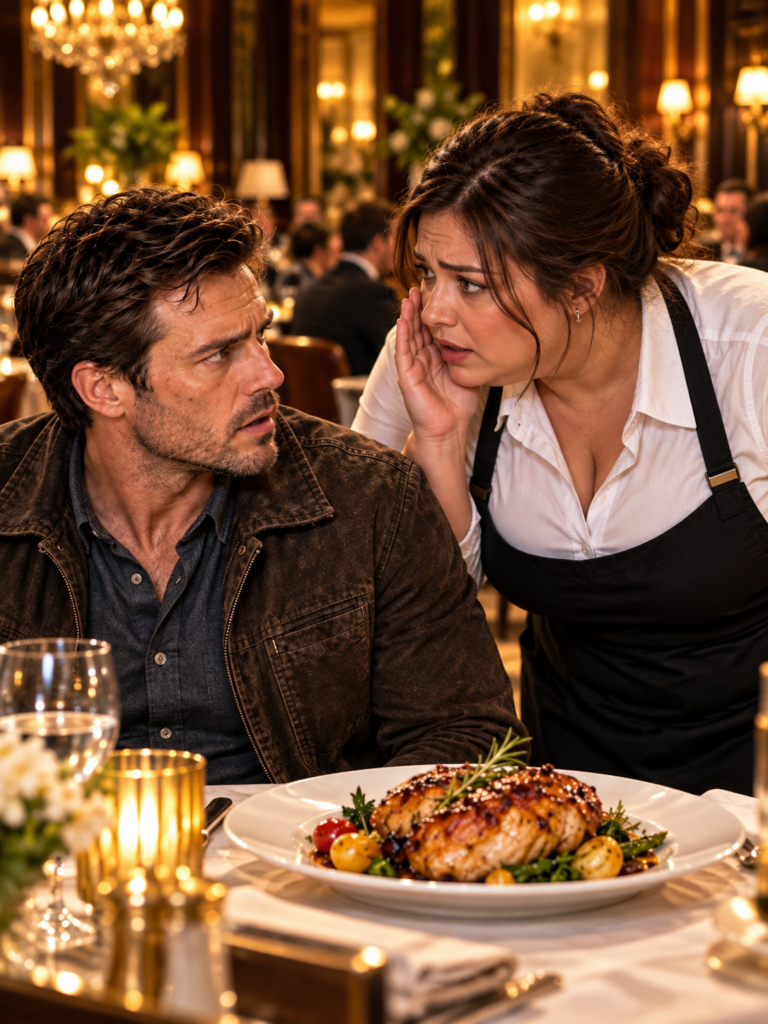
The waitress had just placed a beautifully prepared plate of roasted chicken in front of Ethan Cole when she realized she might be about to destroy her own life.
Across the elegant dining room, her manager was watching.
The restaurant was crowded with well-dressed couples, wealthy businesspeople, and guests enjoying an expensive Friday evening. Crystal glasses reflected the warm ceiling lights. Silverware touched porcelain with delicate, expensive-sounding clicks. Somewhere near the windows, a woman laughed at something her husband had said.
Everything looked perfect.
Except the food on table thirty-two.
And the frightened young woman standing beside it.
Ethan reached for his fork.
“Sir,” she whispered.
He glanced up.
Her professional smile remained in place, but the color had disappeared from her face.
“Please don’t eat that.”
Ethan stopped moving.
“What?”
She bent toward his water glass, pretending to straighten it.
Her next words were barely audible.
“Leave. Now.”
For several seconds, he studied her expression.
She looked genuinely terrified.
What she didn’t know was that the ordinary-looking man sitting before her owned the restaurant, the building that housed it, and ten other luxury restaurants across the country.
And what Ethan didn’t know was that the woman warning him had already been threatened with losing her job for questioning the very meal sitting in front of him.
Neither of them understood how completely their lives were about to change.
Only one thing was certain.
Someone had decided Ethan Cole was too insignificant to deserve safe food.
And Lily Parker was the only person willing to prove them wrong.
Twenty-four hours earlier, Ethan Cole had been sitting in his private office at Cole Hospitality headquarters, examining a financial report that should have made him happy.
At thirty-eight, Ethan had built a restaurant company most entrepreneurs could only dream of owning.
Eleven successful locations. Hundreds of employees. Prestigious addresses. Guests who waited weeks for reservations.
His flagship restaurant, Cole House, had become a symbol of everything he believed a luxury dining experience should represent.
Precision. Elegance. Consistency.
Above all, trust.
Yet the figures on his computer screen troubled him.
Revenue was increasing. Operating margins were improving. Food waste expenses had fallen significantly.
On paper, Cole House was performing better than ever.
But employee turnover was rising.
And ingredient purchasing remained almost unchanged.
Ethan leaned back in his chair, studying the figures again.
Something didn’t fit.
A business could certainly become more efficient. Better inventory planning reduced waste. Stronger training improved productivity. Careful management protected profit margins.
But efficiency was supposed to have an explanation.
These numbers seemed almost too convenient.
He opened another report.
More resignations.
Fewer waste write-offs.
Higher profitability.
The same pattern appeared month after month.
He could already imagine the explanation his managers would provide.
Improved systems.
Better cost controls.
Stronger accountability.
Words that sounded convincing in a presentation but meant very little without the truth behind them.
Ethan closed the report.
There was another problem.
Whenever he visited Cole House, everything was flawless.
Not merely good.
Flawless.
The entrance was spotless. Every employee seemed unusually enthusiastic. Managers anticipated questions before he asked them. The kitchen looked as though it had been prepared for a magazine photo shoot.
Even the customers appeared to receive extraordinary attention.
It had taken Ethan years to recognize the weakness in those visits.
He was never seeing his restaurant as an ordinary guest experienced it.
He was seeing a performance prepared for the man who signed the checks.
The moment his arrival became known, the restaurant transformed.
Managers straightened their jackets. Employees were quietly warned. Minor problems vanished behind closed doors.
Ethan could inspect inventory, interview supervisors, and examine financial statements.
But there was one thing he couldn’t easily buy.
An honest view of what happened when nobody was trying to impress him.
By Friday afternoon, he had made his decision.
He would visit Cole House without announcing himself.
No reservation.
No executive assistant.
No tailored suit.
And certainly no expensive watch.
He wanted to discover how the restaurant treated someone who appeared to have absolutely nothing worth offering.
At six forty-five that evening, Ethan parked a short distance from the restaurant.
He sat inside his car for a moment, looking toward the illuminated entrance.
Through the windows, he could see the familiar golden glow of the dining room.
Cole House.
His first truly successful flagship.
He remembered the pride he’d felt when the restaurant opened. He had personally examined everything from the table settings to the lighting above the bar.
Tonight, however, he wasn’t interested in elegance.
He was interested in honesty.
He glanced down at his clothes.
Faded jeans.
A plain gray sweater.
An old brown jacket.
Cheap shoes.
Without his usual tailored clothing, he looked like a man who had wandered into an expensive restaurant simply because he wanted one good meal.
Perfect.
He stepped out of the car and walked toward the entrance.
The hostess looked up when he approached.
Her eyes moved first to his shoes, then to his jacket.
“Good evening,” she said.
The greeting was polite, but something in her expression had cooled.
“Do you have a reservation?”
“No.”
She checked her screen.
Ethan could see several empty tables beyond her shoulder.
“Just one?” she asked.
“Yes.”
She glanced toward the dining room before picking up a menu.
“Follow me.”
She led him past the better tables, away from the windows and the soft conversation of the main dining area.
They stopped beside the service station near the back.
Table thirty-two.
One of the least desirable places in the restaurant.
Employees constantly passed behind it. Glassware was collected nearby. The kitchen corridor opened only a few steps away.
Ethan pulled out the chair.
“Thank you.”
The hostess gave a brief nod and left.
He watched her return to the entrance, where another couple had just arrived.
The man wore an expensive-looking suit.
The woman’s handbag was unmistakably designer.
The hostess’s face brightened immediately.
She smiled.
She laughed.
And within moments, she was leading them toward one of the attractive tables Ethan had noticed sitting empty.
He looked down at his own faded jacket.
Interesting.
He took out no notebook and made no complaint.
Instead, he quietly observed.
A few minutes later, a young waitress approached.
“Good evening. I’m Lily. I’ll be taking care of you tonight.”
Ethan looked up.
She was around twenty-nine, with dark hair pulled neatly away from her face. A white shirt and black apron made up the restaurant uniform. Her expression was composed, although the faint shadows beneath her eyes suggested a long day.
Unlike the hostess, she didn’t inspect his clothes.
She didn’t glance toward his shoes.
She simply handed him a menu.
“Can I start you with something to drink?”
“Just water, please.”
“Of course.”
No disappointment.
No attempt to persuade him to order an expensive bottle of wine.
No change in her voice.
She returned a moment later with a glass of water, placed it carefully beside his menu, and asked whether he needed more time.
Ethan studied the menu.
“What would you recommend?”
Lily looked down.
“The roasted chicken is usually one of our most popular dishes.”
Then she stopped.
It was a small hesitation, but Ethan noticed it.
Her fingers tightened slightly around her order pad.
“Actually,” she continued, “the pasta is especially good tonight.”
He raised an eyebrow.
“You changed your recommendation.”
A faint smile appeared.
“Just making sure you know your options.”
“What’s wrong with the chicken?”
“Nothing,” she said too quickly.
Ethan watched her.
He had spent years negotiating contracts and studying people across conference tables. He knew the difference between someone carefully choosing words and someone speaking freely.
Lily was being careful.
Very careful.
“I think I’ll have the chicken,” he said.
For the briefest moment, distress crossed her face.
“Are you certain?”
“Yes.”
She looked toward the kitchen.
Then back at him.
“All right, sir.”
“Ethan,” he said.
She blinked.
“My name is Ethan.”
“Then I’ll put that order in for you, Ethan.”
She offered a small, distracted smile and walked away.
Ethan watched her disappear through the kitchen doors.
Something was wrong.
And he had the uncomfortable feeling it involved his dinner.
Earlier that evening, Lily Parker had stood inside the restaurant’s walk-in refrigerator staring at a container of chicken that should no longer have existed in usable inventory.
The container had been marked for disposal.
She knew because she’d seen the previous label.
She remembered the date.
She remembered the unusual smell when the container had been opened during preparation.
And she remembered watching a kitchen employee set it aside after questioning whether it was still safe to serve.
Now there was a new label.
A fresh date.
As though the previous warning had never existed.
Lily stared at it.
Then she found the kitchen supervisor.
“That chicken is still here.”
He barely looked at her.
“Talk to Mark.”
“It was supposed to be discarded.”
“I said talk to Mark.”
Lily followed his gaze toward the manager’s office.
Mark Harris stood near the doorway, examining something on a tablet.
He was a man who believed every problem could be solved by making someone else too frightened to mention it.
Lily had learned that during her two years at Cole House.
At first, Mark had seemed demanding but professional. Over time, his approach changed.
Questions became insubordination.
Complaints became negativity.
And employees who challenged his decisions discovered their schedules had suddenly become less generous.
Lily approached him.
“Mark, we need to talk about the chicken.”
He continued looking at his tablet.
“What about it?”
“It was marked for disposal.”
“Then the original label was wrong.”
“No. I saw it myself.”
Mark finally raised his eyes.
“Lily, you work in the dining room.”
“I know where I work.”
“Then focus on your customers.”
“That food shouldn’t be served.”
His expression hardened.
“You’re not qualified to make that determination.”
“Then have someone properly check it.”
“I already have.”
She looked at him.
“Who?”
Mark set down the tablet.
“Be very careful how you speak to me.”
Lily felt her stomach tighten.
She needed this job.
Desperately.
Her apartment rent had recently increased. Her younger sister was staying with her temporarily, and what little money Lily had managed to save was disappearing into bills faster than she could replace it.
She had already lost two valuable Friday shifts after questioning earlier food-handling practices.
Two shifts that normally paid some of her best tips.
Another reduction could leave her choosing which bills to pay first.
Mark knew it.
He also knew how much control a schedule gave him over the employees who depended on it.
“You’ve already been warned,” he said quietly. “Do you really want to lose more hours?”
Lily looked toward the refrigerated container.
“This isn’t about my hours.”
“Then stop making it about your employment.”
He stepped around her.
“Get back to work.”
She remained still for a moment.
Then, because the dining room was filling and she needed her paycheck, she returned to the floor.
She told herself she would keep watching.
She would refuse to serve anything she knew was unsafe.
She would find some way to report it again.
But fifteen minutes later, the man in the old brown jacket ordered the roasted chicken.
And everything became much worse.
Mark noticed the order ticket as it entered the kitchen.
“Table thirty-two?”
The kitchen supervisor nodded.
“Roasted chicken.”
Mark glanced through the service opening.
A man sat alone near the back.
Old jacket.
Cheap shoes.
A glass of water.
No wine.
No companion.
No reservation.
Mark looked back at the kitchen supervisor.
“Use the older batch.”
Lily had just entered to check another order.
She stopped.
“No.”
Mark turned slowly.
“Excuse me?”
“You told me that chicken wasn’t being served.”
“I told you to do your job.”
“It needs to be thrown away.”
Mark moved closer.
His voice dropped low enough that the busy kitchen continued working around them without responding.
“If you challenge me one more time tonight, you’ll be looking for another job before midnight.”
Lily felt her face grow hot.
She looked toward the chef preparing the order.
Nobody met her eyes.
That was another thing she’d learned about Cole House.
People didn’t have to agree with Mark to obey him.
They only had to be afraid of what would happen if they didn’t.
Minutes later, the plate was ready.
It looked extraordinary.
Golden roasted chicken rested beside elegant vegetables. Fresh herbs decorated the sauce. The presentation was exactly what customers expected from a luxury restaurant.
Nothing about the dish revealed what had happened behind the kitchen doors.
And that made Lily feel sick.
She picked up the plate.
For several seconds, she couldn’t move.
She could carry it to the table and say nothing.
She could pretend she didn’t know.
She could protect her schedule, her paycheck, and the fragile stability of the small apartment she shared with her sister.
Or she could warn the stranger.
The stranger who would probably eat his meal, pay his bill, and disappear from her life forever.
She thought about her rent.
Then she imagined him getting sick.
She had already watched management erase warnings from containers and dismiss concerns from employees.
If she stayed quiet now, she wouldn’t merely be obeying orders.
She would be helping them.
Lily started walking.
Ethan looked up as she arrived.
“Roasted chicken,” she said.
“Looks excellent.”
“Thank you.”
He reached for his fork.
Lily saw Mark watching from across the room.
She leaned toward the water glass.
“Please don’t eat that.”
Ethan stopped.
His eyes moved from her face to the plate.
“What’s wrong?”
“I can’t explain here.”
“Is it unsafe?”
She swallowed.
“Please.”
Her gaze flickered toward Mark.
“Just leave.”
Ethan slowly placed the fork beside his plate.
“Are you telling me there’s something wrong with my dinner?”
Lily struggled to keep her expression pleasant for anyone watching.
“I’m asking you not to eat it.”
“Why?”
“Because I don’t want you getting hurt.”
He studied her.
There was no performance in her eyes.
Only fear.
Not fear for herself alone.
Fear for him.
“What’s your name again?”
“Lily.”
“Lily, you realize you could lose your job for warning me?”
Her mouth tightened.
“Yes.”
“Then why would you do it?”
She looked at the untouched chicken.
For a moment, her voice almost failed.
“Because losing my job would be awful.”
She raised her eyes to his.
“But knowing I let someone get hurt when I could have stopped it would be worse.”
Ethan felt something shift inside him.
He had entered Cole House hoping to expose careless management.
Instead, he had found a waitress willing to sacrifice her livelihood to protect someone she assumed had no power at all.
He glanced at the plate.
“Bring me the check.”
Relief appeared on her face.
“Of course.”
“But I’m not leaving until I understand what’s happening.”
The relief vanished.
“Ethan, please.”
“Someone deliberately served me food you’re afraid to let me eat. I want to know why.”
“You don’t understand.”
“Then help me understand.”
She looked across the room again.
“If I tell you everything, I’ll be fired.”
He almost answered with the truth.
You won’t be. I own this place.
The words were right there.
But he stopped himself.
If he revealed who he was, the investigation would change instantly.
Mark would apologize.
The kitchen would suddenly become spotless.
Employees would become cautious, and everyone would start telling Ethan whatever they believed their wealthy employer wanted to hear.
He needed to know what was really happening.
And Lily had already risked too much for him to waste her courage on an impulsive revelation.
A shadow fell over the table.
Mark Harris had arrived.
“Good evening, sir. Is there a problem with your meal?”
Ethan leaned back.
“I’ve changed my mind.”
Mark looked at the untouched chicken.
“May I ask why?”
“I’m not hungry anymore.”
Mark’s eyes moved toward Lily.
“Did something happen?”
“No,” Ethan replied.
The manager smiled without warmth.
“Of course. We hope you’ll give us another opportunity.”
“I’ll pay for the meal.”
“Very well.”
Mark stood there a moment longer, studying Lily.
Then he walked away.
Ethan waited until he was out of earshot.
“Has this happened before?”
Lily said nothing.
That silence was more disturbing than an answer.
“Other customers have been served questionable food?”
Her fingers tightened around the edge of her order pad.
“Sometimes people complain.”
“And what happens to those complaints?”
She looked at him.
“They disappear.”
Ethan felt cold anger settle beneath his ribs.
“How?”
“I can’t explain here.”
She picked up his untouched plate.
“There’s a service alley beside the restrooms.”
He waited.
“Five minutes,” she whispered.
Then she turned and walked back toward the kitchen.
Ethan remained seated for several seconds, looking at the empty place where the dangerous meal had rested.
He had wanted to know whether his managers treated ordinary people fairly.
Now he was beginning to wonder whether they treated ordinary people as expendable.
And the answer was waiting for him in an alley behind his own restaurant.
Part 2
The service alley smelled of wet pavement, discarded cardboard, and the lingering heat from the restaurant kitchen.
Ethan stood near the side wall, his old jacket pulled around him against the evening air.
A metal door opened.
Lily stepped outside carrying a trash bag.
She immediately looked toward both ends of the alley.
“You shouldn’t still be here.”
“You asked me to come.”
“I didn’t know if you would.”
She crossed to the waste container and dropped the bag inside.
For a moment, neither spoke.
Through the wall, Ethan could hear the faint hum of the kitchen ventilation system.
He looked at her.
“Tell me what’s happening.”
She folded her arms.
“Why do you care so much?”
“Because I nearly ate something you believed could hurt me.”
“You didn’t.”
“Someone else might.”
That answer seemed to reach her.
She looked down at the pavement.
“It started a few months ago.”
Ethan remained quiet.
“At first it seemed like management was just trying to reduce waste. They said we were throwing away too much food because our standards were unnecessarily strict.”
“What changed?”
“Dates. Mostly.”
“Expiration dates?”
“Internal use dates. Food that was supposed to be discarded would get another day. Then sometimes another.”
She rubbed her fingers together, remembering.
“People were told the original labels were overly cautious. Mark said the company had become obsessed with procedures and that we’d all lose hours if profits didn’t improve.”
Ethan thought of the financial reports.
The shrinking waste expenses.
The unusually strong margins.
“Did it stop there?”
Lily shook her head.
“Damaged produce would get trimmed and used. Some sauces stayed longer than policy allowed. Refrigerated ingredients weren’t always discarded when employees questioned them.”
“Did you report it?”
“Yes.”
“To Mark?”
“At first.”
“And after he ignored you?”
“To corporate.”
Ethan’s attention sharpened.
“Corporate?”
“Anonymous complaints. More than one person submitted them.”
“What happened?”
She gave a small, humorless laugh.
“Nothing. Except Mark somehow found out.”
Ethan stared at her.
“What do you mean, found out?”
“He read part of a complaint during a staff meeting.”
Ethan stopped moving.
“An anonymous complaint?”
“Yes.”
“From the company’s internal reporting system?”
“As far as we knew.”
He looked away for a moment.
Cole Hospitality had procedures designed specifically to prevent that.
Employees were supposed to be able to report misconduct without fear of retaliation.
Local managers were not supposed to learn who had submitted confidential complaints.
If Mark had obtained those reports, either the system had failed spectacularly or someone with greater authority was helping him.
Neither possibility was acceptable.
“Did he identify the employee?”
“Not directly. He didn’t need to.”
Lily looked toward the kitchen door.
“People got scared.”
“Did anyone lose their job?”
“A prep cook named Sam kept reporting problems. His schedule went from almost forty hours a week to sixteen. Eventually he quit.”
Ethan’s face remained controlled.
But his fingers had curled against his palms.
“And you?”
“I’ve already lost shifts.”
“Because you complained?”
She shrugged.
“Mark calls it scheduling based on business needs.”
“Convenient.”
“He’s very good at making things sound reasonable.”
Ethan looked at her more carefully.
She wasn’t exaggerating for sympathy.
She sounded exhausted.
The exhaustion of someone who had repeated the truth so many times that being believed had begun to feel impossible.
“What about inspections?” he asked.
“The kitchen suddenly becomes perfect.”
“How does Mark know when to prepare?”
“I don’t know.”
She hesitated.
“But everyone knows when it’s time to clean things up.”
Ethan considered the implications.
The problem was no longer a single manager stretching the boundaries of food safety.
Someone might be protecting that manager from inside the organization.
He looked toward the restaurant.
“And the chicken tonight?”
Lily’s expression darkened.
“That was worse.”
“Why?”
“Because Mark picked your table.”
Ethan turned back.
“Picked it?”
She nodded.
“When there’s something they want to use before they have to throw it out, he looks at the dining room.”
“And?”
“He decides which customers are least likely to complain.”
For a moment, Ethan thought he had misunderstood.
“Which customers?”
“People who are alone. Tourists. Sometimes older customers. People who order inexpensive meals. People who don’t look like they can afford a lawyer or make trouble.”
Her eyes drifted toward his brown jacket.
Ethan followed her gaze.
“People like me.”
Lily looked ashamed.
“Yes.”
The word settled between them.
Ethan had expected snobbery.
Perhaps poor service.
Perhaps the indignity of being seated beside a service station because his clothes looked cheap.
He had not expected the appearance of poverty to determine whether someone received food management knew had been questioned.
“So Mark looked at me,” Ethan said, “and decided I wasn’t important enough to worry about.”
Lily’s voice softened.
“I’m sorry.”
“You didn’t make that decision.”
“No. But I work here.”
“You also stopped me from eating it.”
She looked at him.
“I nearly didn’t.”
Ethan waited.
“I stood in the kitchen for a long time with that plate. I kept thinking about my rent. My sister. The shifts I’ve already lost.”
Her voice grew quieter.
“I kept trying to find a way to do the right thing without losing everything.”
“And then?”
“There wasn’t one.”
Ethan felt that answer more strongly than he expected.
For years he had spoken about integrity in management meetings.
He had approved employee handbooks emphasizing honesty and accountability.
He had signed messages telling staff to do the right thing, even when doing so was difficult.
But Lily had been forced to make that choice with something real at stake.
Her rent.
Her employment.
The financial security of someone she loved.
He had the luxury of calling integrity a corporate value.
She had to pay for it.
“Why me?” he asked.
She frowned.
“What?”
“You didn’t know me. I wasn’t especially friendly. I ordered one of the cheapest drinks on the menu. Why take that risk?”
Lily thought about the question.
Then she answered.
“Because you were alone.”
Ethan said nothing.
“Mark looked at you and decided you wouldn’t fight back. And I kept thinking, if I stayed quiet too, then he’d be right.”
There was no dramatic flourish in her voice.
She simply believed what she was saying.
Ethan looked at the woman standing in an alley behind the restaurant he’d built.
Her shoes were worn from long shifts. Her sleeves were rolled neatly to her elbows. She still had work to finish before she could go home.
He felt a strange, painful admiration.
She had shown him more about his company in ten minutes than months of executive reporting had managed to reveal.
The kitchen door opened.
Both turned.
Mark stood in the doorway.
“Lily.”
She stiffened.
“I was taking out the trash.”
“For ten minutes?”
“I was just coming back.”
Mark looked at Ethan.
His expression sharpened.
“Why are you still here?”
Ethan kept his voice calm.
“Just leaving.”
“Then I suggest you do that.”
Lily looked down.
Ethan met Mark’s eyes.
Something inside him wanted to end the deception immediately.
To tell the man exactly who owned the restaurant.
To watch the contempt disappear from his face.
But anger wasn’t evidence.
And Ethan needed enough evidence that Mark could never dismiss what happened as a misunderstanding.
“Good evening,” Ethan said.
He walked past the manager and left the alley.
He didn’t look back.
Twenty minutes later, Ethan sat inside his car with his phone pressed to his ear.
Daniel, Cole Hospitality’s operations director, answered on the third ring.
“Ethan?”
“I need a complete review of Cole House.”
Daniel heard something in his voice.
“What kind of review?”
“Purchasing records. Waste reports. Employee complaints. Inspection history. Vendor invoices. Scheduling changes. Everything from the last twelve months.”
A pause.
“What’s happened?”
Ethan watched the restaurant through his windshield.
“Someone warned me not to eat dinner tonight.”
Another pause.
“I’m sorry?”
“I went to Cole House without announcing myself.”
“Why didn’t you tell me?”
“Because I wanted to see what happened when nobody knew I owned the place.”
“And?”
Ethan thought about Lily’s face.
“Someone tried to serve me food a waitress believed should have been discarded.”
Daniel swore quietly.
“Are you certain?”
“Certain enough to investigate immediately.”
“I’ll contact regional management.”
“No.”
“Ethan—”
“Not yet.”
Daniel became quiet.
Ethan explained what Lily had told him about confidential complaints appearing in Mark’s possession.
When he finished, Daniel understood.
“You think someone above Mark is involved.”
“I think we shouldn’t rule it out.”
“What do you want me to do?”
“Pull the records independently. Limit access. Don’t warn the restaurant.”
“Understood.”
“And Daniel?”
“Yes?”
“Find everything you can about Lily Parker’s employment history.”
“The waitress?”
“Yes.”
“What specifically?”
“Every shift she lost after submitting a complaint. Every disciplinary note. Every change to her schedule.”
Daniel paused.
“Did she tell you all this?”
“She told me enough.”
Ethan looked toward the restaurant entrance.
“And she did it believing I couldn’t help her.”
Inside Cole House, Lily finished her shift under a cloud of growing dread.
Mark barely spoke to her for the rest of the night.
Somehow, that was worse than shouting.
He watched her work.
Watched the tables she approached.
Watched her carry empty plates toward the kitchen.
Lily kept doing her job.
She refilled water glasses, processed payments, answered questions, and thanked customers for coming.
Her hands didn’t shake until she finally reached the staff area near midnight.
The new schedule had been posted.
She scanned the names.
Then stopped.
Friday.
Gone.
Saturday.
Gone.
Sunday.
Gone.
Her three most profitable shifts had disappeared.
For a moment she couldn’t breathe properly.
She checked again, hoping she’d read the schedule incorrectly.
But her name wasn’t there.
Below the schedule was a note.
Lily Parker — see Mark before your next shift.
She stood very still.
Rent was due soon.
Her sister needed a stable place to stay.
And Lily had spent years trying to build a life that didn’t collapse every time something went wrong.
She pressed her lips together.
The man in the brown jacket had left safely.
That should have been enough.
But as she gathered her belongings, she couldn’t stop wondering whether Ethan had believed her.
Maybe he’d gone home thinking she’d overreacted.
Maybe he would never visit the restaurant again.
Maybe she had just sacrificed her job for someone who would forget her by morning.
She pulled on her coat and stepped into the night.
At least he hadn’t eaten the chicken.
She held on to that thought all the way home.
By Saturday morning, Ethan had stopped thinking of the problem as an isolated violation.
Daniel’s preliminary findings were worse than either of them had expected.
The financial records revealed a consistent pattern.
Food waste expenses had dropped dramatically.
Purchasing remained relatively stable.
The restaurant’s profitability had improved.
But the improvement wasn’t supported by any meaningful reduction in the amount of food being purchased.
Ethan stood in his office while Daniel spread the reports across the desk.
“These numbers don’t tell us exactly what was served,” Daniel said, “but they strongly suggest food that should have been discarded remained in use.”
Ethan studied the reports.
“Look at the timing.”
Daniel followed his finger.
Several months earlier, waste expenses had begun dropping.
Shortly afterward, employee complaints increased.
Then staff turnover rose.
Ethan looked at the dates again.
“The employees noticed.”
“Yes.”
“And management punished them for saying something.”
Daniel opened another folder.
“We found complaint records.”
Ethan looked up.
“How many?”
“Enough to establish this wasn’t a one-time concern.”
The documents included reports about relabeled ingredients, pressure to alter waste records, and retaliation against employees who questioned unsafe practices.
Some complaints described incidents in specific kitchen areas.
Others described scheduling changes following reports.
There were repeated concerns about the same management decisions.
And almost every complaint had been closed.
Ethan read the approval names.
One name appeared again and again.
Paul Bennett.
Regional director.
Seven years with Cole Hospitality.
A man Ethan had trusted with considerable responsibility.
He looked at Daniel.
“How long has Paul known?”
“We’re still checking exactly what he knew and when. But the complaint approvals run through his office.”
Ethan slowly lowered the paper.
Paul had joined the company during a difficult expansion period.
He had helped standardize operations, coordinate managers, and keep several locations profitable.
Ethan had considered him reliable.
Not warm.
Not especially inspiring.
But reliable.
Now his signature appeared on reports employees believed had vanished into a useless system.
Daniel placed another record beside the first.
“We also found indications that employees were scheduled for fewer hours after raising concerns.”
Ethan searched for Lily’s name.
There it was.
Earlier complaints.
Reduced shifts.
A disciplinary warning.
And a pattern that made the likely motive painfully clear.
“How long?” Ethan asked.
“At least eight months of documented concerns.”
Ethan turned away from the desk.
Outside the office windows, the city continued moving as though nothing had changed.
He thought of the speeches he’d given about leadership.
The managers he’d promoted.
The systems he’d believed would protect the people who worked for him.
His company had been growing while employees were being punished for trying to prevent harm.
“Prepare legal,” he said.
Daniel nodded.
“And the food safety team?”
“Immediately.”
“Should we contact the restaurant?”
“No.”
Ethan returned to the desk.
“Not until we’re standing inside it.”
While Ethan was uncovering the records, Lily spent Saturday morning searching job listings.
She sat at the small kitchen table in her apartment, a mug of coffee growing cold beside her laptop.
Her younger sister was in another room.
Lily had told her only that work was becoming difficult.
She hadn’t explained how frightened she was.
The first restaurant listing offered fewer hours.
The second was too far away.
The third looked promising until Lily read the schedule requirements.
Late-night transportation would cost more than she could comfortably afford.
She opened another application.
Then another.
After almost an hour, she rested her forehead against her hand.
She wasn’t afraid of working hard.
She had done that all her adult life.
She was afraid of working hard and still losing the small amount of stability she’d managed to create.
At three thirty, she closed the laptop.
Mark had ordered her to attend a meeting at four.
She knew what the meeting was about.
She just didn’t know whether she would walk out of Cole House with a job.
Before leaving the apartment, she checked her phone.
No message from the man she’d warned.
Of course there wasn’t.
She hadn’t given him her number.
He was a stranger.
A man who had happened to sit at her table on the wrong evening.
She hoped he was safe.
Then she went to face Mark.
At four o’clock, Lily stood outside the manager’s office.
Mark sat behind his desk.
A single document waited in front of him.
“Close the door.”
She obeyed.
“Sit down.”
“I’d rather stand.”
He looked irritated but said nothing.
Instead, he pushed the paper toward her.
“Read this.”
Lily picked it up.
Her eyes moved over the accusations.
Insubordination.
False statements regarding food quality.
Improper communication with a guest.
Failure to follow management instructions.
She read the first paragraph twice.
“This says I lied.”
Mark leaned back.
“You created unnecessary concern over perfectly usable food.”
“The chicken should have been discarded.”
“We’ve already discussed that.”
“You changed the date.”
“I told you there was a labeling error.”
“And I told you I saw the original label.”
Mark’s expression became flat.
“Lily, you seem determined to make this difficult.”
“I didn’t create the problem.”
“You disobeyed a direct instruction.”
“I stopped someone from eating food I believed was unsafe.”
“You frightened a customer.”
“Because you wouldn’t listen.”
He tapped the document.
“Sign it.”
She looked down.
The statement required her to acknowledge wrongdoing and accept the disciplinary action.
It also contradicted everything she knew had happened.
“What happens if I sign?”
“We move forward.”
“With my shifts restored?”
“That depends on your attitude.”
There it was.
Not an apology.
Not a promise.
Only another opportunity for Mark to keep control.
She thought of the empty schedule.
Her sister.
Her rent.
The bills waiting on the kitchen table.
Then she remembered Ethan raising his fork.
The plate.
The few seconds in which she could still choose to warn him.
Lily set the document down.
“I can’t sign this.”
Mark stared at her.
“Think carefully.”
“I have.”
“You’re making a mistake.”
“No.”
She pushed the document toward him.
“I’d be making a mistake if I agreed to something that wasn’t true.”
Mark’s face reddened.
“Then I don’t think you belong here.”
The words hurt more than she’d expected.
Two years.
Two years of early arrivals, difficult shifts, sore feet, and missed evenings with family.
Two years of trying to do her job well.
And all of it could apparently be erased because she refused to pretend something unsafe was acceptable.
Mark pointed toward the door.
“You’re fired.”
Lily stood motionless.
Her eyes burned.
She refused to let him see her cry.
“All right,” she said.
She turned and opened the door.
She had barely reached the staff corridor when the main restaurant entrance opened.
Several people walked inside.
A tall man carrying a professional-looking folder led the group.
Two attorneys followed.
Behind them came the head of Cole Hospitality’s food safety team.
The dining room manager hurried forward.
“Can I help you?”
The man with the folder spoke calmly.
“I’m Daniel, from corporate operations. We need immediate access to the kitchen, inventory records, storage areas, and management computers.”
Mark emerged from his office.
“What is this?”
Daniel turned.
“An internal investigation.”
Mark looked from one face to another.
“Nobody told me anything.”
“That was intentional.”
The front door opened again.
And the man Lily had warned the night before stepped inside.
But there was no faded sweater.
No old brown jacket.
No cheap shoes.
He wore a dark tailored suit, a crisp white shirt, and polished shoes.
His posture was familiar.
His face was unmistakable.
Lily stopped breathing for a moment.
It was Ethan.
The stranger from table thirty-two.
Mark stared at him.
“You?”
Ethan walked toward the center of the restaurant.
“Yes, Mark.”
“Why is that customer here?”
Daniel closed the folder in his hands.
“He isn’t a customer.”
Mark looked confused.
Daniel continued.
“This is Ethan Cole. He owns Cole Hospitality.”
Lily’s hand moved instinctively toward the edge of the counter.
Cole.
The name above the restaurant.
The name on the company website.
The billionaire whose photograph occasionally appeared in business magazines.
The supposedly powerless customer.
The man she had risked her job to protect.
Ethan looked across the dining room.
His gaze found Lily.
For one brief moment, the controlled expression on his face softened.
Then he turned back toward Mark.
“Now,” Ethan said, “we need to have a conversation.”
Part 3
Mark Harris had spent years learning how to sound confident in front of powerful people.
He could explain disappointing figures without sounding defensive.
He could make staffing problems appear temporary.
He could describe cost cutting as innovation and employee dissatisfaction as resistance to change.
But now, standing in his own dining room with the owner of Cole Hospitality watching him, he seemed unable to find the right words.
“Mr. Cole,” he began, “I wasn’t aware you were visiting.”
“I know.”
“If there was a problem last night, I’m sure we can resolve it.”
Ethan said nothing.
Mark glanced toward Daniel and the attorneys.
“Perhaps we should speak privately.”
“No.”
The answer was quiet.
But it ended the discussion.
Ethan placed a folder on the nearest table.
“I’d prefer that the people affected by your decisions hear what we’re discussing.”
Employees had begun gathering near the kitchen entrance.
Some looked frightened.
Others appeared cautiously curious.
Lily remained near the staff corridor, still holding the small bag containing her belongings.
Mark noticed her.
His eyes narrowed.
Ethan saw the look.
“Don’t look at Lily.”
Mark turned back.
“She misunderstood what happened.”
“Did she?”
“She made accusations about kitchen procedures she wasn’t qualified to evaluate.”
Ethan opened the folder.
“Then perhaps you can explain these records.”
He placed a waste report on the table.
Mark glanced at it.
Then a second document.
“Employee complaints.”
Another.
“Scheduling changes.”
A fourth.
“Inventory discrepancies.”
Mark’s professional smile had disappeared.
“These figures need context.”
“Then provide it.”
“We were under pressure to improve margins.”
“From whom?”
“Corporate expectations.”
Ethan watched him.
“What expectations?”
“Profitability. Efficiency. Lower waste.”
“And did anyone instruct you to serve food employees had identified as needing disposal?”
Mark shifted his weight.
“That’s an unfair characterization.”
Ethan looked toward the kitchen.
“Was the chicken served to table thirty-two last night taken from a batch that had previously been marked for disposal?”
Mark’s mouth opened.
Then closed.
“The labeling situation was complicated.”
“That wasn’t my question.”
The employees near the kitchen exchanged uncertain looks.
Ethan continued.
“I was sitting at table thirty-two.”
Mark’s gaze moved toward the back of the restaurant.
For the first time, he seemed to understand exactly how much Ethan had witnessed.
“I know what I was served,” Ethan said. “And I know an employee warned me not to eat it because she believed it was unsafe.”
Mark turned toward Lily.
“She’s been making—”
“I told you not to look at her.”
Ethan didn’t raise his voice.
He didn’t need to.
Mark faced him again.
“Mr. Cole, yesterday was an isolated incident.”
“Then why do the complaints describe the same practice over several months?”
“We’ve been improving operations.”
“By changing labels?”
“By reducing unnecessary waste.”
“Against employee objections?”
“Some employees don’t understand the business.”
Ethan let the words sit for a moment.
Then he opened another document.
“This report describes refrigerated ingredients kept after employees questioned their condition. This one describes altered waste records. This one describes disciplinary pressure after a complaint.”
Mark swallowed.
“We have to make difficult decisions.”
“Yes,” Ethan replied. “And you’re accountable for yours.”
The room had grown unusually quiet.
Even the staff who normally kept moving during management conversations were listening.
Mark looked toward the table.
“We served hundreds of guests without complaints.”
“That’s not evidence the food was safe.”
“We weren’t trying to hurt anyone.”
Ethan studied him.
“Then why was that particular meal assigned to my table?”
Mark hesitated.
“I don’t understand.”
“Last night, you looked into the dining room and chose which customer would receive the older batch. Why me?”
“That wasn’t how it happened.”
Ethan waited.
Mark glanced toward the documents.
Then toward Daniel.
Finally, his frustration overcame his caution.
“It was a low-risk table.”
The words landed with a weight Mark didn’t seem to anticipate.
Ethan remained perfectly still.
“Low risk?”
Mark knew immediately that he’d said too much.
“I mean, from a customer complaint standpoint.”
“Explain.”
“Someone dining alone. No reservation. No expensive order.”
“Go on.”
Mark’s eyes shifted.
“You didn’t look like someone who would make trouble.”
Ethan slowly nodded.
There it was.
The truth Lily had described in the service alley.
Not confusion.
Not an innocent mistake.
A calculation.
Ethan looked toward table thirty-two.
He could still picture the water glass, the plate of chicken, and Lily’s frightened expression.
“You thought I was unimportant,” he said.
Mark said nothing.
“You saw my clothes. You saw that I was alone. You decided I was unlikely to complain if something went wrong.”
“I wouldn’t put it that way.”
“But that’s what you did.”
Ethan turned toward the employees.
“And that is why we’re not talking about one mislabeled container.”
He looked back at Mark.
“You decided that some customers deserved less protection than others.”
Mark began to speak, but Ethan continued.
“Older customers. Tourists. People who look poor. People eating alone. Anyone you believed lacked the money or influence to challenge you.”
He touched the folder.
“You reduced waste expenses by making other people carry the risk.”
No one interrupted him.
“And when your employees tried to stop it, you used their schedules and their jobs against them.”
Mark lowered his eyes.
Ethan looked toward Lily.
“The woman you treated as disposable was the one person who refused to let me eat that meal.”
Lily felt tears gathering.
She had imagined this confrontation a hundred different ways during the night.
In none of them had she expected the man from table thirty-two to be standing in the middle of the restaurant defending her.
But what affected her most was not his expensive suit.
It was the fact that he remembered.
He remembered what she’d told him.
He believed her.
And he was making certain nobody could pretend she’d said nothing.
The investigation began immediately.
Mark was suspended from his position while the food safety team inspected the kitchen and reviewed inventory records.
Questionable ingredients were separated for assessment and disposal.
Access to records was secured.
Staff members were interviewed individually so they could describe concerns without Mark standing nearby.
The restaurant’s operations were temporarily halted.
For Ethan, closing Cole House was not a comfortable decision.
He knew exactly what it meant.
Lost revenue.
Cancelled reservations.
Disappointed customers.
Questions from business partners.
Damage to the reputation he’d spent years building.
But reopening before the problems were understood would mean preserving appearances at the expense of people’s safety.
And he had finally seen what happened when appearances became more important than the truth.
He would not repeat the mistake.
By the end of the day, the restaurant was closed pending further review.
The investigation expanded beyond Mark.
Daniel and the attorneys examined the internal complaint process.
The evidence led repeatedly to Paul Bennett, the regional director Ethan had trusted for seven years.
As the review continued, investigators confirmed that Paul had suppressed employee complaints and warned restaurant management about inspections.
The allegations that had initially appeared to concern only one restaurant manager exposed a larger failure of oversight.
Paul was removed from his position.
Mark’s suspension became part of a broader disciplinary and accountability process after months of violations and employee retaliation were confirmed.
Ethan insisted that the reporting structure itself be redesigned.
It wasn’t enough to remove the people who had misused it.
The system had allowed them to do so.
Confidential complaints would no longer be accessible to the local and regional managers whose conduct those complaints might concern.
Independent reviewers would handle sensitive reports.
Employee retaliation would be reviewed separately from ordinary scheduling decisions.
Food safety findings would have to be documented rather than dismissed through vague management assurances.
Ethan sat through every major briefing.
He studied the records.
He listened to employees.
And each time someone described being afraid to speak, he remembered Lily standing beside his table with her smile frozen in place.
He had built a company that talked constantly about respecting guests.
Somewhere along the way, he’d failed to ensure that employees were treated with the same respect.
That realization stayed with him.
A week after the investigation began, Lily received a request to return to Cole House for a meeting.
She read the message twice.
Ethan Cole wanted to speak with her.
Personally.
By then, she knew more about the man she’d warned.
His company owned eleven restaurants.
His business success had made him a billionaire.
He had been featured in financial publications and interviewed about leadership.
People described him as private, disciplined, and unusually attentive to detail.
Those descriptions felt strange to Lily.
She remembered someone else.
A man in an old jacket who had thanked her for a glass of water.
A man who had listened when she was frightened.
A man who had refused to leave because he wanted to understand why a stranger was warning him.
She was grateful for what he’d done.
But gratitude didn’t erase the uncomfortable fact that he’d concealed his identity.
She had told him things she might never have said if she’d known she was speaking to the owner.
And she wasn’t sure how she felt about being unknowingly involved in his investigation.
Still, she agreed to meet him.
When she arrived, Cole House was quiet.
The elegant dining room remained closed to guests.
The atmosphere was different without the noise of service.
There were no conversations rising from occupied tables, no glasses being collected, no staff hurrying between the kitchen and dining room.
The absence of activity made the restaurant feel almost unfamiliar.
Ethan stood beside table thirty-two.
He wasn’t wearing the dark suit from the investigation.
Instead, he’d chosen a simple blue shirt and dark trousers.
No lawyers.
No executives.
Just him.
“Lily.”
“Mr. Cole.”
He smiled faintly.
“Ethan is fine.”
She approached slowly.
Then stopped across the table from him.
“You lied to me.”
The statement surprised him only slightly.
He nodded.
“Yes.”
She folded her arms.
“You let me think you were an ordinary customer.”
“I was an ordinary customer that evening. At least, I wanted to be treated like one.”
“But you owned the restaurant.”
“Yes.”
“And you knew you had the power to fire Mark.”
“I did.”
“While I was standing there wondering whether I could afford groceries if he took away another shift.”
Ethan’s expression changed.
He pulled out a chair.
“Would you like to sit?”
Lily looked at it.
Then sat.
He took the chair opposite her.
For a moment, the two of them faced each other across the same table where everything had begun.
“I didn’t know what was happening when I arrived,” Ethan said.
“Why were you there?”
“The financial reports were wrong. Not mathematically. They were telling a story I didn’t trust.”
“So you decided to test everyone.”
“I decided to see how the restaurant operated when nobody knew I was watching.”
“And you didn’t think employees might be hurt by that?”
He considered her question.
“I knew there was a risk. I didn’t understand how serious it was.”
Lily looked toward the empty kitchen corridor.
“I was scared.”
“I know.”
“No,” she said. “I don’t think you do.”
Ethan didn’t interrupt.
“I went home that night believing I’d lose my job. I woke up the next morning searching for work. I spent hours trying to figure out how to keep paying rent.”
She paused.
“And the whole time, you were someone who could have changed everything with one phone call.”
Ethan looked down at the table.
She was right.
He had needed evidence.
But his need to understand the business had not eliminated the cost his employee was paying.
“I should have thought more carefully about what my silence meant for you,” he said.
Lily studied him.
She’d expected an explanation.
Maybe a justification.
Not an admission.
“I was trying to protect the investigation,” he continued. “But that doesn’t mean your fear was any less real.”
She looked away.
“I still can’t believe you ordered the chicken.”
His mouth curved.
“You recommended it.”
“For approximately two seconds.”
“Long enough.”
“It was a terrible recommendation.”
“Your correction was memorable.”
Despite herself, she laughed.
The sound surprised both of them.
For the first time since they’d met, the tension between them eased.
Ethan leaned back slightly.
“I wanted to thank you.”
“You already did.”
“Not properly.”
“You don’t have to give me anything.”
“I know.”
She looked at him.
He continued.
“I’m not offering you a reward for warning me. You did the right thing without expecting one.”
Lily remained quiet.
“But I’ve been thinking about something. Cole Hospitality needs a different way to understand what happens inside our restaurants.”
“What do you mean?”
“Independent visits. Direct conversations with employees. Reviewing concerns that get buried in ordinary reporting. Finding the problems polished presentations don’t reveal.”
She listened.
“We’re creating a small guest integrity team.”
Lily frowned.
“Okay.”
“I’d like you to interview for a position.”
She blinked.
“Me?”
“Yes.”
“As what?”
“Someone who helps us see what our existing systems have missed.”
She stared at him.
“Ethan, I don’t have a business degree.”
“I have plenty of people with business degrees.”
“I’ve never worked in corporate operations.”
“That’s true.”
“Then why would you want me?”
“Because you understand what happens on the restaurant floor. You recognize when management explanations don’t match reality. And you were willing to challenge something wrong when it carried a real personal cost.”
Lily looked down at her hands.
She wanted to feel excited.
Instead, she felt uncertain.
“Are you offering this because I saved you?”
Ethan answered carefully.
“I’m offering you an interview because your actions showed qualities the position requires.”
“That sounds very corporate.”
He smiled.
“Occupational hazard.”
She didn’t smile back.
“I’m serious.”
“So am I.”
His expression softened.
“You didn’t warn me because I owned eleven restaurants. You warned me because you believed I was a stranger with no influence.”
He paused.
“You would have protected anyone sitting in that chair.”
Lily looked toward table thirty-two.
She remembered every second of that night.
Her fear.
Her hesitation.
The fork in Ethan’s hand.
Her own voice telling him to leave.
“Yes,” she said quietly. “I would have.”
“That’s why I want you to interview.”
She thought about the job.
About the possibility of doing something that mattered beyond carrying plates and collecting tips.
About helping other employees speak without fearing the loss of their livelihoods.
But she also thought about the man seated opposite her.
He was powerful.
She was unemployed.
And she had no intention of allowing gratitude to become an obligation.
“If I interview,” she said, “I want to be treated like every other candidate.”
“You will.”
“And if I disagree with you?”
“I suspect you will.”
“Often.”
“Probably.”
She watched his face.
He wasn’t offended.
If anything, he seemed pleased.
“I want the freedom to tell you when something’s wrong,” Lily said.
“Especially then.”
She took a slow breath.
“All right.”
Ethan waited.
“I’ll interview.”
For the first time that afternoon, he smiled without restraint.
“Good.”
The interview was not a formality.
Lily met with the team responsible for developing the new integrity function.
She discussed difficult customer interactions, scheduling practices, food safety reporting, and the ways employees learned to distinguish between policies that existed on paper and policies management actually enforced.
She knew some questions better than others.
When she didn’t know an answer, she admitted it.
When she disagreed with an assumption, she explained why.
And when someone asked how employees could be encouraged to report concerns, she gave a response that stayed with everyone in the room.
“Don’t just tell them it’s safe to speak,” she said. “Make sure they don’t lose their livelihood afterward.”
She was offered training.
She accepted.
The work challenged her.
She learned how to evaluate incident reports, identify suspicious patterns, and document concerns objectively.
She learned to recognize the difference between an isolated error and repeated conduct requiring investigation.
There were days when the unfamiliar corporate language frustrated her.
There were meetings where she felt out of place.
But she gradually discovered that her years in restaurant service had taught her more than she realized.
She understood the rhythm of a kitchen.
The pressure of a busy shift.
The difference between an employee making an honest mistake and someone hiding a problem out of fear.
Her experience gave the new team a perspective it had previously lacked.
And Ethan noticed.
Over the following months, they spent more time together than either had expected.
At first, almost every conversation concerned work.
Restaurant standards.
Customer complaints.
Management accountability.
Ways to protect employees from retaliation.
Lily disagreed with him regularly.
Sometimes she challenged the assumptions behind proposals he’d initially considered straightforward.
Once, during a discussion about complaint handling, she told him that the process looked excellent from an executive’s desk but would feel intimidating to a twenty-year-old server worried about paying rent.
Ethan listened.
Then asked her how she would change it.
That became the pattern between them.
He brought experience building and operating a large company.
She brought the perspective of someone who had lived with the consequences of management decisions.
Neither always agreed.
But each learned to trust the other’s judgment.
And slowly, the conversations changed.
One evening, after a long discussion about employee training, Lily asked him whether he ever stopped working.
Ethan looked genuinely puzzled.
“Of course.”
“When?”
He considered.
“Occasionally.”
“That doesn’t count.”
He laughed.
It was an unfamiliar sound to people who knew him only from business meetings.
Another time, he asked about her sister.
Lily told him she was doing better.
The apartment was still small, but things felt less precarious.
Her new position had given her a kind of stability she hadn’t expected to find.
She asked about his family.
He spoke carefully at first.
Then more openly.
He admitted that wealth made some relationships strangely difficult.
People often seemed to agree with him before he’d finished speaking.
Some wanted access.
Others wanted approval.
Very few appeared comfortable telling him he was wrong.
Lily gave him a skeptical look.
“Maybe you should try being wrong less often.”
Ethan laughed again.
“An ambitious strategy.”
They began discussing music.
Childhood memories.
Mistakes they’d made.
The quiet loneliness of feeling responsible for other people.
Lily discovered that Ethan’s confidence did not mean he was free from doubt.
He could make decisions affecting hundreds of employees, yet struggle with the knowledge that he had failed to see what was happening inside his own flagship restaurant.
Ethan discovered that Lily’s courage was not the absence of fear.
She worried about people.
About money.
About whether she was qualified for her new responsibilities.
But fear had never prevented her from caring.
That distinction mattered to him.
Their connection did not develop through grand gestures or expensive gifts.
It developed through ordinary moments.
Conversations that lasted longer than necessary.
A shared joke after a difficult meeting.
The way Ethan began asking Lily what she thought before settling on a decision.
The way Lily stopped feeling she needed to hide uncertainty when speaking with him.
There was attraction between them.
Neither pretended otherwise forever.
But neither rushed to turn the relationship into something it wasn’t ready to become.
Lily valued the independence she’d worked so hard to regain.
Ethan respected it.
And they both understood that the trust growing between them mattered more than a dramatic declaration.
Months after the investigation, Cole House reopened.
The kitchen had undergone an independent food safety review.
Questionable inventory had been discarded.
New management was in place.
Employee reporting procedures had been rebuilt.
The reopening was deliberately quieter than the grand events Ethan had once associated with success.
He didn’t want the evening to become a performance celebrating executives.
He wanted the restaurant to function properly for the people who entered it.
That was the achievement that mattered.
On the first evening, Ethan invited Lily to dinner.
Not a meeting.
Not a work discussion.
Dinner.
She accepted.
When she arrived, a host greeted her and led her through the elegant dining room.
Warm lights illuminated the tables.
Fresh flowers stood in small arrangements.
The quiet conversation of guests filled the air.
Everything looked familiar.
Yet Lily could feel the difference.
She no longer had to glance toward the manager’s office wondering who might be watching.
She no longer had to pretend not to notice something wrong.
For the first time in a long time, Cole House felt like a place where she could simply enjoy being present.
Then she saw Ethan.
He was standing beside table thirty-two.
Lily stopped.
“You cannot be serious.”
He pulled out her chair.
“Good evening.”
She looked around.
“Of all the tables in this restaurant.”
“I requested the best one.”
She gave him an incredulous look.
“This is beside the service station.”
“An important historical location.”
“Ethan.”
“It has sentimental value.”
She laughed and sat down.
He took his seat opposite her.
For a moment, they looked at each other across the same table where she’d once begged him not to eat his dinner.
So much had changed.
Ethan no longer wore the old jacket.
But the man beneath the expensive clothes was more familiar to Lily now than he’d been that first night.
And Lily was no longer the frightened waitress whose entire livelihood depended on whether her manager approved of her.
She had work she believed in.
A voice that was heard.
A future that felt increasingly like her own.
A server approached with menus.
Ethan opened his.
His eyes traveled down the page.
Lily noticed.
“Don’t even think about it.”
He looked up innocently.
“Think about what?”
“The chicken.”
“I wasn’t going to order it.”
“You were looking at it.”
“I was reading the menu.”
“You’re terrible at pretending.”
He smiled.
“Pasta, then.”
“Much safer.”
They both laughed.
The server took their orders and left them alone.
For several minutes, the conversation moved easily.
They talked about the reopening, the team, and the small changes Lily had noticed while walking through the restaurant.
But eventually, a quiet moment settled between them.
Ethan looked toward the place where her plate would soon arrive.
“Do you ever think about that night?”
Lily followed his gaze.
“Yes.”
“Often?”
“Sometimes.”
“What do you think about?”
She considered.
“How close I came to saying nothing.”
Ethan remained quiet.
“I was so frightened,” she admitted. “I remember standing there with the plate, telling myself that maybe someone else would notice. Maybe the kitchen would stop it. Maybe I should just do what I’d been told.”
“But you didn’t.”
“No.”
“Why?”
She looked at him.
It was a question he’d asked before.
But it felt different now.
Months had passed.
They knew each other.
She understood the man behind the company name.
He understood the woman who had once been too afraid to challenge her manager openly but too principled to remain silent.
“Because Mark looked at you and decided you didn’t matter,” she said.
Ethan didn’t move.
“He saw your clothes. The fact that you were alone. He decided you were someone he could take a risk with.”
She paused.
“And I kept thinking that if I stayed silent, I’d be making the same decision.”
Ethan looked at her for a long moment.
He had received praise for building his company.
Awards.
Recognition.
Invitations to speak about leadership.
But he could not remember any of those things affecting him the way her words did.
“You changed more than one restaurant, Lily.”
She shook her head.
“You did that.”
“I had the authority.”
“Exactly.”
“But authority means very little if nobody is willing to tell you the truth.”
Lily looked down.
He continued.
“I built systems I trusted. I hired people I believed in. And somewhere along the way, I stopped asking whether the people at the bottom of the organization felt as safe as the people at the top.”
She listened.
“You made me see that.”
Her expression softened.
“You listened.”
“Eventually.”
She smiled.
“Yes. Eventually.”
Ethan glanced toward her hand resting on the table.
For a moment, he seemed less certain than she’d ever seen him.
He moved his hand forward and placed it beside hers.
Not on top of it.
Not claiming it.
Simply close enough that she could choose whether to close the distance.
Lily looked down.
Then she slowly placed her hand over his.
Ethan smiled.
Neither spoke immediately.
They didn’t need to.
There was no dramatic announcement.
No audience.
No promise too large to keep.
Only two people sitting at a table that had once represented everything wrong with the restaurant.
Now it held something neither had expected to find there.
Trust.
Respect.
And the beginning of love.
Later that evening, when the server brought their dinner, Ethan looked at the plate of pasta in front of him.
Lily caught the faint smile on his face.
“What?”
“Nothing.”
“Ethan.”
He looked across the table.
“I was just thinking about how this all started.”
“With you making a terrible dinner choice?”
“With me trying to understand some suspicious financial reports.”
“And instead?”
He glanced around the dining room.
The restaurant was busy again.
Employees moved confidently between tables. Guests laughed and talked. The kitchen continued its work behind the doors.
Then he looked back at Lily.
“Instead, I learned how little I knew about the place I thought I understood best.”
She watched him.
“And?”
He smiled gently.
“And I met someone who was willing to protect a stranger even when she had every reason to be afraid.”
Lily felt warmth rise into her cheeks.
“You make it sound heroic.”
“It was.”
“I was scared the whole time.”
“That doesn’t make it less brave.”
She lowered her eyes to their hands.
For years, Lily had believed that surviving meant keeping her head down, doing her job, and refusing to give anyone a reason to threaten the small security she’d built.
That night had taught her something different.
Sometimes courage meant speaking when silence would be easier.
Sometimes doing the right thing came with a cost.
And sometimes the person who appeared powerless was the one who could change everything.
Ethan had entered Cole House disguised as an ordinary customer because he wanted to discover whether wealth changed the way people treated him.
He had expected better service for wealthy guests.
Perhaps colder smiles for those who looked poor.
He hadn’t expected a manager to decide that a person who appeared unable to complain was an acceptable target for food that should never have been served.
And he hadn’t expected a waitress with almost nothing to spare to become the person who protected him.
He could have arrived wearing a luxury suit.
The manager would have recognized him.
The kitchen would have been spotless.
The staff would have received warnings.
And the questionable meal would never have reached his table.
He would have gone home believing his flagship restaurant was operating exactly as it should.
Lily would still have been frightened to speak.
Other employees would still have been punished for reporting problems.
And the numbers on his desk would have continued telling him that everything was fine.
Instead, one woman refused to treat a stranger as disposable.
Her choice uncovered the truth.
It helped bring accountability to people who had abused their authority.
It gave frightened employees the opportunity to be heard.
And it brought two people into each other’s lives who might otherwise have remained strangers forever.
As Ethan sat across from Lily that evening, he understood something no financial report could teach him.
Power reveals very little about the character of people who know you possess it.
The deeper truth appears when they believe you have none.
Lily Parker hadn’t protected Ethan Cole because he was a billionaire.
She had protected him because she believed he was an ordinary man who deserved to be safe.
And that was precisely why, from the moment she whispered her warning, Ethan had never been able to look at her as ordinary again.


