
I turned toward her.
“What do you mean, you knew?”
Mom’s hand remained against mine, trembling.
“I knew somebody was going to send it.”
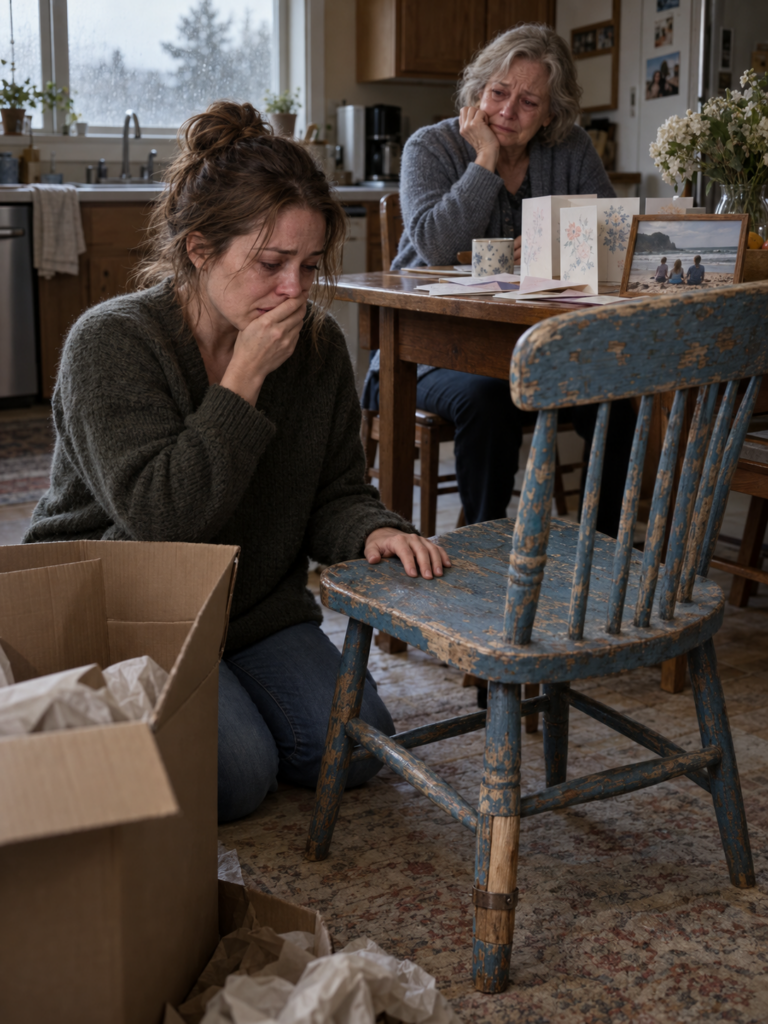
I looked at the enormous box, the packing paper scattered across the floor, and the old chair standing between us.
“Who?”
Mom lowered her eyes.
“Someone from Hawaii.”
“Someone Dad knew?”
“Yes.”
“Then why didn’t you tell me?”
She pressed her lips together.
I could hear the refrigerator humming.
The house felt unbearably quiet without Dad moving through it.
“Mom, you just begged me to throw away something that belonged to him. I think you owe me an explanation.”
She pulled her hand back.
“Sit down.”
I stayed standing.
“No. Please don’t do that.”
“Do what?”
“Ask me to sit down every time there’s something you don’t want to say.”
She looked wounded.
I immediately felt guilty.
Grief had made both of us sharper. We were two exhausted people standing in the kitchen where my father had eaten breakfast almost every morning.
But I couldn’t pretend not to see what was happening.
I pointed at the chair.
“You knew that was coming. You knew it belonged to him. And the moment it arrived, you wanted it gone.”
Mom looked at the floor.
“Because he was supposed to see it.”
“Then why didn’t he?”
Her face crumpled.
“He never knew it was on the way.”
That answer made my stomach twist.
I looked down at the repaired leg.
Somebody in Hawaii had kept this chair for decades.
Somebody had packed it carefully.
Somebody had paid to ship it across the Pacific Ocean and the mainland.
And Dad had died before it arrived.
“Was it a surprise?” I asked.
Mom nodded.
“Whose idea?”
She took a long breath.
“Mine.”
I stared at her.
“You?”
She nodded again.
For a few seconds, I couldn’t find the words.
My mother, who had spent my childhood looking miserable whenever Dad mentioned Hawaii, had arranged for his old chair to be sent here.
It made no sense.
“Why?”
She didn’t answer immediately.
Instead, she reached toward the backrest and ran one fingertip along the chipped paint.
“Your father used to joke that this chair leaned as much as he did.”
I looked at the uneven legs.
“He actually sat in it?”
“Every day, from what he told me.”
“At the foster home?”
“Yes.”
“And someone kept it all this time?”
Mom nodded.
I thought about the photograph.
It was still in the junk drawer where Dad always kept it.
I walked across the kitchen and pulled open the drawer.
Dead batteries rolled against takeout menus.
Underneath them lay the little photograph, its corners softened from years of handling.
I carried it back to the table.
“Is this the foster family?”
Mom looked.
Her expression changed.
“Yes.”
I studied it more carefully than I ever had.
The beach was almost colorless.
Several teenagers stood near a cooler. A woman was beside them, while someone crouched in the sand.
I remembered the way Dad held the picture.
His thumb never rested on the ocean.
It always found the little group of people.
“He wasn’t looking at the beach,” I whispered.
Mom shook her head.
“Not usually.”
Suddenly, an old memory came back.
I was about twelve.
Dad and I were sitting on the back porch after rain had soaked the yard.
He said that sometimes, in Oregon, the air smelled almost like the place where he’d grown up.
I asked whether he missed it.
He smiled.
“More than you know.”
“Then let’s go,” I told him.
He laughed, ruffled my hair, and said maybe someday.
I had believed him.
Children tend to believe someday is a promise.
Now I was thirty-two, and my father had died without ever keeping it.
“Why didn’t he go back?” I asked.
Mom rubbed her hands together.
“At first, he couldn’t afford it.”
That part was easy to understand.
Dad moved to Oregon at twenty. He was young, working hard, building a life on the mainland.
“Then he got a better job,” she continued. “But by then there were responsibilities. Bills. Later, there was you.”
I looked at her.
“Are you saying he didn’t go because of us?”
“No.”
She answered firmly.
“Don’t put that on yourself, Annie.”
“Then what changed?”
Mom stared at the photograph.
“He thought he’d stayed away too long.”
I frowned.
“Too long for what?”
“To come back.”
“That doesn’t make sense.”
“I know.”
“They were his family.”
Mom hesitated.
“He didn’t use that word easily.”
I remembered how Dad rarely talked about the people he’d known before moving here.
He told me about Hawaii as a place, not as a collection of names.
The food.
The rain.
The early morning birds.
Never the people waiting around the kitchen table.
“He was ashamed,” Mom said quietly.
“Of being in foster care?”
“No. Of leaving and never returning.”
I looked at the blue chair.
“But he was twenty.”
“Yes.”
“He had a job opportunity.”
“Yes.”
“Didn’t they want him to go?”
“They encouraged him.”
The contradiction made me angry.
“Then what was he ashamed of?”
Mom gave a helpless little shrug.
“One year became five. Five became ten. He started thinking he couldn’t just walk back into their lives and expect everything to be the same.”
“But he could have called.”
“He did, sometimes.”
That stopped me.
“He called them?”
“Not often.”
“Who?”
“People from the foster home.”
“What people?”
She rubbed the edge of a condolence card.
“There was a girl named Ruth. She lived there when your father did.”
“Is she the one who sent the chair?”
Mom nodded.
I stared at her.
“How did you know where to find her?”
“Christmas cards.”
I almost laughed, but there was nothing funny about it.
“Christmas cards?”
“They kept sending them.”
“For how long?”
“Years.”
“Did Dad answer?”
“Sometimes.”
I looked at the photograph again.
For most of my life, I’d believed the people in that picture belonged to some closed chapter of Dad’s past.
But they had been sending him Christmas cards.
He knew they existed.
They knew he existed.
And somehow, an ocean and a few thousand miles had turned into a distance none of them could cross.
“Why didn’t you tell me?”
Mom’s shoulders sagged.
“I thought your father would when he was ready.”
“He never was.”
“No.”
I turned toward the window.
Outside, the sky hung low and gray over our backyard.
Dad used to stand there watching the rain.
He would say it was colder here, heavier.
I used to tease him about how everything reminded him of Hawaii.
Now I wondered how many times he’d been remembering people instead.
I faced Mom again.
“There’s something else.”
She looked up.
“When I asked Dad why you got upset whenever he talked about Hawaii, he told me that if I knew the whole story, I wouldn’t be angry with you.”
Mom closed her eyes.
I waited.
“What happened between you two?”
She was quiet for so long I thought she might refuse.
Then she said, “I was jealous.”
That was not the answer I expected.
“Of whom?”
“Hawaii.”
I stared at her.
She gave a small, humorless laugh.
“I know how ridiculous that sounds.”
“Mom…”
“When we first married, your father compared everything to Hawaii. The rain, the fish at the grocery store, the coffee. Even sunsets.”
Despite myself, I smiled.
“That sounds like him.”
“It was constant.”
Her expression grew distant.
“We were living in a little apartment. I was trying to make it feel like home. And every time I thought we’d done something nice, he’d tell me how people did it back in Hawaii.”
I could imagine him.
Dad never meant to hurt anyone with his memories.
But I could also imagine my mother, young and trying to build a marriage, feeling as though she were always losing to a place she’d never seen.
“One night,” she said, “I finally snapped.”
“What did you say?”
She looked ashamed.
“I told him that if Hawaii was so wonderful, maybe he should have stayed there.”
I swallowed.
“What did he say?”
“He got very quiet.”
She stared at her wedding ring.
“Then he told me about the foster home.”
I glanced at the blue chair.
“He told me that the first time he’d felt certain he belonged somewhere was at that kitchen table.”
Mom began crying again.
“He wasn’t comparing me to a beautiful island, Annie. He was remembering the first place he could sit down for dinner without wondering whether there would be room for him.”
I couldn’t speak.
“He told me about that chair. How it wobbled. How the family kept fixing it instead of getting rid of it.”
Her hand settled on the table.
“That was when I understood how cruel I’d been.”
I sat down across from her.
“Did you apologize?”
“Of course.”
“Did he forgive you?”
“Immediately.”
She looked at me.
“Your father was good at forgiving people.”
I thought of the way Dad would make a joke after an argument, even when he was still hurt.
It was true.
But something troubled me.
“If you felt so guilty, why didn’t you want him to go back?”
Mom’s head snapped up.
“Annie, I did.”
“Then why did you always get upset when he talked about it?”
“Because I remembered what I’d said.”
“Every time?”
“Sometimes I remembered that. Sometimes I was angry he wouldn’t give himself permission to go.”
She looked down.
“And sometimes I was frightened that if he went, he’d realize how much he’d missed.”
That last admission hurt because it was so human.
“You were afraid he wouldn’t come back?”
“Not exactly.”
She hesitated.
“I was afraid he’d finally find something I couldn’t give him.”
I looked at the photograph.
The woman beside the cooler was barely visible.
Dad had loved Mom.
I had never doubted that.
But the blue chair told me there were parts of belonging that no marriage could replace.
Mom took a shaky breath.
“I spent years suggesting trips.”
“When?”
“When you were ten, for one. I told him we could save for tickets.”
“What did he say?”
“Too expensive.”
“Was it?”
“At the time, probably.”
She gave a sad smile.
“After his promotion, I suggested it again. Then he was too busy.”
I remembered Dad working late during those years.
“And for our twenty-fifth anniversary, I suggested Hawaii.”
I looked up.
“I remember that.”
They’d gone to the Oregon coast instead.
Dad had called it a wonderful trip.
“Why didn’t he agree?”
“He said the people he knew were probably gone.”
“But you had their Christmas cards.”
“Yes.”
“Did you tell him that?”
“Of course.”
I rubbed my forehead.
Nothing about this made sense until I remembered how Dad handled anything that frightened him.
He postponed it.
A difficult conversation.
A doctor’s appointment.
Fixing the garage door.
He’d say he’d get around to it when he had time.
Sometimes he did.
Sometimes he didn’t.
But this wasn’t a garage door.
This was fifty years of distance.
Mom reached for the photograph.
“One summer, I told him I’d buy the ticket myself.”
“What did he say?”
“Next year.”
Her voice broke.
“Always next year.”
I sat there staring at my father’s old chair.
“Then why send it now?”
Mom looked toward the box.
“Because the house in Hawaii was being cleared.”
I waited.
“Ruth and I had been in contact. She told me the chair was still there.”
“After all these years?”
“Yes.”
“Why would anyone keep it?”
Mom’s eyes filled.
“Because it was Gilbert’s.”
There was something about the way she said it that made my chest ache.
“Ruth laughed when I asked about it,” Mom continued. “She said, ‘We still have the silly thing.'”
I glanced at the repaired leg.
“She remembered him?”
“Of course she did.”
I leaned forward.
“And you asked her to send it?”
“Yes.”
“Why?”
Mom looked at me with an exhaustion that seemed older than the past two weeks.
“I thought if the chair was here, your father would finally understand that the people he left behind hadn’t erased him.”
I felt tears rising.
“That was your plan?”
“I wanted to set it at the table before he came home from work.”
She looked toward the empty doorway.
“Then I was going to ask him one more time.”
“To go to Hawaii?”
She nodded.
“To stop being afraid.”
Her voice sank to a whisper.
“He had a place there, Annie. He always had a place.”
I studied the dark carved letters beneath the seat.
Suddenly, the package was no longer mysterious.
It was an invitation that had arrived too late.
The woman who’d spent decades hiding her discomfort about Hawaii had been trying to bring a small piece of it into our home.
I reached across the table and took her hand.
“Mom, why didn’t you just tell me?”
She began crying again.
“Because he was supposed to be sitting in that chair when you found out.”
I closed my eyes.
I pictured Dad coming home, putting down his keys, and stopping in the kitchen doorway.
I pictured his face when he recognized the chipped blue paint.
Would he have laughed?
Would he have cried?
Would he finally have booked the ticket?
We would never know.
And that uncertainty was almost worse than the answer.
For a long time, neither of us moved.
Then my eyes landed on the torn shipping label.
Below the address was a contact number.
A Hawaii number.
I picked up the cardboard and turned it toward the light.
“Mom?”
She looked up.
“Ruth might still be waiting for Dad to call.”
Mom followed my gaze to the number.
I took out my phone.
“Someone needs to tell her.”
Mom reached across the table.
“Annie, what if she doesn’t know?”
“Then she deserves to.”
I typed the number.
My thumb hovered over the call button.
Mom looked at the blue chair, then at me.
“She knew him before I did,” she whispered.
I pressed call.
The phone began to ring.
And suddenly, I was terrified of what the woman on the other end might say.
The phone rang four times.
Then a woman’s voice answered.
“Hello?”
I looked at the name carved beneath the blue chair.
My throat tightened.
“Hello. My name is Annie. I’m calling from Oregon.”
“Yes?”
“I’m Gilbert’s daughter.”
Silence.
I thought perhaps the connection had dropped.
Then the woman spoke again, so softly I almost missed it.
“Gilbert had a daughter?”
I closed my eyes.
Of all the things she could have said, that was the one that hurt most.
“Yes,” I managed. “He did.”
There was a small sound on the other end.
Then the woman laughed shakily.
“Well, I’ll be.”
Mom leaned forward.
I put the call on speaker.
“I’m sorry,” the woman said. “I just… goodness. He never told us.”
My eyes moved to the photograph.
“He didn’t tell me about you either.”
The silence that followed was different.
Not suspicious.
Not angry.
Just the silence of two people realizing how much they had missed.
“My name is Ruth,” she said.
I felt Mom’s hand close around mine.
“Mom’s here with me,” I said. “She knows who you are.”
“Is that so?”
Mom leaned closer.
“Hello, Ruth.”
“Oh, hello.”
Something softened in Ruth’s voice.
“Did it arrive?”
I looked at the chair.
“Yes.”
“Good. I was worried about the shipping. That old thing has been through enough already.”
She chuckled.
“We packed it as well as we could.”
I tried to smile.
Ruth continued.
“Is Gilbert there?”
The room seemed to contract around us.
Mom made a small, strangled sound.
I gripped the phone tighter.
“Ruth, there’s something I need to tell you.”
She became quiet.
“My dad was in a car accident.”
I swallowed.
“Two weeks ago.”
No answer.
“He didn’t survive.”
For several seconds, all I could hear was the faint hiss of the connection.
Then Ruth whispered, “Oh, no.”
Mom covered her mouth.
“I’m so sorry,” I said. “The chair was shipped before it happened. Dad never got to see it.”
Ruth inhaled sharply.
“Oh, Gilbert.”
The way she said his name was so familiar, so full of an older grief, that tears spilled down my face.
I had called to deliver terrible news to a stranger.
But she wasn’t a stranger to him.
She had known my father when he was a boy.
Long before he became the man who taught me to ride a bike, who whistled while washing dishes, who pretended he liked every terrible birthday cake I made.
Ruth had known him before any of that.
“I’m sorry,” she whispered.
“We are too.”
Nobody spoke for a while.
Then Ruth asked, “Was he happy?”
The question startled me.
“Happy?”
“Yes. Did he have a good life?”
I looked at Mom.
She was crying silently.
“He did,” I said. “He worked hard. He loved my mom. He loved me.”
Ruth exhaled.
“I’m glad.”
Then she added, “I always hoped he was happy.”
I wiped my cheeks.
“You kept his chair.”
“Oh, yes.”
“For all those years?”
“Why wouldn’t we?”
I looked at the blue backrest.
“It just seems like such a long time.”
“It is a long time,” she admitted.
Then her voice grew warmer.
“But it was Gilbert’s.”
I glanced at Mom.
Ruth sounded surprised that I needed another explanation.
“People sat in it,” she continued. “Kids came through the house. Somebody broke one of the legs. We repaired it. But nobody ever thought it stopped being his.”
I looked at the darker piece of wood supporting the seat.
“That’s why the leg looks different.”
“Exactly.”
She laughed softly.
“It was always a stubborn chair.”
“So was Dad.”
“Oh, was he ever.”
For the first time since the accident, I laughed without feeling guilty.
Ruth noticed.
“Did he still cheat at cards?”
I sat straighter.
“What?”
“Cards. He used to sneak a look whenever he thought nobody was watching.”
I smiled through my tears.
“He absolutely did.”
Mom gave a watery laugh.
“He insisted it wasn’t cheating if you weren’t caught.”
Ruth laughed.
“That’s Gilbert.”
I had heard Dad say those exact words during family game nights.
The recognition felt strange.
Like discovering a familiar room had a door I’d never noticed.
“Did he still hate papaya?” Ruth asked.
I frowned.
“Dad said he liked papaya.”
Ruth burst out laughing.
“Oh, honey. No.”
I laughed too.
“He always complained about it when we were young. Said the smell alone was enough to ruin breakfast.”
I thought about every time Dad had nodded politely when someone offered him fruit.
That was him.
Always trying to be agreeable.
“Did he still whistle when he was nervous?”
Mom and I looked at each other.
“Constantly,” I said.
Ruth chuckled.
“He used to do that when he was afraid somebody was going to scold him.”
I pictured my father at fifteen.
Not as a vague shape in an old photograph.
As an actual boy.
A nervous boy who whistled when he was worried.
A boy who cheated at cards and hated papaya.
A boy who had finally found a chair nobody else tried to claim.
I rested my palm against the worn blue wood.
“Ruth, can I ask you something?”
“Of course.”
“Why didn’t he go back?”
The laughter faded.
Ruth took her time answering.
“I’ve wondered that for years.”
“Mom said he thought he’d stayed away too long.”
“Too long for what?”
“To come home.”
Ruth went quiet.
Then she said something I knew I’d remember for the rest of my life.
“Nobody told him that.”
Mom bent forward, crying.
Ruth continued.
“We missed him. Of course we did. But there wasn’t some deadline.”
I closed my eyes.
Dad had spent decades fearing a rejection nobody had actually offered.
The chair had stayed.
The Christmas cards had come.
People had remembered him.
And he had remained convinced that time had somehow canceled his place among them.
“Mom tried to get him to go,” I said.
“I know.”
That surprised me.
“You knew?”
“She told me.”
I looked at Mom.
She wiped her cheeks.
“I contacted Ruth months ago, Annie. Remember?”
I nodded.
Ruth sighed.
“I was hoping the chair might finally do it.”
“Do what?”
“Remind him.”
I traced the chipped paint.
“Remind him of what?”
“That he had people here.”
My throat tightened.
“Ruth, were you angry with him?”
She didn’t answer immediately.
“Sometimes,” she admitted.
Mom lowered her eyes.
“I won’t pretend I never was. There were years I thought, well, he’s busy living his life. Maybe he’s forgotten about us.”
The honesty hurt.
Then Ruth added, “But I still would’ve picked him up at the airport.”
I pressed my fingertips against my mouth.
“It wouldn’t have mattered how long he’d been gone?”
“It would’ve mattered,” Ruth said gently. “We would have had a lot to talk about.”
She paused.
“But that isn’t the same as not wanting him.”
I stared at the old chair.
For years, Dad had apparently believed those were the same thing.
And perhaps that was why he never booked the ticket.
He wasn’t only afraid of their anger.
He was afraid of discovering they had learned to live without him.
Yet they had never stopped saving his place.
Mom finally spoke.
“Ruth, I’m sorry.”
“For what, dear?”
“That he didn’t make it back.”
The line was quiet.
Then Ruth said, “You don’t need to apologize for that.”
“But I wish I’d done more.”
“I think you did what you could.”
Mom began crying again.
I knew there were things neither woman could change.
Mom couldn’t go back and erase the cruel comment she’d made in their early marriage.
Ruth couldn’t travel backward through fifty years and tell Dad that nobody was counting the days against him.
And I couldn’t ask my father why he’d let shame become stronger than love.
We could only sit with what remained.
A photograph.
A chair.
A phone call that should have happened years ago.
After a while, Ruth asked what Dad had been like as a father.
I told her he was patient.
That he taught me how to change a tire.
That he used to take extra pancakes off the griddle and pretend they’d been made by accident.
That he could fix almost anything, except sometimes the things he was afraid to face.
Ruth listened.
Then she said, “He sounds like he grew into a good man.”
“He did.”
“He was a good boy, too.”
That broke me.
Because for all thirty-two years of my life, my father had been the adult.
The steady one.
The person I called when something went wrong.
I had rarely imagined him as a child who needed somebody else to be steady for him.
But Ruth had.
And somewhere in Hawaii, a family had made room for that boy.
When we finally ended the call, I kept the phone in my hand.
Mom sat quietly across from me.
The blue chair stood between us.
For the first time, I didn’t see it as a strange package from Hawaii.
I saw it as proof of a place Dad had belonged.
And I understood something that made my grief feel both heavier and gentler.
He hadn’t been forgotten.
He simply hadn’t believed he was remembered.
That evening, after Mom went upstairs to rest, I stayed at the kitchen table.
The shipping box was still open.
The faded photograph lay beside Dad’s old coffee mug.
I picked it up again.
The faces were tiny.
Some were too faded to make out.
I wondered which teenager was Ruth.
I wondered which woman had told everyone not to throw away that silly blue chair.
And I wondered how different Dad’s life might have been if he’d understood what they were really offering him.
Not a trip.
Not a vacation.
A return.
A chance to sit down without apologizing for the years he’d been gone.
The next morning, I found Mom standing in the kitchen, looking at the chair.
“Are you going to throw out the box?” she asked.
“Probably.”
She nodded.
Then she reached out and touched the blue backrest.
“Your father would’ve recognized it immediately.”
“I know.”
She looked toward the empty place where Dad used to sit.
“I wish he’d come home one more time.”
I followed her gaze.
For a moment, I wasn’t sure which home she meant.
Then Mom looked at me and said, “Annie, I’d like you to have it.”
I stared at the chair.
“Are you sure?”
She nodded.
“It was his. And now it’s yours.”
I put my hand on the backrest beside hers.
But before I could say anything, she added something I hadn’t expected.
“Only promise me one thing.”
I looked up.
“Don’t let it become another thing we keep hidden in a drawer.”
I looked from Mom to the old photograph on the kitchen table.
Then back to the blue chair.
“I won’t,” I promised.
She nodded slowly.
Her hand remained on the backrest for another moment before she let go.
I think that was the first time since Dad’s accident that either of us had spoken about the future without immediately becoming frightened of it.
The future meant living without him.
It meant deciding what to do with the things he’d left behind.
And, in some strange way, it meant deciding what to do with the pieces of his life we’d only just discovered.
Mom wanted me to take the chair.
I wasn’t sure I could.
Every time I looked at it, I remembered that Dad had never known it was coming.
I imagined the surprise Mom had planned.
Dad stepping into the kitchen.
Seeing the blue paint.
Recognizing the crooked leg.
Maybe standing there without speaking.
Maybe touching the backrest the way I had.
Mom asking him to go home.
Him making another excuse.
Or maybe, just maybe, finally saying yes.
That version of events would never happen.
For several days, I left the chair where it was.
Sometimes Mom walked past it without looking.
Other times I’d find her standing beside it, her fingertips resting on the repaired leg.
We both understood what it represented.
Not just Dad’s childhood.
All the years he had spent missing people who were still willing to see him.
One afternoon, I found Mom at the kitchen table, staring at the faded beach photograph.
“Tell me something,” I said.
She looked up.
“Anything.”
“Did Dad ever talk about the woman who raised him?”
Mom lowered her eyes to the picture.
“Sometimes.”
“What did he call her?”
“Usually just Mom, when he was talking about those years.”
I glanced at the tiny woman standing beside the cooler.
It was strange hearing that word used for someone I’d never known.
Mom noticed my expression.
“It never bothered me once I understood,” she said.
I sat across from her.
“Did he love her?”
“Very much.”
“Did she know?”
“I think so.”
Mom turned the photograph around.
“Your father said she never made a fuss over the children staying there. She just expected them to sit down and eat.”
I looked at the blue chair beside the wall.
That was such a small thing.
A chair waiting at a table.
But to a boy whose home life had become uncertain, it must have meant everything.
“Did she actually save it for him?” I asked.
“That’s what he told me.”
Mom smiled faintly.
“He said even after he moved out, she’d call it Gilbert’s chair.”
I imagined how embarrassed Dad must have felt about that.
He was the kind of person who hated being the center of attention.
He probably laughed it off.
He probably told everyone to use it.
But perhaps some part of him had been deeply grateful.
“Do you think he believed her?” I asked.
Mom considered that.
“I think he wanted to.”
I looked out the window.
Oregon rain ran down the glass in crooked lines.
Dad had lived here for decades.
He had loved our home.
He had built a life with us.
None of that was false.
But neither was the part of him that belonged to Hawaii.
He could have loved both.
I wished he’d known that sooner.
A week after the package arrived, I borrowed enough space in my car to take the chair to my apartment.
Mom watched while I carefully lifted it into the back.
“Be careful with that leg,” she said.
“I will.”
“It still wobbles.”
“I noticed.”
She stood beside the driveway, holding the faded photograph.
Then she handed it to me.
“Take this, too.”
I looked down at the little group of people standing beside the ocean.
“Are you sure?”
She nodded.
“He held onto it for a reason.”
I slid the picture carefully into my bag.
Mom looked at the chair through the car window.
“You know, I always thought he’d go someday.”
I didn’t answer.
“I thought once he retired, he’d finally stop making excuses.”
She tried to smile.
“He kept telling me we’d have time.”
I reached for her hand.
“I know.”
She squeezed mine.
Then she stepped back so I could close the car door.
Driving home with Dad’s chair in the back seat was one of the strangest experiences of my life.
The chair rattled gently whenever I hit a rough patch of road.
At one stoplight, I glanced in the mirror.
For a moment, I could almost hear Dad complaining that I’d forgotten to secure it properly.
Then I remembered he would never complain about anything again.
I cried the rest of the way home.
At my apartment, I carried the chair upstairs.
I had a small kitchen table beside the window.
Two ordinary chairs were already there.
I moved one against the wall and placed Dad’s blue chair in its place.
It didn’t quite match.
The paint was faded.
The repaired leg was darker than the others.
When I sat down, it shifted beneath me with a familiar little tap.
I almost laughed.
Mom had warned me.
Dad had joked about it decades earlier.
And apparently, despite everything, the chair still leaned.
I placed the photograph on the table.
For several minutes, I just sat there.
I thought about Ruth.
The woman who had remembered a boy from her teenage years.
I thought about the family who had kept repairing an old chair instead of throwing it out.
I thought about the Christmas cards.
About Mom buying anniversary gifts and suggesting vacations.
About Dad saying next year.
And next year.
And next year.
The realization wasn’t comforting exactly.
Dad had lost something he could never recover.
But I also understood that his absence had never erased the love waiting for him.
He hadn’t gone back.
That was true.
But he hadn’t been forgotten.
That was true, too.
And I could hold both truths without turning either one into a lie.
The following Sunday, Mom came over for coffee.
She arrived carrying a small container of cookies and the same worried expression she’d worn since the funeral.
When she stepped into my kitchen, she stopped.
I was sitting in Dad’s blue chair.
The faded photograph lay on the table between the two coffee cups.
Mom stood perfectly still.
For one terrible moment, I thought she might cry and ask me to move.
Instead, she smiled.
It was small and sad.
But it was real.
“You found a place for it.”
“Yeah.”
She walked closer.
Her hand brushed the worn backrest.
“It looks right there.”
“Even though it doesn’t match?”
She gave a quiet laugh.
“It never matched anything.”
I smiled.
“Apparently that was part of its charm.”
Mom sat across from me.
For a while, we drank coffee without speaking.
Then she reached for the photograph.
“See this woman?”
She pointed to the figure beside the cooler.
“That’s the woman who raised him.”
I leaned forward.
I’d looked at that picture hundreds of times.
But now I tried to see her properly.
Not as a tiny figure on a Hawaiian beach.
As the woman who had once made space for my father at a crowded dinner table.
The woman who’d apparently kept his place long after he left.
“She looks happy,” I said.
Mom nodded.
“I think they all were that day.”
I looked at the ocean behind them.
It wasn’t the part of the picture that mattered anymore.
The people were.
Mom turned the photograph over and rested it beside her coffee.
Then she glanced down as the chair shifted under me.
“Still does that.”
“Yeah.”
She pushed the sugar bowl toward me.
It was such an ordinary gesture.
The same gesture Dad had made a thousand times.
I took the sugar and stirred my coffee.
Outside, the rain kept falling.
For years, I’d believed my father loved Hawaii because of the beaches, the warm air, and the ocean.
Now I understood he had been remembering something much simpler.
A crowded kitchen.
A family who made room.
And an old blue chair that nobody had ever stopped calling his.
I couldn’t give Dad the trip he’d missed.
I couldn’t place him back at that table or let him hear Ruth laugh at another one of his old jokes.
I couldn’t undo the years he’d spent believing he’d waited too long.
And I couldn’t pretend Mom’s regret, or mine, would change any of that.
But I could stop treating his memories like something mysterious and dangerous.
I could keep the photograph where people would see it.
I could sit in the chair.
I could tell the truth about where my father had come from.
Not because I wanted to erase the life he’d built with us.
Because it had all belonged to him.
The foster family.
The woman beside the cooler.
The blue chair.
The young man who left Hawaii at twenty.
The husband who loved my mother.
The father who taught me to change a tire.
And the older man who kept a fading photograph in a junk drawer because he couldn’t bring himself to forget the people in it.
Mom finished her coffee.
“Do you think he’d like it here?” she asked.
I looked around my little kitchen.
At the window.
At the photograph.
At the worn blue paint.
“I think so.”
The chair rocked gently as I settled back.
Mom smiled again.
Neither of us said anything else.
For the first time since Dad died, the silence between us didn’t feel like something we were trying to hide.
It felt like room.
And I stayed in Dad’s chair.


