
Part 1
“Claire, I know you’re there. Stop ignoring me.”
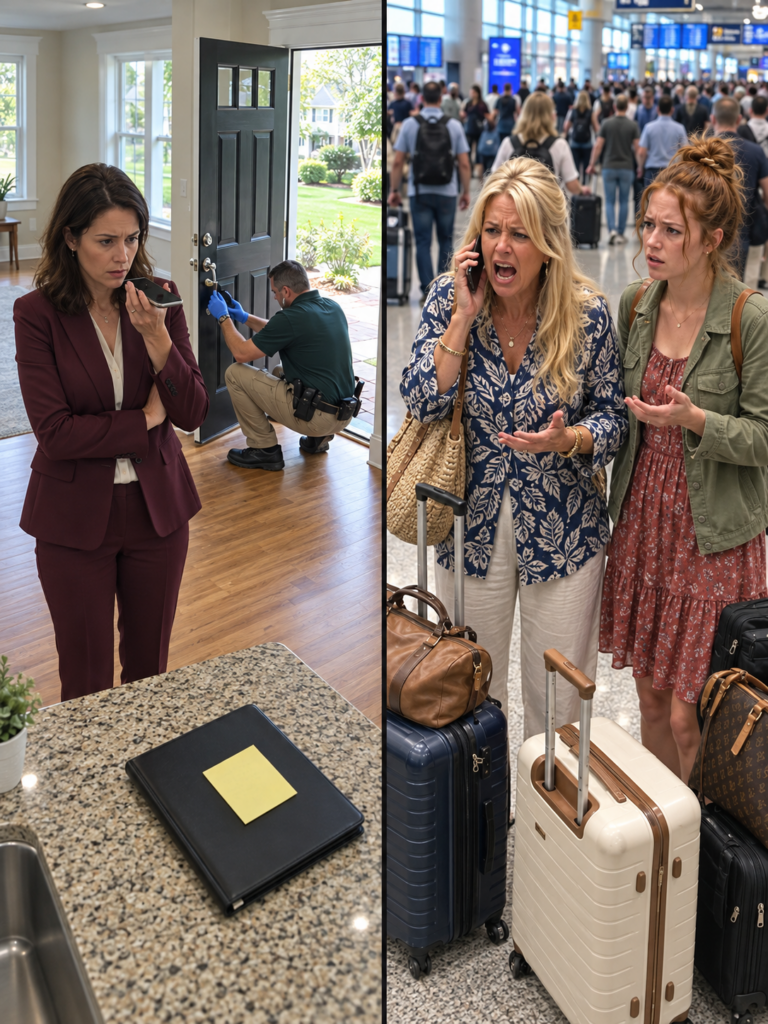
My mother’s voice came through my phone so loudly that Officer Ramirez, who was standing beside my broken front door, turned around.
I was thirty-nine years old, standing in a house I had spent eleven years paying for, and my mother was speaking to me the same way she had when I was fourteen and forgot to wash a dinner plate.
Except this time, she had taken my furniture, emptied my jewelry drawer, and attempted to transfer $500,000 out of my investment account.
And somehow, she was the angry one.
I looked at the other phone lying beside my keys. A woman named Rebecca Ellis, a senior investigator from my bank’s financial crimes department, was listening with my permission. Earlier, she had asked me not to accuse anyone directly until she had documented what happened.
Now she was hearing it herself.
“Mom,” I said, keeping my voice steady, “where are you?”
“That is none of your business.”
A public announcement echoed behind her. Something about passengers proceeding to a departure gate.
My mother, Patricia Bennett, had always dreamed of taking a first-class vacation somewhere tropical. She mentioned it every Thanksgiving, usually while looking pointedly at me.
Apparently, she had decided to stop dreaming.
“Your sister and I are in Maui,” she announced. “Or we will be, once somebody fixes this ridiculous mess.”
“What mess?”
“Don’t act innocent. Both our debit cards have been declined. The resort says our deposit isn’t going through, and your sister has been humiliated in front of everyone at the check-in desk.”
I closed my eyes.
My sister, Lauren, was thirty-four. She had never held a full-time job for more than eighteen months, but she had developed a remarkable talent for being humiliated whenever somebody expected her to pay for something.
“What does that have to do with me?”
My mother gave a sharp, humorless laugh.
“You know perfectly well. The bank is holding our money. You need to call them and tell them to remove the restriction.”
“Our money?”
“Yes, Claire. Family money. I am not having this argument with you again.”
Across the kitchen, Officer Ramirez stopped examining the damaged doorframe.
I could see the frustration on his face. He had probably heard hundreds of explanations from people who believed being related to someone entitled them to that person’s property.
I picked up the yellow paper that had been waiting for me on the counter when I came home.
It was torn from a legal pad.
My mother’s handwriting leaned heavily to the right.
Don’t bother calling. Lauren and I are finally choosing happiness. You have always cared more about things than people.
I had found it sitting exactly where my coffee maker used to be.
“Did you leave me a note?” I asked.
“What note?”
“The one on my kitchen counter.”
“Oh, that. Yes. I figured you would be upset, so I wanted to explain before you made a spectacle of yourself.”
“You broke into my home.”
“We did not break in.”
“Then why is the lock damaged?”
A pause.
“Because you changed it without telling me.”
I looked toward Officer Ramirez.
He raised his eyebrows.
“Mom, why would changing my own locks require your permission?”
“Because I am your mother.”
There it was.
The sentence she had used to end nearly every disagreement of my life.
Because I am your mother.
When I was seventeen and wanted to attend an out-of-state university, she used it.
When I was twenty-five and refused to cosign Lauren’s car loan, she used it.
When I bought this house without putting her name on the deed, she didn’t speak to me for six weeks.
And when she eventually forgave me, she made sure I understood that her forgiveness was a gift.
Now she seemed to believe that the same relationship gave her access to a lifetime of savings.
“You need to call the bank,” she said again. “They are saying the transfer is being reviewed. It was already approved. We saw the money.”
Rebecca sent a message to my other phone.
Ask how she got access.
I swallowed.
“How did you transfer money from my account?”
My mother sounded almost pleased to have an opportunity to explain.
“With the legal authorization you signed.”
“What authorization?”
“The power of attorney, Claire. Don’t tell me you have forgotten it.”
I glanced down at my hands. They were trembling.
Seven years earlier, when I underwent surgery to remove a benign tumor, I had signed a temporary financial authorization so my mother could pay my mortgage and utilities if I remained hospitalized longer than expected.
It had been a frightening period. My father had died the year before, and despite our strained relationship, I still believed my mother was someone I could count on during an emergency.
I had given her limited access to two specific accounts.
Nothing more.
The authorization had expired.
At least, I believed it had.
“Mom, that document was for my surgery.”
“Documents don’t stop being legal just because they become inconvenient.”
“That isn’t how it works.”
“Don’t lecture me. We had it updated.”
My stomach tightened.
“Who updated it?”
“An attorney prepared the paperwork.”
“Which attorney?”
“You don’t need to know.”
“Did I sign it?”
She sighed with theatrical exhaustion.
“Of course you signed it.”
Rebecca’s next message appeared.
Ask where and who witnessed it.
“Where did I sign it?”
“At Marlene’s house.”
Marlene Foster.
My mother’s best friend since before I was born.
A woman who had brought casseroles when my father died and sent me Christmas cards every year.
Marlene was also a commissioned notary.
“When?”
“Last Thursday.”
Last Thursday.
I was in Phoenix last Thursday, attending an annual finance conference for the manufacturing company where I worked.
My presentation had started at 2:30 in the afternoon. My employer had recorded the entire event for the executive team.
“What time?” I asked.
“Three or four. Why?”
“Who was there?”
“Marlene, Lauren, and me.”
“And Marlene watched me sign?”
“Honestly, Claire, this is becoming ridiculous.”
“Did she watch me sign?”
“Yes!”
Her answer cracked through the kitchen.
“Marlene watched you sign every page. She stamped it right there at the dining-room table. And you said you wanted me to handle the accounts because you were tired of dealing with everything.”
I stared at the note again.
My mother had invented an entire afternoon that had never happened.
She sounded so certain that for one strange second I wondered whether she had repeated the lie often enough to believe it.
Then my sister’s voice rose in the background.
“Mom, tell her to stop messing around. They’re going to cancel the room.”
My mother covered the phone badly.
“Lauren, let me handle this.”
Then she returned to me.
“Listen carefully. I want the money released today. And I want you to tell the police you gave us permission to take the things from your house.”
Officer Ramirez began writing.
“You took my things without asking.”
“We were helping you clear out.”
“You took the dining table.”
“You never entertain.”
“You took the television.”
“You spend too much time watching it.”
“You took Dad’s watch.”
Silence.
It was the first time since the call began that my mother seemed unable to find an immediate answer.
My father’s watch was an old stainless-steel Hamilton with a brown leather band. He had bought it after receiving his first promotion at the railroad.
By the time he died, the crystal had a small crack near the edge, and one of the numbers had faded.
When I was little, he would let me wind it while we sat together on the porch.
He used to say, “A clock can tell you what time it is, sweetheart, but only you decide what to do with it.”
I had kept that watch in a wooden box on my bedroom dresser.
Not because it was expensive.
Because sometimes, when I missed him, I liked hearing it tick.
“Lauren wanted it,” my mother finally said.
My throat tightened.
“What?”
“She thought it would look nice with some of her jewelry. You can’t keep everything of your father’s forever.”
I gripped the counter.
“Dad gave that watch to me.”
“He was my husband.”
“And he was my father.”
Her voice turned cold.
“You have always been selfish with things that belong to this family.”
I could hear Lauren complaining again.
Then my mother said something I would remember for the rest of my life.
“If you want to keep pretending we’ve stolen from you, I’ll tell everyone what an ungrateful daughter you are.”
I looked at Rebecca’s final message.
We have sufficient statements. End the call.
“I won’t be calling the bank to release anything,” I said.
“You will if you know what’s good for you.”
“No, Mom. I won’t.”
She hung up.
For several seconds, nobody spoke.
The house seemed unnaturally quiet.
The refrigerator hummed.
A loose cabinet door tapped softly against its frame.
I stood in the kitchen where my father had once taught me how to make pancakes, surrounded by empty spaces left by people who were supposed to love me.
Then Rebecca spoke from the second phone.
“Claire, I need you to listen carefully. The document your mother submitted is not the same document we have in our archived records.”
I sat down on the floor because the nearest chair was gone.
“What does that mean?”
“It means somebody appears to have altered your previous authorization and attached new pages. The signature and notarization are being investigated.”
“Did the money go through?”
“Not completely.”
My heart began pounding.
“What does not completely mean?”
“The receiving account showed a provisional credit. Your mother may have interpreted that as the funds being available. But the transfer had not completed settlement, and our review team stopped it.”
I pressed my hand against my mouth.
Rebecca continued.
“Three months ago, you asked us to revoke any previous authority, add additional verification, and require direct confirmation for high-value transfers. That protection was still in place.”
I remembered the afternoon perfectly.
Lauren had come to dinner with my mother and casually mentioned that I had almost half a million dollars saved.
I had never told her that.
When I asked how she knew, she laughed and said Mom had shown her an old bank statement.
That night, I barely slept.
The next morning, I called my financial adviser and reviewed everything.
I closed an old checking account, revoked previous authorizations, updated passwords, and added a verbal verification requirement.
At the time, I felt guilty for suspecting my own family.
Now those precautions had saved me.
Rebecca said, “The full amount is still protected. We will need time to complete the investigation, but it has not been released to them.”
I looked around my ruined kitchen.
For the first time that night, I felt something other than fear.
Not relief exactly.
Something quieter.
The knowledge that my mother had reached for everything I owned and had not managed to take the one thing she wanted most.
Officer Ramirez crouched a few feet away.
“Miss Bennett, I’m sorry to ask you this now, but we need to establish how they entered the property.”
I wiped my face.
“My sister had an old key.”
“Was it still working?”
“I changed the locks two years ago.”
“Any security cameras?”
“The front camera is gone. They tore it off.”
“Anything else?”
I almost said no.
Then I remembered the garage.
My father had been a practical man. He hated expensive security systems and preferred simple solutions.
When I renovated the detached garage, I installed a separate camera above the rear workbench.
It faced the driveway and side entrance.
Its recordings were stored online.
My mother knew about the front door camera.
Lauren knew about the motion lights.
Neither of them knew about the garage camera.
I pulled out my phone and opened the security application.
The recording from Saturday morning showed a white moving truck turning into my driveway at 8:12.
A woman stepped out wearing sunglasses and a beige cardigan.
My mother.
Lauren followed, carrying what appeared to be a folder.
A locksmith arrived a few minutes later.
My mother showed him some papers.
He looked at the door, made a phone call, and eventually began working on the cylinder.
At 8:47, the door opened.
By nine o’clock, four movers were carrying my living-room furniture toward the truck.
I watched them remove my mother’s birthday gift to me, a framed painting of wildflowers.
I watched Lauren carry my jewelry box down the front steps.
I watched my mother stand in the doorway with a clipboard, checking items off a list.
Then, at 10:36, Lauren looked directly toward the garage camera.
She smiled.
And waved.
Officer Ramirez leaned closer.
“Can you pause that?”
I did.
He looked at the image for a long moment.
Then he said, “I think your sister just made our job considerably easier.”
I should have felt victorious.
Instead, I stared at Lauren’s face.
That easy smile was the same one she had given me when I paid her overdue electricity bill.
The same smile she wore when I helped her move apartments.
The same smile she had given me at my last birthday dinner.
She had waved at the camera because she believed nothing would happen to her.
And for most of our lives, she had been right.
Part 2
By sunrise, I had stopped counting how many times I walked through the empty rooms.
The movers had left behind almost nothing that wasn’t attached to the walls.
In the living room, there were rectangular patches of clean carpet where furniture had stood.
In the dining room, four small dents marked the legs of a table my father had built.
The guest bedroom smelled faintly of cardboard and dust.
Upstairs, my closet had been searched so thoroughly that the hangers were scattered on the floor.
My mother’s handwritten note remained on the kitchen counter inside a clear evidence sleeve.
I had not eaten since the previous afternoon.
I couldn’t remember when I had last slept.
At eight thirty, my neighbor, Mrs. Whitaker, knocked on the side door.
She was seventy-two, a retired school secretary with silver hair and a habit of leaving baked goods on neighbors’ porches.
She had lived across the street since before I bought the house.
When she saw the empty kitchen, she stopped.
“Oh, Claire.”
That was all she said.
Then she put down a covered dish of scrambled eggs and toast.
“I saw the moving truck Saturday,” she told me. “Your mother said you were selling the house and moving closer to work.”
I sat on the floor while she looked around.
“She told you that?”
“She said you had finally decided the place was too big for one person.”
My chest tightened.
That sounded exactly like my mother.
She had criticized my home from the day I bought it.
Too much space.
Too expensive.
Too far from family.
Whenever Lauren needed money, my mother pointed toward my house as proof that I had more than I deserved.
Mrs. Whitaker folded her hands.
“I asked why you weren’t here. Your mother said you had arranged everything before your trip.”
“Did that sound strange to you?”
“Yes.”
“Why didn’t you call?”
Her eyes filled.
“I almost did. Then your mother told me you were embarrassed about the move and didn’t want the neighbors involved. I thought I was respecting your privacy.”
I wanted to tell her it didn’t matter.
But it did.
My mother had understood exactly how to make other people look away.
She hadn’t needed to hide the moving truck.
She had simply given the neighborhood a story.
Mrs. Whitaker touched my shoulder.
“I should have trusted my instincts.”
“You couldn’t have known.”
She shook her head.
“I knew something wasn’t right. That’s different.”
A detective named Hannah Price arrived later that morning.
She wore a navy blazer, carried a small notebook, and seemed much less interested in dramatic accusations than in precise dates.
She asked me to explain the financial arrangements I had made years earlier.
Then she asked about my father.
“Was there an inheritance?” she said.
“Not much. Dad left me a modest life insurance payment and his personal belongings. Most of his estate went to Mom.”
“Any disagreement over that?”
I hesitated.
“Yes.”
“What kind?”
“My mother believes I was favored.”
“Were you?”
I looked down at my hands.
“My father and I were close.”
That was the safest answer.
The fuller truth was harder.
Dad had always tried to be fair, but he noticed things.
When I got my first job, he congratulated me and bought me a used briefcase.
When Lauren dropped out of college, he helped her find a training program.
When I bought my house, he spent three weekends fixing its plumbing.
When Lauren wanted a newer car, he refused to pay for it.
She accused him of loving me more.
My mother agreed.
After his death, their resentment seemed to settle permanently around me.
I had thought grief might eventually soften it.
Instead, it had hardened.
Detective Price listened without interrupting.
“Do you think your mother planned this because of the inheritance?”
“Maybe.”
“And the bank account?”
“I think she sees everything I earn as something Lauren should have had.”
“Why?”
“Because Lauren struggles.”
“Does she struggle because of circumstances, or because she makes choices your mother protects her from?”
I had never heard anyone ask the question so plainly.
“I don’t know,” I admitted.
Detective Price wrote something down.
Then she said, “We need to establish the ownership of the missing property, the origin of the forged documents, and whether anyone knowingly helped them. Emotional history can explain behavior, but it doesn’t replace evidence.”
Over the next two days, evidence began arriving from places I would never have thought to check.
The moving company had photographed several rooms before loading the truck, supposedly to protect itself against damage claims.
Those photographs showed my furniture inside my home.
They also showed Lauren removing labels from the undersides of two expensive pieces.
The truck’s invoice listed my mother as the person authorizing the move.
The delivery address belonged to a storage facility twenty-six miles away.
Detective Price obtained the necessary legal authorization to secure the contents while ownership was investigated.
An employee remembered Lauren because she complained about being charged for a second storage unit.
“She said they’d only need it until they found buyers,” the employee told police.
That word stayed with me.
Buyers.
My mother had not merely moved my belongings.
She had intended to sell them.
The following afternoon, Rebecca called with another development.
“We have obtained the version of the power of attorney that was submitted to the bank.”
“Can I see it?”
“Yes. I’m sending it through the secure portal.”
I opened the file at my temporary dining table, which was actually an overturned storage bin with a laptop on top.
The document was twelve pages long.
My legal name appeared throughout.
It gave my mother broad authority over investment accounts, real estate transactions, financial institutions, and personal property.
The language was disturbingly thorough.
Someone had put effort into making the forgery look complete.
Near the bottom of page eleven was a signature resembling mine.
It was almost correct.
My real signature began with a narrow loop in the C. This one had the loop, but the final stroke was too long.
I recognized it immediately.
Someone had copied an older example.
Beneath it was a notary acknowledgment signed by Marlene Foster.
I stared at her name.
Marlene had known me since I wore pigtails and carried a lunchbox.
She attended my high school graduation.
She had once told me she considered me another daughter.
I dialed her number before remembering Rebecca had advised me not to contact potential witnesses.
I ended the call before it connected.
Then I sat staring at the document until the screen dimmed.
That evening, a message arrived from my uncle Dennis.
Your mother says you’re trying to have her arrested over a misunderstanding. Call me.
I didn’t answer.
Ten minutes later, my cousin Natalie wrote.
I don’t know what’s going on, but Aunt Patricia is telling everyone you promised to help Lauren and then changed your mind.
By midnight, five relatives had contacted me.
My mother had apparently spent the day calling family members from Hawaii.
She told them I had voluntarily transferred money to support her retirement.
She claimed I had gifted Lauren my furniture because I was planning to redecorate.
Then, according to her, I became jealous after seeing photographs of their vacation.
It was absurd.
It was also effective.
One aunt wrote that my mother had sacrificed her youth raising us.
Another said money was replaceable, but family wasn’t.
My uncle Dennis left a voicemail.
“Claire, honey, your mother can be difficult, but putting her through a criminal investigation seems extreme. Can’t you all sit down and settle this like adults?”
I played it twice.
Then I called him.
“Uncle Dennis, did Mom tell you she took five hundred thousand dollars?”
“She said there was a misunderstanding about an account.”
“Did she tell you the bank stopped the transfer?”
“She said there was an administrative error.”
“Did she tell you she hired movers while I was out of state?”
A long silence followed.
“She said you knew about that.”
“I didn’t.”
“Claire—”
“Did she tell you somebody forged my signature?”
He didn’t answer.
I felt the familiar temptation to explain everything, to gather every document and make my case until he believed me.
I had done that my whole life.
When Lauren wrecked my car at nineteen, I explained why I expected her to pay the insurance deductible.
When Mom accused me of abandoning the family by taking a promotion, I explained why the opportunity mattered.
When I refused to lend Lauren money for a business she never formally established, I explained my budget.
Every explanation became another argument.
This time, I stopped.
“Uncle Dennis, I reported a theft. The police and bank are investigating. I’m not going to apologize for protecting myself.”
He sighed.
“I just hate seeing this family torn apart.”
I looked at the empty space where my father’s dining table had stood.
“So do I.”
Then I ended the call.
The next morning, Marlene appeared at my door.
She was wearing a cream-colored sweater and carrying a small paper bag from the bakery near her house.
It was such an ordinary gesture that for a moment I forgot what she had done.
“Claire,” she whispered. “Could we talk?”
I stayed on the doorstep.
“Have you spoken to the investigators?”
Her face changed.
“Yes.”
“Then I think you should speak to them again.”
She looked toward the street.
“I didn’t know what Patricia was going to do.”
I felt cold.
“Did you notarize a document without me there?”
“Your mother told me you had signed it earlier.”
“That isn’t what a notary is supposed to certify.”
“I know that now.”
“You knew it then.”
She began crying.
“Patricia said you wanted her to take care of the finances. She said you were just too busy to come by.”
I stepped back.
“Marlene, I was in Phoenix.”
“I know.”
The answer was so soft I almost missed it.
“You knew?”
She squeezed the paper bag.
“I found out afterward.”
“Did you tell the bank?”
“No.”
“Did you tell me?”
She shook her head.
“Why not?”
Marlene stared at the pavement.
“Because I was afraid your mother would never forgive me.”
That sentence explained more than she realized.
My mother had built a small kingdom out of other people’s fear of disappointing her.
Marlene had risked her commission to keep her happy.
Lauren had spent years avoiding responsibility because my mother rewarded dependence.
And I had allowed insult after insult because setting boundaries made me feel disloyal.
I looked at the bag in Marlene’s hands.
“What is that?”
“Your favorite cinnamon rolls.”
I almost laughed.
She had brought pastries to a conversation about forgery.
“Please take them home.”
“Claire—”
“You certified something that could have cost me everything. Cinnamon rolls don’t fix that.”
I closed the door.
For several minutes, I stood with my back against it, shaking.
I had always thought betrayal would feel like anger.
Sometimes it felt more like discovering that a familiar room had no floor.
Later that day, Detective Price called.
“Marlene has requested another interview.”
I looked at the front door.
“Good.”
“She may be willing to cooperate.”
I didn’t ask whether Marlene was doing it because she was sorry or because she was frightened.
I no longer cared about the difference.
The investigation moved quickly after that.
Marlene admitted she had not witnessed my signature.
She also admitted my mother had arrived at her home carrying a partially completed document and an older authorization with my actual signature.
My mother claimed the pages had been prepared by a legal assistant.
Marlene did not know whether that was true.
But she remembered something important.
Lauren had been there.
And Lauren had taken photographs of the notarized pages with her phone.
When Detective Price obtained Lauren’s messages through the proper legal process, investigators found a conversation between my mother and sister that began nearly four months earlier.
It started with complaints about me.
Claire acts like she’s better than us.
She has plenty of money sitting around while I can’t even catch up on rent.
Then the messages became more specific.
My mother asked whether Lauren remembered the paperwork from my surgery.
Lauren wrote that she thought it was in the filing cabinet in Mom’s basement.
Two weeks later, she sent a photograph of the old authorization.
My mother replied:
This might be what we need.
The detectives also discovered online searches about durable financial authority and notarization requirements.
Some of the messages showed Lauren researching how to create professional-looking legal forms.
Others revealed that my mother had already contacted a moving company before I departed for Phoenix.
But the most painful message had nothing to do with the money.
It was from my mother to Lauren.
Once she realizes everything is gone, she’ll panic. But she won’t call the police. She’s too worried about looking bad.
Lauren replied with a laughing emoji.
I read the exchange in Detective Price’s office.
Then I asked her to show it to me again.
Not because I doubted what it said.
Because I needed to understand how accurately my mother had judged me.
She knew I hated conflict.
She knew I had spent years quietly fixing family emergencies.
She knew I would rather lose money than be accused of being cruel.
And she had built her plan around that knowledge.
Detective Price watched me for a moment.
“You look upset about that message in particular.”
“She knows me.”
“Yes.”
“She knew exactly how I’d react.”
Detective Price closed the folder.
“Apparently she miscalculated.”
I didn’t feel strong.
I felt exhausted.
But perhaps strength wasn’t always something you felt.
Sometimes it was something you did while your hands shook.
Three days later, my mother and Lauren returned from Hawaii.
Their vacation had lasted less than forty-eight hours.
The resort had canceled their suite when the payment failed.
Their airline upgrades had been denied.
They had spent one night in a modest hotel near the airport, using cash Lauren carried.
And when they attempted to travel home, investigators working with local authorities questioned them about the jewelry reported stolen from my house.
The jewelry had been documented in my insurance records, including photographs and identifying marks.
Police recovered several pieces after obtaining consent to inspect their luggage.
My father’s watch was among them.
Lauren told investigators she believed the jewelry had been given to my mother.
Then she was shown the moving-company photographs and the recorded driveway footage.
Her account changed.
She admitted helping pack the valuables.
She claimed Mom had assured her everything was legal.
My mother refused to answer further questions.
When I heard that, I thought the worst was over.
I was wrong.
On Monday morning, an attorney representing my mother sent a letter.
It accused me of making false allegations, interfering with my mother’s lawful financial authority, and intentionally causing emotional distress.
It demanded that I withdraw my criminal complaint and sign a statement confirming the property had been gifted.
If I refused, the letter said, my mother would pursue civil damages.
I was sitting in my office when I read it.
Through the glass wall, I could see coworkers discussing a project around the conference table.
Somebody laughed.
Somebody poured coffee.
The ordinary world kept moving.
I read the letter three times.
Then I closed my office door and cried.
For one terrible moment, I considered giving my mother what she wanted.
Not the money.
Not the furniture.
Just an agreement that would make the phone calls stop.
I was tired of talking to police officers.
Tired of collecting receipts.
Tired of wondering which family member would contact me next.
Tired of opening my email and feeling my stomach tighten.
I wanted my house back.
I wanted my father back.
I wanted a mother who would call to ask whether I had eaten dinner instead of demanding access to my accounts.
That evening, I sat on the floor of my living room, beneath the pale outline where a painting had hung.
Mrs. Whitaker came over with soup.
She didn’t ask questions.
She sat beside me with her knees tucked carefully beneath her coat.
After a while, she said, “Your father used to stop by when he worked on your house.”
I looked up.
“He did?”
“He would borrow tools from my husband. Sometimes he’d stay for coffee.”
I smiled faintly.
“That sounds like Dad.”
“He worried about you.”
I swallowed.
“Why?”
“He said you were always trying to earn peace in a house where people kept moving the price.”
I stared at her.
Mrs. Whitaker continued.
“I remember telling him you seemed perfectly capable of handling yourself.”
“What did he say?”
She smiled sadly.
“He said you were capable of handling almost anything, except disappointing someone you loved.”
I lowered my head.
For years, I had believed my father didn’t understand why I kept helping my mother and sister.
Maybe he had understood better than I did.
Mrs. Whitaker reached into her handbag and took out a folded envelope.
“He gave this to me years ago. Asked me to keep it for a while. I never knew when to pass it on.”
My name was written on the front.
In my father’s handwriting.
I opened it carefully.
Inside was a single sheet of paper.
He had written it shortly after helping me repair the front porch.
Claire,
I know you think being the dependable one means you have to carry everybody else. It doesn’t.
Your mother and sister will make choices you cannot control. You are allowed to love them without paying for those choices.
One day, I hope you learn that saying no doesn’t make you unkind.
It makes your yes mean something.
Love, Dad.
I read it until the words blurred.
Then I folded it again.
That was the night I decided I would not sign anything my mother’s lawyer sent.
I called my own attorney the following morning.
His name was Daniel Brooks, and he had spent twenty years handling financial disputes and property litigation.
He reviewed the evidence, then set down his pen.
“Your mother is treating this as a negotiation over family assets,” he said.
“Isn’t it?”
“No. Your position is that someone forged authority, attempted a large unauthorized transfer, and removed your property. That isn’t something you need to compromise merely because the person involved is your parent.”
I looked at the letter.
“She’s threatening to sue.”
“She can file a lawsuit. That does not make her claims true.”
“Will it get ugly?”
Daniel hesitated.
“It already is.”
Then he explained that the bank’s investigation, police evidence, and ownership records gave me a strong factual position, although the legal proceedings could take time.
I signed the paperwork authorizing him to represent me.
For the first time, I wasn’t going to argue with my mother alone.
That afternoon, Rebecca called with one final discovery.
“Claire, we’ve found something important in the document history.”
“What?”
“The power of attorney wasn’t simply copied from your earlier authorization.”
I sat forward.
“What do you mean?”
“The electronic file contains older material that appears to have been reused. The visible signature was taken from a scanned page, but the document was assembled with additional clauses authorizing transfers to accounts owned by your mother and sister.”
“I know they altered it.”
“There’s more. The account-opening records show that Lauren helped establish the receiving account before your trip.”
I closed my eyes.
“And?”
“Your mother and sister weren’t planning a single transfer. Investigators found instructions referencing additional withdrawals and possible asset liquidation.”
The room felt suddenly smaller.
“What assets?”
“Your investment account wasn’t necessarily the end of the plan.”
For a few seconds, I couldn’t speak.
Then I thought of my house.
The deed.
The insurance documents.
The property tax records.
Everything my mother had seen over the years.
My father had warned me about moving the price of peace.
Now I understood that my mother had never intended to stop at half a million dollars.
She had mistaken my patience for permission.
And she had been preparing to take everything I had left.
Part 3
The first court hearing was scheduled for a rainy Tuesday morning in November.
I arrived twenty minutes early with Daniel.
The courthouse smelled of wet coats and floor polish. People stood near the security checkpoint holding folders and paper cups of coffee.
I had never been involved in a serious legal dispute before.
The building seemed designed to remind everyone that their private problems had become official.
Daniel led me to a bench outside the courtroom.
“Remember,” he said, “today concerns the disputed funds and property protections. The criminal case is separate.”
I nodded.
“You don’t have to respond to anything your mother says. Let the records speak.”
I looked toward the hallway.
My mother had just arrived.
She wore a pale gray coat, pearl earrings, and the small gold cross necklace my father had given her on their twentieth anniversary.
Lauren walked beside her.
My sister looked thinner than she had the last time I saw her. Her hair was pulled tightly into a bun, and she kept looking toward the courtroom doors.
My mother spotted me immediately.
For a brief moment, her expression softened.
It was almost convincing.
Then she noticed Daniel.
Her mouth tightened.
She approached us.
“Claire.”
I said nothing.
She looked at my attorney.
“Could you give us a moment? I need to speak privately with my daughter.”
Daniel stood.
“Any communication should go through counsel.”
My mother’s eyes flashed.
“I’m not asking you. I’m asking Claire.”
I had heard that tone throughout my childhood.
It used to make me stand straighter and search my memory for whatever I had done wrong.
Now it only made me tired.
“Mom, please speak to Daniel.”
She stared at me.
Then she leaned closer.
“Your father would be ashamed of what you’re doing.”
The words landed exactly where she intended.
For a moment, I couldn’t breathe.
She knew Dad was the one person whose opinion still had the power to undo me.
But I also remembered his letter.
You are allowed to love them without paying for those choices.
I met her eyes.
“Dad would have wanted you to leave his watch alone.”
Something changed in her expression.
Not guilt.
Anger.
She stepped back.
“You always did think you were special.”
Then she walked into the courtroom.
The hearing began shortly afterward.
The bank’s attorney laid out a clear timeline.
Three months before my trip, I had formally revoked old permissions and added enhanced security measures.
Two weeks before I left, Lauren helped open a new account.
Four days before my departure, an electronic document was assembled using pages from my old authorization and newly prepared sections granting broad financial control.
The disputed document was notarized on a day I was out of state.
The following morning, my mother used it to request a $500,000 transfer.
Then she attempted to move that money through an account she and Lauren controlled.
The bank’s fraud systems delayed final settlement because of the transaction amount, the new receiving account, and the restrictions I had already placed on my profile.
When the bank requested direct verification, the contact attempts did not match my approved process.
The transfer was suspended.
The receiving balance briefly displayed a provisional credit.
My mother and sister interpreted it as a completed payment.
They booked their vacation using that misunderstanding.
Daniel had told me that much of the hearing would involve technical financial evidence.
He was right.
There were account-opening documents, verification logs, transaction timestamps, and statements from bank employees.
But the most important evidence was startlingly simple.
A recording.
Rebecca had preserved the telephone call from my kitchen.
The bank’s attorney asked permission to play relevant portions.
My mother’s voice filled the courtroom.
“With the legal authorization you signed.”
Then mine.
“Where did I sign it?”
“At Marlene’s house.”
“And Marlene watched me sign?”
“Yes!”
The recording stopped.
The attorney displayed my airline itinerary.
Then the hotel records.
Then a conference photograph timestamped shortly after the alleged signing.
Finally, he played a short excerpt from my presentation in Phoenix.
There I was, standing beneath a large screen, explaining quarterly procurement savings to a room full of executives.
The date and time appeared on the recording.
More than a thousand miles separated me from Marlene’s dining room.
I looked toward my mother.
She was staring down at the table.
Lauren had both hands clasped tightly in her lap.
The attorney then introduced Marlene’s corrected statement.
She admitted she had not witnessed me sign.
She acknowledged that my mother brought the paperwork to her.
And she confirmed Lauren had been present.
My mother’s attorney objected to part of the presentation of the evidence, and the judge addressed the proper scope of the hearing.
For the first time in my life, I watched someone interrupt my mother without apologizing.
It was a small thing.
But it mattered.
The court eventually ordered continued protection of the disputed funds and restrictions on the transfer or disposal of identified property while the relevant legal processes continued.
There was no dramatic gavel strike.
No one applauded.
My mother was not hauled away in handcuffs.
The judge simply explained the order, instructed the attorneys on the next steps, and moved to the following matter.
Yet something fundamental had changed.
My mother’s version of events had been placed beside objective evidence.
And for once, the world did not automatically accept her story because she told it confidently.
Outside the courtroom, Lauren approached me while Daniel was speaking with another attorney.
“Claire.”
I turned.
Her eyes were red.
“Can we talk?”
I hesitated.
She glanced toward our mother, who was arguing quietly with her lawyer.
“Please. Just for a minute.”
I kept a few feet between us.
“What do you want?”
Lauren rubbed her hands together.
“I didn’t know it was going to go this far.”
I stared at her.
“You helped take my furniture.”
“I thought Mom had permission.”
“You waved at my security camera.”
Her face flushed.
“I was being stupid.”
“You helped prepare the paperwork.”
She looked away.
“I didn’t understand all the legal stuff.”
“Did you understand that I hadn’t signed it?”
She said nothing.
“Lauren.”
Her voice broke.
“Yes.”
There it was.
One word.
The truth she had avoided for months.
“Why?” I asked.
She began crying.
“Because Mom said it wasn’t fair.”
I waited.
“She kept saying you had everything. The house. The job. The savings. And I was always behind.”
“You were behind because you kept spending money you didn’t have.”
“I know.”
“Do you?”
She wiped her face.
“I thought once we had enough, things would finally be different.”
I felt a terrible sadness.
Enough.
That word had followed us all our lives.
Lauren never had enough attention.
Enough money.
Enough opportunities.
Enough praise.
And whenever something went wrong, my mother found a way to convince her that someone else had taken what belonged to her.
Usually me.
“You could have asked for help,” I said.
Lauren looked at me.
“You would have said no.”
I felt the old guilt stir.
Then I remembered how many times I had already said yes.
The rent payments.
The medical bills.
The credit card balances.
The deposit on the apartment she abandoned.
The money I had quietly sent when she told me she couldn’t afford groceries, only to see photographs of a weekend shopping trip two days later.
“Sometimes,” I said, “no is the answer.”
She began crying harder.
For one moment, I wanted to hug her.
She was still my little sister.
I remembered teaching her to ride a bicycle in our driveway.
I remembered holding her hand at Dad’s funeral.
I remembered the way she slept in my room during thunderstorms when we were children.
But I also remembered her smile at the garage camera.
And the jewelry box in her hands.
“I can’t fix this for you,” I told her.
She nodded.
Then she walked away.
The criminal investigation continued through winter and into the following spring.
Marlene surrendered her notary commission and cooperated with authorities. Her false certification brought professional penalties and a separate legal resolution.
She sent me an apology through her attorney.
It was six pages long.
She wrote about friendship, poor judgment, pressure, and shame.
She mentioned my father three times.
I didn’t respond.
An apology might explain regret.
It did not create an obligation to restore trust.
Lauren eventually agreed to cooperate with prosecutors.
She provided messages, account records, and details about the planning.
She admitted that my mother had promised her a large portion of the transferred funds.
According to Lauren’s statement, Mom planned to use some of the money to purchase a condominium near the beach.
Lauren wanted to open a boutique.
Neither had developed a legitimate budget.
Neither had considered how I would manage after losing my savings.
When investigators asked Lauren what she thought I would do, she reportedly said, “Claire always figures things out.”
I read that sentence in a case summary.
Then I put the document down.
That was how my family had justified so much.
I was capable.
Therefore I didn’t need protection.
I was employed.
Therefore I could afford to give more.
I was organized.
Therefore I could absorb every emergency.
I was independent.
Therefore I should expect less love.
My competence had become their excuse.
My mother remained defiant.
She refused to acknowledge that the money belonged exclusively to me.
At one point, her attorney proposed a settlement involving partial repayment and an agreement not to discuss the matter publicly.
Daniel explained the proposal.
Then he watched my reaction.
“No,” I said.
He nodded.
“I expected that.”
“Is there a reason I should consider it?”
“There are always practical considerations in litigation. But you are not required to accept an agreement you believe is inadequate.”
I looked at the offer again.
It described the attempted transfer as a family financial arrangement.
Not a forged authorization.
Not theft.
Not fraud.
A family financial arrangement.
I pushed the paper away.
“I don’t want an agreement that requires me to pretend this was a misunderstanding.”
Daniel closed the folder.
“Then we proceed.”
My mother eventually pleaded guilty to charges arising from the fraudulent transfer attempt and the removal of my property.
Lauren entered a separate agreement that reflected her cooperation, including restitution obligations and supervised conditions following confinement.
My mother’s sentence involved incarceration, supervision, and financial restitution.
No-contact restrictions were also imposed.
The legal consequences did not feel triumphant.
I had imagined that seeing my mother held accountable would create a dramatic sense of relief.
Instead, I felt the complicated grief of losing someone who was still alive.
I thought of the mother who bandaged my knees when I fell off my bicycle.
The mother who made chicken soup when I was sick.
The mother who cried at my college graduation.
I had loved that woman.
For years, I had tried to reconcile her with the person who resented my success and treated my boundaries as personal attacks.
Sitting in court, I finally accepted that both versions belonged to the same person.
The good memories were real.
So was the betrayal.
Neither canceled the other.
At sentencing, my mother was given an opportunity to speak.
She rose slowly.
Her hair had gone noticeably grayer.
She looked smaller than I remembered.
“I worked hard to raise two daughters,” she said. “I made sacrifices nobody understands. I wanted both of them to have good lives.”
Her voice trembled.
“Claire has always had advantages Lauren didn’t have. I was only trying to make things equal.”
I closed my eyes.
Even now.
Even here.
She could not say she had been wrong.
The judge listened, then explained that a desire for fairness did not justify using false documents to control someone else’s assets.
He noted the planning involved, the violation of trust, and the consequences of the property theft.
I kept my eyes on the wooden railing in front of me.
My mother did not apologize.
When she was led away after the proceedings, she looked back once.
I expected anger.
Instead, she looked bewildered.
As though she still could not understand why being my mother had not been enough to make every consequence disappear.
The bank completed its investigation and restored full access to my protected funds.
The $500,000 had never completed final settlement to the receiving account.
None of the principal was lost.
I moved my investments to a new account structure with updated protections and reviewed my estate plan with an independent attorney.
I also checked every account, policy, and property record that might have been accessible through old paperwork.
I was determined never again to confuse privacy with secrecy or family trust with unlimited authority.
Recovering my house took longer.
Some furniture remained in the storage facility.
A few pieces had been sold through a consignment shop, but investigators traced several transactions.
Insurance covered losses that could not be recovered.
The dining table my father built came back with a damaged corner.
The finish was scratched.
One leg had been loosened during transport.
When the restoration specialist inspected it, he offered to replace the damaged wood.
I asked him to repair it without changing the original design.
My father had made that table with his own hands.
He had measured every board in the garage, humming old country songs while I held the flashlight.
I remembered the afternoon he finished it.
He ran his palm across the surface and said, “It’s not perfect, but it’s ours.”
I wanted that same table.
Not a perfect replacement.
The original.
The restoration took six weeks.
When it came home, Mrs. Whitaker helped me arrange the chairs.
We sat at it with cups of tea.
For the first time since the burglary, the dining room looked like a room again.
My father’s watch returned several weeks later.
Detective Price called to say the final property release had been approved.
I drove to the station on a bright Thursday afternoon.
She met me near the front desk carrying a sealed evidence envelope.
“Everything has been documented,” she said. “You can take it home.”
I signed the receipt.
Inside was the wooden watch box.
The leather strap was bent.
The crystal still had the familiar crack.
The watch had stopped.
I touched the edge with my thumb.
“I thought she’d sell it.”
Detective Price shook her head.
“Apparently your sister packed it with the jewelry. It was recovered before they could dispose of it.”
I opened the box again.
After everything that had happened, this small object felt more valuable than anything in my investment portfolio.
Not because it proved ownership.
Because it proved something had survived.
I thanked the detective.
Before I left, she said, “You handled a very difficult situation.”
I gave a tired smile.
“I cried through most of it.”
“That doesn’t mean you didn’t handle it.”
On the drive home, I thought about that.
For years, I had believed strength meant remaining calm, solving problems, and never letting anyone see me fall apart.
But I had cried.
I had been frightened.
I had doubted myself.
And I had still done what needed to be done.
That evening, I placed Dad’s watch on the dining table.
I set his letter beside it.
Then I sat in the quiet house and read the letter one more time.
You are allowed to love them without paying for those choices.
The sentence felt different now.
It no longer sounded like advice for some distant future.
It sounded like permission I had finally accepted.
Over the following months, I rebuilt my home slowly.
I painted the living room a soft green instead of the beige my mother had always preferred.
I replaced the heavy curtains with lighter ones.
I bought a comfortable reading chair and placed it near the front window.
I planted lavender along the walkway because Dad used to say it reminded him of his grandmother’s garden.
I stopped arranging my life around the possibility that my mother might disapprove.
Some relatives remained distant.
A few apologized.
Uncle Dennis came over one Saturday carrying a toolbox.
He helped me repair a loose porch railing.
While we worked, he cleared his throat.
“Claire, I owe you an apology.”
I kept holding the board in place.
“For what?”
“For asking you to make peace before I bothered learning what happened.”
I looked at him.
He continued.
“I thought I was protecting the family. Really, I was asking the person who got hurt to make everyone else comfortable.”
I felt my eyes fill.
“Thank you for saying that.”
He nodded.
Then he picked up the screwdriver.
We finished the railing without discussing my mother again.
It was enough.
Mrs. Whitaker became a regular dinner guest.
Sometimes Natalie came over with her children.
I discovered that family gatherings could be pleasant when nobody was keeping score.
Nobody questioned how much money I earned.
Nobody asked why I hadn’t purchased Lauren another car.
Nobody made jokes about my boring vacations or suggested my home was too large.
We ate dinner.
We talked.
We laughed.
It was an ordinary happiness.
I had forgotten how valuable that could be.
One afternoon in early summer, I received a letter from Lauren.
It had been forwarded through her attorney in accordance with the restrictions governing contact.
For several minutes, I held the envelope without opening it.
Then I sat at the dining table.
The letter was short.
Lauren wrote that she had started counseling and was working to understand why she kept expecting other people to rescue her.
She acknowledged that she knew the signature was not mine.
She admitted she helped our mother because she wanted the money.
She did not call it a misunderstanding.
She did not ask me to withdraw anything.
She wrote that she was sorry for taking Dad’s watch.
And for waving at the camera.
That last sentence made me cry.
Not because it erased anything.
Because it was the first time Lauren had named a specific thing she did without immediately explaining why someone else was responsible.
I folded the letter and placed it in a drawer.
I wasn’t ready to respond.
I didn’t know whether I ever would.
For once, I allowed myself not to decide immediately.
My mother’s letters were different.
They arrived through legal channels from time to time.
Some complained about her living conditions.
Others asked about money.
One accused me of destroying the family.
I stopped reading them.
Daniel handled anything requiring a response.
I learned that boundaries were not a single dramatic declaration.
They were a series of quiet decisions.
Not answering a demand.
Not correcting every rumor.
Not explaining my finances to people who had no right to know.
Not accepting an apology simply because someone expected forgiveness.
And not letting guilt make choices that belonged to me.
On the anniversary of Dad’s death, I took his watch to a small repair shop.
The watchmaker was an older man with thick glasses and a magnifying lens attached to his workbench.
He examined the mechanism carefully.
“It’s in decent shape,” he said. “Needs cleaning, lubrication, probably a new spring.”
“Can you keep the original case?”
“Of course.”
“And the strap?”
He lifted it.
“It’s worn.”
“I know.”
“I could replace it with something almost identical.”
I shook my head.
“I’d rather keep it.”
He smiled.
“Sentimental?”
“Very.”
When I returned a week later, the watch was running again.
The watchmaker placed it on the counter.
I lifted it toward my ear.
Tick.
Tick.
Tick.
Such a small sound.
But for a moment, I was nine years old again, sitting beside my father on the porch.
I remembered the smell of cut grass.
The scrape of his work boots.
The warm weight of his watch in my hand.
I drove home and placed it inside a glass display case on the restored dining table.
Beside it, I put a photograph of Dad laughing in our backyard.
I did not display the police reports.
I did not keep my mother’s yellow note.
Once the case was resolved and I was free to dispose of my copy, I shredded it.
I didn’t need her handwriting on my counter to remind me what had happened.
The lesson had already become part of my life.
That evening, Mrs. Whitaker joined me for dinner.
We ate roasted chicken and potatoes at Dad’s table.
She told me about her garden.
I told her about a vacation I was planning.
A simple trip to Maine, where I wanted to rent a little cottage near the water and spend a week reading.
“Are you going alone?” she asked.
“Yes.”
“Are you excited?”
I thought about it.
For most of my adult life, the idea of taking a vacation by myself would have made me feel vaguely ashamed.
My mother would have said it was sad.
Lauren would have joked that I had no one to go with.
I would have felt obligated to invite somebody who would complain about the destination and expect me to pay.
But now I imagined waking up near the ocean, making coffee, walking on the beach, and deciding how to spend every hour.
“Yes,” I said.
“I really am.”
Mrs. Whitaker smiled.
“Good.”
After she left, I washed the dishes and turned off the kitchen lights.
The house was quiet.
I walked through the living room, past the new reading chair and the photographs I had chosen.
The front door was secure.
The windows were closed.
Nothing was missing.
For a moment, I stopped in the dining room.
Dad’s watch ticked softly beneath the glass.
I thought about the half million dollars my mother had tried to take.
For fifteen years, I had built those savings through overtime, careful planning, delayed purchases, and steady work.
But the money itself was never the whole story.
It represented choices.
A chance to retire comfortably.
A home I could keep.
The freedom to help someone because I wanted to, not because I was frightened of their reaction.
My mother had believed that raising me gave her ownership of everything I would ever become.
She had mistaken sacrifice for a permanent debt.
And she had taught Lauren to make the same mistake.
The bank stopped the transfer because I had finally trusted my instincts and protected myself before the worst happened.
The evidence exposed the lies because I refused to stay silent.
The courts held them accountable because family relationships did not erase legal boundaries.
But the most important thing I recovered could not be returned in an evidence envelope.
It was the right to live without asking permission.
I turned off the final lamp and started upstairs.
Then I paused and looked back at the dining table one last time.
The same table my father had built.
The same watch he had worn.
A home that had been emptied and rebuilt.
A life that was still mine.
For years, silence had meant that somebody was angry with me.
Now it meant nobody was demanding anything.
And as I walked upstairs, hearing nothing but the steady ticking of my father’s watch, I realized that I no longer feared the quiet.
I had finally made peace with it.
Not the kind of peace my mother demanded, where I surrendered something to keep her happy.
The real kind.
The kind that comes when the doors are locked, the truth is settled, and you know you no longer owe anyone the keys.


