
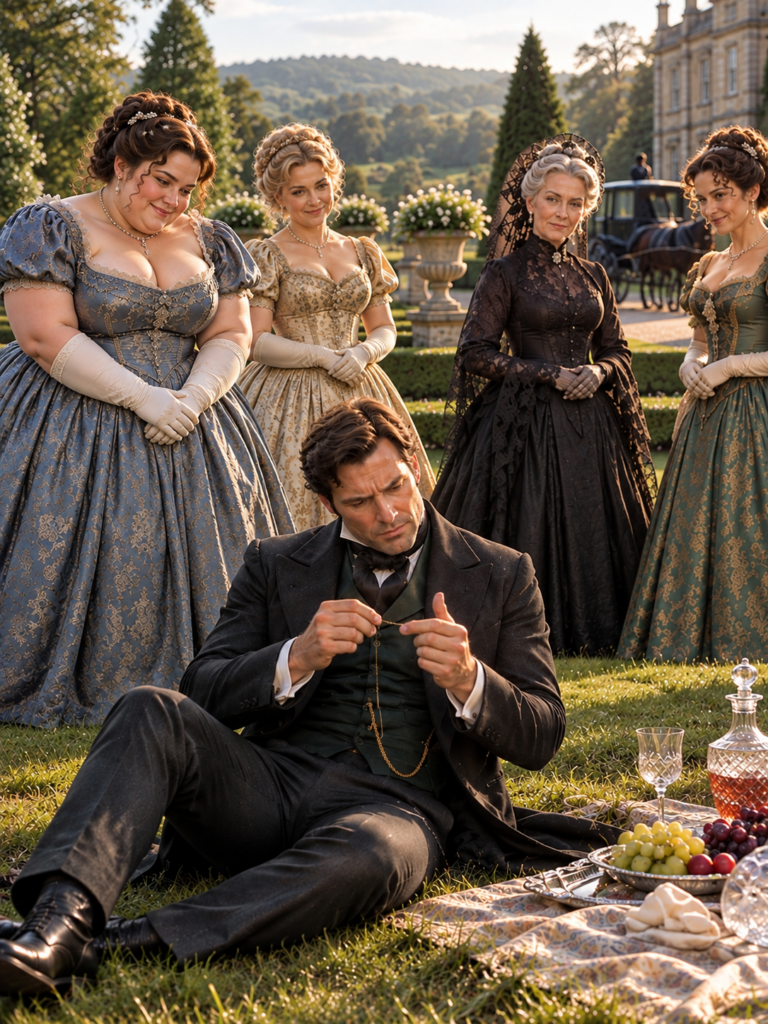
Part 1
The Duke of Coldharbour had never been refused a simple favor in the presence of witnesses.
Until the afternoon Miss Constance Larkin handed him a needle.
It happened on a bright September day at Ravensmere, when the lawns were crowded with embroidered parasols, polished boots, and people who had spent most of their lives learning how to conceal their opinions.
A dozen carriages stood beneath the chestnut trees. Servants moved quietly between picnic blankets carrying silver trays. Somewhere beyond the gardens, a pair of hunting dogs barked at something in the hedgerow.
Nathaniel Ravenscroft, the thirty-six-year-old Duke of Coldharbour, emerged from the orchard with a long tear in the sleeve of his dark riding coat.
He had caught it on a blackthorn branch while retrieving Lady Fenwick’s disobedient spaniel.
The animal had escaped unharmed.
The coat had not.
Nathaniel examined the damage with mild irritation.
“Has anyone a needle?”
Six young ladies immediately expressed their willingness to help.
Lady Sybil Draycott, whose mother had spent the past two years arranging circumstances in which she might become Duchess of Coldharbour, stepped forward first.
“I should be delighted, Your Grace.”
“So should I,” offered Miss Bellamy.
“And I,” said another.
Nathaniel surveyed them with the detached expression he wore when reviewing estate accounts.
He did not wish to encourage any particular lady.
A repaired sleeve, he knew, could become an understanding. An understanding could become a rumor. A rumor could become a conversation with a mother who had already selected a wedding date.
He preferred his difficulties straightforward.
Then he noticed Constance Larkin sitting near the edge of Lady Fenwick’s picnic blanket.
She wore a plain blue gown, carefully brushed and several seasons out of fashion. Her fair hair was arranged beneath a modest bonnet. A small sewing case rested beside her gloves.
She had been Lady Fenwick’s paid companion for four years.
Nathaniel knew this.
He knew little else about her.
“Miss Larkin.”
Constance looked up.
“Your Grace?”
“You have a sewing case.”
“I do.”
He extended the damaged coat.
“Then perhaps you might attend to this.”
The conversation around the blanket fell silent.
Constance regarded the coat, then the duke, then the six ladies waiting to discover whether they had just lost an opportunity to attract his attention.
For four years, she had repaired torn gloves, missing buttons, damaged hems, and ripped linings.
She had done so for people who called her useful, dependable, and sometimes clever.
Almost never had they called her Miss Larkin.
Lady Fenwick introduced her as my companion.
The housekeeper called her the young lady.
Visitors generally discovered her existence only when something needed mending.
Constance had tolerated all of it because employment provided a roof, a salary, and the possibility of someday supporting herself without answering another person’s bell.
But that morning, Lady Fenwick had informed her that she must repair six embroidered napkins before supper, despite having already worked until midnight arranging the guest correspondence.
Something inside her had grown tired.
Not angry.
Simply tired.
She opened her sewing case.
Selected a needle.
Threaded it with dark silk.
And placed it carefully in Nathaniel’s open palm.
“There, Your Grace.”
He looked down.
Then up.
“I beg your pardon?”
“The thread is doubled. It should hold.”
“But the coat—”
“Requires stitching. Yes.”
One of the young ladies gave a small, uncertain laugh.
Constance closed her sewing case.
“You have two perfectly serviceable hands, Your Grace. I believe you will find them equal to the task.”
Nathaniel stared at her.
For the first time in years, he had no immediate answer.
Constance rose.
“Lady Fenwick, if you will excuse me, the household correspondence is still waiting.”
Before the widow could object, Constance dipped into a polite curtsy and walked toward the house.
She did not hurry.
She did not look behind her.
Only when she reached the servants’ passage did she press one trembling hand against the wall.
She had done something foolish.
Possibly unforgivable.
And, for the first time in four years, entirely her own.
Outside, Nathaniel remained beneath the chestnut tree with the needle resting between his fingers.
Lady Sybil recovered first.
“Your Grace, surely you need not trouble yourself. Allow me.”
She reached for the coat.
Nathaniel moved it away.
“Thank you, Lady Sybil. That will not be necessary.”
He sat upon the nearest garden bench.
Examined the needle.
And began to sew.
The first stitch was crooked.
The second caught the lining.
The third pricked his thumb.
He said nothing.
By the time the sleeve was repaired, it resembled the work of a particularly determined child.
Nathaniel regarded it for several seconds.
Then he put the coat on.
Lady Sybil watched him with an expression that was almost alarmed.
No one laughed.
The duke had made certain of that without speaking a word.
Yet the incident became the most discussed event at Ravensmere before the afternoon tea was served.
By supper, the servants knew.
By breakfast, the stable boys knew.
And by the following evening, every guest understood that an insignificant companion had refused the Duke of Coldharbour in front of six eligible ladies.
What they did not understand was why the duke had allowed it.
Neither, at first, did Nathaniel.
He had inherited Coldharbour at twenty-nine after a childhood spent beneath the strict governance of his father.
The previous duke had believed kindness was a poor investment.
He had treated affection as an indulgence, gratitude as weakness, and service as something owed to a man who possessed sufficient land and authority.
When Nathaniel was eight, he had given his winter gloves to a stable boy whose fingers were bleeding from the cold.
His father had discovered it.
The boy was dismissed.
Nathaniel was told that generosity encouraged dependence.
At twelve, he had pleaded for a sick tutor to be allowed another week of rest.
His father had called him sentimental.
At seventeen, he had attempted to speak honestly about his dread of returning to school.
His father had listened without interrupting.
Then instructed the servants to pack his trunks.
Nathaniel had learned that silence preserved dignity.
Obedience preserved peace.
And warmth was something best avoided.
By thirty-six, he had perfected all three.
Yet the needle in his hand had unsettled him more than a dozen serious confrontations.
The woman had not asked for a favor.
Had not demanded an apology.
Had not even attempted to embarrass him.
She had merely declined to perform a task that he could, with sufficient effort, perform himself.
And he could not stop thinking about it.
Three days later, Nathaniel found Constance in the small library.
She sat beside the window, surrounded by correspondence, with a pile of household linen in her lap.
The light caught the silver needle as it passed through a torn seam.
She did not appear surprised when he entered.
“Good afternoon, Your Grace.”
“Miss Larkin.”
She completed her stitch before looking up.
“May I assist you?”
Nathaniel had intended to ask why she had humiliated him.
Instead, he found himself examining the work in her hands.
“Do you always mend the household linen?”
“Only when the household requires it.”
“Does that happen frequently?”
“Frequently enough that I have considered purchasing shares in a thread manufacturer.”
He almost smiled.
Almost.
“Why did you refuse to mend my coat?”
Constance set down her sewing.
“Because you did not ask me.”
“I distinctly recall requesting assistance.”
“You asked whether anyone possessed a needle. When you discovered that I did, you handed me your problem.”
“Was there a distinction?”
“A considerable one.”
Nathaniel folded his hands behind his back.
“Explain it.”
She looked at him steadily.
“A request leaves the other person free to refuse. An order merely waits for obedience.”
The words were spoken quietly.
That made them worse.
He considered them.
“And you believed I was issuing an order?”
“Did you imagine I could decline without consequence?”
He opened his mouth.
Closed it.
Constance’s expression softened slightly.
“Your Grace, I have spent years repairing things for people who never thought to ask whether I had anything of my own that needed mending.”
She glanced at the worn cuff of her dress.
“I discovered that I no longer wished to continue.”
Nathaniel followed her gaze.
For the first time, he noticed the faded fabric.
The careful repairs.
The hands that had worked so often for others they had acquired small scars near the fingertips.
“What would you have preferred?”
“That you ask.”
“And if you refused?”
“Then I should hope you would respect the answer.”
Nathaniel stood silent.
He was accustomed to people offering the answers they believed he wished to hear.
Constance Larkin appeared determined to offer only the truth.
Finally, he said, “I see.”
“I am not entirely certain you do, Your Grace.”
“No,” he admitted. “Nor am I.”
He left the library with a peculiar sensation.
He had been corrected by a woman who possessed neither title nor fortune.
And he had found the correction useful.
That evening, Nathaniel asked his valet what he knew of Miss Larkin.
“An excellent worker, Your Grace.”
“That was not my question.”
The valet hesitated.
“She came to Lady Fenwick after her father died. Educated, I believe. Her family once had property in Yorkshire.”
“Did she lose it?”
“I could not say.”
“Does anyone know?”
“Perhaps Lady Fenwick.”
Nathaniel dismissed him.
He was disturbed by the realization that he had employed hundreds of people without knowing the stories that had brought them into his household.
He knew their wages.
Their duties.
Their hours.
He knew almost nothing of their lives.
It was not a comfortable discovery.
And discomfort, Nathaniel had long believed, was a poor reason to change one’s habits.
Yet within the week, he found himself changing them.
His estate secretary, Mr. Pembroke, had fallen ill with a dangerous fever.
The man would require several weeks of rest.
Important accounts were unfinished. Legal correspondence needed copying. Rents from the northern farms had to be reconciled before the quarterly meeting.
Nathaniel’s mother, the Dowager Duchess of Coldharbour, proposed a temporary solution.
“Lady Fenwick’s companion writes a remarkably neat hand. Put her in the estate office until Pembroke recovers.”
Nathaniel looked up from his correspondence.
“Have you asked her?”
His mother blinked.
“Asked her what?”
“Whether she wishes the position.”
The dowager stared at him as though he had proposed consulting the furniture.
“She is a paid companion, Nathaniel.”
“Precisely. She is already employed.”
“She should be grateful for the opportunity.”
“That does not answer my question.”
His mother sighed.
“Then ask her yourself.”
Constance was summoned the following morning.
She entered the morning room expecting a reprimand for the picnic incident.
Instead, the dowager informed her that she would temporarily assist with the estate accounts.
“It is a considerable responsibility,” the older woman said. “I trust you will not disappoint us.”
Constance listened.
Then asked, “Will I receive Mr. Pembroke’s salary?”
The dowager’s expression hardened.
“Certainly not his entire salary.”
“Then I am afraid I cannot accept.”
Silence filled the room.
Nathaniel, standing by the mantelpiece, slowly turned.
His mother gave an incredulous laugh.
“You seem to have acquired a habit of refusing perfectly reasonable arrangements, Miss Larkin.”
“I am willing to perform Mr. Pembroke’s duties, Your Grace. But I cannot agree that they are worth less because I shall be performing them.”
Nathaniel looked at her.
“What conditions would you require?”
Constance drew a small breath.
“Payment equal to the responsibility. Set working hours. The authority to correct figures rather than merely copy them. And I should like to be addressed by my proper name.”
The dowager flushed.
“Really, Nathaniel—”
“Agreed.”
Both women turned toward him.
Constance recovered first.
“All four conditions?”
“All four.”
His mother stared.
“You cannot be serious.”
Nathaniel met her eyes.
“If we require competent work, Mother, we shall pay for competent work.”
He turned back to Constance.
“Would you accept under those terms, Miss Larkin?”
She studied him for several seconds.
Then, very slightly, she inclined her head.
“Yes, Your Grace.”
For the first time in her life, she had negotiated the terms of her own employment.
The victory frightened her nearly as much as it pleased her.
She began work the next morning.
The estate office occupied a narrow suite of rooms overlooking the east courtyard.
Its shelves held ledgers dating back nearly a century.
Rent agreements were tied with faded ribbon. Correspondence overflowed from wooden drawers. A brass clock above the fireplace had a habit of stopping at eleven minutes past four.
Nathaniel worked at an enormous mahogany desk.
Constance was given a smaller table near the window.
For the first week, their conversations concerned nothing more personal than accounts.
He dictated.
She transcribed.
He reviewed figures.
She corrected them.
They discovered, almost immediately, that they worked well together.
Nathaniel possessed an exceptional memory and an instinct for detecting inconsistencies.
Constance understood numbers, but more importantly, she understood the human circumstances beneath them.
On the fifth morning, she found an error in the Hollowfield farm account.
The estate agent had recorded forty pounds in rent.
The actual agreement required thirty-eight pounds in cash and two pounds in produce.
The produce had already been delivered.
Yet the agent had charged the tenant the full forty pounds.
Nathaniel examined her figures.
“The agent has managed that property for twenty years.”
“Then he has enjoyed twenty years in which to understand the contract.”
“Are you certain?”
Constance placed the original agreement beside his ledger.
“The relevant clause is marked.”
He read it.
Then read it again.
She was right.
“How long has this been happening?”
“At least seven years, according to the available accounts.”
Nathaniel looked at her sharply.
“Seven?”
“The payments were small enough to escape attention.”
“Why did no one discover it?”
“Because the people who paid were not permitted to question the figures, and the people who copied them were not expected to understand them.”
Nathaniel felt the sting of the observation.
He deserved it.
“Summon Mr. Harcourt,” he said.
The estate agent arrived before noon.
He departed an hour later, carrying instructions to review every affected tenancy and return improperly collected sums.
When he had gone, Nathaniel stood by the window.
Constance continued writing.
“Miss Larkin.”
“Yes, Your Grace?”
“Thank you.”
Her pen stopped.
It was the first time he had thanked her for work she had not been explicitly ordered to perform.
“You’re welcome.”
He returned to his desk.
Yet the small exchange remained in the room long after both had resumed their work.
During the following days, Nathaniel began to see the estate differently.
A repaired roof was no longer merely an expense.
It was the difference between a dry nursery and a sick child.
An unpaid bill was not simply an irregularity.
It was the reason a tradesman could not settle his own wages.
Constance did not preach these lessons.
She merely placed the facts before him.
And Nathaniel, who had spent his life respecting facts, found himself unable to ignore them.
But Ravensmere was not a place where such changes passed unnoticed.
Lady Sybil Draycott arrived for the autumn hunting party on a cold Tuesday afternoon.
She brought four trunks, a French maid, and the firm expectation that Nathaniel would finally ask for her hand.
Her family considered the marriage practically settled.
Her mother had cultivated the dowager’s friendship for years.
The match made sense.
Sybil was beautiful, accomplished, wealthy, and impeccably born.
She also possessed a keen understanding of power.
Within an hour of arriving, she learned that Miss Larkin now worked in Nathaniel’s private office.
Within another hour, she had decided this arrangement must end.
At dinner that evening, Sybil waited until the conversation turned to estate management.
“Your Grace,” she said sweetly, “I hear you have found an unusually economical solution to your secretary’s illness.”
Nathaniel glanced up.
“Have I?”
“Why, employing Lady Fenwick’s companion.”
Constance sat farther down the table, beside an elderly colonel who had been discussing the weather for twenty minutes.
Sybil continued.
“How fortunate to discover a young woman willing to perform a gentleman’s duties for a lady’s compensation.”
Several guests smiled uncertainly.
Constance placed her fork beside her plate.
“Actually, Lady Sybil, His Grace pays the full salary attached to the duties.”
“How generous.”
“Not especially. Merely accurate.”
The colonel coughed into his napkin.
Sybil smiled more tightly.
“Surely you must feel rather fortunate.”
“I do, my lady.”
“Then we are agreed.”
“Indeed. Honest work deserves honest payment. It is a refreshing arrangement.”
Nathaniel lowered his wineglass.
For one dangerous moment, he thought he might laugh.
Sybil noticed.
And Constance saw the calculation begin behind her eyes.
Later that night, as the guests dispersed, Lady Sybil approached the dowager.
“Your Grace, I fear Miss Larkin is becoming rather comfortable in her new position.”
The dowager looked toward the corridor.
“She is capable.”
“Capability is not always the issue.”
“What do you mean?”
Sybil paused delicately.
“A young woman without family protection. Working alone with an unmarried duke. Being paid unusually well.”
The implication hung between them.
The dowager’s face hardened.
“Are you suggesting an impropriety?”
“Only that others may.”
It was a skillful answer.
And by breakfast, whispers had begun.
Constance noticed them immediately.
Servants fell silent when she entered rooms.
Guests exchanged glances.
Lady Fenwick warned her to behave with greater modesty.
But the real danger arrived that afternoon.
Mr. Harcourt, the estate agent whose accounts she had corrected, requested a private audience with the dowager.
He carried an old ledger.
And inside it was a record that bore Constance Larkin’s father’s name.
By evening, the dowager had sent for her.
Constance entered the morning room to find Nathaniel’s mother standing beside the fireplace.
The ledger lay open upon the table.
“Miss Larkin,” the dowager said coldly, “I believe we have discovered something rather troubling about your family.”
Constance looked at the page.
Her breath stopped.
At the top, in faded ink, was written:
EDMUND LARKIN — DISMISSED FROM SERVICE FOR FINANCIAL IRREGULARITIES.
Her father’s name.
The accusation that had ruined him.
And beneath it, a signature Constance had never seen before.
The signature of the late Duke of Coldharbour.
Part 2
Constance had not heard her father’s name spoken inside a respectable drawing room for nearly five years.
When it came, the sound was as painful as a wound reopening.
She stood before the dowager with her hands folded.
“Where did you obtain that ledger, Your Grace?”
“Mr. Harcourt discovered it among the old property accounts.”
“I see.”
“Do you?”
The dowager turned the book toward her.
“Your father was employed by the late duke.”
“For eleven years.”
“And dismissed for dishonesty.”
Constance felt her pulse quicken.
“He was accused of dishonesty.”
“The distinction seems rather small.”
“Not to the man who spent the remainder of his life trying to prove it.”
The dowager’s eyes narrowed.
“You would do well to remember your position.”
“I remember it every morning, Your Grace.”
Constance looked again at the ledger.
The signature was unmistakable.
But something about the figures troubled her.
The recorded loss was twelve hundred pounds.
She remembered her father mentioning a different sum.
Nine hundred and forty.
He had repeated that figure during the last winter of his life, sitting beside an empty fireplace with his papers spread across the floor.
Nine hundred and forty pounds.
Not twelve hundred.
“May I examine the entry?”
The dowager shut the ledger.
“No.”
Constance raised her eyes.
“Then I can offer no explanation.”
“There is little to explain.”
“An accusation is not proof.”
“It was sufficient to destroy your father’s reputation.”
The words struck harder than the dowager perhaps intended.
Constance held herself still.
“My father was not a thief.”
“Then why did the late duke dismiss him?”
“I do not know.”
The dowager studied her.
For the first time, uncertainty briefly crossed her expression.
But pride returned quickly.
“Until this matter is resolved, you will no longer work in my son’s office.”
Constance swallowed.
“Has His Grace approved this decision?”
“I do not require my son’s permission to protect this family.”
Constance looked toward the door.
“Then I should like to speak with him.”
“That would be unwise.”
“Nevertheless.”
The dowager’s expression sharpened.
“You have grown remarkably bold, Miss Larkin.”
Constance gave a small, exhausted smile.
“Only when someone asks me to be ashamed of something I did not do.”
She curtsied.
And left.
Nathaniel was in the estate office when she arrived.
He looked up immediately.
Something in her face made him put down his pen.
“What has happened?”
Constance remained near the doorway.
“Your mother has dismissed me from my temporary duties.”
His expression changed.
“On what grounds?”
“My father’s disgrace.”
Nathaniel rose.
“What disgrace?”
She told him.
Not hurriedly.
Not dramatically.
She explained that Edmund Larkin had worked for his father, that an accusation of missing funds had ended his employment, and that no other great estate had been willing to hire him afterward.
Her father had sold his remaining possessions to support them.
Her mother had died the following year.
Then he had died, leaving Constance with a few books, a sewing case, and a name that carried more suspicion than comfort.
Lady Fenwick had accepted her as a companion because she was educated, poor, and unlikely to find anything better.
Nathaniel listened without interruption.
When she finished, he asked one question.
“Did your father confess?”
“No.”
“Was he tried?”
“No.”
“Was evidence presented?”
“Not to us.”
Nathaniel walked toward the window.
His father’s portrait hung above the far bookcase.
A stern man in black.
A man Nathaniel had spent most of his life fearing, obeying, and attempting to become.
“My father was not easily deceived,” he said.
Constance stiffened.
“I did not come here to beg you to contradict him.”
He turned.
“That was not what I intended.”
“Then what did you intend?”
Nathaniel looked at the portrait.
“To acknowledge that I have spent seven years assuming his decisions were beyond question.”
He faced her again.
“And in recent weeks, you have given me several reasons to reconsider that assumption.”
Constance said nothing.
“Your employment will continue,” he told her.
“Your mother has already—”
“My mother does not manage the estate office.”
“And my father’s name?”
“We shall investigate the matter properly.”
Constance looked almost frightened.
“Your Grace, I did not ask you to do that.”
“I know.”
“Then why?”
Nathaniel considered her.
“Because twelve hundred pounds went missing from an estate that belonged to my father. If your father was innocent, the truth is owed to him.”
His voice lowered.
“And to you.”
For several seconds, Constance could not speak.
She had spent years defending her father’s memory alone.
Now a duke was offering to examine the very accusation that had destroyed it.
She wanted to trust him.
That was what frightened her.
“Very well,” she said at last. “But I shall assist in the investigation.”
Nathaniel inclined his head.
“I expected no less.”
They began with the original accounts.
The late duke’s records were extensive but poorly organized.
Mr. Harcourt had supervised much of the estate’s financial business for nearly three decades.
His handwriting appeared throughout the ledgers.
Constance noticed discrepancies almost immediately.
Certain entries had been rewritten.
Others referred to receipts that no longer existed.
One payment had been recorded twice, under different dates.
Nathaniel examined the figures with increasing concern.
“This is either extraordinary carelessness,” he said, “or something worse.”
“Mr. Harcourt does not strike me as a careless man.”
“No.”
“Then we should ask why the missing funds were attributed to my father.”
Nathaniel pulled another ledger toward him.
“Because he was the person responsible for reconciling the accounts that year.”
Constance shook her head.
“He was responsible for copying the accounts. Mr. Harcourt authorized the payments.”
Nathaniel looked up.
“Are you certain?”
“My father told me so.”
“Can you prove it?”
She hesitated.
“Perhaps.”
That evening, she opened the small trunk she kept beneath her bed.
Inside were her mother’s prayer book, a faded ribbon, two letters, and a leather notebook her father had carried during his final years.
She had not opened it for a long time.
The pages smelled of dust and old ink.
Near the end, she found a passage she remembered reading as a girl.
The discrepancy cannot be reconciled because the payment orders do not correspond to the recorded disbursements. I have requested an independent review. His Grace refuses to hear me. Mr. Harcourt insists the figures are correct.
Below it was another entry.
I fear I have been made responsible for a loss I was never permitted to examine.
Constance sat with the notebook in her lap.
Her father had died believing no one would listen.
She had promised herself that one day she would discover the truth.
Then poverty, employment, and the endless work of surviving had buried that promise beneath ordinary duties.
Now, for the first time, she had a chance.
She carried the notebook to the office the following morning.
Nathaniel read the entries carefully.
“Why did you not show me this sooner?”
“Because I was taught that no one would believe it.”
He looked at her.
“And you believed them?”
“For a long time.”
He closed the notebook.
“Then we shall try something different.”
Their investigation continued over the next ten days.
It brought them into closer company than either expected.
They worked through breakfast hours and rainy afternoons, comparing signatures, tracking payments, and visiting the estate’s older tenants.
The first meaningful breakthrough came from a retired carpenter named Thomas Reed.
He remembered a construction project undertaken by the late duke.
“A new bridge was ordered,” Reed explained. “Paid for in full, though it was never built.”
Nathaniel frowned.
“Why?”
“His Grace changed his mind, or so we were told.”
“Who received the payment?”
“Mr. Harcourt arranged it.”
Constance exchanged a glance with Nathaniel.
The sum paid for the unfinished bridge was nine hundred and forty pounds.
Her father’s remembered figure.
The discovery should have pleased her.
Instead, it unsettled her.
Because the additional two hundred and sixty pounds in the accusation had appeared only after her father was dismissed.
Someone had altered the record.
Someone with access to the ledgers.
Someone who had remained in the household for decades.
But the evidence was not yet complete.
And Nathaniel would not accuse a man without proof.
That restraint surprised Constance.
She had expected a duke to summon Harcourt, demand obedience, and force a confession.
Instead, Nathaniel insisted on careful examination.
“You deserve more than another accusation,” he told her.
“Even if the accused man deserves it?”
“Especially then.”
She looked at him thoughtfully.
“Your father would not have agreed.”
Nathaniel’s expression darkened.
“No.”
Then, after a pause, he added, “I am beginning to hope that I may disagree with him more often.”
Their relationship changed during those long hours.
Not suddenly.
Not through grand declarations.
It changed through small things.
Nathaniel began asking whether she had eaten.
Constance learned that he disliked cold tea but always forgot to drink it while it was hot.
He discovered she loved maps and had once dreamed of traveling to Italy.
She learned that he could remember every tenant’s rent but had forgotten his own birthday twice.
He began lighting the fire before she arrived.
She started leaving an extra sheet of clean paper on his desk because he always ran out halfway through a letter.
Sometimes they worked without speaking.
And the silence became something neither wished to break.
One evening, a storm trapped them in the office after the servants had gone.
Rain lashed the windows.
The wind drove smoke down the chimney.
Constance sat near the fireplace examining a bundle of old receipts.
Nathaniel was standing beside the mantel.
“Miss Larkin.”
She looked up.
“Yes?”
“May I ask you something personal?”
The question itself startled her.
“You may ask.”
“Why did you stay with Lady Fenwick for so long?”
Constance looked toward the fire.
“Because I had nowhere else to go.”
“You might have sought another position.”
“With my father’s history?”
He said nothing.
“A woman without money must calculate risks carefully, Your Grace. A familiar humiliation can seem safer than an unfamiliar one.”
Nathaniel regarded her.
“And now?”
“Now I am no longer entirely certain I wish to be safe at that price.”
Outside, thunder rolled across the hills.
He sat opposite her.
“My father believed fear was useful.”
Constance waited.
“He used it often. He believed a man who feared disappointment would avoid weakness.”
“And did it work?”
Nathaniel looked at the flames.
“It made me efficient.”
“That was not what I asked.”
He glanced at her.
“No,” he said quietly. “It did not.”
For the first time, Constance saw something beneath the duke’s reserve.
Not cruelty.
Not indifference.
Loneliness so old he had mistaken it for character.
“I am sorry,” she said.
Nathaniel gave a small, bitter smile.
“That is the one thing I was taught never to require.”
“Sympathy?”
“Yes.”
“It is not a requirement, Your Grace.”
“What is it, then?”
“A gift.”
He looked at her for a long moment.
Something passed between them that neither was prepared to name.
Then Constance returned to the receipts.
And Nathaniel found that he could no longer read the page before him.
Lady Sybil noticed the change.
She had watched Nathaniel for years.
She knew his habits.
His silences.
The slight narrowing of his eyes when annoyed.
She had never seen him look toward a room simply because someone had entered it.
Until Constance.
Sybil did not intend to surrender her future to a paid companion.
She approached Mr. Harcourt after dinner one evening.
Their conversation took place in the conservatory, beneath the shadow of enormous tropical plants.
“I understand Miss Larkin has been examining old accounts,” she said.
Harcourt’s face tightened.
“His Grace has requested a review.”
“How thorough?”
“Quite thorough.”
Sybil studied him.
“Then perhaps you should be concerned.”
The agent stiffened.
“I have nothing to conceal, Lady Sybil.”
“Of course not.”
She let the silence lengthen.
“But the household is becoming rather interested in Miss Larkin’s family history. I wonder what else it might discover.”
Harcourt looked toward the dark glass.
“Your ladyship would be wise not to involve herself.”
Sybil smiled.
“I am already involved.”
She did not know exactly what Harcourt had done.
But she understood that he was frightened.
And frightened men could be useful.
The following afternoon, the dowager received an anonymous letter alleging that Constance had entered the estate office specifically to destroy evidence of her father’s theft.
The accusation was absurd.
But it was beautifully timed.
Guests were still in residence.
The household was already whispering.
The dowager, alarmed for her son’s reputation, confronted Nathaniel at once.
“You must remove that woman.”
Nathaniel was seated at his desk.
He did not rise.
“On whose evidence?”
“An accusation has been made.”
“By whom?”
“The writer did not sign the letter.”
“Then the writer may present it again when sufficiently courageous to attach a name.”
“Nathaniel!”
He looked up.
“Mother, I will not destroy a person’s livelihood because someone finds it convenient to accuse her.”
“She is a companion.”
“She is also my secretary.”
“She has bewitched you.”
His expression cooled.
“That is an unworthy accusation.”
The dowager stared at him.
“You are risking your family name.”
Nathaniel rose slowly.
“I am beginning to think the family name has been used to excuse far too much.”
His mother left in furious silence.
But the confrontation had consequences.
That evening, Constance found a note beneath her bedroom door.
Leave Ravensmere before the end of the week, or the full truth of your father’s disgrace will be made public.
There was no signature.
Only a small black mark resembling the impression of a broken seal.
Constance read it twice.
Then carried it directly to Nathaniel.
He was furious.
Not loudly.
That would have frightened her less.
His anger appeared in the stillness of his face.
“Who gave you this?”
“I do not know.”
“Has anyone threatened you before?”
“Not directly.”
He examined the paper.
“Someone is attempting to frighten you away.”
“Yes.”
“Are you frightened?”
Constance considered lying.
Then decided she had grown tired of that, too.
“Very.”
Nathaniel looked at her.
“Would you prefer to leave?”
She stared.
“You would permit it?”
“I would not prevent you.”
“But the investigation—”
“Can continue without requiring you to endure danger.”
Constance felt an unexpected ache.
He was offering her freedom to choose.
Again.
Not as a test.
Not as a challenge.
Simply because he believed it belonged to her.
She folded the note.
“No,” she said. “I will stay.”
Nathaniel nodded.
“Then we shall ensure you are protected.”
“Your Grace—”
“Nathaniel.”
The name escaped him before he had considered it.
Constance looked at him.
He did not withdraw it.
After a long pause, she said softly, “Very well, Nathaniel.”
He had heard his name spoken thousands of times.
Never quite like that.
The true breakthrough came three days later.
Constance was searching the old records cupboard when a narrow wooden panel shifted beneath her hand.
Behind it lay a sealed bundle wrapped in oilcloth.
The wax had cracked with age.
The papers were addressed in the late duke’s handwriting.
Not to Edmund Larkin.
But to the late duke’s father.
Constance did not open them.
She carried the bundle to Nathaniel.
“I found these behind the cabinet.”
He examined the writing.
The color left his face.
“My father’s hand.”
“I recognized it.”
“Have you read them?”
“No.”
“Why not?”
“Because they are yours.”
Nathaniel looked at her.
He knew many people who would have opened such papers without hesitation.
Some from curiosity.
Others from ambition.
Constance had brought them to him unopened.
“Thank you,” he said.
She left him alone.
That night, Nathaniel broke the seal.
The first letter concerned money.
A warning from his father, written decades earlier, that Mr. Harcourt’s handling of the bridge funds might have been fraudulent.
The letter stated that Edmund Larkin had raised concerns, but that a public investigation would damage the estate’s standing and expose the previous duke’s mismanagement.
The old duke had chosen silence.
Larkin had been dismissed.
Harcourt had remained.
Nathaniel read the page three times.
Then he found a second letter.
Its contents concerned something entirely different.
It had been written shortly after Nathaniel’s birth.
In it, his father begged his own father to allow the child to remain at home rather than be sent away to school at six.
He wrote that he remembered the loneliness of his own childhood.
That he wished to know his son.
That he wanted to be gentle.
Gentle.
Nathaniel stared at the word.
He had never believed his father capable of writing it.
The letter continued.
His grandfather had refused the request.
He had warned that tenderness would produce weakness.
That a son must learn discipline.
That a duke must never become dependent upon affection.
Nathaniel’s father had obeyed.
And somewhere between loving his child and surrendering to his own father’s expectations, he had become the man Nathaniel remembered.
For decades, Nathaniel had believed cruelty was simply the nature of his inheritance.
Now he understood that it had been a choice.
A choice repeated.
A choice defended.
A choice he himself had nearly continued.
He remained in the office until dawn.
When Constance arrived, she found him standing beside the window.
The letters lay open on his desk.
He looked exhausted.
“Your Grace?”
Nathaniel turned.
“We have found the truth.”
She went still.
“About my father?”
“Yes.”
He handed her the first letter.
Constance read it.
Then read it again.
Her fingers tightened around the paper.
Her father’s name appeared three times.
Each mention confirmed his objections.
Each line proved that he had attempted to prevent the loss rather than conceal it.
For years, she had imagined receiving such proof.
She had expected triumph.
Relief.
Perhaps satisfaction.
Instead, she wept.
Quietly.
Without covering her face.
Nathaniel remained beside her, uncertain whether he should speak.
Finally, she whispered, “He knew.”
“Who?”
“Your father. He knew mine was innocent.”
Nathaniel’s jaw tightened.
“Yes.”
“And he allowed him to be ruined.”
“Yes.”
The word cost him something.
Constance pressed the letter against her chest.
“My father died believing he had failed us.”
Nathaniel stood motionless.
He could not undo what had happened.
Could not return her father.
Could not recover the years she had spent in humiliating dependence.
But he could decide what happened next.
“Then we shall clear his name publicly,” he said.
Constance looked up.
“Your family will suffer for it.”
“It should.”
“The truth may alter how people remember your father.”
Nathaniel glanced toward the portrait.
“Then perhaps they will remember him more accurately.”
But they had not yet finished reading the bundle.
At the bottom lay one final document.
A statement prepared by Edmund Larkin.
Witnessed.
Signed.
And never submitted.
It named Mr. Harcourt as the man responsible for diverting the estate’s money.
It also named the person who had instructed Harcourt to conceal the loss.
Nathaniel’s grandfather.
The former Duke of Coldharbour.
Constance stared at the signature.
Nathaniel read the statement in silence.
The truth was larger than they had imagined.
The theft had not merely been hidden.
It had been ordered.
And the man who had ordered it had used the same authority that destroyed Nathaniel’s childhood to destroy Constance’s family.
Nathaniel lowered the paper.
For the first time in his life, he understood that his family inheritance contained something far more dangerous than money or land.
It contained generations of people who had mistaken obedience for virtue.
And generations of others who had paid the price.
Part 3
The announcement was made the following morning.
Every guest at Ravensmere received an invitation to remain for a formal gathering in the great drawing room.
The dowager protested.
Lady Sybil demanded an explanation.
Mr. Harcourt attempted to arrange an urgent journey to London.
Nathaniel refused to permit the matter to disappear quietly.
At eleven o’clock, the drawing room filled.
Servants stood discreetly near the walls.
Lady Fenwick sat beside the dowager, looking deeply uncomfortable.
Sybil occupied the chair nearest the fireplace.
Constance stood near the window.
She wore her plain blue gown.
The same gown she had worn when she handed Nathaniel the needle.
But her hands were no longer folded in the posture expected of a companion.
She held her father’s notebook.
Nathaniel entered carrying the old documents.
He stood before the mantel.
“I have asked you here,” he began, “because a serious injustice was committed under the authority of this family.”
The dowager went pale.
Nathaniel continued.
“Twenty-eight years ago, Edmund Larkin was dismissed from the management offices of this estate after being accused of misappropriating funds.”
Constance lowered her eyes.
“The accusation ruined his reputation. It damaged his family’s circumstances and deprived him of the opportunity to defend himself.”
Nathaniel placed the papers upon the table.
“We have discovered documentary evidence proving he was innocent.”
A murmur moved through the room.
Mr. Harcourt stood abruptly.
“Your Grace, I must protest—”
“You will remain seated.”
The agent hesitated.
Nathaniel’s voice did not rise.
But something in it made Harcourt obey.
“The disputed sum was diverted through a construction account by Mr. Harcourt, under instructions from my grandfather. My father subsequently became aware of the circumstances and chose to conceal them.”
The dowager closed her eyes.
Lady Sybil looked at Harcourt.
For the first time since arriving at Ravensmere, she appeared uncertain.
Nathaniel lifted Edmund Larkin’s signed statement.
“We have independent supporting records, including the original payment orders, which confirm the sequence of transactions. The matter will be referred to the appropriate authorities and legal advisers. Any restitution due will be pursued.”
Harcourt’s face had become the color of old parchment.
“Your Grace, the circumstances were far more complicated—”
“Then you will have an opportunity to explain them.”
Nathaniel looked toward Constance.
“Miss Larkin’s father attempted to prevent this misconduct. Instead, he was punished for discovering it.”
The room fell silent.
“I cannot repair the years stolen from him,” Nathaniel said. “Nor can I undo the suffering endured by his daughter.”
He paused.
“But I can ensure that his name is restored in every record this family maintains.”
Constance felt tears burn behind her eyes.
Nathaniel continued.
“From this day forward, the estate will retain an independent auditor. Every account will be subject to review. No employee shall be dismissed for raising a concern in good faith.”
His gaze moved briefly toward Harcourt.
“And no title will be treated as sufficient evidence of a man’s honesty.”
The statement struck the room like a challenge.
Because everyone understood what it meant.
Nathaniel was not merely accusing an agent.
He was condemning decisions made by his own father and grandfather.
He was choosing the truth over the appearance of family honor.
The dowager rose.
“Nathaniel, surely this could have been settled privately.”
He turned toward her.
“That is precisely how it remained unsettled for twenty-eight years, Mother.”
She recoiled.
He softened his tone.
“The shame lies in what was done. Not in acknowledging it.”
Lady Fenwick began to cry.
Constance was astonished.
The widow fumbled with her handkerchief.
“Oh, my dear girl,” she whispered. “I had no idea.”
Constance looked at her.
For four years, Lady Fenwick had enjoyed the convenience of a companion whose history she never bothered to understand.
Now she was moved by a suffering that had been plainly visible for years.
Constance felt no desire to punish her.
But neither did she feel obligated to comfort her.
“Thank you, Lady Fenwick,” she said.
And nothing more.
After the gathering, Nathaniel withdrew to the estate office.
Constance found him there an hour later.
He stood beside the fireplace holding the second letter.
The one his father had written about him.
She entered quietly.
“May I come in?”
He turned.
“Of course.”
The room was warm.
The fire had been lit early.
The ledgers lay neatly stacked.
Constance approached his desk.
“You did a brave thing this morning.”
Nathaniel shook his head.
“I did something overdue.”
“That does not make it less brave.”
He looked down at the letter.
“My father knew.”
“About the accounts?”
“About everything.”
He drew a slow breath.
“He knew what it meant to be afraid of disappointing his father. He knew what obedience cost. He even knew he wished to raise me differently.”
Constance waited.
“And still,” Nathaniel continued, “he became the very man he had once hoped not to become.”
“Perhaps he believed he had no choice.”
“That is what troubles me.”
He raised his eyes.
“For thirty years, I believed I had no choice either.”
Constance moved closer.
“People often become what they are taught to be.”
“Does that excuse them?”
“No.”
The answer was immediate.
Nathaniel almost smiled.
“You never soften the truth for me.”
“I should think you have had quite enough people doing that.”
He lowered the letter.
“Miss Larkin—Constance—there is something I would like to tell you.”
Her pulse quickened.
“Then tell me.”
He looked at her for a long moment.
“I have spent my entire life believing that affection creates obligations. That kindness is offered to purchase loyalty. That anyone who comes near me must want something.”
“And now?”
“Now I find myself wishing to offer something without demanding anything in return.”
Constance’s breathing slowed.
Nathaniel stepped nearer.
“I wish you to know that your presence has altered this house for the better.”
She looked down.
“Your Grace—”
“Nathaniel.”
She met his eyes.
He continued carefully.
“You have challenged me when everyone else has agreed with me. You have corrected me when silence would have been safer. You have trusted me with the history of your family when you had every reason to distrust mine.”
His voice grew quieter.
“I do not know what name to give the affection I feel for you. I only know that I would rather spend an hour speaking honestly with you than an entire evening receiving praise from a hundred people.”
Constance felt the room become very still.
He did not reach for her hand.
Did not step close enough to make retreat difficult.
“I am not asking you to answer me,” he said. “I know our circumstances are unequal. I know the difference between my position and yours would make any invitation difficult to refuse freely.”
She looked at him with sudden tenderness.
“And what are you asking?”
“Nothing.”
The word hung between them.
Then he added, “For once in my life, I wish to speak the truth without attempting to control what another person does with it.”
Constance could not immediately reply.
All her life, she had believed powerful people offered generosity only when they expected obedience in return.
Yet Nathaniel was standing before her with his heart exposed and his hands empty.
She knew what it had cost him.
“Thank you,” she whispered.
He inclined his head.
And allowed that to be enough.
The weeks that followed brought consequences neither could avoid.
Mr. Harcourt resigned under threat of formal proceedings.
A legal review established the extent of the diverted funds.
The estate issued an official correction to Edmund Larkin’s employment record, and Nathaniel wrote personally to the families and institutions that had received the original accusation.
He arranged compensation for Constance from the estate, including funds representing the earnings her father had lost through his dismissal.
She did not accept it immediately.
“I will not be purchased,” she told him.
Nathaniel answered without offense.
“Then regard it as a debt being repaid.”
She studied the accounts.
Examined the calculations.
And accepted only after insisting that the sum be independently verified.
Nathaniel found the insistence reassuring.
The dowager withdrew from company for several weeks.
The revelations had shaken her understanding of the family she had married into.
One afternoon, she visited Constance in the library.
For the first time, she did not summon her.
She knocked.
Constance looked up.
“Your Grace.”
The dowager stood awkwardly in the doorway.
“May I speak with you?”
“Certainly.”
She entered.
For several moments, neither woman said anything.
At last, the dowager spoke.
“I have been unjust to you.”
Constance set down her book.
“Yes, Your Grace.”
The older woman blinked.
Then gave a small, unexpected laugh.
“You are not inclined to make apologies easy.”
“I did not realize they were meant to be.”
The dowager sighed.
“I have spent years believing that the proper arrangement of society protects everyone within it.”
“And does it?”
“Not everyone, apparently.”
Constance waited.
“I did not ask about your father when you arrived here. I did not inquire whether you were comfortable, or whether Lady Fenwick treated you fairly.”
“No.”
“I called you ‘the girl.'”
“You did.”
The dowager looked down.
“I am sorry, Miss Larkin.”
Constance felt the weight of the words.
They could not erase four years.
But they mattered.
“Thank you, Your Grace.”
The dowager hesitated.
Then said, “My son has been happier these past weeks than I have seen him since he was a boy.”
Constance’s heart tightened.
“He has worked very hard.”
“I do not believe work is the entire explanation.”
Constance did not answer.
The dowager regarded her.
Then, surprisingly, she smiled.
“I suppose it is none of my business.”
It was the first sensible thing Constance had ever heard her say about Nathaniel’s private affairs.
And she treasured it.
Lady Sybil, meanwhile, had discovered that social ambition could not survive every humiliation.
Her attempts to undermine Constance had become widely suspected.
When Nathaniel informed her that he would not propose marriage, she received the news with admirable composure.
At least until they were alone.
“You would choose a paid companion over me?”
Nathaniel remained calm.
“I have made no proposal to Miss Larkin.”
“Not yet.”
“No.”
Sybil looked at him with bitter disbelief.
“I have spent years preparing to become your duchess.”
“That was never an arrangement I accepted.”
“Our families expected it.”
“Our families are not the people who must marry.”
She turned toward the window.
“You make it sound so simple.”
“It is not simple.”
“Then why reject me?”
Nathaniel considered the question.
“Because you and I have never spoken honestly to one another.”
Sybil’s expression flickered.
For a moment, the practiced elegance disappeared.
“I know very little else.”
The admission surprised them both.
Nathaniel looked at her with something resembling compassion.
“Then I hope you learn.”
She departed Ravensmere three days later.
No scandal followed.
No public confrontation.
Only a quiet ending to an arrangement that had existed largely in the imaginations of other people.
Autumn deepened.
The hunting guests left.
Rain turned the garden paths dark.
Mr. Pembroke recovered and returned to his position.
Constance’s temporary appointment ended exactly as promised.
The final day unsettled her more than she had anticipated.
She packed her papers.
Cleaned her desk.
Returned the office keys.
And prepared herself for the familiar world of Lady Fenwick’s companionship.
Nathaniel watched in silence.
At last, he spoke.
“Miss Larkin.”
She looked up.
“Yes?”
“I have a proposal.”
Her hands stopped.
He noticed immediately.
“A professional proposal,” he clarified.
She almost laughed.
“Very well.”
“The estate requires someone to oversee the tenant accounts and correspondence independently of Mr. Pembroke. The investigation has revealed serious weaknesses in our present arrangements.”
Constance looked at him.
“I had considered that.”
“I would like you to take the position permanently.”
She said nothing.
“It would carry a salary appropriate to its responsibilities. You would have your own office, a written contract, and the authority to report concerns directly to me.”
“Why me?”
“Because you are qualified.”
“Not because you feel indebted to my father?”
“No.”
“Not because you pity me?”
“No.”
She watched his face.
“Not because you wish to keep me close?”
Nathaniel was silent.
Then he answered with the truth.
“I would be dishonest if I said that possibility had never occurred to me.”
Constance felt warmth rise in her cheeks.
“But that is not the reason for the appointment,” he continued. “You have proved your competence. The estate would benefit from your work whether I felt affection for you or not.”
She examined the proposed contract.
The salary was fair.
The responsibilities clearly defined.
The working hours reasonable.
There was even a clause granting her the right to resign with notice.
Constance looked up.
“You have learned something.”
Nathaniel’s mouth curved.
“A little.”
She held out her hand.
“Then I accept.”
He shook it.
The contact lasted only a moment.
Yet Nathaniel carried the memory of it through the entire winter.
The next two years passed without any grand announcement of romance.
Instead, something quieter grew.
Constance continued to work at Ravensmere.
She rented a small cottage near the eastern gardens rather than residing under Lady Fenwick’s supervision.
She bought new gowns with money she had earned.
She traveled to London to visit museums and attend lectures.
She joined Nathaniel in inspecting farms and discussing improvements to tenant housing.
Sometimes they disagreed.
Frequently, in fact.
Their arguments became legendary among the estate clerks.
Nathaniel might propose an expenditure.
Constance would demand to see the figures.
He would defend his reasoning.
She would produce another ledger.
And, more often than he cared to admit, he would reconsider.
The servants observed a curious transformation.
The duke began remembering names.
He asked after sick relatives.
He learned that his head gardener had three daughters and that the youngest wished to become a teacher.
He attended a tenant’s funeral without announcing his presence beforehand.
He once spent an entire afternoon helping repair a gate damaged by winter storms.
His valet considered this last development deeply alarming.
But no one was more astonished than Nathaniel himself.
He discovered that generosity did not diminish him.
It did not make the estate weaker.
It did not cause people to forget his authority.
It merely gave that authority a purpose worth having.
And through it all, Constance remained the person whose opinion mattered most.
One spring evening, two years after the picnic, Nathaniel invited her to walk in the orchard.
The trees were covered in white blossom.
The air smelled of damp earth and new grass.
They followed the same path where he had torn his coat.
Constance noticed.
“Are you becoming sentimental, Your Grace?”
“Only occasionally.”
“How unfortunate.”
“I am attempting to bear it with dignity.”
They walked a little farther.
Then Nathaniel stopped.
“Constance.”
She turned.
Something in his face made her heart begin to race.
“I have a question.”
“Another question about the accounts?”
“No.”
“Then it must be serious.”
“It is.”
He took a small velvet box from his pocket.
Constance stared at it.
Nathaniel did not open it immediately.
“I have thought about asking you this for a very long time.”
She looked at him.
“Then why haven’t you?”
“Because I wished to be certain that your answer would be entirely your own.”
A breeze moved through the branches.
White petals drifted between them.
Nathaniel continued.
“When we first met, I believed people remained near me because they desired my title, my fortune, or my favor.”
“And now?”
“Now I know at least one person who was perfectly willing to walk away.”
Constance smiled.
“More than willing.”
“Indeed.”
He opened the box.
Inside lay a simple gold ring set with a small sapphire.
Not the enormous family jewel his mother had once intended for Lady Sybil.
Something Nathaniel had chosen himself.
“Constance Larkin, will you marry me?”
She looked at the ring.
Then at the man holding it.
He was still reserved.
Still serious.
Still inclined to regard difficult emotions as problems requiring careful study.
But he no longer hid behind silence.
He had learned to apologize.
To listen.
To offer without demanding.
And, perhaps most importantly, to let another person refuse him.
“If I say no?” she asked softly.
Nathaniel’s expression did not change.
“Then I shall respect your answer.”
“And if I say yes?”
His voice lowered.
“Then I shall spend the remainder of my life endeavoring to deserve it.”
Constance looked at him for a long moment.
Then she held out her hand.
“Yes, Nathaniel.”
His breath caught.
She smiled.
“On one condition.”
He almost laughed.
“Naturally.”
“You must never forget how to mend your own coat.”
Nathaniel laughed then.
A real laugh.
Warm and helpless and entirely unlike the sound the servants had once imagined their duke capable of making.
“I promise.”
He placed the ring upon her finger.
Then, very gently, he kissed her.
Beneath the apple blossoms.
In the orchard where everything had begun.
Their marriage took place that autumn.
It was not a lavish ceremony by aristocratic standards.
Constance refused most of the ornamental arrangements.
She wished for flowers from the estate gardens, music from the village church, and a modest gathering of people who genuinely cared for them.
The dowager attended in a gown of dark green silk.
She cried during the vows.
Then denied it afterward.
Lady Fenwick sent a silver tea service and a long letter containing more apologies than Constance had believed the widow capable of composing.
Mr. Pembroke gave them a beautifully bound household ledger.
Nathaniel found the gift so amusing that he laughed throughout breakfast.
Three years after the picnic, Ravensmere was a different place.
The estate accounts were accurate.
The tenant cottages had been repaired.
The dowager had begun asking the servants about their families.
And the Duke of Coldharbour was no longer feared for his silence.
He was respected for what he did after listening.
Constance Ravenscroft, Duchess of Coldharbour, continued to inspect the ledgers.
She retained her own correspondence table in the estate office.
Her husband never suggested that marriage should end her work.
On the contrary, he often claimed the estate would collapse within a fortnight if she abandoned it.
She told him he was exaggerating.
He told her he was not.
Their disagreements remained frequent.
Their affection remained constant.
And in a small wooden box upon Nathaniel’s desk lay the letters that had changed his understanding of his father.
He had not burned them.
He had not hidden them.
Sometimes he read them.
Not to excuse what had happened.
But to remember that a person could inherit a mistake without being required to repeat it.
One rainy afternoon, Constance found him seated beside the fireplace with a piece of torn fabric in his hands.
His hunting coat lay across his knees.
A long rip ran along the cuff.
She stopped in the doorway.
“Oh, Nathaniel.”
He looked up.
“I know.”
“What have you done this time?”
“A branch attacked me.”
“How very unreasonable of it.”
“Quite.”
He held up the sleeve.
Constance folded her arms.
“Are you about to ask me to mend that?”
Nathaniel considered the question.
Then smiled.
“I was going to ask whether you had seen my sewing case.”
“Your sewing case?”
“Our sewing case.”
She looked toward the wooden box beside the window.
“Third drawer.”
“Thank you.”
He retrieved the needle and thread.
Sat down again.
And began stitching.
His work was not elegant.
But it was sound.
Constance watched him for a moment.
Then crossed the room and settled beside him.
“Your stitches are improving.”
“I have had an excellent teacher.”
“An impatient one.”
“A very demanding one.”
“And yet you have survived.”
“Against considerable odds.”
She laughed.
Nathaniel glanced at her, the needle suspended between his fingers.
There had been a time when he would have paid almost any price to avoid being laughed at.
Now he understood that being laughed with was an entirely different experience.
He returned to his sewing.
After a while, Constance rested her head against his shoulder.
Nathaniel continued working.
Outside, the rain softened.
The fire burned steadily.
And the enormous house, once governed by silence and obligation, seemed to hold its warmth without effort.
“Constance?”
“Yes?”
“Do you ever regret that afternoon?”
She lifted her head.
“The picnic?”
“Yes.”
“The afternoon I embarrassed the Duke of Coldharbour before six eligible ladies?”
“The very one.”
She pretended to consider.
“Sometimes.”
He turned toward her.
“Truly?”
“Yes. I occasionally regret that I did not charge you for the needle.”
Nathaniel stared.
Then laughed so loudly that a servant passing in the corridor stopped in astonishment.
Constance joined him.
When the laughter subsided, Nathaniel took her hand.
“That was the first time anyone refused me without trying to injure me.”
“And what did you learn?”
He looked at the rough seam in his coat.
“That being denied something is not always a loss.”
She smiled.
“And?”
“That a person who refuses to serve you may still be willing to stand beside you.”
Constance leaned closer.
“Very good, Your Grace.”
He kissed her forehead.
Then resumed his stitching.
And perhaps that was the truest measure of everything that had changed.
Not the wedding.
Not the restored family honor.
Not the fortunes repaid or the great house made warmer.
But a man who had once believed love meant being obeyed, sitting beside the woman he loved, patiently repairing something with his own hands.
He had asked every lady at the picnic to mend his torn coat.
Only one had handed him the needle.
And she had become the woman who taught him that the finest things in life were never owed.
They were freely given.
The End.


