
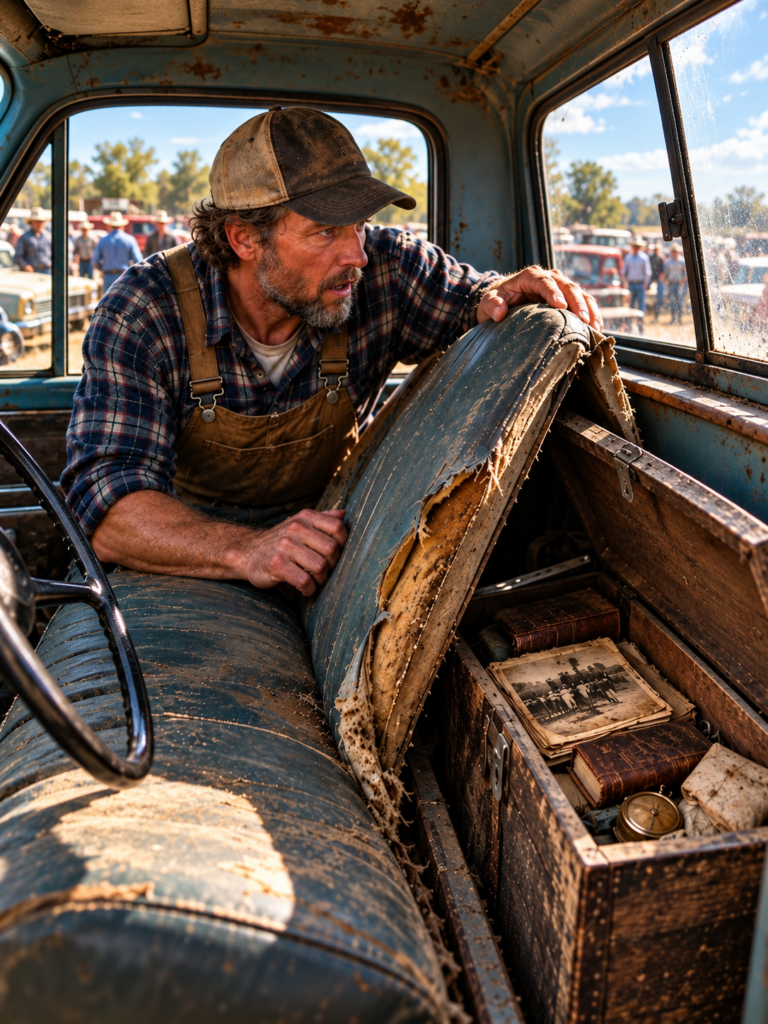
he paid $1,200 for an abandoned farm truck everyone else called junk—then he found the hidden records that could give an entire mountain community its land back
Part 1
By nine o’clock on that October morning, the grass behind the old McAllister barn had already soaked through Luke Vance’s boots.
He stood with his hands in the pockets of his canvas work jacket while an auctioneer sold away what remained of another family’s life.
Augusta County, Virginia, 1994.
The Blue Ridge rose dark and blue beyond the fields, half hidden behind autumn haze. Maples burned orange along the fence lines. A cold wind came down through the hollows carrying the smell of wet leaves, cattle manure, wood smoke, and distant rain.
People had been arriving since daylight.
Farmers came looking for tools.
Dealers came looking for things farmers did not know were valuable.
Scrap men came with flatbed trailers and calculated everything by the pound.
Women wandered through the farmhouse carrying cardboard boxes while estate workers put colored tags on furniture that had probably stood in the same rooms since Roosevelt was president.
Nothing felt permanent at an estate auction.
Luke had always disliked that.
A man could spend fifty years collecting wrenches and machinery, repairing fences, planting trees, scratching dates into barn beams, saving bolts because he might need them someday.
Then he died.
Three months later a stranger held up his best socket set and shouted, “Who’ll give me twenty?”
Luke had come for an air compressor.
Maybe a drill press if the price stayed low.
He was thirty-six years old and ran a two-bay repair shop on five acres of rocky ridge land outside Churchville. The building had once been a poultry shed. Luke had poured the concrete floor himself, rebuilt the doors, wired the lights, installed a used hydraulic lift, and painted VANCE AUTO & FARM REPAIR on a piece of sheet metal because he could not justify paying somebody for a proper sign.
He repaired whatever people dragged through the gate.
Pickup trucks.
Farm tractors.
Hay balers.
Lawn equipment.
Once, a neighbor brought him an antique cider press and asked if Luke could “make the thing quit sounding possessed.”
Luke had fixed that too.
He earned enough.
Some months barely.
He did not have a wife.
He did not have children.
He had a yellow dog named Roscoe who believed oil rags were bedding.
Luke’s father used to tell him a man could be lonely and busy at the same time.
Luke had not understood that when he was twenty.
At thirty-six, he did.
He was walking around the side of the barn when he saw the truck.
It sat alone in waist-high grass beneath a walnut tree.
Light blue.
Or at least it had once been light blue.
Thirty-five years of dust, damp, sun, and neglect had faded the paint until the hood looked almost gray. Dry leaves filled the bed. Moss had taken hold along one rear tire. The chrome grille was cloudy. One headlight was cracked.
But Luke stopped.
A 1958 Ford F-100.
He knew that shape instantly.
Single cab.
Short hood.
Rounded fenders.
Styleside bed.
The truck leaned slightly left because two tires had gone flat.
An auction tag hung from the rearview mirror.
LOT 147.
Luke walked closer.
Someone behind him said, “You planning to catch tetanus?”
Luke glanced over his shoulder.
Earl Givens, a scrap buyer from Staunton, grinned around a toothpick.
“Depends what the bidding does.”
Earl laughed.
“That old thing hasn’t moved since Reagan got shot.”
“You know it?”
“Everybody knows it. McAllister bought this property from some old surveyor’s family years ago. Truck came with the barn. Wouldn’t sell it separate because the title was missing.”
Luke ran one hand over the hood.
“What changed?”
“Estate people found paperwork in a safe.”
Luke crouched.
The frame underneath was dirty.
Not rotten.
That surprised him.
He moved toward the cab.
The driver’s door resisted, then opened with a groan.
Dust rose.
The bench seat was torn across the middle. Foam showed through cracked blue vinyl. Mouse droppings lay along the floor.
But the dash was complete.
Original gauges.
Original steering wheel.
Original radio.
Even the factory knobs remained.
Luke leaned farther in.
“No kidding.”
Earl shook his head.
“You see treasure where sensible men see work.”
Luke smiled faintly.
“That’s why I still have a job.”
He opened the hood.
The hinges protested.
Underneath sat the original Ford inline six.
Two hundred twenty-three cubic inches.
Dirty.
Surface corrosion.
Old oil staining the block.
But nothing obvious had been cannibalized.
Carburetor still there.
Generator still there.
Radiator.
Air cleaner.
Luke checked the oil.
Black.
Not milky.
He looked beneath the radiator cap.
Dry.
That was less encouraging.
Earl had already lost interest.
“Scrap yard gives you maybe three hundred.”
Luke closed the hood.
“I’m not scrapping it.”
“That’s what everybody says before they spend two grand discovering why the last owner parked it.”
Luke watched him walk away.
The auctioneer reached the truck shortly after noon.
There were eleven bidders at first.
At eight hundred dollars there were four.
At a thousand, two.
Luke and a man from Harrisonburg who collected Ford pickups.
“Eleven hundred,” the collector called.
Luke felt the sensible part of himself object.
The air compressor he actually needed had sold forty minutes earlier.
His checking account was not generous.
Winter was coming.
Business usually slowed after Christmas.
Roscoe needed a veterinarian appointment.
The shop roof leaked over the parts shelves.
Luke raised his card.
“Twelve hundred.”
The collector hesitated.
Looked at the truck.
Shook his head.
The auctioneer pointed.
“Sold. Twelve hundred dollars.”
Luke felt the usual mixture of triumph and immediate regret.
Earl called from the crowd.
“Congratulations on purchasing a blue hole to throw money into!”
People laughed.
Luke raised one hand without turning.
By four that afternoon he had the Ford on a borrowed trailer behind his 1981 Chevrolet.
He drove slowly up the ridge toward home.
The old truck followed behind him like something being taken out of a grave.
His workshop stood near the top of the property.
Five acres.
Mostly trees.
A gravel drive.
Small house.
Metal shop.
Vegetable patch he neglected every summer.
Luke backed the trailer beside the shop.
Roscoe barked furiously at the Ford.
“It’s older than you,” Luke told him.
The dog continued barking.
“It may be smarter too.”
Luke unloaded the truck before dark.
He stood in the driveway looking at it.
His father would have loved it.
That thought arrived without warning.
Frank Vance had been dead six years.
Heart attack at fifty-nine.
Too young.
Luke still occasionally picked up a wrench and remembered exactly how his father used to hold it.
Frank had spent most of his life driving a county road grader and repairing machinery for neighbors after work.
He could rebuild a carburetor on a kitchen table, sharpen mower blades by eye, and listen to an engine miss once before telling you which cylinder had gone bad.
He also possessed the deeply irritating ability to be right after Luke had ignored him.
Do not force a rusted bolt.
Luke had broken hundreds.
Measure twice.
Luke still measured once.
Never throw away original hardware until you know what it belonged to.
Luke had once thrown out an entire coffee can of carburetor linkage.
His father reminded him of it for seventeen years.
Luke opened the Ford’s cab again.
“Would’ve told me I paid too much, wouldn’t you?”
Only wind moved through the trees.
He went inside.
The next afternoon Luke began cleaning.
He wore leather gloves and brought a shop vacuum, flashlight, socket set, penetrating oil, and three trash cans.
Roscoe lay nearby pretending to supervise.
Luke removed old newspapers from 1968.
A rusted tobacco tin.
Two feed receipts.
A broken pencil.
A petrified work glove.
Several acorns, probably stored by mice.
He found an old Virginia road map beneath the seat.
Then he decided to inspect the rear cab wall.
He reached beneath the torn bench and found the release.
The mechanism resisted.
Luke sprayed it.
Worked it.
Pulled again.
The seat jumped forward with a metallic clunk.
His flashlight beam passed across darkness behind it.
Then stopped.
Luke frowned.
“Now what is that?”
Something had been built against the cab wall.
Not cardboard.
Not sheet metal.
Wood.
Luke climbed halfway into the cab and directed the flashlight lower.
The object ran almost the entire width behind the seat.
Cherrywood.
Darkened with age but polished.
Three brass hinges.
A small brass lock.
The workmanship immediately told him this was not something a bored farmer had nailed together one winter afternoon.
Every joint fitted cleanly.
The edges followed the shape of the cab.
The box had been bolted directly into reinforced mounting points.
Luke wiped dust from the lid.
Roscoe stood outside watching.
“Well,” Luke said.
“This just got interesting.”
He tried the latch.
Locked.
Luke considered removing the hinges.
Then remembered something.
The Ford’s keys had come on an old steel ring.
Ignition.
Door.
And one tiny brass key he had assumed belonged to a toolbox or padlock that no longer existed.
He climbed out.
The keys were on his workbench.
He returned.
Inserted the brass key.
It fit.
Luke looked at Roscoe.
“You saw nothing.”
He turned it.
Click.
The latch opened as smoothly as if somebody had used it yesterday.
Luke lifted the lid.
A smell rose from the compartment.
Cedar.
Old paper.
Machine oil.
Something faintly floral.
Lavender, maybe.
Luke aimed the light inside.
Then he stopped breathing for a moment.
Wrapped in oilcloth lay stacks of photographs.
Two thick leather-bound books.
Several document tubes.
And three velvet-lined wooden cases.
Luke removed the first case.
Inside lay an old brass surveying compass.
The second held precision drafting instruments.
The third contained an instrument Luke first mistook for an antique level.
All polished.
All carefully protected.
He lifted the top ledger.
The leather creaked in his hands.
On the title page someone had written in black fountain pen:
PROPERTY OF ELI VANCE
MOUNTAIN TIMBER AND LAND SURVEYS
1928–1955
Luke stared at the name.
Vance.
He read it again.
Eli Vance.
His own last name.
Roscoe scratched at the door.
Luke did not hear him.
He sat slowly on the torn bench seat with the ledger open in his hands.
The first entry was dated April 9, 1928.
Cold rain. Walked Lawson boundary from Miller’s spring to old chestnut marker. Logging agent disputes east line by 62 feet. Family deed supports Lawson claim. Set stone at creek bend and witnessed by Samuel Bell.
Luke turned the page.
Another.
Another.
Hand-drawn measurements.
Property names.
Creeks.
Old wagon roads.
Springs.
Timber estimates.
Stone markers.
Names Luke recognized from his own county.
Bell.
Miller.
Ramsey.
McAllister.
Vance.
His throat tightened.
He turned several pages more.
One entry mentioned a parcel on Briar Ridge.
Luke’s ridge.
He carried the ledger outside.
Late-afternoon sunlight fell across the hood.
He placed the book gently on the metal.
Then reached deeper into the chest.
At the back lay a folded sheet of heavy linen paper tied with faded blue ribbon.
Luke untied it.
The paper unfolded wider than the hood.
A map.
Hand-drawn.
Precise.
Beautiful.
Streams marked in blue ink.
Roads in brown.
Property lines carefully measured.
Springs.
Stone walls.
Old family names.
At the lower edge he found the date.
September 14, 1934.
Surveyor: Eli Vance.
Luke searched the ridge.
Found the county road.
Found the forest boundary.
Then found the five-acre lot where his shop stood.
His finger stopped.
A small symbol had been drawn just west of his property.
Spring.
Beside it:
Permanent shared water right reserved to four ridge parcels. Never transferable separately from land.
Luke frowned.
He knew the spring.
Everybody did.
Cold water came out of limestone below the state forest.
But as far as Luke knew, it belonged to a timber company that had acquired several mountain parcels years earlier.
The company had put up a gate the previous spring.
Old Mrs. Ramsey, who lived farther down the ridge, had complained because her family had watered cattle from that spring for generations.
The county said there was no recorded easement.
The timber company said prove otherwise.
Mrs. Ramsey had cried in Luke’s shop while he repaired her old Ford tractor.
She had said the courthouse fire in 1972 destroyed half the old deeds.
Luke looked down at the map.
Then at the leather ledger.
Then at the faded farm truck.
For the first time since paying twelve hundred dollars for what everyone else called junk, Luke stopped thinking about engines.
The thing hidden behind the seat was not an old man’s collection.
It was evidence.
And somewhere in those yellow pages might be proof that people on his mountain had been losing land rights nobody had ever legally taken from them.
Part 2
Luke slept badly.
He left the ledger on his kitchen table.
At midnight he got up and read more.
At one in the morning he made coffee.
At two, he found Eli Vance’s name connected to the spring again.
At three, Roscoe abandoned him and went to sleep in the bedroom.
The entries were not dramatic.
That made them more convincing.
Eli wrote like a working man who expected his measurements to matter after he was gone.
May 3, 1931.
Rechecked Ramsey north line after timber contractor cut three chestnuts beyond blazed boundary. Contractor claims county plat differs. Original stone markers agree with Ramsey deed.
October 19, 1933.
Miller spring low after dry summer. Water remains sufficient for Ramsey, Bell, Vance parcels. Old agreement witnessed 1901 confirmed by stone inscription.
June 4, 1937.
Surveyed access road used since before memory. Logging company again objects. Road predates company tract.
Luke stopped.
Logging company.
Again.
History had a way of putting on new clothes while doing the same old things.
The modern dispute involved Shenandoah Timber Holdings, an out-of-state company that had acquired six hundred acres along the ridge.
Nothing illegal about that.
Land changed hands.
Companies bought forest.
Luke had repaired vehicles for their crews.
Most of the workers were decent men trying to earn checks.
But the company had closed roads people had used for decades.
Put gates across trails.
Claimed springs.
And last summer one of its contractors had marked trees near Ruth Ramsey’s pasture.
Ruth was seventy-four.
Widowed.
Five feet two inches tall.
And entirely capable of making a grown man regret stepping onto her property.
Her family had owned that farm since 1908.
She called Luke at breakfast.
“You open?”
“It’s six-thirty.”
“You didn’t answer my question.”
Luke looked at the clock.
“For you?”
“Yes.”
“Then yes.”
She arrived twenty minutes later driving a 1972 Ford pickup with more rust than paint.
Ruth wore rubber boots, men’s coveralls, and a red scarf tied over silver hair.
She entered carrying a thermos.
“I brought coffee because yours tastes like axle grease.”
“Good morning to you too.”
“What’d you find?”
Luke stared at her.
“How do you know I found something?”
“You called me at six-twenty and asked if I still had old papers concerning the spring. You are not a man who calls anybody at six-twenty unless something broke or caught fire.”
Luke motioned toward the shop office.
He had spread the 1934 map across a folding table.
Ruth stopped.
For several seconds she did not speak.
Then she walked closer.
Her hands trembled slightly.
“Where did that come from?”
“Behind the seat of the blue Ford I bought yesterday.”
“What blue Ford?”
“Long story.”
She leaned over the map.
Luke pointed.
“Here’s your place.”
Ruth followed his finger.
He showed her the spring.
The notation.
The access route.
Her mouth opened.
“My daddy told me about that.”
Luke looked at her.
“What?”
“The four-family water agreement.”
“You knew?”
“I knew the story.”
Her voice had changed.
“My grandfather used to say nobody owned that spring alone. Said four families set stones around it and agreed the water belonged to all of them as long as the mountain stood.”
“Do you have paperwork?”
She shook her head.
“Courthouse fire.”
Luke nodded.
Ruth touched the map.
“My husband spent years trying to prove this.”
“When?”
“Eighties.”
“What happened?”
“Nothing.”
Her mouth hardened.
“We hired a lawyer. He charged us six hundred dollars to tell us old people remember things wrong.”
Luke looked at the map.
“Eli Vance didn’t remember wrong.”
Ruth turned toward him.
“Who?”
Luke showed her the title page.
She read the name.
Then looked at him.
“Your family?”
“I don’t know.”
“Your people came from around here.”
“My dad’s side did.”
Ruth crossed her arms.
“You ask your mother?”
“I will.”
Luke called her that afternoon.
Margaret Vance lived forty miles away in Waynesboro.
She listened without interruption.
Then said, “Eli.”
“You know the name?”
“Of course.”
Luke sat straighter.
“Who was he?”
“Your great-grandfather’s brother.”
Luke looked toward the truck through the shop window.
“You’re sure?”
“I have a photograph somewhere. Tall man. Always wore a vest even in summer.”
“Why did Dad never mention him?”
“He did.”
“No.”
“Yes.”
“When?”
“When you were little.”
Luke rubbed his forehead.
“Mom, I do not remember every relative Dad mentioned when I was eight.”
“That is not my fault.”
He smiled despite himself.
“What do you know?”
“Eli never married. Surveyor. Lived up on the ridge. Helped farmers with deeds.”
“Where?”
“Near where your shop is now, I think.”
Luke stared.
“My shop?”
“Your father knew. That is partly why he liked that land when you bought it.”
Luke went quiet.
“What do you mean?”
“He said Vances had worked that ridge before.”
“Why didn’t he tell me?”
“He probably thought he had.”
That sounded exactly like Frank.
Assume Luke knew something.
Discover thirty years later he did not.
Margaret continued.
“There was an argument in the family after Eli died.”
“What kind?”
“I was young. I only heard pieces.”
“About what?”
“Papers, I think. Land.”
Luke looked toward the ledger.
“Who got Eli’s property?”
“A nephew on another branch. Eventually it became McAllister land.”
That explained the truck.
“What happened to Eli?”
“Stroke, I believe.”
“When?”
“Late sixties.”
Luke thanked her and hung up.
The discovery no longer felt accidental.
The truck had sat within ten miles of Luke most of his life.
His father may even have known about it.
And yet Frank had never tried to buy it.
Maybe he could not.
Maybe he did not know it still existed.
That evening Luke opened the photograph packet.
The first image showed a sawmill.
Men in work clothes stood beside stacks of lumber.
One young man held surveying equipment.
Someone had written names on the back.
Eli Vance.
Luke studied the face.
Long nose.
Narrow jaw.
Deep-set eyes.
He had seen that face before.
Not the man.
The expression.
His father used to look exactly that way when somebody explained something stupid.
Luke sat down.
“Well, I’ll be damned.”
Over the next three days he read both journals.
He found more than boundary records.
Eli had recorded springs during droughts.
Old family cemeteries hidden in forest.
Footpaths used before public roads existed.
Stone walls built before the Civil War.
He had noted timber companies challenging lines during the 1930s and 1940s.
Some disputes had been resolved.
Others had simply faded when the companies left.
One entry stopped Luke completely.
August 12, 1941.
Met Frank Vance Sr. at north ridge tract. Boy brought along his son, Daniel. Explained spring covenant and marker stones. Told them paper burns. Stone does not, if people remember where to look.
Frank Sr.
Luke’s grandfather.
Daniel was Frank’s older brother, who had died as a child.
Luke realized Eli had not merely known his family.
He had taught them the ridge.
Luke wondered how much knowledge had disappeared when people died without anyone thinking to ask questions.
He called the Augusta County Historical Society.
Dr. Sarah Jenkins answered.
She sounded distracted until Luke mentioned the survey dates.
Then less distracted.
When he said Eli Vance, she became silent.
“Can you repeat that name?”
“Eli Vance.”
“Where are you?”
“My shop.”
“Do not unfold anything else.”
Luke frowned.
“I’ve already unfolded most of it.”
“Oh, Lord.”
“They’re in good condition.”
“That does not mean they want your fingerprints.”
“I washed my hands.”
“That is not archival conservation, Mr. Vance.”
Luke looked at his grease-blackened thumbnail.
“Fair point.”
Sarah arrived the next morning carrying document boxes, cotton gloves, sleeves, and the expression of someone entering a church.
She was in her early forties, with short brown hair and wire-frame glasses.
Luke showed her the chest.
She stared.
“The truck preserved all of this?”
“Cedar liner. Pretty tight seal.”
“Who built it?”
“I assume Eli.”
Sarah ran gloved fingers near the joinery without touching.
“This is extraordinary.”
She spent three hours examining the documents.
Then she removed her glasses.
“Do you understand what you found?”
“Old surveys.”
“You found possibly the most complete private collection of prewar ridge surveys left in Augusta County.”
Luke leaned against the truck.
“The courthouse fire.”
Sarah nodded.
“In 1972, a significant number of nineteenth- and early-twentieth-century land records were damaged or destroyed. Not everything. But enough that some older boundary chains became difficult to reconstruct.”
“Can these settle disputes?”
She hesitated.
“Historical surveys are not magic. Modern legal boundaries require proper review. Deeds, successor documents, recorded plats, physical markers—everything matters.”
Luke nodded.
“But?”
“But this can establish evidence everyone thought was gone.”
She looked toward the ledger.
“Where did you say the spring is?”
Luke showed her.
Sarah became very still.
“I know this dispute.”
“Ruth Ramsey.”
“And others.”
“What others?”
“Shenandoah Timber is petitioning the county to recognize an exclusive access road through one of those parcels.”
Luke’s stomach tightened.
“When?”
“Hearing is next month.”
He looked at the map again.
The road was clearly drawn.
Not as a private timber road.
As a shared community easement.
Sarah saw his face.
“Luke.”
“What?”
“Do not charge into a county hearing waving eighty-year-old paper.”
“Wasn’t planning to wave it.”
“You were absolutely planning to wave it.”
He smiled faintly.
“Maybe hold it firmly.”
“I’m serious.”
“So am I.”
Sarah closed the ledger.
“We document everything first.”
She looked at him.
“Then we find the stones.”
Part 3
The first boundary stone took them two days.
The second took twenty minutes.
The third had been buried beneath roots.
Luke, Sarah, Ruth Ramsey, and retired surveyor Owen Keller walked the ridge carrying copies of Eli’s map, modern county plats, shovels, flagging tape, and enough coffee to keep a road crew awake.
Owen was sixty-eight and had surveyed mountain land for forty years.
He distrusted enthusiasm.
That made Luke trust him immediately.
“Maps lie,” Owen said.
Sarah looked offended.
“Maps do not lie.”
“People drawing maps do.”
“Eli appears meticulous.”
“So did several men whose work caused me forty years of headaches.”
They reached the creek bend described in the 1934 ledger.
Eli had written:
From twin sycamore at limestone run, proceed N 42° E 11 chains to dressed stone bearing cross and V mark.
The sycamores were gone.
The creek had shifted.
Owen measured from the old channel.
Luke searched the slope.
Nothing.
Ruth sat on a fallen log.
“You sure we’re not chasing ghosts?”
Luke wiped sweat from his forehead.
“Probably.”
“Good. Wanted to know.”
They moved uphill.
Roscoe had come with Luke despite being explicitly told to stay home.
The dog suddenly began digging near a root ball.
Luke looked over.
“What have you got?”
Roscoe dug harder.
“Probably a dead squirrel.”
Luke crouched.
Something gray showed beneath leaves.
He brushed dirt away.
Stone.
Flat-sided.
Set upright.
Owen knelt.
Luke scraped away moss.
A cross had been carved into the face.
Below it:
V
Nobody spoke.
Ruth covered her mouth.
Owen sat back on his heels.
“Well.”
Sarah photographed it.
Coordinates were taken.
Measurements matched.
At the next marker they found an R.
Ramsey.
The line between the stones placed part of the disputed spring access exactly where Eli’s map said it belonged.
Ruth cried.
Quietly.
Luke pretended not to notice until she grabbed his sleeve.
“My husband should’ve seen this.”
Luke looked at her.
“He believed you.”
“Yes.”
“That counts.”
“Not enough.”
Luke understood.
Being right after the person you loved died carried a peculiar bitterness.
Ruth wiped her eyes roughly.
“He spent his last year thinking he failed me.”
Luke looked toward the stones.
“Maybe this fixes some of that.”
The historical society began digitizing the collection.
Sarah insisted Luke sign a temporary custody agreement.
He refused to donate the originals immediately.
Not because he wanted to sell them.
Because he needed time.
“They were Eli’s.”
“And?”
“He was family.”
“You discovered that three days ago.”
“Still family.”
Sarah studied him.
“You think keeping them makes you responsible for him?”
Luke looked away.
Maybe.
His father had died leaving ordinary things behind.
Work boots.
Tools.
A pocketknife.
A thermos with a cracked lid.
Luke had kept too much.
His mother called it clutter.
Luke called it not being ready.
The truck complicated that feeling.
He found himself restoring it more carefully than he had intended.
At first he planned to make it run.
Nothing more.
Then he removed the fuel tank.
Found rust.
Replaced the lines.
Rebuilt the carburetor.
Cleaned the engine block.
Changed every fluid.
Pulled the brake drums.
The wheel cylinders were shot.
The shoes were useless.
The hoses cracked.
He rebuilt everything.
Late November nights found him alone in the shop beneath fluorescent lights.
Country radio played quietly.
Roscoe slept beside the heater.
Luke would work until midnight, hands black with grease.
Sometimes he talked to his father.
Not because he expected an answer.
Because the empty shop seemed less empty when he did.
“You’d rebuild this carburetor or buy new?”
He already knew.
“Yeah. Rebuild.”
Another night:
“You’d leave the dents.”
He ran his palm over one in the tailgate.
“Me too.”
The truck began revealing its life.
Wear on the clutch pedal.
Scratches along the bed rails.
Small holes where survey stakes had once been mounted.
A circular stain in the passenger footwell exactly the size of an old thermos.
Luke imagined Eli driving mountain roads.
Stopping at farms.
Arguing lines.
Eating sandwiches in the cab.
Writing measurements in rain.
Maybe protecting people who had little money against companies that had plenty.
One snowy evening Luke found a narrow envelope beneath the wooden compartment itself.
It had slid between the box and cab wall.
The paper was brittle.
On the front:
For whoever keeps the truck after me.
Luke stood holding it.
Then sat on the running board.
He opened it carefully.
The handwriting matched the ledgers.
If this truck lasts longer than I do, the papers belong with the people whose land they describe.
Do not sell them to collectors.
A map locked in a rich man’s cabinet does no good to a widow losing her spring.
Land is memory measured in feet and chains.
Men will tell you the paper matters most.
It does not.
People matter most.
The paper is only how you remind powerful men that poor families remember too.
Luke read it three times.
At the bottom Eli had written:
If you are a Vance, remember we were never rich enough to own much except our word. Try not to cheapen it.
Luke laughed once.
Then covered his eyes.
His father could have written that.
Different hand.
Same voice.
He left the shop and walked through snow to the house.
Called his mother.
When she answered, Luke said, “Did Dad ever regret not owning more land?”
Margaret was silent.
“No.”
“Never?”
“He regretted working too much.”
Luke smiled.
“That sounds right.”
“He regretted not taking you fishing more.”
Luke’s throat tightened.
“I didn’t know that.”
“He regretted arguing with your uncle.”
“Everybody regretted arguing with Uncle Gene.”
Margaret laughed softly.
Luke looked out the kitchen window toward the blue truck under shop lights.
“Did he ever talk about keeping the family name respectable?”
“No.”
Luke smiled.
“That sounds less like him.”
“He said a name means nothing if the man wearing it is useless.”
“That sounds like him.”
They talked for nearly an hour.
Luke slept better afterward.
The county hearing came in December.
Shenandoah Timber Holdings had lawyers.
Three.
Luke noticed that immediately.
Ruth Ramsey had one.
Young man named Peter Leland who looked frightened by the company’s legal team but tried not to show it.
The hearing room filled with ridge residents.
Sarah brought certified archival reproductions.
Owen brought survey calculations.
Luke brought nothing except himself.
The company attorney argued first.
He was polite.
Professional.
Reasonable.
That made him more effective.
The timber company had purchased its parcels lawfully.
Modern title searches showed no active water easement.
No recorded shared access agreement survived.
The road crossed company property.
The spring rose within the company tract.
Therefore the company held the rights.
Peter stood.
He introduced Eli’s records.
The other attorney objected.
Historical documents.
Unverified.
Private.
Potentially incomplete.
Sarah testified.
Owen testified.
Then Ruth.
She told them her father watered cows there.
Her grandfather did too.
The attorney asked for documentation.
She pointed toward Eli’s map.
He asked for documentation recorded at the courthouse.
Ruth’s face hardened.
“You know damn well the courthouse burned.”
A few people laughed.
The chairman banged his gavel.
The company attorney softened his voice.
“Mrs. Ramsey, I mean no disrespect.”
“Yes, you do.”
“Ma’am—”
“You just learned to do it politely.”
The room went silent.
Luke almost smiled.
Then the attorney introduced something nobody expected.
A 1950 deed.
It appeared to transfer water rights exclusively to the predecessor of the modern timber tract.
Sarah leaned toward Luke.
“That contradicts Eli.”
Luke stared at the document.
The company lawyer continued.
The deed had survived because a private title company retained a copy.
Dated June 12, 1950.
Signed by landowners from the four parcels.
Including a Ramsey.
A Bell.
A Vance.
Ruth went pale.
Peter requested time to examine it.
The hearing recessed.
In the hallway Ruth turned on Luke.
“You said those papers proved it.”
“I said they showed the old agreement.”
“This says my father signed it away.”
“We don’t know what this is.”
“It’s got his name!”
Sarah stepped closer.
“Ruth, give us time.”
“I’m seventy-four. Everybody keeps asking me for time.”
She walked away.
Luke watched her leave.
The old familiar feeling returned.
Failure.
He hated it.
That night he searched Eli’s ledgers again.
January.
February.
March.
He turned pages.
June.
June 10.
Surveyed spring after Bell complaint.
June 12.
Nothing.
June 13.
Nothing.
June 20.
One sentence.
Met county clerk concerning false transfer paper. Advised family not to sign anything presented by Harwood Timber agent. Copy supposedly carries signatures already. Will contest.
Luke stood so fast the kitchen chair fell backward.
He read it again.
False transfer paper.
Already.
He called Sarah.
No answer.
Called Owen.
No answer.
Called Peter.
Voicemail.
Luke grabbed his coat.
Then stopped.
One line was not enough.
Powerful men required proof.
Eli had written that himself.
Luke went back through the chest.
Every pocket.
Every photograph.
Every document tube.
Nothing.
Then he looked at the cherrywood compartment.
Precision built.
Airtight.
Too deep.
Luke had restored enough vehicles to understand space.
The chest interior did not extend as far down as its outer shell.
False bottom.
He removed the contents.
Ran his fingers along the cedar lining.
One narrow strip moved.
Luke pressed.
Click.
The bottom lifted.
Beneath it lay another oilcloth packet.
Inside were six documents.
One bore a county clerk’s stamp.
AFFIDAVIT OF FRAUDULENT LAND TRANSFER
June 16, 1950.
Four signatures.
The same four families.
Luke read until his hands shook.
The Harwood Timber agent had apparently prepared a transfer claiming the families had surrendered shared spring and access rights.
The owners denied signing.
The dispute had never reached final court judgment because Harwood Timber went bankrupt in 1951.
The fraudulent deed somehow remained in a private title chain.
The affidavit disappeared from county records during the 1972 fire.
But Eli had kept a certified copy.
There was more.
A notarized handwriting comparison.
Correspondence from the county clerk.
And a photograph showing the four landowners standing beside the boundary stone.
Luke stared at Eli’s hidden cache.
The old surveyor had built two compartments.
One for history.
One for ammunition.
Not bullets.
Proof.
Part 4
The second hearing was different.
The timber company arrived confident.
It left asking for continuance.
Peter Leland placed the 1950 affidavit before the board.
Sarah authenticated the copy.
Owen explained its relationship to the surveys.
An elderly retired clerk confirmed the stamp style and notarial marks were consistent with county records from that period.
Then Luke testified.
He hated public speaking.
His mouth went dry before he reached the table.
Peter asked him where the documents were found.
“Behind the seat of a 1958 Ford truck.”
One board member looked confused.
“The truck?”
“Yes, sir.”
Luke described the compartment.
The ledgers.
The false bottom.
The letter.
“Why do you believe Eli Vance preserved these documents?”
Luke looked toward Ruth.
Then at the timber company attorneys.
“Because he thought somebody would need them.”
The attorney cross-examined.
“You are related to Eli Vance?”
“Apparently.”
“And your own property may benefit from recognition of these old rights?”
“Yes.”
“So you have a financial interest.”
Luke considered the question.
“My shop lot might have water access restored.”
“Meaning money.”
“Meaning water.”
“Water has monetary value.”
“So does land.”
“Yes.”
“And you would benefit.”
Luke leaned back.
“So would Mrs. Ramsey.”
“That does not answer—”
“And Bell’s family. And the old Miller parcel.”
The attorney frowned.
Luke continued.
“If I wanted money, I would’ve sold the papers.”
Peter looked at him.
The attorney paused.
Luke said, “A collector already called the historical society offering to buy Eli’s ledgers.”
Sarah turned sharply toward him.
“You didn’t tell me that.”
Luke looked at her.
“This seemed like a bad time.”
The chairman hid a smile.
The attorney continued.
“And you refused?”
“Yes.”
“Why?”
Luke thought about Eli’s letter.
Because a map locked in a rich man’s cabinet does no good to a widow losing her spring.
He did not repeat it.
Instead he said, “Because they don’t belong in somebody’s private collection.”
“Who do they belong to?”
Luke looked around the room.
“The people whose names are in them.”
That answer ended up in the local newspaper.
Luke hated that too.
For two weeks strangers called his shop.
Some wanted to see the truck.
Some wanted copies of maps.
Some believed Eli’s ledgers might solve their own property disputes.
One man from North Carolina offered Luke twenty thousand dollars for everything.
Luke hung up.
Then called Sarah.
“I’m donating the collection.”
There was silence.
“All of it?”
“Original ledgers. Maps. Photographs. Tools. Everything except duplicate display copies.”
“What changed?”
“Too many people want to own it.”
Sarah understood.
“You want nobody to own it.”
“I want everybody to be able to use it.”
They created an agreement.
The historical society would preserve and digitize Eli’s collection.
Copies would go to the county land records office.
Originals remained publicly accessible for research.
Luke retained ownership of the truck and its hidden compartment.
Ruth Ramsey came to his shop the day the agreement was signed.
She brought an apple pie.
Luke looked suspiciously at it.
“What do you want?”
“Maybe I’m being nice.”
“You drove a tractor here last month because you didn’t want to pay me seventy dollars.”
“The fuel pump was practically new.”
“It was eighteen years old.”
“That is practically new for a tractor.”
Luke cut the pie.
Ruth looked toward the Ford.
The engine was partly disassembled.
“You going to finish that thing?”
“Eventually.”
“My husband had a fifty-seven.”
“That explains why you’re difficult.”
“He hated Fords.”
Luke stared.
“Then why are you telling me?”
“To keep you humble.”
They ate pie on overturned buckets.
After a while Ruth said, “The company offered to settle.”
Luke looked up.
“What terms?”
“Shared spring rights recognized permanently. Access road stays open. Boundary line follows the stones.”
“All of it?”
“All of it.”
Luke smiled.
Ruth did not.
“What?”
She looked down at her paper plate.
“Would have meant everything to Harold.”
Luke knew she meant her husband.
“He died thinking he couldn’t protect this place.”
“You told me.”
“He mortgaged cattle to pay that lawyer.”
Her hands tightened.
“I was angry with him.”
“For what?”
“For spending money we didn’t have chasing something everybody said was already lost.”
Luke waited.
“I told him to let it go.”
Her voice cracked.
“The last argument we ever had about the farm, I told him his pride would bury us.”
Luke stared at the shop floor.
Ruth wiped her cheek.
“Now I know he was right.”
“Being right wouldn’t have made him happier if it cost you.”
She looked at him.
Luke continued.
“He wasn’t fighting the spring because he wanted to win an argument.”
“How do you know?”
“Because men don’t mortgage cattle for arguments.”
Ruth gave a wet laugh.
“He was stubborn enough.”
“Maybe.”
Luke handed her a shop towel.
“He was fighting so nobody could tell you to leave.”
Ruth pressed the towel against her eyes.
For a long time neither spoke.
Then she said, “Your father would’ve liked what you did.”
Luke swallowed.
“Maybe.”
“He did.”
“You knew Dad pretty well?”
“Everybody did.”
She smiled.
“He fixed my mower for free twice.”
“He probably charged somebody else double.”
“He did not.”
Luke laughed.
Ruth looked toward the truck.
“Frank used to stop by my place sometimes.”
“When?”
“After you bought this land.”
Luke frowned.
“Why?”
“He was looking for the spring markers.”
Luke went still.
“What?”
“He said he thought Eli’s old survey might still be somewhere.”
Luke stared at her.
“He knew?”
“Not where the map was.”
“Why didn’t he tell me?”
Ruth shrugged.
“He said you were busy trying to build your shop and didn’t need an old man filling your head with dead family mysteries.”
Luke looked toward the truck.
Suddenly he could see his father walking that ridge alone.
Searching.
Never finding.
Ruth continued.
“He was proud of you.”
Luke shook his head once.
“Dad mostly told me what I was doing wrong.”
“That was how Frank showed affection.”
“Poorly?”
“Very.”
Luke laughed.
Then unexpectedly began crying.
Not much.
Just enough that he turned away.
Ruth said nothing.
She was old enough to understand the courtesy of pretending not to notice.
Winter came hard that year.
Ice coated the ridge.
The shop heater struggled.
Luke kept working.
He had spent fourteen hundred dollars on parts before he stopped counting.
New brake lines.
Wheel cylinders.
Shoes.
Shocks.
Tires.
Belts.
Hoses.
Fuel pump.
Carburetor kit.
Battery.
Ignition components.
He refused to replace anything original that could be repaired.
The paint stayed.
Faded blue.
Dents stayed.
Scratches stayed.
The bench seat received careful repair, not replacement.
And the cherrywood compartment remained exactly where Eli built it.
Luke cleaned the brass latch.
Oiled the hinges.
Polished nothing excessively.
He wanted age to remain visible.
On February 18, after months of work, Luke rolled the truck outside.
Snow sat beneath the trees.
His mother had driven up.
Ruth came.
Sarah.
Owen.
Peter.
Even Earl Givens, the scrap buyer.
“Thought I’d come watch twelve hundred dollars catch fire,” Earl said.
Luke raised the hood one last time.
Checked fuel.
Checked battery.
Climbed behind the wheel.
The cab smelled of old vinyl and cold metal.
His father’s photograph lay on the passenger seat.
Luke had not planned that.
His mother placed it there.
He looked at her through the windshield.
She shrugged.
Luke turned the key.
The starter groaned.
Engine turned.
Nothing.
Earl shouted, “Three hundred scrap value!”
Luke raised one finger.
Tried again.
The engine coughed.
Stopped.
Luke waited.
Pumped once.
Twice.
Turned the key.
The inline six caught.
Rough first.
Then stronger.
Smoke rolled from the exhaust.
The engine stumbled.
Luke adjusted the choke.
The idle settled.
A steady mechanical hum filled the driveway.
Nobody spoke for a second.
Then Ruth clapped.
Sarah laughed.
Owen nodded approvingly.
Luke kept both hands on the steering wheel.
His eyes filled.
He looked at the photograph beside him.
“You were right about the carburetor.”
The engine idled beneath him.
For the first time in thirty-five years, the old Ford was alive.
Luke did not feel as if he had restored it.
He felt as if he had finished something two generations of Vance men had left waiting.
Part 5
The settlement became official in March.
Shenandoah Timber Holdings recognized the historical water covenant.
The spring remained accessible to the four original parcels.
The old ridge road could not be permanently closed.
Boundary lines would follow the verified markers and modern resurvey.
No one lost a house.
No one became rich.
That pleased Luke more than anything.
Justice did not always arrive with somebody punished.
Sometimes justice was simply an old woman walking through a gate nobody could legally lock against her anymore.
Ruth was the first person to use the spring after the agreement.
Luke drove her there in the blue Ford.
The road was muddy.
The truck bounced over ruts.
Every squeak in the cab delighted him.
Ruth held onto the dashboard.
“This thing rides like a lumber wagon.”
“It is a farm truck.”
“My Cadillac rides better.”
“You don’t own a Cadillac.”
“That is how bad this is.”
They parked near the spring.
Water came out of limestone clear and cold.
Ruth carried an old galvanized bucket.
She filled it.
Then stood looking at the water.
Luke waited.
“My daddy brought me here when I was five.”
She smiled.
“Made me carry the bucket back because he said girls needed strong arms same as boys.”
Luke looked at the forest.
“Good father?”
“Most days.”
She laughed.
“Terrible temper.”
“Family tradition around here.”
Ruth dipped one hand into the spring.
“Harold proposed to me right over there.”
Luke followed her gaze toward a fallen oak.
“That romantic?”
“No. Cow got loose halfway through.”
Luke laughed.
Ruth lifted the bucket.
“For fifty years this was just part of my life.”
Her eyes filled.
“You don’t understand what it feels like when somebody with papers and attorneys tells you a thing you remember does not exist.”
Luke thought of Eli.
Paper burns. Stone does not, if people remember where to look.
“I think I do now.”
The Augusta County Historical Society opened the Eli Vance collection to the public that summer.
Sarah organized an exhibit.
Old photographs.
Survey equipment.
Digital maps.
Selected ledger pages.
One wall showed a large enlargement of the 1934 ridge map.
At the bottom Sarah placed Eli’s words from the letter Luke found.
Land is memory measured in feet and chains.
People came.
More than Luke expected.
Farm families.
Students.
Surveyors.
Older men who recognized forgotten road names.
Women who found grandparents in Eli’s notes.
A teacher brought an entire fourth-grade class.
One boy stared at Eli’s brass compass for five minutes.
Luke understood.
He would have done the same thing at ten.
His mother stood before a photograph of Eli.
“He looks like your father.”
“I thought so too.”
“He looks unhappy.”
“That definitely runs in the family.”
Margaret elbowed him.
Near the door, Ruth spoke to a reporter.
Luke heard her say, “That mechanic did not give me my water rights. They were mine already. He helped prove I wasn’t crazy.”
That was exactly right.
The truck restoration drew attention too.
Luke entered it in the Shenandoah Valley Classic Vehicle Parade the following spring.
He almost backed out.
Too polished.
Too many men who carried microfiber cloths in their back pockets.
Luke’s Ford still had worn paint.
A dent in the left bed rail.
Tool scratches.
A patched seat.
One judge asked why he had not repainted it.
Luke looked offended.
“Because Eli painted it once already.”
The judge smiled.
The cherrywood chest stayed open during the show.
Luke displayed reproductions of the survey map.
Copies only.
The originals were safely archived.
He placed the brass compass in a locked glass case.
Children climbed onto the running board and looked behind the seat.
Older farmers stood staring longer than anyone else.
One man touched the faded hood.
“My daddy had one exactly this color.”
Another said, “We hauled calves in ours.”
A woman in her eighties told Luke she learned to drive in an F-100 before she could see over the steering wheel without sitting on feed sacks.
That was what surprised Luke most.
He had thought people would come because of the treasure.
They came because of memory.
The Ford won Best Historic Preservation and Story.
Luke accepted the plaque awkwardly.
Earl Givens found him afterward.
“Still say you paid too much.”
Luke looked at the trophy.
“Want to buy it?”
“Truck?”
“Plaque.”
Earl laughed.
“You know what truck’s worth now?”
“More than twelve hundred.”
“I heard somebody offered twenty grand.”
“Twenty-five.”
Earl whistled.
“You turn it down?”
“Yes.”
“Why?”
Luke stared at him.
“You know why.”
Earl rubbed his jaw.
“Yeah.”
He looked toward the truck.
“Suppose I do.”
Luke began using the Ford regularly.
Not every day.
Enough.
He hauled lumber.
Fence posts.
Feed.
Tools.
Once, against Sarah’s strong objection, he carried folding display tables for the historical society.
“You are using the museum truck to haul plywood.”
“It is a farm truck.”
“It is an artifact.”
“It is a Ford.”
She glared.
He kept loading.
Luke eventually installed a small brass plaque on the dashboard.
Nothing fancy.
1958 FORD F-100
VANCE MOBILE SURVEY UNIT
ELI VANCE, SURVEYOR
PRESERVED AND RETURNED TO SERVICE 1994–1995
Below it he added one line from Eli’s letter.
THE PAPER IS ONLY HOW YOU REMIND POWERFUL MEN THAT POOR FAMILIES REMEMBER TOO.
His mother cried when she saw it.
Then complained that Frank’s name was not included.
Luke pointed at the glove box.
A second small plate was mounted there.
FRANK VANCE TAUGHT THE MECHANIC.
Margaret ran her fingers over the letters.
“He would’ve said this was sentimental nonsense.”
“I know.”
“He would’ve secretly loved it.”
“I know.”
Luke never married quickly.
Life did not suddenly turn into a different story because he found old papers in a truck.
He still worked too many hours.
Still burned toast.
Still forgot birthdays unless his mother called.
Still let invoices pile up in the office.
But things changed.
The shop became busier.
People came because they had seen the Ford.
He hired a young mechanic named Danny Walters.
Danny was twenty-one, impatient, talented, and absolutely certain modern technology had made old mechanical knowledge obsolete.
Luke recognized himself immediately.
One afternoon Danny reached for an impact wrench on a rusted manifold bolt.
Luke shouted from across the shop.
“Don’t force that.”
Danny froze.
Luke stared.
His father’s voice had just come out of his mouth.
Danny looked confused.
“What?”
Luke rubbed his face.
“Heat it first.”
Danny shrugged.
“Okay.”
Luke walked into the office.
Sat down.
Started laughing.
There was something comforting about discovering the dead remained inside ordinary habits.
The truck continued giving.
Not hidden treasure.
Connections.
A researcher found records proving the location of a forgotten family cemetery before a road project disturbed it.
A landowner used Eli’s notes to locate an old springhouse foundation.
A forestry professor studied his timber measurements to compare historical tree growth.
And three years later, one of Eli’s old trail surveys helped volunteers reopen a public footpath that had disappeared beneath brush.
Luke stopped thinking of the documents as things he had found.
They were things he had delivered.
That difference mattered.
Ruth Ramsey lived another nine years.
She stayed on her farm until the end.
Her cattle eventually went.
Her garden became smaller.
Her knees worsened.
But every summer she walked to the spring at least once.
Luke usually drove her.
During her final year she could not manage the slope.
He brought the water to her.
One gallon in a glass jug.
She drank a little.
“Still tastes the same.”
“Water usually does.”
“You always were smart-mouthed.”
“So I’m told.”
Ruth looked out her kitchen window toward the ridge.
“I’m leaving the farm to my granddaughter.”
“Good.”
“She wants to keep it.”
“Better.”
“I made her promise never to sell the spring rights.”
Luke smiled.
“They run with the land anyway.”
“I know.”
“Then why make her promise?”
“Because law changes.”
She looked at him.
“Promises have to be taught too.”
Luke remembered that.
Ruth died that winter.
Her granddaughter kept the farm.
Years passed.
The Blue Ridge changed slowly.
Then quickly.
Roads widened.
Old barns came down.
New houses climbed hillsides where cattle once grazed.
People moved in who had no idea which paths were old wagon roads or why stones stood in certain tree lines.
Luke became the person younger neighbors called when they wanted to know.
He found that amusing.
At fifty-five he became the old man with stories.
At sixty he finally replaced the shop roof.
At sixty-two he admitted Roscoe’s third successor was also named Roscoe because he lacked imagination.
The Ford remained.
Its faded blue paint grew thinner.
Luke refused to repaint it.
One September afternoon, almost thirty years after the auction, he drove it to the ridge spring.
A young woman waited there.
Emily Ramsey.
Ruth’s granddaughter.
She had brought her ten-year-old son.
The boy ran toward the truck.
“Mr. Vance, is this the one?”
“The one what?”
“With the secret treasure.”
Luke got out.
“Depends what you call treasure.”
“The gold.”
“There was no gold.”
The boy looked disappointed.
“My mom said there was treasure.”
“Your mom exaggerates.”
Emily laughed.
Luke opened the cab.
Pulled the seat forward.
The cherrywood compartment remained.
The brass latch still worked.
Click.
The boy leaned closer.
Inside Luke kept duplicate maps.
A modern copy of Eli’s first ledger.
The brass tools traveled only to special events now.
The boy touched the cedar edge.
“So what was in here?”
“Maps.”
“That’s it?”
“Maps. Ledgers. Survey tools.”
“No money?”
“No.”
“Jewels?”
“No.”
“Guns?”
“No.”
The boy frowned.
“That’s not treasure.”
Luke looked toward the spring.
Emily stood nearby smiling.
“Those maps helped your family keep this water.”
The boy looked at the stream.
“And your great-great-grandmother’s farm.”
The boy became quieter.
“All because somebody hid paper in a truck?”
“Because somebody bothered to write the truth down.”
Luke closed the chest.
“And somebody else bothered not to throw it away.”
They walked to the water.
The same limestone spring still ran.
Cold.
Clear.
Unimpressed by history.
Luke sat on a stone.
His knees hurt more than he liked to admit.
The boy skipped rocks.
Emily said, “Grandma used to talk about you.”
“That concerns me.”
“She said you gave her husband peace.”
Luke shook his head.
“No.”
“That’s what she said.”
“Harold was already gone before we found the records.”
“She meant her.”
Luke looked at her.
“She stopped believing their last argument was the whole story.”
Emily sat beside him.
“She said for years she remembered telling him to quit fighting.”
Luke remembered that day in his shop.
Apple pie.
Snow outside.
A seventy-four-year-old woman holding a shop towel against her eyes.
Emily continued.
“After you found Eli’s records, she remembered why Grandpa Harold fought.”
Luke looked down.
“That was worth more to her than the spring.”
There it was again.
The real value of old things.
Not money.
Not appraisal.
Meaning.
Luke had spent most of his life repairing machinery.
A failed alternator made sense.
Bad bearings made sense.
Rust made sense.
People were harder.
You could not replace regret.
Could not machine a new memory.
Could not rebuild years with a gasket set and torque wrench.
But sometimes evidence changed the shape of an old wound.
Sometimes one letter told you a dead husband had not been foolish.
One map proved a father had told the truth.
One photograph returned a forgotten face.
One truck carried a voice through sixty years of silence.
Luke rose slowly.
The boy ran back.
“Can I ride in the truck?”
Luke looked at Emily.
She shrugged.
“If you trust the brakes.”
“I rebuilt them.”
“When?”
Luke paused.
“Recently enough.”
Emily stared.
“Luke.”
“I’m joking.”
He probably was.
The boy climbed into the passenger side.
Luke settled behind the wheel.
The old inline six started after two turns.
They drove down the ridge with the windows open.
Leaves blew across the road.
The boy asked questions without stopping.
“How fast does it go?”
“Fast enough.”
“Did Eli sit here?”
“Yes.”
“Right where you’re sitting?”
“Probably.”
“Did he know you’d get it?”
“No.”
“Would he like that you did?”
Luke thought about the letter.
If you are a Vance, remember we were never rich enough to own much except our word.
“I hope so.”
They reached Luke’s shop near sunset.
The building had changed.
Larger now.
Better sign.
New lifts.
Danny Walters owned half the business.
He had children of his own.
Luke parked the F-100 in front.
The boy jumped out and ran to inspect the bed.
Luke remained behind the steering wheel.
Warm evening light came through the windshield.
His hand rested on the old wheel.
For a moment he could see everyone.
Eli driving mountain roads with survey stakes rattling behind him.
Frank walking the ridge searching for stones.
Ruth carrying spring water.
Sarah opening those ledgers with white gloves.
His mother touching Frank’s brass plaque.
Men and women whose names survived only because Eli had written them carefully in ink.
Luke looked over his shoulder.
The cherrywood chest remained hidden behind the bench.
Most people walking past would never know it was there.
That felt right.
The greatest things in a life were often like that.
Behind something ordinary.
Inside something worn.
Waiting for someone patient enough to pull the seat forward.
Luke turned off the engine.
Ticking metal filled the quiet.
He ran one hand across the faded dashboard.
He had paid twelve hundred dollars for an old farm truck because everybody else saw a machine that had stopped running.
He found a county’s missing memory behind the seat.
But even that was not the whole gift.
The truck had given Ruth back the truth about her husband.
It had shown Luke that his father had walked the same land before him.
It had returned Eli Vance’s work to families he had tried to protect.
It had reminded a community that property lines were never merely marks on paper.
They were fences repaired by tired hands.
Springs children drank from.
Fields where people buried dogs, planted gardens, raised cattle, argued with spouses, watched sons leave, welcomed grandchildren home, and grew old believing someone after them would remember.
Luke locked the truck.
The little brass key remained on the same steel ring as the ignition key.
He had never separated them.
He never would.
Above the shop door hung the preservation award the Ford had won years earlier.
Luke barely looked at it anymore.
The better memorial sat on the dashboard.
And another one lived in the county archive.
And another ran cold from limestone every day of the year.
The next morning Luke loaded fence posts into the Ford and drove up the mountain.
There was work to do on Emily Ramsey’s boundary fence.
He could have taken a newer truck.
One with air-conditioning.
Power steering.
Better brakes.
He chose the blue Ford.
The six-cylinder engine pulled steadily up the grade.
Sunlight flashed across faded paint.
Tools rattled in the bed.
Luke passed the place where Eli’s old road joined the county lane.
He raised two fingers from the wheel as though greeting someone.
Maybe his father.
Maybe Eli.
Maybe nobody.
It did not matter.
The road still existed.
The stones still stood.
The spring still ran.
The families still remembered.
And the old truck that everyone had walked past at an estate auction kept doing what it had done from the beginning.
Carrying proof from one generation to the next.


