
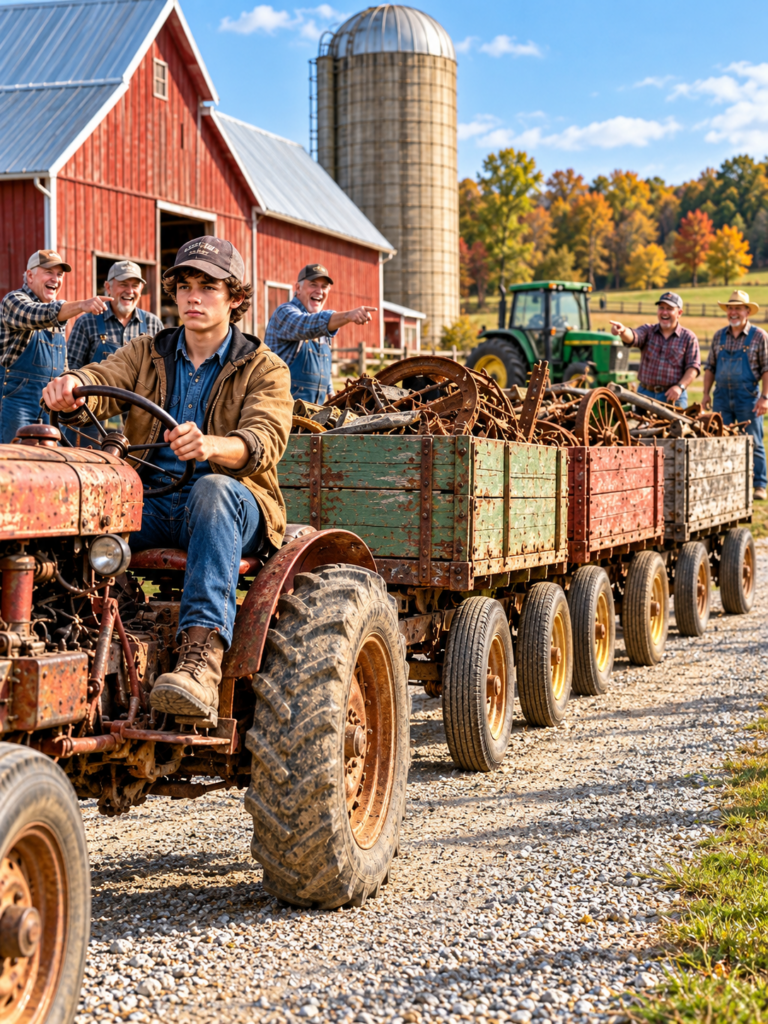
The wagon comes up the gravel lane at 11 miles an hour, and every board on it complains.
It is the last Saturday in October in Juniata County, Pennsylvania. The sun sits low over the cornstalk stubble, turning the fields the color of old brass.
Behind a worn Ford tractor, 17-year-old Eli Rhodes is towing a wooden box gravity wagon older than his father’s marriage. Red paint mostly gone, one rear tire flat to the rim, a sideboard split clean through.
It is the third one.
The other two are already parked behind the machine shed, Virginia creeper climbing their wheels.
At the fence, Walt Dunmire, who milked cows on the next ridge for 44 years, watches with his arms folded.
“I sold you one of those because you asked,” he says when the engine quits. “I still don’t understand it. Two hundred bushels a wagon. The big farms haul that in one pass now. What are you going to do with three?”
Eli looks back at the wagon.
“I don’t know yet. Not all of it.”
Walt nods slowly, the way you nod at an honest answer that isn’t a useful one.
He had every right to ask.
Nobody in that county would have bet $50 on those wagons.
But less than three years from that afternoon, a line of vehicles would turn into this same gravel lane, and the people stepping out would be looking for exactly what Eli was about to build.
Not the wagons. What the wagons would become.
How do three unwanted wagons lead to buyers driving out to a dead-end farm road?
That comes later.
First, you have to understand why Walt was right.
A gravity wagon is a simple idea. A tall wooden box on four wheels, its floor slanted like a funnel, a sliding gate at the bottom. Open the gate and the grain pours out by its own weight.
In the 1960s and 70s, that was harvest. The combine filled the wagon, a tractor pulled it to the bin, and a handful of these carried a family farm through the season.
Then farms grew, and the machines grew with them.
A modern combine’s hopper holds more than one of these wagons. Grain carts carry a thousand bushels. Semi-trucks take it from there.
When a harvest window can close with the next rainstorm, a machine that needs five trips to do one trip’s work stops being charming and starts costing money.
So the wagons were parked, then forgotten, then sold by the pound as scrap.
Eli knew all of that.
He just kept a different kind of count.
Since he was 14, a spiral notebook had lived in his coverall pocket. Every load his family hauled, which field, what moisture, how many minutes from field gate to bin.
His father called him the county’s youngest bookkeeper.
Walt put it another way.
“You write down more than you haul.”
He didn’t buy the wagons with a plan.
He collected them the way some people collect good hand tools.
The first had been sitting behind his family’s barn since his grandfather’s day. His father, Dale, told him to take it before the weeds finished the job.
The second came from Walt himself, $150, mostly because Walt wanted his shed back.
The third came from Harlan Bowman, 81, who had sold his cattle years ago and wanted the fencerow cleared before the farm changed hands.
Eli paid $75 plus diesel to haul it home.
Every dollar came from mowing lawns and working a roadside produce stand.
Under $300 for three wagons.
And if you’d pressed him, he could only have given you two reasons.
The steel running gears were sound under the rust, and while logging the previous summer’s wheat harvest, he’d noticed something small, something he couldn’t yet put into words.
It would take him nine months to understand it.
The work started in November in a drafty shed with a kerosene heater.
The wheel bearings had seized solid, packed with grease gone hard as candle wax. He drove them out with a punch and a hammer, then pressed in new sets from the farm store at $38 a hub.
Two tires were dry-rotted, so he tracked down replacements at a salvage yard 40 minutes away.
A cracked tongue on the second wagon he welded the way his shop teacher had shown him, badly the first time, then again.
He replaced split sideboards with rough-sawn oak, scraped rust until his forearms ached, and freed gates that had been stuck since the Carter administration.
Weekends, evenings, a snow day.
The kids at school started calling him Wagon Boy. Not cruelly, mostly.
There were nights he stood in the cold shed at nine, hands numb, holding a bolt that had snapped off flush in the hub, and wondered what exactly he was proving.
Dale never told him to stop.
He just left a thermos of coffee on the workbench most evenings, and that said something, too.
His plan was modest: use them on his father’s wheat the next summer.
It wasn’t a business, and by spring, even Eli had started asking the question everyone else already had.
Is this actually worth it?
July answered him, and not kindly.
The wagons worked at wheat harvest.
They worked slowly.
On the second day, his father, patient as ever, put it plainly.
“It runs, Eli. It’s just slower than what we’ve got.”
On the fourth day, the combine’s drive system failed in the middle of a field with rain two days out.
The repair bill passed $5,000 in a year when grain prices were already thin.
That night at the kitchen table, Dale did the arithmetic out loud.
He wasn’t angry, and that was the hard part.
The scrapyard in Mifflintown would pay by weight for three running gears, a few hundred dollars, enough to cover part of a parts order.
“I’m not asking you to like it,” Dale said. “I’m asking you to look at what we need.”
Eli had no argument.
Three wagons, one season, no income.
He called the yard and booked a Monday pickup.
But before Monday, there was a meeting at the Grange Hall that he almost skipped.
The Penn State Extension evening was about small grains, which meant retired farmers and free coffee.
Dale couldn’t go with the combine parts to chase, so he sent Eli with a legal pad.
Near the end, a woman named Renata Alvarez stood up.
She bought grain for Broad Mountain Malt and Spirits, a craft distillery in Harrisburg making rye whiskey, and she described her problem without drama.
Her distillery wanted heritage rye grown in Pennsylvania and kept by lot.
Every batch traceable to one field, one variety, no mixing.
Whiskey made from rye tastes like the rye, and a few bushels of wheat, a film of last week’s soybean dust, or a musty smell can undo a batch.
But local elevators blend everything, a truck, a pit, a bin, by design, a river.
For commodity grain, that’s efficient.
For her, it was a wall.
“I’d rather buy down the road than out of state,” she said. “I just can’t find anyone who can keep a load separate and prove it.”
Eli stopped writing.
Keep a load separate and prove it.
He drove home, pulled out his notebook, and flipped to the wheat harvest.
Because he’d had only three wagons, he’d labeled them A, B, and C.
Each carried one field’s grain. Each had its moisture, its minutes, its cleanup written beside it.
The handicap he’d been fighting all summer, small boxes that couldn’t keep up, was exactly what the distillery couldn’t find anywhere else.
A wagon holds one thing, and he already had the record of what each one held.
He called the scrapyard and canceled.
Then he asked his father for one week.
Renata agreed to meet him, probably out of politeness.
He arrived with a notebook and a photo of a wagon.
She asked what she’d asked every grower.
How would he prove a lot never touched anything else?
“I’m not sure yet,” Eli said. “Give me a summer.”
She gave him a spec sheet instead.
Moisture at or under 14% so the grain stores without spoiling, minimal foreign material, no off odors, one variety per lot, a record from field to delivery.
What he built over the next weeks was not glamorous.
He sanded the wagon interiors and sealed the wood so no seed could hide in cracks.
He replaced gapped floorboards with smooth, sealed plywood.
He fitted rubber gaskets on every discharge gate, built tarp lids, and bolted a numbered plate on each wagon.
He wrote a cleanout checklist: sweep, air blow, flashlight inspection, initials.
Each wagon got a plastic envelope for its log.
And the wagons became dedicated.
No more wheat, no more anything but rye stored in a swept shed.
In the trade, this is called identity preservation, keeping a crop’s identity intact from field to buyer.
Eli called it not mixing things up.
They were still three old wagons.
The value lived in the system around them.
He didn’t bet the farm.
He asked Walt for the back field, ten acres that hadn’t been planted in two years.
“Pay me when it works,” Walt said. “If it doesn’t, you’ve cleaned up my field.”
That September, he sowed the heritage rye Renata supplied in three plots of about three acres each.
The following July, his father’s repaired combine rolled through.
Lot A went in clean.
Lot B came out four bushels short, and Eli found a worn gasket leaking grain along the lane. His log caught it because the weight didn’t match the field’s yield.
Lot C tested wet, 16%.
He made everyone wait a day rather than risk spoilage.
Three lots passed the lab.
Renata’s team ran a trial distillation.
That week, the elevator was paying around $6 a bushel for rye.
Broad Mountain paid just over eight.
On roughly 500 bushels, that was a little more than $1,000 above the elevator price.
Not a fortune.
Proof.
He handed the first check to his mother toward the combine bill.
She set it on the kitchen windowsill for a full day before she banked it, like something worth looking at.
The test answered one question and opened a bigger one.
In August, Renata called.
The trial whiskey had performed beautifully.
Her head distiller, Tom Gaffney, wanted 4,000 bushels next year, and two other small distillers in the Susquehanna Valley had heard about the program.
Eli hung up and sat down on a wagon tongue.
The question had changed.
It was no longer whether the idea worked. It was whether the farm could handle it.
The wagons themselves were the problem.
Each lot had to sit, sealed, for about a day and a half while the lab results came back.
Then the wagon needed cleaning before it could hold anything else.
Three wagons meant three lots in motion at once.
Harvest doesn’t wait politely.
Dale and Walt disagreed, and each had a point.
Dale had watched grain markets swallow neighbors and thought they should lean in, borrow, buy new wagons, say yes to all 4,000.
“Someone’s going to fill that order. Might as well be us.”
Walt had seen what a bad year does to borrowed money.
“A man gets hurt chasing a big check. Rain doesn’t read contracts.”
Neither was foolish.
Scale fast and risk debt and a broken promise.
Scale carefully and risk losing the customer.
But for the first time, Eli wasn’t defending a hunch.
He had a notebook.
He spread four years of records across the kitchen table.
Cleaning a wagon averaged just under three hours.
Lab turnaround ran a day and a half.
So one wagon could turn a lot about every two and a half days.
The rye window ran about ten days, and his father’s old weather logs showed three of those days usually lost to rain.
Seven workable days, three wagons, eight lots.
Not enough.
Twelve lots of 200 bushels, 2,400 bushels, needed five wagons with a little room for a bad day.
He even knew where to find them.
Walt, it turned out, had a second wagon he hadn’t mentioned.
Harlan’s neighbor had another.
Repairs and all, under $1,500.
A new gravity wagon cost many times that.
So Eli called Renata and told her, in a way, “No.”
“I can promise 2,400 bushels in twelve documented lots, not 4,000. I’d rather deliver every bushel than promise more and lose lots.”
Silence on the line.
“Then that’s the most honest answer I’ve had from a grower in a long time. 2,400 with an option to grow.”
Dale read the notebook pages that night, slowly.
“I’d have called this a hobby,” he said. “It’s evidence.”
The visit came on a bright Tuesday in June, three weeks before harvest.
Two vehicles turned into the gravel lane.
Renata stepped out first, followed by Tom Gaffney, a quality manager with a clipboard, and a man from a malt house in Lancaster County who had come because Renata wouldn’t stop talking about this farm.
Behind them, a second distiller’s pickup.
Nobody said much.
They walked into the shed where five wagons stood in a row on a swept concrete floor.
Numbered plates bolted on, tarps folded.
Tom lifted a lid and breathed in.
He ran his thumb along a gasket seam.
The quality manager asked how Eli cleaned between lots, and he walked her through the checklist line by line.
She asked to see a log.
She read it for a long time.
Then she asked him to demonstrate on wagon four.
Eli’s hands were steady, but only because he’d rehearsed every step in his head the night before.
Sweep, air, flashlight, initial.
The quality manager watched without writing anything, which was somehow worse.
And then she nodded once and wrote a single line.
Walt stood at the edge of the shed with his cap in his hand.
He didn’t say a word.
At the end, Renata said the sentence Eli would remember.
“Most farms can tell me what they grow. Very few can tell me where it’s been.”
They signed at the kitchen table over Janet’s coffee.
No cheering.
Pens, paper, a handshake.
The wagons nobody had wanted were now a system a buyer could audit.
So what actually created the value?
Not the wood or the steel.
Those were worth a few hundred dollars the day Eli towed them home.
A newer wagon would have been worth more as an object and no more useful for this job.
What the buyers valued was handling, the ability to keep a crop separate, clean, and documented from field to delivery.
Specialty markets pay for reliability.
Records revealed an opportunity.
A small test made it safe to pursue.
And Eli judged equipment by the problem it could solve, not the year it was built.
George Washington Carver, who spent his life teaching farmers to build on what they already had, wrote that the thrifty, wide-awake farmer will think of many other things to do and ways to do them.
Notice what Eli never did.
He never bought something new to chase a market he hadn’t tested.
He never risked the home farm on a guess.
Each step answered one question, then earned the right to ask the next.
That is how a small farm can enter a specialty market without betting everything on it.
Nothing miraculous happened in that shed.
Someone paid attention longer than everyone else did.
Eleven years later, Eli Rhodes farms far more than a back field.
There’s a thousand-bushel grain cart now, steel bins, a seed-cleaning line, a combine with a cab quieter than his mother’s kitchen.
Broad Mountain is still a customer with other buyers beside it, but in the machine shed on that same swept concrete sits one faded red wagon with a one on its plate.
A 16-year-old summer hand named Marcus stops and looks at it.
“Why do you keep that old thing? You could scrap it.”
Out by the door, 90-year-old Walt Dunmire sits in a lawn chair as he does every harvest.
“Same question I asked,” he calls. “What are you going to do with it?”
Eli smiles.
“Nothing, Walt. It already did it.”
Then to Marcus, “That’s where I learned the question. Not what it’s worth, what problem it can solve.”
Value isn’t always found in what’s new.
Sometimes it’s in seeing an old resource differently, testing the idea small, and proving it before you spend heavily.
A person can walk past an opportunity simply because everyone around them has already decided it’s worthless.
Eli didn’t succeed because he owned the newest equipment.
He succeeded because he asked what the old equipment could do.
Out in the shed, wagon number one waits for July.


