
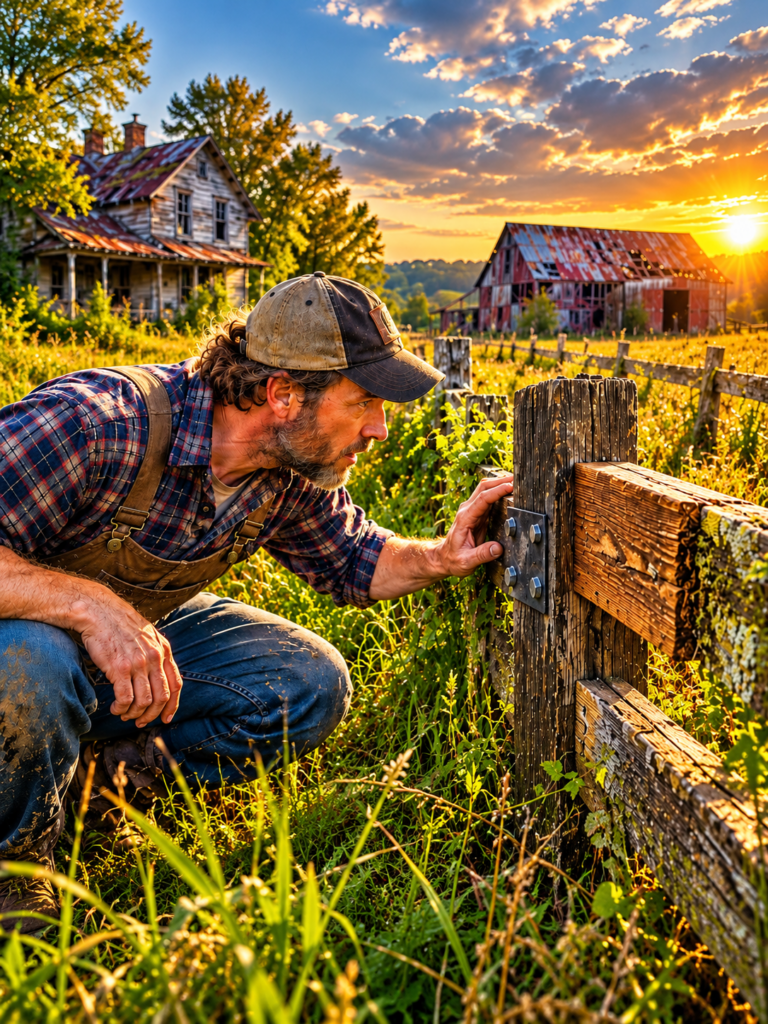
By the time Thomas Vance first saw the property, everyone in Highland County had already decided what it was worth.
Almost nothing.
The 30-acre farm sat on the outer edge of the county, half hidden behind neglected hedgerows and a sagging line of wooden fence. It had been abandoned for more than 40 years. The farmhouse roof had partially collapsed inward. The red barn stood behind a wall of wild briars so thick that from the road it looked as though the woods were slowly swallowing it. Fence rails had rotted gray with age, and many of the cedar posts had softened to the point that a hard push could break them at ground level.
Local real estate agents called the place an unsellable liability.
Farmers who had lived in the valley for decades had their own names for it.
Bad dirt.
Dry ground.
Cursed acreage.
Whenever prospective buyers came to inspect the property, they usually followed the same pattern. They stopped first at the farmhouse, looked through the broken windows, then walked toward the barn and examined the field beyond it. Eventually they began calculating aloud.
New roof.
Foundation repairs.
Fencing.
Barn structure.
Water.
Always water.
There was no functioning well on the lower pasture, no modern irrigation, and the shallow creek bed that crossed the property had apparently been dry for decades. A broad depression near the western side of the farm was listed on county maps as a pond, but in reality it was little more than a muddy basin filled with reeds during wet weather and cracked soil during dry months.
Most buyers reached the same conclusion.
The land would cost far more to restore than it would ever be worth.
Thomas Vance saw something else.
He was 34 years old in October 1994 when he attended the county foreclosure auction.
Thomas was not a farmer by profession.
He had spent most of his adult life working as a timber framer and structural carpenter, learning to understand buildings by studying what held them together. He knew how an old beam failed. He knew the difference between decorative joinery and load-bearing work. He could look at a sagging roofline and tell whether the problem was surface damage or something deeper.
More importantly, he had spent enough years around old structures to know that neglected did not always mean worthless.
Sometimes it only meant misunderstood.
He did not see a collapsed farmhouse.
He saw hand-cut framing that might still be salvageable.
He did not see a barn consumed by briars.
He saw a structure that might be standing because the original builder had overbuilt it.
And when he looked across the 30 acres, he saw land that appeared dry but did not look naturally barren.
The slope interested him.
The shape of the ravine interested him.
The old depression labeled as a pond interested him most of all.
It looked less like a random low spot than something that had once been used deliberately.
Thomas asked questions.
Most of the answers were vague.
The farm had once belonged to a man named Henry Vance.
No one at the auction seemed to know whether Henry was related to Thomas. The surname was common enough in that part of Virginia that Thomas did not assume anything.
Henry had apparently been an eccentric builder.
He had lived there before the Second World War.
After his death, the farm passed through several hands, none of whom stayed.
At some point, the water stopped.
The fields dried.
The buildings deteriorated.
Eventually the taxes went unpaid.
Thomas listened.
Then he bid.
When the auction ended, he owned the property for $18,000.
Nearly every dollar he had saved disappeared that day.
Friends told him he had made a mistake.
One former coworker drove out, stood beside the old barn, and said Thomas would spend $50,000 making the place worth $20,000.
A local farmer offered a gentler version.
“You’ve got good hands,” the man told him. “But hands can’t make water.”
Thomas did not argue.
Three days after the purchase, he moved onto the property with a tool truck and an old camper trailer.
The trailer became his bedroom, kitchen, and office.
He parked it near the farmhouse but far enough away that falling roof material would not reach it.
The first 2 days were spent doing practical things.
Clearing enough brush to create safe access.
Checking the barn.
Covering sections of the farmhouse roof with temporary tarps.
Inspecting the old chimney.
Making lists.
On the third morning, Thomas decided to walk the northern boundary before winter weather arrived.
He carried fencing pliers, a hammer, a small wire brush, a utility belt, and a notebook.
The task was simple.
Count failed posts.
Estimate replacement rails.
Determine how much cedar he would need before the ground froze.
Most of the fence was exactly what he expected.
Rotten.
The posts had been set decades earlier and left untreated. Some had split along the grain. Others leaned outward beneath the pressure of vines. Several collapsed when Thomas touched them.
He began making marks in his notebook.
Post.
Rail.
Post.
Two rails.
Corner brace.
Then, near a thick hedge line below the western ridge, he stopped.
At first he could not have explained why.
Something simply looked wrong.
Or rather, too right.
Ten feet of fence did not match the decay around it.
The rails themselves looked old enough.
Gray wood.
Lichen.
Moss.
But the central post was different.
Thomas pushed through the brush.
The timber was white oak.
Not cedar.
Not pine.
Heavy, dense white oak.
He scraped away moss with his thumb.
The grain remained solid.
He rapped the post with the metal handle of his pliers.
The sound was deep and hard.
No hollow rot.
No softness.
No decay.
For something supposedly exposed to more than 40 years of Virginia weather, the post was unnaturally sound.
Then he noticed the steel.
Two thick metal plates had been fitted to the sides of the timber.
At first glance, they resembled an old repair.
But Thomas had worked around structural hardware for too long to believe that explanation.
Repairs were usually improvised.
These were machined.
Quarter-inch steel.
Cleanly cut.
Six heavy 3/4-inch hex bolts secured each side.
A weather-sealed steel cap protected the top grain of the post from rain.
No farmer would build an ordinary fence post like this.
Not unless the fence were expected to stop a truck.
Thomas crouched.
The wet grass soaked the knees of his work pants.
He ran his hand over the metal.
One thing immediately became clear.
The steel was not reinforcing the fence.
It was holding something.
He leaned closer.
The upper horizontal oak rail did not appear to enter the post in the normal way.
There was a narrow separation between rail and timber.
Thomas pushed against it.
No movement.
Then he looked at the hardware again.
The plates were aligned with a vertical channel.
That made even less sense.
He pulled the wire brush from his belt.
Slowly, he scrubbed 40 years of moss and lichen from the upper face of the post.
Dark wood emerged.
Then metal.
A small rectangular brass plate had been recessed into the top grain.
Thomas brushed harder.
Letters appeared.
PATENT PENDING
VANCE HYDRAULIC AND DRAINAGE
1938
Thomas stopped.
He read it again.
Vance.
Hydraulic.
Drainage.
Not fencing.
He sat back on his heels.
For several seconds, the only sound came from wind moving through the hedge.
The fence post was part of a machine.
Thomas stood and walked around it.
He began inspecting everything again, now with an entirely different question in mind.
The 6 hex bolts.
The steel side plates.
The detached upper rail.
The vertical channel.
Nothing was accidental.
He took a socket wrench from his tool bag.
The top bolt resisted at first.
He sprayed penetrating oil around the threads and waited.
Then he leaned into the wrench.
Metal groaned.
The bolt turned.
Once.
Twice.
He loosened the second.
Then the third.
As tension came off the steel assembly, the side bracket shifted downward.
Thomas froze.
It had moved nearly an inch.
He placed both hands against it.
The bracket slid farther along the hidden vertical channel.
Then something inside the white oak post released with a heavy metallic click.
The upper horizontal rail swung inward.
Thomas jumped back.
The rail rotated smoothly on an internal steel pin.
Behind it, the center of the post was hollow.
Not rotten.
Engineered.
Inside, a steel cable disappeared vertically into the ground.
A compact pulley assembly sat inside the timber cavity.
A heavy iron handle rested behind the plate.
Thomas stared.
What the entire county had believed was a reinforced fence post was actually a disguised control station.
He shined a flashlight into the cavity.
The cable was rusted but intact.
Behind it, he could see part of a counterweight system.
He pulled lightly on the handle.
Resistance.
A great deal of it.
Thomas repositioned himself.
Both hands.
One boot braced against the base.
Then he pulled downward with his full weight.
Nothing happened.
He stopped.
Applied more oil.
Worked the lever several inches.
Metal creaked deep underground.
Thomas pulled again.
This time the mechanism moved.
Not quickly.
Slowly.
Reluctantly.
The sound that followed did not come from the post.
It came from somewhere beneath the earth.
A deep grinding noise.
Then a metallic thump.
Thomas released the handle.
Silence.
Another thump came from farther downslope.
Approximately 40 yards away.
Toward the dry creek bed.
He grabbed his flashlight and ran.
The slope was wet from recent rain.
His boots slid through the mud as he descended.
The creek bed below had always looked natural from a distance.
Once Thomas reached it, that illusion vanished.
Beneath 40 years of briars, honeysuckle, and fallen branches stood a structure.
Stone.
Concrete.
Steel.
He began tearing away vines.
A massive iron gate crossed the narrowest point in the ravine.
Its lower edge sat flush against exposed bedrock.
A cable assembly disappeared into the hillside.
The mechanism inside the fence post had pulled it.
The gate was lifting.
Only inches.
But moving.
Then Thomas heard water.
At first, it sounded like wind.
Then a trickle.
Then a rush.
Clear water surged from the upper side of the gate.
Not muddy runoff.
Spring water.
Cold.
Clean.
Fast.
It rushed into the old creek channel and began flowing downhill.
Thomas followed.
The channel curved toward the depression everyone had called a useless mud hole.
Water entered it.
At first it vanished into the dry soil.
Then the level began rising.
Thomas stood at the edge of the basin while decades of assumptions collapsed in front of him.
The pond was not naturally dry.
It had been empty because the water feeding it had been mechanically shut off.
The useless farm had a hidden water system.
And Thomas had just turned it back on.
PART 2
Thomas spent the rest of that afternoon clearing vegetation.
Every hour revealed something new.
The creek channel was not simply a creek.
Along its lower edges, he found formed concrete.
Sections of old distribution trench emerged beneath weeds.
Some channels branched east.
Others ran toward the lower pasture.
Several had small stone control boxes positioned at intersections.
By sunset, Thomas no longer believed he had found one unusual gate.
He had uncovered part of an irrigation network.
A sophisticated one.
The system had been built decades before electric pumps became common on farms like this.
Yet water moved with no electricity.
No engine.
No fuel.
Gravity alone drove it.
The pond continued filling.
Thomas estimated its surface area at approximately 2 acres when full.
By evening, several feet of clear water had accumulated.
He stood beside the bank as the sky darkened.
The value of what he had discovered was difficult to calculate.
A dependable water source could determine whether land was marginal or productive.
On 30 acres, irrigation changed everything.
Thomas eventually forced himself back to the camper.
He ate quickly.
Then drove into town.
The county historical archive occupied part of an old municipal building.
The head archivist was a retired historian named Evelyn Miller.
She was preparing to close when Thomas arrived.
“I need property records.”
Evelyn looked at the clock.
“Everybody needs property records 5 minutes before closing.”
“I found something.”
“That is what everybody says too.”
“Hydraulic equipment.”
She stopped gathering papers.
“Where?”
“Vance property. North boundary.”
Her expression changed.
“The old Henry Vance farm?”
“Yes.”
Evelyn studied him.
“Sit down.”
She disappeared into the records room.
Ten minutes later, she returned carrying a thick leather binder.
Dust coated its upper edge.
The pages inside contained deeds, tax records, hand-drawn maps, engineering notes, and correspondence.
Thomas read the name.
Henry Vance.
The original builder had not been simply a farmer.
He had been a master hydraulic engineer during the Great Depression.
During the 1930s, Henry had purchased or inherited the acreage and begun designing a closed gravity-fed conservation system around a natural artesian spring located above the farm.
No electrical pump.
No gasoline engine.
The elevation difference between the spring, storage pond, and lower pastures generated enough pressure to distribute water over most of the property.
Evelyn showed Thomas a 1938 engineering drawing.
There it was.
The fence post.
Not labeled as a fence post.
MASTER CONTROL RAIL.
Thomas leaned closer.
A line drawing showed the oak casing.
Steel plates.
Counterweight cable.
Mechanical advantage.
Below it, a cross section displayed the buried linkage leading toward the sluice gate.
“Why hide the lever?” Thomas asked.
Evelyn turned several pages.
The answer came from records dated 1941.
A severe regional water dispute had developed.
Several industrial operations and land speculators wanted access to private springs feeding farms around the county.
Henry refused.
According to the records, there had been attempts to divert water from his property.
So he modified the system.
The control mechanism was concealed inside a section of perimeter fence.
Then he shut the master gate and locked the system.
The spring remained private.
The distribution network went dormant.
Thomas looked at Evelyn.
“He sealed his own irrigation?”
“To keep other people from taking the water.”
“Why didn’t he open it later?”
Evelyn continued reading.
Henry apparently reopened portions of the system at different times, but after the dispute the master mechanism became increasingly private.
He died in 1952.
Those who inherited the property understood that some form of irrigation had once existed but apparently did not know how to operate the concealed release.
Over the following decades, memory turned into rumor.
Rumor became confusion.
Eventually people stopped believing there was anything to understand.
The fields dried.
The pond emptied.
The farm lost value.
The system remained beneath the soil.
Thomas sat back.
Everyone who had passed on the foreclosure believed the property lacked water.
In reality, it had an artesian supply that had been mechanically shut for more than 40 years.
“Do the records say how much flow?”
Evelyn found another page.
“One hundred twenty gallons per minute.”
Thomas stared.
“What?”
“Natural artesian yield. Approximately 120 gallons per minute under the recorded conditions.”
He did the calculation instinctively.
That was more than 7,000 gallons per hour.
More than 170,000 gallons in a day if unrestricted.
Enough to transform the entire property.
Evelyn watched him.
“You bought the farm, didn’t you?”
“Yes.”
“How much?”
“Eighteen thousand.”
She smiled.
“Then I imagine you are having a better evening than you expected.”
The following morning, Thomas returned to the northern fence with a full tool kit.
Now that he understood what he was looking at, the design became even more impressive.
The white oak casing had been selected because of its strength and resistance to damage.
The 1/4-inch steel plates carried mechanical load.
The pulley assembly used a counterweight to provide roughly a 1-to-10 mechanical advantage.
That explained why Thomas had been able to shift a much heavier gate with a hand-operated lever.
Henry had hidden industrial engineering inside farm carpentry.
Thomas spent hours cleaning the mechanism.
He removed each bolt carefully.
The worst were replaced with stainless steel hardware.
The original steel plates remained serviceable.
He greased the pulley shafts.
Inspected the cable.
One section of wire rope had corroded enough that he replaced it.
He cleaned the oak cavity.
Then repaired the timber casing without altering the original geometry.
His total immediate repair cost came to approximately $250.
Grease.
Bolts.
Wire rope.
Small hardware.
A modern irrigation well and distribution system for 30 acres could easily have cost more than $45,000.
Henry’s system required almost no operating energy.
Thomas began mapping it.
He carried a notebook across the farm, following each concrete branch as he uncovered it.
The main reservoir fed channels running toward the lower pasture.
Smaller diversion structures could redirect flow.
Some sections needed cleaning.
Others had cracked after decades underground but remained repairable.
The design used topography rather than machinery.
The artesian spring supplied the source.
Elevation supplied pressure.
Gravity supplied distribution.
The control rail supplied regulation.
Thomas became increasingly convinced Henry had built one of the most elegant passive agricultural systems he had ever seen.
Then the land began changing.
At first, only the soil darkened.
Dry red earth absorbed water greedily.
Then dormant grass recovered.
Green appeared in narrow lines along the channels.
Within 3 weeks, entire sections of pasture changed color.
Brown fields turned green.
Not spring green.
Not the weak growth that followed one rainstorm.
Thick grass.
Deep-rooted.
Even.
The transformation happened before winter had fully arrived.
Drivers on the county road began slowing.
Some stopped.
One old farmer pulled his truck onto the shoulder and stood beside the fence staring across the property.
“You putting in a well?” he asked when Thomas approached.
“No.”
“What are you pumping with?”
“Nothing.”
The old man frowned.
Thomas pointed toward the upper field.
“Spring.”
“There ain’t enough spring water on that place.”
“There is.”
“How?”
Thomas led him toward the reinforced fence post.
The farmer stopped.
His expression changed.
“That thing?”
“You know it?”
“Know of it.”
He walked around the post.
“We all thought Henry was crazy building a fence like this back in ’38.”
Thomas opened the protective plate.
The counterweight mechanism became visible.
The old farmer stared.
“Good Lord.”
“Master release.”
“For what?”
Thomas pointed downslope.
“The sluice.”
The farmer looked toward the now-visible pond.
Understanding came slowly.
Then he laughed.
A deep, surprised laugh.
“So that was it.”
“You knew there was a system?”
“Everybody knew Henry did something with water. Nobody knew how it worked.”
He shook Thomas’s hand.
“Turns out he was the smartest man in Highland County.”
Then he looked at Thomas.
“And you were the only fool smart enough to look close at a fence post.”
Thomas accepted the compliment.
More farmers came.
Some remembered stories.
One remembered seeing water in the pond as a child.
Another said his grandfather had spoken about Henry Vance’s “underground gates.”
Others had assumed those stories were exaggerations.
People who ignored the auction began stopping at the property.
They asked questions.
Thomas answered most of them.
He avoided saying one thing aloud.
The land’s value had changed almost overnight.
He had paid $18,000.
A post-discovery appraisal later placed the property above $140,000.
But Thomas did not sell.
Money had made the discovery important to everyone else.
To him, the system itself had become important.
He wanted to know whether it could live again as Henry intended.
The farmhouse came next.
The roof was worse than Thomas initially hoped.
Several rafters had failed.
Water damage extended into the upper framing.
But the main structural walls remained surprisingly strong.
Thomas dismantled the damaged sections carefully.
He harvested white oak from his own woodlot.
Using the same timber-framing skills that had allowed him to recognize the unusual fence post, he shaped replacement beams.
Hand-hewn.
Traditional joints.
New material fitted into old structure.
The work took months.
Then the barn.
Then the channels.
Then the pond spillway.
As he worked, Thomas began considering another possibility.
The flowing water had energy.
Not theoretical energy.
Measurable head pressure.
The elevation difference between the pond and lower spillway could drive a small turbine.
Henry had built the system before small-scale rural hydroelectric equipment became practical for ordinary farmers.
Thomas lived in a different era.
So he added something Henry had never had.
A micro-hydroelectric turbine.
It was installed at the pond spillway.
Nothing enormous.
Enough.
Continuous water flow turned the turbine.
The generator produced electricity.
Not for an entire industrial operation.
For the homestead.
Workshop lights.
Power tools.
Basic household electricity.
The farm that had been dismissed as dry, useless acreage was now producing both water and power without relying on a conventional pump or the public grid.
Thomas found a strange satisfaction in that.
The old system had been designed around self-reliance.
The new turbine extended the same idea.
Water flowed because of elevation.
Electricity flowed because the water moved.
The system did not fight the land.
It used what the land already offered.
By the second year, the property no longer resembled the foreclosure Thomas had bought.
The farmhouse roof stood straight.
The barn had been cleared.
The pond held clean water.
Pastures remained productive.
Concrete channels carried controlled flow across the acreage.
The workshop ran partly on electricity generated at the spillway.
Still, the object that fascinated visitors most was not the pond.
Not the turbine.
Not even the restored house.
It was the fence post.
Thomas began receiving requests from local farmers, extension agents, historians, and engineers who wanted to see the mechanism.
At first he simply opened the plate.
Eventually he worried repeated handling would damage it.
So he built a protective wooden housing around the original oak structure.
A clear glass viewing panel allowed visitors to see inside.
The steel plates.
Cable.
Pulley.
Counterweight linkage.
He left the 1938 brass identification tag visible.
PATENT PENDING.
VANCE HYDRAULIC AND DRAINAGE.
The words that had changed the entire direction of the farm.
PART 3
By October 1996, exactly 2 years after Thomas bought the property, the Vance Homestead had become something no one in Highland County would have predicted.
A local landmark.
The State Agricultural Extension Office sent representatives.
They photographed the irrigation network.
Measured flow.
Reviewed Henry Vance’s original drawings.
Interviewed Thomas about the restoration.
The story was eventually featured in an annual rural conservation journal as an example of passive water engineering.
What interested the agricultural specialists most was not that the system was old.
It was that the principles remained useful.
The spring produced approximately 120 gallons per minute under favorable flow conditions.
The system distributed water without fuel.
No electric pump was required.
The concrete channels used natural grade.
The storage pond provided buffering and reserve capacity.
The control gate allowed the network to be isolated.
The disguised fence mechanism provided mechanical advantage through a counterweight system.
Everything had been designed around maintenance that one capable person could perform.
Henry’s brilliance had not been in building something mysterious.
It had been in building something durable.
The mystery came later, when the knowledge disappeared.
Thomas often thought about that distinction.
For 40 years, people had walked past the reinforced fence post.
Farmers.
Owners.
Buyers.
Surveyors.
Appraisers.
Some probably noticed it.
Perhaps they assumed it was a repair.
Perhaps they thought Henry had overbuilt a corner.
Perhaps someone once pulled on the wrong bolt and gave up.
The important thing was not simply that Thomas had seen the post.
It was that he had noticed the post did not fit the explanation everyone had accepted.
Fence posts did not need quarter-inch steel side plates.
Fence rails did not need internal slide bolts.
Farm repairs did not normally carry recessed brass patent tags.
The object had been answering the question the entire time.
Most people simply never asked it.
Thomas became careful whenever visitors praised him too much.
They often told the story as though he had outsmarted everyone.
He did not see it that way.
His background had prepared him to notice.
That was all.
A timber framer learns to read load paths.
A carpenter learns that hardware has purpose.
A repairman learns to distrust explanations that do not match physical evidence.
Thomas happened to bring those habits to the correct 10 feet of fence.
Everything after that was work.
Hard work.
Clearing channels.
Replacing cable.
Restoring gates.
Reframing the house.
Maintaining the pond.
Installing the turbine.
Repairing neglected land.
The discovery opened the door.
It did not walk through it for him.
The financial numbers still impressed people.
$18,000 purchase price.
More than $45,000 estimated for a comparable modern well-irrigation system.
Approximately $250 spent restoring the original control mechanism.
More than $140,000 estimated property value after the water system became operational.
But Thomas resisted reducing the farm to a lucky real estate deal.
If he had wanted only profit, he could have sold early.
He had opportunities.
More than one buyer offered a price far above what he paid.
Thomas declined.
The farm had become something else.
A working record of engineering.
A conversation between 1938 and 1994.
Between Henry Vance’s understanding of water and Thomas’s understanding of structures.
The shared surname became a source of local speculation.
People occasionally asked whether Henry was a relative.
Some county records hinted at extended Vance family connections in the region, but the surviving documents Thomas consulted did not establish a simple direct relationship.
In time, he stopped worrying about it.
Whether the connection was blood or coincidence mattered less than the physical inheritance sitting on the property.
Henry had built something.
Thomas had recognized it.
That was enough.
One autumn morning, Thomas walked the northern fence again.
The same route he had taken on his third day.
Much of the perimeter fencing was new now.
Fresh cedar posts.
Replacement rails.
Strong corners.
But when he reached the western ridge, he stopped at the old oak control post.
It looked different than it had 2 years earlier.
Not new.
Thomas had resisted making it new.
The oak still carried weather.
The steel still showed age beneath the protective treatment.
The brass tag remained worn.
History was visible.
He opened the housing.
The mechanism inside moved smoothly.
He pulled the lever.
Far below, the sluice gate responded.
There was a delay.
Then the familiar mechanical thump.
Water changed course.
Even after 2 years, the sound still affected him.
It was a reminder that one small action at the fence could control water across the farm.
He understood why Henry had hidden it.
During the 1941 dispute, open control infrastructure would have been vulnerable.
A visible gate could be tampered with.
A pump could be sabotaged.
A valve house could be entered.
But a fence post?
People walked past fences.
That was their purpose.
They defined boundaries and then disappeared into familiarity.
Henry had hidden the most important control on the property inside the most ordinary object on the property.
Thomas admired that more every year.
After the extension-office article appeared, visitors sometimes arrived expecting a spectacular machine.
They saw the oak post and looked disappointed.
“That’s it?”
Thomas usually smiled.
“That’s it.”
They expected gears.
Levers.
Large steel assemblies.
The real system existed mostly underground.
The post was only the key.
Thomas would remove the viewing cover and explain.
The reinforced timber carried the control hardware.
The internal lever shifted the counterweight.
The counterweight amplified the force.
The cable transferred movement downhill.
The sluice gate opened.
The spring released.
Gravity did everything afterward.
People usually became quieter at that point.
The elegance was difficult to see until someone explained it.
Then it seemed obvious.
That was often how good engineering worked.
By late 1996, the micro-hydroelectric turbine had also become part of the tours.
Thomas showed visitors how controlled discharge from the pond passed through the turbine before returning to the lower watercourse.
The electricity generated was modest by utility standards.
For Thomas, it was transformative.
His workshop lights did not depend entirely on the grid.
Many power tools could run from the system.
The restored farmhouse could be illuminated through energy created by water that people had once assumed did not exist.
He enjoyed that irony.
The land had been called barren because no one knew how to open the water.
The buildings had been called useless because no one wanted to repair them.
The farm had been called a liability because everyone calculated its value according to what was visible.
Thomas’s entire experience seemed to argue against that habit.
Visible condition mattered.
But not always most.
A collapsed roof did not mean every beam had failed.
A dry pond did not mean no water existed.
A rotten fence did not mean every post served the same purpose.
Sometimes the most important part of a structure was the part that seemed slightly wrong.
Thomas eventually decided the control post needed a permanent marker.
Not for himself.
For whoever came later.
He ordered a custom brass plaque.
When it arrived, he mounted it beside Henry’s original 1938 patent tag.
The new plate read:
VANCE HYDRAULIC CONTROL RAIL
BUILT 1938 BY HENRY VANCE
RESTORED OCTOBER 1994 BY THOMAS VANCE
LOOK CLOSELY AT WHAT OTHERS PASS BY.
THE BEST ANSWERS ARE OFTEN BUILT TO LAST.
Thomas stood in front of it for a long time after tightening the final screw.
He was not usually sentimental about tools or machines.
He liked them because they worked.
But the plaque meant something.
Henry’s mechanism had nearly vanished without physically disappearing.
It sat in plain sight for decades.
Its survival was not the miracle.
The knowledge of what it was had been lost.
That difference mattered.
A thing could remain perfectly present and still become invisible if no one remembered why it existed.
Thomas had restored more than metal and wood.
He had restored context.
Over the following years, the Vance Homestead continued producing.
The irrigated pasture supported agriculture the previous owners had believed impossible.
The pond became a reliable water reserve.
The spring continued flowing.
The turbine continued generating.
Maintenance became routine.
Grease the moving hardware.
Inspect the wire rope.
Check the concrete channels.
Clear debris.
Watch the spillway.
Listen for changes.
The great hidden system became ordinary again.
Thomas liked that.
Engineering did not exist to remain mysterious.
Its best condition was often normal use.
On winter mornings, he could look from the farmhouse window and see the pond.
In summer, the pasture stayed green when nearby ground began turning brown.
The workshop hummed.
The barn stood clean.
The farmhouse roof no longer sagged toward the center.
Visitors sometimes found it difficult to reconcile the restored homestead with photographs taken at the foreclosure auction.
Thomas kept several of those photographs.
Not as trophies.
As reminders.
One showed the farmhouse with its broken roof.
Another showed the barn buried behind briars.
A third captured the lower pasture before water returned.
Brown.
Thin.
Dry.
The difference was so dramatic that people occasionally assumed Thomas had performed massive excavation or installed an entirely new water system.
He always corrected them.
“The system was already here.”
That sentence summarized almost everything.
The water was already here.
The gate was already here.
The channels were already here.
The control mechanism was already here.
The farm did not become valuable because Thomas imported some extraordinary new resource.
He found the resource everyone had forgotten.
And because he understood that, he preserved the original design instead of replacing it unnecessarily.
Modern equipment could have done the same job.
Electric pumps.
PVC distribution lines.
Automated valves.
Pressure systems.
But all of those would require energy, maintenance, replacement parts, and operating expense.
Henry’s design needed gravity.
Steel.
Timber.
Water.
Knowledge.
Thomas added modern improvements only where they strengthened the original purpose.
Stainless steel hardware where old bolts had rusted.
New wire rope where the original cable had weakened.
Protective housing around the control post.
The hydroelectric turbine at the spillway.
He did not erase the old system in order to prove that newer meant better.
He made the old system legible again.
That approach became the feature agricultural specialists praised most.
Self-reliance was not about refusing technology.
It was about understanding what a place could already do before adding complexity.
Thomas had learned that accidentally.
The farm taught him.
Years after buying the property, he could still remember the exact feel of the first steel plate beneath his fingers.
Cold.
Wet.
Too heavy for a fence repair.
He remembered brushing away moss.
Seeing the brass.
Reading the year.
He remembered the first groan underground.
The first thump in the ravine.
Then water.
That sound changed everything.
But what stayed with him most was the moment before the discovery.
The quiet moment beside the hedge when he almost kept walking.
If he had been thinking only about replacing rotten rails, he might have marked the oak post as sound and moved on.
That possibility bothered him.
Not because the farm would necessarily have remained dry forever.
Someone might eventually have found the mechanism.
But because it showed how easily people miss answers when they decide too early what they are looking at.
Everyone else had seen fence.
Thomas saw hardware that did not belong.
Everyone else had seen marsh.
Thomas eventually saw reservoir.
Everyone else had seen worthless acreage.
Thomas saw a structure whose explanation did not match its condition.
The homestead became known throughout Highland County not because a fortune had been buried beneath it.
There was no chest of gold.
No secret inheritance.
No mysterious treasure.
What had been hidden was better suited to the land.
Water.
Engineering.
A system designed by someone who understood that survival depended less on spectacle than on control of ordinary resources.
Henry Vance had built that understanding into oak and steel.
Thomas found it because he looked closely enough.
And in the years that followed, every green field, every turning turbine, every light glowing inside the restored farmhouse became evidence that the farm had never truly been worthless.
It had only been unread.
The fence post remained near the northern boundary.
Visitors continued to stop there.
Some photographed it.
Children pressed their faces against the glass housing.
Farmers studied the linkage.
Engineers traced the cable path.
Thomas answered questions when he was nearby.
When he was not, the brass plaque answered for him.
Built 1938.
Restored October 1994.
Look closely at what others pass by.
The best answers are often built to last.
And there, on a farm that had been abandoned for more than 40 years, one weathered oak post continued doing what it had quietly done all along.
Holding the secret in plain sight.
Tighten the repeated ending themes


