
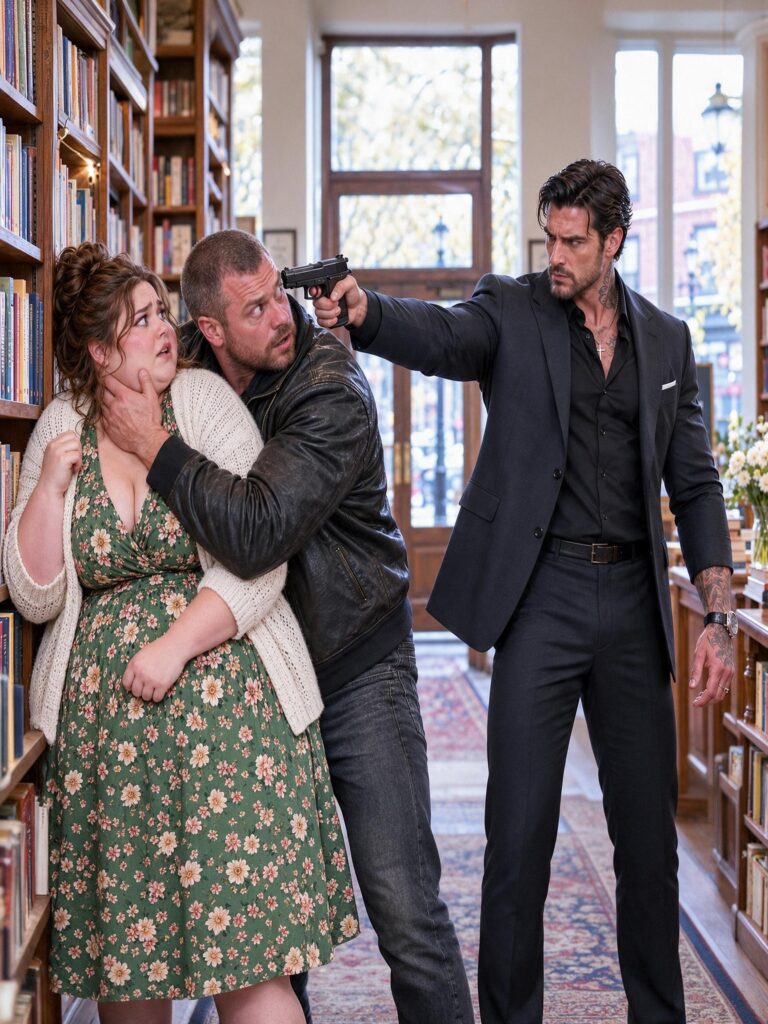
The Plus-Size Bookstore Owner Was Pinned Against the Shelves by a Loan Shark, Until the Quiet Man Who Bought Her Poetry Pressed a Gun to His Skull and Claimed Her as His
Part 1
The bell over the door of The Gilded Page had a particular sound when the weather turned mean. Rain made the brass tongue of it stutter, a thin, uncertain note that never quite finished. Penelope Gallagher heard it at six minutes past eight on a Tuesday in November and knew, before she looked up from the rag in her hand, that it was not a customer.
The shop smelled of Murphy Oil Soap and old paper. Mahogany shelves climbed nearly to the tin ceiling. First editions slept behind glass. A Persian rug, worn thin at the center by thirty years of her father’s pacing, drank the yellow light of the desk lamp. Outside, Beacon Hill was slick and black, the cobblestones holding the neon of the bar on the corner like spilled paint. Penelope had already turned the sign. She had already counted the drawer. She had already promised herself a hot shower and the last slice of ricotta pie from the North End bakery that did not look at her twice when she ordered it.
Bradley Higgins locked the deadbolt behind him with a click that landed in her ribs.
“Shop’s closed,” she said.
“It’s never closed for me, Penny.”
He wiped rain from a leather jacket that had seen better decades and worse men. Cheap cologne arrived ahead of him, sweet and chemical, fighting the cigarettes on his breath. His knuckles were bruised the way they always were, yellow going green at the edges. Frank Gallagher had borrowed eighty thousand dollars to cover a string of sports bets that had not, in the end, been covered by anything except a heart attack. For six months Bradley had come for the interest. Two thousand this week. Two thousand the week before. The number never shrank. It only grew teeth.
Penelope stepped behind the antique register. The walnut was solid. It was not a wall.
“I had to replace the boiler,” she said. Her voice held. Her pulse did not. “I’ll have the two thousand by Friday. I swear on my father’s grave.”
Bradley laughed, low in his throat, and came down the narrow aisle. His boots scuffed the rug her mother had chosen before the cancer. “Your father’s grave ain’t worth a dime, sweetheart. But this shop is. These books are. You got a Fitzgerald in that case. First edition. I know what that brings.”
“That’s on consignment.” She came out from behind the counter because the glass case was closer to him than to her, and because some foolish, inherited stubbornness would not let her watch him put his hands on another person’s property. “You can’t take it.”
He did not look at the book.
His gaze dragged over her the way a man inventoried a room he meant to wreck. Penelope was twenty-eight, a size twenty-two, and long finished apologizing for the space her body required. She wore a vintage wrap dress the color of dried wine and a cardigan soft enough to hide the fact that the dress did not quite close at the chest the way the catalog had promised. Her dark hair was pinned with tortoiseshell clips. In the shop she was a queen of ink and silence. Under Bradley’s eyes she was meat.
“You always wear these nice tight dresses,” he said, closing the distance. “A lot of guys don’t appreciate a big girl. Me? I know there’s a lot of you to love. Maybe we work out a different payment plan for this week’s interest.”
“Don’t touch me.”
She stepped back. Her spine met the edge of a shelf. An art history text slid free and hit the floor with a thud that sounded, absurdly, like a judge’s gavel.
Bradley lunged.
His hands clamped her thighs through the dress, fingers digging hard enough to bruise. The smell of wet leather and stale beer closed over her. She brought her fists down on his shoulders. He was built like a cinder block and just as interested in argument. He shoved her into the shelves, the wood biting her shoulder blades, his weight pinning her breath flat. His mouth opened against her neck, wet and certain.
Penelope squeezed her eyes shut. A sound tried to leave her and died against his chest.
Then the shadows at the back of the shop moved.
The door had not opened. No bell had rung. A man stepped out of the European history aisle as if he had been standing there long enough for the dark to accept him. She knew the cut of him. Every Tuesday at four, immaculate, a charcoal suit that cost more than her quarterly rent, the scent of cedar and espresso arriving a half step before he did. He bought Roman military strategy and Renaissance poetry. He tipped twenty dollars. He never lingered. She had filed him under harmless, the way a person files a recurring dream.
“Take your mouth off her.”
He did not raise his voice. The temperature in the room dropped anyway.
Bradley turned his head, annoyance first, calculation second. “Who the hell are you? Shop’s closed, buddy. Get lost before I break your jaw.”
The man did not walk so much as arrive. Three silent strides. His hand shot out, fingers finding the back of Bradley’s neck with a precision that had nothing to do with anger and everything to do with practice. He slammed Bradley’s face into the mahogany edge of the shelf.
The crunch was wet. Blood sprayed across the spine of a Dickens. Bradley screamed and released her. Penelope slid down the shelves until the floor caught her, one hand clutched at her torn collar, air finally getting in.
The man in the charcoal suit was not finished. He took Bradley by the jacket and threw him. Two hundred pounds of loan shark’s lackey crossed the room and met the front counter as if weight were a suggestion. Glass shattered. Fountain pens skittered. Bradley spat teeth onto the hardwood and reached for his waistband.
“You dead son of a—”
The Glock was simply there, drawn from inside the tailored jacket, steel mouth pressed to the center of Bradley’s forehead. No speech. No theater. The man’s eyes were the color of ice that had been broken and refrozen.
“I will not repeat myself,” he said. His voice was velvet pulled over a blade. “You touch her again. You look at her again. You breathe the same air she breathes, and I will cut you into pieces small enough to wash down the storm drains into the Charles. Do you understand?”
Bradley nodded. Blood ran into his collar. His eyes had gone crossed with concussion and a fear older than pride.
“Leave.”
He scrambled. He slipped in his own blood. He fumbled the deadbolt and fell out into the rain. The bell jingled, cheerful and obscene, and then the door slammed.
Silence returned, broken only by Penelope’s breathing.
The man holstered the gun with a motion so practiced it looked like manners. He turned. She was on the floor with her knees drawn up, trying to make a large body into a small target, tears cutting clean lines through the dust on her cheeks. When he took a step she flinched.
Something crossed his face. Not pity. Something darker, and pained.
He went to one knee. His hands stayed on his own thighs. Large hands. A bruise already blooming across one knuckle that had not been there when he entered the aisle.
“Are you hurt, Penelope?”
It was the first time he had used her name. It sounded, insanely, like a prayer.
“N-no.” She pulled the cardigan tight. “Who— what are you?”
“Dominic Russo.”
The name hit the way the shelf had hit Bradley. Anyone who had lived in Boston longer than a year knew it, even if they pretended they did not. The Russo syndicate held the ports, the private games, the unions that mattered, and a quiet percentage of the men who wrote the laws. They were not street thugs. They were weather.
“You’re the head of the family,” she whispered. “Why are you in my bookstore? Why did you save me?”
He took a white handkerchief from his breast pocket. He moved slowly, the way a person moves around a frightened animal that has every right to bite. The linen touched her cheekbone and came away with a speck of Bradley’s blood.
“I didn’t happen to be in the history aisle,” he said. “I’ve been coming here for six months for a reason.”
His gaze dropped to her mouth and stayed there one honest second too long. The cold in him shifted. Under it was something that had been burning without oxygen.
“I’ve been watching over you.”
“Watching over me? Why?”
“Your father didn’t only owe the mid-level sharks.” Dominic’s voice roughened. “Before he died, Frank borrowed a quarter of a million from a crew in Providence. They were going to take the shop, burn it for the insurance, and sell you to settle what the fire didn’t cover. My men heard it. I stepped in.”
The floor tilted. The lamp buzzed.
“You paid them off?”
“I bought your debt.” He said it the way another man might say I bought the building. “The day after I walked past this window in the rain and saw you behind that counter reading Whitman. You were wearing a yellow dress. You were the most beautiful thing I had ever seen in a miserable, blood-soaked life.”
A laugh broke out of her, harsh and wet. “Don’t lie to me. Please don’t lie. Look at me. I’m fat. I’m drowning in debt. I’m nobody. Men like you don’t look at women like me.”
His jaw tightened until a muscle ticked. He abandoned the careful distance. His hands came up and framed her face, warm, calloused at the edges, thumbs brushing tears she had not given him permission to touch.
“Men who don’t look at you are fools,” he said, close enough that she smelled bergamot under the gun oil. “I have spent my life surrounded by fake smiles and starving people. You are soft. You are brilliant. You have more strength in your little finger than half the capos who eat at my table. Every time I see you in those dresses, carrying boxes that weigh more than they should, fighting to keep this place alive, it takes everything I have not to lock the door and claim you.”
Her breath snagged. No one had ever spoken to her as if she were a feast and a verdict at the same time. Bradley’s hunger had been rot. This was something else. Protective. Absolute. Dangerous in a way that did not make her want to scream.
“But the debt,” she whispered. Her hands found his forearms without asking her. Muscle, wool, heat. “I owe you a quarter of a million dollars. I can’t pay that. I’ll never pay that.”
“The debt is forgiven.” His gaze stayed on her mouth. “On one condition.”
“What?”
“You belong to the Russo family now. More specifically, you belong to me.” His thumb traced the curve of her jaw. “Bradley works for a crew that doesn’t respect borders. He won’t be a problem by morning. Others will come looking for your father’s money. From this moment, you are under my protection. Two of my men, Matteo and Luca, will be outside this shop. When you go home, they follow. When you buy groceries, they follow.”
“You’re making me a prisoner.”
A ghost of a smile touched his mouth and ruined her a little. “I’m making you untouchable. No one lays a hand on you again. I swear it on my life.”
He stood. The shop rearranged itself around his height. He offered his hand.
Penelope looked at it. A hand that had just put a gun to a man’s head. A hand that had dabbed blood from her face as if the blood were an insult to her and not to the floor. She placed her palm in his. He drew her up without effort, and for a moment she was flush against a chest that did not yield.
His other hand settled at the heavy curve of her hip. Not grabbing. Learning. Fire went through her anyway.
She had traded a local monster for the devil of Beacon Hill, the ports, and every quiet room where men decided who lived. She should have run. She should have called the police and accepted whatever ruin followed.
Instead she stood in the wreckage of her counter, his handkerchief still curled in her fist, and understood with a clarity that frightened her more than Bradley ever had that she was not going to run.
Outside, rain struck the glass. Somewhere in it, a man with a broken face was already dialing a number that would not save him.
Dominic Russo looked down at her as if the night had finally given him something he intended to keep.
“Lock up what you can,” he said softly. “Matteo will be here in four minutes. You’re done being alone in this shop after dark.”
Penelope’s fingers tightened on his lapel. She did not know yet that her father had stolen something worse than money. She only knew the door was still locked from the inside, the deadbolt Bradley had thrown, and that the most dangerous man in Boston had just decided the lock belonged to him.
Part 2
By Wednesday morning the shop had two shadows.
Matteo was the broader of them, a man with a fighter’s nose and the manners of someone who had been taught, late and thoroughly, that doors were to be held. Luca was younger, dark-eyed, restless at the edges, the kind of soldier who smiled at old women and stopped smiling the instant a car slowed too long at the curb. They did not come inside unless she asked. They drank coffee from paper cups. They nodded at her regulars. Mrs. Ellison, who came for gardening books and gossip, took one look at them and whispered, delighted, that Penelope had finally hired security with shoulders.
Penelope did not correct her.
The glass at the counter had been replaced before she arrived. The blood was gone. A new lock gleamed on the oak door, heavier than the old one. On the register lay an envelope with her name in a sharp hand. Inside was a receipt from a glazier, marked paid, and a single line: Eat something before noon. —D
She should have been angry. She was, a little. She was also so tired of being the only person who noticed when the boiler failed that the anger could not find a clean place to stand.
He came at six.
Not to browse. The pretense had been retired. He brought dinner from Carmelina’s in the North End: garlic and tomato, veal that fell apart under a fork, bread with a crackling crust, a bottle of red he did not drink much of. He locked the door himself. He turned the sign. He set the plates on the mahogany counter as if a bookstore were a reasonable place to feed a woman he had decided belonged to him.
“You don’t have to do this,” she said. The burgundy dress was the one with the wrap that behaved. She smoothed it over her thighs anyway, an old habit, the body bracing for a comment that did not come. “I’m capable of ordering takeout.”
“I know you are capable.” He sat beside her. His thigh brushed the plush line of her hip and stayed, a heat through wool. “You’ve been taking care of yourself and this shop for too long. Let me take care of you.”
She ate because the food was extraordinary and because refusing it to prove a point felt like another way of shrinking. For years she had learned the public portion: the half salad, the joke about saving room, the way some men watched a large woman lift a fork as if appetite were a confession. Dominic watched her the way he had watched the poetry shelves. Intent. Unhurried. When sauce caught at the corner of her mouth, he did not offer a napkin. He leaned in, eyes on hers, and took it with his thumb. He brought the thumb to his own mouth.
“You are perfect,” he said. “Every soft inch of you. Don’t let anyone make you feel otherwise.”
Her face went hot. “You can’t just say things like that.”
“I can. I don’t say things I don’t mean. It creates paperwork.”
A startled laugh escaped her. He looked almost satisfied to have caused it.
They built a ritual out of the wreckage of that first night. He told her pieces of his world in a voice that did not ask for absolution: the syndicate inherited from a father who had died with a smile and a lie, the blood required to keep the ports from becoming someone else’s, the men who mistook cruelty for leadership and did not last. She read to him. Whitman, then Donne, then a battered volume of Millay she kept under the counter because it was not valuable enough to lock up and too loved to sell. He rested his head in her lap one Thursday as if the act were not an earthquake. His hand stroked the heavy curve of her calf through her stocking, lazy, proprietary, never pushing higher than she allowed. The restraint undid her more than a grab would have.
“You’re shaking,” he said into the quiet.
“I’m not used to being touched like I’m not a problem to solve.”
“You’re not a problem.” His eyes opened, ice gone softer at the edges. “You’re the only room I walk into where I don’t have to be a warning.”
On Friday a woman from a Back Bay gallery came in for a Wharton and looked Penelope over with the bright, cruel interest of someone who collected flaws. “Bold choice,” she said, meaning the dress, meaning the body. “Most women your size stick to black. It’s slimming.”
Dominic was in the poetry aisle. He heard. He crossed the floor without hurry and set a hand at the small of Penelope’s back, in full view of the glass and the street.
“She’s not most women,” he said mildly. “And she isn’t interested in your notes. The Wharton is forty-two dollars. Matteo will ring you up.”
The woman paid. She did not offer further criticism. When the door shut, Penelope turned on him, mortified and lit up in equal measure.
“You can’t threaten my customers.”
“I didn’t threaten her. I ended a conversation you didn’t start.” His mouth quirked. “If you’d like me to threaten her, that can be arranged. She has a husband who owes the wrong bookie.”
“Dominic.”
“Penelope.” He lifted her hand and kissed the inside of her wrist, a small, devastating courtesy. “Let them look. Let them choke on it. You stand next to me now. That is not a secret I’m willing to keep for their comfort.”
She should have pulled away. She curled her fingers into his instead.
Sunday arrived with more rain. Dominic was in New York for a sit-down he described only as necessary. Matteo and Luca took the door. Penelope used the quiet to face the box she had been avoiding since the funeral: her father’s personal effects, dumped into an old leather satchel and then into the back office because grief was a room she locked when the shop was open.
A letter fell out when she upended the satchel. Her name on the front. Frank’s messy scroll.
Penny Bear, it began. If you’re reading this, I’m gone. I made a terrible mistake. The money wasn’t only gambling. I stole something from Declan Murphy in Southie. A black ledger. Union payoffs. Port routes. I thought I could clear my debts with it. I got scared. It’s behind the false spine of the 1902 Count of Monte Cristo. Give it to the police or give it to Murphy, but get out of Boston. I’m sorry. Dad.
The paper shook in her hands.
Declan Murphy. Irish mob. A decade of bad blood with the Russo name, the kind of war that lived in newspaper euphemisms and sudden funerals. Her father had not only been a gambler. He had tried to play god with men who kept ledgers of their own.
She ran for the classics. Top shelf, third from the left. The rolling ladder squealed under her weight. Her fingers had just brushed the leather spine when the front door exploded inward.
Wood splintered. Glass screamed across the rug. Penelope’s own scream followed it. Through the wrecked doorway she saw Luca on the cobblestones, a dark pool widening under his head, rain diluting the edges. Matteo was not there.
Three men came in wearing work boots and the desperate look of soldiers who had been promised a simple job. The one in front had a scar through his left eyebrow.
“Grab the fat one,” he barked. “Find the book.”
Penelope did not freeze. She kicked the ladder. It careered down the aisle and met the nearest man’s face with a crack she felt in her teeth. He went down howling.
“Get her!”
A revolver came up. She scrambled off the rungs and threw herself behind the counter, squeezing her body into the narrow dark beneath the register. Boots struck the floorboards. Her heart beat so hard she tasted metal.
“Come on out, sweetie. Murphy wants what your old man stole. We take the ledger, we put a bullet in you, everybody goes home happy.”
Her eyes found the cast-iron fire poker her father had kept by the cold stove, useless for years, heavy as a verdict. She closed her hand around it.
A man rounded the counter.
She swung upward with everything the city had ever told her was too much. The poker met his knee. The crack was worse than the ladder. He dropped, screaming, gun skittering away.
“You stupid bitch!” The scarred man leveled the revolver.
The doorway darkened.
Dominic Russo stepped through the ruin of her door, suit soaked, eyes black with a rage that had no interest in negotiation. He did not speak. The suppressed pistol coughed twice. The scarred man fell backward into a display of antique globes, already gone. The man with the ruined knee reached. Dominic crossed the room, kicked the gun aside, took him by the throat, and squeezed until the eyes rolled. He threw the body the way he had thrown Bradley, like garbage that had offended the room.
Rain lashed the broken windows.
“Penelope.” His voice was ragged. Not the boss. The man.
She crawled out. The poker slipped from her fingers. He went to his knees in the glass and pulled her in, face buried at her neck, the whole powerful frame shuddering as if he had run through a fire to reach her.
“I’m here,” he said. “I’ve got you. I will burn Southie to the ground for this. I will kill Declan Murphy with my bare hands.”
She clung to his wet jacket and sobbed once, ugly and furious, then pulled back far enough to see his eyes.
“My dad,” she said. “He stole a ledger from Murphy. It’s here. It’s in a book.”
Dominic went still. The rage did not leave. It changed temperature.
“Show me.”
Part 3
She led him to the fallen Monte Cristo. The false spine gave with a tired creak. Inside, a black notebook, pages dense with names, dates, amounts, and routes that could sink a waterfront. Dominic read in silence. A smile touched his mouth, dark and triumphant, and then he closed the book as if it were something that could bite the woman beside him.
“Your father was a fool,” he said. “He also handed me the knife I’ve wanted for ten years.” His gaze returned to her, and the triumph drained out of it. What remained was wrecked devotion. “You fought them. My brave girl. I thought I was going to lose you.”
“Luca,” she said. The name snagged. “He’s outside. He’s—”
“Matteo has him. He’s alive. Barely. That’s on me.” Dominic’s jaw worked. “I left you with two men and a secret I didn’t know existed. That will not happen again.”
Sirens rose somewhere toward Charles Street, still distant. Dominic’s people would arrive first. They always did. He wrapped an arm around her waist and guided her away from the blood, over the rug, into the back office where the letter still lay on the desk like a second crime.
Penelope picked it up. Her hands had stopped shaking. That frightened her more than the shaking had.
“He told me to run,” she said. “Give it to the police or give it to Murphy and get out. He didn’t mention a third option. He didn’t mention you.”
“The police will bury it or sell it. Murphy will kill you for reading it. I will use it.” He set the ledger on the desk between them, not touching her now, giving her the distance he had not given Bradley or the men on her floor. “This is the part where you decide what I am to you. Protector. Jailer. The man who bought your father’s ghost. If you want out of Boston tonight, I will put you on a plane under a name that isn’t yours. The debt stays forgiven. The guards stay until you’re clear. I won’t come after you.”
She stared at him. Rain tapped the alley window. In the shop, someone on his payroll was already speaking quietly into a phone.
“And if I stay?”
“Then you don’t stay as cargo.” His voice dropped. “I won’t pretend I haven’t wanted you since the yellow dress. I won’t pretend the protection was only strategy after the first week. But I am not going to lock you in a house and call it love. If you stay, you stand where I stand. You hear what I hear. You tell me when I’m about to do something that makes me the man you’re afraid of. Murphy comes for this book. He comes for you, because your father made you the lock on it. I can end him. I would like to do it with you knowing exactly what you’re choosing.”
A week ago she would have called that a prettier cage. Now she thought of the poker in her hands. Of the ladder. Of the way she had not waited to be saved until the doorway darkened. Of Mrs. Ellison’s gossip and the gallery woman’s slimming black and Bradley’s mouth on her neck. Of a man who had gone to his knees in glass.
“I’m not a queen,” she said.
“You don’t have to be. You have to be Penelope. The rest is a room I can build around you if you want it.”
She crossed the small office. She took his face in her hands the way he had taken hers on the night of the handkerchief. His stubble scraped her palms. Up close he looked younger and older at once, a man who had not slept, who had killed in her shop, who was asking instead of taking.
“I choose you,” she said. “Not the plane. Not Murphy. Not the version of this where I hand you the ledger and disappear into your protection like a coat. I choose you, and I choose to be in the room when this ends. If that makes me complicit, then say it plainly. Don’t dress it up.”
“It makes you complicit,” Dominic said. “It also makes you the only person I trust to tell me if I’ve gone too far.”
“Then don’t go too far where I can see another way.”
He kissed her.
It was not careful, not entirely. Rain and copper and the shock of almost losing her. His hands spanned her waist, then her hips, pulling her soft body against the hard line of him as if he could memorize the fact that she was alive. She kissed him back with the anger still in her, with the want she had been refusing to name since he dabbed blood from her cheek. When they broke apart, his forehead rested against hers.
“Tonight,” he said, “you come to the house. Not as a prisoner. As the woman Murphy tried to take from me. Matteo will sit outside your door if you want him to. I will sleep in the chair if you want that instead of the bed. In the morning we finish this.”
The house on the hill above the river was all stone and low light and men who nodded at her without smirking. Someone had put her toothbrush in a glass. Someone had guessed her size and been close enough that the sleep clothes did not insult her. Dominic kept his word. He took the chair. She lay awake anyway, listening to him breathe, and understood that safety could feel like a hand at her throat if she let it, or like a locked door with the key on her side of the mattress.
She got up at three. He was awake.
“I can’t sleep if you’re in a chair guarding me like I’m glass,” she said. “Come here. Don’t make it a ceremony.”
He crossed the room. He did not rush. When he lay down he kept a space until she closed it, her back against his chest, his arm a weight over her waist that she could have lifted and did not. His mouth touched her hair.
“If you change your mind at dawn,” he murmured, “the plane still exists.”
“Stop offering me exits you’re hoping I won’t take.”
A quiet sound, almost a laugh. “Yes, ma’am.”
Morning brought Declan Murphy to a warehouse Dominic owned and Murphy did not know he owned, which was its own kind of poetry. Penelope went because she had said she would be in the room. She wore the burgundy dress under a coat Matteo had produced. The ledger sat in a case at Dominic’s feet. Murphy was sixty, red-faced, flanked by two men who had already been relieved of their guns. He looked at Penelope the way Bradley had, then adjusted, because the man beside her made recalculation a survival skill.
“Frank’s girl,” Murphy said. “Didn’t expect the paperwork to come with an audience. Russo, you always did like a show.”
“You sent three men into her shop,” Dominic said. “One of mine is in surgery. You don’t get banter.”
“Her father stole from me.”
“Her father is dead. She didn’t know the book existed until yesterday. You tried to murder her for a secret she didn’t have.” Dominic opened the case. He did not hand the ledger over. “Union payoffs. The Harbormaster. Two city councilmen. A route through your cousin’s freight company that Customs would frame and hang on a wall. I can give this to the federals in an envelope with your name on it. Or I can burn the pages that keep you alive and keep the pages that keep you useful. You will leave Boston. You will leave her alone. You will pay Luca’s medical bills and the shop’s door and a sum large enough that Penelope never has to hear your name attached to a dollar again. If a single man of yours comes within a block of The Gilded Page, I will not negotiate a second time.”
Murphy’s mouth twisted. “And the fat bookseller stands there so you can feel like a hero?”
Penelope stepped forward before Dominic could answer. Her voice did not shake.
“I stood there because your men called me a thing to grab, and I broke one’s knee with a poker while you were somewhere warm deciding I was acceptable damage. You don’t get to talk about my body. You don’t get to talk about my father as if his theft makes my murder a receipt. Take the exile. Or I walk this ledger into a building you can’t buy, and I testify that I watched your crew kick in my door. I kept the letter. I kept the false spine. I am not a rumor you can bury.”
The warehouse held still. Murphy looked at her, really looked, and found no flinch left to use.
“You’ve made her mean,” he said to Dominic.
“She arrived mean,” Dominic said. “I only stopped letting the city sand it down.”
Murphy left Boston on a Tuesday, which felt like a private joke. The money arrived. The new door was oak again, thicker. Luca lived, sour about the scar and sentimental about the espresso Penelope brought to the hospital, which he denied. Bradley Higgins did not resurface. Dominic never offered details. Penelope did not ask for the kind that would make her a different woman than the one who had chosen the room.
The shop reopened. Regulars returned. Mrs. Ellison asked if the handsome man was permanent. Penelope said yes before she had cleared it with anyone, including herself.
He asked her on a Thursday, not in the house, but in the aisle where he had first stepped out of the dark. No audience. No gun. A ring that was old gold and not so large it forgot her hands.
“Not for the debt,” he said. “Not for the ledger. Not because Murphy might grow a spine in Providence. I want a wife. I want you. If you wear this, you argue with me in front of my capos when I’m wrong. You keep the shop. You keep your name on the door if you want it. You are not a prize I collected. You are the person I intend to come home to when the ports are ugly and the men are worse.”
Penelope looked at the ring, then at him. The ice in his eyes had somewhere warm to go now. She thought of the yellow dress, the rain, the Whitman, the poker, the chair he had slept in because she might need the exit.
“I won’t be a symbol,” she said.
“I don’t want a symbol. I want the woman who told Declan Murphy he doesn’t get to talk about her body. Marry me.”
“Yes.”
He kissed her among the histories, one hand at the back of her neck, the other spread over the curve of her waist as if he were learning a coastline he had no plan to leave. Outside, Matteo pretended to study a parking meter. The bell over the door waited, quiet for once.
Later, when the shop was closed and the city had narrowed to the lamp and the rug and the man who no longer pretended he came for poetry, Penelope set the closed sign herself. Dominic watched her do it. She crossed to him without flinching, without making herself smaller, and fit her body to his as an equal weight.
“Take me home,” she said.
“You are home,” he answered, and for the first time the sentence was not a claim he had purchased. It was a fact she had written herself, in blood and rain and a choice made in a back office while the sirens were still far away. The queen of nothing she had not agreed to rule. The owner of The Gilded Page. The wife of the most dangerous man in Boston, who had gone to his knees in broken glass and stayed there until she told him to get up.


