
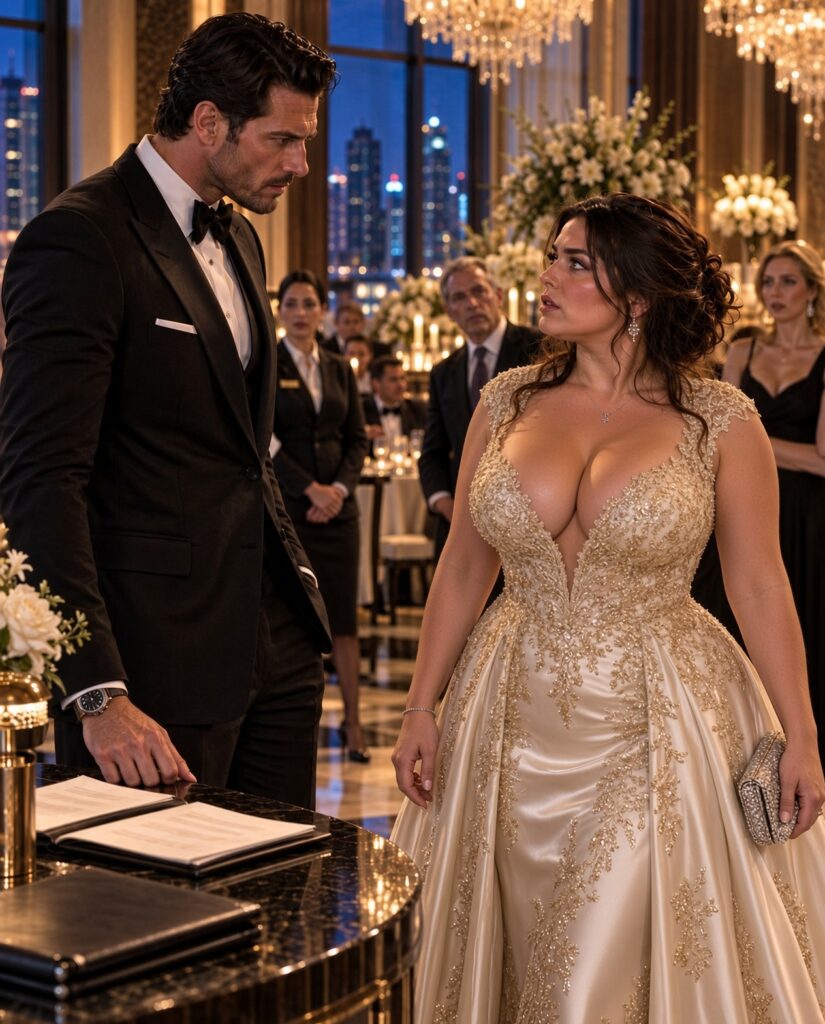
My Family Sent Me to Marry the 6’7 Mafia Boss Every Other Woman Rejected—Then I Found One Impossible $48,000 Charge in His Hotel Ledger and Realized Someone Was Destroying His Empire From the Inside
They sent Elena Russo because she was the daughter her family could afford to lose, dressed her in ivory, and let her discover only after she arrived that the “business dinner” was actually a marriage negotiation with Luca Moretti.
When her heel caught beneath her dress and the room laughed, Luca did not offer comfort—he watched the woman everyone expected to become bride number seven rise without his hand and notice a $48,000 hotel charge none of his executives had questioned.
Before midnight, Elena would discover the marriage was not the most dangerous arrangement inside the Moretti Grand; somebody had been manufacturing failures on a schedule designed to make Luca look incompetent before his own board.

PART 1 — THE BRIDE WHO FOUND THE IMPOSSIBLE NUMBER
Elena Russo had been inside the Moretti Grand for less than thirty seconds when her ivory heel caught beneath her dress.
Her knee struck marble.
A few men laughed.
Not loudly.
That made it worse.
She looked up from the floor and saw Luca Moretti standing beside the lobby table.
Six feet seven.
Black suit.
Broad shoulders.
The kind of stillness that made everyone else seem unnecessarily animated.
Six women had reportedly rejected marriage arrangements involving Luca.
Some feared the Moretti name.
Some feared his reputation.
Others, Elena had been told with embarrassing bluntness, simply could not imagine standing beside a man who looked capable of blocking sunlight.
Luca extended one hand.
Elena ignored it.
She stood by herself.
Then she noticed the blue ledger beside him.
Her humiliation disappeared.
“Who approved this?”
The laughter stopped.
Dominic Moretti, Luca’s uncle, gave a dry smile.
“Perhaps introductions before an audit?”
“I’m not auditing.”
Elena pointed at the page.
“I’m wondering how your Grand North Ballroom was turned over at 8:15 while four hundred guests were still eating dinner inside it.”
Luca closed the ledger.
“That isn’t your concern.”
“Then don’t make it mine.”
Her brother Anthony laughed nervously.
“Elena handles banquet problems for our hotels.”
“I run banquet operations.”
she corrected.
“That’s what I meant.”
“No.”
Elena looked at him.
“It isn’t.”
Luca reopened the ledger.
The emergency entry showed overtime labor, cleaning, linen replacement, and vendor surcharges.
Total:
$48,000.
“When did the gala begin?”
Elena asked.
“Six-thirty.”
Luca answered.
“And end?”
“After eleven.”
“Then nobody reset that ballroom at eight-fifteen.”
Dominic folded his arms.
“Clerical mistakes happen.”
“Yes.”
Elena turned the page.
“They usually don’t happen three times.”
A second emergency turnover.
Same ballroom.
Different weekend.
Same impossible overlap.
Another page.
A third.
The room went quiet.
Elena looked toward Luca.
“If these entries are real, your hotel discovered additional hours in the night.”
His expression changed.
“And if they aren’t?”
“Then somebody expected you to pay for work that never had time to happen.”
Anthony stepped closer.
“Elena, you’re here for a family dinner.”
She looked down at the ivory dress.
“You told me the Morettis wanted operational advice.”
“We do.”
“You forgot the part where you dressed me like a bride.”
Silence.
Elena looked directly at Luca.
“Am I here because our families expect me to marry you?”
He realized she had not been told.
“Yes.”
Her face went still.
Anthony reached for her arm.
“We were going to explain.”
“When?”
“Over dinner.”
“Between soup and selling me?”
“Elena—”
Dominic spoke.
“Walking out embarrasses both families.”
She picked up her handbag.
“Then both families will survive embarrassment.”
Luca watched her.
He had expected fear.
Maybe refusal.
Maybe another woman trying not to look at him.
Instead she had found a financial anomaly before asking whether she would marry him.
“No one is discussing marriage tonight.”
he said.
Dominic turned sharply.
“Luca.”
“That includes you.”
Luca looked at Elena.
“You can leave.”
Her eyes narrowed.
“Or?”
“Stay for dinner.”
“Nothing changes without your agreement.”
Elena looked toward the entrance.
Then back at the ledger.
“Twenty minutes.”
Anthony exhaled.
She raised one finger.
“Not for marriage.”
Her hand landed on the blue book.
“For this.”
Dominic smiled thinly.
“You think three strange lines make you an expert?”
“No.”
Elena turned another page.
“One made me curious.”
Then another.
“Three make me worried.”
She closed the ledger.
And for the first time that evening, nobody in the Moretti Grand was looking at Elena Russo like the unwanted bride.
They were looking at the woman who had just discovered that someone inside the hotel was billing Luca Moretti for events that had never existed.
PART 2 — THE LOSSES THAT ARRIVED BEFORE EVERY BOARD MEETING
The first interruption came before dinner.
A young banquet supervisor rushed into the lobby so quickly one shoe squeaked against the marble.
“Mr. Moretti.”
Luca turned.
“We have a staffing problem upstairs.”
Dominic exhaled impatiently.
“What kind?”
“Fourteen servers are missing from tonight’s roster.”
The hotel manager swore under his breath.
Luca’s face hardened.
“Call replacements.”
“We did.”
“Call more.”
“There aren’t enough available.”
Elena was still holding her handbag.
Twenty minutes.
That had been the agreement.
She could leave.
She wanted to leave.
Then the supervisor added:
“Doors open in thirty-two minutes.”
Elena stopped.
“How many guests?”
The supervisor looked at her, then Luca.
“Answer her.”
Luca said.
“Three hundred sixty.”
“Plated?”
“Yes.”
“Courses?”
“Four, plus cocktails.”
“Bartenders?”
“Eight.”
“Captains?”
“Four.”
“Runners?”
“Six.”
“Bus staff?”
“Twelve.”
Elena looked toward the elevators.
Dominic gave her a dry smile.
“Still leaving?”
She ignored him.
Then looked at Luca.
“Do you want advice or obedience?”
The question surprised everyone.
Luca answered first.
“Advice.”
“Then stop solving a staffing shortage by searching for people who do not exist.”
Dominic laughed once.
“That is precisely how staffing shortages are solved.”
“No.”
Elena said.
“That is how executives panic.”
She stepped into the elevator.
Luca followed.
“Where are you going?”
“To find out whether you are actually missing fourteen servers.”
“I was told—”
“Being told a number is not the same as understanding the problem.”
Dominic followed them.
The doors closed.
The service corridor smelled of roasted meat, coffee, steam, and metal warming beneath heat lamps.
Elena changed the moment she entered it.
The ivory dress stopped being ridiculous.
She simply ignored it.
She took the banquet event order from the captain.
Studied table counts.
Service windows.
Kitchen exits.
Then she walked the route from plating line to the farthest section of the ballroom.
Luca followed without interrupting.
Dominic interrupted constantly.
“You’ve never worked this hotel.”
“No.”
“You don’t know these employees.”
“No.”
“You don’t know our procedures.”
Elena stopped beside a service station.
“I know a server should not walk one hundred forty extra feet every time a table needs bread.”
Dominic went quiet.
She looked at the supervisor.
“You have six runners covering four large sections.”
“Yes.”
“And three pickup points outside the ballroom.”
“Yes.”
“That is the problem.”
The supervisor frowned.
“The missing staff—”
“Make the problem visible.”
Elena pointed through the open ballroom doors.
“Your floor plan creates it.”
She began moving staff.
Two bus employees to bread and water.
Four runners dedicated to food.
Two runner stations moved inside.
No bartenders reassigned.
Cleanup delayed until after dessert.
Dominic shook his head.
“You weaken breakdown.”
“Yes.”
“That creates another problem.”
“Later.”
Elena looked at him.
“Tonight’s problem arrives in twenty-eight minutes.”
The supervisor looked at Luca.
“Sir?”
Luca looked at Elena.
“If it fails?”
“You lose first-course pacing.”
“And if it works?”
“You stop searching for fourteen people you do not have.”
He nodded.
“Do it.”
Dominic stared at his nephew.
“You are giving control of a Moretti event to a woman you met half an hour ago.”
Luca looked at Elena.
“No.”
His gaze remained steady.
“I am giving control to the only person who has given me a plan.”
Something changed in Elena’s expression.
Small.
Careful.
Not trust.
Possibility.
The ballroom opened.
Three hundred sixty guests entered beneath chandeliers and soft gold lighting.
Servers moved.
Wine poured.
The first plated course left the kitchen eight minutes after seating.
No section stalled.
No captain shouted.
By the third course, the supervisor was smiling.
Elena was not.
She kept watching.
Traffic.
Distance.
Hands.
Empty trays.
People reveal systems through movement.
Luca stood beside her near the back wall.
“You knew.”
“No.”
“You sounded certain.”
“I sounded useful.”
She watched a runner turn too late near table twelve.
“There’s a difference.”
“What were the odds?”
“Good enough.”
“That is not an answer.”
“It is the answer operations people give when executives demand certainty from situations executives created.”
Luca looked at her.
Elena finally glanced over.
“That was rude.”
“It was accurate.”
“That too.”
His mouth nearly moved.
Almost a smile.
She noticed.
Ignored it.
Then looked across the ballroom.
Dominic stood speaking with the hotel manager.
Watching her.
“He does not like me.”
Elena said.
Luca followed her gaze.
“My uncle dislikes variables.”
“I’m a variable?”
“At the moment.”
“Comforting.”
After the last entrée left the kitchen, the hotel manager returned with printed schedules from the three nights Elena had found in the blue ledger.
They moved into a service office.
No chandeliers.
No ivory roses.
Fluorescent light and humming refrigeration.
Elena placed the schedule beside the ledger.
She did not compare money first.
She compared time.
“This ballroom was occupied here.”
She circled 8:15.
“And here.”
Second date.
“And here.”
Third.
Dominic crossed his arms.
“You already established that.”
“No.”
Elena looked up.
“I suspected it.”
“Now I have operational records.”
She pointed.
“Look.”
Accounting recorded turnover.
Banquet records showed active service.
Payroll showed servers still assigned to guests.
Vendor records showed linen release after the supposed reset.
Four different systems.
Four different truths.
None could exist together.
Luca leaned closer.
“How did nobody see it?”
“Because each department sees one piece.”
Elena tapped the ledger.
“Accounting sees invoices.”
“Banquets see event schedules.”
“Payroll sees hours.”
“Management sees totals.”
She looked around the room.
“Nobody asks whether all four versions can physically happen in the same universe.”
Silence.
Luca looked at the blue ledger differently now.
“You think somebody understands the gaps between departments.”
“Yes.”
Dominic’s voice cooled.
“That is an accusation.”
“No.”
Elena closed the book.
“That is an operational conclusion.”
She looked directly at Luca.
“The accusation begins when you identify who benefits.”
The hotel manager shifted.
“There’s one thing.”
Everyone turned.
“What?”
Luca asked.
“The same person entered all three emergency requests.”
Dominic’s gaze sharpened.
“Who?”
“Peter Walsh.”
Luca knew the name.
Nine years in banquet operations.
Reliable.
Quiet.
The type of manager executives barely noticed precisely because nothing collapsed around him.
“Bring him.”
Luca said.
“Don’t.”
Elena answered.
He looked at her.
“You just said somebody manufactured the charges.”
“I said somebody understood the gaps.”
“That sounds like Walsh.”
“That sounds convenient.”
Dominic gave a cold laugh.
“You are protecting an employee you have never met?”
“No.”
Elena looked at Luca.
“I am protecting the question.”
Twenty minutes later, Walsh entered pale and sweating.
Luca placed the ledger before him.
“Did you enter these?”
Walsh looked.
“Yes.”
Dominic stepped forward.
“There.”
Elena did not move.
“Who approved them?”
Walsh hesitated.
“I submitted the exception requests.”
“That is not what I asked.”
His eyes moved toward Dominic.
Only for a fraction of a second.
Elena saw it.
So did Luca.
“Who had approval authority?”
she asked.
Walsh swallowed.
“Executive operations.”
“Do you?”
“No.”
“Can you release vendor payments over twenty-five thousand?”
“No.”
“Can you change a rejected exception once accounting locks it?”
“No.”
Dominic interrupted.
“He could still falsify the original request.”
Elena nodded.
“Yes.”
She looked at Walsh.
“But he cannot make money move.”
The room became quiet.
The manager spoke softly.
“Only three executives can approve banquet exceptions above that threshold.”
“Which three?”
Luca asked.
The manager did not answer immediately.
Dominic stepped toward Walsh.
“Careful.”
One word.
Walsh’s face changed.
So did Luca’s.
Elena slowly turned toward Dominic.
“That word just damaged your position more than anything he could have said.”
Dominic’s voice hardened.
“You have no idea what you are implying.”
“I am not implying anything.”
Elena looked at Walsh.
“Continue.”
Walsh shook his head.
“I want counsel.”
Luca nodded.
“Granted.”
Dominic snapped:
“You’re letting him walk away?”
“No.”
Luca said.
“I’m preventing anyone in this room from frightening him into giving me an answer I cannot trust later.”
That was the first time Elena saw Luca openly resist his uncle.
Again:
Possibility.
Walsh left under escort.
Dominic waited until the door closed.
Then turned toward Luca.
“You are allowing a stranger to destabilize your management team.”
Elena picked up her handbag.
“I was leaving.”
“Finally.”
Dominic said.
The manager reappeared.
“Mr. Moretti?”
He carried another folder.
“There is something else.”
Inside were family-alliance documents.
Russo.
Moretti.
Marriage.
Elena recognized her surname before she understood the dates.
Six weeks earlier.
The marriage negotiations had begun six weeks earlier.
Exactly when the emergency losses accelerated.
Her stomach tightened.
She looked at Luca.
“You knew.”
His expression hardened.
“Knew what?”
“That your operating numbers were deteriorating when the alliance was proposed.”
“Yes.”
“Your board was worried.”
“Yes.”
“And a Russo marriage strengthened confidence.”
“Potentially.”
Elena laughed once.
No humor.
“So what was I?”
“No.”
Luca’s voice changed.
“Do not answer that for me.”
“Then answer.”
He did.
“I thought you were another alliance my family expected me to tolerate.”
The truth landed harder because he did not soften it.
Elena looked down.
“At least we finally agree.”
Dominic spread one hand.
“The marriage still benefits both families.”
Elena turned.
“There is no marriage.”
Anthony entered in time to hear it.
“Elena.”
He looked horrified.
“Do not be emotional.”
She stared.
“I am the calmest person in this building.”
“You are throwing away an extraordinary opportunity.”
“No.”
Elena said.
“I am finally recognizing one.”
He stepped toward her.
“You cannot simply walk away.”
Luca answered before she could.
“Yes.”
Everyone looked at him.
“She can.”
Dominic’s expression sharpened.
“Luca.”
The marriage agreement was still inside the folder.
Luca removed his signature page.
Tore it once.
Then again.
The sound of paper seemed louder than it should have.
“The arrangement is finished.”
Dominic stood.
“You cannot make that decision alone.”
“I just did.”
Anthony stared at the torn pages.
“Our family already committed resources.”
“Send invoices.”
Luca said.
Elena’s eyes narrowed.
“I do not want you paying for my freedom.”
Luca looked at her.
“Then I won’t.”
He placed the paper down.
“No compensation.”
“No condition.”
“No obligation.”
“You arrived without the truth.”
“You leave with it.”
Elena studied his face for a trap.
Nothing.
That frightened her almost as much as coercion would have.
Freedom offered without a hook felt unfamiliar.
Her phone vibrated.
Chicago.
The independent hotel group that had interviewed her twice.
She answered in the hall.
Four minutes.
That was all.
When she returned, Anthony knew.
“What happened?”
“I got the job.”
His expression fell.
“Which job?”
“General Manager.”
“Chicago.”
“When?”
“Monday.”
Dominic almost looked relieved.
Luca did not.
“What did you say?”
he asked.
“That I’m coming.”
Luca nodded.
No counteroffer.
No attempt to buy the hotel.
No promise to give her a title if she stayed.
“I can have a car take you wherever you need.”
“I can call my own.”
“I know.”
That answer stopped her.
Because the sentence was not let me.
It was I know.
She had a way out.
And he recognized it.
Elena walked toward the elevator.
Then stopped.
The ledger.
Three clusters.
The timing.
Something was wrong.
She stepped inside.
Doors closed.
The elevator began descending.
Then she saw the pattern.
The largest emergency charges appeared during the ten days before monthly performance reporting.
Not random.
Scheduled.
She pressed the lobby button.
Her mind moved faster.
If somebody wanted to steal money, why create losses precisely when the board was measuring Luca’s performance?
Why not hide them after reports?
Why make the failures visible?
The elevator reached the lobby.
Elena did not leave.
She opened her notebook.
Wrote the three dates.
Then the reporting dates she remembered Dominic mentioning.
Match.
Match.
Match.
Her phone rang.
Anthony.
She declined.
Then called Chicago.
The hiring director answered warmly.
“Elena?”
“I need until tomorrow morning before I travel.”
A pause.
“Problem with the offer?”
“No.”
Elena looked toward the elevators.
“That offer is the first uncomplicated thing anyone has given me today.”
The woman laughed softly.
“Take the night.”
Elena ended the call.
She could still leave.
That mattered.
Then she pressed sixty-eight.
Luca stood where she had left him when the elevator opened.
He looked at her handbag.
“You forgot something?”
“No.”
She walked past him.
“I understood something.”
He followed her into the service office.
“Show me when your board receives performance reports.”
He did not ask why.
Calendar.
Dates.
Elena compared them with the ledger.
Her pulse accelerated.
Every cluster aligned.
“What?”
Luca asked.
“These charges were not hidden.”
She turned the book toward him.
“They were placed where someone wanted the board to see them.”
“Why?”
“If you steal, you hide losses.”
She tapped the calendar.
“If you are trying to make someone look incompetent, you time them before review.”
Luca stepped back.
His face went very still.
“You think somebody is manufacturing poor performance.”
“Yes.”
“And then presenting the marriage alliance as stability.”
“Yes.”
“My uncle pushed hardest for the Russo arrangement.”
Elena met his gaze.
“I know.”
“You think Dominic did this.”
“No.”
That surprised him.
“Why not?”
“I think Dominic had access.”
“That is not proof.”
Luca studied her.
“You could have accused him.”
“I could have been wrong.”
Something changed in his face.
This time not attraction.
Respect.
She had protected the truth even when a convenient villain stood directly in front of her.
“What do you need?”
he asked.
“Approval hierarchy.”
“Done.”
“Six months of board reporting dates.”
“Done.”
“And nobody touches this ledger.”
Luca nodded.
“It stays with you.”
Elena shook her head.
“No.”
“With both of us.”
He understood the distinction.
Not ownership.
Custody.
Accountability.
“Agreed.”
They worked another hour.
No flirtation.
No discussion of marriage.
Dates.
Permissions.
Patterns.
Elena found another detail.
The emergency expenses rose before reporting windows.
Then fell immediately after.
Not gradually.
Instantly.
The hotel did not become efficient overnight.
The manufacturing simply stopped after the board saw the damage.
“This was never primarily theft.”
she said.
Luca looked over.
“What then?”
“Governance.”
His face hardened.
“Someone wanted your board to believe you could not control your own company.”
The office door opened.
Dominic entered.
Two board members behind him.
He looked at Elena first.
“I thought you were leaving.”
“I was.”
“What changed?”
“Your numbers have remarkable timing.”
His expression tightened.
One board member frowned.
“What does that mean?”
Dominic answered for her.
“It means Ms. Russo has spent one night inventing conspiracies from accounting errors.”
Elena closed the ledger.
“No.”
She looked at him.
“I spent eighteen years learning what real operational mistakes look like.”
Dominic walked toward the table.
“Give me the book.”
Elena placed one hand over it.
“No.”
His expression sharpened.
“That is Moretti property.”
Luca stepped beside Elena.
“She said no.”
Dominic stared at him.
“You are allowing a rejected bride to control internal records?”
The insult clarified everything.
Elena no longer felt humiliated by it.
Only interested.
“Rejected bride.”
she repeated.
“Interesting choice.”
Dominic ignored her.
“The board vote has been moved.”
Luca’s expression changed.
“When?”
“Tomorrow morning.”
Less than twelve hours.
Dominic continued:
“Given deteriorating performance, members believe delay would be irresponsible.”
There it was.
Manufactured loss.
Accelerated vote.
Control.
Elena understood the architecture now.
Dominic had turned failure into urgency.
One board member looked at her.
“Ms. Russo, unless you hold a position here, tomorrow’s meeting is not your concern.”
Dominic smiled.
Elena picked up her handbag.
“You are correct.”
Luca looked at her.
“Elena.”
She met his eyes.
“I still have a job in Chicago.”
Dominic’s smile widened.
“I suggest you take it.”
Elena walked toward the door.
Luca did not stop her.
That mattered.
She reached him.
Stopped.
“If the board decides operations are failing, what happens to banquet?”
“We restructure.”
“How many jobs?”
Luca said nothing.
Enough.
Peter Walsh.
Servers whose hours had been weaponized.
Managers whose signatures could become convenient.
Invisible employees converted into evidence against themselves.
Elena knew that world.
She had spent eighteen years inside it.
She set her handbag back down.
Dominic’s face tightened.
“I thought you were leaving.”
“I am free to leave.”
Elena reopened the ledger.
“That is why staying means something.”
She looked at Luca.
“Tomorrow I explain this.”
“Not you.”
“Not Dominic.”
“Me.”
Luca nodded.
“What do you need?”
“Make sure they let me finish.”
He held her gaze.
“Then you have the floor.”
Across the room, Dominic finally looked worried.
Because Elena Russo had returned without a marriage contract, without an obligation, without anything to gain from obedience.
And tomorrow morning, the same people who had laughed when she fell would be forced to listen while she explained why the Moretti empire was falling with her.
At nine sharp, Elena entered the Grand North Ballroom wearing navy.
No ivory.
No family jewelry.
Hair pinned simply.
Blue exception ledger beneath one arm.
The room had been converted for the board.
Water glasses.
Folders.
Projection screens.
Dominic sat beside the chairman.
His eyes dropped to Elena’s empty ring finger.
“Still pretending this concerns you?”
Elena set the ledger down.
“No.”
“I am explaining why it concerns you.”
Several board members exchanged looks.
Dominic leaned back.
“She holds no position here.”
Luca sat at the opposite end.
“She has the floor.”
“You would risk a control vote on the opinion of a banquet manager?”
Elena turned.
“Operations director.”
Dominic smiled.
“From another company.”
“Yes.”
She opened the book.
“That is why I can say what your own structure trained people not to say.”
The smile vanished.
“I am going to show you three events.”
Elena said.
“No theories.”
“No marriage politics.”
“Only time.”
First entry.
Four hundred guests entered at 6:30.
Emergency turnover billed at 8:15.
A board member frowned.
“Timestamp error.”
“Possible.”
Second entry.
Same impossibility.
Third.
Again.
Different vendors.
Different totals.
Same physical contradiction.
Dominic interrupted.
“Careless records.”
“No.”
Elena answered.
“They describe work that could not occur.”
She turned toward the board.
“Each impossible event creates emergency expense.”
“Overtime.”
“Cleaning.”
“Replacement linen.”
“Vendor searches.”
“One department sees one item.”
“Nobody compares them.”
The chairman leaned forward.
“Who entered requests?”
“Peter Walsh.”
Dominic answered.
“Then the obvious—”
Elena raised one hand.
“Peter Walsh could enter them.”
“He could not approve them.”
Silence.
“Threshold is twenty-five thousand.”
“These exceed it.”
“They require executive operations.”
Dominic’s expression hardened.
“You are implying—”
“I have not finished.”
She turned pages.
“At first I believed the motive was money.”
“That was wrong.”
The chairman asked:
“Then what?”
Elena pointed toward the performance calendar.
“Placement.”
The room quieted.
“These losses rise before monthly reporting.”
“They stop immediately afterward.”
“If the goal were stealing quietly, that is irrational.”
“Unless the loss itself is the product.”
One member sat back.
Elena continued.
“Somebody wanted Luca’s results to appear unstable.”
“Then somebody offered stability.”
“New controls.”
“Reduced authority.”
“Marriage alliance.”
“A reason for the board to transfer power.”
Dominic pushed his chair back.
“This is fantasy.”
Elena met his eyes.
“No.”
“The fake failures were not hiding a weak operation.”
“They were manufacturing one.”
The chairman looked at Luca.
“Did you know?”
“No.”
No defense.
No excuse.
Luca continued.
“I should have.”
Dominic stared.
“You are admitting incompetence during a control vote?”
“I am admitting responsibility.”
Luca looked toward Elena.
“And admitting the first person to see what was happening was someone I mispriced before she had spoken ten sentences.”
The room shifted.
Because powerful men rarely admit misjudgment without attaching explanation.
Luca did not.
Dominic reached toward the ledger.
Elena moved it away.
“Stop touching the record.”
He glared.
“You do not control this room.”
The chairman stood.
“Mr. Moretti.”
Dominic turned.
“Sit down.”
His face emptied.
“For what?”
“Pending independent review, your executive approval authority is suspended.”
“You cannot—”
The chairman looked around the table.
Hands rose.
Majority.
“We just did.”
Dominic stared at Luca.
“You’re letting outsiders dismantle your family.”
Luca’s voice remained low.
“No.”
“I am finally separating family from authority.”
That sentence ended something older than the meeting.
Dominic knew it.
So did Luca.
The board did not declare Dominic guilty.
That mattered.
No theatrical confession.
No instant justice.
Only suspension.
Forensic review.
Outside accounting.
Preservation order.
Peter Walsh was given counsel.
Executive systems were frozen.
Emergency exceptions required dual authorization.
Every vendor connected to the flagged entries entered review.
Elena refused interviews.
She had no interest in becoming “the bride who exposed the mafia hotel.”
The phrase already irritated her.
She had not exposed a hotel.
She had identified an operational inconsistency.
Reality was less glamorous and more important.
Two hours later, the board reconvened.
The chairman placed a resolution before her.
Elena read every line.
Independent Director of Operations and Controls.
Direct reporting access to board audit committee.
Authority over operational exceptions.
Power to halt payments pending verification.
Authority to build an internal controls team.
Protected reporting channels for staff.
Luca could not override findings without recorded board review.
Elena looked up.
“You’re offering me a job.”
“Yes.”
“I already have one in Chicago.”
“We know.”
Luca answered from across the table.
“You do not have to accept.”
That mattered.
The chairman said:
“We want someone whose authority does not depend on existing management loyalties.”
Elena looked again at the document.
“One condition.”
The chairman waited.
“My authority cannot depend on any relationship with the Moretti family.”
“Agreed.”
“And Luca cannot dismiss me unilaterally.”
Luca answered:
“Agreed.”
“Compensation set by committee, not him.”
“Agreed.”
“If the audit clears Dominic, the findings are recorded exactly.”
The chairman nodded.
“Yes.”
No predetermined villain.
No convenient outcome.
Elena signed.
Not a marriage contract.
A professional one.
That distinction was almost enough to make her smile.
The audit took twelve weeks.
Long enough for gossip to mutate several times.
First:
Dominic stole millions.
Then:
Walsh framed Dominic.
Then:
Luca staged everything to remove his uncle.
Then:
Elena seduced Luca and invented fraud to take control.
The last rumor amused her least.
Invisible women become manipulative women quickly once they gain authority.
Elena ignored it.
The records did not.
Forensic accountants found fifty-three questionable emergency exceptions across nine months.
Thirty-eight involved services impossible to reconcile with room schedules.
Nine used vendors created within thirty days of billing.
Six were legitimate.
That mattered too.
Not every unusual expense was fraud.
Peter Walsh had submitted twenty-seven questionable entries.
But emails proved he had repeatedly questioned the coding.
His supervisor instructed him:
Use corrective exception. Executive approved.
The supervisor was the hotel’s regional operations controller.
A man named Victor Hale.
Victor reported to Dominic.
But reporting to someone was not proof of conspiracy.
Elena insisted the distinction remain.
“Follow approvals.”
she told the auditors.
“Not personalities.”
Luca was present.
He said nothing.
Afterward he caught her near the elevators.
“You’re still protecting Dominic.”
“I’m protecting the investigation.”
“Same thing?”
“No.”
“Good.”
The crucial evidence emerged from approval metadata.
Dominic’s credentials had authorized nineteen questionable exceptions.
He denied doing so.
Could be lying.
Could be compromised.
Victor’s device had generated eight.
A shared executive terminal generated eleven.
Elena hated shared terminals.
“Why does this exist?”
she demanded.
Victor shrugged.
“Convenience.”
“Convenience is where accountability goes to die.”
She ordered individual authentication.
Victor disliked her from that moment forward.
Useful.
People often reveal themselves faster after a control becomes inconvenient.
Then an old system administrator found archived security logs.
Dominic’s credentials had been used on nights Dominic was demonstrably outside the hotel.
One approval occurred while he attended a televised charity event.
Another while flying to Montreal.
His credentials had been copied.
Dominic was not cleared entirely.
He had still pushed the marriage alliance.
Still used the manufactured losses politically without questioning them enough.
But he had not authorized the false payments under review.
The story became messier.
Messier usually meant closer to truth.
Victor disappeared on a Tuesday morning.
His office empty.
Company phone wiped.
That created urgency.
Luca wanted security to find him.
Elena stopped him.
“You have police and counsel.”
“He has company records.”
“Then preserve systems.”
“He could leave the country.”
“That is not your job.”
Luca stared.
“You enjoy saying that.”
“Yes.”
“Why?”
“Because powerful men often create secondary disasters trying to solve problems that belong to institutions.”
He looked offended.
Then called counsel.
Progress.
Victor was detained at the airport under a warrant related to fraud and falsified records.
The forensic trail connected him to two vendor companies.
Still not the whole scheme.
The false expenses totaled only $1.8 million.
Too much for clerical error.
Too little to explain the governance campaign.
Then auditors found where the money went after the vendors.
Consulting entities.
One connected indirectly to an investment partnership whose beneficial owner was Anthony Russo.
Elena’s brother.
She stared at the page for a long time.
The room seemed to lose temperature.
Luca stood across from her.
“Elena.”
“No.”
She raised one hand.
“Not yet.”
Anthony.
The brother who brought her wearing ivory.
The brother who called her work “little things.”
The brother who told her not to make things difficult.
She understood suddenly why the marriage negotiation had been presented as a business dinner.
Not merely cowardice.
Operational necessity.
If Elena knew enough to question the arrangement before arriving, she might ask what problem the alliance was solving.
And Elena asked questions for a living.
She called Anthony herself.
Speakerphone.
Counsel present.
Luca not in the room.
Her choice.
Anthony answered warmly.
“Finally.”
“Did you know Victor Hale?”
Silence.
Small.
Enough.
“Elena—”
“Yes or no.”
“Professionally.”
“How?”
“Our development group had consulting work with—”
“Did you receive money from companies connected to the Moretti emergency vendors?”
Silence.
Longer.
“Elena, you need to understand—”
“No.”
She closed her eyes.
“You need to answer.”
“It wasn’t supposed to hurt anyone.”
Her throat tightened.
That sentence.
Always that sentence.
“How much?”
“Not what you think.”
“How much?”
“Eight hundred thousand.”
Elena’s hand became cold around the phone.
“For what?”
“Facilitating the alliance.”
She opened her eyes.
“What alliance?”
No answer.
“The marriage?”
Anthony exhaled.
“It stabilized both companies.”
“My family sent me as consideration in a transaction you were being paid to help create.”
“That is not fair.”
“Was the money tied to the alliance?”
“It was advisory—”
“Anthony.”
“Yes.”
The word broke something.
Elena ended the call.
For several minutes, she sat alone.
Counsel offered to stay.
She asked them to leave.
Luca arrived later because the audit chair told him only that new evidence affected the Russo side.
He knocked before entering.
Elena almost laughed at that.
A man whose family owned the building now asking permission.
“Come in.”
He saw her face.
“What happened?”
“Anthony.”
Luca became still.
“He was paid.”
“By Victor’s network?”
“Yes.”
“To facilitate the alliance.”
Luca’s jaw tightened.
“Elena—”
“Do not tell me you’re sorry.”
He stopped.
Good.
She looked out the window.
“My family did not merely choose me because I was convenient.”
“They were compensated.”
“I walked in wearing ivory because my brother had already turned the marriage into revenue.”
Luca remained silent.
Correct choice.
Elena’s hands shook.
“I spent eighteen years covering his disasters.”
“Hotel openings.”
“Bad directors.”
Payroll.
Vendors.
“I made him look competent.”
“And he sold the person doing the work.”
Her voice broke on the final sentence.
Luca took one step forward.
Stopped.
“Can I come closer?”
Elena looked at him.
That question undid her more than comfort would have.
She nodded.
He sat in the chair beside her.
Did not touch her.
She cried anyway.
Anthony cooperated after counsel became involved.
Not nobly.
Evidence had narrowed his options.
He and Victor had been recruited by a financial adviser tied to several board members who wanted Luca’s authority reduced.
Dominic knew the board was anxious and pushed the Russo marriage because he sincerely believed family consolidation would stabilize control.
He had not created the false losses.
But he had exploited them.
And when Walsh hesitated, Dominic’s “careful” in the service office had exposed exactly how his leadership culture worked.
People feared him enough to stay quiet.
That had allowed fraud to breathe.
The board’s final report did not call Dominic mastermind.
It called his governance failures material.
Elena thought that was more accurate and, in some ways, more devastating.
Dominic resigned from executive operations.
Not willingly at first.
He fought.
Then the evidence established that his habit of informal overrides, shared credentials, verbal approvals, and loyalty-based management created the gaps Victor used.
His last meeting with Elena occurred in the same lobby where she had fallen.
He looked older.
Less polished.
“You won.”
Elena almost sighed.
“No.”
“That is not what happened.”
“I lost authority.”
“You were never supposed to own it permanently.”
His face tightened.
“You really believe systems matter more than people?”
“No.”
“I believe good systems keep people from being forced to trust the wrong person.”
Dominic considered that.
Then looked toward Luca.
“He will disappoint you.”
Elena answered before Luca could.
“I expect him to.”
Dominic looked surprised.
“Everybody does eventually.”
She continued.
“The question is whether disappointment becomes a license for control.”
Dominic gave a faint, bitter smile.
“You should have been born into our family.”
Elena shook her head.
“I’m starting to think I was lucky not to be.”
Anthony avoided prison on some charges through cooperation but lost his executive role, paid restitution, and accepted a civil settlement that stripped him of most profit from the consulting arrangement.
Elena did not intervene.
Her parents called repeatedly.
“Family should forgive.”
Her mother said.
Elena answered:
“Forgiveness and access are different things.”
Anthony wrote a letter.
She read it.
Kept it.
Did not reply for eight months.
When she finally did, she wrote three sentences.
I believe you regret what happened.
I do not believe regret automatically repairs trust.
If we have a relationship again, it will be built slowly and without business between us.
Anthony accepted.
That was the first useful thing he had done in years.
The Moretti Grand changed.
Not overnight.
Controls rarely feel dramatic.
That is why executives neglect them.
Dual approvals.
Automated schedule reconciliation.
Vendor identity verification.
No emergency exception without independent operational confirmation.
Department records linked instead of isolated.
Anonymous staff reporting.
No shared executive credentials.
Peter Walsh returned after review cleared him of intentional fraud.
Elena asked whether he wanted his job back.
He looked surprised.
“I thought you’d fire me.”
“Why?”
“I entered the requests.”
“You questioned them.”
“Not hard enough.”
Elena nodded.
“That is worth discussing.”
“But fear is not fraud.”
He returned as senior banquet controls manager.
His first task was helping design a system where the next Peter Walsh would not need courage to stop an improper approval.
That mattered more than punishment.
Six months after the board meeting, Elena stood inside the Grand North Ballroom watching another gala begin.
No staffing collapse.
No phantom turnover.
No impossible expenses.
Luca approached.
Dark suit.
Same towering frame.
Different posture around her now.
He stopped beside her.
“You never answered Chicago.”
Elena smiled.
“I turned it down.”
“I know.”
“You checked?”
“They sent flowers congratulating us for stealing you.”
“That sounds dramatic.”
“The hospitality industry has feelings.”
She laughed.
Then looked toward the ballroom.
“I did not stay for you.”
“I know.”
“I need you to keep knowing that.”
“I do.”
Their first dinner had happened months earlier.
Neutral restaurant.
No family.
No security at the table.
Luca asked about her work.
Not the audit.
Her.
How had she learned banquet operations?
Her first job was folding napkins at fourteen.
Her father put both sons into management training and told Elena she could help “with events.”
She learned inventory.
Labor.
Scheduling.
Procurement.
Service design.
Costing.
Eventually she ran the operation while men with larger titles presented results.
Luca listened.
Then said:
“They made you invisible.”
“No.”
Elena corrected.
“They used visibility selectively.”
“When something failed, I was visible.”
“When it worked, management was.”
Luca nodded.
“That is worse.”
“Yes.”
She asked about the six women.
He looked almost embarrassed.
“What six women?”
“The ones who rejected you.”
“How do you know about that?”
“Hotels are gossip machines.”
He sighed.
“Some arrangements never reached a meeting.”
“Because of your reputation?”
“Yes.”
“And?”
“My height.”
Elena smiled.
“You’re very tall.”
“I’m aware.”
“Do you scare children?”
“Sometimes.”
“Useful.”
He looked at her.
“You did not seem frightened.”
“I was furious.”
“Different?”
“Very.”
Their relationship stayed slow.
Deliberately.
Elena refused gifts beyond ordinary things.
Luca never sent a car without asking.
They kept their professional authority separate.
If Elena issued an operational finding against a project Luca favored, it went to the board exactly as written.
Once, Luca argued for twenty minutes.
Elena listened.
Then said:
“My answer is still no.”
He stared.
“Do you enjoy saying that?”
“When necessary.”
He left irritated.
Next morning, his email said:
Understood. Proceed with your recommendation.
No punishment.
No cold silence.
No leverage.
Elena reread the message three times.
Being respected after disagreement took adjustment when your family had spent years teaching you usefulness was the price of belonging.
The first real fracture came a year later.
Luca arranged additional security after Anthony received a threatening message connected to the old fraud case.
He did not tell Elena.
She discovered a second car following her home.
The old anger returned instantly.
She confronted Luca in his office.
“You put security on me.”
“Yes.”
“Without asking.”
“There was credible risk.”
“That explains concern.”
“It does not explain permission.”
Luca’s jaw tightened.
“You were in danger.”
“Then tell me.”
“And if you refuse?”
“Then you decide what risk you can tolerate in your life.”
“Not mine.”
His voice rose.
“I am not going to stand by while someone targets you because of me.”
Elena went still.
“There.”
“What?”
“That sentence.”
Luca looked confused.
“Because of you?”
“No.”
“While someone targets me.”
She stepped closer.
“You heard the subject of the sentence.”
“You.”
“My life.”
“My danger.”
“My answer.”
Silence.
Luca looked away.
The realization arrived slowly.
He had thought protection made control morally cleaner.
It did not.
Finally:
“You’re right.”
Elena’s anger did not disappear.
Good apologies should not function like erasers.
“What happens now?”
he asked.
“You remove them.”
“Then we assess together.”
He nodded.
“Okay.”
“And if I say yes to security, we agree on scope.”
“Yes.”
“If I say no, you do not secretly replace it.”
A longer pause.
Then:
“Yes.”
Elena watched him.
“Hard?”
“Extremely.”
“Good.”
They chose security together.
One car only during high-risk weeks.
Elena knew names.
Routes.
When it ended.
No hidden surveillance.
Nothing romantic about it.
That was precisely why she trusted it.
PART 3 — THE WOMAN WHO STAYED ONLY AFTER THE DOOR WAS OPEN
Two years after the ivory-dress dinner, Elena became Chief Operating Officer of the Moretti Grand hospitality group.
Not Luca’s company as a whole.
She refused that.
Hotels.
Events.
Controls.
Operations.
Her field.
Her authority.
The appointment required full board vote.
Luca abstained voluntarily.
Elena discovered only after minutes were published.
She found him in the lobby.
“You abstained.”
“Yes.”
“Why?”
“You were the candidate.”
“So?”
“I’m dating the candidate.”
“You could have voted after disclosure.”
“I could have.”
“Then why not?”
Luca looked toward the reception desk.
“Because if you won by one vote, I never wanted anyone—including you—to wonder whose vote made the difference.”
Elena became quiet.
“That was thoughtful.”
“Do not sound surprised.”
“I have historical reasons.”
He smiled.
Fair.
Under Elena, hotel performance improved.
Not magically.
Some quarters were bad.
A union negotiation went poorly.
A renovation exceeded budget.
One restaurant concept failed spectacularly.
Elena presented the failure to the board without hiding it.
Dominic, no longer executive but still a family shareholder, attended one meeting.
Afterward he stopped her.
“You voluntarily showed a six-million-dollar miss.”
“Yes.”
“Why?”
“Because it happened.”
“You could have spread the impairment.”
“That sentence explains many of our earlier problems.”
He almost smiled.
“You really are impossible.”
“So I’ve been told.”
They were never friends.
They did eventually become accurate with each other.
Sometimes that is enough.
Peter Walsh became one of Elena’s most trusted managers.
Not because he was perfect.
Because after nearly being used as the fall guy, he stopped treating questions as disloyalty.
One afternoon, a junior banquet coordinator named Maya Chen flagged a linen invoice.
Only $11,800.
Below most executive thresholds.
Peter brought it to Elena.
“Could be nothing.”
“What did she notice?”
“Vendor changed bank details twice in one month.”
Elena nodded.
“Good catch.”
It was fraud.
Small.
Caught early.
Maya later said:
“I almost didn’t say anything.”
“Why?”
“I didn’t want to look difficult.”
Elena felt the old ivory dress around her shoulders for one second.
“Listen to me.”
She said.
“Difficulty is not a character flaw when the numbers deserve it.”
Maya smiled.
Elena made the phrase part of training.
Her relationship with Anthony remained cautious.
He stayed sober.
Worked for a smaller development firm with no connection to Elena’s hotels.
No shared investments.
No business favors.
On the third anniversary of the audit, he asked to meet.
Public café.
He brought no excuses.
“I resented you.”
Elena looked up.
He swallowed.
“You were better at our business than I was.”
“That is uncomfortable honesty.”
“I kept telling myself you were good at details.”
“While I handled operations.”
“Yes.”
“If I admitted what you were doing, I had to admit what I wasn’t.”
Elena listened.
Anthony continued.
“When the alliance came up, I thought…”
He stopped.
“What?”
“That maybe this was finally something only I could manage.”
Her throat tightened.
“And you got paid.”
“Yes.”
He looked ashamed.
“I am sorry.”
Elena waited.
Not to punish him.
Because she wanted to hear whether a but arrived.
It didn’t.
Good.
“I believe you.”
she said.
His eyes lifted.
“That doesn’t mean we go back.”
“I know.”
“We build forward or not at all.”
He nodded.
For the first time in years, Elena believed he understood.
Luca proposed after four years.
He did it badly.
Of course.
He reserved the Grand North Ballroom.
The same room.
Elena walked inside after a supposed inspection meeting and found no guests.
Just one table.
Blue exception ledger.
She stopped.
“Absolutely not.”
Luca emerged near the windows.
“What?”
“If this is some symbolic reenactment—”
“It isn’t.”
“There is a ring in your pocket.”
He stared.
“How did you—”
“You keep touching the jacket.”
Luca looked annoyed.
“Operational awareness is becoming tiresome.”
Elena smiled despite herself.
Then she saw the ledger.
The original.
Preserved after the audit.
“What is that doing here?”
“I wanted to show you something.”
He opened the cover.
Inside was not the old fraud record.
A new page.
Blank.
Elena frowned.
“Luca.”
“No contract.”
“I know.”
“No alliance.”
“I know.”
“No Russo commitment.”
“No board implication.”
“No family expectation.”
He stepped closer.
“But I wanted the book here because it is the first thing you saw clearly when everyone else in the room was looking at the wrong story.”
Elena’s chest tightened.
“You’re becoming sentimental.”
“It is unpleasant.”
Luca did not kneel immediately.
That surprised her.
Instead:
“If you say no, nothing changes tomorrow.”
“My position remains mine.”
“My board vote remains separated from it.”
“Your home remains yours.”
“No family call.”
“No renegotiation.”
“No consequence.”
Elena’s eyes burned.
He continued.
“I need you to know the exit is open before I ask you to stay.”
There it was.
The entire story reduced to one principle.
Freedom first.
Then choice.
Luca reached into his pocket.
“May I?”
Elena nodded.
He knelt.
Not because he was surrendering power theatrically.
Because at six foot seven, otherwise she would spend the entire proposal staring at his tie.
That made her laugh.
He smiled.
“Elena Russo.”
“Yes?”
“Will you marry me?”
She looked toward the ballroom.
The same room once used to make her feel like inventory.
Now empty.
No audience.
No family.
No leverage.
“Yes.”
Luca exhaled.
She added:
“Prenup.”
“Already drafted.”
Her smile vanished.
“You drafted it before asking?”
“Independent lawyers.”
“Still presumptuous.”
“I was optimistic.”
She laughed.
“You remain difficult.”
“So do you.”
“That is why this might work.”
Their prenup took three months.
Elena’s lawyer rejected seven clauses.
Luca’s lawyer rejected four of hers.
They argued about property.
Business conflicts.
Future employment.
Governance.
No clause tying marriage to corporate voting.
No automatic board roles.
No requirement Elena use Moretti assets.
No non-disparagement clause preventing truthful testimony.
The lawyers looked exhausted.
Elena felt wonderful.
Consent should survive paperwork.
Otherwise the romance is irrelevant.
They married at City Hall.
Thirty people.
No ivory dress.
Elena wore dark green.
Anthony attended after asking if she wanted him there.
Dominic attended but sat in the back.
Peter Walsh came with his wife.
Maya Chen cried more than anyone despite barely knowing either family personally.
Afterward, they had dinner at the hotel.
No headline.
No alliance announcement.
Just a marriage.
Their marriage did not transform Luca into a saint.
He remained intimidating.
Impatient.
Suspicious.
He sometimes walked into a room and expected compliance before remembering people were allowed to question him.
Elena questioned him enough for everyone.
He also changed the parts of his organization that could not survive scrutiny.
Not because Elena gave him an ultimatum.
Because the fraud case taught him something he should have learned earlier.
Opaque power is useful until someone else learns how to use the darkness.
Drolett-like? No.
Moretti.
His world became smaller.
Cleaner.
Less dependent on fear.
Some relatives called him weak.
Luca asked Elena:
“Am I?”
She looked at the man who once watched her fall without moving.
“No.”
Then:
“But you were when you needed everyone afraid.”
He absorbed that.
Did not argue.
Years later, Dominic became seriously ill.
Cancer.
He asked Elena to visit.
She almost refused.
Then went.
His hospital room smelled of antiseptic and stale coffee.
No executive authority.
No blue ledger.
No board.
Dominic looked small for the first time.
“You were right.”
Elena sat.
“About?”
“Which thing?”
He smiled weakly.
“The culture.”
That surprised her.
“I thought loyalty meant nobody questioned me.”
He looked toward the window.
“Turns out it meant nobody warned me.”
Elena did not soften history.
“You also used fear when it benefited you.”
“Yes.”
He breathed carefully.
“I know.”
A pause.
“I did not create Victor’s fraud.”
“No.”
“But I created the kind of room where Walsh was afraid to tell the truth.”
“Yes.”
Dominic nodded.
“Hard sentence.”
“Useful ones usually are.”
He smiled.
“You and Luca happy?”
“Mostly.”
“Mostly?”
“We’re married, not fictional.”
Dominic laughed until he coughed.
Before Elena left, Dominic said:
“I insulted you.”
“You did many things.”
“That first night.”
“Rejected bride.”
“Yes.”
He looked ashamed.
“I wanted you smaller because you were making me uncomfortable.”
Elena stood.
“I know.”
“Do you forgive me?”
She thought.
“Enough.”
He frowned.
“What does that mean?”
“Enough that I don’t carry you into every room.”
Dominic nodded slowly.
“That sounds fair.”
It was.
He died six weeks later.
Anthony eventually remarried.
Invited Elena.
She attended.
At the reception, the banquet schedule had a problem.
Anthony approached her automatically.
“Elena, can you—”
Then stopped.
She raised an eyebrow.
He laughed.
“Old habit.”
“Very.”
He called the banquet captain instead.
Elena smiled.
Growth sometimes looks embarrassingly small.
That does not make it meaningless.
At fifty, Elena became CEO of the hospitality group.
Luca chaired the separate holding company.
Their governance structures were intentionally designed so neither could casually override the other.
People joked about their complicated marriage.
Elena preferred complicated.
Complicated written clearly was safer than simple based on assumptions.
Under her leadership, every hotel used integrated operational controls derived from the original blue-ledger failure.
Scheduling.
Payroll.
Vendor invoices.
Room occupancy.
Approval chains.
Systems cross-checked automatically.
But Elena refused to rely only on software.
“Fraud changes.”
she told managers.
“Physics doesn’t.”
If a record said a ballroom was empty while four hundred people were photographed eating inside it, no algorithmic sophistication mattered.
Reality won.
The blue exception ledger eventually went into the corporate archive.
Not hidden.
Used for training.
On the display beside it:
SYSTEM FAILURE CASE: CROSS-DEPARTMENT RECONCILIATION
No mention of the marriage.
Elena insisted.
A young manager asked:
“But isn’t that the famous ledger you found when you came here to marry Mr. Moretti?”
Elena looked horrified.
“I came here for a business dinner.”
The manager smiled.
“That isn’t what everyone says.”
“Everyone is wrong.”
Luca happened to be walking past.
“They told her after she arrived.”
The manager stared.
“You’re kidding.”
Elena pointed at Luca.
“See why governance matters?”
Luca sighed.
“Twenty-five years and I am still evidence.”
“Useful evidence.”
They never had children.
Not because of tragedy.
Choice.
Their lives were full.
Hotels.
Travel.
Anthony’s children.
Maya’s children, somehow.
Employees who became friends.
Sunday dinners that no longer included negotiations disguised as family occasions.
Elena kept one habit from her old life.
Every large event, she walked the service corridor once.
Not because executives had to.
Because rooms look different from the back.
People too.
One winter gala, she noticed an older dishwasher rubbing his wrist.
She asked if he was injured.
He said no.
Then admitted yes.
Short staffing.
Did not want to lose shifts.
Elena had him evaluated, reassigned temporarily, and paid under existing injury policy.
A junior executive later asked:
“How did you notice?”
“He changed hands carrying trays.”
“That’s it?”
“That was enough to ask.”
The executive nodded.
Elena thought of the blue ledger.
The world gives clues constantly.
The problem is usually not absence of information.
It is hierarchy deciding which information deserves attention.
Luca developed heart disease in his late sixties.
At the hospital, a nurse looked at Elena.
“You’re his health-care proxy?”
“Yes.”
Luca opened one eye.
“With instructions.”
The nurse smiled.
“What instructions?”
Elena answered:
“He doesn’t get to turn dying into another management project.”
Luca muttered:
“Hostile.”
“Accurate.”
The nurse laughed.
He recovered that time.
Six years later, he did not.
The final illness was ordinary.
No rival family.
No violence.
Just age, damaged arteries, and a body finally refusing negotiation.
In his last week, Luca asked Elena:
“Do you still have the ivory dress?”
She stared.
“Why would I keep that?”
“Historical value.”
“It was hideous.”
“It was expensive.”
“That made it expensive and hideous.”
He smiled weakly.
“What happened to it?”
“I donated it.”
“To whom?”
“A theater.”
Luca looked horrified.
“My arranged-marriage bride costume became wardrobe?”
“Yes.”
“What production?”
Elena smiled.
“Something involving a villain.”
He closed his eyes.
“Appropriate.”
Later that night, he asked:
“Do you regret staying?”
Elena looked toward the dark hospital window.
“Sometimes.”
He nodded.
Years earlier, that answer might have frightened him.
Now it simply interested him.
“When?”
“When staying made things harder.”
“When loving you meant carrying Moretti history I didn’t create.”
“When people assumed every achievement was because I married you.”
His jaw tightened.
“I hated that.”
“I know.”
“And?”
Elena took his hand.
“I never regretted having the right to leave.”
His eyes filled.
“That is not the same question.”
“It is my answer.”
She leaned closer.
“The only reason staying became love is because you stopped making departure a betrayal.”
Luca looked at her for a long time.
Then:
“That took me too long.”
“Yes.”
“You are supposed to comfort me.”
“No.”
He smiled.
“Good.”
He died before sunrise.
Elena sat beside him after the monitors became quiet.
She did not speak immediately.
There was nothing to manage.
No staffing issue.
No ledger.
No board vote.
No decision capable of fixing the room.
So Elena did what she had once taught Luca without realizing it.
She stayed beside a problem that could not be solved.
And allowed grief to exist without turning it into work.
Months later, Luca’s attorney delivered one personal item.
The blue exception ledger.
The original.
Elena stared.
“I thought this belonged in the archive.”
“It does.”
The attorney handed her a note.
“Mr. Moretti requested you receive it first.”
Elena unfolded the paper.
Luca’s handwriting had become uneven.
Still recognizable.
You came into my hotel because everyone else had already decided what role you would play.
Bride. Alliance. Russo daughter. Solution.
You ignored every role and looked at the number that did not make sense.
Elena paused.
Then continued.
I spent years thinking the night changed because you found fraud.
It didn’t.
It changed because you were the first person in the room willing to ask what was true before asking what was convenient.
Her eyes blurred.
Final line:
Thank you for staying only after I learned you were free to leave.
Elena sat down.
Cried.
Then laughed softly.
He had finally learned how to write something without making it too long.
She returned the ledger to the archive.
But added Luca’s note.
Not because their marriage belonged in a controls exhibit.
Because governance was never only technical.
It was also human.
Systems fail when people cannot speak.
Families fail for the same reason.
At seventy-two, Elena retired.
The board held a dinner in the Grand North Ballroom.
She almost refused.
Then agreed.
The room had been renovated twice since that first night.
New carpet.
Different chandeliers.
Same proportions.
Before the dinner, Elena stood near the place where her heel once caught beneath ivory fabric.
Maya, now COO, approached.
“You okay?”
“Yes.”
“Thinking about Luca?”
“Actually, I was thinking about falling.”
Maya smiled.
“The famous fall.”
“It was not famous.”
“Every new manager knows the story.”
Elena sighed.
“Organizations should not have folklore.”
“They do.”
“Dangerous.”
“So is pretending they don’t.”
Fair.
During the dinner, the chairman introduced Elena.
No mention of her marriage.
Exactly as she requested.
He spoke about integrated controls.
Worker protections.
Operational independence.
Record profitability.
Transparent governance.
Then said:
“Twenty-nine years ago, Elena Russo asked a question no one else in this company had thought to ask: Can these records all be true at the same time?”
Elena felt her throat tighten.
“That question changed this organization.”
Applause rose.
Elena looked toward the empty chair beside her.
For a moment, she imagined Luca there.
Too tall.
Uncomfortable.
Probably complaining the speech was sentimental.
She smiled.
Her own speech lasted six minutes.
“Most corporate failures do not begin because nobody has information.”
she said.
“They begin because information is separated by hierarchy.”
“One person knows the room schedule.”
“One knows payroll.”
“One sees invoices.”
“One approves payments.”
“Everyone owns a piece.”
“Nobody owns reality.”
She paused.
“The lesson of the blue ledger was not simply reconciliation.”
“It was humility.”
“The willingness to ask whether the story leadership prefers is physically possible.”
Then Elena looked toward younger employees near the back.
Servers.
Supervisors.
Housekeepers.
Analysts.
“Your title affects your authority.”
“It does not define your ability to notice.”
“And leadership is not proven by having the fastest answer.”
“It is proven by making it safe for the person with the better question to finish speaking.”
Maya smiled.
Elena knew exactly why.
That had been her condition to Luca before the board meeting.
Make sure they let me finish.
He had.
Eventually, so had the company.
After retirement, Elena moved into a smaller condo overlooking Lake Michigan.
No mansion.
No hotel suite.
She consulted occasionally.
Visited Anthony.
Saw nieces and nephews.
Read more than she had during forty years of solving things.
The quieter life took adjustment.
Some mornings she woke convinced somebody somewhere needed a staffing plan.
Nobody did.
Liberating.
Slightly insulting.
One spring, the corporate archive asked permission to digitize the ivory-dinner correspondence.
Including the marriage documents Luca tore.
Elena laughed.
“You still have those?”
“We preserve everything.”
“Dangerous habit.”
“You taught us.”
Fair.
The archivist asked whether she wanted the original marriage proposal sealed.
“No.”
“Public?”
“Internal research only.”
“Why not destroy it?”
Elena considered.
“Because pretending coercion did not happen does not make later consent more meaningful.”
The archivist nodded.
Elena added:
“Keep both.”
“The torn contract and the later prenup.”
“Why?”
“So anyone reading the history understands the difference.”
One arrangement had been built around other people deciding what Elena should do.
The other had been negotiated line by line by two adults who could walk away.
Same institution.
Different meaning.
At seventy-eight, Elena visited the hotel one last time for Maya’s retirement.
She moved slower.
Used a cane.
Hated it.
A young banquet supervisor rushed through the service corridor carrying a clipboard.
Elena stepped aside.
The woman stopped.
“Ms. Russo?”
“Elena.”
“I studied your controls case.”
“Condolences.”
The supervisor laughed.
Then hesitated.
“Can I ask something?”
“Yes.”
“If you had found those ledger entries and nobody listened, what would you have done?”
Elena thought.
“Left.”
The young woman looked surprised.
“You wouldn’t have fought?”
“I would have documented what I could.”
“Escalated appropriately.”
“Protected myself.”
“But if a system makes truth impossible to raise safely, leaving may be the correct operational decision.”
The supervisor frowned.
“That sounds less heroic.”
“It is.”
Elena smiled.
“Heroism is an expensive substitute for functioning controls.”
The woman wrote that down.
Elena groaned.
“Please don’t turn it into a slogan.”
Too late.
That evening, Elena entered the Grand North Ballroom.
Empty before the reception.
She stood beneath the chandeliers.
No ivory dress.
No blue ledger in her hands.
No Luca.
Still herself.
She closed her eyes.
Memory returned.
The laugh when she fell.
Dominic calling her a rejected bride.
Anthony telling her not to make things difficult.
Luca saying:
You can leave.
That had been the first moment that mattered.
Not because he saved her.
Because he stopped participating in the structure trapping her.
Then she came back.
That mattered more.
For decades, people told the story incorrectly.
They said Elena Russo had been sent to marry Luca Moretti and accidentally discovered corruption.
Too simple.
The corruption mattered.
So did the marriage.
But the deeper story had been about valuation.
Everyone in that lobby had assigned Elena a number before hearing her speak.
Anthony valued her as family leverage.
Dominic valued her as alliance credibility.
Luca initially valued her as a tolerable obligation.
The room valued her as entertainment when she fell.
And Elena?
Elena had spent years valuing herself according to usefulness.
If she could solve the emergency, fix the staff shortage, rescue Anthony, keep payroll stable, make difficult things look easy—
then perhaps she deserved her place.
That had been her own trap.
Luca’s greatest gift was not the job.
Not marriage.
Not the title.
It was not even the open door.
It was learning, eventually, to stand beside that door without treating Elena’s decision as a judgment on his worth.
And Elena’s greatest victory was not exposing Victor.
Not surviving Dominic.
Not becoming CEO.
It was understanding she did not need to stay useful every second in order to deserve love.
They had learned opposite lessons.
That was why they worked.
Eventually.
Elena crossed the ballroom slowly.
Near the back wall, staff prepared water stations.
A young server nearly collided with her.
“I’m sorry.”
“You’re fine.”
The girl rushed away.
Elena smiled.
Invisible labor.
Still moving while guests had not yet arrived.
She hoped the company remembered.
Systems forget unless people design memory into them.
That was what policies were.
Institutional memory.
She reached the lobby.
The same marble floor.
Different carpet runner.
She stopped where she had once fallen.
Then laughed.
Alone.
A concierge looked over.
Elena ignored him.
At twenty-four—no, older than that, but young enough—she had believed falling in front of powerful people was humiliation.
Age had corrected her.
The humiliation belonged to the people who laughed.
Standing back up had never been the remarkable part.
She had always known how to do that.
The remarkable part was what happened after.
She looked sideways.
Saw the ledger.
Asked the question.
Refused the role.
Walked toward the door.
Then came back only because she chose to.
That sequence changed everything.
Elena pushed through the hotel doors.
Chicago air touched her face.
Cold.
Clean.
Unconcerned with Moretti history.
A car waited.
Not Luca’s.
Not family security.
Her own driver from the retirement community.
She smiled at the thought.
People spend entire lives trying to become important enough that doors open automatically.
Elena had learned something better.
An open door only matters when you are equally free to walk through it in either direction.
That first night, she had been sent into the Moretti Grand as the bride her family could afford to lose.
By morning, Luca Moretti had torn up the arrangement.
By the end of the week, the board had given Elena authority because she had earned it.
Years later, Luca asked her to marry him again—this time with nothing attached to the answer.
And when Elena finally said yes, it was not because she needed Moretti protection, Moretti money, Moretti approval, or Moretti power.
She said yes because no had become completely safe.
That was the only kind of yes she ever trusted again.
And if Elena Russo’s life proved anything, it was this:
The people who underestimate you may decide what room you enter.
They may choose the dress.
They may write the contract.
They may even laugh when you fall.
But they do not get to decide what you notice once you are inside.
They do not get to decide which questions you ask.
And they do not get to decide whether you stay.
That choice—
the one everyone thought belonged to the Morettis—
had been Elena’s all along.

