
Owen turned another page, stopped, and ran his finger beneath the most recent service entry.
“The fluid was changed,” he said. “Filter was replaced. They thought that would settle it.”
Tessa looked at the dates.
The tractor hadn’t received a complete hydraulic-system correction. Someone had addressed the most obvious symptoms and returned it to service.
She looked back at the filter on her workbench.
A recent service record wasn’t proof of a proper repair.
That distinction mattered.
If the pressure relief valve was reacting to contamination, replacing it unnecessarily could waste hours and parts. If the inlet continued pulling air, even a clean valve wouldn’t solve the problem.
She asked Owen for the correct filter and fittings.
Grant’s crew had them in inventory.
By late afternoon, Tessa had flushed the contaminated circuit, corrected the inlet connection, cleaned and freed the relief valve, and fitted the proper filter.
She ran the hydraulics through three complete heating cycles.
Only then did she load the front-loader.
Owen stood beside her with a clipboard.
The hydraulic pressure remained stable at operating temperature.
The loader raised the specified test weight.
Held it.
Lowered it.
Then repeated the movement without the earlier loss of pressure.
Owen wrote down the results.
“That one passes,” he said.
Grant appeared long enough to examine the tractor.
“One machine doesn’t make you a mechanic.”
Tessa was already picking up her tools.
“I’ve got two more.”
The round baler revealed a different kind of neglect.
A replacement chain had been installed without correctly aligning the drive timing marks.
The mechanism wasn’t failing randomly.
Every tying cycle reached the same point of resistance. The shear bolt did exactly what it was designed to do: break before the overloaded components suffered worse damage.
The electronic fault indication was real.
But it wasn’t the underlying cause.
Tessa realigned the drive, replaced the worn idler contributing to chain movement, and inspected the guards before attempting an unloaded cycle.
The mechanism turned cleanly.
A proper acceptance test still required dry hay.
Owen promised to arrange it for the following morning.
As daylight faded, Tessa drove back to her storage unit.
A notice was attached to the roll-up door.
She read it twice.
The landlord had rented the unit to another occupant.
She needed to remove her belongings by the following evening.
Inside were the shelves she’d assembled herself, boxes of fittings, diagnostic instruments, and the small whiteboard where she tracked customer jobs.
Her business occupied less space than a typical farm equipment shed.
But every inch represented something she’d built after losing her dealership position.
For a long moment, she stood in the doorway.
She could abandon the wager, seek smaller jobs, and hope to rebuild.
Or she could continue gambling her remaining resources on three machines and land that couldn’t immediately provide her an income.
She began loading the truck.
By midnight, nearly everything she owned for work was packed.
Her handmade shop sign came down last.
The following morning, Owen had arranged the hay.
Tessa fed the baler through its first complete field cycle.
No broken shear bolt.
The second cycle passed.
Then the third.
Then the fourth.
Owen recorded the results and signed the acceptance documentation.
Tessa photographed the sheet.
Two machines were functioning to the agreed standards.
One remained.
Grant found her outside the field and requested the records.
This time, he wasn’t laughing.
He examined the readings, the documented test cycles, and Owen’s signatures.
Then he named a figure.
“$6,800. Take it now, and we’ll call this settled.”
Tessa looked at him.
“For all the work?”
“For the whole arrangement.”
He gestured toward the bottomland.
“That ground will cost you more than it’s worth.”
She knew the parcel had serious problems.
She’d known before signing.
But Grant had offered it because he believed she would fail.
Now he wanted to substitute money because she might succeed.
“You can tell me the land is expensive to manage,” she replied. “You can’t replace the agreement just because I’m meeting it.”
Grant folded the documents and handed them back.
He walked away without answering.
An hour later, Owen approached with an old maintenance log.
It covered the bottomland’s former drainage system.
Years earlier, machinery had kept part of that ground workable.
The operation had deteriorated when maintenance funding stopped.
Tessa studied the recorded pump specifications, then looked toward the final disabled machine.
The land hadn’t always been as useless as Grant claimed.
But getting it back into condition would take years of careful work.
And first, she needed the pump running.
She placed the log beneath her clipboard, crouched beside the diesel unit, and began removing its damaged suction hose.
The damaged hose came free with a stubborn pull.
Tessa laid it on the workshop floor.
Its inner lining had partly collapsed, restricting the suction flow whenever the pump worked under load.
That alone could explain an unstable output.
But she had learned long ago that finding one fault didn’t mean finding every fault.
She inspected the remaining intake connections, cleaned the fuel delivery line, and dismantled the priming mechanism.
Owen watched from a short distance.
“How bad?”
“Ask me after it holds pressure.”
By early afternoon, the suction hose had been replaced and the priming system rebuilt.
The diesel engine started cleanly.
Water moved through the pump.
Pressure climbed.
For four minutes, the instruments showed what Tessa wanted to see.
Then the output fell.
She checked the gauge.
Waited long enough to establish the decline wasn’t a momentary variation.
Then shut down the engine.
Owen approached.
“Same problem?”
“Different problem, same symptom.”
She inspected the intake assembly again.
No obvious restriction.
The fuel delivery was stable.
The engine wasn’t faltering.
So the loss of output had to be examined elsewhere.
She moved around the unit with a light, following the casing and its lower connections.
Beneath the pump housing, a painted patch looked slightly different from the surrounding metal.
Tessa crouched.
The surface carried a fine line through the coating.
She cleaned away the grime and inspected it closely.
A fracture ran along the underside of the casing.
Someone had previously filled it with epoxy and painted over the repair.
It wasn’t a hidden trap.
It was an old temporary repair that could no longer withstand full operating pressure.
At low load, the patch held.
As pressure and temperature rose, it flexed and allowed internal pressure to leak back toward the inlet side.
The pump was losing output because its own damaged housing couldn’t maintain the conditions it was designed to produce.
Tessa called Owen over.
“Has this casing been repaired before?”
He stared at the exposed patch.
Then he walked toward the office.
He returned with an earlier work order.
Eighteen months before, a replacement casing had been recommended.
Grant had declined the estimate and authorized temporary epoxy work instead.
The document established what had happened.
Not sabotage.
Not an unexpected act against Tessa.
Just another repair postponed until the consequences became unavoidable.
“Did you know?” she asked Owen.
“I knew the estimate was declined. I didn’t know how far that patch had deteriorated.”
She studied the work order.
The original decision had saved money eighteen months earlier.
Now it threatened the only opportunity she had to secure a permanent place for her business.
She carried the records to Grant.
“The casing is fractured. The old patch fails under load. It needs proper replacement components.”
Grant read the work order.
His expression barely changed.
“You inspected the machines before accepting.”
“Externally. I specifically flagged this casing for a closer check.”
“You agreed to the deadline.”
She couldn’t dispute that.
Her preliminary inspection hadn’t revealed the full defect.
But the contract contained no automatic extension for concealed mechanical damage.
Grant also had authority under the written terms to provide approved parts within the agreed funding arrangement.
He wasn’t willing to authorize additional expense.
“There’s no time to order a new casing,” Tessa said.
“Then I suppose you’ve got a problem.”
She returned to the pump without answering.
The nearest suitable new replacement couldn’t arrive before Friday morning.
The deadline remained fixed.
And the contract required performance, not an explanation for why performance had become impossible.
At the parts store, Marlene answered Tessa’s call.
Tessa described the pump model, casing damage, and interface requirements.
Marlene went quiet.
“There’s a salvage assembly here from the same product family,” she said. “It came in a while back.”
Tessa remembered seeing it listed among available inventory.
She hadn’t verified its compatibility because she’d hoped the pump’s original casing would be serviceable.
“Can you hold it?”
“I’ll put it on the counter.”
Tessa checked the time.
She still needed to identify the parts, verify dimensions, transport the assembly, and complete the reassembly before the independent acceptance test.
There was very little room for another mistake.
At the store, Marlene helped her uncover the salvage unit.
It wasn’t identical to the equipment at Brier Run.
That was immediately apparent.
The casing mounting points appeared compatible, but the drive interface used a different configuration.
A complete direct swap wouldn’t work.
Tessa compared casting identifiers and checked bolt patterns against the available specifications.
Then she inspected the parts individually.
Some components could be used.
Others would have to remain with the original assembly.
It would require careful selection, correct alignment, and more time than she wanted to spend.
Marlene looked at the list she’d made.
“You can make that combination work?”
“I can make a compatible combination. I still have to prove it under pressure.”
“How much funding did Mercer approve?”
Tessa showed her the remaining amount.
The salvage purchase exceeded it.
Marlene understood.
“Is he going to authorize more?”
“I asked.”
“And?”
“He refused.”
Marlene looked at her for a moment.
Tessa took out her own money.
The payment hurt.
It came from funds she could barely afford to lose.
But abandoning the pump now meant losing her labor, the three days she’d committed, and the prospect of owning the land.
She bought the assembly.
Kept the receipt.
And recorded Grant’s refusal to authorize the additional cost.
By the time she returned to Brier Run, it was 11:40 Thursday night.
The deadline was 8:00 Friday morning.
Her truck headlights swept across the equipment bay.
The old storage-unit key rattled in the cup holder.
She no longer had a shop to return to.
Only the tools in her truck, the unfinished pump, and an agreement Grant still believed he wouldn’t have to honor.
Tessa climbed down and opened her toolbox.
The temptation to hurry was almost unbearable.
But haste was dangerous here.
A badly aligned drive component could destroy the pump before the formal test even began.
She’d already caught a measurement error while preparing the replacement components.
That warning was enough.
She wiped down the work surface.
Arranged the tools.
Checked each casting designation again.
Then began.
The salvage housing could be mounted in place of the damaged casing, but the drive components required a more complicated arrangement.
She compared the original assembly with the usable salvage parts, identifying which individual elements were compatible and which could not be mixed.
She checked every measurement twice.
Near midnight, Owen appeared at the bay door.
He examined the disassembled pump and the lifting arrangement.
Without touching the repair, he moved the shop crane into position.
Tessa glanced at him.
“You’re still here?”
“So are you.”
He adjusted the lifting sling.
“Tell me where you need it.”
That assistance mattered.
A heavy casing couldn’t be held safely in alignment while Tessa worked with both hands.
Owen operated the crane.
She controlled the assembly.
He never attempted to take over the technical repair.
By three in the morning, the housing was seated.
The gasket was positioned.
The drive alignment had been checked.
Tessa inspected the connections, verified the intake line, and manually primed the pump before authorizing any powered operation.
She sat on an overturned parts bin and drank the last of her coffee.
Outside, Brier Run was quiet.
She thought briefly of the storage-unit shelves she’d built and the sign she’d taken down.
Her entire business was now scattered between a truck and whatever temporary space she could borrow.
If she failed, Grant would keep his land.
Her storage space would still be gone.
The salvage parts would still have cost her money.
But if she succeeded, the result wouldn’t simply be a reward for seventy-two hours of labor.
It would be a starting point.
Land.
A place from which she might eventually build something no one could close on short notice.
She stood and inspected the work again.
At 6:47 Friday morning, she started the diesel engine.
The pump came to life.
The system primed.
Pressure began to rise.
Tessa watched for leakage around the replacement housing.
None appeared.
The instruments stabilized under preliminary operation.
For the first time since discovering the fracture, the repair looked capable of passing a proper test.
But looking capable wasn’t the same as passing.
At 7:15, Dorian Beck arrived carrying his own instruments.
He’d worked as an independent diesel technician in the county for more than twenty years.
Both Tessa and Grant had accepted him as the witness when the agreement was signed.
He inspected the paperwork.
Reviewed the specified operating conditions.
Confirmed his measurement equipment.
Then examined the repaired pump.
Grant stood a short distance away.
His eyes kept moving between Dorian’s instruments and the clock.
The requirement was straightforward.
Forty continuous minutes at rated output.
Flow rate and pressure readings recorded at ten-minute intervals.
All values within the tolerances stated in the manufacturer-based acceptance standard.
Tessa had insisted on those conditions.
Grant had agreed to them.
The contract did not require the pump to merely start, idle, or appear functional.
It had to do the actual work.
Dorian looked toward her.
“Ready?”
Tessa checked the suction line one final time.
“Ready.”
At 7:16, she brought the pump under its specified load.
Dorian started his timer.
For the first ten minutes, the readings were acceptable.
Tessa watched the gauges without speaking.
At approximately twelve minutes, the flow rate dropped.
Eleven percent.
Grant shifted his weight.
Owen looked toward the intake.
Tessa immediately checked the inlet screen.
Sediment had accumulated near the intake mouth.
The operating manual accounted for that condition and described how to clear the screen during field operation.
It was routine maintenance, not a mechanical repair.
Tessa followed the documented procedure without shutting down the engine or replacing a component.
Dorian recorded the event.
The timer continued.
The next readings improved.
By the twenty-five-minute mark, the pump had returned to rated output.
The casing remained dry.
Pressure held within the agreed tolerance.
Tessa kept her hands away from unnecessary adjustments.
She had done the repair.
Now she needed the machine to prove it.
At thirty minutes, the readings remained stable.
At thirty-five, Grant stepped closer.
He didn’t interrupt.
At forty minutes, Dorian stopped the timer.
It was 7:56 Friday morning.
Four minutes remained before the deadline.
Dorian checked the complete record.
Then he reached for the acceptance form.
Grant moved beside the truck.
“The pressure dipped.”
Dorian looked at the log.
“The sediment event and corrective maintenance were documented. The test remained continuous and the recorded performance meets the agreed acceptance criteria.”
He signed.
The tractor had passed.
The baler had passed.
And now the diesel pump had passed.
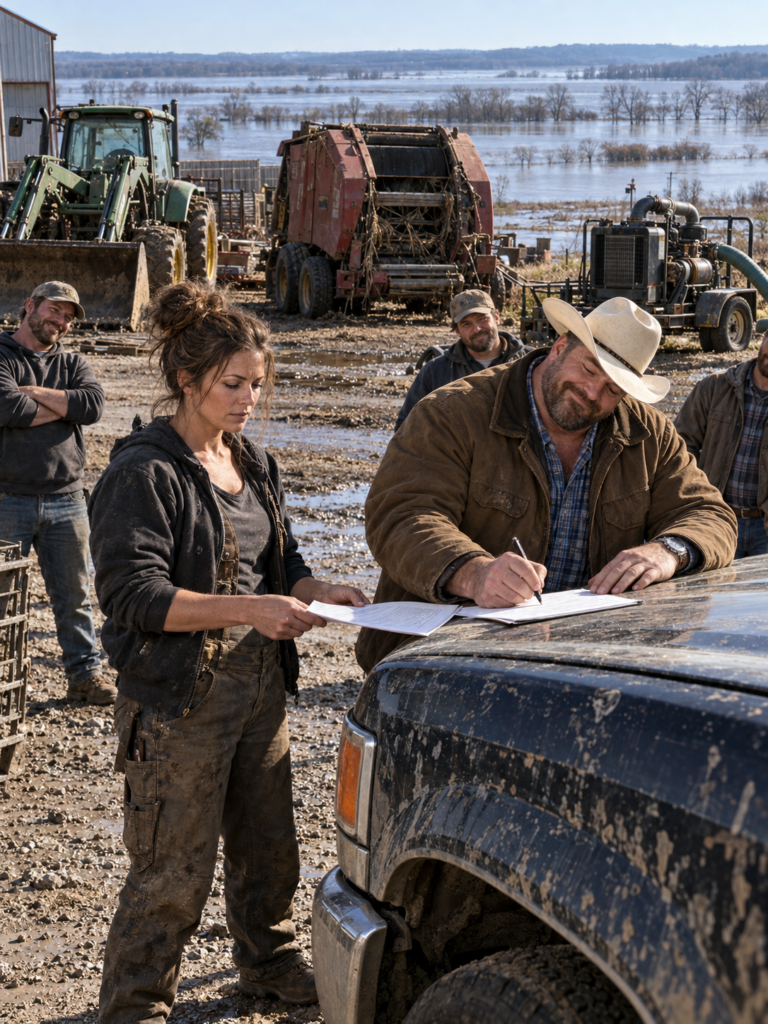
Tessa set all three acceptance records beside the original contract on the truck hood.
Each document identified the relevant machine.
Each performance requirement had been met before the deadline.
Grant stared down at the papers.
Then he made the argument Tessa had expected from the beginning.
“Those repairs won’t last. You got them running for a test. That’s all.”
Tessa looked at the signed acceptance form.
He was no longer disputing what had happened.
He was disputing whether the written agreement should matter.
“Those were the standards you accepted,” she said.
Dorian left his instruments beside the paperwork.
He didn’t offer an opinion about who deserved the land.
He didn’t need to.
His measurements established whether the agreed tests had been passed.
And all three had.
Tessa gathered the papers carefully.
“Your signature is on the agreement,” she told Grant. “And the results are on these forms.”
Grant looked from her to the 500 acres beyond the equipment yard.
The wager he had made for an audience had become a documented obligation.
But when Tessa asked when they would arrange the transfer, he gave her no answer.
He turned and walked toward the barn.
For the first time since she’d arrived at Brier Run, the men standing nearby didn’t laugh.
And Tessa understood that fixing the three machines had been only the first fight.
The next would be making Grant honor the contract he’d signed.
Grant disappeared into the barn, leaving Tessa beside the truck with the signed agreement and three acceptance records in her hands.
She didn’t follow him.
There was no reason to argue in the equipment yard.
The machinery had passed the tests. The independent witness had documented the result. The deadline had been met.
Those were facts.
Whether Grant would voluntarily honor the land-transfer obligation was now a different question.
Owen approached quietly.
“What are you going to do?”
Tessa placed the documents inside a folder.
“Keep copies of everything.”
Dorian confirmed the acceptance documentation before leaving.
The pump’s performance record showed the complete forty-minute operating test, including the sediment accumulation at the intake screen and the corrective maintenance performed without interrupting the run.
The tractor’s hydraulic readings had been recorded at operating temperature.
The baler’s four successful field cycles were documented.
None of the three machines had simply been declared repaired because Tessa said so.
They had been evaluated under standards established before work began.
Grant had signed those standards.
And each machine was identified by serial number.
That was the detail Grant had treated as unnecessary paperwork on Tuesday morning.
Now it mattered enormously.
Without clear equipment identification, he might have tried to argue that different machinery or different conditions had been involved.
Without load-test criteria, he could have claimed the repairs were inadequate.
Without a defined deadline, he might have disputed whether the work had been completed in time.
And without the recorded land-parcel identification, there could have been an argument about what, exactly, he’d promised.
Tessa had addressed those questions before accepting his challenge.
Not because she expected him to become generous.
Because she expected the agreement to need proof.
She left Brier Run with copies of the records.
Her first stop was Marlene’s parts store.
Marlene was behind the counter when Tessa walked in.
She looked up, studied her exhausted face, and asked a single question.
“Did it pass?”
“All three.”
Marlene set down the inventory sheet she was holding.
“Before eight?”
“Seven fifty-six.”
For the first time in days, Tessa allowed herself a small smile.
Marlene smiled back.
Then she noticed the folder.
“Has he transferred the land?”
“No.”
The smile faded.
Marlene came around the counter.
“Keep that paperwork somewhere safe.”
“I intend to.”
Tessa placed a copy of the signed acceptance documents with her other records.
She also retained the receipt for the salvage assembly she’d purchased herself and the written record of Grant’s refusal to authorize the additional expense.
Those records wouldn’t automatically make the disagreement disappear.
But they established what work had been performed, what had been purchased, and what each side had agreed to.
The distinction was important.
Tessa wasn’t demanding a reward based on a handshake and a crowd’s memory.
She was insisting that a signed bargain be honored.
During the following days, Grant did not arrange the transfer.
Instead, he grew quiet.
His earlier confidence had depended on the assumption that Tessa couldn’t complete the mechanical work.
Now he needed another way out.
Eventually, he proposed a larger cash settlement.
The amount was higher than the $6,800 he’d offered after the second machine passed.
He presented it as a practical solution.
The land was neglected, expensive to maintain, and prone to flooding.
Why would a struggling mobile mechanic want to inherit those problems?
Tessa listened.
Parts of his argument were true.
The bottomland wasn’t a thriving agricultural asset.
Its drainage infrastructure needed substantial investment.
The access road had deteriorated.
Not all five hundred acres could be put to productive use immediately.
Accepting the property would create expenses and responsibilities.
But none of those realities were new.
They existed when Grant made the offer.
They existed when he signed the contract.
And they existed when Tessa chose to work through the night rather than abandon the final repair.
His later regret didn’t change what he had promised.
Tessa had already consulted an attorney.
She brought the agreement, the machine identification records, the acceptance results, and the supporting expense documents.
The legal question wasn’t whether Grant thought the land was a good prize.
It was whether the written conditions had been fulfilled and what obligations followed from that.
The agreement identified the parcel and the required performance standards.
The testing had been witnessed independently.
The results were recorded.
Grant could dislike the outcome.
But he couldn’t easily rewrite the conditions after they had been satisfied.
The dispute did not end overnight.
For eight weeks, the parties negotiated.
Tessa continued working during that period.
She had to.
Ownership of future land didn’t pay current bills.
And she still had no permanent workshop.
Marlene offered bench space at her parts store on a day-rate arrangement.
Tessa accepted.
She stored equipment in the back lot, took mobile service calls from her truck, and continued repairing machines for the smaller operators who had kept her business alive.
Some days she worked out of the borrowed space until closing.
Other days she returned from distant farm calls after dark.
She didn’t try to reclaim her old storage unit.
The landlord had already moved on.
So had she.
The absence of a permanent shop was inconvenient.
It wasn’t the end of her business.
She’d spent eleven years learning to diagnose problems in fields, yards, sheds, and equipment bays that belonged to other people.
For now, she continued doing exactly that.
But every time she sorted parts into temporary storage or moved a tool case because another customer needed the counter space, she remembered the land.
Five hundred acres.
Most of it unsuitable for immediate use.
Yet potentially enough room to establish a permanent operating base.
It was an opportunity.
Not a finished success.
She understood the difference.
During negotiations, Grant continued emphasizing the property’s limitations.
He was correct about some of them.
The drainage would require serious work.
The lower acreage could not simply be treated as ready farmland.
Tessa didn’t deny those facts.
Owen’s old maintenance log had already shown that the land’s productive history depended on infrastructure that had been allowed to deteriorate.
But the log had also shown something else.
The ground had once supported a working drainage operation.
The problems weren’t mysterious.
They were physical, costly, and potentially manageable over time.
That didn’t prove the land would become profitable.
It did prove Grant’s description of the parcel as entirely useless was too simple.
There was higher ground.
There were sections that might be workable without restoring the entire drainage system.
And there was sufficient space, potentially, for a service operation that didn’t depend on the lowest fields.
Still, Tessa refused to treat possibility as certainty.
She knew how often expensive failures began with assumptions someone never bothered to test.
It was the same lesson that had saved the front-loader tractor.
An apparent solution needed verification.
At the end of eight weeks, the negotiations produced a settlement.
The specified 500-acre parcel transferred to Tessa.
Grant also reimbursed the salvage-parts expense she’d paid from her own funds.
The transfer did not repair the access road.
It didn’t drain the fields.
It didn’t place a workshop on the property or fill a bank account.
But the land was now hers.
The obligation Grant had tried to laugh away had finally been honored.
The first time Tessa returned to the parcel after the transfer, she didn’t arrive with a bulldozer or a grand construction plan.
She arrived with documents.
Before spending money on development, she arranged a survey.
She wanted to know precisely what she owned and where the boundaries stood.
Then she had the drainage mapped.
The existing access road was assessed.
Soil conditions on the higher ground were evaluated to determine which areas might support practical use.
She treated the land like a complicated machine.
Before changing anything, establish what is there.
Identify the failures.
Determine what can function safely.
Estimate the cost of what cannot.
And avoid spending money on a guess when measurements are available.
The survey and assessments gave her a realistic starting point.
Most of the acreage would need to remain untouched for the time being.
Attempting to restore the entire drainage system immediately would have consumed resources she did not possess.
But a smaller section of upper ground offered a more immediate opportunity.
Tessa approached a neighboring farm family about leasing twenty-eight acres.
The arrangement was documented in writing.
The lease defined the terms and responsibilities.
She hadn’t forgotten the lesson of the truck-hood contract.
Business agreements were easier to manage when both sides understood what had been promised.
The rent from those twenty-eight acres covered the property’s ongoing carrying costs.
That changed the financial picture.
The land didn’t suddenly become a fortune.
But it no longer required Tessa to support every ownership expense entirely from her repair income.
She could keep the remaining acreage on hold.
She could continue working.
And she could make decisions at a pace her finances could support.
That restraint was as important as the original mechanical victory.
Many people might have looked at five hundred acres and immediately imagined what all five hundred could become.
Tessa concentrated on what twenty-eight could safely accomplish.
The same principle guided her business.
She didn’t immediately open a large repair facility.
She continued expanding the customer base that already depended on her.
She used the stability of ownership to plan rather than react.
Gradually, the property gave her something she’d been missing for years.
Room to grow.
Room to store equipment.
Room to organize work without worrying that another landlord could remove her from the space.
Four years after Grant Mercer signed the contract, the northwest corner of the parcel looked very different.
A converted equipment building housed Rowan Field Service.
There were five service bays.
A dedicated parts room.
An operating schedule covering six days each week.
And a team large enough to manage more work than Tessa could have accepted alone during her mobile-service years.
The business hadn’t grown because the five hundred acres magically solved her problems.
It had grown because she combined the property with years of technical experience, steady customer service, careful planning, and disciplined reinvestment.
She still understood the difference between making a machine run and repairing it correctly.
Now that distinction defined how the entire shop operated.
Owen Pike joined Rowan Field Service to manage its maintenance program.
He was no longer required to stretch failing equipment indefinitely because someone refused to acknowledge the real cost of repair.
Tessa gave him standing authority to reject a specification he considered unsafe.
That wasn’t a ceremonial title.
It meant an unsafe job could be stopped.
Even if a customer was impatient.
Even if delaying the work cost money.
Even if someone believed the mechanic ought to follow instructions without asking questions.
Owen knew what happened when warning signs were ignored.
He had spent years watching it at Brier Run.
At Rowan Field Service, he could act on what the equipment was telling him.
Marlene Voss remained essential to the operation.
She supplied parts through a standing business account.
Tessa paid every invoice on time.
Marlene had been the first person to tell her about Brier Run’s disabled machines.
She had warned her to insist on written terms.
She had helped locate the salvage assembly that saved the final pump repair.
And she’d provided temporary work space when Tessa had nowhere else to operate.
Tessa never treated those actions as small favors.
They were part of the chain of events that made the business possible.
Grant Mercer, meanwhile, faced the consequences of his own management decisions.
Brier Run lost two full-time employees during the same year Tessa’s operation was establishing itself.
Equipment maintenance continued falling behind.
There was no campaign against Grant.
Tessa didn’t have to undermine him.
The deferred repairs, limited budgets, and treatment of his workforce had already created problems that couldn’t be solved by pretending they didn’t exist.
Then, one afternoon, a representative from Brier Run arrived at Rowan Field Service with a tractor.
Planting season was approaching.
The representative wanted to know whether the repair could be moved ahead of other scheduled jobs.
Tessa checked the job board.
Several customers already had equipment waiting.
Some were small operators who depended on one or two machines to complete their seasonal work.
She gave the representative an accurate estimate.
Quoted the standard rate.
And placed the tractor in the ordinary queue.
She didn’t refuse the business.
She didn’t invent a higher price.
She didn’t use Grant’s name as an excuse to punish the driver.
But she didn’t offer special treatment either.
Brier Run would receive the same professional service every other customer received.
That was the kind of operation she’d wanted to build.
One where repair standards weren’t determined by a customer’s status.
Where a small farmer’s equipment mattered as much as machinery from a larger property.
Where the technician doing the work was respected for technical judgment.
Not appearance.
Not age.
Not whether the customer believed a woman belonged in a service bay.
Later that week, Tessa was working on an engine when another customer arrived with a round baler needing diagnostics.
A younger female technician had been with Rowan Field Service for eight months.
She was in her midtwenties, trained, prepared, and assigned to handle the machine.
The customer looked from the younger technician to Tessa.
Then around the workshop.
“Which one of you is actually in charge of my equipment?”
Tessa recognized the tone immediately.
She’d heard variations of that question for more than a decade.
At farm gates.
In equipment yards.
Outside dealerships.
From men who believed the mechanic they needed would arrive after she stepped aside.
Four years earlier, Grant Mercer had questioned whether she belonged anywhere near his machines.
He’d laughed at her contract.
Then he’d offered five hundred acres because he believed failure was inevitable.
Now she stood in a workshop built on a portion of the land she’d won by meeting the very terms he established.
She could have delivered a speech.
She could have told the customer what she’d endured.
She could have explained how much experience the younger technician already had.
Instead, she reached for the clipboard and handed it to her employee.
“She’s handling your machine,” Tessa told the customer. “Ask her anything you need to know.”
The younger technician studied the job sheet.
Then she introduced herself and began discussing the baler’s symptoms.
The customer hesitated.
But the inspection proceeded.
Tessa turned back to the engine in front of her.
She didn’t have to supervise every conversation.
That was part of the point.
She had built a shop where skilled people could do their jobs without waiting for her to defend their right to stand there.
Later, when the workday quieted, Tessa walked outside.
From the northwest corner of the property, she could see the service building behind her and the open land stretching away beyond it.
Much of the acreage remained exactly what it had been when Grant offered it.
Low ground.
Seasonal water.
Drainage problems that required patience and money.
She hadn’t transformed every acre.
She didn’t need to.
Twenty-eight leased acres covered carrying costs.
The converted building supported a thriving repair operation.
And the rest could wait until there was a sound reason to develop it.
Inside her office, the original contract remained among her important records.
Two handwritten pages.
Three machine serial numbers.
Three performance standards.
One deadline.
And a recorded parcel number.
She remembered the Tuesday morning when the pages had rested against the hood of her pickup.
Grant had been laughing.
His men had been laughing.
She’d been worried about overdue rent and three days of income she couldn’t afford to lose.
But she hadn’t signed because she believed the world owed her a reward.
She’d signed because she’d inspected the problems, assessed the risks, and believed she could do the work.
She’d also insisted that the terms be clear enough to survive disagreement.
The land hadn’t been handed to her out of generosity.
And the signed contract alone hadn’t repaired a single machine.
She had still needed the diagnostics, the long hours, the precision, the salvage parts, Owen’s assistance, Marlene’s support, and Dorian’s independent verification.
She had still needed to pursue the agreement after the deadline passed.
And she’d needed four more years of careful decisions to turn a damaged piece of property into a lasting business.
The real achievement wasn’t that Grant had lost five hundred acres.
It was that Tessa no longer needed someone like Grant to decide whether she deserved an opportunity.
She could create one.
And now, when another capable young mechanic walked into Rowan Field Service carrying a toolbox, there was already a place for her to work.
No wager required.
No laughter from nine men.
No proving her worth before she was allowed to begin.
Just an open service bay, a real job, and the expectation that her work would speak for itself.
Tessa looked back toward the workshop as another engine started inside.
She recognized the steady sound of a machine running properly.
Then she went back to work.


