
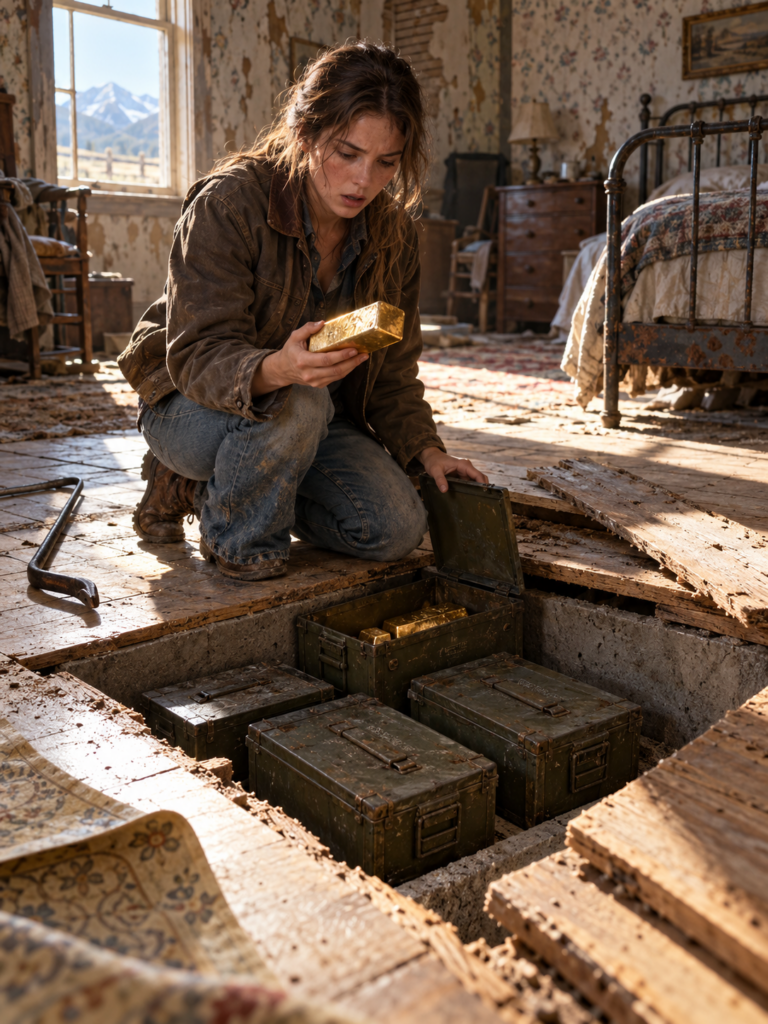
Her fingers closed around the envelope, but Sadie didn’t invite Granger inside.
She withdrew the contract and studied the price.
Six thousand dollars.
Yesterday he’d made it sound as though offering five was an act of charity.
Now he had returned early, increased his bid, and expected her to make a decision before she could properly investigate the property.
“Why the extra thousand?” she asked.
Granger adjusted his sunglasses.
“Business reasons. Easier to settle quickly than keep a file open.”
“But you said the land was useless.”
“Commercially useless. That doesn’t mean I can’t make something of it.”
He tried to look past her shoulder.
Sadie shifted sideways, blocking the doorway.
“How long have you been interested in this ranch?”
Granger paused.
“Your grandfather was difficult to deal with.”
That wasn’t an answer.
“You knew him?”
“We crossed paths.”
“How many times?”
His expression tightened.
“Ms. Miller, you have twenty-two thousand dollars in back taxes. That house is barely standing. I’m giving you an opportunity that probably won’t come again.”
It was a reasonable financial argument.
That bothered her almost as much as his persistence.
Without the gold, she would have accepted.
Maybe she still should.
Those crates might not legally belong to Arthur’s estate. The markings on the bars suggested they could be traced. If she sold the ranch without disclosing them, someone else might become responsible for whatever they concealed.
And if Granger already knew about them, she had very little information with which to protect herself.
“I’m not signing today,” she said.
He stared at her.
“I was under the impression you needed the money.”
“I do.”
“Then be practical.”
“I intend to.”
Sadie folded the contract and handed it back.
Granger didn’t immediately take it.
“Arthur made his life much harder than it needed to be,” he said quietly. “I wouldn’t recommend following his example.”
Something about the way he said Arthur’s name made her stomach tighten.
“Goodbye, Mr. Granger.”
She closed the door.
Only after his truck disappeared did she allow herself to breathe normally.
Then she went back to the bedroom.
The floorboards were still loose beneath the rug. The crates remained exactly where she’d left them.
She had discovered something valuable, but she didn’t yet understand what it was, who had put it there, or whether she had any rightful claim to it.
She couldn’t carry the crates away in her sedan without help.
She couldn’t sell them without asking questions.
And she couldn’t pay the property taxes with gold she was afraid to show anyone.
What she needed was information.
She remembered the little town she’d passed on the way in.
Oak Haven.
There had been a hardware store on the main street.
If Arthur had lived here for decades, somebody in town might remember him before he became the isolated old man she knew.
Sadie covered the floor opening again.
She drove the ten miles into Oak Haven and entered the hardware store, where an older man stood behind the counter.
His name was Roy.
He recognized her family resemblance immediately.
“Arthur Miller’s granddaughter,” he said. “I’d know that nose anywhere.”
Sadie bought a few basic supplies and asked what her grandfather had done for work.
Roy considered the question.
“He worked around the old copper mines. Back in the eighties.”
“Doing what?”
“State work, far as I remember. Checking things. Supervising, maybe. I wasn’t exactly his closest friend.”
“Did he make good money?”
Roy gave a short laugh.
“Not judging by the way he lived.”
Then his face became serious.
“Something happened out there. After the mines shut down, Arthur changed. Started watching every car that passed. Said people were listening to his calls.”
Sadie kept her expression neutral.
“Did anyone believe him?”
“Some did. Most figured he’d become a little strange.”
“Did he ever mention gold?”
Roy looked genuinely puzzled.
“Gold? Those were copper mines.”
She almost explained.
Instead, she asked about Granger.
Roy’s reaction was immediate.
“That fellow’s been after Arthur’s place for years. Long before your grandfather died.”
Sadie felt the room become smaller.
“So he didn’t just hear about the sale from the estate lawyer?”
“Not originally. Arthur used to run him off.”
Roy handed her the supplies.
“I’d be careful about assuming any of those people are doing you a favor.”
Outside, Sadie noticed a dark sedan parked beneath the awning of an abandoned gas station.
The windows were tinted.
She couldn’t see who was inside.
It might have meant nothing.
But Granger’s sudden second offer, Arthur’s old fears, and the crates now formed a pattern she couldn’t comfortably dismiss.
She drove back toward the ranch, deciding not to sell.
She would first find out what Arthur had taken from those mines, if anything, and why he had spent the rest of his life hiding.
As darkness approached, Sadie carried her new locks inside.
She secured the doors.
Then she took a flashlight into Arthur’s bedroom, pulled both remaining dresser drawers out of their runners, and began searching for whatever explanation her grandfather might have left behind.
The second drawer struck the bedroom floor with a hollow wooden rattle.
Sadie directed her flashlight into the dresser’s empty frame.
Dust.
A dead spider.
The warped back panel.
Nothing resembling a letter, bank record, or explanation for the fortune beneath her feet.
She ran her fingertips around the inner corners anyway.
Arthur had spent decades concealing something enormous. Surely he’d left behind some record of it.
But the dresser gave her nothing.
She turned toward the bed.
The mattress was stained and thin. She lifted it, checked beneath it, and examined the hollow metal frame.
Nothing.
She searched the closet again.
A few empty hangers swayed when she brushed past them.
In one corner sat Arthur’s mud-caked boots.
She had examined the closet that morning and dismissed the boots as useless.
Now she picked up the left one.
The leather was stiff, the sole worn unevenly along the outside edge.
She turned it upside down.
Dry dirt fell onto the floor.
She tried the right boot.
It felt heavier.
Not dramatically so, but enough that she noticed.
Sadie reached into the opening and pushed her fingers toward the toe.
Something flat was lodged beneath the collapsed inner lining.
She worked it free.
A small black leather notebook.
Its cracked cover had been held closed by an old rubber band, which broke when she touched it.
Sadie carried the book to the mattress and opened it beneath her flashlight.
The first pages were crowded with Arthur’s writing.
She recognized the cramped handwriting from the few birthday cards he had sent when she was little.
Most of the later entries made her uneasy.
License plate numbers.
Descriptions of vehicles.
Dates when strangers supposedly waited outside the ranch.
Complaints about telephone noises and people watching him.
Some entries were coherent. Others were fragmented, repeating the same suspicions without offering proof.
Sadie could understand why Roy had described her grandfather as paranoid.
But near the back, the handwriting changed.
The letters grew neater.
The entries became shorter and more deliberate.
And the dates reached back to 1989.
She read the first relevant page twice.
Arthur had been assigned work near a closed mine shaft.
According to his account, the shaft was supposed to be sealed.
Instead, he’d discovered that somebody had cut its padlock.
He went inside expecting to find trespassers.
What he claimed to have found was a shipment of metal crates.
Not copper.
Gold bullion.
Sadie’s flashlight trembled against the page.
She turned it.
The next entry described Arthur checking paperwork at the mine office.
He couldn’t find the shipment listed on the records available to him.
There were references to late-night movements and a company operation Arthur believed was being deliberately concealed.
He speculated about tax evasion and other financial wrongdoing.
But those were Arthur’s suspicions.
The notebook didn’t contain company records proving them.
Still, the description of the crates was unmistakable.
Olive-green metal.
Heavy.
Stacked on pallets.
Sadie looked down at the floor.
That matched what she’d found.
She continued reading.
In an entry dated November 2, 1989, Arthur wrote that he’d taken three crates from the mine and hidden them beneath the house.
He called them his retirement fund.
Three crates.
Sadie sat upright.
There were four beneath the floor.
She checked the sentence again.
Three.
Not four.
Either Arthur had miscounted, taken another later, or deliberately kept an incomplete record.
She searched the following pages for an explanation.
The next entries weren’t about taking more gold.
They were about being watched.
A dark Lincoln parked near a diner.
A car appearing behind his truck on the highway.
Men he believed were connected to the mine operation.
By 1991, the confidence of his earlier writing had vanished.
He wrote that whoever owned the gold knew something was missing.
He couldn’t spend it.
He couldn’t move it.
He couldn’t safely tell anyone.
He believed that reporting what he’d discovered would expose his own theft while leaving him vulnerable to people who might have concealed far greater wrongdoing.
The last clear sentence on that page was painfully simple.
He had wanted security.
Instead, he had trapped himself.
Sadie closed the notebook.
For the first time, her grandfather’s miserable life made a kind of sense.
Arthur had stolen gold.
At least, that was what his own account said.
The wealth beneath his bedroom wasn’t a forgotten investment or an eccentric collection of precious metal.
He had taken something he knew was being secretly moved through the mines.
And the people responsible had apparently never forgotten.
She thought about Granger.
His repeated attempts to buy the ranch.
His insistence on a quick sale.
The warning that she shouldn’t repeat Arthur’s mistakes.
It was possible he was simply an aggressive property buyer.
But the more Sadie learned, the less convincing that explanation seemed.
Then she remembered the fourth crate.
Arthur’s notebook described three stolen crates, yet she had found four.
The account was incomplete.
She didn’t know whether the difference mattered.
It mattered enough that she refused to make another move without preserving what she’d found.
Sadie slipped the notebook into her jacket pocket.
She considered removing one of the gold bars and hiding it in her car.
But what would that achieve?
A stamped gold bar would attract questions. The quantity and origin could not be explained by a simple inheritance claim.
The land was hers according to the estate documents.
The gold was another matter.
She didn’t want to surrender it blindly.
She also didn’t want to become the next person who spent a lifetime protecting something she couldn’t use.
She returned to the open floor section, lifted the rug, and studied the crates.
The broken padlock lay where she’d left it.
The other three remained sealed.
In her flashlight beam, the crates looked nearly identical.
She couldn’t tell from their exteriors which one Arthur had taken first or whether all four came from the same place.
The notebook helped explain the hiding place.
It didn’t prove that the gold now legally belonged to her.
Nor did it explain why Arthur had written down three crates rather than four.
Sadie lowered the rug.
She could try contacting the estate lawyer in the morning.
She could tell him about the gold and Arthur’s notebook, then ask how to have its ownership properly investigated.
That was the sensible path.
But first she needed to survive the night in a house that seemed increasingly exposed.
She went to the living room.
The windows were dark.
Beyond them stretched seventy acres of empty Wyoming scrub.
Her sedan stood beside the porch.
A little before midnight, she was crouched near the front window when a pale beam swept across the wall.
It moved slowly.
Stopped.
Moved again.
Headlights.
Sadie switched off her flashlight.
She eased toward a narrow gap in the curtain.
A dark sedan had entered the driveway.
It stopped some distance from the porch.
The engine died.
Then one car door opened.
Another followed.
Two figures stepped onto the gravel.
She couldn’t identify either person.
One carried a flashlight.
The other appeared to be studying the house.
Sadie felt the notebook pressing against her ribs inside her jacket.
For years, Arthur had described men watching his property.
Now two strangers were outside, in the middle of the night, moving toward her front door.
A floorboard creaked beneath her boot.
She froze.
The figures continued forward.
One climbed the porch steps.
The other remained near the path leading around the house.
A hand tested the front door.
The new padlock held.
A muffled voice spoke.
Then somebody pushed hard against the frame.
Dust dropped from the ceiling.
Sadie backed away.
“She’s here,” a man said from outside. “Car’s still parked.”
The second voice answered.
“Try the back.”
They knew someone was in the house.
And they were trying to get inside anyway.
Sadie retreated into the hallway, gripping the crowbar she’d used on the floorboards.
She knew the doors were old.
The new hasps had been drilled into weakened wood.
If the men were determined, locks would only delay them.
A heavy impact sounded against the rear entrance.
Then another.
She looked at the telephone mounted near the kitchen.
Dead.
Her cell phone had shown no usable signal since she’d arrived.
She could make for her car, but the visitors were between her and the driveway.
If she ran into the open yard, they would see her immediately.
She thought about hiding in the bedroom.
But the room had only one practical way out.
And the gold was underneath it.
She would be trapping herself beside the very thing they might have come to recover.
Her flashlight caught the hallway closet door.
Earlier, while searching for household supplies, she’d seen an old metal fuel can on the lower shelf.
She opened the closet.
The can was still there.
Five gallons in capacity, its label nearly worn away.
She unscrewed the cap.
The smell of kerosene rose sharply.
It was about half full.
Sadie stared at it.
She knew what she was considering was dangerous.
One spark in the wrong place could destroy the house and kill her.
But whoever was outside had ignored the locked doors.
And her grandfather’s notebook suggested that the men connected to the gold valued secrecy as much as the bullion itself.
She couldn’t overpower two intruders.
Perhaps she could convince them that trying to take everything would cost them more than leaving her a way out.
She carried the can into the bedroom.
The old pine floorboards were dry.
The discarded newspapers in the other rooms would ignite easily.
Even the fumes could make a small flame catastrophic.
She began pouring kerosene across the bedroom floor, around the rug concealing the crates and toward the doorway.
Her hands shook so badly that the liquid splashed unevenly.
She stepped back, breathing through her mouth.
Then she heard glass shatter in the living room.
The intruders had abandoned the doors.
They were coming through the window.
Sadie left the bedroom, taking care not to step into the spilled fuel.
She stopped at the end of the hallway.
Two men were climbing over the floral sofa she’d pushed against the front window.
Broken glass crunched under their boots.
The taller one raised a flashlight.
Its beam struck her face.
“Ms. Miller,” he said.
She recognized his smooth, controlled tone from the way he addressed her.
But she didn’t recognize the man.
“Stop there,” she told him.
He looked at the crowbar in her hand.
Then his gaze shifted to the box of matches she had taken from the kitchen.
“We’re not here to hurt you,” he said.
“You broke into my house.”
“We need to recover property that belonged to a company your grandfather worked for.”
Sadie kept her back straight.
“What property?”
The man paused.
“Don’t make this difficult.”
She understood then that the notebook had given her something the men didn’t know she possessed.
She knew the crates were connected to the mines.
She knew Arthur believed the shipments were unrecorded.
And she knew these men were uncomfortable explaining why they had entered her house at night.
“I found the gold,” she said.
The man with the flashlight stopped moving.
His companion shifted his weight.
For one second, neither spoke.
Then the smooth-voiced man said, “Your grandfather took something that wasn’t his.”
Sadie tightened her grip on the matchbox.
“And I found the notebook that says where he took it from.”
The man’s flashlight lowered slightly.
Behind her, the smell of kerosene drifted into the hallway.
His eyes narrowed.
“What notebook?”
Sadie pulled a match free.
“The one Arthur kept about the mine.”
The taller man took half a step forward.
She struck the match.
A tiny yellow flame appeared between her fingers.
The man’s expression changed instantly.
“Put that out.”
Sadie held the match away from her body.
“I want to make a deal.”
He glanced past her toward the hallway, where the sharp odor of fuel was unmistakable.
“First,” he said, “tell me exactly what you’ve done.”
Sadie looked from the burning match to the two strangers standing among the shattered glass.
And she realized she had finally forced them to listen.
“I poured kerosene in the bedroom,” Sadie said. “Around the floor where the crates are hidden.”
The man with the flashlight stared at her.
For the first time since entering the house, he looked uncertain.
“Put the match out,” he repeated.
“Then stop coming toward me.”
His companion gave a disbelieving laugh.
“Gold doesn’t burn.”
Sadie knew that.
She also knew the wooden house could burn, that the notebook was combustible, and that a fire would bring attention to a property these men had apparently spent years trying to acquire quietly.
“Then you won’t mind explaining to the authorities why you broke into an occupied house to recover gold that was never listed in the mine records.”
The taller man’s eyes shifted toward her jacket pocket.
“You don’t understand the situation.”
“Arthur wrote about the shipments. The shaft. The missing records. He wrote about taking three crates.”
She watched for a reaction.
There was one.
The shorter man turned sharply toward his companion.
“Three?”
The taller man didn’t look away from Sadie.
“Be quiet.”
Sadie felt her pulse quicken.
The discrepancy mattered.
Arthur had written about stealing three crates.
There were four beneath the floor.
For the first time, she wondered if the men standing before her knew more about the number than she did.
“How many were you expecting?” she asked.
No one answered.
The match burned lower.
Heat reached her fingertips.
She dropped it onto the bare living room floor, away from the kerosene, and ground it out beneath her boot.
The taller man breathed out.
Then she struck a second.
He raised his hand sharply.
“Enough.”
“Then listen.”
Sadie was terrified.
There was no strength in pretending otherwise.
Her knees felt weak, and the flame trembled between her fingers.
But she understood one advantage she possessed.
The men wanted what was hidden beneath the bedroom.
They wanted it quietly.
They didn’t want a wrecked house full of smoke, emergency crews, and questions about an old mining operation.
“I don’t want all of it,” she said.
The taller man stared.
“What?”
“The gold. I don’t want all four crates.”
The shorter man let out another sharp laugh.
“You think you can negotiate stolen property?”
“I think you came here because calling the police would make your employers answer questions they don’t want asked.”
Neither man contradicted her.
That silence was not proof of every allegation Arthur had written.
But it told her they weren’t eager to involve anyone outside the room.
“I take one crate,” Sadie said. “You take the other three. You leave me alone. Granger leaves me alone. Nobody comes after me.”
“You’re demanding a fortune,” the shorter man said.
“I’m offering you three quarters of what you came for.”
The taller man studied her.
“And the notebook?”
“I keep it.”
“That’s not happening.”
“Then neither is the quiet recovery you wanted.”
She let the threat hang between them.
In her pocket, the actual notebook contained only Arthur’s account.
It didn’t contain signed corporate confessions or complete transaction records.
It might not be enough to prove the company’s wrongdoing.
But the men had no way to know how much documentation Arthur had preserved.
Sadie leaned into that uncertainty.
“If you follow me, copies of what Arthur wrote will reach people who can investigate the mine records.”
The shorter man looked toward the hallway.
His face was damp with sweat.
The smell of kerosene was getting stronger.
“We could take it from her,” he muttered.
The taller man didn’t move.
“And risk a fire? With all this old paper and wood? Think.”
Sadie watched them.
She had tried to create leverage.
Now she needed to keep it long enough to leave.
The taller man considered her demand.
At last, he said, “One crate.”
The words were almost too quiet to hear.
“One crate,” he repeated. “We recover the others. You leave. No more contact.”
Sadie didn’t mistake the statement for a reliable guarantee.
She didn’t know who had authorized him to make such an agreement.
She didn’t know whether anyone else would honor it.
But the men were standing in her house, and she had no safe means of calling for help.
This was the only opening she could see.
“You move them,” she said.
The shorter man glared at her.
The taller one nodded.
“Put the matches away.”
“After the crates are outside.”
She directed them toward Arthur’s bedroom.
The shorter man pulled back the rug and lifted the loosened boards.
The plastic covering came away with a crackle.
The four crates lay in the concrete cavity.
The first had its damaged lock.
The other three remained sealed.
The taller man swept his flashlight over them.
His expression gave away almost nothing.
But Sadie saw him pause when all four came into view.
“You knew there were four?” she asked.
He didn’t answer.
The shorter man gripped one crate handle and strained to lift it.
“Help me.”
Together they hauled the metal box from the cavity.
It struck the floor with a heavy thud.
They repeated the process with the second crate, then the third.
Each movement was slow, awkward, and exhausting.
The house was too cramped to move them easily.
They had to guide the boxes through the narrow doorway, down the hall, past the broken glass, and out onto the porch.
Sadie followed at a distance, keeping the remaining matches in her hand.
Every time they passed the kerosene-soaked bedroom, the danger of what she’d done became painfully clear.
She had filled part of a wooden house with flammable liquid.
If a flame reached it, she might never get out.
What had seemed like a clever threat in a moment of panic now looked like a decision that could have ended all three lives.
But turning back while the men were still inside seemed equally frightening.
At the front door, the taller man stopped.
“Which one are you taking?”
Sadie looked at the four boxes.
The first was open.
It was the only crate whose contents she’d inspected.
“That one.”
The man nodded.
The men carried the three locked crates to their sedan.
Sadie watched from the porch.
The night wind had cooled considerably, and each breath of clean air cleared her head a little more.
The car sank slightly as the crates were loaded.
Then the men returned for the open box.
They lifted it with difficulty.
Sadie directed them to her rusted sedan.
She unlocked the trunk.
They placed the crate inside.
The rear suspension compressed under its weight.
For several seconds, nobody moved.
Then the taller man turned to her.
“The notebook.”
Sadie stood with one hand on the trunk lid.
“I told you. I’m keeping it.”
“That wasn’t the arrangement.”
“It was my condition.”
He moved closer.
She instinctively reached for the pocket containing the leather book.
His gaze followed.
And Sadie understood that handing it over would leave her with no remaining leverage.
“You already have three crates,” she said. “Take them and go.”
The man looked toward the house.
Through the broken window, the dark living room was visible behind the ruined sofa.
Perhaps he was calculating what else might happen if he prolonged the confrontation.
Perhaps he simply wanted the gold secured before someone noticed the vehicle.
Sadie couldn’t know.
Finally, he said, “You don’t understand who you’ve involved yourself with.”
“Neither did Arthur.”
The words emerged before she could stop them.
The man’s expression became unreadable.
Then he stepped away.
“Let’s go.”
He climbed into the sedan.
His companion followed.
The engine started.
Gravel spat from beneath the tires.
The dark vehicle reversed down the driveway and disappeared into the night.
Sadie kept watching until even the taillights were gone.
Only then did her legs give out.
She dropped beside the sedan, one hand gripping the gravel.
Her stomach convulsed.
She breathed in short, desperate bursts, trying to stop shaking.
She had stood inside her grandfather’s ruined house and threatened a fire she might not have survived.
She had negotiated with two men whose names she didn’t know.
She had permitted them to remove three crates of gold without verifying their claim of ownership.
And the fourth was sitting in the trunk of her car.
Nothing about the arrangement was legally settled.
Nothing about the men suggested she could trust them.
Yet she was alive.
And for the first time since arriving, she had a way to leave.
Sadie pushed herself upright.
The porch leaned against the darkness.
One window was shattered.
The doors were scarred where the men had tried to force them.
Inside, the bedroom floor remained open and soaked with kerosene.
She looked at the house and felt something shift.
For years, she’d imagined Arthur as a selfish, impossible old man who had deliberately pushed his family away.
Now she understood at least part of what had happened to him.
In 1989, he’d discovered something he believed was being concealed at the mines.
Rather than report it, he took gold for himself.
He had called it a retirement fund.
But according to his own notebook, the people connected to the shipment eventually noticed.
Arthur stopped trusting strangers.
Then he stopped trusting familiar people.
He bought little.
He spoke less.
He watched passing vehicles and wrote down license plates.
He lived above an enormous fortune but couldn’t use it without risking questions he couldn’t answer.
The gold had not made him free.
It had given him something to protect at the cost of almost everything else.
Sadie thought of the first entry she’d read.
The confident handwriting.
The casual reference to taking three crates.
Arthur had apparently believed he could hide the gold and enjoy it later.
Later had stretched into years.
Then decades.
Until he died in a collapsing house with unpaid taxes and almost no family left around him.
But one part of the story still bothered her.
Three crates.
Arthur had written three.
She had found four.
She took the notebook from her jacket and opened it beneath the flashlight.
The entry was unchanged.
There was no later page explaining the additional box.
Perhaps Arthur had gone back.
Perhaps his first account was incomplete.
Perhaps he’d deliberately avoided writing everything down.
She could not resolve that contradiction from the material she possessed.
And now three of the boxes were gone.
She had surrendered the opportunity to examine them.
Sadie sat on the car’s rear bumper, the open notebook in her lap.
She could no longer pretend that the mystery had been fully solved.
Arthur’s account explained how gold had come to be hidden beneath the bedroom.
It explained why he feared discovery.
It supported her suspicion that Granger’s interest in the ranch had not been an ordinary business opportunity.
The intruders’ knowledge of the crates made their interest undeniable.
But the notebook didn’t establish every corporate allegation Arthur had made.
It didn’t identify who had originally owned the bullion.
It didn’t prove the company’s supposed tax evasion.
And it didn’t explain the fourth crate.
There were still facts that would require investigation.
For a moment, she considered staying.
She could secure the house, contact the estate lawyer, and begin sorting out the ownership questions from the place where everything had happened.
Then she looked through the broken window.
The dark hallway extended toward the bedroom.
She could smell kerosene even from outside.
The ranch was unsafe.
The men who had entered it had known she was there.
And Granger remained a presence she couldn’t dismiss.
She had spent years making decisions from a place of desperation.
That night, desperation had nearly killed her.
She would not spend another one inside the house.
Sadie returned to the kitchen.
Her duffel bag still rested on the dusty counter where she’d dropped it upon arriving.
She packed her remaining belongings.
There wasn’t much.
Three changes of clothes.
Her old bills.
A few personal things that had traveled with her from Denver.
She checked that the stove was off and the house held no open flames.
She did not attempt to repair the damage or move the kerosene-soaked materials.
The building was no longer safe to occupy.
Before leaving, she stood in Arthur’s bedroom doorway.
The mattress lay crooked on its frame.
The dresser drawers were scattered across the floor.
The linoleum rug had been kicked aside, exposing the empty concrete cavity.
For thirty-seven years, that space had held the secret around which Arthur’s life had apparently narrowed.
Now it held nothing but dust, broken locks, and the smell of fuel.
Sadie thought about the man she’d known as a child.
She remembered the way he’d stand at the window when a truck passed.
The way he kept the curtains closed even during bright afternoons.
The way he always seemed angry when someone asked too many questions.
She had thought he was simply cruel.
His notebook suggested something more complicated.
He had been frightened.
He had made choices that helped create his fear.
And he had never found a way out.
Understanding that didn’t erase the distance he’d created between himself and his family.
It didn’t make the theft acceptable.
It didn’t turn his suspicions into established facts.
But it made the shape of his loneliness clearer.
Sadie didn’t forgive everything.
She also couldn’t bring herself to hate him as easily as she once had.
“Goodbye, Arthur,” she said.
The wind moved through the broken living room window.
She turned off the flashlight and walked outside.
Her sedan started on the second attempt.
The engine coughed, shook, and settled into a rough idle.
Sadie fastened her seat belt.
In the trunk sat twenty gold bars whose legal ownership remained unresolved and whose value was likely immense.
They represented the possibility of a life without overdue rent, collection notices, or the constant fear of being locked out of her own home.
But their presence also meant that Arthur’s problems had not simply vanished.
She needed proper advice.
She needed to preserve the notebook and find out what could be established about the gold’s origin.
And she needed to stop allowing other people’s demands to determine how quickly she made irreversible decisions.
Those were problems for a safer place and a clearer morning.
She turned onto the gravel driveway.
The house receded in her rearview mirror.
The leaning mailbox post passed on her left.
Then the ranch disappeared behind a low rise.
She did not look back again.
By dawn, she’d reached the interstate.
The eastern horizon was beginning to glow pink and orange.
Traffic was sparse.
The heater barely worked.
Her shoulders ached from moving crates and holding the crowbar.
She reached into her jacket and touched the little black leather notebook.
Arthur’s handwriting lay inside.
It was the closest thing he’d left to an explanation.
He had wanted wealth to protect him from an uncertain future.
Instead, he had hidden it beneath the floor and built his entire life around the fear of losing it.
Sadie had nearly done the same thing in a single night.
She thought about the moment Granger offered her six thousand dollars.
The desperation she’d felt before discovering the gold.
The way his contract would have decided her future if she had signed without asking questions.
Then she thought about the men carrying three crates out of her grandfather’s house while she held a burning match.
Every choice had seemed reasonable for one frightening second.
Each had carried consequences she hadn’t fully understood.
There would be no magical ending in which a fortune erased those consequences.
She still had to establish whether she could lawfully keep or sell the bullion.
She still had to learn whether the people who had broken into the ranch would respect the agreement.
She would need help.
And the fact that she might finally be able to afford that help did not make the underlying questions disappear.
But she was no longer planning to return to the bedroom and spend her life guarding the floor.
That mattered.
She rolled down the window.
Cool Wyoming air filled the car.
In the rearview mirror, morning light spread across the empty highway.
Sadie set the notebook on the passenger seat beside her duffel bag.
For decades, Arthur had treated that small book as evidence of every danger waiting outside his front door.
To Sadie, it now meant something different.
It was a record of where one frightened decision could lead.
She intended to preserve it, not worship it.
She would find out what she could about the gold.
She would take the legal and financial questions seriously.
And she would not make secrecy the organizing principle of the rest of her life.
The rusted sedan continued east.
In the trunk was a fortune she had never expected to find.
On the passenger seat was the history of a man who had found wealth and lost his freedom.
Sadie kept both with her as the sunrise filled the windshield.
For the first time since losing her apartment, she had somewhere to go.
Not a particular town or house.
Not yet.
But toward a future she intended to choose for herself.
And this time, she wasn’t going to bury it beneath the floor.


