
The cradle rose awkwardly between them, its unfinished rail catching against a projecting board.
Rebecca tightened her grip.
Jonah immediately steadied the heavier end.
“Careful. There’s a nail behind you.”
“I see it.”
She guided the cradle clear of the stacked lumber, refusing to release her side until they reached the open barn doorway.
Only then did she step back.
Her breathing had grown shallow.
Jonah looked concerned.
“Sit a moment.”
“I’m all right.”
“I believe you. There’s still a chair behind you.”
That earned him the faintest smile.
Rebecca sat.
The cradle stood between them, its small wooden runners uneven against the earth.
“Thomas used to work on it after supper,” she said. “He wasn’t a fine carpenter, but he took such care with every joint.”
Jonah examined the workmanship.
“He knew enough to make it strong.”
“He wanted the vines to go all the way around.”
“Then that’s what I’ll aim for.”
Rebecca’s eyes filled unexpectedly.
She looked toward the low hill beyond the fence.
“I’ve been angry with him.”
Jonah said nothing.
“Not for dying. I know he didn’t choose that.”
She rubbed her hands together.
“I’m angry that he left me to remember everything. Every payment. Every fence. Every decision about a child he never got to meet.”
Her voice faltered.
“And then I feel ashamed for being angry.”
Jonah rested one hand on the cradle.
“Grief doesn’t always make sensible company.”
She gave a small, unsteady laugh.
“No. It certainly doesn’t.”
He asked whether she wanted the cradle brought inside.
“Not yet,” she said. “Finish it here. I want to see it when it’s ready.”
“All right.”
That evening, Rebecca opened the family Bible.
Between its pages lay the receipt proving Thomas had paid the ninety-two-dollar assessment.
The signature of the territorial clerk was still legible.
Jonah sat opposite her at the kitchen table.
“Have you shown this to anyone?”
“The land office has been told it exists.”
“That isn’t the same as having it entered into the record.”
“Corwin says their books are authoritative.”
“Then we’ll need someone besides him to examine both.”
Rebecca studied the receipt.
“Why should you care about a dispute that doesn’t concern you?”
Jonah looked toward the barn.
“Because a man shouldn’t take wages for keeping a roof sound and stand by while somebody steals the ground underneath it.”
For several seconds, she regarded him without speaking.
Then she closed the Bible.
“I make the decisions about the property, Mr. McCrae.”
“Of course.”
“I won’t agree to sell it simply because a man with better clothing tells me I ought to.”
“I wouldn’t ask you to.”
“And I won’t have you confronting anyone on my behalf without speaking to me first.”
Jonah nodded.
“Then we speak first.”
The answer was so simple that Rebecca scarcely knew what to do with it.
In the days that followed, he worked on the cradle each evening.
He matched Thomas’s carved vines as closely as possible, leaving the original workmanship untouched.
Meanwhile, Rebecca examined every document related to the homestead.
She copied the receipt details, organized her husband’s papers, and prepared questions for the territorial office.
Her husband had trusted her with the accounts while he lived.
She would not suddenly become incapable of understanding them because he was gone.
On a clear morning, Jonah drove her into town for an appointment with Mrs. O’Leary, the experienced midwife who had agreed to attend the birth.
The older woman examined Rebecca carefully.
“You’re carrying well enough,” she said, “but you’re tired.”
“There’s much to do.”
“There always is.”
Mrs. O’Leary looked toward Jonah.
“You’re the hired man?”
“Yes, ma’am.”
“Then see that the firewood stays stacked and the water stays carried.”
“I can manage that.”
“And when the time comes, somebody rides for me promptly.”
Rebecca nodded.
On their return, the cabin appeared less desolate than it had a month earlier.
The fence stood straight.
The woodpile was full.
And beside the hearth waited a newly finished cradle, its carved vines running from one end to the other.
Rebecca stopped when she saw it.
Jonah had brought it inside while she rested the previous evening, after completing the work she had requested.
She knelt beside it and touched the two distinct sections of carving.
The difference was visible if one looked carefully.
Thomas’s work was smaller and more intricate.
Jonah’s strokes were firmer.
But the pattern continued.
Rebecca pressed her fingers to her lips.
“Thank you,” she whispered.
Jonah remained beside the doorway.
“It’s still his cradle.”
She looked at him.
“Yes. And now it’s finished.”
Their quiet moment ended three mornings later.
A horse approached through the dust.
Adley Corwin stopped beside the gate wearing a fine dark coat, his expression professionally pleasant.
He remained mounted while explaining that the official records still showed the unpaid assessment.
The development company, he said, remained willing to purchase the property for one hundred dollars.
Rebecca stepped onto the porch with the Bible held against her chest.
“My husband’s receipt proves otherwise.”
“Private documents may be examined at the hearing.”
“Then I intend to attend.”
Corwin glanced toward her pregnant belly.
“The proceedings may be rather difficult in your condition.”
Rebecca’s voice sharpened.
“My condition is not evidence that I owe ninety-two dollars.”
Jonah stood beside the woodpile, listening.
Corwin’s smile thinned.
“The hearing is now scheduled for twenty-one days from the notice, Mrs. Lang. I trust you understand the consequences of failing to establish your claim.”
Rebecca tightened her hold on the Bible.
“I understand exactly what is at stake.”
Corwin tipped his hat and turned his horse toward the road.
But before he could leave, Rebecca stepped down from the porch.
“Mr. Corwin.”
He looked back.
She opened the Bible and held up the signed receipt.
“When that hearing begins, I intend to ask why a payment witnessed by two people disappeared from your office’s records.”
For the first time, his composure slipped.
Only for an instant.
Then he rode away.
Rebecca watched until the dust settled.
She turned to Jonah.
“We have twenty-one days.”
He nodded.
“And the first thing we do is find out who can examine that receipt without asking Corwin’s permission.”
Rebecca closed the Bible.
Then she started toward the cabin to prepare her papers.
Rebecca carried the Bible inside and laid it carefully on the kitchen table.
Jonah followed only after securing the gate.
She took out the receipt, smoothed its creases, and began writing down the questions she intended to ask at the hearing.
“Who entered the payment? Where is the duplicate record? Who discovered the supposed deficiency? And why did the company offer to buy my land before the dispute was resolved?”
Jonah pulled out a chair.
“Those are good questions.”
“They’re questions Corwin doesn’t want answered.”
She dipped her pen again.
“Then he’d better grow accustomed to disappointment.”
Jonah smiled.
He was beginning to recognize that expression.
Rebecca Lang might be frightened.
She might be exhausted.
But once she decided to stand her ground, fear had very little influence over her feet.
The following morning, Jonah rode into town to inquire about the court procedure and the clerk responsible for receiving evidence.
Rebecca remained at the homestead, making copies of the documents and organizing the farm accounts.
She would have preferred to go herself, but the previous day’s strain had left her back aching.
Mrs. O’Leary’s warning remained fresh in her mind.
A woman could defend her independence without pretending her body had no limits.
When Jonah returned, he brought disappointing news.
The clerk would accept the receipt for the hearing, but the territorial books still showed the assessment unpaid.
The discrepancy would have to be addressed formally.
“Then that’s what we’ll do,” Rebecca said.
Jonah set his hat aside.
“There’s another matter.”
She looked up.
“The development company has been asking around town about witnesses to Thomas’s payment.”
“Trying to find the clerk?”
“Trying to find anyone who’ll say they never saw it.”
Rebecca’s mouth tightened.
“They won’t be satisfied until I’m gone.”
“Maybe not.”
“Then we must keep the evidence where no one can misplace it.”
She wrapped the original receipt carefully, returned it to the Bible, and put the copies into a separate envelope.
By then, the late-autumn evenings were growing colder.
Jonah continued working around the property.
He repaired the cabin shutters, checked the roof timbers, and secured the animals’ shelter.
Rebecca supervised what needed doing while preparing the food, maintaining the accounts, and finishing the tiny garments neighbors had passed along for Emma.
Their conversations gradually became easier.
Jonah learned that Thomas had loved the land partly because he wanted their child to grow up with something secure beneath her feet.
Rebecca learned that Jonah had spent years wandering after the war.
He had worked wherever a day’s labor was needed.
Yet he had never stayed long enough for a place to begin feeling like home.
“Why?” she asked one evening.
They sat beside the hearth, where the completed cradle waited.
Jonah turned a small piece of wood between his fingers.
“After the war, moving seemed easier than stopping.”
“Because you didn’t like where you were?”
“Because stopping gave me too much time to remember where I’d been.”
Rebecca watched the fire.
“Thomas used to say a man could outrun almost anything on horseback.”
“Not everything.”
“No.”
A silence settled between them.
Then Rebecca asked, “Do you think you’ll keep traveling?”
Jonah glanced toward the cradle.
“I haven’t thought as far as spring.”
She looked down at her sewing.
For reasons she did not fully understand, that answer pleased her.
Their arrangement remained clear.
He was a hired hand.
She was his employer.
And neither had spoken of changing it.
Still, she had begun leaving a second cup on the table before he came in from the yard.
And Jonah had begun finding reasons to finish his evening work near the cabin rather than retreat immediately to the barn.
The changes were small.
But neither failed to notice them.
Then the pressure from the land company increased.
The general store stopped extending Rebecca the credit she had previously been allowed.
The storekeeper apologized awkwardly.
He would not explain who had encouraged the change.
Rebecca paid cash for what she could afford and returned home angry.
“They think if they make ordinary living difficult enough, I’ll sell.”
Jonah listened while she unpacked the supplies.
“Will you?”
“No.”
She placed the last parcel on the table.
“I’ve buried my husband on that hill. I’ve worked this ground beside him. My daughter has a right to know the place he loved.”
Her voice softened.
“And I mean to have the choice of leaving it someday, if that’s what life requires. Not to be driven from it.”
Jonah understood the distinction.
Keeping the farm mattered because it belonged to Rebecca’s future.
Not because Thomas’s memory required her to remain imprisoned there.
A few days later, another letter arrived.
This time it questioned the propriety of a widow living on isolated property with an unrelated hired man.
Rebecca read the words twice.
Then she laid the paper down.
“They’ve questioned my accounts. Now they question my character.”
Jonah’s jaw tightened.
“We can ask Reverend Whitam to confirm the nature of our arrangement.”
Rebecca looked at him.
“Do you realize how humiliating that is?”
“Yes.”
“I’ve done nothing improper.”
“I know.”
“Then why should I have to prove it?”
Jonah paused.
“You shouldn’t. But if a letter puts an end to the accusation, it might leave them one less way to trouble you.”
She considered that.
Then nodded.
“All right. But I want the letter to state that you’re a paid employee and that I’m responsible for the property.”
“That’s exactly what it should say.”
Reverend Whitam wrote the statement.
The court accepted it without further objection.
The allegation disappeared from the proceedings.
Its sting remained.
That evening, Rebecca sat on the porch sorting the smallest baby clothes.
Jonah helped by holding each garment while she examined the seams.
He lifted a pair of tiny stockings.
“These can’t possibly fit feet.”
Rebecca laughed.
“They’re for a newborn.”
“They look more suited to a doll.”
“Emma may think the same.”
She took them from him.
Jonah watched her fold them carefully.
“Have you always known what you wanted to call her?”
“Thomas chose the name.”
“And if it’s a boy?”
Rebecca smiled.
“Then we’ll have to make another decision.”
He laughed softly.
They sat together as the last sunlight faded.
For several minutes, neither spoke.
It was an ordinary evening.
A woman preparing for her child.
A man helping with small garments he scarcely understood.
And a half-finished life beginning to feel less lonely than either had expected.
Then the court’s next notice arrived.
Corwin had petitioned to move the hearing forward.
The proposed stage road survey, he claimed, needed to be settled before winter travel became difficult.
The request had been granted.
Rebecca now had only eleven days.
She read the notice beneath the kitchen lamp.
“He’s trying to exhaust me before I can be heard.”
Jonah stood beside the table.
“Then we’ll be ready sooner.”
She looked up.
“You say that as though it’s easy.”
“It isn’t.”
He sat opposite her.
“But you’ve kept every document. You know the accounts. You’ve got the original receipt.”
“And what do you have?”
“Two good hands and a horse that’ll carry me into town as often as necessary.”
She studied him.
“Why are you doing so much?”
Jonah took a moment before answering.
“At first, I needed wages.”
“And now?”
He looked toward the cradle.
“Now I care what happens here.”
Rebecca lowered her eyes.
The words were simple.
But they touched something she had guarded since Thomas’s death.
She had not asked Jonah to replace her husband.
He had never attempted to.
What he offered was help in the life she was still trying to live.
And for the first time, she began wondering whether his place in that life might continue beyond winter.
Three days before the rescheduled hearing, the sky changed.
Dust began rising beyond the distant mesas.
By noon, the wind had strengthened.
The air carried a strange stillness beneath the gusts, as though the country were gathering itself for something far worse.
Jonah brought the animals into shelter.
He checked the shutters and secured the loose boards near the barn.
Rebecca helped prepare the cabin, placing water near the hearth and bringing the most important papers inside.
“Do you think it’ll be bad?” she asked.
Jonah looked west.
“I think we’d best stay under this roof.”
The storm arrived with frightening speed.
A towering wall of dust swallowed the horizon.
Within minutes, daylight turned amber brown.
Wind screamed against the cabin walls.
Fine grit pushed beneath the door and through cracks around the shutters.
Jonah packed damp cloth along the worst gaps.
Rebecca covered the food and water.
Together they checked the roof supports from inside, listening as the wind battered the timbers.
Then Rebecca stopped beside the table.
Her hand went to her belly.
Jonah turned.
“Rebecca?”
She drew a sharp breath.
The pain tightened, held, then released.
For several seconds, she could not speak.
When she did, her voice was very quiet.
“That wasn’t the baby moving.”
Jonah approached but stopped short of touching her.
“How long has it been happening?”
“Only just now.”
Another contraction came sooner than she expected.
She gripped the table.
Jonah moved the chair behind her.
“Sit.”
Rebecca lowered herself carefully.
Outside, the storm struck the shutters so hard that the whole cabin shuddered.
“It’s too soon,” she whispered.
Jonah knelt beside the chair.
“We need Mrs. O’Leary.”
“She’s four miles away.”
“I know.”
The wind roared.
Neither pretended a rider could safely cross that distance in the blinding dust.
Rebecca closed her eyes.
“Six weeks early.”
Jonah looked toward the hearth, the water, the clean cloth, and the cradle he had finished with his own hands.
“I worked in a field hospital,” he said. “I’ve assisted with births before.”
She opened her eyes.
“But not like this.”
“No.”
He met her gaze.
“I won’t pretend I know everything. I’ll do what I can, and as soon as the road is safe, we’ll send for the midwife.”
Rebecca took his hand.
For the first time since meeting him, she made no attempt to hide how frightened she was.
“Jonah, I’m afraid.”
He held her hand steadily.
“So am I.”
She searched his face.
“Then don’t leave.”
“I won’t.”
Another contraction gripped her.
Rebecca bent forward, holding tightly to his hand.
And outside, the storm swallowed the last trace of daylight.
The next contraction came harder.
Rebecca pressed both hands against the edge of the table while Jonah pulled the chair closer to the hearth.
The storm battered the cabin.
Dust slipped through the cracks despite the cloth he had packed around the door.
He helped Rebecca move to the prepared bed, brought clean water within reach, and laid out the linens Mrs. O’Leary had instructed them to keep ready.
For all his steadiness, his heart was pounding.
He remembered wounded men from the field hospital.
He remembered the fear of watching another human being struggle through pain while knowing that skill and willingness could not guarantee the outcome.
But Rebecca needed him in the room.
So he remained.
He spoke to her calmly, reminding her to rest between contractions whenever she could.
When she asked for water, he brought it.
When she wanted silence, he gave it.
When the pain frightened her, he let her grip his hand until his fingers ached.
Hours passed.
The wind did not relent.
At one point, Rebecca looked toward the cradle.
“Thomas should be here.”
Jonah followed her gaze.
“I know.”
“He promised he’d finish it.”
“He started something worth finishing.”
Tears spilled down her cheeks.
“I thought I could bear losing him if only I could keep his child safe.”
Jonah leaned closer.
“You’re doing everything you can.”
“What if it isn’t enough?”
He had no honest answer that could promise her safety.
So he did not invent one.
Instead, he said, “I’m here, Rebecca. Whatever happens in the next hour, you won’t face it alone.”
She nodded.
Then another contraction took her breath away.
The night narrowed to the firelight, the sound of the wind, the effort of labor, and the long intervals in which Rebecca gathered enough strength to continue.
Jonah recalled what he had learned assisting medical men during the war.
He also remembered Mrs. O’Leary’s instructions and tried not to mistake his limited experience for certainty.
Rebecca did the hardest work.
Again and again, when exhaustion made her believe she had nothing left, she found the strength for another effort.
Shortly after midnight, the child was born.
For one terrible instant, the little body was silent.
Jonah’s breath caught.
Then the baby moved.
A sharp, furious cry broke through the cabin.
Rebecca lifted her head.
“Jonah?”
He looked at her, his face suddenly wet with tears.
“A girl.”
Rebecca reached for her daughter.
Jonah carefully wrapped the tiny infant in the blanket she had prepared, then placed her against her mother’s chest.
The baby cried again.
Rebecca looked down in disbelief.
Her daughter was smaller than she had imagined, with tightly closed eyes and a determined voice.
“Emma,” she whispered.
Outside, the storm continued raging.
But inside the cabin, another sound had become more important.
The thin, insistent cry of a child who had arrived before anyone was ready.
Rebecca kissed the baby’s forehead.
“Hello, sweetheart.”
Jonah sat beside the bed.
For several moments, he could do nothing but watch.
He had helped bring life into the world before.
Yet this felt different.
Perhaps because he knew the father who would never hold this child had spent his final days building her a cradle.
Perhaps because he had watched Rebecca fight for the ground beneath that cradle.
Or perhaps because he had spent so many years convincing himself that he belonged nowhere, only to discover how fiercely he wanted this little family to survive.
Rebecca looked up.
“Would you bring it closer?”
Jonah followed her gaze.
The cradle.
He moved it beside the bed.
Its wooden runners rested firmly on the floor.
The carved vines continued from one end to the other.
Rebecca touched the rail.
“Thomas began this.”
Jonah nodded.
“And you finished it.”
She looked down at Emma.
“Two men made you a cradle, little one.”
Her voice broke.
“One loved you before he ever saw your face.”
Jonah lowered his eyes.
“And the other made certain you had somewhere to sleep,” Rebecca finished softly.
He reached for a clean cloth, more moved than he could explain.
The worst of the storm passed toward dawn.
By the time the eastern sky began to lighten, the wind had weakened enough for travel.
A neighbor helped summon Mrs. O’Leary, who arrived as soon as the road could be crossed safely.
She found Rebecca exhausted but awake, holding Emma close.
The midwife examined mother and child carefully.
Emma was small and early.
She would need warmth, close attention, and frequent feeding.
Mrs. O’Leary stayed through the morning, checking Rebecca’s recovery and making certain Jonah understood the assistance still required.
“You did well to keep your heads,” she told them.
Jonah shook his head.
“Rebecca did the hard part.”
The midwife looked at the young mother.
“That she did.”
Rebecca smiled faintly.
But beneath her relief lay a worry neither of them could ignore.
The hearing was still approaching.
Her body was exhausted.
Her daughter needed constant care.
And the man trying to take their land had shown no inclination toward mercy.
Jonah sat beside her after Mrs. O’Leary stepped into the yard.
“We can ask for a postponement.”
Rebecca looked at the Bible on the table.
“He may oppose it.”
“Then we’ll have the midwife explain your condition.”
She looked toward Emma.
“I don’t want her first days spent worrying whether we’ll have a home.”
“Then let me carry the papers to town when you’re ready.”
Rebecca considered.
The receipt was hers.
The land was hers.
The dispute was hers.
But accepting assistance did not mean surrendering the right to decide.
“All right,” she said. “You’ll take the original receipt only when we’re ready to submit it properly. And I want a copy kept here.”
Jonah nodded.
“Agreed.”
They were interrupted by the sound of approaching hooves.
Jonah rose and went to the door.
Adley Corwin was riding toward the cabin.
His horse was coated in dust.
The agent appeared as composed as ever until he saw Jonah standing in the doorway, exhausted and wearing a shirt still marked by the previous night’s labor.
“Mr. McCrae.”
“Mr. Corwin.”
“I’ve come regarding the hearing.”
Jonah did not move aside.
“Mrs. Lang gave birth last night.”
Corwin blinked.
“What?”
“Six weeks early. During the storm.”
The agent’s gaze went toward the shuttered window.
For the first time, he seemed uncertain what to say.
“Is the child alive?”
“Yes.”
“And Mrs. Lang?”
“Recovering. The midwife’s with her.”
Corwin removed his hat.
“I didn’t know.”
“No,” Jonah said. “You didn’t.”
An uncomfortable silence followed.
Then Corwin looked toward the low hill where Thomas Lang lay buried.
“My wife died in childbirth six years ago.”
Jonah remained still.
Corwin swallowed.
“Our child lived three days.”
The words came out without his usual practiced smoothness.
He told Jonah that afterward he had thrown himself into contracts, property acquisitions, and the accumulation of money.
He had convinced himself that enough security could protect him from ever suffering such helplessness again.
But no amount of land could undo his loss.
And somewhere along the way, he had begun treating other people’s homes as nothing more than figures on a map.
Jonah listened.
When Corwin finished, the agent stared down at his gloves.
“I don’t expect that to excuse what I’ve done.”
“It doesn’t,” Jonah replied.
Corwin nodded.
“The tax record was altered.”
Jonah’s expression hardened.
“By whom?”
“Under my direction.”
The admission hung between them.
“I knew the assessment had been paid,” Corwin continued. “The company wanted the route cleared. I believed she’d accept the offer rather than fight.”
“She has her husband’s receipt.”
“I know.”
“You’ve frightened a widow who is carrying the child of a man buried on that hill.”
Corwin looked toward the grave again.
“Yes.”
Jonah stepped down from the doorway.
“Then you know what needs doing.”
Corwin’s face tightened.
“Withdrawing the claim may cost the company money.”
“That’s a consequence of your own actions.”
The agent looked back toward the cabin.
“What would Mrs. Lang say?”
A voice answered from inside.
“That I want the truth entered into the record.”
Rebecca stood just beyond the open door, supported by the frame.
Mrs. O’Leary remained close behind her.
Jonah immediately turned.
“You ought to be resting.”
“I will. But I heard enough.”
She looked directly at Corwin.
“My husband paid that tax.”
“Yes, Mrs. Lang.”
“And your office claimed otherwise.”
“Yes.”
“You attempted to purchase the land while knowing the claim was false.”
Corwin lowered his eyes.
“I did.”
Rebecca’s face was pale with exhaustion.
But her voice remained firm.
“Then I want the claim withdrawn in writing. I want the correct receipt acknowledged. And I want the court informed that your company has no lawful basis for taking this property.”
Corwin looked at her.
For a moment, Jonah thought he might attempt another argument.
Instead, the agent nodded.
“I’ll submit the correction myself.”
Rebecca tightened her hold on the doorway.
“Your apology is not what I need, Mr. Corwin.”
“I understand.”
“I need my daughter’s home secured.”
Corwin put his hat back on.
“I’ll see the record corrected.”
When he rode away, Jonah turned toward Rebecca.
She was trembling.
Mrs. O’Leary helped her back to bed.
For several minutes, Rebecca said nothing.
Then she began to cry.
Not because she believed the danger had vanished.
The documents still needed filing.
The court still needed to accept the correction.
And she knew better than to trust a man merely because remorse had found him for one morning.
But she had spoken the truth aloud.
And for the first time, Corwin had admitted it.
In the days that followed, the land agent carried out his promise.
He submitted the original payment evidence and a written acknowledgment that the deficiency claim had been improperly entered.
The disputed lien was withdrawn before the hearing.
The development company revised its proposed stage road route rather than pursue Rebecca’s property.
The change required additional surveying and expense.
Rebecca did not concern herself with what it cost Corwin’s employers.
She cared only that the corrected records finally recognized the payment Thomas had made.
When the confirmation reached the homestead, Jonah brought the envelope inside.
Rebecca sat beside the hearth with Emma sleeping in her arms.
“Read it,” she said.
He opened the letter and read the acknowledgment aloud.
The claim had been withdrawn.
No payment was due under the disputed assessment.
The property would not be auctioned on that basis.
Rebecca closed her eyes.
For a long moment, she did not speak.
Then she stood carefully and carried Emma toward the window.
The fields stretched beneath a pale autumn sky.
Beyond them stood the fence Jonah had repaired.
The barn.
The woodpile.
And the small hill where Thomas rested.
“We’re still here,” she whispered to her daughter.
Jonah remained by the table.
He felt relief so deep that it was almost painful.
For weeks, the threat of losing the homestead had hung over everything they did.
Now, at last, Rebecca could begin planning for something beyond the next notice from the land office.
Mrs. O’Leary continued visiting through Emma’s early weeks.
The baby remained small, requiring careful attention, but she gradually grew stronger.
Rebecca’s recovery was slower than she would have liked.
Some days she tired after only a little work.
Jonah never treated that fatigue as failure.
He brought water, tended the animals, repaired what needed repairing, and accepted that some tasks could wait.
Rebecca kept the accounts.
She planned the winter provisions.
She decided which repairs were necessary and which could be postponed.
They began to work with a familiarity that no longer required explaining every small intention.
On evenings when Emma slept, they sat beside the hearth.
Sometimes they discussed the homestead.
Sometimes they spoke about Thomas.
Sometimes Jonah told Rebecca about places he had traveled after the war.
He admitted that he had avoided becoming attached to people because leaving first seemed safer than losing them.
Rebecca listened carefully.
“Does it still feel safer?”
He looked toward the cradle.
“No.”
She lowered her sewing.
“Why not?”
“Because I’ve discovered leaving can hurt even when nobody dies.”
The answer remained with her.
As November moved toward December, Jonah’s original period of employment neared its end.
They had never agreed that he would remain indefinitely.
He had his wages.
The heavy work was largely finished.
The disputed claim had been resolved.
And Rebecca could no longer pretend she had not been thinking about what his departure might mean.
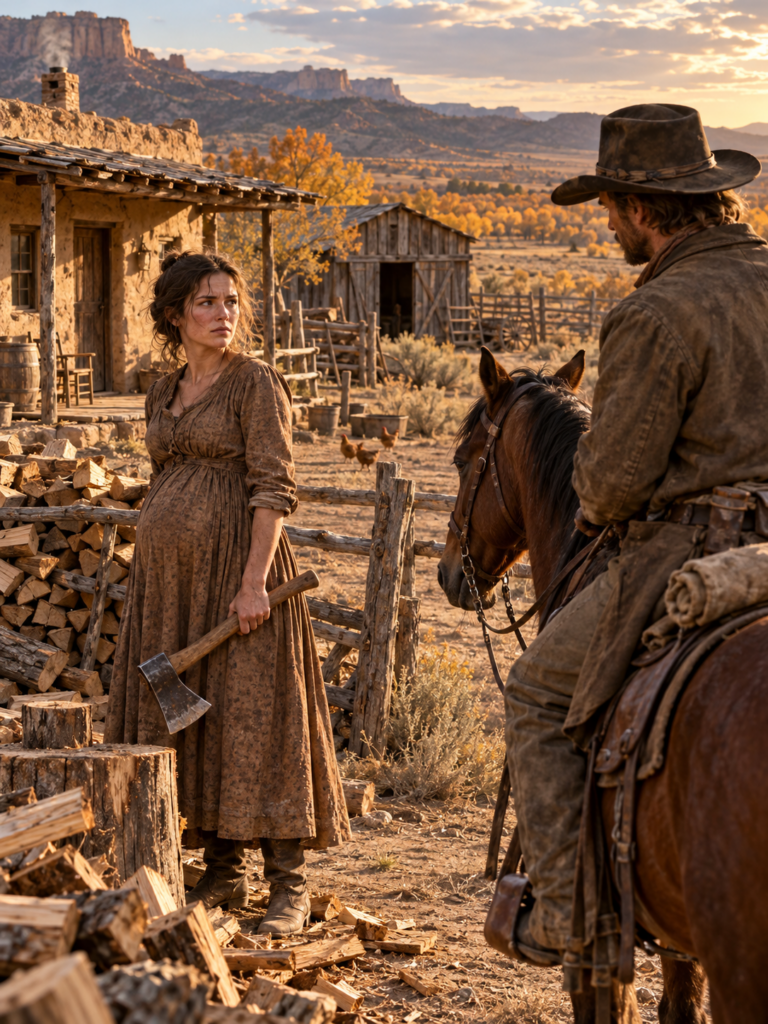
One evening, she found him beside the woodpile.
He was stacking the last of the split logs beneath the shed roof.
The same woodpile where they had first met.
The same ground where she had stood with an axe, terrified that her strength would fail before her child arrived.
Jonah straightened when he saw her.
“Emma asleep?”
“For now.”
“Good.”
Rebecca folded her hands.
“I’ve been thinking about our agreement.”
His expression changed.
“So have I.”
“The winter work is almost finished.”
“I know.”
“I owe you your remaining wages.”
“Your accounts are never wrong.”
She smiled faintly.
“Not often.”
He set down the log he was carrying.
“Rebecca, I need to tell you something.”
She waited.
“When I first rode up to this gate, I was looking for work. Nothing more.”
“I remember.”
“I’ve spent years moving from one place to another. I told myself that was freedom.”
He looked toward the cabin.
“But I’ve found something here I haven’t had in a very long time.”
“What?”
“A reason to stay.”
Rebecca’s breath caught.
Jonah continued carefully.
“I care for you. And I care for Emma. I don’t expect that to give me any claim over either of you.”
She watched his face.
“I know this land is yours. I know Thomas was your husband. I know you’ve barely had time to recover from losing him.”
He paused.
“I’d like to remain, if you’d have me. Not simply until the roads clear. But I won’t ask you to make a decision because you need help.”
Rebecca looked beyond him.
The low evening light touched the barn.
She remembered Thomas laughing over the cradle, teasing her about how badly he carved vines.
She remembered the river.
The funeral.
The long nights when she had wondered whether she was capable of raising their child alone.
Then she remembered Jonah sitting through the dust storm, frightened but steady, never pretending that he could guarantee what would happen.
And she remembered the way he had put the unfinished cradle within reach without ever trying to erase the hands that began it.
“I loved Thomas,” she said.
Jonah nodded.
“I know.”
“I still do.”
“I know that too.”
She took a slow breath.
“For weeks after he died, I thought making a new life meant leaving him behind.”
Jonah said nothing.
“But Emma will know who her father was. She’ll know what he built here. She’ll know why his name matters.”
“She should.”
Rebecca looked directly at him.
“And I think she can know all that while being loved by someone else too.”
Jonah’s eyes softened.
She stepped closer.
“I don’t want you to stay because you pity us.”
“I don’t.”
“Or because you think we need someone to take Thomas’s place.”
“I wouldn’t presume to.”
“Then stay because this is where you want to build a life.”
His voice was quiet.
“It is.”
Rebecca held out her hand.
He took it gently.
She looked down at their joined fingers.
“I want you to stay, Jonah.”
He drew a breath.
“Are you certain?”
“Yes.”
She smiled through sudden tears.
“And I want us to consider marriage. Not because you’ve earned me by helping. Not because Emma needs a name. But because I believe there is something between us worth choosing.”
Jonah’s expression changed with such naked emotion that she almost laughed.
“Rebecca…”
She squeezed his hand.
“I won’t rush toward a wedding simply because we’re afraid of losing another good thing. But neither will I pretend I haven’t come to love you.”
He stepped closer.
“May I hold you?”
She nodded.
He drew her into his arms.
The embrace was gentle.
No grand promise.
No claim of ownership.
Only two adults standing beside a winter woodpile, choosing not to hide what had grown between them.
The months ahead were not effortless.
Emma needed care.
The homestead required work.
There were accounts to balance, supplies to purchase, and days when Rebecca’s grief returned unexpectedly.
Jonah learned not to mistake those days for regret.
Rebecca learned that loving him did not require her to speak less often of Thomas.
They made their plans together.
Jonah would contribute labor and the money he had saved.
Rebecca would retain ownership of the homestead inherited through Thomas’s work.
Major decisions about the land would be made together, and Emma’s future would remain central to their plans.
When they married, it was a quiet ceremony attended by neighbors and Reverend Whitam.
Rebecca did not feel that she was beginning her life again from nothing.
She was carrying forward the life she had already lived.
Thomas remained part of her story.
Jonah became part of its future.
And Emma grew in a house where neither man’s kindness needed to diminish the other’s.
That spring, Jonah repaired the barn doors while Rebecca planned a larger kitchen garden.
She kept the accounts and managed their purchases.
He tended the heavier fieldwork and taught her better methods of mending harness.
She taught him how to record crop yields and determine whether a promised bargain was truly worth its price.
They laughed over their mistakes.
They disagreed.
They learned.
And gradually the little homestead began to reflect both of them.
The fence was stronger.
The roof no longer leaked.
The woodpile remained neatly covered through winter.
Inside, Emma’s cradle stood beside the hearth.
As the child grew, Rebecca sometimes ran her fingers along the carved vines.
One side had been shaped by Thomas Lang before his death.
The other by Jonah McCrae after he had ridden through the gate seeking a few weeks of honest work.
Their styles were different.
But together, they formed one continuous pattern.
Years later, when Emma was old enough to ask about it, Rebecca told her the truth.
“Your father Thomas began this cradle because he loved you before you were born.”
Emma touched the first section of carving.
“And who finished it?”
“Jonah did.”
The little girl studied the other side.
“Why?”
Rebecca smiled.
“Because he wanted you to have somewhere safe to sleep.”
Emma considered that.
Then she asked whether the vines were supposed to be different.
Rebecca ran her hand along the rail.
“Yes, sweetheart. They’re different because two different people made them.”
Emma looked pleased.
“I like both.”
Rebecca drew her close.
“So do I.”
From the doorway, Jonah listened without interrupting.
He had never asked Rebecca to erase her first husband’s memory.
And she had never asked Jonah to remain merely grateful for whatever affection she might spare him.
They had chosen one another freely.
That choice had become the foundation of their home.
Later that evening, Rebecca stepped outside.
The air was cool.
The sky above New Mexico stretched wide and clear.
Beyond the fence, the little hill where Thomas lay buried caught the last light of sunset.
Jonah joined her.
“Thinking about him?”
“Yes.”
They stood together quietly.
Then Rebecca rested her hand against Jonah’s arm.
“I used to pray that God would give Emma a roof that would still be hers when she arrived.”
Jonah looked toward the cabin.
“He did.”
She shook her head gently.
“That wasn’t all I needed.”
“What else?”
Rebecca watched the warm light shining through the window.
“A way to keep living beneath it.”
Inside, Emma called for them.
Jonah opened the door.
Rebecca went in first.
And the man who had once ridden past every gate rather than risk belonging somewhere followed her into the home he had freely chosen.
The finished cradle stood beside the hearth, its vines unbroken.
It was no longer a reminder of everything Rebecca had lost.
It was proof that love could honor what had ended while still making room for what came next.
And on those eighty acres, where grief had once seemed stronger than hope, a widow, a wandering handyman, and a child born in the middle of a storm had built something no forged paper could measure.
Not merely a house.
A home where the past was remembered, the present was shared, and the future belonged to those who lived there.


