
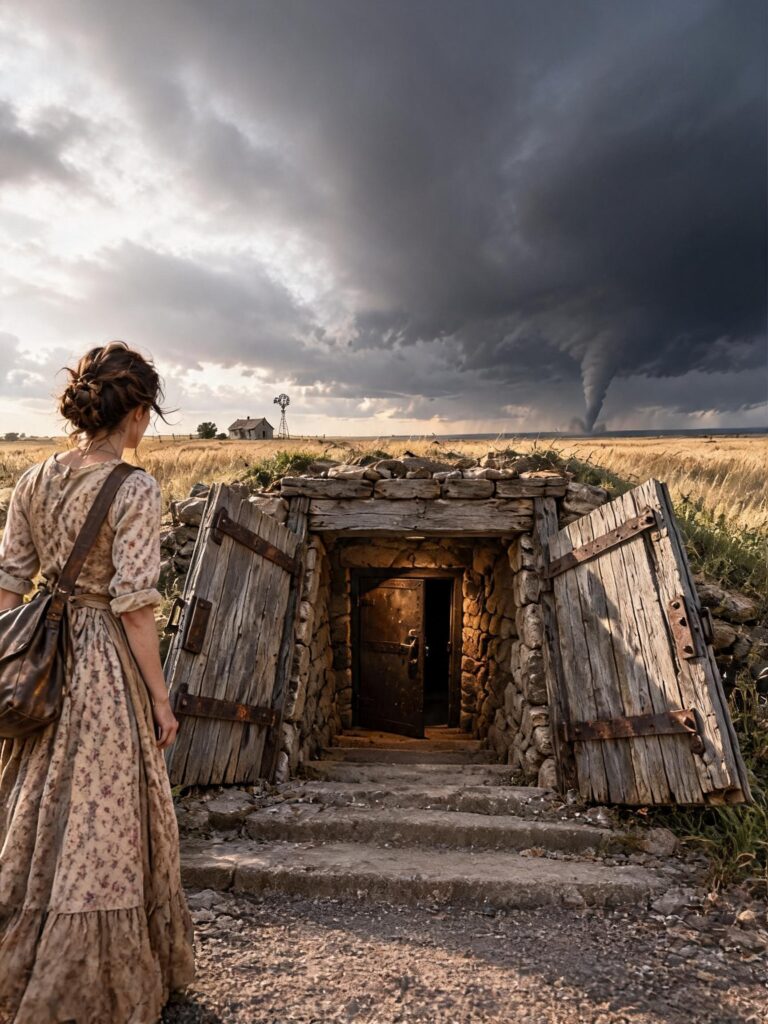
the 20-year-old girl was thrown off her family’s ranch with just $7.40—then a deadly tornado drove her into an abandoned storm cellar, where a hidden second door held the truth her mother’s enemies never wanted found
Part 1
The lawyer did not look ashamed when he told Emma Weaver she no longer had a home.
He merely straightened the papers on his polished desk, adjusted his spectacles, and explained that the north-bench ranch in Sage Basin now belonged to a man from Missouri named Alder Pike.
Emma sat across from him with her hands folded in her lap.
She was twenty years old, wearing a faded brown dress her mother had sewn three summers earlier. Her boots were cracked along the toes. Beneath her apron, hidden inside a carefully stitched hem, rested a small silver thimble.
It was the last thing her mother had given her.
“Surely there’s been some mistake,” Emma said.
The lawyer sighed.
“Miss Weaver, we’ve been through this. Your mother left no recognized will. Her ownership was never properly established in the county records presented to the court. And there is the matter of your parents’ marriage.”
“My parents were married.”
“Unfortunately, we have no legal record proving that.”
Emma looked at him.
“My mother never lied to me.”
“I’m not suggesting she did.”
“Then what are you suggesting?”
The lawyer looked down at his papers.
“I’m suggesting that the law requires proof.”
Outside his window, two men were loading flour sacks onto a freight wagon. A horse stamped its foot against the dusty street. Somewhere farther down the block, a woman laughed.
The world continued as if nothing important had happened.
Emma had been born in the little pine house on the north bench. Her mother, Hannah Weaver, had lived there before her. Hannah’s mother had raised children there, and her grandmother had helped dig the irrigation ditch that carried mountain water into the hay meadow.
Three generations of Weaver women had made that stubborn strip of land productive.
And now a stranger had arrived with documents, a lawyer, and a blood connection that the court considered more important than Emma’s entire life.
“You’ll have one week to remove your belongings,” the lawyer said.
Emma stared at the edge of his desk.
“What about my mother’s grave?”
He hesitated.
“The burial ground remains on the property.”
“I know where it is.”
“Mr. Pike may permit you to visit.”
Something tightened inside her chest.
Permit.
A stranger might permit her to visit the woman who had worked herself to death keeping that land alive.
Emma stood.
The lawyer pushed another paper toward her.
“This acknowledges that you’ve received notice of the judgment.”
She read it carefully. Hannah had taught her never to sign anything without reading every line.
Then she signed her name.
Not because she believed the ruling was fair.
Because she had no money to fight it.
When she stepped outside, the heat struck her face.
In the pocket of her apron were seven dollars and forty cents.
Everything else she owned fit inside a flour sack.
A folded wool blanket. A tin drinking cup. Half a loaf of bread. A wedge of cheese. A horn comb. A second apron. Two needles. Three matches.
And the silver thimble.
She had sewn it into her apron hem because she could not bear the thought of losing it.
Hannah Weaver had been a quiet woman.
She had never owned fine dresses or expensive jewelry. She had worked with hands roughened by winter water, sheep wool, fence wire, and the handles of farm tools.
Every evening, after supper, she had worn that thimble while mending clothes or sewing quilts for families in town.
Sometimes Emma had fallen asleep listening to the small, steady tapping of Hannah’s needle.
The sound had meant warmth.
Safety.
Home.
Now Hannah was buried beneath the pines, and Emma had nowhere to go.
She started north along the wagon road.
Eleven miles separated Sage Basin from the ranch.
Emma knew every bend.
She knew the dry creek crossing where spring floods sometimes washed out the wagon ruts. She knew the fence post struck by lightning when she was twelve. She knew where wild roses grew along the ditch in June.
She also knew the mountain weather.
By noon, something was wrong.
The wind had been blowing steadily out of the southwest, carrying hot air down from the ridges.
Then it stopped.
Not gradually.
All at once.
The grass stood motionless.
The meadowlarks fell silent.
Emma lifted her head.
Above the western hills, a wall of dark clouds had risen. Beneath it, the sky carried a sickly green color.
Her mother had shown her that color when she was nine.
“If you ever see the sky looking like that,” Hannah had told her, “don’t stand around admiring it. Get below ground.”
Emma searched the horizon.
The nearest occupied ranch was miles away.
The road offered no protection.
Far to the east, beneath the clouds, a dark shape descended toward the ground.
It twisted once.
Then again.
Emma’s stomach dropped.
A tornado.
She turned toward the abandoned Mercer property.
The old house had collapsed years earlier. The barn was little more than a stone foundation. But beyond the broken corral, half buried in the earth, stood a storm cellar.
Emma remembered it.
Jonas Mercer had shown her how to open its heavy door when she was a little girl.
He had been Hannah’s closest neighbor, a patient man with a square beard and hands that smelled of leather and cedar shavings.
He had once told Emma, “A storm cellar ain’t much to look at, but on the right day it’ll be worth more than the finest house in the county.”
That day had arrived.
Emma ran.
The flour sack slapped against her hip.
Loose gravel rolled beneath her boots.
Behind her, the wind returned with a sound like a distant freight train.
She reached the cellar and seized the iron ring set into its slanting wooden door.
She pulled.
Nothing happened.
The wood had swollen in its frame.
Emma bent her knees, worked her fingers beneath the upper edge, and lifted with everything she had.
The door rose two inches.
Then stopped.
A low roar rolled across the pasture.
“Come on,” she whispered.
She pushed again.
The door lifted enough for her to reach the wooden prop Jonas had once shown her.
She wedged it beneath the frame, grabbed her sack, and squeezed through.
Three worn steps led down into darkness.
Emma stumbled onto the packed-earth floor and pulled the prop free.
The heavy door slammed shut overhead.
The world disappeared.
For several seconds, she heard nothing but her own breathing.
Then the tornado reached the pasture.
The ground trembled.
The wooden door thudded against its frame.
Something large struck the earth above her.
Emma crouched against the wall and covered her head.
She had no family waiting for her.
No husband.
No home the law recognized.
No one who even knew where she had gone.
And as the roar grew louder, she understood that she might die beneath the earth without anyone knowing where to look.
She pressed her hand against the silver thimble hidden in her apron.
“I’m trying, Mama,” she whispered.
The storm answered with another terrible roar.
And then, as suddenly as it had come, the sound began to move away.
Emma remained crouched for a long time.
When she finally stood, a thin line of daylight crept through the edge of the cellar door.
Her eyes adjusted slowly.
There were old shelves along the walls, a broken potato bin, several empty jars, and dust thick enough to show the tracks of mice.
But something on the floor caught her attention.
Three heavy wooden planks lay crookedly across the center of the room.
Emma looked at the ceiling.
Nothing had fallen.
The boards above were intact.
She looked back at the floor.
Those planks had not fallen.
Someone had placed them there.
And beneath the nearest one, barely visible in the dim light, was the curved edge of an iron ring.
Emma knelt.
She brushed away the dirt.
Then she whispered the words that would change everything.
“That’s another door.”
Part 2
Emma did not open the hidden door immediately.
Her mother had taught her that curiosity could be useful, but carelessness could kill a person just as easily as bad weather.
She examined the floor first.
The three loose planks were unusually heavy, made from good pine rather than the rough scrap wood used for the cellar shelves.
Their edges had once fitted together neatly.
Someone had deliberately separated them.
Emma lifted the first plank and leaned it against the wall.
Then the second.
Beneath them lay a square wooden hatch fitted almost perfectly into the clay floor.
An iron ring rested in a shallow groove.
There was no lock.
No visible marking.
Only careful workmanship.
Emma ran her fingers around the edges.
The hatch was far older than the dust covering it.
She wondered whether Jonas Mercer had built it.
But Jonas had been dead for years, and Emma had never heard him mention a hidden room.
Outside, the storm still moved across the valley.
She could hear occasional gusts striking the cellar door.
Emma considered leaving the hatch alone.
The Mercer property belonged to someone else now. Its last owner had sold it to a railroad investor who seldom visited the basin.
Emma had been raised to respect another person’s property.
Yet something about the hatch troubled her.
Why construct a second room beneath a storm cellar?
Why conceal the entrance?
And why leave three planks lying across it as if someone expected the floor to be examined?
She gripped the iron ring.
The hatch resisted.
She shifted her weight, braced her boots, and pulled again.
With a low wooden groan, it opened.
A square opening appeared beneath her.
Three cedar-faced steps descended into another room.
Emma leaned closer.
The air rising from below was unexpectedly sweet.
Cedar.
Beeswax.
Old paper.
And lavender.
Her breath caught.
Her mother’s cedar chest had smelled exactly like that.
For a moment, memory overwhelmed her.
She saw Hannah sitting beside the stove on a winter evening, folding freshly washed quilts into the chest at the foot of her bed.
She heard her mother’s voice.
“Things worth keeping deserve to be kept properly.”
Emma closed her eyes.
Then she stood and searched the upper cellar for light.
On a dusty shelf she found a candle stub resting in a tin saucer. Beside it sat a little bottle holding a small amount of lamp oil.
She took the three matches from her apron.
She hesitated before striking one.
Three matches were not many.
But she needed to see what was below.
The first match caught.
She lit the candle.
Its small flame illuminated the clay walls.
Emma carried it to the open hatch and carefully descended.
The hidden chamber was no larger than a storage room.
Yet it had been built with extraordinary care.
Smooth cedar planks lined the walls and floor. The seams were sealed with dark pitch. There were no water stains, no signs of rodents, and no musty smell.
Against the far wall stood a cedar chest reinforced with iron bands.
On top rested a faded red tin box, a tiny glass bottle sealed with wax, and an oilcloth packet tied with blue ribbon.
Above the chest, a single sheet of paper had been pinned to the wall.
Emma lifted her candle.
The first words were written in a familiar hand.
For whoever comes.
She stared.
The particular slope of the letters.
The narrow spaces between words.
The distinctive way the writer formed the capital F.
Emma knew that handwriting.
She had spent ten winters copying it from ranch ledgers.
Her candle trembled.
“Mama?”
No one answered.
She stepped closer and read the first lines.
If you have found this room, then I am gone.
Emma’s knees weakened.
If you are my daughter Emma, read on and know that what you were told above the ground is not the whole truth.
She pressed a hand against the wall.
Her mother’s handwriting.
Her mother’s words.
Written in a room Emma had never known existed.
She continued reading.
Hannah explained that the money in the red tin box was intended for travel, meals, and courthouse expenses.
The papers in the chest concerned the ranch.
And the land records, Hannah wrote, had been properly filed.
A second copy existed at the territorial seat.
Emma reread that sentence.
Then she read it again.
Her heart began beating so hard that she could feel it in her throat.
The lawyer had told her the family’s ownership was invalid.
But her mother had written that the necessary proof existed.
Why had Hannah hidden it?
Why had she never explained?
Emma turned toward the cedar chest.
The iron hasp was secured with a carved wooden peg.
The peg looked familiar.
Jonas Mercer had always made pegs in that particular shape, tapering the sides while leaving the rounded head easy to grip.
Emma withdrew it.
The lid opened smoothly.
Inside lay carefully arranged books and documents.
There was a thick green journal.
A smaller brown notebook.
A leather wallet.
Several bundles of letters.
And a large folded paper bearing a single word in Hannah’s handwriting.
Land.
Emma carried the journal and land paper upstairs, where the candlelight seemed stronger.
She sat against the clay wall and opened the journal.
The first pages contained ordinary entries.
The birth of a lamb.
The repair of a fence.
The price of salt.
The number of quilts sold before Christmas.
Then came entries about Emma.
The day she took her first steps.
The winter she nearly died of fever.
The afternoon she cut her hand on shearing blades and insisted on finishing her work.
Emma smiled through the ache gathering in her chest.
Hannah had recorded things Emma herself had forgotten.
Then she found an entry concerning her father.
Thomas Weaver.
Emma had never known him.
He had died in a logging accident at Cutter Ridge three months before she was born.
Hannah had spoken of him sometimes, usually while washing dishes or working beside the stove.
“He had your eyes,” she would say.
Or, “Your father could repair a wagon wheel faster than any man I ever saw.”
But she had rarely spoken about their wedding.
Emma had assumed grief made the subject painful.
Now, in the green journal, she found a detailed account.
Hannah and Thomas had married in a Methodist chapel in the railroad town.
Reverend Hollis had performed the ceremony.
Jonas Mercer had served as one witness.
A woman named Mrs. Pedigrew had served as the other.
And the marriage had been entered in the chapel register.
Emma stopped reading.
The lawyer’s words returned.
We have no legal record proving your parents were married.
But there had been a record.
Her mother had named the witnesses.
She had described the register.
She had even written down the month and the preacher’s name.
Emma opened the paper marked Land.
It bore the seal of the territorial land office.
The document recorded the original family land claim, the subsequent patents, and the transfer of ownership to Hannah Weaver when Emma was two years old.
The official seal was pressed into the paper.
A clerk’s signature appeared at the bottom.
Emma sat perfectly still.
She remembered walking away from the lawyer’s office.
She remembered the humiliation of signing a paper acknowledging that she would not contest the judgment.
She remembered imagining Alder Pike standing in her mother’s kitchen, opening her cupboards, and moving the furniture as if generations of work could be transferred by the stroke of a pen.
Now she understood something terrible.
The court had made its ruling without documents that might have changed everything.
And somewhere, hidden among the county’s records, another copy might already exist.
But finding a document was not the same as winning a legal fight.
She was twenty.
She had almost no money.
The man occupying her ranch had a lawyer.
And the county had already issued a judgment against her.
For the first time since entering the cellar, Emma felt afraid in a different way.
The tornado had threatened her life.
What lay inside the cedar room threatened to reopen every wound she had tried to survive.
If the documents failed, she would lose her home a second time.
This time knowing she had almost recovered it.
She leaned her head against the wall.
“I don’t know how to do this, Mama.”
Her mother’s answer existed only in memory.
Do the next thing, Emma. Don’t carry tomorrow before you’ve finished today.
Emma looked toward the hidden room.
There were more papers below.
More answers.
She rose and carried the candle downstairs.
Inside the red tin box, she found two gold coins and a collection of silver dollars.
Not a fortune.
But enough to reach the courthouse.
She opened the oilcloth packet.
There were letters written to Hannah by Thomas Weaver.
And a small photograph.
Emma lifted it toward the flame.
A young man looked back at her.
He wore a canvas coat and a neatly trimmed mustache. His eyes were dark. His jaw was long and narrow.
She touched her own face.
For twenty years, she had wondered what her father looked like.
Now she knew.
Tucked beneath the photograph lay her parents’ marriage certificate.
Reverend Hollis’s signature appeared at the bottom.
So did Jonas Mercer’s.
Emma held the paper with both hands.
She had entered the cellar to escape death.
Now she was holding proof of a life she had been told never legally existed.
Above her, the last of the storm moved east.
Emma placed the certificate back inside its protective wrapping.
She gathered the land record, journal, and money.
Before closing the chest, she looked at the sealed glass bottle.
A tiny folded paper remained inside.
She did not break its wax seal.
There would be time to understand everything her mother had left.
But first, she needed to protect the proof.
And she needed to return to Sage Basin.
Part 3
The land outside the cellar looked wounded.
Grass lay flattened in long strips. Broken limbs littered the pasture. A heavy cottonwood branch had crashed across the ruined Mercer corral.
Farther east, a barn roof had disappeared entirely.
Emma stood beneath the pale afternoon sky with her flour sack over one shoulder.
The tornado had passed close enough to destroy lives.
Yet the abandoned cellar had remained standing.
She looked back at its heavy door.
Jonas Mercer had once told her that a good shelter was built for the person who might need it, not merely for the person who owned it.
She understood his words differently now.
She closed the cellar, leaving the hidden chamber concealed.
Then she turned south.
Her boots were sore.
Her legs trembled from running.
She had eaten nothing since morning.
But she walked toward town with something she had not possessed when she left it.
Evidence.
By the time she reached Sage Basin, the sun was sinking behind the mountains.
The boardinghouse above the feed store charged twenty-five cents for a bed and a simple supper.
Emma counted the money carefully before paying.
The woman who ran the place, Mrs. Larkin, looked at the dust covering Emma’s dress.
“Were you caught in that storm?”
“Yes, ma’am.”
“Good Lord. Where did you shelter?”
“An old cellar north of the dry creek.”
Mrs. Larkin shook her head.
“We heard the Henshaw barn lost its roof. Somebody said a wagon overturned on the east road.”
Emma accepted a bowl of stew and sat beside the window.
She wanted to tell the woman about the cedar room.
She wanted to unfold the papers and ask whether this meant she could go home.
Instead, she ate slowly.
Hannah had taught her that important business was best approached with food in the stomach and a clear head.
That night Emma barely slept.
Every sound on the street startled her.
She imagined the documents being dismissed.
She imagined Alder Pike claiming they were forged.
She imagined the lawyer smiling politely while explaining another technicality she did not understand.
At dawn, she washed her face, combed her hair, and folded the land paper inside her apron.
Then she walked to the recorder’s office.
Ross Drier had kept the county books for nineteen years.
He was a thin man with gray sleeves protected by black cloth guards and an inkwell permanently staining one fingertip.
He looked up when Emma entered.
“Can I help you?”
“Mr. Drier, I need you to examine a land record.”
He recognized her after a moment.
“Miss Weaver.”
“Yes, sir.”
His expression softened.
“I’m sorry about your mother. And about the trouble with the ranch.”
Emma placed the document on his counter.
“I’d like you to tell me whether this is genuine.”
He unfolded it.
His eyes moved across the printed headings.
Then stopped at the seal.
“Where did you find this?”
“In a place my mother kept safe.”
He studied the clerk’s signature.
“Would you mind waiting?”
He crossed the room and opened a long drawer in an oak cabinet.
Emma watched him search through the files.
He withdrew a brown folder.
Returned to the counter.
Opened it.
And placed another document beside the one she had brought.
For several minutes, neither spoke.
Finally Ross looked up.
“These match.”
Emma gripped the edge of the counter.
“Exactly?”
“Line for line.”
He compared the signatures again.
“This transfer was recorded years ago.”
“Then why did the court say my mother never held proper title?”
Ross looked uncomfortable.
“The records presented during the probate matter apparently did not include this file.”
“Why?”
“I don’t know.”
“Wasn’t anyone supposed to look?”
His silence lasted long enough to answer.
Emma swallowed.
“My mother worked that land for twenty years.”
“I know.”
“She paid taxes.”
“Yes.”
“She buried her parents there.”
Ross lowered his eyes.
“I know that too.”
Emma looked down at the documents.
“I signed a paper because a lawyer told me there was nothing I could do.”
Ross removed his spectacles.
“Miss Weaver, I cannot undo what happened this morning. But I can make sure these documents are examined properly.”
He explained that he would request a certified copy from the territorial office and seek a halt to further transfers while the court reviewed the newly produced evidence.
It might take days.
Possibly longer.
And she still needed to establish her parents’ marriage.
Emma listened carefully and wrote down everything he said.
When he finished, she asked, “What will it cost?”
“One dollar and twenty cents for the initial filings.”
She paid without arguing.
The money was precious, but Hannah had left it for exactly this purpose.
Ross gave her a receipt.
“You’ll want to visit the Methodist chapel in Railroad Town. If the marriage was entered there, the register may still exist.”
Emma folded the receipt.
“Thank you.”
At the door, Ross called after her.
“Miss Weaver?”
She turned.
“Someone should have found this record before that judgment was entered.”
Emma looked at him for a moment.
“Yes, sir,” she said. “Someone should have.”
She left before anger could make her say more.
The mail wagon to Railroad Town departed at ten.
Emma paid fifteen cents and climbed onto the bench behind the driver.
A crate of chickens rattled beneath her feet.
Beside her sat a woman who spent most of the journey describing her daughter’s new house in Cheyenne.
Emma answered politely when necessary.
But her thoughts were elsewhere.
She pictured Hannah riding this road years earlier.
Had her mother carried the same papers?
Had Jonas Mercer accompanied her?
Had she known there might one day be trouble?
The little Methodist chapel stood two streets from the railroad depot.
Its white paint was peeling around the windows.
A bell hung in a narrow wooden tower.
Inside, the air smelled of old hymnals and furniture polish.
Emma found Mrs. Pedigrew in a room behind the pulpit.
The elderly woman wore a black dress and a white collar. Her hair was pinned tightly beneath a lace cap.
Emma introduced herself.
Mrs. Pedigrew stared at her.
“Thomas Weaver’s girl?”
Emma felt her throat tighten.
“Yes, ma’am.”
The older woman approached slowly.
“Well, mercy. You have your father’s eyes.”
Emma could not speak.
Mrs. Pedigrew touched her sleeve.
“I remember the day your parents married.”
“You do?”
“As clearly as I remember yesterday.”
She led Emma to an oak cupboard.
From an upper shelf, she removed a heavy leather-bound register.
“Your father was nervous,” she said as she turned the pages. “Kept smoothing his coat. Your mother told him if he ruined the buttons she’d make him sew them back himself.”
Emma smiled.
“That sounds like Mama.”
“Oh, she was a practical girl.”
Mrs. Pedigrew stopped at a page.
“Here.”
Emma leaned over the book.
There were the names.
Thomas Weaver.
Hannah Weaver.
The date.
Reverend Hollis.
Jonas Mercer.
Mrs. Pedigrew herself.
The marriage had been recorded.
The proof had existed all along.
Emma touched the edge of the page.
“Why didn’t anyone know?”
Mrs. Pedigrew looked troubled.
“I can’t tell you why the court never asked this chapel for its records.”
She paused.
“But I can tell you I watched your parents make those promises.”
Emma looked at the faded ink.
“Did they seem happy?”
Mrs. Pedigrew smiled gently.
“Child, your father looked at your mother as if the sun had decided to rise just for him.”
Emma blinked quickly.
The older woman brought a chair.
“Sit down.”
Emma obeyed.
For a moment, she could not stop her hands from trembling.
Mrs. Pedigrew placed her own thin fingers over them.
“You’ve had a hard time, haven’t you?”
Emma nodded.
“I thought there was nobody left who could tell me about them.”
“Well,” the woman said, “you’ve found one.”
Mrs. Pedigrew prepared a certified transcription of the marriage entry.
She pressed the chapel seal into the wax and handed the folded paper to Emma.
Then she insisted Emma stay for tea before catching the return wagon.
They sat together in the quiet little room.
Mrs. Pedigrew told her about Thomas bringing wildflowers to Hannah, about Jonas teasing him over his wedding coat, and about the sudden rainstorm that had followed the ceremony.
Emma listened to every word.
For the first time in months, her parents seemed less like names on grave markers.
They were young people again.
People who had laughed.
Made promises.
Dreamed of a future.
People whose love had been real long before any court questioned it.
When Emma returned to Sage Basin, she carried the chapel transcription inside her dress.
That evening, she went to the boardinghouse window and watched the mountains darken.
She had not won anything yet.
The ranch remained occupied.
The judge had not reversed his ruling.
But she had found people who remembered.
Records that existed.
And evidence that could be checked without asking anyone simply to believe her.
She touched the thimble in her apron.
“I’m getting closer, Mama.”
Outside, the first stars appeared over Sage Basin.
Part 4
The following morning, Emma returned to Ross Drier’s office.
He examined the chapel transcription beneath the window.
Then he opened Hannah’s land record beside it.
For several minutes, the only sounds were the scratching of a pen in the next room and the distant rattling of freight wagons.
Ross looked up.
“These documents are powerful evidence, Miss Weaver.”
Emma waited.
“Does that mean I can go home?”
“Not yet. We still have to correct the court record.”
Her hope faltered.
He spoke more gently.
“I don’t intend to give you a promise the law hasn’t fulfilled. But your mother’s recorded ownership and your parents’ documented marriage leave the previous judgment on very uncertain ground.”
“Will Mr. Pike fight it?”
“He has the right.”
“And if he does?”
“Then the court will need to hear the evidence.”
Emma looked at the land record.
“How much would that cost?”
Ross hesitated.
She understood.
More than she could comfortably afford.
Perhaps more than Hannah’s little tin box contained.
Emma went back to the boardinghouse and laid everything across her rented bed.
Her blanket.
Her tin cup.
Her remaining food.
The green journal.
The documents.
The small red box.
She counted the money.
For a while, she simply sat there.
She remembered her mother’s hands cracked from cold weather.
She remembered lambs dying during a late frost despite every effort to save them.
She remembered selling the family’s sorrel mare, Juniper, to pay the doctor during Hannah’s final illness.
The mare had been raised on that land.
Emma had watched the buyer lead her away while Hannah lay feverish in the back room.
She had told herself the sacrifice was necessary.
Now she wondered how much more she might be asked to give.
A knock sounded at the door.
Mrs. Larkin stood in the hallway.
“There’s a gentleman downstairs asking for you.”
Emma’s stomach tightened.
“A lawyer?”
“No. Says his name’s August Henshaw.”
Emma followed her downstairs.
August was a lean rancher in his forties with sun-darkened skin and a hat worn white along the brim.
She recognized him from livestock sales.
“Miss Weaver.”
“Mr. Henshaw.”
He shifted his hat between his hands.
“Heard you might be getting the north-bench place back.”
“We’re trying.”
He nodded.
“My roof went east in the tornado. Lost half a haystack too.”
“I’m sorry.”
“Could’ve been worse.”
He examined the floor for a moment.
“Your mother sat with my wife three nights when she was sick years back. Doctor couldn’t get through because the creek was flooded. Hannah stayed until the fever broke.”
Emma remembered.
Her mother had returned home exhausted, with swollen feet and mud nearly to her knees.
“She never charged us a cent,” August continued.
Emma said nothing.
“So when you need a wagon to carry your belongings home, you send word. Mine’s yours for the day.”
He put on his hat.
“You don’t owe me anything.”
Before Emma could answer, he left.
She stood by the boardinghouse door watching him walk away.
The next morning, Edith Barlo arrived.
Edith was sixty-two and kept bees west of town.
She had gone to school with Hannah.
She brought warm bread and a jar of dark honey.
“I heard you’ve been staying up here alone,” she said.
Emma accepted the parcel.
“That was kind of you.”
Edith waved away the thanks.
“Your mother helped me when I had nothing but three hives and a roof that leaked. She taught me how to keep accounts so I wouldn’t get cheated at market.”
She looked closely at Emma.
“You’ve got her stubborn chin.”
Emma almost laughed.
“She used to say I got that from my father.”
“Well, he had it too.”
Edith kissed Emma’s forehead.
“When you’re home, I’ll bring you a hen. I’ve got one that needs a quieter yard.”
Home.
People were beginning to say the word as if it might belong to Emma again.
Yet the official answer had not arrived.
Days passed.
The territorial certification was pending.
A registered notice was prepared for Alder Pike.
The uncertainty exhausted her more than the eleven-mile walks had.
Every morning, Emma went to the recorder’s office.
Every afternoon, she returned to the boardinghouse with nothing settled.
She began mending clothes for Mrs. Larkin in exchange for a reduced room charge.
The work gave her hands something to do.
She sewed buttons onto shirts.
Repaired torn apron strings.
Patched a child’s trousers.
Each evening she wore Hannah’s silver thimble, carefully taking it from the apron hem before beginning.
It felt strange to have the thimble on her own finger.
Hannah had used it for so many years that Emma almost expected to see her mother’s hand moving instead.
One afternoon, while Emma was repairing a coat sleeve, a young messenger appeared.
He carried an envelope from the lawyer who had handled the inheritance case.
Emma opened it.
The letter stated that Alder Pike’s attorney questioned the late production of the documents and reserved the right to challenge their authenticity.
There was no outright accusation.
No direct threat.
Only careful legal language.
But Emma understood its meaning.
The fight might continue.
She sat with the letter in her lap for a long time.
At supper, Mrs. Larkin noticed she had barely touched her food.
“Bad news?”
“Not exactly.”
“That sounds worse than bad news.”
Emma tried to smile.
She explained the letter.
Mrs. Larkin listened.
“Are the papers genuine?”
“Yes.”
“Can the clerk prove it?”
“He says he can.”
“Then you’ve done what you can today.”
Emma lowered her eyes.
“I wish that were enough.”
The older woman pulled out a chair.
“My husband died owing money on this building. For three years I thought the bank would take it. Every letter they sent made my hands shake.”
“What happened?”
“I worked. I argued when I had to. I asked for help when I couldn’t manage alone.”
She glanced around the dining room.
“And I’m still here.”
Emma looked at the worn tables and clean curtains.
Mrs. Larkin covered Emma’s hand.
“Don’t let their letters take your sleep before they’ve taken anything else.”
That night Emma opened Hannah’s green journal again.
Near the middle she found an entry about a winter storm when the sheep had become trapped beyond the north fence.
Hannah had written that she and Jonas Mercer spent half the night digging a path through drifts.
Several lambs survived only because they carried them beneath their coats.
At the bottom of the page was a sentence Emma had not noticed before.
The work is ours. The outcome belongs to the morning.
Emma read it several times.
Then she closed the book and slept.
The next day, Reverend Dalton visited the boardinghouse.
He had heard from Mrs. Pedigrew.
He offered the chapel’s records and testimony should any hearing require them.
Then Cord and Isaac Fen arrived.
The brothers raised sheep along the upper creek.
They had purchased several of Hannah’s animals during the forced sale after the court ruling.
Cord spoke first.
“Twenty of your mother’s ewes are still with us.”
Emma straightened.
“You kept them?”
“Bought them fair at the sale,” Isaac said. “Didn’t feel right about the whole business.”
Cord removed his hat.
“When you get that pasture back, we’ll bring them home. You can pay what we paid, after the first wool clip.”
Emma looked from one brother to the other.
“I can’t promise when I’ll have the money.”
“We aren’t asking when,” Cord said.
They left without making a ceremony of it.
Afterward, Emma sat alone beside the boardinghouse window.
For so long she had believed she was the only person who remembered what Hannah had done.
Now kindness arrived in small, practical forms.
A wagon.
A loaf of bread.
A jar of honey.
A chapel record.
A promise to return old sheep.
None of these people could guarantee the court would change its ruling.
But they were reminding Emma that she had not been forgotten.
The greatest question still remained.
Would the documents be accepted?
Or would the same system that had taken her home find another reason to keep it from her?
Late one afternoon, Ross Drier came to the boardinghouse carrying a sealed envelope.
Emma recognized the territorial markings immediately.
He removed his hat.
“Miss Weaver, we need to talk.”
Her hands grew cold.
“Is it about the ranch?”
“Yes.”
He placed the envelope on the table.
“And this time,” he said, “I have an answer.”
Part 5
Emma stared at the envelope.
Ross Drier broke the seal and withdrew the certified land record.
The territorial clerk had verified Hannah Weaver’s ownership.
The marriage documentation had been examined.
The court had reviewed the new evidence.
And the earlier ruling could no longer stand.
Ross laid the papers in front of her.
“The ownership claim made by Mr. Pike has been set aside.”
Emma barely breathed.
“What does that mean?”
“It means the ranch belongs to you, Miss Weaver.”
She looked at him.
“Legally?”
He nodded.
“Legally.”
For several seconds she did not move.
Then she asked the question she had carried inside herself since leaving the lawyer’s office.
“Can anybody tell me I don’t belong there anymore?”
Ross’s face softened.
“Not on the basis of the claim that took it from you.”
Emma looked down at the paper.
She had imagined this moment a hundred different ways.
She had imagined shouting.
Crying.
Running into the street.
Instead, she sat quietly, tracing the edge of the official seal with one fingertip.
“My mother knew,” she whispered.
Ross waited.
“She knew there might be trouble someday. She kept the papers safe.”
“Yes,” he said. “She did.”
Alder Pike received formal notice.
He could have continued contesting the matter, but the recorded transfer, marriage evidence, and certified copies left little basis for his original claim.
He departed Sage Basin with his trunk and valise.
He never met Emma face to face.
The lawyer who had told her she had no family and no claim sent an apology through a messenger.
He described the failure as an oversight involving documents not considered in the earlier proceeding.
Emma read the note once.
Then folded it.
She did not answer.
There was nothing he could say that would restore the nights she had spent wondering whether she had lost everything.
And there was no need to spend the rest of her life pursuing his shame.
Her mother had taught her better uses for a person’s strength.
On the tenth day after the tornado, August Henshaw arrived with his wagon and two bay horses.
Emma packed her belongings into a small wooden crate.
The flour sack.
The green journal.
The land record.
The chapel transcription.
The red tin box.
And the silver thimble, once again wrapped in blue flannel.
August lifted the crate onto the wagon.
“Ready?”
Emma looked at the boardinghouse.
Mrs. Larkin stood in the doorway.
Edith Barlo had come to see her off.
Ross Drier stood near the feed store, holding his hat.
Emma’s throat tightened.
“Thank you,” she said.
Mrs. Larkin smiled.
“Go take care of that house.”
Emma climbed onto the wagon.
August clicked his tongue to the horses.
They started north.
The journey took them past the same dry creek and the same long rise Emma had crossed on foot.
The storm had left broken branches along the road, but the grass was already lifting again.
At the old Mercer pasture, Emma turned her head.
She could see the low earth mound of the storm cellar beyond the ruined corral.
The hidden door remained beneath three crooked planks.
For a moment she imagined Hannah working there with Jonas Mercer.
She pictured the cedar chest being carried down the narrow steps, the papers arranged carefully, and the little message pinned to the wall.
For whoever comes.
Perhaps Hannah had feared fire.
Perhaps she had feared a dishonest claimant.
Perhaps she had merely wanted the essential records stored somewhere protected from weather and theft.
Emma would never know every reason.
But she knew the work had been done with care.
And that care had outlived the woman who performed it.
The wagon climbed toward the north bench.
Then the house came into view.
Emma’s breath caught.
The little pine building stood against the trees exactly where it always had.
The porch sagged slightly at one corner.
The barn doors were weathered.
The irrigation ditch still carried cold mountain water across the meadow.
Beyond the house, beneath the pines, stood the family’s grave markers.
Emma gripped the side of the wagon.
August slowed the horses.
“You all right?”
She nodded.
“I just wanted to look.”
He let the horses stand.
Emma watched sunlight move across the roof.
That house had held her first breath.
Her childhood illnesses.
Her mother’s laughter.
Her father’s photograph, though she had not known it.
Twenty winters of meals, work, songs, and prayer.
For weeks, she had been told she had no right to any of it.
Now she was going home.
August drove up beside the barn and helped her down.
He carried the crate to the porch.
“I’ll bring some split pine tomorrow,” he said. “Ned can help stack it.”
“You’ve already done enough.”
He shook his head.
“Your mother did plenty for us. This isn’t something we’re keeping score on.”
He climbed back onto the wagon.
Emma watched him drive away.
Then she approached the front door.
The old iron latch felt familiar beneath her thumb.
It lifted with a small click.
Inside, the rooms smelled stale.
The kitchen table had been moved away from the mark its legs had worn into the floorboards.
A brown earthenware jug was missing from the windowsill.
Someone had smoked a pipe near the stove.
But Hannah’s ranch ledger still stood on its shelf.
Emma opened the windows.
She moved the table back into place.
Then she carried her mother’s papers to the oak box beneath the bed.
She stood for a long time in the small back bedroom where she had been born.
The blanket she had left behind remained folded on the chair.
Her comb lay beside it.
Even her second apron had not been disturbed.
Emma picked up the blanket and pressed it against her face.
It smelled faintly of cedar and soap.
For the first time since her mother’s death, she cried without trying to stop herself.
Not loudly.
There was nobody to hear.
She simply sat on the edge of the bed and let the grief come.
She cried for Hannah.
For Thomas, whose face she had finally seen.
For the mare sold to pay the doctor.
For the twenty months she had lived without her mother.
And for the frightened girl who had walked away from the lawyer’s office believing that the world contained no place for her.
When the tears passed, Emma washed her face.
Then she went to work.
She drew water from the ditch.
Heated it on the stove.
Scrubbed the kitchen floor.
Washed the windows.
Beat the dust from the braided rug.
Cleaned the bedroom where Alder Pike had slept.
And swept the porch until the boards showed their old pale grain.
She did not do these things because the house was dirty.
She did them because it was hers to care for again.
That evening, she took Hannah’s silver thimble from its blue flannel.
For twenty months, Emma had kept it hidden.
Now she slipped it onto the second finger of her right hand.
It fit.
She sat at the kitchen table and opened the ranch ledger.
On a clean page, she wrote:
Emma Weaver, returned to the north bench. House sound. Ditch running. Stove drawing. Pines still standing.
She read the words once.
Then closed the book.
The next morning, August returned with his son Ned and a wagonload of firewood.
They stacked it beneath the eaves.
Afterward, August walked the fence line with Emma.
Several posts needed replacing.
A stretch of wire had been poorly repaired.
The lambing shed door hung slightly crooked.
Emma made a list.
August glanced at it.
“That’s a fair amount of work for one person.”
“Yes, sir.”
“You want Ned for a day or two, send word.”
“I will.”
He nodded.
He understood that Emma would ask for help when she needed it.
Four days later, Edith Barlo arrived with a hen in a wooden crate.
“She needs somewhere quieter,” Edith explained.
The hen was speckled gray and looked thoroughly displeased with the journey.
Emma laughed as she carried the crate behind the lambing shed.
She repaired the chicken wire using old baling wire from the Mercer cellar.
That evening, the hen laid a brown egg.
Emma entered it in the ledger.
The following morning, she ate the egg with bread and a spoonful of Edith’s honey.
It was the first breakfast in months that felt like the beginning of an ordinary day.
Then the Fen brothers arrived.
Twenty sheep came slowly up the wagon road, followed by two dogs.
Some of the ewes were old.
A few were thin.
But Emma recognized them by their ear marks.
She remembered their mothers.
She remembered lambing nights when Hannah had stayed awake beside them.
Emma opened the pasture gate.
The sheep moved through.
One old ewe stopped, raised her head, and looked toward the house.
Then she lowered her nose to the grass.
Cord Fen watched her.
“They know this place.”
Emma nodded.
“Yes,” she said. “They do.”
The brothers accepted cups of water and left without asking for immediate payment.
Emma stood at the gate until the last sheep disappeared into the tall summer grass.
That night she recorded all twenty animals in the ledger.
The next week, Mrs. Pedigrew came to visit.
She brought the original chapel register, borrowed with permission so Emma could see her parents’ names in the old book.
They sat at Hannah’s kitchen table.
Mrs. Pedigrew turned the pages carefully.
When she reached the marriage entry, she placed the book before Emma.
Emma read her father’s signature.
Then her mother’s.
Then Jonas Mercer’s.
She rested her fingertips beside the writing.
Three people who had stood together on a wedding day long before Emma existed.
Three people who had believed that the promises made in that little chapel mattered.
Emma closed the book.
“Thank you for keeping it.”
Mrs. Pedigrew smiled.
“That’s what records are for, child. So the truth doesn’t disappear when the people who remember it are gone.”
They drank tea and spoke about Hannah’s quilts, the price of wool, and the changing weather.
Before leaving, Mrs. Pedigrew stood on the porch and looked toward the pines.
“Your mother would be pleased.”
Emma watched the trees moving in the wind.
“I hope so.”
“She always believed you could manage this place.”
Emma looked toward the sheep.
“I’ll have to learn some things she never got around to teaching me.”
Mrs. Pedigrew touched her arm.
“That’s how families continue.”
By August, the ranch had begun to live again.
The ditch was cleared.
The worst fence posts had been replaced.
Hay grew across the upper meadow.
The gray hen had become comfortable in her new yard.
And the sheep moved through the pasture in familiar patterns.
Emma was not wealthy.
There were bills to pay and repairs she could not afford immediately.
Winter would bring new difficulties.
She would need to plan carefully for feed, firewood, and the first heavy snow.
But she no longer woke wondering where she belonged.
One evening, she carried the photograph of her father onto the porch.
She sat on the top step as the sun lowered behind the ridges.
The silver thimble rested on her finger.
The photograph lay in her lap.
She studied Thomas Weaver’s dark eyes and narrow face.
For the first time, she noticed how much she resembled him.
She wished she could ask him questions.
What had made him laugh?
Had he liked horses?
Was he afraid when he climbed the timber slopes?
Had he hoped for a daughter?
The photograph could answer none of these things.
But it proved that the man had lived.
And the chapel book proved that he had loved her mother enough to marry her before witnesses.
Emma thought about Jonas Mercer.
He had helped dig Hannah’s grave in frozen ground.
He had taught Emma how to open a storm cellar door.
He had carved the wooden peg that secured the cedar chest.
And years earlier, he had stood beside Thomas and Hannah as they promised to build a life together.
He had not known how important those small acts would become.
Perhaps none of them had.
Emma looked toward the southern pasture.
The abandoned Mercer cellar was hidden beyond the ridge.
She intended to return one day and preserve the room exactly as her mother had left it, with the proper owner’s permission.
Not because she still needed the documents.
But because that little cedar chamber had held a family together after everyone who built it was gone.
The sun disappeared.
Emma returned inside.
She placed her father’s photograph beside Hannah’s green journal on the shelf above the stove.
Then she opened the ranch ledger.
She wrote down the day’s work.
Two fence posts replaced.
Twenty sheep accounted for.
One hen laying.
Ditch running clear.
Weather fair.
She paused.
Then, beneath the ordinary entries, she wrote one final sentence.
Home, and grateful for it.
Emma closed the ledger.
The thimble clicked softly against the wooden cover.
Outside, the mountains darkened beneath a peaceful evening sky.
The house settled around her.
A breeze stirred the curtains.
From the pasture came the distant sound of sheep moving through grass.
Emma Weaver had once walked away from that house carrying seven dollars and forty cents, believing everything her family had built was lost.
A tornado had driven her into an abandoned storm cellar.
A hidden door had led her to forgotten documents, her father’s face, and the unmistakable handwriting of the mother she missed more than words could express.
The papers had helped return her land.
But the greater gift was understanding that her mother had never left her entirely unprotected.
Hannah had left more than a ranch.
She had left knowledge.
Patience.
Records carefully kept.
Neighbors who remembered kindness.
And a daughter capable of standing upright when the world tried to push her down.
Emma extinguished the lantern.
Then she went to bed in the room where she had been born.
For the first time in a long while, she did not dream of losing her home.
She slept knowing she had found her way back to it.
And beneath the quiet northern sky, the Weaver ranch waited for another morning, another season, and another generation of careful hands.

