Homeless at 19, Chloe Inherited a Dying Dairy Farm—Then Found a Locked Bunker Under the Silo
Part 1
Frost had formed on the inside of the Honda Civic’s windshield during the night.
Chloe woke before dawn with one knee wedged against the steering wheel and a dull ache running from her neck to the middle of her back. For a few seconds she stayed still, listening.
The parking lot was quiet.
No security guard knocking on the glass. No police cruiser creeping past. No employee from the big-box store telling them they had to move.
Beside her, Jess slept curled beneath a thin sleeping bag that had stopped being warm weeks ago. Her younger sister’s face was almost completely hidden, but Chloe could see the small cloud of her breath every time she exhaled.
Three months in a car had taught Chloe things she never expected to know at nineteen.
Which gas stations had bathrooms where nobody asked questions.
Which parking lots tolerated overnight cars.
How long a quarter tank of gas might last if you only ran the engine when your fingers started going numb.
How hunger changed from pain into a strange empty quiet after enough hours.
And how quickly people learned not to see you.
She rubbed her hands together and reached toward the ignition.
Ten minutes of heat.
Maybe eight.
Before she could turn the key, the prepaid phone lying on the dashboard vibrated against the plastic.
Chloe froze.
Almost nobody had that number.
The diner manager had it, but he had fired her three weeks earlier after she arrived ten minutes late for a shift. Her explanation—that Jess had been sick and the Civic would not start—had made no difference.
Chloe picked up the phone.
“Hello?”
A man with a dry, careful voice asked if he was speaking to Chloe Reed.
Her first thought was debt collector.
Her second was that something had happened to their father.
“My name is Mitchell,” the man said. “I’m an attorney. I’m calling regarding the estate of Calvin Reed.”
The name pulled something loose in Chloe’s memory.
Calvin Reed.
A great-uncle on their father Dean’s side of the family. She had never met him. As far as she knew, Jess had not either. Chloe remembered only a faded photograph their mother once kept in a cardboard box with old tax returns and birthday cards.
“What about him?”
“He passed away.”
Chloe looked at Jess.
Her sister had opened her eyes.
Mitchell continued with the brisk tone of someone trying to finish an unpleasant administrative task. Calvin had died after a sudden stroke. He had left no will. After a search of the family records, Chloe and Jess appeared to be his surviving heirs.
The word heirs sounded ridiculous inside a freezing Honda that smelled like old coffee, damp clothes, and fast-food wrappers.
Chloe almost laughed.
“What exactly did he leave?”
“A dairy farm.”
Jess pushed herself upright.
Mitchell continued before Chloe could imagine too much.
The farm had been inactive for years. There were substantial unpaid property taxes. Utilities had been disconnected. The buildings were in poor condition. The county was preparing to foreclose.
His recommendation was simple.
They could sign a quitclaim deed and walk away.
No repairs. No tax problem. No worthless property hanging around their necks.
“I can prepare the paperwork,” Mitchell said. “Frankly, in your situation, that would probably be the sensible course.”
Chloe stared through the frosted windshield.
“How bad is the house?”
There was a pause.
“The house?”
“Does it have a roof?”
“Technically, yes.”
Jess was watching her now.
“Does the front door lock?”
“I believe so.”
Chloe looked at the fourteen dollars in crumpled bills sitting in the cup holder.
“When can we get the keys?”
Seven hours later, the Honda crawled up a gravel road in upstate New York beneath a November sky the color of dirty wool.
They had stopped at Mitchell’s office on the way.
He was thinner than Chloe had imagined from his voice, with wire-rimmed glasses and an expensive-looking coat draped over the back of his chair. His office smelled of stale coffee and cigarettes. He gave them a manila folder containing estate paperwork and several heavy brass keys.
He also placed the quitclaim documents neatly in front of Chloe.
“You should seriously consider these,” he told her.
“I will.”
She put them in the folder without signing.
Now, as the Honda reached the property, Chloe understood why Mitchell had expected them to walk away.
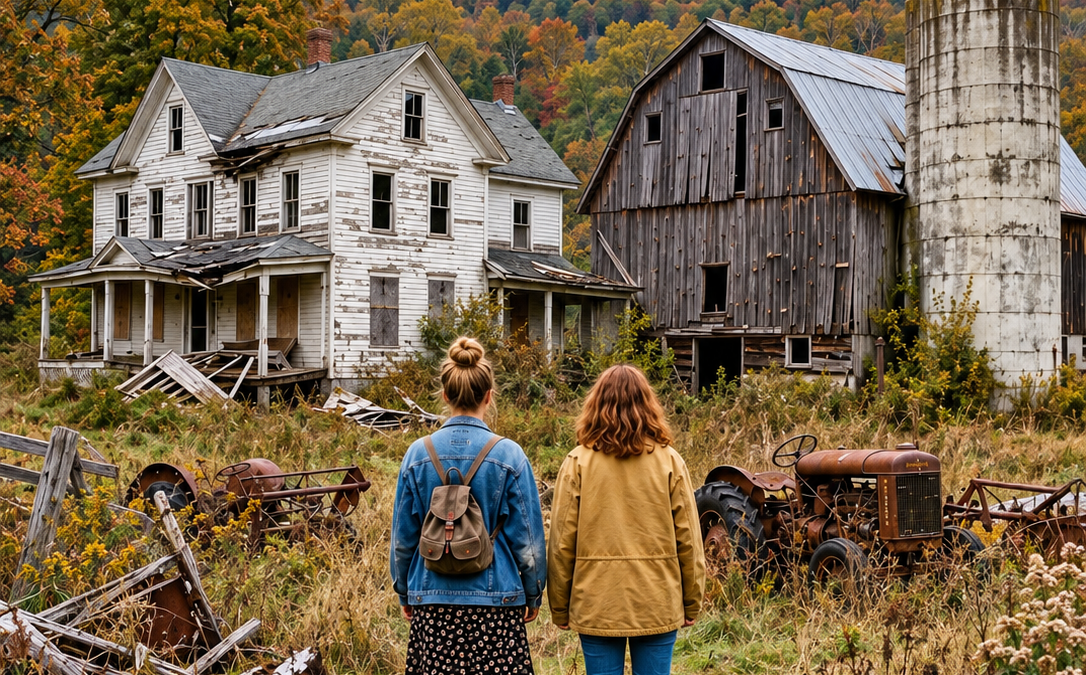
The farm looked abandoned by more than one generation.
Dead weeds had swallowed rusted machinery. A tractor sat near the barn with its hood open, orange corrosion covering the engine. The main barn leaned visibly to one side. Beside it, an old concrete silo rose above the yard.
The farmhouse had probably once been handsome.
Two stories. Victorian lines. Wide porch.
But its white paint had peeled away in strips. Several windows were covered in plywood. The porch sagged toward the middle.
Chloe parked.
The Honda shuddered once after she turned off the ignition.
Jess stared through the windshield.
“This is ours?”
“Apparently.”
“This place is going to fall down.”
“It has walls.”
“That’s your standard now?”
Chloe looked at her.
“We don’t have to sleep sitting up.”
Neither of them said anything after that.
They stepped into the cold.
One of the brass keys opened the front door after Chloe fought the rusted deadbolt for nearly a minute.
The smell struck first.
Dust.
Mouse droppings.
Wet wood.
Old paper.
Something sour from the direction of the farm buildings.
Chloe tried the nearest light switch.
Nothing.
She took their plastic flashlight from her pocket and turned it on.
The beam revealed stacks of newspapers lining the hallway. Broken chairs leaned against boxes. Mason jars, wire, tools, unopened mail, and things Chloe could not identify occupied almost every flat surface.
Calvin had not simply neglected the house.
He had filled it.
Jess stood behind her.
“He lived like this?”
Chloe moved farther inside.
The living room was dominated by a large stone fireplace.
For the first time since arriving, she saw something useful.
“We can make a fire.”
Then the flashlight passed over the floor.
Chloe stopped.
Directly in front of the hearth was a clean square of hardwood surrounded by years of grime. Deep curved scratches marked the boards around it.
Something heavy had been moved there repeatedly.
Jess noticed where Chloe was looking.
“What did that?”
“No idea.”
Chloe had learned not to spend energy on mysteries when practical problems could kill you first.
The temperature inside the house was dropping.
They spent the next two hours pulling dry pieces from collapsed fencing and hauling them into the living room. The chimney smoked badly at first, forcing them to open the front door, but eventually a weak fire established itself.
They found an old mattress in a downstairs room and dragged it in front of the hearth.
That first night, the house made a hundred noises.
Boards shifted.
Wind pressed against the windows.
Mice moved inside the walls.
Something metallic tapped intermittently outside.
Jess fell asleep first.
Chloe lay flat on the mattress, staring at the water stains on the ceiling.
She could stretch her legs.
It was such a small thing that she almost cried.
For ninety days she had slept with her body folded around the interior of a Honda Civic.
Now she had a floor beneath her.
A roof above her.
A lock on the door.
The house was filthy, freezing, and possibly one hard storm away from serious damage.
But nobody could tell them to leave the parking lot.
Morning came gray and cold.
Jess remained asleep while Chloe wrapped herself in an old wool blanket and explored.
The kitchen plumbing had been shut off. The main valve was so badly rusted that Chloe could not move it with a wrench.
The cabinets held ancient food she did not trust.
At the rear of the house she found Calvin’s office.
Unlike the rest of the property, it had a strange kind of order.
The desk was buried under ledgers, receipts, maps, envelopes, and legal pads, but the piles seemed deliberate.
Chloe opened one of the ledgers.
Feed costs.
Veterinary expenses.
Milk production.
Then, around 1998, the entries changed.
The ordinary farm accounting disappeared.
In its place were numbers and abbreviations.
14 C. 400 intact.
22 A. 150 transferred.
Silo base secured.
Chloe turned more pages.
There were rough sketches of buildings, measurements, notes about walls and foundations.
Then she found bank statements.
The balances did not match the story of a completely ruined farmer.
For years Calvin had deposited large sums—ten thousand here, twenty thousand there.
Then, around 2010, he had begun withdrawing enormous amounts in cash.
After that, almost nothing.
Chloe studied the pages.
If Calvin had possessed this much money, why had he stopped paying his taxes?
Why had he let the house rot?
Why leave the utilities disconnected?
A loud thud sounded from the living room.
Chloe dropped the ledger.
“Jess?”
She ran down the hallway.
Jess was kneeling at the fireplace, hands black with soot. The heavy iron grate had been pulled aside.
“I was cleaning it out,” Jess said. “Look.”
Beneath years of ash were rough stones.
One stone in the center sat differently from the others.
Tilted.
Not mortared the same way.
Chloe crouched beside her.
Together they scraped away packed ash.
The stone would not move.
Chloe took an iron poker, forced it into the gap, and leaned down with all her weight.
The stone shifted.
Jess grabbed the edge.
They pulled until it finally came free.
A square cavity had been cut into the foundation beneath it.
Chloe aimed the flashlight inside.
Something metallic reflected the beam.
She reached down and found a handle.
What emerged was an old military ammunition box sealed along the edges with hardened wax.
They carried it onto the clean square of flooring.
Now the scratches made sense.
Someone had repeatedly dragged the fireplace grate away from this exact spot.
Chloe found a screwdriver and broke the old seal.
The lid opened.
No cash.
No jewelry.
Inside lay a leather-bound journal, a heavy brass key, and a black-and-white photograph.
Chloe picked up the photograph.
Her father was standing in front of Calvin’s silo.
Dean Reed looked younger than Chloe remembered him, but there was no possibility of mistaking him.
He held a shovel.
Jess leaned closer.
“Is that Dad?”
Chloe stared at his face.
Dean had disappeared from their lives nine years earlier.
He had left unpaid bills behind.
He had left their mother to explain what could not be explained.
He had left Chloe, old enough to understand abandonment but too young to do anything about it, with the private belief that if she had somehow been more useful, quieter, easier, he might have stayed.
Years later, when their mother was gone and their own lives had collapsed, Dean had remained absent.
And now his face was inside a hidden box beneath Calvin Reed’s fireplace.
Chloe opened the journal.
Calvin’s handwriting was steadier here than in the ledgers.
The entries were blunt.
One mentioned Dean by name.
Dean had come around asking questions.
He believed something valuable was hidden near the silo.
Calvin had warned him away.
Another entry described Calvin’s growing hostility toward county officials and his belief that they were manipulating property taxes to force owners from their land.
Chloe read farther.
Calvin had not lost his money.
He had removed it from the banking system.
They want the land.
They know what is under the limestone ridge.
Let them foreclose. They will get the dirt, but they will not get the reserve.
The silo base is secure.
The brass lock holds.
Chloe stopped reading.
Jess’s lips were pale from the cold.
The discovery could wait.
Hypothermia could not.
But Chloe could feel the heavy key in her palm.
She looked toward the window.
Beyond the glass, across the dead weeds and rusted machinery, the silo stood against the gray sky.
“We’re checking it,” she said.
Jess stared at her.
“Now?”
“If there’s something out there Calvin thought was worth hiding, I want to know before we spend another night freezing.”
They wrapped themselves in old blankets and crossed the yard.
The silo smelled of rotten silage and damp concrete.
There was no obvious entrance.
Chloe studied the base.
Then Jess pointed.
Near one section of the foundation, weeds stopped growing.
The earth appeared raised.
They dug.
The ground was beginning to freeze, and within minutes Chloe could no longer feel her fingertips.
Five inches down, Jess struck metal.
They cleared the soil.
A square steel hatch was set into the foundation.
At its center sat an industrial padlock.
Chloe removed the brass key.
It barely entered the keyhole.
She cleaned away dirt and pushed again.
Then she twisted.
For several seconds nothing happened.
She leaned harder.
The lock broke free with a metallic snap.
Together they lifted the hatch.
Darkness opened beneath them.
An iron ladder descended into a concrete shaft.
Jess backed away.
“No.”
Chloe shined the flashlight down.
The ladder reached a floor perhaps fifteen feet below.
Beyond it, a reinforced corridor disappeared into darkness.
“That’s not a hole somebody dug with a shovel,” Chloe said.
“I don’t care what it is.”
“Calvin used it.”
“Calvin also lived inside a mountain of newspapers.”
Chloe looked at the key.
Then at the tunnel.
Then at her sister.
“We came here with fourteen dollars.”
Jess closed her eyes.
“I hate when you say things like that.”
Chloe swung one leg over the opening.
The iron ladder was painfully cold.
At the bottom, she found dry concrete.
“Jess.”
No answer.
“It’s warmer down here.”
“That’s how horror movies start.”
But a moment later Jess climbed down.
They followed the corridor.
Fifty feet in, the tunnel widened.
Chloe’s flashlight crossed one metal shelving unit.
Then another.
Then another.
Canvas sacks were stacked across them.
One had split.
Something metallic showed through.
Chloe pulled at the rotted fabric.
The bag tore.
Heavy silver bars spilled across the concrete floor.
For a long moment neither sister moved.
Jess picked one up.
It filled her palm.
She rubbed away the tarnish with her thumb.
“Chloe.”
Chloe could barely hear her.
“Chloe, how many are there?”
The flashlight moved across the room.
Hundreds.
Maybe more.
Then the beam reached a wooden desk at the far wall.
Several thick black binders sat on top.
Chloe opened the first.
Property records.
County assessments.
Bank documents.
Correspondence.
Maps.
Names.
Calvin had not only hidden his money.
He had built an archive.
Chloe turned pages until she found one name marked repeatedly.
Mitchell.
The attorney who had called a homeless nineteen-year-old and suggested she give away the farm.
The man whose office had already prepared the deed.
The man who had described the property as nothing but debt.
Chloe continued reading.
Mitchell’s family was connected to Oak Haven Land Trust, a company that had acquired other farms in the area.
Calvin’s notes alleged a deliberate pattern: unusually aggressive property assessments, farms pushed into foreclosure, distressed owners convinced to surrender the land, and Oak Haven acquiring parcels along the same limestone ridge.
Beneath that ridge, according to the geological material in Calvin’s files, lay a valuable natural gas reserve.
Jess was still holding the silver bar.
“Why would Dad be here?”
Chloe looked toward the dark tunnel behind them.
The journal had already answered enough of that question.
Dean had learned there was something valuable at Calvin’s farm.
He had come looking.
Not for his daughters.
Not for family.
For whatever Calvin had hidden.
Chloe shut the binder.
Suddenly the silver mattered less than the papers.
Mitchell had expected them to sign because he believed poverty would make the decision for them.
He had looked at two girls living in a Honda and assumed desperation had erased their ability to ask questions.
Chloe picked up one of the silver bars.
It was cold and far heavier than its size suggested.
“We aren’t signing anything,” she said.
Jess looked at her.
Chloe tightened her grip on the metal.
“And we’re never sleeping in that car again.”
Part 2
Getting rich, Chloe discovered, did not immediately make anything easier.
First they had to get fifty silver bars up a fifteen-foot ladder.
By the twentieth trip, her shoulders burned.
By the thirtieth, Jess had stopped speaking.
By the time they carried the canvas sacks across the field, both sisters were breathing hard enough to see clouds forming around their faces.
They loaded the silver into the Honda’s trunk.
The rear of the car sank noticeably.
Chloe locked the silo hatch again and covered it with soil and leaves.
Nobody in town could know what they had found.
Especially Mitchell.
They drove south across the county line.
The gas gauge was nearly empty when Chloe spotted a bullion shop in a strip mall.
She left Jess in the car and carried six bars inside.
The dealer stood behind reinforced glass.
He looked at Chloe’s coat, her worn shoes, and the dirt beneath her fingernails before he looked at the silver.
“Where’d you get it?”
“My grandfather died.”
It was the first lie that came to her.
She did not enjoy saying it.
But she had no intention of explaining Calvin Reed to a stranger.
The dealer tested one bar.
Then another.
“Real.”
He quoted her a price below the spot value.
Chloe knew enough arithmetic to understand she was losing money.
She also understood that six perfect silver bars were useless if Jess got sick in an unheated house.
“Cash.”
When Chloe returned to the Honda, she dropped an envelope containing $1,080 into Jess’s lap.
Jess counted the money once.
Then again.
She looked at Chloe.
“Is this real?”
“Apparently.”
For the first time in months, they filled the Honda’s tank completely.
At a home improvement store they bought insulated coats, boots, sleeping bags, two kerosene heaters, fuel, locks, and a heavy crowbar.
Then Chloe took Jess to a diner.
They sat in a booth near the back.
The waitress brought cheeseburgers, fries, and hot coffee.
Jess stared at the plate.
Chloe had already picked up her burger when she noticed her sister had not moved.
“You okay?”
Jess nodded.
Then a tear rolled down her cheek.
“I forgot food could be hot.”
Chloe put the burger down.
Three months of homelessness had given them very little room for feelings. Every day had been a sequence of immediate problems: gasoline, food, bathrooms, warmth, somewhere to sleep.
Now, for one hour beneath fluorescent lights in a roadside diner, nothing was required of them.
Jess ate slowly.
Chloe did not.
Her mind remained at the farm.
Mitchell.
The papers.
The taxes.
The silver.
The limestone ridge.
“What do we do?” Jess asked.
“Go back.”
“What if Mitchell comes?”
“I think he will.”
Jess stopped chewing.
“You say that like you want him to.”
Chloe wiped her fingers on a napkin.
“He thinks we’re still deciding whether to sign.”
“Aren’t we?”
“No.”
“What if those papers are wrong?”
“Then we still inherited silver.”
“What if Mitchell knows about it?”
Chloe looked through the diner window at the Honda.
“If he knew exactly where the silver was, he wouldn’t need our signatures.”
That night the farmhouse felt different.
Not safe.
Not yet.
But warmer.
The heaters filled the living room with steady heat. Their new sleeping bags lay across the old mattress.
Jess fell asleep quickly.
Chloe spent the night with Calvin’s binders spread around her.
The more she read, the more coherent his apparent madness became.
He had documented property assessments over fifteen years.
He had maps of the ridge.
Corporate filings connecting Oak Haven Land Trust to people associated with Mitchell.
Copies of correspondence.
Bank records.
Notes showing how neighboring farms had been pushed into financial distress before their land changed hands.
Calvin had believed county officials and Oak Haven were working together.
Whether every accusation could be proven was another question.
But Chloe did not need to understand every statute or financial transaction to understand the pattern.
The taxes on targeted farms rose.
Owners failed.
Oak Haven benefited.
And Calvin had refused to cooperate.
Instead, he withdrew his money, converted much of it into silver, buried his wealth under the silo, and let his property appear increasingly worthless.
He had turned neglect into camouflage.
Near dawn, Chloe found the tax figure.
$84,000.
That was the burden hanging over the property.
Yesterday it had sounded impossible.
Now it was a number.
An enormous number, yes.
But a number they could pay.
Chloe sat back.
For months she had measured money in gallons of gasoline and diner meals.
Now she was calculating how much silver had to be sold to stop a foreclosure.
Jess woke to the sound of Chloe boiling water on a camping stove.
“You sleep at all?”
“No.”
“That’s healthy.”
“We can pay the taxes.”
Jess blinked.
“All of them?”
“Looks like it.”
“With the silver?”
“Yes.”
Jess pulled the sleeping bag around her shoulders.
“And then what?”
“Then nobody can force us off the property over the debt.”
A vehicle entered the driveway.
Both sisters went silent.
The engine was too deep and smooth to belong to an old farm truck.
Chloe crossed to the window.
A black SUV came up the gravel drive.
Mitchell stepped out.
He wore a charcoal overcoat.
A second man emerged from the passenger side.
Heavy build.
Work jacket.
Broken-looking nose.
Chloe turned.
“Lock the door after me.”
Jess stood.
“Absolutely not.”
“Jess.”
“You’re not going out there alone.”
“I need you inside with the papers.”
“That makes no sense.”
“It makes perfect sense. If this goes bad, you don’t let anybody into the house.”
Jess stared at her.
“What exactly counts as going bad?”
Chloe took the crowbar.
After a moment she slid it inside her coat.
“Lock the door.”
She stepped onto the porch.
Mitchell smiled when he saw her.
It was the same controlled smile he had used in his office.
“Chloe. I was beginning to wonder whether you had reconsidered my advice.”
“We’ve been busy.”
“I can imagine.”
His eyes passed over the house.
The heaters were not visible from outside, but Chloe wondered whether he had noticed the Honda’s full gas tank, the newer boots, the coat.
He opened his briefcase and produced a manila envelope.
“I brought another copy of the quitclaim documents. The county timetable is moving quickly. If you sign today, I can make sure this burden is resolved.”
He held out a pen.
Chloe did not take it.
“I have a question.”
Mitchell waited.
“Why are the property taxes so high?”
A slight pause.
“The property has accumulated years of unpaid assessments.”
“That wasn’t my question.”
The second man near the SUV shifted.
Chloe continued.
“Why did farms bought by Oak Haven Land Trust get different treatment?”
Mitchell’s expression changed.
Not much.
But enough.
“I’m not familiar with every transaction in the county.”
“Calvin was.”
The smile vanished.
Chloe’s heart was pounding so hard she could feel it in her throat.
She forced herself not to move.
Mitchell lowered the papers.
“I’m not sure what you think you found in that house.”
“Neither am I. There’s a lot to read.”
For the first time, Mitchell looked toward the windows.
Chloe saw calculation replace irritation.
“How much did you find?”
It was the wrong question.
Chloe knew it immediately.
If Mitchell truly believed Calvin’s records were meaningless, he would have asked what she was talking about.
Instead, he wanted quantity.
Chloe reached into her pocket.
She had carried one bar from the bunker for exactly this reason.
She tossed it down.
The silver struck the snow beside Mitchell’s shoe.
His face drained.
Behind him, the larger man took a step.
“Mr. Mitchell?”
Mitchell raised one hand sharply.
“Don’t.”
Chloe looked at the attorney.
“Calvin’s estate isn’t broke.”
Mitchell stared at the silver.
“You have no idea what you’re getting involved in.”
“I know the tax bill is eighty-four thousand dollars.”
“You don’t have eighty-four thousand dollars.”
Chloe glanced at the bar.
Mitchell followed her eyes.
His jaw tightened.
“A box of papers does not stop a county proceeding.”
“No. Paying the taxes does.”
“You’re a nineteen-year-old girl with no understanding of property law.”
“That didn’t seem to bother you when you wanted my signature.”
For several seconds, Mitchell said nothing.
Chloe heard the heater running inside the house.
She wondered whether Jess was watching through the crack in the plywood.
Mitchell finally spoke.
“Calvin was paranoid.”
“Maybe.”
“He accused everyone.”
“Maybe.”
“He believed conspiracies that existed only in his head.”
“Then you have nothing to worry about.”
Mitchell looked at her.
Chloe continued.
“I’m paying the debt. After that, I’m taking copies of what Calvin collected to the state attorney general.”
The second man near the SUV muttered something Chloe could not hear.
Mitchell snapped his head toward him.
Then back to Chloe.
“You should think very carefully before making accusations against people you don’t understand.”
“I’ve spent three months sleeping in a Honda. I’ve been careful enough.”
The sentence came out more quietly than Chloe expected.
It was not a threat.
It was simply true.
Three months ago, the idea of standing in front of an attorney and refusing him would have frightened her.
But poverty had already stripped away most of the things people used to intimidate each other.
She had lost housing.
Work.
Privacy.
Security.
She had eaten from dollar menus and washed her hair in sinks.
What exactly was Mitchell going to threaten her with?
Another bad night?
Chloe pointed toward the driveway.
“Get off the property.”
The larger man stepped forward again.
“Want me to—”
“I said no,” Mitchell barked.
This time there was panic in his voice.
He knew Chloe had found enough.
Maybe not everything.
But enough.
Mitchell looked down at the silver one last time.
Then he turned.
He left the bar where it lay.
Both men climbed into the SUV.
The tires threw mud and snow behind them as the vehicle backed down the driveway.
Chloe remained standing until it disappeared from sight.
Then her knees gave way.
She sat hard on the porch.
The crowbar slipped from beneath her coat and hit the boards.
Her hands shook uncontrollably.
The front door opened.
Jess came outside.
She sat beside Chloe without speaking and wrapped both arms around her.
For a while they listened to nothing but their breathing.
Finally Jess looked at the silver bar lying in the snow.
“You know that was like a thousand-dollar dramatic gesture, right?”
Chloe laughed.
The laugh came out broken and half hysterical.
Jess started laughing too.
Then both of them were crying.
Part 3
The next forty-eight hours were the busiest of Chloe’s life.
Fear returned once the confrontation ended.
Not fear that Mitchell would persuade them to sign.
That possibility was gone.
The new fear was that he might find another way to act before they secured the property.
Chloe no longer wanted to sell small amounts of silver locally.
They loaded another portion from the bunker into the Honda and drove south into Pennsylvania, far beyond Mitchell’s immediate circle.
This time Chloe chose a larger precious-metals dealer.
The transaction was less personal.
The bars were tested.
Documentation was created.
Funds were transferred into a new account.
They liquidated enough to cover one hundred thousand dollars.
Chloe stared at the account balance for nearly a full minute.
Jess leaned over her shoulder.
“I keep expecting the number to disappear.”
“So do I.”
They did not celebrate.
Not yet.
The following morning, Chloe obtained a cashier’s check.
Then she walked into the county clerk’s office carrying eighty-four thousand dollars in payment for the back taxes.
The clerk behind the counter looked tired.
Chloe had expected resistance.
Questions.
A phone call to Mitchell.
Instead, the woman examined the documents, entered information into her computer, and processed the payment.
The ordinary nature of the transaction almost made Chloe dizzy.
For Calvin, the debt had represented years of defiance.
For Mitchell, it had been leverage.
For Chloe and Jess, it had been the difference between owning the farm and losing it.
For the clerk, it was another file.
A red stamp came down on the paperwork.
Paid.
Chloe took the receipt.
“Is that it?”
The clerk looked up.
“As far as the delinquent amount? Yes.”
Chloe held the paper with both hands.
She had imagined that safety would arrive as a feeling.
It did not.
It arrived as a stamped receipt.
Outside, Jess was waiting in the Honda.
Chloe got in.
She placed the receipt on the dashboard between them.
Jess read it.
“Paid?”
“Paid.”
“All of it?”
“All of it.”
Jess leaned back against the seat.
Neither spoke.
After a few seconds, Jess started crying.
Chloe did not tell her to stop.
She stared at the courthouse steps.
“We still have one thing to do.”
They drove to Albany with copies of Calvin’s records.
Chloe had spent enough time sorting the binders to know which documents were clearest.
She brought corporate information.
Assessments.
Correspondence.
Maps.
Property transfers.
Anything tying the people named in Calvin’s notes to the farms acquired along the ridge.
At the attorney general’s office, a receptionist initially treated the visit as exactly what it appeared to be: two young women arriving without an appointment carrying a heavy black binder and making accusations involving local officials.
Chloe could not blame her.
Then Chloe opened the binder.
She showed the records.
She explained who Calvin Reed had been.
She explained Mitchell’s attempt to secure a quitclaim deed.
She explained the tax debt, Oak Haven Land Trust, and the pattern Calvin had documented.
She did not exaggerate.
She did not claim she understood every entry.
Whenever she was uncertain, she said so.
“This is what Calvin believed.”
“This is what the document says.”
“This is the property record.”
“This is Mitchell’s name.”
“This is what he told me.”
That distinction mattered.
Within an hour they were moved to another room.
Then another person joined the meeting.
Then two more.
The discussion lasted most of the day.
Investigators asked Chloe how the records had been found.
She described the office.
The ledger.
The box under the fireplace.
The journal.
The silo.
The bunker.
She did not bring the entire silver cache to Albany, but she had photographs and transaction documentation proving that Calvin’s hidden assets existed.
One investigator asked whether Mitchell knew they had found the records.
Chloe exchanged a look with Jess.
“Yes.”
“How?”
“I told him.”
The investigator stared at her.
“You confronted him?”
“He came to the farm.”
“With anyone else?”
“Yes.”
“And you told him you were bringing the records here?”
“Yes.”
The investigator leaned back.
“That was dangerous.”
Chloe looked down at her hands.
“I know.”
Only then did she fully believe it.
During the confrontation, anger had been useful because it kept fear in its place.
In Albany, under bright office lights with doors that locked properly and adults treating Calvin’s evidence seriously, Chloe could finally admit how badly the encounter might have ended.
They left after dark.
What happened next belonged mostly to investigators.
Calvin’s archive had been built over years; understanding it would take longer than one meeting.
But Chloe saw enough activity to know the records had not been dismissed.
Requests were made.
Names were checked.
Additional records were sought.
The machinery Mitchell had once invoked as a threat was finally moving in another direction.
Back at the farm, winter settled in.
Chloe and Jess spent money carefully at first.
Neither sister trusted abundance.
After months when fourteen dollars represented their entire future, every purchase felt dangerous.
But the house needed repairs that could not be postponed.
They hired contractors to inspect the roof.
Damaged sections were sealed.
The plumbing was repaired.
A dependable heating system was installed.
Broken windows were addressed.
Trash came out of the house by the truckload.
For days, Chloe watched strangers carry away the physical evidence of Calvin’s final years.
Stacks of newspapers.
Broken furniture.
Useless machinery parts.
Rusted containers.
Things saved long past any reasonable purpose.
She wondered how much of Calvin’s hoarding had been illness and how much had been strategy.
Maybe even Calvin had not known.
His distrust had protected the evidence.
It had also left him living alone in a collapsing house with his money buried underground.
Wealth had saved Chloe and Jess because they found it.
It had not necessarily saved Calvin.
That realization prevented Chloe from treating the silver as a fairy-tale ending.
Money could buy heat.
Food.
Repairs.
A lawyer of their own.
Education.
Time.
It could not repair nine years of wondering why their father had left.
One evening, Chloe brought Dean’s photograph into the kitchen.
The room had changed dramatically.
The counters were clean.
The sink worked.
Steam rose from Jess’s mug.
The photograph looked out of place on the repaired table.
Jess sat across from Chloe.
“You keep looking at it.”
“I know.”
“Do you think he knew everything?”
“No.”
“How can you be sure?”
“Because if Dad knew everything, he would’ve found a way into the bunker.”
Jess considered that.
“Calvin said he kept coming around.”
“He knew enough to smell money.”
“That sounds like him.”
Chloe picked up the photograph.
Dean stood in front of the silo with the shovel in his hands and an expression that seemed defiant even through faded black and white.
For years, Chloe had secretly imagined explanations for his disappearance.
Maybe he had been ashamed.
Maybe he had been afraid.
Maybe something had happened.
Maybe, somehow, he had loved them from far away.
The photograph did not answer every question.
But Calvin’s journal answered enough.
Dean had been close enough to visit the farm.
Close enough to chase Calvin’s secret.
And still he had not come back for his daughters.
Chloe placed the photograph facedown.
“I used to think if I understood why he left, it would make it different.”
Jess looked at her.
“Does it?”
“No.”
That answer hurt.
But it was cleaner than hope.
A few days later, they returned to the bunker.
Not for emergency cash this time.
They went slowly.
With good flashlights.
Proper gloves.
Masks against the dust.
Chloe made an inventory rather than grabbing whatever they could carry.
Calvin’s system became clearer the longer she studied it.
The canvas sacks were organized.
Some markings corresponded to the coded ledger entries.
The numbers Chloe had first thought were meaningless were records of transfers and storage.
The bunker was not a desperate last-minute hiding place.
Calvin had planned it.
The sisters decided not to liquidate everything.
They would need professional advice.
Taxes mattered.
Ownership documentation mattered.
Selling precious metals created records and obligations.
The farm itself needed a proper valuation.
So did the mineral rights.
For the first time, Chloe could afford to admit that she did not know what she was doing.
That felt like its own kind of wealth.
Poverty had forced her to make every decision alone because expertise cost money.
Now she could hire people who understood what she did not.
She retained an attorney with no connection to Mitchell or Oak Haven.
An accountant followed.
The explanation of how two young sisters had come to possess a large quantity of silver took some time.
But Calvin’s ledgers, estate documents, bunker, and transaction records provided a paper trail.
The professionals were cautious.
Chloe appreciated caution.
She had started to distrust anyone who promised simple answers.
The investigation into the county widened.
Chloe and Jess were interviewed again.
So were former farm owners.
Calvin’s claims had seemed paranoid when written in isolation.
Placed beside property records, corporate relationships, assessment histories, and testimony from other people, some of them looked far less irrational.
The sisters did not attend a dramatic courtroom showdown.
There was no single afternoon when every accusation was announced and every guilty person marched away.
Real investigations were slower.
Documents moved.
Attorneys called.
Records were subpoenaed.
People stopped returning phone calls.
Oak Haven’s name began appearing in conversations that no longer treated it as an ordinary land trust.
Mitchell stopped coming to the farm.
That alone was enough for Jess.
Months earlier, his name on the phone had represented authority.
Now he was simply a man under scrutiny.
By December, snow covered the fields.
The dead weeds vanished beneath white.
The barn still leaned.
The old tractors still needed to be removed.
The silo still looked ugly.
But the farmhouse glowed at night.
Warm light behind repaired glass changed everything.
One afternoon Chloe stood in the kitchen while snow fell beyond the window.
She had spent the morning discussing school.
Finishing high school had once felt like an abstract ambition from another life.
Now she and Jess could plan around it.
Not dream.
Plan.
There was a difference.
Jess entered wearing clean sweatpants and thick socks.
She placed a plate of toast on the counter.
“Contractor says the barn isn’t as bad as it looks.”
“That sounds expensive.”
“Everything sounds expensive to you.”
“Everything is expensive.”
“We have a bunker full of silver.”
“That is not permission to become stupid.”
Jess smiled.
“You sound eighty.”
“Calvin rubbed off on me.”
They both looked toward the yard.
For a while neither mentioned him.
Calvin Reed had been dead before they arrived.
They had never heard his voice.
Never sat at his table.
Never asked why he chose isolation.
But he had shaped their lives more profoundly than people who had known them for years.
He had left no careful will explaining what he wanted.
No warm letter.
No apology.
No instructions addressed to Chloe and Jess.
He had left a ruined dairy farm, unpaid taxes, a journal, a key, silver beneath a silo, and enough evidence to make powerful people afraid.
It was not a conventional inheritance.
But neither was their family.
Jess ate a piece of toast.
“You think he meant for us to find it?”
Chloe considered the question.
Calvin could not have known exactly who would inherit.
Maybe he had only believed that someone stubborn enough to search would eventually understand.
Maybe the clean floorboards, the hidden box, the journal, and the key were his last attempt to create a trail.
“I think he wanted somebody to.”
Jess looked toward the silo.
“Dad almost did.”
“No.”
Chloe shook her head.
“Dad wanted the money.”
“What’s the difference?”
Chloe looked around the kitchen.
At the working faucet.
At the repaired cabinets.
At the stack of school information on the table.
At Calvin’s copied records waiting for another meeting.
“The difference is what you do after you find it.”
Jess was quiet.
Chloe thought about Dean standing with the shovel.
Mitchell offering the pen.
Calvin sealing silver underground.
Every person connected to the farm had been presented with the same basic question in a different form.
What was land worth?
What was money worth?
What did you owe other people once you had power over them?
Dean had seen a shortcut.
Mitchell had seen an opportunity.
Calvin had seen something he refused to surrender.
Chloe had first seen a roof.
That was all.
On the morning of the phone call, she had not wanted justice.
She had not wanted mineral rights or silver or revenge.
She had wanted somewhere Jess could sleep without curling around the gearshift.
Maybe that was why the farm never felt like treasure to her.
Treasure was abstract.
The farm was a locked door.
A hot shower.
Food that did not have to be divided carefully.
A bed.
A future measured in years instead of gas gauges.
Chloe poured coffee.
The mug warmed both hands.
Outside, the snow softened the rusted machinery and the collapsing edges of the property.
Jess stood beside her at the window.
“You know,” she said, “it’s actually kind of beautiful.”
Chloe looked across the white fields.
At the barn.
At the concrete silo that had seemed like a rotten monument when they arrived.
At the driveway where Mitchell’s SUV had disappeared.
At the place where the Honda had coughed to a stop on their first evening.
For three months that car had contained everything they owned.
Now it sat beside a house with heat in the walls and food in the cabinets.
The fear had not vanished all at once.
Chloe suspected some part of it might stay with her for years.
She still checked the fuel gauge too often.
Still saved restaurant napkins.
Still woke occasionally with the confused belief that she was sleeping behind the steering wheel.
But each morning the room around her remained.
The house remained.
Jess remained.
Nobody knocked on a window and told them to move.
Chloe lifted the coffee to her lips.
It was hot.
Outside, snow continued falling over Calvin Reed’s old dairy farm.
“Yeah,” she said.
“It really is.”
You Might Also Enjoy
The Auctioneer Sold Her the Wrong Townhome By Mistake—Its Key Opened Every Door in the City
She Bought an Injured Horse Nobody Wanted — Then He Led Her to Her Father’s Hidden Canyon
The Duke Gave Her a Ruined Estate to Be Rid of Her — She Made It the Finest in the County