She Bought an Injured Horse Nobody Wanted — Then He Led Her to Her Father’s Hidden Canyon
Part 1
The gate to Miller Ranch had not opened for a stranger in nearly a year.
On a cold October morning, Tess Miller shoved it wide anyway and stood beside the cattle guard while a rusted horse trailer rattled toward her through a veil of pale dust.
The truck stopped crooked in the yard.
Its driver climbed out without shutting off the engine.
“Horse is in back,” he said.
That was his greeting.
Tess had spoken to him twice by telephone, enough to know he was coming from three counties over and wanted the animal gone. He had called Copper dangerous, unsound, unpredictable, and half-crazy. He had also named a price low enough to make Tess suspicious.
Then he opened the trailer.
The horse inside was worse than she had imagined.
His ribs showed beneath a coat so dull with dirt that his real color was impossible to tell. One hind leg was wrapped in a filthy bandage. The material had slipped almost to the fetlock, stained brown and stiff along the bottom. His mane hung in knots. There was an old scrape along one hip.
But it was his eyes that held Tess.
He did not look wild.
He did not even look frightened.
He simply watched her.
Steady. Patient. Alert.
As if he had been waiting for somebody in particular.
The seller spat into the dirt.
“Won’t make it through winter anyway.”
Tess crouched near the trailer ramp without moving closer.
The horse tipped one ear toward her.
“Vet seen the leg?” she asked.
“Somebody did.”
“That isn’t what I asked.”
The man shrugged. “Something’s wrong with the leg. Worse, something’s wrong with his head. Keeps trying to bolt toward every treeline he sees.”
“Toward them?”
“Every chance he gets.”
Most frightened horses tried to get away from something.
Tess knew that.
Apparently the seller did not care.
She straightened and looked again at the horse’s thin body, the neglected bandage, the calm expression that did not match the story she had been given.
Buying him would be foolish.
The ranch account had already been stretched thin by hay, repairs, taxes, and the ordinary expenses that seemed to multiply whenever there was only one person left to pay them. The old cattle operation was gone. The land itself was smaller than it had been during Tess’s childhood. What remained of Miller Ranch survived mostly because Tess trained a few horses, boarded a few more, repaired things instead of replacing them, and refused to admit how close some months came to breaking her.
The sensible decision was obvious.
She reached into her coat pocket.
The seller counted the bills twice.
“You’re buying yourself trouble.”
“Maybe.”
“He goes stupid on you, don’t call me.”
“I wasn’t planning to.”
The man unloaded the horse, took his money, and left so quickly that dust still hung over the road when Tess led her new problem toward the barn.
It was not the first foolish thing she had done since her father died.
People in town had been kind enough to point that out.
A woman alone had no business trying to keep a ranch that had already lost half its old reach. She should sell while the house and barns still had value. She should stop buying animals that needed more care than they could possibly earn back. She should lease out the pasture. She should move closer to town.
Everybody seemed to have a plan for Miller Ranch except Tess.
Her own plan was simpler.
Get through today.
Then do it again tomorrow.
She cleaned the horse’s leg first.
Beneath the rotten bandage was an ugly injury, but not the hopeless one she had feared. Swelling ran above the joint. The skin was raw in places. He flinched once when she washed the wound, then stood still with his nose near her shoulder.
“Sorry,” she murmured.
He breathed against her sleeve.
Under the dust, his coat began showing a warm copper color.
That settled his name.
“Copper,” Tess said.
One ear came toward her.
“You’ve been called worse, I’m guessing.”
The veterinarian arrived the following afternoon and came back once more before the month ended.
“He got lucky,” he told Tess after the second examination. “Rest him. Keep the wound clean. Don’t get ambitious because he starts feeling better.”
“Will he be sound?”
“Probably. Might always carry a little hitch.”
“And the bolting?”
The vet glanced toward Copper’s stall.
Tess had told him what the seller claimed. By then she had seen a version of it herself. Copper never panicked in the barn or pasture, but more than once he had fixed his attention toward distant brush and leaned against the lead rope as though some destination beyond the fence had called to him.
The vet put his instruments back into his bag.
“Horses don’t run from nothing.”
“So you think he is frightened of something?”
“No.”
He closed the bag.
“I think he’s going somewhere. He just hasn’t gotten permission yet.”
Tess almost laughed.
But after his truck disappeared down the road, she remained beside the barn, looking toward the dark line of cottonwoods in the distance.
Going somewhere.
The words stayed with her.
So did Copper.
Winter settled over the ranch slowly.
Tess fed before sunrise, often by lantern light, breaking thin skins of ice from water troughs and carrying buckets through frozen mud. Copper gained weight. His coat brightened. The swelling in his leg eased.
On bitter evenings, after the other horses had gone quiet, Tess sometimes sat on an overturned bucket outside his stall.
She did not talk much.
Neither did he.
That suited both of them.
Silence had become the most reliable thing in her life.
Her mother had been gone for years. Her father was gone now too. The rest of the family had scattered long ago, leaving behind only names connected to stories nobody wanted to finish.
Tess had learned not to ask.
She had also learned that grief behaved strangely in an empty house.
It hid in ordinary things.
Her father’s coffee mug.
His work gloves hanging from a nail.
A feed-store receipt in his handwriting.
The dent his boots had worn into the mudroom threshold.
She could spend all morning repairing fence without crying, then find one of his pencils behind a ledger and have to stand motionless until she could breathe properly again.
Copper helped because he required things.
Hay.
Medicine.
Clean bedding.
A patient hand.
Grief could argue with a person.
A horse could not.
By spring, his leg had healed enough for the vet to approve short rides.
Tess saddled him on a clear morning and followed the old fence trail that curved through what remained of the ranch’s grazing land.
Her father had ridden the same route when Tess was young and Miller Ranch still ran cattle across a much larger spread. Back then, she remembered gates swinging all day, bawling calves in the lower pasture, hired hands drinking coffee beside the barn before sunrise.
Now grass covered stretches where cattle trails had once cut the earth bare.
Copper moved carefully beneath her.
At first Tess listened for every uneven step.
There was a slight hitch, exactly as the vet had predicted, but no sign of pain.
They reached a bend where the fence dipped near a brush-choked opening leading toward the canyon country beyond the ranch.
Copper stopped.
Not stumbled.
Stopped.
His ears pointed toward the gap.
Tess touched a heel lightly against his side.
“Come on.”
He took one step, then turned his head back toward the brush.
“No.”
She guided him onto the fence trail.
He obeyed.
The next ride, he did the same thing.
And the next.
Always at that bend.
He would slow, stare toward the opening, and wait.
“Not today,” Tess told him for the third time.
She tried to dismiss it as a quirk.
Horses had plenty.
But the veterinarian’s words returned whenever she thought about it.
He’s going somewhere.
The canyon had been part of Tess’s childhood mostly because her father had forbidden it.
Nothing back there but rock slides and bad footing, he used to say.
He had never taken her there.
Not when she was a little girl following him on her first pony. Not later when she was old enough to handle rough terrain. Not once.
The restriction had seemed ordinary when she was young.
Now she remembered something else.
Whenever she asked about that country, her father’s face changed.
Not dramatically.
Her father had not been a dramatic man.
His mouth simply tightened, his gaze drifted somewhere past her, and his answer became final.
Nothing back there.
Which was strange, Tess thought.
Because plainspoken men rarely needed repeated warnings to describe nothing.
By late April, the grass had turned green around the ranch.
Tess and Copper rode the fence trail again.
When they reached the bend, he slowed.
His ears went forward.
Tess already knew where he was looking.
“Copper.”
He stepped off the trail.
She gathered the reins.
“Hey.”
Another step.
There was no panic in him.
No fight.
He moved with quiet certainty toward the opening in the brush.
Tess could have turned him.
She knew that.
Instead she sat there, listening to the wind.
Eleven months of grief had taught her what happened when every difficult question was avoided.
Eventually silence itself became an answer.
She looked into the canyon.
“All right,” she said softly.
Copper waited.
Tess loosened the reins.
“Show me.”
He walked forward.
The trail was barely a trail at all.
Scrub oak crowded both sides. Branches scraped Tess’s jeans and caught at her jacket. Loose stone rolled beneath Copper’s hooves.
Yet he never hesitated.
He chose his footing with the confidence of an animal following something remembered rather than something discovered.
As they traveled deeper, red canyon walls rose around them. Old rain scars cut the stone. Juniper clung to narrow shelves. The air cooled in the shadows.
Tess glanced behind her.
The opening through which they had entered had nearly vanished.
Her father’s voice returned.
Bad footing.
Rock slides.
Nothing back there.
“Then what are we doing?” she whispered.
Copper’s ears flicked.
At the next bend in the wash, he stopped.
Tess followed his gaze.
A vertical shape stood among the brush.
Too straight for a tree.
Too square for stone.
She rode closer.
It was a weathered wooden post, silver with age.
Beyond it lay a clearing.
Tess dismounted.
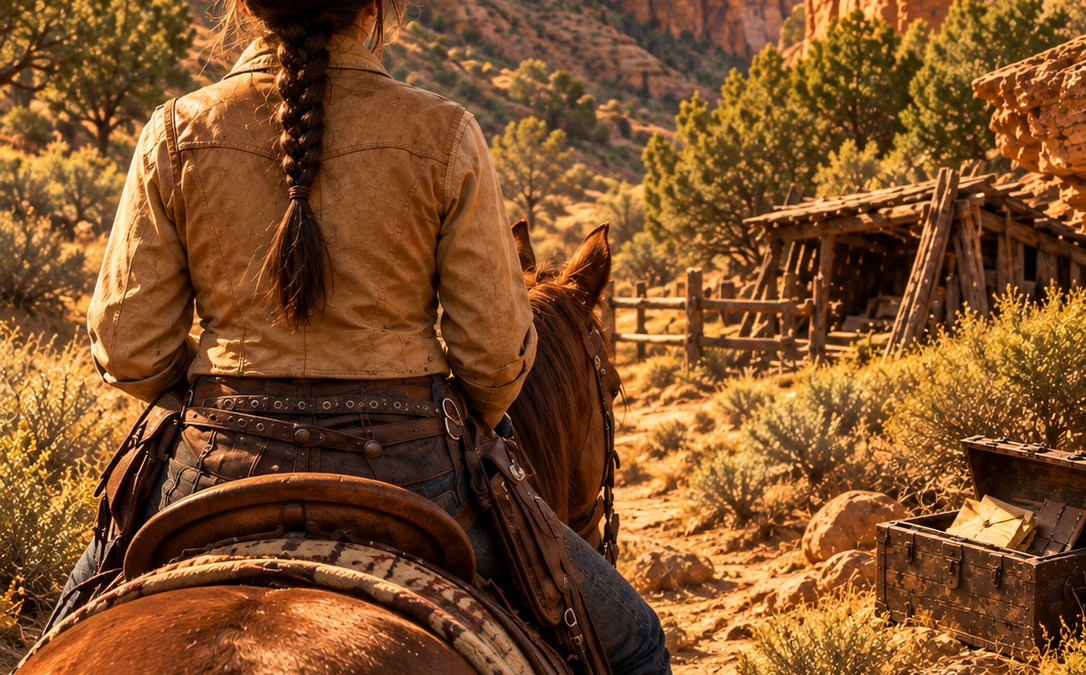
She led Copper the final yards on foot and stepped onto a flat shelf of land tucked beneath the canyon wall.
The remains of a lean-to had collapsed near one side. A stone fire ring sat gray and cold beneath years of dirt. Half-fallen corral fencing made a rough square.
Tess stared.
She knew what she was looking at.
An old seasonal ranch camp.
Before trucks and trailers made cattle work easier, ranchers used places like this when grazing pushed stock too deep into rough country for riders to return home every night.
She moved toward a corral post.
Something faint marked the wood beneath dust and dead vine.
Tess brushed it clean.
Two connected half circles above a straight bar.
Her father’s brand.
The same mark burned into the old gatepost at Miller Ranch.
The same mark stamped on saddle blankets and halters she had handled since childhood.
“This was yours,” she said.
The canyon gave no answer.
Behind her, Copper lowered his head to graze.
Tess walked slowly around the abandoned camp.
She found a rusted horseshoe half buried near the corral. A broken tack rack leaned against stone. Beneath an overhang, protected from decades of direct weather, sat a storage chest.
She stopped.
It was the sort of weatherproof box ranchers used for tack oil, tools, records, or whatever needed to stay dry.
The metal latches were orange with rust.
Tess knelt.
For several seconds she only rested her hands on the lid.
Then she worked one latch.
It resisted.
She rocked it back and forth until flakes of rust broke loose against her palm.
With a stiff metallic groan, it opened.
The second followed.
Tess lifted the lid.
Inside, beneath a sheet of oiled canvas, lay notebooks and a bundle of envelopes tied with brittle twine.
Her breath shortened.
She moved the canvas.
The first notebook fell open in her hand.
She recognized the handwriting instantly.
Her father’s.
The same cramped, slanting script that filled old feed ledgers in the ranch office.
But these pages were not about feed.
They were not about cattle either.
Dates went back nearly fifteen years.
Names appeared between paragraphs. Some Tess remembered only vaguely.
She turned several pages.
A sentence stopped her.
Then another.
She closed the notebook.
The envelopes lay beneath it.
All were sealed.
All were addressed.
And nearly every one carried the same name.
Daniel Whitfield.
Tess stared at the handwriting until the letters seemed to detach from the paper.
Her father’s younger brother.
Her uncle.
A man she had not seen since childhood.
A man whose name had disappeared from family conversation so completely that Tess had eventually learned to stop noticing the absence.
Copper tore another mouthful of grass.
The sound was absurdly ordinary.
Tess sat back on her heels.
For the first time since her father’s funeral, she felt something shift beneath the grief she thought she understood.
Whatever her father had hidden in this canyon, he had not hidden nothing.
Part 2
Tess did not open the letters immediately.
She sat in the clearing with the chest beside her and the envelopes in her lap.
Daniel Whitfield.
She remembered almost nothing clearly.
A tall man laughing at something in a kitchen.
A Christmas gathering when Tess had been around eight.
Voices behind a closed door.
Her mother taking plates from the table sooner than expected.
Her father standing stiff beside the sink.
Daniel leaving.
After that, his name became one of those subjects adults could silence merely by changing their faces.
Tess grew up with a simple version of the story.
Daniel had left.
Her father wanted nothing to do with him.
The family had split, and that was that.
She had built the rest from scraps.
Daniel must have done something unforgivable.
Her father must have been too proud to reconcile.
Both men had chosen anger over family.
That explanation had hardened inside her until it felt like memory.
Now a stack of letters suggested she had never known the story at all.
Tess untied the twine.
She chose the oldest envelope.
The paper had softened with age.
Her father had written Daniel’s name carefully across the front, then sealed the letter and apparently carried it to this canyon rather than a mailbox.
She opened it.
The first lines sounded so much like him that for a moment Tess could almost hear his voice.
He wrote that he did not expect Daniel would ever read the letter because he did not have the nerve to send it.
He wrote because keeping the words inside was becoming unbearable.
Then Tess reached the part that made her sit straighter.
Her father had sold the west section of Miller Ranch to the Garner family.
Tess remembered that sale.
She had been young, but old enough to remember her parents discussing falling prices and the need to consolidate.
That was what her father had told them.
The market was down.
The ranch needed to shrink.
The letter said otherwise.
Daniel had called that September.
Something had happened with Daniel’s boy.
Her father had heard desperation in his brother’s voice and sold the land.
Tess lowered the page.
Wind moved through the canyon grass.
The west section.
She could still picture it.
Long pasture beyond the creek. A wind-bent line of cottonwoods. The ridge where her mother used to stop and look back toward the house.
Gone because the market was bad.
Except it had not been.
Not entirely.
Tess read the next letter.
Then another.
She stopped following the dates in order because each envelope seemed to answer a different question.
The brothers had fought over money years earlier.
There had been borrowing.
A promise not kept.
A betrayal her father alluded to but never fully explained even in private.
Whatever happened had been serious enough to keep them from speaking normally for almost twenty years.
But the silence had never been as complete as Tess believed.
Nine years earlier, there was a hospital bill.
Later came another reference to Daniel’s son and continuing medical trouble.
Then a missed mortgage payment.
The possibility of foreclosure.
Each time, Tess’s father had sent money.
Not with warmth.
Not with reconciliation.
Not even with an honest conversation.
He helped, then retreated.
And afterward he came to the canyon and wrote what he could not say.
Some letters were angry.
Her father accused Daniel of wasting chances.
In another, he admitted he still remembered taking his younger brother fishing when they were boys.
One letter contained three pages of complaint before ending with only a few lines that mattered: money had been sent, Daniel’s family would be safe for another month, and no one at Miller Ranch knew.
Tess read until the shape of her father began changing in her mind.
She had always thought of him as a man who could sever a relationship and live with the consequences.
He had not.
He had simply hidden the consequences better than everyone else.
Then she found the letter that made her cover her mouth with one hand.
Her father wrote that Tess believed Daniel had walked out on the family and never looked back.
He knew she believed it.
He had allowed her to.
Not because he hated Daniel.
Because he believed the truth would burden his daughter.
If Tess knew Daniel’s family was struggling, he wrote, she would try to help them herself.
She had too big a heart for her own good.
Just like her mother.
Her father would rather sell pieces of her inheritance than let Tess carry a responsibility he believed belonged to him.
The words hurt more than she expected.
Not because he had sold the land.
For years, Tess had watched Miller Ranch become smaller and assumed failure had eaten it piece by piece.
She had wondered privately whether her father had simply been unable to save what earlier generations built.
She had never accused him.
But the thought had existed.
Now she understood that at least some of what disappeared had been sacrificed deliberately.
Her father had protected people he was supposedly too angry to forgive.
And he had protected Tess from knowing he was doing it.
“You stubborn old man,” she whispered.
Her eyes blurred.
Copper lifted his head.
Tess laughed once through tears.
“Yeah. Him.”
She went back to the chest.
There was one final envelope beneath the others.
It was different.
Her name was written across the front.
Tess Miller.
Her fingers went cold.
She sat absolutely still.
Her father had written this for her.
Not in a ledger.
Not in a will.
Not in some ordinary drawer at the ranch.
Here.
In the canyon he had spent her whole life telling her to avoid.
She broke the seal.
The first sentence stopped her.
If you’re reading this, then I expect Copper finally decided you were ready.
Tess looked toward the horse.
Copper stood thirty feet away, chewing grass.
“What?”
He flicked an ear.
She read the sentence again.
Copper.
Her father had written the horse’s name.
There was no mistaking the spelling.
Her mind reached for an explanation and found none that satisfied it.
She had bought Copper after her father was gone, from a man three counties away. Yet her father’s letter spoke of him as though the animal’s presence in Tess’s life had been expected.
The unanswered question sat there, impossible to ignore.
But the letter continued.
Daniel was still alive, as far as her father knew.
Living in Larksburg County.
An address was folded behind the page.
Her father wrote that he did not know what kind of man his younger brother had become. He could not make that judgment for Tess.
But Tess deserved the choosing.
Those were his words.
She deserved to decide whether Daniel belonged in her life.
Her father admitted, in the quietest way he knew how, that he had denied himself that same choice for too long.
Then came the final lines.
Whatever Tess decided, he wanted her to understand why he had carried the secret.
He loved her enough to carry the weight himself.
Tess lowered the letter.
For years she had thought of love as something her father showed through work.
Fixed fence.
A full woodshed.
A truck that always had fuel when she needed it.
He had never been a man who said much.
Now she realized his silence had contained entire decisions.
Some noble.
Some foolish.
Some unfair.
Love did not automatically make secrecy right.
It did not return the west pasture.
It did not give Tess the years she might have known an uncle.
But the discovery made it impossible to keep believing the easier version of her father.
People were not one thing.
Not even after death.
Especially not then.
Tess unfolded the smaller slip behind the letter.
An address in Larksburg County had been written in newer ink.
She folded it again and placed it inside her jacket.
She packed the letters carefully beneath the oiled canvas, then reconsidered and took the letter addressed to her.
The others she left protected in the chest for the moment.
On the ride home, Copper followed the trail without hesitation.
Tess barely noticed the canyon walls.
She was thinking about Daniel.
And about her father.
And about the impossible appearance of Copper’s name.
For the next two weeks, Tess did nothing.
The address stayed in her pocket.
She carried it while feeding horses.
She carried it while repairing fence.
She carried it into town for grain.
At night she placed it beside her bed, then put it back into her jacket every morning.
She could write.
She could call.
She could also leave the past buried.
That option had an appeal she hated admitting.
Miller Ranch was quiet.
Predictable.
Daniel could disturb that.
He might still be the man her father could not forgive.
He might resent Tess.
He might feel entitled to something because her father had helped him.
He might reopen arguments whose surviving participants no longer even remembered them the same way.
Or he might simply not want her.
That possibility frightened Tess more than the others.
It was easier to think family had disappeared because of old pride than to offer someone a road back and discover he preferred the distance.
Her father’s sentence followed her through every chore.
You deserve the choosing.
On evening rides, Copper made the decision harder to avoid.
Whenever they passed the canyon bend, he slowed.
The first time, Tess pulled him forward.
“We already did that.”
He obeyed.
Two evenings later, he stopped again.
“You showed me the box.”
Copper turned his head toward the opening.
“The job’s done.”
He waited.
Tess looked at the trail.
For a horse that could not speak, he had an irritating way of winning arguments.
A week later they reached the same place.
Again he slowed.
Again he looked toward the canyon.
Tess rested a hand on his neck.
“All right,” she said.
His skin twitched beneath her palm.
“I hear you.”
She rode home.
That night, Tess sat at the kitchen table where her father used to keep ranch accounts.
She took out paper.
Calling felt impossible.
Writing felt manageable.
She began with Daniel’s name.
Then stopped.
Started again.
She refused to pretend the past did not matter.
She also refused to reopen a fight she had not witnessed and could not settle.
So she wrote the simplest truth.
She had found the letters.
She knew her father had been helping Daniel’s family.
She knew about the land sale, the hospital bills, and the years of secret assistance.
She did not hold Daniel responsible for decisions her father had made before Tess was old enough to understand them.
She was not writing to relitigate an argument between two brothers.
She was writing because her father was gone.
Her mother was gone.
And she was tired of treating family like a word that belonged only to the dead.
She wanted to know whatever family she still had left.
Tess read the letter three times before mailing it.
Afterward, she expected to feel relieved.
Instead she felt exposed.
For days, nothing happened.
Then on a Tuesday evening, while Tess was measuring feed into buckets, her phone rang.
Unknown number.
She stared at it.
It rang again.
Tess nearly let the call go to voicemail.
At the last second, she wiped one hand against her jeans and answered.
“Hello?”
Silence.
Then a man said, “Tess?”
The voice was older than the one in her memory.
Rougher.
But something inside it was familiar.
“Yes.”
Another pause.
“This is Daniel.”
Tess closed her eyes.
Copper shifted in his stall behind her.
Daniel cleared his throat.
“I got your letter.”
“I figured.”
“I’ve started calling you about twelve times.”
“You made it to thirteen.”
A small sound came through the phone.
Not quite laughter.
But close.
That was how the first conversation began.
It lasted more than an hour.
At first, both of them spoke carefully.
Daniel asked about the ranch.
Tess asked about Larksburg County.
Then her father entered the conversation and everything became easier and harder at the same time.
Daniel told Tess about the brother he remembered before bitterness took over.
A teenager who once slipped out of chores with him to go fishing.
A young man who could repair nearly anything if given enough time.
A brother who became furious when Daniel borrowed money and failed to keep a promise attached to it.
“He had a right to be angry,” Daniel said.
“Apparently he also had a talent for staying angry.”
Daniel was quiet.
“Yeah.”
Tess leaned against the feed-room wall.
“But he helped you.”
“Yes.”
“Why didn’t you tell me?”
“I figured he had.”
“He hadn’t.”
“I know that now.”
Daniel told her about his son’s medical problems.
About hospital bills he could not meet.
About the phone call that eventually cost her father the west section.
“I didn’t ask him to sell land,” Daniel said.
“I’m not accusing you.”
“I need you to know that.”
“I do.”
“I called because I was desperate.”
Tess stared through the barn door at the fading light.
“My father heard desperate even when people tried to hide it.”
“That was his problem.”
“One of them.”
Daniel laughed softly then, and Tess did too.
The sound surprised both of them.
Before the call ended, Tess told him about Copper.
She told him about the canyon.
The old camp.
The chest.
The letters.
When she mentioned the final letter, Daniel became silent.
“He wrote Copper’s name?” he asked.
“Exactly.”
Daniel did not offer an explanation.
Neither of them had one.
Tess glanced toward the stall.
Copper stood with his head over the door.
“I think that horse knows more about my family than I do.”
Daniel answered quietly.
“Wouldn’t take much.”
This time Tess laughed first.
It was not reconciliation.
Not yet.
But after the call ended, the ranch felt slightly less empty.
Part 3
The weeks that followed did not heal twenty years of family damage.
They did something less dramatic and more useful.
They made room for honesty.
Daniel called again.
Then Tess did.
Some conversations were easy.
Others were not.
They talked about money.
About pride.
About the hospital bills.
About Daniel’s son.
About the mortgage payment that nearly ended in foreclosure.
About her father’s habit of solving practical problems while refusing to solve emotional ones.
Daniel never pretended innocence.
He had made mistakes.
He had borrowed money he could not repay when promised. He had chased plans that failed. He had said things during the argument with his brother that he wished he could take back.
Tess’s father had said things too.
Then each man had waited for the other to make the first move.
Years passed.
Children grew.
Illness arrived.
Bills arrived.
Parents died.
Still, neither brother found the humility to cross the distance completely.
Yet when Daniel’s family was in real danger, Tess’s father crossed it halfway.
With money.
Never with words.
“That was your father,” Daniel told her during one call. “He could drive two hundred miles to fix a problem rather than walk across a room and say he missed you.”
Tess looked toward her father’s empty chair.
“That sounds about right.”
Daniel did not ask Tess for anything.
That mattered.
He did not ask about land.
He did not ask what her father had left.
He did not suggest that years of financial help created any claim on Miller Ranch.
Mostly he asked how she was doing.
Not the polite version.
The real one.
Some days Tess told him.
Some days she didn’t.
Trust returned in small amounts.
Early that summer, Daniel called and said he wanted to visit.
Tess stood at the kitchen window while they spoke.
“When?”
“Whenever you can tolerate me.”
“That narrow of a window?”
“I was hoping age improved your sense of humor.”
“My father said sarcasm was a family defect.”
“He would know.”
They chose a Saturday.
Tess spent Friday pretending she was not nervous.
She swept the porch.
Then swept it again.
She cleaned a kitchen already clean enough.
She told herself Daniel was only one man arriving for one visit.
But Saturday morning she checked the road every time she heard an engine.
Near noon, an old truck turned through the Miller Ranch gate.
A horse trailer followed behind it.
Tess stepped off the porch.
The truck stopped.
For several seconds nobody moved.
Then the driver’s door opened.
Daniel Whitfield climbed out.
He was older than the uncle in Tess’s scattered childhood memory.
Gray touched his hair beneath his hat. His shoulders had rounded slightly. He held himself like someone accustomed to hard work but no longer interested in proving it.
He took off his hat.
“Tess.”
“Daniel.”
His gaze went past her to the ranch house.
Emotion crossed his face before he could hide it.
“He never changed the porch.”
“No.”
“Always said he would.”
“He said a lot of things.”
Daniel smiled.
“True.”
Neither seemed sure whether they should hug.
Tess solved the problem by looking at the trailer.
“You bring something?”
Daniel rubbed the back of his neck.
“That depends.”
“On?”
“Whether you’re still taking horses nobody has much use for.”
Tess folded her arms.
“Apparently that reputation travels.”
He opened the trailer.
Inside stood a gentle bay mare.
Healthy.
Alert.
Untrained enough to be uncertain, but not frightened.
Daniel rested an arm against the door.
“She’s been standing mostly idle in my pasture. Needs proper work.”
Tess studied the mare.
“Why me?”
Daniel looked down at his hat.
“Your dad always said you had a gift for this.”
The words reached her before she could prepare for them.
For a moment, Tess saw her father standing at the fence, arms folded, pretending not to be proud.
Daniel continued.
“Figured it was time somebody let you prove it.”
Tess touched the bay mare’s neck.
“You planning to pay training fees?”
Daniel blinked.
Then she smiled.
His answering grin changed his whole face.
“Runs in the family,” he said.
“What?”
“Your father never forgot to send a bill either.”
The mare became the first horse Daniel brought her.
Not the last.
His visits grew more regular.
Sometimes he stayed for a weekend.
Sometimes only long enough to deliver feed or help with fencing.
He had an irritating habit of noticing repairs Tess had postponed and starting them without asking.
The first time she found him replacing broken corral boards, she stood with her hands on her hips.
“You know I can do that.”
“I know.”
“Then why are you doing it?”
“Because there are two of us.”
The answer disarmed her.
So she handed him another board.
They worked mostly in silence.
But this silence was different from the kind Tess had lived in after her father’s death.
It did not feel empty.
It felt shared.
Word traveled through horse country.
A woman who could bring a neglected animal back from the edge developed a reputation whether she asked for one or not.
Copper had been evidence.
Daniel’s bay mare became more.
Tess worked slowly with her, establishing basic handling before asking for anything harder. The mare learned to yield, load calmly, carry a saddle, respond without panic.
Someone saw her.
Then somebody called.
Another horse arrived.
Then another.
Within a year, the small training operation Tess had fought to keep alive began looking less like an act of stubborn survival and more like a business with a future.
Daniel helped when he could.
He repaired fence.
Hauled feed.
Held gates.
Made coffee badly.
Argued with Tess over whether certain boards were worth saving.
Never once did he behave as though the ranch belonged to him.
That mattered too.
Rebuilding family turned out to resemble rebuilding old fencing.
You did not stand at one end, make a grand declaration, and expect the whole line to become sound.
You found the first weak post.
You fixed it.
Then the next.
Some pieces could be reused.
Others had rotted too far.
You accepted the difference and kept working.
There were subjects Tess and Daniel approached carefully.
Her father remained the hardest.
Love for a dead man made criticism feel like betrayal at first.
Eventually Tess understood she did not have to choose between gratitude and anger.
Her father had loved her.
He had also kept truths from her that she deserved to know.
He had saved Daniel’s family.
He had also helped preserve a silence that cost all of them years.
Both things were true.
The letters did not turn him into a saint.
They made him human.
That was harder.
And better.
Months after Daniel’s first visit, Tess returned to the hidden canyon.
Copper carried her.
This time, when they reached the familiar bend, she did not make him wait.
“All right,” she said.
He stepped into the brush.
The trail looked less forbidding now.
Not safe.
Not easy.
Just known.
At the abandoned camp, Tess opened the storage chest and gathered the remaining letters and notebooks.
She did not want to leave them to weather forever.
The old corral still leaned.
The fire ring remained cold.
Her father’s brand was still visible beneath years of wear.
Tess touched it once.
“I found him,” she said.
Wind moved through the clearing.
Copper stood nearby.
She looked at him.
“And you knew I would.”
The unanswered mystery of her father writing Copper’s name remained.
Tess had considered dozens of explanations.
None was certain enough to become truth.
Eventually she stopped demanding one.
Her father had left many things unexplained.
Perhaps this was simply the strangest.
Tess packed the letters and rode home.
She kept them in a safe drawer in the house.
Not hidden.
Protected.
There was a difference.
Sometimes she reread them.
Not often.
They were no longer a puzzle she needed to solve.
They had become a record of what silence could cost and what love could still attempt even after pride made speech impossible.
Daniel read some eventually.
Not all at once.
The first time Tess handed him a letter addressed in her father’s handwriting, he held it without opening it.
“I spent years wanting him to say something,” he murmured.
“He did.”
“Apparently just not where I could hear it.”
Tess sat across from him at the kitchen table.
“He was difficult.”
Daniel smiled sadly.
“So was I.”
He opened the envelope.
Tess left him alone to read.
That evening they did not talk about what it contained.
They fed the horses instead.
Sometimes work remained the language the Whitfield brothers had understood best, and Tess had inherited enough of that language to know when words would only get in the way.
Copper grew stronger with every season.
The slight hitch in his hind leg never disappeared entirely.
When he was tired, Tess could see it.
That imperfection became part of him rather than something needing to be erased.
He was not the horse he might have been without injury.
Tess was not the woman she might have been without grief.
Daniel was not the brother he might have been without pride.
Miller Ranch was not the spread it had once been before portions were sold.
None of them could return to an untouched version of the past.
That stopped seeming tragic.
The ranch was still standing.
So were they.
One evening, almost a year after Daniel’s first visit, Tess rode Copper along the old fence trail.
Below them, the pasture glowed beneath late sunlight.
A young horse she was training called from a distant paddock.
Near the barn, Daniel was working on a gate he claimed had been hung wrong years earlier.
Tess had told him her father installed it.
Daniel had said that explained everything.
She had laughed so hard she nearly dropped the wrench she was holding.
Now, reaching the familiar bend, Copper slowed.
His ear turned toward the canyon opening.
Tess looked that way too.
For most of her life, that gap had represented a warning.
Nothing back there.
Stay away.
Bad footing.
Now she knew what had actually waited beyond it.
An abandoned camp.
A rusted chest.
Unsent letters.
The truth about land she thought her father had lost.
The truth about an uncle she thought had abandoned them.
And a final message from a man who had made mistakes trying to protect the people he loved.
Copper waited.
Tess rubbed his neck.
“No need tonight.”
He remained still for another second.
Then he continued down the fence line.
Tess smiled.
Maybe he had only been checking.
The training business grew slowly, then steadily.
Not into anything grand.
Tess did not need grand.
She needed enough clients to pay the bills, enough horses in the barn to make the place feel alive, and enough help that every broken board no longer became her problem alone.
Daniel never replaced her father.
Tess never wanted him to.
He became something else.
An uncle returned too late to recover childhood, but early enough to become part of adulthood.
They accumulated new memories instead of trying to manufacture the old ones they had missed.
Coffee before chores.
Arguments over fence repairs.
Long drives hauling horses.
Meals eaten too late after work went longer than expected.
Stories about her father that Tess had never heard.
Stories about Daniel that made her understand why two brothers could love each other and still hurt each other badly.
There was no single moment when Tess could say the family was repaired.
One day she simply realized she no longer thought of herself as the last person left.
The old ranch house sounded different with another voice in it.
The barn sounded different with more horses.
Even grief sounded different when someone else remembered the person being mourned.
The chest from the canyon remained empty after Tess moved its contents home.
She left the chest where it was.
Some things belonged to the place that had kept them.
When she occasionally returned, she would sit near the old fire ring while Copper grazed.
The canyon no longer frightened her.
But she respected it.
Places could hold versions of people we never saw while they were alive.
Her father had been one man at the ranch house.
Another at the bank when he sold land.
Another when Daniel called needing help.
And another here, alone with a pen, writing letters he could not bring himself to send.
Tess had spent years believing strength meant carrying whatever life handed you without needing anyone.
Her father had believed something similar.
The canyon had shown her the flaw in that idea.
Carry something alone long enough and eventually the weight becomes part of the family inheritance.
Unless somebody puts it down.
Her father had not managed to do that while he lived.
He had left Tess a chance to do it afterward.
Not through land.
Not through money.
Through a choice.
Daniel or no Daniel.
Anger or understanding.
Silence or a letter mailed to Larksburg County.
Tess had chosen.
That choice did not erase what happened.
It simply kept the past from deciding everything that happened next.
As for Copper, he never explained himself.
Horses rarely did.
Tess never discovered why an unwanted injured horse from three counties away seemed to know a trail into a canyon he should not have known.
She never learned with certainty why her father’s final letter mentioned him by name.
Maybe somewhere in the missing years was an answer.
Maybe her father had known more than Tess ever realized.
Maybe Copper’s path to Miller Ranch had begun long before the morning his trailer rattled through the gate.
Or maybe some questions were not meant to surrender every last piece.
Tess had spent enough of her life believing that an unanswered question was the same thing as an empty one.
It wasn’t.
Copper had led her somewhere real.
That was enough.
On warm evenings, they still rode the fence line.
At the canyon bend, he would sometimes slow and flick one ear toward the opening.
Tess would look across the brush toward the country her father once told her to avoid.
Then she would look home.
Toward the barn.
Toward the horses.
Toward Daniel’s truck whenever it happened to be parked beside the house.
Toward Miller Ranch, smaller than it had once been but alive in a way it had not been for years.
And each time, Tess understood the canyon a little differently.
Her father had hidden letters there.
But what he had truly left behind was not treasure in the ordinary sense.
It was the truth beneath a family story.
The knowledge that abandonment was not always what it appeared to be.
That a man could be too proud to reconcile and still quietly sacrifice for the brother he could not face.
That love could exist inside silence without making the silence wise.
And that sometimes healing began with something so small it hardly looked like courage at all.
Buying a horse nobody wanted.
Loosening the reins.
Following a forgotten trail.
Opening a rusted latch.
Mailing one letter.
Answering one phone call.
Trust did not arrive all at once.
Neither did forgiveness.
They came the way Copper had entered the canyon.
One careful step at a time.
And sometimes, Tess thought, the truth never came looking for you at all.
Sometimes it waited quietly in the place you had been warned your whole life not to go.
Waiting behind brush and stone.
Waiting beneath oiled canvas.
Waiting in handwriting you would recognize anywhere.
Until one injured horse turned his head toward a forgotten trail—
and someone finally trusted him enough to follow.
You Might Also Enjoy
The Auctioneer Sold Her the Wrong Townhome By Mistake—Its Key Opened Every Door in the City
Homeless at 19, Chloe Inherited a Dying Dairy Farm—Then Found a Locked Bunker Under the Silo
The Duke Gave Her a Ruined Estate to Be Rid of Her — She Made It the Finest in the County