Homeless at 19, He Bought a Dead Drive-In for $200—Behind the Screen Was a Fortune
Part 1
At nineteen years old, Eli owned one backpack, a faded Polaroid, and three hundred ten dollars rolled inside a sock.
By Thursday morning, he was prepared to spend two hundred of those dollars on eleven acres of weeds, cracked concrete, rusted speaker poles, a ruined snack bar, and a drive-in screen split almost from top to bottom.
Everyone in the county annex seemed to understand that this was a terrible idea except him.
The auctioneer pushed his glasses higher on his nose and looked around the room.
“Old Aurora Drive-In,” he said. “Eleven acres. Concession building, projection booth, screen structure. Condition listed as poor, and I’ll tell you right now, that description is charitable. Fifteen years delinquent taxes. Previous owner deceased. No heirs came forward. Sold as is.”
A few people chuckled.
“Opening bid, two hundred dollars.”
Nobody moved.
The silence was not uncertainty. It was agreement.
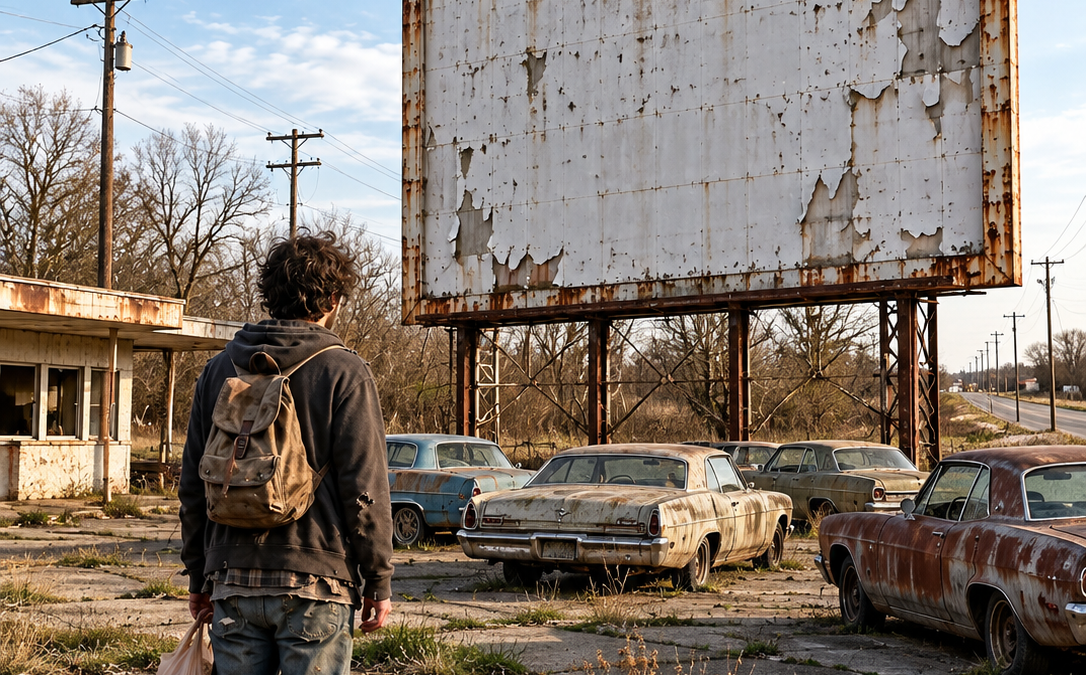
The Aurora had been abandoned so long that people had stopped imagining it could belong to anyone. The screen had cracked. The well had gone dry. The electrical service had been shut off. The gravel road leading there was slowly surrendering to grass.
“Two hundred,” the auctioneer repeated.
Eli raised his hand.
Every head in the room turned.
He was painfully aware of how he looked: sunburned, too thin, thrift-store jacket, worn backpack between his shoes. A stranger who had walked into town two days earlier with eleven dollars left.
A man near the front twisted around in his chair and stared as though Eli had volunteered to buy a sinking boat.
“I’ve got two hundred from the young man in back,” the auctioneer said.
He hesitated.
“Son, you know what you’re buying?”
“Yes, sir.”
“There’s no power. Well’s dry. Roof on the concession building may or may not hold through another winter.”
“I understand.”
The auctioneer studied him.
Eli wasn’t sure he did understand. Not really.
But he understood one thing nobody in that room did.
He had been looking for the Aurora most of his life.
“Going once.”
Silence.
“Going twice.”
The auctioneer gave him one final chance to save himself.
“Sold.”
The gavel hit the desk.
Someone laughed.
Another person muttered, “Poor kid.”
Eli stood, walked down the aisle, and paid two hundred dollars.
For the first time in his life, he owned a place nobody could order him to leave.
That mattered more to him than whether the roof leaked.
Eli had learned the meaning of unclaimed long before he learned what property ownership meant.
His mother died when he was very small. The illness moved quickly enough that his memories of the hospital had blurred into bright lights, white sheets, and adults speaking softly whenever he entered a room.
There was no father on his paperwork.
The state searched for relatives and found nobody willing or able to take him.
After that came six placements in a little more than a decade.
Six houses.
Six sets of rules.
Six versions of this is your room for now.
Then his eighteenth birthday arrived.
A caseworker handed him his clothes in a black trash bag, wished him luck, and sent him into adulthood with the kind of smile people use when they know a system has failed but do not know what else to offer.
Eli worked wherever somebody would pay cash.
Framing crews. Scrap yards. Produce fields.
He slept in shelters when beds were available and beneath an overpass when they were not. He washed in gas-station bathrooms and learned which convenience stores left their coffee out late enough that a person could warm his hands without being chased away.
Through all of it, he carried one photograph.
The Polaroid was soft along the edges from years of being held.
In it, a young woman stood beneath a purple evening sky with a laughing little boy sitting on her shoulders.
The woman was Eli’s mother.
The boy was Eli.
Behind them rose an enormous white movie screen. Across the marquee above it was one word.
AURORA.
Eli did not remember that night.
He remembered the photograph of that night, which was not quite the same thing.
Still, it was evidence.
Once, his mother had been alive.
Once, she had laughed.
Once, somebody had carried him high enough that he could see over a crowd.
For years he assumed Aurora was a place he would never identify. Eventually he began looking.
A license plate barely visible on an old pickup in the photograph gave him a state. The flat, dry horizon narrowed the region. A librarian helped him search archived business listings.
There had been one Aurora Drive-In on the high plains outside a town called Calder.
So Eli went looking for it.
He rode buses until the routes ended, then walked and accepted rides from truckers.
He reached Calder on a Tuesday in late April with eleven dollars, blistered feet, and a hunger strong enough to make him light-headed.
That was how Dileia found him.
Her diner stood between a closed pharmacy and a hardware store on Main Street. A bell rang when Eli came through the door.
Dileia looked up from behind the counter.
She had been serving people long enough to recognize hunger before they admitted it.
“Sit down before you fall down.”
“I’m okay.”
“You can be okay sitting.”
He sat.
She poured coffee and placed eggs, toast, and hash browns in front of him.
Eli looked at the plate.
“I didn’t order this.”
“I know.”
“I’ve only got a few dollars.”
“Did I ask how much you had?”
“No.”
“Then eat.”
He hesitated.
Dileia pointed toward the back.
“If your pride starts hurting, sweep my lot afterward.”
So he ate.
Halfway through breakfast, two men in a booth near the window began talking about the county tax sale.
“Finally dumping the Aurora,” one said.
Eli’s fork stopped.
The other man laughed. “Who’d buy it? Maddox died out there and nobody found him for a week. Screen’s cracked. Land’s useless.”
“The Aurora?” Eli asked.
Both men turned.
“The drive-in?”
“Used to be.”
Eli opened his backpack and took out the Polaroid.
The laughter disappeared.
One man leaned closer.
“Well, I’ll be.”
Dileia came around the counter.
“That’s the old marquee,” the man said. “Hasn’t looked like that in twenty years.”
Dileia examined the picture, then Eli.
“Where did you get this?”
“It’s mine.”
He touched his mother’s faded face with one finger.
“She took me there when I was little.”
Nobody joked after that.
Two days later, Eli bought the Aurora.
The county clerk who processed the sale counted his money twice before sliding the papers toward him.
“There are people who wanted that land cheap before,” she said quietly. “Couldn’t get it because of the tax-sale rules.”
Eli frowned.
“Why are you telling me?”
“Because if somebody comes around acting real friendly, remember they had their chance.”
He folded the deed carefully into his jacket.
After fees and food, he had eight dollars left.
Dileia called him three different kinds of fool when he told her what he had done.
Then she packed him a sandwich, two bottles of water, and a flashlight.
The Aurora sat three miles outside town.
Eli reached it near sunset.
The screen appeared first.
Sixty feet high, gray with age, split by a jagged crack.
The parking field had become waist-high grass. Rusted speaker poles stood in rows like markers for graves. The concession building sagged near the rear of the lot, and behind it the projection booth rose on aging supports.
Eli stood at the gate.
He took the Polaroid from his pocket and held it against the horizon.
The bright screen in the photograph lined up with the ruined one beyond the fence.
“Okay,” he whispered.
Nobody had claimed the Aurora.
Nobody had claimed him either.
He entered the padlock code from the county receipt and opened the gate.
The concession building smelled of mouse droppings, old grease, and wet wood, but one room remained dry enough to sleep in. Eli swept a patch of concrete, spread his thin blanket behind the counter, and ate half Dileia’s sandwich.
He saved the rest.
Saving food was older than hope.
He had almost fallen asleep when he heard whining outside.
Eli sat up and reached for the flashlight.
At the bottom of the giant screen, an old dog sat in the weeds.
Its coat was the color of prairie dust. Gray covered its muzzle. Its ribs showed.
But the dog was not looking at Eli.
It was staring at a plywood-covered section at the base of the screen tower.
The animal scratched once at the boards.
Then it looked back at Eli.
He crossed the lot.
The dog backed away but did not leave.
Up close, Eli realized the plywood had not been slapped over a broken opening to keep rain out.
It had been sealed deliberately.
Screws had been sunk deep and painted over. The seams were caulked.
Someone had wanted that opening to stay closed.
Eli tried pulling at one corner.
Nothing moved.
“Tomorrow,” he told the dog.
The animal stared at him.
“I don’t have any tools.”
The following days became a lesson in what ownership really meant.
Eli hauled water from a spring near the edge of the property and boiled it. He scrubbed the concession room. He cleared trash from the lot. He climbed the projection-booth stairs and discovered two enormous projectors beneath dusty sheets.
He did not know how to operate them.
He immediately wanted to learn.
At the sealed wall, he worked each day with a flat stone and his bare hands and accomplished almost nothing.
The dog remained nearby.
On the first day it would not eat while Eli watched.
By the fourth, it slept near the concession building.
By the fifth, it allowed him to scratch behind one ear.
Dileia arrived in her hatchback with a camp stove, canned food, drinking water, and dog kibble.
She pretended these were ordinary supplies she happened to have.
When she saw the dog, she stopped.
“That’s Hopper.”
“You know him?”
“Gus Maddox’s dog. Has to be.”
“Gus was the owner?”
“For most of his life.”
She stared toward the screen.
“That poor fool’s been waiting out here for a dead man.”
Two days later, an old blue pickup came rattling through the gate.
The driver eased himself down carefully.
He was dark-skinned, white stubble along his jaw, an old feed-store cap worn almost soft enough to fold into a pocket.
He stood looking at the screen before acknowledging Eli.
“You the boy who bought this place?”
“Yes, sir.”
“For two hundred?”
“Yes, sir.”
The old man shook his head.
“Name’s Cyrus.”
He touched the nearest speaker pole.
“I ran pictures here thirty-one seasons.”
Cyrus had known Gus Maddox better than most of Gus’s relatives had.
He told Eli how Gus and his wife, Lorna, built the drive-in when the roads around Calder were mostly dirt.
Lorna came from farther north and missed seeing the aurora borealis.
So Gus named the theater for the lights she missed.
“I’ll build you a sky that won’t ever go completely dark,” he had told her.
For decades the Aurora filled on summer weekends.
Then Lorna became ill.
After she died, Gus changed.
Televisions became larger. Audiences shrank. One Saturday only nine cars came.
Gus finally locked the gate.
Afterward he withdrew from everyone, even Cyrus.
Years later, the sheriff found him dead.
Alone.
Hopper approached while Cyrus talked.
The old man looked down.
His face softened.
“Hopper?”
The dog pressed against his leg.
Cyrus crouched and buried both hands in the dusty fur.
“You old fool,” he whispered. “You stayed.”
Eli made coffee on the camp stove.
On the concession steps, he finally showed Cyrus the Polaroid.
Cyrus held it in both hands.
“That’s our marquee.”
“My mother brought me here.”
Cyrus studied the picture.
“Well,” he said at last, “you came home.”
From then on, he arrived almost every morning with tools.
He taught Eli about lamp housings, reels, sound heads, splices, bearings, and film gates.
Eli learned quickly.
They patched the booth roof. Cleared lanes. Worked on the marquee.
One evening they connected an old generator and tried one projector.
The lamp sputtered.
Then white light burst through the projection window and struck the ruined screen.
No movie.
Just a pale rectangle.
Eli walked into the middle of the lot.
Cyrus joined him.
“First light,” Cyrus said.
“What?”
“That’s what Gus called it. First light of the season.”
They stood together beneath the beam.
After a while, Hopper began whining.
The dog had returned to the sealed wall.
Eli nodded toward it.
“He does that every day.”
Cyrus stared.
“Gus spent a lot of time down there his last years.”
“You know what’s inside?”
“No.”
Eli told him about the screws.
Cyrus walked to his pickup.
He returned carrying a battery drill and a pry bar.
“Then I suppose we find out.”
They drilled the rusted screw heads and pulled away the first sheet of plywood.
Behind it was a steel door.
Cyrus stopped.
“Well.”
They broke the old lock.
The door opened inward.
Stale air moved across Eli’s face.
He lifted his flashlight.
And discovered that Gus Maddox had built a hidden room inside the screen.
Part 2
The room did not look abandoned.
It looked paused.
A narrow cot rested against one wall, its blanket folded neatly at the foot. A hot plate sat on an overturned crate. A coffee can held forks and spoons.
On one wall Gus had painted a small white rectangle, a private screen.
Every other available surface was covered with photographs.
Hundreds of them.
Families sitting on blankets.
Children asleep across station-wagon roofs.
Young couples leaning against cars.
People carrying popcorn beneath the marquee.
Cyrus stepped inside slowly.
“I remember some of these.”
Then Eli saw the shelves.
Film cans covered an entire wall from floor to ceiling.
He lifted one.
Instead of a movie title, Gus had written a date in white grease pencil.
Beside it:
Full house.
Another:
Rain after second reel.
Another:
Lorna laughed all night.
Cyrus removed his cap.
“I thought that camera he kept up in the booth was a hobby.”
“He filmed the customers?”
“Looks like he filmed everybody.”
At the back of the room stood a workbench with splicing tools and a hand-cranked rewind.
Behind it, a steel cabinet had been mounted to the wall.
Below it, a square section of concrete looked newer than the floor around it.
Eli touched the cabinet.
Locked.
Cyrus examined the hasp.
“Lock’s stronger than the wood.”
They used the pry bar.
The screws tore free.
The cabinet doors opened.
For several seconds neither man spoke.
Money filled the shelves.
Bundles of twenties, fifties, and hundreds, some held by brittle paper bands marked with old years.
On the bottom shelf sat four coffee cans.
Eli lifted one.
It was astonishingly heavy.
He opened it and tipped the contents into his palm.
Gold coins.
Under them, silver.
Cyrus stared.
“Gus.”
Eli had spent most of his life measuring security in dollars small enough to fold into a sock.
The amount in front of him did not feel real.
Then he remembered the floor.
“There’s something underneath us.”
They spent nearly an hour breaking the newer concrete.
Beneath it lay a fireproof strongbox and a flat document case wrapped in oilcloth.
The strongbox held decades of savings bonds.
The document case held papers, a wedding photograph, Lorna’s ring, and an envelope addressed:
TO WHOEVER FINALLY OPENS THIS DOOR
Eli held it toward Cyrus.
“You should read it.”
“No.”
“You knew him.”
“He didn’t write it to me.”
Cyrus nodded toward the envelope.
“You opened the door.”
So Eli read.
Gus explained that he never trusted banks after one persuaded his brother to take a loan, then foreclosed on the family farm during a bad year.
He had watched the property sold from the courthouse steps.
After that, he kept much of what he earned in cash, bonds, coins, and metal.
But the letter made one thing clear.
The money was not a reward for whoever happened to find it.
It was a promise.
Gus wanted the Aurora to reopen.
The money was for the drive-in.
Not a new house.
Not a new car.
Not an easier life.
For the light.
Eli stopped reading for a moment.
Cyrus faced the photographs.
The letter continued.
Gus wrote about Lorna and the customers and his belief that small towns forgot themselves too easily.
That was why he had filmed the crowds.
I filmed them so the dark would remember them.
Near the end, another name appeared.
Garrett.
Gus’s grandnephew.
Gus predicted Garrett would come if he learned about the money. Their last conversation had ended badly. Garrett had told him the Aurora was worthless and should be sold.
Gus wrote that a person who saw only a price should not be trusted with something precious.
He left the Aurora and what he had hidden there to whoever kept the light burning.
The final line stated that the letter was his last will and that he had written it in his right mind.
Eli lowered the pages.
Then he noticed something.
Every film can had a date.
His Polaroid did too.
The handwriting on the back was faint, but readable.
“Cyrus.”
The old projectionist understood immediately.
They searched.
Month.
Year.
Then the exact day.
Cyrus found the can.
“Full house,” he read. “Hot night. Gave out a lot of pictures.”
He looked at the Polaroid.
“Gus used to carry an instant camera through the lanes some nights. He’d give people the pictures.”
“He took this?”
“I’d bet my life.”
A small projector stood near Gus’s painted screen.
Cyrus threaded the film.
The machine clicked and rattled.
Light jumped onto the wall.
A summer evening appeared.
Cars.
Children.
People waving at the camera.
Eli barely breathed.
Then a young woman entered the frame.
His mother.
Not frozen inside a Polaroid.
Moving.
Laughing.
Alive.
Little Eli sat on her shoulders with his fingers tangled in her hair.
She looked directly toward Gus’s camera and said something the silent film could not preserve.
Eli leaned forward.
The boy on the wall laughed.
His mother laughed with him.
For sixteen years Eli had possessed one still photograph as proof that this happiness had existed.
Now he could see the way she moved.
The way she tilted her head.
The way she gripped his ankles.
He covered his eyes.
His shoulders shook.
Cyrus rested one hand against the back of his neck.
Neither man pretended Eli was not crying.
They watched the reel three more times.
Later, sitting outside with Hopper between them, Eli asked, “Could there be more?”
“Of her?”
He nodded.
Cyrus looked toward the hidden room.
“There are hundreds of cans.”
“So there could be more.”
“There could.”
“We’ll check all of them.”
Cyrus smiled faintly.
“All winter if we have to.”
The next problem was the money.
Eli had no idea what any of it was worth.
The following morning he carried one gold coin into Calder.
At the bank, a teller examined it and fetched the manager.
The manager’s expression changed the moment he saw it.
“Where did you get an American gold eagle in this condition?”
Eli put the coin back in his pocket.
“Just found it.”
“Do you have more?”
“No.”
He left.
Outside, Cyrus said, “Town this size, that story gets around before lunch.”
Two days later, a dark sedan appeared on the gravel road.
It passed once.
Returned the next afternoon.
Hopper began barking before it reached the concession building.
Two men stepped out.
One wore an expensive gray coat.
The other carried a leather folder.
The man in the coat introduced himself.
“Garrett Maddox.”
Eli’s stomach tightened.
“Gus was my great-uncle.”
The lawyer explained the claim.
The tax sale had transferred the real estate to Eli.
Personal property was different.
Cash, coins, bonds, and valuables belonging to Augustus Maddox could be considered part of his estate. If Gus had died without a valid will, his surviving family could inherit them.
“There is a will,” Eli said.
The lawyer asked to see it.
When he finished reading Gus’s handwritten letter, his expression remained annoyingly calm.
“No witnesses. No attorney. Discovered by the one person who benefits from it.”
“He signed and dated it.”
“That may help you. But if Mr. Maddox contests it, this could take years.”
Garrett said little.
Eli looked at him.
“You didn’t come when Gus was alive.”
Garrett’s restraint cracked.
“You think you know this family?”
He told Eli about his grandfather—Gus’s brother.
The farm.
The bank.
The foreclosure.
How the family had spent years afterward trying to recover.
“And Gus sat out here with gold in a wall.”
Garrett’s voice shook.
“He could have saved his own brother.”
Eli had no answer that made the pain disappear.
“I read his letter,” he said. “Watching the bank take that farm is why he stopped trusting banks.”
“That’s supposed to make me feel better?”
“No.”
Garrett looked toward the screen.
“He owed us.”
For the first time, Eli saw something other than greed in him.
Not goodness exactly.
Grief.
The lawyer placed an offer on the counter.
Garrett would pay Eli a large settlement immediately if he surrendered any claim to Gus’s personal property.
Eli stared at the number.
It was enough for a reliable vehicle.
Rent.
Food.
Years without sleeping beneath an overpass.
Tomorrow could be paid for.
“I need to think.”
The men left.
The following morning Dileia arrived with a legal-aid attorney.
The woman examined the letter and the property documents.
“The land is yours,” she told Eli. “That part is finished.”
“And the will?”
“In this state, a handwritten will can be valid if the legal requirements are met. This has a real chance.”
“A chance?”
“If Garrett contests it, you could spend years proving that chance.”
She had made a rough inventory.
Cash.
Bonds.
Gold and silver.
The value was north of four hundred thousand dollars.
Dileia sat down.
Cyrus whistled softly.
Eli walked out toward the lanes.
Four hundred thousand dollars existed behind a screen on property he had purchased for two hundred.
And he might never see any of it.
Or he could take Garrett’s offer.
He imagined an apartment door with his name on the lease.
A truck.
A refrigerator with food.
A bed no shelter employee could assign to somebody else.
He thought about the line in Gus’s letter.
I never hid money. I hid a promise.
Eli returned to the concession building.
“I’m not taking the offer.”
Dileia stared at him.
“If Garrett files, you may not be able to touch a dollar.”
“I know.”
“Then how are you going to reopen a drive-in?”
Cyrus straightened.
“He has me.”
Dileia looked at him.
“He has a projector. He has a screen we can repair enough to use. And I’ve spent thirty-one seasons making pictures move.”
“With what money?”
“One night,” Cyrus said. “We don’t reopen forever. We reopen one night.”
Dileia folded her arms.
Cyrus was warming to the idea.
“People bring chairs. We borrow generators. You run food from your diner equipment. We patch what we can. We don’t touch Gus’s money.”
He pointed toward the screen.
“We put the light on with nothing but people.”
Word spread through Calder.
This time it spread faster than the story about the gold.
People remembered the Aurora.
A retired farmer lent them a generator.
A woman brought paint because she had been kissed for the first time in lane six.
Teenagers came to clear brush.
Former customers called from other states.
The marquee was repainted.
Across it went fresh letters:
ONE NIGHT ONLY — THE AURORA RETURNS
Garrett’s response arrived through his attorney.
The estate claim would be contested.
No money or property from the hidden room was to be moved or spent.
And Garrett intended to attend reopening night.
The night before the show, Eli sat outside with Hopper.
Originally, Cyrus planned to screen an old western they had found in the projection booth.
Eli looked toward the hidden room.
Then toward the shelves of film.
He thought of people who had spent decades believing certain faces were gone forever.
He thought of his mother.
He thought of Garrett.
Then he stood and began carrying film cans into the booth.
Part 3
By sunset Saturday, cars were backed up along the gravel road.
Pickup trucks.
Minivans.
An old convertible polished until it reflected the sky.
Grandparents arrived with grandchildren in pajamas. Families unfolded lawn chairs. People who had not visited Calder in decades searched for the lanes where they once parked.
The Aurora filled.
Dileia worked the concession stand while borrowed generators hummed outside. Popcorn smelled better than it had any right to.
Cyrus climbed the projection-booth stairs.
The repaired marquee glowed.
The screen was not perfect, but it was white again.
Eli stood near its base with Hopper.
“Full house,” Cyrus said after coming down for one final check.
Eli looked across the rows.
For the first time, the words meant something to him.
A dark sedan arrived late.
Garrett and his attorney had to park near the gate.
The lawyer carried his folder.
Garrett carried nothing.
Night settled over the prairie.
Cyrus shut off the lot lights.
Conversation faded.
The projector started.
A white beam crossed the darkness.
And instead of an old western, the Aurora showed Calder its own past.
At first people laughed.
There was Dileia decades younger behind the concession counter.
Someone shouted that she had not changed.
She put a hand over her mouth.
The reel changed.
Another summer appeared.
Then another.
People began recognizing themselves.
A woman stood when her dead husband appeared at twenty-five years old, smiling while carrying a cooler.
She never sat down again.
An elderly man softly called names.
“Earl.”
A moment later:
“That’s the Hutchkins girl.”
Then:
“My mother.”
Laughter and grief moved together through the lot.
Children stared at grandparents who were suddenly younger than their own parents.
The dead walked between the cars again.
For a few seconds at a time, nobody had been lost.
Eli moved toward the rear of the lot.
Garrett stood there alone.
Even the attorney had drifted away, his leather folder hanging uselessly at his side.
Then the oldest film began.
A little boy ran across the screen carrying a sparkler.
A tall man caught him and swung him upward.
The crowd disappeared for Garrett.
The man on the screen was Gus.
The child was Garrett.
Young Lorna stepped into the frame laughing.
Gus lifted the boy onto his shoulders and turned him toward the movie screen.
One broad hand held him safely across the chest.
Garrett made a broken sound.
Eli stood beside him.
“That’s you.”
Garrett did not answer.
“I went through the old cans last night,” Eli continued. “There are years of you.”
On the screen, the little boy laughed.
“You at the snack bar. You riding in Gus’s truck. You asleep during a movie.”
Eli handed Garrett several film cans.
Garrett took them without looking down.
“He kept all this?”
“Looks like it.”
Garrett’s eyes never left the screen.
“I thought he didn’t care.”
“You came here because you wanted what he left you.”
Eli placed the final can into his hands.
“This is what he left you.”
Garrett began crying.
Not neatly.
Not in a way he could disguise as anger.
He stood at the rear of the Aurora holding reels of his own childhood while the uncle he had resented for years carried him across a sixty-foot screen.
Around him other people cried too, so nobody turned to stare.
His attorney eventually approached.
“Garrett, regarding the proceeding—”
“Go home.”
The lawyer paused.
Garrett wiped his face.
“There’s no claim.”
“Are you certain?”
“Tear it up.”
The folder closed.
Later, when Garrett could speak, he said, “He wrote that I only saw a price.”
Eli waited.
“He was right.”
Garrett looked down at the film cans.
“I spent years thinking he had money and refused to save us. But that wasn’t what I wanted from him.”
“What did you want?”
Garrett watched his younger self on the screen.
“I wanted to matter to him.”
“You did.”
Eli nodded toward the light.
“It’s right there.”
Garrett withdrew his contest.
Without an opposing claimant, Gus’s handwritten will moved through probate. The legal-aid attorney handled the process. A judge reviewed the letter, its date, its signature, and Gus’s declaration that he had written it in his right mind.
The will was honored.
But Eli did not treat the hidden money as a personal fortune.
That had never been the promise.
The funds were placed in a trust dedicated to preserving and operating the Aurora.
Cyrus became one of its keepers.
Eli ran the theater.
He repaired buildings.
Learned projection.
Painted signs.
Fixed speakers.
Balanced receipts.
Cleaned the concession stand after midnight.
The money made the work possible.
It did not replace the work.
Eli did not become rich in the way people imagined when they heard about the cash and gold.
What he received was different.
A permanent roof.
Useful work.
A dog that waited at the door.
A place where people noticed if he did not show up.
Near the end of the first summer, he and Dileia were closing the concession stand after the last cars left.
Eli watched the taillights disappear down the gravel road.
“Strange,” he said.
“What is?”
“A kid with no family being the one who ended up here.”
Dileia stopped wiping the counter.
“You still saying that?”
“What?”
“That you don’t have family.”
He shrugged.
“I don’t.”
“Honey.”
She pointed the rag toward the window.
Outside, Cyrus was locking the projection booth.
Hopper slept near the doorway.
Several volunteers were stacking chairs before leaving.
“Blood made you,” Dileia said. “It didn’t raise you. Raising is showing up.”
She nodded toward the lot.
“That’s what people have been doing since you got here.”
Eli looked outside.
“You bought yourself a wreck of a drive-in just to figure out you weren’t alone.”
He smiled.
“Two hundred dollars.”
“Worst investment I ever saw.”
“You bring that up a lot.”
“Because I was right.”
She went back to wiping the counter.
“So were you.”
In August, Eli noticed a boy standing outside the fence.
Fourteen, maybe.
Dirty sneakers.
Backpack still strapped across his shoulders.
The boy did not ask to enter.
He simply watched.
Eli recognized the posture.
A kid trying not to take up enough space for anyone to notice him.
He walked to the fence and leaned against it.
Neither spoke at first.
Then Eli asked, “You hungry?”
The boy’s name was Theo.
He had run from a placement that had gone bad.
No money.
No safe place to sleep.
No plan for what came after tonight.
Eli knew that shape of fear.
“There’s a cot behind the concession stand.”
Theo looked suspicious.
“You charge?”
“You can help with popcorn.”
“For how long?”
“Till we figure something better out.”
“What if somebody says I can’t stay?”
Eli looked toward the screen.
“Nobody’s telling you to leave tonight.”
Theo swallowed.
Eli opened the gate.
After that, the Aurora had a new rule.
Any kid in foster care could attend free.
Always.
No explanations required.
Eli considered it his payment on a debt owed to a man he never met.
Garrett returned that fall.
The first time, he sat in a folding chair near the concession stand and watched a movie alone.
He left quietly.
The second time he arrived carrying a cardboard box.
Inside were photographs from his father’s house and a reel of old home movies.
Garrett placed them in front of Cyrus.
“I want these with the others.”
Cyrus looked inside.
“Family?”
“What survived.”
Garrett glanced toward Gus’s wall of photographs.
“He kept everybody else. Seems wrong if mine aren’t there too.”
So they added them.
The lost farm.
Gus’s brother.
Garrett’s father.
People who had spent years believing they had been abandoned by one another were placed on the same wall.
The Polaroid of Eli and his mother stood in the hidden room beside the dated reel Gus had filmed that night.
New photographs slowly appeared around it.
Dileia serving popcorn on reopening night.
Cyrus leaning through the projection window.
Hopper asleep in lane one.
Theo holding a popcorn scoop with an enormous grin.
Every season added more.
People in Calder continued telling the story of the fortune hidden behind the Aurora screen.
They talked about cash packed into an old cabinet.
Coffee cans of gold.
Savings bonds beneath concrete.
The handwritten will.
The homeless nineteen-year-old who bought eleven acres for two hundred dollars and accidentally discovered more than four hundred thousand.
Eli always thought they told that part wrong.
The money had been hidden.
The fortune had not.
The fortune was visible every Friday and Saturday night.
It was Dileia turning on the fryer.
Cyrus checking the focus.
Theo arguing about which movie should play.
Hopper sleeping through half the show.
It was grandparents pointing toward old speaker poles and telling children who had once sat beside them.
It was Garrett returning now and then without a lawyer.
It was a room full of old film preserving ordinary people who had never imagined anyone would care enough to remember the way they looked while laughing.
Most of all, it was a place that had once been abandoned finding an abandoned boy at exactly the moment both of them needed someone stubborn enough to stay.
Years earlier, everyone in Calder had said nobody claimed the Aurora.
Eli had understood that better than they knew.
For most of his childhood, nobody had claimed him either.
In the end, the two unclaimed things at the end of the gravel road claimed each other.
Then a town returned and claimed them both.
Some nights, after the final car entered and the sky turned completely dark, Eli climbed into the projection booth beside Cyrus.
Below them the lanes filled with families.
The concession window glowed.
Hopper slept where he could hear everyone.
The projector started.
A beam of white light crossed the darkness and landed on the repaired screen.
A thousand faces lifted toward it.
Held there on purpose.
Remembered.
And whenever someone asked Eli what it felt like to find a fortune behind the screen, he thought of his mother laughing on Gus Maddox’s old film.
He thought of a boy sitting on her shoulders.
He thought of the first night he slept on the concession-room floor because even that ruined building was the first place that belonged to him.
Then he looked through the booth window at all the people who had come back.
The money had only kept the projector running.
This was the fortune.
Knowing that when the light came on, someone was still out there waiting for it.
You Might Also Enjoy
The Auctioneer Sold Her the Wrong Townhome By Mistake—Its Key Opened Every Door in the City
Homeless at 19, Chloe Inherited a Dying Dairy Farm—Then Found a Locked Bunker Under the Silo
She Bought an Injured Horse Nobody Wanted — Then He Led Her to Her Father’s Hidden Canyon
The Duke Gave Her a Ruined Estate to Be Rid of Her — She Made It the Finest in the County