Turned Out at 61, the Housekeeper Found Someone Had Swept Her Inherited House at Dawn
-
Part 1
At sixty-one, after forty years of keeping Vessie Court in order, Edith Fenner discovered how little noise a life made when someone else decided it was over.
The new housekeeper came into the servants’ hall before the funeral meats had even been cleared away.
She wore stiff gray silk and carried herself with the certainty of a woman who had already measured the cupboards, counted the linen, and decided which servants would remain useful. She stopped on the opposite side of the long table where Edith sat with a cup of tea cooling between her hands.
“The keys, Mrs. Fenner.”
That was all.
No thanks for forty years. No word about Lady Phoebe. No acknowledgment that Edith had held those keys when the new woman was still learning how to fold a sheet.
Edith set down her cup.
She unhooked the ring from the belt at her waist and removed the keys one by one.
The stillroom key, small and polished bright where her thumb had rubbed it over decades.
The linen press key.
The wine cellar.
The pantry.
And finally the long iron key to the china closet, which for nearly half a lifetime no other hand had turned without Edith standing beside it.
Each key dropped into the new housekeeper’s palm with a small metallic sound.
Around the table, spoons stopped moving.
The kitchen maids stared into their bowls.
One of the footmen looked toward the window.
No one spoke.
When Edith’s belt was empty, her hand went instinctively to the place where the weight should have been. Once. Then again.
Nothing.
She had never noticed before how much the keys had pulled at her waist.
Now their absence seemed to pull harder.
The Viscount had read his mother’s will himself two days earlier because Lady Phoebe had insisted that the household servants hear the relevant provisions.
He had sat at the head of this same table with his new wife beside him.
He was not a cruel-looking man. That almost made his laughter worse.
“To my faithful housekeeper, Edith Fenner,” he had read, “I leave the Dower House at Lark End.”
He paused.
Then he laughed.
“Shut since my grandmother died. There’s nothing left in it to keep.”
His wife smiled.
A few lines later he read, “And to my housekeeper, Edith Fenner, my French china, wherever it may be found.”
That amused him even more.
“Sold years ago,” he said. “As the whole county knows.”
He had looked down the table at Edith then.
She had been wearing the plain black dress she had worn since Lady Phoebe’s death, her hands folded in her lap.
Edith had said nothing.
At the far end of the table, an old pensioner who had come to collect his quarter’s allowance had also said nothing.
He had looked at Edith once.
Then down at his hands.
Now, with the keys gone, there was nothing more to do.
No one offered her the estate carrier’s cart.
No servant was instructed to help with her trunk.
The following morning, before the sun had cleared the hedges, Edith tied her tin trunk to a handcart borrowed from the potting shed.
She had packed carefully.
Four dresses.
Two good aprons.
Her Bible.
A sewing box.
A little packet of Lady Phoebe’s Christmas notes that she had no reason to keep and could not make herself throw away.
And at the bottom of the trunk, wrapped in an old flannel shirt that had belonged to her father, the small bow drill he had used when Edith was a child.
Her father had been a traveling china mender.
He had walked from house to house carrying tools that looked more suited to a watchmaker or dentist than to crockery. When there was a cracked platter, a broken teapot, a prized bowl no family could bear to discard, he sat at the kitchen table and made it useful again.
Edith had learned beside him.
Fine porcelain, he told her, should never be plunged into hot water.
“No warmer than your wrist, Edie.”
She remembered that.
She remembered straw between plates, soft paper around gilding, and the faint singing note of the bow drill as its diamond tip bit gently into china.
Her father had died long ago.
The drill had stayed with her.
So had his habits.
Count everything.
Carry breakable things with both hands.
Never hurry what cannot be replaced.
She pushed the handcart down the wet lane.
The wheel squeaked every few yards.
Hawthorn crowded both sides, heavy with moisture, and the morning sun turned the drops along the leaves to gold.
Edith did not look back at Vessie Court.
She had spent forty years looking after it.
She would not give it another look for free.
Lark End appeared beyond the last bend.
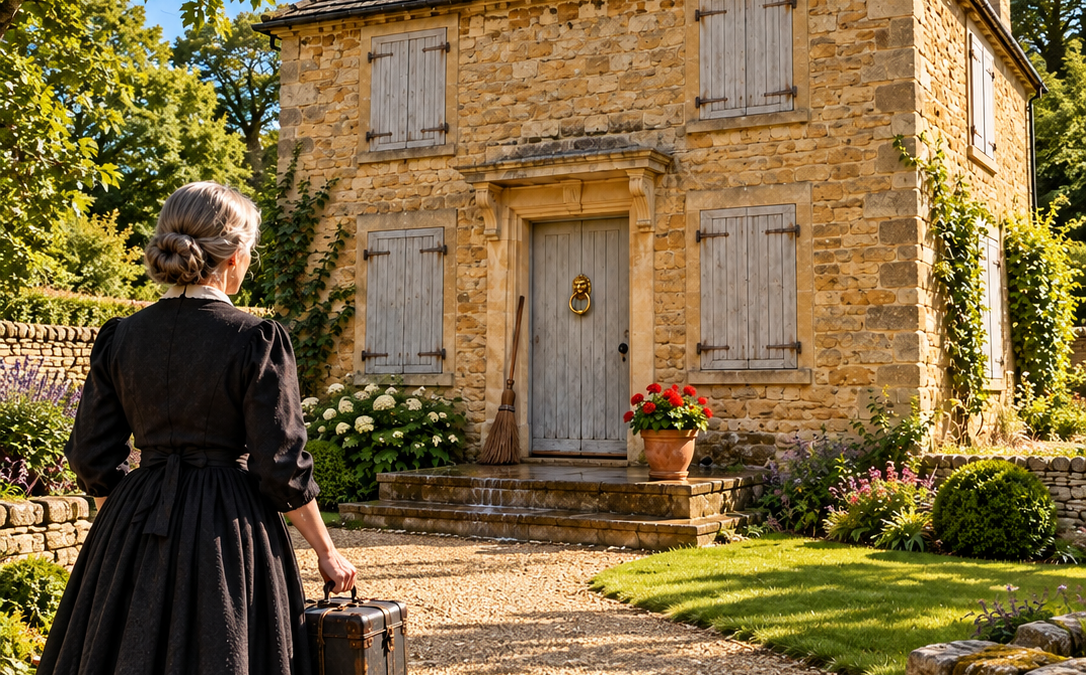
The Dower House stood alone in a square of lawn, built of warm honey-colored stone. Pale wooden shutters covered the windows. The front door had once been green, perhaps, but years had faded it toward the color of dry bone.
Edith stopped.
Not because the house looked abandoned.
Because it did not.
The grass had been cut.
Not recently enough to smell fresh, but recently enough that it had not gone to seed.
The brass knocker caught the morning light.
And the front step was wet.
Edith left the handcart in the gravel and walked closer.
Water darkened the stone from edge to edge. A thin stream still trickled down to the lower step and disappeared into the grass.
Across the wet surface ran the unmistakable marks of broom bristles.
Someone had swept it.
Not yesterday.
Not even an hour ago.
Minutes ago.
A birch broom leaned against the stone beside the doorway. Water still clung to its twigs.
Edith turned.
The lane behind her was empty.
The lawn was empty.
The shuttered windows gave nothing away.
Then she noticed a red geranium on the top step.
Its soil was dark from watering.
Behind the flowerpot, a piece of brown string hung from a nail driven into the stone.
A key dangled from it.
So did a luggage label.
Edith lifted the label between two fingers.
Two words had been written on it in a round, careful hand.
Mrs. Fenner.
She stopped breathing for a moment.
For forty years she had seen that handwriting on luncheon menus, lists of Christmas parcels, instructions for guest rooms, notes asking whether Mrs. Fenner might please send tea to the library.
Lady Phoebe’s hand.
There could be no mistake.
Edith had never married. Like many housekeepers, she had been called “Mrs.” as a courtesy from the day she took the position.
Most people wrote it because convention required it.
Lady Phoebe had always written it as though the title belonged to Edith.
As though it meant something.
Lady Phoebe had been buried nine days ago.
Yet her writing hung from a string on a freshly swept doorstep.
Edith took the key.
It entered the lock cleanly and turned without resistance.
Someone had oiled it.
She pushed open the door.
She expected the sourness of damp plaster and shut rooms.
Instead she smelled beeswax.
Wood smoke, very faint.
Lavender.
The flagstones were dry.
She left her trunk in the hall and stood still.
Housekeepers learned to listen to buildings.
A drip in a pipe.
A mouse behind wainscoting.
A chimney drawing badly.
Floorboards giving warning beneath a servant’s step.
A neglected house had its own language.
Lark End said nothing.
Edith opened the parlor shutters.
June sunlight fell across floorboards polished to the color of dark honey.
She touched the mantel.
No dust.
In the grate, a fire had been laid.
Twisted newspaper beneath dry kindling. Split logs above.
Ready for one match.
She went into the morning room.
Another laid fire.
Dining room.
The same.
Kitchen.
The black range shone. Copper pans hung bright along the wall.
Upstairs, white dust sheets covered the beds, but when Edith pressed her palm against a mattress, it was dry and smelled faintly of air and sunlight.
Someone had been turning these mattresses.
Someone had been opening these rooms.
Someone had been keeping the house alive.
Every grate was prepared.
Nothing was lit.
At the rear of the ground floor, down a narrow passage beyond the kitchen, Edith found the only thing in the house that did not welcome her.
A plain oak door.
A brass lock that looked newer than the door itself.
She tried the key from the geranium pot.
It did not fit.
She tried the few personal keys she still carried.
None worked.
Edith placed her palm against the oak.
Cool.
Then she touched the plaster beside it.
Warm.
She frowned.
The warmth was unmistakable.
Not hot. Not enough to suggest danger.
More like the side of a bread oven an hour after baking.
Yet there was no fire burning anywhere in the house.
Edith slowly removed her hand.
That evening she ate bread and cheese on the kitchen settle.
She could not bring herself to light one of the prepared fires.
It seemed oddly intrusive, as though the person who had laid it might return and find that Edith had interfered.
After supper, she opened her trunk.
At the bottom lay her father’s bow drill.
The pear-wood shaft fit inside her hand. Near its foot sat the little iron flywheel and diamond point. A bent cane bow was strung with cord darkened by decades of fingers.
Edith ran her thumb over it.
Her father had once told her that good repair work required patience enough to let the broken thing tell you what it needed.
Perhaps houses were the same.
That night Edith slept poorly.
At first light, she heard nothing.
She went downstairs in her stockings.
When she opened the front door, the step was wet again.
Swept.
The broom was gone.
For the next day she watched the lane.
No one came.
She walked into the village near evening and bought bread, salt, candles, and tea.
On the way back, the loaf was still warm beneath her arm and the western light lay across the fields.
The question that had followed her since arrival had become impossible to ignore.
Someone had aired her beds.
Someone had polished the brass.
Someone had laid the fires.
Someone had watered the geranium.
Someone possessed a label written by a dead woman.
And whoever it was came every morning before Edith woke, swept the step, and disappeared.
It was not charity from a stranger.
It had been arranged.
That night Edith did not go upstairs.
She wrapped a shawl around her shoulders and sat on a hard chair in the unlit hall.
Hours passed.
The black glass of the fanlight gradually softened to gray.
Then came the faint pearl light before sunrise.
Edith heard gravel shift outside.
A slow step.
Another.
The clink of a pail being set down.
Then water struck stone.
A pause.
And the broom began.
Swish.
Swish.
Swish.
The most ordinary sound in the world.
Edith rose, drew back the bolt, and opened the door.
An old man stood bent over the step.
His white hair was flattened with dew. His shirtsleeves were rolled to the elbows. A birch broom moved between his thin, knotted hands.
He froze.
Then straightened carefully, vertebra by vertebra.
Edith recognized him.
The pensioner from the end of the servants’ table.
Wilfred Barlow.
Eighty years old.
Once an undergardener at Vessie Court.
A quiet man who, long before his pension, had occasionally left sweet peas on the stillroom windowsill in summer without ever admitting they were from him.
He now held the broom against his chest like stolen property.
Edith gripped the doorframe.
“Mr. Barlow.”
“Mrs. Fenner.”
“You’ve been doing this?”
Wilfred glanced down at the wet step.
“Yes.”
“Since I came?”
A small shake of his head.
“No.”
Edith waited.
Wilfred looked toward the lane, perhaps considering escape.
“Every morning,” he finally said.
“For how long?”
He swallowed.
“Since Her Ladyship shut the house.”
Edith stared at him.
“That was twenty years ago.”
“Yes.”
“Who told you to?”
Wilfred looked genuinely puzzled by the question.
“Her Ladyship.”
The world seemed suddenly very quiet.
Edith stepped aside.
“You’d better come in.”
She made tea.
Not servant’s tea.
Not estate tea.
Tea in her own kitchen, drawn from her own pump, on the range of the house Lady Phoebe had left her.
Wilfred sat at the scrubbed table with his cap on one knee.
For a while he only drank.
Then, piece by piece, he told her.
Twenty years earlier, when Lady Phoebe’s husband had been alive, the Vessie finances had become dangerously bad.
Creditors circled the estate.
Men came asking questions about furniture, paintings, silver, horses.
Lady Phoebe went one winter night to Wilfred’s cottage alone, her cloak pulled over her head.
“She asked me to keep this place,” Wilfred said.
“Keep it how?”
“Dry. Sound. Quiet.”
He had lit the kitchen range through every winter.
A modest fire.
Enough that the warmth passed through the inner walls and kept damp from settling into the back rooms.
He aired the beds.
Waxed floors.
Trimmed grass.
Swept the front step every morning.
The sweeping had been Lady Phoebe’s idea.
“Why every morning?”
“She said if anybody noticed, they’d think it was an old gardener’s habit.”
Edith looked toward the passage.
The warm wall.
The locked door.
Lady Phoebe had paid Wilfred from her private purse, not through the estate accounts.
No ledgers.
No questions.
“At first,” Wilfred continued, “she told me it was for what was in the back room.”
Edith’s fingers tightened around her cup.
“And later?”
Wilfred looked at her.
“These last years, she said it was for you.”
Edith put the cup down before she dropped it.
“For me?”
“She knew her son.”
There was no anger in Wilfred’s voice.
That made the words sharper.
“She knew he’d marry. Knew his wife would bring her own woman. Said sooner or later you’d be sent off with a character and a trunk and nowhere that belonged to you.”
Edith stared at the table.
Lady Phoebe had known.
She had seen the dismissal coming before Edith herself had allowed the possibility.
“So she made somewhere,” Wilfred said.
From his waistcoat pocket he removed a small brass key.
It was tied with brown string.
A luggage label hung from it.
Lady Phoebe’s careful handwriting covered the card.
For Mrs. Fenner’s hand only.
Wilfred laid it on the table.
“I’ve never used it.”
Edith touched the key.
Warm from his pocket.
“She told you not to?”
“Never open the door. Keep the room dry from the other side of the wall. Give you the key when you came.”
“When,” Edith repeated.
Not if.
When.
Wilfred nodded.
Something inside Edith, held rigid since the funeral, gave way.
The tears came without warning.
She turned her face aside.
It was not the loss of her keys.
Not the servants watching her leave.
Not even the Viscount’s laughter.
She wept for the woman who had known all of it would happen and had quietly prepared an answer twenty years before anyone else thought there was a question.
Wilfred looked out the window while she cried.
He did not offer advice.
He did not tell her not to upset herself.
He finished his tea and let her have her grief in peace.
It was the kindest thing anyone had done for her since Lady Phoebe died.
Edith did not open the locked room that day.
Instead she heated water.
Scalded an old wooden washing tub.
Found soft brushes.
Cut lengths of clean flannel.
She arranged everything on the kitchen table exactly as her father once arranged his tools before examining a damaged piece.
Only then did she go into the parlor.
She struck a match.
For the first time, she lit one of the fires Wilfred had laid for her.
Kindling caught.
A thin thread of smoke rose into the chimney.
The logs began to crackle.
Edith stood in front of the hearth, warming her hands.
Not Lady Phoebe’s house now.
Not the Viscount’s.
Hers.
And tomorrow, she would open the door.
Part 2
Wilfred arrived at dawn with his broom.
This time Edith was waiting on the step.
She had two cups of tea.
He looked embarrassed by the second.
“You needn’t trouble, Mrs. Fenner.”
“You have swept my step for twenty years.”
“Not your step all twenty.”
“It seems unwise to argue with the woman supplying the tea.”
Wilfred sat.
They drank while the sun came over the hawthorn.
Afterward, Edith placed the brass key in her apron pocket and walked down the passage.
Wilfred did not follow.
Lady Phoebe had been precise.
Mrs. Fenner’s hand only.
The key entered the new lock.
The mechanism resisted at first, then turned with a hard little click.
Edith pushed.
Warm, dry air moved past her face.
The smell came first.
Straw.
Paper.
Old wood.
Something clean and mineral beneath it.
The room was long and low, built against the kitchen wall. One small window sat high beneath the ceiling, covered by a shutter.
Edith opened it.
Morning light entered.
She turned.
Tea chests filled the room.
Dozens.
They stood against the walls and in careful rows down the center, stacked two and sometimes three high.
Straw showed at a few seams.
The timber was dry.
Not one chest carried a damp stain.
Edith touched the wall shared with the kitchen.
Warm from end to end.
Twenty winters of rain and frost had passed around this room while Wilfred’s fires guarded what lay inside.
Every chest had a luggage label nailed to its lid.
Every label was written in Lady Phoebe’s hand.
Dinner plates.
Soup plates.
Tureens.
Sauce boats.
Cups, pair and pair.
Dessert.
Flowered ice cups—12. Handle with care.
Then, on one:
For Mrs. Fenner.
Edith walked between the rows, fingertips brushing the labels.
At the far end sat a smaller chest tied with tape.
A folded letter was pinned to it.
On the outside:
Edith, read this first.
She sat on the nearest chest.
For a moment she could not make her fingers unfold the paper.
Then she began.
“My dear Edith,
“If you are reading this, I am dead, and my son has done exactly what I told Wilfred he would do.”
Edith stopped.
Lady Phoebe’s voice seemed to inhabit the room.
She continued.
When Lord Vessie’s creditors had come years ago, Lady Phoebe wrote, the possession they most wanted was her mother’s French china.
It had come to Lady Phoebe on her marriage.
It was hers.
Not her husband’s.
Rather than risk its loss, she allowed the county to believe it had been sold.
At night, quietly, the entire service was carried to Lark End.
Wilfred was paid to keep the house dry.
Then came the lines Edith would remember for the rest of her life.
“A house kept for someone is a house that is waiting.
“There has only ever been one person I would trust to put her hands on it.
“You kept my house for forty years.
“Now let someone keep one for you.
“It is yours. All of it.
“And so is the house.
“Wash it gently.
“Your friend,
“Phoebe Vessie.”
Edith read the letter twice.
Then a third time.
Not mistress.
Friend.
She pressed the paper to her chest.
For forty years she had believed she understood her position exactly.
Lady and servant.
Employer and housekeeper.
Two women living under one roof but separated by rank, money, expectation, and all the invisible architecture of their world.
Lady Phoebe had understood those boundaries too.
She had simply decided that gratitude could cross them.
Edith opened the small chest.
First came straw.
Then tissue.
Then the curved edge of a plate.
She slid both hands beneath it.
The weight surprised her.
Fine.
Light.
Her father used to say the best French soft-paste porcelain felt warm as skin and weighed less than the eye expected.
Edith raised the plate into the light.
The rim was blue.
Not an ordinary blue.
A deep, luminous blue that seemed to hold light rather than reflect it.
Gold ornament lay inside the border, delicate as lace.
In the white center, painted flowers spread across the surface—a half-open pink rose, blue cornflowers, tiny white blossoms and veined green leaves.
Edith turned it over.
Two interlaced letters appeared in blue on the underside.
She knew the mark.
She had seen it only once as a girl, on a broken saucer in her father’s pack.
The royal works at Sèvres.
Porcelain made outside Paris for courts and kings.
Edith’s hands began to tremble.
There was no chip.
No discoloration.
No wear to the gold.
No knife scratch.
The plate looked as though it had left the kiln and gone directly into its wrapping.
Apparently, that was nearly what had happened.
A complete service, packed away and protected across generations, hidden from creditors and forgotten by the family that believed it gone.
Except Lady Phoebe had not forgotten.
And now it belonged to Edith.
The estate agent’s letter came during Edith’s second week at Lark End.
A stable lad from Vessie Court carried it up the lane.
He stopped at the gate.
Would not step farther.
Edith wondered whether the Viscount had instructed him not to or whether the boy simply understood that this was no longer court property.
The letter was short.
Polite.
His Lordship wished to close the late Lady Vessie’s affairs.
Would Mrs. Fenner kindly confirm that she had found no French china at Lark End, so that the matter might be considered settled?
Edith read the sentence twice while standing on Wilfred’s freshly swept step.
She imagined the servants’ hall.
The laughter.
Sold years ago.
Nothing left in it to keep.
She took the letter to the parlor.
At the writing desk she uncapped the ink, dipped her pen, and wrote one sentence beneath the agent’s signature.
I have found it.
She blotted the ink.
Folded the paper.
Sealed it.
The stable lad was still waiting at the gate.
“Will there be an answer, Mrs. Fenner?”
“That is the answer.”
She placed it in his hand.
She heard nothing from Vessie Court for the rest of the summer.
That suited her.
She had work.
Each morning began the same way.
Wilfred swept.
Edith poured tea.
Then she opened one chest.
Only one.
She did not hurry.
A housekeeper who had spent forty years accounting for linen, silver, glasses, serving dishes, pantry stores and cellar bottles did not suddenly become careless because the objects before her were worth more than anything she had previously handled.
She lifted each piece from straw.
Washed it in water no warmer than her wrist.
Dried it by hand.
Held it against the window.
Examined the glaze.
Her father’s lessons returned not as memories but as movements.
Turn slowly.
Never grip a handle if the body can be supported instead.
Watch for the dark hairline that means a crack.
The pieces emerged one by one.
Dinner plates with different sprays of flowers.
Dessert plates crowded with roses, tulips, cornflowers and honeysuckle.
Covered cups for custard and cream.
Tureens with domed lids.
Sauce boats.
Tall ice pails.
Tiny flower knobs no larger than Edith’s fingertip.
By the end of July, every safe surface in the kitchen and scullery held blue, white, gold and painted blossoms.
It looked as though a garden had grown indoors.
Edith counted.
Then counted again.
Near two hundred pieces.
All had survived darkness, transport, straw, winters and secrecy.
All except three.
Three dinner plates, packed near the bottom of one chest, had hairline cracks beginning at the rim.
No missing fragments.
No chips.
But Edith knew what a crack meant.
A plate waiting to become two plates.
She brought her father’s bow drill from the trunk.
Wilfred sat at the far end of the table.
“You mean to mend those?”
“I mean to stop them breaking.”
She folded a cloth and placed the first plate facedown.
Marked tiny points with whiting.
Placed the diamond tip.
Set the wooden cap against her palm.
Then drew the bow.
The drill began to sing.
The sound was thin and patient.
Edith had not heard it in more than thirty years.
Back and forth.
Back and forth.
The diamond bit entered the porcelain by fractions.
Her father had hummed when he worked.
Usually the same three or four notes, never enough to form a proper tune.
For a moment Edith was not sixty-one in a house unexpectedly her own.
She was a girl again, leaning over a kitchen table while her father said, “Easy, Edie. China remembers rough hands.”
Her eyes burned.
The bow kept moving.
When the drilling was finished, Edith bent short pieces of brass wire into tiny staples.
She warmed the plate near the range, fitted the staples across the crack, and secured the holes with the old mixture she remembered.
When she turned the plate faceup, the painted rose remained where it had always been.
The crack was visible to anyone who knew where to look.
But it would not travel.
The plate would hold.
Wilfred exhaled.
“I remember that sound.”
Edith glanced at him.
“Do you?”
“Your father. Came to the court once. Mended a punch bowl on the kitchen step.”
Edith smiled faintly.
“He did.”
“You with him?”
“I held the bow.”
Wilfred nodded toward the repaired plate.
“Seems you still do.”
She repaired the other two that week.
Late August brought heat.
For two days the air became so still that even the curtains seemed heavy.
The third night, Edith sat beside the kitchen range while candle flames burned straight upward without a flicker.
Far to the west came a low roll of thunder.
Then another.
The wind arrived all at once.
Hawthorn branches struck the windows.
Rain hit the glass hard enough to sound like gravel.
By midnight the storm stood directly over Lark End.
Edith remained awake.
She had spent too many years responsible for old roofs to sleep through weather like that.
Then, beneath the rain, she heard it.
Drip.
Pause.
Drip.
She took the lamp and hurried down the passage.
Water was entering the china room.
A dark stain spread across the ceiling.
A roof slate had shifted.
Rainwater gathered in the plaster and fell directly toward the remaining chests.
Edith set down the lamp.
She moved the first chest herself.
Heavy.
Too heavy.
The back door opened.
Wilfred stumbled inside, soaked through, holding his coat over his head.
“Saw your lamp.”
“The roof.”
He looked once down the passage.
Then removed his coat.
They said nothing else.
Each took an end of a chest.
Kitchen.
Back again.
Another.
Kitchen.
Back again.
Thunder shook the windows.
Water widened across the china-room ceiling.
Their shoes slipped on the floorboards.
Wilfred was eighty and breathing hard, but he refused to stop.
They had moved perhaps half the chests when someone pounded on the front door.
Edith froze with both hands beneath a crate.
The knock came again.
Harder.
“Leave it,” she told Wilfred.
She took the lamp and went to the hall.
A stout man of about fifty-five stood outside in the lightning.
Water streamed from his traveling coat. His hat had collapsed around his ears.
Behind him, a hired fly leaned badly in the lane, one wheel in a ditch while the driver struggled beside it.
“Beg pardon, madam,” the stranger said. “Wheel’s gone. We saw your light.”
Edith looked at him.
Then down the passage toward Wilfred and twenty years of Lady Phoebe’s planning sitting beneath a leaking roof.
“Come in,” she said.
The man stepped forward gratefully.
Edith handed him the lamp.
“You can help me carry.”
He blinked.
Then looked toward the passage.
“Yes, madam.”
His name was Mr. Cyril Dunn.
He had been visiting the porcelain works at Coalport and was traveling toward Shrewsbury to catch the London train.
None of that mattered yet.
What mattered was that he had strong hands.
The driver came in too.
Four people could move the chests far faster than two.
By the time the thunder rolled eastward toward morning, every chest stood safely in the kitchen against the warm wall.
Not one piece had been damaged.
Edith put the kettle on.
Wilfred sagged into a chair.
The driver fell asleep near the back door.
Mr. Dunn sat on the settle, soaked and steaming.
Then he looked across the kitchen.
The three repaired plates stood on the dresser among their untouched sisters.
Mr. Dunn stopped moving.
He rose.
Walked toward them.
Did not touch.
His whole expression changed.
“May I?”
Edith nodded.
He lifted one plate.
Turned it over.
Saw the mark.
His face became very serious.
Then he noticed the brass staples on one of the repaired plates.
He looked from them to Edith.
“You did this?”
“My father taught me.”
Mr. Dunn placed the plate down using both hands.
“Mrs. Fenner,” he said quietly, “may I ask where these came from?”
And for the first time since Edith opened the locked room, someone who understood exactly what she possessed had walked through her door.
Part 3
Mr. Dunn did not leave when the rain stopped.
His carriage wheel required repair, and the driver went to find help after breakfast.
That gave Mr. Dunn most of a day at Lark End.
He used it carefully.
He did not behave like the Viscount.
He did not laugh.
He did not begin with questions about value.
He asked permission before touching anything.
Edith showed him Lady Phoebe’s letter.
He read it standing beside the kitchen window.
When he reached the final lines—You kept my house for forty years. Now let someone keep one for you—he looked toward Edith and then returned to the page.
He visited the empty storage room.
Touched the warm wall.
Examined the labels.
Studied plate after plate.
Eventually he explained that he had spent thirty years working among porcelain associated with the British Museum.
Edith had already guessed he was no ordinary traveler.
There was a manner certain people had around exceptional objects.
Not greed.
Attention.
The same attention her father had given a cracked bowl before deciding where to place the drill.
Mr. Dunn possessed it.
Before his repaired carriage left the following afternoon, he stood with Edith on the front step.
“Would you permit the service to be seen?”
Edith frowned.
“Taken away?”
“No. Not yet. Certainly not without your wishes. I mean seen here.”
“By whom?”
“People who understand what it is. People who ought to know it survived.”
Edith looked through the open doorway.
For twenty years the porcelain had survived because Lady Phoebe kept it hidden.
Opening the house felt almost contrary to the plan.
Then she thought of the letter.
It is yours.
All of it.
The decision was no longer Lady Phoebe’s to make.
It was Edith’s.
“Here,” she said.
Mr. Dunn waited.
“If it is shown, it is shown here.”
His face relaxed.
“Of course.”
“Nothing leaves without me.”
“Agreed.”
“And no one handles a piece unless I permit it.”
Mr. Dunn almost smiled.
“Mrs. Fenner, I would not dream of arguing.”
Word traveled.
A secret that had survived twenty years spread across the parish in weeks.
By September, everyone seemed to know that Lark End would open its doors for one day.
Edith prepared the house as she had prepared Vessie Court for great occasions.
The difference was that no one stood over her.
No bell summoned her.
No visiting family occupied the rooms.
No one asked whether the silver had been counted.
She decided where every object would stand.
The long dining table was extended.
Clean linen covered it.
Porcelain ran from one end to the other.
Plates.
Tureens.
Cups.
Sauce boats.
Dessert pieces.
The dresser held more.
The sideboard more still.
Blue, white, gold and painted flowers caught the September sunlight.
The three repaired plates stood among the others.
Edith considered hiding them.
Mr. Dunn noticed her looking.
“You could put those elsewhere,” he said.
“They belong to the service.”
“Yes.”
“Then they stay.”
Wilfred swept the front step at dawn.
Edith had stopped telling him not to.
Instead she brought his tea.
By ten o’clock the first visitors appeared.
The rector and his wife.
Two local squires with their ladies.
The doctor.
Tenant farmers from Vessie lands.
Old people who remembered Lady Phoebe when she first came to the county.
Some arrived in gigs.
Some on foot.
They crossed the step Wilfred had kept clean for twenty years.
Inside, Lark End smelled of beeswax, tea and wood smoke.
Visitors talked in low voices until they reached the dining-room doorway.
Then most stopped.
Edith had seen grand tables laid with silver and crystal.
She had managed dinners for thirty.
She had watched guests admire flowers, centerpieces and imported wines.
Nothing compared to this.
Nearly two hundred pieces of porcelain transformed the room.
It did not look like a collection.
It looked alive.
A garden arranged across linen.
No two painted flowers quite the same.
Mr. Dunn stood near the head of the table, answering questions when Edith wished him to and sending people to Edith when the question concerned the history of the house.
Late in the morning, carriage wheels sounded outside.
Conversation shifted.
The Viscount had come.
His agent sat beside him.
Edith saw the carriage through the window.
She did not move.
The Viscount entered Lark End for the first time in Edith’s memory.
Perhaps he had been there as a child.
If so, he showed no recognition.
He brought with him the same faintly amused expression he had worn while reading his mother’s will.
Edith understood immediately why he had come.
He expected exaggeration.
A few old plates.
Perhaps a sentimental gathering built around his mother’s eccentricity.
Something he could witness, tolerate, and later dismiss.
He reached the dining-room doorway.
The smile disappeared.
His gaze traveled down the table.
Blue.
Gold.
Flowers.
Piece after piece.
He looked toward the dresser.
Then the sideboard.
Then back at the table.
His agent remained half a step behind him.
Mr. Dunn was standing at the head of the room.
He looked not at the Viscount, but at Edith.
“Mrs. Fenner.”
His voice carried.
Every conversation stopped.
Edith stood near the foot of the table in her plain black dress.
“Do you have any idea what you have kept?”
Edith placed one hand lightly against the back of a chair.
She could have answered.
She chose not to.
Mr. Dunn turned to the guests.
“This is a service entire. Preserved essentially as it left the royal factory and, so far as I can determine, never once used for formal dining.”
Someone near the wall drew in a breath.
Mr. Dunn continued.
“I have seen major collections in London and Paris. I know of nothing comparable in England in this condition and completeness.”
He paused.
“There are kings who dine from less.”
No applause followed.
Not yet.
People simply looked.
Then the rector stepped forward.
He had known Lady Phoebe for three decades.
He had also witnessed her will.
From inside his coat he removed a folded copy.
“I believe,” he said, “there is one sentence relevant to the occasion.”
The Viscount’s face changed.
The rector unfolded the paper.
“To my housekeeper, Edith Fenner, my French china, wherever it may be found.”
He folded it again.
Every person in the dining room turned toward the doorway.
The Viscount stood with his gloves in one hand.
Three months earlier, he had laughed at a sixty-one-year-old servant across a table.
Sold long ago.
Nothing left in it to keep.
Now he stood inside the house he had dismissed, surrounded by the county, facing the woman he had turned out.
His mother had known him well enough to predict the exact shape of Edith’s dismissal.
And had planned beyond him.
The Viscount looked at the service.
Then at Edith.
His mouth opened.
No words came.
For years afterward, people would speculate about what he intended to say.
That he disputed the gift.
That he meant to congratulate her.
That he wanted to ask whether she would sell.
That he had suddenly remembered something his mother once said.
Edith never cared which.
He closed his mouth.
Turned.
Walked through the hall.
Crossed the swept step.
Entered his carriage.
The driver had already started down the lane when his agent hurried outside and had to run several yards to catch it.
Inside the dining room, no one spoke for a few seconds.
Then someone near the back clapped once.
A quiet sound.
The rector’s wife joined.
Another person.
Then another.
Soon the room filled with applause.
Edith did not bow.
She did not smile triumphantly.
She rested her palm on the table.
For forty years, after a great dinner at Vessie Court, she had sometimes placed her hand against the locked china cupboard and counted the evening’s success in what had not happened.
No plate broken.
No glass chipped.
No silver lost.
No servant injured.
Everything returned safely to its place.
Now the same sense of completion came over her.
Not revenge.
Order.
Something wrongly measured had been measured again.
The Viscount had believed Edith’s life could be reduced to the keys she surrendered.
Lady Phoebe had known better.
The following spring, the service traveled to London.
Not for sale.
Edith refused that from the beginning.
She had lived her entire life watching valuable things leave one set of hands and enter another.
She had no desire to turn Lady Phoebe’s trust into a number written on a banker’s paper.
Mr. Dunn arranged for the porcelain to be exhibited on loan.
Under Edith Fenner’s name.
He saw personally that it was recorded that way.
Edith packed the service herself.
New chests.
Dry straw.
Soft paper between every piece.
She worked methodically while Mr. Dunn’s men stood by and followed her instructions.
When one young assistant reached for a cup by its handle, Edith said, “No.”
The man stopped.
“Support the body.”
“Yes, Mrs. Fenner.”
“Handles are invitations to accidents.”
Mr. Dunn, standing nearby, hid a smile.
Edith kept twelve plates at Lark End.
Among them were the three she had repaired.
Someone once suggested the riveted plates might be less suitable for display.
That was precisely why Edith wanted them.
Perfect things told one story.
Repaired things told another.
On Sundays she used one at dinner.
The first time, Wilfred nearly protested.
“Mrs. Fenner, that’s—”
“A plate.”
“Yes, but—”
“Made to be eaten from.”
He considered this.
“Suppose it breaks?”
Edith looked at the little brass staples beneath the rim.
“Then I know someone who can mend it.”
Wilfred laughed.
A rare sound.
Life at Lark End became quieter after that.
Not empty.
Quiet.
There was a distinction Edith had not understood while living at Vessie Court.
For forty years, silence had usually meant waiting for the next bell.
At Lark End, silence meant no one required anything from her.
If she lit the parlor fire, it was because she was cold.
If she left it unlit, no guest complained.
She opened the shutters when she pleased.
Closed them when weather came in.
Planted herbs beside the kitchen.
Moved a chair because she disliked where someone else had placed it twenty years before.
Small freedoms.
Ridiculous freedoms.
Precious freedoms.
She had spent most of her adult life ensuring that other people’s preferences were carried out invisibly.
Only at sixty-one did she discover the pleasure of having preferences of her own.
The parlor mantel held two objects.
Her father’s bow drill.
And the brown luggage label Lady Phoebe had tied to the first key.
Mrs. Fenner.
Sometimes Edith sat by the fire and looked at them together.
One came from the man who had taught her how to mend what was cracked.
The other came from the woman who had ensured Edith would have somewhere to live when her old life broke apart.
Perhaps that was why Edith kept the repaired plates close.
She no longer believed a crack made something worthless.
A crack only meant care was required.
Wilfred continued sweeping the front step.
Every morning.
Rain.
Mist.
Cold.
Sun.
At eighty he had earned the right to stop.
Edith told him so repeatedly.
“You have done it long enough.”
“Yes, Mrs. Fenner.”
“You could sleep until seven.”
“Yes.”
“You could sit by your own fire.”
“Yes.”
“You are not employed here.”
“No.”
The following morning, swish.
Swish.
Swish.
Eventually Edith gave up arguing.
Instead she woke early enough to put the kettle on.
By the time the step was washed and swept, Wilfred’s cup was waiting.
Some mornings they sat without speaking.
They had no need to fill the silence.
Years later, county ladies still occasionally visited Lark End and asked Edith about the September morning when the Viscount stood in her dining room and walked away without a word.
They hoped, perhaps, for a sharper story.
A humiliation.
A clever remark.
A servant finally delivering the line she had stored for forty years.
Edith never gave them one.
She turned her teacup between her hands.
“He turned me out of the house I had kept for forty years,” she would say.
The visitor would lean closer.
Edith would glance toward the front window, where dawn light sometimes still caught moisture on the swept stone.
“He never asked who was keeping mine.”
That was all.
She had been sixty-one when she left Vessie Court with a tin trunk roped to a borrowed handcart.
No keys on her belt.
No husband.
No children.
No position.
No idea what the next month of her life would look like.
She had thought she was walking toward the remains of whatever the Viscount no longer wanted.
Instead, she found a wet doorstep.
A watered geranium.
A key in a dead woman’s handwriting.
A fire laid but not lit.
A warm wall.
An old gardener carrying twenty years of loyalty in his waistcoat pocket.
And behind one locked door, a room full of proof that someone had thought about Edith’s future long before Edith believed she had one.
The porcelain was extraordinary.
People came from London to say so.
Experts studied it.
Visitors admired the blue and gold, the painted flowers, the untouched surfaces.
But in the end, that was not the inheritance Edith valued most.
The greater gift was quieter.
For forty years she had kept a house for someone else.
And without telling her, someone had kept one for her.
Lark End waited through twenty winters.
It waited through debt, funerals, marriages, changes of servants and changes of title.
Wilfred lit the range.
Aired the beds.
Cut the grass.
Polished the knocker.
Swept the step.
Every morning.
Waiting for a woman who did not know she was expected.
Edith Fenner was sixty-one when she pushed her handcart down that lane into what she believed was the small remainder of her life.
It turned out to be a long life.
And a good one.
And whenever she remembered where it truly began, she did not think first of the Viscount’s laughter, or even of the locked room filled with royal porcelain.
She thought of the first morning.
Sun rising over wet hawthorn.
A shuttered house of honey-colored stone.
A red geranium freshly watered.
And a doorstep still dark with water because someone had reached it before dawn and made it ready for her.
You Might Also Enjoy

The Auctioneer Sold Her the Wrong Townhome By Mistake—Its Key Opened Every Door in the City

Homeless at 19, Chloe Inherited a Dying Dairy Farm—Then Found a Locked Bunker Under the Silo

She Bought an Injured Horse Nobody Wanted — Then He Led Her to Her Father’s Hidden Canyon

The Duke Gave Her a Ruined Estate to Be Rid of Her — She Made It the Finest in the County